Episode 869: The man who walks in the day

In October 1897, the hypocritical Rev’d Mr Gregory Trask is married to the vastly wealthy Judith Collins, owner of the estate of Collinwood and of the Collins family businesses. For more than thirteen weeks, everything seemed to be going Trask’s way. He had gaslighted Judith into a mental hospital and had almost free rein over all of her assets. In her absence, he invited the lovely and mysterious Amanda Harris to stay in the great house on the estate, and set out to seduce her.

Piece by piece, Trask’s little corner of paradise fell apart. First, 150 year old sorcerer Count Petofi orchestrated a series of events that led Trask to sign a confession to the murder of his first wife, and no matter how many times he destroyed the confession new copies of it kept materializing. Then Petofi erased the personality of Trask’s daughter and enforcer Charity, replacing it with that of late Cockney showgirl/ mentalist Pansy Faye. Later, Amanda fell in love with Judith’s brother Quentin, told Trask off, and wound up leaving for New York by herself. Now, Judith has returned from the mental hospital, all sane and deeply suspicious.

The front door of the great house is Trask’s enemy today. No sooner does he enter it than he finds Pansy in the foyer, singing her song. He demands she stop and tells her he is her father. She laughs at this claim, and reminisces about the late Bertie Faye. Trask goes into the drawing room, and to his horror sees a large oil painting of Amanda on an easel. We saw Pansy setting it up earlier in the episode, and saw her buy it a few days ago. But Trask didn’t see those things, and when she tells him she doesn’t know anything about it, he seems to accept her denials. She exits upstairs.

The front door opens again, and Judith’s brother Edward enters with two other men. One appears to be Quentin, but is in fact Petofi in possession of Quentin’s body. The other appears to be time-traveling vampire Barnabas Collins.

Trask and Edward both believe that Petofi is Quentin; since he is played by David Selby, I call him Q-Petofi. The man who appears to be Barnabas is very weak. He says that his name is indeed Barnabas Collins, but that he is not the vampire. He claims to have arrived from England, to have been attacked by a vampire who looked just like him, and to have little memory of what happened after.

In #845, Pansy went into a cave and found a coffin containing what appeared to be Barnabas. She drove a stake through his heart. When Edward and Q-Petofi met this weak Barnabas yesterday in the doctor’s office, they were skeptical of his story. They took him to the cave, opened the coffin, and saw the body Pansy had staked inside, the stake still lodged in its heart. Since they could see the two of them side by side, Edward could only conclude that the weak man is different from the vampire, and that his story is therefore true. Q-Petofi, well aware of the many magical and science-fictional entities in Barnabas’ orbit, is not at all convinced.

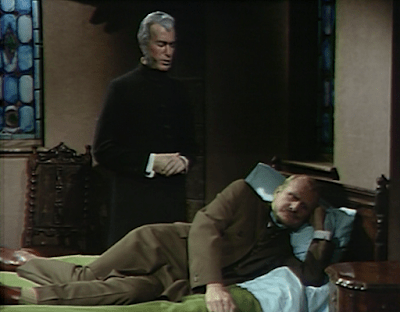
Trask sees the weak Barnabas and is enraged that Edward and Q-Petofi have brought the vampire back from the dead. While Q-Petofi takes the weak Barnabas upstairs to a bedroom, Edward tries to reason with Trask. This is seldom a fruitful exercise. When Edward finally points out that it is broad daylight and the weak Barnabas is alive and moving, Trask is left speechless.

Alone with the weak Barnabas, Q-Petofi tries to trick him into believing that he is Quentin and that he can trust him. When Q-Petofi goes on about all the secrets that Barnabas and Quentin have shared, the weak Barnabas responds only with bewilderment.

Q-Petofi goes back to the cave and sets the coffin on fire, acting on the hypothesis that the destruction of the staked Barnabas will have some kind of effect on the weak Barnabas. We cut back to Collinwood and see that it has none. Trask lets himself into the bedroom. After some small talk, he thrusts a large wooden cross at the weak Barnabas’ face and stands silently for a moment. The weak Barnabas looks up from his bed and asks if Trask is all right. He hurriedly says that he only brought the cross to help him pray for his recovery. The weak Barnabas observes that this is very kind, and closes his eyes while Trask kneels beside the bed.

My wife, Mrs Acilius, points out that not only the actor Jerry Lacy, but the character Gregory Trask, seems to enjoy himself very much when there is something to be righteously indignant about. Not only does Trask have a whole set of self-aggrandizing mannerisms and techniques for silencing everyone else when he is furious, but as a con man an atmosphere of crisis provides him with an opportunity to think on his feet and devise new schemes for bilking people out of whatever they have that he wants. Mr Lacy’s joy in performance runs throughout the whole episode, but Trask’s goes through wild fluctuations, peaking each time he thinks he has found a new way to present himself as the champion of The Almighty and plummeting each time his understanding of the situation is deflated. In his first several appearances, Trask was so overwhelmingly evil and so frequently successful that he was hard to watch. When we see him repeatedly brought up short in an episode like this, all of the discomfort of those early days pays off.

In the drawing room, Edward tells Pansy that there is a sick man in a bed upstairs who looks like the vampire Barnabas and is named Barnabas Collins, but is not the man she staked. She is horrified at the thought. Barnabas was indirectly responsible for the death of Pansy as a physical being, and later murdered her fiancé, the childlike Carl Collins. He also took Charity as one of his victims for a time. Besides, in her manner of dress, quantity of makeup, working-class accent, and brashly friendly manner Pansy is the representative of all the “girls at the docks” upon whom Barnabas has fed down the centuries. So no one has more reason to fear Barnabas than does Pansy in the form of Charity. Edward reassures her as best he can, then goes up to look in on the patient.

Pansy absorbs the news that another Barnabas Collins is in the house.

The scene between Pansy and Edward will remind longtime viewers of the characters the same actors played between November 1967 and
March 1968, when Dark Shadows was set in the 1790s. Nancy Barrett was fluttery heiress Millicent Collins, while Louis Edmonds was haughty overlord Joshua Collins. In #450, Millicent had discovered the horrible truth about Barnabas and it had proven to be too much for her rather fragile grip on sanity. She decided that the vampire was not her cousin, but an impostor, and she told Joshua that it was wrong of him to have “That man who says he is Barnabas” in the house.

Not only is Pansy’s horror at the thought of a man who says that he is Barnabas staying at Collinwood reminiscent of Millicent, but her relationship to Charity also reflects the development of Millicent throughout the 1790s segment. Millicent’s transformation from a lighter-than-air comedy character to a darkly mad victim, first of her wicked husband Nathan, then of Barnabas, marked the transition to the climactic phase of the 1790s segment. Charity’s replacement by Pansy in #819 came at a time when the show was flashing many signals that the 1897 segment was nearing its end. Those signals may well have reflected an earlier plan, but 1897 was such a hit that they kept passing by the off-ramps back to the 1960s and restarting the uncertain and frightening journey into the past. Now it seems they really are getting ready to move on, and Pansy’s prominence reminds us of just how radically different a place Collinwood is now than it was when we arrived in this period in #701, at the beginning of March.

Pansy is still quaking at the thought of another Barnabas Collins when Q-Petofi enters and closes the doors of the drawing room behind him. Pansy hasn’t quite figured out his true identity, but she knows that he is not really Quentin, and that he does not mean her well. She is terrified and says she will scream unless he opens the doors.

Regular viewers have reason to believe Pansy will do more than scream. In #829, she tried to stab Quentin. And those who have been with the show for a long time will remember what happened in #204, broadcast and set in April 1967. Heiress Carolyn Collins Stoddard, another Nancy Barrett character, found herself in the drawing room with dangerously unstable ruffian Willie Loomis. When Willie closed the doors and refused to open them, Carolyn didn’t bother screaming- she pulled a loaded gun on him.

Q-Petofi has magical powers that neither Quentin nor Willie could match, so he is not in mortal jeopardy as they would be were they to put themselves in his position. But he has created a volatile situation, and unless he resolves it within a few seconds he is likely to find himself with a huge mess on his hands. Rather than falling back on his occult talents, Q-Petofi takes a page from Quentin’s book and charms Pansy into cooperating. He tells her that he is as frightened of Barnabas as she is. That intrigues her sufficiently that she starts listening to him. He tells her that only she can discern whether the man in the sick bed upstairs is what he claims to be. A moment later, Q-Petofi has persuaded Pansy to go with him to see the weak Barnabas. The episode ends with Pansy looking at the weak Barnabas lying in bed, her eyes widening in a strong but unspecified reaction. We will have to wait until tomorrow to find out whether she is terrified at the sight of her nemesis or amazed to see an innocent man wearing the hated face.
Episode 833: We don’t have any secrets in Collinwood

There once was a woman named Miss Charity Trask. Charity was desperate to please her father, the hypocritical and overwhelmingly evil Rev’d Mr Gregory Trask. She faced the world as Trask’s enforcer, and was herself so fiercely repressed that she drained the joy out of every group she joined.

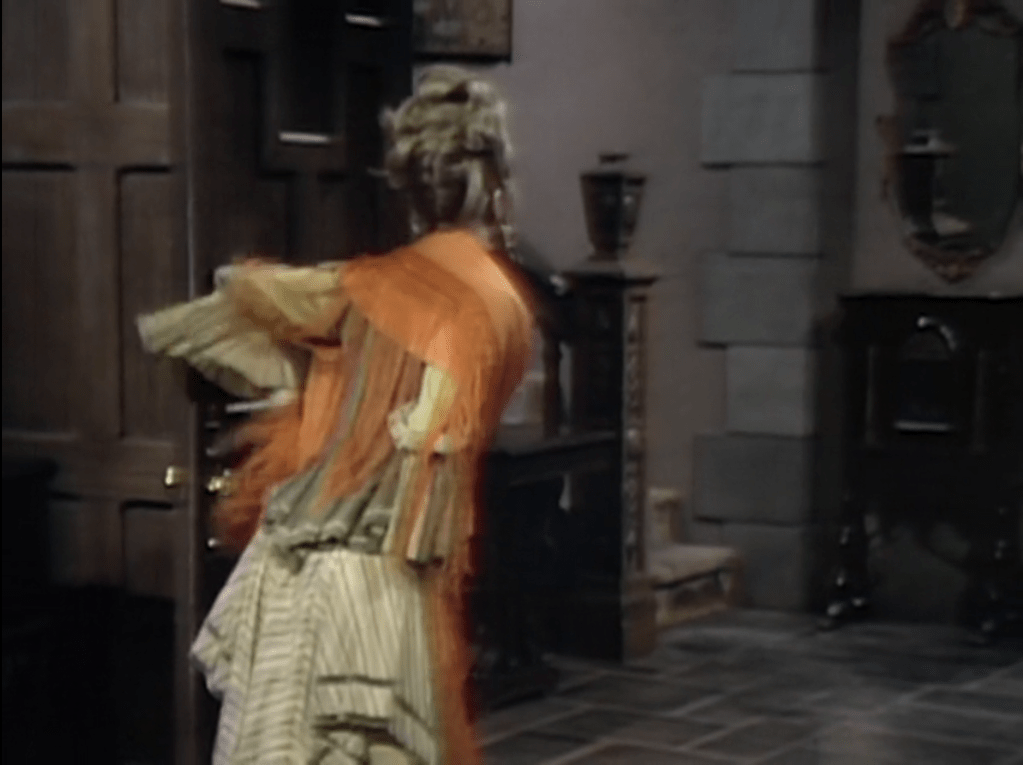
There is no longer such a person as Miss Charity Trask. Sorcerer Count Petofi caused the spirit of the late Pansy Faye, Cockney showgirl and fake psychic, to take up residence in Charity’s body. Charity/ Pansy still lives in the great house of Collinwood, of which Trask has established himself as master, but since her only functioning mind is that of the deceased Pansy, she doesn’t understand why people insist on livenaming her.

Charity/ Pansy enters the drawing room and finds Amanda Harris. Amanda greets her as “Miss Trask,” alienating her at once. Charity/ Pansy demands to know what Amanda is doing at Collinwood. Amanda says that she lives there as Trask’s guest. Charity/ Pansy calls for Trask. She leans out the door of the drawing room and in the loudest, harshest voice Nancy Barrett could manage shouts “Hey, Trask! Trask!” It takes Trask a moment to answer, perhaps because Jerry Lacy had the same trouble we had while watching and couldn’t stop laughing. It is one of the top ten intentional comedy moments in the series, maybe top five.

“Hey TRA-A-ASK! TRASK!

Charity/ Pansy can see that Trask has designs on Amanda, as can everyone else. But she doesn’t care about that. She is convinced Amanda has come to the house to seduce rakish libertine Quentin Collins, whom she herself is determined to marry.

Amanda had no such plans when she first came to the house, but she meets Quentin today, and a few minutes later they are locked in a passionate kiss. Trask surprises them, and declares that he will protect Amanda from her weaknesses.

For his part, Quentin is busy trying to figure out what is happening to him. He is a werewolf, and there is a full Moon tonight, yet he did not transform. He finds a portrait in his room. It bears a plate with his name and the current year- “Quentin Collins, 1897.” But it depicts him as he is when he is in his lupine form. He knows that it is the work of artist Charles Delaware Tate, and goes to confront Tate in his studio in the nearby village of Collinsport.

Quentin handles Tate roughly and demands to know why he painted a wolf on the canvas with his nameplate. Tate says that Charity saw the painting and thought it looked like a wolf, but that when he looked at it himself he saw only Quentin’s face. Quentin takes Tate to his room and shows him the painting; Tate is shocked to see that it is, indeed, the wolf.

Tate gets another shock before he leaves the house. He meets Amanda, and Trask asks him to paint her portrait. Tate has never seen Amanda before, but he has painted her many times. Returning viewers know that Tate’s painting abilities are a gift from Petofi, and that with them comes the power to conjure into existence that which he paints. Amanda is Tate’s creation.

Tate doesn’t want to accept this fact, and so he flees the house. He rushes back to his studio, and tries to take his mind off what is happening by sketching a still life. He adds an imaginary vase to the arrangement of fruit on the table before him. To his dismay, the vase materializes.

Tate painted Amanda into existence two years prior, and has been working steadily as a visual artist since. So you might wonder why he is only now noticing that things pop into being when he draws or paints them.

One possible explanation that comes to mind is about Petofi, the source of Tate’s abilities. Petofi’s right hand was cut off a hundred years ago, in 1797, and most of his power went with it. He was just recently reunited with the Hand. It once more grows from his wrist, and he is restored to his former might. Perhaps when Petofi first gave Tate his abilities, he could give him just enough to create Amanda and a great deal of commercial success. But now he is stronger, and perhaps Tate is stronger too. Petofi had better hope Tate doesn’t think of painting a picture of an avenger putting him to death for the many crimes he has committed against the Rroma people.

Episode 830: Up in the tower room, all bloody

We open in the woods on the estate of Collinwood, where a young woman in heavy makeup and bright clothing is crying. Another woman in even heavier makeup and even brighter clothing approaches and asks her what is wrong. The first woman says that she had a vision which told her that the rakish Quentin Collins will die of stab wounds twelve days from now, on 10 September 1897.

The first woman used to be Charity Trask, the miserably repressed daughter of the evil Gregory Trask. She is now possessed by the spirit of Cockney showgirl Pansy Faye. Charity knew that Quentin was a werewolf, and wanted nothing to do with him. Evidently Pansy did not acquire that knowledge when she took up residence in Charity’s body, and has decided that she will marry Quentin. Quentin has no interest in either Charity or Pansy, and already has two other fiancées, one of whom he loves, at least after his fashion, and the other of whom is sealed to him by a pact with the Devil. Yesterday Charity/ Pansy learned of the second engagement, and tried to kill Quentin to prevent it coming about; week before last, she tried to end the first engagement by killing the fiancée. Pansy had her faults, but she wasn’t inclined to physical violence. That part seems to be Charity’s contribution to the symbiont.

The other woman is broad ethnic stereotype Magda Rákóczi. Magda was the one who made Quentin a werewolf in the first place. She cursed him for murdering his wife Jenny, who was her sister. It was only after she had placed the curse that Magda learned that Jenny had given birth to Quentin’s twin children, a boy and a girl. Since the curse is hereditary, Magda is now desperate to lift it, and she and Quentin have become allies.

Some time ago, we learned that if Quentin dies, there will be no hope of lifting the curse. So Magda is terrified when Charity/ Pansy tells her of her vision of Quentin’s death.  She takes her back home to the great house on the estate, where her father and Quentin are bickering while they recap yesterday’s story. Trask tries to deny that Charity/ Pansy is insane or that she is capable of killing, but when she enters and announces that she will murder the first person who comes between her and Quentin he has to admit that it might be time to find a place for her in residential care.

We turn our attention to the upstairs of the great house. We see Charity/ Pansy in bed, with Magda sitting in a chair beside. The gramophone is playing a record of Pansy Faye’s theme song. Regular viewers will wonder where Charity/ Pansy could possibly have found such a thing. Charity never met the living Pansy, who was killed the very evening she arrived at Collinwood. Perhaps Pansy’s fiancé, the childlike Carl Collins, bought the record when he met Pansy in Atlantic City and brought it back with him. Carl himself was killed well before the possession began, but perhaps Charity or Charity/ Pansy found it among Carl’s effects.

Charity asks Magda if she likes the tune. “I only like Gypsy music,” she replies. Charity/ Pansy and Quentin both reiterate their theme songs endlessly, but few other characters in the 1897 segment have so much as a dedicated entrance cue. This line of Magda’s makes us wonder what the show might have been like if they had given every major character a theme song.

Trask has a crisis in the drawing room. He hears a ghostly voice warning him that there will be another killing soon. He starts shouting the name “Minerva!” and pleading for mercy. First time viewers might not know what to make of this. Those who have been with the show for a while know that Minerva was Trask’s wife and Charity’s mother, and that he instigated a plot to murder her so that he could marry wealthy spinster Judith Collins and become master of Collinwood. When the voice starts to talk about “the beast that walks like a man,” Trask says “You’re… not Minerva?” Jerry Lacy is an expert comic actor, and his delivery of that line is laugh-out-loud funny.

The same ghost appears visibly to Quentin in his room. He recognizes it as that of Tessie Kincaid, a woman he killed in a recent fit of lycanthropy. He knows that she is appearing to him because tonight there will be a full Moon.

Tessie appears to Quentin. Screenshot by Dark Shadows Before I Die.

Magda enters and finds Quentin writing a suicide note. She tells him he must not kill himself. She chains him to a post in his room and stands by with a pistol. Trask enters and finds them in this compromising position. Mrs Acilius and I laughed as we imagined how Magda and Quentin might have claimed they were planning to spend the evening.

But there is no point in lying to Trask. Between what Tessie’s ghost told him and what he overheard while eavesdropping on a conversation Quentin and Magda had earlier in the drawing room, he has figured out Quentin’s problem. He takes the gun from Magda and recognizes the bullets with which it is loaded as silver. He announces that he will wait until the Moon rises and see what happens.

Tessie’s turn today marks Deborah Loomis’ third and final appearance on Dark Shadows. Miss Loomis didn’t get to do very much, but she made the most of all of it, and I wish we had seen more of her.

Episode 822: I’ll give you some spins

For some time after the Rev’d Mr Gregory Trask first appeared in #725, he projected an intense evil that overshadowed everything around him. Trask’s daughter Charity debuted in #727. Charity was Trask’s enforcer, and was herself so intensely joyless that her mere presence could drain the life out of anyone she disapproved of. The Trasks are triumphs of acting by Jerry Lacy and Nancy Barrett, but they are so intense they threaten to overload the show. So even as devoted a fan as my wife, Mrs Acilius, chose to skip many of the Trask-driven episodes on this watch-through.

In #771, inveterate prankster Carl Collins brought Cockney showgirl Pansy Faye home to the estate of Collinwood. At that point, Dark Shadows was quite somber; when Pansy starts singing and dancing, she seems to have wandered in from another universe altogether. Pansy bills herself as a mentalist; when she tries to do her act at Collinwood, an actual message from the supernatural interrupts her, much to her astonishment.

Pansy was killed by a vampire named Dirk Wilkins the very night she arrived at Collinwood, leading us to assume that the note of brightness she represented was at an end. But strangely, she has now returned. Charity and Pansy never met; when Carl was looking for Pansy in #772, he asked Charity if she had seen her, and the sheer idea of the two of them sharing a scene was enough to raise a chuckle. But now they share more than that. Sorcerer Count Petofi has cast a spell causing Pansy’s spirit to take up residence in Charity’s body. Now, Charity’s personality seems to have faded away altogether, and all that’s left is Pansy.

Charity/ Pansy has a scene with Trask that blasts away the excessive tension he once introduced. He keeps demanding that she behave as he is used to seeing Charity behave, and she keeps singing, dancing, and making fun of him. Miss Barrett and Mr Lacy are both highly accomplished comic actors, and this scene is among their finest achievements in that field.

It also includes a serious moment that further confirms Charity really is channeling Pansy, not acting out some kind of delusion. At one point she becomes very still and prophesies the circumstances of Trask’s death. As she completes this pronouncement, she says that it is different now when she speaks of things unseen. It used to be a game, but now she hears another voice and reports what it tells her. This picks up on Pansy’s astonishment at her own success in #771, something Charity could not possibly have known about.

Charity/ Pansy puts the “boom” in Ta-Ra-Boom-De-Yay. Screenshot by Dark Shadows Before I Die.

Episode 811: A man’s investment in the future

In #797, the ghost of Rroma maiden Julianka appeared and placed a curse on her fellow grievous ethnic stereotype, Magda Rákóczi. Julianka blamed Magda for her death, and decreed that everyone Magda loved would die. Today, Magda is trying to prevent Julianka’s curse from taking the life of her desperately ill infant niece Lenore, daughter of her late sister Jenny. Magda goes to Lenore’s crib in company with Lenore’s father, Quentin Collins. Magda and Quentin try to conjure up Julianka’s ghost to plead for Lenore’s life, but instead they get the ghost of another Rroma woman- Jenny.

Jenny assumes physical form. She picks up Lenore and sings the lullaby “All the Pretty Little Horses.” We’ve heard Jenny sing this almost every time she has been on the show. It appears to be the only song she knows. For his part, Quentin has a phonograph and only one record, which he plays obsessively over and over. When they lived together, their home must have been a pretty grim place, playlist-wise.

Jenny lifts Lenore’s illness, and says that if Quentin looks into his heart he will know what he must do to ensure that Lenore has a bright future. She vanishes, and Quentin mutters dismissively at the idea that his heart will be a source of useful information.

Later, Quentin will have a dream while sleeping in the drawing room at the great house on the estate of Collinwood. Jenny visits and tells him that he must have nothing to do with Lenore and that she must grow up far from Collinwood. So far, dream sequences on Dark Shadows have always represented visits from the supernatural, but this one might be an exception. Jenny did say that the information Quentin needed to help Lenore was already in his heart. He is clearly not the stuff of which good fathers are made, and as Jenny explicitly says in the dream no one has ever been happy at Collinwood. So the advice she gives does seem to be correct. Perhaps this is just Quentin’s own knowledge taking a shape he can recognize.

Quentin goes on dreaming that his brother Edward is choking him. He wakes up to find that Edward is in fact choking him. This might seem like a prophetic dream, but it too might just be a natural expression of Quentin’s own unprocessed knowledge. Edward, because of a magic spell not directly connected with today’s events, is under the mistaken impression that he is a valet formerly in the service of the Earl of Hampshire. Quentin has followed the Collinses’ long-established protocol for dealing with mentally ill family members, and locked Edward up in the room on top of the tower in the great house. He knows this makes Edward miserable, and it is reasonable to suppose that he would expect Edward to express anger about it. Strangulation is Quentin’s own preferred method of expressing anger, especially towards members of his immediate family, so it can’t have been hard for him to see that coming.

Edward’s motivation is not as simple as Quentin’s would be if their positions were reversed. The evil Gregory Trask has been visiting Edward in the tower room, and has told him that Quentin is determined to keep him imprisoned in that room forever. He asks him to kill Quentin. Edward apparently has decided to comply.

Earlier in the episode, Edward had been more punctilious about cooperating with Trask. Trask presented him with a document to sign, promising that by signing it he would secure his freedom. Edward read the document, even after Trask very loudly insisted that it was unnecessary to do so. When Edward saw that it involved making Trask guardian of his son, Edward protested that he had no son. Trask said that this did not matter, but Edward would not be moved. Edward later tells Quentin about this encounter.

The tower room is a re-dress of the set used as the bedroom of strange and troubled boy David Collins in the parts of Dark Shadows set in the 1960s. Today it includes the bed from that set, and we see Edward trying to sleep in it. This is a powerful image for longtime viewers. Louis Edmonds plays Edward in this costume drama segment and David’s father Roger in contemporary dress. Edward is the father of Jamison, who like David Collins is played by David Henesy. Not only has the spell robbed Edward of the memory of Jamison and of his role as a father, it has reduced him to curling up in a bed made for a boy rather than a man.

Edward in the child’s bed. Screenshot by Dark Shadows Before I Die.

Roger was, for the first year of Dark Shadows, a spectacularly bad father. He openly hated David and exploited David’s miseries to try to manipulate him into doing his own criminal dirty work. He was indifferent to the family’s name and the fate of its businesses, would go to any lengths to hide from the consequences of his actions, had killed someone, and was an alcoholic. Edward shares none of these shortcomings. On the contrary, he goes to the opposite extreme. He is as brave as Roger is cowardly and tenderly loves his children, Jamison and Nora. But he is also stuffy, name-proud, and money-grubbing. The contrast with Roger shows these failings, not simply as negatives, but as the overgrowth of the virtues that separate Edward from Roger. Though Louis Edmonds and Jerry Lacy are such accomplished comic actors that Edward’s scenes with Trask are funny enough to be worthy of a staging of the Jeeves and Wooster stories, Edward’s loss of his identity as father of Jamison and Nora is a genuine tragedy.

Quentin is fond of Jamison, and once he learns that his children exist he seems to wish them well. Nonetheless, he shares most of the other vices of early Roger. As Edward shows us what Roger might have been had he had stronger moral fiber, Quentin is Roger with his vices magnified by black magic. When Jenny tells Quentin that he must not raise Lenore, longtime viewers remember Roger as he was when first we knew him, and remember how grim David’s future seemed at that time. It was only after well-meaning governess Vicki became the chief adult influence in his life that we could have hopes for David. So we cannot doubt that Jenny is right.

This is the last of 21 episodes of Dark Shadows directed by executive producer Dan Curtis. When Curtis first took the helm in #457, he had no experience as a director, and it showed. But he learned very quickly. This one looks great and the scenes play very smoothly. He would later direct the feature films House of Dark Shadows and Night of Dark Shadows, as well as six episodes of the 1991 prime time revival of Dark Shadows and many other productions.

Episode 805: The shocking condition of your face

The 150 year old evil sorcerer Count Petofi has taken possession of twelve year old Jamison Collins. Jamison/ Petofi has been casting spells to make the various residents of the estate of Collinwood reveal their true selves. Jamison’s distant cousin, Barnabas the vampire, has locked Jamison/ Petofi in the prison cell in the basement of the Old House on the estate. When Barnabas says that he will let Jamison out once Petofi has vacated his body, Jamison/ Petofi replies “If that is what you intend to do, Mr Collins, I’m afraid that you are stupid and incompetent.” There is no need to cast a spell on Barnabas- Maker of Stupid and Incompetent Plans is his true self, and we love him for it.

The great house on the estate is currently under the legal authority of the evil Rev’d Gregory Trask, husband of Judith Collins, who is a patient in a mental hospital. Jamison/ Petofi’s spell has caused Trask’s daughter Charity to be intermittently possessed by the spirit of Cockney showgirl Pansy Faye. Trask is horror-stricken by the makeup, clothes, and hairstyle Charity wears when Pansy is in charge of her, and her East London accent, insouciant attitude towards him, and tendency to sing and dance escalate this horror further. Nancy Barrett and Jerry Lacy are both talented comic actors, and their scenes as Charity/ Pansy and Trask are hilarious.

Trask is appalled to see Charity/ Pansy. Screenshot by Dark Shadows Before I Die.

Collins family lawyer Evan Hanley is at home. Barnabas appears in Evan’s drawing room and asks for some information which Evan denies having. Evan tells Barnabas he has renounced his former interest in black magic and Satanism. Barnabas is skeptical, and Evan replies that his latest forays resulted in a gruesome disfigurement of his face. This disfigurement was later relieved, how we (frustratingly) do not know. But he wants nothing more to do with the occult, since he values the ability to look at himself in the mirror. Barnabas reminds Evan that he cannot see himself in a mirror, implying that he will use his vampire powers against him if he does not cooperate.

Trask comes to Evan’s house. He asks him to draw up papers that will complete his plan to seize control of all the Collins family’s assets. He mentions in passing that Jamison thinks he is Petofi. Evan knows enough about Petofi to be terrified. He tells Trask that neither of them has a chance in a battle with Petofi, and refuses to draw up the papers. Trask responds contemptuously.

Alone in the cell, Jamison/ Petofi decides to have some fun with Evan. We see Evan dozing in his armchair. He has a dream in which Jamison appears. Jamison kisses him; it is by his kisses that Petofi spreads the “true self” spell. Later, Evan goes to the great house at Collinwood and presents Trask with a paper to sign. Trask signs it eagerly, assuming it is the document he asked Evan to bring him. Instead, Evan has prepared a full confession to the murder of Trask’s first wife Minerva. The two of them plotted this murder together, and Trask is horrified when he sees his signature on it. He throws the paper in the fire; after he leaves the room, it rematerializes on the desk, complete with signatures.

During Trask’s confrontation with Charity/ Pansy Faye, the picture suddenly changes from color to sepia tone. After about a half a minute, it changes back. Evidently there was a fault in the videotape master at this point, and an excerpt from the kinescope was used to patch it. The color comes back right after Trask slaps Charity/ Pansy, causing Pansy to release Charity for a bit. It creates the eerie feeling that Trask somehow fixed our TV set by slapping her.

Dark Shadows continually comments on itself as it goes along. In the early days, all the episodes were scripted by Art Wallace. Wallace’s favorite method of composition was a sort of diptych, in which two sets of characters faced similar situations and responded to them differently, highlighting the contrast between their personalities. Petofi’s “true self” spell is of course another way of creating similar contrasts between characters played by the same actor.

As the show came to focus on time travel stories, they could cast actors as characters who represent alternative versions of parts they played in other periods, again putting characters played by the same actors in contrast with one another. And as Wallace would juxtapose similar situations within a single episode, the multiple times periods allowed them to take themes that had been developed in one way in a story set in one year and develop them differently in a story set in another. So Jamison/ Petofi’s contagious curse is a reworking of the “Dream Curse,” which dragged on from April to July 1968. The Dream Curse involved a lot of repetition and very little variety of tone. Jamison/ Petofi’s spells all get right to the point, and are sometimes scary, sometimes bizarre, and often quite funny. So the second time is definitely the charm here.

At one point Charity holds a recorder and tells her father she wants to learn how to play it. The first time we saw this prop was in #260. That episode was set in 1967, and Barnabas was holding Maggie Evans, The Nicest Girl in Town, prisoner in the cell where Jamison/ Petofi is today. The ghost of Barnabas’ little sister Sarah befriended Maggie, and materialized in the cell playing “London Bridge” on that recorder. Over the next several months, the recorder came to be a symbol of Sarah, one that she occasionally left behind as a sign that she had been in a place. Longtime fans will likely remember that, and see it as an indication that what is happening to Charity is going to have permanent consequences, as Sarah’s haunting had permanent consequences.

Episode 791: Roomful of spirits

The evil Gregory Trask coerced lawyer/ Satanist Evan Hanley into helping him murder his wife, Minerva, so that he could marry wealthy spinster Judith Collins. Now Trask and Evan have conjured up a magical simulacrum of Minerva and caused it to hang around Judith. They claim they can’t see it, which, coupled with some other troubles Judith has had, leads her to believe that she has lost her mind. Trask and Evan strong-arm Judith into signing a paper, Trask locks her up in the tower room, and Evan makes the simulacrum disappear.

In case you can’t tell, these guys are villains. Screenshot by Dark Shadows Before I Die.

Meanwhile, Judith’s brother Quentin is at large. Quentin is a werewolf, and when he returned to human form this morning his face was disfigured. This worked to his advantage. He was in jail at the time, and he was being watched. The sheriff’s deputy had not recognized Quentin’s brother Edward when he came to jail that night, so it isn’t so surprising he doesn’t recognize Quentin, even though he is six foot four, has a distinctive hairdo and prominent mutton chop sideburns, and is wearing the same blue suit with a frock coat that he always wears. It is surprising that Edward doesn’t recognize him either, but this may be the result of a congenital problem the Collinses have. Not only was Quentin himself stumped when the equally identifiable Evan had a similar glob of makeup on his face recently, but Judith fails to recognize Quentin today when he comes to the drawing room. When Judith found him, Quentin was listening to his favorite record and reciting its lyrics in his unaltered voice, and he identified himself to her by name. Still, she couldn’t see it.

Quentin bursts into Evan’s room shortly after he finishes dissolving the simulacrum of Minerva. He sees that Evan’s face is no longer disfigured, and assumes that he used the magical Hand of Count Petofi to restore his appearance. Evan tells him he did not- he can’t explain why his face reverted, it just did so on its own. This does not satisfy Quentin, and it will not satisfy returning viewers. We saw Evan struggle to fix his problem for some time, and when he found himself in a crisis situation he suddenly turned up looking like his old self. So we’ve been in suspense for several days wondering what the explanation would be for his cure, and we are no more inclined to settle for a non-explanation than is Quentin.

Quentin knocks Evan out with a candlestick; the background music is a cue we have previously heard during on-camera murders, leading us to wonder if Evan will survive the blow. Quentin rummages around for a moment and finds the hand. He is looking at it, wondering how to use it to restore his appearance, when a man in a wool cap enters and orders him to surrender the hand at once.

This episode features one of Dark Shadows‘ all-time great goofs. When Evan is casting the spell to dissolve the simulacrum, a black-clad figure dashes past in front of him. A voice can be clearly heard exclaiming “Jesus, Lacy!” Evidently actor Jerry Lacy was in such a hurry to get from one set to another that he didn’t realize he was crossing a live camera.

Episode 790: Making a demon of her

The evil Gregory Trask orchestrated a plot to murder his first wife, Minerva, and has married wealthy spinster Judith Collins. Now he and his accomplice, lawyer/ Satanist Evan Hanley, have conjured up a simulacrum of Minerva to hang around Judith and drive her insane. Once Judith is safely confined to the nearest high-class asylum, Trask will enjoy Judith’s riches, minus only whatever percentage Evan squeezes out of him.

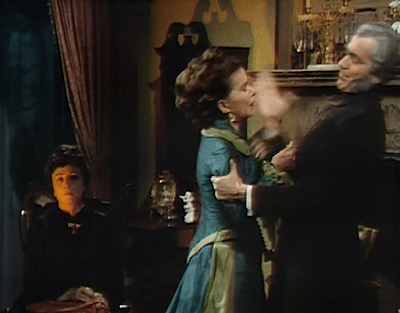
Today, Judith stands in her bedroom in the great house on the estate of Collinwood. She isn’t ready to go to bed, and the simulacrum of Minerva is sitting in the rocking chair, sewing. Trask pretends he cannot see the simulacrum, and forbids Judith to leave the room. When Judith becomes upset, he slaps her. This slap occurs on the soundtrack and in our imaginations. What we see on screen some time before the slapping sound effect plays is Jerry Lacy waving his hand a considerable distance short of Joan Bennett’s face. The two of them do such a good job of acting that this failure of blocking does nothing to undercut the oppressive atmosphere. For her part, Clarice Blackburn plays the pseudo-Minerva with just enough animation that we cannot predict what she will do. These performances take a sequence which may not have seemed like much on the page and make it into one of the most frightening scenes on Dark Shadows. When Judith lies to Trask and says that she does not see Minerva, it’s enough to produce a shudder.

Trask slaps Judith while pseudo-Minerva sews. Screenshot by Dark Shadows Every Day.

Downstairs, Trask answers a knock at the door and broad ethnic stereotype Magda Rákóczi enters. Regular viewers know that Judith despises Magda and Magda hates her, and so it is surprising when we hear that Judith has sent for Magda. Trask blocks her way upstairs. Magda is defiant towards Trask; she knows what he did to Minerva, and is using that knowledge to force him to let her and her husband stay in the Old House on the grounds of Collinwood. But Trask has a new threat to make.

Trask knows that Magda is the sister of the late Jenny, who married Judith’s brother Quentin. He also knows something that not even Quentin knows, that Jenny bore twin children to Quentin after he left her. He threatens to send Jenny’s children away from the village of Collinsport. Evidently Magda wants the children to stay where they are, in the care of a woman named Mrs Fillmore. It is unclear why this would matter to her; we have had no indication that she has met Mrs Fillmore, much less visited the children at her house. But it is important enough to her that they not be moved that Magda responds to Trask’s threat with “What do you want me to do to her?”

We cut to Judith’s room. Magda enters. Judith tells her that the ghost of Mrs Trask vanished a few minutes ago, after sitting in the rocking chair for hours. Judith asks if she thinks she sounds mad, to which Magda replies there is nothing so strange about a simple ghost. The simulacrum reappears, and Judith asks Magda if she sees it. Magda says she does not.

Back downstairs, Magda tells Trask that he is a swine. She spits on the floor next to him and stalks off. Much as Magda hates Judith and many as are the crimes in which she is implicated, she is a warm-hearted sort, and Trask’s bloodless cruelty is not to her liking. Indeed, it is strange she did not tell Judith of Trask’s attempt to extort her complicity and make an alliance with her against him.

Meanwhile, Quentin is being held in the jail. When Magda realized that he murdered Jenny, she turned Quentin into a werewolf. She did not then know about the twins, and so she made the curse hereditary. Once she found out that her own kin were in line to become monsters, she started looking for a way to undo the curse.

The police captured Quentin the night before, while he was in his lupine form. As a result of Magda’s latest futile attempt to cure him, Quentin emerged from his bout of lycanthropy with his face disfigured and his memory a blank. Though his clothing and his hairstyle are so highly distinctive that virtually everyone who has seen the show before can tell that the man in the cell is Quentin, the Collinses suffer from a peculiar form of blindness that keeps them from recognizing people with globs of makeup on their faces, so his brother Edward is at a loss as to who he could be.

Magda is working with time-traveling vampire Barnabas Collins, distant cousin of Quentin, Edward, and Judith, who has set out on a mission to set the events of the year 1897 right so that Quentin will not become a malign ghost ruining things for everyone at Collinwood in 1969. Unfortunately, vampires are not problem-solvers; their function in a story is to create problems. Since coming to 1897, Barnabas has been responsible for at least six homicides. He has wrought a great deal of havoc even beyond those killings. For example, it was as a direct result of his actions that Judith and Trask got together in the first place. Today, Magda goes to Quentin’s cell and tries to tell him that Barnabas will come to him after nightfall and take him to the Old House.

We do not see Barnabas. We are watching Quentin in his cell when we hear a bat squeaking outside the jail. Barnabas can materialize wherever he chooses; he does not choose to materialize in the cell, where Quentin is alone and unattended, but goes into the outer office in his bat form. We hear a deputy in that office talking to the bat affectionately, asking him where he came from. We haven’t seen the deputy before this episode, but one suspects that a fellow who sees a bat in his office and strikes up a friendly conversation with it must have an extremely sweet personality. We then hear the deputy make a horrified exclamation, and the doors to Quentin’s cell and to the world outside open by themselves. As Quentin walks out, we see the deputy slumped at his desk, two bleeding wounds on his neck.

We cut to the darkened interior of the great house at Collinwood. Quentin comes ambling in. Biting the deputy was certainly not part of any plan Barnabas made with Magda, but it isn’t completely surprising- he hadn’t had a square meal for quite a while. But even for Barnabas, it shows an unusually low degree of operational competence to let Quentin wander off by himself when the whole idea is to get him to the Old House.

In the drawing room, we hear Quentin’s thoughts as he dwells on his amnesia. He does not know who he is, where he is, or why he has come. He sees his gramophone, and starts playing his only record. That brings him back to himself.

Judith enters. Quentin is not only wearing his usual suit and his distinctive hairstyle, he is listening to the music he has been playing obsessively for months and reciting the lyrics to it. As if that weren’t enough, his voice is quite outstanding- he must be the only senior member of an aristocratic Maine family with a West Virginia accent. Yet Judith not only fails to recognize her brother, she refuses to believe him when he identifies himself to her by name.

The simulacrum of Minerva enters, holding a letter opener above her head. Earlier this week, Minerva’s actual spirit had possessed Judith, and under her power Judith had held that same letter opener in that same position as she confronted Evan and accused him of her murder. Judith does not remember that, and she screams at the sight.

Episode 781: Sympathy somewhat disturbing

When vampire Barnabas Collins first appeared on Dark Shadows in April 1967, regular viewers may have thought they knew what to expect. They had just spent four months focused on undead blonde fire witch Laura Murdoch Collins, mother of strange and troubled boy David. David’s well-meaning governess Victoria Winters gradually realized that Laura was a deadly threat to him. After some initial confusion, Vicki rallied the other characters in opposition to Laura. Ultimately Laura went up in smoke and David escaped her clutches, choosing Vicki and life over his mother and death.

In many ways, the Laura story was modeled on Bram Stoker’s Dracula. So when Laura’s successor as supernatural menace was an out and out vampire, we may have expected further mining of that source. Barnabas bit and abducted Vicki’s friend Maggie Evans. As the daughter of drunken artist Sam, Maggie had played a key role in the “Revenge of Burke Devlin” storyline. But that storyline fizzled in the show’s early months, and by #201 even Burke Devlin lost interest in it. Maggie was at that point surplus to requirements, and when Barnabas added her to his diet we might have suspected that she would die and rise as a vampire. As Mina and the group she led in Dracula had to destroy her friend Lucy when Lucy rose as “the Bloofer Lady,” so Vicki and her friends would have to destroy Maggie. Vicki herself would then stake Barnabas. The average viewer would have expected this to be the sign to move on to the next menace; those who were aware of TV ratings and programming decisions might think it would be Dark Shadows‘ way of going out with a flourish before its impending cancellation.

Barnabas turned out to be a hit. The idea of a vampire on a daytime soap was such an oddity that a sizable new audience tuned in out of curiosity, and Jonathan Frid’s portrayal of Barnabas’ scramble to impersonate a living man native to the twentieth century resonated with so many of them that he became a breakout star. So they had to figure out a way to make him a permanent part of the cast. That meant Maggie couldn’t die. In the first place, they couldn’t risk making Barnabas responsible for the death of so likable a character. Second, as the survivor of the horrendous abuse Barnabas inflicts on her Maggie would have a new function, as the witness who might emerge to expose him and wreck the show. Third, while Maggie was in Barnabas’ clutches Kathryn Leigh Scott proved herself such a versatile actress that it would obviously damage the show to lose her. So Barnabas not only failed to kill Maggie, he completed only two homicides in the whole of 1967. Each of his two victims was a male character who had run out of story. As a result, the killings and the victims were quickly forgotten.

Barnabas’ nonlethal vampirism made it easier to keep the cast intact, but it also drained him of the lurid novelty that had made him such a draw. To reassure the audience that Barnabas really was a bloodthirsty fiend from the depths of Hell, the show had Vicki come unstuck in time in #365. She found herself in the 1790s, when Barnabas first became a vampire. That gave us a whole cast of characters whom we did not expect to see again once the show returned to contemporary dress. So Barnabas was free to slaughter people to his heart’s content.

The 1790s flashback was a hit in the ratings. When Vicki brought us back to 1968 in #461, the makers of the show had to figure out a way to keep the momentum going. They cured Barnabas of the effects of the vampire curse and surrounded him with a hectic parade of other refugees from 1930s horror movies- mad scientists, Frankensteins, witches, werewolves, and a couple of fresh vampires. After that Monster Mash period exhausted itself, they took us through a long, deliberately paced segment focusing on just two stories, one about a tormented werewolf and the other about a ghost who takes possession first of two young children, then of the whole estate of Collinwood. Barnabas, who has come to see himself as a good guy and the protector of the family, tries to cure the werewolf and reason with the ghost. His efforts instead transport him back in time to 1897.

In that year, Barnabas is a vampire again. He keeps saying that his only goal is to prevent the evils that will befall the family in 1969, but he is as uninhibitedly murderous as he ever was in the periods when he was unambiguously a villain. In Friday’s episode, he murdered one of the principal members of the Collins family, prankster Carl Collins, uncle of the Jamison Collins whose daughter and son are the adults at Collinwood in the 1960s. Barnabas had become so careless after so many killings that he left Carl’s body propped up behind the curtains in the windows of the drawing room, where it fell into plain view moments after Barnabas’ foe the Rev’d Gregory Trask entered. In this episode, Trask enlists Edward Collins, brother of Carl and father of Jamison, to help him hunt Barnabas.

My wife, Mrs Acilius, points out that when we see a character closing the doors to the drawing room, that person is in charge of the house. So in the early months of the show matriarch Liz was the one to close the doors; when Liz was taken to a hospital and her daughter Carolyn was in charge, Carolyn closed the doors. When Vicki was fully in command of the campaign against Laura, she closed the doors to consult privately with her lieutenants. When Trask and Edward go into the drawing room to discuss the situation, it is Trask who closes the doors. Vicki was good, so consistently so that she had to be written out of the show months ago. But Trask is overwhelmingly evil. That he has ascended to the rank of door-closer means that virtue has no stronghold anywhere.

Edward and Trask go to the Old House on the estate, where Barnabas has been staying. They find Barnabas’ reluctant sidekick, broad ethnic stereotype Magda Rákóczi. Magda denies that Barnabas is in the house and pretends not to know what Trask and Edward are talking about when they say that Barnabas is a vampire. Trask slaps Magda in the face; we have seen many face-slaps on Dark Shadows, but so far as I can recall this is the first delivered while the slap-ee has her back to the camera. Since he does not have to swing his hand very close to Grayson Hall’s face, Jerry Lacy can therefore put full force into the gesture, making it look like Trask is delivering a truly brutal blow to Magda. Afterward, Magda rubs her face and vows revenge on Trask. She quotes a rather confusing “old gypsy saying”: “Walk fast and the Devil will overtake you; walk slow and misfortune will catch you. You’d better not walk slow, because I will never be far behind.”

Edward and Trask search the Old House and find nothing. At dusk, Barnabas emerges from the secret room behind the bookcase in the front parlor. Magda hadn’t thought to look there, and Trask and Edward didn’t know the room existed. Barnabas says he will have to find a new hiding place for his coffin. Magda says she will do whatever she can to help him. Barnabas is surprised at her support for him; after all, he has bitten and enslaved her husband Sandor, and his destruction would mean Sandor’s restoration. Magda has an atypical moment of speechlessness, after which she says that Trask is an “animal” and must be punished at all costs.

Trask and Edward went back to the main house early in the morning to look for the plans to the Old House. It apparently took them all day to find them. By the time they have gone through them and identified all of its secret rooms, Barnabas is already up. They come back to the Old House and find the empty coffin in the secret room. Trask says that he will make the coffin “unusable” for Barnabas before daybreak. He leaves Edward, who is carrying a gun loaded with silver bullets, to guard the house.

Barnabas goes to one of his blood-thralls, Trask’s daughter Charity. He tells Charity that he is “in serious trouble” and commands her to go to the basement of the Old House. There, she will find some soil from his original grave, which he needs to prepare his new resting place. He tells her about a tunnel from the beach to the basement which she can use to elude detection by Edward. Since Barnabas has just materialized in Charity’s room and will shortly materialize in the secret room in the Old House while Edward is standing on the other side of the bookcase, we wonder why he can’t use that same power to get into the basement himself.

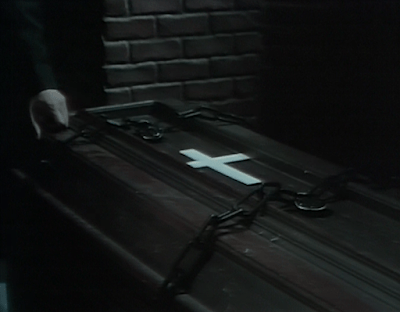
Barnabas finds that the coffin is topped with a cross. He can’t get close enough to take hold of the coffin and move it, so presumably even after he gets the soil he needs he will have to plunder a mortuary showroom to get a fresh resting place before dawn.

The unusable coffin. Screenshot by Dark Shadows Before I Die.

Charity does go to the basement. She puts some soil in her purse, then knocks over a crate, attracting Edward’s attention. She does not run away, but merely hides in an alcove until Edward comes down, sees her in shadow, and orders her to show herself.

Episode 774: Sometimes people change their roles in life

Tim Shaw, uptight teacher turned victim of brainwashing turned fugitive murder suspect, makes his way into an abandoned root cellar. He finds a coffin there. Naturally, he opens the coffin. That’s what everyone does on Dark Shadows when they find a coffin where one shouldn’t be. You meet the most interesting people that way.

Tim finds that the coffin is empty, and goes into a dark corner to hide. Someone comes to the door, and Tim gets up to greet whoever it might be. He hasn’t been a fugitive very long, and hasn’t quite perfected all the skills that the status calls for.

Tim sees Dirk Wilkins, a dimwitted servant of the ancient and esteemed Collins family who has been missing for several days. Tim calls out “Dirk!” This is the first time we learn the two men know each other. They are unlikely to have been friends. Tim rarely left the school where he worked. The school has been housed in a building on the Collins family’s estate for several weeks, so it makes sense that he and Dirk would have met, but Dirk has been unpleasant to everyone we have seen him with, including his employers and pretty girls he wants to attract. It is hard to imagine the painfully shy Tim befriending him.

Dirk turns out to be a vampire, and he bites Tim. We then cut back to the school. The headmaster, the overwhelmingly evil Gregory Trask, is browbeating Tim’s fellow teacher and onetime girlfriend, neurotic intellectual Rachel Drummond. Returning viewers will recall that Trask has made flagrant passes at Rachel, and also know that Trask conspired with a local Satanist to cast a spell on Tim which caused him to kill Trask’s wife Minerva. Trask is pretending to be upset about Minerva’s murder and to believe that Rachel plotted with Tim to commit it. He tells Rachel that if she does not leave the school, he will accept that she is innocent. She goes to her room, distraught. Later in the episode, Trask will telephone his co-conspirator, gloating that the authorities are on their side.

Spinster Judith Collins, sole proprietor of all her family’s great wealth, shows up to offer her condolences to Trask. They find that Rachel is gone, and he tells her that she must have gone with Tim. Trask realizes that Tim and Rachel have no money, and wonders if there is anyone who might give them enough to allow them to flee the state. Judith says that her distant cousin Barnabas Collins, who is currently staying at the Old House on the estate, is very fond of Rachel and that he might give them some money. She says that she will get in her carriage and go to the Old House before Rachel can get there. She will tell Barnabas about the murder and about Tim and Rachel’s involvement in it, thereby ensuring that he will not give them any money.

Judith consoles he new widower. Screenshot by Dark Shadows Before I Die.

Judith knocks on the front door of the Old House and gets no answer. She enters, and finds the house empty. She is still in the front parlor when Dirk enters. She chastises him for staying on her property after she dismissed him, and tells him she will call the police if he is not gone within 24 hours. He walks towards her, backing her against the wall and ignoring her demands that he let her leave. He says that he is no longer her servant, but that she will soon be his. He bites her.

Judith was right when she told Trask that Rachel would go to the Old House. Rachel does go there. She peeks in the window, sees Judith sitting in a chair, and scurries off. This is rather an odd moment- Judith told Trask just a few minutes before that she would go to the Old House in her carriage. It seems unlikely that she drove her own carriage and there is no driver waiting outside, but even if if she did the carriage must still be sitting there in full view. How did Rachel fail to notice it?

Trask comes to the Old House and tells Judith he wanted to offer her his support in her conversation with Barnabas. Trask knows how fond Barnabas is of Rachel, and may well suppose that he would want more details about Minerva’s death than Judith could offer before he agreed to regard Rachel as a criminal. Judith says Dirk’s name when Trask enters, and when Trask notices the bleeding wounds on her neck he quickly realizes that Dirk inflicted them.

We cut back to the root cellar, which we see Rachel entering. She sees the coffin, and of course opens it. That’s just good manners. She turns, and sees Dirk in the entryway.

In his post about this episode at Dark Shadows Every Day, Danny Horn transcribes a conversation among Roger Davis, Jerry Lacy, and director Lela Swift captured on video when the three were on a panel at a convention:

Roger Davis:  I do remember being very excited when I got to be a vampire on the show, so excited, and the first person that I got to bite was Joan Bennett, and I was so enthusiastic and excited I knocked her over — flat on her back!

Jerry Lacy:  I remember when you did it, it was rehearsal in the morning.

Roger:  Was it?

Jerry:  Yeah. You grabbed her, and you bit her, and then you just threw her. And she was already sixty years old then.

Lela Swift:  Then we had to pick Joan up and put her together again.

Danny Horn, “Episode 774: What’s Up, Dirk,” posted at Dark Shadows Every Day, 21 November 2015.

To which my comment is, fuck that guy. I don’t make a habit of swearing, but there are not enough curse words in the language to express my reaction to Mr Davis chortling through his reminiscences of physically abusing his female scene partners. He can fuck off straight to hell.

This story gives an extra dimension to the scene between Judith and Trask in the Old House. Mr Lacy plays Trask’s relentless evil so effectively that he is difficult to watch; my wife, Mrs Acilius, refuses to watch his episodes this time through the series. It usually makes a viewer’s skin crawl to see Trask posing as a representative of something good. But knowing that behind Trask in the position of standing by Judith after she had been attacked by Dirk was Jerry Lacy standing by Joan Bennett after she had been attacked by Roger Davis, our response is much more complex. After all the times we might have wondered how anyone could fail to see through Trask’s blatant hypocrisy, this time enough of the thoroughly decent humanity of Jerry Lacy peeks through that we can understand why Judith has been so supportive of Trask.

The cast went into makeup after the morning rehearsal. From the looks of Dirk’s fake mustache and artificial pallor, makeup artist Vincent LoScalzo must not have brought his usual enthusiasm to his work when Mr Davis sat in his chair. The mustache in particular is so crudely affixed that it looks like Mr Davis might have done his own makeup today.