It’s the wee hours of the morning, and hardworking young fisherman Joe comes to his fiancée Maggie’s house. Maggie had telephoned Joe and asked him to come right over. Joe can’t imagine what Maggie wants. In the chaste world of Dark Shadows, there is no word for “late night booty call.”
Joe finds Maggie and her friend Vicki waiting for him in their nightgowns. Maggie tells him that she had heard a noise in the bedroom where Vicki is staying, that she went in to investigate, and that she saw a ghost whispering into Vicki’s ear. Vicki tells him that she is staying at Maggie’s house to escape the power of a witch who is trying to make her have a nightmare that Maggie and others have already had, and that if she does have the nightmare it will spell doom for Barnabas Collins, who hasn’t been on the show for a week and a half. Joe gets more and more befuddled as the women go on about these matters. When they mention occult expert Professor Timothy Eliot Stokes, Joe perks up. Stokes is a topic on which he has a definite opinion. He thinks Stokes broke into Maggie’s house while she was away mourning for her father Sam, that he is harboring a fugitive named Adam who was involved in Sam’s death, and that he is in general a slippery sort. When Vicki says she is planning to call on Stokes the following day, Joe insists on accompanying her.
Stokes is slow to answer the door when Joe and Vicki knock. Vicki tells Stokes about her experience the night before, and Stokes replies that he can do nothing for her unless she leaves the town of Collinsport.
Joe finds some beginning reader’s flashcards and asks Stokes what he is doing with them. Stokes claims to be tutoring a three year old nephew in reading. Joe hears footsteps in the back bedroom. He wants to go to investigate, as Maggie had investigated sounds in her back bedroom, but Stokes denies him permission, claiming that there are cleaning people working in there. Joe seems to suspect what the audience already knows, that neither the nephew nor the cleaning people exist and Adam is in the bedroom.
Thus compromised, Stokes is off his guard when Joe reaches into his pocket and takes out a stickpin bearing the monogram “S.” Stokes confirms that it is his, and Joe says it was found in Maggie’s living room. Stokes suggests he dropped it there when he visited Sam. Joe argues this could not have been so, and Stokes is compelled to accept his reasons. He claims to have let himself into Maggie’s house through the unlocked door hoping to find her and offer his condolences, and that when he found no one home he left right away.
Later, Joe lets himself into Maggie’s house and grabs a rifle. Maggie asks him what he is doing. He refuses to explain himself and insists on going away with the weapon. She objects quite forcefully, as one would expect, but cannot stop him. Throughout the first 106 weeks of the show, Joe has been an unfailingly kindly and conscientious fellow; longtime viewers will therefore be as shocked as Maggie is to see Joe behaving in this way.
Joe returns to Stokes’ place. Stokes is unsettled to see him with a gun. Joe declares that he has come to conduct a thorough search for Adam. Stokes orders him out of the house. Joe refuses to go, and Stokes threatens to call the police. Joe encourages him to call them. The two start to scuffle, and Adam bursts in from the bedroom. Joe points the gun at Adam, and Stokes urges him to put it down. Joe and Adam both run out the door. Stokes is looking on and urging Joe not to fire when we hear a shot.
In November 1967, well-meaning governess Vicki Winters came unstuck in time and found herself marooned in the late eighteenth century. She took the audience with her, and for 19 weeks Dark Shadows was a costume drama set in that period.
Joel Crothers, who in the parts of Dark Shadows set in the 1960s plays hardworking young fisherman Joe Haskell, played roguish naval officer Nathan Forbes in the 1790s segment. Crothers was too capable an actor for Joe ever to be uninteresting to watch, but his scrupulous honesty and unfailingly wholesome desires keep him from making anything happen. Nathan comes as a revelation. Starting as a basically friendly fellow with some conspicuous weaknesses, Nathan steadily evolved into a very cold villain. Along the way, he figured in genuinely funny comic scenes and displayed rich psychological complexity. When Vicki brought us back to a contemporary setting in March 1968, it was more than a little sad to see Crothers return to duty as earnest Joe.
We get another visit from Nathan today. In the eighteenth century, Vicki stumbled into a romance with an unpleasant man named Peter Bradford. Peter has followed her to the present, but has amnesia and angrily refuses to believe Vicki when she tells him who he really is. Today, Peter has a dream in which he confronts Nathan. He fires a gun at Nathan, and is bewildered when Nathan only laughs. Nathan explains that Peter can’t kill him, because he’s already dead.
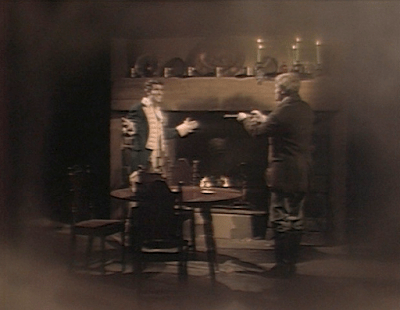
This scene plays out in front of a table and mantelpiece which we saw together in #459. In that one, it was Nathan who fired a shot with results that bewildered him. His target was Barnabas Collins, who smiled and told Nathan he could not kill him because he was already dead. Barnabas, a vampire, strangled Nathan not long after.
Joe is in the next room while Peter has this dream. He hears Peter talking in his sleep, and comes in to wake him up. When he does so, Peter mistakes him for Nathan and tries to strangle him.
This is not the first time Peter has picked up where Barnabas left off. Barnabas had some vague intention of joining with Vicki in one or another sort of relationship, and now Peter is the one who is in a confusing and unsatisfying relationship with her. Mad scientist Eric Lang built a Frankenstein’s monster, intending for Barnabas to leave his own body and wake up in it; Lang intended to cut Peter’s head off and sew it onto the creature. Had that plan succeeded, actor Roger Davis would have traded the part of Peter for that of Barnabas. It is not immediately clear why the makers of Dark Shadows want us to bracket Peter and Barnabas together, but evidently they do.
Roger Collins is on the telephone in the foyer of the great house of Collinwood. He is assuring the caller that it will be fine if Maggie, whom returning viewers know to be The Nicest Girl in Town, comes to stay. He says that he and Cassandra will be glad to have her for as long as she wants to be with them, and that he is sure Liz will approve. First time viewers thus learn that Roger has a wife named Cassandra, and that they live as guests in a house belonging to someone called Liz. A moment later, Liz enters, and is too distracted to hear anything Roger says to her.
Roger ends the phone call, and follows Liz into the drawing room. She stares out the window and makes a gloomy remark about death. He says he understands she must be very upset about Sam Evans. Returning viewers know that Sam was Maggie’s father, and that he died in yesterday’s episode. Roger goes on about how it is natural to be grieved at the loss of a friend like Sam, but soon learns that Liz’ mood has nothing to do with Sam’s demise- it’s news to her that he is dead.
Roger’s lines will startle longtime viewers. For the first 40 weeks of the show, Roger and Sam were united by a deep and abiding mutual hatred, and since then they have had no contact at all. Roger’s words about Sam as a family friend are so far from what we have previously seen that they should be considered a retcon.
Liz and Roger spend several minutes in the drawing room. She keeps going on about the all-pervasive reality of death, and he keeps urging her to see a doctor. There isn’t much to their lines, but Joan Bennett and Louis Edmonds were such extraordinary screen performers that it’s always fun to watch them together. This scene might be a particular pleasure to longtime viewers, who have rarely seen Roger as the responsible adult in any encounter.
We dissolve to a bedroom where a young woman in a black wig is sifting through some powders, looking directly into the camera, and telling Liz that her obsession with death will become even worse than it already is and will have dire consequences. Liz will believe that she is someone else, a woman who lived and died in another century, and may die by the same poison that killed that person.
There is a knock at the door. It is Roger. The woman hides her powders and lets him in. He addresses her as Cassandra and asks why the door was locked. Thus first-time viewers learn that she is his wife, that this is their room, that she is a witch, and that Liz’ problem is the result of a spell she has cast.
Cassandra tells Roger that she locked the door because David kept pestering her about Sam’s death and she wanted a moment to herself. With that, first-time viewers find out that David is Roger’s son, that Cassandra is his stepmother, and that she expects Roger to consider locking him out of the room an appropriate response to his grief about Sam.
Roger does not so consider it, and is bewildered by what Cassandra tells him. He tells Cassandra that Liz is in a bad way, and he is worried about her. Cassandra says she did not know that Roger was so concerned about his family. Baffled by this, Roger says that of course he is concerned, Liz is his sister. This tells first time viewers both what Roger’s relationship to Liz is, and that Cassandra has so little sense of family that she cannot imagine how other people feel.
Regular viewers will learn more. In the first year of the show, Roger’s keynote was his lack of loyalty to the family. That has now been set aside once and for all, and his normal attachment to his son and his sister provide a contrast with Cassandra’s apparently sociopathic coldness. Further, we saw a great deal of Cassandra from November 1967 through March 1968, when the show was a costume drama set in the 1790s and she was called Angelique. We saw then that Angelique had no conception of family or friendship, and that her idea of love begins and ends with her control over a person.
Cassandra promises to join Roger downstairs for a game of bridge in half an hour. He leaves, and she gets back to work spellcasting. As she does so, a figure in a black cassock materializes behind her. She turns, and the figure vanishes. In a quizzical tone, she says Roger’s name, revealing that she did not see the figure or realize that it is a supernatural presence. Together with her locking the door, scrambling to hide her magical paraphernalia when Roger knocked, lying to cover what she was doing, and failing to understand what a person with a reasonable amount of human empathy would consider acceptable behavior, her puzzlement shows that whatever her powers may be, they have definite limits.
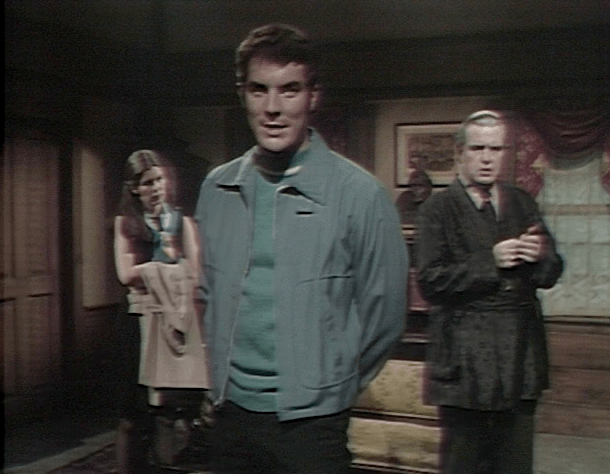
Back in the foyer, another young woman with black hair lets a man into the house. She calls him Joe, and he calls her Vicki. Joe and Vicki talk about Sam’s death and about Maggie. Joe says that he wants to marry Maggie as soon as possible and to move away. Vicki is all for their marriage, but does not want them to go. Joe talks about how close he and Sam were. Longtime viewers will remember that when Sam and Roger were enemies, Sam was the town drunk. Even then, Joe was always happy to help him in whatever way he could, and did not see his condition as any obstacle to marrying Maggie.
Liz enters and angrily addresses Joe as “Lieutenant Forbes.” Joe has never heard of Lieutenant Forbes, and cannot understand why Liz, who knows him well, would not recognize him. Vicki clearly does know who Liz is talking about, and manages to calm her down. After Liz apologizes and hastens away, Vicki answers Joe’s questions only by saying that Forbes is someone from “the past.” Since we heard Cassandra talk about Liz taking on the personality of someone who lived in “another century,” this suggests that Vicki, too, has an unnatural familiarity with that same century.
Joe wants to go upstairs to the room where Maggie is sleeping so that he will be the first person she sees when she wakes up. Vicki is about to lead him to Maggie when Cassandra insists she join her in the drawing room to talk about David. Vicki tells Joe which door to open, and complies with Cassandra’s directions. This shows that Vicki is a member of the household staff whose responsibilities have to do with David. Regular viewers know that she is his governess, and that they are very close.
Cassandra tells Vicki that David has been asking about Sam’s last words. Vicki says that he addressed them to Maggie, not to her, and implies that she did not hear them. When Cassandra continues probing, Vicki protests. She asks if Cassandra can’t see that she is upset. Considering how clueless Cassandra was about human feelings in her conversation with Roger, it is entirely possible that she cannot. Vicki tells her that Liz is deeply depressed; Cassandra feigns ignorance. Vicki says in a cold voice, “You wouldn’t know anything about that,” then leaves.
Longtime viewers know that it was Vicki who came unstuck in time in #365 and took us with her to the 1790s. During her nineteen weeks in the past, Vicki came to know not only Forbes, but Angelique. She knows perfectly well that Angelique and Cassandra are the same person, that she is a witch, and that she is a deadly menace to everyone. She likely suspects that Liz’ depression is the consequence of one of Cassandra’s spells, and the tone of her parting remark would suggest that she does. Further, those who saw the show yesterday know that Vicki is lying about Sam’s last words. They were addressed to her, and she heard them clearly. She is choosing not to repeat them to Cassandra lest Cassandra use them for her nefarious purposes.
Cassandra is alone in the drawing room for only a few seconds. She is joined there by the same figure who had appeared in her room. This time she sees him. He confronts her.
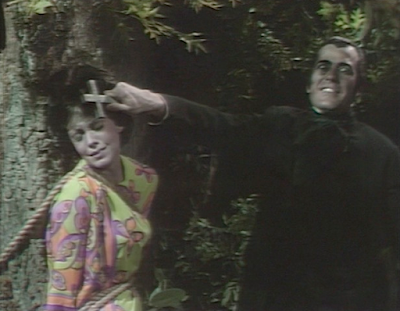
Regular viewers know that the figure is the Rev’d Mr Trask, a fanatical witchfinder who mistook Vicki for the witch in the 1790s and sent her to the gallows. He tells Cassandra that he now has the opportunity to correct that error. He shows her a cross, from which she recoils. We cut to a scene in the woods. Trask has tied Cassandra to a tree and performs an exorcism on her. This is Trask’s go-to technique; he tied Vicki to a tree in #385 and performed an exorcism on her in #386. Since Cassandra actually is in league with the devil (or as Trask would say, THE DE-VILLL!!!,) he has more success this time. Cassandra vanishes and leaves the ropes hanging on the tree.
A first-time viewer might take this climax as an indication that Dark Shadows is a Christian show and Trask is its hero. Not only is Trask going after the right target, he is clearly making some headway. He says all the right things about casting the evil out of Cassandra and saving whatever good is left in her. His delivery of his lines is so fervent that Mrs Acilius, a vigorous Christian, cheered him on. In fact, Trask’s wild incompetence throughout the 1790s segment led to one disaster after another, and was of a piece with the show’s light regard for religion. Not until #450 did a cross provoke a reaction from a monster; that was the first suggestion the show gave that there might be anything to Christianity, and the scenes between Cassandra and Trask today are the second.
Dark Shadows borrows story points freely from all sorts of books, plays, movies, and folklore. So far, it has steered clear of Christianity as a source. For obvious reasons- most of the audience is at least nominally Christian, and Christianity is, in one way or another, a live option for the rest. So it’s a topic that can take over very quickly once it is introduced. I suppose a specifically Christian version of Dark Shadows could have worked, but I can’t imagine that the staff they had would have been particularly interested in making a show like that. So when it looks like they are going to let Trask have even a temporary win, we see the show running one of its boldest risks yet.
Hardworking young fisherman Joe Haskell is engaged to marry Maggie Evans, The Nicest Girl in Town. Early in their relationship, Maggie warned Joe that they might never be able to get married, because her father Sam was an alcoholic and would always need her to come rescue him. Joe liked Sam, drunk or sober, and was always quick to lend him a hand. He didn’t seem to understand Maggie’s worries.
Now, it’s Joe who is worried, and Maggie who doesn’t understand why. Sam’s drinking doesn’t seem to be as much of a problem as it was then. But he has been struck blind, ending his career as a painter. Joe still wants to marry Maggie, and is still glad to help Sam. But Sam has befriended a very tall, phenomenally strong man named Adam, who is wanted by the police because he abducted heiress Carolyn Collins Stoddard several days ago. Sam doesn’t consider the abduction to be a strike against Adam, whose ignorance of social customs he considers to be a disability equal to his own blindness. Joe is convinced that Adam is a violent felon and is alarmed that Sam insists on inviting him to the Evans cottage. Maggie has been out of town and doesn’t know about Adam.
Today, Joe finds a reason to be as alarmed about Maggie’s judgment of men as he is about Sam’s. Maggie was missing for some weeks in May and June of 1967, and when she was found she was so severely traumatized that she could barely talk. She spent months in a mental hospital called Windcliff after that, during which time she had regressed to childhood and developed a tendency to become wildly agitated. She seems to be her old self now, but she still has amnesia covering the whole period from her disappearance through her time at Windcliff.
Like the rest of the village of Collinsport, Joe believes that Maggie was abducted and brutalized by Willie Loomis, servant to old world gentleman Barnabas Collins, and that Willie was trying to kill Maggie when the police shot him in #322 and #323. When he survived his gunshot wounds, Willie was sent to Windcliff. In #483, Joe was appalled to find that Barnabas had arranged Willie’s release and brought him back to work for him. Joe informed Barnabas that he intended to kill Willie if he ever again saw him near Maggie.
Joe is on his way to the Evans cottage when he sees Willie heading for the front door. He confronts him and reminds him of what he told Barnabas. Willie tells him Maggie is no longer afraid of him, that they are friends now, that she visited him at Barnabas’ house earlier that evening, and that it wasn’t the first time she had gone there. Willie is going on about himself as Joe’s “competition” for Maggie’s attention when Joe hits him a couple of times and knocks him out.
Joe goes into the house and tells Maggie what happened. She admits that she did go to Barnabas’ house earlier, that she talked to Willie, and that it wasn’t the first time. Joe reacts with incredulity and says that Willie tried to kill her. Maggie insists that Willie is innocent. Joe asks why she believes that; she can’t explain. He asks why she went to Barnabas’ house. Again, she can’t explain. She says that she does not know why she went there, but that she is sure it wasn’t to see Willie. Joe is shocked that Maggie can’t explain something she did just an hour or two before. He keeps asking, but she insists that she does not know why she went to the Old House.
Joe becomes more and more alarmed. Maggie turns away from him, and he grabs her arm. All the fansites remark on the roughness of this move; it looks like an act of domestic violence. It certainly is not what we would expect of Nice Guy Joe, who was Carolyn’s doormat in the early months of the show and has been a Perfect Gentleman in his relationship with Maggie since then. The 1960s were a particularly bad time for intimate partner violence on screen, so it speaks relatively well of actors Joel Crothers and Kathryn Leigh Scott, and especially of director John Sedwick, that this moment passes briefly. Joe doesn’t follow it up with any further violence, and Maggie seems to forget about it instantly, as if it were an accident. In those days, it might just easily have been highlighted as a proof of Joe’s manliness.
The arm-grab is not defensible, but Joe’s intense feelings in response to Maggie’s inability to explain her behavior are. Joe and Sam visited Maggie at Windcliff in #265. She didn’t recognize them and started shrieking lyrics to “London Bridge” in what I think is the single most frightening scene in the whole of Dark Shadows. Maggie’s amnesia blotted that out, but Joe can hardly have forgotten it. He also remembers Willie as he was in his first weeks on the show, when he seemed determined to rape all the young women and beat up their boyfriends. The idea of Maggie’s mental health regressing to such a low point that she would wander off with a man like that must terrify Joe.
#1. Sam recently went blind; that’s why Joe has to pick him up at the bar.
#2. “Cassandra” is really Angelique, who’s cast a complicated Dream Curse spell that will eventually lead to Barnabas’ death. The gift that she brought was pipe tobacco, laced with a magic powder that would make Sam have the dream.
#3. Professor Stokes is fighting Cassandra, and trying to stop the Dream Curse. He stole the pipe tobacco, because he doesn’t want Sam to have the dream.
#4. Willie has a crush on Maggie, so he stole a pair of Josette’s earrings from Barnabas, and left them in Maggie’s purse while she wasn’t looking. When she puts the earrings on, she has a flashback to the period when Barnabas held her captive, and tried to convince her that she was Josette — a period that should be blocked from her memory.
#5. Adam, the newborn Frankenstein, has befriended Sam, and is now looking for him…
[#6.] Barnabas… was chained up a couple episodes ago and trapped behind this wall. Now he’s kicking at the wall, desperate for someone to come and rescue him.
[#7. A] man… abducted Carolyn a few weeks ago.
[#8.] Cassandra putting a curse on Liz, and making her think about death all the time.
Danny might have mentioned several other stories that don’t come up today, but of which regular viewers are aware and on which the ones that do come up depend. For example, Barnabas’ vampirism has gone into remission, and as a result his sometime victims were freed of the effects of his bites. It is unclear what this means for them, particularly for Willie, who often seems to have become once more the dangerously unstable ruffian whom Joe and the others knew when he first came to Collinsport. Also, a man named Peter is dating well-meaning governess Vicki, and Vicki has trouble remembering that Peter would prefer to be called Jeff. That may not be too exciting, but it’s no duller than Liz moaning endlessly about death. We could also bring up strange and troubled boy David, who has come into possession of a tape recorder with a message that has been played for the audience approximately umpteen billion gazillion times, but that no character other than Adam has heard, and if anyone else does there will be consequences. And Harry, the ex-convict son of housekeeper Mrs Johnson, is staying at Collinwood, and may someday be mentioned again. If he is, there is a danger that the audience will once more have to watch Craig Slocum try to act, truly a grim prospect.
Danny argues that the dense packing of so many storylines into the show makes watching it a stimulating cognitive exercise that “actually teaches people how to process information more efficiently.” As this blog makes obvious, I enjoy this kind of complexity very much. Not only do I keep talking about how ongoing storylines relate to each other, I reach back and find echoes of plot elements from months or years before and consider the significance of the common themes they develop; I look at the way the show borrows stories from books and plays and movies and folklore and notice how they put those source materials in dialogue with each other; and sometimes, my dissatisfaction with stories that didn’t work leads me to think up other stories that might have turned out better, adding yet another layer of narrative accretion to the already extremely intricate existing dramatic text.
I think Danny goes overboard, though, in his presentation of his case. He suggests that an increase in the number of storylines per minute of airtime is equivalent to an increase in the intellectual power of the show. But analysis and collation of plot elements is only one of many kinds of mental activities audiences engage in, and is far from the most important one. If that was all you wanted, you wouldn’t need actors. When an actor creates a character, s/he transforms the story points into the experiences of a person and the audience into witnesses of those experiences. When the drama is well executed, those experiences, even if they can be assigned to some category that is familiar to us, strike us as fresh and unique. When that happens, you don’t need a large number of interlocking storylines to generate complexity- your responses, emotionally and intellectually, will be as complex as your own background can support.
The audience’s background matters. There’s an old saying that when you engage with a literary work, it isn’t just you who read the book, but the book reads you. I often see how true this is in my job as a faculty member in ancient Greek and Latin at a state university in the interior of the USA. When I teach courses on ancient Mediterranean literature in translation, students aged 18-25 have an entirely different reaction than do the “non-traditional” students, those coming back to school after some years doing something else. Most of the students who are in the traditional college age group make interesting connections with a wide variety of topics, while others in that group get bored and can’t see a point in reading old books. But of the dozens of students I’ve taught when they were over the age of 40, every single one has found the reading to be a deeply rewarding experience. The literature that we have from the ancient world was written for adults, and the average American post-adolescent is only going to get so much out of it.
At this point in 1968, Dark Shadows is very much a show for children. The biggest and fastest-growing share of the audience is under 13 years old. So if it is going to be a smart show, it’s going to be smart in the sense that IQ tests measure, transmitting large amounts of information and giving the audience a short period of time to absorb, analyze, and recombine that information before it is followed by another close-packed message. It’s no wonder that an actor like Joel Crothers would become discontented with the show and go away complaining that the cast was being crowded out. He has ever less basis for the hope that he will be able to present the audience with a recognizable human feeling and leave them with hard thinking to do about what that feeling means.
For nineteen weeks from November 1967 to March 1968, Dark Shadows was a costume drama set in the late eighteenth century. Among the more interesting characters introduced in that period were fanatical witchfinder the Rev’d Mr Trask; roguish naval officer Nathan Forbes; fast-talking con artist Suki Forbes; and streetwalkers Ruby Tate and Maude Browning. All five of these characters were murdered by vampire Barnabas Collins, and all five of them are among those who return today for an impromptu trial of Barnabas.
Barnabas killed Trask by luring him to his basement and bricking him up in an alcove, as Montresor did to Fortunato in Edgar Allan Poe’s 1846 story “The Cask of Amontillado.” Some other characters invited themselves to the basement yesterday and held a séance there. As a result of the séance, the bricks fell away and Trask came back to life. Now, Trask has confined Barnabas to the same alcove. He declares that he will give him a trial before he bricks him up.
In the eighteenth century, Trask was the prosecutor in the trial of time traveling governess Vicki Winters. Victoria was convicted of witchcraft and sentenced to death. Vicki’s trip from the 1960s to the 1790s inverted Barnabas’ displacement in time; as Vicki’s witchcraft trial was so chaotic it did not seem to follow rules of any kind, neither does the murder trial Trask improvises for Barnabas fit any conceivable model of procedure. Vicki’s trial stretched over two weeks, from #427 to #437; Barnabas’ begins and ends today, during the second half of the episode.
Trask conjures up Nathan, Suki, Ruby, Maude, and Barnabas’ first homicide victim, his uncle Jeremiah, to serve as a jury; he conjures up a man named Ezra Simpson, of whom we have never previously heard, to act as judge. Trask is the prosecutor, and Nathan is his sole witness. This court of “the damned!,” as Trask calls them, recalls the rogues who confront Jabez Stone as jurors and judge in Stephen Vincent Benét’s 1936 story “The Devil and Daniel Webster.” Unlike Jabez Stone, however, Barnabas does not have a right to counsel.
Trask asks Nathan how he died. After Nathan says that Barnabas strangled him, Trask asks him how Suki died. Barnabas objects that Nathan shouldn’t be allowed to speak for others; regular viewers sympathize with this, since Suki, played today as she was originally by Jane Draper, was sensational every second she was on screen, and when we saw Miss Draper again we were happy to think that she would have another chance to show what she could do. Barnabas also shouts at one point that he is innocent; this is less likely to attract the audience’s sympathy. Mrs Acilius and I certainly got a good laugh from it.
Barnabas asks to be allowed to present a defense. Trask invites him to question Nathan. He is about to do so when Nathan smiles at him, turns around, and vanishes. Trask explains that Nathan has already said all that needs to be said. Later, Trask looks at the recompleted wall and laughs with vicious glee, delighted at what is behind it.
Barnabas has neither the powers nor the limitations of a vampire now. The effects of the curse went into remission when mad scientists Eric Lang and Julia Hoffman created a man from parts scavenged from the cemetery and connected Barnabas to him as they electrified him and brought him to life. Barnabas named this man Adam.
Now Adam has escaped from the horribly abusive home Barnabas and Julia provided for him. He has found a friend in Sam Evans, an artist who was blinded when Barnabas enlisted him in one of his hare-brained schemes. Sam is teaching Adam to speak, and is so impressed with his ability to learn that he wonders aloud if he will be able to teach him to paint professionally.
Adam develops a sudden pain in his wrists. He moans “Barnabas! Hurt!” A shot of Barnabas hanging by his wrists in the basement alcove is laid over a closeup of Adam. Evidently the bond between them is such that Adam can sense Barnabas’ pain, even though they are miles apart. Apparently it is mid-1840s day on Dark Shadows; the scene in Barnabas’ house recalls “The Cask of Amontillado,” and the scene at Sam’s house is based on Alexandre Dumas’ 1846 novella The Corsican Brothers. “The Devil and Daniel Webster” was set in that decade or a bit earlier, and while Frankenstein was written in 1818 many adaptations of it, including the one Dark Shadows creator Dan Curtis would make in 1973, are set in the 1840s.
Adam becomes agitated. He cannot explain what is happening to him, no matter how patiently Sam asks. Sam’s son-in-law-to-be Joe Haskell comes in; Adam brushes against Joe as he runs out the door. Though Joe is a tall and sturdy man, Adam is so tremendously strong that this casual contact sends him flying.
It dawns on Joe that Adam is the man who abducted heiress Carolyn Collins Stoddard and then fell from the cliff on Widows’ Hill. Sam calmly replies that he had already figured that out. Joe is shocked that Sam hasn’t called the police; Sam replies that Adam is as disabled as he is, and that he means no one any harm. Joe is not at all convinced of the second of these points, and worries that “Barnabas! Hurt!” might not have reflected a fear that Barnabas is hurt, as Sam thinks it does, but might rather express Adam’s resolution to hurt Barnabas. Joel Crothers and David Ford bring out the full comic value of this scene; Mrs Acilius laughed at the blandness with which Ford’s Sam confirms that he knows who Adam is.
Joe goes to Barnabas’ house to warn him, but finds it locked and apparently empty. Later, Julia goes there too. She has a key, and lets herself in. She doesn’t see any evidence that Barnabas is or has been home; she goes downstairs, and is mystified to see that the alcove wall, which was broken when she was there for the séance, is now bricked up again.
Several times, Dark Shadows has contrasted Barnabas’ home, the Old House on the great estate of Collinwood, with the Evans cottage, a working class residence in the village of Collinsport. Today they draw this contrast in sharp relief. The basement of the Old House is always dark, but even the upstairs is lit by candles today; the scenes in the Evans cottage, taking place at the same time, are sunlit. The basement is the most haunted part of the most haunted house on the haunted estate, and eight characters in costume dress materialize from thin air there; the Evans cottage is a part of the modern world where Sam and Joe can use reason to arrive at agreement about facts, even if they make different judgments about the significance of those facts. When Julia and Joe go to the Old House, each wanders about alone, finding no one to talk to; at the Evans cottage, even Adam is able to have a conversation, and while there he can receive a message from Barnabas by some mysterious means. Trask seizes control of the basement of the Old House to make a parody of the criminal justice system and enact his vengeance on Barnabas; in the Evans cottage, Sam refuses to call the sheriff because he wants to shield Adam from punishment for the crimes he inadvertently committed.
From #227 to #260, Maggie Evans, The Nicest Girl in Town, was under the influence of vampire Barnabas Collins. As Barnabas tried to brainwash Maggie so that her personality would disappear and that of his lost love Josette would take its place, she began to rebel against him. From #251 until she escaped in #260, Barnabas kept Maggie locked up in a prison cell in his basement.
Throughout this whole period, Barnabas’ sorely bedraggled blood thrall Willie Loomis tried to spare Maggie the worst. Willie anonymously telephoned Maggie’s friend Vicki in #230 so she and her friends could interrupt Barnabas’ first attempt to take Maggie into custody; while Maggie was Barnabas’ prisoner he several times pleaded with Barnabas to show her mercy; and when in #260 Barnabas had decided to kill Maggie with extreme cruelty, Willie brought a glass of poison to her cell so she could die painlessly.
Now, Barnabas’ vampirism is in remission. He has brought Willie back to work for him, arranging his release from the mental hospital where he was confined after Barnabas framed him for all of his crimes against Maggie. It is by no means clear what effect Barnabas’ loss of his vampire powers has had on Willie. At times he seems to be confused and childlike; at times, to be the dangerously unstable ruffian he was before he fell into Barnabas’ clutches. But he is still fascinated by Maggie, and still longs for her friendship. The very night Barnabas brought him home from the hospital, Willie sneaked off to visit Maggie and tell her he was innocent.
For her part, Maggie’s memories of her experience with Barnabas were excluded from her conscious mind when mad scientist Julia Hoffman hypnotized her. The other day, Maggie had a nightmare as part of the “Dream Curse,” and in the course of the nightmare she heard the sound of Josette’s music box, which Barnabas forced her to listen to while in captivity. She also saw a skull with eyes, suggesting that her deepest fear has to do with the dead watching her. Since Barnabas, as a vampire, was dead and yet kept Maggie under surveillance, this image combines with the music to suggest that Maggie’s memory might soon return.
Today, Willie is minding Adam, a Frankenstein’s monster whom Julia brought to life in a procedure meant to cure Barnabas of his vampirism once and for all. Barnabas and Julia have no idea what to do with Adam, and so they have chained him up in Maggie’s old cell. Barnabas’ jewel box is stashed behind the secret panel Maggie used to escape from the cell, and Willie shows Adam some of its shinier contents to calm him.
Among the shiniest are a pair of emerald earrings. Barnabas has been talking to Willie as if Willie remembers everything that happened when he was his blood thrall, yet Willie has not confirmed that this is so. When he sees the earrings, Willie gets very intense. He says that he saw Josette wearing them, then realizes that it was Maggie. Perhaps Barnabas, by modeling the conversations they used to have, is inadvertently providing the therapy Willie needs to recover his memory.
Willie decides to give the earrings to Maggie. He goes to Maggie’s house and peeks through the window. He sees her with her boyfriend Joe. When he came to the house the other day to tell Maggie he never meant to hurt her, she was terrified and Joe stated as a matter of fact that he would kill Willie if he ever came near Maggie again. Willie does not knock on the door to greet the two of them.
Instead, he slips into the house while they are out of the room. He plants the earrings in Maggie’s purse, and is gone by the time she and Joe come back. Maggie finds the earrings. The tinkling sound of Josette’s music box plays on the soundtrack while she looks at them. She is fascinated:
Maggie says that the earrings “remind me of something- something I’ve forgotten. I know they don’t belong to me yet. But somehow when I look at them, I seem to think they were meant for me- I mean from the start. They are lovely, a very beautiful and thoughtful gift. Only a man who has gazed into my eyes with deepest love would know they were meant for me.” As she delivers these lines, Kathryn Leigh Scott fades out of Maggie’s voice, into the tones she used while playing Josette from #370 to #430.
Barnabas’ attempt to turn Maggie into Josette would have reminded many viewers at the time of the 1932 film The Mummy, in which the undead Imhotep (played by Boris Karloff, whose voice Jonathan Frid often seems to be imitating as Barnabas) abducts the beautiful young Helen Grosvenor, whom he believes to be the reincarnation of his lost love, the Princes Ankh-esen-amun. In that movie, Helen and the Princess were both played by Zita Johanns, suggesting that Imhotep was onto something. From November 1967 to March 1968, Dark Shadows was a costume drama set in the 1790s and we saw that Maggie and Josette are both played by Kathryn Leigh Scott, suggesting the same about Barnabas. The bleakness and horror of Barnabas’ treatment of Maggie in the summer of 1967 makes this suggestion a daring one, and that Maggie makes a speech blissfully describing the one who looked at her and saw Josette as a “man who gazed into my eyes with deepest love” in the middle of an episode that begins and ends in the cell where he confined her and planned to torture her to death is more daring still.
I don’t think the risk pays off. Miss Scott was usually one of the most reliable performers on Dark Shadows. She found Maggie in her relationship to her father Sam, whose drinking problem was a major story point for the first 40 weeks of the show, and articulates the character as a series of very intelligent answers to the question “How would an Adult Child of an Alcoholic respond to this situation?” This scene presents her with a very complex challenge, as she is supposed to show that the earrings have jarred loose some fragment of a memory but to keep us guessing just what that fragment is. Joel Crothers plays Joe’s disquiet at the appearance of the earrings with a simplicity that sets Miss Scott up for a star turn. But she doesn’t seem to have any idea what to make of her lines. For the first time on the show, she is physically stiff and vocally overbearing. As a result of her atypical overacting, the scene does not deliver the sense of mystery and foreboding it requires. It just leaves the audience confused.
In April 1967, dangerously unstable ruffian Willie Loomis inadvertently freed vampire Barnabas Collins to prey upon the living. Barnabas made Willie his blood thrall, and reduced him to a sorely bedraggled state. As spring turned to summer, Barnabas added Maggie Evans, The Nicest Girl in Town, to his diet. When Barnabas first held her captive in his house, Maggie was dazed and submissive, but as he tried to brainwash her so that her personality would disappear and that of his lost love Josette would take its place, she began to rebel. Maggie and Willie formed a strange friendship as he did what he could to protect her from Barnabas. Eventually she escaped, and mad scientist Julia Hoffman erased her memory of what Barnabas did to her. When Willie tried to warn Maggie that Barnabas might attack her again, the police jumped to the conclusion that it was he who had abducted her. They shot him. He was declared insane and sent to Windcliff, a mental hospital of which Julia is the director.
A few weeks ago, another mad scientist, Eric Lang, gave Barnabas a treatment that put the symptoms of his vampirism into remission. At the time he was feeding on two women, heiress Carolyn and well-meaning governess Vicki. When Barnabas gained the ability to go around in the sunlight, cast a reflection, and eat solid food, Carolyn and Vicki’s bite marks disappeared. It is unclear whether either of them remembers that Barnabas was a vampire, but their personalities certainly went back to what they were before he bit them. That leaves us wondering about Willie. When Barnabas responded to Lang’s treatment, did Willie revert to the violent personality he had in his first full week on the show, when on Tuesday he menaced Maggie in a barroom, on Wednesday he cornered Vicki in the study at Collinwood, and on Thursday would have raped Carolyn if she hadn’t drawn a gun on him? Did he become some version of the deeply troubled young man who was desperate to help Maggie but powerless to resist Barnabas? Or did he become something else entirely?
Today, in furtherance of Lang’s evil plans, Barnabas wants to free Willie from Windcliff and bring him back to his house on the great estate of Collinwood. Julia has become Barnabas’ best friend, but she is firmly opposed to his association with Lang. So Barnabas lies and tells her that he wants to free Willie because his conscience is plaguing him. Julia knows that isn’t true, and points out that he never visited Willie at Windcliff. Barnabas replies that when he was in the full grip of the curse, he could move about only after dark, and says that he could hardly show up at the hospital to visit Willie in the middle of the night. Julia says that she would have arranged it had he asked. He doesn’t have an answer to this, and she doesn’t fall for any of Barnabas’ other fabrications. But she can’t figure out what he really is doing. She plays along with him, and the two of them go to see Willie at Windcliff.
This is the first time we have seen Barnabas outside of a little orbit composed of Collinwood, the village of Collinsport, and the cemetery north of town. Not only was Barnabas’ ability to travel limited while the symptoms of the curse were manifest, he often lost interest in people when they left the area. So in the fall of 1967 he was obsessively hostile to strange and troubled boy David and obsessively indecisive about Vicki until the two of them went to Boston, at which point he seemed to forget they existed. It’s too bad the set representing the waiting area at Windcliff isn’t more visually striking- Barnabas’ first trip out of the Collinsport area marks a significant change in the character’s possibilities, and it would be good if it came with an image that would stick with us.
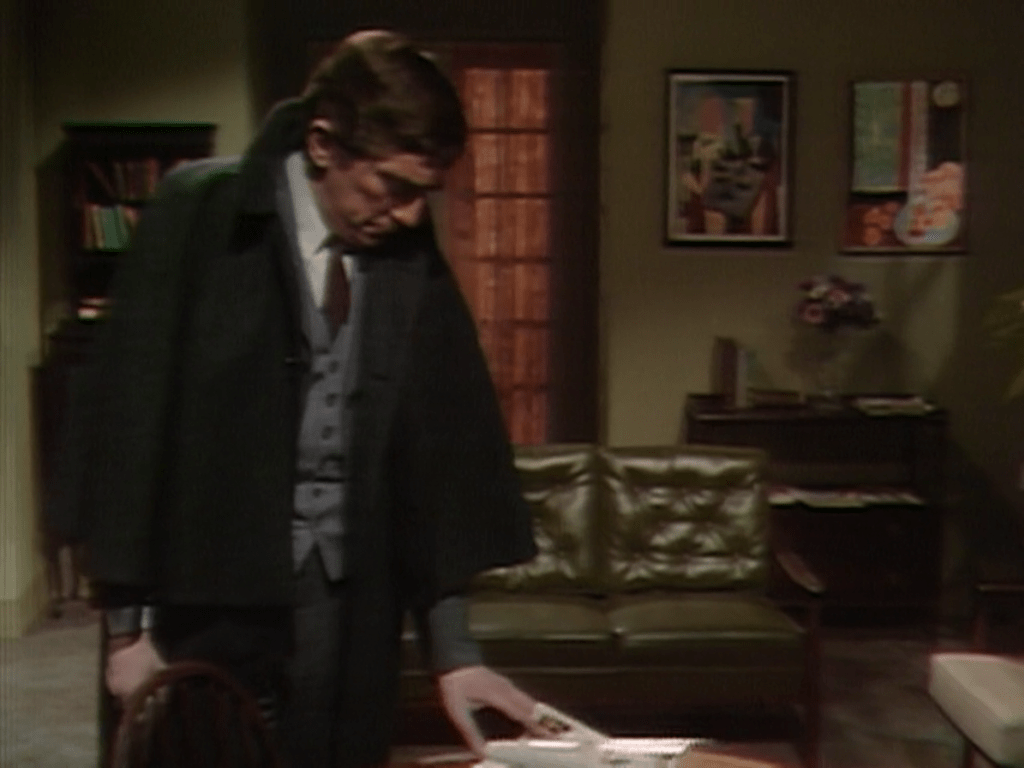
While Barnabas waits, a glossy magazine catches his attention. He picks it up and leafs through it. Since we are about to see Willie for the first time in several months, there is a good chance that this little bit of stage business will remind regular viewers of a peculiar remark Barnabas made shortly before the last time we saw Willie. Shifting the blame for his own crimes onto Willie, Barnabas planted Maggie’s ring in Willie’s room. When he came up with this plan, Barnabas remarked that the cheaper sort of tabloids say that criminals sometimes hold onto morbid mementos of their crimes, prompting us to picture Barnabas reading a cheap tabloid. That incongruous image comes to life here:
Julia joins Barnabas in the waiting room. They talk for a moment, then a nurse ushers Willie in.
At first, Willie is silent, a confused look on his face. He walks slowly towards Barnabas. Barnabas asks Willie if he recognizes him. In this moment we pick up exactly where we left off in #329, when Willie was a patient in another hospital and did not remember who Barnabas was.
This time Willie does recognize Barnabas. But as he did at the end of #329, he seems happy and untroubled. He is positively childlike in his eagerness to go back to Barnabas’ house and work for him again. He says that he and Barnabas were friends and that he always enjoyed their time together, a statement that dumbfounds Julia, as it dumbfounds anyone who remembers the show from April to September 1967. Even when Barnabas wasn’t bashing Willie across the face with his cane, Willie was miserable beyond words and hated everything Barnabas forced him to do.
Julia sends Willie back to his room, and Barnabas proclaims that Willie is entirely cured. Julia sarcastically thanks him for his diagnosis, calling him “DOCTOR Collins!” This too harks back to #329, which ended with Willie asking Barnabas if he were a doctor, to which Barnabas replied, “That’s right. I am a doctor!”
Barnabas takes Willie back to his house and tells him that for the time being, he must not so much as go outside by himself. Willie accepts Barnabas’ explanation that many people in the area will have to be prepared for his return before they see him. Willie gladly agrees to stay in the house. Barnabas leaves him alone, and he immediately slips out. He is heading for Maggie’s place.
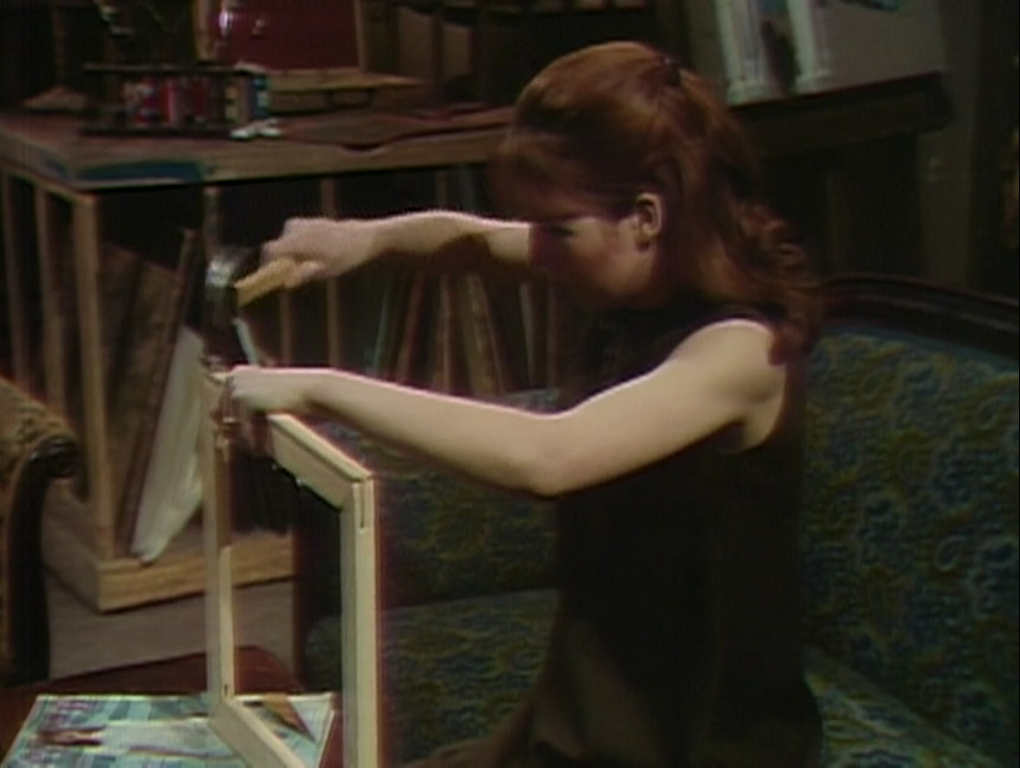
Maggie’s father Sam is a painter, a fact advertised by the canvases around the cottage they share. When we cut to the cottage, she is making a frame. This is rather an obvious visual metaphor. The last time Willie came to the cottage, he inadvertently framed himself for Barnabas’ crimes against Maggie.
Of course Maggie is horrified to see Willie at the door; of course she demands he leave; of course she threatens him with her hammer when he insists on staying and telling her he is innocent; of course she cries for help when her boyfriend Joe comes to the door; of course Willie runs off when Joe enters. Willie puts himself in the frame again, this time as an ongoing threat to Maggie and all the women of Collinsport.
Joe goes to Barnabas’ house and demands to see Willie. At first Barnabas plays dumb, but Joe doesn’t give an inch. Barnabas then admits that he persuaded Julia to let Willie out of the hospital, but assures Joe that Willie is no longer dangerous and tells him that he will see to it that Willie behaves himself. Joe says that Barnabas has already failed in his responsibility, since Willie just went to Maggie’s house and scared her. Joe says that he will kill Willie if he goes near Maggie again. He repeats that assurance, and his voice is pure steel.
Joe exits the house. We see him outside, walking away. Willie emerges from the shadows with a rifle. He takes aim at Joe and squeezes the trigger. The gun isn’t loaded, so Willie makes nothing more than a click. Apparently that was enough for him. He grins maniacally.
On their Dark Shadows Every Day, John and Christine Scoleri point out that the the gleeful face Willie flashes after he clicks his rifle at Joe is the same expression he showed in the frenzied crimes he committed before he came under Barnabas’ power. They back this observation up with a pair of screenshots, one of Willie immediately after he pretended to kill Joe, one from his last moment before he released Barnabas and lost his freedom:
Indeed, the whole episode replays Willie’s character arc from April to September in reverse. He starts as the crushed little thing we had seen at the end of #329, becomes Maggie’s tormented and misunderstood would-be protector, then ends as the dangerously unstable ruffian who followed seagoing con man Jason McGuire to town. If the episode were a few minutes longer, John Karlen might have had to take a break and let James Hall play the last scene. This recapitulation heightens the initial suspense generated by the question of how Willie would be after Barnabas had lost his vampire powers. Whatever effect the change in Barnabas has had on Willie has certainly not made him less complex or more predictable. We can’t tell when he is being sincere and when he is faking. Based on what we see today, it’s possible he is being sincere the whole time, but that he is just extremely impulsive, and equally possible that everything he does and says is a fake meant to cover up something we don’t yet know enough to guess at.
The actors are uniformly excellent today. John Karlen has to recreate the three faces of Willie in quick succession, and executes each of them clearly and memorably. Almost all of Grayson Hall’s dialogue is expository, but while delivering it she shows us all of Julia’s complicated feelings about Barnabas and lets us into her attempt to solve the riddle of his plans for Willie. Kathryn Leigh Scott is only on screen for a few minutes, beginning with her absorbed in carpentry and proceeding directly to screaming and running around and clutching at her male scene partners, but still makes it clear that Maggie is a strong and level-headed person who has been forced into frantic behavior by circumstances no one should have to face.
In the confrontation with Barnabas, Joel Crothers shows us a new side of Joe. Always loyal, always honest, always hardworking, Joe has up to this point been soft-spoken and self-effacing, deferential towards members of the ancient and esteemed Collins family. The only time he broke that deference was when he spoke some harsh words to matriarch Liz in #33, and he had to get thoroughly drunk to manage that. There is no trace of drink in him now, and he does not regard himself as anything less than Barnabas’ equal. For the first time since Burke Devlin lost his connection with the plot and shriveled so drastically that he ceased to be Mitch Ryan and became Anthony George, Dark Shadows has a plausible action hero in its cast.
The part of Barnabas is especially challenging today; he tries and fails to fool Julia in the beginning and Joe at the end, and in between may or may not have fooled Willie. So Jonathan Frid must show us what it looks like when Barnabas does an unsuccessful job of acting. He chooses to do that by having Barnabas overact. My wife, Mrs Acilius, pointed out that Frid’s own performance in the role of a man who is severely overacting is in fact exceptionally restrained and precise. Frid bobbles his lines as he usually does, but never makes a wrong physical move, and not for one second does he miss the perfect tone for Barnabas’ lines. The result is simply outstanding.
Like every episode of Dark Shadows, this one begins with a voiceover by a member of the cast. Unlike all the preceding voiceovers, this one is delivered by a man. Thayer David does the honors.
We open in the drawing room of the great house of Collinwood. For the first time in months, Barnabas Collins is there. Barnabas died and rose as a vampire in January, and has been concealing his existence since. But now his secret is known to several people in the house. One of those, his mother Naomi, reacted to the knowledge by taking poison. In his agony, Barnabas is pacing the floor, complaining to his friend, much put-upon servant Ben, that the doctor hasn’t come. Barnabas’ father Joshua comes downstairs and announces that there is no longer any need for a doctor- Naomi has died.
Joshua dismisses Ben and talks with Barnabas. He confesses his doubts that he is able to love anyone. Barnabas tells him that such a disability might save his life- the curse wicked witch Angelique placed on him means that everyone who loves him will die. Joshua says that he must end the curse, and will do so by destroying Barnabas. Barnabas asks if he will drive a stake through his heart. Joshua replies that he found a book in Boston that tells of another way. Come morning, he will fire a silver bullet through Barnabas’ heart.
This is the first we have heard that silver bullets will kill vampires. There is some lore that suggests vampires avoid silver, but we know that doesn’t apply to Barnabas- one of his chief trademarks is a cane with a mostly silver handle. The 1941 film The Wolf Man established silver bullets as a means of killing werewolves, and the Lone Ranger fires silver bullets to knock the guns out of the bad guys’ hands, so I guess they might have come to mind in the 1960s if you were thinking of exotic weaponry.
Barnabas has plans for his final night. It was naval officer/ sleazy operator Nathan Forbes who led Naomi to discover Barnabas’ secret, and who is to that extent responsible for her death. Ben enters to inform Joshua and Barnabas of another item to add to the list of Nathan’s misdeeds. Nathan has evidently apprehended bewildered time traveler Victoria Winters and taken her into town, where she faces death on the gallows after being unjustly convicted of witchcraft. The Collinses knew Vicki to be innocent and had been harboring her since shortly after she escaped from gaol. Joshua and Barnabas are certain that Nathan turned her in solely to collect the reward that has been posted for her capture. Barnabas vows to kill Nathan, and Joshua can’t talk him out of it.
We cut to Nathan in the Eagle tavern, where he is spending the money he sold Victoria for. The Eagle has changed pretty dramatically in the last several weeks. In #419, bartender Mr Mooney greeted a female patron with the announcement that the Eagle did not admit unaccompanied women. Since the Eagle is a public house on the waterfront, the management evidently thought this policy was necessary to keep the place from becoming a headquarters for the sex workers of Collinsport.
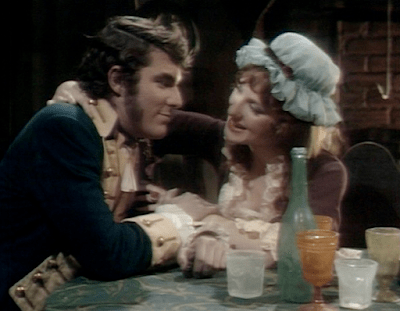
Now Mr Mooney is nowhere to be seen, and the only person in the barroom with Nathan is identified in the closing credits as “Barmaid.” She is played by Rebecca Shaw, whom we saw the other day as a streetwalker whom Barnabas was about to bite when good witch Bathia Mapes summoned him away with a magical incantation. She is sitting with Nathan, drinking with him, and flirting with him pretty heavily. A bat squeaking at the window frightens her, and when she catches her breath she announces that she will be leaving him alone in the bar for a bit while she lies down. Nathan replies to that by saying he will see her soon, and she turns to take a look at him, apparently expecting him to follow her to bed. It seems possible she is the same character who was working the docks, now employed in a similar capacity in the Eagle. If this is the person who has taken over from Mr Mooney, the management must have given up the hopes it formerly had for its reputation.
Once the woman leaves Nathan alone, Barnabas appears. He confronts Nathan about his many crimes. Nathan pulls a gun and tells Barnabas he will take him to the constable and turn him in as the Collinsport Strangler. Barnabas jeers. Nathan shoots, and Barnabas keeps standing there. He declares that Nathan cannot kill him, because he is already dead. He then informs Nathan that he will wait until 9 pm to kill him. Since it is now 8:30, this does not give Nathan a great deal of time.
At 8:45, Nathan appears at Collinwood. He finds Joshua and Ben in the drawing room, and tells them what has happened. They are neither surprised nor sympathetic. Joshua leaves the room, explaining that he would prefer not to see a gruesome murder. Ben is willing to stay for a while. When Nathan asks how Barnabas can be destroyed, Ben decides to have a little fun. He tells him that if he finds Barnabas resting in his coffin after sunrise and drives a wooden stake through his heart, that will take care of it. Ben is quite jolly when he points out that Nathan will be dead long before sunrise, so that this information would seem to be of little practical use to him. Ben then decides that he doesn’t want to watch the murder either, so he also takes his leave of Nathan.
With five minutes to go, Nathan tells himself that Barnabas will not kill him if Joshua is in the room. He finds Joshua in the study. He begs Joshua to stay. As Joshua is refusing, Nathan looks at the wall and sees a crossbow mounted there, with three wooden bolts next to it. Suddenly his cowardice gives way to wild hope. He tells Joshua he will wait in the study for Barnabas. Joshua goes.
Nathan takes a practice shot at the door, then stands waiting. Barnabas does open the door, Nathan does release another bolt, and does strike him in the chest, a bit to the left of the sternum. Barnabas cries out in pain, and as the episode ends it looks very much as if Nathan may have managed to stake him.
Barnabas is the reason the show is a hit, so we can be quite sure he won’t actually die. Still, the episode is good enough that it feels for a moment that he might. The contrast between the prospect of Joshua killing Barnabas in the stately manner he described earlier in the episode and the idea of Nathan killing him is instructive. Had Joshua carried out his plan or even attempted it, the result would have been what Aristotle was talking about in his Poetics when he described the majestic terror of tragedy. It would have been at once horrifying and awe-inspiring to see a father duty-bound to kill his son. But Nathan is a cheap bum, trying only to save himself so that he can live to abuse and exploit more people. When we root against Nathan destroying Barnabas, we do not want only to continue the pleasure of watching the show. We are rejecting a resolution that would be unworthy of what we have seen so far.
Nathan, indeed, is unworthiness incarnate. When he was first on the show, Nathan was a likable rogue, but in recent weeks he has become both cruel and dreary. So cruel that he has tried to arrange the murder of an eleven year old; so dreary that he works through a conspicuously dim-witted, relentlessly unappealing henchman. Many fans complain about Nathan’s turn, and some speculate that the show just ran out of villains sinister enough to be worthy of Barnabas’ vengeance. On that theory, Nathan’s grave crimes are a last-minute, slapdash invention.
I don’t agree. We met Nathan before Angelique came to Collinwood. In those days, there was room for light comedy, for grand gestures, for dashing heroism, for fairy tale whimsy, and for tender romance. But as her curses have done their work, everyone and everything has been ground down. The ceiling has been lowered, and there is no longer space for the bouncy good cheer of the Old Nathan, much less for the Satanic majesty of villains like Angelique or that Rev’d Mr Trask. The whole world is pervaded by cheapness and sordidness now, and growing more so by the minute.
The only grandeur left is in The Tragedy of Joshua Collins. Were Nathan to destroy Barnabas, that grandeur would vanish, not in sublime pity, but with a taunt. That would be a harsh ending indeed.
Naval officer/ sleazy operator Nathan Forbes seemed to have lost his best chance at getting rich quick when his fiancée, fluttery heiress Millicent Collins, discovered that he was already married when they got engaged. Since then, he has figured out that Millicent’s second cousin, Barnabas Collins, did not go to England as the family has been telling everyone, but that he is still lurking about the village of Collinsport and has murdered several people there. Among Barnabas’ victims was Nathan’s wife Suki.
Widower Nathan has a plan to profit from this information. Today, we see the first step in Nathan’s plan. He persuades his henchman, commercial mariner Noah Gifford, to wear a mask, carry Barnabas’ cane, and assault Millicent while he lies in wait. Apparently he will rescue her, and she will tell her family both that Nathan was the hero of the incident and that the attacker carried Barnabas’ instantly recognizable cane.
The whole episode is full of comic moments, and the climactic scene of the assault at the gazebo had my wife, Mrs Acilius, laughing out loud and making comparisons to A Funny Thing Happened on the Way to the Forum. That reaction shows that Nathan and Noah are a more successful rewriting of Dark Shadows‘ first seagoing con man, Jason McGuire, and his henchman Willie Loomis. Jason was supposed to be a comic villain, but the writers never gave him much that was funny to do or say. Actor Dennis Patrick was such a talented comic that he could pad his part with facial expressions, tones of voice, and gestures that got laughs, especially in his scenes with Willie. But it was never at all clear why he needed Willie, and most of the time he was on camera Jason was grinding the other characters down with a depressing blackmail scheme. But Nathan keeps scrambling to find his way into his marks’ good graces, and he and Noah get up to all sorts of high-jinks. Regular viewers will be happy to see a demonstration of what Jason and Willie might have been had Dark Shadows been able to employ a better writing staff in 1967.
Another major improvement over the period when Dark Shadows was set in 1966 and 1967 is the show’s use of Joel Crothers. He did what he could with the part of hardworking young fisherman Joe Haskell, but since Joe’s only note is earnestness he always winds up as less of a character than a function. But Nathan is always working an angle, is never quite predictable, and is tremendously fun to watch. The prospect of seeing Crothers return to the role of Joe is one of the major reasons the audience might want to prolong our stay in the eighteenth century.
Closing Miscellany
Noah remarks on one of the odd quirks of the Collins family when he mentions that the vacant Old House on their property is still full of all sorts of valuable objects. From the first week of the show, we’ve seen that disused parts of their estate are heavily stocked with high-priced antiques. This acknowledgement of the oddness of that fact leaves us wondering if the show is going to change it.
Today marks the only appearance on Dark Shadows of actress Charlotte Fairchild. Fairchild plays a downstairs maid who tells Millicent that a man has brought her a fan. Her angular figure and pale complexion made her a perfect choice to play an eighteenth century servant, and she does a fine job with the dialogue.
When well-meaning governess Vicki came unstuck in time and found herself in the year 1795, regular viewers of Dark Shadows could expect certain plot points to be resolved before she returned to the 1960s. We would learn how Barnabas Collins became a vampire, and how he wound up trapped in a chained coffin in the secret chamber of the Collins family mausoleum. We would learn how Barnabas’ little sister Sarah died. We would see Barnabas’ lost love, gracious lady Josette, marry his uncle Jeremiah Collins. We would see Josette jump to her death from the precipice atop Widows’ Hill. And we would see Vicki escape from some dangerous situation and find herself back in her own time.
Now, the only items on that list left unresolved are Barnabas’ chaining and Vicki’s return. The show has made it clear to people paying close attention how each of those events will happen, and they could fit them both into one episode. Into any given episode, in fact- they’ve given us all the foundation we need for both stories.
But they aren’t going home to a contemporary setting quite yet. The eighteenth century segment has been a ratings hit, Dan Curtis Productions owns the period costumes, and several fun characters are still alive. So they have decided to restart some storylines they had shut down earlier and to build up some new ones.
The main thing that happens today is the first step towards restarting an apparently concluded story. Fluttery heiress Millicent Collins had shared a series of wonderful comedy scenes with untrustworthy naval officer Nathan Forbes, become engaged to him, and discovered that he was already married to someone else. Since that discovery, Millicent has been grimly determined to exact revenge on Nathan, and the rest of the Collins family has regarded him with icy disdain.
Nathan has made a discovery of his own. He has learned that Barnabas did not go to England, as his family has been telling everyone, but that he is still in Collinsport, and is the serial killer preying on the young women of the town. Last week, he made it clear to the audience he had a plan to turn this information into money, apparently by blackmailing the Collinses. Today, we learn that his plans are more complicated, and involve a renewal of his relationship with Millicent. Late at night, he shows up at the lodgings of a visiting witchfinder, the Rev’d Mr Trask. He asks Trask to take a letter to Millicent.
Trask does not want to let Nathan into his room, since the corpse of a prostitute is sprawled across his bed. She is Maude Browning. Barnabas murdered her in Friday’s episode. As part of his campaign to make life difficult for Trask, he deposited her remains at his place.
Nathan won’t take no for an answer, so Trask throws a blanket over Maude and lets him in. Nathan notices Maude’s arm sticking out from under the blanket and is delighted to think that Trask is not the fanatical ascetic he seems to be. Trask breaks down and starts telling Nathan what happened. He tells him that he was astounded to find Maude’s body on his bed, and he asks him to help get rid of it. Nathan agrees to do so on condition he deliver the letter to Millicent.
We then cut to the great house at Collinwood, where Millicent is studying a layout of Tarot. All the Dark Shadows fansites point out that Millicent misidentifies the Queen of Cups as the High Priestess. This is not the fault it is often made out to be. On Dark Shadows Before I Die, Christine Scoleri reminds us that the Countess DuPrés made the same mistake in #368. Since the countess introduced the Tarot to Collinwood and presumably taught Millicent how to read the cards, it would have been a break in continuity had she called it anything else.
Millicent looks at the cards and addresses the absent Nathan, telling him that she is filled with hatred for him and that he faces certain destruction as punishment for his mistreatment of her. Naomi Collins, mistress of the house, enters and asks Cousin Millicent to whom she is speaking. When she answers that she is talking to Nathan, Naomi tells her Nathan is not there. Millicent replies that he does not need to be present to hear her voice. Since Barnabas was able to magically project his own taunting voice across space into Trask’s hearing in Thursday and Friday’s episodes, this claim of Millicent’s has a curious resonance for returning viewers.
Trask shows up with Nathan’s letter. He wants to meet with Millicent alone in the drawing room to give it to her, but Naomi insists on being present. They stay in the foyer. When Naomi forces Trask to tell them that the letter is from Nathan, Naomi takes it and tears it to pieces. Millicent says that she approves of Naomi’s action, but we can see a flicker in her eye and hear a quiver in her voice that suggest the hatred of Nathan she spoke of a few minutes before may not be quite so undiluted as she would like to believe. Trask leaves the house, Naomi leaves the foyer, and Millicent gathers up the shredded pieces of the letter.
Back in his room, Trask goes to sleep. He has a dream. The dream sequence begins with an image reminiscent of pieces moving in a kaleidoscope.
That kaleidoscopic pattern was part of a visual effect we saw when Dark Shadows was still set in 1967. That effect introduced scenes that took place in #347, #352, and #354, when mad scientist Julia Hoffman hypnotized Vicki and took her to the Old House at Collinwood. At Collinwood, Barnabas’ helper Carolyn spotted Julia and Vicki, putting Julia in great danger.
The echo of those episodes is startling coming on the heels of the scene we just saw, in which Millicent figures as a student of the countess. Julia and the countess are both played by Grayson Hall, and Millicent and Carolyn are both played by Nancy Barrett. The relationships between their characters are different now, shifted as the colored pieces shift in a turning kaleidoscope. But remembering those earlier episodes, we might remember that what is seen in a semiconscious state might be a message sent to manipulate and deceive, and we certainly remember that people who go to the Old House are in danger from Barnabas.
Trask’s dream brings him face to face with the ghost of Maude, accusing him of having her remains dumped in the sea, so that she cannot rest. She predicts that everyone will learn that her dead body was in his bed. He denies both her accusation and her prediction, but does not convince either her or himself.
Another ghost then appears. It is that of Trask’s great supporter, repressed spinster Abigail Collins. Trask tries to tell Abigail that he is innocent of Maude’s charges, but she tells him she has no idea what he is talking about. She wants to tell him that there is a great evil he must destroy. Trask has a vision telling him the evil is lurking in the Old House. He resolves to go there.
All of the acting is excellent in this one. That’s no more than we would expect from most of the cast members we see today, but Vala Clifton’s two turns as the living Maude were pretty bad, so that it is a pleasant surprise that she is so good as Maude’s ghost. The physical space gives her a hard job. She is standing a very few feet in front of Jerry Lacy with only a couple of wispy stage decorations indicating that she is separated from him, but she strikes a pose and maintains a degree of stillness that really does create the sense that she is speaking to him from another realm. She also manages to keep up an ethereal quality while making it clear that Maude is determined to be avenged. I wonder what her first appearances would have been like if she had had more time to rehearse. If they had been as good as this one, Ms Clifton and Maude would be among the more fondly remembered parts of the eighteenth century segment.







 Dark Shadows Commentary