Suave warlock Nicholas Blair is lounging in his living room, blissfully contemplating the imminent success of all his evil plans. An unexpected visitor arrives. He is Adam, a Frankenstein’s monster whom Nicholas has been teaching to adopt a cruel and amoral code of extreme egoism. Adam is under the mistaken impression that recovering vampire Barnabas Collins created him, and he wants Barnabas to create a mate for him. Much to Nicholas’ approval, Adam abducted well-meaning governess Vicki Winters and told Barnabas he would kill her unless he gave in to his demands. Nicholas has Vicki stashed in a room in his attic.
Adam is bringing news Nicholas does not welcome. Adam’s former mentor, Professor Timothy Eliot Stokes, visited him in his hiding place. Barnabas had told Stokes of Adam’s threats against Vicki. Stokes tried to talk Adam into letting Vicki go. His last appeal was to ask the big guy to imagine how he would feel if someone were holding his favorite person, heiress Carolyn Collins Stoddard, and threatening to kill her if his demands weren’t met. That got through to him. He has come to tell Nicholas that they must release Vicki.
Nicholas asks Adam why he finds Stokes’ arguments convincing. Adam finally says that by making the comparison between Vicki and Carolyn, Stokes made him feel bad. Nicholas seizes on this, and says that those bad feelings are not evidence of any truth about the situation, but are just something Stokes imposed on him by trickery. Nicholas’ dismissal of conscience as a product of other people’s influence rather than an intuitive source of knowledge sounds rather like one of the crass immoralists Socrates shoots down in Plato’s dialogues, or like a simplified version of the criticisms of conventional morality with which thinkers like Marx, Nietzsche, and Freud scandalized the late nineteenth century.
Adam goes back to Barnabas’ house and repeats his demand. Barnabas and his friend, mad scientist Julia Hoffman, waver. Barnabas finally agrees to try to build a woman for Adam, but only after he sets Vicki free. The big guy thinks about it for a moment, then agrees. He tells Barnabas that if he backs out of his part of the bargain, he will not only find Vicki again and kill her, but that he will murder everyone who bears the name of Collins. Since that includes Carolyn, it would seem that Nicholas’ teachings have had a very profound influence on him indeed.
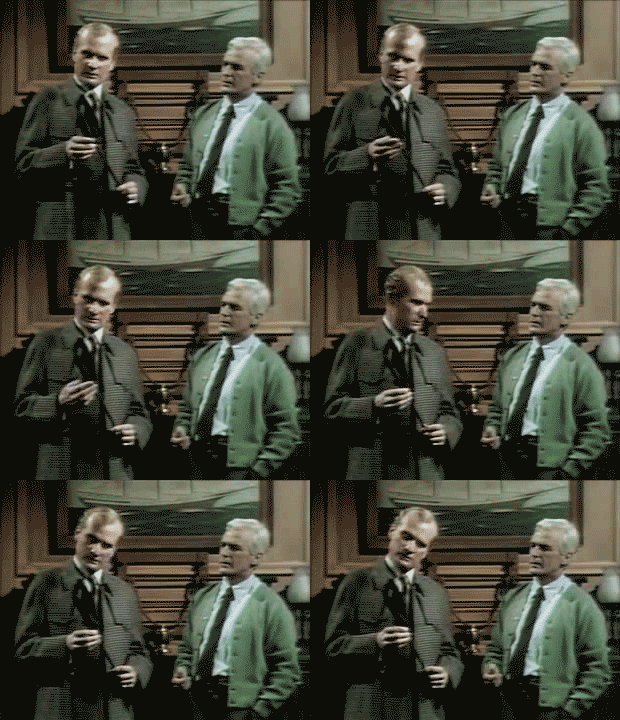
Christine Scoleri of Dark Shadows Before I Die dramatized Stokes’ and Nicholas’ competing attempts to influence Adam with this image:
Wicked witch Angelique defied her supervisor, suave warlock Nicholas, one too many times. Yesterday, Nicholas stripped Angelique of her powers, including her immunity to aging. Since she is 194 years old, this leaves her with a sharply limited future.
Today, Nicholas tells Angelique he will think of sparing her from her imminent demise if she can persuade recovering vampire Barnabas to forgive her for her extreme abuse of him and of everyone he has ever cared about. She goes to Barnabas and begs him for forgiveness. Barnabas replies that when he asked her for forgiveness, she responded by turning him into a vampire. He does show signs of concern for her, but cannot pardon everything she has done. He specifically mentions The Dream Curse, a three month storyline that not only brought great suffering to him and a dozen other characters, but which also made the audience miserable. She dies.
Nicholas’ only acknowledged motivation to this point has been a selfless devotion to evil for its own sake. That makes it odd that he would place a value on forgiveness. Dark Shadows is pervaded with ghost stories, and ghost stories are, first and foremost, explanations of how unresolved conflicts in the past can poison relationships among people in the present. It is also a soap opera, and the biggest events in soaps are changes in the way particular characters feel about each other. So both genres tend to elevate forgiveness, not only as a virtue, but as the highest form of The Good in human life. We saw this in the first year of the show, when well-meaning governess Vicki kept forgiving strange and troubled boy David for his attempts to kill her, acts of forgiveness which culminated in #191 when David ran from the mother who was trying to lure him to his own death into Vicki’s arms and an acceptance of life. Two weeks later, in #201, dashing action hero Burke closed another narrative thread left over from episode #1 when he forgave sarcastic dandy Roger for an old grievance he had against him. With those events, it was pardoning that cleared the flotsam left over from Dark Shadows 1.0, paving the way for the introduction of Barnabas and the advent of Dark Shadows 2.0.
Perhaps Nicholas was so certain Barnabas would not be able to bring himself to forgive Angelique in the time available before her death that making her beg for forgiveness was his way of perverting the world’s best thing into yet another instrument of cruelty. Certainly he suggests this interpretation when he introduces the idea with a laugh and a comment that he might find it “amusing.”
When Nicholas stands over Angelique’s corpse, he tells her that her own hatred had made it impossible for Barnabas to forgive her because it had “become too much a part of him.” That Angelique’s hatred became a part of Barnabas rings a bell for longtime viewers. The show has always depicted supernatural beings, not as self-contained individuals, but as complexes of phenomena that operate more or less independently, often without each other’s knowledge, sometimes in pursuit of mutually exclusive goals. For example, in 1967 the ghost of Barnabas’ little sister Sarah visited David during the day and tried to prevent him finding out Barnabas was a vampire, but she also appeared to David in a dream and showed him everything the daytime ghost wanted to keep hidden. When David told the Sarah of the waking hours what her dream visitation form had shown him, she was horrified and forbade him from following up on any of that information.
When Angelique places a curse, she sometimes seems to create a little version of herself, give it possession of the person she is targeting, and turn it loose in the world. Sometimes that little Angelique turns against her. For example, she raised the body of Barnabas’ uncle Jeremiah from the dead to use for her own nefarious purposes, only to find that it would not return to its grave when she was finished with it. When Barnabas was a vampire, he had some obsessions that were strikingly similar to obsessions Angelique had shown. So Angelique wanted Barnabas to love her, and had the power to cast a spell that would make him do so, but instead wrought immense havoc on everyone else with one wild scheme after another, because she wanted him to come to her “of his own will.” Likewise the vampire Barnabas wanted to make Vicki his victim, but passed up one opportunity after another to bite her because he wanted her to come to him “of her own will.” That similarity is so close that it makes us wonder if the Barnabas we first met was simply Angelique in disguise. Not only her hatred, but all of her quirks had become part of him.
Angelique came from the 1790s to 1968 by some magical process that involved a portrait of her that is now on a stand in Vicki’s room. Today she uses a secret panel to let herself into the room and look at the portrait. We first saw that panel open when the show was a costume drama set in the 1790s. The room was occupied then by gracious lady Josette, and it was the vampire Barnabas who used the panel to enter. We haven’t seen the panel since, leaving it strongly associated with Barnabas in the minds of regular viewers. Angelique’s use of it today further suggests her identity with him when he is in his vampire state.
Recovering vampire Barnabas Collins is dead, and this time it seems like he might stay that way. At least it seems so to his friend Julia Hoffman, MD, and his servant Willie Loomis; they’ve buried him, and are talking about what to do next. Julia decides they should tell people Barnabas went on a long trip, and that they themselves should leave the area before dawn. They will go to a sanitarium called Windcliff. Julia will resume her duties as its chief, while Willie will take a job there doing whatever he can handle.
Julia orders Willie to pack his things; he asks if he should pack Barnabas’ things also. Julia is impressed that Willie thinks of this. Perhaps he is remembering his onetime friend Jason McGuire, whom Barnabas killed in #275. Jason was hated by all and was under orders from the sheriff to leave town when he fell afoul of Barnabas, and so it was easy for everyone to assume he had simply gone away. Still, in #277, sarcastic dandy Roger wondered why Jason hadn’t taken his clothes or his shaving kit. No one ever tried to tie up that loose end, but perhaps Willie learned of the problem and made a note of it for the next time he had to conspire to conceal a death.
Willie goes directly from Barnabas’ freshly dug grave to Maggie Evans’ house. Willie has an unwholesome preoccupation with Maggie. Longtime viewers will remember Willie’s menacing approach to her in #202 and #207, before Barnabas got hold of him and turned him from a dangerously unstable ruffian into a sorely bedraggled blood thrall; those who are mindful of the period when Dark Shadows first became a hit will remember May and June of 1967, when Maggie was Barnabas’ prisoner and Willie tried desperately to lessen her suffering; and first time viewers will be startled by the beginning of the scene, when we see Willie peeking through the window at Maggie. When Barnabas’ vampirism went into remission, his former victims tended to return to the personalities they had before he bit them. Willie has not quite become the rapey goon he was in his first two weeks on the show, but neither is he the first man a woman would choose to be alone with.
Willie!
Since she is The Nicest Girl in Town, Maggie has long since forgiven Willie what he did when he first came to Collinsport. And Julia used a magical version of hypnosis on Maggie to induce amnesia covering the whole period of her involvement with Barnabas and to leave her with warm feelings of goodwill for him. But it’s late at night, so when Willie knocks, she is reluctant to let him in. He insists, and she relents.
Willie tells her he will be going away soon to take an exciting new job. Maggie says that she is sure everyone will miss him. At first he repeats the story that Barnabas is going away on a long trip, but then he starts crying. When Maggie asks why, he tells her Barnabas has died. He asks her to keep this secret, but the most she will agree to do is to wait until he leaves town to start talking about it.
Meanwhile, Julia has gone to the great house of Collinwood, where she has been a houseguest for about a year. Before she goes upstairs to pack, she stops and tells Roger’s wife Cassandra that Barnabas is dead.
Julia knows that Cassandra is actually Angelique, the wicked witch responsible for Barnabas’ woes. It would seem that the whole point of covering up Barnabas’ death would be to keep Angelique/ Cassandra from finding out about it. Yet Julia not only goes out of her way to tell her, she also declares to her that she will continue to fight against her.
Angelique/ Cassandra spits out that Julia is in love with Barnabas, to which Julia replies “Not nearly as much as you are.” For some time, the show has been developing the theme that Julia would like Barnabas to be her lover. In their post about the episode on Dark Shadows Before I Die, John Scoleri said “So Julia’s true feelings are finally on the table.” To which Christine Scoleri replied, “Where have you been? Julia’s feelings have been on the table, the wall, the floor…pretty much everywhere for a long time.”
Willie’s visit to Maggie and Julia’s to Angelique/ Cassandra mark a difference between the first year of Dark Shadows and its later phases. When the show started, the characters were too good at keeping secrets, with the result that very little happened. They took this to such an extreme that one of the two principal storylines with which the show began- well-meaning governess Vicki’s attempt to find out who her parents were- died out altogether because reclusive matriarch Liz and her lawyers, the only characters who knew anything about it, would never talk.
Now, the characters involved in the action don’t keep secrets from each other at all, with the result that events comes thick and fast, but it is hard to build complex alliances or to explore nuanced relationships. They still conceal information from Vicki, Liz, Roger, and other characters left over from the early days, rendering them background figures with little to contribute to the story. Video game enthusiasts might call them “NPCs”- non-player characters.
Professor Timothy Eliot Stokes, occult expert, enters. Stokes tells Julia that a man named Adam appears to be dead. Julia goes with him to an abandoned shack in the woods where she examines Adam’s body and pronounces him dead. When Stokes tells her that Adam exhibited sharp pains in his neck starting at about 11 PM, that he called out for Barnabas, that his strength appeared to ebb for no apparent reason, and that he then died, Julia’s eyes widen. Suddenly Adam comes back to life. He starts gasping for air and miming a struggle against an invisible barrier just above his face. Julia tells Stokes she will have to go. He protests that she must stay with her patient. What she says next doesn’t mean much to Stokes, and would mean less to a first-time viewer:
JULIA: He is suffocating- I may know why. No, it’s impossible! But it may be that they are the same. Experiment- perhaps Adam is why-
STOKES: What are you talking about?
JULIA: Barnabas- I buried him- alive!
Regular viewers know that Adam is a Frankenstein’s monster created in an experiment begun by mad scientist Eric Lang. Shortly before he died of wounds inflicted by Angelique/ Cassandra, Lang recorded an audiotape in which he explained that as long as Adam lives, Barnabas’ vampirism will remain in remission. Julia has not heard that tape, but the audience has, time without number. We also know that when Barnabas was sealed up in a wall from #512 to #516, Adam experienced the pains that Barnabas suffered. In these lines, we see Julia for the first time beginning to understand the true nature of the connection between Adam and Barnabas.
Stokes’ approach to Julia is as indiscreet in its own way as were Willie’s to Maggie and Julia’s to Angelique/ Cassandra. Adam hates Julia and Barnabas, because they abused him shockingly in his first weeks of life, and forbade Stokes to bring her. Julia’s closing outburst is also an extreme indiscretion, as Stokes is basically a law-abiding person who could not be expected to help Julia and Willie cover up their many crimes. Again, we have come a long way from the days when the show would drop a major story rather than have a recurring character breach attorney-client privilege.
Like the Scoleris, Danny Horn was in good form when blogging about this part of the show. His post on Dark Shadows Every Day about this episode makes a number of penetrating observations about the connections between Julia and Willie’s opening scene at the grave and absurdist plays like Waiting for Godot and Rosenkrantz and Guildenstern are Dead.
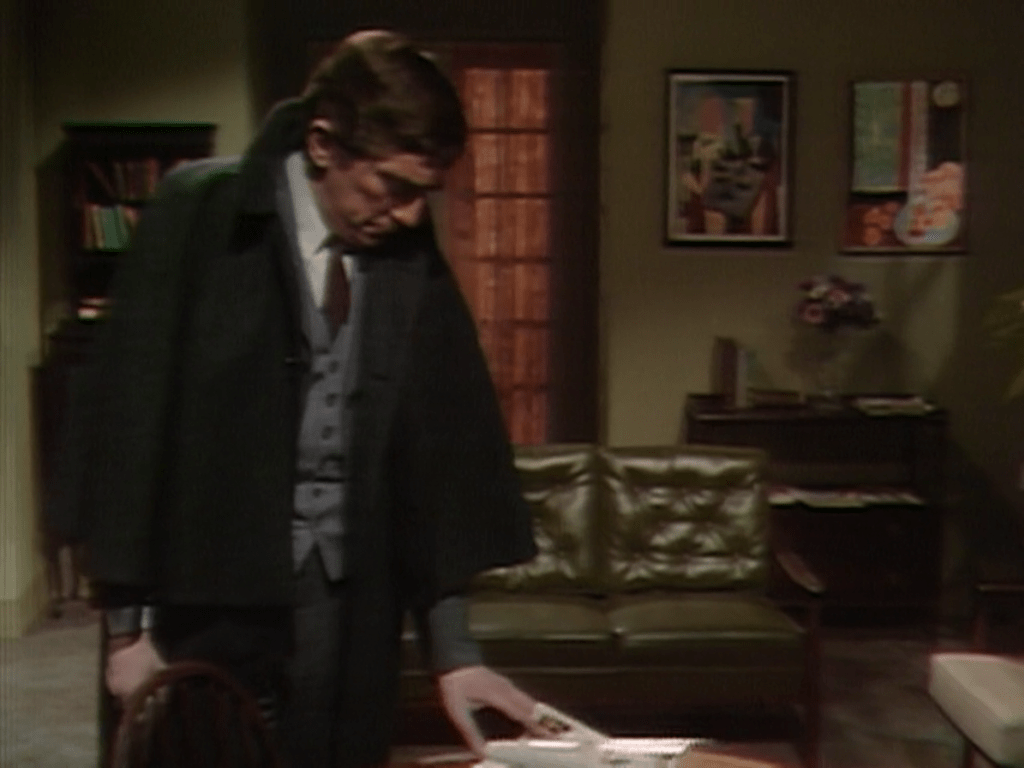
This was the second of five episodes credited to director John Weaver. One possible reason he wasn’t contracted to do more is seen in the first minute, when recovering vampire Barnabas crouches down to lift a paper from the floor. The camera lingers on the show’s biggest star in this ungainly posture.
The latest installment of our occasional series of photos, “Sex Symbols of the 1960s.”
The paper is a note in the handwriting of well-meaning governess Vicki. It says that Vicki wants to go away rather than tell Barnabas about a dream she had. It ends with the declaration that Vicki would “rather die” than hurt Barnabas; he jumps to the conclusion that this means she is about to commit suicide, and he rushes off to the great house of Collinwood to stop her.
Barnabas and Vicki know what regular viewers also know, that her dream was no ordinary nightmare, but was the penultimate event in the “Dream Curse” that the wicked witch known variously as Angelique and Cassandra has set as part of her quest to destroy Barnabas. Each of an appallingly long list of characters has the same dream and suffers terrible torment that can be relieved only by telling it to the next person in line, who repeats the process. Vicki knows that when the dream gets back to Barnabas, Angelique/ Cassandra’s goal is supposed to be complete. Vicki thinks that goal is Barnabas’ death; he and we know that it is his relapse into active vampirism.
Barnabas’ interpretation of “I’d rather die than do that” as Vicki saying she is going to kill herself may seem silly to first-time viewers, but those who have been watching Dark Shadows from the beginning will see some grounds for it. In #2, Vicki was standing on the cliff of Widows’ Hill when sarcastic dandy Roger startled her by asking if she was planning to jump; he went on to tell her that she wouldn’t be the first to end her life in that way. In #5, drunken artist Sam saw her in the same place and told her the story of gracious lady Josette, who apparently was the first to do so. In the months that followed, we several times heard of a legend that governesses kept jumping off the cliff. Throughout the first year, Vicki came to be deeply involved with the ghost of Josette. When Barnabas joined the show, Josette was retconned as his lost love, and her suicide as her response to his vampirism. So Vicki’s connection to Josette, her job as a governess, her affection for Barnabas, and her involvement in a crisis about his curse combine to prompt him to think of her as a likely suicide.
When Barnabas gets to the great house, Vicki tells him she did not write the note. They figure out that it was a forgery by Angelique/ Cassandra, meant to bring Barnabas into contact with Vicki so that she would have an opportunity to tell him the dream. Barnabas goes, and permanent houseguest Julia, who is Barnabas’ best friend and partner in crime, talks with Vicki about the dream.
Later, Julia goes to Barnabas’ house, and he tells her that he cannot let Vicki go on suffering for his sake. He says that he will make her tell him the dream to end her suffering. Julia points out that this will make him a vampire again, and he says he will just have to accept that.
Barnabas laments his own past selfishness throughout this scene, but his willingness to revert to vampirism suggests that he has learned nothing. He will not be the only one who suffers if that condition reoccurs. Vicki herself was his victim when his blood-lust went into remission, and there is no telling how many other people he will bite, enslave, and kill if he reverts. That he can strike a noble pose while claiming that he is going to sacrifice himself for Vicki creates an image of total narcissism.
Meanwhile, heiress Carolyn learns that a very tall man named Adam is still alive and is being hunted by the police. Adam abducted Carolyn and held her prisoner in an old shack in the woods some weeks before, but later saved her life. What she does not know is that Adam is a Frankenstein’s monster and that before she met him, he had spent virtually his whole conscious life chained to a wall in a prison cell in Barnabas’ basement. As far as he knew, holding each other captive was just how people behaved. In those days, Adam spoke only a few words, and could not explain this to Carolyn. But she did find a gentleness in him, and even while she was his prisoner she never hated him.
Now, Carolyn is very concerned about Adam’s well-being. She goes back to the old shack in the woods and finds him hiding there. She discovers that he has learned a great many words since she knew him; he confirms that Professor Timothy Eliot Stokes had been harboring him and teaching him. She goes off to get Stokes, promising to bring him back so that he and Adam can reconnect.
In the discussion following the recap of this episode on Dark Shadows Before I Die, Christine Scoleri remarks on Carolyn’s “Frankenfantasy date with Adam.” That was the first I’d seen the expression “Frankenfantasy,” or had thought that enough people harbored erotic feelings about Frankenstein’s monster that such a term would be necessary.
Amused as I am by the word “Frankenfantasy,” I really don’t think it applies to Carolyn. But since she is the only woman with whom Adam has ever had a conversation, it makes sense that he might interpret her behavior that way. As my wife, Mrs Acilius, pointed out, that would continue theme that has been developed among the other male and female characters who interact in the episode. Barnabas sees Julia as a close friend, and she wants him to be her lover. Barnabas and Vicki share a real affection, which he has a vague idea of converting into a romance, but there is zero erotic chemistry between them. If Adam mistakes Carolyn’s earnest friendship for sexual desire, he’ll fit right in.
Yesterday, recovering vampire Barnabas opened the door to his closet. Hardworking young fisherman Joe fell out, and Barnabas saw Frankenstein’s monster Adam at the window, laughing menacingly. Adam has many reasons to hate Barnabas, and Barnabas concludes that Adam wants to frame him for the murder of Joe.
A commenter on John and Christine Scoleri’s Dark Shadows Before I Die, posting under the name “Grant,” pointed out that in Mary Wollstonecraft Shelley’s novel Frankenstein the Creature kills someone and frames one of Frankenstein’s closest friends for the crime. The reference seems to be pretty obvious.
Barnabas’ friend, mad scientist Julia, shows up. She finds that Joe is not dead. She says that he has, in a bit of Collinsport English we have heard once or twice before, “a pulsebeat.” She and Barnabas have a long conversation about a variety of topics, several of them highly incriminating, while Joe lies on the floor. Julia goes off to attend to another matter, and Barnabas’ servant Willie comes. Joe is still on the floor while Willie argues against Barnabas’ orders to take Joe to the hospital. Barnabas, who had told Julia that Adam must have “wanted Joe to be found here,” dismisses Willie as “absurd” when he says that Adam is trying to frame them.
When Willie was first on the show, he was a dangerously unstable ruffian who was determined to rape all the young women and beat up their boyfriends. In #210, he accidentally released Barnabas, who enslaved him and turned him into a nice guy. Now that Barnabas’ vampirism has gone into remission, Willie has taken several steps back to his old ways. He whines that if Joe dies, his fiancée Maggie might turn to him. Barnabas finds this idea “insane,” and Willie tells him that Maggie has recently stopped by the house and talked to him more than once. This is true, and Barnabas’ reaction makes it clear that it is the first time he has heard it. He responds that he is not interested in discussing Willie’s “mental aberrations,” and tells him that if Joe dies he will tell the police about Willie’s interest in Maggie. That leaves Willie no choice but to help get Joe to the hospital.
Julia has gone off to see well-meaning governess Vicki. Vicki is about to have a nightmare that is part of the “Dream Curse.” Three months ago, wicked witch Angelique decreed that one person after another would have the same dream. After Vicki has it, the dream will pass to Barnabas, and Angelique means for it to reactivate his vampirism. Vicki doesn’t seem to know that Barnabas was a vampire, though she has had many clues, as for example when he kept biting her and sucking her blood. I suppose she just thought he had a really aggressive make-out technique. But she does know that Barnabas is supposed to die if he has the dream.
Julia urges Vicki to come with her to Windcliff, a sanitarium she runs, and promises that she will get the best of care there. But she finds that Vicki is resigned to having the dream. Julia reports this to Barnabas, and tells him that she wants to go away with him, far away from Vicki. Vicki can’t pass the dream to Barnabas unless she describes it to him after she has it, and she won’t be able to do that if she can’t find him. Barnabas refuses to go, reminding Julia that those who have the dream suffer terribly until they pass it on to the next person. When he says “You know how I feel about Vicki,” Julia gets a brief closeup, and her reaction reminds us that she is supposed to be harboring an unrequited love for Barnabas. This is rather an easy point to forget. Barnabas and Julia spend all their time together and tell each other all their secrets. Since there doesn’t seem to be any such thing as sexual contact in the world of Dark Shadows, it’s hard to see how her feelings could be much more requited.
Julia urges Barnabas to run away with her.“You know how I feel about Vicki.”
Vampires are metaphors for extreme selfishness, and Barnabas usually plays to type. It is startling that he tells Julia that any part of his motivation for sticking around is his wish to spare Vicki suffering. But he also talks about his long vain struggle against Angelique in terms that immediately make it clear that whatever goodwill he might have for Vicki is a distant third behind his usual ruling passions, self-pity and laziness, but still, her well-being is among his considerations. That sets him apart from her ostensible boyfriend, a man variously known as Peter and Jeff. As Christine Scoleri points out on Dark Shadows Before I Die, Vicki might never have had the dream at all if Peter/ Jeff hadn’t refused to listen to her explanation of the curse and insisted that she stay where he could visit her easily, yet now that she is suffering from the dream and its effects he is nowhere to be seen. Christine speaks for all of us with her summary of Peter/ Jeff’s character- “What a louse!”
Vicki has the dream. Barnabas beckons her into the haunted house attraction where the bulk of it has always taken place before. She keeps telling him that she doesn’t want to have the dream, not for her sake, but for his. She opens three doors that show Halloween gimmicks we’ve seen before, then opens a fourth behind which she sees the Sun. The Sun shrinks into the distance, and she walks through the door, following it. Her face dissolves into an image of the Sun; the Sun dissolves to the exterior of Barnabas’ house. We cut to the interior, looking at the doors. A small dot of Sun appears there. It expands until it fills most of the screen. The doors open, and the Sun gives way to Vicki. She enters, and sees Barnabas lying on the floor by his desk. He is bleeding from two small wounds on his neck.
Part of the dream is a bit of doggerel that has never made much sense. The last lines are “Ahead a blazing light does burn, And one door leads to the point of return.” These lines are almost explained today. Each door exposes a symbol of something that is frightening either to the dreamer or to Barnabas or to both. Vicki isn’t afraid of the Sun, but she knows that Barnabas has a strange and intense relationship with it. In #277, he harangued her about his hatred for the Sun; in #347, he made plans with her to watch the Sun rise, plans which he had to break under very strange circumstances in #349. So now we know that the “blazing light” is the Sun, which vampires cannot withstand.
Of the ten characters who had the dream before Vicki, only strange and troubled boy David, her charge and dear friend, was able to walk through any of the doorways. In his case, he walked into a gigantic spider web and was caught there, just a few feet beyond the entry. But Vicki is on the path that “leads to the point of return,” and she goes to a different set altogether.
Had Barnabas’ introduction not brought a new audience to the show, Dark Shadows would probably have been canceled in June 1967. In that case, the final episode would have been #260, and it surely would have ended with Vicki, who was in those days the show’s main character, driving a stake through Barnabas’ heart. That she and the Sun overlap in the same space on the screen suggests that by passing the dream to Barnabas she will fulfill her original destiny and become his destroyer.
When Vicki looks into the parlor and sees Barnabas bloodied and lying on the floor by his desk, we are reminded of #405. In that episode, we saw that Angelique originally turned Barnabas into a vampire by sending a bat to bite him in this room. At that time, he fell, not by his desk, but by the staircase. That’s very close to where Joe was lying for the first half of the episode, so they have to do some rearranging to avoid suggesting an identity between them. Barnabas’ vampirism is so much the foundation of the show’s success that virtually everyone in the audience expects him to relapse sooner or later, but they are being careful not to raise the question of whether Joe will also join the ranks of the undead.
Until the dream, the episode is made up of long scenes with a great deal of dialogue. That isn’t unusual for Dark Shadows. It is unusual that the scenes play out with very little background music. I wonder if director Jack Sullivan decided that a spare sound design would set the right mood for the very ambitious dream sequence. I think it paid off- the dialogue scenes felt slow, but Vicki’s dream achieves the surrealistic quality it needs.
One of the main themes Danny Horn developed on his blog Dark Shadows Every Day was his ridiculously exaggerated impatience with the character of Vicki and his severe bias against Alexandra Moltke Isles’ acting. That gave me something to talk about in his comments section, and was part of the reason I started this blog. Danny’s post about this episode very nearly makes up for his incessant Vickiphobia. He alternates stills of Vicki with epigrams written in her voice, and the result is just magnificent, worth anyone’s while to read.
Beginning in #365, well-meaning governess Vicki Winters spent nineteen weeks in the 1790s. Ever since Vicki brought Dark Shadows back to a contemporary setting in March 1968, the show has been dealing with the consequences of her journey.
Today, we open with a dream sequence. The boyfriend who followed Vicki from the 1790s, a man named Peter, came to the twentieth century with total amnesia and a belligerent personality that kept him from listening when Vicki tried to explain who he was. His dream is about people and events from 1796, and it finally breaks down his insistence that he is someone else. That insistence was never at all interesting- it wasn’t as if his name were Watt Iduno Hu, in which case he and Vicki could at least have done a version of Abbott and Costello’s “Who’s on First?” But now that it is over, there are no obstacles at all between Peter and Vicki, and no reason for either of them to be on the show.
Meanwhile, suave warlock Nicholas Blair has carried a portrait of wicked witch Angelique from the bedroom where he is staying in the great house on the estate of Collinwood down to the drawing room. He makes a tremendous display of effort as he concentrates on the portrait, talks to it in an urgent voice, and makes many movements with his hands, all in an attempt to make contact with Angelique’s spirit so that he can reconstitute her body. Vicki walks in on him as he is doing this, and he breaks off, embarrassed. He finds out that Vicki owns the portrait, and she refuses him permission to borrow it.
Nicholas caught in the act.
Later, Nicholas finds out about Vicki’s visit to the 1790s. He is intrigued that in those days the same witchfinder who has disincorporated Angelique mistook Vicki for a witch and tried to perform an exorcism on her. He decides that the spot on which this rite took place must be the same as that where Angelique’s ashes are now deposited. So he casts a spell on Vicki, causing her to lead him to the place.
Other fansites feature complaints that Nicholas could just have cast a spell on Vicki during their first scene together. In his post about the episode on Dark Shadows Every Day, Danny Horn writes of their first scene that “Nicholas actually has the power to mesmerize Vicki and get her to do whatever he wants, so technically he could just put the whammy on her right now, and tell her to clear the room.” And on Dark Shadows Before I Die, Christine Scoleri wonders “If Blair could make Vicki ‘listen and obey’ so easily, then why didn’t he just make her give him the portrait instead of getting all pissy when she refused to loan it to him?”
That didn’t bother me. When Vicki walked in on Nicholas in the drawing room, he was straining himself to make contact with the spirit of Angelique. He again puts himself deeply into his mumbo-jumbo when he casts his spell on Vicki. So it seemed perfectly reasonable to me that he couldn’t just drop what he was doing with the portrait and go directly into another spell.
The obvious sexual symbolism of the scene in the drawing room reinforces that point. On the Dark Shadows Daybook, Patrick McCray describes the display Nicholas makes while interacting with the painting depicting his putative sister as suggestive of incestuous feelings;* and the awkwardness Humbert Allen Astredo and Alexandra Moltke Isles bring out when Vicki walks in on Nicholas getting all worked up as he stares at a woman’s picture and puts all his energy into imagining her physical presence will likely seem familiar to anyone who has ever had a room-mate. Since Nicholas’ mind is so intensely engaged with the idea of Angelique, it isn’t hard to imagine that he would need time to redirect his attention to Vicki.
*His actual words were “uncomfortably Kentuckian,” but Mrs Acilius was born in Kentucky and is tired of incest jokes about her onetime neighbors. [UPDATE: Patrick points out his own Kentuckian heritage, and protests that his little joke was an irony fondly intended.]
The late Dr Eric Lang built a Frankenstein’s monster with the intention of draining the “life force” from recovering vampire Barnabas Collins into it. Wicked witch Angelique turned Barnabas into a vampire in the first place, and has returned to the scene to thwart this experiment and make Barnabas once more an undead abomination preying upon the living. Angelique struck Lang dead with one spell, and with another has started a “Dream Curse” that has for the moment compromised the ability of the senior mad scientist in town, Barnabas’ best friend Julia Hoffman, to pick up where Lang left off.
In Lang’s laboratory, Julia and Barnabas recap the plot. Under the stress of the Dream Curse, Julia is having trouble controlling her emotions. At one point she refers to her crush on Barnabas. Every time she has mentioned this before, Barnabas has been a huge jerk about it, ridiculing her and reminding him of the crimes they have committed together, including murder. This time, he is warm and kindly. His non-obnoxious response marks a significant change in their relationship.
Lang left an audio message for Julia on his tape recorder. He said that if she does the experiment and Barnabas and the Frankenstein’s monster, whose name is Adam, both live, neither Barnabas nor Adam will be a vampire. But if Adam dies, Barnabas will revert. His recovery is already hanging by a thread, as he feels ever stronger cravings for blood.
Julia and Barnabas play the tape today, but leave the room before it gets to the part with the message. Lang’s voice plays to an empty set. Addison Powell didn’t do a very good job playing Lang on screen, and he’s no better as a voice actor. Powell appeared in a number of feature films, including hits like The Thomas Crown Affair and Three Days of the Condor, but is best remembered for a series of commercials he did in the 1980s as “The Gorton’s Fisherman.” I remember those spots- I thought he was an actual fisherman they’d hired to read copy. Usually I’m uneasy with the idea of taking a job away from an actor, since I know lots of very talented people who have spent years training in that craft, never to make a living at it. But Powell was so bad I wish my original impression had been correct.
Julia has reached out to Professor Timothy Eliot Stokes, a scholar of the occult, for help with the Dream Curse. When she met with him yesterday, she did not identify Angelique as the witch. She couldn’t tell him anything about the experiment or about Barnabas’ vampirism without confessing to her many crimes. Today, Stokes is trying to fill in the blanks Julia left so that he can help to oppose the Dream Curse. He calls on Barnabas at Lang’s house. He breaks down Barnabas’ resistance and learns that the witch is Angelique, whom he knows under her alias of Cassandra Blair Collins.
Stokes next calls on Maggie Evans, The Nicest Girl in Town, at her house. Maggie was the first person to have the dream, and she gives Stokes a detailed description of it. This gives Kathryn Leigh Scott an opportunity to look into the camera and emote, which is always worth seeing.
There are a lot of shots today using mirrors. In their post on Dark Shadows Before I Die, John and Christine Scoleri include several screenshots of these and of ambitious camera angles from other episodes.
In April 1967, dangerously unstable ruffian Willie Loomis inadvertently freed vampire Barnabas Collins to prey upon the living. Barnabas made Willie his blood thrall, and reduced him to a sorely bedraggled state. As spring turned to summer, Barnabas added Maggie Evans, The Nicest Girl in Town, to his diet. When Barnabas first held her captive in his house, Maggie was dazed and submissive, but as he tried to brainwash her so that her personality would disappear and that of his lost love Josette would take its place, she began to rebel. Maggie and Willie formed a strange friendship as he did what he could to protect her from Barnabas. Eventually she escaped, and mad scientist Julia Hoffman erased her memory of what Barnabas did to her. When Willie tried to warn Maggie that Barnabas might attack her again, the police jumped to the conclusion that it was he who had abducted her. They shot him. He was declared insane and sent to Windcliff, a mental hospital of which Julia is the director.
A few weeks ago, another mad scientist, Eric Lang, gave Barnabas a treatment that put the symptoms of his vampirism into remission. At the time he was feeding on two women, heiress Carolyn and well-meaning governess Vicki. When Barnabas gained the ability to go around in the sunlight, cast a reflection, and eat solid food, Carolyn and Vicki’s bite marks disappeared. It is unclear whether either of them remembers that Barnabas was a vampire, but their personalities certainly went back to what they were before he bit them. That leaves us wondering about Willie. When Barnabas responded to Lang’s treatment, did Willie revert to the violent personality he had in his first full week on the show, when on Tuesday he menaced Maggie in a barroom, on Wednesday he cornered Vicki in the study at Collinwood, and on Thursday would have raped Carolyn if she hadn’t drawn a gun on him? Did he become some version of the deeply troubled young man who was desperate to help Maggie but powerless to resist Barnabas? Or did he become something else entirely?
Today, in furtherance of Lang’s evil plans, Barnabas wants to free Willie from Windcliff and bring him back to his house on the great estate of Collinwood. Julia has become Barnabas’ best friend, but she is firmly opposed to his association with Lang. So Barnabas lies and tells her that he wants to free Willie because his conscience is plaguing him. Julia knows that isn’t true, and points out that he never visited Willie at Windcliff. Barnabas replies that when he was in the full grip of the curse, he could move about only after dark, and says that he could hardly show up at the hospital to visit Willie in the middle of the night. Julia says that she would have arranged it had he asked. He doesn’t have an answer to this, and she doesn’t fall for any of Barnabas’ other fabrications. But she can’t figure out what he really is doing. She plays along with him, and the two of them go to see Willie at Windcliff.
This is the first time we have seen Barnabas outside of a little orbit composed of Collinwood, the village of Collinsport, and the cemetery north of town. Not only was Barnabas’ ability to travel limited while the symptoms of the curse were manifest, he often lost interest in people when they left the area. So in the fall of 1967 he was obsessively hostile to strange and troubled boy David and obsessively indecisive about Vicki until the two of them went to Boston, at which point he seemed to forget they existed. It’s too bad the set representing the waiting area at Windcliff isn’t more visually striking- Barnabas’ first trip out of the Collinsport area marks a significant change in the character’s possibilities, and it would be good if it came with an image that would stick with us.
While Barnabas waits, a glossy magazine catches his attention. He picks it up and leafs through it. Since we are about to see Willie for the first time in several months, there is a good chance that this little bit of stage business will remind regular viewers of a peculiar remark Barnabas made shortly before the last time we saw Willie. Shifting the blame for his own crimes onto Willie, Barnabas planted Maggie’s ring in Willie’s room. When he came up with this plan, Barnabas remarked that the cheaper sort of tabloids say that criminals sometimes hold onto morbid mementos of their crimes, prompting us to picture Barnabas reading a cheap tabloid. That incongruous image comes to life here:
Julia joins Barnabas in the waiting room. They talk for a moment, then a nurse ushers Willie in.
At first, Willie is silent, a confused look on his face. He walks slowly towards Barnabas. Barnabas asks Willie if he recognizes him. In this moment we pick up exactly where we left off in #329, when Willie was a patient in another hospital and did not remember who Barnabas was.
This time Willie does recognize Barnabas. But as he did at the end of #329, he seems happy and untroubled. He is positively childlike in his eagerness to go back to Barnabas’ house and work for him again. He says that he and Barnabas were friends and that he always enjoyed their time together, a statement that dumbfounds Julia, as it dumbfounds anyone who remembers the show from April to September 1967. Even when Barnabas wasn’t bashing Willie across the face with his cane, Willie was miserable beyond words and hated everything Barnabas forced him to do.
Julia sends Willie back to his room, and Barnabas proclaims that Willie is entirely cured. Julia sarcastically thanks him for his diagnosis, calling him “DOCTOR Collins!” This too harks back to #329, which ended with Willie asking Barnabas if he were a doctor, to which Barnabas replied, “That’s right. I am a doctor!”
Barnabas takes Willie back to his house and tells him that for the time being, he must not so much as go outside by himself. Willie accepts Barnabas’ explanation that many people in the area will have to be prepared for his return before they see him. Willie gladly agrees to stay in the house. Barnabas leaves him alone, and he immediately slips out. He is heading for Maggie’s place.
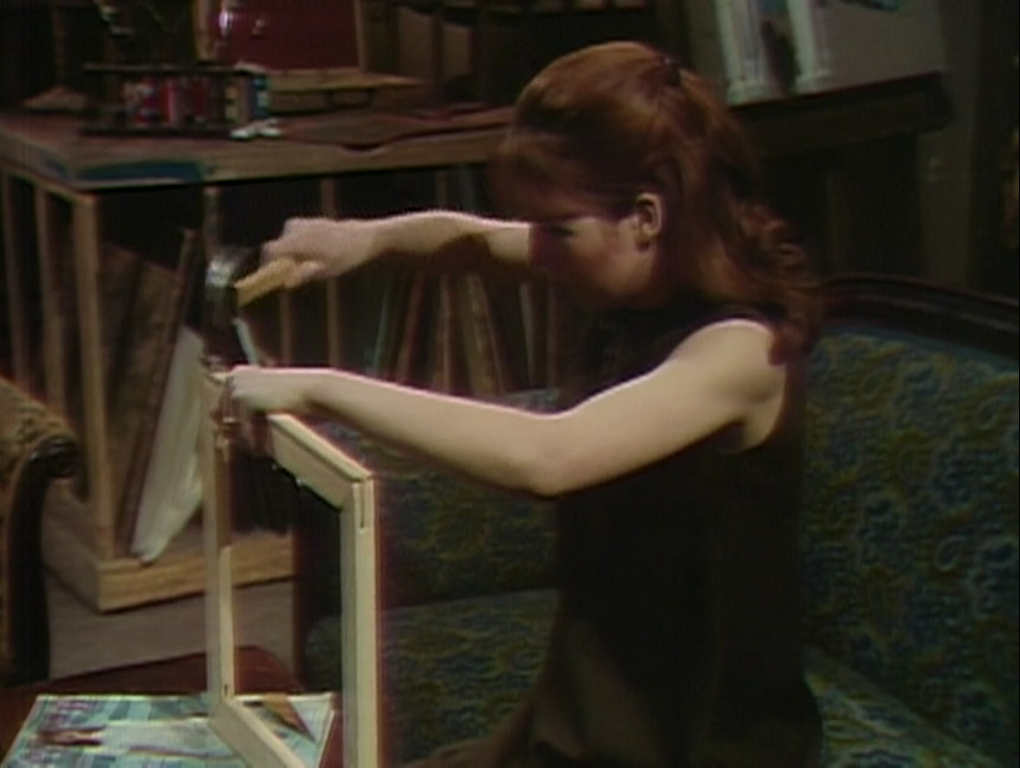
Maggie’s father Sam is a painter, a fact advertised by the canvases around the cottage they share. When we cut to the cottage, she is making a frame. This is rather an obvious visual metaphor. The last time Willie came to the cottage, he inadvertently framed himself for Barnabas’ crimes against Maggie.
Of course Maggie is horrified to see Willie at the door; of course she demands he leave; of course she threatens him with her hammer when he insists on staying and telling her he is innocent; of course she cries for help when her boyfriend Joe comes to the door; of course Willie runs off when Joe enters. Willie puts himself in the frame again, this time as an ongoing threat to Maggie and all the women of Collinsport.
Joe goes to Barnabas’ house and demands to see Willie. At first Barnabas plays dumb, but Joe doesn’t give an inch. Barnabas then admits that he persuaded Julia to let Willie out of the hospital, but assures Joe that Willie is no longer dangerous and tells him that he will see to it that Willie behaves himself. Joe says that Barnabas has already failed in his responsibility, since Willie just went to Maggie’s house and scared her. Joe says that he will kill Willie if he goes near Maggie again. He repeats that assurance, and his voice is pure steel.
Joe exits the house. We see him outside, walking away. Willie emerges from the shadows with a rifle. He takes aim at Joe and squeezes the trigger. The gun isn’t loaded, so Willie makes nothing more than a click. Apparently that was enough for him. He grins maniacally.
On their Dark Shadows Every Day, John and Christine Scoleri point out that the the gleeful face Willie flashes after he clicks his rifle at Joe is the same expression he showed in the frenzied crimes he committed before he came under Barnabas’ power. They back this observation up with a pair of screenshots, one of Willie immediately after he pretended to kill Joe, one from his last moment before he released Barnabas and lost his freedom:
Indeed, the whole episode replays Willie’s character arc from April to September in reverse. He starts as the crushed little thing we had seen at the end of #329, becomes Maggie’s tormented and misunderstood would-be protector, then ends as the dangerously unstable ruffian who followed seagoing con man Jason McGuire to town. If the episode were a few minutes longer, John Karlen might have had to take a break and let James Hall play the last scene. This recapitulation heightens the initial suspense generated by the question of how Willie would be after Barnabas had lost his vampire powers. Whatever effect the change in Barnabas has had on Willie has certainly not made him less complex or more predictable. We can’t tell when he is being sincere and when he is faking. Based on what we see today, it’s possible he is being sincere the whole time, but that he is just extremely impulsive, and equally possible that everything he does and says is a fake meant to cover up something we don’t yet know enough to guess at.
The actors are uniformly excellent today. John Karlen has to recreate the three faces of Willie in quick succession, and executes each of them clearly and memorably. Almost all of Grayson Hall’s dialogue is expository, but while delivering it she shows us all of Julia’s complicated feelings about Barnabas and lets us into her attempt to solve the riddle of his plans for Willie. Kathryn Leigh Scott is only on screen for a few minutes, beginning with her absorbed in carpentry and proceeding directly to screaming and running around and clutching at her male scene partners, but still makes it clear that Maggie is a strong and level-headed person who has been forced into frantic behavior by circumstances no one should have to face.
In the confrontation with Barnabas, Joel Crothers shows us a new side of Joe. Always loyal, always honest, always hardworking, Joe has up to this point been soft-spoken and self-effacing, deferential towards members of the ancient and esteemed Collins family. The only time he broke that deference was when he spoke some harsh words to matriarch Liz in #33, and he had to get thoroughly drunk to manage that. There is no trace of drink in him now, and he does not regard himself as anything less than Barnabas’ equal. For the first time since Burke Devlin lost his connection with the plot and shriveled so drastically that he ceased to be Mitch Ryan and became Anthony George, Dark Shadows has a plausible action hero in its cast.
The part of Barnabas is especially challenging today; he tries and fails to fool Julia in the beginning and Joe at the end, and in between may or may not have fooled Willie. So Jonathan Frid must show us what it looks like when Barnabas does an unsuccessful job of acting. He chooses to do that by having Barnabas overact. My wife, Mrs Acilius, pointed out that Frid’s own performance in the role of a man who is severely overacting is in fact exceptionally restrained and precise. Frid bobbles his lines as he usually does, but never makes a wrong physical move, and not for one second does he miss the perfect tone for Barnabas’ lines. The result is simply outstanding.
Recovering vampire Barnabas Collins hopes that mad scientist Eric Lang will be able to free him of his curse once and for all. Since wicked witch Angelique, who put the curse on Barnabas in the first place, has come back to the great estate of Collinwood, Barnabas found a twelfth century Sicilian talisman with the power to protect against witches and gave it to Lang with instructions that he was to keep it on his person at all times. Several days ago, Angelique drove Lang to the point of death, and he survived only because he managed to touch the talisman at the last moment. Even so, Lang refuses to wear the talisman or even to keep track of it. Now Barnabas is with Lang in his study, whence they discover that the talisman has been stolen. Lang asks Barnabas if he can get another one for him. Barnabas looks at Lang as if he were the world’s stupidest man, and tells him that such objects are extremely rare.
The whole business with Lang and the talisman is a prime example of what Roger Ebert called Idiot Plot, in which the story would end immediately if the characters showed as much intelligence as the average member of the audience has. If Lang were played by a good actor, he might be able to hold our interest through a few of these inexplicable actions. Both Alexandra Moltke Isles, as well-meaning governess Vicki, and Dana Elcar, as Sheriff George Patterson, were cast as the Designated Dum-Dum in a number of episodes, and each managed to survive longer than one might have expected. Mrs Isles kept the audience on board for Vicki by making us wonder how anyone could absorb the torrent of bizarre information drowning her. Elcar made the sheriff watchable by making speculate he might only be pretending to be clueless. But as Lang, Addison Powell is just dismally bad. Not only does he not invent a way to make Lang seem like he might be secretly smarter than the script makes him out to be, he does not show any sign of ever having acquired even the most basic acting skills. When Lang seems to think Barnabas can take him to Talismans-Я-Us to replace the priceless object he has lost, the audience loses whatever patience it may have had with him.
Lang’s assistant, a former mental patient named Peter who insists on being called “Jeff,” is quitting after months of helping Lang steal body parts from fresh graves. Peter/ Jeff tells Barnabas that he will be staying in town. That’s bad news for Barnabas, but much worse news for the audience. Peter/ Jeff is played by Roger Davis, who is a far more skilled actor than Addison Powell but, if anything, even less pleasant to watch. His characters are either full of rage or insufferably smug, he often manhandles his scene partners, and when he raises his voice he projects, not from the muscles of his pelvic floor, but from his anal sphincters, causing him to sound like he is suffering from severe constipation.
Lang tells Barnabas he needs a new assistant as soon as possible. Barnabas says he knows just the man. He is Willie Loomis. As Peter/ Jeff was a patient in an institution for the criminally insane when Lang found him, Willie is a patient in such an institution now. Willie was Barnabas’ servant for the first months he was in the 1960s, when Barnabas was a vampire rampaging through the village of Collinsport. Barnabas eventually took the heat off himself by pinning some of his crimes on Willie, packing him off to the mental hospital.
Willie was a fan favorite. Largely this was because actor John Karlen was as capable as Addison Powell was inept and as likable as Roger Davis is repellent. But the writers, too, always found fresh ways to make Barnabas’ conversations with Willie interesting, and when mad scientist Julia Hoffman teamed up with Barnabas she and Willie were great fun to watch together. The idea of Willie replacing Peter/ Jeff, in whatever capacity, is something to cheer for.
We cut to the cottage where Maggie Evans, The Nicest Girl in Town, lives with her father Sam. Maggie is wearing a pair of trousers which may well be the weirdest things ever shown on Dark Shadows. According to a blog called 1630 Revello Drive,* they are based on an article of women’s clothing traditional in India called a gharara. Surely no one in India ever made such things out of this brightly colored floral quilt. If this garment can exist, we would be foolhardy to rule out the possibility of ghosts or vampires or time travel or witches or anything else.
Maggie answers a knock on the door and finds Peter/ Jeff. Vicki had arranged for him to rent a room at the Evans cottage. Shortly after he arrives, Vicki comes. Peter/ Jeff tells her she doesn’t know much about him, and asks what she will do if it turns out he is someone she hates.
The next thing we see after that question is Peter/ Jeff with his shoe, a shoe he wears while robbing graves, on Maggie and Sam’s coffee table. Anyone who saw that might well conclude that Peter/ Jeff is such a clod that any civilized person would be tempted to hate him.
That isn’t an ottoman, buddy.
Again, there are actors who specialize in playing men who are compelling to watch when they do unpleasant things. Dark Shadows hit the jackpot in this regard when it cast Jonathan Frid as the vampire Barnabas. It narrowly missed doing so on other occasions. In the first year of the show, future movie stars Harvey Keitel (in #33) and Frederic Forrest (in #137) showed up as background players. Surely they would have taken speaking parts on the show at this point in their careers, and either of them could have made Peter/ Jeff almost as much of an asset as John Karlen made Willie, even if he did wantonly ruin people’s furniture.
Sarcastic dandy Roger, possessed by the spirit of wicked witch Angelique, visits mad scientist Dr Lang. The village of Collinsport was once a whaling center, and Lang is mindful enough of that long-ago history that he collects harpoons. Roger appears to be fascinated by Lang’s collection. He holds one of the finer pieces, admires it, fondles it, and tries to kill Lang with it. At the last moment, the murder is prevented by recovering vampire Barnabas and Julia, who is a scientist as mad as Lang but infinitely more interesting. As is typical of supernatural beings on Dark Shadows, Angelique projects her power through a portrait of herself; the portrait also has some adventures today.
There is a lot of great stuff in this one, as other bloggers have well explained. The 1960s were the heyday of Freudianism in the USA, and in the first year of the show the influence of that school of thought could often be traced in the scripts of Art Wallace and Francis Swann. Patrick McCray documents in his post on The Dark Shadows Daybook that this was an episode where writer Gordon Russell allowed himself to cut loose and have fun with the sillier side of the Freudian approach.
On his Dark Shadows Every Day, Danny Horn focuses on the scene where Barnabas and Julia decide to go and stop Roger. He points out that it is the first conversation they have had about something other than themselves, the first time Barnabas shares with Julia the secret of how he became a vampire, the first time they take heroic action, and the first time they are recognizably friends. It is that friendship that will drive the action of the show from now on.
In their meticulously detailed summary of the action of the episode on their Dark Shadows Before I Die, John and Christine Scoleri capture the effect on the audience of the steady accumulation of one absurdity upon another as the episode goes on. Reading their unfailingly matter-of-fact description of the ever-mounting lunacies we witness in this half-hour is almost as exhilarating as it was watching them in the first place.
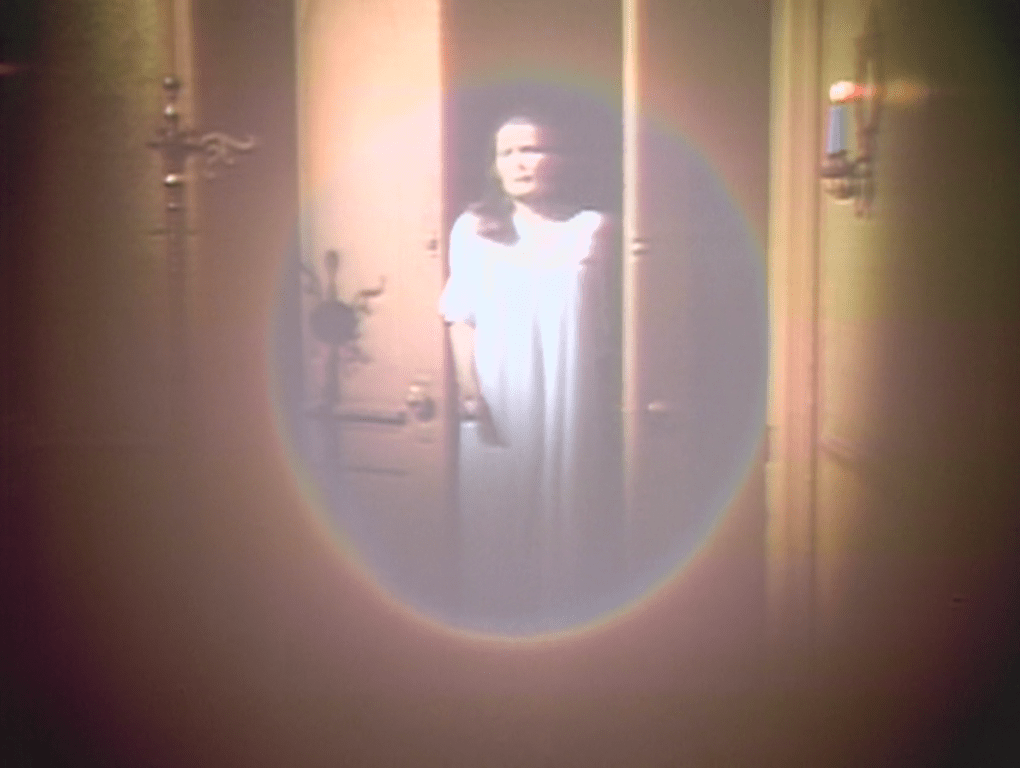
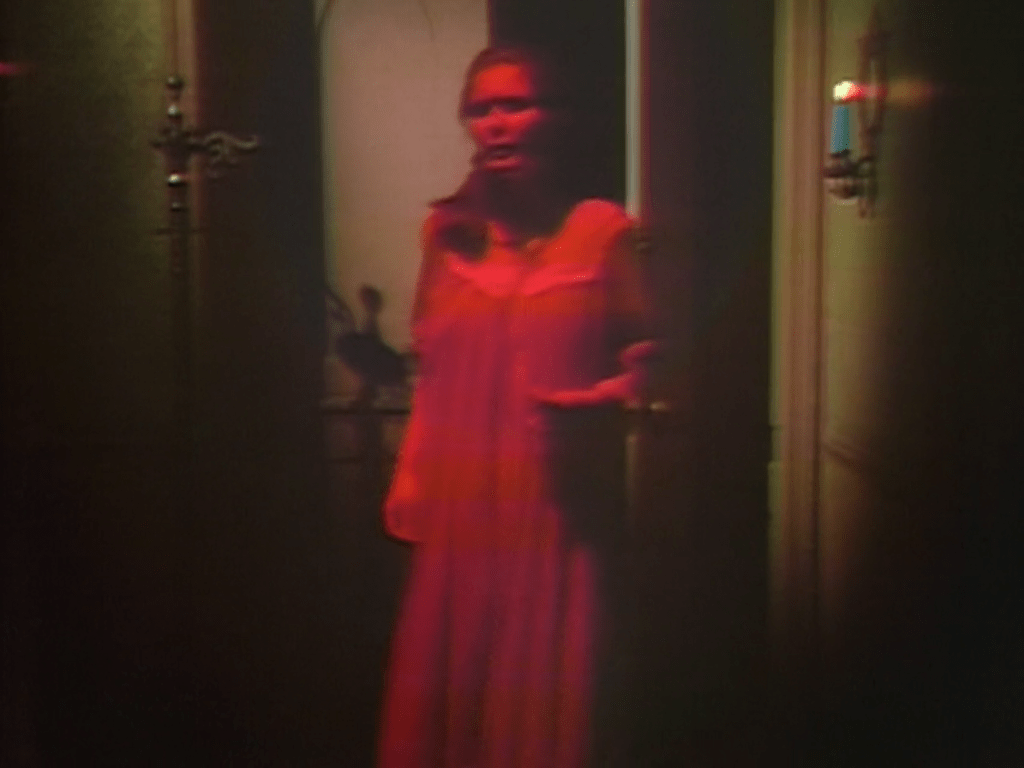
Barnabas calls Julia’s attention to the closing cliffhanger. Screenshot by Dark Shadows Before I Die.













 Dark Shadows Commentary