Episode 419: Collins as in Collinsport?

When gallant gentleman Barnabas discovered that his wife Angelique was a wicked witch who had been casting spells to ruin the lives of everyone he knows, she forbade him to disclose this information. If he did, she would kill his true love, the gracious Josette.

Now, Angelique has turned Barnabas into a vampire. When he found out about this, he killed her. Sadly, that didn’t take. For the last few days Angelique’s disembodied head has been floating around foiling all of Barnabas’ attempts to contain the damage he has been doing.

Today, we open in the Collins family mausoleum. Barnabas’ coffin is hidden in a secret chamber inside the mausoleum. He and Josette are in the publicly-known outer chamber, where she found him yesterday. He pleads with her to leave him and forget she ever knew him, but will not tell her why. Angelique has made it obvious that she is already working to kill Josette, so obvious that Barnabas and his friend Ben were talking about it yesterday. So Barnabas has no reason to withhold any information from Josette, and every reason to tell all. But he continues to keep everything back that might persuade her to flee from him. This does fit with his pattern of behavior- half the reason they are in this situation is that Barnabas wouldn’t tell Josette that he and Angelique had had an affair long ago. But it is still frustrating.

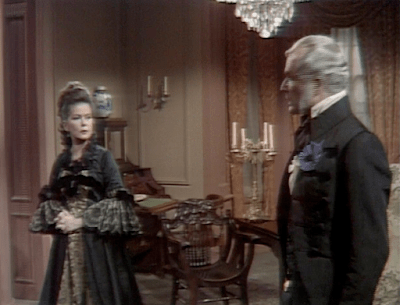
Back in the great house of Collinwood, Josette runs into the two characters who have been keeping the show watchable for the last couple of weeks, fluttery heiress Millicent Collins (Nancy Barrett) and caddish naval officer Nathan Forbes (Joel Crothers.) After a series of delightfully played comedy scenes, Millicent and Nathan have become engaged. They break their happy news to Josette. She is so preoccupied with her encounter with Barnabas that she barely reacts.

Nathan leaves. In the drawing room, Josette tells Millicent that she saw Barnabas tonight. Millicent knows that, according to Barnabas’ parents, Barnabas has gone to England. She is therefore certain that Josette could not have seen Barnabas, and she patiently explains this impossibility to Josette. The difficulties Millicent knows about are nothing to what Josette knows- she saw Barnabas die.

Millicent lost at the threshold of thought. Screenshot by Dark Shadows Before I Die.

In the parts of Dark Shadows set in the 1960s, Nancy Barrett plays another heiress, Carolyn Collins Stoddard. In those same parts of the series, Joel Crothers plays hardworking young fisherman Joe. In 1966, Carolyn and Joe were dating each other for no reason they could discern, and the audience was afflicted with scene after scene of them out on dates staring at each other in boredom. Millicent and Nathan are as much fun to watch together as Carolyn and Joe were dull. They are pursuing objectives we can understand, and we can also be sure that their plans will not work out as they expect.

Nathan is clever, charming, and unscrupulous. He was uninterested in Millicent until he found out she was rich, then immediately began an assiduous pursuit of her hand and her inheritance. In addition to greed, he has also shown a keen eye for opportunities to bed the women on the household staff. When his naval career is threatened by the villains, he shows no sign of courage. Yet we have also seen him behave admirably, even heroically, in trying to help bewildered time-traveler Vicki. And when Barnabas was alive, Nathan was a trustworthy friend to him. So for all we know, by the time he gets his hands on Millicent’s money, this complex man might have fallen in love with her and made up his mind to be a good husband.

Millicent is not a “smart character” in an IQ-test sense, but her limitations translate into an accidental wisdom. Her ideas of life have been shaped by plays she has seen and novels she has read, leading her to think she is a character in a florid melodrama. But of course that is exactly what she is, and so her behavior is, if anything, more situationally appropriate than are the actions of the more superficially rational people around her. Certainly it is jarring when Josette starts telling Millicent about Barnabas, when she knows that Barnabas wants to keep his presence secret. Considering what will happen to Josette if she keeps approaching Barnabas, Millicent does quite the sensible thing when she insists on leaving the official story alone.

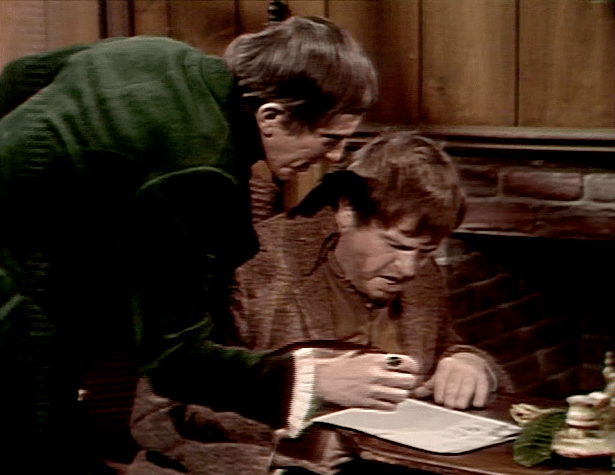
Nathan has gone to the local tavern. In the 1960s, this same set will be a tavern known as The Blue Whale. Joe will be a regular customer, and the man who will preside behind the bar is played by actor Bob O’Connell. In #319, a character pretending to be drunk called the bartender “Bob-a-roonie,” leading fans of the show to call the character “Bob Rooney,” a name never used in the series.

Now, in 1796, the tavern is called The Eagle. Bob O’Connell again plays the man who pours the drinks. His name is Mr Mooney. “Mooney” sounds enough like “Rooney” that I wonder if the “Bob Rooney” gag circulated among the production staff. Mr Mooney gets more lines today than Bob the bartender ever did, and his name is listed in the credits for the first time at the end of his 57th episode.

O’Connell did a lot of very good work in those first 56 appearances. He was especially good with facial expressions that showed he had overheard enough of a conversation to think he ought to be more aggressive about refusing to serve drinks to customers before they lose all sense, but not enough to have anything substantial to report to the police. I’m sorry to say that his delivery of dialogue today is not on that level. Partly that’s because he has to put on some kind of Anglo-Celtic accent that he is none too sure of. But that isn’t the only problem. He delivers his lines much too fast and too loud, and does not modulate his voice in response to anything his scene-mates do. He isn’t interacting with the others at all, just waiting for his cues and making sure the microphone picks up the words. His scene is a major letdown for Bob the bartender fans everywhere. O’Connell’s previous successes as a working guy who knows more than others assume he does leave me wishing they could have done another take of the scene with some fresh guidance from the director.

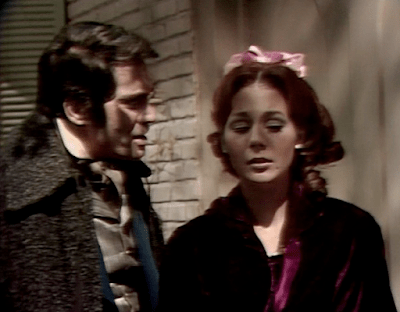
Fortunately, the same scene introduces one of the most magnificent characters in all of Dark Shadows. She walks in, tells Mr Mooney she’s with Nathan, and gives her name as Suki Forbes. That’s Forbes as in “Mrs Nathan Forbes.”

Suki takes command. Screenshot by Dark Shadows Before I Die.

Nathan tries out a series of lies on Suki, each of which she bats away effortlessly. He offers to pay her to leave town; she lets him go collect his money, while she stays in the tavern and gets all the relevant information from Mr Mooney. Nathan has been away for about ten seconds by the time Suki finds out he plans to marry into the family that owns the town. She is quite pleased by the prospects this introduces.

Suki thinks of how much she might earn by pimping Nathan out. Screenshot by Dark Shadows Before I Die.

Our hopes that Nathan would eventually make Millicent happy are thus reduced to a very low order of probability. Regular viewers are again reminded of Carolyn, in this case of Carolyn’s absentee father Paul Stoddard. Paul was a charming, dishonest, and cruel man who married Carolyn’s mother Elizabeth only for her money.

We haven’t seen Paul, and know very little about his background. What we do know is that he was not from the village of Collinsport, had no money of his own, and that his best friend was a merchant seaman named Jason McGuire. We got to know Jason quite well when he showed up and blackmailed Liz for a long dull stretch of the show. Poor men would have few opportunities to meet young women of Liz’ lofty station, and even fewer means of persuading them they were acceptable marriage partners. Since the marriage took place in 1945 or 1946, when a sizable fraction of American men were on active duty in the armed forces, and since Paul was connected to Jason and therefore to the sea, it would seem likely that Paul was a Navy officer. After all, an officer’s uniform can get a man admitted to any social circle, as Nathan illustrates. So the miserable marriage that Liz endured might have echoed a similarly ill-conceived match a collateral ancestor of hers made in the late 18th century.

Suki is played, sensationally, by Jane Draper. In his June 2014 post about #420, Danny Horn wrote that Ms Draper was “a bit mysterious.” The lady herself saw that post and commented on it in August 2020. She wrote:

Hi
I am the Jane Draper who played Suki on Dark Shadows! Thought I’d be on it longer but got killed off by Barnabas. I worked on Broadway, film and this soap opera. Now, I play Bluegrass, always my passion, on guitar and upright bass. Born in Illinois, grew up mostly in Southern Indiana and moved to NYC in my teens.

thank you for your kind words.

Jane Draper, comment left 13 August 2020 on “Episode 420: The Stalking Dead,” Dark Shadows Every Day.

Episode 417: Distant laughter

The terrace at the great house of Collinwood is a set where characters often behave as if things are possible that the audience knows won’t happen. Couples make dates we know they will never keep and talk about weddings we know one of them won’t live to see. Today, much put-upon servant Ben sees grand lady Josette there. He urges her to leave Collinwood, and she says she is planning to do so. Ben is overjoyed. He, and he alone, knows that Josette’s lost love Barnabas has become a vampire and is obsessed with her. When Josette talks about leaving, Ben hopes she will escape from the danger Barnabas represents.

The placement of this scene at the terrace is one of several pieces of evidence that Ben’s hopes will be dashed. We have known since #5 that Josette is fated to jump to her death from the precipice known as Widow’s Hill. We learned in #233 that she did this because she saw Barnabas up there and was horrified by what he had become. Josette’s death is such an important part of the show’s backstory that we are sure she will not escape her doom. Moreover, we have seen bewildered time-traveler Vicki try to persuade Josette to go away before it is too late. Everything Vicki has done since arriving in the year 1795 has backfired, so that is another sign that Josette will not leave.

Toward the end of the scene on the terrace, Josette asks Ben if he can hear a sound of distant laughter. He says that he didn’t hear it, and neither did she. He urges her to get some sleep, and they go their separate ways.

After sunrise, Ben goes to the secret chamber in the Collins family mausoleum where Barnabas’ coffin is hidden. Obeying Barnabas’ command, he has brought a stake made of holly wood and a mallet. When he was alive, Barnabas had been a friend and benefactor to Ben. Ben finds it difficult to stake him, but is just about to do so when a loud sound of laughter, punctuated by sharp intakes of breath, comes on the soundtrack. The head of wicked witch Angelique floats onto the screen. This visual effect had been a signature of undead fire witch Laura Murdoch Collins when she was on Dark Shadows late in 1966 and early in 1967; it is the first time we have seen it since Laura went up in smoke in #191.

Floating head. Screenshot by Dark Shadows Before I Die.

It was Angelique who cursed Barnabas to become a vampire. As her head floats in front of Ben, we hear her recorded voice telling him her curse will be fulfilled. When Ben says she can’t stop him, she points out that the stake and mallet have vanished from his hands. She orders him to leave the chamber. He is to come back tonight and tell Barnabas that they will never escape her power.

In his post about this episode on Dark Shadows Every Day, Danny Horn argues that since Barnabas just killed Angelique in #411, she hasn’t been gone long enough to make her return particularly effective. I agree. Even if the scene were well-conceived and well-executed in every other way, that alone would make it disappointing. But there are some other substantial problems. Angelique regretted the curse she put on Barnabas, and her last mortal act was to try to stake him to keep him from rising as a vampire. Nothing she says today explains the reversal of her attitude.

The repetition of the effect from the Laura story isn’t much of a problem, not only because it has been a long time since they’ve used it, but also because the show had such low ratings when Laura was on that most viewers watching now never saw it then. What is a problem is the execution of the effect. Angelique’s voice is a tinny recording that sounds very bad when she laughs, and they keep sliding the floating head around in the frame trying to square it with Ben’s line of sight. So far from terrifying us, the result simply irritates.

Episode 409: Some of the facts

When well-meaning governess Victoria Winters came unstuck in time and tumbled from 1967 to 1795, she brought with her a copy of the Collins family history. We first saw this book in #45, when flighty heiress Carolyn Collins Stoddard read this excerpt aloud:

Jeremiah Collins, sixth generation descendant of the founder of Collinsport. In 1830 married Josette Lafrenière of Paris, France. The construction of Collinwood, the family mansion, was begun the same year.

Right up to the last few weeks before Vicki left for the past in November 1967, Dark Shadows kept equivocating about whether Josette, Jeremiah, and the rest of them lived in 1830 or in the late 18th century. The name “Lafrenière” was not mentioned again after #45, but neither was any other surname given for her birth family until the name “DuPrés” was introduced during the 1795 segment. Likewise, #45 is the only time we hear that Josette was from Paris. Her association with the island of Martinique is established in #239, when the vampire Barnabas Collins tells his victim Maggie that he met Josette there and taught her English on the journey to Collinsport, where she was to marry Jeremiah. That Josette was the daughter of the richest French planter on Martinique, a condition that in 1795 in our time-band characterized the lady who would become the Empress Josephine, is something the show commits itself to during the flashback segment.

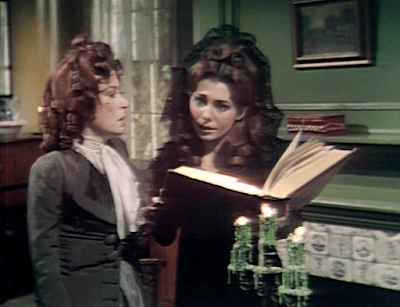
These were only a few of the myriad revisions and retcons the show went through in regard to Barnabas and Josette’s time as living beings. Today, Josette and her aunt, the Countess DuPrés, go through the book and remark on its many inaccuracies. The episode ends with a shock when they realize that at least one of these inaccuracies is the result of a conscious decision by haughty overlord Joshua Collins to falsify the record of events.

Josette and the countess read The Book. Screenshot by Dark Shadows Before I Die.

I was going to write about how meta this all is, but then I reread Danny Horn’s post about the episode on Dark Shadows Every Day and found that he had already done it. I would just add that the very idea of traveling back in time is a metaphor for rewriting, so that the whole storyline is an exercise in self-reference by the writers and producers.

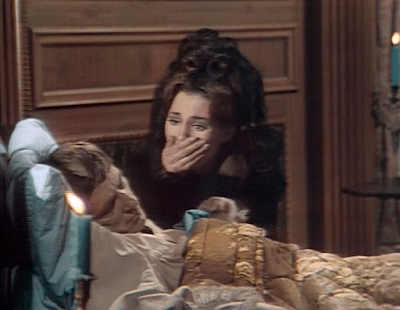
This episode features the death of Barnabas Collins. Barnabas has been the show’s main draw for a long time, but he was already dead when we met him in April 1967, and he’s been dying for the last four days of this flashback, so that’s less of a milestone than it might seem. The event is presented as another exercise in continuity. In #345, vampire Barnabas told mad scientist Julia Hoffman that before his death he had vowed to Josette that he would someday return to her. Indeed, Josette is at his bedside in his last moments as a human, and he does make that vow.

Barnabas dies. Screenshot by Dark Shadows Before I Die.

Barnabas accompanies his vow with a plea for Josette to wait for him. That, too, is a continuity moment. Josette is played by Kathryn Leigh Scott, who also played Maggie. When Barnabas returned as a vampire in 1967, he kept Maggie prisoner and tried to replace her personality with that of Josette. Whatever the living Barnabas may have been thinking in his last moments, the vampire Barnabas expected to find Josette waiting for him, 172 years after his death, and that expectation motivated the first major crime we saw him commit.

Episode 392: This great democracy of yours

In episode 368/369 of Dark Shadows, haughty overlord Joshua Collins of Collinsport, Maine told his house-guest, the Countess DuPrés, that he was surprised she still chose to “affect a title,” since in this year of 1795 “France has followed our example and become a republic.” After the countess handed Joshua his head, he fumed to his wife Naomi that her snobbish Old World ways offended him, since he is such a devout believer in human equality.

It was immediately clear to any viewer that Joshua was being hypocritical. He tyrannizes his family and treats his servants as domestic animals that have unaccountably, and rather inconveniently, gained the power of speech. When he says that all men are equal, he means that he, personally, is the equal of anyone in a sufficiently lofty position, and the superior of everyone else.

Audience members who know something about the history of the late eighteenth century in the USA and France will find more to savor in Joshua’s preposterous position. By 1795, the French Revolution had gone through its most radical phases, and was anathema to everyone in the USA other than some of the nascent political tendency led by Thomas Jefferson, a tendency known in the southeast and New England as the Republican Party and in the middle states and the west as the Democratic Party. When Joshua says with great satisfaction that “France has followed our example and become a republic,” he is identifying himself with the most militant factions of the Jeffersonian party, and when he tells Naomi that “all men are equal” he is echoing the most famous passage of Jefferson’s most celebrated writing.

Ridiculous as it is to hear Joshua invoke the egalitarian rhetoric for which Jefferson was so well known, as a major landowner in a rural area far removed from the major cities he was perfectly typical of the most important backers of the Democratic/ Republicans. Jefferson himself was a member of this category, and he displayed both a remarkably sophisticated understanding of the leftwardmost theorists of the French Revolution, as demonstrated for example in the edition of the works of Destutt de Tracy that he prepared for publication in 1817, and a dismally cruel approach to his livelihood as a slave-holding planter.

When Dark Shadows was on the air in 1966-1971, the party that traced its origins to Jefferson was undergoing a revolution of its own. The coalition he forged between working-class groups in the north and rich slave-owners in the south had been an inspiration to the Democratic Party from the days before the Civil War right through the presidencies of Woodrow Wilson and Franklin Roosevelt. After World War Two, the African American freedom movement finally scrambled this unlikely coalition, winning Black southerners the vote and challenging the dominance the heirs of the slave-owners had long held in the Democratic Solid South. Thoughtful Americans, seeing this change, might well think back to the origins of the Democratic Party and to the ridiculous incongruity of Jefferson’s soaringly egalitarian words coming out of his and other oligarchic mouths.

At the top of today’s episode, Joshua is very thorough about betraying all of Jefferson’s ideals. He tells Naomi that the common folk of the town must not know that their son Barnabas killed his uncle Jeremiah in a duel. Naomi replies that everyone already knows; Joshua insists that they do not, and declares that they will believe what he tells them to believe.

The philosophe in his salon. Screenshot by Dark Shadows Before I Die.

One of the major themes of Jefferson’s correspondence, as indeed of Destutt de Tracy and other Enlightenment philosophes, was what Karl Marx, a close reader of Destutt de Tracy, would call “false consciousness,” the tendency of the oppressed classes to see the world in categories generated by the ruling class, and that if false consciousness were erased the oppressed would rise up and sweep away all manner of social evils. Joshua’s determination to keep the working people of Collinsport in the dark about what is happening on the estate of Collinwood puts him at the opposite extreme from the beliefs his leader Jefferson professed. In his own life, Jefferson himself set about enforcing regimes of lies on more than one occasion, as for example when he used his office as president of the United States to cover up the crimes of General James Wilkinson. Even viewers who hadn’t read Jefferson’s letters and who were unaware of Jefferson’s less inspiring actions may well have known, in 1967, that the confidence which the Declaration of Independence expresses in what will happen if “the facts be submitted to a candid world” sat uneasily with the lies on which slavery in particular and white supremacy in general rests.

Joshua begins dictating to Naomi a fictitious story that sounds oddly familiar to regular viewers. Before well-meaning governess Vicki was plunged into her uncertain and frightening journey into the past, we had heard several versions of the Collins family history, none of which resembles the events that we have actually seen play out so far. As Joshua tells Naomi what he has decided people should believe, for the first time the outlines of the Collins family history published in the 1950s come into view. That history is not only sustained by false consciousness, but has its origins in a brazen lie.

Joshua is busy fabricating when Naomi interrupts him with more bad news. Barnabas has decided to marry Angelique, maid to the Countess DuPrés and to the countess’ niece, Barnabas’ former fiancée Josette. The great egalitarian Joshua is thunderstruck that his son would fall into the clutches of an “adventuress.”

Joshua sends Naomi to fetch Barnabas. He thunders his disapproval of the marriage, and Barnabas stands his ground.

Later, we see Josette in the cemetery, at Jeremiah’s grave. Barnabas spots her, and wonders whether he should tell her about his engagement to Angelique. He doesn’t want her to hear of it from someone else, as she surely will very soon. But the place could not be less appropriate. He approaches her; they have an awkward little talk, in the course of which he urges her to hate him for killing her husband. She says she cannot. She tells him not to say any more. He is helpless.

Angelique arrives and tells Josette that her carriage is waiting. Josette invites Barnabas to ride back to the manor house with them; he declines. Josette leaves the two of them alone for a moment; with a note of jealousy that belies her agreement to a sham marriage to a man who will always love Josette, she asks Barnabas if she interrupted something. He says that she did not. That’s true- he had already given up the idea of telling her about their engagement when Angelique joined them.

Back in the manor house, Joshua summons Angelique to the front parlor, where he offers her $10,000 to relinquish her claim on Barnabas and go back to the island of Martinique. It is difficult to compare prices between 1795 and 2023; to get a sense of proportion, we might remember that when Joshua offered Vicki a job as governess to little Sarah Collins in #367, he offered her a salary of $4 a week, and that this was rather a generous rate of pay for the position. So it would take even an upper servant 2500 weeks, that is to say almost fifty years, to earn the amount of money Joshua is offering Angelique.

Angelique refuses Joshua’s bribe. He says he is prepared to offer more, but when he sees that she is firm in her refusal he switches to threats. Naomi intervenes and says that she does not want to break ties. With Naomi’s promise of friendship, Angelique agrees to wait until the mourning period for Jeremiah is complete before marrying Barnabas.

What returning viewers know that Joshua, Naomi, Barnabas, the countess, and Josette do not is that Angelique is not only a maid, but is also a witch. It was under her spell that Josette, though in love with Barnabas, conceived a mad passion for Jeremiah, that Jeremiah, though a loyal friend to Barnabas, reciprocated that passion, and that the two of them, though they struggled with their consciences, eloped. That elopement prompted the jilted Barnabas to challenge his uncle to a duel, and his bewilderment at his own actions prompted Jeremiah to delope and let Barnabas kill him. Angelique and Barnabas had had a brief romantic fling before he became engaged to Josette, and she believed that once Josette was out of the way Barnabas would return to her.

It hadn’t quite worked out that way. In her frustration at Barnabas’ continued preference for Josette, Angelique cast a spell on Sarah, sickening her and threatening her life. When she saw how upset Barnabas was by his little sister’s illness, Angelique said that she could cure it, and extorted his promise to marry her if she did so. She released Barnabas from that promise in #390/391. When he told her that Josette would always come first for him, even though he knew there could never again be anything between them, she said she would marry him anyway. Apparently thinking he wouldn’t be likely to find another woman willing to enter a sham marriage on that basis, Barnabas proposed, and Angelique accepted.

In their conversation in the parlor, Joshua tells Angelique that he knows about the promise she extorted from Barnabas with her ability to cure Sarah. Evidently Barnabas told Naomi about that. There are those in the house who believe that witchcraft is afoot; indeed, Vicki is in hiding, having been accused as the witch. This story would seem to be proof positive that Angelique, not Vicki, is the guilty party, and she does widen her eyes when Joshua brings it up. But he and Naomi don’t make the connection.

Back in the graveyard, Angelique is holding a miniature coffin and casting a spell.

Where did she get that miniature? Screenshot by Dark Shadows Before I Die.

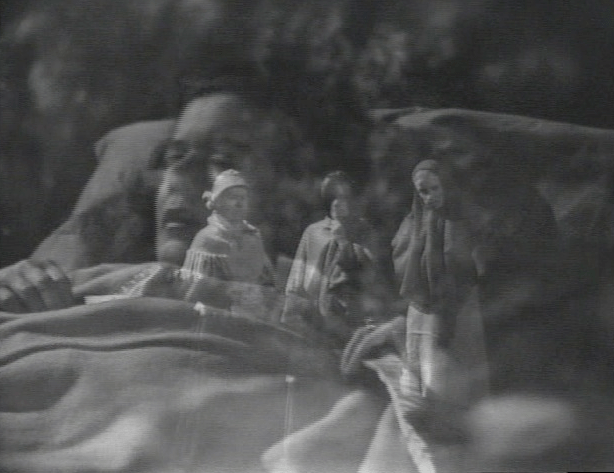
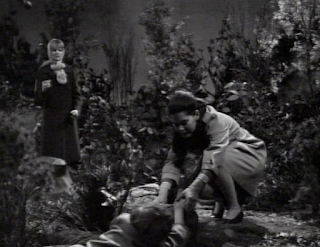
In her bedroom, Josette hears Angelique’s disembodied voice, saying that Jeremiah is not dead. She runs to the front door, where Naomi sees her. Unable to dissuade her from going out in the night, Naomi follows Josette to Jeremiah’s grave. Josette keeps hearing the voice; Naomi does not hear it. But when Jeremiah’s hand bursts out of the soil, both women see it.

Jeremiah waves to the ladies. Screenshot by Dark Shadows Before I Die.

In the parts of Dark Shadows set in the twentieth century, Joan Bennett played matriarch Elizabeth Collins Stoddard. Of all the major characters, Liz was the most reluctant to acknowledge the existence of supernatural forces, and she was the one who was least likely to see the evidence of such forces that abounded in the world around her. So when we see her as Naomi watching Jeremiah’s hand reaching out of his grave, it is the first time we have seen her react to an incontrovertible sign of the paranormal. It makes us wonder how far back in the Collinses’ past the roots of Liz’ denial extend.

Episode 388: Someone else you love

Gracious lady Josette DuPrés left her home on the island of Martinique to marry her fiancé, young gentleman Barnabas Collins. She is Mrs Collins now, but not Mrs Barnabas Collins.Her aunt’s maid, Angelique, is a wicked witch who wants Barnabas for herself. To that end, she cast one spell to cause Josette to conceive a mad passion for Barnabas’ uncle and dearest friend, Jeremiah Collins, and another to cause Jeremiah to reciprocate her feelings. On what was supposed to be the night of Josette’s wedding to Barnabas, she ran off with Jeremiah. The two of them married. When they returned to the estate of Collinwood, Barnabas challenged Jeremiah to a duel. Remorseful, Jeremiah let Barnabas shoot him. Now, he is hovering at the point of death.

We open with Angelique in Barnabas’ room, massaging his forehead. She wants him to say that he hates Josette. He says “I hate her!,” but can’t bring himself to say “I hate Josette.” He kisses Angelique and agrees to visit her room in the servants’ quarters later.

The results of Angelique’s magical activities have not gone unnoticed. Some members of the household believe there is a witch at work among them, and have called a professional witch-hunter named the Rev’d Trask to conduct an investigation. No one suspects Angelique- Trask and his supporters have fastened on recently arrived governess Victoria Winters. Vicki is in hiding, and Barnabas and his friend, caddish naval officer Nathan Forbes, have been helping her.

Downstairs in the manor house, Trask is questioning Josette. When he raises the possibility that she may have been the victim of demonic influence and therefore not responsible for her recent actions and their tragic consequences, she is intrigued. But she cannot take the escape he offers. She insists that she is responsible for her actions. Even so, she allows Trask to begin an exorcism.

Barnabas interrupts the ceremony. He makes no secret of his contempt for Trask. When Trask tells him that Josette has been under the control of forces alien to herself, Barnabas demands Josette tell him what she did that she did not want to do. She will not say anything to suggest disloyalty to Jeremiah. “He is my husband, and he is dying. That is all that matters.” When Barnabas asks if she loves him, she says yes. He asks if she married him because she loved him, again she says yes. She says she wishes things had been different; he asks what she could wish different, if she has married the man she loves. She cannot answer.

Barnabas is back in his room, looking depressed. Angelique enters and asks why he didn’t come to her. He says that it can’t work between them. He still loves Josette, in spite of everything. She asks what Josette told him to make him feel that way. He says that all she said was that she is married to Jeremiah and loves him.

Angelique is devoted to manipulating people, and cannot believe Josette did not somehow trick Barnabas into loving her. But we can see that Barnabas is responding to Josette’s attempt to do her duty to Jeremiah. He does not believe in magic, and is convinced that Josette and Jeremiah willfully betrayed him. But he knows virtue when he sees it, and in Josette’s attempt to be a good wife to the dying Jeremiah he recognizes the trustworthy partner with whom he had expected to share his life.

Barnabas asks Angelique if it is still possible for them to be friends. She notices a doll on a shelf, a favorite plaything of Barnabas’ ten-year old sister Sarah. She takes the doll, saying she will return it to Sarah.

Angelique finds the doll. Screenshot by Dark Shadows Before I Die.

Back in her room, Angelique talks to herself. She says that she will punish Barnabas for spurning her. This time, she will not cast a spell on Josette. Instead, she will use her powers to make Sarah suffer. Barnabas will watch Sarah suffer, Angelique proclaims, and that will be the hardest experience of his life.

Angelique is a fun character, and up to now the roots of her behavior in her unrequited love for Barnabas have made it possible for us to sympathize with her. But we’ve known Sarah since she first showed up as a ghost in #255, back in June. She is adorable, and the doll Angelique is planning to use against her was something she used in lifesaving good deeds back in the summer. There is nothing sympathetic about a threat to hurt her. With her final scene today, Angelique crosses into very dark territory.

Episode 383: Between men now

In 1966 and the early weeks of 1967, the Collinsport Inn was an important place on Dark Shadows. The restaurant there, presided over by Maggie Evans (Kathryn Leigh Scott,) The Nicest Girl in Town, was a place where people could meet each other unexpectedly and characters new to town could be introduced. Dashing action hero Burke Devlin (Mitch Ryan) lived in a suite at the inn, and the place often represented his territory, the base from which he conducted his war against the ancient and esteemed Collins family.

The sign. Screenshot by Dark Shadows Before I Die.

We haven’t seen Burke’s room since #206, at which point he had given up his vendetta against the Collinses and proceeded far down the road to irrelevance. We haven’t seen the restaurant since vampire Barnabas Collins (Jonathan Frid) met Maggie there in #221. By the time Anthony George took over the part of Burke in #262, Burke seemed to live in the Blue Whale tavern. He made business calls from the pay phone there, and in one episode apparently stayed behind when the bartender locked the place up for the night.

The inn makes a return appearance at the top of today’s episode. It is 1795, and Jeremiah Collins (Anthony George) is sharing a suite with Josette DuPrés (Kathryn Leigh Scott.) They are on their honeymoon.

Jeremiah and Josette eloped from the estate of Collinwood on the night when Josette was supposed to marry Jeremiah’s nephew, kindly gentleman Barnabas Collins (Jonathan Frid.) Josette truly loved Barnabas and Jeremiah was his dearest friend, but they were under a spell cast by wicked witch Angelique, who wanted Josette out of the way so she could have Barnabas for herself. The power of the spell waxes and wanes. When Josette and Jeremiah are in the grip of it, a trident shaped mark appears on their hands; when they return to their senses, the mark disappears.

Tridents showing. Screenshot by Dark Shadows Before I Die.

When the episode begins, the tridents are showing, and the newlyweds are inflamed with passion. Shortly after, Josette’s mark is gone, Jeremiah’s still showing. She is filled with regret, he is still ardent.

Back in the manor house of Collinwood, Barnabas has a conversation with Josette’s father André and his own father Joshua. He resists André’s suggestion that Josette and Jeremiah must have left together, and resists even more strenuously Joshua’s declaration that they did so because they are the victims of witchcraft. Joshua says that his sister Abigail and André’s sister, the Countess DuPrés, found a blasphemous trinket in the quarters of governess Victoria Winters, and that a witch-hunting divine, the Reverend Trask, is coming to investigate the matter. Barnabas is appalled at the notion of an inquiry into witchcraft, and vows to defend Victoria if Trask comes. Joshua forbids him to do so.

Barnabas’ reaction to the idea of a witchcraft trial, coupled with what we have seen of him so far in the 1795 segment, looks like a retcon. In #358, only a week and a half before we began this uncertain and frightening journey to the past, vampire Barnabas told a story about studying witchcraft under a warlock on Barbados who taught him “the secret magic number of the universe.” Events are moving so fast that it doesn’t look like Barnabas will have time to sail to the Caribbean before he becomes a vampire, and he won’t be crossing any waters after that. But now he is a man of the Enlightenment, who scoffs at the idea of witchcraft today as he scoffed at the tarot when the countess introduced him to it in #368/369.

Jeremiah returns to the house. There is an exquisite little scene with a servant, Riggs, who is uncomfortable at the sight of the disgraced Mr Jeremiah. Riggs stands in for the establishment of Collinwood and the whole working class of the town of Collinsport, and in his reaction we see the disquiet that bad news from the big house on the hill would spread among the people whose livelihoods are at stake when trouble comes to the family there. Riggs makes haste when Jeremiah tells him to go out and fetch Joshua.

When Riggs is gone, Josette enters. The audience sees that the mark is gone from Jeremiah’s hand, and Josette can tell that his passion for her is gone. She tells him that he no more loves her than she loves him. He begins with a protest against this remark, but ends by saying that they must be kind to each other.

Joshua and André enter. André embraces his daughter and tells her everything will be all right; Joshua looks at his brother with distaste and demands an explanation.

Jeremiah says that he and Josette are married. He further says he realizes they are not welcome, and that they will return to the inn. This raises the prospect of a recreation of the early days, with the inn as a territory separate from and opposed to Collinwood. Joshua rejects the idea at once. He will not have the scandal of Jeremiah and his new wife living in town because they have been estranged from the rest of the Collinses. He decrees that they will live at Collinwood and put on a happy face for the townsfolk.

Barnabas enters. Joshua tells him that Jeremiah and Josette are married. He refuses to believe it until Josette confirms it herself. He takes the glove from Jeremiah’s hand and slaps him in the face. He gives him a choice of weapons.

Dueling may have been as alien to the ideals of the Enlightenment as were Barbadian warlocks, but so too is Joshua’s plan of forcing the whole family to commit itself to a massive lie in order to preserve its hereditary privileges. Joshua, the proud apostle of Jeffersonian republicanism, is simply being a hypocrite, but Barnabas is a more complicated figure. Seeing his every hope turned to dust before him, his ideals have become useless. He has only a moment to choose among the evils the Enlightenment had promised to stamp out, and he chooses the most macho one available.

Joshua forbids the duel, but Barnabas disregards his father’s authority and insists on it. In 1795 and for some time after, dueling was widely practiced in much of the United States, and particularly in the South and West a gentleman lost face if he refused a challenge. No such stigma attached in New England, where dueling was condemned by law and religion. Had Joshua or Jeremiah gone to the police, Barnabas would have been arrested. In 1719, Massachusetts, of which Maine was a part until 1821, passed a law making it an offense punishable by a fine of £100 (equivalent to about $7000 today) to challenge someone to a duel. Massachusetts law already considered it murder to kill someone in a duel, and prescribed death by hanging as punishment. Of course, Joshua’s declaration that Jeremiah and Josette will live in the house and the family will present a “united front” to deter scandal makes it clear he will never turn his son over to the police, and the pattern of cover-up with the support of law enforcement we saw among the Collinses in 1966 and 1967 leads us to doubt that anything a member of the family does will ever be a matter for the courts to judge.

There is a missed opportunity in the show’s lack of interest in Massachusetts’ actual laws about dueling. The 1719 law was amended to be even stricter in 1730. Among the provisions added to the law at that time was a requirement that anyone who had either been killed in a duel or been put to death for winning a duel would “be given an unchristian burial at a gallows or crossroads, with a stake driven through their body.” Since the audience knows that Barnabas is fated to become a vampire, there is a chilling irony in seeing him volunteer for a staked burial.

Episode 380: No end to your tricks

Indentured servant Ben was unhappy enough when he was under the rule of haughty overlord Joshua Collins. He has now found himself doubly enslaved, still subject to the Collinses, but also under a spell cast by lady’s maid/ wicked witch Angelique that compels him to do her bidding. At least Joshua isn’t bothering him these days- Angelique has, for reasons of her own, turned him into a cat. In Angelique’s room, Ben wields a hatchet, gleefully preparing to decapitate the cat formerly known as Joshua.

Angelique interrupts Ben’s evil plan.

Angelique enters and forbids Ben from committing this act of felicide. Ben is disappointed. When his arguments make no impression on her, he whines “Ple-e-e-ase!” Thayer David gets the full comic value out of that, Mrs Acilius and I laughed out loud.

Angelique’s main business is preventing Joshua’s son Barnabas from marrying the gracious Josette. To that end, she orders Ben to steal some things. When he protests that it will be the end of him if he is caught, she tells him to see to it that he isn’t caught.

In the parts of the show set in 1967, Barnabas is a vampire. We have heard him use the very words Angelique uses here when telling people who were under his power not to be caught, most recently with his distant cousin/ blood thrall Carolyn in #362. The echo is so specific and of so recent an episode that we can’t help but wonder if Angelique’s witchcraft will not only turn Barnabas into a vampire, but will deposit her personality in his body.

Barnabas and Josette’s wedding is supposed to be held in the front parlor of the manor house. When the bride doesn’t come downstairs, her father, André DuPrés, asks his sister, the Countess DuPrés, if he should look for her. She agrees that he should. This is an odd little moment, suggesting that the Bossy Big Sister/ Bratty Little Brother dynamic we have seen among the Collinses of the 1960s may have been familiar in the House of DuPrés in 1795.

André goes up to Josette’s room. He shouts her name, looks for her in the linen chest at the foot of her bed, and shouts for her some more. He reports her absence to the party downstairs. Angelique lifts a flute of champagne, silently toasting her triumph.

Angelique toasts herself.

Episode 377: A brand for lovers

In #370, wicked witch Angelique cast a spell on her onetime lover, young gentleman Barnabas Collins. To her surprise, the spell seemed likely to kill him. It took her the bulk of #371 to figure out a way to undo it.

That was the first we learned that Angelique was a witch, and her ill-success left us wondering if it was her first time casting a spell. By now we have seen her cast several more, some quite powerful. It no longer seems likely that she is a novice conjuror.

Early in today’s episode, we learn that Angelique is aware of the limitations of her ability. Thinking about what she has planned for Barnabas, she tells herself that once she has cast her next spell, she won’t be able to stop its consequences even if she wants to. As the idea that she might be new to sorcery led us to wonder if she would at some point turn from her ways and try to make up for her misdeeds, so this line leads us to expect that she will eventually find herself regretting something she has done.

For most of its first 73 weeks, Dark Shadows kept falling into long stretches where only one storyline was going at a time. They are in danger of that now; we are in the middle of the third week of the trip back in time to 1795, and only Angelique has made anything happen. Today, they take a step to correct the situation.

Caddish naval officer Nathan Forbes brings some papers to kindly Jeremiah Collins, and asks if governess Victoria Winters is available for his attentions. Jeremiah says that she isn’t, and asks if he would “accept Millicent Collins as a substitute.” Millicent is Jeremiah’s second cousin, and she is a feather-headed germophobe. Nathan recoils at the suggestion, until Jeremiah mentions that Millicent is very, very rich. He then goes directly to her and starts wooing her with gusto.

Joel Crothers and Nancy Barrett play Nathan and Millicent. In 1966, the same two actors played hardworking young fisherman Joe and flighty heiress Carolyn. In those days, Joe and Carolyn were dating but would rather not be. They were stuck playing one pointless scene after another about how bored they were with each other. When shameless Nathan plies his mercenary charms upon muddled Millicent, we see how much fun Crothers and Miss Barrett could have when the script gave them something to work with. They are a joy to watch.

Nathan and Millicent. Screenshot by Dark Shadows Before I Die.

Meanwhile, Angelique is working to prevent Barnabas from marrying his fiancée Josette. To that end, she has cast a spell causing Josette and Jeremiah to conceive a mad passion for each other. Last night, Barnabas’ mother Naomi had a dream in which Jeremiah was kissing a woman who had a trident marked on her hand. Today, she tells Jeremiah about the dream. He affects unconcern.

Josette, Millicent, and Naomi are about to have a little tea party. Naomi says that her husband disapproves of tea on political grounds. “Joshua remembers the Revolution, and regards tea as a symbol of British authority.” This reminds us of #368/369, when Joshua told Josette’s aunt, the Countess DuPrés, that he was surprised she still chose to “affect a title,” since, as he proudly reminds her, “France has followed our example and become a republic.” After the countess has put him rather firmly in his place, Joshua seethes to Naomi about her snobbery, and loudly declares his belief that all men are equal. These statements mark Joshua as a supporter of Thomas Jefferson, and as an extraordinary hypocrite- we have seen that Joshua is a tyrant in his household and that he regards his servants as a rather noisy form of domesticated animal.

As Josette offers her a cup of tea, Naomi sees the trident mark on her hand. She exclaims “It’s you!” and dashes out.

Trident mark on Josette’s hand. Screenshot by Dark Shadows Before I Die.

Josette had never seen the mark before. She goes to her room and tries to wash it off her hand. Angelique enters; she is the countess’ maid, but she also seems to be the only servant the DuPrés family has brought to Collinwood, and she is the one who has been attending Josette. Josette has no idea she has anything to fear from Angelique; had Barnabas admitted to Josette that he had a brief affair with Angelique before he knew Josette was interested in him and that Angelique is angry he does not want to resume it, Josette might not place herself so completely in her hands. Angelique rubs away the mark, but no doubt also applies some further mumbo-jumbo to her in the process.

Josette is alone in her room when a knock comes at the door. It is Jeremiah. He has been struggling to keep himself from coming to her, but he cannot resist. She is more deeply under the spell than he is, and welcomes him. He tries to shake her out of her amorous state. Some think he overdoes it:

Shake it off! Screenshot by Dark Shadows Before I Die.

He tries to go, then turns and nearly kisses her.* Finally he manages to leave the room. He has resolved to stay away until Josette and Barnabas are safely married.

*There is some kissing earlier in the scene. I discussed Anthony George’s stupefyingly bad kissing in detail when he played Burke Devlin, fiancé of well-meaning governess Vicki. In his post about this episode on Dark Shadows Every Day, Danny Horn goes into depth about how George “sticks his face to” Kathryn Leigh Scott and makes “weird kissing motions” with “his big monkey lips.” He provides five screenshots to accompany his analysis of this “watershed moment in awkward affection.” I don’t see any need to add further comment on this matter.

Episode 375: Decisions melt like ice

Last night Josette DuPrés, fiancée of young gentleman Barnabas Collins, slipped into the bedroom of Barnabas’ uncle and best friend Jeremiah and propositioned him. This morning, Jeremiah thinks he must tell Barnabas that his intended is not the virtuous maiden he thought her to be.

Jeremiah finds Barnabas teaching kindly indentured servant Ben Stokes the alphabet. Ben marvels that children are able to learn something he finds so difficult. After struggling a while with the letter Q, Ben says he thinks it unlikely that he would ever say a word with a Q in it anyway. When Jeremiah says he has something important to discuss with Barnabas, Ben is excused from his lesson.

Minding Ben’s Ps and Qs. Screenshot by Dark Shadows Before I Die.

When Jeremiah sees how devoted Barnabas is to Josette, he can’t bring himself to break the bad news. He simply declares that no one must come between them. and Barnabas happily says that he is sure no one would want to do that.

Jeremiah sees Josette entering the house. She tries to hurry away, ashamed to face him, but he insists they go outside and talk. She swears that she has never before approached a man as she did him, that she is utterly mystified as to what came over her, and that rather than hurt Barnabas she would kill herself.

“Before I did that, I would kill myself.” Screenshot by Dark Shadows Before I Die.

Josette’s aunt, the Countess Natalie DuPrés, is a house-guest at Collinwood. She meets Josette in the front parlor. She wonders why Josette has been out of the house and alone from dawn until after lunch. Josette will not explain, and when Barnabas enters she runs away and shuts herself in her room. The Countess tells Barnabas that Josette is suffering from the sort of jitters girls often have before they become brides, and insists he take her rather than Josette on a furniture-shopping expedition.

Josette, Barnabas, Jeremiah, and the Countess are all unaware of the true situation. The Countess’ maidservant, Angelique, is a witch who has cast a spell on Josette so that she will conceive a mad passion for Jeremiah. She has cast another spell on Ben to make him her henchman. Angelique’s plan was that after Josette threw herself at Jeremiah, Jeremiah would tell Barnabas of the advance and the wedding would be off. Angelique would then be in a position to renew the affair that she and Barnabas had before he became engaged to Josette, and she would end up as the new Mrs Collins.

When Ben reports to Angelique that Jeremiah could not bring himself to tell Barnabas what Josette had done, she is shocked. She comes up with another plan- she will make Jeremiah reciprocate Josette’s feelings. She orders Ben to pour a love potion into the hot toddy he serves Jeremiah at night.

The other day, Angelique had Ben put a sleeping potion into Jeremiah’s hot toddy while he was in his room getting ready for bed. This time, Jeremiah is in the front parlor with Barnabas and the Countess. That makes for a more complicated scene, as Ben has to slip the potion in when none of the three are looking. Moreover, at one point the Countess asks for a drink other than sherry, and at another she urges Barnabas to have a drink. Since Jeremiah has asked for a smaller drink than usual, it seems possible at both of these moments that he might give the hot toddy away, foiling Angelique’s plan. It is all very well handled, and of course it ends with Jeremiah taking the drink and falling into the trap.

The Countess is still playing cards in the front parlor when everyone else is in bed. She sees Josette coming downstairs. Her niece tells her she can’t sleep and is going for a walk. The Countess offers to go with her, an offer Josette firmly declines.

We cut to a new set, a gazebo on the grounds of the estate. Jeremiah is there. He tells Josette that he was compelled to go there, he knew not why, but that some time ago he realized he was waiting for her. Josette says she was compelled to come also. They profess their love for each other and kiss. We turn to the bushes, and see the horrified face of the Countess watching their ominous embrace.

The Countess shocked. Screenshot by Dark Shadows Before I Die.

Episode 368/369: Whole future

In 1966 and 1967, supernatural menaces Laura Murdoch Collins and Barnabas Collins would often be seen staring out the windows of their houses on the great estate of Collinwood, sending psychic energy towards the targets of their sinister plans. In 1795, Barnabas is neither supernatural nor menacing, but we already see him peering out one of those windows. He is not projecting bad vibes into the world, but is worried about his beloved fiancée, Josette DuPrés. She is supposed to arrive soon, in fact was supposed to arrive some time ago. Now there is a storm, and he hopes she is not at sea.

Earliest window-stare, by dramatic date. Screenshot by Dark Shadows Before I Die.

The audience’s main point-of-view character in 1966 and for most of 1967 was well-meaning governess Vicki. Now Vicki has come unstuck in time, and found herself in this extended flashback to the eighteenth century. Since she will know Barnabas and regard him as a close friend in the 1960s, she is at her ease talking to him now. Although she is a member of the staff in his family’s house in a period when it was customary for masters to summon their servants with bells and communicate with them only in direct commands, Barnabas is a remarkably genial and democratic sort who welcomes her casual manner.

Vicki has already annoyed the audience several times by blurting out information that makes it obvious to the other characters that she does not belong in their world. She does that again in this scene. Barnabas is worried something may have happened to Josette, and Vicki tells him that she will arrive safely. He is surprised by the assurance with which she delivers this prediction, and asks if she is clairvoyant. She realizes that she has been indiscreet, and denies that she is. He is unconvinced.

Barnabas’ father, haughty overlord Joshua Collins, enters. He is appalled to find his son socializing with a servant. He dispatches Vicki to the nursery to look after her charge, his young daughter Sarah. He demands to know why Barnabas is not tending to his own duties at the family’s shipyard. They begin to quarrel, when a knock comes at the door.

Barnabas opens the door to find a woman named Angelique, whom he identifies as maid to Josette’s aunt, the Countess DuPrés. Angelique says that the countess was on her way to Collinwood, but that her carriage is stuck in the mud. Joshua orders Barnabas to send a footman to rescue her. Angelique is the first character we have met in 1795 who is not played by a performer we have seen in the first 73 weeks of the show.

Enter Angelique. Screenshot by Dark Shadows Before I Die.

Joshua goes to his wife, Naomi. Naomi is an alcoholic, a fact of which we are made aware because almost her every scene begins with a shot of her drinking alone. That’s what she is doing before Joshua finds her. He scolds her for her drinking; she complains that he doesn’t allow her to do anything else. She can’t even pass the time with a book- we saw Monday that Naomi is completely illiterate.

Glug glug glug. Screenshot by Dark Shadows Before I Die.

Naomi’s alcoholism is both a nod to the concern of first-wave feminism with the atrophy of the elite housewife, and a suggestive side-light on Barnabas as we knew him in the 1967 segment. Then, Barnabas abducted Maggie Evans, The Nicest Girl in Town, and tried by more or less magical means to replace her personality with that of Josette. For the first 40 weeks of Dark Shadows, Maggie’s father’s alcoholism had been a substantial story element, and she would always retain a number of classic Adult Child of an Alcoholic (ACoA, in the lingo of the recovery movement) characteristics, such as beginning utterances with a little laugh to prove that she is happy. Now that we know that Barnabas is also an ACoA, we can wonder if that shared experience was part of the reason he was drawn to Maggie.

The countess arrives. Since she is played by Grayson Hall, who also plays mad scientist Julia Hoffman in the parts of the show set in the 1960s, Vicki blurts out “Julia!” when she sees her. Hall had also been nominated for an Academy Award for her performance as Judith Fellowes in the 1964 film Night of the Iguana; if Vicki is going to keep the audience up to date on the cast’s resumes, it would have been more interesting if she’d exclaimed “Judith!” Vicki explains that the countess looks like someone she once knew who was named Julia, a remark which irritates the countess, who would like to think her appearance is distinctive. Vicki has certainly not made a favorable impression on this grand lady.

Joshua tells the countess he is surprised that “You still affect a title” when “France has followed our example and become a republic.” His pride in this development, after the Terror and in the bloodiest year of the wars in the Vendée, marks Joshua as a member of the Jeffersonian party in US politics. The Federalists and others had long since turned against the French Revolution by that year.

The countess tells Joshua that it is precisely because France has become a republic that she chooses to live on the island of Martinique. That answers a question that some fans ask about Angelique- why is she white? If the DuPrés family lives on Martinique and are major sugar planters there, they must hold a great many African people in slavery. When we hear that they are bringing a servant with them, we expect that servant to be Black. When we learn that the the countess is an emigré, we realize that she brought Angelique with her from France.

The countess may solve one puzzle for us in her exchange with Joshua, but she presents us with another. Josette’s father André is the countess’ brother, yet he is never referred to as a count. Indeed, when he appears, we will see him answer to “Mr DuPrés.” Perhaps he renounced his title, as many French aristocrats did during the Revolution.

Whatever the explanation, “DuPrés” would seem to represent a missed opportunity. When Josette was first mentioned, in the early months of Dark Shadows, her maiden name was given as “LaFrenière.” It would have been a nice touch to have kept that name for Josette and her father, and to have reserved “DuPrés” as the name of the countess’ late husband.

“LaFrenière” had been a perfect choice because of its class ambiguity for a show about an aristocratic family in the state of Maine- it was originally the family name of the barons of Fresnes, and could therefore be a sign of a senior order of nobility, but is also a very widespread name in Quebec. So “Josette LaFrenière” might either have been a French noblewoman who deigned to marry into the mercantile Collins family at the apex of their prestige, or a working class girl from the north who eloped with the boss’ son.

The choice of Martinique as Josette’s place of origin might add a new twist to this class ambiguity. The Empress Josephine grew up there as a member of the untitled but ancient Tascher family, who, like the fictional DuPrés family, owned an enormous sugar plantation on the island. The Taschers of Martinique went back and forth between Martinique and metropolitan France, and Josephine herself was living there in 1779 when she married her first husband, the Vicomte de Beauharnais. Josephine herself was in prison when the vicomte was guillotined in 1794, one of the last to die in the Reign of Terror, and she was freed just a few days later. The next year, she recovered her husband’s property, and a year after that married the young general Napoleon Bonaparte. It seems likely that the similarity between the names “Josephine” and “Josette” was writer Sam Hall’s inspiration for placing Josette’s origins on Martinique. Association with a figure who was at once a grand lady and an example of very steep upward social mobility could synthesize the two possible Josettes LaFrenière into a single figure.

Had they developed the story of the family’s relationship with the town of Collinsport more richly in Dark Shadows 1.0 and 2.0, they could have used this ambiguity to build up suspense that would be resolved today, in the third episode of Dark Shadows 3.0. Since they did so little with that theme in those days, when the story was moving very slowly and it would have been relatively easy to fit just about anything in, I suppose we shouldn’t be surprised that they drop it so completely at this period of the show, when the story is flowing at a breakneck speed.

The countess’ lofty aristocratic manner stings Joshua. Alone with Naomi, he loudly proclaims his belief that all men are equal. We already know enough about Joshua’s tyranny over his household that this absurd little speech must be an intentional spoof of the rich landowners who supported the Jeffersonian party in the early decades of the Republic. Again, this would be funnier and more poignant if the show had done more with social class in its first 73 weeks.

Barnabas sees the countess dealing out tarot cards. He tells her she is too sophisticated for them, and is reluctant to sit with her while she uses them to read his fortune. The moment she says that the cards suggest a connection between him and the concept of infinity, his skepticism evaporates instantly and he excitedly asks if that means he will live forever. The countess cautions that his jubilation at this idea may be misplaced. She notices the “Wicked Woman” card, and takes a significant look at Vicki. Evidently the audience is not alone in objecting to Vicki’s brainless nattering about what the show used to be like.*

Angelique comes to Barnabas’ room. It turns out the two of them had a brief affair when he was first on Martinique, and she expects to resume it. He is not at all pleased at her attentions.

Not how every man would react to a passionate embrace from Lara Parker… Screenshot by Dark Shadows Before I Die.

Barnabas explains that he was already falling in love with Josette when he and Angelique had their fling, but that he didn’t really know her. He couldn’t believe that she would reciprocate his feelings, and consoled himself by dallying with Angelique. This explanation goes over with her about as well as you’d expect, and she storms out of the room, vowing that she will get her way in the end.

We know that the tarot cards are giving accurate information, because the show leans heavily on the uncanny and they wouldn’t have spent so much time on a gimmick that wasn’t meant to advance the plot. We also know that Vicki is not the Wicked Woman the countess is looking for. That leaves Angelique, and we can assume that her wickedness will express itself in some supernatural action taken to avenge herself on Barnabas. Since we know that Barnabas will become a vampire, we wonder if it is Angelique who makes him one.

Closing Miscellany

I usually refer to surviving cast members with courtesy titles and to deceased ones by surname alone. So Alexandra Moltke Isles is “Mrs Isles,” which has been her professional name for 56 years, David Henesy is “Mr Henesy,” Nancy Barrett is “Miss Barrett,” etc, while Jonathan Frid, Joan Bennett, Louis Edmonds, and Grayson Hall are just “Frid,” “Bennett,” “Edmonds,” and “Hall.” Until last month, I’d been looking forward to saying lots of things about “Miss Parker” and her portrayal of Angelique, but Lara Parker died on 12 October 2023. So she’s just going to be “Parker,” and I’m going to be sad about it.

Artist Teri S. Wood has created a number of short animations about Angelique and Barnabas. This one is based on their two-scene at the end of today’s episode:

https://www.youtube.com/watch?v=pyxI0q2aOIk

Patrick McCray has a post about this episode that mystifies me. He writes that “After seven months of hearing about Angelique, today, she enters. So, no pressure Lara. You only have to live up to a half year of build-up.” Uh, what? There has been absolutely no reference to Angelique on the show before today. I can think of an interpretation of the story that might retroject Angelique into episodes #211-365, and I will talk about it next week. But I don’t think it is an interpretation Patrick would favor.

He also talks about David Ball’s method of reading plays from the ending back to the beginning and then from the beginning forward, so that the ending comes to seem implicit in everything else. He allows that Dark Shadows has more than one ending, but I would say he doesn’t go far enough. I’d say the series has ten endings. The first came in #191, when Laura went up in smoke while her son David found refuge in Vicki’s arms. That ending defined Dark Shadows 1.0 as the story of David’s escape from his evil, undead mother Laura, and his adoption of Vicki as his new, life-affirming mother. The second came in #364, when Barnabas met the ghost of his little sister Sarah, she commanded him to be nice to the living, and he went right on with his murderous plans. That ending defined Dark Shadows 2.0 as the story of Barnabas’ irredeemable evil.

Two of the other endings will feature Angelique dying in Barnabas’ arms, and Patrick suggests that those make the whole show the story of their relationship. I don’t buy it at all. Each of the ten parts is about what it is about, and even those two episodes with Angelique dying derive more dramatic charge from other moments.

*Making connections with the first 73 weeks is my job!