Yesterday, haughty tyrant Joshua Collins found out that his son Barnabas is a vampire. Today, he shoots Barnabas in the chest and learns that vampires can’t be killed by gunshots. So Joshua insists that Barnabas come with him to a place where he can be kept until they figure out a way to lift his curse.
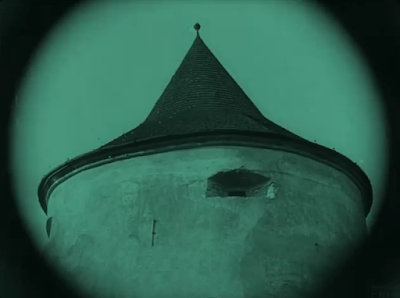
Barnabas is always making plans that fail spectacularly the moment they come into contact with reality. Today, Joshua shows that Barnabas inherited his planning abilities from him. The hiding place Joshua chooses for Barnabas is not one of the underground prison cells on the estate or a cabin off in the woods somewhere, but the many-windowed room on top of the tower in the center of the great house. No one in the house can avoid seeing the light of the candle Joshua carries up there.
The tower at Collinwood.
The tower room has been vacant up to this point, so when Joshua returns to the drawing room his wife Naomi meets him with questions about why there was a light there. He is reduced to insisting that she didn’t see what she clearly knows she saw.
Joshua realizes Naomi saw the light.
There are a couple of interesting visual echoes today. Naomi and Joshua are played by Joan Bennett and Louis Edmonds, who in the parts of Dark Shadows set in the 1960s play reclusive matriarch Liz and her brother, high-born ne’er-do-well Roger. Liz was standing at this window when we first saw her in episode #1. Roger approached her there and whined to her about her decision to hire well-meaning governess Vicki. The selfish, cowardly, weak-willed Roger represents the ultimate destination of the path on which Joshua’s habit of denial and concealment has set the family. Joshua’s absurd insistence that Naomi did not see a light in the tower puts him in a position as ridiculous and contemptible as any that Roger brings upon himself.
From episode #1.
In their post about this episode on Dark Shadows Before I Die, John and Christine Scoleri point out that the tower looks very much like the one in F. W. Murnau’s Nosferatu. That movie was not widely available in the 1960s, but books about film history were finding a mass audience in those days, and some of them would have had stills from it.
Haughty tyrant Joshua Collins goes to the basement of the Old House on his estate and finds his son Barnabas rising from a coffin. Barnabas explains to his father that he has become a vampire.
This scene prompts considerable discussion in fandom about gay subtext. In his post about the episode on Dark Shadows Every Day, Danny Horn points out that actors Jonathan Frid and Louis Edmonds were both gay, and speculates that this fact might have had some influence on the way they play Barnabas’ coming out to his father. “I’m not suggesting that this situation is intended to be a metaphor for a gay child talking to his father about his terrible, shameful secret life… But the ‘keep the secret, don’t tell my mother’ part — there’s some resonance, isn’t there? At least, it’s a hook into the story that helps us to get closer, and really feel some of the horror of this moment. A father hands a gun to his son, and says, Kill yourself, so that your mother never finds out.”
Even this tentative raising of the question, with its “I’m not suggesting” and “some resonance” and “at least,” is too much for Patrick McCray. In his Dark Shadows Daybook post about #446, he concedes that “homosexuality is the obvious choice” for an interpretive lens through which to read the scene, but goes on to flatly assert that “this isn’t a veiled metaphor for something like homosexuality.” For him, as for Danny, Barnabas figures in the scene as a murderer first and last, and Joshua as a man finding himself irrevocably severed from the world of rationally explainable phenomena.
For my part, I think that we have to remember that intentionality is always a more complicated thing in a work of art than it is when lawyers are interpreting a contract or cryptographers are cracking a cipher. Certainly the scene is not simply a coming-out scene played in code. Barnabas’ murders do not map onto any metaphor for sexual encounters. While the vampire’s bite is often a metaphor for the sexual act, Barnabas presents his acknowledgement in this scene that he has murdered three women in terms of the secrets he calculated he could keep by killing them and maintains a cold, matter-of-fact tone while doing so. When in the course of the scene Barnabas exasperates Joshua by attempting to murder him, there is nothing erotic between the men. No doubt the scene is at one level meant to be what Danny Horn and Patrick McCray say it is, the point when Joshua realizes he is part of a supernatural horror story and the audience realizes that Barnabas is a cold-blooded killer. As such, it is one of the key moments that defines the 1795 flashback as The Tragedy of Joshua Collins.
But there are other levels of intentionality here as well. One has to do with the word “vampire.” When Barnabas is trying to tell his story to Joshua, his first approach is to give him the facts and leave it to him to apply the correct label. But the facts are so alien to Joshua that they only deepen his confusion. Seeing his father’s bewildered reaction, Barnabas’ frustration mounts until he finally shouts “I am a vampire!”
We have heard this word only once before on Dark Shadows, when wicked witch Angelique mentioned it in #410, but it figured in the show as a metaphor for outness long before it was spoken. In #315, Barnabas’ associate, mad scientist Julia Hoffman, urges him not to murder strange and troubled boy David Collins. She catches herself, breaking off after saying that David deserves better than “to die at the hands of a-” Barnabas grins and teases her, asking “At the hands of a what, doctor?” He dares her to say the word and taunts her for her faux pas in coming so close to using it. Julia and Barnabas have a tacit understanding that they will discuss his vampirism only in euphemisms and circumlocutions. To say the word would be to push beyond the limits of Barnabas’ outness to Julia.
When he tries to avoid calling himself a vampire, Barnabas is trying to establish a relationship in which his father will know enough that he is no longer inclined to ask questions, but not enough to achieve any real understanding of his feelings. When he realizes that he cannot keep from using the embarrassing, ridiculous, utterly necessary word, Barnabas is forced to come out to Joshua in a way he had desperately wanted to avoid.
Moreover, Jonathan Frid’s performance as Barnabas departs starkly from anything else he does on Dark Shadows. After he calls himself a vampire, Frid’s whole body relaxes. His neck, shoulders, and hips are looser than we have ever seen them; even his knees bend a little. His voice shifts a bit away from the old-fashioned mid-Atlantic accent he typically uses as Barnabas, a bit toward twentieth century Hamilton, Ontario. At that point, he is not playing a murderer or a creature from the supernatural or an eighteenth century aristocrat- he is playing himself, enacting a scene from his own life.
Barnabas’ coming out to his father is not today’s only story about information management. Joshua rules his corner of the world by parceling out just that information he thinks people ought to have. We have seen this habit lead to disaster after disaster. In his scene with Barnabas, we see another such instance. Joshua has come to the basement because naval officer/ sleazy operator Nathan Forbes told him that he had seen Barnabas at the Old House, and that Barnabas had attacked Joshua’s second cousin Millicent. After Barnabas admits to his various murders, Joshua brings up the attack on Millicent. Barnabas denies that he had any involvement in that attack, sparking an angry response from Joshua. When Barnabas later asks Joshua why he came to the basement, he swears that Barnabas will never know why.
Had Joshua told Barnabas that Nathan sent him to the basement, the two of them might have figured out that Nathan faked the attack on Millicent as part of his scheme to trick her into agreeing to marry him and to blackmail Joshua into consenting to the marriage. That in turn might have helped Joshua find a way to prevent Nathan from carrying out his evil schemes. But his parsimony with information leaves Joshua believing Nathan’s story about the attack, and therefore puts him and the rest of the Collinses entirely at Nathan’s mercy. When we see the effect that the radical honesty of coming out as a vampire had on Barnabas, we can’t help but wonder how many misfortunes the Collinses might have avoided if they had not lived according to Joshua’s code of truthlessness.
A voice comes from the upstairs. Naomi Collins, wife to Joshua and mother to Barnabas, has entered the house. Joshua leaves his gun with Barnabas and tells him to do the honorable thing, then hastens up to meet her.
Naomi tells Joshua that she he came to the Old House because Nathan told her he had gone there. She insists that Joshua explain what is going on; he pleads with her not to ask. She tells him to think of her; a quiver in his voice, he says “I am thinking of you now.” Naomi is as mystified and as frustrated by Joshua’s refusal to explain himself as Joshua had been with Barnabas’ story, but even as she plays these reactions Joan Bennett also shows us Naomi softening towards her husband. She catches a glimpse of the lover hidden beneath the lord of the manor, peeking out from below the massive superstructure of his pride.
Back in the great house, Nathan is sprawled on the sofa, his boots resting on a polished table, guzzling the Collinses’ fine liqueurs. When Joshua and Naomi return, Nathan offers Joshua a snifter of brandy and invites him to drink it with him in the drawing room. Joshua reacts indignantly, protesting that he is not accustomed to a guest offering him the hospitality of his own house.
This exchange is familiar to longtime viewers. From March to June of 1967, when Dark Shadows was set in contemporary times, the great house was dominated by seagoing con man Jason McGuire, who was blackmailing reclusive matriarch Liz. Several times, most notably in #200 and #264, Jason poured himself a drink and invited Liz’ brother, high-born ne’er-do-well Roger Collins, to join him. Roger would protest that he was not accustomed to being offered a drink of his own brandy in his own house, often drawing the rejoinder that it was Liz’ brandy and Liz’ house, and that he was as much her guest as Jason was.
Roger and Joshua are both played by Louis Edmonds. Roger represents the final stage of decay from the height Joshua represents. He has squandered his entire inheritance, committed acts of cowardice that cost the lives of two men, and let a more or less innocent man go to prison in his place. In #4 he tried to sneak into well-meaning governess Vicki’s room while she slept, and when Liz caught him he told her he didn’t want to be lectured on his “morals,” leaving no doubt that he was looking for some kind of cheap sexual thrill at Vicki’s expense. He openly scorns his responsibilities as a father, cares nothing for the family’s traditions, and the one time we see him working in his office at the headquarters of the family’s business all he does is answer the telephone and tell the caller to contact someone else instead. He drinks constantly, is always the first to give up on a difficult task, makes sarcastic remarks to everyone, and backs down whenever he faces the prospect of a fair fight. In #273, he even admitted to Liz that, had he known what Jason knew about her, he probably would have blackmailed her too.
Joshua’s relentlessly dishonest approach to life may be rooted in fear, and it is never difficult to see that its end result would be to produce a man as craven as Roger. But Joshua himself is as strong as Roger is weak. It is impossible to imagine Roger shaking off an attempt on his life as Joshua shakes off Barnabas’ attempt to strangle him today. While Roger is prepared to sacrifice any member of his family for his own convenience, Joshua will go to any lengths to protect Naomi from the truth of Barnabas’ horrible secret. Nor does Joshua take the easy way out even when he is knuckling under to Nathan. In their scene today, Nathan makes it clear that he is willing to accompany Joshua back to the Old House. Had Roger known what Joshua knows about that basement, he would never have missed an opportunity to send Jason there and let Barnabas do his dirty work for him. But Joshua cuts Nathan off the moment he raises the subject.
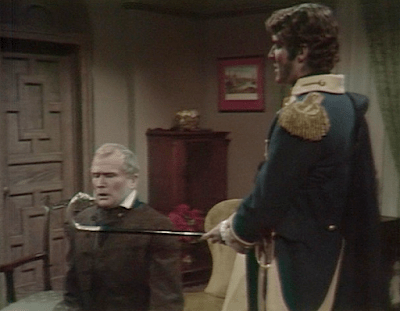
Joshua does go back to the coffin room, and he finds Barnabas standing around. He is disappointed that his son has not killed himself. Barnabas tries to explain that he cannot die by a gunshot, but Joshua dismisses his words. He takes the gun himself and, with a display of anguish, shoots Barnabas in the heart. Only thus, he believes, can he keep the unbearable truth from coming to light.
Fluttery heiress Millicent Collins has been staying at the great estate of Collinwood as the guest of her second cousin, haughty tyrant Joshua Collins, and Joshua’s wife Naomi. Today, Millicent has news for Joshua and Naomi. She has agreed to marry naval officer/ sleazy operator Nathan Forbes.
Joshua and Naomi are stunned by this announcement. Millicent had been obsessed with avenging herself on Nathan for some time, ever since she discovered that when they became engaged on a previous occasion he was already married. But now Nathan has apparently rescued her from an attempt on her life by Joshua and Naomi’s son Barnabas, and Millicent no longer holds Nathan’s late wife against him. For their part, Joshua and Naomi are quite sure that Barnabas did not attack Millicent, and suspect that the whole thing was a ruse by Nathan. Joshua forbids Millicent to marry Nathan, and threatens to have her declared insane if she tries to go through with the marriage.
Nathan shows up. He tells Joshua that he and Millicent will not marry without his consent. At that, Joshua agrees to meet privately with Nathan. Joshua withdraws. Millicent tells Nathan that she wishes he had not told Joshua that they would accede to his demands, and Nathan tells her that he has the situation in hand.
In this scene, played out in the entryway and seen from a point of view inside the coat closet, director John Sedwick makes some clever use of a portrait. The portrait, which hangs in the drawing room in the parts of Dark Shadows set in the 1960s and which is identified by fans as that of Joshua,* at first mirrors the furious Joshua as he looks at a sheepish Nathan:
Richard Wagner Collins is on Joshua’s side.
Nathan screws up his courage to face his accusers.
As Nathan begins to make his play, his face overlaps with the portrait, creating the momentary illusion of a kiss. Joshua is startled by Nathan’s assertiveness.
Smoochy-smoochy!
When Nathan and Millicent are alone in the entryway, Nathan stands where Joshua had stood. The portrait now mirrors him as before it had mirrored Joshua, suggesting that he is in the process of taking Joshua’s place.
Big Richard energy
Joshua and Nathan meet in the study. The study was a set that first became prominent during a blackmail story that played out from March to June of 1967, when Dark Shadows was set in contemporary times. Then, seagoing conman Jason McGuire had established the drawing room of the great house at Collinwood as his base, and the study was a place to which his victim, reclusive matriarch Liz, would retreat, only to discover that Jason had even more power over her than she had thought.
Now, the show is a costume drama set in the 1790s, and Nathan is coming to resemble Jason more and more strongly. Joshua is in Liz’ place as head of the household. When Nathan starts talking about a secret he is sure Joshua very much wants to keep from public view, Joshua at first has no idea what he is talking about. He assumes, to his scornful amazement, that Nathan is taking a shot in the dark, hoping that Joshua might have some shameful secret and gambling that he will be able to convince him that he is in a position to expose it.
Nathan shows Joshua Barnabas’ cane with its distinctive wolf’s-head handle. He assures Joshua that Barnabas dropped it when he attacked Millicent. Joshua does not believe that Barnabas had anything to do with the attack on Millicent, for the excellent reason that he knows Barnabas is dead. Joshua cannot share this information with Nathan, since he has insisted on lying to everyone and claiming that Barnabas is alive and well and living in England. In fact, Nathan and a henchman of his did fake the attack on Millicent, but Barnabas’ situation is not so simple as his parents believe. Unknown to them, or to Nathan, or to any of the Collinses, Barnabas has risen from the dead and now preys upon the living as a vampire.
For his part, Nathan knows that his one-time friend Barnabas is in town, and that he is responsible for the many killings that have recently taken place there. He believes that Barnabas is alive and has become a serial killer, and that the family spread the story about England to cover up this new hobby. Nathan presses more information on Joshua about sightings he and others have recently made of Barnabas, and about evidence connecting Barnabas with the murders. Since Joshua himself had seen that Barnabas’ coffin was vacant in #422 and occupied again in #428, he cannot simply dismiss Nathan’s story. Nathan tells him that Barnabas is hiding in the Old House on the estate, and Joshua decides to go there.
While Joshua prepares to go, Nathan makes himself at home in the great house. He pours himself a drink in the drawing room, as Jason McGuire often did. We cut from the shot of him doing that to the study, where Naomi pours her own drink. Longtime viewers, remembering the miserable state to which Jason reduced Liz while blackmailing her, will be apprehensive that Nathan’s blackmail of the family will bring the alcoholic Naomi to an equally profound despair.
At the Old House, Joshua encounters much put-upon servant Ben Stokes, who tries to keep him from going to the basement. Ben has reason to hate Joshua, and often expressed such hatred earlier in the 1795 flashback. But there is no hatred in him today. He sincerely wants to spare Joshua the sight that he knows awaits him downstairs. But Ben is powerless to stop Joshua, and sadly watches him go through the cellar door.
Joshua finds Barnabas’ coffin at the foot of the stairs. The lid opens, and Joshua sees a hand under it wearing a familiar ring. As Jason had inadvertently pushed Liz to discover a secret she had herself not dreamed of when he directed her attention to the basement of the great house once too often, thereby losing his power over her and leading to his death at Barnabas’ hands, so Nathan is about to change Joshua’s awareness of the situation in ways he himself could not have anticipated and which are likely to lead to his own downfall.
Some people have conversations relating to the ongoing witchcraft trial of bewildered time traveler Vicki Winters. The trial itself is a waste of time, so a half hour listening to people talk about what might happen during the trial is a grim prospect. Indeed, none of today’s scenes is necessary to the overall development of the plot or of any major themes. Still, they give the actors an opportunity to show us what they can do, and four of the five members of the cast turn that opportunity to good advantage.
The exception is of course Roger Davis as Vicki’s defense attorney Peter Bradford. Mr Davis was usually tolerable when he delivered his lines in a normal conversational tone, but when he had to raise his voice, as characters on Dark Shadows have to do very frequently, the results were painfully bad. Voice teachers sometimes tell their students to sing from way down in their bodies; the more indelicate among them have been known to tell boys’ choirs that “The music escapes from the testicles.” Such a teacher would be displeased with Mr Davis. When he raises his voice, the muscles he is tensing are not those around the pelvic floor, but the sphincters in his buttocks, with the result that he seems to be having difficulty evacuating his bowels. I realize this is rather a distasteful discussion, but the topic is impossible to avoid when you listen to Davis going through one sentence after another, in each case building up to one word and grunting it out loudly. Yesterday, young Daniel Collins mentioned that repressed spinster Abigail’s personality was that of someone suffering from indigestion, and when today we hear Peter ask untrustworthy naval officer Nathan Forbes (Joel Crothers) “Why did you LIE!” or tell him “You already DID!” he sounds so much like someone struggling with constipation that we can think of nothing else.
The episode opens with a long scene between Peter and Nathan. One of Crothers’ great strengths as an actor was his ability to relax. He stays loose and moves fluidly, never stiffening in response to Mr Davis’ muscular tension, much less reacting to his straining sounds with either a giggle or a misplaced expression of disgust.
Nathan and Peter’s scene involves a fistfight, the first we have seen on Dark Shadows since dashing action hero Burke Devlin fought dangerously unstable ruffian Willie Loomis in #207. The fight is well-choreographed and Crothers does a good job falling down and looking like he has been beaten, but that result stretches credibility. Not only was Crothers the taller man, but his easy physicality would have given him a great advantage in hand-to-hand combat against someone as rigid and awkward as Mr Davis.
We cut to the drawing room of the great house at Collinwood, where Naomi Collins (Joan Bennett) wants to talk to her husband, haughty tyrant Joshua Collins (Louis Edmonds.) Joshua is moping after the death of his sister Abigail, and doesn’t want to talk to Naomi or anyone else. At first they exchange a few words about Abigail. Naomi doesn’t try to hide her dislike of her late sister-in-law, saying that she led a senseless life. This of course offends Joshua, but Naomi stands her ground.
This part of the conversation includes two lines that are interesting to fans who are curious about the details of the characters’ relationship to their society. When Naomi says that it was because Abigail had too few responsibilities that she became a religious fanatic and a dangerous bigot, Joshua says that she did have some things to do. “She had her church,” he says. Not “the church,” not “our church,” but “her church.” This is not the first indication we have had that Abigail differed from the rest of the family in religion, but it is the most definite confirmation. As aristocratic New Englanders of the eighteenth century, presumably the family would be Congregationalists. Abigail might just have gone to the another, stricter meeting within the Congregationalist fold, or she might have joined a different group.
The other line marks Naomi as a remarkably advanced feminist for her time and place. She says that Abigail was “Like a businesswoman with no business to run.” The concept of “businesswoman” was hardly familiar in the days when this episode is set. Even the word “businessman” was not widely known then- the earliest citation of it in The Oxford English Dictionary dates to 1798, two years after this episode is supposed to be taking place, and its first appearance in the modern sense came several years after that. The same dictionary can find no use of “business-woman” until 1827, and then in only a strongly pejorative sense. But the audience, seeing Joan Bennett on this set, will think of her character matriarch Elizabeth Collins Stoddard, who in the parts of Dark Shadows set in the 1960s runs the family’s business enterprises from this room. Naomi is looking towards the future, and she sees Liz.
Edmonds and Bennett are both wonderful in this scene. She is steady and authoritative throughout; he is alternately gloomy, irritated, and sullen. It is as compelling to watch her hold her single mood as it is to watch him navigate from one to the other. Joshua at no point concedes anything to Naomi, and he ends by turning his back on her and going away. But he is not at all in command today, as he has always been in command before. He is hurting too deeply to give orders and compel obedience by the force of his presence.
In the village of Collinsport, Nathan meets with the Rev’d Mr Trask (Jerry Lacy,) visiting witchfinder. The other day, Nathan capitulated to Trask’s blackmail and testified against Vicki. Now he wants Trask to intercede with Joshua and to talk him out of informing the Navy of his many crimes. He tries to sell Trask a bill of goods, claiming that all the things he did wrong were simply the result of his pure and innocent love for fluttery heiress Millicent Collins. The audience knows that this is entirely false, but Trask doesn’t even let him start on it- he responds that “Physical love is beyond my comprehension.” Mr Lacy is an accomplished comic, and he doesn’t fail to get a laugh with this line. Trask realizes that Nathan’s testimony would lose much of its persuasiveness if he were exposed as the scoundrel he is, Trask agrees.
Joshua comes to meet with Trask. Mr Lacy is a great shouter, and Trask is always on full volume. When he insists that Joshua meet with Nathan and forswear his plan to send a letter to the Navy, he builds Trask into a tower of hypocrisy and repression, and we remember all of the scenes where Joshua has demolished people he disdains, Trask among them. But Joshua is not going to demolish anyone now, not while he is mourning everyone he ever loved. He mutters, frowns, and finally caves in to Trask’s demand. The contrast between the overweening Trask and the fusty Joshua is electrifying to returning viewers.
Joshua then consents to meet privately with Nathan. He tells Nathan that he will keep quiet on condition he secure a transfer to another port as soon as possible. Nathan tells some lies and makes some excuses that impress neither Joshua nor anyone who has been watching the show for any length of time, but again, the actors are fascinating to watch together. The chaos and evil Trask represents has turned the world upside down, weakening the strong Joshua and emboldening the degenerate Nathan.
More bad news awaits Joshua when he goes home. Unhappy as Joshua was with Naomi’s insistence on discussing the faults of his recently deceased sister, he is much more upset when she tells him she has decided to go to court and testify in Vicki’s defense. Joshua is appalled she would do this. He is sure Vicki is to blame for the deaths of both of their children, of both of his siblings, and of various other people, some of whom he cared about when they were alive. He threatens to lock Naomi up in her room to prevent her going to court, but she replies that if he does that she will escape, and he will never see her again. The children are dead and she has no work of her own; she has no reason to stay.
Fluttery heiress Millicent Collins thought that she had a bright future to look forward to when she became engaged to young naval officer Nathan Forbes. That prospect shattered when she discovered that Nathan was already married. Making matters worse, Nathan’s wife, Suki, had presented herself to the Collinses as his sister, and he had gone along with this imposture. Suki is now dead, strangled in an apparently empty house, her body discovered by Nathan when no one else was anywhere near and he had a great deal to gain by her death. For some reason, no one seriously suspects Nathan of the murder, but the whole thing rather tends to cast him in a poor light.
Millicent has recently seen her second cousin, Barnabas Collins. Barnabas’ father, haughty tyrant Joshua, has put the word about that Barnabas has gone to England. Like most people in and around the village of Collinsport, Millicent had believed this story. But the other night she spotted Barnabas in the cemetery. Now she is determined to find Barnabas and recruit him to avenge her honor by fighting a duel with Nathan. She is indignant that Joshua and his wife Naomi keep insisting that she did not really see Barnabas, and that he is not available to fight Nathan.
As it happens, Barnabas did not go to England. Joshua invented that story to cover up the fact that Barnabas had died. Joshua believed that Barnabas died of the plague, and that if that became known the men would not show up to work at the family’s shipyard.
Today, Millicent hears for the first time that Barnabas has died. The news comes from an unpleasant young man named Peter, who is acting as attorney for accused witch Victoria Winters. Peter comes to the great house of Collinwood looking for much put-upon servant Ben Stokes, hoping that Ben will testify for Vicki. Millicent is uninterested in Peter’s mission, but asks him to look for Barnabas. Peter has heard that Barnabas is dead, and passes that information along to Millicent. Since she has seen Barnabas with her own eyes, she simply laughs at this.
As it happens, Peter and Millicent are both right. Barnabas is dead, most of the time. At night he rises as a vampire and preys upon the living. No one but his friend Ben knows this.
In her scene with Peter, Nancy Barrett’s Millicent is slightly, cheerfully crazy. She doesn’t get much support from Roger Davis as Peter, and winds up playing the part a little bit bigger than she might have wished. In her next scene, she has a partner who helps her stay on firm ground.
Millicent answers the front door, as she had done when Peter knocked. This time she is appalled to find that it is Nathan. He puts his foot in the door and refuses to leave until she has heard him out.
Nathan spins a tale to Millicent that he and Suki were in the process of divorcing. We know this is false, and Millicent should as well. When they became engaged, Nathan insisted on the earliest possible wedding date. Since Suki did not show up with a final decree, Nathan could not have been sure that the divorce would be official by that date. Of course, we also know that there was no divorce in the offing; Nathan had abandoned Suki, she had tracked him down, and when she found out about Millicent, she planned to force Nathan to send as much of Millicent’s vast inheritance her way as possible.
Millicent doesn’t know about those details, but she is quite sure Nathan is lying. When he tries to embrace her, she takes a letter opener and tries to stab him.
Millicent is not supposed to be particularly brainy, but she is a smart character in every sense that matters. She absorbs the facts presented to her, interprets them reasonably, forms plans, and pursues those plans by means which, if her interpretations are correct, might well succeed. She believes, correctly, that Nathan has mistreated her and made her look like a fool. She believes, as a young lady of the late 18th century well might, that matters can be set right only by Nathan’s violent death. Having seen Barnabas and knowing that he once fought a duel, she hoped that he would be her avenger. Since Barnabas is being kept from her for no reason she can fathom, she has decided to take matters into her own hands. Her actions may not be the optimal response to the situation, but we can follow her train of thought at each point and are in suspense as to what it will lead her to do next.
Joshua interrupts Millicent before she can accomplish her purpose. He sends her out of the room and confronts Nathan. He tells Nathan he will soon inform the Navy department of what he has done, and that he is sure they will share his eagerness to resolve the issue discreetly. Joshua’s horror of scandal, which we have seen many times, most spectacularly in his cover-up of Barnabas’ death, explains his willingness to believe that Nathan is innocent of Suki’s murder. There would be no way to settle that entirely out of the public eye.
Joel Crothers brought a great deal of wholesome charm to the role of the scoundrel Nathan. We are impressed when Millicent does not give him an inch, even though we can see that she is tempted to do so. We can understand why Joshua several times seems to have to remind himself that he disapproves of Nathan. When, as Joshua, he says he does not believe Nathan killed Suki, Louis Edmonds gives a little smile which flashes real affection for the man he is condemning. It is a testament to Crothers’ talent that his partners are able to achieve these subtle effects in the scenes they share with him in the drawing room.
We cut to the cemetery, where Ben is digging a grave in a heavy fog. Peter shows up to shout at him about testifying for Vicki. Thayer David answers him with an impressive simplicity. Roger Davis is as loud and monotonous as he usually is, but David’s Ben doesn’t waste the tiniest energy on any uncalled-for displays with his voice or face or gestures. It really is a master class in acting under difficult circumstances.
Joshua shows up and shoos Peter away. Joshua insists on going with Ben into the secret chamber where Barnabas’ coffin is hidden. The other night he went into the chamber alone, opened the coffin, and found it empty. Today he goes in with Ben and opens the coffin again. Unaware of the vampire curse, he is as shocked to find the body there as he had earlier been to find it missing.
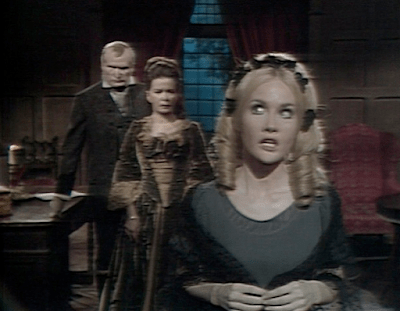
For months now, fluttery heiress Millicent Collins has been staying at the great house of Collinwood as the guest of her cousin Joshua and Joshua’s wife Naomi. Tonight, she returns to the drawing room after a moonlight stroll and makes a series of statements that bewilder Joshua and Naomi.
Joshua and Naomi wonder what Millicent could possibly be talking about. Screenshot by Dark Shadows Before I Die.
Millicent tells her hosts that she has seen their son Barnabas. Joshua and Naomi are shocked to hear this, because they know that Barnabas has died. Believing that Barnabas died of the plague and that this news would scare the workers away from the family’s shipyard, Joshua put the word out that Barnabas went to England. Millicent saw Barnabas standing in the graveyard, near the secret chamber where his coffin is hidden. This further shocks Joshua and Naomi.
Millicent says that she needs Barnabas. He is the only member of the family who has fought a duel, and there is a family matter that can be settled only by dueling. Joshua and Naomi have no idea what she is talking about. She tells them she has learned that naval officer Nathan Forbes, to whom she recently became engaged, was already married. That hits them so hard they almost embrace her, something characters on this show do not do. They are supposed to be New Englanders, after all. She shies away from them.
What neither his parents nor Naomi know is that Barnabas rises from the dead by night and walks the earth as a vampire. The only living person privy to this secret is Barnabas’ friend, much put-upon servant Ben Stokes.
Ben saw Millicent at the graveyard, moments after Barnabas vanished into thin air. He tried desperately to convince her that she did not see Barnabas, repeating Joshua’s story that he has gone to England. He tried to bargain with her, promising to look for Barnabas and tell her if he finds him. His insistent denials that she saw what she knows she saw frustrated her. She told him that she wants to be buried in the mausoleum, and that she thinks of herself as already dead, dead as of today, no matter how long her body may survive. She told him her grave marker should reflect this date of death. He begged her to let him walk her back to Collinwood. Irritated with him, she allowed him only to follow her at a distance.
Millicent complains to Joshua and Naomi that Ben kept telling her that Barnabas had gone to England. She says that he must be punished. Joshua has been telling Millicent she is ill, and he wants Ben to stick to the official story. But he is such a tyrant that he cannot help but warm to the idea of punishing Ben. He ends the episode by expressing his vigorous agreement with Millicent.
Ben and Millicent are both wonderful today. Millicent has dozens of lines, all of them quotable, and most of them quoted in Danny Horn’s post about this episode. Nancy Barrett developed a deliberately stagy style for Millicent that always works, and today it reaches its summit.
As Ben, Thayer David has a subtler part to play, and he does it perfectly in this one. In an opening scene with Barnabas, he begins with a gruff expression of distaste for the horrible things Barnabas does, and before we know it is pleading with him not to allow himself to be destroyed. In a tiny bit of time, with only a few lines to speak and only a few opportunities to show his face, he takes us from loathing for the vampire to devotion to his friend, and at no point does the transition feel forced.
Naomi and Joshua have recently lost both of their children, among other loved ones, and there doesn’t seem to be any end to the death that surrounds them. Joan Bennett and Louis Edmonds fully connect us to their grief today. Dark Shadows too rarely gives these two extraordinary actors a chance to show what they can do, and both of them make great use of this opportunity.
Barnabas’ part is somewhat ridiculous. Today, he outdoes himself in narcissism, describing the death of his true love Josette solely as a thing that happened to him. But we know going in that that’s his deal- as a vampire, he is a metaphor for selfishness, and he was pretty self-centered even when he was alive. By this time, Jonathan Frid’s performance has made this preposterous creature into a major phenomenon of the era’s pop culture, and when he is this deep in his wheelhouse he does not disappoint. The result is a surprisingly strong entry in the series.
Yesterday, 5 February 1796, the Countess DuPrés visited suspected witch Victoria Winters in the Collinsport gaol. The countess begged Vicki to lift the spell that she believes to be causing her niece, the gracious Josette, to behave strangely. Vicki responded that she had cast no spell on Josette or anyone else. She claimed that she was not a witch at all, but an unwilling and well-meaning time traveler displaced from the year 1968. As it happens, this is true.
Vicki told the countess that according to the history and legend she learned in the 1960s, Josette will soon die. The last events leading to her death will be triggered when she loses a ring with a black onyx stone. Vicki’s remarks settled any lingering doubts the countess may have. She is now certain that Vicki is a witch, and that when she claims to be warning people against upcoming dangers she is in fact taunting them with her own cruel plans.
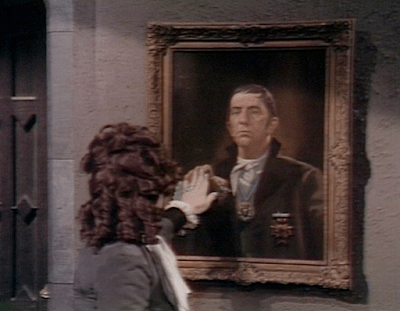
In Josette’s room, the countess discovers that Josette has somehow come into possession of just such a ring as Vicki described. Josette refuses to tell her where it came from. Later, the countess stands in the foyer of the great house of Collinwood, studying the portrait of the late Barnabas Collins that hangs there. She recognizes Josette’s new ring as the one in the portrait. Well might she recognize it- she knew Barnabas well, he died only a couple of weeks before, and he wore the ring all the time. He and Josette had been engaged to marry each other, and never gave up their passionate attachment even after they married other people. It is hard to think of a reason why the countess would not have thought of Barnabas at the moment Vicki began describing the ring, much less as soon as she saw it on Josette’s finger.
Barnabas’ father, haughty overlord Joshua, asks the countess what she finds so interesting about the portrait. She asks if the ring was part of a set; he answers that it was unique. He begins to reminisce about Barnabas’ great fondness for the ring. His warm look of recollection gives way to an expression of deep pain, and he stops himself as he is about to say that he left it on Barnabas’ finger when he buried him. He refuses to say any more about Barnabas.
The countess and Joshua do not like each other very much, but they are of one mind about Vicki. It is inexplicable that the countess does not tell Joshua about Vicki’s prediction and about the fact that Josette now has Barnabas’ ring. Her reticence sets up a dramatic moment, when Josette comes downstairs, faints, and Joshua finds the ring on her finger. But that moment would only have been more dramatic if it had also been the first time the countess saw Josette with the ring. Vicki’s description of a ring should have been more than enough to prompt her to study the portrait and ask Joshua about Barnabas’ ring, but perhaps not enough to embolden her to say much to Joshua. The scene in Josette’s room makes a hash of the countess’ motivations here, and leaves Joshua’s discovery of the ring as a pointless repetition.
Joshua goes to Barnabas’ coffin, hidden in a secret chamber of the family mausoleum. He talks to Barnabas for a while. He admits that he was a cold and distant father, but vows to take a terrible revenge on anyone who might have disturbed his rest. He opens the coffin and finds that it is empty. His shock is chiefly to do with the disappearance of the body, but can only be sharpened when he realizes that instead of delivering his heartfelt confession to his son’s corpse he was in the somewhat ridiculous position of delivering it to a piece of furniture. This is a characteristic situation for Joshua- when he is ready to open up about his feelings, he finds that no one is there who can even appear to be listening.
Returning viewers know that no one robbed Barnabas’ grave. He has become a vampire. He gave Josette the ring himself, after biting her and telling her she would become his undead bride. All of this has been concealed from Joshua, the countess, and Vicki. Barnabas shows up today and has a forgettable scene with Josette. They get involved with the secret passage leading out of her bedroom.
Josette’s room will be Vicki’s in the 1960s, when she is the governess at Collinwood, and we saw in #412 that she knows about the secret passage. There is one other thing you would expect Vicki to have known. Barnabas returned to prey upon the living in April of 1967; Vicki knew him from then until she came unstuck in time in November of that year, though she thought he was alive. He wore the ring with the black onyx stone all the time in 1967, just as he did in 1795. Vicki was familiar with the portrait, which still hung there in her time. She believed its subject to be the ancestor of her acquaintance, knew that it was the same ring, and knew that the “original” Barnabas had been Josette’s lover. So if Vicki read a book or heard a legend that described the ring in connection with Josette, you would think she would have put one and one together and come up with two.
We open in the drawing room of the great house of Collinwood, where Naomi Collins (Joan Bennett) is drinking alone. Her husband Joshua (Louis Edmonds) enters, returning home after an absence of some days, and greets Naomi with a loud expression of scorn for her alcoholism. She looks up and recites these lines: “A little bird flew to the window. It hovered there for a moment, and then flew away. The first bird of the morning.” Many times, Joan Bennett found ways to show the viewers of Dark Shadows why she had been one of the biggest movie stars of her generation, but this is not one of those times. She delivers this little speech stiffly, as if embarrassed by it.
Joshua is about to leave the room when Naomi tells him that their daughter Sarah died the night before, on her eleventh birthday. He is thunderstruck and says that he cannot believe it. Naomi replies, “Yes, that is what we must do- not believe it!” With this line, Joan Bennett recovers her footing. As matriarch Elizabeth Collins Stoddard in the first 73 weeks of Dark Shadows, when the show was set in 1966 and 1967, Bennett created a character who had devoted her entire life to this motto. Now that the show is set in the late 18th century, we see that the Collinses had been living by it for hundreds of years. Once she starts playing a character who is wrestling with denial, Bennett is in familiar territory, and she is terrific to watch.
Joshua believes that the bewildered Victoria Winters (Alexandra Moltke Isles) is a witch, and that a spell she cast on Sarah caused her death. He goes to the gaol in the village of Collinsport where Vicki is being held, awaiting trial on witchcraft charges. We see her in her cell, the first time we have seen this set. Joshua confronts her there. She denies his accusation. She tells him she is a time-traveler displaced from 1967 and that she has been trying to use her knowledge of history to rescue people from the fates that she has read about. This is true, as it happens, but of course Joshua is not favorably impressed. He tells her to enjoy the few sunsets and sunrises that she will see between now and the day she is put to death.
A week before, Naomi and Joshua’s other child, their forty-ish son Barnabas (Jonathan Frid,) had died of a mysterious illness. Joshua decreed that no one must know that Barnabas had died. He had Barnabas’ body interred in a secret chamber hidden inside the Collins family mausoleum, and put out the word that Barnabas had gone to England.
Unknown to Joshua or Naomi, Barnabas has become a vampire. Joshua’s remark to Vicki about sunrises and sunsets thus carried an ironic charge for regular viewers. When Barnabas emerges from his coffin after this sunset, his friend, much put-upon servant Ben Stokes (Thayer David,) tells him Sarah has died. Barnabas blames himself for this. Sarah had seen him with blood on his face, and in her fear had run away. Alone in the night, she suffered from exposure. Barnabas tells Ben that he will go into the village of Collinsport, confess everything to the authorities, and let the sunlight destroy him. At least that will save Vicki. Ben pleads with him to find another way, but Barnabas insists.
Sarah’s remains have been deposited in a vault in the outer part of the mausoleum. Naomi comes in to look at the vault again; Joshua follows her. Naomi has many bitter words for Joshua; he is ready to lament the deaths of their children. Barnabas and Ben, hiding inside the secret chamber, listen to this painful conversation.
Joshua losing his grip on NaomiBarnabas and Ben eavesdrop.
For viewers who have been watching Dark Shadows from the beginning, the scene of Barnabas and Ben eavesdropping on Joshua and Naomi evokes two earlier scenes with particular force. In #318, Barnabas and his associate, mad scientist Julia Hoffman, stood on the same spots where Barnabas and Ben stand now, listening as two local men talking in the outer chamber revealed knowledge that might expose their many crimes. In #118, crazed groundskeeper Matthew Morgan, also played by Thayer David, held Vicki prisoner in a different secret chamber, and the two of them listened as another pair of local men searched for Vicki just outside. In those episodes, Frid and David played men who were bent on murder, but whom we knew to be unlikely to kill their intended targets. Today, they are playing characters who are both desperate to stop killing, but we know that they are doomed to take more lives.
After Naomi and Joshua leave, Barnabas tells Ben he cannot turn himself in. The family must not be disgraced. He tells Ben to come back in the morning with a stake made of holly and to drive it through his heart. He gives him this command in just the same words the witch Angelique had used in #410. Ben had not at that time known what had become of Barnabas, and had complied only because he was under Angelique’s power. He resists Barnabas’ command now, saying that he cannot destroy one who has been a true friend to him. Barnabas tells him he is already destroyed, and that staking him will be a mercy. Ben reluctantly agrees.
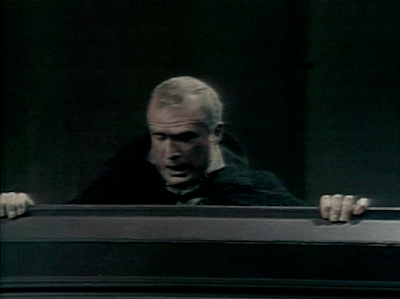
At the top of the episode, wicked witch Angelique is in the secret chamber hidden inside the Collins family mausoleum. She is standing before the open coffin of Barnabas Collins, a stake in one hand and a mallet in the other. The sun is setting; once it does, Barnabas will rise as a vampire. She would drive the stake through his heart to prevent this outcome, but she is moving in time with the background music, and it is too slow. Barnabas awakes, knocks the equipment from her hands, and grabs her throat.
In 1967, throat-grabbing was Barnabas’ reflex when someone opened his coffin at dusk. The character first appeared in #210 as a hand darting to the throat of would-be grave robber Willie Loomis; Barnabas would bite Willie and enslave him. In #275, seagoing con man Jason McGuire opened the coffin; again the hand darted to the throat, and in #276 we learned that Jason was dead. That was the first time in 1967 Barnabas killed someone.
Now it is 1795. When we return from the opening title sequence, Barnabas has let go of Angelique. He has questions, and she is trying to avoid answering them. He realizes that she is afraid of him. When he figures out that she has turned him into a monster, he strangles her. In 1967, thirteen weeks separated Willie’s freeing of Barnabas from the death of Jason; this time, Barnabas chokes the life out of Angelique only eight minutes after he first awakens as a vampire.
Barnabas opens the door to the outer part of the mausoleum. The mechanism that opens this door is hidden inside one of the stairs leading out, and the camera lingers on it long enough to show that Barnabas must already be very familiar with the room to have gone directly to it. Returning viewers will remember that Angelique seemed unable to find it yesterday, and committed fans will remember that strange and troubled boy David Collins spent a whole week trapped in the secret chamber in September 1967 because it was so well hidden. The ghost of Barnabas’ little sister Sarah had to manifest to David in #315 and show him the door opener before the plot could move forward.
In the outer part of the mausoleum, Barnabas finds much put-upon servant Ben. Ben had been Barnabas’ devoted friend, but Angelique cast a spell on him and forced him to do her evil bidding. He is glad to hear Angelique is dead, and pledges to help Barnabas. As a living man, Barnabas had always gone out of his way to reciprocate Ben’s friendship, but throughout their conversation in the mausoleum he keeps telling Ben about the reasons he has to kill him. Only when Ben points out that he will need someone to protect him during the day does Barnabas agree to let him live. This was the same appeal that mad scientist Julia Hoffman made to Barnabas in #351. Since Barnabas was busily preparing to kill Julia a few episodes after that, this echo does not inspire much hope for Ben’s future.
Barnabas and Ben are having a little talk about how to dispose of Angelique’s corpse when they hear someone approaching the mausoleum. Barnabas hustles back into the secret chamber. Ben turns to the entrance, an appropriately helpless expression on his face.
Ben faces the darkness, waiting for whatever fresh hell may be approaching.
Haughty overlord Joshua Collins enters. Joshua is Barnabas’ father and Ben’s legally recognized master. Joshua accuses Ben of coming to rob Barnabas’ grave. Ben denies it. Joshua demands to know who he was talking to a moment before. Ben says that he was praying and that the only way out of the chamber is the way Joshua came. Joshua says that it is not the only way- Ben’s confederate could have gone into the secret chamber. Joshua opens the secret chamber, looks inside, and sees only Barnabas’ coffin. He is about to close the panel again when a bat flies out and flusters him. After the bat is gone, he agrees to let Ben stay and say more prayers for Barnabas.
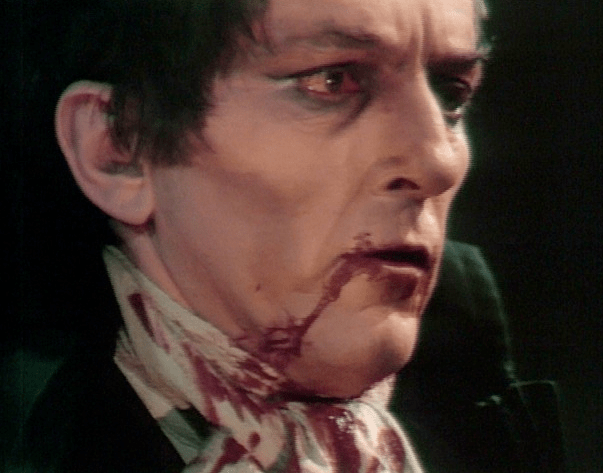
Ben is in the graveyard when Barnabas materializes in front of him. Barnabas tells Ben that his new existence has brought him new powers. When the two of them return to the mausoleum, Ben sees that Barnabas’ face is streaked with blood. Barnabas tells him that he has discovered that along with his new powers, he has a new need- he must drink other people’s blood in order to survive. Tomorrow, Ben will hear of an unfortunate woman in the village killed by a wild animal. Barnabas says that he should have let Angelique destroy him; Ben protests that he oughtn’t say things like that. Evidently Ben is going to stick with Barnabas no matter how gruesome his deeds become.
In a moment of anger, wicked witch Angelique cursed her husband Barnabas Collins. In the first stage of the curse, a bat bit Barnabas on the neck. Barnabas lost a great deal of blood, and now has a high fever. If he dies, he will rise as a vampire. Angelique regrets placing the curse and is trying to undo it.
At the top of today’s episode, Angelique is fussing over a large bloodstain on the floor of the front parlor. With a word, she can turn Barnabas into a vampire. Earlier, she turned his father Joshua into a cat one day and back into a human another day. She made Barnabas’ true love, the gracious Josette, conceive a mad passion for his uncle, Jeremiah, made Jeremiah reciprocate it, and drove the two of them to elope. She enthralled Barnabas’ devoted friend, much put-upon servant Ben Stokes, and forced him to assist her in her evil plans. She could sicken Barnabas’ little sister Sarah and kill her or heal her as she chose. She made bewildered time traveler Vicki suffer hallucinations that led her to incriminate herself as the witch. Yet for all her powers over humans, she is utterly stumped by the stain on the floor. She stares at it and talks to herself for a minute or two, helplessly rubs it with a dry cloth, then stands up, defeated. Considering that she was a lady’s maid until she married Barnabas, you might think that the first thing she would have learned when she took up black magic would be spells to help with the house-cleaning, but evidently not.
Unlike the blood on Lady MacBeth’s hands, the stain on the floor is visible to everyone. Barnabas’ mother Naomi sees it when she has come to the house and asked to see her son. Angelique denies that he is there. We cut back and forth between the women in the front parlor and Barnabas in his sick room. When Naomi notices the bloodstain on the floor, Angelique claims that it is a wine stain. Naomi is a serious alcoholic, so she probably knows the difference between a wine stain and a bloodstain. The ailing Barnabas makes noises that Naomi hears, and Angelique claims that they are just the sounds of the house. Naomi lived in the house until she gave it to Barnabas a couple of weeks before, so she probably knows the house’s noises well enough that this won’t fool her either. Even after Angelique has resorted to these two very ill-chosen lies, Naomi gives up and goes away. It is fun to watch Angelique struggle to find a way out of an awkward situation with her mother-in-law, and touching to see that Naomi is so determined to believe the best about Barnabas and his new wife that she decides to accept Angelique’s explanations.
Angelique goes upstairs and gives Barnabas a potion meant to cure him of her curse. She is terribly upset when it doesn’t work. We’ve seen Angelique regret her spells before, and in #377 we heard her thinking about the fact that she can’t control their effects once she has cast them. But this is the first time we have seen her go so far in an effort to undo her evil deeds. When she offers to bring Josette to Barnabas, there is enough desperation on her face that it seems plausible that she sincerely intends to let her rival try to help him.
In the great house, Naomi and Joshua quarrel about Barnabas and Angelique. Joshua claims that he has not the slightest concern about Barnabas; as soon as Naomi leaves the room to answer the door, we see a haunted look on his face that shows this to be a lie. It’s a wonderful touch, and sets up an expectation that Joshua will soon relent in his hostility to Barnabas.
Naomi opens the door to find Josette and her aunt, the Countess DuPrés. When the bat attacked Barnabas, Josette and the countess were many miles away from Collinwood, yet Josette not only sensed that something terrible was happening, streams of blood appeared on her neck at the same spots where they appeared on Barnabas’ neck. After this experience, they hastened back to Collinwood.
While Josette and the countess were in the inn far away, a bat appeared outside their window. Though Angelique has been dispatching bats to do her bidding, she did not then know and still does not know where Josette and the countess were at that time. Regular viewers of Dark Shadows should be ready for this. The show’s first supernatural menace, undead fire witch Laura Murdoch Collins, was introduced in December 1966 as an assortment of related but autonomous phenomena, and we saw in 1967 that the ghost of Sarah was also made up of several parts, not all of which were aware of each other or working towards the same goals. So the bat that spies on Barnabas, the bat that bites Barnabas, and the bat that hangs around Josette and the countess may all be parts of the complex known as “Angelique,” but that need not mean that they are all under the control of the woman we know by that name or that she is even aware of them.
Josette is determined to help Barnabas and says that she and her aunt will be going to the Old House to ask Angelique where he is. Naomi is sure Angelique does not know, but Josette and the countess insist on going to the Old House anyway.
When Naomi came to visit, Angelique had to be pleasant. Naomi is Barnabas’ mother, and she is the only ally Angelique can hope to have in the family. But she doesn’t have any need to be nice to Josette or the countess. She keeps telling them to get out of her house, and they keep refusing. Finally they are on their way to the door when they hear Barnabas’ voice crying out “Josette!” At that, there’s no stopping Josette from rushing up the staircase to his room. The countess holds Angelique back, and Josette finds Barnabas bleeding and delirious. He keeps calling her name, unable to recognize that she is with him. He staggers past her. His back to her, he leans out into the hallway and calls “Josette! Josette!” It’s a poignant image of a man who has never fully appreciated anything he had, and who has now lost everything.










 Dark Shadows Commentary
