He could not help laughing now and then over the Scientist’s defeat. But whenever this came up, the Phoenix would shake its head with a kind of sad wisdom.
“My boy, there are certain things, such as head colds and forgetting where you have left your keys, which are inevitable—and I am afraid that the Scientist is, too.”
“Oh, Phoenix, you don’t think he’ll come back, do you?”
“Yes, my boy, I do. I can see the whole train of events: He will recover from his fright. He will be curious about the Wail, and will return to investigate it. Once here, he will remember us, and we shall have to take him into account once more.”
“Oh. Do you think it’ll happen soon?”
“Oh, no, my boy, nothing to worry about for the time being. But we must remember that it will happen some day.”
“Yes, I guess you’re right. I think he’s hateful!”
“I cannot disagree with you there, my boy. Of course, I have no doubt that, in general, the advancement of science is all to the good. Knowledge is power. But on days like this I sometimes wonder…. Does it not seem to you that the highest aim in life at the moment is to enjoy the sunlight and allow others to do the same?”
“You’re right, Phoenix—but then, you always are. I was just thinking the same thing. It’s funny … I mean … well, you know. Why can’t people leave other people alone—and—and—well, just enjoy themselves and lie in the sun and listen to the wind?”
“That is the way of the world, my boy. Getting and spending, and all that sort of thing. But come! Why should we worry over the follies of the rest of the world? A day like this was made for living, not thinking. Begone, dull care!”
And they would forget the Scientist and watch a pair of butterflies chase each other instead.
Dark Shadows’ Phoenix is the none-too-benevolent Laura Murdoch Collins, and its David is her son. Laura has not told her David of her true nature. She desperately needs to persuade him to leave his home and to follow her into the flames of her next pyre. Evidently she has to be sparing about the details of what she has in store for him if she is to win him over. So in our story, David will not help the Phoenix do battle with The Scientist.
We open today with Laura staring hard into the flames of the hearth in her cottage on the great estate of Collinwood, casting a spell on her enemy. This enemy, like the one Ormondroyd’s Phoenix confronted, is a scientist, but he has a name. He is Dr Peter Guthrie of the psychology department at Dartmouth College, of all places.
Guthrie is in the drawing room of the great house, some distance away, stumbling about and gasping under the pressure of Laura’s spell. Well-meaning governess Vicki enters and urges Guthrie to “snap out of it!” He tells her that he can’t, and continues writhing about while Laura’s staring eyes are superimposed above his image.
All seems lost for Guthrie, when David strolls into Laura’s cottage and calls to her. She doesn’t react. David finally puts his hand on his mother’s shoulder and shakes her, breaking her concentration. At first she wants him to go away so that she can resume casting her spell on Guthrie, but when he becomes angry she asks him to stay. She has been saying that she has very little time to complete the task that brought her to Collinwood- evidently she is not sure she will have time to repair even one quarrel with David.
In the great house, Guthrie is recovering. Vicki tells him that his symptoms are those which reclusive matriarch Liz exhibited shortly before she lapsed into a catatonic state from which she has yet to recover. They are sure that Laura is responsible. David returns and they talk with him. They realize that he interrupted Laura while she was casting a spell. David goes off to have a dinner which will be followed with two desserts- cake and ice cream. Vicki and Dr Guthrie are starting to make a plan to oppose Laura when the front doors of the house fly open and reveal her standing there.
Laura appears in the doorway
Laura’s appearance in the doorway is a very effective moment. It seems that Laura has come to the house to intimidate Vicki and Dr Guthrie, to show that while he may have escaped her spell and they may have learned something about her methods, she can move so much more quickly than they can that they are after all helpless against her. Once that point has been made, there isn’t much reason for the episode to go on.
Diana Millay and John Lasell do what they can with the scene between Laura and Guthrie in the drawing room, which is a lot- Millay was superb at blitheness, John Lasell at conscientiousness, and those are the notes their characters strike throughout the exchange. But the lines don’t make any sense. Guthrie asks Laura if she isn’t surprised to see him up and around- why would she be? He knows that she was interrupted before her spell could be completed. He tells her what he does and doesn’t know about her supernatural powers. Why would he tip his hand that way? He tells her that once he has figured her out, he plans to reveal his knowledge to the world. So he is letting her know that he hasn’t revealed anything yet, and won’t reveal anything or recruit any allies if she can stop him before he gets all the answers. Guthrie has been represented as a shrewd operator up to this point- apparently the spell Laura started casting on him has knocked his IQ down by three or four standard deviations.
Another question that comes up when we see Laura confronting Vicki and Dr Guthrie in the foyer is why she doesn’t attack Vicki. It was Vicki, through her boyfriend Frank, who brought Guthrie to Collinwood. Flighty heiress Carolyn is temporarily in charge at Collinwood in the absence of her mother Liz, and Carolyn is dependent on Vicki for a hundred things. Carolyn is an opponent of Laura’s and would likely be immobilized if Vicki were out of action. Laura’s estranged husband, Roger, relies on Vicki to look after David, and would be even more eager than he already is to get rid of David if he had to take care of the boy himself. Laura’s sometime boyfriend, dashing action hero Burke Devlin, is the closest thing she has to an ally. Vicki has some influence over Burke, and has used it to bring him to question whether he ought to trust Laura. In every connection, Vicki is Laura’s chief adversary. Yet Laura has not attacked her directly, and the show has not explained why she hasn’t.
It isn’t like they don’t have time to develop a story point that would explain this. They have had as many as three episodes in a row (for example, #161, #162, and #163) which consisted entirely of conversations in which characters recapped conversations from previous episodes, conversations which themselves were nothing but recap of still earlier episodes. They could have dumped some of that recap and shown us some kind of event that would have explained why Vicki hasn’t yet been a target of Laura’s power.
Parapsychologist Peter Guthrie calls on blonde fire witch Laura Murdoch Collins at the cottage where she is staying. He tells her that the charred remains of an unknown woman found in the burned ruins of her apartment in Phoenix, Arizona have inexplicably vanished from the morgue where they were being kept. Laura reacts to this news with shock. Guthrie asks her why the news means so much to her. She denies that it means anything to her, and demands he leave. She warns him that something will happen to him if he doesn’t leave her alone. He asks what she means by this warning, and she refuses to answer.
Laura sizes up Guthrie
Guthrie was usually rather quiet and retiring from his second appearance, in #161, until yesterday. He first showed anger then. He’s agitated again at the beginning of today’s episode, and he holds his ground with Laura. Evidently he is ready for a confrontation.
Dashing action hero Burke Devlin charges into the cottage. He is rude to Guthrie, who makes a few pointed remarks and then leaves. Burke takes over asking Laura questions she won’t answer. When he too leaves, she looks exhausted. She hastens back to the hearth and sits by the fire, which seems to be the source of her energy.
Guthrie returns to the great house of Collinwood. He calls for well-meaning governess Vicki. Then Laura’s face is superimposed on the screen. Guthrie wobbles, takes his glasses off, and falls down.
Yesterday, we saw that Guthrie was considering the same three explanations of Laura’s relationship to the supernatural that the audience had in mind when we had the same information he has now. Perhaps a supernatural force has followed her to Collinwood and is doing things she knows nothing about. Perhaps a supernatural force is attached to her and acts on her unconscious impulses without her knowledge. Or perhaps she herself is the force, and is actively making the strange goings-on go on.
Today, Guthrie takes an interest in Laura’s reaction to the news of the vanishing corpse. A focus on this reaction makes us wonder just how Laura works. We have gathered that she is a humanoid Phoenix, who achieves a cyclical immortality by periodically incinerating herself at some point before reappearing as a living being. We also know that the charred remains of two other Laura Murdochs who died by fire were buried in the town of Collinsport in previous centuries- the body of Laura Murdoch Stockbridge in 1767 and of Laura Murdoch Radcliffe in 1867.
Now it is 1967. The corpse in Phoenix had been identified as Laura Murdoch Collins, and has disappeared. Perhaps we are to gather that when the humanoid Phoenix incinerates herself, she initiates a multi-stage process. The fire separates the woman into a dead body and a living Doppelgänger. The Doppelgänger is surrounded by magical occurrences, and as she gathers strength she is able to direct these magical occurrences to bring the process to its climax. Laura’s shocked reaction to the news that the body has disappeared, coupled with her signs of tiredness and her repeated assertions that she is running out of time, suggests that the disappearance of the body is an event outside her control. It marks the end of one stage of the process and the beginning of another. Evidently it means that Laura has even less time to complete her task than she had thought. If that is how it works, then we would expect that the charred remains deposited in the grave of Laura Murdoch Radcliffe and in the tomb of Laura Murdoch Stockbridge would also have vanished, and that the coffins in those places would also be empty.
Friday, Dark Shadows showed us its first séance. Yesterday, the people who attended that séance tried to figure out what it meant. Today, word of the séance starts to get out to people who weren’t there.
These three episodes also involve wrapping up a lot of loose ends that only people who watched the show from the beginning will remember. Friday’s episode harked back to the ghostly image we saw in #30. Yesterday’s episode drew a line under the alarmingly inappropriate crush flighty heiress Carolyn had on her Uncle Roger in the first few weeks of the show. Today, dashing action hero Burke Devlin shows that he is still laboring under a misunderstanding that led him to a dead end in #89 and #99.
In those episodes, Burke was trying to take his revenge on the ancient and esteemed Collins family by hiring the most valued employees away from their cannery. He was confident he would succeed in this plan because he had more money than the Collinses. In #89, he explained that confidence to his lawyer with a bunch of cliches rich guys use when they are villains in old movies: “Money talks. Money buys loyalty. Everyone has their price. Name it and you can buy them. Some just come a little higher than others, that’s all, but everyone is for sale.”
Those men all rebuffed Burke’s offer, as hardworking young fisherman Joe had refused Burke’s attempt to buy his loyalty in #3. Burke believes that the Collinses’ power comes from their money. His failures suggest that it is more nearly the other way around. The Collinses dominate the town of Collinsport because the population is so much in the habit of deferring to them that they can’t really imagine any other way of life. Simply by living in town, they have been indoctrinated into an ideology that puts the Collinses at the center of everything. Though from the perspective of the outside world Burke may have come back to town as a representative of high finance and large-scale capitalism, in the eyes of the locals he might as well be trying to start a communist revolution.
The one Collinsport resident who has agreed to take Burke’s money as payment for working against the Collinses is Mrs Johnson. For many years, Mrs Johnson had been the faithful housekeeper to cannery manager Bill Malloy. In her first appearances, Mrs Johnson talked of her unrequited love for Bill and her conviction that the Collinses were responsible for his death. Wanting revenge on them, she agreed to Burke’s plan to take a job as housekeeper at Collinwood and to give him whatever information she could gather. He has been paying her ever since.
Today, Mrs Johnson comes to Burke’s room and announces she has some information she would give him even if he weren’t paying her. This remark will strike regular viewers as absurd. Those who remember Mrs Johnson’s early appearances know that her motivation for joining with Burke was not his money, but her drive for vengeance. Those who have seen her since, including earlier in this episode, know that she always tells everyone she meets everything she knows. Her usual conversational gambit is to declare “I mind my own business, and expect others to do the same!” and then divulge the entire contents of her awareness, including everything she learned by her incessant eavesdropping on everyone in the house.
In Mrs Johnson’s case, Burke is overlooking not only the power of ideology, but also the persistence of personal habits. Mrs Johnson not only does not need to be paid to give information; no amount of money could keep her from giving information. She can’t be incentivized out of telling too much, because she doesn’t know that she is doing it. She is perfectly sincere when she says “I mind my business!” or “I’m not a gossip!” or makes any of her other usual protestations.
One thing Burke and Mrs Johnson have in common is a tender regard for well-meaning governess Vicki. The séance was very hard on Vicki, because her body was the scene of a battle between the ghost of Josette Collins and blonde fire witch Laura. Josette had possessed Vicki in order to warn the company about Laura, but Laura used her own powers to drive Josette from Vicki before she could say her name. Now Vicki is spending the day sick in bed. After talking with Burke, Mrs Johnson goes back to Collinwood and takes it upon herself to keep anyone from bothering Vicki.
The first person to try to see Vicki is visiting parapsychologist Dr Guthrie. Mrs Johnson stands on the stairs and forbids him to go up. He tries to persuade her that, as a doctor, he might be able to help. She responds that the only way he will get to Vicki’s room is by knocking her down and walking over her. At that, he gives up and goes to the drawing room.
Keeping Guthrie at bay
Laura then comes to the house and tries to see Vicki. Mrs Johnson takes exactly the same line with her. Laura is more aggressive than Guthrie had been, and tries to walk past Mrs Johnson. Mrs Johnson puts her arm in the way to physically block her. Laura too gives up and goes to the drawing room.
Keeping Laura at bay
There, she finds Dr Guthrie listening to the audiotape he made of the séance and taking notes. We hear Vicki’s voice desperately muttering about “le tombeau vide” before he sees Laura and shuts the player off. He explains that he does not want anyone who was at the séance to hear the recording, as he does not want it to color their recollections.
Laura and Guthrie talk about the tape recorder and about his use of electronic devices in his work as a scientist. Not even actors as capable as Diana Millay and John Lasell can make this dialogue seem to have much point. But a few weeks ago, friend of the blog Courtley Manor called my attention to a 1957 novel for children, David and the Phoenix, by Edward Ormondroyd. I think there is a reference to that book in this scene.
Ormondroyd’s David is a preteen boy who climbs a mountain and finds himself in a magical realm where he comes face to face with the Phoenix. The Phoenix is initially guarded with David, but relaxes when David says that he doesn’t know any scientists. Evidently the Phoenix’ great goal is to be left alone, and scientists were to learn that there really was such a bird as the Phoenix that goal would forever pass out of reach.
Some of the similarities between Dark Shadows’ “Phoenix” storyline and David and the Phoenix may be the result of common source material. In #140, Laura tells David that her real home is a magical world that sounds quite a bit like the place Ormondroyd’s David stumbles upon. But from the 1930s through the 1960s, the legends of the Holy Grail were a staple of university English departments in the USA, and many of those associate the Phoenix with just such places. So it could be that both Edward Ormondroyd and Malcolm Marmorstein had read Wolfram of Eschenbach or someone like him. And “David” was an extremely common name for boys born in the USA in the 1940s and 1950s, so that could be a coincidence.
But when The Scientist appears in Ormondroyd’s book and emerges as the great enemy of the Phoenix, Ormondroyd presents The Scientist in terms of his equipment. He must wait for his equipment to arrive before he can act against the Phoenix, he puts a great deal of effort into transporting his equipment and setting it up, and he suffers his climactic defeat when the Phoenix sabotages his equipment. So readers of Ormondroyd’s book would have to see a nod to it in this conversation between Guthrie the Scientist and Laura the Phoenix.
After Laura has left, Guthrie calls urgently to Mrs Johnson. He asks her if she touched the tape recorder. She tells him she wouldn’t touch the machine with a ten-foot pole. He plays the tape back, and shows that the sounds of the séance have been replaced with the sounds of a crackling fire. Ormondroyd’s readers will remember that The Scientist did not give up after the Phoenix destroyed his equipment, and will expect Guthrie to try to find new ways to fight Laura.
When we heard the crackling on the tape, Mrs Acilius jokingly asked me when the show was made. “This was before Watergate, right?” Yes, indeed; Dark Shadows was not making a reference to the 18 1/2 minute gap in the Nixon tapes. While the consensus among scholars today is that that gap was caused accidentally, it is amusing to imagine that someone in the White House in those days was a Dark Shadows fan and took a page from Laura’s book. I guess the president’s daughter Tricia was into the show for a while, but even if the erasure were deliberate she wouldn’t have been a very likely suspect.
Yesterday, we saw the first séance on Dark Shadows. Today, the characters who participated in that séance try to make up their minds about what it meant.
At opposite poles stand flighty heiress Carolyn and her uncle, high-born ne’er-do-well Roger. Roger declares that he has made up his mind to forget all about the séance, and demands that its organizer, visiting parapsychologist Dr Guthrie, be expelled from the great estate of Collinwood. Carolyn regards the séance as a success, and tells Roger that Guthrie will be continuing his work. They quarrel about this difference. There are weighty threats veiled in the dialogue. Their voices are sometimes quite sharp, but their facial expressions and body language are anything but. Watch the scene without sound, and Carolyn looks like she is pleading with Roger, while he just looks sad. They are losing something that neither of them wants to let go.
Something is ending
In the first weeks of the series, Carolyn spoke rather alarmingly of her crush on her uncle. Her flirtation with Roger’s enemy, dashing action hero Burke Devlin, somewhat reduced the intensity of that crush, dialing it down from frankly incestuous to merely disquieting. After the Carolyn/ Burke flirtation ended, we had some scenes where we were reminded of Roger and Carolyn’s odd intimacy. This scene marks the end of all that. Roger might still address Carolyn as “kitten” from time to time, but the red flags are furled for good and all. Dark Shadows won’t be developing any kind of storyline about unsavory goings-on between Carolyn and Roger, or using hints of such to emphasize any point they might want to make about the weirdness of the Collins family.
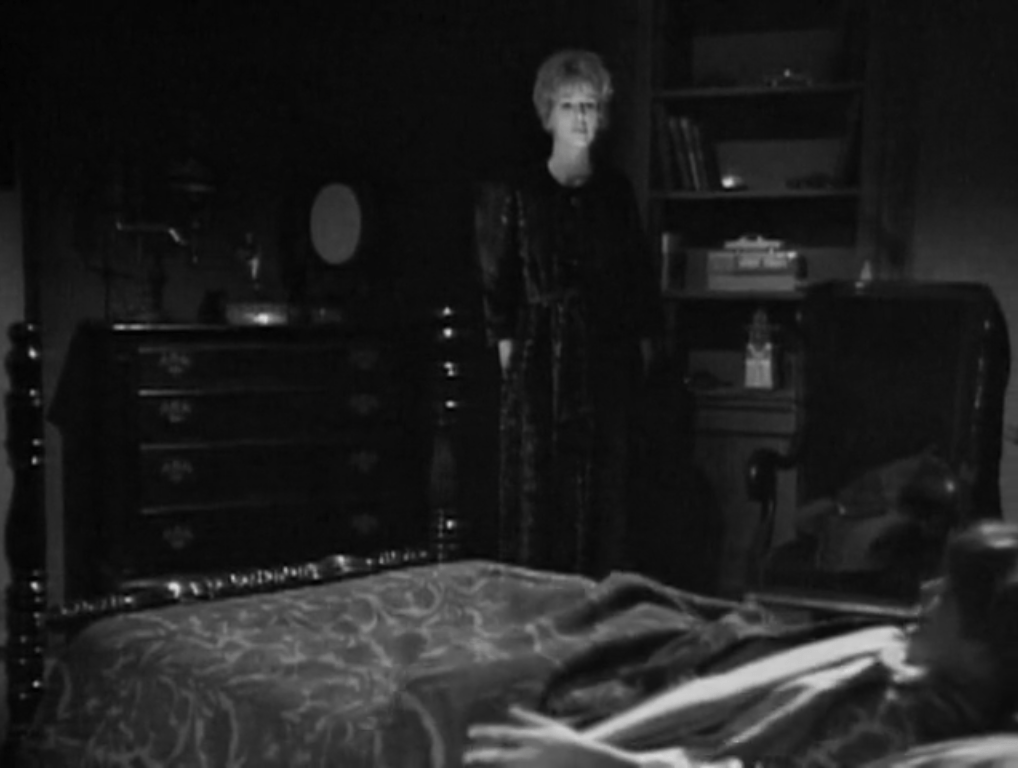
Well-meaning governess Vicki had a rough time at the séance. The ghost of Josette Collins used her as a mouthpiece, and blonde fire witch Laura used her powers to keep herself from being named as the source of the recent troubles and as a danger to her son, strange and troubled boy David. Caught in the crossfire between these supernatural beings, Vicki was exhausted and disoriented. At 2:15 AM, Laura materializes in Vicki’s bedroom, waking her. Vicki is bewildered by Laura’s presence. Like a dream in ancient Greek literature, Laura stands at the foot of Vicki’s bed and makes a speech. Unlike those Greek dreamers, Vicki talks back, engaging Laura in conversation. Laura’s point is that Vicki ought to quit the service of the Collinses and leave Collinwood immediately. She tells Vicki that she will be taking David away soon in any case, removing the need for a governess. Vicki looks away from Laura for a moment while gathering her thoughts. When she looks back, Laura has vanished.
Laura has appeared and disappeared in this manner before. This time, it would seem that she is trying to raise a question about Vicki’s sanity. Vicki might think she was dreaming, or might wonder if she is suffering some kind of hallucination. She might also tell others in the house all about the incident, leading them to wonder the same things about her. If Laura can undercut Vicki’s confidence in herself, she might reduce her overall effectiveness as an adversary. If others start to wonder whether Vicki might be given to psychotic breaks, the events of the séance might seem less significant.
At the end of last week, reclusive matriarch Liz left the estate of Collinwood for an extended stay in a hospital. It would seem that she took all of Dark Shadows‘ plot points with her. This is the third episode in a row in which we see nothing but characters reprising conversations that didn’t advance the story the first time we heard them. Writers Ron Sproat and Malcolm Marmorstein have been in charge of the scripting for twelve weeks, and they are clearly in big trouble.
This one has a bizarrely dumb opening. Yesterday, strange and troubled boy David took Dr Peter Guthrie, visiting parapsychologist, to the long-abandoned Old House on the grounds of the great estate of Collinwood. Dr Guthrie told David that he would leave him alone in the parlor for a few minutes to try to summon the ghost of Josette Collins. David stared at the portrait of Josette over the mantelpiece until it transformed. It became a painting of David and his mother, blonde fire witch Laura Murdoch Collins, in flames.
Today’s episode picks up at that point. Dr Guthrie finds David standing on what returning viewers will recognize as the exact spot where he had left him two or three minutes before. Even someone who had never seen Dark Shadows before will look at the set and see that David occupies what must be the most conspicuous location in the entire house, between the foot of the staircase, the fireplace, and the front door. Inexplicably, Guthrie comes downstairs calling “David! Da-a-a-vid!” and announces “I was looking for you!” In a later scene, David will tell Laura that Dr Guthrie is nice but not very smart. After this senseless exchange, that line draws a laugh from the audience.
A conversation between Laura and her estranged husband, high-born ne’er-do-well Roger Collins includes a couple of interesting remarks. Roger wonders whether Laura will succeed in what they both want and persuade their son to leave with her after their divorce becomes final. Laura’s assurance that she can win David over after a single night alone with him (“That’s all I need, Roger–one night…one night alone with him and you’ll never be troubled by him again…because he’ll belong to me…completely”) is delivered in the same jarringly sensual tone she had used talking to David in #159. Considering that David has already tried to kill his father, the suggestion that the danger Laura presents to David is something to do with Freud’s theory of the Oedipus complex is not far to find.
Roger says that when they lived together, Laura’s receptiveness to other men’s attention made him jealous. She contradicts him, saying that the only reason he ever wanted her was that his nemesis, dashing action hero Burke, wanted her. We’ve seen time and again that neither Roger nor Burke is ever as excited about anyone else as they are about each other, and we’ve been invited to wonder what exactly went on between them before they became enemies.
When David comes to Laura’s cottage, the two of them talk about the idea that he might leave Collinwood and live with her. He brings up a point he hasn’t in their previous discussions of this matter, saying that well-meaning governess Vicki will lose her job if he does that. When Laura says that Vicki can get another job, and will probably get married and have children of her own soon, David insists that Vicki loves him more than she does anyone else. This is a touching moment for regular viewers, who saw David move from hatred of Vicki to friendship for her in the one narrative arc of the first several months of Dark Shadows that worked every time we saw it. The Laura story, whatever else it may be, is the grand finale of that theme, and therefore the logical conclusion of the show as we have known it so far.
Mrs Acilius and I agree that the best part of the episode comes in the four seconds after Laura hears someone knocking on her door. As we’ve seen several times, she is sitting motionless, staring into the fire, and only after the second knock does she stir. This time Diana Millay does a particularly good job of looking robotic while Laura tears herself away from the flames.
It registers on Laura that someone is knocking on the door
The best thing about the last two weeks has been the addition to the cast of John Lasell as Dr Guthrie. As of this writing,* it would appear that Mr Lasell is still alive; I’ve found addresses for John Whitin Lasell, Jr, aged 95 years, in both Los Angeles and Orange, New Jersey. Oddly enough, there’s also a Post Office Box in his name in Franklin, Maine. Franklin is about 40 miles from Bangor, down towards the coast where Collinsport would have been.
IMDb says that Mr Lasell was born 6 November 1928 in Worcester, Massachusetts. Wikipedia agrees about the date, but says that he was born in Williamstown, Vermont. The 1940 US Census records the 11 year old John W. Lasell, Jr, as a resident of Northbridge, Massachusetts and gives his birthplace as Massachusetts. There is a memorial to John W. Lasell, Sr, in Northbridge, commemorating his heroic death in the Second World War. So I think we can be confident that John Junior was a Bay Stater by birth. I’m inclined to think Wikipedia’s claim that he was born in Vermont is the result of confusion with dairy farmer John Elliot Lasell. John E. Lasell actually did live in Williamstown, Vermont, and does not appear to have been any relation to the actor. Also, Mrs. John W. Lasell, Sr, the former Frances Sumner, lived into her 97th year, so it shouldn’t be too much of a surprise that her son is still around in his mid-90s.
Blonde fire witch Laura Murdoch Collins has returned to Collinsport, Maine, after a long absence. She wants to divorce her husband, high-born ne’er-do-well Roger Collins, and to go away with their son, strange and troubled boy David. Roger is delighted by this prospect, but he is dependent for his living on his sister, reclusive matriarch Liz, and Liz is adamant that David must stay with her in the great house of Collinwood.
Last week, things came to a head between Laura and Liz. Liz declared that she would never let Laura take David, and Laura responded by casting a spell on Liz. As a result of the spell, Liz is bedridden and given to bouts of confusion.
Well-meaning governess Vicki suspects that Laura is connected with the supernatural. Yesterday, Vicki and her boyfriend, instantly forgettable young lawyer Frank, came across some documents that she interpreted to support this suspicion. Frank is one of Liz’ attorneys and Vicki is for all intents and purposes a member of the Collins family. Further, the ghost of Josette Collins has intervened a number of times to guide Vicki to become the protagonist in the story about the dangers Laura poses. So it would seem that a potent alliance is taking shape against Laura.
Today, another member seems to be joining this force. Liz’ only acknowledged child, flighty heiress Carolyn, initially reacts to the doctor’s recommendation that her mother be moved to a hospital in Boston by agreeing to talk her into it. Then it dawns on her that it would be very convenient for Roger and Laura if Liz were away from the house. She makes some pointed remarks to each of them in turn. She does not say that she thinks Laura is responsible for what happened to Liz, but she is hostile enough that she is unlikely to discourage Vicki’s efforts.
As Liz, Joan Bennett has a lot of screen time today, all of it in bed. You can see why she was such a big movie star in her youth- all she really has to work with are her eyes, and with those alone she holds what could have quite a dreary episode together.
Liz looking at Roger with alarm
Liz considers the idea of going to the hospital, and tells first Carolyn, then Vicki, to stand up to Laura. When each points out in her turn that, as David’s parents, Laura and Roger have certain legal rights to which they must yield, she declares that they are too young to fill in for her in her absence, and resolves to stay in the house.
Vicki leaves the room and Laura appears, sitting on the foot of Liz’ bed. Liz is outraged and demands to know who let her in the house. Laura assures her that no one else knows she is there. The first time Laura insinuated herself into the house, lighting effects made her look like a ghost. She interacted only with David, in circumstances that suggested the whole thing might be a dream he was having, then vanished. Now she is very corporeal, and after her talk with Liz she heads downstairs to talk with Roger and Carolyn in the drawing room. She seems to be gaining strength, becoming able to sustain her form and assert her personality for longer periods. The alliance forming against her will have its work cut out.
Carolyn goes up to Liz’ room while Roger and Laura talk about what Liz’ absence might mean for their divorce. Roger says that as long as Liz can speak, she can keep them from getting what they want. Laura says that may not be as much of a problem as he thinks. At that, they hear Carolyn scream. Roger runs up to Liz’ room and finds that she is catatonic. In the drawing room, Laura smiles.
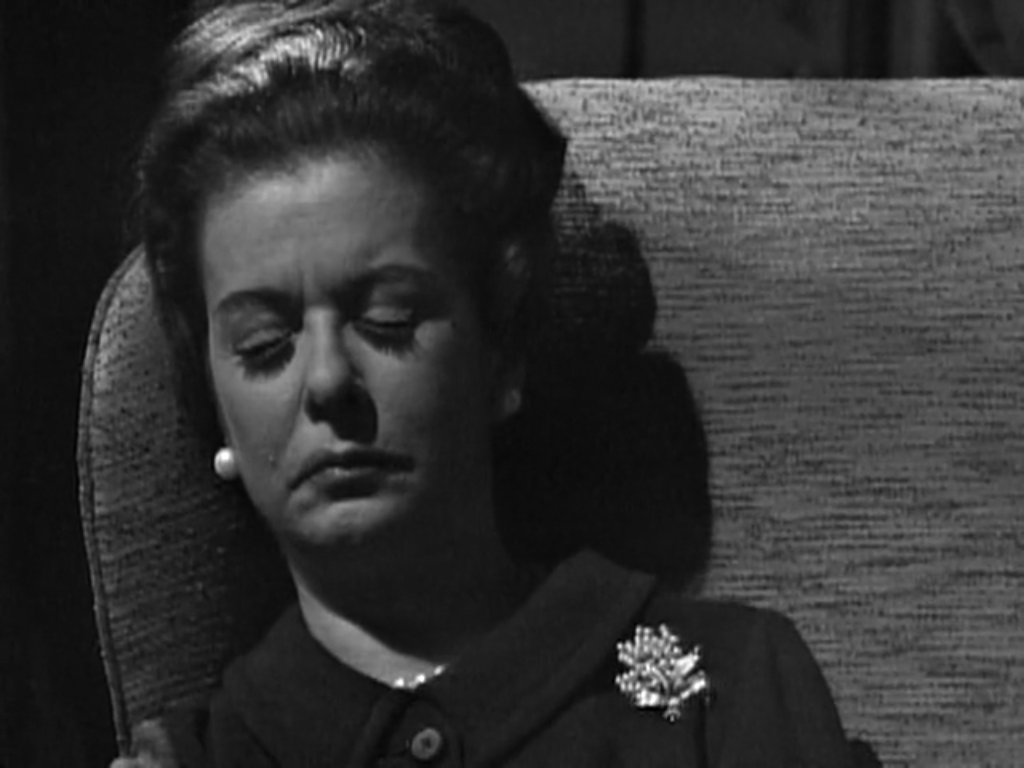
In episode 10, reclusive matriarch Liz had napped in a chair in the drawing room of the great house of Collinwood. Her sleep was troubled by unpleasant dreams; we saw her shifting in the chair and heard her muttering about ghosts. Strange and troubled boy David awakened her when he came in, having just sabotaged his father’s car in an attempt to murder him.
Liz’ troubled sleep in episode 10
Today, we open with well-meaning governess Vicki sleeping in the same chair, showing the same signs of discomfort, and muttering in her sleep words she had heard Liz say in a mad scene at the end of yesterday’s episode: “fire… stone… bird…”
Vicki’s troubled sleep in episode 157
Vicki awakens, not to find David returning from a homicidal errand, but to be overwhelmed by the presence of the ghost of Josette Collins. She smells Josette’s jasmine perfume, and the picture is out of focus. She walks around the room talking to Josette, whom we can neither see nor hear. She agrees to some instruction from Josette only she can hear.
Vicki’s boyfriend, instantly forgettable young lawyer Frank, shows up. He is complaining that Vicki called him at 5 AM, asked him to come over at once, and still won’t explain why.
Liz’ brother, high-born ne’er-do-well Roger Collins, appears at the top of the stairs and demands to know what Frank is doing in the house. Vicki claims that she wants Frank to take her for a drive in the country to help her clear her head. This makes sense to Roger. Liz is in a very bad way, for no reason the doctors can determine, and it has been a rough night in the house. Roger tells Vicki that he thinks it would be a good idea if she and Frank did take a drive. He is going to need a lot of help today, and the more relaxed Vicki is, the better able she will be to provide it.
The audience knows what Vicki has come to suspect, that Roger’s estranged wife Laura is a blonde fire witch who is responsible for Liz’ condition. Laura is staying in the cottage on the estate and she and Roger have begun the process of divorce. Laura and Liz clashed about guardianship of David, and Laura responded by casting a spell on Liz. With something like this in mind, Vicki wants Frank to take her back to a cemetery where they found some clues about Laura last week.
It is interesting to see Vicki with Frank in this episode. She is usually very demure, rarely looking anyone directly in the eye and consistently using a soft, delicate voice. She is that way today when Roger is around. But she looks straight at Frank and tells him in a crisp, candid tone just what they are going to do and why they are going to do it. That’s one of the reasons I keep wishing someone other than Conard Fowkes had played Frank. Fowkes is so dull that he simply could not survive on a show like Dark Shadows, but Frank is a character who gives us a chance to see a seldom-glimpsed side of Vicki.
Frank and Vicki visit the Caretaker of the cemetery outside town. In the archives of his building, Vicki smells jasmine and feels Josette’s presence. The Caretaker catches a distant whiff of jasmine too, but only Vicki’s nose can lead her to where Josette wants her to go. Josette pushes a book off a shelf and opens it to a page about a Laura Murdoch Radcliffe, who died by fire in Collinsport in 1867. Since they already know of another Laura Murdoch who died by fire there in 1767 and of someone who is medically indistinguishable from Laura Murdoch Collins who died by fire in Arizona earlier this year (1967,) Vicki finds great significance in the interval of 100 years. She tells Frank that the Laura Murdochs who died in Collinsport in 1767 and 1867 and the woman who died in Arizona this year are parts of the same corporate entity that is represented by the woman staying in the cottage.
Patrick McCray and Wallace McBride of “The Collinsport Historical Society” gave up writing daily episode commentaries around the time Ron Sproat joined the writing staff of Dark Shadows, but McCray does have a post about this episode. As usual, his remarks are thought-provoking:
We are about fifty episodes away from the introduction of Barnabas Collins, and you can feel the show straining with the need for it. We are at least watching a supernatural show, now. Going back to something less exotic will take the charm of a Dennis Patrick to pull off. He and Laura have something new that they are bringing/will bring to the show. One of the problems with the first six months of the show is how sad it is. The villains are wracked with guilt, somewhat grating in their personalities, and driven by necessity. Laura changes that. Her contribution to the show is less supernatural than philosophical. She likes who she is. She likes what she’s doing. She is demented enough to see that burning David alive is just dandy. Contrast this with Roger. He just wanted to be left alone, like a quietly queeny, ineffectual Hulk.
I’m not at all sure Laura “likes what she’s doing.” Most of the time, what she’s doing is sitting motionless by the fire. She is stirred from that position only when someone calls for her, and then only with difficulty.
The only times happiness registers on Diana Millay’s face are when Laura is talking to David and telling him about the blissful life that awaits in the fantastic realm she comes from, not about the path she must take to approach that realm. At other times, her dominant mood is weariness and her manner is so distant as to be inscrutable. With characters other than David, she is energetic and immediate only when she flies into a rage.
We don’t even know how many of her there are. Vicki tells Frank at the end of today’s episode that Laura seems to be made up of four components, but the audience also knows of ghostly apparitions that seem to travel with those corporeal Lauras and to be at least partly independent of them. Maybe somewhere in that complex there is a spirit that delights in the idea of taking David into a pyre, but we don’t see that delight.
McCray goes on:
Burke? He just wanted to even the odds. I get that. But his victory would mean shutting down Collinwood, and that gives any viewer mixed feelings. As much as I like Burke, his storyline misfired because you’re left with nobody to root for. If Burke wins, the show has to end, and that’s not going to happen. For Burke to lose, justice must elude him once more, and a character we like goes away. I suppose that the show originally was so Vicki-centric that we weren’t supposed to care for either Team Burke or Team Collins compared with Team Winters. With the arrival of Laura, all of this changes. (I say this because Matthew was a loon and couldn’t take pride in his wrongdoing.) Like Burke and Roger or not, everyone is pitted against/used by the first in a series of Gloucesters employed by the series to delight viewers.
Ibid
McCray is exactly right that Burke’s original storyline could never be resolved. The character had an even bigger problem that prevented the writers from coming up with a new storyline for him. That problem is his type. As a dashing action hero, sooner or later he’s going to have to rescue someone. Yet he never gets to save anyone from anything.
The first three rescues on the show are all rescues of Vicki. David locks her up and leaves her to die in the abandoned part of the great house of Collinwood. Burke doesn’t have access to that part of the house, so she ends up being rescued by Roger, of all people. That adds some complexity to Vicki’s attitude to Roger, keeps her from catching on to some plot points she isn’t supposed to understand yet, and most importantly enlarges the obstacles keeping her from befriending David, thereby enriching the one narrative arc that works every time we see it.
Next, gruff groundskeeper Matthew tries to break Vicki’s neck in the cottage. Liz saves her that time. It would have to be her, since she is the only person Matthew listens to. That’s the in-universe reason. Also, Joan Bennett is the biggest star on the show, the origin of the relationship between Liz and Vicki is supposed to be the biggest secret in the show, and the mostly-female audience of a daytime soap might be interested in a scene where a female character saves the day. So it is more satisfying all around to have Liz rescue Vicki from Matthew than it would have been to have Burke barge in.
When Matthew is holding Vicki prisoner in the Old House on the estate and is about to swing an ax at her head, Burke is in the area looking for her. But it is the ghosts of Josette and the Widows, accompanied by the ghost of beloved local man Bill Malloy, who rescue Vicki then. Burke and Roger show up after the fact and walk her home. The show has spent so much time building up the ghosts and the supernatural back-world behind the continuity in which the characters operate that it would be a cheat if they did not come forward at this point and bring a story to its climax. Again, Burke is left on the outside looking in.
Now David needs rescuing, but since the show’s most reliably interesting storyline has been the budding friendship between David and Vicki, she is the only one who can be his rescuer. Burke is got out of the way by having Laura entrance him with the memory of their old love. Since the threat to David is supernatural, this is also an opportunity to bring the ghosts back into play.
When the vampire story begins, Burke will become entirely superfluous. A dashing action hero can’t allow a bloodsucking fiend to run amok. But stop the vampire, and you stop the first ratings generator the show has ever had. So that will finish Burke once and for all.
Further:
I may be so-so on the Phoenix as a big bad on the show, partly because she was such an out-there villain, grounded in an unclear mythology. Nonetheless, she ushered in a sentient, supernatural threat and a new school of evil that finally gave viewers a moral compass to lead them through Collinsport.
Ibid.
It may be pedantic to point this out, but it is the nature of supernatural mythologies to be unclear. Once you pass the point where the laws of nature that we can examine out in the open apply, it’s up to the audience to guess at what the alternative structure of cause and effect might be. The storytellers can guide our guesses. Vicki’s discovery that the three Laura Murdochs died by fire in 1767, 1867, and 1967 leads her to tell us that the hundredth anniversary of the previous fire has the power to cause the next one. The power of anniversaries will indeed become a major part of Dark Shadows’ cosmology, coming up in several future storylines, and is the inspiration for my posting these blog entries at 4:00 pm Eastern time on the 56th anniversary of each episode’s original broadcast.
When you get to vampires and witches and Frankensteins and werewolves and other relatively familiar monsters, you can draw on horror movies produced by Universal Studios in the 1930s and endlessly shown on television since the 1950s, and beyond those on the plays, novels, and folklore from which those movies derived some of their imagery. That reduces the amount of explaining the protagonist has to do. We all know what blood and bats and wooden stakes and crosses and mirrors and daylight signify in connection with vampires, for example. That creates an impression that there are clear and logical rules, but when you hang out with the vampire for a thousand episodes you start to realize just how little sense any of those rules really make.
Laura is interesting precisely because she starts without any of that unearned sense of clarity. The show has to build her up to the point where she makes enough sense that we are in suspense, but not to go beyond that point and explain so much that we can’t avoid realizing how disconnected she is from the world we live in. I’d say they strike that balance quite well.
Moreover, because we have so little information about Laura, she is the perfect adversary for the supernatural beings we have met so far on the show. The ghosts of Josette and the Widows are definitely around, but they are deep in the background, seldom seen, even more seldom heard, and when they do intervene in the visible world their actions are brief and the consequences of them ambiguous. These vague, distant presences are credible as a counterforce to a figure as undefined as Laura, but have to evaporate when a menace appears that calls for a dynamic response sustained over a long period. Since the show has spent so much time hinting around about Josette and the Widows, it would be a shame if they hadn’t come up with a supernatural adversary for them to engage.
Back to McCray:
This episode is rich in atmosphere and menace, but anything involving the mysterious Caretaker will do that. It serves up Collins history as a net that strangles generation after generation… and the place where the answers to today’s mysteries will be found. The show has always been about the past… Paul Stoddard, the car accident, Vicki’s parentage… but (Widows notwithstanding) never beyond the lifetimes of the protagonists. By having our heroes deal with ancient dangers that still long to cause harm, DARK SHADOWS truly begins.
Ibid.
I demur from lines like “Dark Shadows truly begins” at some point other than episode 1. The whole wild ride of improvisation and reinvention is what I find irresistible. Each period of the show has some connections to the one immediately before it, but as time goes on there is absolutely no telling where they will go. Watching this part, the so-called “Phoenix” story, you can just about see how it follows from the moody, atmospheric showcase that Art Wallace and Francis Swann’s scripts provided for fine acting, ambitious visual compositions, and evocations of Gothic romance in the first 20 weeks of the series. And you can just about see how the period of the show that comes after it is resolved follows from the Phoenix. But when you look at the stories they will be doing in 1968 and later, all you can do is ask how they could possibly have found their way from here to there. Going along for that chaotic, meandering journey is the fun of it, and you deny yourself a little bit of that fun every time you ignore or downgrade an episode.
I also have reservations about the remark that “This episode… serves up Collins history as a net that strangles generation after generation.” The 1767 incarnation of Laura Murdoch married into the Stockbridge family, and the Caretaker told us they were great and powerful. The 1867 version of her married into the Radcliffes, and the Caretaker is shocked to find that her parents are not listed in his records- the Radcliffes were so high and mighty that none of them would ever have married someone whose parents were not known. So the history that strangles generation after generation is not the history of a single family, but something about the part of central Maine where Collinsport is. “Laura Murdoch” is a curse that falls on each prominent family in the region in its turn.
Eventually, Dark Shadows became the kind of pop culture phenomenon that even people who never saw the show couldn’t really avoid. Most such things spawn catchphrases that become widely familiar and remain so for years. Think of Star Trek with “Beam me up!” or “Warp speed.” To my knowledge, Dark Shadows was an exception to that, with no phrases or expressions spreading beyond its fans. But if it had already been a hit when today’s episode aired, I think a character we meet in it would have been the source of two catchphrases. That character is Cemetery Caretaker, played by DanielF.Keyes.
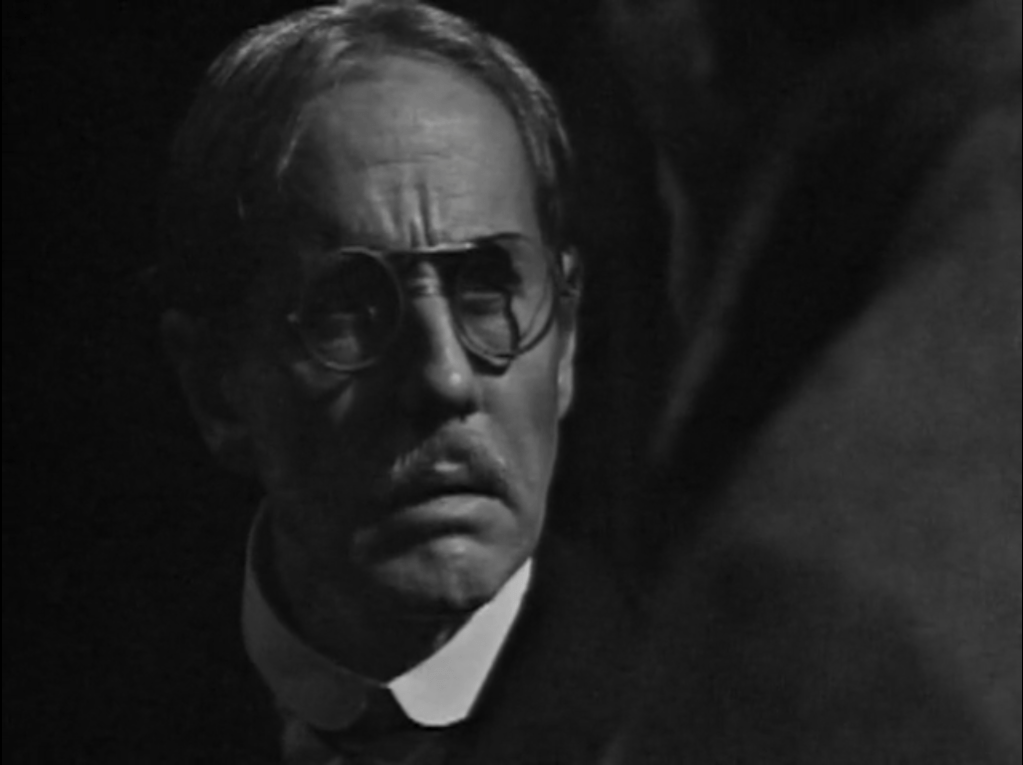
Under the influence of the ghost of Josette Collins, well-meaning governess Vicki has ordered her boyfriend, instantly forgettable lawyer Frank, to take her to a graveyard out in the country someplace. Vicki knocks on the door of a building there, and at length an aged figure in a celluloid collar and wire-frame glasses opens the door. He stands mute for the first minute Vicki and Frank talk to him. When he finally starts speaking, he asks them if they are alive.
Guy’s got star quality
Frank doesn’t show any surprise at the question. You wouldn’t really expect him to- with his personality, he must get that a lot. He assures the caretaker that yes, he and Vicki are alive. The caretaker explains that he often hears knocking at the door, but it is usually the unquiet spirits of the dead.
Some months from now, the caretaker will introduce his second memorable phrase, “The dead must rest!” At this first appearance, we learn why they must. If the dead aren’t resting, they’re going to be keeping him awake all night, and he has things to do in the morning.
Frank tells the caretaker that they are lost. Vicki contradicts him and insists that this is where she is supposed to be. Frank apologizes for bothering him and tries to go; Vicki insists on staying. The caretaker lets them into the building.
Inside, Vicki and Frank find a strange combination of archive and mausoleum. By the standards of Dark Shadows, it’s a big, elaborate new set, a definite sign that something important is happening.
The front room of the caretaker’s buildingVicki examines one of the bookcasesEntering the archive areaIn the archive area
Vicki keeps talking about how fresh the air is, and how full of the scent of jasmine. The caretaker is bewildered by her words, and Frank says the only scents he can detect are must and mold. The audience knows that the scent of jasmine is a sign that the ghost of Josette Collins is trying to attract a character’s attention.
Vicki declares that the source of the scent is in a connected room. The caretaker is reluctant to let Vicki and Frank into that room. He says that it is the final resting place of those members of the illustrious Stockbridge family* who died particularly gruesome deaths. Vicki pleads with him, and he gives in. He does insist that while in the crypt, they must be very quiet- “So quiet, even they can’t hear.”
Entering the crypt areaExamining a plaque
The caretaker talks in a not-particularly hushed stage voice the entire time they are in the crypt, so he must not think the dead have such great hearing after all. He tells the stories of the crimes and accidents that took the lives of each of the people whose remains lie behind the large stone plaques on the wall. When he comes to the last of them, L. Murdoch Stockbridge, Frank interrupts him. “L. Murdoch! I’ve seen that name on legal documents around the office a hundred times!” Frank is handling the divorce of high-born ne’er-do-well Roger Collins from his mysterious and long-absent wife, Laura Murdoch Collins.
Examining THE plaque
Frank asks about L. Murdoch Stockbridge. The caretaker doesn’t know what the L. stood for. He does know that she was a woman, and he can describe the circumstances of her death. One night in 1767, a candle set the curtains around her bed ablaze, and she burned to death. Such remains as are in the niche are little but ashes. He says, and then repeats, “L. Murdoch Stockbridge died by fire! L. Murdoch Stockbridge died by fire!” Once Vicki learns about L. Murdoch Stockbridge, the scent of jasmine disappears and she is in the same dank musty space as Frank and the caretaker.
I heard she died by fire
It’s been three years since Mrs Acilius and I first saw these episodes, and I can still make her laugh by putting on an old man voice and saying “Died by fire!” Sometimes we find ourselves in situations where everyone is being very serious, and someone mentions that a person “died by fire.” I glance at her, and find her biting her lip to keep from laughing out loud. That’s why I say that if Dark Shadows had been at the peak of its popularity in January of 1967, “Died by fire!” would have been one of the great pop culture catchphrases of the period.
Back at the great house of Collinwood, wildly indiscreet housekeeper Mrs Johnson comes into the drawing room while Roger is at his usual station, leaning on the cabinet where the brandy is kept and draining a snifter. She asks him if she can bring him anything. Those are the words, but the voice spells out a stern sermon about the evils of alcohol. Roger goes to sit down, saying nothing of consequence but saying it in a way that makes clear he dislikes and resents her.
Laura enters. Roger sends Mrs Johnson off to make coffee. Alone in the drawing room, Roger and Laura argue about all the things they have been arguing about since she returned from her long absence. There is no new information in the dialogue, but it is good to see another side of Roger. Lately we’ve seen him almost exclusively as the bratty little brother of reclusive matriarch Liz, and his interactions with other characters are dominated by the narcissism that is most fully expressed in his scenes with Liz. When he is the unloving father of strange and troubled boy David, the unsettlingly flirtatious uncle of flighty heiress Carolyn, the cowardly foe of dashing action hero Burke Devlin, or the malign co-conspirator of drunken artist Sam Evans, we see vices that we can trace back directly to his certainty that Liz will always shelter him from the consequences of his actions, whatever they may be. When he stands up to Laura in this scene, we see that there is a semi-functional adult somewhere inside Roger.
Roger and Laura realize that Mrs Johnson has been eavesdropping on their conversation. They are worried about what she might have heard. They do not know what regular viewers know, that she is a paid agent of Roger’s enemy Burke, placed in the house to spy on the Collinses. They do know that she has a big mouth, though, and since the last words they spoke were about a crime they want to keep covered up that’s enough to give them pause.
Frank brings Vicki home to Collinwood. Standing outside the front door, they remark on the caretaker’s frequent muttering of “died by fire! Died by fire!”
Reviewing their visit to the caretaker
Vicki reviews all of the strange occurrences that have taken place since Laura’s return. She sums up the whole course of any story about people investigating the supernatural- “It seems connected- and yet so unconnected.” By the laws of nature as science describes them, by the ordinary logic of waking life, none of the events she lists means anything. It’s only after you accept the idea that uncanny forces are at work that they form a pattern pointing to Laura. The audience can accept that, because we can hear the theremin on the soundtrack. Vicki and Frank have a harder time.
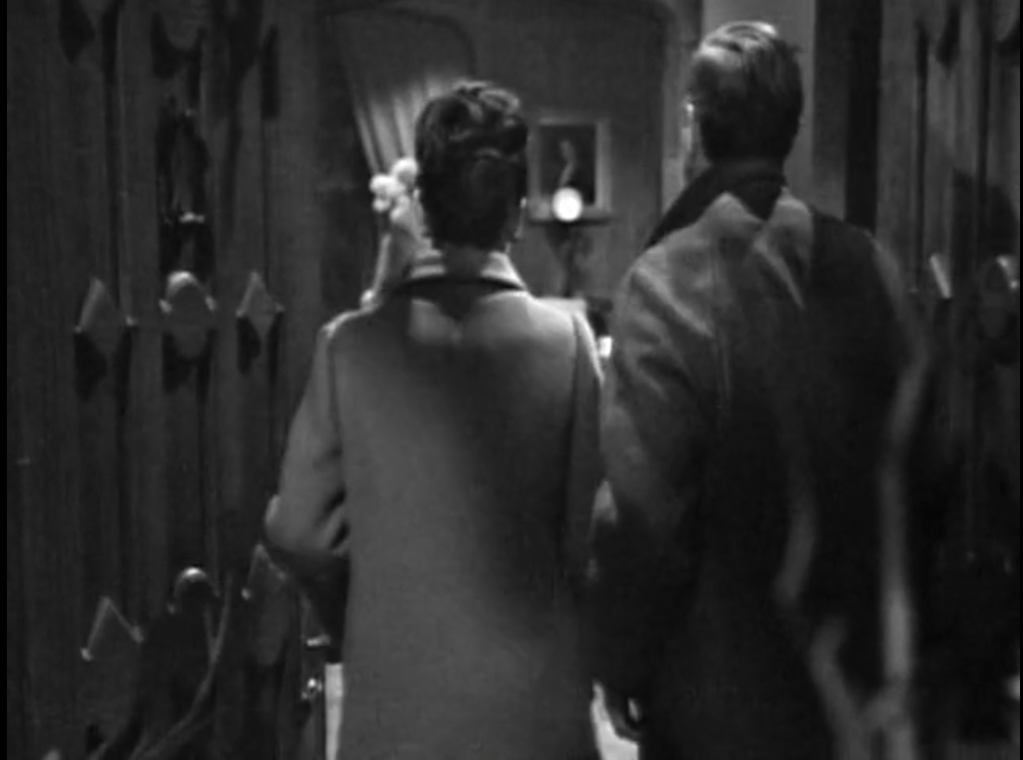
Frank tells Vicki he has to get home. She invites him in for a drink. He replies “You make it a stiff one, and you’re on!” That’s what you need before a long drive on dark, winding roads, to get tanked up on a lot of booze. They open the doors and walk into the house. The camera dwells on them as they make this procession. As they had gone through doors that led to L. Murdoch Stockbridge, now they go through the doors that lead to L. Murdoch Collins.
Entering the house
Vicki and Frank join Roger and Laura in the drawing room. The men drink brandy, the women sip coffee. Vicki asks Laura about her family background, claiming that David is curious about it. Laura responds merely that her family is a distinguished one and had been in the area for a long time.
Roger tells Frank that he will be hearing from Lieutenant Riley of the state police tomorrow. Laura objects that she doesn’t want to talk about Riley’s message, Roger says there won’t be any conversation- he will simply announce the lieutenant’s laughable news. The authorities in Phoenix, Arizona are convinced that a charred corpse found in Laura’s apartment there is hers, and that she died when the apartment building burned to the ground. Vicki looks at Laura, and with a strange smile says “Laura Murdoch Collins died by fire.”
“Laura Murdoch Collins died by fire”
*The caretaker was deeply versed in the lore of the Stockbridge family, and told Vicki and Frank that most of the graves in this eighteenth century cemetery were theirs. Yet he showed no glimmer of recognition when Vicki mentioned Josette Collins to him. That suggests that the Stockbridges were leading citizens of the area before the Collinses rose to prominence.
It might be interesting if someone would write a story in which the first Collinses were servants of the Stockbridges who got rich by doing their dirty work. Maybe the first and darkest shadow of all was that some colonial Collins scabbed on his fellow employees when they were trying to get a fair deal from the Stockbridges. I’m not up on Dark Shadows fanfic, for all I know there may be whole novels out there on this theme.
The mysterious and long-absent Laura Collins is sitting motionless by the fire in her current residence, the cottage on the grounds of the great estate of Collinwood. A knock sounds at the door. As always in this situation, it takes Laura a moment to rouse herself and begin moving. When she does, her movements are disconnected and robotic, as if she is reassembling herself. This image, coupled with what regular viewers have seen in previous episodes, suggests that what we see when we look at Laura is never more than half of a person. Part of her, maybe most of her, exists in the form of energy that somehow inheres in the fire.
Laura opens the door to instantly forgettable young lawyer Frank Garner. Frank identifies himself as the representative of Laura’s estranged husband, high-born ne’er-do-well Roger Collins, in their divorce. She tells him she doesn’t want any money or property. All she wants is custody of their son, strange and troubled boy David. Since Roger is eager to see David go with her, she doesn’t see the need for a lawyer of her own.
Frank points out that as one of the heirs to the Collins interests, David stands to become a “very wealthy young man.” Laura suggests that all of David’s assets be put in a trust that she cannot access. When Frank asks how she will support David until he comes into his legal majority, she says vaguely “I have… resources.” When he presses the point, she assures him that “where I plan to take [David,] he’ll have no need for anything the Collins family could give him.” Since the Collins family is presented in this episode as “very wealthy,”* that would suggest she is taking him someplace where money cannot be exchanged for goods and services. This is, to put it mildly, an intriguing prospect.
Throughout her talk with Frank, Laura makes it clear her priority is to settle the divorce and leave with David as soon as possible. Frank says that lawyers can usually settle business among themselves more quickly than they can with people unrepresented by counsel and asks if she wants the matter settled quickly. Laura answers that she wants that “more than he can realize.” She asks Frank to represent both her and Roger, to draw up the papers to finalize what they have discussed, and to get it over with.
Before he can leave the cottage, Frank has to break some bad news to Laura. The police in Phoenix, Arizona, are still investigating a fire that destroyed the apartment where she lived in that city and killed an unidentified woman who had a key to it. There might be a hearing. If so she will have to return to Phoenix to testify, perhaps on short notice.
Laura chose to live in Phoenix. She has told versions of the legend of the phoenix both to David (#140) and to Maggie Evans (#128,) who was waiting on her table at the restaurant in the Collinsport Inn. Furthermore, Maggie’s father, drunken artist Sam, knew Laura when she lived in town ten years before and hasn’t been in touch with her since. When Maggie told him that a customer had told her the legend of the Phoenix, he clearly knew that Maggie was talking about Laura. So she has been fascinated with the story for years. In the version of the legend she related to David, it was in the context of a description of a mystical land like those which figure in the stories of the Holy Grail, which “some call Paradise,” and which is her true home. So when Laura implies that she plans to take David someplace where there is no buying or selling, we listen up.
Frank leaves, but before Laura can resume her stupor beside the fire someone else knocks. It is well-meaning governess Vicki. Vicki tells her that her boss, reclusive matriarch Liz, has ordered her to keep Laura away from David. Laura asks if Vicki will obey this command. Vicki says she has no choice. It’s her job, after all, and besides, Liz has been very nice to her.
Laura asks how someone who herself grew up in a foundling home can keep a child from his mother. Vicki recaps all the strange things that have happened since Laura came back. Regular viewers know that these events are signs of supernatural activity. We know this because we’ve seen transparent figures superimposed over shots and have heard theremin music playing on the soundtrack. But Vicki hasn’t been watching the show, so even though she tells Laura almost everything she has seen and heard Laura can provide more-or-less plausible explanations for all of it.
Vicki is unconvinced, but still goes back to the great house and tells Liz that she won’t be able to follow her orders. Laura is David’s mother, after all, and does have her rights. Liz is so angry that she can’t look at Vicki, and stares directly at the teleprompter throughout the entire scene.
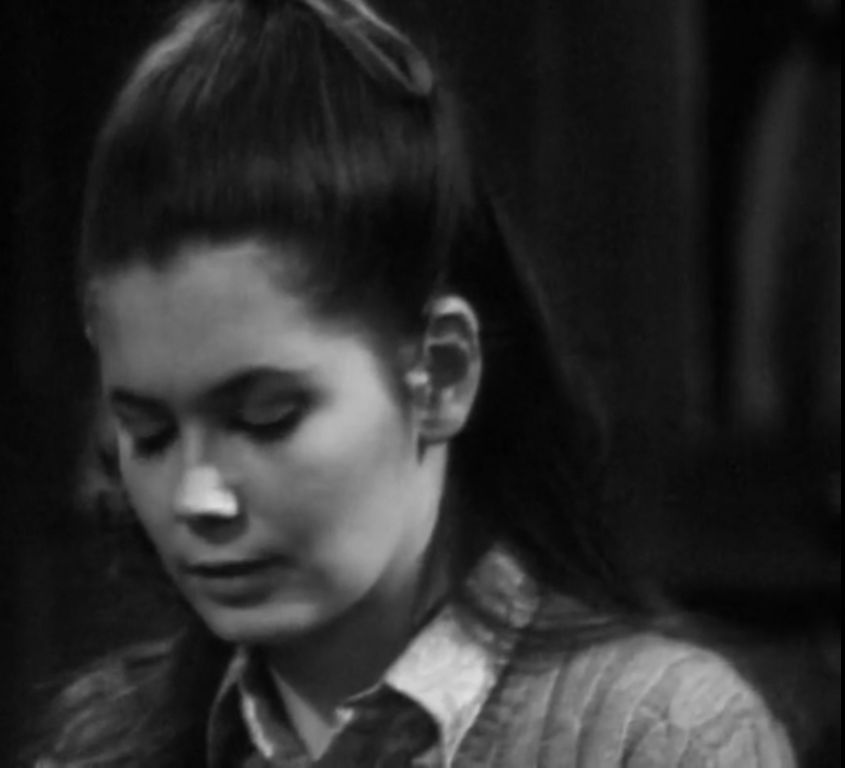
Liz demands that Vicki say she will do as she has commanded. Vicki looks down, and even after Liz has repeated herself more than once she still doesn’t say that she will. The closeup on Vicki before Liz sends her away to check in on David is quite a powerful moment. In a couple of seconds, Alexandra Moltke Isles shows very clearly that Vicki is ashamed to be disobeying Liz, embarrassed to be yelled at in the drawing room, and yet determined to continue in her course of action.** It’s a remarkably efficient performance.
Vicki being yelled at
Vicki leaves the room. The camera stays on Liz as we hear voices in the foyer. Roger crosses paths with Vicki. He enters the drawing room and asks Liz why Vicki is upset. Liz dismisses the question, and Roger compares her to Lucrezia Borgia. Irritated, Liz says she is in no mood for his jokes. “Who’s joking?” he replies.
That’s a startling moment. Roger spent the first several months of the show trying to get Vicki out of the house, if necessary by manipulating David into murdering her (#68.) Now, he’s expressing sympathy for Vicki, apparently spontaneously. It’s true that the motive for that hostility was rooted in a storyline that has been partially resolved, but it is still interesting that Roger actually seems to like Vicki now.
A knock sounds. Again the camera stays on Liz in the drawing room while we hear Roger greet Frank in the foyer. It was a week ago, in #147, that we first heard characters speaking while off-camera. I wish they had done that more often. They need all the tricks they can find to create a sense of space, to make us feel that their little sets are actually a huge mansion, a rolling estate, and a whole town.
Frank tells Roger and Liz about his conversation with Laura. Roger is delighted that the only thing Laura wants is custody of David and urges Frank to draw up the papers at once. Liz, outraged, declares that custody of David is the one thing Laura can’t have, and forbids him to draw the papers up at all. Faced with this disagreement between Roger, his client of record, and Liz, who is actually paying his fee, Frank can do nothing. He excuses himself. On his way out, Roger whispers to him that he should prepare the papers- he promises to handle Liz.
The telephone rings. It is a report that the authorities in Phoenix have examined the charred corpse found in the burned ruins of Laura’s apartment. They are positive that it is the body of Laura herself. Roger and Liz are bewildered by the news.
*In other episodes, especially those focusing on the “Revenge of Burke Devlin” storyline, they seem to be gasping along on the brink of total financial ruin. But today, we hear about nothing but how terribly rich they are, so that’s what we’ll go with.
**This is puzzling for regular viewers. In #148, Vicki expressed a determination to keep Laura away from David. The information she shares with Laura is the basis for that determination. It isn’t at all clear why she doesn’t stick with it. For that matter, if she can tell Laura everything she knows when she regards Laura as a menace, why can’t she tell her benefactress Liz that she is thinking the same way she is? It could be that Ron Sproat, who wrote #148, and Malcolm Marmorstein, who wrote this one, didn’t talk to each other, and the producer was too busy with other things to catch the inconsistency. Whatever the cause, Mrs Isles gives such strong performances in both episodes that I’m inclined to treat them as self-contained stories so far as Vicki is concerned.
Yesterday, several characters saw clear evidence that supernatural forces are intervening to warn that the mysterious and long-absent Laura poses a grave danger to her son, strange and troubled boy David Collins.
High-born ne’er-do-well Roger Collins was one of those characters. In keeping with his family’s traditions, Roger habitually responds to signs of the supernatural by going into denial. He has an especially strong motive for denying that there is anything alarming about the relationship between David and Laura. David is his son, Laura is his wife, and he wants to be rid of them both. Laura wants to divorce him and leave with David, a prospect he finds most attractive.
At the insistence of well-meaning governess Vicki, Roger tells reclusive matriarch Liz some of the signs that uncanny beings are at work. In response, Liz decides to go to Laura and tell her that she may no longer see her son.
The confrontation between Laura and Liz takes place in the cottage where Laura is staying now that she has returned from her long absence. Laura points out that it is absurd for a child’s paternal aunt to forbid his mother from seeing him. The only case Liz could make in answer to this objection would rest on yesterday’s supernatural manifestations, but even if she had seen those events first-hand that isn’t something you can really bring up while conducting an argument in the modern world. So the two women just make assertions about their respective strength of personality.
Upstairs at Collinwood, David was crying before Vicki managed to calm him by telling him his mother’s favorite story, the legend of the Phoenix. In his sleep, he is crying again. Laura appears as a glowing figure in the corner of the room. She awakens him and stands at the foot of his bed.
Laura appearsLaura speaks
The oldest surviving version of the legend of the Phoenix appears in the Histories of Herodotus. Many passages in Herodotus describe dreams, and they all represent the dream as a figure standing at the foot of the dreamer’s bed, making a speech to him. That’s the usual form dreams take in ancient Greek literature generally, in fact, and that Greek image of the dream has had its influence in later writing. So I suppose it could be that Laura’s visit to David is a nod to the sources of the Phoenix legend, and it certainly could be meant to suggest a familiar way dreams are depicted in literature.
Diana Millay usually plays Laura as a dreamlike figure, rather vague in manner and stilted in speech, and this scene is no exception. David Henesy plays David Collins here in the wide-awake style of an uncomfortable character in a comedy of manners. Laura makes cryptic promises of being forever united to David, to which he gives polite but nervous responses such as “That’s nice!” and “I’m sure we will!” David doesn’t seem to be asleep, suggesting that Laura’s otherworldly manner signifies nothing so familiar as a dream.
Laura notices David’s tears. She gives him a handkerchief to dry them. At the end of their conversation, she vanishes into thin air and David falls asleep. The handkerchief is still there, however, proving it was no ordinary dream.
At this stage of her existence, Laura seems to be divided into at least three entities. There is the woman who lives in the cottage, visits the great house, and talks to the other characters. There is a ghostly image David has seen flickering on the lawn. And there is a charred corpse in the morgue in Phoenix, Arizona. There is no assurance that these are the only three components of Laura, and no explanation of how they relate to each other. Does the speaking character know about the ghost? Does one control the other? If they operate independently, do they have the same goals? If they have different goals, might they come into conflict with each other? A scene like this one raises all of those questions, because we don’t know which Laura we’re dealing with.
It is also possible that she isn’t Laura at all. A couple of weeks ago, we thought it was Laura who compelled drunken artist Sam Evans to paint pictures of her naked and in flames. Yesterday, we learned that the spirit possessing Sam was actually the ghost of Josette Collins, and that she was doing it to oppose Laura’s plans. So maybe Josette has disguised herself as Laura in order to unsettle David and keep him from following his mother to his doom.
There is an unusual blooper just short of the 3 minute mark. From 2:51 to 2:57, Alexandra Moltke Isles has a fit of the giggles. This starts when Joan Bennett enters and flares up again as she walks past Mrs Isles. It’s true that Miss Bennett’s dress betrayed a good deal more of the outlines of the garments underneath it than one would expect. That may have had something to do with the laughing attack, but Mrs Isles was usually so professional that it is difficult to believe she wouldn’t have gotten that under control after dress rehearsal. Some of the actresses have talked about how Louis Edmonds would make remarks to them before shots that made it extremely difficult for them not to laugh on camera during serious scenes, perhaps he was the culprit here.
The giggle beginsThe giggle resumesThe giggle concealed









 Dark Shadows Commentary