Episode 870: Your Josette, always

In October 1897, the estate of Collinwood and all of the other assets of the Collins family are the property of Judith Collins Trask. Judith has just returned from a stay of more than thirteen weeks in a mental hospital, but even when she was having the breakdown that put her there she was not one of the show’s principal sources of that great motive force of Soap Opera Land, Crazy Lady Energy (CLE.)

In #819, sorcerer Count Petofi erased the personality of Judith’s stepdaughter Charity Trask and gave her body to the late Pansy Faye, Cockney showgirl/ mentalist. Since then, Pansy has been a reliable provider of CLE. But today, she serves as the baseline of sanity.

We open in a bedroom occupied by the mysterious Barnabas Collins. Months ago, the Collinses discovered that their distant cousin Barnabas was a vampire who originally lived in the 1790s. Pansy staked Barnabas in his coffin in #845, and for the four and a half weeks after the characters believed he was destroyed. Now a sickly man has shown up who looks and sounds just like Barnabas. He claims to have been the vampire’s victim. He lives in the daylight, casts a reflection, does not recoil from the sign of the cross, and eats food not derived from human blood. He has been seen alongside the staked vampire. So Judith’s brother Edward has accepted the sickly Barnabas’ story. At Edward’s invitation, he is a guest at Collinwood, resting after his ordeal. Edward wins Judith over to his point of view, and she is glad to welcome Barnabas as a dinner guest.

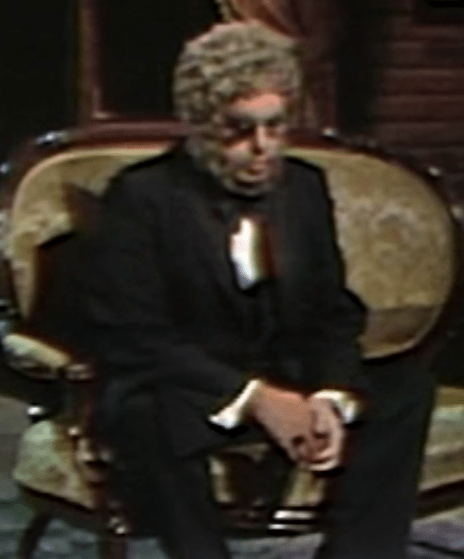
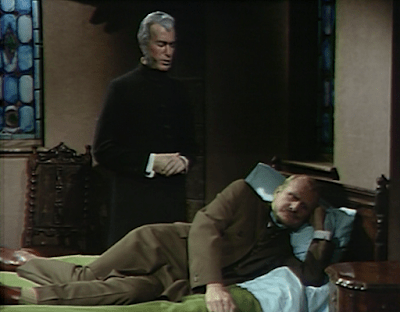
Another resident of the great house is not so sure. He appears to be Judith and Edward’s brother Quentin. He is in fact Petofi, who has cast a spell to hijack Quentin’s body and confine Quentin to his own aging and pudgy form. Q-Petofi has seen all the evidence that Edward has, including the two Barnabases side by side. But he also knows that Barnabas is a time traveler who came to 1897 from 1969, and that several magical beings and science fiction types are in his orbit. So he is looking for a trick. He has coaxed Pansy into the room, telling her that only she can make the final determination about who the man in the bed is. Pansy looks at Barnabas and declares that he is not the vampire. Q-Petofi is still unconvinced, and is about to put some kind of spell on Barnabas when Edward enters.

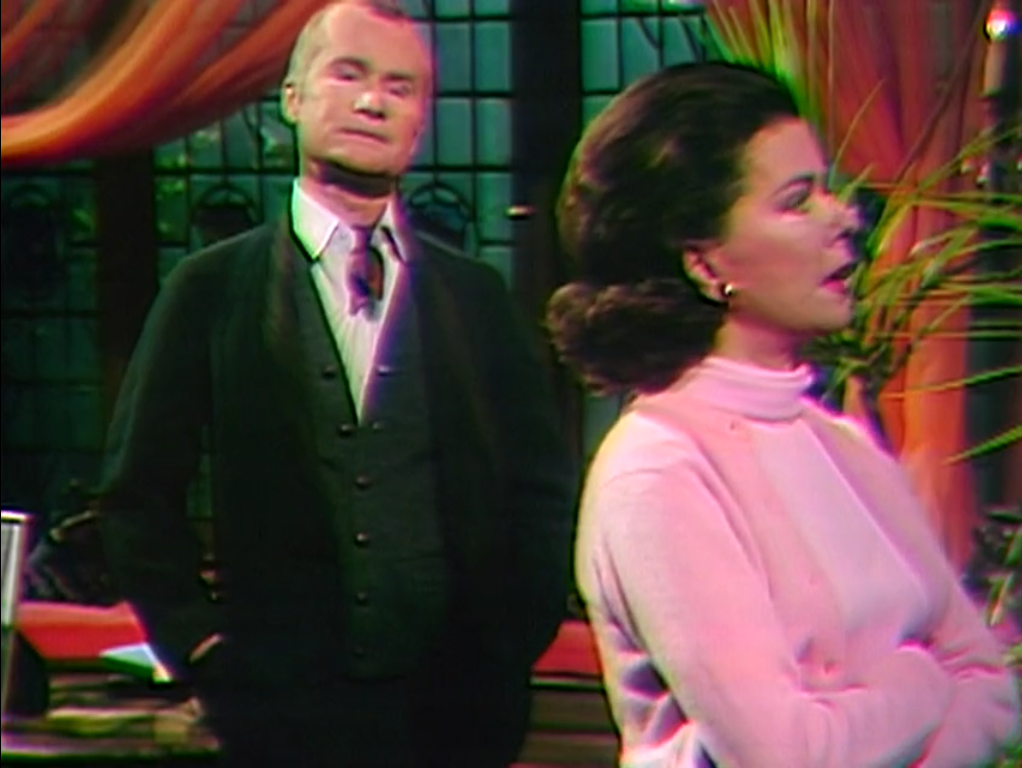
Downstairs, Pansy meets with Judith. Judith has figured out that her husband, Charity’s father Gregory Trask, gaslighted her into the breakdown that put her in the hospital, and that among his many misdeeds while she was there was his attempt to seduce a woman named Amanda Harris. In #864, Pansy bought a portrait of Amanda for an eye-wateringly large sum; yesterday, she set it up in the drawing room at Collinwood, causing Trask to fly into a rage. We learn in this scene that Judith put Pansy up to buying the portrait as part of a plan to get back at Trask. The two of them share some amusingly salty dialogue, showing us a worldly wise side of Judith that we have not seen before.

Today’s dose of CLE comes from a houseguest, Kitty Soames. Kitty is a young American woman who is the dowager countess of Hampshire. She is Edward’s guest, and she came to the house in #844 intending to lure Edward into a marriage that would relieve the financial distress she has been in since the late Earl’s bankruptcy. But since the day she arrived, she has been having fits of madness caused by the irruption into her consciousness of the mind of the late Josette, lost love of Barnabas. The conflict between Kitty/ Josette’s two personalities gives her one mad scene after another today.

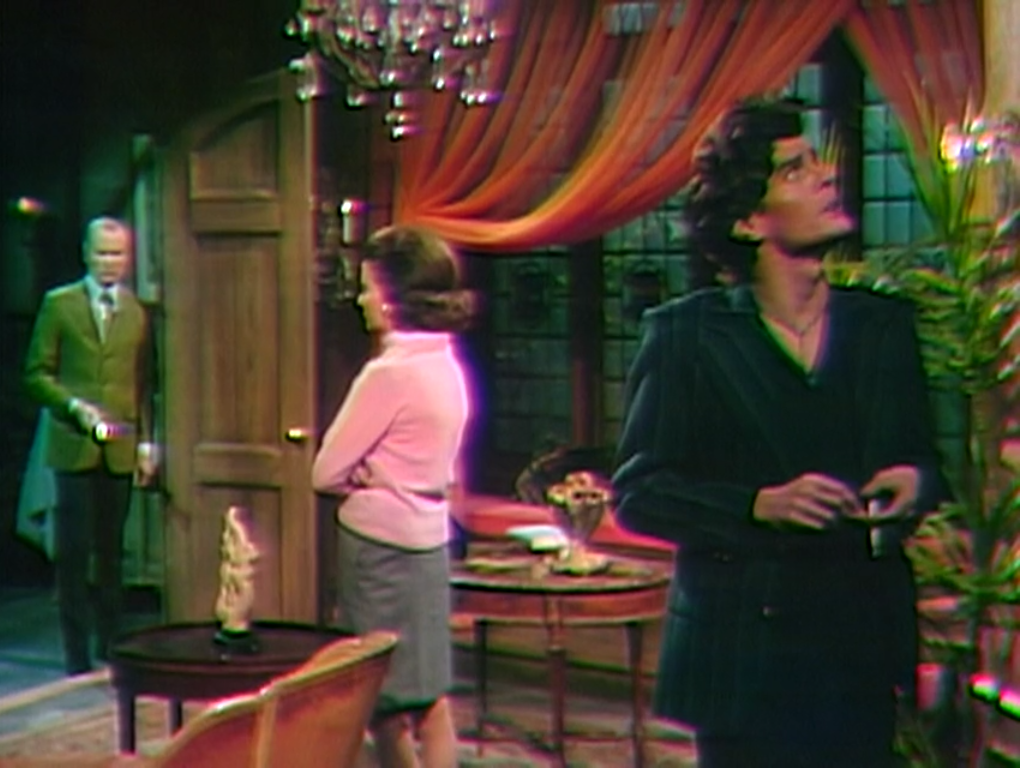
Kitty enters the foyer, where a portrait of Barnabas hangs. She sees the portrait’s eyes glow and hears a heartbeat, something which has been happening to people under Barnabas’ influence since #205. She has a panic attack. Pansy and Judith come from the drawing room and cluster around her. Pansy walks her upstairs to her bedroom and tries to persuade her to have a cup of broth. Kitty raves about the danger that an antique music box in her room presents to her. After a bit, Edward enters and dismisses Pansy.

Kitty tells Edward that she thinks she ought to leave Collinwood, since she has been suffering from a severe mental illness throughout her stay. Edward says that he does not believe that the problem is psychological, since the music box and other objects that she finds disturbing have in fact materialized around her inexplicably. He says that to the extent that her problems are rooted in her feelings, a therapy he will suggest might be just the thing to cure them. He asks her to marry him. She agrees, and they kiss.

Edward kisses Kitty

Edward’s first wife was the former Laura Murdoch, an undead blonde fire witch. Laura was quite calm and rational in her way, but she embodied a principle of insanity in the universe. Quentin was married to a woman named Jenny, who may have seemed mentally healthy when they met but who went immensely insane after Quentin ran off with Laura. I suppose that, with that kind of family history, Edward is just cutting out some of the preliminaries by proposing to a lunatic while she is in the middle of a psychotic episode.

Edward and Kitty announce their engagement after dinner. Q-Petofi notices that Barnabas is shocked; he apologizes, smiles, and stands, a champagne glass in his hand and congratulations on his lips. He then excuses himself, saying that he still feels weak and thinks he ought to retire for the evening.

If any longtime viewers harbored doubts that Q-Petofi is right and this Barnabas is our old friend, they are dispelled when we see him in his room moaning about how he doesn’t want to lose Josette again. We end with a blissed-out Kitty entering his room, telling him she heard him calling, and declaring that she will be his Josette always. They share a passionate kiss.

Edward is the third major role Louis Edmonds has played on the show; he has been a principal member of the cast since episode #1. This is his first on-screen kiss on Dark Shadows. Some fans like to show off their knowledge of the actors’ sexual orientations by speculating about a correlation between their private lives and their on-screen kissing of opposite sex scene partners. This particularly settles on Anthony George, who was on the show for a while in 1967 and whose attempts to kiss women always went horribly wrong. But that is obvious nonsense. Jonathan Frid was gay, and the actresses all attested that he was the best kisser in the cast; Barnabas’ kiss with Kitty/ Josette today is a case in point. Joel Crothers, a regular from 1966 to 1968, was gay too, and he was another expert smoocher. Roger Davis is as straight as they come, and rivaled George for traumatic lip collisions. Kitty and Edward’s kiss shows that, while Edmonds might not have been interested in taking Kathryn Leigh Scott home, he was the equal of any heterosexual actor at playing love scenes with women when the cameras were rolling. I believe that what men like Edmonds, Frid, and Crothers did is known as “acting.”

Episode 869: The man who walks in the day

In October 1897, the hypocritical Rev’d Mr Gregory Trask is married to the vastly wealthy Judith Collins, owner of the estate of Collinwood and of the Collins family businesses. For more than thirteen weeks, everything seemed to be going Trask’s way. He had gaslighted Judith into a mental hospital and had almost free rein over all of her assets. In her absence, he invited the lovely and mysterious Amanda Harris to stay in the great house on the estate, and set out to seduce her.

Piece by piece, Trask’s little corner of paradise fell apart. First, 150 year old sorcerer Count Petofi orchestrated a series of events that led Trask to sign a confession to the murder of his first wife, and no matter how many times he destroyed the confession new copies of it kept materializing. Then Petofi erased the personality of Trask’s daughter and enforcer Charity, replacing it with that of late Cockney showgirl/ mentalist Pansy Faye. Later, Amanda fell in love with Judith’s brother Quentin, told Trask off, and wound up leaving for New York by herself. Now, Judith has returned from the mental hospital, all sane and deeply suspicious.

The front door of the great house is Trask’s enemy today. No sooner does he enter it than he finds Pansy in the foyer, singing her song. He demands she stop and tells her he is her father. She laughs at this claim, and reminisces about the late Bertie Faye. Trask goes into the drawing room, and to his horror sees a large oil painting of Amanda on an easel. We saw Pansy setting it up earlier in the episode, and saw her buy it a few days ago. But Trask didn’t see those things, and when she tells him she doesn’t know anything about it, he seems to accept her denials. She exits upstairs.

The front door opens again, and Judith’s brother Edward enters with two other men. One appears to be Quentin, but is in fact Petofi in possession of Quentin’s body. The other appears to be time-traveling vampire Barnabas Collins.

Trask and Edward both believe that Petofi is Quentin; since he is played by David Selby, I call him Q-Petofi. The man who appears to be Barnabas is very weak. He says that his name is indeed Barnabas Collins, but that he is not the vampire. He claims to have arrived from England, to have been attacked by a vampire who looked just like him, and to have little memory of what happened after.

In #845, Pansy went into a cave and found a coffin containing what appeared to be Barnabas. She drove a stake through his heart. When Edward and Q-Petofi met this weak Barnabas yesterday in the doctor’s office, they were skeptical of his story. They took him to the cave, opened the coffin, and saw the body Pansy had staked inside, the stake still lodged in its heart. Since they could see the two of them side by side, Edward could only conclude that the weak man is different from the vampire, and that his story is therefore true. Q-Petofi, well aware of the many magical and science-fictional entities in Barnabas’ orbit, is not at all convinced.

Trask sees the weak Barnabas and is enraged that Edward and Q-Petofi have brought the vampire back from the dead. While Q-Petofi takes the weak Barnabas upstairs to a bedroom, Edward tries to reason with Trask. This is seldom a fruitful exercise. When Edward finally points out that it is broad daylight and the weak Barnabas is alive and moving, Trask is left speechless.

Alone with the weak Barnabas, Q-Petofi tries to trick him into believing that he is Quentin and that he can trust him. When Q-Petofi goes on about all the secrets that Barnabas and Quentin have shared, the weak Barnabas responds only with bewilderment.

Q-Petofi goes back to the cave and sets the coffin on fire, acting on the hypothesis that the destruction of the staked Barnabas will have some kind of effect on the weak Barnabas. We cut back to Collinwood and see that it has none. Trask lets himself into the bedroom. After some small talk, he thrusts a large wooden cross at the weak Barnabas’ face and stands silently for a moment. The weak Barnabas looks up from his bed and asks if Trask is all right. He hurriedly says that he only brought the cross to help him pray for his recovery. The weak Barnabas observes that this is very kind, and closes his eyes while Trask kneels beside the bed.

My wife, Mrs Acilius, points out that not only the actor Jerry Lacy, but the character Gregory Trask, seems to enjoy himself very much when there is something to be righteously indignant about. Not only does Trask have a whole set of self-aggrandizing mannerisms and techniques for silencing everyone else when he is furious, but as a con man an atmosphere of crisis provides him with an opportunity to think on his feet and devise new schemes for bilking people out of whatever they have that he wants. Mr Lacy’s joy in performance runs throughout the whole episode, but Trask’s goes through wild fluctuations, peaking each time he thinks he has found a new way to present himself as the champion of The Almighty and plummeting each time his understanding of the situation is deflated. In his first several appearances, Trask was so overwhelmingly evil and so frequently successful that he was hard to watch. When we see him repeatedly brought up short in an episode like this, all of the discomfort of those early days pays off.

In the drawing room, Edward tells Pansy that there is a sick man in a bed upstairs who looks like the vampire Barnabas and is named Barnabas Collins, but is not the man she staked. She is horrified at the thought. Barnabas was indirectly responsible for the death of Pansy as a physical being, and later murdered her fiancé, the childlike Carl Collins. He also took Charity as one of his victims for a time. Besides, in her manner of dress, quantity of makeup, working-class accent, and brashly friendly manner Pansy is the representative of all the “girls at the docks” upon whom Barnabas has fed down the centuries. So no one has more reason to fear Barnabas than does Pansy in the form of Charity. Edward reassures her as best he can, then goes up to look in on the patient.

Pansy absorbs the news that another Barnabas Collins is in the house.

The scene between Pansy and Edward will remind longtime viewers of the characters the same actors played between November 1967 and
March 1968, when Dark Shadows was set in the 1790s. Nancy Barrett was fluttery heiress Millicent Collins, while Louis Edmonds was haughty overlord Joshua Collins. In #450, Millicent had discovered the horrible truth about Barnabas and it had proven to be too much for her rather fragile grip on sanity. She decided that the vampire was not her cousin, but an impostor, and she told Joshua that it was wrong of him to have “That man who says he is Barnabas” in the house.

Not only is Pansy’s horror at the thought of a man who says that he is Barnabas staying at Collinwood reminiscent of Millicent, but her relationship to Charity also reflects the development of Millicent throughout the 1790s segment. Millicent’s transformation from a lighter-than-air comedy character to a darkly mad victim, first of her wicked husband Nathan, then of Barnabas, marked the transition to the climactic phase of the 1790s segment. Charity’s replacement by Pansy in #819 came at a time when the show was flashing many signals that the 1897 segment was nearing its end. Those signals may well have reflected an earlier plan, but 1897 was such a hit that they kept passing by the off-ramps back to the 1960s and restarting the uncertain and frightening journey into the past. Now it seems they really are getting ready to move on, and Pansy’s prominence reminds us of just how radically different a place Collinwood is now than it was when we arrived in this period in #701, at the beginning of March.

Pansy is still quaking at the thought of another Barnabas Collins when Q-Petofi enters and closes the doors of the drawing room behind him. Pansy hasn’t quite figured out his true identity, but she knows that he is not really Quentin, and that he does not mean her well. She is terrified and says she will scream unless he opens the doors.

Regular viewers have reason to believe Pansy will do more than scream. In #829, she tried to stab Quentin. And those who have been with the show for a long time will remember what happened in #204, broadcast and set in April 1967. Heiress Carolyn Collins Stoddard, another Nancy Barrett character, found herself in the drawing room with dangerously unstable ruffian Willie Loomis. When Willie closed the doors and refused to open them, Carolyn didn’t bother screaming- she pulled a loaded gun on him.

Q-Petofi has magical powers that neither Quentin nor Willie could match, so he is not in mortal jeopardy as they would be were they to put themselves in his position. But he has created a volatile situation, and unless he resolves it within a few seconds he is likely to find himself with a huge mess on his hands. Rather than falling back on his occult talents, Q-Petofi takes a page from Quentin’s book and charms Pansy into cooperating. He tells her that he is as frightened of Barnabas as she is. That intrigues her sufficiently that she starts listening to him. He tells her that only she can discern whether the man in the sick bed upstairs is what he claims to be. A moment later, Q-Petofi has persuaded Pansy to go with him to see the weak Barnabas. The episode ends with Pansy looking at the weak Barnabas lying in bed, her eyes widening in a strong but unspecified reaction. We will have to wait until tomorrow to find out whether she is terrified at the sight of her nemesis or amazed to see an innocent man wearing the hated face.

Episode 857: Champagne for Wanda

Sorcerer Count Petofi is wearing the body of rakish libertine Quentin Collins as a disguise, while Quentin is trapped in Petofi’s own aging and pudgy form. I will call the villainous Petofi played by David Selby Q-Petofi, and the forlorn Quentin as played by Thayer David P-Quentin.

We open with Q-Petofi at the front door of the great house of Collinwood. Yesterday we saw P-Quentin on the same spot, and heard David Selby’s voice articulating the miserable thoughts that showed on Thayer David’s face. Today the roles are reversed, and we see Mr Selby looking exultant while the voice of Thayer David talks about the glories of his situation.

We see that Q-Petofi is accompanied by his henchman, Aristide. He dismisses Aristide’s fear that he will somehow reveal his true identity to the occupants of the great house. He twits Aristide for a little while, pretending that he will use him as a guinea pig in a dangerous experiment he has planned for later in the evening, then sends him off to find someone else to serve that purpose.

Q-Petofi walks in on an argument in the drawing room between stuffy Edward Collins and the overbearing Gregory Trask. Trask is in charge of the house while his wife, Edward’s sister Judith, is in a mental hospital. Trask is going over the household accounts and complaining that Edward is spending too much on his houseguest, Kitty Soames, the dowager countess of Hampshire. Edward asks Q-Petofi to explain Collinwood’s tradition of hospitality to Trask, setting Trask off with a rant about Quentin’s relationship with Trask’s own former houseguest, the lovely and mysterious Amanda Harris. Q-Petofi’s indifference to the whole discussion strikes both Trask and Edward as odd, but it really is quite typical of the old Quentin.

After Trask exits, Edward tells Q-Petofi that he thinks he can subdue Trask by marrying Kitty. He says that it takes money to run Collinwood, and the late Earl’s estate gives Kitty ownership of half the county of Hampshire. Returning viewers know that the Earl died bankrupt, and so far from owning great swathes of southern England Kitty doesn’t even have train fare to get from Collinwood in central Maine to her mother’s house in Pennsylvania. So we have confirmation that Kitty has been less than fully honest with Edward. On the other hand, Kitty is under the impression that Edward is rich, while in fact their grandmother left every penny to Judith. So neither is leveling with the other about their financial status. Q-Petofi knows all of this, but it has nothing to do with his plans, and so he struggles to feign interest.

For his part, P-Quentin is sitting in the caretaker’s cottage on the estate. It seems right to longtime viewers that a character played by Thayer David should seek refuge here. When we first saw the cottage, it belonged to handyman Matthew Morgan, who was at that time played by George Mitchell. In #38, Mitchell was replaced in the part of Matthew by Thayer David, in the first of the many roles he would play on Dark Shadows. When Matthew had to leave the cottage for the last time in #112, his whole world fell apart. So when Aristide comes in and brutally evicts him, we can feel the full weight of the disaster that has befallen P-Quentin.

With nowhere else to go, P-Quentin returns to the great house. Once again it is Thayer David’s turn to look soulfully at the camera while David Selby’s voice speaks desperate words in voiceover. He tells himself that his brother Edward will have to believe him when he tells him the truth.

As it happens, Edward likes Petofi and is glad when he believes he is receiving a visit from him. Based on Edward’s earlier remarks about Collinwood’s tradition of hospitality, we could be quite sure that if P-Quentin presented himself as Petofi, Edward would be glad to offer him a place to stay. But P-Quentin plunges right in and tries to tell Edward the whole story. Of course Edward is not convinced. He treats it as a joke in questionable taste, and offers P-Quentin a brandy. When P-Quentin tells him to forget the brandy, he says that if he really were Quentin, he would never forget the brandy.

P-Quentin insists on going ahead with the lunatic tale, and keeps clutching at Edward’s arm. Edward finds the whole experience revolting, and firmly escorts him to the door. If it has occurred to P-Quentin to tell Edward any of the little stories of childhood that only he and Edward would know, it is too late now to do so. Edward orders P-Quentin to stop talking and go home. Little does he know that P-Quentin has no home to go to.

At the waterfront, the fog machine is working overtime, and so is one of the locals. In a comment on Danny Horn’s post about the episode at his great Dark Shadows Every Day, user “Goddess of Transitory” remarks:

I was remarking to my husband about the really remarkable size and relative wealth of the hooker population of Collinsport. They may hang at the docks (makes sense in a port town–you troll for lonely sailors) but they all have really nice clothes and jewelry and no matter how many of them Barnabas et al. tear through, there’s always more.

Makes you wonder what modern day Collinsport’s main economic generator really is…

Comment by “Goddess of Transitory,” left 7 April 2021 on Danny Horn, “Episode 857: All of Him,” 5 May 2016, Dark Shadows Every Day.

We find today’s well-bathed, well-coiffed, well-made-up young woman of professionally agreeable disposition drinking from a flask. Aristide emerges from the fog and takes the flask from her. When she protests, he says that if she follows him, she will be drinking champagne, and her protests subside. Her name is Wanda Paisley.

Aristide takes Wanda to the cottage, where Q-Petofi is waiting. Wanda is quite pleased at the prospect of sharing her favors with two handsome young men at once, but less pleased when Q-Petofi says that before the festivities get underway she will have to throw some I Ching wands and meditate on them. He assures her that she will be well paid for whatever services she may render, and asks her to agree that this is what really matters. Wanda’s agreement is not forthcoming. When Q-Petofi keeps yammering on about the wands and the hexagrams and the trance and the doors, it dawns on Wanda that this evening is not going to be what she signed up for, and she gets up to leave. Aristide grabs her, and Q-Petofi uses his magical powers to coerce her into cooperating.

Wanda casts the wands and meditates on them. She has a vision of a skeleton with big plastic eyeballs reaching its arm bones out to her. She screams. Where she had been sitting is another skeleton with big plastic eyeballs, this one also wearing a dress and a wig. Q-Petofi tells Aristide that “beyond the door anything is possible.”

Her turn as Wanda today marks Karen Lynn’s only appearance on Dark Shadows. She’s very good, it’s a shame they couldn’t find more for her. Her only other screen credit is a 1963 feature called The Orgy at Lil’s, which an IMDb reviewer says made history as “the first roughie.” I don’t know what a “roughie” is, and based on the description of The Orgy at Lil’s I rather doubt that my education in cinematic history would be significantly deepened by finding out. At any rate, it sounds like Miss Lynn was well-prepared to portray Wanda’s enthusiastic response when Q-Petofi first joined her and Aristide.

I made a contribution of my own to the comment thread on Danny’s post:

This has to be the archetypal Dark Shadows episode. It has Jerry Lacy modeling the style of acting he and Lara Parker invented for the show, Louis Edmonds being sarcastic, a squabble about control of Collinwood, people drinking brandy, a prostitute picked up on the docks while the [fog] machine runs, several kinds of supernatural mumbo-jumbo presented as if we will of course understand them, a dream sequence, and a skeleton in a wig. The next episode opens with a grave-digging scene, which is pretty nearly the only thing missing from this one.

Comment left by “Acilius,” 3 December 2020, on Danny Horn, “Episode 857: All of Him,” 5 May 2016, Dark Shadows Every Day.

It’s true no actors blow their lines, none of the boom mic shadows obstruct our view of anything crucial, and there is only one audible cough from a crew member, so it is an unusual episode in some ways. But I could have mentioned another very typical thing- a practical effect they try for the first time. I believe the split screen shot of Q-Petofi in the drawing room and P-Quentin at the cottage is the first time the show has used this device. It doesn’t work very well, but they were always pushing to do something new:

P-Quentin (Thayer David) and Q-Petofi (David Selby.) Screenshot by Dark Shadows Before I Die.

Episode 829: Miss Moon Eyes

The dramatic date is 28 August 1897. On 23 July, in #803, sorcerer Count Petofi cast a spell on stuffy Edward Collins. Ever since, Edward has believed he was a valet recently separated from the service of the Earl of Hampshire. This led Edward’s brother, the rakish Quentin, to follow the Collinses’ long-established procedure for responding to mental illness and lock him up in the room on top of the tower in the great house of Collinwood.

In #816, broadcast on 11 August 1969 and therefore set on 11 August 1897, Petofi brought something even stranger on Edward’s twelve year old son Jamison. He called the spirit of Jamison’s grandson David to project itself from 1969 and to take possession of Jamison. In 1969, David is deathly ill because Quentin’s ghost had besieged him and everyone else at Collinwood. Now, Jamison too is dying, and in the moments he has been able to speak he has let the living Quentin in on the fact that he will eventually become a family-annihilating ghost.

Wicked witch Angelique has made a bargain with Quentin. She will try to restore Jamison and Edward to their usual selves, and if she succeeds Quentin will marry her. We see her beside Jamison, talking earnestly with him, praying loudly to “the Master of Darkness” to cure him and Edward so that she and Quentin can devote themselves to the service of that supernatural personage. In 1968, when the show was in contemporary dress, Angelique and others used a lot of euphemisms like “Master of Darkness,” but lately the ratings are high enough that the ABC network’s office of Standards and Practices has been letting them say the name “Satan.” I suppose Angelique’s persistence in the former phrasing shows that she’s still devoted to the old time religion.

Satan comes through, and Jamison and Edward are freed. This leads to a bit of awkwardness in each case. Quentin and Edward’s step-niece Charity Trask has lost her personality as the result of another of Petofi’s spells, and is now hosting that of the late Pansy Faye, Cockney showgirl and onetime fiancée of Quentin and Edward’s late brother Carl. Charity/ Pansy is exploring the great house when she comes to the locked door of the tower room. She hears Edward inside calling for help. He is still in his valet persona, and he is delighted with her when she promises to get a key and let him out. Edward returns to himself, with no memory of anything that has happened since 23 July, while Charity/ Pansy is away. When she comes back up and opens the door, she finds that he is in a foul mood and that he disapproves of her intensely. She is understandably miffed at his apparent fickleness and ingratitude.

For his part, Jamison’s quite different experience has left him with some memories. He tells Angelique of images that are floating around in his mind. She recognizes them as things associated with Petofi, and is distressed. She tells him he is better off not knowing what they are. Quentin is more distressed when Jamison looks at him and asks why he is trying to kill David Collins. Jamison can’t explain who David Collins is or how he learned that Quentin was trying to kill him, but this does confirm everything Quentin has gathered about his post-mortem destiny.

While Edward comforts Jamison in the study, Quentin and Angelique meet in the drawing room. She asks if he will honor his end of their deal; he says that he will, though he makes abundant protests about his reluctance to do so. Charity/ Pansy eavesdrops at the door. She has decided that she will marry Quentin, and is horrified to hear this conversation.

Edward enters and asks Angelique to excuse him and his brother. She exits, and Edward declares that the first order of business must be to hunt and destroy vampire Barnabas Collins. Quentin is appalled at this. He tries to tell Edward that Petofi is their most immediate threat; after he explains who Petofi is, Edward agrees that they will get around to fighting him at the appropriate time, but he insists that Barnabas is their main concern.

Edward exits, and Charity/ Pansy enters. She tells Quentin that she overheard his conversation with Angelique. She says that he will not marry Angelique. Quentin bitterly responds that he will, and that there is nothing she can do to stop it. At this, Charity/ Pansy picks up a knife and tries to stab Quentin. Quentin holds her at bay, and Edward enters in time to see what is happening and to get Charity/ Pansy off of Quentin. Quentin says that Charity/ Pansy’s condition is further evidence of the need to focus on fighting Petofi, but Edward will not swerve from his determination to concentrate on Barnabas. Moreover, he decides that he will now quiet Charity/ Pansy himself. He sends Quentin out of the room and prepares to give Charity/ Pansy a stern talking-to.

Charity/ Pansy’s attempt to prevent Quentin’s marriage to Angelique by stabbing him is of a piece with her attempt to break up Quentin’s relationship with maidservant Beth in #823/824 by poisoning Beth’s brandy. The original Pansy, whom we saw as a live person in #771, was not exactly nice. She was cold, hard, and cynical, trying to exploit the childlike Carl. But she didn’t seem to be bent towards physical violence. That appears to be Charity’s contribution to the composite being that the two of them now make up.

Before Edward can deliver whatever lecture he had planned to give Charity/ Pansy, she goes into a trance. The live Pansy had done a stage act as a “mentalist” and fortune teller, and was astonished in #771 when she tried to do her act at Collinwood and found herself actually channeling spirits from the great beyond. Now Charity/ Pansy routinely acts as a medium.

Charity/ Pansy announces that something terrible will happen on 10 September. Countdowns don’t usually work as a source of suspense on soaps. They might be all right in a play or a feature film, where we know that there will be a final curtain or a last frame after which the imaginary universe will cease to exist, but so long as the series is scheduled to come on every weekday at 4 PM, we know that there is always going to be room to move any deadline a little further out. Besides, since Dark Shadows was done virtually live to tape, they could rarely predict with any accuracy just how many ticks of the clock it would take to get all the movements made and dialogue spoken before the crisis is supposed to be reached. But “10 September” is in a slightly different category. Quentin explicitly says on screen that today is 28 August, which was indeed the original broadcast date in 1969. And when Edward says that his last memories are of 23 July, he is indeed referencing the original broadcast date of #803. So when Charity/ Pansy says “10 September,” she is committing the show to something in the real world. We may well sit up and take notice.

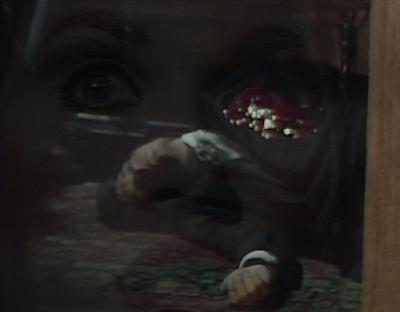
Charity/ Pansy has a vision of what will happen on that date. She sees Angelique looking at a portrait of Quentin in the drawing room. Red paint is dripping from the figure’s chest into a pool on the floor. That pool is next to a trail of other drops of red. In her mind’s eye, Charity/ Pansy follows the drops into the foyer, up the stairs, and into the tower. There, she sees Angelique opening the door to the tower room and finding Quentin sprawled, a sheet of red plastic, or perhaps construction paper, on his chest. Charity/ Pansy screams and runs out. From the dramatic music and Charity/ Pansy’s agitated reaction, I take it the object lying on Quentin’s chest is meant to suggest blood.

Through Charity/ Pansy’s eyes. Screenshot by Dark Shadows Before I Die.

The acting is all very strong today. I was fascinated with Nancy Barrett’s use of her face to highlight Charity/ Pansy’s makeup. She relaxes her jaw muscles slightly more than usual, causing the dark treatment around her eyes to stand out. That in turn creates a visual metaphor labeling Charity/ Pansy a “painted lady.”

My wife, Mrs Acilius, was particularly impressed with Louis Edmonds’ realization of Edward. When the spell breaks and he becomes himself again, Edward is alone in an empty room. He has no dialogue, no props, and no scene partner to work with. Yet he instantly conveys what has happened. Even first time viewers will understand that the obliging servant has now become a stuffy authority figure.

Edward’s towering indignation when Quentin first tells him he was the one who locked him in the tower room gives way instantly when Quentin explains that he was under a delusion at the time. Edmonds executes that transition so smoothly that first time viewers will not notice the oddness of it, but longtime fans who remember the many previous occasions when the Collinses locked each other there as a response to mental illness will chuckle.

One of the prominent features of Edward’s personality is his warm relationship with his children. This sets him apart from the first two characters Louis Edmonds played on the show, high-born ne’er-do-well Roger Collins and haughty overlord Joshua Collins. Edward’s dialogue in his scene alone with Jamison involves several discrete points of information, and it would have been understandable if the affection he displays for Jamison while he getting all of those words across had been either perfunctory or mawkish. But he and David Henesy get the emotions exactly right while also delivering the lines very clearly.

Edward’s preoccupation with Barnabas is a delicious little bit of commentary on the show itself. Dark Shadows‘ ratings, chronically low during its first 42 weeks on the air, perked up when it added Barnabas to the cast in April 1967. That summer, schoolkids curious to see a vampire on daytime TV made it into a hit, and not long after Barnabas became one of the pop culture sensations of the 1960s, instantly recognizable to many millions of people who never watched the show. To this day, people who have heard of Dark Shadows are likely to refer to it as “the vampire soap opera from the 60s.” It was Barnabas who took us with him to 1897, when he traveled back in time in the course of his attempt to rescue David from Quentin’s ghost, and for the first months of the 1897 storyline he was the only character who knew what was at stake for the 1969 version of the Collinses in the events going on around him.

But now Barnabas is on the fringes of the story, and Quentin, Angelique, and Petofi all know about 1969. Edward’s idea that the action has to focus on Barnabas is evidence that he hasn’t been watching the show. Petofi is the principal antagonist now, Quentin the chief protagonist, and Barnabas can be absent for weeks at a time while they and others find all sorts of things to do. This represents, not Barnabas’ failure, but his ultimate success. Before he was introduced, every story revolved around well-meaning governess Vicki, the main character. A soap opera can’t really have a main character. It needs to keep multiple storylines running at once, occasionally intersecting with each other, often running for long periods with little or no interaction. When one person had to be at the center of every development, the result was slow and claustrophobic.

Barnabas blew that confining structure open, because as a vampire his function in the story was not to solve problems, but to create problems for other people to solve. So no matter how much time they spent focusing on him, he always directed our attention towards everyone else. We wondered who would catch on to his secret, who would fall victim to his malign intentions, who would find a way to fight him, etc. When a mad scientist managed to free Barnabas of the effects of the vampire curse, he retained his function as a problem-maker, even when he set out to be a problem solver. Every time he announced that he had a plan, we looked forward to seeing how the rest of the cast would react to that plan’s rapid and catastrophic collapse.

Barnabas is as hapless in 1897 as he has been in every other time period, as witness the fact that he has been exposed as a vampire and driven into hiding. But he isn’t even the show’s Screw-Up-in-Chief now. That title belongs to broad ethnic stereotype Magda Rákóczi. In #807, Petofi compelled Magda to review the preceding 22 weeks of the show and admit that she had precipitated every plotline. The first of those was the release of Barnabas into the world of 1897, so that his crimes and misadventures are just a subcategory of hers. Since Magda is played by Grayson Hall, who in her original role of Julia Hoffman is waiting for us in 1969, we can be confident she won’t be coming back to contemporary dress with us, but for the moment she has relegated Barnabas to the status of a secondary character.

Episode 811: A man’s investment in the future

In #797, the ghost of Rroma maiden Julianka appeared and placed a curse on her fellow grievous ethnic stereotype, Magda Rákóczi. Julianka blamed Magda for her death, and decreed that everyone Magda loved would die. Today, Magda is trying to prevent Julianka’s curse from taking the life of her desperately ill infant niece Lenore, daughter of her late sister Jenny. Magda goes to Lenore’s crib in company with Lenore’s father, Quentin Collins. Magda and Quentin try to conjure up Julianka’s ghost to plead for Lenore’s life, but instead they get the ghost of another Rroma woman- Jenny.

Jenny assumes physical form. She picks up Lenore and sings the lullaby “All the Pretty Little Horses.” We’ve heard Jenny sing this almost every time she has been on the show. It appears to be the only song she knows. For his part, Quentin has a phonograph and only one record, which he plays obsessively over and over. When they lived together, their home must have been a pretty grim place, playlist-wise.

Jenny lifts Lenore’s illness, and says that if Quentin looks into his heart he will know what he must do to ensure that Lenore has a bright future. She vanishes, and Quentin mutters dismissively at the idea that his heart will be a source of useful information.

Later, Quentin will have a dream while sleeping in the drawing room at the great house on the estate of Collinwood. Jenny visits and tells him that he must have nothing to do with Lenore and that she must grow up far from Collinwood. So far, dream sequences on Dark Shadows have always represented visits from the supernatural, but this one might be an exception. Jenny did say that the information Quentin needed to help Lenore was already in his heart. He is clearly not the stuff of which good fathers are made, and as Jenny explicitly says in the dream no one has ever been happy at Collinwood. So the advice she gives does seem to be correct. Perhaps this is just Quentin’s own knowledge taking a shape he can recognize.

Quentin goes on dreaming that his brother Edward is choking him. He wakes up to find that Edward is in fact choking him. This might seem like a prophetic dream, but it too might just be a natural expression of Quentin’s own unprocessed knowledge. Edward, because of a magic spell not directly connected with today’s events, is under the mistaken impression that he is a valet formerly in the service of the Earl of Hampshire. Quentin has followed the Collinses’ long-established protocol for dealing with mentally ill family members, and locked Edward up in the room on top of the tower in the great house. He knows this makes Edward miserable, and it is reasonable to suppose that he would expect Edward to express anger about it. Strangulation is Quentin’s own preferred method of expressing anger, especially towards members of his immediate family, so it can’t have been hard for him to see that coming.

Edward’s motivation is not as simple as Quentin’s would be if their positions were reversed. The evil Gregory Trask has been visiting Edward in the tower room, and has told him that Quentin is determined to keep him imprisoned in that room forever. He asks him to kill Quentin. Edward apparently has decided to comply.

Earlier in the episode, Edward had been more punctilious about cooperating with Trask. Trask presented him with a document to sign, promising that by signing it he would secure his freedom. Edward read the document, even after Trask very loudly insisted that it was unnecessary to do so. When Edward saw that it involved making Trask guardian of his son, Edward protested that he had no son. Trask said that this did not matter, but Edward would not be moved. Edward later tells Quentin about this encounter.

The tower room is a re-dress of the set used as the bedroom of strange and troubled boy David Collins in the parts of Dark Shadows set in the 1960s. Today it includes the bed from that set, and we see Edward trying to sleep in it. This is a powerful image for longtime viewers. Louis Edmonds plays Edward in this costume drama segment and David’s father Roger in contemporary dress. Edward is the father of Jamison, who like David Collins is played by David Henesy. Not only has the spell robbed Edward of the memory of Jamison and of his role as a father, it has reduced him to curling up in a bed made for a boy rather than a man.

Edward in the child’s bed. Screenshot by Dark Shadows Before I Die.

Roger was, for the first year of Dark Shadows, a spectacularly bad father. He openly hated David and exploited David’s miseries to try to manipulate him into doing his own criminal dirty work. He was indifferent to the family’s name and the fate of its businesses, would go to any lengths to hide from the consequences of his actions, had killed someone, and was an alcoholic. Edward shares none of these shortcomings. On the contrary, he goes to the opposite extreme. He is as brave as Roger is cowardly and tenderly loves his children, Jamison and Nora. But he is also stuffy, name-proud, and money-grubbing. The contrast with Roger shows these failings, not simply as negatives, but as the overgrowth of the virtues that separate Edward from Roger. Though Louis Edmonds and Jerry Lacy are such accomplished comic actors that Edward’s scenes with Trask are funny enough to be worthy of a staging of the Jeeves and Wooster stories, Edward’s loss of his identity as father of Jamison and Nora is a genuine tragedy.

Quentin is fond of Jamison, and once he learns that his children exist he seems to wish them well. Nonetheless, he shares most of the other vices of early Roger. As Edward shows us what Roger might have been had he had stronger moral fiber, Quentin is Roger with his vices magnified by black magic. When Jenny tells Quentin that he must not raise Lenore, longtime viewers remember Roger as he was when first we knew him, and remember how grim David’s future seemed at that time. It was only after well-meaning governess Vicki became the chief adult influence in his life that we could have hopes for David. So we cannot doubt that Jenny is right.

This is the last of 21 episodes of Dark Shadows directed by executive producer Dan Curtis. When Curtis first took the helm in #457, he had no experience as a director, and it showed. But he learned very quickly. This one looks great and the scenes play very smoothly. He would later direct the feature films House of Dark Shadows and Night of Dark Shadows, as well as six episodes of the 1991 prime time revival of Dark Shadows and many other productions.

Episode 781: Sympathy somewhat disturbing

When vampire Barnabas Collins first appeared on Dark Shadows in April 1967, regular viewers may have thought they knew what to expect. They had just spent four months focused on undead blonde fire witch Laura Murdoch Collins, mother of strange and troubled boy David. David’s well-meaning governess Victoria Winters gradually realized that Laura was a deadly threat to him. After some initial confusion, Vicki rallied the other characters in opposition to Laura. Ultimately Laura went up in smoke and David escaped her clutches, choosing Vicki and life over his mother and death.

In many ways, the Laura story was modeled on Bram Stoker’s Dracula. So when Laura’s successor as supernatural menace was an out and out vampire, we may have expected further mining of that source. Barnabas bit and abducted Vicki’s friend Maggie Evans. As the daughter of drunken artist Sam, Maggie had played a key role in the “Revenge of Burke Devlin” storyline. But that storyline fizzled in the show’s early months, and by #201 even Burke Devlin lost interest in it. Maggie was at that point surplus to requirements, and when Barnabas added her to his diet we might have suspected that she would die and rise as a vampire. As Mina and the group she led in Dracula had to destroy her friend Lucy when Lucy rose as “the Bloofer Lady,” so Vicki and her friends would have to destroy Maggie. Vicki herself would then stake Barnabas. The average viewer would have expected this to be the sign to move on to the next menace; those who were aware of TV ratings and programming decisions might think it would be Dark Shadows‘ way of going out with a flourish before its impending cancellation.

Barnabas turned out to be a hit. The idea of a vampire on a daytime soap was such an oddity that a sizable new audience tuned in out of curiosity, and Jonathan Frid’s portrayal of Barnabas’ scramble to impersonate a living man native to the twentieth century resonated with so many of them that he became a breakout star. So they had to figure out a way to make him a permanent part of the cast. That meant Maggie couldn’t die. In the first place, they couldn’t risk making Barnabas responsible for the death of so likable a character. Second, as the survivor of the horrendous abuse Barnabas inflicts on her Maggie would have a new function, as the witness who might emerge to expose him and wreck the show. Third, while Maggie was in Barnabas’ clutches Kathryn Leigh Scott proved herself such a versatile actress that it would obviously damage the show to lose her. So Barnabas not only failed to kill Maggie, he completed only two homicides in the whole of 1967. Each of his two victims was a male character who had run out of story. As a result, the killings and the victims were quickly forgotten.

Barnabas’ nonlethal vampirism made it easier to keep the cast intact, but it also drained him of the lurid novelty that had made him such a draw. To reassure the audience that Barnabas really was a bloodthirsty fiend from the depths of Hell, the show had Vicki come unstuck in time in #365. She found herself in the 1790s, when Barnabas first became a vampire. That gave us a whole cast of characters whom we did not expect to see again once the show returned to contemporary dress. So Barnabas was free to slaughter people to his heart’s content.

The 1790s flashback was a hit in the ratings. When Vicki brought us back to 1968 in #461, the makers of the show had to figure out a way to keep the momentum going. They cured Barnabas of the effects of the vampire curse and surrounded him with a hectic parade of other refugees from 1930s horror movies- mad scientists, Frankensteins, witches, werewolves, and a couple of fresh vampires. After that Monster Mash period exhausted itself, they took us through a long, deliberately paced segment focusing on just two stories, one about a tormented werewolf and the other about a ghost who takes possession first of two young children, then of the whole estate of Collinwood. Barnabas, who has come to see himself as a good guy and the protector of the family, tries to cure the werewolf and reason with the ghost. His efforts instead transport him back in time to 1897.

In that year, Barnabas is a vampire again. He keeps saying that his only goal is to prevent the evils that will befall the family in 1969, but he is as uninhibitedly murderous as he ever was in the periods when he was unambiguously a villain. In Friday’s episode, he murdered one of the principal members of the Collins family, prankster Carl Collins, uncle of the Jamison Collins whose daughter and son are the adults at Collinwood in the 1960s. Barnabas had become so careless after so many killings that he left Carl’s body propped up behind the curtains in the windows of the drawing room, where it fell into plain view moments after Barnabas’ foe the Rev’d Gregory Trask entered. In this episode, Trask enlists Edward Collins, brother of Carl and father of Jamison, to help him hunt Barnabas.

My wife, Mrs Acilius, points out that when we see a character closing the doors to the drawing room, that person is in charge of the house. So in the early months of the show matriarch Liz was the one to close the doors; when Liz was taken to a hospital and her daughter Carolyn was in charge, Carolyn closed the doors. When Vicki was fully in command of the campaign against Laura, she closed the doors to consult privately with her lieutenants. When Trask and Edward go into the drawing room to discuss the situation, it is Trask who closes the doors. Vicki was good, so consistently so that she had to be written out of the show months ago. But Trask is overwhelmingly evil. That he has ascended to the rank of door-closer means that virtue has no stronghold anywhere.

Edward and Trask go to the Old House on the estate, where Barnabas has been staying. They find Barnabas’ reluctant sidekick, broad ethnic stereotype Magda Rákóczi. Magda denies that Barnabas is in the house and pretends not to know what Trask and Edward are talking about when they say that Barnabas is a vampire. Trask slaps Magda in the face; we have seen many face-slaps on Dark Shadows, but so far as I can recall this is the first delivered while the slap-ee has her back to the camera. Since he does not have to swing his hand very close to Grayson Hall’s face, Jerry Lacy can therefore put full force into the gesture, making it look like Trask is delivering a truly brutal blow to Magda. Afterward, Magda rubs her face and vows revenge on Trask. She quotes a rather confusing “old gypsy saying”: “Walk fast and the Devil will overtake you; walk slow and misfortune will catch you. You’d better not walk slow, because I will never be far behind.”

Edward and Trask search the Old House and find nothing. At dusk, Barnabas emerges from the secret room behind the bookcase in the front parlor. Magda hadn’t thought to look there, and Trask and Edward didn’t know the room existed. Barnabas says he will have to find a new hiding place for his coffin. Magda says she will do whatever she can to help him. Barnabas is surprised at her support for him; after all, he has bitten and enslaved her husband Sandor, and his destruction would mean Sandor’s restoration. Magda has an atypical moment of speechlessness, after which she says that Trask is an “animal” and must be punished at all costs.

Trask and Edward went back to the main house early in the morning to look for the plans to the Old House. It apparently took them all day to find them. By the time they have gone through them and identified all of its secret rooms, Barnabas is already up. They come back to the Old House and find the empty coffin in the secret room. Trask says that he will make the coffin “unusable” for Barnabas before daybreak. He leaves Edward, who is carrying a gun loaded with silver bullets, to guard the house.

Barnabas goes to one of his blood-thralls, Trask’s daughter Charity. He tells Charity that he is “in serious trouble” and commands her to go to the basement of the Old House. There, she will find some soil from his original grave, which he needs to prepare his new resting place. He tells her about a tunnel from the beach to the basement which she can use to elude detection by Edward. Since Barnabas has just materialized in Charity’s room and will shortly materialize in the secret room in the Old House while Edward is standing on the other side of the bookcase, we wonder why he can’t use that same power to get into the basement himself.

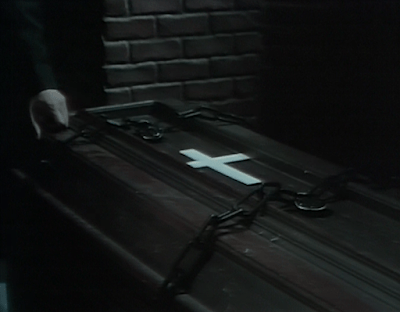
Barnabas finds that the coffin is topped with a cross. He can’t get close enough to take hold of the coffin and move it, so presumably even after he gets the soil he needs he will have to plunder a mortuary showroom to get a fresh resting place before dawn.

The unusable coffin. Screenshot by Dark Shadows Before I Die.

Charity does go to the basement. She puts some soil in her purse, then knocks over a crate, attracting Edward’s attention. She does not run away, but merely hides in an alcove until Edward comes down, sees her in shadow, and orders her to show herself.

Episode 770: We must give him a vampire

Vampire Barnabas Collins first appeared on Dark Shadows in #210 and quickly became the show’s main character and star attraction, but the word “vampire” was not uttered on-screen until #410, and thereafter was used quite sparingly for a long while. Those days are definitely behind us now; the characters say “vampire” eight times in this one.

Barnabas has traveled back in time to the year 1897, and is embroiled in a great many storylines, none of which he fully understands or has any idea of changing for the better. Yesterday, crazed groundskeeper Dirk Wilkins told twelve year old Jamison Collins (David Henesy) that Barnabas was a vampire, and Jamison, checking on his story, found an empty coffin in Barnabas’ basement. Today, Jamison tells his father, the stuffy Edward (Louis Edmonds,) what Dirk said and what he saw.

Edward comes to Barnabas’ house, repeats Jamison’s story, and asks to see the basement. Barnabas has hidden the coffin, but Edward tells him that he cannot dismiss the story so easily. A few weeks before, Edward discovered that Jamison’s mother Laura was an undead blonde fire witch bent on incinerating her children to renew her own existence; since that experience, he can no longer disregard claims about the supernatural. There have been a number of attacks on the estate of Collinwood and in the village of Collinsport which have left victims drained of blood and showing bite marks on their necks; he must take Jamison’s claims seriously. He is alone with Barnabas in his basement while explaining this to him, rather a foolhardy position in which to lay out to a man one’s grounds for suspecting that he is a vampire.

Edward, unfrightened. Screenshot by Dark Shadows Before I Die.

Edward leaves. Barnabas is in a bind. Jamison’s children will be the adults at Collinwood in the 1960s, and they are the ones who accept Barnabas’ story that he is their distant cousin from England and give him the Old House on the estate to live in. If Jamison knows about him, it will hardly be likely that his children will be so welcoming. Even if he can reverse his journey through time, there will be no future for him to go back to. So he tells his blood thrall, maidservant Beth, that they must provide a vampire to take the blame for his earlier deeds and allay Jamison and Edward’s suspicions.

Barnabas thinks that he has already arranged a solution to this problem. He bit Dirk in order to shut him up and bring him under control, but apparently he over-ate. Dirk is not going to live through the night. When he dies, he will rise as a vampire. Barnabas and Beth will see to it that Dirk is caught and that he takes the fall for Barnabas’ crimes.

Barnabas has stashed Dirk in a secret room off the parlor of the Old House, a space behind the bookcase in the front parlor. Barnabas opens this space, intending to sit by Beth until they see Dirk die, only to find that it is too late- Dirk has wandered off.

Longtime viewers will find satisfactions in the reflections of earlier characters that run throughout this episode. The secret chamber in which Barnabas tried to keep Dirk is not a place which he has used before, but it first appeared on the show long before he did. In #115, another crazed servant, handyman Matthew Morgan, locked well-meaning governess Vicki up in the chamber, eventually attempting to kill her there. When Barnabas suddenly thinks of that chamber, he is emphasizing the echo of Matthew in Dirk’s rampage.

Edward’s fearlessness in standing alone before Barnabas in his basement and telling him that he suspects he may be a vampire is also something we have seen before. From November 1967 to March 1968, when Dark Shadows was set in the 1790s, Louis Edmonds played haughty overlord Joshua Collins. In #446, Joshua found his son Barnabas rising from his coffin in this same basement and confronted him about his bad behavior. When Barnabas moved to kill him, Joshua glared at him and Barnabas slunk away in shame. Edward is quite different from Joshua; on the one hand he lacks the earlier man’s sense of enterprise and drive for power, while on the other he is far more loving towards his children and quicker to set aside his individual pride for the sake of family unity. But we can see that he does share his kinsman’s ability to fend off vampire attacks by insisting on good manners.

The most fully developed echo is of #333. In that episode, set in contemporary times, strange and troubled boy David Collins (David Henesy,) had seen a coffin in Barnabas’ basement. Connecting that with an abundance of other readily available evidence, David concluded that Barnabas was a vampire. David’s father, high-born ne’er-do-well Roger Collins (Louis Edmonds,) refused to consider such a notion. When local men Burke and Dave went to Barnabas’ house and demanded to search the basement, he initially resisted. At length he led them downstairs. The coffin was not there. Burke and Dave went back to the great house of Collinwood, and Roger crowed with triumph that they had been so silly as to take David’s story seriously. Embarrassed, Burke and Dave asked David if he might have made the whole thing up.

Barnabas may have had this incident in mind, and with it a hope that by showing Edward the empty basement he would embarrass him as he had embarrassed Burke and Dave, perhaps turning him into the same kind of ally that Roger was in 1967. But Edward is made of sterner stuff, and he sheds light on what was in the minds of the makers of the show.

Laura was another iteration of the show’s first supernatural menace. From December 1966 to March 1967, we learned that David’s mother, Laura Murdoch Collins, was a humanoid Phoenix who had returned from the dead to incinerate him along with herself and thereby renew her existence. Roger eventually came face to face with that fact and made himself marginally useful in the effort to stop her. Afterward, he was shocked out of his habit of openly expressing hatred for David, and eventually even showed a modicum of affection and concern for the boy. But he quickly snapped back into the Collins family’s traditional attitude of denial that the supernatural could have any role in human events, and he would not be budged from this denial.

The Laura we saw in 1897 was a violent retcon of many of the most important features of the story we saw in 1966 to 1967, and as Jamison’s mother she implies that Roger married his own grandmother. So it seemed inexplicable that the makers of the show would choose to introduce her. It is when Edward explains that his experience with Laura has opened his mind to the possibility of dangers intruding from the world of the supernatural, that we understand why they did it. They are showing us that Edward is on a continuum about halfway between Joshua and Roger.

Joshua was in a way too strong for his world to support, so that he defeated his own aims and produced tragedies for all those he meant to elevate. By contrast, Roger is like one of Nietzsche’s “Last Men,” what nowadays some call “cage-stage,” a person who is so degenerated he cannot exist on his own or create anything lasting but can be happy in captivity. Edward does not have Joshua’s anomalous strength; like Roger, he lives in his sister’s house as her guest and works for her business as an employee. But neither does he have Roger’s cowardly inability to face facts or his vicious glee in the humiliation of others. He is brave enough and strong enough and fair-minded enough to represent a grave threat to Barnabas.

Episode 749: The kiss of death

In the parts of Dark Shadows set in the 1960s, Louis Edmonds plays Roger Collins, younger brother of matriarch Elizabeth Collins Stoddard. In 1966 and 1967, we saw that Roger had squandered his entire inheritance. He was reduced to living as a guest in Liz’ house and working as an employee for her business. Roger was the show’s first villain. His villainy was confined to a storyline known as “The Revenge of Burke Devlin.” That story never really caught on, and by #201 even Burke Devlin had lost interest in it. Roger receded to the margins, and for the rest of the series Edmonds’ gift for sarcastic dialogue kept the character alive as occasional comic relief.

From November 1967 to March 1968, Dark Shadows was a costume drama set in the 1790s. Edmonds, a costume drama specialist in his years on Broadway, came into his own as haughty overlord Joshua Collins. Joshua’s focus on moneymaking and his determination to preserve the glamour of the Collins family name at all costs placed him at the opposite pole from Roger, a blithe spendthrift pathologically lacking in family feeling. Joshua used his power to cover up all of the tragic and horrible events we saw in the 1790s segment, and imposed a false history in its place.

Now, the show is set in 1897. Edmonds plays Edward, the stuffy eldest brother of the adult members of the Collinses of Collinsport. Edward has Joshua’s imperious demeanor and his determination to conceal the family’s disgraces, but like Roger he finds himself penniless, dependent on his sister’s largess. Yesterday he learned that his youngest brother, libertine Quentin, had killed his estranged wife Jenny. So far, Quentin has been a breezily amoral wastrel, easily recognizable to longtime viewers as a kindred spirit of his great-nephew Roger. But Quentin shocked himself when he murdered Jenny, and he had a terrified look on his face as he tried to sneak out of the house afterward.

Edward intercepted him then and forbade him to go. Edward had learned from Quentin’s girlfriend, Jenny’s former maid Beth, what happened. Edward was in a high dudgeon about the mess Quentin had made, but did not seem particularly surprised or at all grieved. He was quite confident he would be able to hush the whole thing up, and fabricated a story about Jenny falling down the stairs and dying shortly after from a head injury.

What did shock Edward was Quentin’s revelation that Jenny was the sister of one of the neighbors, Magda Rákóczi. Magda is a member of the Romani people, an ethnicity against whom Edward and the rest of the Collinses are violently prejudiced. “You married a Gypsy!” he exclaims in utter disgust. He remained convinced that he could keep the whole thing quiet, and drilled Beth and Quentin in the lies they were to tell Magda and her husband Sandor.

Magda did not give Edward a chance to direct the little play he had written. She found physical evidence indicating Quentin had murdered Jenny, and accused him. When she threatened to go to the police, Edward asked her what she imagined the authorities would do when asked to choose between the word of a Collins and the word of a “Gypsy.” At that, Magda dropped her plan to go to the police and vowed to place a curse on Quentin. Edward dismissed that as “words,” but Quentin is deeply involved in the occult. He is helpless with fear.

Today, Edward calls on Quentin in his room. He finds that Quentin has not slept all night. He continues to regard Quentin’s fear of Magda’s curse with total contempt, but perks up when Quentin says that he has thought of a way to escape it. Returning viewers already know that there is one way wide open to Quentin to escape the curse. He can go to the police and confess that he murdered Jenny.

This, of course, is not Quentin’s idea. He wants to offer Magda $10,000. Neither he nor Edward has that kind of money, but their sister Judith, whom their grandmother chose as her sole heiress, does. Edward says that he might be able to persuade Judith to give him that sum on one condition. Their grandmother’s will left Quentin no property or income, but it did guarantee him the right to live in the great house of Collinwood as long as he might wish. If he will sign documents renouncing that right, Judith might give him the money.

Edward embarrassed by Quentin’s craven mewling. Screenshot by Dark Shadows Before I Die.

Quentin drifts off to sleep. He has a nightmare. Sandor and Magda show him Jenny’s body and tell him he can escape punishment if he blesses it. He does so, and Jenny comes back to life. She asks for a kiss. Quentin gives it, and Magda and Sandor laugh. They say that the kiss has sealed his fate- it is “the kiss of death!”

Edward returns with word that Judith will give him his $10,000, but that she has added a condition. Not only Quentin, but Sandor and Magda too, will have to leave the area forever. Quentin promises to make that happen, and signs the papers.

Meanwhile, Magda and Sandor are at home in the Old House on the grounds of the estate. Magda has mixed a potion and told Sandor that “a very old Gypsy woman” once used it to place a terrible curse on someone called “Count Petofi.” All they have to do is trick Quentin into drinking the potion, and the same curse will befall him. Sandor disdainfully replies that he had thought Magda might have come up with a plan that had a chance of working. He can’t imagine Quentin drinking anything they might give him.

They look out the window, and see Quentin coming to the house. They are pleasantly surprised that he is delivering himself. He knocks. They open the door, and he bursts in. Magda makes a great show of telling him he is not welcome and demanding he leave. He tells them about the nightmare, and says he knows that it is part of the curse. He offers them money to lift it. Magda is at first openly offended, while Sandor behaves as if he is tempted. Quentin shows them the money, and Magda plays the part of a woman succumbing to greed. She asks Jenny’s spirit to forgive her, and takes the envelope. She makes a gesture that Quentin takes to be an act of spellcasting. While she counts the money, Sandor says they will have to share a drink to complete the deal. Quentin happily agrees.

Once Quentin has taken the drink, Magda tells him that he has been fooled. The nightmare was not part of any curse, but was simply the voice of his own conscience. She tells him that the drink brought the curse on him, and that he will begin to suffer its effects tonight. She throws the money at him and tells him to take it. He reels away, dazzled by the horror of it all.

Magda’s curse shows the limits of the Collinses’ power. Their prestige and connections enable them to intimidate the authorities so that they need not worry about an insistent police investigation. But their freedom from that concern has allowed Quentin to travel so far into depravity that he has committed murder and brought a curse upon himself. When they encounter someone who will not be intimidated, their only recourse is to money. Magda’s unwillingness to sell her sister’s vengeance for any number of dollars means that the rich Judith would be as powerless against her as are the impecunious Edward and Quentin.

Not only has the Collinses’ station led Quentin to indulge himself in one vice after another until he is so far gone he cannot imagine good behavior, it has led him to assume that everyone assigned to a humbler place in the world can be bought. Sandor and Magda are quite good actors, almost as good as Thayer David and Grayson Hall, and they look very much like people who are tempted to take the bribe Quentin is offering. But even to make the offer shows a complete lack of perspicacity. Jenny has not been dead for twenty four hours, and he somehow supposes her sister is ready to bargain away her memory.

Quentin cannot say he wasn’t warned. His dream told him that Magda and Sandor would trick him into bringing the curse on himself by leading him to believe they were giving him a way to escape the curse. He is so far gone in the symptoms of his over-privileged background that he cannot even interpret this message. Thus we see that the real curse of the Collinses, the obstacle that blocks the sunlight and casts all the dark shadows that shroud them, is their wealth and power. The first ten months of the show made some feints towards developing a social drama about the relations between the Collinses in their house on the hill and the working people in the village below. The village is mentioned nowadays only as a source for victims of the various monsters bred at Collinwood, but the price everyone pays for the Collinses’ exalted position is always front and center.

Episode 731: Your greatest weakness

One of the first “Big Bads” on Dark Shadows was crazed handyman Matthew Morgan, played by Thayer David. Matthew was the most devoted employee of reclusive matriarch Elizabeth Collins Stoddard (Joan Bennett.) Matthew took his devotion to Liz to such an extreme that he was a menace to everyone else. In November and December of 1966, we learned that Matthew had decided that Liz’ second most dedicated employee, plant manager Bill Malloy, was a threat to her. Matthew had tried to put a stop to Bill’s doings. Not knowing his own strength, Matthew accidentally killed Bill. When well-meaning governess Victoria Winters discovered what had happened, Matthew abducted Victoria, held her prisoner in the long-deserted Old House on the grounds of the estate of Collinwood, and was about to murder her when a bunch of ghosts emanated from the show’s supernatural back-world and scared him to death.

In those days, Dark Shadows was a slow-paced “Gothic” drama set in contemporary times. From November 1967 to March 1968, it was a costume drama set in the 1790s, and its plot often moved at a breakneck speed. Among the characters then was much-put-upon indentured servant Ben Stokes, who like Matthew was played by Thayer David. At first Ben made a stark contrast with Matthew. He was as relaxed, friendly, and reasonable as Matthew was tense, forbidding, and paranoid. But when his one ally among the Collins family, scion Barnabas, was cursed to become a vampire, Ben’s devotion made him resemble Matthew ever more closely. In his development, we saw a retrospective reimagining of Matthew. The curses that were placed on Barnabas and the rest of the Collinses from the 1790s on had burdened the village of Collinsport, and people who grew up there labored under the consequences of those curses and of the Collinses’ attempts to conceal them. Ben was what Matthew might have been had he not been warped by the evil that began when black magic was first practiced in the area so many generations before.

In January 1969, the show briefly returned to 1796, to a time coinciding with the last days of the earlier flashback. We saw that by that point, the curses had already transformed life on and around the great estate. In that period, Ben’s efforts to protect Barnabas led him inadvertently to kill a man, not knowing his own strength, and then to cover that crime up by killing a woman, not at all inadvertently. He had become Matthew. The curse placed on Barnabas had become the curse of all those who work for the Collinses and all of those who live in the shadow of their wealth and power.

Before Matthew, Dark Shadows‘ chief villain was high-born ne’er-do-well Roger Collins (Louis Edmonds); after, it was Roger’s estranged wife, undead blonde fire witch Laura Murdoch Collins (Diana Millay.) In this episode, the makers of the show take a page from its 1790s flashbacks. They have Edmonds and Millay reconceive the Roger and Laura of that atmospheric, sometimes almost action-free soap as characters appropriate to the fast-paced supernatural thriller it now is.

Since #701, Dark Shadows has been set in the year 1897. Louis Edmonds plays Roger’s grandfather Edward; Diana Millay plays Edward’s estranged wife, undead blonde fire witch Laura Murdoch Collins. In his days as a villain, Roger’s defining characteristic was his unnatural lack of family feeling. He had squandered his entire inheritance, a fact which did not bother him in the least. When his sister Liz confronted him in #41 about the difficulties he had created by putting his half of the family business up for sale, he airily replied that he had enjoyed his inheritance. When in #273 Liz and Roger discussed a blackmail plot of which she had been the victim, Roger admitted that had he known her terrible secret, he probably would have used it to force her to give him her half of the estate so that he could squander that, as well.

It wasn’t only the family’s material possessions and Liz’ right to them to which Roger was indifferent. He openly hated his son, strange and troubled boy David Collins (David Henesy.) He continually insulted David, badgered Liz to send David away, and in #83 coldly manipulated David’s fears to lead him to try to murder Victoria.

In the 1897 segment, Edward is as stuffily serious about the family business as Roger was in 1966 nihilistically apathetic about it. Edward loves his children, twelve year old Jamison (David Henesy) and nine year old Nora, but his rage at Laura has come between himself and them. Laura left Edward the year before to run after Edward’s brother, breezy libertine Quentin (David Selby.) Edward tried to conceal the fact that his brother cuckolded him. He has repeatedly declared that Laura “No longer exists!” and has forbidden her name to be mentioned in the house.

Edward trapped between the enigmatic Laura and the exuberant Quentin. Screenshot by Dark Shadows Before I Die.

For his part, Quentin bears a striking similarity to the early, wicked Roger. He wants money only to spend it, a fact which he cheerfully admits. He tried to forge a will in his grandmother Edith’s name to cheat his sister Judith (Joan Bennett) out of her inheritance, having previously threatened to kill Edith. He does have great affection for Jamison, but since he often uses the boy as a pawn in Satanic ceremonies, his fondness for his nephew is not much of an improvement over Roger’s hatred for his son. Indeed, Quentin’s resemblance to Roger connects the 1897 segment not only to the early months of the show, but also to the weeks immediately preceding it. Early in 1969, Quentin’s ghost had taken possession of David Collins and was causing him to die. When we see that Quentin is now what Roger was originally, David’s ordeal takes on a new dimension. He is dying for the sins of his father.

In this episode, Laura has returned. Edward has offered her a great deal of money to go away and never come back; she refuses. She threatens to tell the world about her relationship with Quentin if Edward does not let her stay at Collinwood. Edward buckles to this blackmail. Laura tells him that “Family pride is your greatest weakness,” making him Roger’s exact opposite.

When Laura was at Collinwood from December 1966 to March 1967, her old boyfriend Burke Devlin kept pestering her with his suspicion that he, not Roger, was David Collins’ father. Burke was not the first character to bring this idea up. Roger had mentioned it to Liz in #32, when they were talking about an attempt David had made to kill Roger. At that time, Liz was horrified that Roger seemed to want to believe that David was Burke’s natural son.

It seems unlikely that Quentin is Jamison’s father. They have been firm about 1870 as Quentin’s date of birth, and in 1897 Jamison is quite plainly twelve. Laura may have gone on to marry her own grandson, but it would be a bit of a stretch for her to have started sleeping with her brother-in-law when he was fifteen, even if he did look like David Selby.

But Roger’s anger and jealousy about Burke and Laura do mirror Edward’s about Quentin and Laura. It was abundantly clear that Roger and Burke’s deepest pain regarding Laura was that their intense attachment to each other was disrupted when she left Burke for Roger; Diana Millay used her gift for dry comedy to make this explicit in a scene the three of them played in the groundskeeper’s cottage in #139. Likewise, Edward’s frustration with and disappointment in his brother is at least as deep a source of anguish to him as is his loss of Laura’s love.

Laura, too, is quite different this time around. The first Laura story took shape gradually over a period of weeks, as Laura herself emerged from the mist. Now Laura is a forceful presence from her first appearance. Originally we heard that Laura had married into several of the leading families of the Collinsport region; now they have given up on the idea of developing other leading families, and Laura just keeps coming back to the Collinses. In the first story, they laid great emphasis on the interval of precisely one hundred years between her appearances; now, the number of years doesn’t seem to have any particular significance. As we go, we will see an even more important difference. When we first met Laura, she was utterly determined to make her way into a pyre so that she could rise as a humanoid Phoenix; now she is unhappy about the whole thing, and angry with people who have helped her on her fiery way.

Edward lets Laura live in the cottage where Roger and Liz would put her in 1966. In the final scene, she goes there and finds Quentin, drunk and trying to conjure up an evil spirit. Quentin keeps telling Laura that she is dead. Frustrated with her persistent refusal to concur with this statement, Quentin puts his hands around her neck and announces that whether or not she is dead now, she will be by the time he gets through with her.

Roger was uncharacteristically sober at the beginning of his three-scene in the cottage with Burke and Laura in #139, but he did enter brandishing a fire-arm. So Quentin’s homicidal intentions on this set further cement his affiliation with his great-nephew in the eyes of longtime viewers.

Millay and Edmonds are not the only actors whose screen iconography the show turns to advantage today. We first saw Kathryn Leigh Scott and Don Briscoe together in #638, when she was playing ex-waitress Maggie Evans and he was playing mysterious drifter Chris Jennings. They met in the foyer at Collinwood. Maggie was angry with Chris, and Chris was guilt-ridden. Today, Miss Scott plays governess Rachel Drummond and Briscoe plays teacher Tim Shaw. They meet in the foyer at Collinwood. Rachel is angry with Tim, and Tim is guilt-ridden.

Though the same actors are playing the same basic emotions on the same set, the situations are different, and the characters are very different. Maggie is Dark Shadows‘ principal representative of the working class of the village of Collinsport. She speaks directly and bluntly, using the plainest language she can to dare Chris to try to excuse his inexcusable behavior. Chris occupies a lowly and unsettled place in the world, and he dodges her gaze and evades her questions, saying as little as he can, almost mumbling.

But Rachel is a neurotic intellectual, and she expresses her anger in complex sentences featuring vocabulary that only a very well-read person would have used in 1897 (for example, the word “sadist.”) Tim retreats from her anger into a defense of his job that quickly devolves into the tiredest platitudes imaginable. At one point he actually intones “It is better to light one candle than to curse the darkness.” Miss Scott makes Rachel’s highly literate onslaught on Tim as forceful as was Maggie’s unvarnished challenge to Chris, and Briscoe makes Tim’s pompous posturing as pitiable as was Chris’ broken burbling. Writer Gordon Russell must have been delighted that the actors did such good work with his ambitious pages.

Episode 730: The very same dream

When Laura Murdoch Collins first appeared on Dark Shadows in December 1966, it was far from clear what sort of being she was. From the beginning, there were definite hints that she had emerged from the supernatural back-world of ghosts and presences lurking behind the action, but as those ghosts and presences were undefined and vague, so Laura herself was undefined and vague when we met her. We couldn’t even tell how many of her there were- there was a charred corpse in Phoenix, Arizona, a phantom flickering on the front lawn of the great estate of Collinwood, two graves of Laura Murdochs from previous centuries, a woman who turns up in various places that serve food but never eats or drinks, and a series of dream visitations and inexplicable compulsions. Some of those were Laura, maybe all of them were, but how they were connected to each other, if they were connected at all, was anyone’s guess. Diana Millay’s performance reflected that uncertainty. Her Laura was initially blank and distant.

As her storyline went on, Laura came into ever sharper focus. By the time we realized that she was a humanoid Phoenix, an undead fire witch who had returned to Collinwood to take her son, strange and troubled boy David Collins, into the flames with her so that she could renew her life, she had become a dynamic character. As Laura gained force, Millay had the chance to reveal a talent for sarcastic dialogue rivaling that of Louis Edmonds, who played Laura’s estranged husband Roger Collins. Before Laura went up in flames in March 1967, we wished we could have seen a whole series featuring Millay and Edmonds as an unhappily married couple sniping at each other.

In those days, Dark Shadows was set in contemporary times. Now, its dramatic date is 1897, and Edmonds plays Roger’s grandfather, the stuffy Edward Collins. As in the first 24 weeks of Dark Shadows we saw that the name of Roger’s estranged wife was taboo in the great house of Collinwood, so in the first six weeks of the 1897 segment Edward has been furiously insistent that his estranged wife should never be mentioned. When Laura turns up, bearing the same name and played by the same actress as Edward’s granddaughter-in-law, we know what we are in for.

The show moves a lot more quickly now than it did when it debuted. David had shown signs of a psychic connection with Laura from #15 in July 1966, over 21 weeks before she arrived. Edward and Laura’s nine year old daughter Nora had dreams, visions, and an episode of automatic writing directed by Laura yesterday and the day before, and Laura herself shows up today. At first she meets Nora on the peak of Widow’s Hill, as a dream had told her she would. Laura comes to the house and sees Edward the following afternoon. Edward is horrified to see her; she is understated and cool at the beginning of their scene, but by the end of it she is in tears, pleading with Edward to be allowed to see their children, Nora and twelve year old Jamison. She thus recapitulates within minutes a progression that in 1966 and 1967 took months.

Laura trying to figure out what to say to Nora. Screenshot by Dark Shadows Before I Die.

When Laura saw Nora on Widow’s Hill, she swore her to secrecy, forbidding her to tell anyone but Jamison that she is back. Nora did try to tell Jamison, only to find that he wouldn’t believe her. She showed him a broach Laura gave her which bears an Egyptian symbol that popped into her head yesterday; Jamison is entirely unimpressed.

We learned the other day that when Edward’s brother Quentin was banished from Collinwood a year before, Laura followed him. The two wound up in Alexandria, Egypt, together. Jamison and Nora come to Quentin’s room today; Quentin sees the broach and flies into a panic. He searches through a book, then demands to know where Nora got the broach. She says only that she found it in the woods, and he keeps asking if someone gave it to her. She keeps denying that anyone did, and he rushes downstairs, looking for Edward.

In the drawing room, Quentin sees Laura. He is utterly shocked. “You’re dead!” he exclaims. “I saw you die!” Last week, Quentin himself died and came back to life. When he told Edward about his death and resurrection, he laughed delightedly. When Edward asked for an explanation, Quentin dismissed the whole subject, having exhausted his interest in it with his laughter. Yet now he is stunned out of his wits to see that Laura too has returned from the dead. Seems to be quite a double standard at work.

Every character we see in this episode bears the surname “Collins.” I believe this is the first episode we have seen with an all-Collins cast.