Nathan Forbes, naval officer and scoundrel, goes to the Old House on the great estate of Collinwood and finds his estranged wife Suki dying. With her last breath, Suki gasps out the name “Barnabas Collins.”
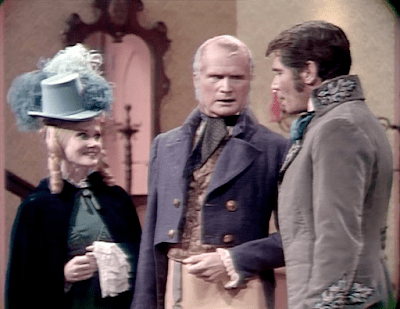
Nathan goes to the great house and informs the master of the estate, haughty tyrant Joshua Collins, of what he has found. Joshua accompanies Nathan to the Old House. Suki told the Collinses that she was Nathan’s sister, lest she disrupt Nathan’s engagement to fluttery heiress Millicent Collins, a second cousin of Joshua. Suki had planned to force Nathan to divert a large percentage of Millicent’s vast wealth to her. Unaware of the true nature of Suki’s relationship to Nathan, Joshua is only mildly suspicious that Nathan might have murdered her.
Nathan brings up the fact that in her dying words Suki named Joshua’s son. This irritates Joshua, who reminds Nathan that Barnabas has gone to England. Nathan tells Joshua that he thought he saw Barnabas the other night, from a distance, in the dark. Considering that the most Nathan could have been sure he saw under those conditions was Barnabas’ coat, no one would be impressed by such an account. It’s an unusual coat, but there’s nothing to prove Barnabas didn’t get rid of it and wear a new one to England. Joshua is particularly bland about Nathan’s thought that he may have seen Barnabas, since he made up the story that Barnabas went to England to conceal the fact that he died. Joshua believes that Barnabas died of the plague, and that if that news got out the men wouldn’t show up to work at the family’s shipyard. So he does not share Nathan’s suspicion that Barnabas may have had something to do with Suki’s death.
What we know that Joshua does not is that after his death, Barnabas became a vampire. Suki discovered him in the Old House, and he was indeed the one who murdered her. But so far as anyone can tell, Nathan is the only suspect, and whoever learns that Suki was actually his wife will have to regard him as something more than a suspect.
Joshua and Nathan are about to search the house when the gracious Josette comes staggering downstairs. Josette had come to Collinwood to marry Barnabas, had been put under a spell that caused her to marry Barnabas’ uncle Jeremiah instead, and was miserable when both Barnabas and Jeremiah were dead. Now Barnabas has bitten Josette and is planning to kill her and raise her as his vampire bride.
When Suki was killed, everyone around the estate was involved in a search because Josette had gone missing. Joshua and Nathan are shocked to find her here, and even more shocked by her physical condition. She reaches the foot of the stairs, says Barnabas’ name, and collapses.
Joshua and Nathan bring Josette back to the great house. Joshua orders his wife Naomi to look after Josette; Nathan tells Millicent that Suki is dead. When Naomi asks Joshua if Josette said anything when they found her, he lies, concealing Barnabas’ name. Naomi knows as much about Barnabas’ death as Joshua does; that he lies to her suggests that he himself is unsure what to make of the situation.
Millicent decides to make herself useful. She goes through Suki’s papers, looking for the address of the maiden aunt in Baltimore whom Suki told her was the only living relative she and Nathan had. While Nathan tries frantically to stop her, Millicent finds Suki and Nathan’s marriage certificate. She bursts into tears and runs away. The comedy portion of the Millicent and Nathan story has ended.
As Josette, Kathryn Leigh Scott has some scenes in bed today, adding to many such scenes she has already had. Her character in the parts of Dark Shadows set in the 1960s is Maggie Evans, The Nicest Girl in Town. Maggie also spends a lot of time in bed. In their post about this episode on Dark Shadows Before I Die, John and Christine Scoleri speculate that Miss Scott must have been the best-rested member of the cast, and append an album of screenshots from 22 scenes we have seen so far where Miss Scott was in bed to substantiate their case.
When gallant gentleman Barnabas discovered that his wife Angelique was a wicked witch who had been casting spells to ruin the lives of everyone he knows, she forbade him to disclose this information. If he did, she would kill his true love, the gracious Josette.
Now, Angelique has turned Barnabas into a vampire. When he found out about this, he killed her. Sadly, that didn’t take. For the last few days Angelique’s disembodied head has been floating around foiling all of Barnabas’ attempts to contain the damage he has been doing.
Today, we open in the Collins family mausoleum. Barnabas’ coffin is hidden in a secret chamber inside the mausoleum. He and Josette are in the publicly-known outer chamber, where she found him yesterday. He pleads with her to leave him and forget she ever knew him, but will not tell her why. Angelique has made it obvious that she is already working to kill Josette, so obvious that Barnabas and his friend Ben were talking about it yesterday. So Barnabas has no reason to withhold any information from Josette, and every reason to tell all. But he continues to keep everything back that might persuade her to flee from him. This does fit with his pattern of behavior- half the reason they are in this situation is that Barnabas wouldn’t tell Josette that he and Angelique had had an affair long ago. But it is still frustrating.
Back in the great house of Collinwood, Josette runs into the two characters who have been keeping the show watchable for the last couple of weeks, fluttery heiress Millicent Collins (Nancy Barrett) and caddish naval officer Nathan Forbes (Joel Crothers.) After a series of delightfully played comedy scenes, Millicent and Nathan have become engaged. They break their happy news to Josette. She is so preoccupied with her encounter with Barnabas that she barely reacts.
Nathan leaves. In the drawing room, Josette tells Millicent that she saw Barnabas tonight. Millicent knows that, according to Barnabas’ parents, Barnabas has gone to England. She is therefore certain that Josette could not have seen Barnabas, and she patiently explains this impossibility to Josette. The difficulties Millicent knows about are nothing to what Josette knows- she saw Barnabas die.
In the parts of Dark Shadows set in the 1960s, Nancy Barrett plays another heiress, Carolyn Collins Stoddard. In those same parts of the series, Joel Crothers plays hardworking young fisherman Joe. In 1966, Carolyn and Joe were dating each other for no reason they could discern, and the audience was afflicted with scene after scene of them out on dates staring at each other in boredom. Millicent and Nathan are as much fun to watch together as Carolyn and Joe were dull. They are pursuing objectives we can understand, and we can also be sure that their plans will not work out as they expect.
Nathan is clever, charming, and unscrupulous. He was uninterested in Millicent until he found out she was rich, then immediately began an assiduous pursuit of her hand and her inheritance. In addition to greed, he has also shown a keen eye for opportunities to bed the women on the household staff. When his naval career is threatened by the villains, he shows no sign of courage. Yet we have also seen him behave admirably, even heroically, in trying to help bewildered time-traveler Vicki. And when Barnabas was alive, Nathan was a trustworthy friend to him. So for all we know, by the time he gets his hands on Millicent’s money, this complex man might have fallen in love with her and made up his mind to be a good husband.
Millicent is not a “smart character” in an IQ-test sense, but her limitations translate into an accidental wisdom. Her ideas of life have been shaped by plays she has seen and novels she has read, leading her to think she is a character in a florid melodrama. But of course that is exactly what she is, and so her behavior is, if anything, more situationally appropriate than are the actions of the more superficially rational people around her. Certainly it is jarring when Josette starts telling Millicent about Barnabas, when she knows that Barnabas wants to keep his presence secret. Considering what will happen to Josette if she keeps approaching Barnabas, Millicent does quite the sensible thing when she insists on leaving the official story alone.
Nathan has gone to the local tavern. In the 1960s, this same set will be a tavern known as The Blue Whale. Joe will be a regular customer, and the man who will preside behind the bar is played by actor Bob O’Connell. In #319, a character pretending to be drunk called the bartender “Bob-a-roonie,” leading fans of the show to call the character “Bob Rooney,” a name never used in the series.
Now, in 1796, the tavern is called The Eagle. Bob O’Connell again plays the man who pours the drinks. His name is Mr Mooney. “Mooney” sounds enough like “Rooney” that I wonder if the “Bob Rooney” gag circulated among the production staff. Mr Mooney gets more lines today than Bob the bartender ever did, and his name is listed in the credits for the first time at the end of his 57th episode.
O’Connell did a lot of very good work in those first 56 appearances. He was especially good with facial expressions that showed he had overheard enough of a conversation to think he ought to be more aggressive about refusing to serve drinks to customers before they lose all sense, but not enough to have anything substantial to report to the police. I’m sorry to say that his delivery of dialogue today is not on that level. Partly that’s because he has to put on some kind of Anglo-Celtic accent that he is none too sure of. But that isn’t the only problem. He delivers his lines much too fast and too loud, and does not modulate his voice in response to anything his scene-mates do. He isn’t interacting with the others at all, just waiting for his cues and making sure the microphone picks up the words. His scene is a major letdown for Bob the bartender fans everywhere. O’Connell’s previous successes as a working guy who knows more than others assume he does leave me wishing they could have done another take of the scene with some fresh guidance from the director.
Fortunately, the same scene introduces one of the most magnificent characters in all of Dark Shadows. She walks in, tells Mr Mooney she’s with Nathan, and gives her name as Suki Forbes. That’s Forbes as in “Mrs Nathan Forbes.”
Nathan tries out a series of lies on Suki, each of which she bats away effortlessly. He offers to pay her to leave town; she lets him go collect his money, while she stays in the tavern and gets all the relevant information from Mr Mooney. Nathan has been away for about ten seconds by the time Suki finds out he plans to marry into the family that owns the town. She is quite pleased by the prospects this introduces.
Suki thinks of how much she might earn by pimping Nathan out. Screenshot by Dark Shadows Before I Die.
Our hopes that Nathan would eventually make Millicent happy are thus reduced to a very low order of probability. Regular viewers are again reminded of Carolyn, in this case of Carolyn’s absentee father Paul Stoddard. Paul was a charming, dishonest, and cruel man who married Carolyn’s mother Elizabeth only for her money.
We haven’t seen Paul, and know very little about his background. What we do know is that he was not from the village of Collinsport, had no money of his own, and that his best friend was a merchant seaman named Jason McGuire. We got to know Jason quite well when he showed up and blackmailed Liz for a long dull stretch of the show. Poor men would have few opportunities to meet young women of Liz’ lofty station, and even fewer means of persuading them they were acceptable marriage partners. Since the marriage took place in 1945 or 1946, when a sizable fraction of American men were on active duty in the armed forces, and since Paul was connected to Jason and therefore to the sea, it would seem likely that Paul was a Navy officer. After all, an officer’s uniform can get a man admitted to any social circle, as Nathan illustrates. So the miserable marriage that Liz endured might have echoed a similarly ill-conceived match a collateral ancestor of hers made in the late 18th century.
Hi I am the Jane Draper who played Suki on Dark Shadows! Thought I’d be on it longer but got killed off by Barnabas. I worked on Broadway, film and this soap opera. Now, I play Bluegrass, always my passion, on guitar and upright bass. Born in Illinois, grew up mostly in Southern Indiana and moved to NYC in my teens.
thank you for your kind words.
Jane Draper, comment left 13 August 2020 on “Episode 420: The Stalking Dead,” Dark Shadows Every Day.
In April 1967, Dark Shadows had the smallest audience of any of the 13 daytime serials on the three major broadcast networks in the USA. With cancellation looming and nothing to lose, the show introduced vampire Barnabas Collins to its cast of characters, and quickly jumped in the ratings, becoming the first genuine hit of any kind on ABC’s daytime schedule. Since Barnabas was the show’s one selling point, there were long stretches when he was in every episode, and almost every scene.
In November, the show went back in time to the year 1795, when Barnabas was alive and kindly. When the 1795 segment began, Barnabas was close to his uncle, the equally kindly Jeremiah Collins. Jeremiah was cleverer than Barnabas. So, while Barnabas merely showed a benign politeness to bewildered time-traveler Vicki, Jeremiah caught on that she was radically out of place and tried to coach her in the con games she would have to master to survive in her new surroundings. Even so, Jeremiah was dull, and were it not for our knowledge of what he was doomed to become, the living Barnabas would have been even duller. While in 1795, Dark Shadows has to explain not only how Barnabas falls under his curse, but also show how he becomes interesting.
Yesterday, we saw Barnabas in one of the modes in which he was most consistently interesting in 1967, that of comic villain. He’d found out that his wife Angelique was a witch and that by her evil spells she is the source of all the misery that has recently engulfed the great estate of Collinwood, and his response to that information was to make a series of farcically unsuccessful attempts to murder her. At the top of today’s episode, Angelique makes it clear that she is peeved with him about this, and she insists that he stop. She also makes it clear that she will use her magical powers to force him to spend the rest of his life being a dutiful husband, however much he hates her.
Outside the great house on the estate, feather-headed heiress Millicent is talking with caddish naval officer Nathan. It is late and Millicent is worried about the impropriety of being alone with Nathan. It is a charming scene, not least to regular viewers who remember the first months of the show, when the same actors were trapped in a pointless storyline as a couple who were so bored with each other they couldn’t muster the energy to break up. Millicent and Nathan, by contrast, are attracted to each other, zestful, and full of ideas. Millicent’s ideas are mostly silly and old-fashioned, while Nathan’s are mostly concerned with getting his hands on her money. Nancy Barrett and Joel Crothers make the most of these roles. As Nathan, Crothers plays a man who is pretending to be dashing and heroic, but who time and again betrays signs that he is cowardly and venal. As Millicent, Miss Barrett adopts an unmistakably stagy diction, articulating each word with great distinctness. Thus she tells us that Millicent has derived her ideas about life from watching melodramatic plays.
Barnabas comes upon Nathan and Millicent. Seeing him, Millicent exclaims “I’m ruined!” Neither man even acknowledges that she has said this. This is a laugh-out-loud moment, but Millicent is onto something- she really is a character in a melodrama.
Barnabas asks Millicent to help him meet Josette while Nathan and the Countess look on. Screenshot by Dark Shadows Before I Die.
Barnabas is desperate to confer with the gracious Josette. He was engaged to marry Josette until Angelique’s spell put them asunder. Josette’s aunt, the Countess DuPrés, is furious with Barnabas for trying to see her. He tells her that Josette is in great danger and will be safe only if she leaves Collinwood tonight. He refuses to explain the nature of the danger. It’s true Angelique threatened to kill Josette if Barnabas exposed her as the witch, but the warning he is already giving would by itself seem to be enough to provoke that. He might as well tell everything he knows- at least then there would be a chance he would persuade the countess and enlist her as an ally.
Again, regular viewers will see something in the exchange between Barnabas and the countess that those watching the show for the first time may miss. The countess is played by Grayson Hall, who in some of the parts of Dark Shadows set in the twentieth century plays mad scientist Julia Hoffman. Julia knows that Barnabas is a vampire, has made herself complicit in some of his crimes, and wants to be close to him. When we see Barnabas failing to make a connection with the countess, we are reminded that one of the most interesting things about him in 1967 was his relationship with Julia.
They didn’t have camera drones in 1795, so Angelique comes up with the next best thing- she casts a spell that causes a bat to watch Barnabas. The bat isn’t subtle- the sight of it alarms Barnabas and terrifies Millicent. But perhaps that’s the point- Angelique wants Barnabas to know he cannot escape her.
In #370, wicked witch Angelique cast a spell on her onetime lover, young gentleman Barnabas Collins. To her surprise, the spell seemed likely to kill him. It took her the bulk of #371 to figure out a way to undo it.
That was the first we learned that Angelique was a witch, and her ill-success left us wondering if it was her first time casting a spell. By now we have seen her cast several more, some quite powerful. It no longer seems likely that she is a novice conjuror.
Early in today’s episode, we learn that Angelique is aware of the limitations of her ability. Thinking about what she has planned for Barnabas, she tells herself that once she has cast her next spell, she won’t be able to stop its consequences even if she wants to. As the idea that she might be new to sorcery led us to wonder if she would at some point turn from her ways and try to make up for her misdeeds, so this line leads us to expect that she will eventually find herself regretting something she has done.
For most of its first 73 weeks, Dark Shadows kept falling into long stretches where only one storyline was going at a time. They are in danger of that now; we are in the middle of the third week of the trip back in time to 1795, and only Angelique has made anything happen. Today, they take a step to correct the situation.
Caddish naval officer Nathan Forbes brings some papers to kindly Jeremiah Collins, and asks if governess Victoria Winters is available for his attentions. Jeremiah says that she isn’t, and asks if he would “accept Millicent Collins as a substitute.” Millicent is Jeremiah’s second cousin, and she is a feather-headed germophobe. Nathan recoils at the suggestion, until Jeremiah mentions that Millicent is very, very rich. He then goes directly to her and starts wooing her with gusto.
Joel Crothers and Nancy Barrett play Nathan and Millicent. In 1966, the same two actors played hardworking young fisherman Joe and flighty heiress Carolyn. In those days, Joe and Carolyn were dating but would rather not be. They were stuck playing one pointless scene after another about how bored they were with each other. When shameless Nathan plies his mercenary charms upon muddled Millicent, we see how much fun Crothers and Miss Barrett could have when the script gave them something to work with. They are a joy to watch.
Meanwhile, Angelique is working to prevent Barnabas from marrying his fiancée Josette. To that end, she has cast a spell causing Josette and Jeremiah to conceive a mad passion for each other. Last night, Barnabas’ mother Naomi had a dream in which Jeremiah was kissing a woman who had a trident marked on her hand. Today, she tells Jeremiah about the dream. He affects unconcern.
Josette, Millicent, and Naomi are about to have a little tea party. Naomi says that her husband disapproves of tea on political grounds. “Joshua remembers the Revolution, and regards tea as a symbol of British authority.” This reminds us of #368/369, when Joshua told Josette’s aunt, the Countess DuPrés, that he was surprised she still chose to “affect a title,” since, as he proudly reminds her, “France has followed our example and become a republic.” After the countess has put him rather firmly in his place, Joshua seethes to Naomi about her snobbery, and loudly declares his belief that all men are equal. These statements mark Joshua as a supporter of Thomas Jefferson, and as an extraordinary hypocrite- we have seen that Joshua is a tyrant in his household and that he regards his servants as a rather noisy form of domesticated animal.
As Josette offers her a cup of tea, Naomi sees the trident mark on her hand. She exclaims “It’s you!” and dashes out.
Josette had never seen the mark before. She goes to her room and tries to wash it off her hand. Angelique enters; she is the countess’ maid, but she also seems to be the only servant the DuPrés family has brought to Collinwood, and she is the one who has been attending Josette. Josette has no idea she has anything to fear from Angelique; had Barnabas admitted to Josette that he had a brief affair with Angelique before he knew Josette was interested in him and that Angelique is angry he does not want to resume it, Josette might not place herself so completely in her hands. Angelique rubs away the mark, but no doubt also applies some further mumbo-jumbo to her in the process.
Josette is alone in her room when a knock comes at the door. It is Jeremiah. He has been struggling to keep himself from coming to her, but he cannot resist. She is more deeply under the spell than he is, and welcomes him. He tries to shake her out of her amorous state. Some think he overdoes it:
He tries to go, then turns and nearly kisses her.* Finally he manages to leave the room. He has resolved to stay away until Josette and Barnabas are safely married.
*There is some kissing earlier in the scene. I discussed Anthony George’s stupefyingly bad kissing in detail when he played Burke Devlin, fiancé of well-meaning governess Vicki. In his post about this episode on Dark Shadows Every Day, Danny Horn goes into depth about how George “sticks his face to” Kathryn Leigh Scott and makes “weird kissing motions” with “his big monkey lips.” He provides five screenshots to accompany his analysis of this “watershed moment in awkward affection.” I don’t see any need to add further comment on this matter.
Angelique, lady’s maid/ wicked witch, has cast a spell over kindly indentured servant Ben Stokes, making him her slave in an even deeper sense than he was already Joshua Collins’ slave. She gives Ben various tasks in support of her current project, black magic that will make the lovely Josette forget her fiancé Barnabas and conceive a mad passion for Barnabas’ uncle and dear friend Jeremiah. Most notably, she needs an unbroken spider web from an oak tree, and Ben brings her one.
Meanwhile, cousin Millicent Collins has come to the estate of Collinwood. Millicent is giggly, afraid of germs, and very, very rich. Joshua means for his bachelor brother Jeremiah to marry Millicent, a prospect that repels Jeremiah.
Time-traveling governess Vicki enters. When she sees Millicent, Vicki calls her “Carolyn,” because she is played by Nancy Barrett, who plays a character named Carolyn in the parts of Dark Shadows set in the twentieth century. The makers of the show wanted Vicki to keep the audience up to date on the cast members’ resumés, even though it makes all the other characters think she is a lunatic.
Alone with Vicki, Jeremiah confides that he does not want to marry Millicent. Vicki had studied Collins family history when she was living in the 1960s and has an idiotic compulsion to verbalize her every thought, so she declares that Millicent will never marry. Jeremiah remarks that she says the strangest things.
This scene is more tolerable than the others in which Vicki blurts out information she wouldn’t know if she belonged in 1795 because of the casting of Anthony George as Jeremiah. George was a cold actor who kept the audience guessing what was going on inside his characters’ heads. That made him a disaster as the second to play the hot-blooded Burke Devlin, but when we see him as Jeremiah we take his ready acceptance of Vicki’s bizarre behavior as a sign that he has something up his sleeve. If they can stop giving Vicki such tiresome lines, Jeremiah might be a promising love interest for her.
When Dark Shadows debuted in June 1966, it was a Gothic romance in which characters sometimes equivocated about whether they were using the word “ghost” metaphorically to refer to present troubles caused by past conflicts or literally to refer to things that go bump in the night.
That version of the series ended with the story of undead fire witch Laura Murdoch Collins. In Laura’s months on the show, her arc absorbed such major plot elements as the conflict between high-born ne’er-do-well Roger Collins and local man Burke Devlin, the psychological problems of strange and troubled boy David, David’s relationship with his well-meaning governess Vicki, and the tensions between the ancient and esteemed Collins family and the working class people of the town of Collinsport. By the time Laura went up in smoke in #191 and #192, there was no life remaining in any open narrative thread, and Dark Shadows 1.0 was at an end.
Dark Shadows 2.0 launched in #193 with the introduction of seagoing con man Jason McGuire. Jason was an in-betweener who would tie up the loose ends remaining from the 25 weeks before Laura joined the gallery of characters and facilitate the introduction of Laura’s successor as a major supernatural menace, vampire Barnabas Collins. Jason kept himself busy blackmailing reclusive matriarch Elizabeth Collins Stoddard, his sidekick Willie Loomis accidentally released Barnabas, and the show kept dropping hints that when Liz finally stood up to Jason all of the original secrets would be laid bare.
The makers of Dark Shadows didn’t do much advance planning, so they kept Jason on the show for 13 weeks after Barnabas premiered while they tried to come up with some other way to fill the time. When Jason’s plan finally blew up in his face, they even left some of the old secrets still buried, most notably the question of where Vicki originally came from.
Barnabas finally killed Jason in #275, and he hasn’t been mentioned in a while. But he is not forgotten. As we open today, lawyer Tony Peterson has caught heiress Carolyn Collins Stoddard in his office, rummaging through his safe. Tony has been dating Carolyn and is clearly very much attracted to her. He invites her to tell him a story that will give him an excuse not to call the police. She has to think fast to come up with one, and what she settles on is a version of the story of Jason and Liz.
Tony knows that Carolyn was trying to steal a notebook that he had put in his safe. This notebook was the property of his newest client, Julia Hoffman, a permanent guest at the great house of Collinwood. Carolyn tells Tony that Julia was blackmailing Liz. The notebook, she claims, is a diary kept by a man with whom Liz had an affair, and it contains proof that the man was Carolyn’s father. Julia knew the man and knew that he was planning to come to Collinwood to squeeze money out of Liz in return for his silence, but he died before he could do so. Julia took the diary and picked up where he left off.
Since Tony’s professional ethics will not allow him to be a party to blackmail, this is the one story that could give him a plausible reason not to report Carolyn’s crime to the police. It also gives him a reason to feel sorry for the Collinses, whom he hated when we first saw him, removing an obstacle to the possibility he might fall in love with Carolyn.
The echo of the Jason/ Liz story in the image of Liz forced to accept a blackmailer as a member of the household offers a great deal more than narrative convenience to regular viewers. The audience knew what Jason was threatening to tell if Liz did not submit to his demands, but the characters did not. One idea that some among them seemed to suspect was that Jason was Vicki’s father and Liz was her mother. Indeed, the makers of the show did plan to explain Vicki’s paternity at the end of the blackmail arc, a plan they abandoned so late that the climactic episode runs some minutes short. When Carolyn brings up the idea of her mother being blackmailed to keep it secret that she bore a child out of wedlock, those of us who have been watching all along will realize that she was among those who suspected that this was the secret that gave Jason his hold over her.
The audience knows that there will be no romance between Tony and Carolyn, because we know that she is Barnabas’ blood thrall. Barnabas sent her after Julia’s notebook, because it contains the records of an experiment in which she tried to cure him of vampirism. It would expose him were it to fall into the hands of the authorities. Since Barnabas wants to rid himself of Julia, perhaps by killing her, perhaps by driving her totally insane, he cannot leave such a document out of his possession.
Dark Shadows has come to as much of a dead end now as it had when Laura’s arc was ending. None of the ongoing stories has room for more than a few steps of further development, and if they keep running through those steps at the current pace everything will be resolved in a couple of days. Bringing up Jason, whose introduction marked the beginning of Dark Shadows 2.0, leads us to wonder if they have something up their sleeves that will launch Dark Shadows 3.0.
Tony takes Carolyn home to Collinwood, where he confronts Julia. He tells her what Carolyn told him. She denies it, and says that she will write a letter entrusting the notebook to him to remain unread unless something happens to her, in which case he will read it and hand it over to the authorities. That satisfies him that he isn’t a party to blackmail, and he agrees to her terms.
For the last couple of days, Barnabas has been using black magic in an attempt to break Julia’s grip on sanity. Her clear thinking and calm demeanor in this scene prove that this attempt has failed. The only open question in the only ongoing conflict is, therefore, whether Barnabas will try to murder Julia. She is such a valuable character that it is hard to feel any real suspense about whether he will succeed in killing her, but there is a chance that he will make an attempt.
David and Vicki have come home from a trip to Boston. David enters the drawing room, sees Julia, and greets her. She can barely pay attention to him long enough to say hello. He asks if she is all right; again, she is clearly not at all focused on him. She excuses herself, saying she has to go to Barnabas’ house.
David’s relationships to the other characters were the engine that drove Dark Shadows 1.0, and when Barnabas began to pose a danger to David that same engine accelerated the pace of Dark Shadows 2.0. Julia has been central to the plot for some time; that she can’t be bothered to take any notice of David tells us that that engine has fallen apart. Whatever they are planning to do next week, David won’t be at the heart of it.
David leaves the drawing room. He gets as far as the foyer. There, he sees his friend, the ghost of Barnabas’ ten year old sister Sarah. He tells Sarah that he has been on a trip. She asks where he went. He says he went to China. “Oh,” she responds, blandly. “You’re not impressed?” “No, my father’s friends used to go to China on their ships.” “Well, I didn’t really go to China. I went to Boston.” “BOSTON!!!” Sarah exclaims. “I went to Boston once!” She’s electrified. It’s adorable beyond belief.
Suddenly, Sarah looks disturbed and says she has to go. David asks why, and she says there is trouble brewing at the Old House. Again, David has been sidelined. If there is going to be any more action, it will have to come from fresh sources.
The Old House is Barnabas’ house, and that’s where we go next. We see Julia arriving there. She tells Barnabas that Vicki is back. He is mildly interested. She then tells him that she has seen Sarah. Barnabas longs to see Sarah, and is tormented that she will appear to others but not to him. He accuses Julia of lying. She insists that she is not, and taunts him with Sarah’s refusal to appear to him. He grabs Julia by the throat. He has done this before as a threat, but this time it looks like he really means to strangle her. Before he can, a wind blows the door open and the candles out, and Sarah walks in. She approaches her brother, glaring at him.
Barnabas Collins is a vampire, but he rarely bites anyone. He spends most of his time pursuing an acting career. His role is that of Living Man Born in the Twentieth Century, and his audience is almost everyone he meets.
Jonathan Frid often has trouble with Barnabas’ lines, but usually he manages to make it seem that it is Barnabas, not he, who is scrambling to keep his performance on track. His posture and facial expression project whatever emotion Barnabas is supposed to be feeling, and the words rarely get in the way.
As my wife, Mrs Acilius, pointed out, there is a moment today when he simply falls out of character. Barnabas is telling his distant cousin and blood thrall, Carolyn, that he is going to cast a spell that will bring madness upon his co-conspirator turned bête-noire, mad scientist Julia Hoffman. Barnabas has been acquiring new powers lately, and this is the first time we hear that he knows how to cast spells. Apparently this case of power creep was too much for Frid. While telling Carolyn about the “secret magic number of the universe,” he drifts from Barnabas’ voice into his own, looks down, then breaks off and stares mutely, not at Carolyn, but at Nancy Barrett struggling valiantly to keep a straight face. He then has to stand up and do a little dance while wearing a green dressing gown. The ridiculousness of it, for once, overwhelms him.
Yesterday’s episode ended with vampire Barnabas Collins telling his distant cousin and newly acquired blood thrall Carolyn that he would punish his associate Julia Hoffman. Carolyn smiled delightedly when she asked “Are you going to kill her?”
Today begins with a reprise of that scene. But there is a difference. Now, it is Barnabas who brings up the idea of killing Julia. Carolyn reacts with horror, tries to talk him out of it, says she won’t be part of a murder, and only reluctantly yields to him.
This instant retcon is disappointing to regular viewers for four reasons. First, while we can accept the show changing course from time to time, we do expect the story to build on itself as a reward to us for watching every day. If they’re going to pull a U-turn as abruptly as this, it may as well be an anthology series. Second, Carolyn’s reluctance to go along with Barnabas’ evil plans is nothing new to us- even her lines are recycled from objections her predecessor Willie and Julia herself had made to Barnabas’ earlier declarations that he intended to kill someone or other. Third, Nancy Barrett was tremendously fun to watch as a happy assistant murderer. She was nowhere near done exploring the possibilities of that persona.
The fourth disappointment goes deeper. It’s easy enough to see why the writers wouldn’t want Carolyn to rejoice in her situation for an indefinitely long period. As Stephen Robinson put it in a comment on Danny Horn’s Dark Shadows Every Day, “There’s no conflict [if] Barnabas’s partner in crime is a fully willing psychopath. They would just stand around going bwah-ha-ha.” But the excitement in the first four episodes of this week came from that very lack of dramatic possibility. It was so clear Carolyn’s relationship to Barnabas could not stay as it was for very long that we’re waiting for some big event to change it at any moment. When they slide back to the same old stuff we’ve already been through with Willie and Julia, that excitement gives way to the sinking feeling that nothing much is going to change in the foreseeable future.
Blonde heiress Carolyn Collins Stoddard is under the power of her distant cousin, Barnabas the vampire. She begins today’s episode in the foyer of the great house of Collinwood. She stares at Barnabas’ portrait, lifting her scarf to bare the marks of his fangs to it. She is eager to comply with Barnabas’ commands. He has ordered her to do two things- stop strange and troubled boy David Collins from sounding the alarm about him, and induce well-meaning governess Vicki to become his bride.
Ever since she stopped being a vicious narcissist in February, Carolyn has spent her time trying to protect her family members against threats she didn’t quite understand. She’d been trying to protect David, a first cousin who has come to be something like a little brother to her, when she stumbled upon Barnabas in his lair and became his slave. Her glad willingness to help Barnabas do whatever it takes to silence David shows how complete her subjection to him is.
Today, Carolyn wakes David before 6 AM. David asks “Are you sick or sum’thin?” David Henesy had a real gift for comedy, and Mrs Acilius and I laughed out loud at this line. Carolyn tells David that she does not believe any of the things he has been saying about Barnabas, that she never saw the ghost of ten year old Sarah Collins, and that if he keeps talking about supernatural menaces he will have to be sent to a mental hospital.
David’s reaction will puzzle regular viewers. Last Wednesday, in #348, Carolyn told David she had seen Sarah and was inclined to believe him about the other things. He was horrified. He said that local physician Dr Woodard saw Sarah, believed him, and died as a result. He begs Carolyn to say that she doesn’t believe him and that she didn’t see Sarah, and when she can’t he sobs in her arms. On Friday, David overheard matriarch Liz telling Carolyn he might have to be sent away to an institution, to which Carolyn responded that she had seen Sarah and did not think David was mentally ill. Afterward, David invited Carolyn to believe that he was crazy rather than accept the stories he had told before Woodard’s death. So when Carolyn shows up and tells David that she has decided to disbelieve the things he was desperate she disbelieve, and that the only danger will come if he repeats stories he wasn’t going to repeat anyway, he ought to be happy.
But David goes to pieces. He is as upset by Carolyn’s newfound disbelief as he was a few days ago by her belief. The actors do such a good job with the material that I am reluctant to complain about it, but if people are going to be watching the show every day the writers really should keep track of what’s in each other’s scripts.
As David is the functional equivalent of a brother to Carolyn, so Vicki is the equivalent of a sister. In fact, Art Wallace’s original story bible for Dark Shadows, titled “Shadows on the Wall,” called for a story that would climax with the revelation that Vicki was Carolyn’s half-sister, the daughter of Carolyn’s father Paul Stoddard. Well before the show went into production, the part of Vicki had been cast with Joan Bennett-lookalike Alexandra Moltke Isles, setting up the hints that run heavily throughout the first 92 episodes that Vicki is Liz’ daughter by some man other than Paul. Whichever half of her genealogy Vicki has in common with Carolyn, Liz has been tacitly treating her as a daughter all along. Liz has referred to Vicki and Carolyn as “the girls” for a long time, and now she is even encouraging Vicki to restore the west wing of the great house, which sounds very much like a project a person undertakes on something she is set to inherit. For a time Carolyn showed some resentment and jealousy towards Vicki, but the last clear indication of that was in #263. Since then, Carolyn has been treating Vicki as if she had always known her as a sister.
The enthralled Carolyn is as happy serving Vicki up to Barnabas as she was betraying David for his sake. Or she would be, if she had the chance.
Barnabas’ co-conspirator, mad scientist Julia Hoffman, is staying in the house. Julia has been passing herself off as an historian studying the old families of New England while secretly trying an experimental treatment meant to cure Barnabas of vampirism. That treatment reached an impasse before Barnabas bit Carolyn, and he has decided to discontinue it. Yesterday, Julia persuaded Barnabas to let her stick around to help guard him when he lies in his coffin during the day.
A few days ago, in #347, Julia hypnotized Vicki and showed her Barnabas in his coffin. By a post-hypnotic suggestion, she kept Vicki from consciously remembering what she had seen, but left her with an emotional aversion to Barnabas. That hypnosis gag is reenacted today, with Julia taking Vicki to the room in Barnabas’ house which he has prepared for her when she becomes his bride. There, she tells Vicki the details of Barnabas’ plans for her. Again, she gives a post-hypnotic suggestion confining this knowledge to her subconscious mind.
The difference between #347 and today is that Carolyn is working for Barnabas now. In that one, Julia had free rein to take hypnotized governesses in and out of Barnabas’ house all day long, without a care in the world. But now, Carolyn is watching. Even before Julia did her thing with Vicki, Carolyn confronted her and asked a series of pointed questions. That scene set up an interesting take on the whole idea of a relationship triangle- Carolyn and Julia are in conflict over Barnabas’ attentions, though neither is going to be his lover in any conventional sense. Triangles are so important in soap operas that this clash calls our attention to how Dark Shadows is rewriting the rules of the genre.
Carolyn sees Vicki and Julia leave the house. After they have returned, she asks Vicki about the walk she and Julia took. Vicki doesn’t know what she’s talking about. Carolyn says that she saw them down by Barnabas’ house, implying that she followed them. Vicki is still baffled. In a recorded voiceover monologue, Carolyn wonders why Vicki would lie. She concludes that she wouldn’t, and that Julia must be up to some kind of hocus-pocus.
Carolyn then asks Julia about her walk with Vicki. Julia feigns ignorance. Carolyn says she saw them leave the house together. Julia is defensive, but Carolyn waits patiently for an answer. Julia claims that they just stepped outside the door for fresh air, and Carolyn leaves it at that. Julia exits, and Carolyn ends the episode as she began- staring at the portrait of dear cousin Barnabas.
Nancy Barrett’s acting style is to throw herself unreservedly into whatever the script calls for her character to be doing on any given day, without regard for what the character may have done in past storylines. This turns out to be the perfect approach to playing Carolyn Collins Stoddard. In the first months of the show, flighty heiress Carolyn was fickle, capricious, and self-centered, traits that were all the more disturbing in someone who never showed any particular awareness of what she had said or done as recently as the day before.
That all changed when Carolyn shouldered responsibility for the Collins family business while her mother, matriarch Liz, was away for several weeks in February and March of 1967. After that period, her chief motivation was an earnest concern for the family’s well-being, and her chief difficulty was incomplete information. In her frustration, she tried to save her loved ones by doing just the wrong thing. So when Liz was going to marry seagoing con man Jason McGuire, Carolyn figured out that Jason was blackmailing Liz into the marriage. She also deduced that Liz’ fear was that her secret, if exposed, would ruin Carolyn’s chance at happiness. But Carolyn did not know what the secret was. So, she first tried to ruin her own happiness by dating motorcycle enthusiast Buzz, then when the prospect of Buzz as a son-in-law did not suffice to prompt Liz to stand up to Jason, Carolyn brought a gun to the wedding and planned to shoot Jason dead while he was saying his vows.
By Friday, Carolyn’s concern centered on her young cousin, strange and troubled boy David Collins. David was in touch with the supernatural, and had said that distant relative Barnabas Collins was an undead creature who posed a terrible threat to everyone. Carolyn thought Barnabas a fine and pleasant fellow, but she knew that much of what David had said was true. Though the boy kept pleading with her to forget everything he has said lest she die as the previous adult to believe him, Dr Dave Woodard, died, Carolyn could not do so. She decided to slip into Barnabas’ house to investigate David’s claims. There, she found Barnabas’ coffin. When he bit her and sucked her blood, she learned that he was a vampire.
Miss Barrett’s style usually produces a hot performance, in which she flings the character’s emotions directly before the audience. Today, though, she is playing a vampire’s newly acquired blood thrall. That is a part for a cold actor, one who keeps the audience guessing at the character’s feelings and intentions. On Friday, Barnabas told his co-conspirator, mad scientist Julia Hoffman, that if he bit her she would no longer have a will of her own; having heard that line, returning viewers are supposed to be unsure whether Carolyn even has an inner life now.
Miss Barrett rises to the challenge admirably. In her scenes with Julia at Barnabas’ house and with her mother and her uncle Roger at the great house of Collinwood, she manages to sound faraway and disconnected without seeming bored or confused; in her scenes with Barnabas, she sounds a note of unquestioning devotion without seeming robotic. All of the actors have been doing exceptional work the last few days, and with this eerie turn Miss Barrett is on a par with the very best.
Barnabas gives Carolyn two instructions. First, he tells her to convince everyone that David is mentally ill and that everything he has said should be disregarded. Carolyn smiles readily and says that this will not be difficult to accomplish. Since we have over recent months come to know Carolyn as the determined if maladroit protector of her family, and since she has been so focused on helping David, this easy acquiescence in Barnabas’ wicked plans for David comes as a heartbreak to regular viewers.
Barnabas’ second command is for Carolyn to encourage well-meaning governess Vicki to discard her personality, replace it with that of his long-lost love Josette, and come to him willingly as his bride. Carolyn is a bit puzzled by the Josettification project, but just a couple of days ago Vicki was telling her that she is “more than fond” of Barnabas. Besides, Vicki really is fascinated with Josette, and her current personality hasn’t given her much to do on the show lately. So Carolyn smiles again and says that she will see to it that Vicki comes to Barnabas.
The original videotape of this episode is lost, and the kinescope is particularly gray and scratchy. That is a happy accident. The very cheapness of its look adds to the Late Late Show quality of a story about a beautiful young blonde under the power of a vampire. The abstractness of black and white imagery also takes us out of the literal, workaday world of color pictures, into a realm of dreams and fables where we might expect to encounter vampires.
Most important, the kinescope makes a sharp contrast with images we saw last week. In #348, we got a look at Carolyn’s bedroom. It was the most brightly decorated set we have seen so far on Dark Shadows, so much so that I had to squint for a second when Carolyn switched a lamp on. In color, Barnabas’ house is drab enough, but in black and white it is so severely bleak that the idea of the resident of that glowing bedroom ending up there should give us a shudder. While Barnabas is on his way upstairs to see Carolyn, the camera lingers a bit on this shot of melted candles; for me, that was the moment that particular shudder comes hardest.
Smoldering in the ruins
Of course, a vampire’s bite is a metaphor for rape; of course, Barnabas’ investment in presenting himself as a member of the Collins family makes his attack on Carolyn a metaphorical incest. Every other Dark Shadows blogger who has posted about this episode has explored that theme- Danny Horn (and several of his commenters) here; Patrick McCray and Wallace McBride here and here; and John and Christine Scoleri here. All I have to add to that chorus of voices is that Carolyn’s role as doughty if misguided protector of her kindred makes her a particularly poignant victim of an incestuous assault.





 Dark Shadows Commentary