Episode 860: I just say things

Edward Collins isn’t what he seems. His stuffy manner is real enough, as are his kind impulses when he sees people in distress. But he allows those who meet him to believe that he is the heir to the vast Collins family fortune, which in fact belongs in its entirety to his sister Judith. Judith is currently an inmate in a mental hospital. During her absence, her husband, the odious Gregory Trask, exercises control of all the family’s assets. Edward hopes to get out from under Trask’s thumb by marrying the dowager countess of Hampshire, a young American woman named Kitty Soames. He befriended Kitty while a houseguest of the late Earl’s, and now that she is widowed and is his guest at the great house of Collinwood he sees an opportunity to take over the Hampshire interests.

Kitty isn’t what she seems. The Earl was bankrupt when he died. He had lost all his wealth and been driven to suicide by sorcerer Count Petofi. Kitty wrote a letter to her mother the other day saying that unless she marries Edward and becomes the mistress of Collinwood she didn’t think she could raise train fare from central Maine to her home in Pennsylvania. Nor is this all. If Kitty were simply without funds, she and Edward would be on an even footing. But she is not what she seems in a metaphysical sense as well as a financial one. She is intermittently possessed by the ghost of the late Josette Collins. Regular viewers have reason to believe that she is Josette’s reincarnation, and that the fits of possession are part of the process by which Josette is reuniting her spirit with her body. But the characters don’t know what we know. As far as they are concerned, Kitty seems to be a plain lunatic.

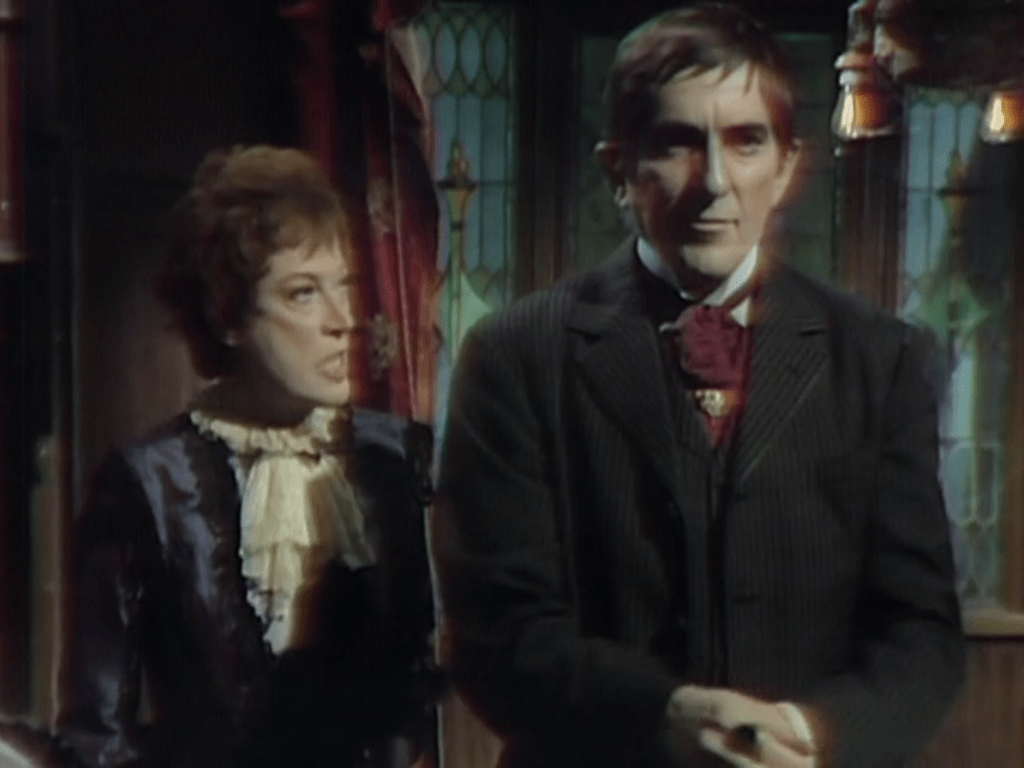
At rise, Edward catches Kitty in his brother Quentin’s room. She is rummaging through an armoire, apparently looking for something. He asks her what she is doing, and she feigns one of her fits. Kitty is not nearly as good an actress as Kathryn Leigh Scott; she doesn’t fool us for a minute. But Edward believes her. He gently escorts her out of the room. As they leave, we see a face peering at them from the shadows. It is Quentin’s face.

Downstairs, we hear Kitty’s thoughts as she takes satisfaction in having fooled Edward into thinking she was having a fit. Mental health professionals often talk about how people learn to use the resources they have, so that patients who carry diagnoses of major disturbances will sometimes find ways to exaggerate their symptoms for effect. It’s true that psychotic episodes are not usually an asset in the husband-hunting business, but everyone in the segment of Dark Shadows set in 1897 has some issue or other, and Edward really does have a soft spot for mentally ill women (unless they are married to Quentin, but that’s another thing altogether.) So Kitty may as well play up her particular case of dissociative identity disorder.

Kitty was in Quentin’s room trying to steal a portrait of him. She was doing this from her fear of Petofi, whom she believed to have ordered her to bring him the portrait before 9 PM lest he use his magical powers and make her vanish. It is almost that time now, and she has no idea how to find the portrait, let alone get it to him before the deadline. While she is worrying about this situation, a woman named Angelique enters.

Angelique isn’t what she seems. She is one of Quentin’s fiancées, and Edward takes her to be an innocent woman, about 30 years old, who has been hard done by in the course of the supernatural doings of the last several months. In fact, she is a wicked witch who wrought immense destruction the first time she was at Collinwood, in the 1790s, and again the second time, in 1968. She has traveled back in time to 1897, and has been one of the most powerful participants in all of the strange goings-on.

Kitty tells Angelique that she saw Petofi in the vacant rectory on Pine Road, and that he told her the woman who had been squatting there vanished into thin air before his eyes. At this, Angelique turns and rushes off to investigate. It dawns on Kitty that Angelique knows more than she is saying. We cut to the drawing room, where Edward is bracing for a conversation with Quentin.

Quentin isn’t what he seems. In fact, he isn’t Quentin at all. Petofi forcibly swapped bodies with him a few days ago. It is Petofi, using Quentin’s body as a disguise, who confronts Edward and demands to know what he and Kitty were doing in the room. I refer to this form of Petofi as Q-Petofi, and the Quentin who looks like Petofi as P-Quentin.

Q-Petofi confronts Edward. Screenshot by Dark Shadows Before I Die.

Edward tells Q-Petofi that Kitty had had a “seizure.” Q-Petofi expresses skepticism about this claim. He proceeds to tell Edward that Kitty’s late husband died in poverty, shortly after being released from prison for a jewel theft. Edward is thunderstruck. He calls the story a lie, and forbids Q-Petofi from repeating it to anyone.

Kitty goes to the village of Collinsport, and pays a visit to The Blue Whale, the local tavern. She wants to see the entertainer, Miss Pansy Faye.

Pansy isn’t what she seems. She has met the Collinses twice. Miss Charity Trask, daughter of Gregory and enforcer in his operation, came to the great house in #727 and took up residence when her father married Judith. Pansy Faye, mentalist and Cockney showgirl, came to the estate in #771 as the coldly cynical fiancée of the childlike Carl Collins. Pansy was killed the night she arrived. A few weeks later, Pansy started to take possession of Charity, and in #819 Petofi erased Charity’s personality altogether and gave her body over to Pansy.

When Kitty enters, Pansy is alone in the bar. She is picking out her theme song on the piano. When Petofi was in the process of switching bodies with Quentin, Quentin was with Pansy in this room. Petofi took control of him briefly and played the same song on this piano. He played it very impressively.

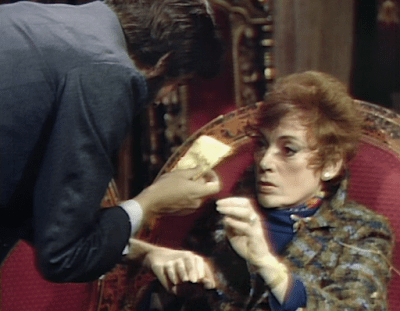
Kitty is desperate to find out what is happening to her, and she knows that Pansy has powers. Once Pansy assures her that she doesn’t work for Count Petofi, Kitty offers her a diamond-encrusted brooch in return for information. Pansy is offended. She says that she will take a gift in return for her services after she has rendered them, but that she does not accept payment in advance. She tells Kitty that there is one way to find out what is happening to her, which is to have a séance. Kitty gets up to leave, and Pansy presses the brooch on her.

The diamond brooch is a puzzle. Perhaps Kitty was lying to her mother when she said that she couldn’t buy a train ticket to Pennsylvania? Or perhaps the brooch is part of the late Earl’s ill-gotten gains, and Kitty doesn’t want to show it to anyone more reputable than Pansy.

Nancy Barrett’s approach to all her roles on Dark Shadows was to throw herself completely into whatever the character was doing at any given moment. That isn’t to say that her performances lacked nuance or that she didn’t support her scene partners, but that her method was to take her part from the outside in, letting the action supply the motivation. As Kitty, Miss Scott has opportunities to take this same approach. But in Kitty and Pansy’s scene in the Blue Whale, she deliberately lets Miss Barrett drive the action. Since Pansy has already completed a process of possession and transformation like that into which Kitty is now entering, Miss Scott can convey a great deal of information about Kitty’s state of mind by giving rather subtle reactions to Pansy’s behavior.

Back at Collinwood, Edward and Q-Petofi are drinking. Edward shakes his head at his brother’s ability alternately to enrage him and charm him. Q-Petofi asks him to be the best man at his wedding to Angelique; Edward agrees at once. Angelique enters, and Edward exits.

Angelique says that she doesn’t want to get married after all. Q-Petofi insists they go ahead. She points out that it was her idea, and he was extremely reluctant to agree to it. This is true- the engagement was part of Angelique’s price for invoking the power of Satan to break spells Petofi had cast on Edward and his son Jamison. While Q-Petofi has managed to copy Quentin’s behavior towards Edward almost exactly, his behavior towards Angelique has been radically different than was Quentin’s. We don’t know what Angelique has made of this.

Edward finds Kitty and Pansy preparing the séance. After an initial protest, he declares he will join them. It ends with a visual quote from Dark Shadows‘ first séance, back in #170. As in that episode, a hooded figure appears in the doorway.
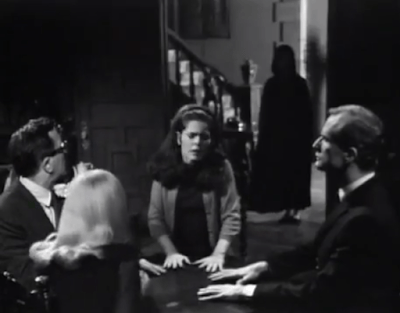
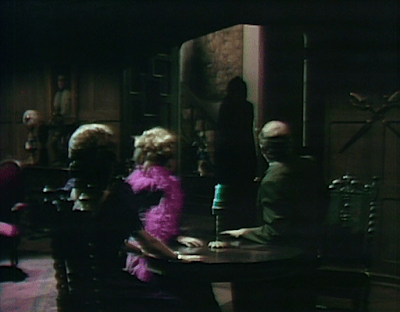
The hooded figure in #170 turned out to be undead blonde fire witch Laura Murdoch Collins. Another iteration of Laura was on the show as Edward’s estranged wife in April and May. It seems unlikely she is coming back, so longtime viewers are in suspense as to the significance of the allusion.

The hooded figure today is Natalie Norwick, making the last of her seven appearances as an uncredited stand-in on Dark Shadows. Norwick was in many plays on Broadway, as the lead in more than one, appeared in three feature films, and worked steadily in television from 1945 until the mid 1960s. She retired from acting in 1982, returning to the Broadway stage as understudy to her friend Julie Harris in 145 performances of The Gin Game from 1997 and 1998 when she was in her mid-70s. When Harris had a fall in 1999, Norwick took over the part, playing it in Florida and Washington, DC. She was chiefly based in Los Angeles in the late 1960s; perhaps she took the stand-in work to pay some bills during visits back east.

Norwick is best remembered for a single supporting performance on television in 1966. She appeared in “The Conscience of the King,” an episode of the original Star Trek, as Martha Leighton, the wife of Captain Kirk’s troubled friend Tom. She didn’t get much screen time, but she made the most of it. After Tom is murdered, she plays Martha’s understated reaction with a quietness that startles you no matter how many times you’ve seen it. Norwick is another of the significant talents one wishes Dark Shadows had found more to do with.

Episode 855: The winds of change

The Point of Return

Barnabas Collins went into a trance at the end of February 1969 and came to in March 1897, a time when he was a vampire. Barnabas took the audience with him, so that Dark Shadows has been a costume drama set in 1897 ever since. We’ve had a few glimpses of 1969- we can see that time is passing there, that twelve year old David Collins has been saved from death, that the ghosts of rakish libertine Quentin Collins and maidservant Beth Chavez have stopped haunting the great house of Collinwood, and that Barnabas’ physical body has vanished, leaving him no avenue of return to the 1960s. We’ve also had indications at several points that the show was about to put the 1897 segment into its climactic crisis, each of which was followed by a restart of that segment. Some of those false signs probably reflected long-range plans that were abandoned when they saw how popular 1897 was.

Now, they are in a position when they can go back to 1969 whenever they wish. There are only a few unresolved story points in 1897. Most of those can be wrapped up quickly, and the rest can be forgotten. If they wanted to, they could write a single slam-bang episode in which the evil Gregory Trask is forced to accept the annulment of his marriage to Judith Collins and to relinquish control of Collinwood, the family is persuaded that Barnabas never really was a vampire after all, and Kitty Soames, the dowager countess of Hampshire, turns into Barnabas’ lost love Josette and finds a way to leave him that will make him even more miserable than he already is. Sorcerer Count Petofi might be left watching helplessly as Barnabas, his friend Julia Hoffman, and the living Quentin all escape into the future. We could then assume that the rest of the characters just toddled off and led quiet lives.

They could equally well take another tack on their way back to contemporary dress. Barnabas and Julia came to 1897 separately; there is no reason why they, or any other characters, should have to go to 1969 together. Today, Petofi is performing some kind of mumbo-jumbo that is supposed to lead to a body swap that will cause him to trade forms with Quentin. After that, he is confident he will travel to 1969 and be safe from his foes, the Rroma people. He seems to be succeeding. So perhaps a Petofi who looks and sounds like Quentin will appear in 1969, in a Collinwood based on the events that have taken place so far in 1897.

In that pocket universe, Collinwood would be known as Traskwood. Its owner in 1969 would be Trask’s son by a subsequent marriage. Call him Gregory, Junior. It would be unclear at first what happened to Judith and to her presumptive heir, her twelve year old nephew Jamison. The revelation of their fates could set us up for some big twists and the introduction of new characters with familiar faces.

Since Gregory, Junior would be in his sixties, he could have a couple of adult children who would carry on some story points. Gregory III could be played by Jerry Lacy without old age makeup, and could be a morally ambiguous character who might emerge as a protagonist and would certainly become prominent in the pages of the fan magazines. None of the Trasks would have any legal obligation to let Quentin stay in any of their houses or to work for any of their businesses, nor would any surviving Collinses. Moreover, everyone in the area would know full well that there used to be a vampire on the estate named Barnabas Collins, and no one would ever have heard of Julia.

Petofi begins his incantation. Screenshot by Dark Shadows Before I Die.

If the show goes that direction, we could spend half of each week with Petofi-as-Quentin while he makes a place for himself in that pocket universe version of 1969, while we would spend the other half with Barnabas and perhaps Julia back in 1897, where they are in an uneasy alliance with wicked witch Angelique as they try to set history right. Kitty’s Josettification would threaten to destroy this alliance, since Barnabas is obsessed with his love for Josette and Angelique is equally obsessed with her hatred for her.

The body-swap theme of today’s episode, along with the emphasis on the procedure Petofi is following, will remind longtime viewers of The Experiment, a theme that ran from April to May 1968. Barnabas and Julia built a Frankenstein’s monster with the intention of killing Barnabas and bringing him to life again in the new body. Some viewers may have wondered if Jonathan Frid was actually going to leave the show, and if the actor playing the monster was going to take over the role of Barnabas.

This time a larger fraction of the viewers are likely to think the transfer might work, since it would not require a popular star to leave the show. On the contrary, casting David Selby as Petofi in an altered twentieth century would give him the chance to wear up-to-date clothing, have magical powers, inflict cruel punishments on people who get in his way, run con games, hint at an ambiguous sexual orientation, and generally have a wonderful time. Since Mr Selby had by this point become the pin-up of a huge percentage of America’s teenaged and preteen girls, that sounds like a recipe for sky-high ratings. Meanwhile, casting Thayer David as a Quentin estranged from his body and his social environment would present an expert character actor with a challenge worthy of his skills.

It might sound like it would be too confusing to intercut between a parallel version of 1969 and a continuation of 1897, but the show will try almost exactly the same tactic a couple of years from now, as they set up for the storyline that carries the series through its final nine weeks. That closing bit is not widely regarded as one of the better phases of Dark Shadows, but the intercutting timelines that lead to it are an intriguing gambit. Maybe the idea for it came when they were trying to figure out how to get from 1897 back to 1969, in which case it is possible that the scenario I have outlined above may be very much like what the writers had in mind at some point in the development of the story.

Corridors of Trial and Error

We do get a few hints today about what we might see in the 1897 half of the show if it does split. Broad ethnic stereotype Magda Rákóczi shows up for the first time since #834, before Julia came to 1897. We had begun to fear we wouldn’t see her again. It’s good to have her back, but since Magda is also played by Grayson Hall, it raises the possibility that Julia might go away for a long time. Maybe the action will be split between 1897 and 1969 for some months, and during those months Julia will be in 1969, running her hospital, entirely unaware that there ever was a Barnabas Collins.

Beth is a servant of Petofi’s now, and she spends the episode bickering with her colleague Aristide. It turns out that she still has feelings for Quentin. At the end, she runs out of Petofi’s lair to try to help Quentin. This suggests that Beth’s conflicted loyalties will be a source of drama. Aristide shouts after her not to go, then says that “You’ll ruin everything.” He delivers this line in such a mild tone that the resulting laugh must have been intentional. This raises the possibility of Aristide emerging as a source of laughs. In the hands of actor Michael Stroka, that is a distinct possibility.

Quentin rambles into the Blue Whale, the tavern in the village of Collinsport. It’s after hours, and the only person in the barroom to tell him to stop knocking on the door is cabaret performer Pansy Faye, whose body Quentin first met when it was occupied by Trask’s daughter Charity. He still calls her Charity, which she overlooks because she has the hots for him. Pansy lets Quentin in, and invites him to her place.

Charity lived at Collinwood with her father, and after Pansy took over she stayed on there for some time. The other day she talked about wanting to leave Collinwood and go “home,” but it was not at all clear what that meant. Her invitation to Quentin is the first time she explicitly says that she has her own apartment now. Perhaps, if we stay in 1897, we will see that apartment. Maybe when Thayer David takes over the part of Quentin, Pansy’s psychic gifts will enable her to recognize who he really is, and she will take him in. In those days, of course, a man and a woman would have to get married to rent a lodging, so presumably that would have involved a wedding. Since Quentin would appear to be Petofi, Pansy would thereby become a countess, Kitty’s equal in rank. It already makes Kitty exceedingly uncomfortable to be around Pansy, so that would be an occasion for a great deal of comedy. Moreover, any viewer who saw that both women had the same title and both were involved in supernatural changes of personality would be convinced that the writers had planned that phase of their story all along.

Pansy goes into her act. She sings her song; Quentin is seized with a fit of brio. He gives a little speech addressed to the absent bartender, picks Pansy up, spins her around, kisses her passionately, then sits down at the piano and bangs out the tune of her song. She admires his piano playing and he says that he used to be able to play quite well, before “they” came. Then he suddenly sinks back into his previous depression. He denies that he ever played the piano in his life. We know that it was Petofi who had that moment of brightness, and that Petofi’s mood darkened when he remembered the Rroma who cut his hand off 100 years before. Quentin has no recollection of anything his body does or says when Petofi is using it.

A piano is prominently featured in the drawing room at Collinwood in the 1960s- perhaps there will also be one there when the estate is renamed Traskwood, and when Petofi, as played by David Selby, wangles an invitation to the great house, he will play it. That might set us up for a moment when Quentin returns to his proper body, tries to explain what has happened, and finds that his inability to play the piano marks him as an impostor. You could build a lot of story on that- you might make it look for a while like Quentin could find a home in the Traskwood universe, then show that no, the people back in 1897 have to reset the past before anything can work again.

Episode 846: Advantage of an unfortunate creature

Tim Shaw was a poor put-upon fellow when first we met him in #731, an episode set in April 1897. He had spent his childhood among the pupils imprisoned at Worthington Hall, a dungeon masquerading as a school, and when he was of age the headmaster, the evil Gregory Trask, coerced him into staying on as a teacher. In company with another man, Trask contrived to use Tim as an unwitting instrument in his plot to murder his wife Minerva. Trask’s plan to frame Tim for the murder fell apart, and Tim managed to keep his freedom. Not only that- he stole the legendary Hand of Count Petofi and took it to New York City, where within weeks he used its magical powers to make himself very rich. In August, he returned to Collinsport determined to take revenge on Trask.

Shortly after coming back to his hometown, Tim lost the Hand. (Which, to be clear, was an actual human hand severed from a sorcerer named Count Petofi a century before.) The 150 year old Petofi himself reclaimed it, and reattached it to his wrist. The ill-fortune Tim suffered in his youth left him a weak and cowardly man, who betrayed his only friend when Trask was looking for her. But his good fortune when he was in possession of the Hand has corrupted him much more severely. He used to be kind to children and even risked his life to rescue nine year old Nora Collins when Worthington Hall burned down in #736, but in #816 he violently shook Nora when he found that she had let the box containing the Hand out of her sight. In his pursuit of another gimmick that will enable him to continue getting rich, he has developed a number of schemes, the worst of which do not stop at murder.

This morning, Tim is sitting at a table in the Blue Whale, Collinsport’s tavern. The place isn’t open yet, and Tim does not appear to have any connection with it, so it is simply a mystery how he got in and why he wants to be there. The only other person in the room is sitting at the bar. She is a woman who used to be Trask’s daughter Charity, but who has since been transformed into Cockney showgirl and sometime mentalist Pansy Faye, who died in June.

Pansy’s presence makes some kind of sense, as she works at the tavern doing her act. But returning viewers know that she isn’t still there from the night before. After closing, she went back to the great house of Collinwood, where Trask and she live, and talked with the rakish and profoundly drunk Quentin Collins. After dawn, Pansy followed Quentin from the house to a cave. In the cave, she found a mallet and stake Quentin left behind, and next to them the coffin occupied by vampire Barnabas Collins. She drove the stake into Barnabas’ heart. Now she wants a good stiff drink, and she doesn’t care if she has to pour it herself.

Tim stops Pansy’s attempt to pilfer her employer’s stock, and she tells him that she has destroyed Barnabas. Dollar signs flash in his eyes as he calculates what it is worth to the Collins family to know that their single most embarrassing relative is no longer going to be exsanguinating the locals. Pansy does not want to go back to the great house or even to tell the Collinses what happened, and she steadfastly declares she does not want any of their money. But Tim insists.

At the house, stuffy Edward Collins makes it clear he wants nothing to do with Tim and that he regards Pansy as a lunatic. When Tim makes him listen to the story, Edward dismisses it out of hand. But Edward finally agrees to go to the cave with Tim while Pansy stays in the drawing room.

Edward sees that Pansy was telling the truth, and returns to Collinwood in time to see the aftermath of a strange conversation. Pansy meets Edward’s guest, a young American woman named Kitty Soames who is the widow of the Earl of Hampshire. Pansy’s reaction when the dowager countess introduces herself as “Lady Hampshire” is a very characteristic “Well, la-dee-dah!”

Pansy’s delighted smile and relaxed manner suggest that in Kitty she has recognized a kindred spirit. Returning viewers know she’s onto something- we’ve heard Kitty’s interior monologue as she’s screwed up her courage to try to connect with the rich Collinses. We also know that she and her husband were mixed up with Petofi, who is not an individual who often attracts the innocent. And while she is so quick to deny to Edward that her husband’s suicide had anything to do with business reverses that he assumes she is still imposingly rich, later today we will hear the text of a letter in which she tells her mother that if she doesn’t get something going with Edward, she won’t be able to raise enough money to pay the train fare from Maine to Pennsylvania. So Kitty’s presentation of herself is misleading, and she is not so different from the living Pansy, who was what in the parlance of the 1890s might have been called an adventuress.

In her letter to her mother, Kitty mentions that she first came to the earl’s home as the governess. This circumstance reminds us of two other characters played by the same actress. In the parts of Dark Shadows set in 1969, Kathryn Leigh Scott’s Maggie Evans was the governess at Collinwood. And in the first part of the 1897 segment, she took the role of neurotic intellectual Rachel Drummond, who held the same job in that year.

Rachel was the friend whom Tim betrayed to Trask, and the contrast between her and Kitty reflects the change in Tim. Rachel and Tim were both well-meaning but helpless before Trask. They stood out in the 1897 segment as almost the only characters who weren’t playing an angle of their own. Rachel died in Tim’s arms, in the same room where he would later find the Hand. As his discovery of the Hand opened the way for Tim to become a schemer, so the death of Rachel allowed Miss Scott to return as a someone who could keep up with the quick-witted and merrily vicious characters who make 1897 such a delight. Moreover, we are in suspense as to what sort of person Kitty will turn out to be. She could end up being as innocent as Miss Scott’s previous roles, she could be as detestable as Tim has become, or she could land anywhere in between.

Pansy has a vision of a music box. She vocalizes its tune, and tells Kitty that if she ever receives one like it she must destroy it at once. If she does not, she will die. Kitty is upset by the whole conversation. Pansy tells Kitty that she ought to listen to her, because she has “powers.” “I guess… I didn’t use to have, but now I do.” Pansy often mentions this point, which harks back to her first appearance. In #771, the living Pansy came to Collinwood as the fiancée of the childlike Carl Collins. She was astounded to find that in the spirit-charged atmosphere of the estate her phony “mentalist” act really did conjure up a voice from the supernal realms. In turn, that echoed #400, when Charity’s ancestor, the fanatical Rev’d Mr Trask, was delighted that an exorcism he was performing seemed actually to work.

When Edward comes back, he assures Kitty that Pansy is mad and that he will “deal with her.” Kitty goes upstairs to her room, where she will later find that the music box Pansy described has materialized. This music box has a long history, and in 1967, when the show was set in contemporary times, Barnabas used it to try to convince girls that they were his lost love Josette. Even if Barnabas hadn’t been staked, we wouldn’t suspect him of planting the music box in Kitty’s room- it appears there during the daytime. Viewers who have been with the show from the beginning will remember that Josette’s ghost used to be quite active around Collinwood, and might wonder if she did it.

In the drawing room, Edward talks with Tim and Pansy. He refuses to call Pansy anything other than “Charity Trask”; she is indignant at being live-named, but he won’t relent. He asks her to stay in the house, and offers to provide her with the best possible mental health care. She angrily declares “I! Ain’t! Sick!”

Tim is sure his angle will open up any second now. Screenshot by Dark Shadows Before I Die.

Tim says that he will see to it that Pansy doesn’t tell anyone about Barnabas; Edward doesn’t bother to conceal his contempt for Tim, and makes it clear that he will not pay him for this or any other service he might offer to perform. Pansy tells Tim that it is time for them to leave. She invites Edward to catch her act at the Blue Whale; he says he doesn’t expect to find the time, but that he is sure Tim will come back to Collinwood when he wants something.

When Tim first came back to town, he had a girlfriend named Amanda whom he planned to use in the game he was going to run on Trask. Eventually we learned that this plan was to involve the murders of the former Judith Collins, who is now Trask’s wife, and of Trask himself. Amanda would marry Trask after she had incited him to kill Judith, they would then kill Trask, and Tim would marry Amanda, thereby becoming the master of Collinwood. Amanda was never fully sold on the homicides, and she and Tim now seem to have gone their separate ways. So Tim is left without friends and without a plan. Nor does he seem to understand how dangerous the people he is dealing with truly are. He thinks that he can bluff his way into partnership with the enormously powerful and thoroughly evil Petofi, and is only dimly aware of the other monsters lurking in the area. One might surmise that Tim’s happiest days are firmly behind him.

Episode 845: Dance your cares away

Julia Hoffman is miserable. She has followed her friend, vampire Barnabas Collins, and traveled back in time to the year 1897 on a mission to prevent terrible things that were happening in 1969. She has managed to come up with a treatment that is similar to one that briefly cured Barnabas of vampirism in March and April 1968, and is giving him regular injections in the course of that treatment. She is in hiding with him in an abandoned building, and has survived kidnapping and attempted murder. And what is her reward for all that? He is back on the same bullshit he was involved in when she first learned of his existence in 1967. He has met a girl and made up his mind to throw away all of their plans in an effort to convince her that she is the reincarnation of his lost love Josette. It’s no wonder Julia is so furious with him that she looks like she is the one with fangs.

Barnabas in danger.

Making matters worse, this time it seems Barnabas might be on to something. He pays a visit to his distant cousin, Quentin Collins, and asks who the girl is. Quentin says that she is Kitty Soames, widow of the late Earl of Hampshire, returned to her native USA after her husband’s death. When Barnabas starts in with his lunacy about Josette, Quentin becomes excited. He tells him that Kitty looked at the spot where his portrait hung until he was exposed as a vampire and asked what had become of it. When Quentin asked how she knew about that, since she had never been to the house before, she laughed and said that of course she knew the portrait, of course she was familiar with Barnabas. After a few seconds, she said she knew nothing of any portrait or of anyone named Barnabas.

Barnabas takes this as proof positive that Kitty is Josette returned to life, and that her memories of the 1790s are coming back to her. He asks Quentin to meet him at his hiding place so that they can arrange for him to meet her. He tells him where the hiding place is. Quentin agrees. Barnabas gives Quentin an enigmatic look before he exits.

Quentin is miserable. He is under the power of sorcerer Count Petofi, who has ordered him to kill Barnabas. Now that he knows where Barnabas keeps his coffin, there is nothing to stop him obeying. He will have to go there at dawn and stake his friend.

Barnabas has confronted Quentin about his subjection to Petofi, whom he knows to be his deadly foe. He has several times shown his distrust of Quentin. So people who started watching the show in the last year or so will be puzzled when he tells Quentin where to find him when he is helpless. Those who have been in the audience longer know that Barnabas not only has a habit of telling his enemies exactly what they need to know, but that he also loses all semblance of rationality where Josette is concerned. It is all too believable that he may have done this. Still, there is that look back at Quentin, suggesting that Barnabas knows that he is giving information to his enemies.

Quentin is in the drawing room of the great house, waiting for the dawn to bring with it his obligation to kill his friend. A woman who used to be Miss Charity Trask enters. Petofi erased Charity’s personality some time ago. Her body is now home to Pansy Faye, Cockney showgirl, mentalist, and onetime fiancée of Quentin’s late brother, inveterate prankster Carl Collins.

Pansy is miserable. Pansy is cross that Quentin did not go to see her perform at the Blue Whale, a local tavern where she is doing her old act. But what really has her down is that it is exactly three months since Barnabas murdered Carl, and she is the only one who seems to remember him. When Kitty and Quentin spoke of Carl yesterday, they were the first characters other than Pansy to mention his name since the immediate aftermath of his death. She is irritated with Quentin for getting drunk, angry that Barnabas is still at large, and sorrowful that while the dawn means a new day for most, for people like her and Quentin it just means reliving the same day time and again. Quentin perks up when Pansy lists the many good reasons why someone ought to kill Barnabas, and for a moment it seems like he is going to tell her where he is and invite her to do it. She recognizes this, and keeps asking questions after he stops himself. The whole scene is beautiful from beginning to end, one of the highlights of the series. If they had had Daytime Emmys in 1969, it is the tape they should have sent to the voters to get the acting awards for Nancy Barrett and David Selby.

Dawn comes, and Quentin does go to the cave where Barnabas’ coffin is. He has a stake and mallet with him. He opens the coffin, sees Barnabas, places the stake over his heart, and raises the mallet. That’s as far as he can go. He throws the weapons aside and leaves the cave, vowing that if Barnabas can face whatever he has faced, he too can face his own destiny.

Shortly after, we hear footsteps. Pansy enters. She sees the coffin and opens it. She finds the mallet and stake. She drives the stake into Barnabas’ chest. Blood spurts out around the wound and out of his mouth. It would seem that Barnabas Collins is no more.

Quentin is a villain, but he is charming, and at this point David Selby is a breakout star to rival Jonathan Frid as Barnabas. Earlier, it had seemed Pansy might kill Quentin, and many fans hated her for that. No one seriously expected her to kill Barnabas, since he was a pop culture phenomenon familiar even to people who never saw the show. To this day, Dark Shadows is known (to those who know it at all) as “the vampire soap opera from the 1960s.” So having her kill Barnabas is certainly a twist worthy of ending a week.

Episode 837: Somewhere locked up in her mind

Most of the episode revolves around the fact that Julia Hoffman cannot speak. Grayson Hall uses a whole new set of acting techniques playing a mute character than we had seen in her appearances as the most talkative human beings imaginable, and the result is absolutely fascinating. I’d have been glad to watch the episode again as soon as it ended.

We open in the basement of the Old House on the estate of Collinwood. Julia is sitting at a table in front of a set of I Ching wands. These wands are still in the pattern recovering vampire Barnabas Collins cast several months ago, when he was trying to contact the malign ghost of Quentin Collins. Barnabas meditated on them, and his “astral body” went back in time to 1897. Since his physical body was also in 1897, confined to the coffin in which he was at that time trapped, he became a resident of that year, and met the living Quentin.

Julia has decided that she, too, must travel to 1897. So she meditates on the wands. She tells herself that she must visualize them on a door, and she tells herself to “Empty your mind of everything else.”

She follows this injunction only too well. After passing through a series of doors, she collapses outside the great house at Collinwood in 1897. When stuffy Edward Collins takes her into the drawing room and questions her, she can respond only with a blank stare. Quentin comes in and finds a letter from Barnabas in Julia’s pocket. He asks her if she is the Julia addressed in the letter and why she has a letter from Barnabas. She does not recognize her own name or Barnabas’.

Quentin takes the letter from Julia. Screenshot by Dark Shadows Before I Die.

Quentin has become Barnabas’ friend, and his brother Edward has become his enemy. When he reads the letter Julia brought, Quentin realizes that Edward has locked Barnabas in the prison cell in the basement of the Old House. When dawn comes, Barnabas will not be able to get back to his coffin. Since he is a full-fledged vampire in 1897, that means he will disintegrate into dust.

Quentin leaves Edward with Julia and goes to Barnabas’ rescue. Quentin knows that Barnabas is a vampire and that he is trying to help him, and he knows that if things keep on as they are going he might become a family-annihilating ghost at Collinwood in 1969. But it is only while talking to Barnabas about the letter that he learns that he has come to 1897 from that year. The pieces start falling into place in Quentin’s mind as he absorbs this information.

Barnabas goes to hide in “the old rectory on Pine Road.” Quentin takes Julia there. Barnabas can’t get any information out of her, but he is sure that she knows how to save Quentin’s life. He is also sure that if they don’t find out what she knows, Quentin will be killed on this night, 10 September 1897.

The basis of Barnabas’ certainty regarding this latter point is a vision that a woman had. This woman used to be the repressed Charity Trask, but has now by supernatural means been transformed into the late Cockney showgirl/ psychic Pansy Faye. Pansy’s psychic act was fake until she came to Collinwood in #771. In the spirit-laden atmosphere of the estate, even her phony mumbo-jumbo called up real voices from the great beyond. Pansy’s stunned reaction when she actually contacted a ghost reminded longtime viewers of #400, when Charity’s ancestor, the fanatical witchfinder the Rev’d Mr Trask, conducted an exorcism to drive a witch out of the Old House and showed delight and not a little astonishment when the person he believed to be the witch came running out at the climax of the ceremony. Perhaps Pansy reminded the writers of Trask as well, and that was where they got the idea of having her spirit take possession of Charity.

Charity/ Pansy is in today’s episode. She’s the one who finds Julia, and she tells Edward that Julia “has death written all over her face!” She also says that she has a job. She is working at the tavern in the village of Collinsport, the Blue Whale. Presumably she is doing Pansy Faye’s old act there, singing, dancing, and doing psychic readings. We can imagine what Charity’s father, the hypocritical Rev’d Gregory Trask, must think of that.

Episode 830: Up in the tower room, all bloody

We open in the woods on the estate of Collinwood, where a young woman in heavy makeup and bright clothing is crying. Another woman in even heavier makeup and even brighter clothing approaches and asks her what is wrong. The first woman says that she had a vision which told her that the rakish Quentin Collins will die of stab wounds twelve days from now, on 10 September 1897.

The first woman used to be Charity Trask, the miserably repressed daughter of the evil Gregory Trask. She is now possessed by the spirit of Cockney showgirl Pansy Faye. Charity knew that Quentin was a werewolf, and wanted nothing to do with him. Evidently Pansy did not acquire that knowledge when she took up residence in Charity’s body, and has decided that she will marry Quentin. Quentin has no interest in either Charity or Pansy, and already has two other fiancées, one of whom he loves, at least after his fashion, and the other of whom is sealed to him by a pact with the Devil. Yesterday Charity/ Pansy learned of the second engagement, and tried to kill Quentin to prevent it coming about; week before last, she tried to end the first engagement by killing the fiancée. Pansy had her faults, but she wasn’t inclined to physical violence. That part seems to be Charity’s contribution to the symbiont.

The other woman is broad ethnic stereotype Magda Rákóczi. Magda was the one who made Quentin a werewolf in the first place. She cursed him for murdering his wife Jenny, who was her sister. It was only after she had placed the curse that Magda learned that Jenny had given birth to Quentin’s twin children, a boy and a girl. Since the curse is hereditary, Magda is now desperate to lift it, and she and Quentin have become allies.

Some time ago, we learned that if Quentin dies, there will be no hope of lifting the curse. So Magda is terrified when Charity/ Pansy tells her of her vision of Quentin’s death.  She takes her back home to the great house on the estate, where her father and Quentin are bickering while they recap yesterday’s story. Trask tries to deny that Charity/ Pansy is insane or that she is capable of killing, but when she enters and announces that she will murder the first person who comes between her and Quentin he has to admit that it might be time to find a place for her in residential care.

We turn our attention to the upstairs of the great house. We see Charity/ Pansy in bed, with Magda sitting in a chair beside. The gramophone is playing a record of Pansy Faye’s theme song. Regular viewers will wonder where Charity/ Pansy could possibly have found such a thing. Charity never met the living Pansy, who was killed the very evening she arrived at Collinwood. Perhaps Pansy’s fiancé, the childlike Carl Collins, bought the record when he met Pansy in Atlantic City and brought it back with him. Carl himself was killed well before the possession began, but perhaps Charity or Charity/ Pansy found it among Carl’s effects.

Charity asks Magda if she likes the tune. “I only like Gypsy music,” she replies. Charity/ Pansy and Quentin both reiterate their theme songs endlessly, but few other characters in the 1897 segment have so much as a dedicated entrance cue. This line of Magda’s makes us wonder what the show might have been like if they had given every major character a theme song.

Trask has a crisis in the drawing room. He hears a ghostly voice warning him that there will be another killing soon. He starts shouting the name “Minerva!” and pleading for mercy. First time viewers might not know what to make of this. Those who have been with the show for a while know that Minerva was Trask’s wife and Charity’s mother, and that he instigated a plot to murder her so that he could marry wealthy spinster Judith Collins and become master of Collinwood. When the voice starts to talk about “the beast that walks like a man,” Trask says “You’re… not Minerva?” Jerry Lacy is an expert comic actor, and his delivery of that line is laugh-out-loud funny.

The same ghost appears visibly to Quentin in his room. He recognizes it as that of Tessie Kincaid, a woman he killed in a recent fit of lycanthropy. He knows that she is appearing to him because tonight there will be a full Moon.

Tessie appears to Quentin. Screenshot by Dark Shadows Before I Die.

Magda enters and finds Quentin writing a suicide note. She tells him he must not kill himself. She chains him to a post in his room and stands by with a pistol. Trask enters and finds them in this compromising position. Mrs Acilius and I laughed as we imagined how Magda and Quentin might have claimed they were planning to spend the evening.

But there is no point in lying to Trask. Between what Tessie’s ghost told him and what he overheard while eavesdropping on a conversation Quentin and Magda had earlier in the drawing room, he has figured out Quentin’s problem. He takes the gun from Magda and recognizes the bullets with which it is loaded as silver. He announces that he will wait until the Moon rises and see what happens.

Tessie’s turn today marks Deborah Loomis’ third and final appearance on Dark Shadows. Miss Loomis didn’t get to do very much, but she made the most of all of it, and I wish we had seen more of her.

Episode 829: Miss Moon Eyes

The dramatic date is 28 August 1897. On 23 July, in #803, sorcerer Count Petofi cast a spell on stuffy Edward Collins. Ever since, Edward has believed he was a valet recently separated from the service of the Earl of Hampshire. This led Edward’s brother, the rakish Quentin, to follow the Collinses’ long-established procedure for responding to mental illness and lock him up in the room on top of the tower in the great house of Collinwood.

In #816, broadcast on 11 August 1969 and therefore set on 11 August 1897, Petofi brought something even stranger on Edward’s twelve year old son Jamison. He called the spirit of Jamison’s grandson David to project itself from 1969 and to take possession of Jamison. In 1969, David is deathly ill because Quentin’s ghost had besieged him and everyone else at Collinwood. Now, Jamison too is dying, and in the moments he has been able to speak he has let the living Quentin in on the fact that he will eventually become a family-annihilating ghost.

Wicked witch Angelique has made a bargain with Quentin. She will try to restore Jamison and Edward to their usual selves, and if she succeeds Quentin will marry her. We see her beside Jamison, talking earnestly with him, praying loudly to “the Master of Darkness” to cure him and Edward so that she and Quentin can devote themselves to the service of that supernatural personage. In 1968, when the show was in contemporary dress, Angelique and others used a lot of euphemisms like “Master of Darkness,” but lately the ratings are high enough that the ABC network’s office of Standards and Practices has been letting them say the name “Satan.” I suppose Angelique’s persistence in the former phrasing shows that she’s still devoted to the old time religion.

Satan comes through, and Jamison and Edward are freed. This leads to a bit of awkwardness in each case. Quentin and Edward’s step-niece Charity Trask has lost her personality as the result of another of Petofi’s spells, and is now hosting that of the late Pansy Faye, Cockney showgirl and onetime fiancée of Quentin and Edward’s late brother Carl. Charity/ Pansy is exploring the great house when she comes to the locked door of the tower room. She hears Edward inside calling for help. He is still in his valet persona, and he is delighted with her when she promises to get a key and let him out. Edward returns to himself, with no memory of anything that has happened since 23 July, while Charity/ Pansy is away. When she comes back up and opens the door, she finds that he is in a foul mood and that he disapproves of her intensely. She is understandably miffed at his apparent fickleness and ingratitude.

For his part, Jamison’s quite different experience has left him with some memories. He tells Angelique of images that are floating around in his mind. She recognizes them as things associated with Petofi, and is distressed. She tells him he is better off not knowing what they are. Quentin is more distressed when Jamison looks at him and asks why he is trying to kill David Collins. Jamison can’t explain who David Collins is or how he learned that Quentin was trying to kill him, but this does confirm everything Quentin has gathered about his post-mortem destiny.

While Edward comforts Jamison in the study, Quentin and Angelique meet in the drawing room. She asks if he will honor his end of their deal; he says that he will, though he makes abundant protests about his reluctance to do so. Charity/ Pansy eavesdrops at the door. She has decided that she will marry Quentin, and is horrified to hear this conversation.

Edward enters and asks Angelique to excuse him and his brother. She exits, and Edward declares that the first order of business must be to hunt and destroy vampire Barnabas Collins. Quentin is appalled at this. He tries to tell Edward that Petofi is their most immediate threat; after he explains who Petofi is, Edward agrees that they will get around to fighting him at the appropriate time, but he insists that Barnabas is their main concern.

Edward exits, and Charity/ Pansy enters. She tells Quentin that she overheard his conversation with Angelique. She says that he will not marry Angelique. Quentin bitterly responds that he will, and that there is nothing she can do to stop it. At this, Charity/ Pansy picks up a knife and tries to stab Quentin. Quentin holds her at bay, and Edward enters in time to see what is happening and to get Charity/ Pansy off of Quentin. Quentin says that Charity/ Pansy’s condition is further evidence of the need to focus on fighting Petofi, but Edward will not swerve from his determination to concentrate on Barnabas. Moreover, he decides that he will now quiet Charity/ Pansy himself. He sends Quentin out of the room and prepares to give Charity/ Pansy a stern talking-to.

Charity/ Pansy’s attempt to prevent Quentin’s marriage to Angelique by stabbing him is of a piece with her attempt to break up Quentin’s relationship with maidservant Beth in #823/824 by poisoning Beth’s brandy. The original Pansy, whom we saw as a live person in #771, was not exactly nice. She was cold, hard, and cynical, trying to exploit the childlike Carl. But she didn’t seem to be bent towards physical violence. That appears to be Charity’s contribution to the composite being that the two of them now make up.

Before Edward can deliver whatever lecture he had planned to give Charity/ Pansy, she goes into a trance. The live Pansy had done a stage act as a “mentalist” and fortune teller, and was astonished in #771 when she tried to do her act at Collinwood and found herself actually channeling spirits from the great beyond. Now Charity/ Pansy routinely acts as a medium.

Charity/ Pansy announces that something terrible will happen on 10 September. Countdowns don’t usually work as a source of suspense on soaps. They might be all right in a play or a feature film, where we know that there will be a final curtain or a last frame after which the imaginary universe will cease to exist, but so long as the series is scheduled to come on every weekday at 4 PM, we know that there is always going to be room to move any deadline a little further out. Besides, since Dark Shadows was done virtually live to tape, they could rarely predict with any accuracy just how many ticks of the clock it would take to get all the movements made and dialogue spoken before the crisis is supposed to be reached. But “10 September” is in a slightly different category. Quentin explicitly says on screen that today is 28 August, which was indeed the original broadcast date in 1969. And when Edward says that his last memories are of 23 July, he is indeed referencing the original broadcast date of #803. So when Charity/ Pansy says “10 September,” she is committing the show to something in the real world. We may well sit up and take notice.

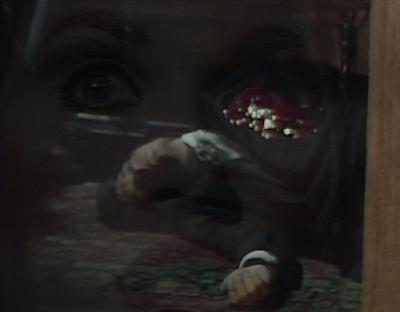
Charity/ Pansy has a vision of what will happen on that date. She sees Angelique looking at a portrait of Quentin in the drawing room. Red paint is dripping from the figure’s chest into a pool on the floor. That pool is next to a trail of other drops of red. In her mind’s eye, Charity/ Pansy follows the drops into the foyer, up the stairs, and into the tower. There, she sees Angelique opening the door to the tower room and finding Quentin sprawled, a sheet of red plastic, or perhaps construction paper, on his chest. Charity/ Pansy screams and runs out. From the dramatic music and Charity/ Pansy’s agitated reaction, I take it the object lying on Quentin’s chest is meant to suggest blood.

Through Charity/ Pansy’s eyes. Screenshot by Dark Shadows Before I Die.

The acting is all very strong today. I was fascinated with Nancy Barrett’s use of her face to highlight Charity/ Pansy’s makeup. She relaxes her jaw muscles slightly more than usual, causing the dark treatment around her eyes to stand out. That in turn creates a visual metaphor labeling Charity/ Pansy a “painted lady.”

My wife, Mrs Acilius, was particularly impressed with Louis Edmonds’ realization of Edward. When the spell breaks and he becomes himself again, Edward is alone in an empty room. He has no dialogue, no props, and no scene partner to work with. Yet he instantly conveys what has happened. Even first time viewers will understand that the obliging servant has now become a stuffy authority figure.

Edward’s towering indignation when Quentin first tells him he was the one who locked him in the tower room gives way instantly when Quentin explains that he was under a delusion at the time. Edmonds executes that transition so smoothly that first time viewers will not notice the oddness of it, but longtime fans who remember the many previous occasions when the Collinses locked each other there as a response to mental illness will chuckle.

One of the prominent features of Edward’s personality is his warm relationship with his children. This sets him apart from the first two characters Louis Edmonds played on the show, high-born ne’er-do-well Roger Collins and haughty overlord Joshua Collins. Edward’s dialogue in his scene alone with Jamison involves several discrete points of information, and it would have been understandable if the affection he displays for Jamison while he getting all of those words across had been either perfunctory or mawkish. But he and David Henesy get the emotions exactly right while also delivering the lines very clearly.

Edward’s preoccupation with Barnabas is a delicious little bit of commentary on the show itself. Dark Shadows‘ ratings, chronically low during its first 42 weeks on the air, perked up when it added Barnabas to the cast in April 1967. That summer, schoolkids curious to see a vampire on daytime TV made it into a hit, and not long after Barnabas became one of the pop culture sensations of the 1960s, instantly recognizable to many millions of people who never watched the show. To this day, people who have heard of Dark Shadows are likely to refer to it as “the vampire soap opera from the 60s.” It was Barnabas who took us with him to 1897, when he traveled back in time in the course of his attempt to rescue David from Quentin’s ghost, and for the first months of the 1897 storyline he was the only character who knew what was at stake for the 1969 version of the Collinses in the events going on around him.

But now Barnabas is on the fringes of the story, and Quentin, Angelique, and Petofi all know about 1969. Edward’s idea that the action has to focus on Barnabas is evidence that he hasn’t been watching the show. Petofi is the principal antagonist now, Quentin the chief protagonist, and Barnabas can be absent for weeks at a time while they and others find all sorts of things to do. This represents, not Barnabas’ failure, but his ultimate success. Before he was introduced, every story revolved around well-meaning governess Vicki, the main character. A soap opera can’t really have a main character. It needs to keep multiple storylines running at once, occasionally intersecting with each other, often running for long periods with little or no interaction. When one person had to be at the center of every development, the result was slow and claustrophobic.

Barnabas blew that confining structure open, because as a vampire his function in the story was not to solve problems, but to create problems for other people to solve. So no matter how much time they spent focusing on him, he always directed our attention towards everyone else. We wondered who would catch on to his secret, who would fall victim to his malign intentions, who would find a way to fight him, etc. When a mad scientist managed to free Barnabas of the effects of the vampire curse, he retained his function as a problem-maker, even when he set out to be a problem solver. Every time he announced that he had a plan, we looked forward to seeing how the rest of the cast would react to that plan’s rapid and catastrophic collapse.

Barnabas is as hapless in 1897 as he has been in every other time period, as witness the fact that he has been exposed as a vampire and driven into hiding. But he isn’t even the show’s Screw-Up-in-Chief now. That title belongs to broad ethnic stereotype Magda Rákóczi. In #807, Petofi compelled Magda to review the preceding 22 weeks of the show and admit that she had precipitated every plotline. The first of those was the release of Barnabas into the world of 1897, so that his crimes and misadventures are just a subcategory of hers. Since Magda is played by Grayson Hall, who in her original role of Julia Hoffman is waiting for us in 1969, we can be confident she won’t be coming back to contemporary dress with us, but for the moment she has relegated Barnabas to the status of a secondary character.

Episode 823/824: Brandy will warm you

Count Petofi, 150 year old sorcerer, is holding time-traveling vampire Barnabas Collins prisoner. Barnabas’ distant cousin, rakish libertine Quentin Collins, is convinced that only Barnabas can free him of the curse that has made him a werewolf and condemned any male descendants he may have to the same fate. Petofi is afraid of the Rroma people, a group of whom are in the area, and Quentin hits on a plan to use this fear to his advantage. He will tell Petofi that he has a confederate who will tell the Rroma where he is unless he releases Barnabas by 12:45 AM.

In fact, Quentin has enlisted his girlfriend, maidservant Beth, to carry this message to the Rroma camp. When Petofi reminds Quentin that his magical powers make it very easy for him both to compel Quentin to tell him who the messenger is and to stop any messenger once he knows her name, Quentin says there is no need to compel him to say the name. He claims that it is wicked witch Angelique.

As soon as Quentin tells this lie, we wonder why he hadn’t thought of Angelique sooner. Angelique has intervened to rescue Barnabas before, and she and Quentin are in touch. Petofi’s powers may be greater than hers, but it would take him more time to outfight her than it would for her to show the Rroma the way to his hiding place.

Petofi insists Quentin drink with him, and Quentin is too civilized to refuse. This is mirrored back at Collinwood. The repressed Charity Trask has lost her personality and became a vessel for the spirit of Cockney showgirl Pansy Faye. Charity/ Pansy insists that Beth drink with her.

Pansy approves of her new looks. Screenshot by Dark Shadows Before I Die.

While Petofi does not tamper with Quentin’s drink, Charity/ Pansy puts something in Beth’s that knocks her out. Charity/ Pansy wants Quentin for herself. She has thought of killing Beth, and knows Quentin will be upset with Beth if she disappoints him. That leaves us in suspense as to whether she murdered Beth or merely kept her from running her errand.

This diptych emphasizes Petofi’s power and Charity/ Pansy’s unpredictability. Quentin need not fear Petofi will poison him, because there are any number of more elegant ways he could kill him if he wished to do so. As another sorcerer said of himself in #528, he is much too talented to spend his time drugging drinks. But Beth should fear Charity/ Pansy, because she is still connected to the world of the living only uncertainly, and there is no telling what she might do to find her footing.

Episode 822: I’ll give you some spins

For some time after the Rev’d Mr Gregory Trask first appeared in #725, he projected an intense evil that overshadowed everything around him. Trask’s daughter Charity debuted in #727. Charity was Trask’s enforcer, and was herself so intensely joyless that her mere presence could drain the life out of anyone she disapproved of. The Trasks are triumphs of acting by Jerry Lacy and Nancy Barrett, but they are so intense they threaten to overload the show. So even as devoted a fan as my wife, Mrs Acilius, chose to skip many of the Trask-driven episodes on this watch-through.

In #771, inveterate prankster Carl Collins brought Cockney showgirl Pansy Faye home to the estate of Collinwood. At that point, Dark Shadows was quite somber; when Pansy starts singing and dancing, she seems to have wandered in from another universe altogether. Pansy bills herself as a mentalist; when she tries to do her act at Collinwood, an actual message from the supernatural interrupts her, much to her astonishment.

Pansy was killed by a vampire named Dirk Wilkins the very night she arrived at Collinwood, leading us to assume that the note of brightness she represented was at an end. But strangely, she has now returned. Charity and Pansy never met; when Carl was looking for Pansy in #772, he asked Charity if she had seen her, and the sheer idea of the two of them sharing a scene was enough to raise a chuckle. But now they share more than that. Sorcerer Count Petofi has cast a spell causing Pansy’s spirit to take up residence in Charity’s body. Now, Charity’s personality seems to have faded away altogether, and all that’s left is Pansy.

Charity/ Pansy has a scene with Trask that blasts away the excessive tension he once introduced. He keeps demanding that she behave as he is used to seeing Charity behave, and she keeps singing, dancing, and making fun of him. Miss Barrett and Mr Lacy are both highly accomplished comic actors, and this scene is among their finest achievements in that field.

It also includes a serious moment that further confirms Charity really is channeling Pansy, not acting out some kind of delusion. At one point she becomes very still and prophesies the circumstances of Trask’s death. As she completes this pronouncement, she says that it is different now when she speaks of things unseen. It used to be a game, but now she hears another voice and reports what it tells her. This picks up on Pansy’s astonishment at her own success in #771, something Charity could not possibly have known about.

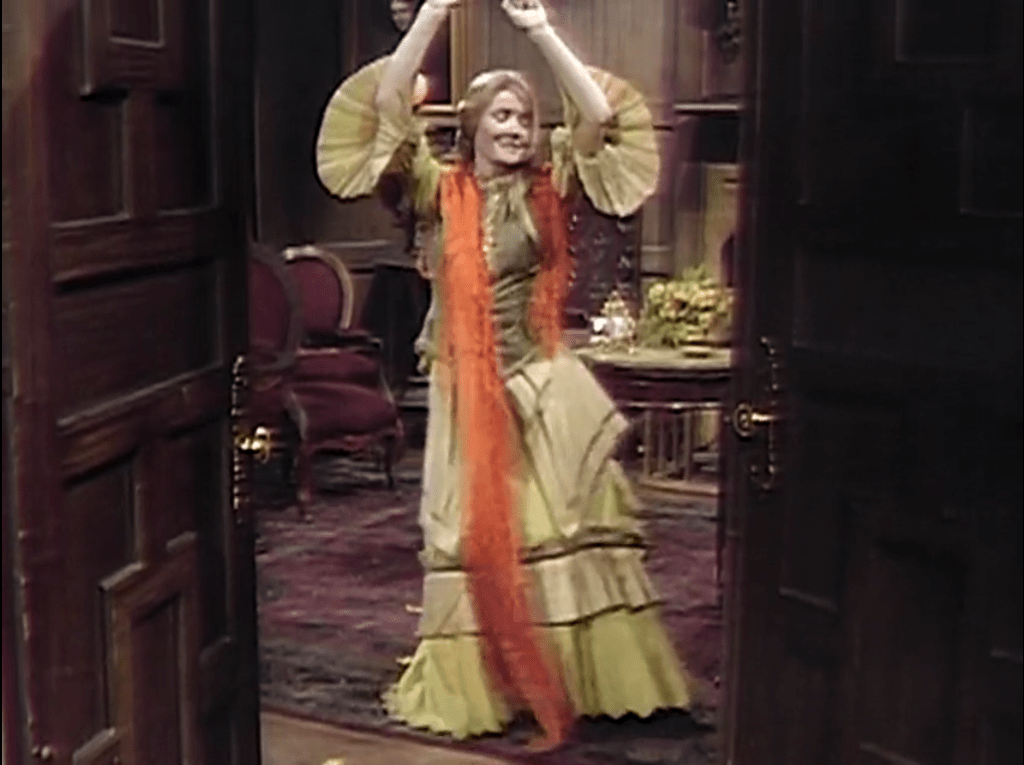
Charity/ Pansy puts the “boom” in Ta-Ra-Boom-De-Yay. Screenshot by Dark Shadows Before I Die.

Episode 819: You’re a bit of all right, you are!

Evil sorcerer Count Petofi tells the disastrously repressed Charity Trask that he will show her a vision of her own death. He’s tried that twice before on other characters, with mixed success, and it doesn’t work at all with Charity. He can’t see the visions he causes her to have; when she describes them to him, he is afraid that she has seen, not her own impending demise, but his. He casts a spell on her and rushes out.

Petofi meets his boyfriend Aristide and takes him on a shopping trip through the cemetery. What he wants with the body he orders Aristide to exhume is not made clear.

The importance of the episode is in the spell Petofi casts on Charity. He effectively murders her. For the rest of the segment of Dark Shadows set in the year 1897, Nancy Barrett will play, not Charity, but Pansy Faye, Cockney showgirl who came to the great estate of Collinwood as the fiancée of the daffy Carl Collins. The show often tends towards the somber, so it is a joyous thing to see Charity/ Pansy enthusiastically shake her moneymaker.

It is sometimes said that Petofi makes Charity believe that she is Pansy, but this is not correct. Charity never met Pansy, and barely knew the late Carl. She certainly never saw Pansy perform on stage. Yet she sings Pansy’s theme song word for word and note for note as she did, and does the dance that went with it just as Pansy did it. She has Pansy’s garish sense of style, her not-very-convincing East London accent, and her memories of Carl. Petofi has caused Pansy to take possession of Charity and to live again through her body, as he has caused David Collins, strange and troubled boy indigenous to the mid-twentieth century, to take possession of his grandfather Jamison Collins. While David’s spirit is killing Jamison’s body, Pansy seems to be having a wonderful time in Charity’s person, certainly far more than Charity ever had herself. As for Charity’s mind, that seems no longer to exist.