Episode 889: Remember the night

The Departures

At the end of 1968 and beginning of 1969, two supernatural menaces were growing in tandem. The malign ghost of Quentin Collins was becoming steadily more powerful until it made the estate of Collinwood uninhabitable. As Quentin’s power grew, the curse that made Chris Jennings a werewolf also gained force, so that Chris could no longer be sure of keeping his human form even on nights without a full Moon. By the end of February, the Collins family had evacuated the great house on the estate, and Chris was in his lupine form permanently.

Trying to contact Quentin’s ghost, recovering vampire Barnabas Collins meditated on a set of I Ching wands. To his surprise, Barnabas found himself relocated in time to the year 1897, when he was a vampire and Quentin was a living being. Over the next eight months, Dark Shadows was a costume drama set in that year. Barnabas learned that Quentin had been a werewolf, and that he was Chris’ great-grandfather. He also learned that a magical portrait painted by an artist named Charles Delaware Tate had freed Quentin of the effects of the werewolf curse. In #839, we saw that the characters in the 1960s are aware of time passing in Barnabas’ absence; we also saw the haunting of Collinwood break in that episode. The characters remember what happened in the previous episodes, and are relieved that Quentin has found peace and they can now move back into the great house. We did not hear anything about Chris at that time. Last we saw him he was locked up in the hidden chamber inside the old Collins mausoleum in the cemetery north of town. For all we know, he’s still there.

When Barnabas went to the past, his entranced body remained in place sitting before the I Ching wands in the basement of his home, the Old House on the grounds of Collinwood. In September, mad scientist Julia Hoffman and Professor Timothy Eliot Stokes were visiting the basement and saw Barnabas’ body vanish before their eyes. Julia then sat down to meditate on the wands, and found herself transported back to 1897. She was there for a couple of weeks, during which time she initiated a treatment for Barnabas like the one that had freed him of the effects of the vampire curse for a while early in 1968. She snapped back to 1969 before the treatment was completed, but other friends of his were able to pick up where Julia left off and finish it successfully.

The portrait of Quentin would appear to have been destroyed in a fire in #883. Some unspecified supernatural agency whisked Barnabas out of the year 1897 at the end of #884, but it did not send him to 1969. Instead, he found himself in 1796, the year he first became a vampire. Amid some sinister doings, Barnabas found himself in a mysterious clearing in the woods where he saw a massive stone structure. Two hooded figures stood by this cairn. He was unable to resist or escape them. He lost consciousness, and they laid him on the cairn. They used it as an altar, covering him with foliage and consecrating him to whatever unknown beings they served. When he awoke, he knew all about the hooded figures and the cult they represented. They greeted him as their master. He spoke a ritual formula, gave some orders, and prepared to leave the eighteenth century.

The Returns

On Tuesday, we saw that Julia has been hanging around the Old House for the five weeks since she returned to 1969. She explained to heiress Carolyn Collins Stoddard that Barnabas would have to reappear in the place from which he disappeared. So she locked the basement from the outside, evidently expecting to hear Barnabas calling to be let out. There is another way out of the basement, a tunnel from the prison cell there to the beach outside, but Julia must have forgotten about that.

At the opening of today’s episode, we learn that Julia was right about Barnabas reappearing in the place from which he disappeared. But she does not know that the last place the audience saw him was at the cairn. The cairn opens, and Barnabas materializes in front of it. He delivers an incantation, and goes on his way.

We cut to the great house at Collinwood, where Julia is showing Stokes a painting she bought yesterday. It is one of Tate’s works, a landscape painted sometime around 1949. Seeing that Tate was still doing work as good as any he ever did only twenty years ago, Julia wonders if he might still be alive in 1969. Stokes scoffs at this possibility, since Tate would be a hundred years old or more, but Julia is determined to search for him. When Stokes asks why she is so interested, she says that she cannot tell him, because it is a confidential favor she is doing for a friend.

While Stokes knows about the haunting of Collinwood and about Barnabas’ trip back in time, he does not know that Chris is the werewolf. If he did, he would probably turn him in to the police. So Julia can’t very well tell him that she is hoping Tate will be able to paint a portrait that will do for him what Quentin’s portrait did 72 years earlier. Fortunately for her, Stokes readily accepts her refusal to explain herself.

Stokes tells Julia about a project of his own. He says that local physician Dr Reeves has enlisted him to help with a patient. Stokes is a scholar of occult lore, not a clinician or therapist of any kind. Reeves’ decision to enlist Stokes’ aid would admit of either of two possible explanations. It could be something that often happens on soap operas, a genre in which all forms of authority tend to become interchangeable with each other, so that scholars can function as doctors, doctors can function as lawyers, and anyone who dresses up for work can function as a cop. The other possibility is that Reeves has caught on that the village of Collinsport is rife with supernatural phenomena and has decided that Stokes’ expertise might enable him to diagnose his patient. Julia’s amused disbelief when Stokes announces that he is going to see “a patient” counts against the first possibility. She is closer than any other character in the parts of Dark Shadows to a representative of the audience’s point of view, so if she is still aware of Stokes as someone whose competence is limited to a specific field we are as well. So we can assume that Dr Reeves has concluded that there is something uncanny about what ails his patient.

Stokes identifies the patient to Julia as Sabrina Stuart, a young woman who, a few years previously, was discovered with a head of white hair and without the ability to speak. He says that he and Reeves have managed to get her to start saying words but that she cannot describe the origin of her trauma. Julia knows that Sabrina’s trouble began when she saw Chris transform into the wolf, and so she is alarmed at the prospect that she will begin talking. She tries to persuade Stokes to give up, but he is nothing daunted.

Stokes exits, and Chris enters. Julia scolds him for having checked himself out of Windcliff, the mental hospital she controls. This is the first we learn that he left the hidden chamber in the mausoleum; it is also the first we learn that he has reverted to human form. He acknowledged that he can change back to the wolf at any time, and that something has to be done, but he can’t take solitary confinement any longer. Longtime viewers, remembering that every time he changes he kills people, will find this to be a stupefyingly selfish decision. It alienates whatever sympathy we may have for Chris.

Chris tells Julia that even if he is cured, he will not be truly free so long as Sabrina is around. He does not say what he plans to do about Sabrina, but if he is willing to commit all the murders that will surely follow from his decision to leave the hospital we can’t help but suspect it won’t be good for her.

We cut to Sabrina’s room in the facility where she is staying. Stokes is providing her with a sort of therapy. The audience will be surprised to see Sabrina again. Sabrina, played by Lisa Blake Richards, appeared in episodes #692, #697, and #698. The show went to 1897 in #701; Miss Richards could easily have been cast in a part in the costume drama segment, but was not. Surely no one could have expected that she would be waiting for us when we returned to contemporary dress, but here she is.

Miss Richards is pleasant enough, but she bears an ill omen. Julia and Stokes talk about Sabrina’s brother Ned, to whom Stokes refers as “a rather surly fellow.” That’s putting it mildly. Not only does he shout at his scene partners and violate their physical space, traits common to all characters played by Roger Davis, but he had a habit of groping his sister’s breasts and rubbing his cheeks on her face. These habits led us to wonder how much of Sabrina’s catatonia was a symptom of the shock of seeing Chris’ transformation and how much was the result of her brother’s constant abuse. Julia is already threatening to bring back Tate, another of Mr Davis’ characters. If Roger Davis winds up playing two parts concurrently, the show might become entirely unwatchable.

Dr Reeves is another character we haven’t seen for a long time. Fred Stewart appeared as Dr Reeves in #17, where he treats Roger Collins after an auto wreck, and in #158, where he examines Elizabeth Collins Stoddard after she has fallen down the stairs. Actors have been returning from long absences lately; Miss Richards’ surprising reappearance today reminds us of all-time champ Alfred Hinckley, unseen since his turn as a train conductor in episode #1, who came back as a doctor in #868, and of John Harkins, who played a policeman in a scene set in Phoenix, Arizona in #174 and returned as a very different law enforcement officer from another faraway place in #878. Perhaps the reference to Dr Reeves means that Stewart will rejoin the cast. Stewart didn’t have much to offer, but I’ll take a thousand of him over one Roger Davis any day.

Be that as it may, what I really wonder about is where writer Gordon Russell found Dr Reeves’ name. Neither he nor any other member of the writing staff was connected with the show when Dr Reeves appeared, and line producer Peter Miner just started three weeks ago. Executive producer Dan Curtis and director Lela Swift were with the show from the beginning, but Curtis was busy getting ready to make the feature film that became House of Dark Shadows at this time, and Swift doesn’t seem to have interacted much with the writers. Even Harriet Rohr, Costello’s assistant who often attended table reads and seems to have helped with continuity, wasn’t around much at this period. So there must have been pieces of paper floating around listing seldom-seen characters and other points of trivia for the writers’ reference. I’m sure fandom would go nuts if those papers ever turned up!

During their therapy session, Sabrina suddenly looks at Stokes and asks him who Carolyn Stoddard is. She then declares that Carolyn is in danger, and demands to meet with her at once.

As it happens, Carolyn dated Chris for a while around New Year’s 1969. Stokes knows Carolyn well enough that he must have been at least dimly aware of this. Ned is obsessed with his hostility to Chris and is rarely far from Sabrina, so Stokes must have heard about Chris and Sabrina’s relationship. But Stokes does not make the connection. He can’t imagine why Sabrina is suddenly talking about Carolyn.

Back at the great house, Chris and Carolyn have a conversation. She is irked that he went away for so long without a word to her. It’s understandable he does not want her to know that he is the werewolf, but why can’t he tell her he was confined to a mental institution? It isn’t as if he is worried about making a good impression on her. On the contrary, everything he says to her is part of his effort to convince her he does not want to renew their relationship.

That terrible beating

By this time, Julia has moved on to her chief concern. She has heard a heartbeat pounding from the portrait of Barnabas that hangs in the foyer of the great house, a sign that he is near. Julia goes to the Old House and finds Barnabas coming down the stairs. She is delighted to see him, but puzzled he is not locked in the basement. He tells her he returned by means of the I Ching. She is sure this cannot be true.

Julia had already returned to 1969 when sorcerer Count Petofi used the I Ching to project himself into that year for a few minutes in #872 and #873 in a way altogether unlike the one Barnabas had used. No one in 1969 saw Petofi while he was then, nor did Barnabas or any of his allies know about the trip. But Julia herself went back to 1897 by yet another radically different I Ching-mediated path, and both of them really ought to be aware that they are dealing with forces that work unpredictably. So it does not make much sense that Julia is so certain whatever it is that is released when one contemplates the I Ching could send Barnabas only to the basement.

Barnabas does not return any of Julia’s warm emotional displays. When she bursts into a smile and hugs him, he stands still and stares icily ahead. This is quite startling to regular viewers, who have seen the two of them grow quite cozy over the last year and a half.

Julia welcomes Barnabas back to the 1960s. Screenshot by Dark Shadows Before I Die.

Barnabas also refuses to answer any of Julia’s questions about what happened in the last weeks of the 1897 story. This will be even more startling. Barnabas and Julia gave each other huge amounts of information even when they first met and he saw her as an enemy. Since they became fast friends in the summer of 1968, their conversations have been the heart of the show. The show burned through so much story in the final weeks of the 1897 segment that it brings us up very short when Barnabas declares that he is too tired to talk about any of it. He won’t even say that everything was settled- his only explanation of anything is that he returned because he wanted to. For all he tells Julia today, their enemies might have triumphed completely in 1897.

While Julia is looking at him, Barnabas picks up a box that he has placed on the mantel. This seems to be a way of calling her attention to it, so she politely asks what it is. He becomes flustered and demands she disregard it. Returning viewers know that it is the one thing he brought with him from his encounter with the hooded figures in 1796. In his conversation with them, he said that it must not be opened until the proper time, lest their whole vast eternal plan come to ruin. Barnabas’ function in the story is to make a mess of everything, so of course he leaves the box out in the open and waves it in front of the face of the world’s most inquisitive person.

Meanwhile, Carolyn visits Sabrina. Sabrina insists Stokes leave them alone; when he does, she insists Carolyn not repeat their conversation to Stokes. She tells Carolyn that Chris, even though he is good, will kill her if they stay together.

We would be hard put to defend the idea that Chris is good, or to regret it if Stokes or any other law-abiding person were in a position to end his reign of terror. It is also surprising that Sabrina, who can barely say her own name when Stokes is working with her, talks quite fluently once he is out of the room. Maybe Dr Reeves was not so wise to choose him as Sabrina’s therapist.

Back in the Old House, Julia tells Barnabas that “Today, I was given reason to believe that Charles Delaware Tate may still be alive.” Barnabas replies “There’s no reason to believe that’s true.” That flat contradiction, with the jarring repetition of the word “reason,” shows that Barnabas is not only evading Julia’s questions, he is rejecting her personally in a way that he did not do even before they became friends, when he kept plotting to kill her. At least in those days he always listened closely to what she said, knowing that her great intelligence made her a danger to him. In this exchange he is treating her as if her words were beneath notice.

Julia sticks with the topic, and Barnabas says that even if Tate were still alive he would be “a hundred and totally useless!” That’s pretty rich coming from Barnabas, who himself is at least twice that age and would be in an awkward spot if he had to explain what use he is to anyone. But Julia only says that they must look into the matter.

A careless lie

Chris enters. He is delighted to see Barnabas, on whom he has pinned all his hopes. Barnabas tells him that “In all the time I was in the past, I found no solution for you. I am afraid there’s nothing that I can possibly do.” He follows that with “I must ask you to excuse me, I’m very tired,” and toddles off to bed.

Julia and Chris leave the house together. She tells him why she thinks Barnabas was lying. Chris goes home, and Julia goes back into the house, through the unlocked front door. She picks up the box, which is still on the table in the middle of the living room. As she heard Barnabas’ heartbeat coming from his portrait in the great house, so she hears breathing coming from inside the box. One wonders what other bodily functions will audibly manifest in objets d’art around Collinwood.

Episode 870: Your Josette, always

In October 1897, the estate of Collinwood and all of the other assets of the Collins family are the property of Judith Collins Trask. Judith has just returned from a stay of more than thirteen weeks in a mental hospital, but even when she was having the breakdown that put her there she was not one of the show’s principal sources of that great motive force of Soap Opera Land, Crazy Lady Energy (CLE.)

In #819, sorcerer Count Petofi erased the personality of Judith’s stepdaughter Charity Trask and gave her body to the late Pansy Faye, Cockney showgirl/ mentalist. Since then, Pansy has been a reliable provider of CLE. But today, she serves as the baseline of sanity.

We open in a bedroom occupied by the mysterious Barnabas Collins. Months ago, the Collinses discovered that their distant cousin Barnabas was a vampire who originally lived in the 1790s. Pansy staked Barnabas in his coffin in #845, and for the four and a half weeks after the characters believed he was destroyed. Now a sickly man has shown up who looks and sounds just like Barnabas. He claims to have been the vampire’s victim. He lives in the daylight, casts a reflection, does not recoil from the sign of the cross, and eats food not derived from human blood. He has been seen alongside the staked vampire. So Judith’s brother Edward has accepted the sickly Barnabas’ story. At Edward’s invitation, he is a guest at Collinwood, resting after his ordeal. Edward wins Judith over to his point of view, and she is glad to welcome Barnabas as a dinner guest.

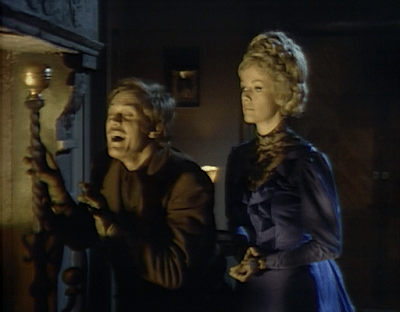
Another resident of the great house is not so sure. He appears to be Judith and Edward’s brother Quentin. He is in fact Petofi, who has cast a spell to hijack Quentin’s body and confine Quentin to his own aging and pudgy form. Q-Petofi has seen all the evidence that Edward has, including the two Barnabases side by side. But he also knows that Barnabas is a time traveler who came to 1897 from 1969, and that several magical beings and science fiction types are in his orbit. So he is looking for a trick. He has coaxed Pansy into the room, telling her that only she can make the final determination about who the man in the bed is. Pansy looks at Barnabas and declares that he is not the vampire. Q-Petofi is still unconvinced, and is about to put some kind of spell on Barnabas when Edward enters.

Downstairs, Pansy meets with Judith. Judith has figured out that her husband, Charity’s father Gregory Trask, gaslighted her into the breakdown that put her in the hospital, and that among his many misdeeds while she was there was his attempt to seduce a woman named Amanda Harris. In #864, Pansy bought a portrait of Amanda for an eye-wateringly large sum; yesterday, she set it up in the drawing room at Collinwood, causing Trask to fly into a rage. We learn in this scene that Judith put Pansy up to buying the portrait as part of a plan to get back at Trask. The two of them share some amusingly salty dialogue, showing us a worldly wise side of Judith that we have not seen before.

Today’s dose of CLE comes from a houseguest, Kitty Soames. Kitty is a young American woman who is the dowager countess of Hampshire. She is Edward’s guest, and she came to the house in #844 intending to lure Edward into a marriage that would relieve the financial distress she has been in since the late Earl’s bankruptcy. But since the day she arrived, she has been having fits of madness caused by the irruption into her consciousness of the mind of the late Josette, lost love of Barnabas. The conflict between Kitty/ Josette’s two personalities gives her one mad scene after another today.

Kitty enters the foyer, where a portrait of Barnabas hangs. She sees the portrait’s eyes glow and hears a heartbeat, something which has been happening to people under Barnabas’ influence since #205. She has a panic attack. Pansy and Judith come from the drawing room and cluster around her. Pansy walks her upstairs to her bedroom and tries to persuade her to have a cup of broth. Kitty raves about the danger that an antique music box in her room presents to her. After a bit, Edward enters and dismisses Pansy.

Kitty tells Edward that she thinks she ought to leave Collinwood, since she has been suffering from a severe mental illness throughout her stay. Edward says that he does not believe that the problem is psychological, since the music box and other objects that she finds disturbing have in fact materialized around her inexplicably. He says that to the extent that her problems are rooted in her feelings, a therapy he will suggest might be just the thing to cure them. He asks her to marry him. She agrees, and they kiss.

Edward kisses Kitty

Edward’s first wife was the former Laura Murdoch, an undead blonde fire witch. Laura was quite calm and rational in her way, but she embodied a principle of insanity in the universe. Quentin was married to a woman named Jenny, who may have seemed mentally healthy when they met but who went immensely insane after Quentin ran off with Laura. I suppose that, with that kind of family history, Edward is just cutting out some of the preliminaries by proposing to a lunatic while she is in the middle of a psychotic episode.

Edward and Kitty announce their engagement after dinner. Q-Petofi notices that Barnabas is shocked; he apologizes, smiles, and stands, a champagne glass in his hand and congratulations on his lips. He then excuses himself, saying that he still feels weak and thinks he ought to retire for the evening.

If any longtime viewers harbored doubts that Q-Petofi is right and this Barnabas is our old friend, they are dispelled when we see him in his room moaning about how he doesn’t want to lose Josette again. We end with a blissed-out Kitty entering his room, telling him she heard him calling, and declaring that she will be his Josette always. They share a passionate kiss.

Edward is the third major role Louis Edmonds has played on the show; he has been a principal member of the cast since episode #1. This is his first on-screen kiss on Dark Shadows. Some fans like to show off their knowledge of the actors’ sexual orientations by speculating about a correlation between their private lives and their on-screen kissing of opposite sex scene partners. This particularly settles on Anthony George, who was on the show for a while in 1967 and whose attempts to kiss women always went horribly wrong. But that is obvious nonsense. Jonathan Frid was gay, and the actresses all attested that he was the best kisser in the cast; Barnabas’ kiss with Kitty/ Josette today is a case in point. Joel Crothers, a regular from 1966 to 1968, was gay too, and he was another expert smoocher. Roger Davis is as straight as they come, and rivaled George for traumatic lip collisions. Kitty and Edward’s kiss shows that, while Edmonds might not have been interested in taking Kathryn Leigh Scott home, he was the equal of any heterosexual actor at playing love scenes with women when the cameras were rolling. I believe that what men like Edmonds, Frid, and Crothers did is known as “acting.”

Episode 866: Some various phases of change

It is 20 October 1897. Angelique, immortal witch and time-traveler, has discovered that her sometime fiancé, Quentin Collins, is not himself. He is 150 year old sorcerer Count Petofi, and Petofi is him, having used his magic powers to force Quentin to trade bodies with him. I will refer to the villainous Petofi who looks like Quentin as Q-Petofi, and to the forlorn Quentin who looks like Petofi as P-Quentin.

Q-Petofi

Yesterday, Q-Petofi caught Angelique trying to help P-Quentin. He attacked her, and we open today in a cave where he has imprisoned her. He tells her he has stripped her of her powers. He demands she tell him what she and time-traveling mad scientist Julia Hoffman have been doing. Regular viewers know that Julia is gone, having vanished from 1897 and returned to the 1960s in #858. That Q-Petofi does not know this is one of the few signs we have had recently that he has limitations.

Q-Petofi leaves Angelique in the cave with a chained coffin. He tells her that it is the one in which her ex-husband, vampire Barnabas Collins, was staked (#845.) She looks at the coffin and gives a little soliloquy about how she needs Barnabas, but he cannot help her.

Q-Petofi is not the only resident of the great house of Collinwood who is not the person he seems to be. Kitty Soames, a young American woman who is the dowager countess of Hampshire, came to Collinwood intending to get Quentin’s stuffy but lovable brother Edward Collins to marry her by concealing some key facts about her financial status. But the very day she arrived, in #844, Kitty found that she was the one most gravely deprived of information about herself. As soon as she saw the portrait of Barnabas that hangs by the front door in the foyer, she became possessed by the spirit of Barnabas’ lost love Josette.

Kitty’s episodes of Josettification have continued. Today’s begins with another look at the portrait and a longing sigh. As sight of the chained coffin sets off Angelique’s yearning for Barnabas, so the portrait is the visual cue that triggers Josette to come to the surface of Kitty’s mind. By the end of the episode, she will be in Josette’s bedroom at the Old House on the estate, telling an unseen person that she is waiting for him.

Kitty is still herself most of the time. And we can assume that sooner or later, Petofi will be defeated and Quentin will return to his right body. But a third resident of the great house has made a permanent and irreversible change of spirit. Her body is that of Charity Trask, whose father, the odious Gregory Trask, is married to Quentin and Edward’s sister Judith. But in #819, Petofi annihilated Charity’s personality and replaced it with that of Pansy Faye, a Cockney showgirl/ mentalist who came to Collinwood in #771 and was killed that very night, without ever having met Charity.

Angelique and Kitty/ Josette yearn for Barnabas’ return. Increasingly, the audience does too- there doesn’t seem to be anywhere the story can go until he comes back. That sets them and us against Pansy. She doesn’t share our concern for narrative progression- she is such a daffy invention she can amuse us all by herself. And she knows that Barnabas was a vampire, who preyed on Charity and was ultimately, if indirectly, responsible for Pansy’s death. Indeed, it was she who drove the stake in #845. So Barnabas is absolutely the last person Pansy wants to see again. But now someone else has emerged in next to last place.

On Friday, Pansy looked at Q-Petofi and realized that he was not Quentin. She confronted him with questions that Quentin could answer but he couldn’t, exposing him to Angelique as an impostor. When Pansy shut herself in her room, Q-Petofi went upstairs and through her door threatened that if she didn’t keep quiet “her days [would be] numbered.” Now, she has passed a note to Edward reporting on the incident. Edward and Q-Petofi meet with Pansy in her room. She tells Edward about the visions and sensings that led her to conclude that the man with him is not really Quentin. Edward thinks Pansy is just a delusion Charity is having, and so cannot ascribe much evidentiary value to these experiences. Q-Petofi claims that when he said “her days are numbered” he meant that her days as a resident of the house were numbered if she went on saying bizarre things about him. Edward asks Pansy if she might be mistaken in her interpretation of her psychic data. She says she never has been before, but allows, in a very reasonable tone, that it is possible she could be this time.

Pansy is, at the moment, the only person who could possibly be an ally for P-Quentin in his attempt to return to his own body. She does not seem to be a match for Q-Petofi’s magical powers, and so others would have to be recruited to help in the fight. But if she is now as unsure as it seems, P-Quentin doesn’t even have a place to start.

When Kitty/ Josette is in the room at the Old House, she looks at the portrait of Josette and sees that it is signed and dated. We’ve seen the portrait many times since its first appearance in #70, and it has never before borne either a signature or a date. The signature is “Coswell,” which is as good as any.

The date on the portrait is 1797, which is rather less good. In #402, set early in January 1796, we saw the portrait delivered to the Old House. Moreover, it was in #425, set in February 1796, that Josette flung herself to her death from the top of Widows’ Hill. So if this portrait is a replacement for the original, it was painted at a time when the subject was unavailable for further sittings.

Moreover, Kitty misstates the current date as 1797 in a letter to her mother, which is supposed to be a sign of her Josettification. Viewers who remember the 1790s flashback will just be puzzled by this, while those who do not are unlikely to see much significance in the date at all. It is hard to see why they’ve decided to retcon this particular point.

Episode 853: Strange and horrifying spirits

Kitty Soames, a young American woman who is the dowager Countess of Hampshire, is gradually turning into Josette DuPrés, who has been dead for 101 years. Kitty is staying at the great house on the estate of Collinwood. Also among the houseguests is Angelique, the immortal, time-traveling wicked witch who was responsible for Josette’s death.

Kitty has been getting information about Angelique, apparently from Josette’s ghost. She interrogates Angelique’s fiancé, rakish libertine Quentin Collins. Quentin does not give her any useful information about Angelique. When Kitty asks if Angelique has ever lived in England, Angelique herself enters and says that she has not. Kitty asks Angelique if she was ever a servant. Angelique made it quite clear yesterday that she knows perfectly well what is happening to Kitty, but she regards the transformation as a nuisance and does not want to help it along. She chooses to pretend that Kitty is being a snob, and says that Quentin is not marrying beneath his station. With that, Kitty has nowhere to go but back to her room.

Angelique has made an alliance with Julia Hoffman, MD, a fellow time-traveler from the late 1960s. Julia followed her friend and the object of Angelique’s lunatic obsessions, vampire Barnabas Collins, to 1897. Barnabas is now believed to have been destroyed, but we’ve already seen that Julia is continuing work replicating the experimental procedure that put his vampirism into abeyance for a little while in the spring of 1968. Today, Angelique brings some medical supplies to Julia in her hiding place, and Julia asks if she can come a little earlier the next day.

The two women sit down and have a friendly chat. Longtime viewers will find this breathtaking. Angelique was at Collinwood in 1968, wearing a black wig, calling herself Cassandra, and functioning as Julia and Barnabas’ bitterest enemy. Now that Angelique has turned to Quentin and has let go of her drive to dominate Barnabas, she and Julia have made an alliance against sorcerer Count Petofi. Their animosity set aside, they can commiserate about the difficulty of a life yoked to Barnabas.

“Ugh, vampires, all the good ones are either obsessed with recreating their dead ex or gay.” Screenshot by Dark Shadows Before I Die.

Angelique wants to liberate Quentin, whom Petofi has enslaved. Julia is horrified today when Kitty, in Josette mode, bursts into her hiding place and demands to see Barnabas. Quentin follows her in and hears her ask why she is keeping Barnabas in the next room. Neither Kitty nor Quentin believe Julia when she keeps insisting that Barnabas is no more. If Quentin knows that Barnabas is still around, Petofi will soon know it as well, and that can only be bad news.

Petofi is not content keeping Quentin as a slave. He wants to abuse him even more totally. We saw the other day that Petofi wants to swap bodies with Quentin as his means of escaping from his deadly enemies, the Rroma people. Petofi visits Quentin in the drawing room at Collinwood this evening and gives him a scalp massage. Quentin notices Petofi’s ring, and agrees that he would like a new life. He falls asleep, then wakes up to find Petofi’s ring on his finger. To his alarm, he cannot take it off. My wife, Mrs Acilius, called out to the screen to suggest he spray some Windex on his finger, but that wasn’t invented until 1933 and the dramatic date is 1897. Presumably the transfer of the ring is the first step towards Quentin’s eviction from his own body and his replacement in it by Petofi.

Closing Miscellany

Danny Horn’s post about the episode at his great Dark Shadows Every Day is a study of Kathryn Leigh Scott’s facial expressions. His thesis is that Miss Scott is imitating Grayson Hall, who plays Julia. Later in the series there will be a moment when Miss Scott imitates Hall in a scene they play together; Hall’s reaction then will be hilarious.

Kitty sees the portrait of Barnabas Collins hanging in the foyer on the spot by the front door. She Josettifies and becomes fascinated by it. Stuffy but lovable Edward Collins had the portrait removed when Barnabas was exposed as a vampire some time ago, and is shocked to find that it has returned. Presumably whatever supernatural agency is Josettifying Kitty put it there. Longtime viewers, who remember how active Josette’s own ghost was at Collinwood before Barnabas first appeared on the show, will think she is the likeliest suspect.

When Kitty/ Josette is kneeling beside the grave of Josette’s husband Jeremiah Collins (spelled “Jerimiah” on the marker,) Edward shows up and tells her that she was married, not to Jeremiah, but to the late Gerald Soames Earl of Hampshire. That was the first time it dawned on me that both Josette and Kitty married guys named Jerry.

Angelique’s intrusion into the scene between Quentin and Kitty might have been more effective if the camera hadn’t swung wide and shown her standing outside the door waiting to make her entrance. We don’t see Angelique eavesdropping, but Lara Parker standing well upstage waiting to make her entrance.

Episode 844: Some clean, fresh air

Adventurer Tim Shaw is in his hotel room with an apparently mute man, trying to get him to speak. The man is struggling to make a sound when artist Charles Delaware Tate enters and produces a revolver. Tate proclaims that the man will never speak. He fires, and the man falls dead to the floor.

The man’s body glows, then vanishes. Tim knows that Tate created the man earlier in the evening. Tate has a magical power that enables him to cause objects and people to pop into existence just by drawing them. Tim says that he ought to call the police, since Tate just murdered a man in cold blood in front of him. But there is no body, and the only other person who has seen the man is Tim’s traveling companion and occasional accomplice Amanda Harris, who turns out to be another of Tate’s creations. So instead Tim pours a drink, and Tate tells him all about how he gained his powers as the result of a bargain he struck with sorcerer Count Petofi.

Petofi is aware of several magical abilities he gave Tate, but does not know that he can bring his creations to life. Tim calls Petofi to his room and brings him up to date. He believes that this report will somehow establish a partnership between himself and Petofi. Since Tate made it clear that his powers are the result of Petofi’s own interventions, it is unclear why Tim would expect even a finder’s fee for this information. It certainly does not provide the basis for an ongoing relationship of any kind.

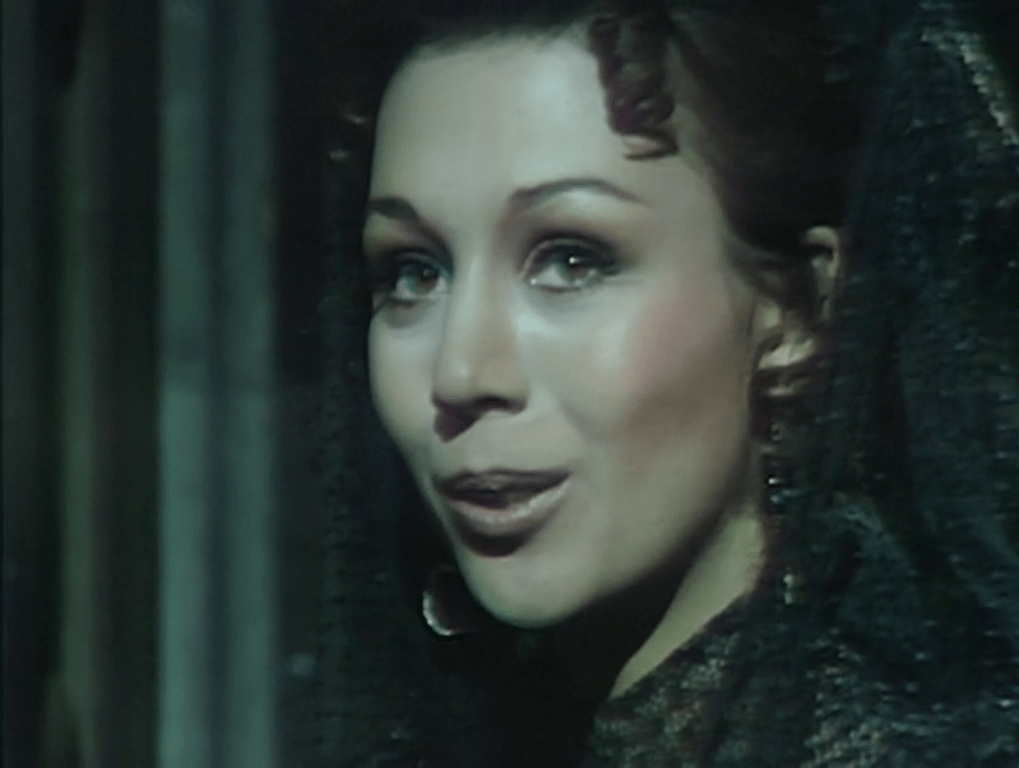
Meanwhile, a visitor is arriving at the great house of Collinwood. Her face is familiar to longtime viewers- she is played by Kathryn Leigh Scott, who has been in the cast from #1 as Maggie Evans, wisecracking waitress turned The Nicest Girl in Town. When from November 1967 to March 1968 the show was a costume drama set in the 1790s, Miss Scott played the gracious Josette; she had already played Josette’s ghost in some of the episodes in contemporary dress, and in the spring and summer of 1967 vampire Barnabas Collins had tried to brainwash Maggie into becoming Josette. We last saw Miss Scott from March to June in the first part of the still-ongoing segment set in 1897, when she was neurotic intellectual Rachel Drummond.

Before we know the name of this new character, we see that she is wearing widow’s weeds. There is also a first- we hear her thoughts in an interior monologue before she interacts with another character. Whoever she is, the widow is telling herself that she has come to her big moment and she shouldn’t chicken out now. “No one will know,” she assures herself.

Neither Maggie, Josette, or Rachel ever used that facial expression.

The unknown widow knocks, and rakish libertine Quentin Collins lets her in. He appreciates her beauty and asks who in the house is fortunate enough to know her. She says that she and her late husband were friends of the stuffy Edward Collins. Quentin says that Edward is away, and identifies himself as his brother. “Quentin or Carl?” asks the widow. Quentin says, with a sad note, that Carl is dead. This is the first time anyone other than his onetime fiancée Pansy Faye has mentioned Carl’s name in the three months since his death.

The widow finally identifies herself as Kitty Soames, Countess to the late Earl of Hampshire. She says that she is an American, and that after her husband’s death she felt that she was a stranger in England and ought to return home. Quentin invites her to stay in the house.

Kitty is alone in the foyer when Petofi enters. She is horrified to see him. It becomes clear that her husband’s death was a suicide, and that Petofi’s threats prompted it. She goes out to take a walk in the woods.

Along the way, she meets Barnabas, who has traveled back in time from 1969. They have a brief talk. When she exits, he says that she is Josette, returned to him at last.

Back in the great house, Quentin finds Kitty looking at the spot on the wall next to the front door where Barnabas’ portrait has long hung. Some weeks ago, Edward learned that Barnabas was a vampire and ordered the portrait removed. There is a mirror there now, the same mirror that hung in that spot in #195, when the ABC art department was painting Barnabas’ portrait and another portrait was reflected in it. Kitty asks Quentin why Barnabas’ portrait was removed. Since she has never been in the house before, this question perplexes him. He asks how she knows about the portrait and how she knows of Barnabas. At first she is amused by the idea that she would not know of him, but a second later she returns to herself. She insists she has never met anyone named Barnabas and has no idea what Quentin is talking about. Perhaps this time, Barnabas is right- maybe Kitty really is a revenant of Josette.

Miss Scott was one of the biggest stars on the show. She tells a story nowadays about a trip she and her then-husband took to Africa in the late 1960s, when they were on a photo safari deep in the bush. Some people happened by, took one look at her, and all started saying excitedly “Maggie Evans!” So it is inexplicable that today’s closing credits misspell her name as “Kathryn Lee Scott.”

Episode 738: The rest of the truth

This episode ends with one of the most thrilling moments in all of Dark Shadows.

The show’s first supernatural menace was undead blonde fire witch Laura Murdoch Collins, who was on it from December 1966 to March 1967. Its second was vampire Barnabas Collins, who first appeared in April 1967. Laura herself was presented with many tropes that conventionally mark vampires; for example, they laid great emphasis on the fact that Laura was never seen eating or drinking. And Laura’s story was structured very much like Bram Stoker’s Dracula, with well-meaning governess Vicki taking Mina’s role as the driving force behind the opposition to her. Presumably, if Barnabas had been staked and destroyed as the original plan envisioned, Vicki would have led the fight against him as well, and in #275 driven the stake into his heart. But Barnabas brought the show a new audience, and so Vicki was never called on to go to battle with him. Her character withered and was written out, and he replaced her as its chief protagonist.

In early 1967, Vicki learned that Laura had appeared at least twice before, and had died in strikingly similar ways each time. In 1767, Laura Murdoch Stockbridge was burned to death with her young son David; in 1867, Laura Murdoch Radcliffe was burned to death with her young son David; and in 1967, Vicki found Laura Murdoch Collins beckoning her young son David to join her in the flames consuming a wooden building. At the last second, Vicki broke through David’s trance and he ran to her, escaping the flames.

In November 1967, the show established that Barnabas lived on the great estate of Collinwood as a human in 1795, and that he became a vampire as a result of the tragic events of that year. If Barnabas were the same age in 1795 that Jonathan Frid was in 1967, he would have been born late in 1752, meaning that he would have been a teenager when Laura Murdoch Stockbridge and little David Stockbridge went up in smoke. The Stockbridges were a very wealthy family, so they would likely have been on familiar terms with Barnabas and the other rich Collinses of Collinsport, and the deaths of Laura and David would have been one of the major events in the area in those days. So longtime viewers have been wondering ever since whether Barnabas knew Laura, and if so what he knew about her.

Now Barnabas has traveled back in time to the year 1897, and there he meets another incarnation of Laura. He is thunderstruck at the sight of her. In her bland, enigmatic way, she expresses curiosity about his reaction, and he collects himself sufficiently to make some flattering remarks about her beauty. As soon as he is alone with his blood thrall, Miss Charity Trask, he declares that Laura has been dead for over a hundred years. So has he, but apparently when a woman rises from the dead to prey on the living that’s different, somehow. We saw this same old double standard a couple of weeks ago, when libertine Quentin Collins expressed shock at Laura’s return from the dead, when he himself had died and been a zombie just the week before.

If Laura did know Barnabas when she was as she is now and he was an adolescent, it is no wonder she does not seem to recognize him. She knows that there is a Barnabas Collins on the estate, and has heard that he is a descendant of the eighteenth century bearer of the same name. She would expect him to resemble the boy she knew, but would not necessarily know what that boy looked like when he was in his forties.

This is the first time we’ve seen Charity since Barnabas bit her in #727. She lives in the town of Rockport, which in the 1960s was far enough away from Collinwood that in #521 it was worthy of note that you could dial telephone numbers there directly. In 1897, when automobiles were rare and roads weren’t made for the few that did exist, a long-distance relationship between vampire and blood thrall would seem quite impractical. Still, in #732 we saw a character make two round trips between Rockport and Collinwood in a single evening, so I suppose it could be managed.

Barnabas’ recognition of Laura is a fitting conclusion to a fine episode. Much of it is devoted to a three-cornered confrontation between Laura, her twelve year old son Jamison Collins, and her brother-in-law/ ex-lover/ mortal enemy, Quentin. Danny Horn analyzes this in his post about the episode at Dark Shadows Every Day. I recommend that post highly. All I would add is that as it plays out today, the confrontation makes me suspect that the writers of the show may have done more planning than Danny usually credits them with. Jamison is the only person Quentin loves, and so far we have seen that Jamison loves Quentin back. When he learns that Quentin is his mother’s foe, Jamison turns against Quentin. Barnabas traveled back in time after Quentin’s ghost had made life impossible for everyone in 1969. The evil of Quentin’s spirit fell heaviest on David Collins, whom Quentin had possessed, turned into another version of Jamison, and was in the process of killing. Nothing yet has explained why Quentin’s ghost would focus its malignity on the image of Jamison. Actress Diana Millay used to claim that Laura was added to the 1897 segment at the last minute because she told Dan Curtis she wanted to work, but Millay famously enjoyed testing the credulity of Dark Shadows fans with outlandish remarks. I wonder if a falling-out between Quentin and Jamison over Laura was in the flimsies all along.

Charity makes her first entrance in the great house of Collinwood. Quentin is apologizing to her for some boorish behavior when he realizes she hasn’t been listening to him at all. She is completely absorbed in the eighteenth century portrait of Barnabas that hangs in the foyer. She excuses herself and wafts out the front door.

In Barnabas’ house, Charity says that he makes her feel beautiful, and that she wants to see herself in a mirror. Barnabas is a bit sheepish about the particulars of vampirism, and so he changes the subject. We cut from this exchange to Laura’s room in the great house, where she is with a servant named Dirk whom she has enthralled to serve as a source of body heat. That scene opens with a shot in a mirror, making the point that Laura’s relationship with Dirk is a reflection of Barnabas’ relationship with Charity. Earlier, there had been a clumsy attempt at an artsy shot of Laura reflected in Quentin’s sherry glass. That does show us that Laura casts a reflection and that her relationship with Quentin has been affected by his drinking, but it calls too much attention to itself to do much more than that.

The portrait in the foyer is hugely important to Barnabas. It made its debut on the show in #204, the day before his name was first mentioned and more than a week before he himself premiered. His thralls stare at it and receive his commands through it. He himself uses it as a passport, appealing to his resemblance to it as proof that he is a descendant of its subject and therefore a member of the Collins family. Today, Barnabas is surprised when Charity comes to his house; he wasn’t transmitting a message through the portrait summoning her. Instead, it was functioning as another mirror, in which Charity, who has become a part of Barnabas, could see the motivating force within her own personality.

Dirk is played by Roger Davis, a most unappealing actor. At one point he makes this face while Dirk is involved in some kind of mumbo-jumbo:

Screenshot by Dark Shadows Before I Die.

At one point today, Quentin tells Jamison that he shouldn’t be afraid of telling the servants what to do, since after all he will someday be the master of Collinwood. Jamison takes this altogether too much to heart, and spends the rest of the episode ordering everyone around. David Henesy is a good enough actor to extract the comic value from this. For example, when he turns to Quentin, says “I’ll talk to you later!,” and keeps walking, we laughed out loud.

Episode 705: Mrs Collins no longer exists

Three of the residents of the great house of Collinwood in the year 1897 are spinster Judith Collins, her brother, libertine Quentin Collins, and their grandmother, nonagenarian Edith Collins. At the opening of today’s episode, Judith walks in on Quentin strangling Edith in her bed. She tells him to stop it and leave the room. He complies, with a sulk. Edith shakes off her annoyance with Quentin, and she and Judith have a conversation about various matters.

One of Dark Shadows’ signature relationships is that between Bossy Big Sister and Bratty Little Brother. However serious the misconduct Bratty Little Brother commits in his disobedience to Bossy Big Sister, in the end she will cover it up and protect him from its consequences. Nothing at all will happen to Quentin as a result of his attempt on his grandmother’s life; Judith will just continue disapproving of him, as she has always done. Later in the episode, Quentin will remark to his recently arrived and quite mysterious distant cousin Barnabas Collins that Judith “gets carried away by delusions of authority. The fact is, she has no authority whatsoever.” Judith overhears this and objects to it, but Quentin’s presence in the house suffices to prove that her manner is not an expression of authority, but simply childlike role-playing.

Quentin’s motive for his attack on dear old grand-mama was his demand that she tell him the family’s “secret.” Edith has declared that she will pass this secret on only to Edward, who is Judith and Quentin’s eldest sibling. Edward is away, and Edith is terribly afraid she will die before he returns. After Judith shoos Quentin out of Edith’s room, she herself tries to wheedle Edith into telling her the secret. Edith tells Judith she is better off not knowing, but Judith does not seem to be convinced. Quentin has said in so many words that his only desire is to take control of the family’s wealth, and Judith is focused on preventing him from doing that. So we can assume that their frantic eagerness to learn the secret is rooted in the belief that the person who knows it will inherit the estate from Edith.

We see Edward. He is not at Collinwood, or even in the village of Collinsport. If I recall correctly, this is the first time the show has taken us anyplace out of town other than the mental hospital since we visited Phoenix, Arizona in #174, more than two years ago.

Edward is in a train station, impatient and irritable, talking with a young woman whose rigid posture and blank facial expression show that she is exceedingly uncomfortable. Her name is Rachel Drummond, and she is to be the new governess for Edward’s son and daughter. He says that he means for her to use her own judgment in making up their curriculum. Rachel says she will have a clearer idea of what her approach will be once she has met the children and Edward’s wife. Edward freezes, and says that he has no wife. Rachel apologizes for her assumption; he says that she has no need to do that, as he had given her no way of knowing about the situation. In a soft voice, Rachel asks about Mrs Collins’ death; Edward replies that “Mrs Collins no longer exists” and that is all he will be saying about the topic. Rachel asks how she should respond if the children ask about their mother; Edward tells her to say that she is away, nothing more.

Back at Collinwood, a recently arrived visitor named Barnabas Collins comes calling with a gift for Edith. It is a piece of jewelry that he inherited from Naomi Collins, whom he identifies as his great-great-great-grandmother. Judith accompanies him to Edith’s bedroom.

Meanwhile, Edward lets himself and Rachel in the front door. He is carrying their bags and grumbling about the lack of servants. Quentin enters. Edward is shocked that his ne’er-do-well brother has returned to the house from which he was banished a year ago, he hoped forever. He has little to say as Quentin teases him and Rachel, saying that she is too pretty to be either the new governess or Edward’s new wife. He asks if she is Edward’s mistress, angering him and making the already unhappy Rachel quite miserable. She says she is the new governess. Quentin asks if she is married. Edward erupts with “Would it make any difference to you if she were?” In the wake of the painful exchange about Edward’s wife no longer existing, this carries a suggestion that makes Rachel’s position even more difficult. Edward realizes what he has said and falls into a horrified silence.

Edward asks Rachel to excuse him and Quentin while they have a private talk. She has nowhere to go; she has not been shown around the house or told which areas she is free to enter, so all she can do is sit quietly in the foyer. Still, that would appear to be an improvement over the endless cascade of awkward exchanges she has had so far, and so she agrees without protest.

While Edward reads Quentin the Riot Act in the drawing room, Judith shows Barnabas into Edith’s room. The room is darkened so that only the outlines of their figures are visible. Judith opens the curtains to let the moonlight in, and sees Edward’s carriage outside. She hurries down to fetch Edward, leaving Barnabas alone with Edith.

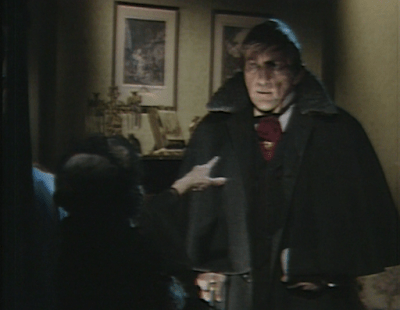
Edith asks his name. When he says that he is called Barnabas Collins, she is startled. She sits up and uneasily asks him to step into the light so she can see his face. She reacts with horror. “You! You are the secret!” she exclaims. “Passed down from one generation to the other! You were never to be let out! We have failed! We have failed!” He approaches her. “Don’t come near me! I know what you are!”

Edith tells Barnabas that he is the secret. Screenshot by Dark Shadows Before I Die.

When Dark Shadows premiered, the Collinses of 1966 had three big secrets. Matriarch Elizabeth Collins Stoddard had summoned a young woman who had never heard of her or of Collinwood, Victoria Winters, to be governess to her nephew David. Vicki was trying to find out who her biological parents were and why she was left at a foundling home as an infant; the show hinted heavily that Liz was her mother, but dropped that without any resolution. Also, Liz hadn’t left the house for 18 years. That turned out to be because she thought she killed her husband and that his body was buried in the basement. After 55 weeks of that story, it turned out she hadn’t killed him at all, and within days they forgot about the whole thing forever. The third secret was about Liz’ brother Roger. A man named Burke Devlin thought Roger had framed him on the manslaughter charge that cost him five years in prison, and vowed to destroy the Collinses in revenge. After 40 weeks, Burke forced Roger to confess that his suspicions were correct, but by that time Burke had decided to let bygones be bygones and that story also vanished with barely a trace.

With that record, all the talk about “the secret” that we hear when we first arrive in 1897 might make longtime viewers apprehensive that there will be another interminable guessing game that peters out with little or no resolution. But the show has changed. This secret is not only revealed to us within a week, it is a forceful and elegant solution to a major problem.

Barnabas is a time traveler from the 1960s. He has come back by means of some mumbo-jumbo to prevent Quentin’s ghost from haunting Collinwood and making life impossible for the Collins family in the year 1969. He is also a vampire. He originally lived in the 1790s, and Naomi was his mother, not his great-great-great-grandmother. A would-be thief accidentally freed him to prey on the living in April 1967; he managed to conceal his true nature from his living relatives, and in March 1968 he was freed from the effects of the vampire curse. When he came to this period, he found himself once more an undead abomination.

Barnabas has no idea why Quentin’s ghost has become such a problem in 1969, no idea how to investigate the question, and no idea what, if anything, he will be able to do to correct matters if he somehow does manage to find the answer. Since events are moving very fast in 1897, everyone there is deeply and intricately involved with everyone else, and Barnabas is a stranger, there is a distinct possibility that he will be sidelined. That happened to Vicki when she left November 1967 and found herself in the year 1795; by the time the show returned to contemporary dress four months later, she had been an ineffectual ninny for so long that she had lost the loyalty of the audience, never to regain it. As a vampire, Barnabas could make his way to the center of the story by killing everyone, but that would tend to create a narrative cul-de-sac. So Dark Shadows is taking an enormous risk with its star by putting him in this situation.

When Edith tells Barnabas that he is the secret, at one stroke she puts him at the center of the story, connects the part of the show set in 1897 with that set in 1795, and raises a whole set of questions about how the events of those two periods led to what we have seen in the parts set in the 1960s. She electrifies the audience with the promise of an entirely new kind of show.

She also answers a minor, but potentially nagging question. From #204 on, we saw that Barnabas’ portrait hangs beside the entrance to the great house, and we are repeatedly told that it has been there as long as anyone can remember. The Collinses know that the man who sat for it was a cousin of their direct ancestor, and believe that he left for England in the 1790s, never to return. Why display the portrait of so distant a relative in so prominent a place for so long?

Edith’s recognition of Barnabas tells us why. She has studied the portrait for as long as she has known the secret, and when he comes into the light she can see at once that he is its subject. The portrait was therefore meant to help the keeper of the secret defend the family against Barnabas. It actually had the opposite effect. In 1967 and again on his arrival at the great house this week, Barnabas appealed to his resemblance to the portrait as evidence that he was a descendant of “the original Barnabas Collins,” and so persuaded the living members of the family to let him make his home in the Old House on the estate.

The opening voiceover today is the same we heard yesterday and the day before. I do not believe they had ever replayed an opening voiceover even once prior to this; I’m sure they had never done so twice. This one just tells you that Barnabas has traveled back in time, and it is now 1897. Repeating it doesn’t hurt anything, but I do wonder what they were thinking. Were they considering changing the nature of the voiceover, making them so simple that they could be reused routinely? Or was there some kind of problem, say a technical difficulty with the equipment or an issue with the actors’ contracts, which kept them from recording fresh ones?

Episode 554: What must be

Recovering vampire Barnabas Collins is in the woods on the estate of Collinwood, searching for well-meaning governess Vicki Winters. He hears dogs howling, as they used to howl when he was in the grip of bloodlust. He goes to pieces at the memory.

Barnabas’ fellow searcher, Vicki’s fiancé Peter Bradford, sees him standing petrified. Barnabas asks him if he can hear the dogs. Peter says he can, and is puzzled that Barnabas was afraid he was hallucinating their sounds. Peter asks Barnabas if he is all right. Barnabas insists that he is just worried about Vicki, and resumes searching.

Shortly after, Barnabas finds himself in the foyer of the great house on the estate, slumped in a chair under his own portrait. He makes a sad contrast with the haughty figure in the painting. His friend Julia Hoffman enters, and he gives her a pleading look that emphasizes the contrast between his present weakness and the arrogant power he wielded when he posed for the portrait, more than 170 years before.

Barnabas tells Julia that he does not know how he got into the house. The last he remembers, he was in the woods and heard the dogs howling. She suggests that their noise may not mean anything, but he is sure there is some unearthly horror afoot.

Barnabas tells Julia something else he is sure of. Earlier this evening, Frankenstein’s monster Adam came to his house. Adam mistakenly believes that Barnabas created him, and demanded that he build a woman to be his mate. When Barnabas told him that would be impossible, Adam vowed to make him sorry, then left. Shortly after, Vicki came by for a brief visit. Barnabas is certain that Adam abducted Vicki to use as a hostage, and that the only ransom he will accept is the artificially created woman he has no way of supplying.

Barnabas goes to the telephone and announces he is going to tell the police what he knows about Adam. Julia objects that Adam can tell the police enough about the two of them to expose them both to prosecution. Barnabas says that he is willing to take that risk for Vicki’s sake, and begins dialing. Julia says she is not, and places her finger on the telephone receiver to end the call.

Julia has never been able to entirely conceal her dislike for Vicki, rolling her eyes when Vicki talks to her and making sarcastic remarks when Barnabas praises her, so regular viewers can hardly be surprised that Julia does not volunteer to go to prison for her sake. Still, Julia has often enough shown a troubled conscience about the many crimes she has committed during her association with Barnabas that her utter coolness represents a new step in the character’s development. The other day she wanted to shoot wicked witch Angelique, but Angelique was not really human and was enormously dangerous. Even so, Julia was deeply upset when she made up her mind to kill her, and she backed down when she came face to face with Angelique. But Vicki is resolutely, unfailingly, rather tediously good, Good with a capital G. That Julia is so blandly willing to consign her to death at Adam’s hands suggests that her sense of right and wrong will no longer serve as a brake on any sinister plans that might advance whatever goals she and Barnabas are pursuing.

Barnabas looks at Julia, shocked. Perhaps her coldness shocks him. Perhaps what shocks him is that he is so dependent on her that he does not resume dialing.

Meanwhile, another drama has played out not so far away. Electrician Tom Jennings was inspecting the wiring in a house that suave warlock Nicholas Blair is renting from the ancient and esteemed Collins family. Tom told Nicholas that he wanted to inspect the cellar to make sure the foundation was in good repair. Nicholas replied that this would not be necessary, but Tom insisted. He opened the cellar door, and found a coffin. Nicholas told him that the coffin was there when he moved in. Tom asked if he’d called the police, and Nicholas replied there was no need, since the coffin was empty.

On his way home, Tom told himself that the Collinses wouldn’t leave a coffin in the basement of one of their houses. That shows what he knows- for the first 55 weeks of the show, matriarch Elizabeth Collins Stoddard thought that her husband was buried in a box in the basement of the great house, and when he was a vampire Barnabas kept his coffin in the basement of his house. It wouldn’t be a Collins house if it didn’t have a coffin in the basement, and a dungeon too.

Tom sees someone and asks who it is. The part of the other person is played by the camera, so we do not know. The camera zooms in, and Tom collapses.

Later, Peter finds Tom propped against a tree. He touches Tom, and Tom falls over, apparently dead. He has two bloody wounds on his neck. Peter goes back to the great house. He tells Barnabas and Julia that he must use the telephone. They hear him describe Tom’s wounds to the police. Afterward, Barnabas and Julia realize that there is another vampire operating in the area.

Tom’s appearance is the debut of Don Briscoe, who would be a big part of Dark Shadows for almost two years. On his Dark Shadows Every Day, Danny Horn told an amazing story about Briscoe:

Many years ago, when I was in high school, my mother walked into the room while I was watching Dark Shadows.

She looked at the guy on the screen, and said, “Is his name Don?”

I said, yeah, that’s Don Briscoe, and she said, “I thought so. I knew him, when I was in grad school. He asked me out once.”

Seriously, true story. She said that they were both getting a master’s in English — he was at Columbia University, and she was at Barnard, which is right across the street. He asked her out on a date, and he was very handsome, and very nice, but he wasn’t Jewish, so she said no.

At the time, I had no way to verify this, and I never really knew what to think about it. I mean, she knew the guy’s first name, but maybe she confused him with some other brown-haired guy named Don.

But now I have this excellent book called Barnabas & Company, which has extensive bios on everybody in the cast. It turns out that he really did get a master’s degree in English at Columbia University, and that means that Don Briscoe is kind of my dad.

Danny Horn, “Episode 565: Weird Science,” Dark Shadows Every Day, 10 January 2015

Granted, hundreds of actors had parts on Dark Shadows over the five years of its run, a great many people have blogged about the show, and I’m sure Danny’s mother was a very attractive young woman who had offers from lots of fellows. But Briscoe was one of the more important members of the cast, and Danny is as good as any of the bloggers. So it really is a noteworthy coincidence that they are connected to each other in that particular way.

Episode 499: Fair warning

From #133, artist Sam Evans was compelled to paint a series of pictures that explained the evil intentions of undead blonde witch Laura Murdoch Collins, estranged wife of sarcastic dandy Roger Collins. In #146, Laura put a stop to Sam’s work by starting a fire that burned his hands so badly it seemed for a time he might never be able to paint again.

Sam shares his home, the “Evans cottage,” with his daughter Maggie, who is The Nicest Girl in Town and a waitress at the diner in the Collinsport Inn. Between her earnings there and the paintings Sam sells, the Evanses make a living, but it isn’t such a grand living that he can turn down any commissions, even very eccentric ones. Moreover, his work space entirely dominates the interior of the cottage. In the early days of the show, Sam’s old friend Burke Devlin often stopped by, and the conversation always turned to reminiscences of Burke’s youthful days of honest poverty. Nowadays the most frequent visitor is Maggie’s fiancé, hardworking fisherman Joe Haskell. Sam is delighted with the prospect of this upwardly mobile laborer as a son-in-law. When a representative of the moneyed world visits Sam or Maggie at home, as New York art dealer Portia Fitzsimmons did in #193 and old world gentleman Barnabas Collins did in #222, the contrast between their manner and the humble surroundings is meant to jolt us. The Evans cottage is therefore our window on the working class of Collinsport. When the troubles of the ancient and esteemed Collins family have an effect there, Dark Shadows is telling us that the whole town is dependent on the businesses they own and suffers as a result of their problems.

Yesterday, Barnabas came back to the cottage and brought Sam a very odd commission indeed. He presented a painting of a lovely young woman in eighteenth century garb and offered Sam $500* to paint over the image so that before morning the woman would look to be “about 200 years old.” Sam wasn’t in a position to refuse that much money, even though Barnabas wouldn’t explain why he wanted him to do such a thing.

If Sam knew what the audience knows, he would likely have turned the job down even if Barnabas had offered $500,000,000. The woman in the portrait is Angelique, and like Laura she is an undead blonde witch. In the 1790s, Angelique cursed Barnabas and made him a vampire. In #466, Barnabas’ vampirism went into remission. Shortly thereafter, the portrait made its way to the great house of Collinwood, where Roger became obsessed with it. In #473, Roger returned from an unexplained absence with a new wife. She is Angelique, wearing a black wig and calling herself Cassandra. From #366-#461, Dark Shadows had been a costume drama set in the 1790s; during this segment, we saw that Angelique was a far more dynamic and brutal menace than Laura ever was. Sam would hardly want to involve himself in a battle with this wiggéd witch.

For his part, Barnabas first appeared on camera in #210 and #211. But his portrait was first seen hanging in the foyer at Collinwood in #205, having been prefigured in #195. Dangerously unstable ruffian Willie Loomis became obsessed with the portrait of Barnabas. Willie could hear a heartbeat pounding from the portrait in #208 and #209, and followed its sound to the crypt where Barnabas was trapped in his coffin. As Roger’s obsession with Angelique’s portrait would bring her back to the world of the living, so Willie’s obsession with Barnabas’ portrait led to his return.

In the opening teaser, we see Sam working on the painting. He tells it that he can’t understand why Barnabas would want to disfigure such a pretty face, then resumes his task. The camera zooms in on the painting, as it had zoomed in on Barnabas’ portrait in #208 and #209, and the soundtrack plays the same heartbeat. Sam doesn’t react- he can’t hear it. It is addressed to the audience, especially to those members of the audience who remember the show as it was 13 months ago.

Angelique/ Cassandra is in the gazebo on the grounds of Collinwood. She is wearing a hooded cloak to conceal the aging she has already experienced as a result of Sam’s work. Her cat’s paw Tony Peterson, a local attorney, shows up, responding to her psychic summons. She entrances him with a flame and he tells her that the artist who has been in touch with the Collinses most frequently of late is Sam Evans. From this she concludes that Sam is aging her portrait at Barnabas’ bidding. Before Angelique/ Cassandra and Tony can go their separate ways, heiress Carolyn Collins Stoddard comes upon them.

Tony and Carolyn met in #357. In that episode, he was an instance of Jerry Lacy’s Humphrey Bogart imitation. A hard-boiled materialist, Tony had grown up in Collinsport as a working-class boy. He resented the Collinses and attributed all of their unusual characteristics to their wealth and social prominence. At that time, Barnabas was still a vampire and Carolyn was under his power. As a blood thrall, she knew that there was more to life than could be explained by Tony’s reductive logic, but she wasn’t free to offer any explanations. When Tony saw Barnabas biting Carolyn in #463, he interpreted their embrace as a sign of a sexual relationship.

Now their roles are reversed. It is unclear what Carolyn remembers from her time under Barnabas’ control; Nancy Barrett often plays the character as if she remembers everything, but the dialogue doesn’t give her much support for that, and in this scene she is as this-worldly as Tony was in the Autumn of 1967. She interprets Tony and Angelique/ Cassandra’s meeting at the gazebo as proof positive of an adulterous liaison, and declares she will report it to Roger. When Tony tells her that Angelique/ Cassandra has some mysterious power, Carolyn is dismissive, declaring that the Collinses are the ones who have all the power in this town. Tony tries to explain that the power Angelique/ Cassandra has is of an entirely different order from the power their ownership of capital gives the Collinses, and Carolyn responds with unconcealed contempt.

Angelique/ Cassandra knocks on the door of the Evans cottage. Sam opens the door. She ignores his objections and enters. While he keeps ordering her to get out of his house, she stands next to the portrait as he has aged it and points out her resemblance to it. He is astounded, but keeps telling her to leave. She says that she has no grievance against him and that no harm will come to him if he hands the painting over to her. He refuses. She heads out.

Angelique/ Cassandra and her portrait. Screenshot by Dark Shadows Before I Die.

Angelique/ Cassandra has barely closed the door behind her when Sam has trouble seeing. After a moment, he realizes he has been struck blind. She comes back in, takes the painting, tells him she warned him, and leaves.

Sam realizes he is blind. Screenshot by Dark Shadows Before I Die.

Closing Miscellany

Over the years, several members of the cast said on the record that Sam’s blindness was actor David Ford’s idea. He thought that if he could wear dark glasses it wouldn’t bother the audience that he read all his lines off the teleprompter.

In 2022, a commenter on Danny Horn’s post about this episode on his blog Dark Shadows Every Day identified the portraits of Angelique as the work of ABC Art Department specialist Joseph Guilfoyle:

You asked if anyone knew who painted these portraits. I can verify that the portraits of Angelique were painted by Joseph Guilfoyle. He was an artist in the Art Department at ABC. He was my Godfather and his daughter remembers this very well as it made her a bit of a celebrity at the time. Portraits were not commissioned out but instead were created in the Art Department as it was filled with many talented artists.

“Erin Allan,” posted at 5:55 PM Pacific Time 26 February 2022 on “Episode 499: A Senior Moment,” Dark Shadows Every Day, Danny Horn, 10 October 2014

Also worthy of note are the two facial makeups representing Angelique’s aging. It’s no wonder they didn’t have the personnel to make David Ford’s fake mustache look convincing when they were lavishing all the work on turning Lara Parker into two quite distinct old crones.

The costumers were involved in a famous production error in the final scene. Angelique/ Cassandra’s hooded cloak cuts off above her knees. There is no old age makeup on her legs, which are featured from every angle, making a ludicrous contrast with her face and wig.

*In 2024’s money, that’s $4544.17.

Episode 474: A Collins does the unexpected

Wicked witch Angelique (Lara Parker,) pretending to be named Cassandra, met sarcastic dandy Roger Collins (Louis Edmonds) one day and married him the next. Roger’s sister, matriarch Liz (Joan Bennett,) confronts Angelique/ Cassandra. Liz tells her that Roger has not been well and urges her to annul their marriage.

In the course of her confrontation with Liz, Angelique/ Cassandra reveals that she is not all-knowing. She thinks that Roger owns the great estate of Collinwood and the family’s business. Liz quickly explains that Roger owns nothing. He lives as a guest in her house and works as an employee of her company. Angelique/ Cassandra takes this in stride, and stands up to Liz’ insistence that the marriage must end. The only sign that Liz’ words are having an effect on anyone at all comes in the very last syllable of the scene. Unfortunately for Liz, it is not Angelique/ Cassandra who is intimidated by her, but Lara Parker who is intimidated by Joan Bennett. Angelique/ Cassandra’s mid-Atlantic accent vanishes and the purest musical note of Parker’s native Tennessee sounds as the word “you” emerges as “yeww.” If there had been another page or two of dialogue, she might have ended with a honeyed smile and a lethal “Bless your heart!”

From #395 to #461, Dark Shadows was a costume drama set in the late 1790s. In that segment, Angelique came to Collinwood as a servant girl and used her magical powers to manipulate scion Barnabas Collins (Jonathan Frid) into marrying her. Barnabas’ parents, Joshua (Louis Edmonds) and Naomi (Joan Bennett) were unhappy about the marriage. Joshua demanded that it be annulled, as Liz today demands Roger and Angelique/ Cassandra’s marriage be annulled. Naomi took a more conciliatory approach. Advocating Joshua’s position and but showing Naomi’s temperament, Liz combines two challenges Angelique has already shown herself able to overcome easily. Returning viewers will therefore have little hope that Liz will be able to stave off the disasters Angelique has in mind for the Collinses.

Angelique/ Cassandra is eager to get to work on the evil plans she has for the people at Collinwood, and so she is trying to stop Roger taking her on a honeymoon. She contrives to injure her ankle. We see permanent houseguest/ medical doctor/ mad scientist Julia Hoffman (Grayson Hall) in the bedroom Angelique/ Cassandra will be sharing with Roger, bandaging her ankle. Angelique/ Cassandra asks a series of questions about old world gentleman Barnabas Collins (Jonathan Frid,) making Julia visibly uncomfortable.

Barnabas is the same man Angelique married in the 1790s. He is here in 1968 because she turned him into a vampire then. He was relieved of the symptoms of vampirism only a couple of weeks ago. He and Julia are becoming fast friends, and on Tuesday he told her all about Angelique. He identified her as the woman in a portrait that has obsessed Roger, and expressed his belief that Roger’s obsession was a sign that Angelique herself was returning to Collinwood. Julia can see how strongly Cassandra resembles the portrait, and knows that Roger’s obsession led directly to his marrying her, so she really ought to have figured out by now that she is Angelique.

Like the scene between Angelique/ Cassandra and Liz, the scene between her and Julia makes an instructive comparison with the parts the same actresses played in the 1790s segment. Angelique was originally lady’s maid to the Countess DuPrés. We saw her helping the Countess put herself together in a bedroom that was a different dressing of the set on which Julia is now attending to her foot. This apparent reversal of roles illuminates the extent to which Angelique’s command of black magic always made her a mightier figure than her nominal mistress. As a mad scientist, Julia is far more formidable than was the countess, but this scene leaves us wondering if she will be able to stand up to Angelique for any longer than could her counterpart.

Well-meaning governess Vicki (Alexandra Moltke Isles) had traveled back in time and was at Collinwood through the 1790s segment. She recognizes Angelique, knows well how dangerous she is, and is desperate to stop her. She tries to tell Liz about the situation, but Liz has a very limited tolerance for information about the supernatural. Vicki later meets Julia at the gazebo on the grounds of the estate and shares her information with her. Julia knows as much as anyone about the strange goings-on, and what Vicki tells her confirms what she already has reason to suspect. However, Julia pretends to have trouble believing Vicki.

This pretense enables Julia to probe the limits of Vicki’s own knowledge. Barnabas and Julia do not want Vicki to know any of Barnabas’ secrets. Julia incredulously asks Vicki if she thinks the Barnabas Collins of 1968 is the same person she knew in the eighteenth century. Vicki turns away from Julia, looks troubled, and says that she does not believe this. Vicki has encountered plenty of evidence to that effect, not least when Barnabas bit her and sucked her blood, and the audience wonders what she knows. We see Julia studying her, trying to find the answer to the same question. In the first year of Dark Shadows, Vicki represented the audience’s point of view, the resolutely normal outsider getting to know the Collinwood crazies. In this moment, we see Vicki through Julia’s eyes. We identify, not with any sane person from the world of sunlight and natural laws, but with a mad scientist who has cast her lot with a vampire.

Vicki thinking about Barnabas, with a facial expression straight out of MAD magazine. Screenshot by Dark Shadows Before I Die.

Angelique/ Cassandra and Roger chat in their bedroom. He seems utterly delighted to be married to her, until she slips something into his drink. Suddenly he starts having doubts. Nothing we have seen leads us to expect she would want him to feel this way. The scene leaves us scratching our heads.

We end with Angelique/ Cassandra alone in the foyer of the great house, looking at the portrait of Barnabas that hangs there and vowing to restore the curse that had made him a vampire. We know that she is Angelique and that such is her goal, so her speech doesn’t set up any new story points.

It does give us some world-building information. Angelique says that the only way she knew that Barnabas was walking among the living in the 1960s was that Vicki had traveled back in time to the 1790s and told her. That explodes a theory some fans like that Angelique herself called Vicki back in time. When Vicki left the 1960s in #365, it was quite clear that the ghost of Barnabas’ little sister Sarah was sending her on the journey. Sarah has been fading steadily from our awareness, not least because child actress Sharon Smyth aged out of the part, and so it is not surprising that people expect a retcon to attribute the time travel story to a different force. But not only does Angelique rule herself out with this line, Sarah’s name comes up in the conversation between Julia and Vicki, reminding regular viewers of the original explanation.

More importantly, it confirms that once one person has made a wrong-way journey through time, a gate opens through which other unexpected things may come. To some extent we saw this when Barnabas himself was released from his coffin and Sarah’s ghost began showing up around the estate. The cosmological point will become extremely important for the rest of Dark Shadows, as one time-travel story keeps leading to another. Dark Shadows is often described as the story of the house, and so I can’t resist an inelegant metaphor from the building trades. It’s as if Vicki wrecked the plumbing of the universe when she went through the pipes backwards and then abruptly forward. Time will never flow the right way again.