Throughout its first 73 weeks, Dark Shadows was usually very slow-paced, even by the standards of a 1960s daytime soap. Major characters like matriarch Liz and her brother, high-born ne’er-do-well Roger, often seemed to exist solely for the purpose of refusing to accept the facts in front of their faces and thereby slowing down the progression of the plot. Even characters who did face facts would often as not have the memory of goldfish, so that weeks of character development would evaporate with a sudden display of inexplicable ignorance.
That changed when well-meaning governess Vicki came unstuck in time in #365. For the next few months, Dark Shadows was a costume drama set in the 1790s, and events came thick and fast. When Vicki returned to the present and Dark Shadows returned to contemporary dress in March 1968, the show was a genuine hit. They tried to sustain the breakneck pace of the 1790s segment throughout 1968, with mixed success. That period was a Monster Mash, featuring multiple witches, vampires, mad scientists, Frankensteins, ghosts, and the Devil himself, or perhaps one of his middle managers. That attracted a new audience of preteen viewers, but all too often left the characters spinning their wheels as they tried to make room for each other within one small fishing village near Bangor, Maine.
A few months ago, they dumped all of those larger than life but ultimately unproductive figures and started concentrating on two storylines. The A story so far has been that of werewolf Chris and the efforts old world gentleman Barnabas and mad scientist Julia have made to keep him from killing quite so many people. That one has been moving along at a steady clip.
The B story has not progressed nearly as fast. At times, it has matched the leisurely pace of the show’s early days. Today is dedicated to that story, and in today’s pre-title teaser it appears that it has brought narrative progression to a total halt.
Maggie is the new governess in the great house of Collinwood, charged with the education of Chris’ nine year old sister Amy and of strange and troubled boy David. As usual, we open with a reprise of the previous episode. This time, the reprise is 5 minutes and 45 seconds of Maggie wandering around the house looking for the children and hearing voices, while doors open themselves. That was OK at the end of Friday’s installment, but on its own it is stupefying.
The story is that the evil spirit of the late Quentin is taking possession of David and Amy in order to destroy the Collins family and have the house to itself. It made sense that that story would start slow. Quentin was at first very weak. He existed only in a sealed chamber the children stumbled upon while exploring the long deserted west wing, and could influence events outside that chamber only by persuading them to do his bidding. He gradually gained the power to control one child at a time, and to manifest himself outside his little room. A while ago he was able to put strychnine into Chris’ drink; by the end of Friday’s episode he had Amy and David under his power simultaneously.
Once the action finally gets underway in today’s episode, Quentin is about to strangle Maggie and the children are screaming at him to stop. Housekeeper Mrs Johnson and Liz enter the room. Mrs Johnson sees Quentin, Liz does not. Maggie is unconscious and the children are in a state. By the end of the episode, Liz, Maggie, and Mrs Johnson know Quentin’s name, his plan, and his power. He has managed to create some kind of bubble around the house so that the people inside it cannot hear the rain. The children pass out. David comes to, and announces that it is too late to be afraid. He laughs maniacally, and in the background we also hear Quentin’s laughter.
With this slam-bang ending, the Haunting of Collinwood takes over as the A story and Liz forever sheds her role as a blocking figure. This phase of the show is approaching its climax, and there is a chance that what comes next will be exciting.
We open with governess Maggie Evans entering the bedroom of strange and troubled boy David Collins. She had heard David’s screams and a man’s laughter coming from the room; the man is gone, and David is unconscious on the floor. He has a nasty burn on his arm, and as he is coming to he pleads with “Quentin” not to hurt him.
Once David is fully awake, Maggie asks who Quentin is. David frantically denies that there is any such person, and claims that the laughter she heard was his own voice as he was playing a make-believe game. She says that she knows he couldn’t have made those sounds. He points out that they are the only people in the room. Maggie does not even try to explain how anyone could have left the room unseen; she seems already to have concluded that Quentin is a supernatural being. Maggie identifies Quentin with a strange and frightening man she and housekeeper Mrs Johnson have both seen. David keeps trying to deny everything, and Maggie keeps telling him she wants to help. David sobs, and Maggie holds him.
Maggie holds David.
Quentin is indeed a ghost who is taking possession both of David and of Maggie’s other charge, nine year old Amy Jennings. With their help, Quentin has so far killed two people, tried to kill two others, and set about trying to drive everyone off the estate of Collinwood. Up to this point, Maggie has failed completely to represent any sort of obstacle to Quentin. She is a poor disciplinarian who lets the children run rings around her even when they are themselves, and is altogether at sea when they are doing Quentin’s bidding. This scene promises a breakthrough. Maggie is the first of the adult characters to learn Quentin’s name, she does not flinch from the evidence of his uncanny nature, she vows to fight him, and David finds comfort in her arms.
The breakthrough does not come today, however. After a moment, David declares that no one can help him, and he rushes out of the room. He goes downstairs to the foyer and hears a knocking at the door. He opens it and sees notoriously abusive actor Roger Davis standing there. He reacts to that sight as anyone might, running away without a backward glance.
Maggie follows David downstairs. There is again some question as to how much of the body language in the next scene is the blocking the director gave as an interpretation of Maggie’s response to the character Ned Stuart and how much is Kathryn Leigh Scott’s reaction to Mr Davis. Maggie tells Ned she can’t talk because she must go out in search of David; as she prepares to exit, she circles around with as much space as possible between her and him, never quite making eye contact but glancing back every time he moves towards her. This is not a pattern of movement we have seen before on the show, even when a character was dealing with a vampire or some other murderous foe. Miss Scott looks very much like a woman alone with a man whom she does not trust not to assault her. If he had, it wouldn’t be the first time he has physically abused a castmate on camera.
She keeps her eyes on his hands
A child’s voice is heard, singing the song “Inchworm.” It is Amy, and she is working a jigsaw puzzle in the drawing room. The drawing room brings out Amy’s musical side. She played “London Bridge” on the piano there in #656 and tapped a few random keys on the same instrument in #676. She is quite a good singer, perhaps not surprising since actress Denise Nickerson had been in the cast of the short-lived James Lipton/ Laurence Rosenthal Broadway musical Sherry! in 1967.
Ned enters and introduces himself to Amy. His lines are all perfectly polite and friendly. Amy is supposed to gradually sense that Ned is hostile to her big brother Chris and to become uncomfortable around him, but that is supposed to come at the end of their time together. As it plays out, she already seems uncomfortable when he first enters. A minute or so into the scene, Amy smiles at Ned. Nickerson was remarkably good at flashing quick smiles, but it doesn’t work this time. She looks like she is displaying her teeth to the dentist. When Amy is supposed to start edging away from him, Nickerson turns around and proceeds to her next mark at full speed. The camera pans back, but does not capture her movement- she has gone clean out of the shot, leaving Mr Davis alone in the frame.
She goes as far as she can as fast as she can.
Ned approaches Amy; he grabs her by the shoulders and pulls her back into the shot. Chris enters. Amy starts to warn him against Ned, and he tells her not to be afraid for his sake. Indeed, Chris is safe. It is only women and children who have to be afraid of Roger Davis.
Ned confronts Chris. Evidently something bad happened to Ned’s sister Sabrina. She can’t tell Ned what it was, but he thinks Chris is responsible and wants him to go with him to the Collinsport Inn to see her. Returning viewers know that Chris is a werewolf and that Sabrina saw him transform. He assumed that he had killed her while in his beastly form, and he is surprised to learn from Ned that she is still alive. Chris is a character we are supposed to sympathize with, so it is a bit disturbing that he does not seem particularly relieved to find that he did not kill Sabrina.
In the woods, Amy finds David. She learned some days ago that Quentin wants to hurt Chris, and she has been resisting Quentin’s influence ever since. She and David talk about ways they can work together to fight him. David says that he has decided to tell Maggie what has been happening; Amy objects that this is too dangerous. They seem to be getting somewhere when Quentin appears to them. They are terrified, and then resign themselves to their fate.
Later, the children are in the drawing room with Maggie. Amy is still working her jigsaw puzzle, and David is staring into the fireplace. Longtime viewers will remember that this is something his mother used to do. She was the show’s first supernatural menace and tried to lure David to his doom. Maggie’s predecessor, well-meaning governess Vicki, led the other characters in the campaign that saved David then. We wonder if Maggie will be able to match her success.
Maggie admires the puzzle and calls David over to look at it. David makes a show of being bored, leading Amy to remark airily that boys don’t like jigsaw puzzles. David complains that there is nothing to do. Maggie suggests the three of them sit down together for a heart-to-heart talk, an idea the children reject. They suggest a variety of games they might play. Maggie notices that their manner is quite different than it was earlier in the day. David is more assertive, Amy supercilious. She finally agrees to let them play dress-up.
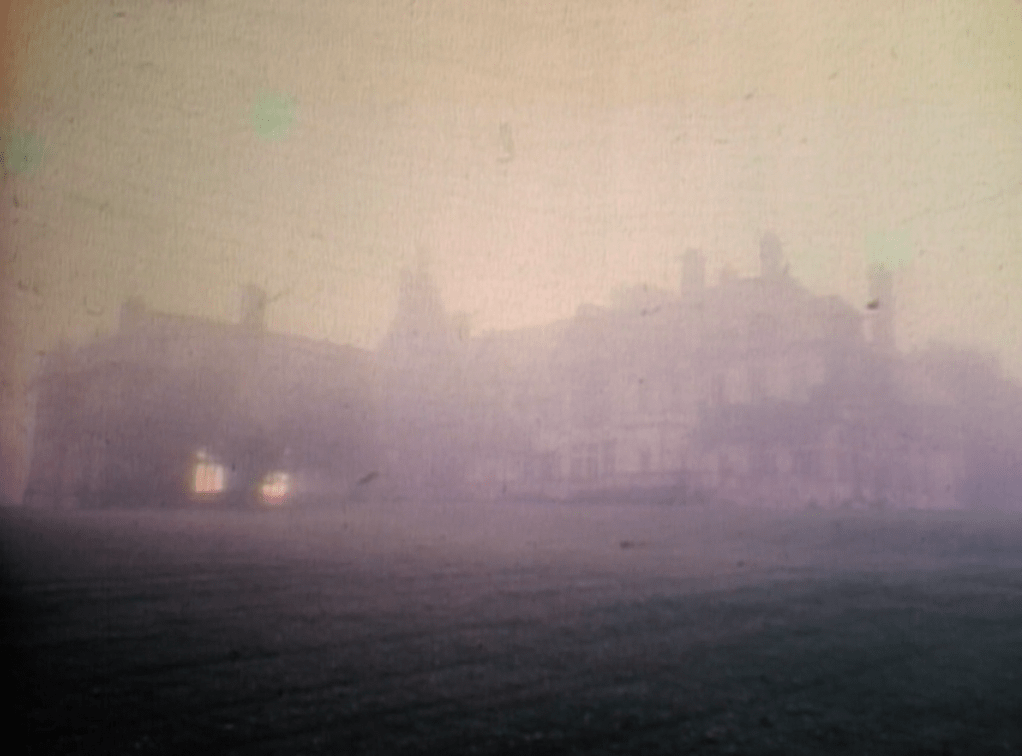
In the first year of the show, the opening voiceovers often involved a weather report. “A cold wind blows from the sea to the great house of Collinwood, but the fog still hangs heavy on its vast lawns” that sort of thing. They stopped doing that some time ago, but today they slip in an almost comically detailed bit about atmospheric conditions- “Soon dark, threatening clouds will gather over Collinwood, and long, ever-lengthening shadows will creep menacingly toward the great house. By late afternoon, rain will come, a rain that will begin slowly but steadily increase into a raging storm.” You expect them to go on with “Expect cooler temperatures and clear skies after 8 PM, with a chance of frost in the morning.” But the rain, at least, plays a part in the story. It explains why David and Amy have to stay indoors, and a roar of thunder gives Amy a chance to sneeringly ask Maggie if she is frightened. It also occasions the use of this still of the exterior of the house, one which I do not believe we have seen before:
We don’t usually see that much of the lawn.
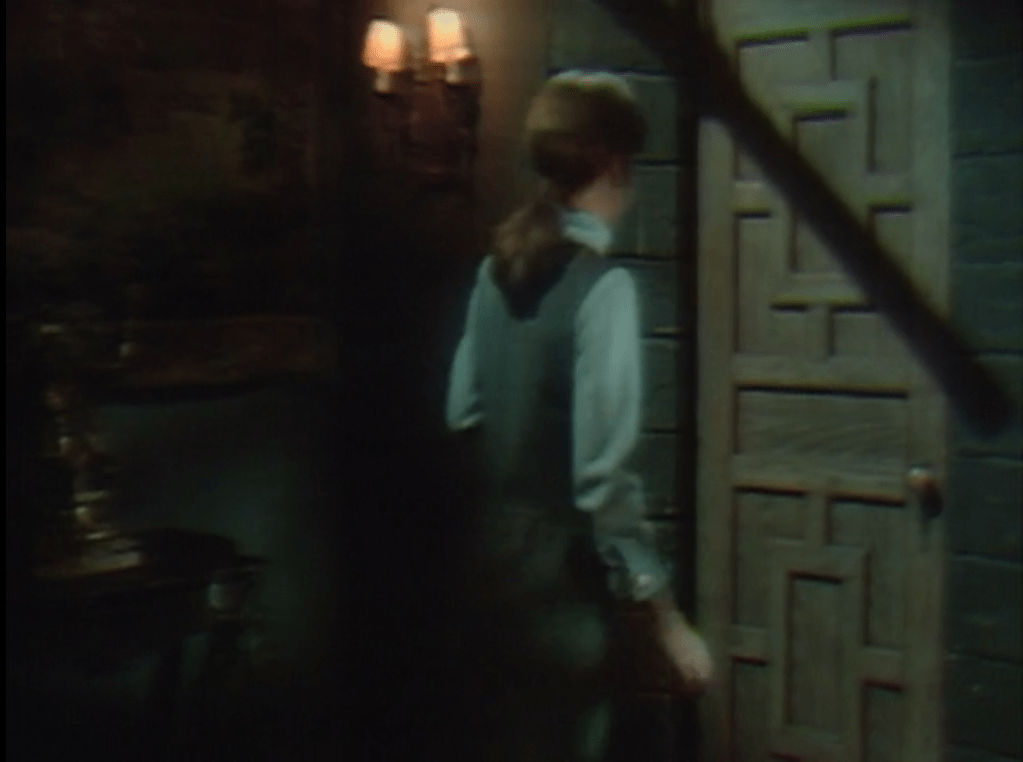
Later, Maggie goes to look for the children. She enters the study. This set has been familiar since early 1967, but today is the first time we see the outside of its door. Lately we have been seeing more of the little spaces that are supposed to join one room to another, part of a strategy to make the house seem like a bigger place.
The sequence before this suggests Maggie is heading into the long-deserted west wing, but once she goes through the door it is clearly the study.
Once in the study, Maggie hears Amy and David calling to her from no particular direction while Quentin laughs. She is bewildered, then the children join Quentin in laughing. His laughter is hearty, theirs is maniacal. Maggie goes out into the corridor, sees something frightening, and retreats into the study. She is only there for a moment when the doorknob starts turning. We end with Maggie staring directly into the camera, its lens representing the point of view of whatever it is that is terrifying her.
Maggie terrified.
This is the first of only two episodes credited to writer Ralph Ellis. Dark Shadows never had more than three writers on staff at any time. I often wish they had had many more. Ellis is one of those whom I would have liked to see as a senior writer on the show right the way through. The episode is well-paced, the characters are clearly defined, and the dialogue is smooth with just a touch of wit. If he had been in charge of, let’s say, every Monday’s script, the whole series would have been a cut above what it actually was. Since he only contributed two scripts, it is especially sad that Roger Davis had to crap on one of them, but even when Mr Davis is on camera you can still tell that Ellis did his job well.
Old world gentleman Barnabas Collins finds his distant cousin, strange and troubled boy David Collins, trying to pull the metal ring that opens the secret chamber hidden inside the old mausoleum.
Barnabas asks what David was doing. He says he was upset with his governess, Maggie Evans, and was hiding from her. Barnabas gestures around the publicly known part of the mausoleum and says “There’s no place to hide here.” David vigorously agrees, and says he didn’t expect Maggie to come there at all. Barnabas asks if David was trying to get into the hidden chamber.
Panicked, David claims not to know what Barnabas is talking about. Barnabas reminds him that he caught him at the mausoleum in #315. Longtime viewers will recall that he subsequently found part of David’s pocket knife in the hidden chamber and confronted him with it, and David seems to remember that as well. He drops his attempt to deny knowing about the chamber, and tells Barnabas he heard an animal inside it.
This goes to the heart of the issue that has brought Barnabas to the mausoleum. Barnabas has befriended mysterious drifter Chris Jennings and has learned that Chris is a werewolf. When Chris is in his beastly form, Barnabas locks him in the hidden chamber to keep him from hurting anyone. The werewolf is in there now. He was growling and snarling when David arrived, but fell silent when Barnabas entered.
Barnabas asks how an animal could have got into the hidden chamber; David admits he can’t think of a way. He then asks David if he can hear the noise now; he says he can’t. He asks if he might have imagined the whole thing; he doesn’t disagree.
Barnabas takes David back home to the great house of Collinwood. His governess Maggie is waiting up for him. She stays in David’s room until he seems to be asleep, then kisses him on the forehead and goes.
Yesterday, David told Maggie that she is a pretty girl. He’s twelve now, old enough to get excited about that very conspicuous fact, so when he opens his eyes immediately after she leaves the room returning viewers might think the reason he faked being asleep was that he was angling for the kiss.
David went to the mausoleum to release the werewolf because the evil spirit of the late Quentin Collins made him do it. Quentin has been dominating David lately. After Maggie goes, Quentin appears in the room and David confronts him. He says he does not want to be part of Quentin’s cruel schemes any longer. In response, Quentin causes David to suffer extreme pain. Passing by in the hallway, Maggie hears David’s scream and Quentin’s laugh, and she opens the door to find David curled up on the floor.
The laugh is noteworthy. Maggie hears it, and it is not a sound David could have made. She has already seen Quentin, but now she has further evidence that he exists. Moreover, it is the first time Quentin has broken his silence. We first met Quentin when he was in company with another ghost, a woman named Beth Chavez. Beth has spoken since then; we wonder when Quentin will have lines to deliver.
Governess Maggie Evans saw the evil spirit of the late Quentin Collins yesterday, and she tells housekeeper Mrs Johnson about it today. Mrs Johnson saw Quentin a few days ago; she and Maggie are the only adults in the great house of Collinwood who know that Quentin exists, and not even they know his name. Quentin is gradually taking control of Maggie’s charges, nine year old Amy Jennings and twelve year old David Collins. Yesterday, David led Maggie and his aunt, matriarch Elizabeth Collins Stoddard, to the room in the long deserted west wing where Maggie saw Quentin. There is a mannequin there wearing a coat like Quentin’s; David says that he and Amy call it “Mr Juggins,” and Liz chooses to believe that Mr Juggins is what Maggie saw.
We see Maggie in bed. She gets up, goes back to the room, and sees Mr Juggins. We dissolve to a shot of Quentin in Mr Juggins’ place. Horrified, Maggie watches Quentin approach with a length of fabric. He chokes her with it. She falls to the floor. She is lying there when we cut to commercial. Maggie was introduced in #1 and has for long stretches been a central character, one of the most recognizable on Dark Shadows. Kathryn Leigh Scott tells a story of going to a wilderness area in Africa when the show was a hit and being greeted with cries of “Maggie Evans!” For the moment, it looks like they have decided to kill her off in the middle of a Tuesday episode.
Of course they haven’t. We come back from the break to hear Maggie telling old world gentleman Barnabas Collins about the dream in which she was strangled. She is surprised that Barnabas believes her story about seeing the man when she was awake, shares her suspicions that David and Amy are connected with the man, and is open to the idea that the dream is “a warning.” Barnabas tells Maggie that he and his inseparable friend, permanent houseguest Julia Hoffman, MD, saw a woman dressed in clothes of the same period as Quentin’s clothes, that the woman’s presence could not be explained, and that she led them to Amy’s brother’s Chris at a moment when Chris needed medical help to save his life. Barnabas has concluded that the man and the woman are ghosts and that they represent something very dangerous.
Barnabas enlists the aid of occult expert Timothy Eliot Stokes. Stokes agrees to conduct a séance in the drawing room in the hopes of contacting Madame Janet Findley, a psychic researcher whom he brought to the house in #647 to investigate the early signs of Quentin’s haunting. Amy and David tricked Madame Findley into going to Quentin’s stronghold in the west wing in #648, and she did battle with him there in #649. After that confrontation, Madame Findley appeared at the head of the stairs in the foyer and tumbled down them, dead.
This is the tenth séance we have seen on Dark Shadows. They usually come with four roles to be filled. In all séances, someone acted as organizer and leader. In eight of the first nine séances, someone else objected to the idea of a séance, but reluctantly took a place around the table. In seven of the nine, someone went into a trance, becoming a medium. Every time the trance began, someone grew alarmed at its first signs and tried to end the séance before the dead could speak; that drew a stern rebuke from the leader. The medium then spoke, more often than not passing out after struggling to utter a few mysterious words.
The roles of reluctant participant and objector are often combined. Today, Mrs Johnson is the first to combine the role of reluctant participant and medium. This is also the first time the trance does not draw an objection from someone wanting to stop the séance. Mrs Johnson does pull her hands back early on, breaking the circle of contact, and Stokes delivers the requisite stern rebuke. But no one speaks up when she starts to moan. As Madame Findley, she at first produces the usual jumble of words (“The children! Panel! Room!”) She manages to cry out “He killed me! He killed me!” before collapsing face first onto the table in the orthodox manner.
In their post about this episode on Dark Shadows Before I Die, John and Christine Scoleri compare Mr Juggins with Otto the Automatic Pilot from the 1980 film Airplane! Perhaps inspired by the dissolve from Mr Juggins to Quentin today, they go on to Juggins-ize Otto:
The Scoleris also list all the séances on the show up to this point. They name the leaders and mediums, but not the reluctant participants or the objectors. I have added those:
Dark Shadows Before I Die Séance Tracker
Episode 170/171: Dr. Peter Guthrie conducts; Carolyn, Vicki, Roger and Laura Collins participate; Josette speaks through Vicki in French; held in the drawing room at Collinwood [Roger and Laura join reluctantly; Carolyn objects]
Episode 186: Vicki conducts; Sam and David participate; David Radcliffe speaks through David; held in the drawing room at the Old House [Sam is both reluctant joiner and objector]
Episode 280/281: Roger conducts; Liz, Vicki, Burke, Barnabas, Carolyn participate; Josette speaks through Vicki; held in the drawing room at the Old House [Liz, Burke, and Barnabas are reluctant; Barnabas objects]
Episode 365: Roger conducts; Liz, Julia, Vicki, Carolyn and Barnabas participate; Sarah Collins speaks through Vicki after Carolyn pretends Sarah is speaking through her; Vicki is transferred to 1795; held in the drawing room at Collinwood [Liz and Barnabas are reluctant; Liz objects]
Episode 449: Countess duPrés conducts; Joshua Collins participates; Bathia Mapes shows up, claiming she was called; held in the drawing room at Collinwood [Joshua is reluctant; no trance]
Episode 510/511: Professor Stokes conducts; Julia and Tony Peterson participate; Reverend Trask speaks through Tony Peterson; the basement wall breaks open to reveal his skeleton; held in the basement at the Old House [Tony is reluctant, Julia objects]
Episode 600: Professor Stokes conducts; Barnabas and Julia participate; Phillipe Cordier speaks through Barnabas; held in the drawing room at the Old House [No conspicuously reluctant participant. Julia objects]
Episode 640: David conducts; Amy participates; unsuccessful attempt to contact Quentin Collins; held in Amy’s bedroom at Collinwood [Amy is reluctant; no trance]
Episode 642: Professor Stokes conducts; Liz, Vicki, Carolyn, Chris participate; Magda speaks through Carolyn; held in the drawing room at Collinwood [Chris is reluctant and is objector]
Today’s episode: Professor Stokes conducts; Barnabas, Maggie and Mrs. Johnson participate; Janet Findley speaks through Mrs. Johnson; held in the drawing room at Collinwood [Mrs Johnson is reluctant; no objector]
This is Maggie’s first séance, and they’ve been spending a lot of time lately showing us that she is unsure of herself. So it would have been expected for her to become frightened and try to stop the séance when Mrs Johnson goes into the trance. Maybe that’s why they left it out- it was too obvious a move. But the pattern is so familiar now that it feels like they’ve forgotten something when they leave the objection out.
Strange and troubled boy David Collins and nine year old Amy Jennings are falling under the sway of the evil spirit of the late Quentin Collins. Quentin has been gaining strength gradually; at first he was confined to a small chamber hidden behind a wall in a storage room in the long deserted west wing of the great house of Collinwood, and was dependent on Amy and David to do his bidding elsewhere. Now he can move around the estate and do things for himself. He is still able to control only one of the children at a time, though, and when Amy found out that Quentin had poisoned her brother Chris she made up her mind to fight him.
Today, David goes to the west wing to tell Quentin that Amy will cooperate with him if he promises to leave Chris alone. When David puts this to Quentin, he nods in agreement. If Quentin is still weak enough that he must give in to Amy on this point, he is still weak enough to be stopped before he does any great harm. That builds suspense- the show has invested so much time in building up the threat Quentin poses that it would feel like a cheat if he were defeated now, but we can look forward to seeing him survive a series of close calls between now and the time when his storyline approaches its climax.
David was not the only one who went from the main part of the house to the west wing. Governess Maggie saw him go there, in direct defiance of her orders that he stay in his room. Maggie followed David down the corridor and saw him go into the storage room. By the time she entered that room, David had gone into Quentin’s secret chamber and closed the panel behind him, leaving Maggie baffled as to where he could be. She went back to the main part of the house to wait for David.
In David’s room, Maggie sits in the armchair by the wall. She is still there when David comes back. This recreates a pair of scenes in #667, when David sat in the chair and was still there when Amy entered. That was supposed to be a power move, and it worked, more or less. David asserted his role as Quentin’s spokesman, and Amy acquiesced.
But Maggie can’t pull it off. She doesn’t give in to David when he denies everything, tells her her eyesight must be failing, claims that she doesn’t have the right to punish him, and yells at her that he will “get even.” But her visible nervousness encourages him to try each of these tactics. It’s only when she reminds him that he had his flashlight with him when he went into the west wing and says she will look for it in the storage room that she shuts him down, and then only for a moment.
David protests his innocence to Maggie, but he tells us that the sky is falling.
Maggie goes back to the west wing, where she sees Quentin. David looks directly into the camera and recites the epigram “I do not love thee, Dr Fell.” In the first months of the show, David was the only character who made eye contact with the audience. He stopped doing that late in 1966, when he stopped being a menace, and several other characters have been called on to do it since. It’s good to see him revisit the technique, and he is quite effective at it today.
Closing Miscellany
As my screen name may have led you to suspect, I make my living as a Latin teacher. So I would be remiss if I did not mention that “I do not love thee, Dr Fell” is a translation of a piece often used on the first day of introductory Latin classes, Martial’s Epigram 32:
Non amo te, Sabidi, nec dicere possum quare.
Hoc tantum possum dicere: non amo te.
When poet Tom Brown translated the epigram in 1680, he changed the name “Sabidius” to “Dr Fell” in memory of the dean of the Oxford college which he had briefly attended. A literal translation should enable you to figure out the meaning of each of the Latin words: “I do not love you, Sabidius, and I cannot say why. I can say only this: I do not love you.”
In a conversation with housekeeper Mrs Johnson, matriarch Elizabeth Collins Stoddard says that “David is twelve years old.” This is the first time in a while David’s age has been specified explicitly.
Liz orders Mrs Johnson to take David’s dinner to him on a tray and sit in his room while he eats. Longtime viewers may remember that when Mrs Johnson started working in the house in #77 and #79, David was afraid she would be his “jailer”; in #189, she actually did sit in his room and function as his jailer for a little while. She is reluctant to do that again today, because she has caught on that David and Amy are involved with something uncanny and she is afraid of them.
Danny Horn devotes his post about this episode on his great Dark Shadows Every Day to a tour of the props and decor of David’s room. It’s a lot of fun. One of his commenters, “Jayson O’Neill,” links to a 2014 post on the Dark Shadows News blogspot page focusing on David’s posters; another, “John E. Comelately,” points out that famed rock and roll band The Turtles released a track in 1967 called “Chicken Little Was Right.” I made a comment myself finding fault with the acting and blaming director Dan Curtis for it; I don’t agree with that anymore, but you’re welcome to read it if you want.
Old world gentleman Barnabas Collins and mad scientist Julia Hoffman have figured out that mysterious drifter Chris Jennings is a werewolf. Last night, Barnabas took Chris to the room hidden behind the secret panel in the old Collins family mausoleum and locked him up there. That had the desired effect- Chris transformed, but couldn’t get out and didn’t kill anyone.
This morning, Barnabas walks with Chris as he returns home to the caretaker’s cottage on the grounds of the estate of Collinwood. They find Julia already there. Barnabas had neglected to tell Chris that Julia also knows his secret, so he is puzzled to find her in his house. When she explains that she knows he is the werewolf, she also says that she advised Barnabas against helping him. She seems to be in quite a snippy mood.
Chris says that Julia was right; Barnabas replies “Right or wrong, I have made my decision and I intend to follow it through!” That’s a perfectly characteristic remark for Barnabas, who often shows great tenacity but never shows any signs of a functional conscience. Julia warms up and tells Chris that she will come back the following morning and begin a series of tests meant to discover a medical intervention to deal with his condition. Later, Chris will call Barnabas “a good man.” When Barnabas says that some would dissent from this view, Chris says that those who do are “wrong, very wrong.” Chris hasn’t been watching Dark Shadows!
While werewolf Chris was cooped up in the mausoleum, strange and troubled boy David Collins was at home in the great house of Collinwood. David is friends with Chris’ nine year old sister Amy, and both children are coming under the sway of the evil spirit of the late Quentin Collins. Last night, Quentin showed David a bottle of strychnine and ordered him to poison Chris with it. David refused that order. A moment after Barnabas and Julia leave the cottage, David knocks on the door.
David asks who it was he saw “sneaking out” of the cottage. Chris tells him that he may have seen Julia and Barnabas, but that they probably weren’t “sneaking”- they had simply stopped by to visit him. When David is surprised that they came so early in the morning, Chris points out that he dropped in only a few minutes later. David declares that he always gets up early, and is surprised Chris doesn’t know that. Chris does not seem to believe that it is reasonable for David to expect him to know what time he gets up.
David tells Chris he likes what he has done with the interior of the cottage. Chris says he hasn’t changed a thing- it is just as he found it. This will interest longtime viewers. The last person to stay in the cottage was David’s mother, undead blonde fire witch Laura Murdoch Collins, who occupied it early in 1967. David often visited her there in those days. We remember those scenes when he takes a seat in front of the fireplace, where he and Laura used to sit.
David in a familiar spot.
Chris tells David he was up all night and has to get some sleep. He offers him a soda “to give you some energy for your hike through the woods.” Once they have collected their sodas, Chris tells David “Well, I tell ya, I like a carbonated grape soda myself. It reminds me of the vineyards in the south of France.” He delivers this line in the voice of W. C. Fields. This is the first unmistakable occurrence of Briscoe’s W. C. Fields imitation; it is a seed from which much will grow. In August, another character of Briscoe’s will make an appearance wearing Fields’ signature costume, top hat and all.
David’s comment about the figures he saw “sneaking” from the cottage shows that he is worried about Chris, and he keeps talking and asking questions until Chris all but pushes him out. His concern is quite understandable in the light of the command Quentin gave him the night before.
After David leaves the cottage, the camera stays in the front room by itself and focuses on the door for such a long time we begin to wonder whether anyone else is coming. Maybe they just want us to see what a nice door the set department has put together. Finally it does open, but we do not see anyone enter. The stopper rises from a decanter of brandy on the table, apparently by itself. The strychnine bottle Quentin showed David comes into view; it tips over, and its contents are emptied into the decanter.
When the day is done, we are at the great house. Julia and Barnabas have had a conversation about a book she is reading, The Lycanthrope of Angers. Coupled with Chris’ joking reference to the south of France, this mention of a city in northwestern France suggests that there is something French about being a werewolf. Barnabas used to be a vampire; that condition came upon him because of his involvement with some French people. Perhaps the makers of the show were planning to turn to the same country to explain the origin of Chris’ troubles. It might not be so far-fetched. The show is set in Maine, after all, home to a great many Franco-Americans.
Alone in the cottage, Chris decides to celebrate the end of the Moon’s “cycle of fullness” by taking a drink of whiskey before bed. He sickens. At first he thinks he is transforming into the werewolf. He collapses, but does not go into the convulsions typical of strychnine poisoning.
Julia is in bed in her room in the great house. She is awakened by the sound of sobbing. A tall, very thin blonde woman in a long white dress appears. She beckons Julia and leaves the room. Julia pauses to put on a robe.
Barnabas is downstairs; he sees the woman. He initially mistakes her for heiress Carolyn Collins Stoddard, the only blonde woman in the house, but by the time the woman in white has reached the bottom of the stairs and gone out the front door he knows it is not her.
Given their shared hair color, it is unsurprising Barnabas mistakes the woman in white for Carolyn. But there is a bit of an Easter egg here for sufficiently obsessive fans. As the Dark Shadows wiki notes, actress Terry Crawford appeared in a 1969 commercial for the “Barnabas Collins Dark Shadows Board Game” with her hair styled so that she would look like Nancy Barrett as Carolyn.
Julia arrives downstairs and asks if Barnabas saw the woman. The two of them go out the front door and spot her in the distance, on the path to Chris’ cottage. We cut to the cottage, and see the woman enter. Barnabas and Julia enter a moment later, at which point she is gone. They find Chris unconscious, and Julia says he is dying.
Returning viewers recognize the woman in the white dress as Quentin’s associate Beth. We do not know why Quentin wants Chris to be poisoned, or why Beth wants Julia and Barnabas to find him while he is still alive. Perhaps they are working at cross-purposes, and Beth is trying to keep Quentin from killing Chris. Or perhaps they are working together, and their shared plan was to injure Chris but to get Julia, who is after all a doctor, to him in time to prevent the worst.
Chris Jennings turns into a werewolf when the moon is full, which it is about half the time in the universe of Dark Shadows. Old world gentleman Barnabas Collins has learned of Chris’ plight and decided to help him. As they make their way through an old cemetery to the hidden chamber where Barnabas will lock Chris up so that he doesn’t hurt anyone tonight, Barnabas asks Chris to confirm that he doesn’t remember anything he does in his lupine form. Chris does, saying that waking up and not knowing what he did the night before “is the most agonizing part of the whole thing.” You might think that he would find it even more agonizing to know that he has been killing one or two random human beings a month for the last seven years, but different things bother different people.
Chris asks how Barnabas knew that he didn’t remember what he did as the werewolf. Barnabas replies “Well, it’s obvious you’ve forgotten that you attacked me in this graveyard the night before last.” Chris says that “It’s a wonder you’re still alive.” To which Barnabas replies “No, it’s a wonder YOU’RE still alive!” For a moment we wonder how long this will go on, but Barnabas explains that werewolves can be killed by silver weapons. The head of the cane he carries is silver, and he struck him with it.
Barnabas shows Chris to the hidden room in the back of the old Collins family mausoleum. Barnabas himself was kept in a chained coffin in this room for over 170 years, when he was a vampire. He tells Chris that the room was originally constructed to hide ammunition from the British during the Revolution, which we have heard before. The coffin is still there; he tells him it is empty, and denies knowing anything about it. He says that the walls of the tomb are solid granite a foot thick; this is the first we’ve heard this detail. When Chris asks if anyone else knows about the room, Barnabas concedes that “A few” do. He assures him that none of them will be around tonight. Regular viewers will start making up a list of all the characters currently on the show who know about the room; Barnabas’s friend Julia Hoffman and his servant Willie Loomis know about it, as does strange and troubled boy David Collins. Barnabas can tell Julia and Willie to stay clear, and David has no reason to come to the cemetery tonight.
Barnabas explains that he will not show Chris the mechanism that unlocks the door from the inside, but promises to come back to release him after dawn. Chris urges Barnabas to leave at once; Barnabas insists on sticking around and asking more questions, saying that the moon isn’t up yet. Chris tells him that he first transformed shortly after he graduated from architecture school. “Oh, I was going to be an architect to be reckoned with, bold, imaginative, revolutionary. I thought nothing could stand in my way. Then something did.”
After Chris delivers a monologue about what a soulful and remorseful serial killer he is, Barnabas finally does close the secret panel. He sticks around until he hears the sounds of the werewolf snarling in the hidden room.
Chris’ nine year old sister Amy is staying at the great house of Collinwood. David finds her standing outside the front door, staring at the moon. She tells him that the moon scares her sometimes. His response is “Well, then don’t look at it,” which does seem logical. But she tells him that she can’t help it. David complains about how odd she is. We will hear more of this grumbling; it makes them seem like an old married couple, and is hilarious.
Amy and David are coming under the influence of the evil spirit of the late Quentin Collins. Quentin keeps trying to get them to set various members of the Collins family up for lethal traps; they haven’t succeeded yet in killing anyone, but housekeeper Mrs Johnson has caught on that there is something peculiar going on with the two of them, and she is frightened.
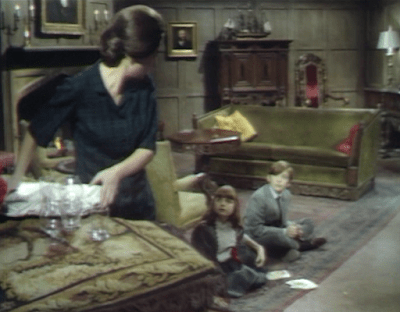
Mrs Johnson enters the drawing room to do some straightening up and finds the children playing a game with a deck of stage magician’s oversized cards. She and they stare silently at each other for a minute or two, and she protests. They say they were just watching her work, and she orders them to go to bed. They object that it isn’t bedtime yet. Of course it isn’t, Mrs Johnson doesn’t work around the clock. They get even more intensely on her nerves by bringing up a recent incident when she saw Quentin’s ghost, and in her exasperation she chases them out of the room.
There isn’t anything about Quentin in the episode prior to that scene, so I cannot imagine what viewers would make of it. It’s late in the day, a domestic is tired, and a couple of kids are trying to annoy her. That is a relatable situation, but it doesn’t match with the heavy, melodramatic Dark Shadows music and the terrified affect with which Clarice Blackburn plays Mrs Johnson. I suppose that by January 1969, Dark Shadows was so widely known as a supernatural thriller that most people tuning in for the first time would assume that something paranormal was going on, but if they turned the television on after the opening titles and didn’t realize what show they were watching, they could only have concluded that they were witnessing an utterly ludicrous case of exaggerated seriousness. After David and Amy are out of Mrs Johnson’s sight, we see them go upstairs laughing, but that proves only that they are trying to upset her, not that they are connected to a malign power greater than themselves.
Barnabas enters and sees that Mrs Johnson is upset. She begins to tell him why, but interrupts herself to declare that he won’t believe her. He assures her that he will, and keeps asking her to go on. After she has told him everything she and the audience both know, he asks her to start over. The scene cuts out, suggesting that Barnabas is taking pains to get as much information from Mrs Johnson as he possibly can.
The children go to the little room in the long-deserted west wing of the house where they first met Quentin. Quentin is there when they arrive. This is the first time we have seen Quentin waiting for them; previously, they have had to summon him. Quentin does not speak; David can sense that he wants Amy to go back to the main part of the house so that they can talk privately.
Alone with Quentin, David asks where “the bottle” is. Quentin opens a rolltop desk, and David sees a bottle. He is shocked to find that the bottle is labeled “strychnine.” He declares that he won’t hurt Chris, and he runs out of the room.
Downstairs, Amy is in the drawing room, where she presses a few keys of the piano. We heard her play “London Bridge” in #656, but this doesn’t seem to be a part of any song. She is just idly pecking at the keyboard. When David comes, Amy complains about how long he was gone. He is distant, refusing to maintain eye contact or to answer any of her questions. He says they won’t be playing tonight.
We cut back upstairs, where Quentin is picking up the bottle of strychnine. Mrs Johnson saw Quentin in Chris’ cottage, so we know that he can go there. If David won’t poison Chris, perhaps Quentin will do it himself.
Governess Maggie Evans forbids her charges, David Collins and Amy Jennings, from going outside. They ask her to play hide and seek. She agrees, and accepts the role of It. She searches for them for a long time, ultimately finding them outdoors. She points out that she had told them to stay indoors, and they pretend not to have understood that this applied to their hiding places.
Maggie does not punish Amy and David for this obvious insubordination. This establishes that Maggie is a squish who will not maintain discipline. That point had already been made in yesterday’s episode, when Maggie caught Amy hiding in David’s room, in defiance of orders from heiress Carolyn Collins Stoddard. At that time, Maggie lied to housekeeper Mrs Johnson to cover up what the children had done. Maggie’s irresolution bears repeated exposure, though, since the children are coming under the influence of the evil spirit of the late Quentin Collins and would not be very effective as his helpers if they were subject to even moderately competent adult supervision.
Today Mrs Johnson and her son Harry are under orders from Carolyn to fix up the caretaker’s cottage on the estate. Carolyn has invited mysterious drifter Chris Jennings, Amy’s big brother, to live in the cottage. In the opening, Mrs Johnson tells Maggie she objects to this idea on the grounds that the cottage is cursed. Maggie dismisses Mrs Johnson’s belief in such a curse, but she really shouldn’t. Mrs Johnson keeps calling it “Matthew Morgan’s cottage” after the crazed handyman who lived there for eighteen years. Matthew killed Mrs Johnson’s beloved employer Bill Malloy, then tried to kill Maggie’s dear friend and predecessor as governess at Collinwood, Vicki Winters. Maggie knows all about those incidents. Mrs Johnson also says that no good happened at the cottage after Matthew; the only resident of the cottage since Matthew’s death was David’s mother, undead blonde fire witch Laura Murdoch Collins. Maggie knows plenty about Laura as well, since her father Sam was deeply involved in the strange goings-on concerning Laura and Vicki led the fight against her.
Under orders from Quentin, the children contrive to trap Mrs Johnson in the cottage by herself. Quentin appears to her there. She is terrified. This is quite a surprise to regular viewers. Quentin has appeared on screen only once before, in #646. Moreover, the children have made it very clear that Quentin is confined to the little room hidden in the long-deserted west wing of Collinwood where they found him. We are left to wonder how he gained the ability to manifest himself in the cottage and even to walk outside it when no one is looking.
Perhaps we are to think that Quentin is in some way connected with the curse on the cottage, and with Chris. When the children first contacted Quentin, Amy could communicate with him before David could. This left David miffed, since “Quentin Collins is my ancestor.” That line of David’s led us to expect that we would learn that Quentin is also Amy and Chris’ ancestor. Tomorrow, David will tell Amy that Quentin is “quite pleased” that Chris is living in the cottage. Maybe it was Amy’s presence in the room in the west wing that activated the ghost of Quentin there, and Chris’ impending arrival in the cottage that activates it in that space.
This episode marks the last appearance of Harry. Until today, he was played by Craig Slocum. Edward Marshall takes Harry over the horizon. Mr Marshall must have been watching the show; he does a flawless imitation of Slocum’s very peculiar line delivery. His Harry is just as petulant and resentful as Slocum’s was, but he is so much more physically relaxed and so much more responsive to his scene partners that he is enjoyable to watch in a way Slocum never was. I can’t help but wonder if Harry would have caught on and become a bigger part of the show had Mr Marshall taken the part earlier. Harry’s personality made it impossible for him to figure in a romance of any kind, limiting his usefulness on a soap, but there’s plenty of room on Dark Shadows for comic relief in the form of an inept, grumbly, dishonest servant.
The ghost of Quentin Collins has lured children Amy Jennings and David Collins to the room in the long deserted west wing of the great house of Collinwood where his skeleton is hidden. For the first time, Quentin appears. Later, a woman in a white dress will also materialize.
An old gramophone starts playing a sickly waltz, and David snaps into an odd mental state. He is slow to respond when Amy calls him by name, and tells her she knows that the waltz is his favorite piece of music. She does not know this, and is puzzled to hear it, since he hadn’t heard the waltz until the night before. Soon it becomes apparent that David is coming to be possessed by Quentin. He tells Amy that they have things they must do, including a conversation with “Roger.” Roger is David’s father; this is the first time we have heard him refer to him by name, and it makes it clear to regular viewers that David is not himself. Later, they are wearing clothes of the same period as those Quentin and the woman in the white dress wore, and they decide to address each other as “Quentin” and “Beth.”
Longtime viewers will also recognize the motif of a piece of music as a device with the power to overwrite a character’s personality. In #155, David’s mother, undead fire witch Laura, gave him a music box, apparently as part of her plan to prepare him to follow her to a fiery doom.
Another music box became much more famous a little later. In the summer and fall of 1967, David’s distant cousin Barnabas was a vampire, and he was determined to re-create his lost love, the gracious Josette. His plan involved forcing a young woman to listen to Josette’s music box incessantly. Barnabas hoped that someone who spent enough time listening to the box would forget her old habits and memories and turn into Josette. The music box did seem to have some measure of the power Barnabas had in mind. First Maggie, The Nicest Girl in Town, then Vicki, David’s well-meaning governess, did spend substantial amounts of time listening to the music box with a vacant look on her face. Episode #303 ended with Vicki’s boyfriend Burke listening to the music box and staring off into space; Mrs Acilius wondered if that meant Burke was going to think he was Josette. Burke wouldn’t have looked so good in the dress that comes with the part, but who knows, maybe he and Barnabas would have been happy together.
David and Amy carry a chest out the front door of the great house. Roger and his sister, matriarch Liz, see them do this and ask what is in the chest. David says that it is full of his toys, and that he and Amy want to play with them outdoors. Roger points out that David has never taken a chest full of toys outdoors before, and asks what has led him to do so now. David tells him it is a military secret. Amy explains that one of David’s toy soldiers is broken and they are going to bury him with full military honors. Amused by this idea, Roger holds the front door open and salutes the children as they carry the chest past. In fact, the chest holds, not a toy soldier, but Quentin’s skeleton. It is that which Amy and David bury.
At night, Roger is about to go to sleep when a knock comes on his bedroom door. It is Amy, telling him she heard from sounds from the downstairs that made her suspect someone might be trying to break into the house. Roger takes this concern seriously enough that he retrieves a pistol from his nightstand and carries it as he goes to investigate.
David ties a wire across the second stair from the top of the case from the bedrooms to the foyer, opens the front door, then hides. Roger enters. He is alarmed to see that the front door is open. He stumbles on the trap David has set. He lies unconscious and bleeding at the foot of the stairs. Amy and David enter, see his condition, and nod at each other gravely.
This is the second time David has tried to kill Roger. The first time, in #15, he had sabotaged the brakes on Roger’s car. As he watched the car pull away, he called to his mother. Laura was not physically present, and would not be for another 22 weeks, but when those who watch the show from the beginning learn of her supernatural character they will ask if she influenced David to patricide. Today there is no doubt that David and Amy are doing the bidding of the ghosts, and so we wonder again if David was under Laura’s power when he took the bleeder valve from the wheel cylinder of Roger’s car.
I don’t know how much of a spoiler it is to tell someone reading a Dark Shadows blog that in the spring of 1969 Quentin would become a major breakout star, rivaling Barnabas’ popularity. Quentin would be such a big part of the show’s appeal that Dan Ross would give the last 16 of the 32 original Dark Shadows novels he wrote under his wife Marilyn’s name titles beginning with the words “Barnabas, Quentin, and the.” They were:
Barnabas, Quentin, and the Mummy’s Curse, April 1970
Barnabas, Quentin, and the Avenging Ghost, May 1970
Barnabas, Quentin, and the Nightmare Assassin, June 1970
Barnabas, Quentin, and the Crystal Coffin, July 1970
Barnabas, Quentin, and the Witch’s Curse, August 1970
Barnabas, Quentin, and the Haunted Cave, September 1970
Barnabas, Quentin, and the Frightened Bride, October 1970
Barnabas, Quentin, and the Scorpio Curse, November 1970
Barnabas, Quentin, and the Serpent, December 1970
Barnabas, Quentin, and the Magic Potion, January 1971
Barnabas, Quentin, and the Body Snatchers, February 1971
Barnabas, Quentin, and Dr Jekyll’s Son, April 1971
Barnabas, Quentin, and the Grave Robbers, June 1971
Barnabas, Quentin, and the Sea Ghost, August 1971
Barnabas, Quentin, and the Mad Magician, October 1971
Barnabas, Quentin, and the Hidden Tomb, December 1971
Barnabas, Quentin, and the Vampire Beauty, March 1972
My first choice is always to title these entries after lines of dialogue from the episodes, and “morbid games children play” was so perfect that I couldn’t pass it up. But Barnabas, Quentin, and the Bleeder Valve was also very tempting, and I do suspect I will use at least a few Barnabas, Quentin, and the titles in the next two and a half years.
The ghost of the mysterious Quentin Collins has trapped children David Collins and Amy Jennings in a storeroom in the long-deserted west wing of the great house of Collinwood. Unable to open the door to the corridor, David and Amy have found another room hidden behind a panel in the storeroom. A room inside another room is often referred to as a “closet,” and this is the perfect soap opera closet- there is literally a skeleton in it.
On Dark Shadows, a fashion-conscious skeleton is never seen without a wig. This one is no exception. It is seated in a chair that swivels towards the children, revealing its face. This swivel reminds us of one of the most famous reveals of a bewigged skeleton in cinema, that of Norman Bates’ mother in Alfred Hitchcock’s Psycho.
Amy and David conclude that the skeleton in the closet must be Quentin’s. The skeleton sits beside an antique gramophone that plays a sickly old waltz over and over; Amy wonders how it started playing. David has been living in the house for two and a half years, so his experience with ghosts is already very extensive, and the gramophone is the least of his concerns.
The adults in the great house have noticed David and Amy’s absence and have gone looking for them. Matriarch Elizabeth Collins Stoddard calls at the other residence on the estate, the home of her distant cousin Barnabas Collins. She tells Barnabas that she wonders if they may have slipped in while he was sleeping. Barnabas tells Liz that he locked all the doors before going to bed, to which she responds “Barnabas, a locked door never kept David Collins out.” In 1967, Barnabas was a vampire and David kept endangering himself by sneaking into his house. In those days, David’s father Roger once made a similar remark. Barnabas isn’t a vampire anymore, but everyone other than Dark Shadows‘ hardcore fans will always think of him as one. David’s inability to get out of the room where Quentin kept him and Amy would suggest that he too has changed, and is now at a loss before locked doors. But for Liz, her nephew will always be a master burglar.
Barnabas searches his house and does not find the children. He and Liz leave for the great house. Hiding nearby, the children see them go and sneak in. As per Quentin’s orders, they go upstairs and take a wooden cradle. Later, we will see them put the cradle in the room with the skeleton and interact with Quentin’s ghost there. Their activities in the room don’t make any sense to the audience; they clearly are not meant to. They come after Amy and David have agreed to “play the game,” using a phrase we hear for the first time today. Those familiar with the mysterious atmosphere of ghost stories can assume it will be some time before we will get enough information even to guess what sort of game it is.
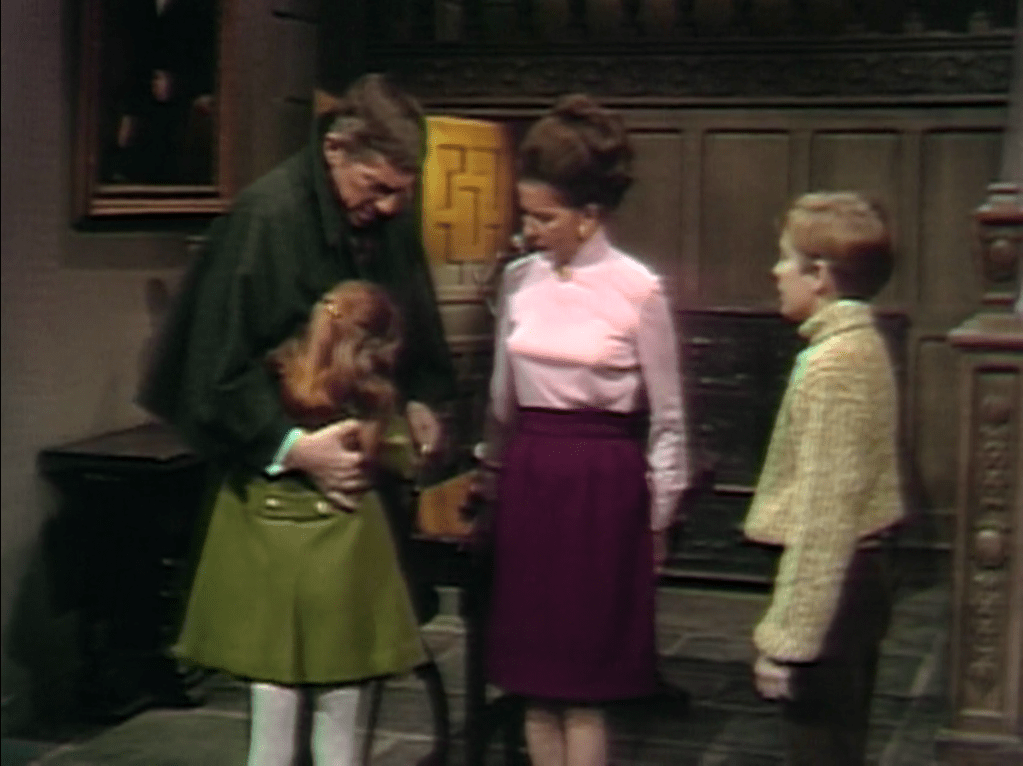
For longtime viewers, the highlight of today’s episode comes when Amy meets Barnabas and gives him a hug. Amy has dominated the show since her first appearance in #632; Barnabas has been its undisputed star since he joined the cast in #211. It turns out that the two of them became friends when they were both patients at Windcliff, a mental hospital a hundred miles north of town.
Amy hugs Barnabas while Liz and David look on.
The director of Windcliff is Julia Hoffman, MD. For almost a year and a half, Julia has been a permanent houseguest at Collinwood; as 1968 has gone on, she has become Barnabas’ inseparable friend. She hugged Barnabas for the first time in #635, to his evident discomfort. But as we saw when he interacted with the ghost of his little sister Sarah in #364 and again when we saw him with the living Sarah in the extended flashback to the 1790s that ran from November 1967 to March 1968, Barnabas gets along well with little girls, so it isn’t such a surprise that he returns Amy’s embrace.
In #629, Liz told Julia that Barnabas was miserable at Windcliff. If Barnabas were still a vampire, it would be easy to imagine his evil overwhelming the scientific rationality at the heart of a psychiatric facility, as it has long since overwhelmed Julia’s professional ethics. But his curse is in abeyance now. They’ve had to work to keep us thinking that he is exotic and uncanny and dangerous; one look at him in a group therapy session would undo all that work so abruptly that we would never stop laughing. Of course we never see him as a patient there. It was daring of them even to include Liz’ line, inviting us to imagine him in such a mundane setting.
There’s an implication that Barnabas and Amy hung out at Windcliff, because apparently exposing small children, in shock over the deaths of family members, to middle-aged mental patients is part of the healing process. The Barnabas/Amy scene makes me laugh at loud because it’s as if the writers think Windcliff is a vacation resort and Barnabas and Amy met by the pool.
Stephen E. Robinson, comment left 11 May 2015 at 6:59 AM Pacific time, on Danny Horn, “Episode 645: Spirited Away,” 10 May 2015, Dark Shadows Every Day.
Stephen is being generous- Barnabas was in the hospital because he had himself been the victim of a vampire, and Amy was there because her brother Tom had died. She did not know, but Julia did, that Tom had also come back as a vampire, and it was Barnabas who destroyed him, first by driving a stake through his heart, later by forcing him into the sunlight. I’m no psychiatrist, but with that history of closely related but non-discussable traumas I wouldn’t think the two of them ought to spend much time together.
But of course none of that matters. Barnabas and Julia are the show’s principal protagonists, and they ran out of story two weeks ago. Ever since Amy took over, we’ve been waiting to see how she will connect with them. Now that we know she is Barnabas’ substitute sister and Julia’s sometime patient, they are ready to rejoin the action.







 Dark Shadows Commentary