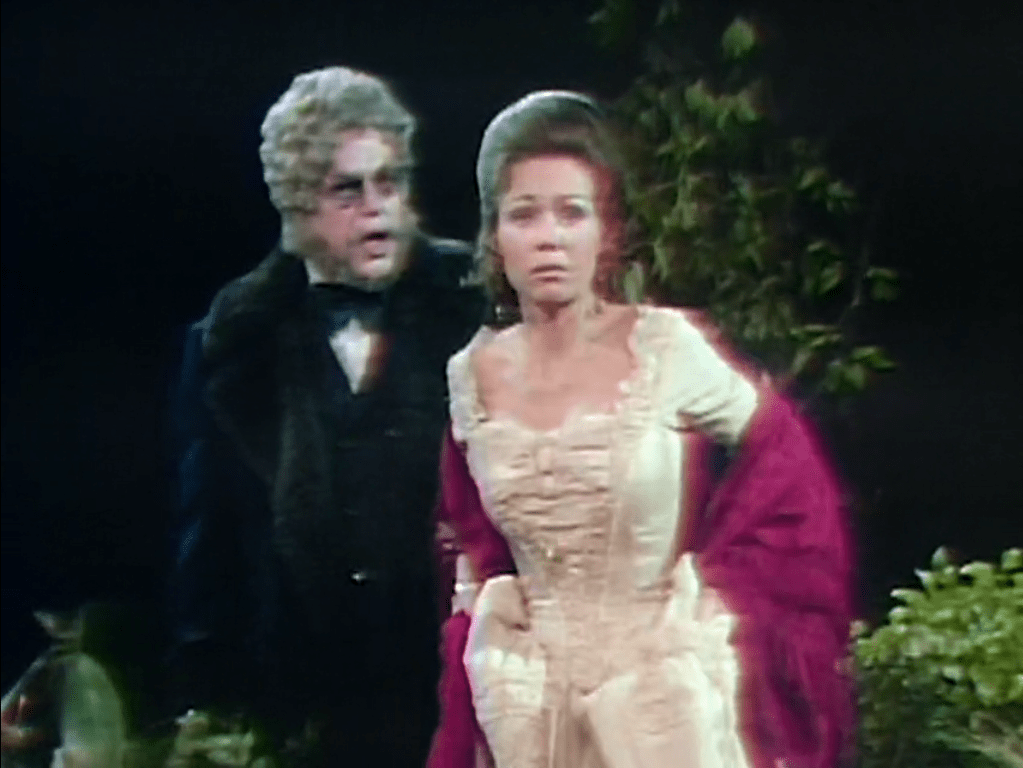
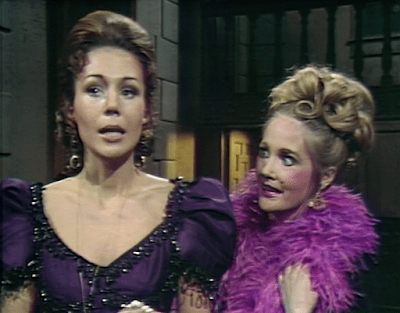
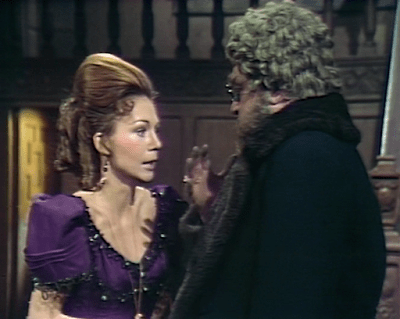
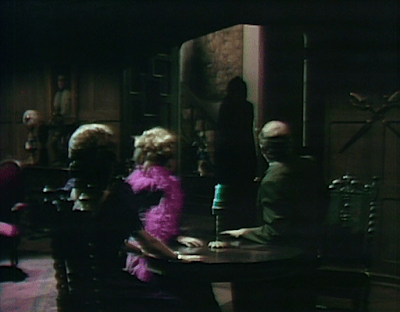
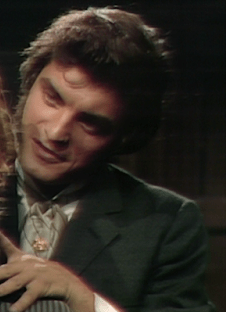
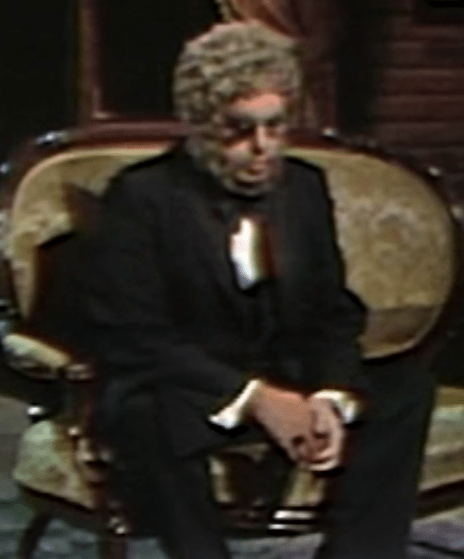
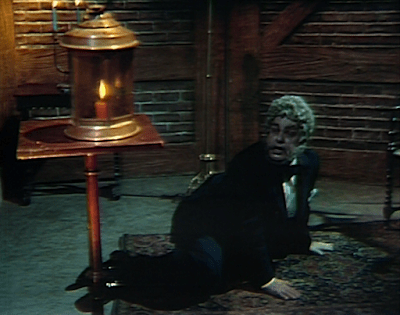
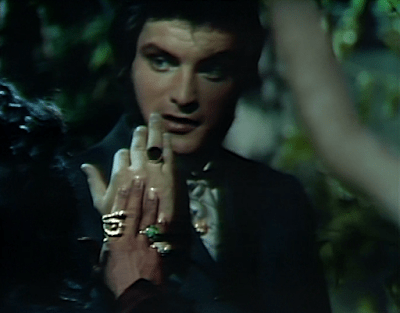
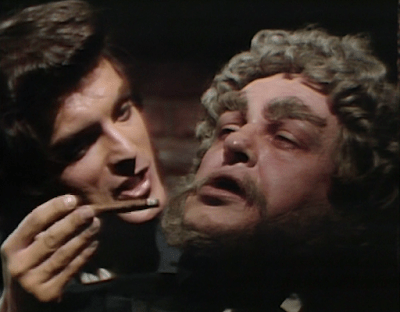
Twenty-eight weeks ago, the ghost of Quentin Collins had made life intolerable on the great estate of Collinwood. Recovering vampire Barnabas Collins, in an attempt to contact Quentin and persuade him to make peace before his haunting killed his twelve year old great-great-nephew David Collins, accidentally traveled back in time to 1897, where he met and befriended the living Quentin.
In that time, he learned that Quentin was a werewolf. In 1969, Barnabas and his friend Julia Hoffman, MD, had been trying to cure a man named Chris Jennings of lycanthropy. Now, Barnabas has figured out that Chris inherited his curse from Quentin, whose infant daughter Lenore will grow up to be Chris’ grandmother.
Julia herself has now traveled back in time. The journey left her dazed and, astonishing to behold, unable to speak. Today, Barnabas and Quentin at her bedside in the hiding place Barnabas has found, and she started talking. She has a vision of 1969. She sees David lying dead and his father Roger mourning him. Suddenly David comes back to life and announces that Quentin’s ghost and that of maidservant Beth are no longer haunting the house. When Julia regains her senses, she tells Barnabas that this means that they should both go back to 1969- their mission in the past is complete.
Barnabas declares that they cannot leave, because Chris is still a werewolf. He doesn’t actually know this. Chris wasn’t in Julia’s vision. His transformations became more frequent and longer lasting as Quentin’s ghost gained power; when Quentin achieved total control over the great house at Collinwood, Chris took on wolf form permanently. For all Barnabas knows, the end of Quentin’s obsession of Collinwood might mean Chris’ return to normal. He also knows that Quentin himself remained human the last time the Moon was full, suggesting that something has happened to the curse. Perhaps if they return to their own time, he and Julia will find that Chris is not a werewolf and never was one.
Barnabas tells Julia that, while she and a fellow mad scientist had managed to free him of the effects of vampirism in the 1960s, he is fully subject to them in 1897. Moreover, everyone knows that he is a vampire, and he is being hunted. And there is an evil sorcerer in the area, Count Petofi, who is closely connected with Quentin and who has malign intentions towards Barnabas. Julia points out that all of these are reasons to return to 1969 at once.
Barnabas demands that Julia develop a treatment that will once more put his vampirism into remission. Julia calls this impossible. The drugs and devices she used to accomplish this in the 1960s have not yet been invented, and even in that time she was just barely able to make the treatments work. In the story we actually saw in 1968, treatments of the kind Julia is talking about worked only for a little while, and the lasting cure came only when Barnabas was hooked up to a Frankenstein’s monster. There clearly is no time to create an abomination of that kind.
But there is no reasoning with Barnabas. Julia concedes this- “I always lose with you, don’t I?” She agrees to stay and to do her best.
Barnabas suspects that Quentin is working for Petofi. This is true. Not only did Petofi save Quentin’s life yesterday, but he also arranged the painting of a portrait which, like the one in Oscar Wilde’s Picture of Dorian Gray, changes while Quentin remains the same. When Quentin realizes that Petofi has the power to make him human or return him to lycanthropy, he caves in to his demand that he act as his spy in his dealings with Barnabas.
Julia has managed to concoct an injection for Barnabas and is planning to give him another when he insists on rushing out. She says this will ruin the treatment; he says he will be back before dawn.
Barnabas goes to see Quentin. He finds the portrait, puts two and two together, and confronts Quentin about his relationship with Petofi. Quentin lies, and Barnabas goes back to the hiding place. It has been ransacked, and Julia is gone.
In #836, the ghost of maidservant Beth Chavez appeared to Julia Hoffman in the year 1969. Beth told Julia what happened on the night in 1897 when she shot the rakish Quentin Collins to death.
Regular viewers would have recognized the events Beth described as different from what would have happened when Quentin originally died in 1897. For the last 28 weeks, the show has been set in that year because Julia’s friend, recovering vampire Barnabas Collins, accidentally traveled back in time while trying to figure out why Quentin had become a ghost bringing death and misery to everyone on the estate of Collinwood. In 1897, Barnabas met the living Quentin and befriended him, but also changed the history of the period substantially. So a wicked witch named Angelique, who was not at Collinwood the first time through 1897, is there on this iteration of events. Beth’s night took the turn that would lead her to shoot Quentin when Angelique told her that her engagement to Quentin was off and that Angelique would be marrying Quentin instead.
After Beth told her what happened in the latest version of 1897, Julia herself traveled back in time, determined to rescue both Quentin and Barnabas. Once she got to her destination, she was too dazed to speak. But Quentin found a letter in her pocket that Barnabas had written, and it led him to Barnabas. Barnabas was able to tell Quentin that he was fated to be killed tonight, after his nephew Jamison rejected him. He had no more to tell him, nor could he restore Julia’s ability to speak.
We open today with Quentin holed up in his room, waiting for midnight to come and go. Sorcerer Count Petofi knocks on his door; Quentin jumps to the conclusion that it is Petofi who will kill him. In fact, Petofi has learned of Quentin’s current fate, and offers to help save him. Quentin has ample reason to distrust Petofi, and refuses the offer.
Jamison then knocks. Quentin lets him in; the two have a happy talk about how much they enjoy each other’s company, and Quentin decides he won’t stay in his room after all. This leads directly to the reenactment of the scenes Beth had described, including Beth’s conversation with Angelique, Jamison’s discovery of Beth in the act of attempting suicide, Jamison’s consequent rejection of Quentin, and Beth’s pointing a loaded pistol at Quentin while she declares that she has decided to kill him.
Quentin’s time in his room shows that his behavior afterward is the direct result, not only of Barnabas’ intervention, but of Julia’s as well. So what we are seeing today is not what happened the first time through 1897 or the second, but is yet a third version of events. It does end quite differently- Petofi turns up in the nick of time and prevents Beth from shooting Quentin. The whole basis of the fantasy of going back in time to change events is the experience of rewriting stories, of what fandoms call “retroactive continuity” (“retcons” for short.) In the contrast between the two versions of the night of 10 September 1897 that Dark Shadows shows us, and in the contrast between each of those and the original events that we never saw, the story merges into the process of writing the scripts, and the characters explicitly create their own retcons.
Petofi tells Beth that she ought to leave Collinwood at once and go as far away as possible, because “Your part in this drama is ended.” The incorporation of retcons as an overt story element shows that metatheatricality can be fun, but I have to say it was pretty cold of Dan Curtis to delegate the job of firing actress Terrayne Crawford to the character Petofi.
Count Petofi tells Terrayne Crawford she won’t be getting another contract.
Petofi then goes to Quentin’s room and tells him the price for his services- Quentin must betray Barnabas. Quentin resists this demand until Petofi shows what else he has already done for him. Petofi commissioned a portrait of Quentin. Quentin saw the portrait the other night when there was a full Moon, and he was horrified by what he saw. The portrait bore, not his usual features, but those of a wolf. Since Quentin is a werewolf, he thought the portrait was a cruel reminder of his curse. But when Petofi bids him look at the portrait again tonight, Quentin sees his accustomed face. Petofi explains that the reason Quentin remained human that previous night was that the portrait changed, and that as long as the portrait remains intact Quentin will be free of the effects of the curse. Quentin’s blissful reaction to that news suggests that Petofi was right to tell him that he belonged to him now and would be able to refuse him nothing.
Sadly, this episode marks the last appearance of the character Jamison Collins. David Henesy plays the same scenes with the same dialogue he had on Monday, but he did a great job then and does an equally great one today. He’ll be back tomorrow for a brief appearance as his 1960s character, David Collins, then will be absent from the cast for almost 11 weeks. We’ll miss him while he is away.
It is 8 September 1969, and the ghost of Quentin Collins has rendered the great house of Collinwood uninhabitable. The family, including permanent house guest Julia Hoffman, have been staying at the Old House on the estate while recovering vampire Barnabas Collins is on a trip back in time to 1897, when Quentin was killed and the trouble started. But Julia has received a letter Barnabas wrote to her in September 1897 indicating that, as of that date, his mission was about to end in total failure, and so she decides to take matters into her own hands. First, she must learn exactly how and when Quentin died.
Julia goes to the great house and follows the sound of Quentin’s theme song to the tower room. There, she finds the ghost of maidservant Beth, who was one of Quentin’s many lovers. When Beth is in a shadowy corner, she puts on a ghostly voice and tells Julia that her name would mean nothing to her. As soon as she comes into the light, Julia says that they’ve met several times, and soon she is calling her by name. Along with the fact that, as Beth, Terrayne Crawford is just standing there in the same light as Grayson Hall, with no practical effect whatsoever to suggest ghostliness, this deflates whatever feeling we are supposed to have that we are witnessing an encounter with the supernatural.
Julia insists Beth tell her how Quentin died. When the ghost of Barnabas’ nine year old sister Sarah Collins was on the show from June to November 1967, she would often insist on the Ghost Rules and vanish if people put direct questions to her. But Beth just wanders around a little, moans to Quentin that she has no choice but to tell Julia what she wants to know, and starts dishing. Again, they aren’t making ghosts like they used to.
Beth tells Julia that on 10 September 1897, she found out Quentin was going to marry a woman named Angelique. Quentin did not tell her this news himself; he left it to Angelique to do so, making the blow fall all the more heavily. This will remind longtime viewers of #392, when Barnabas could not bring himself to tell his ex-fiancée Josette that he was engaged to Angelique, leaving Angelique to tell Josette herself in #393. Josette waited until #425 to leap to her death from the cliff at Widows’ Hill, but things move faster now. Beth went straight from her conversation with Angelique to her room, where she had a bottle labeled “Poison.”
Sensible shopper that she is, Beth buys her poison in the Generic section of the murder weapon store. Screenshot by Dark Shadows Before I Die.
Before she could do away with herself, Beth was interrupted by a knock on the door from twelve year old Jamison Collins. Jamison came in to show her a puzzle he had solved, then saw the bottle. He demanded to know what was going on, and she admitted that she was planning to kill herself because Quentin was going to marry Angelique. He stopped her doing that, but after he left to confront Quentin she took a loaded revolver out of her dresser.
Jamison found Quentin in the drawing room, in Angelique’s arms. Angelique at first dismissed Jamison, saying that his uncle was too busy to speak with him, but Jamison held his ground and insisted on seeing Quentin alone. Quentin obliged, but would answer Jamison’s questions only with airy assertions that he is too young to understand the situation. Jamison is so composed and forceful, and Quentin’s behavior is so flagrantly irresponsible, that we might expect Jamison to ask to be spared lectures on maturity from a man so much more childish than he. Instead, Jamison simply becomes angry and tells Quentin that after what he has done to Beth, he wants nothing more to do with him.
In #767, Jamison had a dream in which Quentin’s ghost said that his death was preceded by three events. The first two events happened shortly after. The third event was that Jamison rejected him. This has now happened, and in the dream Quentin said that once that took place “There was almost no time left for Quentin Collins.” Indeed, shortly after Jamison stalks off Beth shows up with her revolver and shoots Quentin. He staggers from the drawing room and goes upstairs. Since the staircase is made of eleven steps and is eight feet tall, that’s some pretty fancy staggering for a man who has just taken a round to the midsection. Quentin keeps staggering all the way to the tower room, where Beth shoots him a few more times.
We cut back to 1969, where Beth tells Julia she killed herself the day after she killed Quentin. She doesn’t seem to be done talking when Julia excuses herself. Say what you will about Sarah, she always left them wanting more.
Julia finds twelve year old David Collins, Jamison’s grandson, in the drawing room with Quentin’s ghost. Since Barnabas took us back in time with him in #701, we’ve got to know the living Quentin quite well, and he is a charming rascal who has very little in common with the silent, family-annihilating ghost we saw late in 1968. Beth’s story does very little to explain how the one turned into the other. The ghost has been draining the life from David; Julia orders David to come away from him, and he does. David lies down on the couch, and Julia examines him. She finds that he is weak, but resting comfortably.
Occult expert Timothy Eliot Stokes enters. Quentin’s ghost has vanished. Stokes calls Julia by her first name, something he had not done prior to this episode, and asks after David. She at first says he will be all right, then checks on him again. She cannot find a pulse, and declares him dead. Julia has performed wonders in her work as a medical doctor, but her death pronouncements are so often wrong that this does not give much grounds for alarm. However, we then hear Quentin’s voice laughing maniacally, darkening David’s prospects.
Terrayne Crawford seems to be such a nice person that it distresses me to point out that she was not a very good actress. But in this one, Beth’s lack of supernatural quality and Julia’s bland reaction to her make it seem like writer Gordon Russell and director Lela Swift were conspiring to vent their exasperation with Miss Crawford’s limits. She can play one emotion at a time, so that when Beth is shocked to learn that Quentin is going to marry someone else she is only and entirely Shocked. When Beth is suicidal, she is only and entirely Sad; when she decides to take Quentin’s life instead of her own, she is only and entirely Gleeful; when she tells Julia that her vengeance did not relieve her sorrow over Quentin, we can see that’s true, because she is only and entirely Sorrowful. The result is like looking at a series of wood block cuts illustrating various emotions. It’s all very clear and quite vivid, but there’s no sense of development from one scene to the next. Had Miss Crawford been able to lay one emotion over another and play two or more of them at a time, the grin on Beth’s face when she kills Quentin would have shown us that all the layers of complexity of feeling had finally been stripped away and only hatred was left. That would have been a tremendous climax for the character. But since there was never any such complexity to start with, it’s just another block cut.
Often when I see disappointing performances on Dark Shadows, I think of other actors in the cast and try to imagine what they would have done with the part. Gail Strickland, like Miss Crawford, is a tall, thin woman whose chin juts out on a horizontal line, and she was on the show as doomed schoolteacher Dorcas Trilling for a couple of episodes in May. Dorcas’ role would have been well within Miss Crawford’s competence, and in her long and distinguished career Miss Strickland proved she could do just about anything. So on a day like this, I envision a different, much more nuanced Beth. The episode in my imagination is really stellar, I wish you could see it.
Today, David Henesy plays both his 1897 character Jamison Collins and his 1960s character David Collins. He is not credited for either of those roles, but for Daniel Collins, whom he played when the show was set in the 1790s back in late 1967 and early 1968.
There once was a woman named Miss Charity Trask. Charity was desperate to please her father, the hypocritical and overwhelmingly evil Rev’d Mr Gregory Trask. She faced the world as Trask’s enforcer, and was herself so fiercely repressed that she drained the joy out of every group she joined.
There is no longer such a person as Miss Charity Trask. Sorcerer Count Petofi caused the spirit of the late Pansy Faye, Cockney showgirl and fake psychic, to take up residence in Charity’s body. Charity/ Pansy still lives in the great house of Collinwood, of which Trask has established himself as master, but since her only functioning mind is that of the deceased Pansy, she doesn’t understand why people insist on livenaming her.
Charity/ Pansy enters the drawing room and finds Amanda Harris. Amanda greets her as “Miss Trask,” alienating her at once. Charity/ Pansy demands to know what Amanda is doing at Collinwood. Amanda says that she lives there as Trask’s guest. Charity/ Pansy calls for Trask. She leans out the door of the drawing room and in the loudest, harshest voice Nancy Barrett could manage shouts “Hey, Trask! Trask!” It takes Trask a moment to answer, perhaps because Jerry Lacy had the same trouble we had while watching and couldn’t stop laughing. It is one of the top ten intentional comedy moments in the series, maybe top five.
“Hey TRA-A-ASK! TRASK!”
Charity/ Pansy can see that Trask has designs on Amanda, as can everyone else. But she doesn’t care about that. She is convinced Amanda has come to the house to seduce rakish libertine Quentin Collins, whom she herself is determined to marry.
Amanda had no such plans when she first came to the house, but she meets Quentin today, and a few minutes later they are locked in a passionate kiss. Trask surprises them, and declares that he will protect Amanda from her weaknesses.
For his part, Quentin is busy trying to figure out what is happening to him. He is a werewolf, and there is a full Moon tonight, yet he did not transform. He finds a portrait in his room. It bears a plate with his name and the current year- “Quentin Collins, 1897.” But it depicts him as he is when he is in his lupine form. He knows that it is the work of artist Charles Delaware Tate, and goes to confront Tate in his studio in the nearby village of Collinsport.
Quentin handles Tate roughly and demands to know why he painted a wolf on the canvas with his nameplate. Tate says that Charity saw the painting and thought it looked like a wolf, but that when he looked at it himself he saw only Quentin’s face. Quentin takes Tate to his room and shows him the painting; Tate is shocked to see that it is, indeed, the wolf.
Tate gets another shock before he leaves the house. He meets Amanda, and Trask asks him to paint her portrait. Tate has never seen Amanda before, but he has painted her many times. Returning viewers know that Tate’s painting abilities are a gift from Petofi, and that with them comes the power to conjure into existence that which he paints. Amanda is Tate’s creation.
Tate doesn’t want to accept this fact, and so he flees the house. He rushes back to his studio, and tries to take his mind off what is happening by sketching a still life. He adds an imaginary vase to the arrangement of fruit on the table before him. To his dismay, the vase materializes.
Tate painted Amanda into existence two years prior, and has been working steadily as a visual artist since. So you might wonder why he is only now noticing that things pop into being when he draws or paints them.
One possible explanation that comes to mind is about Petofi, the source of Tate’s abilities. Petofi’s right hand was cut off a hundred years ago, in 1797, and most of his power went with it. He was just recently reunited with the Hand. It once more grows from his wrist, and he is restored to his former might. Perhaps when Petofi first gave Tate his abilities, he could give him just enough to create Amanda and a great deal of commercial success. But now he is stronger, and perhaps Tate is stronger too. Petofi had better hope Tate doesn’t think of painting a picture of an avenger putting him to death for the many crimes he has committed against the Rroma people.
Sorcerer Count Petofi enters the great house of Collinwood, carrying a large painting covered with a cloth. He finds the hypocritical Rev’d Gregory Trask, who is at the moment master of the house, standing in the drawing room, dazed. Petofi realizes that Angelique the witch cast cast a spell on Trask, and that this spell is part of her effort to obstruct his own evil plans.
Petofi meets broad ethnic stereotype Magda Rákóczi in the foyer. He forces her to tell him that Angelique is upstairs, in Quentin Collins’ suite. He exits, taking the painting with him.
Angelique is casting a spell, ordering Trask to point a revolver at his temple. She is about to make him squeeze the trigger when Petofi surprises her. He overpowers her, both physically and in terms of the spell, and frees Trask.
Quentin is in the prison cell in the basement. Together with the scene between Petofi and Angelique, this circumstance will ring bells for longtime viewers. We first saw this cell in #401, when the show was set in 1795. In that part of the series, Thayer David played much-put-upon indentured servant Ben Stokes, who was a plaything in Angelique’s hands. Ben was the first prisoner confined to the cell, when haughty overlord Joshua Collins was punishing him for some or other things he had been powerless to prevent. Now, the dramatic date is 1897, and the same actor is playing Petofi, who stands at the opposite extreme from Ben. Angelique is not much better able to resist Petofi than Ben had been to resist her, and so far from being a place where he will be imprisoned the cell is just another place for him to exercise his power over everyone else.
Quentin is in the cell because he is a werewolf, and this is the night of a full Moon. The closing cliffhanger comes when Trask, released from Angelique’s spell, comes and tells him he will watch him transform into the animal, then go get the police.
We open in the woods on the estate of Collinwood, where a young woman in heavy makeup and bright clothing is crying. Another woman in even heavier makeup and even brighter clothing approaches and asks her what is wrong. The first woman says that she had a vision which told her that the rakish Quentin Collins will die of stab wounds twelve days from now, on 10 September 1897.
The first woman used to be Charity Trask, the miserably repressed daughter of the evil Gregory Trask. She is now possessed by the spirit of Cockney showgirl Pansy Faye. Charity knew that Quentin was a werewolf, and wanted nothing to do with him. Evidently Pansy did not acquire that knowledge when she took up residence in Charity’s body, and has decided that she will marry Quentin. Quentin has no interest in either Charity or Pansy, and already has two other fiancées, one of whom he loves, at least after his fashion, and the other of whom is sealed to him by a pact with the Devil. Yesterday Charity/ Pansy learned of the second engagement, and tried to kill Quentin to prevent it coming about; week before last, she tried to end the first engagement by killing the fiancée. Pansy had her faults, but she wasn’t inclined to physical violence. That part seems to be Charity’s contribution to the symbiont.
The other woman is broad ethnic stereotype Magda Rákóczi. Magda was the one who made Quentin a werewolf in the first place. She cursed him for murdering his wife Jenny, who was her sister. It was only after she had placed the curse that Magda learned that Jenny had given birth to Quentin’s twin children, a boy and a girl. Since the curse is hereditary, Magda is now desperate to lift it, and she and Quentin have become allies.
Some time ago, we learned that if Quentin dies, there will be no hope of lifting the curse. So Magda is terrified when Charity/ Pansy tells her of her vision of Quentin’s death. She takes her back home to the great house on the estate, where her father and Quentin are bickering while they recap yesterday’s story. Trask tries to deny that Charity/ Pansy is insane or that she is capable of killing, but when she enters and announces that she will murder the first person who comes between her and Quentin he has to admit that it might be time to find a place for her in residential care.
We turn our attention to the upstairs of the great house. We see Charity/ Pansy in bed, with Magda sitting in a chair beside. The gramophone is playing a record of Pansy Faye’s theme song. Regular viewers will wonder where Charity/ Pansy could possibly have found such a thing. Charity never met the living Pansy, who was killed the very evening she arrived at Collinwood. Perhaps Pansy’s fiancé, the childlike Carl Collins, bought the record when he met Pansy in Atlantic City and brought it back with him. Carl himself was killed well before the possession began, but perhaps Charity or Charity/ Pansy found it among Carl’s effects.
Charity asks Magda if she likes the tune. “I only like Gypsy music,” she replies. Charity/ Pansy and Quentin both reiterate their theme songs endlessly, but few other characters in the 1897 segment have so much as a dedicated entrance cue. This line of Magda’s makes us wonder what the show might have been like if they had given every major character a theme song.
Trask has a crisis in the drawing room. He hears a ghostly voice warning him that there will be another killing soon. He starts shouting the name “Minerva!” and pleading for mercy. First time viewers might not know what to make of this. Those who have been with the show for a while know that Minerva was Trask’s wife and Charity’s mother, and that he instigated a plot to murder her so that he could marry wealthy spinster Judith Collins and become master of Collinwood. When the voice starts to talk about “the beast that walks like a man,” Trask says “You’re… not Minerva?” Jerry Lacy is an expert comic actor, and his delivery of that line is laugh-out-loud funny.
The same ghost appears visibly to Quentin in his room. He recognizes it as that of Tessie Kincaid, a woman he killed in a recent fit of lycanthropy. He knows that she is appearing to him because tonight there will be a full Moon.
Magda enters and finds Quentin writing a suicide note. She tells him he must not kill himself. She chains him to a post in his room and stands by with a pistol. Trask enters and finds them in this compromising position. Mrs Acilius and I laughed as we imagined how Magda and Quentin might have claimed they were planning to spend the evening.
But there is no point in lying to Trask. Between what Tessie’s ghost told him and what he overheard while eavesdropping on a conversation Quentin and Magda had earlier in the drawing room, he has figured out Quentin’s problem. He takes the gun from Magda and recognizes the bullets with which it is loaded as silver. He announces that he will wait until the Moon rises and see what happens.
Tessie’s turn today marks Deborah Loomis’ third and final appearance on Dark Shadows. Miss Loomis didn’t get to do very much, but she made the most of all of it, and I wish we had seen more of her.
The dramatic date is 28 August 1897. On 23 July, in #803, sorcerer Count Petofi cast a spell on stuffy Edward Collins. Ever since, Edward has believed he was a valet recently separated from the service of the Earl of Hampshire. This led Edward’s brother, the rakish Quentin, to follow the Collinses’ long-established procedure for responding to mental illness and lock him up in the room on top of the tower in the great house of Collinwood.
In #816, broadcast on 11 August 1969 and therefore set on 11 August 1897, Petofi brought something even stranger on Edward’s twelve year old son Jamison. He called the spirit of Jamison’s grandson David to project itself from 1969 and to take possession of Jamison. In 1969, David is deathly ill because Quentin’s ghost had besieged him and everyone else at Collinwood. Now, Jamison too is dying, and in the moments he has been able to speak he has let the living Quentin in on the fact that he will eventually become a family-annihilating ghost.
Wicked witch Angelique has made a bargain with Quentin. She will try to restore Jamison and Edward to their usual selves, and if she succeeds Quentin will marry her. We see her beside Jamison, talking earnestly with him, praying loudly to “the Master of Darkness” to cure him and Edward so that she and Quentin can devote themselves to the service of that supernatural personage. In 1968, when the show was in contemporary dress, Angelique and others used a lot of euphemisms like “Master of Darkness,” but lately the ratings are high enough that the ABC network’s office of Standards and Practices has been letting them say the name “Satan.” I suppose Angelique’s persistence in the former phrasing shows that she’s still devoted to the old time religion.
Satan comes through, and Jamison and Edward are freed. This leads to a bit of awkwardness in each case. Quentin and Edward’s step-niece Charity Trask has lost her personality as the result of another of Petofi’s spells, and is now hosting that of the late Pansy Faye, Cockney showgirl and onetime fiancée of Quentin and Edward’s late brother Carl. Charity/ Pansy is exploring the great house when she comes to the locked door of the tower room. She hears Edward inside calling for help. He is still in his valet persona, and he is delighted with her when she promises to get a key and let him out. Edward returns to himself, with no memory of anything that has happened since 23 July, while Charity/ Pansy is away. When she comes back up and opens the door, she finds that he is in a foul mood and that he disapproves of her intensely. She is understandably miffed at his apparent fickleness and ingratitude.
For his part, Jamison’s quite different experience has left him with some memories. He tells Angelique of images that are floating around in his mind. She recognizes them as things associated with Petofi, and is distressed. She tells him he is better off not knowing what they are. Quentin is more distressed when Jamison looks at him and asks why he is trying to kill David Collins. Jamison can’t explain who David Collins is or how he learned that Quentin was trying to kill him, but this does confirm everything Quentin has gathered about his post-mortem destiny.
While Edward comforts Jamison in the study, Quentin and Angelique meet in the drawing room. She asks if he will honor his end of their deal; he says that he will, though he makes abundant protests about his reluctance to do so. Charity/ Pansy eavesdrops at the door. She has decided that she will marry Quentin, and is horrified to hear this conversation.
Edward enters and asks Angelique to excuse him and his brother. She exits, and Edward declares that the first order of business must be to hunt and destroy vampire Barnabas Collins. Quentin is appalled at this. He tries to tell Edward that Petofi is their most immediate threat; after he explains who Petofi is, Edward agrees that they will get around to fighting him at the appropriate time, but he insists that Barnabas is their main concern.
Edward exits, and Charity/ Pansy enters. She tells Quentin that she overheard his conversation with Angelique. She says that he will not marry Angelique. Quentin bitterly responds that he will, and that there is nothing she can do to stop it. At this, Charity/ Pansy picks up a knife and tries to stab Quentin. Quentin holds her at bay, and Edward enters in time to see what is happening and to get Charity/ Pansy off of Quentin. Quentin says that Charity/ Pansy’s condition is further evidence of the need to focus on fighting Petofi, but Edward will not swerve from his determination to concentrate on Barnabas. Moreover, he decides that he will now quiet Charity/ Pansy himself. He sends Quentin out of the room and prepares to give Charity/ Pansy a stern talking-to.
Charity/ Pansy’s attempt to prevent Quentin’s marriage to Angelique by stabbing him is of a piece with her attempt to break up Quentin’s relationship with maidservant Beth in #823/824 by poisoning Beth’s brandy. The original Pansy, whom we saw as a live person in #771, was not exactly nice. She was cold, hard, and cynical, trying to exploit the childlike Carl. But she didn’t seem to be bent towards physical violence. That appears to be Charity’s contribution to the composite being that the two of them now make up.
Before Edward can deliver whatever lecture he had planned to give Charity/ Pansy, she goes into a trance. The live Pansy had done a stage act as a “mentalist” and fortune teller, and was astonished in #771 when she tried to do her act at Collinwood and found herself actually channeling spirits from the great beyond. Now Charity/ Pansy routinely acts as a medium.
Charity/ Pansy announces that something terrible will happen on 10 September. Countdowns don’t usually work as a source of suspense on soaps. They might be all right in a play or a feature film, where we know that there will be a final curtain or a last frame after which the imaginary universe will cease to exist, but so long as the series is scheduled to come on every weekday at 4 PM, we know that there is always going to be room to move any deadline a little further out. Besides, since Dark Shadows was done virtually live to tape, they could rarely predict with any accuracy just how many ticks of the clock it would take to get all the movements made and dialogue spoken before the crisis is supposed to be reached. But “10 September” is in a slightly different category. Quentin explicitly says on screen that today is 28 August, which was indeed the original broadcast date in 1969. And when Edward says that his last memories are of 23 July, he is indeed referencing the original broadcast date of #803. So when Charity/ Pansy says “10 September,” she is committing the show to something in the real world. We may well sit up and take notice.
Charity/ Pansy has a vision of what will happen on that date. She sees Angelique looking at a portrait of Quentin in the drawing room. Red paint is dripping from the figure’s chest into a pool on the floor. That pool is next to a trail of other drops of red. In her mind’s eye, Charity/ Pansy follows the drops into the foyer, up the stairs, and into the tower. There, she sees Angelique opening the door to the tower room and finding Quentin sprawled, a sheet of red plastic, or perhaps construction paper, on his chest. Charity/ Pansy screams and runs out. From the dramatic music and Charity/ Pansy’s agitated reaction, I take it the object lying on Quentin’s chest is meant to suggest blood.
The acting is all very strong today. I was fascinated with Nancy Barrett’s use of her face to highlight Charity/ Pansy’s makeup. She relaxes her jaw muscles slightly more than usual, causing the dark treatment around her eyes to stand out. That in turn creates a visual metaphor labeling Charity/ Pansy a “painted lady.”
My wife, Mrs Acilius, was particularly impressed with Louis Edmonds’ realization of Edward. When the spell breaks and he becomes himself again, Edward is alone in an empty room. He has no dialogue, no props, and no scene partner to work with. Yet he instantly conveys what has happened. Even first time viewers will understand that the obliging servant has now become a stuffy authority figure.
Edward’s towering indignation when Quentin first tells him he was the one who locked him in the tower room gives way instantly when Quentin explains that he was under a delusion at the time. Edmonds executes that transition so smoothly that first time viewers will not notice the oddness of it, but longtime fans who remember the many previous occasions when the Collinses locked each other there as a response to mental illness will chuckle.
One of the prominent features of Edward’s personality is his warm relationship with his children. This sets him apart from the first two characters Louis Edmonds played on the show, high-born ne’er-do-well Roger Collins and haughty overlord Joshua Collins. Edward’s dialogue in his scene alone with Jamison involves several discrete points of information, and it would have been understandable if the affection he displays for Jamison while he getting all of those words across had been either perfunctory or mawkish. But he and David Henesy get the emotions exactly right while also delivering the lines very clearly.
Edward’s preoccupation with Barnabas is a delicious little bit of commentary on the show itself. Dark Shadows‘ ratings, chronically low during its first 42 weeks on the air, perked up when it added Barnabas to the cast in April 1967. That summer, schoolkids curious to see a vampire on daytime TV made it into a hit, and not long after Barnabas became one of the pop culture sensations of the 1960s, instantly recognizable to many millions of people who never watched the show. To this day, people who have heard of Dark Shadows are likely to refer to it as “the vampire soap opera from the 60s.” It was Barnabas who took us with him to 1897, when he traveled back in time in the course of his attempt to rescue David from Quentin’s ghost, and for the first months of the 1897 storyline he was the only character who knew what was at stake for the 1969 version of the Collinses in the events going on around him.
But now Barnabas is on the fringes of the story, and Quentin, Angelique, and Petofi all know about 1969. Edward’s idea that the action has to focus on Barnabas is evidence that he hasn’t been watching the show. Petofi is the principal antagonist now, Quentin the chief protagonist, and Barnabas can be absent for weeks at a time while they and others find all sorts of things to do. This represents, not Barnabas’ failure, but his ultimate success. Before he was introduced, every story revolved around well-meaning governess Vicki, the main character. A soap opera can’t really have a main character. It needs to keep multiple storylines running at once, occasionally intersecting with each other, often running for long periods with little or no interaction. When one person had to be at the center of every development, the result was slow and claustrophobic.
Barnabas blew that confining structure open, because as a vampire his function in the story was not to solve problems, but to create problems for other people to solve. So no matter how much time they spent focusing on him, he always directed our attention towards everyone else. We wondered who would catch on to his secret, who would fall victim to his malign intentions, who would find a way to fight him, etc. When a mad scientist managed to free Barnabas of the effects of the vampire curse, he retained his function as a problem-maker, even when he set out to be a problem solver. Every time he announced that he had a plan, we looked forward to seeing how the rest of the cast would react to that plan’s rapid and catastrophic collapse.
Barnabas is as hapless in 1897 as he has been in every other time period, as witness the fact that he has been exposed as a vampire and driven into hiding. But he isn’t even the show’s Screw-Up-in-Chief now. That title belongs to broad ethnic stereotype Magda Rákóczi. In #807, Petofi compelled Magda to review the preceding 22 weeks of the show and admit that she had precipitated every plotline. The first of those was the release of Barnabas into the world of 1897, so that his crimes and misadventures are just a subcategory of hers. Since Magda is played by Grayson Hall, who in her original role of Julia Hoffman is waiting for us in 1969, we can be confident she won’t be coming back to contemporary dress with us, but for the moment she has relegated Barnabas to the status of a secondary character.
In 1897, King Johnny Romana is the hereditary chieftain of a Rroma tribe that has long been at war with ancient sorcerer Count Petofi. King Johnny is at the supreme moment of his destiny, standing over Petofi with his scimitar raised, ready to deal the ultimate blow, when a creepy little guy ruins it all for him. Petofi’s henchman Aristide throws a knife and catches King Johnny in the back. Aristide has a dagger with a curved blade that he sometimes calls “The Dancing Girl,” other times “The Dancing Lady”; he makes a big deal of it, the thing fascinates him. But when he kills King Johnny, Aristide doesn’t even use his special knife. It’s a brutal anticlimax for King Johnny.
King Johnny does live long enough to tell Petofi that he isn’t safe yet. After nine days pass, he will appear to another Rroma, somewhere in the world, and will pass on to that person his immunity to Petofi’s magical powers and his mission to kill him. After Aristide buries King Johnny, he finds that the scimitar has vanished. Evidently it will go to the new avenger.
Meanwhile, at the great house of Collinwood, twelve-year old Jamison Collins is dying. Petofi cast a spell causing Jamison to be possessed by the spirit of his grandson David Collins, who will live in 1969. But David won’t live at all unless the spell is broken, because it is killing Jamison. Jamison’s devoted uncle, rakish libertine Quentin Collins, makes a deal with wicked witch Angelique. He will marry her if she manages to break Petofi’s spell and save Jamison. They made a similar bargain previously, but that time her magic failed.
Petofi senses that his spells are being challenged. He marches to Collinwood and orders Quentin to make Angelique stop what she is doing. Angelique herself enters; she and Petofi confront each other, then she goes back to the study to resume her attempts to free Jamison. We end with Petofi preparing to cast a spell against her.
Petofi confronts Angelique in the drawing room at Collinwood while Quentin looks on. Screenshot by Dark Shadows Before I Die.
This is an entertaining, fast-paced episode. It’s too bad it is the final appearance of actor Paul Michael in the series. He played the most unpromising part of King Johnny so skillfully that we barely noticed he was little more than a menacing pose, an evil laugh, and an ethnic stereotype. He does return with a small part in the feature film House of Dark Shadows, but it would have been fun to see what he could do with a really meaty role.
Count Petofi, 150 year old sorcerer, is holding time-traveling vampire Barnabas Collins prisoner. Barnabas’ distant cousin, rakish libertine Quentin Collins, is convinced that only Barnabas can free him of the curse that has made him a werewolf and condemned any male descendants he may have to the same fate. Petofi is afraid of the Rroma people, a group of whom are in the area, and Quentin hits on a plan to use this fear to his advantage. He will tell Petofi that he has a confederate who will tell the Rroma where he is unless he releases Barnabas by 12:45 AM.
In fact, Quentin has enlisted his girlfriend, maidservant Beth, to carry this message to the Rroma camp. When Petofi reminds Quentin that his magical powers make it very easy for him both to compel Quentin to tell him who the messenger is and to stop any messenger once he knows her name, Quentin says there is no need to compel him to say the name. He claims that it is wicked witch Angelique.
As soon as Quentin tells this lie, we wonder why he hadn’t thought of Angelique sooner. Angelique has intervened to rescue Barnabas before, and she and Quentin are in touch. Petofi’s powers may be greater than hers, but it would take him more time to outfight her than it would for her to show the Rroma the way to his hiding place.
Petofi insists Quentin drink with him, and Quentin is too civilized to refuse. This is mirrored back at Collinwood. The repressed Charity Trask has lost her personality and became a vessel for the spirit of Cockney showgirl Pansy Faye. Charity/ Pansy insists that Beth drink with her.
While Petofi does not tamper with Quentin’s drink, Charity/ Pansy puts something in Beth’s that knocks her out. Charity/ Pansy wants Quentin for herself. She has thought of killing Beth, and knows Quentin will be upset with Beth if she disappoints him. That leaves us in suspense as to whether she murdered Beth or merely kept her from running her errand.
This diptych emphasizes Petofi’s power and Charity/ Pansy’s unpredictability. Quentin need not fear Petofi will poison him, because there are any number of more elegant ways he could kill him if he wished to do so. As another sorcerer said of himself in #528, he is much too talented to spend his time drugging drinks. But Beth should fear Charity/ Pansy, because she is still connected to the world of the living only uncertainly, and there is no telling what she might do to find her footing.
The disastrously repressed Charity Trask knows that rakish libertine Quentin Collins is a werewolf, and she wants to warn everyone about him without actually saying the facts out loud. She corners maidservant Beth Chavez in the drawing room of the great house at Collinwood and urges Beth to end her romance with Quentin.
Charity keeps saying that there is something about Quentin that Beth does not know. In fact, Beth not only knows everything Charity does about Quentin’s curse, but a great deal more. She was the very first person to know that Quentin was a werewolf, before Quentin himself knew. She was with him the first time he transformed, and when he became human again in the morning she refused to tell him what she had seen. She had previously seen Quentin murder his wife Jenny, she knows that Jenny’s sister Magda placed the curse as vengeance for that murder, and she was the one who told Magda that Jenny had borne children to Quentin who would inherit their father’s curse. Beth is the foremost authority on Quentin’s condition. But she is protecting him anyway.
Charity then goes to a set known to longtime viewers as the Evans cottage. In the parts of Dark Shadows set between 1966 and 1968, this set is home to artist Sam Evans and his daughter Maggie, The Nicest Girl in Town. Today the dramatic date is 1897, but the cottage is already an artist’s studio. It is occupied by Charles Delaware Tate, a nationally renowned painter who was commanded by the evil sorcerer Count Petofi to execute Quentin’s portrait. When we first saw Tate in the cottage, he said that he rented it because he’d heard about it from a friend who had stayed there some time before.
The cottage is full of paintings and sculptures. This is odd for a rental. Several possible explanations come to mind. Did Tate bring a dozen or more of his own works to keep him company? Did his friend or other artists who had rented it leave their completed pieces behind? Did the landlords display their own collection there for the edification of their tenants? Easy as these explanations are to think of, none of them seems very likely, and the question is never addressed in the show. The out-of-universe explanation is of course that when the audience looks at an artist’s studio, it expects to see a lot of artwork, and the artwork here gives director Lela Swift a chance to make good use of color.
At any rate, the set is gorgeous today, full of bright greens and mixed reds. Swift was a highly ambitious visual artist, and she outdoes herself here. The first shot in the cottage begins with a closeup of the portrait of Quentin. It then pulls back further than any previous shot of this very familiar set, showing us a lattice that used to be part of the set representing the kitchen/ breakfast nook area at Collinwood. Behind it is a plant with some large, intensely green foliage. We then track around the set to see several sculpted pieces in black, paintings in a variety of tones, and a whole array of vivid colors in the furniture and other decorations. Dark Shadows has come a long way from the clumsiness that marked its use of color when it first switched from black and white in #295.
Charity is unaware that she and Tate are not alone. Tate’s master, Petofi, is in the next room eavesdropping. Charity is horrified to see the portrait of Quentin, and reminds Tate that she saw Quentin’s features in the portrait change into those of a wolf when she visited the cottage on the night of a full Moon. Tate tries to convince her she did not really see such a thing, but she will not have it. Charity gives Tate a warning somewhat less incoherent than the one she had given Beth. After she exits, Petofi and Tate talk. Tate had suspected Quentin was a werewolf, and now is sure. Petofi says that his plans for Quentin are none of Tate’s concern.
Petofi goes to the great house. Quentin confronts him there, demanding to know by what gods he swears. He replies “I have but one, and his name is Petofi!” Charity sees Petofi and vehemently demands he leave. I don’t know why she does this. As far as I can recall, Charity knows Petofi only as Victor Fenn-Gibbon, an honored guest of the Collins family. He did cast rather a nasty spell on her when he was using that alias, but I don’t see why she would realize that he was to blame for it, or for any of his other misdeeds.
Whatever the motive for Charity’s angry reaction to him, Petofi responds by magically robbing her of the power of speech. When he tells her that he has a healing touch, his manner and the background music indicate that after he touches her, what Charity will say will never again be up to her.