
This is the last script that will be credited to writer Violet Welles. Welles had done a substantial amount of rewriting on scripts attributed to her friend Gordon Russell before her name first showed up in the credits with #711, and she will do more ghosting for Russell later.
Danny Horn’s post about this episode on his great Dark Shadows Every Day is a tribute to Welles; I recommend it highly. Welles was far and away the best author of dialogue among the nine writers credited through the show’s 249 weeks, so much so that her uncredited contributions are easy to recognize. I will mention a week very close to the end of the series in 1971, a long time after the wheels came off, when all of a sudden characters start making witty remarks and developing interesting relationships. Then it’s back to the dreariness of a bunch of go-nowhere stories.
Welles rated herself low as an inventor of plot-lines. I don’t know what went on during the long hours she spent in story conferences with Russell and Sam Hall, but it was when she was in the room that the most fertile planning sessions Dark Shadows ever had took place. They sketched out flimsies thirteen weeks at a time, and from the time Welles became a regular part of the staff until thirteen weeks after she left, the show was packed with more lively ideas than at any other time. So if she was correct in that harsh self-assessment of what she did in the writers’ room, it was only in the narrowest sense.
Welles also spoke disparagingly of herself as a designer of dramatic structure at the level of individual episodes, but today’s installment shows that this was simply wrong. There is a tremendous amount happening in these 22 minutes, it is crystal-clear throughout what is happening and why we should care, and the actors get to do some of the best work they ever did do. We see two stories, one a mashup of Daphne Du Maurier’s 1938 novel Rebecca with Edgar Allen Poe’s 1838 short story “Ligeia,”* the other a retelling of Robert Louis Stevenson’s 1886 novella Dr Jekyll and Mr Hyde, also with a dash of “Ligeia.”
The episode is set in a different universe than the one in which the first 196 weeks of Dark Shadows took place, and most of the characters are “Parallel Time” counterparts of those we met in the main continuity. In the Rebecca/ Ligeia mashup, we today see Quentin Collins, master of the estate of Collinwood, owner of Collinsport Enterprises, and gloomy drunkard; Quentin’s new wife, Maggie Evans Collins; housekeeper Julia Hoffman, fanatical devotee of Quentin’s late first wife Angelique; and Alexis Stokes, Angelique’s freshly arrived identical twin sister. The bit from the Jekyll and Hyde story features scientist Cyrus Longworth and attorney Chris Collins. Angelique comes up in Cyrus and Chris’ conversation, and she is emerging in the role of Ligeia. Like the eponymous character in Poe’s story, she is a celebrated beauty who is dead but expected to return. Alexis herself brings up yet another reference. She wears a short bluish gray suit and chignon hairstyle with a tight spiral twist at the back, the look that the mysterious Madeleine wore and her impostor copied in Alfred Hitchcock’s Vertigo.
Jekyll and Hyde Meet Ligeia
I’ll start with the Jekyll and Hyde story, since it is the simpler one today. Chris is the estate manager at Collinwood, and his responsibilities include custodianship of Angelique’s personal effects. His friend Cyrus has called Chris to his basement laboratory to ask for a favor. Angelique had told him about a chemist in Boston who could help him with some obscure formula he needs for his current experiments. She gave him the man’s contact information, but he lost it, and he wants to look for it in Angelique’s address book.
Before they start talking about the address book, Cyrus tells Chris that he saw Angelique in town today. He tells him he was driving past the drug store and saw her walking down the street. He called to her and she did not answer, but he is certain it was she. Chris does not yet know that Angelique’s identical twin sister is in town, so he does not tell Cyrus about Alexis. He starts with a philosophical approach, then veers towards the explanation medical:
CHRIS: Cyrus, you’re a scientist. A scientist deals in established principle and fact. One thing we have to accept is that death is the end.
CYRUS: I often wonder. People used to believe that the world was flat. They believed that, that the sun revolved around the earth, and these were facts to them.
CHRIS: Uh, what are you saying?
CYRUS: I’m saying that I saw Angelique. I saw her walking down the street.
CHRIS: Well, I wish to submit that there’s an explanation for it. All of this.
CYRUS: What do you mean by that?
CHRIS: You’ve been working yourself too hard. You’ve been locked in this laboratory for over a year. Whatever you’re doing it can’t be worth your health and your peace of mind. It might even damage your mind.
Cyrus tells Chris what he is trying to do:
CYRUS: Let me begin by saying that, that man is chemical in his composition. Now, if the proper compound was distilled, and administered to a human being, this chemical composition could be radically changed, radically altered, and I’ve been working on this composition.
CHRIS: Why, why alter a human being?
CYRUS: Now let me also say this. That man is not one person, he is two. One is good, and the other is, oh, let us say for scientific conversation, the other is evil. Now, these two people are within each of us, and they are always fighting against each other. But if these elements could be separated, just imagine the possibilities. Evil could go its own way, completely free of any aspirations or remorse that are foreign to it. And good, good can have its own life, free of any struggle against, against evil impulses or hostile thoughts. My god, just imagine what a person…
Chris is horrified by this idea, and is glad to be an obstacle to it. Director Lela Swift reinforces Chris’ conviction that Cyrus is destroying himself by placing Christopher Pennock next to a mirror during the most perfervid part of his mad scientist’s programmatic statement, a visual metaphor telling us that Cyrus is splitting himself in two.
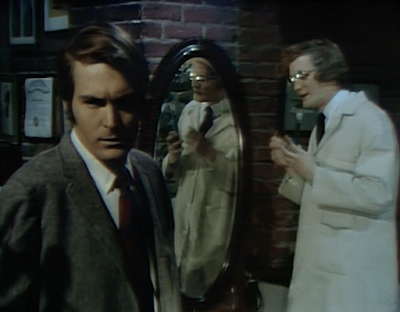
Chris tells Cyrus that he won’t help him bury himself even more deeply in the strictly private world he has created. Cyrus says that it is not private, that it is something he shares with Angelique:
CYRUS: Angelique believed in this theory. She believed it could be done. And she was the one who started me on, on all these experiments. Separating good and evil.
CHRIS: (sourly) There is no doubt in my mind which of the two appealed to her.
Chris tells Cyrus that he has been anxious to see him. He has heard that he presented a paper on black magic to a scientific society, and that the news led him to fear that Cyrus’ mind is becoming unbalanced:
CHRIS: I admire your devotion, Cyrus, but not your direction. It can only lead to trouble.
CYRUS: It can only lead to glory. And it will. Very fast, if you’ll just give me the name of that chemist.
CHRIS: No. I’m sorry to withhold it from you, but it’s the only way I can stop you. And I think I have to stop you. I desperately think that.
Angelique was not only a great beauty and a gracious matron, but was also a scientific mind who inspired Cyrus to pursue his scheme. She could introduce an experimenter to chemists whose specialties are so obscure that they cannot be found in any published directory, and her influence leads to the study of black magic and a skeptical view of the finality of death. In these matters, Angelique recalls Ligeia. The unnamed narrator of Poe’s story, Ligeia’s widower, says of her:
I have spoken of the learning of Ligeia: it was immense –such as I have never known in woman. In the classical tongues was she deeply proficient, and as far as my own acquaintance extended in regard to the modern dialects of Europe, I have never known her at fault. Indeed upon any theme of the most admired, because simply the most abstruse of the boasted erudition of the academy, have I ever found Ligeia at fault? How singularly –how thrillingly, this one point in the nature of my wife has forced itself, at this late period only, upon my attention! I said her knowledge was such as I have never known in woman –but where breathes the man who has traversed, and successfully, all the wide areas of moral, physical, and mathematical science? I saw not then what I now clearly perceive, that the acquisitions of Ligeia were gigantic, were astounding; yet I was sufficiently aware of her infinite supremacy to resign myself, with a child-like confidence, to her guidance through the chaotic world of metaphysical investigation at which I was most busily occupied during the earlier years of our marriage. With how vast a triumph –with how vivid a delight –with how much of all that is ethereal in hope –did I feel, as she bent over me in studies but little sought –but less known –that delicious vista by slow degrees expanding before me, down whose long, gorgeous, and all untrodden path, I might at length pass onward to the goal of a wisdom too divinely precious not to be forbidden!
At the end of Poe’s story, the narrator’s second wife appears to die. Her body is eventually reanimated with the personality and even in the likeness of Ligeia. Cyrus’ un-nuanced belief that the woman he saw was Angelique come to life suggests that he expects her to follow in the footsteps of that other learned woman.
There is a poignancy now in seeing Don Briscoe play Chris’ concern for Cyrus. Briscoe suffered from bipolar disorder, and was at this time trying to self-medicate with street drugs. After he was violently mugged while trying to score a fix late at night in Central Park, he wound up leaving acting and moved into his parents’ house in Tennessee. He died there, morbidly obese, at the age of 64. I suppose what Dr Jekyll wanted was to come up with a drug that could sort the contents of the mind into orderly batches, so that people like Briscoe could live the lives they deserved to live.
Ligeia at Manderley
Meanwhile, at Collinwood, Quentin has been extremely stingy with information Maggie should know, and has neglected to tell her that Angelique had an identical twin. Hoffman and others on the estate are convinced that Angelique will somehow come back to life, and in their obsession with this idea they have made Maggie exceedingly uncomfortable in her imposing new home. Making matters worse, night before last Maggie heard a voice that she can believe to have been part of a prank played on her by Quentin’s son, strange and troubled boy Daniel, but which Daniel and we have reason to believe was actually Angelique’s ghost. So when Maggie opens the doors to the drawing room and sees Quentin giving a glass of sherry to a woman who, to all appearances, can only be Angelique, she flees in panic.
Quentin goes to Maggie in her bedroom. He explains that the woman she has seen is Angelique’s twin Alexis. At first he is relaxed and soothing, as charming as the Quentin of the main continuity has always been, almost as charming as David Selby is. But as Maggie insists on being left alone, his mood darkens. Alexis sticks her head in and suggests they should clear things up right away; Quentin asks her to wait downstairs. When Maggie refuses to be formally introduced to Alexis and play hostess to her, Quentin becomes stiff, grouchy, and patronizing, ordering her to do her duty as mistress of the house. She does not bend, and he leaves the room in a huff.
Back in the drawing room, Alexis tells Quentin she ought to leave rather than go on upsetting Maggie. Quentin dismisses Maggie’s concerns and proclaims that he alone makes decisions at Collinwood. Alexis is visibly startled by Quentin’s claim to autocracy, and doesn’t know where to look or what to do with her hands as she stammers out “Of course… you… make the decisions.” She goes along with Quentin’s decree that she will stay in the house starting tonight, before she can get her luggage back from the inn in the village.
Hoffman enters. At the sight of Alexis, she gasps “It- it’s you!” Hoffman composes herself quickly, and says that Angelique often spoke of her sister. She asks Alexis if she received the letter she sent her when Angelique died. Alexis says she missed it. Hoffman had sent it to her address in Tangier, but Alexis had moved from there to Florence by that time. Alexis does not seem to be in any particular business, and she describes her decision to return to Collinsport as motivated by a vague feeling of personal obligation, so we can assume that her long stays in these famous cities are a sign that she and Angelique have private resources that amount, if not to a fortune, at least to a competence. Hoffman suggests that Alexis stay in Angelique’s old room. Quentin does not object, and Alexis agrees.
Alone in the drawing room, Quentin wishes Alexis did not resemble Angelique so uncannily. In a gruff tone, he tells himself “I’m as bad as Maggie, I’m behaving like a frightened child.” Quentin’s attitude when he was lecturing Maggie about Alexis had indeed been that of an impatient adult ordering a child to stop having an inconvenient emotion. Since he does not believe he handled that exchange badly, it’s jarring to hear him say explicitly that he saw it that way. He pours himself a stiff drink.
In Angelique’s room, Hoffman tells Alexis she doesn’t have to lie to her. She may have her reasons to pretend with the others, but with her she can talk openly about the fact that she is Angelique risen from the grave. Alexis is thunderstruck by this, and tries to reason with her:
ALEXIS: You thought Angelique would come back? But that’s impossible, she’s dead.
HOFFMAN: She is not like others.
ALEXIS: She certainly wasn’t like anyone else. Nevertheless, she is dead. Do you hear me? She’s dead, and I’m her sister.
Hoffman tries to trip Alexis up by asking which nightgown she would like from Angelique’s dresser. Alexis points out that she has never seen any of them, so she can’t very well answer. Hoffman starts to apologize for her bizarre conduct:
HOFFMAN: I’m sorry, Miss Stokes, I’m sorry if I’ve said anything–
ALEXIS: It’s perfectly all right. I can understand how much you must miss her. But I wouldn’t intimate such a thing to anyone else if I were you. They might be very distressed by it, and so might you.
This exchange is very effective, particularly for regular viewers. Up to this point, Lara Parker has been playing Alexis quite differently than she played Angelique. Even when Angelique had been defeated in a conflict or was trying to seem like a wounded innocent, she always maintained eye contact with her scene partners and found a way to put a little more drama into her voice than any other performer would have thought to do. But Alexis looks down when she is confused, talks in a soft and casual tone when she thinks she understands what’s going on, and asks questions to which she obviously does not already know the answer. We can believe she really is a different character. But her last two sentences to Hoffman are exactly what Angelique would have said. When Alexis lifts her head and delivers them with her right eye fixed on Hoffman, we are suddenly in suspense as to whether Ligeia has already returned.
On her way out of the room, Hoffman passes Maggie. Without turning to face her, she explains that Alexis is staying, at Quentin’s orders. This brief scene is blocked as an homage to Hitchcock, whose 1940 film of Rebecca will have come to mind when Hoffman mentioned Angelique’s nightgowns. The censors tried to prevent the release of that movie, because of a scene in which obsessed housekeeper Mrs Danvers took a nightgown out of a wardrobe positioned in the same spot of the late Rebecca’s room as is the wardrobe in Angelique’s. Mrs Danvers went on and on about how sheer the nightgown was, how “You can see my hand through the material,” etc. Dark Shadows isn’t quite as bold with the homoerotic subtext of Hoffman’s devotion to Angelique as Du Maurier and Hitchcock were with that of Mrs Danvers’ devotion to Rebecca, but the shot is so much in his style and the movie was so famous that a large percentage of the grownups in the audience would likely have picked up on the reference.
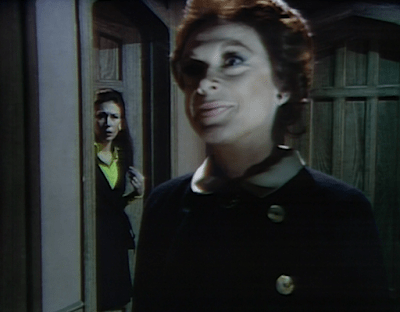
Maggie goes to the drawing room, and finds that the decanter Quentin was drinking from is empty and lying on its side. She goes to Angelique’s room. She arrives just in time to see her obviously intoxicated husband in his first wife’s bedroom, with a woman who looks exactly like that first wife who is wearing a frilly nightgown, putting her hand on his shoulder, and saying in a soft voice “Perhaps we can comfort one another.” When we saw this, my wife, Mrs Acilius, said that she would not be especially pleased if she were to find me in such a situation.
Maggie and Quentin have a showdown about this in the drawing room. It’s a sensational scene, one of the best in the series. Selby plays Quentin as a drunken, condescending grouch, trying to tell Maggie she didn’t see what she clearly saw. Kathryn Leigh Scott is spellbinding as she plays Maggie’s rage. I think it’s her best moment since #265, when the Maggie of the main continuity was a mental patient and went completely nuts while singing “London Bridge.” That, I think, was the scariest scene they ever did, making us think our old pal Maggie was never going to be all right again.
This time Miss Scott doesn’t sound like any character we’ve heard her play before. In fact, she sounds more like a real person than anyone else ever does on Dark Shadows when Quentin has forbidden her to mention Angelique’s name and she responds “You forbid me! Forbid me like a child, and I am not a child, and I refuse to be treated like a child. Not by you or by anyone. I know what I heard and I know what I saw!” At that, Maggie Collins becomes a distinct character and the Parallel Time storyline jumps to a new level.
Quentin whines that Maggie isn’t giving him a chance, and she lets him have it:
MAGGIE: Nobody’s given me a chance. No. This is Angelique’s house, not mine, you’re Angelique’s husband, not mine.
QUENTIN: All right, if that’s the way you feel about it, get out of here!
MAGGIE: All right, Quentin.
QUENTIN: Leave Angelique’s house and leave Angelique’s husband!
MAGGIE: That’s exactly what I’ll do. That is exactly what I will do!
And to Quentin’s bewilderment, that’s exactly what she does. She rushes out the front door. After a bit, Quentin staggers after her. He looks outside. Alexis comes downstairs, in her sister’s frilly nightie, and asks what happened. Quentin frets that “She actually went out that door.” Alexis asks if he is going after her, and he says “No, why should I? She behaved like a child!” He’s still holding onto the idea that it is right and proper for him to regard his wife as a temperamental child. He wonders if perhaps Alexis is right, then hears Maggie drive away and announces that it’s too late to do anything. He wanders back towards the drawing room while Alexis looks on. We are left wondering if she is Angelique masquerading as her sister, or if Alexis, contrary to appearances, was actually the Evil Twin all along.
*I am indebted to Danny Horn’s commenter “Riccardo” for pointing out the connection to “Ligeia.”
 Dark Shadows Commentary