An autumn dusk has settled over Collinwood, bringing with it not the fear of night but a renewed hope of happiness for a young woman long acquainted with the terrors that have plagued these premises. But as the deepening dark surrenders to the night, a new threat, evil in its creation and awesome in its consequence, will reveal its final purpose, the destruction of Victoria Winters.
We then cut to a scene of Vicki with the evil creation that is destined to destroy her, her fiancé Peter. In place of a personality, Peter has a compulsion to insist that no one use his right name. Instead, he wants to be called “Jeff.” He also has a habit of pawing his scene partners and occasionally jerking them around violently. This loathsome man continually fondles Vicki in their scenes together, each time prompting Alexandra Moltke Isles first to stiffen, then to force an awkward smile when she remembers that her character is supposed to like the creep. It is painful to watch, and the more scenes Vicki has with Peter/ Jeff the sooner we hope she will leave the show.
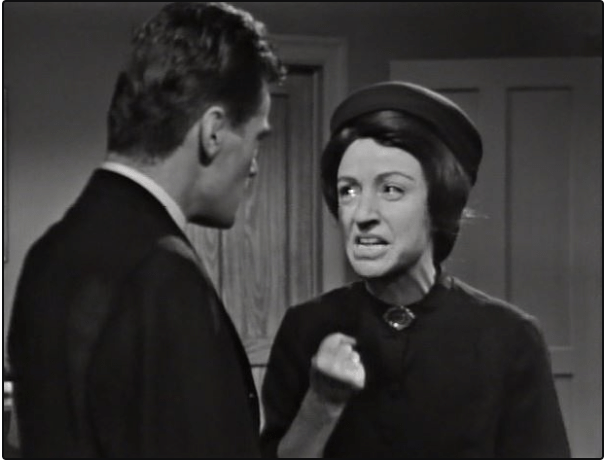
A woman named Eve has seen Peter/ Jeff and recognized him from their previous acquaintance. She finds Peter/ Jeff alone on the terrace outside the great house of Collinwood and confronts him. He looks as uncomfortable alone with her as Vicki does alone with him. It is satisfying to see Peter/ Jeff get a taste of his own medicine, all the more so for regular viewers who know that Eve is a homicidal maniac and hope she will do him in before he blights any more episodes.
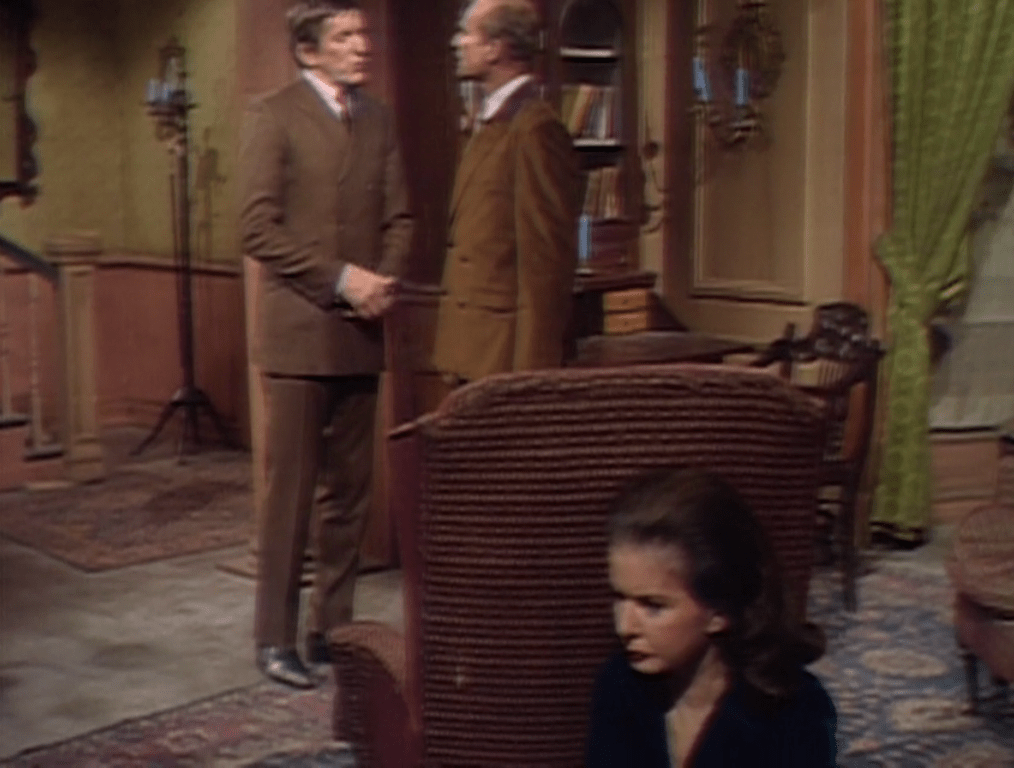
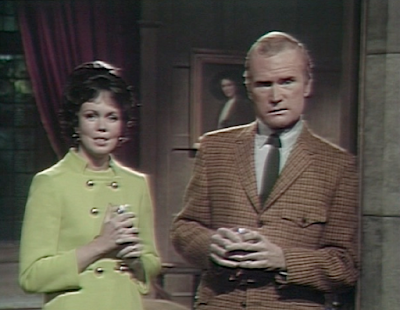
Eve has been kissing Peter/ Jeff passionately for several seconds when sarcastic dandy Roger Collins speaks up and says that he has not been introduced to her. She runs off, and Peter/ Jeff demands that Roger not tell Vicki what he has seen. Roger will not agree to that, but once the two of them are alone with Vicki in the drawing room he backs down and lets Peter/ Jeff off the hook. When Peter/ Jeff realizes Roger will keep his secret he breaks into a gleeful smile. Evil has triumphed once more.
Roger consigns Vicki to her fate, while her destroyer chortles with glee. Screenshot by Dark Shadows Before I Die.
In the early days of Dark Shadows, Roger was rather a dangerous villain. One of his crimes was perjury in a case that sent another man, one Burke Devlin, to prison for a homicide in which they were both implicated. In #201, Roger admitted to that perjury in front of Burke in this very room. That admission came after a long story arc involving the return of Roger’s estranged wife Laura to Collinwood. The Laura story absorbed all the dramatic significance of the conflict between Roger and Burke, leaving Burke nothing to do in response to Roger’s admission but to peace out. To viewers who remember that Vicki was once an interesting character and still have hopes that she will shake free of Peter/ Jeff’s baleful presence, Roger’s concession to Peter/ Jeff is an even bigger disappointment than was the too-late resolution of the Roger vs Burke story.
At the end, Roger has a dream in which it is revealed to him that if Vicki marries Peter/ Jeff, she will die. We suspect that he has missed his last chance to prevent this happening.
Today is devoted to non-supernatural stories. More precisely, we should call them post-supernatural, because they show people dealing with the aftermath of spells and curses.
The episode consists largely of solo performances. As troubled matriarch Liz, Joan Bennett has two scenes in which she is alone with her own voice in a recorded monologue. Dark Shadows has long used these monologues when characters were alone on screen and their faces would silently show how they felt about the thoughts their voices expressed on the soundtrack, but recently it has been experimenting with new ways of deploying them. For example, #581 marked the first time this device was used to share the thoughts a character was having in the middle of a conversation. Today Liz has a remarkably intense debate with her own recorded voice, first in her bedroom, later in an old graveyard.
Some time ago, wicked witch Angelique cast a spell causing Liz to be obsessed with death. Since then, Angelique lost her power and died. But Liz had been the victim of similar spells before, and is prone to depression in any case, as witness the fact that she once holed up in her house for eighteen years. So even if the spell broke when Angelique was de-witched, it makes sense Liz would continue to suffer the psychological damage it inflicted on her.
Between Liz’ two solo scenes, her brother Roger knocks on her bedroom door, This scene lasts less than a minute, but Louis Edmonds shows us a variety of emotions as he talks to Liz through the door, then opens it and finds she is not there. His discovery that he was giving a soliloquy when he thought he was having a conversation makes for a different kind of solo scene.
The other post-supernatural story concerns well-meaning governess Vicki and her ex-fiancé, an unpleasant man named Peter who insists on being called Jeff. Angelique became a vampire after her most recent death, and for a time she took Peter/ Jeff as her victim. The effects of the vampire’s bite made it impossible for Peter/ Jeff to sustain his relationship with Vicki. Peter/ Jeff has been freed from Angelique’s influence, and even his memory of the experience has been erased. Today he comes to ask Vicki to take him back. But he can explain nothing to her about what happened to him. Vicki is frustrated with Peter/ Jeff. Feeling that he does not trust her enough to tell her what happened, Vicki rejects Peter/ Jeff’s attempt at reconciliation. Alexandra Moltke Isles plays Vicki’s frustration with great force. Considering that her scene partner is the lamentable Roger Davis, this, too, qualifies as a solo performance.
Dark Shadows never had more than three credited writers producing scripts at a time. Often it had only two, and there were stretches when a single writer would have to crank out a script every day for weeks. Since they worked under those conditions, the writers’ methods would often be made obvious. So, Art Wallace, who was credited as the writer of the first 40 episodes, started by crafting the structure of an episode, and fitted incidents and information into that structure as time permitted. Ron Sproat, another very prolific contributor, also put structure first, sometimes resulting in a slow-paced script. Today’s author, Gordon Russell, seems to have taken the opposite approach, cramming each script with action and letting the material shake itself out as best it could. So there is some interesting stuff in this one that doesn’t really connect to anything.
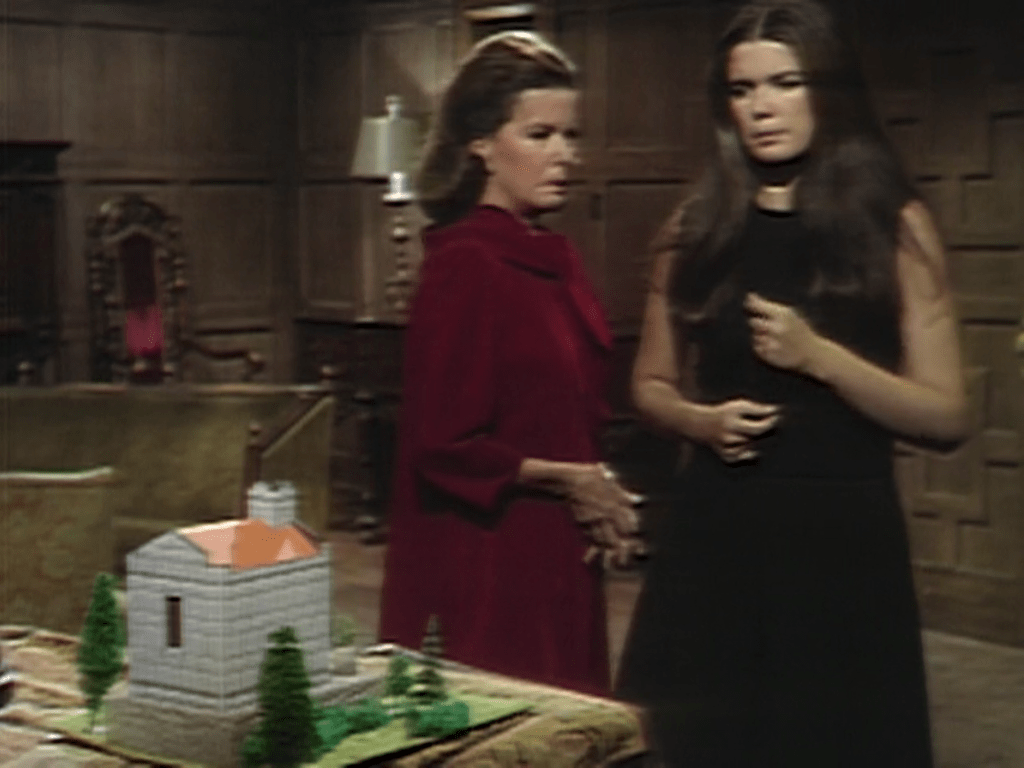
For example, we open today with Liz contemplating an architects’ model of a mausoleum. It really is a lovely little thing.
We have a scene where Vicki is horrified by the idea of the mausoleum. Liz insists Vicki be her voice after her death and stand up to her family for her, seeing to it that she is buried in the mausoleum as she wishes. The show hinted very heavily for a long time that Vicki is Liz’ unacknowledged daughter, but they dropped that a long time ago. As it stands, Vicki is a member of the household staff. As such, she would put herself in an awkward position were she to oppose the family’s wishes after Liz’ death.
Roger enters, demands that Liz forget about everything related to death, and smashes the model. That’s all very dramatic, but it doesn’t make any sense. Though he might well be distressed at Liz’ fixation on the idea that she will soon be buried alive, everyone dies eventually, and rich people often build elaborate mausoleums. Roger’s assertion that the architects must think they are humoring an insane woman and the villagers are all laughing at her is just as nonsensical as his domineering attitude is unconnected to his character as it has been developed up to this point. All of it is entirely irrelevant to the progress of the story.
After that, Liz leaves the room, and Roger talks to Vicki for a bit. He says that Liz’ trouble seemed to start when he married a woman named Cassandra. Unknown to him, Cassandra was actually Angelique in a wig. He tells Vicki “We’ve never been very lucky in love, you and I, have we?,” and edges closer to her. This may come as a bit of a jolt to longtime viewers. In the early days of Dark Shadows, there were a few hints that Vicki and Roger, who are after all modeled on Jane Eyre and Mr Rochester, might strike up a romance. Since they are both single, all of a sudden it seems possible they might get together after all.
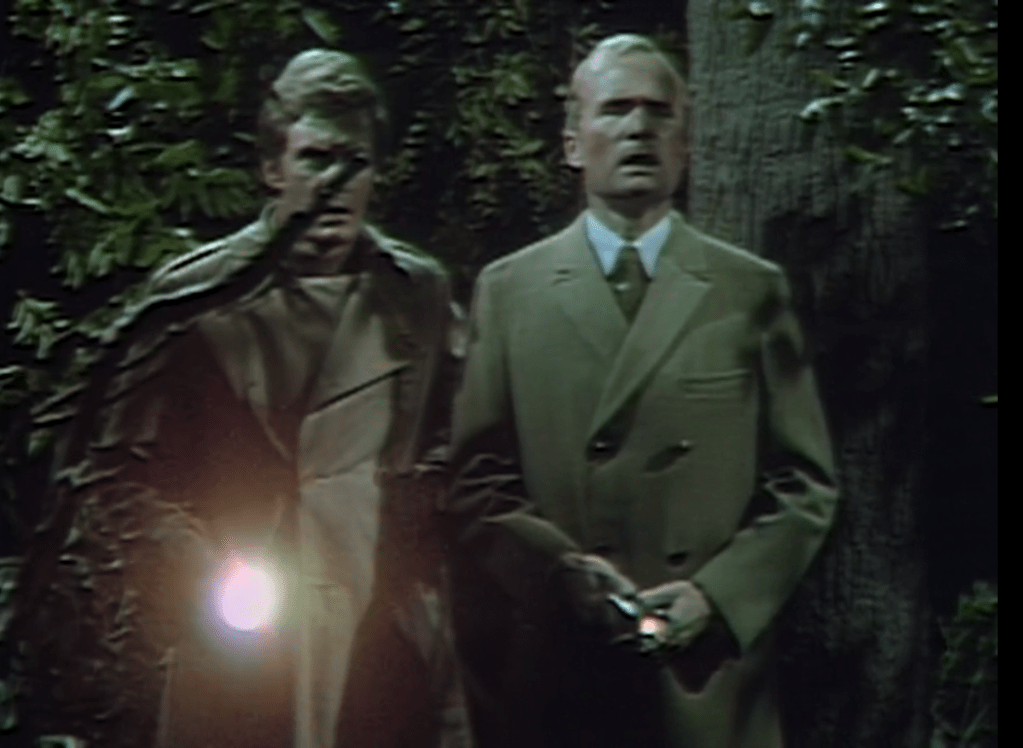
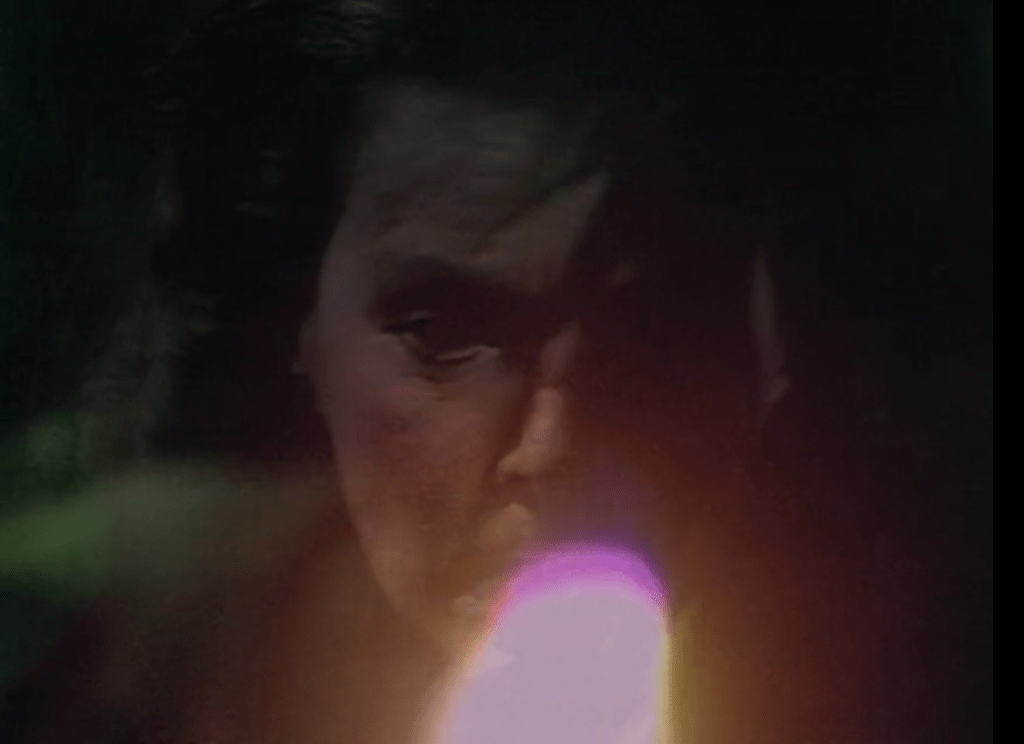
Later, Roger and Peter/ Jeff are outdoors looking for Liz. Each of them shines his flashlight directly into the camera. This is a Dark Shadows trademark. Sometimes it is clearly accidental; Peter/ Jeff does it once, briefly, and that may be an accident. But Roger does it twice, and each time the camera lingers on it. The first time comes as we cut from Liz in the graveyard to Roger and Peter/ Jeff, the second time as we dissolve from them back to Liz.
Cut to a closeup on Roger’s flashlightPeter/ Jeff accidentally shines his flashlight directly into the cameraDissolve to Liz from a second closeup on Roger’s flashlight
Liz is at the grave of Peter Bradford, which is to say Peter/ Jeff. He died in the 1790s and returned from the dead in March, a fact which is obvious to the audience and to Vicki but which he persistently denies. These denials are pointless and dull, but are the closest thing Peter/ Jeff has to a personality, so we can’t very well blame him for sticking to them. Peter/ Jeff finds Liz at his grave; she recognizes him as the dead man and faints. He carries her home. If there is any significance to any of this, it is apparently none of the audience’s business. The script certainly isn’t going to show us what it is.
Well-meaning governess Vicki is engaged to marry an unpleasant man named Peter who prefers to be called Jeff. Vicki knows that Peter/ Jeff has some kind of job that keeps him busy during the day. She does not know that he has been spending all night working at a second job. He is helping to build a Frankenstein’s monster. This second job is unpaid; his incentive is that if the monster is not built, an already existing Frankenstein’s monster named Adam has said that he will kill Vicki and everyone else in the great house of Collinwood.
As we open today, Peter/ Jeff is bitten by vampire Angelique. After Peter/ Jeff regains consciousness, Angelique starts giving him orders. He ignores them, and she bites him again. After that, he seems dazed and agrees to do whatever she commands. She wants him to hook her up to the body under construction and to use her “life force” to animate it. He tells her that he doesn’t know how to do that, and that the body isn’t ready to come to life in any case. Turns out she needn’t have bothered.
Meanwhile, Vicki gets some news. Roger, brother of matriarch Liz, tells her that he wants to send Peter/ Jeff on a six-week training program along with two junior executives from the Collins family business, and that if he works out there will be a job for him at the end of it. Vicki is dazzled by the offer.
Peter/ Jeff comes by. Roger meets him alone in the drawing room to make the offer. Peter/ Jeff can neither leave the Frankenstein project nor tell Roger about it. He has to turn the offer down without explanation, leaving Roger offended. Vicki then asks Peter/ Jeff what he was thinking, and he can’t explain the situation to her, either. She is frustrated that she tells him everything about herself, but she can’t get any information from him. She says that the offer must have represented a “family decision” on the part of the Collinses, implying that Peter/ Jeff’s refusal will reflect badly on both of them in their eyes.
When Dark Shadows started in June 1966, Vicki was its chief protagonist, Roger its most menacing villain, and the Collinses’ business interests a major part of the story. Vicki receded to the margins after her most interesting storyline, her difficult relationship with her charge David, was resolved in March 1967, and by that time Roger had become harmless and the business had long since ceased to be a source of interest. When we hear Roger talking about a job for Peter/ Jeff, for a moment it seems that he and the business might once again be important, and that Vicki might again have something to do with the plot. Vicki’s disappointment in her beau reminds us that the character doesn’t really have a place on the show any more.
Upstairs, Liz is taking clothes out of her closet and talking about them with her daughter Carolyn. They jar longtime viewers when they look at a particular dress and reminisce that they bought it on a trip to Boston. For the first 55 weeks of the show, Liz was a recluse who hadn’t left home since Carolyn was an infant. I suspect Liz had worn that dress during that period, and wish I’d looked for it when we were on those episodes during this watch-through. There certainly hasn’t been enough time since then for the trip to Boston to evoke the nostalgic tone in which they describe it, or for the dress to have fallen so far out of fashion that the ladies agree it is time to throw it away.
The Liz-is-a-recluse story was never exciting, and once they ditched it the show was quick to give us scenes of Liz happily going out. It is sometimes said that Dark Shadows is what Star Trek would have been if they had replaced space travel with agoraphobia, and Liz’ seclusion was the first exploration of this topic. Following the deep cut into the early days of the show in Roger’s offer to Peter/ Jeff with a moment when such a prominent part of its first year is simply forgotten is so typical of this period’s episodes that I wonder if some of the dialogue was written by uncredited contributors who weren’t up to date on bygone story points.
Carolyn is glad that Liz, who just recently escaped from a mental hospital, is taking an interest in her wardrobe. Liz lets her down hard when she says that she wants to get rid of as many belongings as possible in the short time before her death. Carolyn tries to tell her that she isn’t dying, but Liz refuses to listen. She demands that Carolyn promise to have an open casket at her funeral.
Liz was in the mental hospital because of a psychological disturbance with which Angelique afflicted her some months ago. When she did that, Angelique was a witch. Since then, Angelique has been stripped of her witchly powers, killed, and brought back to the world as a vampire. You might think Angelique’s spells would all have been broken when she was de-witched; that has been the pattern on Dark Shadows previously. For example, when blonde fire witch Laura vanished in #191, the spell she had cast that caused Liz to mope around and be obsessed with death until she was sent off to a hospital was broken. Longtime viewers wonder if Liz’ continuing obsession with death and her paranoid fear of being buried alive are natural symptoms of the trauma Angelique put her through, and if she just needs better therapy than she was getting in the hospital.
Liz has a dream. It opens with Angelique looking directly into the camera. Angelique is wearing the same costume she wore in the scene with Peter/ Jeff and laughing. When Liz knew Angelique, she never dressed that way, she wore a black wig, and so far as the audience knows she never let Liz hear her signature evil laugh. So it seems that Liz’ current troubles are indeed a part of Angelique’s ongoing spell.
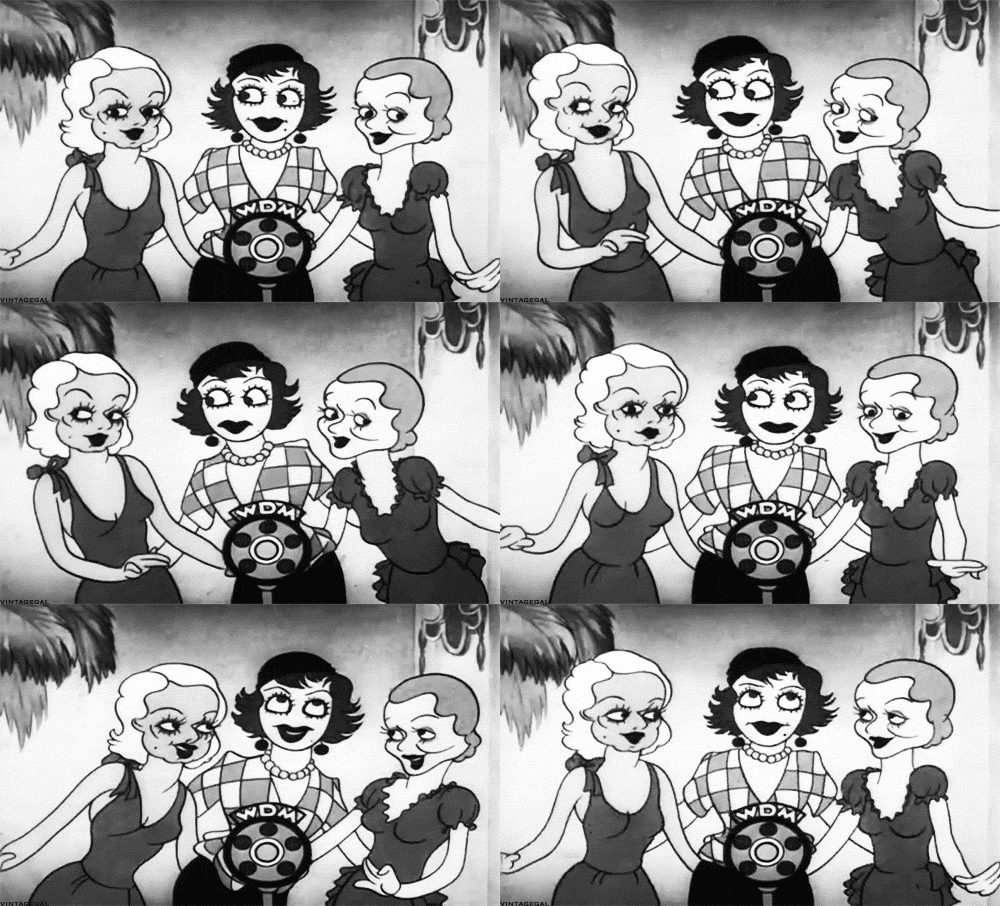
Facing us, Angelique tells Liz that she will be plagued by her obsessions until she dies. This is enough to trigger PTSD flashbacks in regular viewers. Twenty weeks ago, in #477, Angelique was looking at us when she described “The Dream Curse,” an abysmally repetitious, ultimately pointless storyline that dragged on for months. Joan Bennett was a fine actress and a great star, but there was only so much even she could do with a character who just mopes around and talks about death, and Dark Shadows has already made her do it more than once. In a comment on Danny Horn’s post about this episode, I wondered if Angelique couldn’t have cast a spell on Liz that isn’t just a retread of one we’ve seen before, and suggested one that would give her “a compulsion to put on a top hat and tails and sing and dance.” Here’s an animated gif of a cartoon showing Joan Bennett’s sister Constance dancing with Jean Harlow and Joan Crawford; it has more entertainment value than did the entire Dream Curse, and might serve as a consolation to those of us left shaking by Angelique’s threat to clog up the story again:
In #210, dangerously unstable ruffian Willie Loomis found an old coffin and broke into it, hoping to reap a harvest of hidden jewels. Instead a hand darted out, and Willie became the sorely bedraggled blood thrall of vampire Barnabas Collins.
The next person to open Barnabas’ coffin was Maggie Evans, The Nicest Girl in Town. Barnabas was keeping Maggie prisoner in his house on the great estate of Collinwood as part of his plan to persuade Maggie to forget her personality and turn into his lost love, the gracious Josette. In #250, Maggie decided to drive a stake through Barnabas’ heart, but had the bad luck to set to work a moment before sunset. He awoke, and spent the remaining two weeks of her captivity treating her even more cruelly than he had previously.
In #275, Willie’s onetime friend, seagoing con man Jason McGuire, made his way to Barnabas’ basement and found the coffin. As Willie had done 13 weeks before, Jason jumped to the conclusion the coffin was full of jewels. Willie tried to tell him this was not the case, but could not stop Jason looking inside. As when Maggie made her attempt to stake Barnabas, it is sunset. Again Barnabas’ hand darts forth; this time, he strangles Jason to death.
The first time someone opened Barnabas’ coffin during the day was in #289. Mad scientist Julia Hoffman had collected substantial evidence indicating that Barnabas was a vampire. As final confirmation, she slipped into his house one morning, made her way to the basement, opened the coffin, and reeled away, simultaneously shuddering and giving a look of triumph.
From November 1967 to March 1968, Dark Shadows was a costume drama set in the 1790s. In #410, wicked witch Angelique had just turned Barnabas into a vampire. She went to his coffin with a stake and mallet, regretting her curse and trying to cut its effects short. As Jason and Maggie would do in 1967, Angelique waited until sunset to open the coffin. Barnabas awoke, demanded to know what was going on, and killed her.
Since then, Barnabas’ vampirism has gone into remission and he and Julia have become fast friends. As we begin today, Barnabas is engaged in a desperate battle for Julia’s sake. The new vampire on the block, Tom Jennings, has been feeding on Julia. She is near death, and will herself rise as a vampire unless Tom is destroyed and she is freed from his influence. Barnabas has found Tom in a crypt next to a coffin, and the two of them have an embarrassingly awkward fight scene. The sun rises, and Tom has to leave Barnabas and get into his coffin.
Barnabas stands over Tom’s open coffin with a mallet and stake. He wonders if anyone ever looked down on him in his coffin when he was a vampire. He tells himself no one could have, for they would have destroyed him if they had. This is a strange thing for him to think. Julia eventually told him that she had sneaked a peek at him in his coffin, and he must remember Willie, Maggie, Jason, and Angelique.
Julia is back at Barnabas’ house. Elizabeth Collins Stoddard, mistress of Collinwood and escaped mental patient, is watching over her. She is telling Julia that Barnabas left her to die and that she will be dead any moment. This cheery behavior is the consequence of Liz’ fixation on death and her obsessive fear that Julia and others are part of a conspiracy to bury her alive.
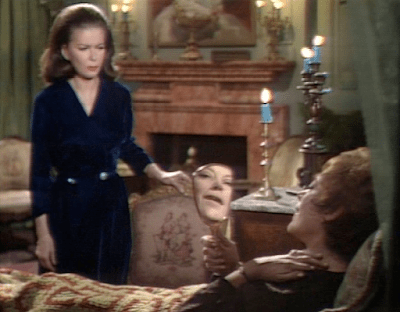
As Barnabas drives the stake through Tom’s heart in the crypt, Julia cries out from her bed, then suddenly gains strength. She asks Liz to bring her a mirror; Julia is delighted to see that Tom’s bite marks are gone.
Barnabas comes back, sends Liz away, and tells Julia that she will be safe from Tom now. Barnabas and Julia are starting to get uncharacteristically mushy over each other when we cut to the downstairs, where Liz looks out the window and sees her brother Roger approaching.
Roger wants to send Liz back to the psychiatric hospital from which she escaped. Liz believes Roger is part of the conspiracy to bury her alive, and that sending her to the hospital will further that goal. So she hides behind an armchair.
Liz hiding.
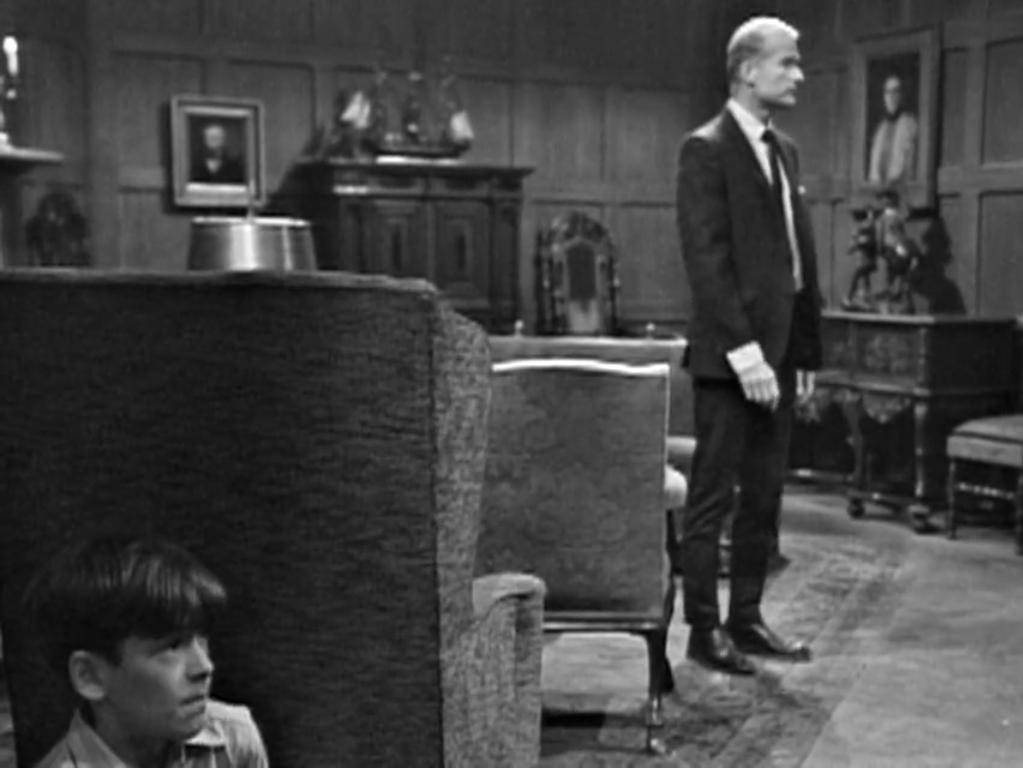
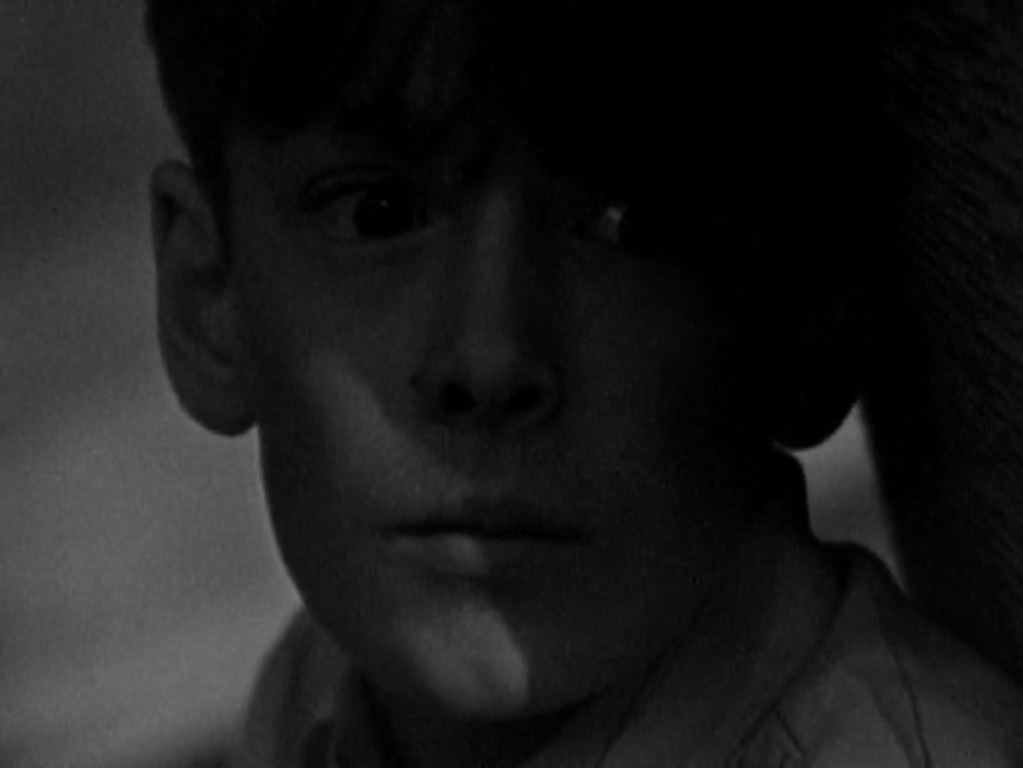
In #10, Liz and Roger had a conversation in the drawing room of the great house of Collinwood while Roger’s son David hid behind an armchair. In that conversation, Roger declared his belief that David should be sent to an institution, a plan which Liz forbade him to pursue. After Liz left the room, Roger caught David behind the armchair.
David found the prospect of institutionalization so terrifying that his next stop was the garage, where he tampered with the brakes of his father’s car in what very nearly turned out to be a successful attempt at patricide. Liz is too upset to develop such an intricate plan, and doesn’t seem to have David’s skills as an auto mechanic. But she shares her nephew’s horror of institutionalization. So after Roger and Barnabas have talked for a moment, she jumps up from behind the chair and starts making accusations.
Liz tells Roger and Barnabas that she saw Julia in a crypt in the family burial ground nearby, and that there was a coffin there. Barnabas is alarmed, since this is the coffin in which Tom’s staked remains now repose. Roger agrees to go to the crypt and to see if there is a coffin. Barnabas offers to go with him.
The suave Nicholas Blair shows up at the front door with a bouquet of flowers. We know that Nicholas is a warlock and that he is behind the renewed outbreak of vampirism, that he was watching while Barnabas staked Tom, and that he is also responsible for some other plots involving Barnabas and Julia. For their part, Barnabas and Julia have every reason to suspect that this is so, and have talked about their suspicions more than once. Nicholas tells Barnabas, Roger, and Liz that he has heard that Julia is ill and has come to visit her. At Liz’ insistence, Barnabas lets Nicholas see Julia while he and Roger go to the crypt.
Nicholas expresses his relief that Julia’s recovery will enable her to return to work soon. The only work Julia has done in the year she has been a houseguest at Collinwood has been in association with the supernatural goings-on she and Barnabas have been entangled in; currently, an agent of Nicholas’ is forcing them to build a Frankenstein’s monster. Nicholas may as well say explicitly that he is behind that scheme and the vampire troubles too. He tells Julia that he thinks he might fall ill and need her help as a doctor; she says that he seems indestructible, a word he receives with pleasure.
Barnabas comes back and tells Julia that the coffin has disappeared. He mentions that it is strange that Nicholas turned up when he did. Julia suggests that Nicholas may be the one who moved the coffin. All of a sudden Barnabas seems to forget everything he knows about Nicholas and dismisses that idea. It’s one of those frustrating moments when the characters seem to have the memory of a goldfish, and it ends the episode on a sour note.
When housekeeper Mrs Johnson was first on Dark Shadows in September 1967, she was hyper-intense, determined to exact vengeance on the ancient and esteemed Collins family for the death of her longtime employer, Bill Malloy. In #69, she told the Collinses’ nemesis, dashing action hero Burke Devlin, that “I believe in signs and omens!” and that the signs and omens she could see showed that reclusive matriarch Elizabeth Collins Stoddard and her family had Bill’s blood on their hands.
“I believe in signs and omens!” Mrs Johnson with Burke Devlin in #69.
As the storyline centered on Bill’s death petered out, Mrs Johnson forgot about her hostility to Liz and her family, and became their devoted retainer. Her new personality was that of a friendly old busybody who kept advancing the plot by blabbing all the information she has to whoever can use it to make the most trouble. Since Mrs Johnson opened the front door to the great house of Collinwood in #211 and admitted Barnabas Collins, she has become an intermittent presence on the show, but Clarice Blackburn plays her with so much style that her occasional appearances are always a highlight.
Today, Mrs Johnson lets suave warlock Nicholas Blair into the house. She informs Nicholas that Liz has escaped from Windcliff, the mental hospital where she has been staying for the last nine and a half weeks. She gets very worked up as she declares that Liz’ aberrations are no ordinary psychiatric problem, but are the product of a hostile supernatural force that plagues the Collinses. Her voice is fearful and she shies away from eye contact with Nicholas, a contrast with the anger and boldness she had shown with Burke Devlin 100 weeks ago, but she again underlines her point with exaggerated hand gestures and facial expressions.
For regular viewers, it is surprising that Nicholas doesn’t seem to have known about the details of Liz’ trouble. His subordinate, the wicked witch known variously as Angelique and Cassandra, had sent Liz mad by placing a spell on her shortly before he arrived on the scene. He’s still keeping Angelique/ Cassandra around his house- he stripped her of her powers, turned her into a vampire, and has been using her to attack various men he wants to silence. You’d think he would at some point have asked her what happened to the lady who owns the town he has settled in. But, evidently his curiosity did not extend that far.
Liz’ brother Roger comes home and invites Nicholas to join him for a brandy. As they are headed for the drawing room, permanent houseguest Julia Hoffman enters. She is pale, unsteady on her feet, and talking with great distress about her inability to find Tom Jennings. Roger points out that Tom is dead, and Julia faints.
Nicholas carries Julia to the couch in the drawing room. While she lies on it unconscious, he sneaks a peek under her scarf and finds bite marks on her neck. Thus he learns that Tom, whom Angelique turned into a vampire at his direction, has been feeding on Julia.
Liz has not been an active part of any major storyline since #272, when it turned out that her belief that she had killed her husband was mistaken and she did not in fact have any terrible secrets to conceal. So Nicholas’ lack of interest in her might just be a sign that he doesn’t want to waste time on irrelevant details. But Julia is indispensable to Nicholas’ plan to found a new race of artificially constructed human beings. She is a medical doctor, and is the only person Nicholas can coerce into building a mate for the Frankenstein’s monster she recently helped bring to life. She hasn’t been able to work on the project since Tom bit her, and apparently won’t be able to resume work until she is freed of his influence. If Nicholas lets his projects get in each other’s way to this extent, one can draw no conclusion other than that he is a bad manager.
Julia recovers and refuses to see a doctor. She goes to bed, and Roger tells Nicholas he thinks Liz might be on the grounds of the estate. The two of them go out to look for her. Of course Liz is there; of course she sees Tom; of course it is only when Roger and Nicholas approach that Tom vanishes and she is spared his bite.
It has been established that Windcliff is about 100 miles north of Collinsport; in #294, the ghost of Sarah Collins performed one of the most stupendous of her many feats when she transported Maggie Evans, The Nicest Girl in Town, from Windcliff to Collinsport on foot in about an hour. Liz has had 24 hours since she went missing from her room, and people used to hitch-hike in those days, so it wouldn’t necessarily have required a supernatural agency to get her home in that time. It still would have been quite a trip for an escaped mental patient to make by herself, without bus fare, as the subject of a state police all points bulletin, on the roads running through the woods of central Maine.
Back in the house, Liz makes it clear that she is not herself when she only gradually recognizes Mrs Johnson. She is also obsessed with a fear of being buried alive. Roger concludes that she has to return to the hospital, and goes off to get the car. Julia comes downstairs, and Mrs Johnson asks her to keep an eye on Liz while she goes off to telephone the hospital.
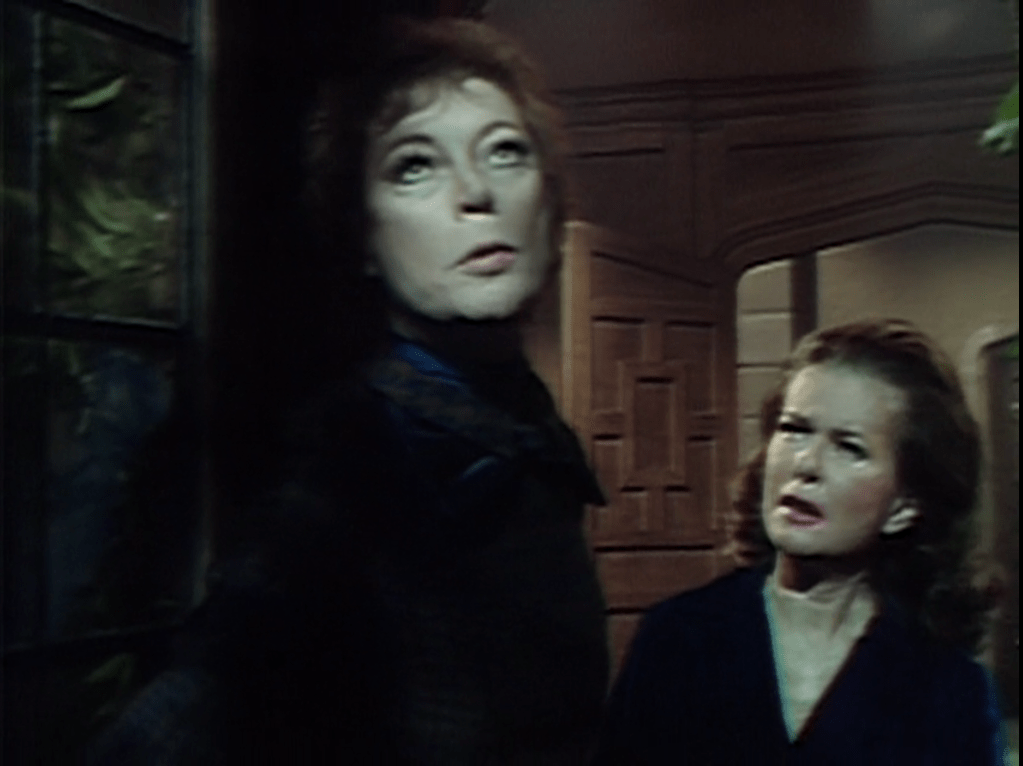
Liz asks Julia, who is the nominal director of Windcliff and a qualified psychiatrist, to examine her and see that she is sane. As she is about to respond, Julia hears dogs howling outside and goes into a trance. She opens the window and stares out into the night, saying that the dogs are calling to her and that she must go to “him.” While she does this, Liz asks her what she’s talking about, but clearly still wants her to serve as the standard of sanity. The first time we saw Liz, in #1, she was standing where Julia stands in this shot, looking out the window with Roger behind her. Liz reprised that pose many times in the first year of the show, and it became her signature. It is incongruous to see Julia in Liz’ customary place as Liz looks on. The whole encounter is so funny that I suspect the humor must have been intentional.
Liz begins to doubt that Julia will be able to help her.
Julia rushes from the house; Liz follows her out. Julia goes to the crypt where Tom’s coffin is kept; evidently Tom’s hunger is getting the better of him, and he has decided to DoorDash it tonight. Liz follows her in. Julia sees Liz and demands that she leave. Liz sees the coffin and asks if it the one in which she will be buried alive. Julia tells her it has nothing to do with her, and repeatedly yells at her to “Get out!” She complies. Tom appears, and opens his mouth to bite Julia.
Julia’s expulsion of Liz from the crypt is an effective turn, but it is also a sad one for longtime viewers. When Dark Shadows started, the presence of Joan Bennett in the cast was probably its single biggest ratings draw, and all the way through her name appears at the beginning of the credits under the word “Starring.” But for a year now, the show’s whole attitude towards Liz has been one of active hostility. They simply will not let her be involved in the action. When Julia shouts “Get out, get out, get out!,” she is speaking with the voice of the story conference.
Danny Horn’s post about this episode on Dark Shadows Every Daydetails how Liz has been pushed to the margins and kept there as the show has evolved. Danny makes a point of not discussing the first 42 weeks, when Liz was enough of a part of the action that Joan Bennett had some chance to show what she could do, but in this post at least he seems to realize that the makers of Dark Shadows were squandering a considerable resource.
In May 1967, seagoing con man Jason had for long months been blackmailing matriarch Liz into letting him stay at the great house of Collinwood. He told Liz that people in the village of Collinsport were starting to talk about the presence of an unmarried man in her house. He informed Liz that they would solve this problem by getting married. She laughed in his face, but he pressed his threats to expose her terrible secret, and they were in the middle of a wedding ceremony when Liz broke down and announced her secret to everyone. It then turned out that there never really was a secret- the whole thing was a sort of misunderstanding. A few days later, Jason was dead, and he hasn’t been mentioned since March 1968.
Today, Liz’ brother Roger shows up at the Old House on the estate, home of their distant cousin Barnabas. He is looking for Julia, a permanent houseguest who settled in at the great house a few weeks after Jason disappeared. Barnabas, a bachelor, tells him that Julia is staying with him for a few days. Roger’s startled response makes it clear that the mores Jason mentioned in #243 have not changed. But Roger is not in a position to insist on propriety, and he has come on an urgent matter. Liz has escaped from Windcliff, the mental hospital of which Julia is the nominal director, and he wants her to come back with him at once to the great house so that she can consult with her staff on the telephone.
Roger is momentarily stunned to learn that Julia is sleeping at Barnabas’ house.
Barnabas tells Roger that Julia is ill and cannot help him. He insists, so Barnabas goes up to her bedroom. Not only does he tell her about Roger and his news, but he also informs her that he earlier found an unpleasant man named Peter who prefers to be called Jeff in the basement. Since the basement houses a lot of technical equipment and a stolen corpse which they are planning to use as material for a Frankenstein’s monster, Julia finds this alarming. But Barnabas has talked Peter/ Jeff into helping them with their little arts & crafts project, and he assures her that he has Peter/ Jeff under control.
Julia is in fact ill, and she tells Barnabas she cannot see Roger. Julia has been bitten by a vampire named Tom. Barnabas, a recovering vampire himself, plans to use her as bait to lure Tom into the bedroom tonight so that he can shoot him with a silver bullet. He explains to her that he took a candlestick to the local silversmith earlier this morning and that the silversmith melted it down and forged five silver bullets. No wonder people are reluctant to leave Collinsport, even much bigger places don’t have same-day service like that.
We cut to the basement, where Julia is wearing her lab coat. Barnabas tells her it is 5 PM. There is no sign they have been working on the project; for all we can tell, they waited around her bedroom all day and decided to get to work shortly before sundown. Peter/ Jeff enters and reports for work. They tell him to work on a particular piece of equipment. Barnabas takes Julia back up to her bedroom, leaving Peter/ Jeff alone with the corpse. Since he was just recruited for the project, this shows a remarkable degree of confidence in his loyalty.
Julia is sitting in a chair and Barnabas is hiding in the closet when Tom materializes. Julia puts herself between Barnabas and Tom, and Tom vanishes. Julia apologizes; Barnabas knows enough about the compulsions that afflict the vampire’s victim that he does not seem to be really upset with her. He frets that they will never have such a good shot at Tom again now that he knows to be on his guard. He looks out the window and thinks he sees Tom on the lawn. He turns, and finds that Julia, too, is gone. He realizes that she must now be alone with Tom.
In his Dark Shadows Daybook post about this episode, Patrick McCray makes some apt remarks about the acting. As Barnabas, Jonathan Frid starts the episode with an unusually self-assured tone in his confrontation with Peter/ Jeff. That’s what the scene calls for, since we need to believe that Barnabas’ force of personality is sufficient to overpower Peter/ Jeff’s aversion to the gruesome project. But it all falls apart about halfway through, when Frid has some line trouble, and as a result we wind up listening to the arguments with which Barnabas defends his position. Patrick doesn’t say anything about those arguments, but on Dark Shadows Every DayDanny Horn does a fine job explaining how utterly unconvincing they are.
Playing Julia as an addict needing a fix, Grayson Hall falls far short of her usual standard, but Patrick doesn’t blame her: “These are the heavy blinking, o-mouthed, head vacillating performances that critics of Hall use against her. I don’t call it bad acting… there’s only so much you can do with a cartoon. But seeing Julia like that is always evidence of a questionable match.” I like the tenderness Barnabas and Julia show each other in their scenes yesterday and today; for me, Barnabas’ earnest concern for Julia and her quiet trust in him outweigh the deficiencies in Frid’s memory for dialogue and Hall’s attempt to show Julia’s weakness. But those deficiencies are impossible to overlook, unfortunately.
Permanent house-guest Julia Hoffman walks into the great house of Collinwood and greets Roger Collins with a chipper “Good morning, Rodgie!” This is the second time we have heard Roger addressed as “Rodgie.” The first time was in #103, when he called to well-meaning governess Victoria Winters with “Oh, Vicki!” and she responded with “Oh, Rodgie!” That was a disastrous blooper; at that point, Roger was the show’s chief villain and Vicki was supposed to be terrified that he was about to murder her. Roger has long since been rendered harmless, and Julia is in a breezy mood, so “Rodgie” seems appropriate.
Roger’s own mood is anything but cheerful. His wife Cassandra hasn’t been seen since last night, and there is no indication where she might be. He is convinced something must have happened to her, and he calls the police.
Julia knows that Cassandra is actually Angelique, a wicked witch who in the 1790s turned Barnabas Collins into a vampire. Now Barnabas’ vampirism has gone into remission, and Angelique/ Cassandra is determined to revive her curse on him. The other day, Julia and some other people conjured up another personage from the 1790s, the Rev’d Mr Trask, a fanatical but wildly inept witchfinder. Julia hopes that Angelique/ Cassandra’s absence means that Trask has destroyed her.
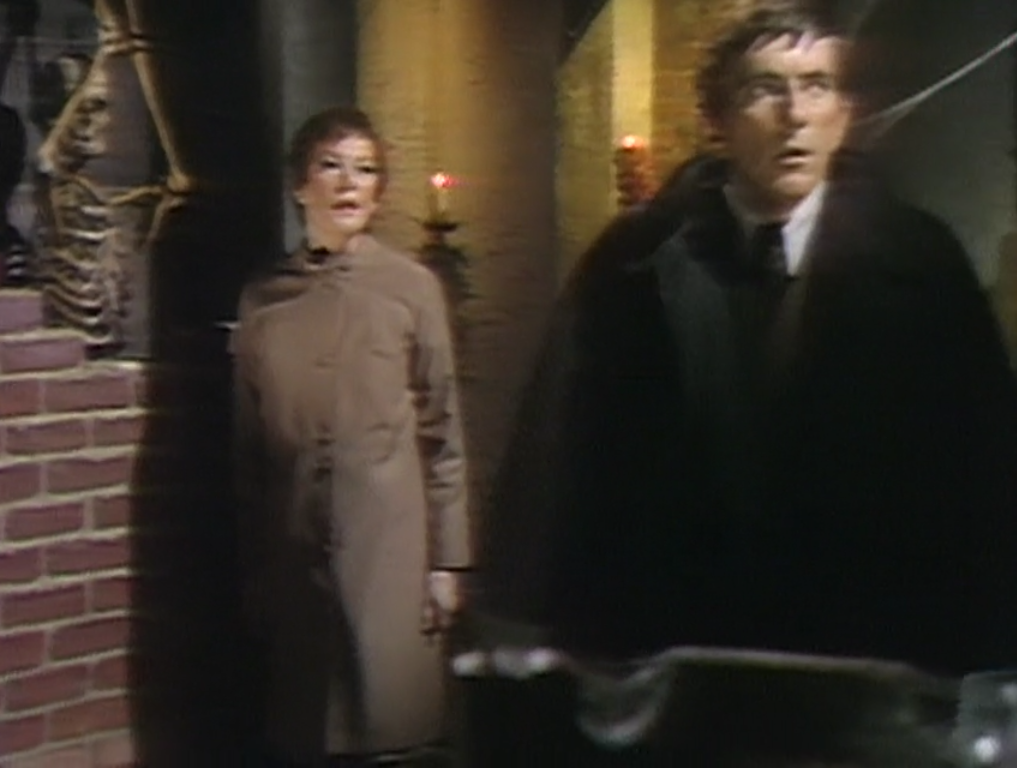
Barnabas stops by. Julia tells him of her theory. He can’t believe Angelique/ Cassandra is really gone. They go to Barnabas’ house and look in the alcove in the basement where, in 1796, Barnabas murdered Trask by hanging him from the ceiling and bricking him up. Trask’s bones had disappeared when Julia and the others brought him back to life, but are there again now. Julia takes this to mean that he is at peace, not a condition usually associated with hanging from a ceiling in a bricked-up little space, and that Angelique/ Cassandra must therefore have been defeated once and for all. At no point does it occur to them to take Trask’s bones down and give him a more respectful resting place. Apparently they consider human remains a standard part of household decor.
Trask, Julia, and Barnabas.
Back in the great house, Julia finds evidence that Angelique/ Cassandra’s powers are still at work. Matriarch Liz is still under a spell Angelique/ Cassandra cast and believes herself to be Naomi Collins, mother of Barnabas. She believes her brother Roger to be Naomi’s husband Joshua and Julia to be houseguest the Countess DuPrés. Most alarming, Liz has all the knowledge Naomi had in the hour before her suicide. She even mentions to Roger and Julia that Barnabas is “the living dead.” Roger and Liz don’t know that Barnabas was a vampire, and Julia doesn’t want them finding out.
Julia goes back to Barnabas’ house and confers with him about the situation. Barnabas says that Roger knows more about the family history than Liz does, and that if he starts hearing the actual facts there is a great danger he will figure everything out. This is a change- previously the show had always indicated that while Liz took some interest in the Collinses of years gone by, Roger took none.
We cut back to the great house and see Liz sitting at the desk in the drawing room. She is putting a note in an envelope addressed to “Joshua.” Regular viewers saw Naomi sit at this same desk and put a note in just such an envelope in #458. As Naomi did then, Liz pours a snifter of brandy, takes a container from the desk drawer, pours a powder from the container into the brandy, then drinks it. She again follows Naomi’s lead when she goes upstairs.
Barnabas and Julia enter. Julia asks exactly what Naomi did before she died. He starts telling the story, and she finds the note. Barnabas says Naomi died in the tower room; they go there, and find Liz. She talks to Barnabas as if she were Naomi and he were her accursed son. She collapses in his arms, as Naomi did in 1796.
Roger Collins is on the telephone in the foyer of the great house of Collinwood. He is assuring the caller that it will be fine if Maggie, whom returning viewers know to be The Nicest Girl in Town, comes to stay. He says that he and Cassandra will be glad to have her for as long as she wants to be with them, and that he is sure Liz will approve. First time viewers thus learn that Roger has a wife named Cassandra, and that they live as guests in a house belonging to someone called Liz. A moment later, Liz enters, and is too distracted to hear anything Roger says to her.
Roger ends the phone call, and follows Liz into the drawing room. She stares out the window and makes a gloomy remark about death. He says he understands she must be very upset about Sam Evans. Returning viewers know that Sam was Maggie’s father, and that he died in yesterday’s episode. Roger goes on about how it is natural to be grieved at the loss of a friend like Sam, but soon learns that Liz’ mood has nothing to do with Sam’s demise- it’s news to her that he is dead.
Roger’s lines will startle longtime viewers. For the first 40 weeks of the show, Roger and Sam were united by a deep and abiding mutual hatred, and since then they have had no contact at all. Roger’s words about Sam as a family friend are so far from what we have previously seen that they should be considered a retcon.
Liz and Roger spend several minutes in the drawing room. She keeps going on about the all-pervasive reality of death, and he keeps urging her to see a doctor. There isn’t much to their lines, but Joan Bennett and Louis Edmonds were such extraordinary screen performers that it’s always fun to watch them together. This scene might be a particular pleasure to longtime viewers, who have rarely seen Roger as the responsible adult in any encounter.
We dissolve to a bedroom where a young woman in a black wig is sifting through some powders, looking directly into the camera, and telling Liz that her obsession with death will become even worse than it already is and will have dire consequences. Liz will believe that she is someone else, a woman who lived and died in another century, and may die by the same poison that killed that person.
There is a knock at the door. It is Roger. The woman hides her powders and lets him in. He addresses her as Cassandra and asks why the door was locked. Thus first-time viewers learn that she is his wife, that this is their room, that she is a witch, and that Liz’ problem is the result of a spell she has cast.
Cassandra tells Roger that she locked the door because David kept pestering her about Sam’s death and she wanted a moment to herself. With that, first-time viewers find out that David is Roger’s son, that Cassandra is his stepmother, and that she expects Roger to consider locking him out of the room an appropriate response to his grief about Sam.
Roger does not so consider it, and is bewildered by what Cassandra tells him. He tells Cassandra that Liz is in a bad way, and he is worried about her. Cassandra says she did not know that Roger was so concerned about his family. Baffled by this, Roger says that of course he is concerned, Liz is his sister. This tells first time viewers both what Roger’s relationship to Liz is, and that Cassandra has so little sense of family that she cannot imagine how other people feel.
Regular viewers will learn more. In the first year of the show, Roger’s keynote was his lack of loyalty to the family. That has now been set aside once and for all, and his normal attachment to his son and his sister provide a contrast with Cassandra’s apparently sociopathic coldness. Further, we saw a great deal of Cassandra from November 1967 through March 1968, when the show was a costume drama set in the 1790s and she was called Angelique. We saw then that Angelique had no conception of family or friendship, and that her idea of love begins and ends with her control over a person.
Cassandra promises to join Roger downstairs for a game of bridge in half an hour. He leaves, and she gets back to work spellcasting. As she does so, a figure in a black cassock materializes behind her. She turns, and the figure vanishes. In a quizzical tone, she says Roger’s name, revealing that she did not see the figure or realize that it is a supernatural presence. Together with her locking the door, scrambling to hide her magical paraphernalia when Roger knocked, lying to cover what she was doing, and failing to understand what a person with a reasonable amount of human empathy would consider acceptable behavior, her puzzlement shows that whatever her powers may be, they have definite limits.
Back in the foyer, another young woman with black hair lets a man into the house. She calls him Joe, and he calls her Vicki. Joe and Vicki talk about Sam’s death and about Maggie. Joe says that he wants to marry Maggie as soon as possible and to move away. Vicki is all for their marriage, but does not want them to go. Joe talks about how close he and Sam were. Longtime viewers will remember that when Sam and Roger were enemies, Sam was the town drunk. Even then, Joe was always happy to help him in whatever way he could, and did not see his condition as any obstacle to marrying Maggie.
Liz enters and angrily addresses Joe as “Lieutenant Forbes.” Joe has never heard of Lieutenant Forbes, and cannot understand why Liz, who knows him well, would not recognize him. Vicki clearly does know who Liz is talking about, and manages to calm her down. After Liz apologizes and hastens away, Vicki answers Joe’s questions only by saying that Forbes is someone from “the past.” Since we heard Cassandra talk about Liz taking on the personality of someone who lived in “another century,” this suggests that Vicki, too, has an unnatural familiarity with that same century.
Joe wants to go upstairs to the room where Maggie is sleeping so that he will be the first person she sees when she wakes up. Vicki is about to lead him to Maggie when Cassandra insists she join her in the drawing room to talk about David. Vicki tells Joe which door to open, and complies with Cassandra’s directions. This shows that Vicki is a member of the household staff whose responsibilities have to do with David. Regular viewers know that she is his governess, and that they are very close.
Cassandra tells Vicki that David has been asking about Sam’s last words. Vicki says that he addressed them to Maggie, not to her, and implies that she did not hear them. When Cassandra continues probing, Vicki protests. She asks if Cassandra can’t see that she is upset. Considering how clueless Cassandra was about human feelings in her conversation with Roger, it is entirely possible that she cannot. Vicki tells her that Liz is deeply depressed; Cassandra feigns ignorance. Vicki says in a cold voice, “You wouldn’t know anything about that,” then leaves.
Longtime viewers know that it was Vicki who came unstuck in time in #365 and took us with her to the 1790s. During her nineteen weeks in the past, Vicki came to know not only Forbes, but Angelique. She knows perfectly well that Angelique and Cassandra are the same person, that she is a witch, and that she is a deadly menace to everyone. She likely suspects that Liz’ depression is the consequence of one of Cassandra’s spells, and the tone of her parting remark would suggest that she does. Further, those who saw the show yesterday know that Vicki is lying about Sam’s last words. They were addressed to her, and she heard them clearly. She is choosing not to repeat them to Cassandra lest Cassandra use them for her nefarious purposes.
Cassandra is alone in the drawing room for only a few seconds. She is joined there by the same figure who had appeared in her room. This time she sees him. He confronts her.
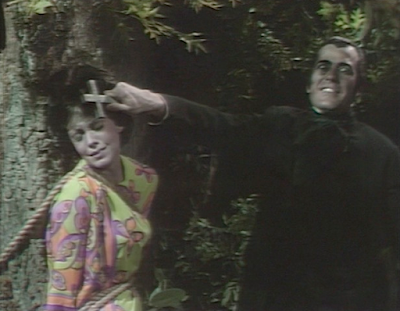
Regular viewers know that the figure is the Rev’d Mr Trask, a fanatical witchfinder who mistook Vicki for the witch in the 1790s and sent her to the gallows. He tells Cassandra that he now has the opportunity to correct that error. He shows her a cross, from which she recoils. We cut to a scene in the woods. Trask has tied Cassandra to a tree and performs an exorcism on her. This is Trask’s go-to technique; he tied Vicki to a tree in #385 and performed an exorcism on her in #386. Since Cassandra actually is in league with the devil (or as Trask would say, THE DE-VILLL!!!,) he has more success this time. Cassandra vanishes and leaves the ropes hanging on the tree.
A first-time viewer might take this climax as an indication that Dark Shadows is a Christian show and Trask is its hero. Not only is Trask going after the right target, he is clearly making some headway. He says all the right things about casting the evil out of Cassandra and saving whatever good is left in her. His delivery of his lines is so fervent that Mrs Acilius, a vigorous Christian, cheered him on. In fact, Trask’s wild incompetence throughout the 1790s segment led to one disaster after another, and was of a piece with the show’s light regard for religion. Not until #450 did a cross provoke a reaction from a monster; that was the first suggestion the show gave that there might be anything to Christianity, and the scenes between Cassandra and Trask today are the second.
Dark Shadows borrows story points freely from all sorts of books, plays, movies, and folklore. So far, it has steered clear of Christianity as a source. For obvious reasons- most of the audience is at least nominally Christian, and Christianity is, in one way or another, a live option for the rest. So it’s a topic that can take over very quickly once it is introduced. I suppose a specifically Christian version of Dark Shadows could have worked, but I can’t imagine that the staff they had would have been particularly interested in making a show like that. So when it looks like they are going to let Trask have even a temporary win, we see the show running one of its boldest risks yet.
Yesterday, wiggéd witch Angelique/ Cassandra sent her cat’s paw Tony to kill sage Timothy Eliot Stokes. Stokes pulled “the old switcheroo” on him, and Tony drank from the glass into which he had put Angelique/ Cassandra’s poison. Today, we learn that Stokes gave Tony an emetic to save his life. Stokes calls mad scientist Julia Hoffman, MD to examine Tony and assist with the next stage of the battle against Angelique/ Cassandra.
Recovered, Tony has no idea why he obeyed Angelique/ Cassandra’s command to kill Stokes, and is ready to surrender to the police. Stokes tells him he is under the power of a witch, and enlists him in the battle against her.
Stokes takes out the memoirs of his ancestor Ben, who was Angelique’s cat’s paw in the eighteenth century. He does some automatic writing in Ben’s hand and finds that they must contact the spirit of the Rev’d Mr Trask, a witchfinder who inadvertently helped Angelique in those days. Fortunately, Trask, like Tony, was played by Jerry Lacy, so it shouldn’t be too hard to get hold of him. Stokes also finds that Trask was walled up in “the coffin room,” which Julia tells him is for some mysterious reason a nickname given to the space at the foot of the stairs in the basement of the Old House on the estate of Collinwood. Stokes decrees that he, Julia, and Tony must go to this room and hold a séance there.
On his way to the Old House, Tony follows Stokes’ instructions and stops at the main house on the estate and tells Angelique/ Cassandra that Stokes is dead. This follows a scene between Angelique/ Cassandra and her husband, sarcastic dandy Roger, in which Roger complains about her lack of interest in him. Her mind isn’t on the game of chess they are playing, she hasn’t been attentive to him for several nights, and she refuses to go on a honeymoon. Angelique/ Cassandra ensorcelled Roger into marrying her so that she could have a perch at Collinwood, and he seems to be slipping out of the spell’s power.
Stokes, Julia, and Tony gather in the coffin room. They begin the séance. This is the fifth séance we have seen on Dark Shadows, but the first that does not include well-meaning governess Vicki. In four of the previous five, it had been Vicki who went into the trance. On the other occasion, it was strange and troubled boy David who became the vessel through which the dead spoke to the living. The first three times Vicki served as the medium, she channeled the gracious Josette Collins, and when David filled that role he gave voice to David Radcliffe. In those days, Vicki was closely connected to Josette, perhaps a reincarnation of her, as David was another version of the cursed boy David Radcliffe. The final time Vicki spoke for the dead, she spoke for nine year old Sarah Collins, with whom she was no more closely connected than were any of a number of other characters. Sarah has no present-day counterpart, so her appearance at a séance suggested that Dark Shadows was moving away from its use of necromancy as a way of connecting characters from different time periods.
This time, Tony goes into the trance. In #481, Angelique/ Cassandra told Tony that she chose him as her cat’s paw because he resembled Trask, so when he is the medium through whom Trask speaks we are returning to Dark Shadows‘ original conception of how séances work. Trask mistakes Stokes for Ben, as Angelique did in a dream visitation last week. The brick wall behind which Trask’s remains are hidden bulges and is about to crumble when we fade to the credits.
True fans of Dark Shadows know that the episode’s real climax comes during those credits. Thayer David strolls onto the set under Louis Edmonds’ credit for Roger. He even looks into the camera when he realizes what he has done.
In the 1790s, wicked witch Angelique turned scion Barnabas Collins into a vampire. When Barnabas realized what she had done to him, he killed Angelique.
In 1967, Barnabas was freed from a long captivity once more to prey upon the living. In 1968, Angelique also returned. Wearing a black wig and calling herself Cassandra, Angelique met sarcastic dandy Roger, ensorcelled him into marrying her, and thereby established herself as a resident of the great house of Collinwood. Wiggéd witch Angelique/ Cassandra found that Barnabas’ vampirism had gone into remission as a result of treatments he had received from mad scientist Eric Lang. She killed Lang before he could complete the process meant to make the cure permanent, but the senior mad scientist in the area, Barnabas’ friend Julia Hoffman, finished his work.
Angelique/ Cassandra and Julia know these facts about each other, but it is unclear how much Angelique/ Cassandra knows about Lang’s process. In particular, when today’s episode begins we do not know whether she has figured out that the main part of it was building a Frankenstein’s monster named Adam and trying to transfer Barnabas’ “life force” into him. Still less do we know whether Angelique/ Cassandra is aware that when Julia took over the experiment she brought Adam to life without killing Barnabas, and that as long as Adam is alive Barnabas will be free of the effects of the vampire curse.
Julia lives at Collinwood as a permanent guest. Today’s episode opens with her and Angelique/ Cassandra coming home, both smiling and chirpy, talking about an exciting conversation they had while they were out together. They had visited Angelique/ Cassandra’s former professor, Timothy Eliot Stokes. Stokes is an expert on paranormal phenomena. In #488 Barnabas told Stokes that Angelique/ Cassandra was a witch and he resolved to join Julia and Barnabas in the battle against her. Julia tells Roger that the exciting conversation she and Angelique/ Cassandra had at Stokes’ home was about the occult.
Considering what these three people know about each other, this conversation would have been fascinating to watch. Julia and Stokes want to probe for Angelique/ Cassandra’s weaknesses; she wants to make sure neither of them has any powers she doesn’t know about, to find out their plans, and if possible to bring them under her influence. Properly written and played by actors as accomplished as Grayson Hall, Lara Parker, and Thayer David, that scene might have been one of the highlights of the whole series. But it doesn’t happen. They just tell us about it in the first 30 seconds of the episode, then move on. It’s one of the major what-ifs of Dark Shadows.
Yesterday Adam escaped from the cell in the basement of Barnabas’ house where he has been confined and met several members of the family who live in the great house. They spend the day recapping that incident. Roger tells Cassandra that Adam seemed to know Barnabas, and she is all ears. It quickly becomes clear that Adam’s existence is news to her, that she is putting everything together, and that Adam is now in grave danger from her.
Angelique/ Cassandra takes in the news Roger has brought her. Screenshot by Dark Shadows Before I Die.








 Dark Shadows Commentary