Dark Shadows‘ first supernatural menace was undead blonde witch Laura Murdoch Collins, estranged wife of sarcastic dandy Roger. Laura was on the show from December 1966 to March of 1967. During that time, Laura tried to rebuild her relationship with her son by Roger, strange and troubled boy David. David’s well-meaning governess Vicki at first encouraged her charge to go to his mother, but eventually figured out that Laura posed a deadly threat to him. Vicki formed a coalition of characters to help her fight Laura, and eventually rescued David from his mother’s clutches at the last minute.
Now, Roger has come home to the great house of Collinwood after an unexplained absence that had Vicki, his sister Liz, and his distant cousin, old world gentleman Barnabas, terribly worried. Roger happily announces that he has taken a new wife, and presents her to the family.
As it turns out, Roger has a definite type. His new bride is also an undead blonde witch, though at the moment she is wearing a black wig that doubles as a physical representation of the concept “1968.” Her name is Angelique, although she pretends it is Cassandra.
Some critics say that the film 2001: A Space Odyssey would more aptly have been titled 1968: A Bad Year for Hats. As you can see, however, headwear in general was passing through a time of trial in that period. Screenshot by Dark Shadows Before I Die.
Vicki and Barnabas recognize Angelique immediately. Vicki came unstuck in time in #365, finding herself in the year 1795, and didn’t make it back to the 1960s until #461. During her nineteen weeks in the late 1790s, Vicki got to know the people who lived at Collinwood in those days, among them Barnabas and Angelique. She saw many horrible things happen to them, and only after being blamed for those catastrophes herself would she realize that they were the consequences of spells cast by Angelique. Due to Angelique’s curse, Barnabas would be a vampire from 1796 until the week after Vicki came back to 1968. Vicki has decided to believe that Barnabas is not the same person she knew in that period, but rather that he is the descendant of that Barnabas Collins. He does not want her to know that he ever was a vampire, and she has resolved not to know that either, even though he used to bite her on the neck and suck her blood.
The battle against Laura was a fairly exciting story, at least in its latter stages. Angelique is a far more dynamic adversary than Laura, and Dark Shadows is much faster-paced and better written than it was then, so a reprise of the structure of that conflict in this new setting would likely be very exciting indeed.
To wage such a battle, Vicki and Barnabas can have no secrets from each other. Many who have been with Dark Shadows from the beginning have been hoping that its original protagonist will eventually become aware of the principal storylines, and this is one of the obvious ways to do it. Vicki can learn that Barnabas was a vampire, can find out that he was the one responsible for all the terrible crimes committed against the women and men and cows of Collinsport in 1967, and can still align herself with him, because she needs his support against Angelique, a more urgent threat. By the time they have vanquished her, not only will the idea of handing Barnabas over to the authorities have lost its salience, but Vicki will doubtless be facing another urgent threat requiring Barnabas’ assistance.
Nothing we see today suggests that such a development is on the horizon. The episode began with Vicki, Barnabas, and Liz worrying about Roger. A couple of weeks ago, Vicki brought a portrait home from an antique store and it had bizarre effects on Roger. The other day, he took the portrait and disappeared.
We can tell that today is not going to be a win for the female characters when Barnabas reacts to Liz’ expression of concern by dismissing her from his presence and she leaves, even though he is in her house. Vicki can tell Barnabas knows more about the situation than she does, and each time he condescends to mete out a little information in response to one of her questions he ends by turning his back to her and explicitly refusing to share anything more.
When Liz first leaves him alone with Vicki, Barnabas sourly remarks “I try to remember… that I must not reproach you for the reasons you’ve given not to marry me.” As Danny Horn shows in a series of screenshots in his post on Dark Shadows Every Day, their body language does not at any point support the idea that Barnabas wants to be with Vicki and she does not want to be with him. Quite the contrary; he withdraws from her, turns from her, and puts physical objects as barriers before her, while she looks at him, follows him, and leans towards him.
This has been Barnabas and Vicki’s dynamic for a long time. By #285, she went so far as to invite herself to a sleepover at his house. Barnabas was a vampire then; he entered the bedroom while she slept and bared his fangs, but couldn’t bring himself to bite her. Time and again, Vicki would all but draw a circle on her neck with the words “Mr Vampire, Bite Here!,” and Barnabas would tremblingly open his mouth, then recoil at the last moment. In #462, he finally sampled her bloodstream. By the end of #466, Barnabas’ vampirism had gone into remission, and that little storyline had evaporated. Now Vicki is vague and confused about what happened between her and Barnabas, and he is afraid he will relapse and bite her again.
Vicki is trapped between two blank walls. On one side Barnabas is excluding her from his life and therefore from active participation in the A story. On the other, she keeps having scenes with her old boyfriend from the 1790s, an unpleasant man named Peter who keeps demanding, for no apparent reason, that she call him Jeff. That habit of his was dead on arrival as a story point, and now that Angelique will be trying our patience by insisting her name is Cassandra, it will become impossibly tedious to have a second character doing the same pointless schtick. As long as she is in this position, Vicki’s prospects for contributing interesting material to Dark Shadows belong to a very low order of probability.
Much to her surprise, well-meaning governess Vicki Winters came unstuck in time in #365 and found herself in the year 1795. She spent the first few weeks of her sojourn in the past telling all the characters she met about the other roles that their actors played in the first 73 weeks of Dark Shadows, thereby puzzling them and irritating the audience. After a few months, the people of Collinsport had decided to try Vicki on a capital charge of witchcraft. There were no laws against witchcraft in Massachusetts or anywhere else in the English speaking world in the 1790s, but Vicki had got on so many people’s nerves by that point that they were willing to overlook that technicality and sentence her to hang. She was whisked back to 1968 in #461, with so little time to spare before she died on the gallows that she came back with rope burns on her neck.
Throughout the first year of Dark Shadows, the writers used Vicki more than any other character to move the action. Unfortunately, they sometimes moved it by having her do things that served the plot, but that the character had no reason to do. That gave rise to “Dumb Vicki,” and Dumb Vicki was very much on display throughout the whole segment set in 1795-1796.
Now, emigrés from the late eighteenth century are starting to join Vicki in her time. We open today as the clock chimes midnight. Vicki, wearing her nightgown, is coming down the grand staircase in the foyer of the great house of Collinwood, roused by the sound of an unexpected voice in the drawing room. It is the voice of haughty overlord Joshua Collins, master of Collinwood in 1795. Vicki enters the room to find sarcastic dandy Roger Collins carrying on a lively, albeit one-sided, conversation with a portrait. Roger is convinced that he is Joshua, and deals with Vicki in just the lofty way Joshua dealt with her during the costume drama segment. He even brings up Vicki’s frequent confusion with names, something Roger could not possibly have known about. This, therefore, is no mere delusion of Roger’s- Joshua’s ghost really is taking possession of him, manipulated by a force with its own malign intentions.
It is no secret from the audience what that force is. Roger has become obsessed with a portrait depicting wicked witch Angelique, who in the 1795 segment wrought terrible harm to the Collins family. Angelique was responsible, in one way or another, for the deaths of both of Joshua’s siblings, both of his children, his wife, and many other people. Too late, Vicki learned that Angelique was the witch for whose crimes she was being condemned to hang. As we have seen other supernatural beings do on Dark Shadows before, Angelique is using her portrait as a means of projecting her powers into the world of the living.
Roger/ Joshua’s remark about the name trouble reminds us of Dumb Vicki, but that is not the version of the character we see today. Instead, we have a visit from Smart Vicki. When Roger keeps insisting that he is Joshua Collins, Vicki picks up a telephone and shows it to him, declaring that it is something that did not exist in Joshua’s time. Roger looks at the receiver in silence for a moment, then groggily asks “Is it for me?”
Vicki says that she will take the portrait back to the antique store where she bought it so that it can be sold to Professor Timothy Eliot Stokes. This is a bit jarring for returning viewers- in #464, Stokes offered Vicki $200 for the painting, and Roger countered with a bid of $50o. Evidently Roger didn’t actually pay Vicki the money, because he doesn’t say that it is his when he urges her to leave it in the house.
Vicki and Roger leave the drawing room. Roger slips back in, takes the painting, and marches out of the house with it. While he does so, a nice little bit of music featuring the harp plays on the soundtrack. I don’t know that it is new, but I didn’t recognize it.
Part Two. Peter/ Jeff
Angelique not only killed Joshua’s son Barnabas, but cursed him to rise at night as a vampire. Barnabas returned to the great estate of Collinwood in 1967. He has been passing himself off to the living Collinses as their distant cousin from England. When Barnabas found that Vicki had visited his native period of history, he bit her in an attempt to keep her from revealing his secret.
Vicki and Barnabas were on their way to spend eternity together when she crashed her car to avoid hitting a pedestrian. In the hospital, the physician on duty when Vicki and Barnabas were brought in, Dr Eric Lang, turned out to be exactly the right sort of mad scientist. He has apparently cured Barnabas of vampirism. It is unclear whether Vicki remembers that Barnabas bit her and sucked her blood, and quite clear that she doesn’t think of him as a monster.
In the 1790s, Vicki met and somehow fell in love with an unpleasant man named Peter. Peter has returned to the present with her; in fact, he was the pedestrian Vicki had to crash her car to avoid hitting. They have seen each other several times since, and for no worthwhile reason Peter keeps insisting he is named Jeff. Peter/ Jeff shows up at Collinwood today. Vicki ushers him into what she alone calls “the living room,” and everyone else calls “the drawing room.” Peter/ Jeff asks Vicki if she loves Barnabas and plans to marry him. She tells him she does not. She says that she doesn’t want to hurt Barnabas’ feelings, but that she will have to break the news to him as soon as possible.
Part Three. Barnabas, Barnabas
Barnabas is still in the hospital. We see him in his room, in the daylight, looking at himself in the mirror. He can’t resist touching his reflection. It is a genuinely beautiful little moment, and an eloquent image. In the contrast between the solidity and familiarity of Barnabas’ standard right profile shot and the fragile little image slightly distorted in the mirror, we see a point of decision. The ghoul has not been destroyed, but a new and very vulnerable human life now co-exists with him in the same body. Wallace McBride says that “On Dark Shadows, your reflection always tells the truth“; this reflection tells a deep enough truth to keep the show going for years.
Vicki visits Barnabas in his hospital room to tell him that she cannot marry him. She thinks that she and Peter might be meant for each other. She also tells Barnabas that there are signs Angelique is making her influence felt at Collinwood again.
Vicki knows that her news about Peter will hurt Barnabas, but she understands that if they are to fight against Angelique, there can be no secrets between them. Barnabas understands this as well. Therefore, he decides to surrender immediately. Right after his scene with Vicki, we see him telling Lang he has decided to revert to vampirism.
That reaction is absurd, but it goes to the heart of the character as we came to understand him in the part of Dark Shadows set in the years 1795 and 1796. He did not believe that gracious lady Josette could love him, so he had a casual fling with her maid, Angelique. He did not believe Angelique cared very deeply about him, so he cast her aside once it became clear Josette was willing to marry him. He did not believe Josette could forgive him for having come to her from a dalliance with Angelique, so he did not tell Josette when Angelique vowed vengeance on them both. At each point, Barnabas’ underestimation of his own lovableness led to disaster. If only Barnabas could have read Jonathan Frid’s fan mail, he and Josette would have had a happy, quiet life and died in obscurity in the first half of the nineteenth century.
Part Four. Vicki
For her part, Vicki spent the first 38 weeks of Dark Shadows growing close to strange and troubled boy David Collins, who tried to kill her more than once, tried to kill his father Roger and frame her for it, who talks to ghosts, and whose mother is an undead fire witch. In the same time, she fell in love with a man named Burke, who spent years in prison for a killing in which Roger had a part but for which he was also very much responsible. While in the 1790s she fell in love with Peter, who committed many crimes and would doubtless have become a killer had Vicki not killed his man before he got to him. So Barnabas’ weird nature and career of homicide hardly guarantee that Vicki will spurn him.
I often wonder what might have been had the show decided to initiate Vicki into Barnabas’ secret. Alexandra Moltke Isles and David Henesy triumphed over some stunningly bad writing to make the story of Vicki’s bonding with David the one consistently interesting thread of the first year of Dark Shadows. Now that there are good writers and other stories that are working, I can only suppose she and Jonathan Frid would have given us something for the ages if they had been allowed to show Vicki coming to accept the true Barnabas.
There are several ways they could have done that. Maybe she gradually learns the horrible truth, can’t go to the authorities right away because she needs Barnabas as an ally against a more immediate threat, and by the time that threat passes decides he’s a good risk. Or maybe she becomes a vampire herself and finds out about his past in the process of being cured.
Or, most daring of all, maybe it turns out Vicki knew that Barnabas was a vampire all along. Sure, she was upset when she thought he’d killed her friend Maggie- why do you think she invited herself to spend the night at his house during that period? She had the guilts because she had failed to save Maggie and wanted him to bite her as punishment. Sure, there were some sleepless nights when it looked like he might be planning to kill David in order to silence him- why do you think she kept making herself available to Barnabas in that period as well, if she wasn’t offering herself as a tool he could use to keep the boy quiet without hurting him?
In a room at the Collinsport Hospital, very loud physician Eric Lang (Addison Powell) opens the curtains to show his patient, old world gentleman Barnabas Collins, that it is a sunny afternoon. It takes Barnabas a moment to realize that this is Lang’s way of showing him that he has cured him of his longstanding affliction, vampirism. Once he figures it out, Barnabas is very happy to be human again.
Barnabas talks with Lang about the origins of his vampirism. At one point Lang says “Ah, so a curse was responsible.” You know how doctors are, always coming out with the same cliches. Lang does say something novel when he remarks on Barnabas’ “pulsebeat.” That specimen of Collinsport English will be back.
In the great house of Collinwood, Barnabas’ distant cousins Roger and Liz are at odds. Roger keeps having conversations with a portrait, in the course of which he loses track of the time. The correct time is 1968, and he keeps thinking it is 1795. When he does that, he mistakes himself for his collateral ancestor Joshua Collins and his sister Liz for Joshua’s wife Naomi. Today, Liz has to slap Roger to get him back to himself. Louis Edmonds’ alternation between Joshua and Roger is masterful, one of the outstanding moments of acting in the whole series.
The portrait is of Angelique, the wicked witch who made Barnabas into a vampire in the first place. At the hospital, it becomes clear that Angelique’s spirit is controlling Roger through it. He is cold and distant, staring out the window when Barnabas tells Liz he wants to take up gardening, refusing to say a word when Lang enters the room. When he takes his leave, Roger looks at Barnabas and declares “It’s not this easy.” We realize that he is a puppet for Angelique. Roger steals Lang’s cartoonish mirror-bearing headpiece.
We cut back and forth between Barnabas’ hospital room and the drawing room at Collinwood. At Collinwood, Roger shows the headpiece to the portrait and explains that it was Lang’s. He starts to twist it. In the hospital, Lang suddenly leaps up with a splitting headache. Roger stops twisting, and Lang says he’s better. He resumes twisting, and Lang resumes suffering. Roger tells the portrait he cannot obey its command to put the headpiece in the fire, and throws it across the room. In the hospital, Lang suddenly recovers from his headache. Barnabas tells him it was Angelique’s doing, and says that he will have to become a vampire again to spare Lang her attentions.
On his blog Dark Shadows Every Day, Danny Horn identified Addison Powell as “THE WORST ACTOR EVER TO APPEAR ON DARK SHADOWS.” I don’t agree with that. In yesterday’s episode, for example, Powell attained a level that could fairly be described as “competent,” a label that forever eluded figures like Mark Allen (Sam Evans #1,) Michael Currie (Constable/ Sheriff Carter,) and Craig Slocum (Noah Gifford and, later, Harry Johnson.) And there will be times when his ludicrous overacting lends just the note of camp that turns a scene from a tedious misfire to an occasion for chuckling. But he is pretty bad today. When an actor gets to be depressing to watch, I sometimes make his scenes bearable by trying to imagine what it might have been like if, instead of casting him, they had chosen someone else who might have been available.
So many members of the original Broadway cast of the musical 1776 appeared on Dark Shadows at one time or another that I tend to assume that any of them would have accepted any part on the show. Howard da Silva played Benjamin Franklin in 1776, and he is my imaginary Dr Lang.
You can see da Silva’s Franklin in the 1972 movie version of 1776, where he plays the Sage of Philadelphia with frequent chortles that suggest a mad scientist gleefully working to release a murderous nightmare on the world, which is more or less the show’s vision of the founding of the USA. That isn’t Franklin’s only note- he has occasion to speak earnestly about the British Empire’s mismanagement of its North American possessions, and sorrowfully about the need to leave slavery alone while concentrating on the fight for independence. Those who have seen da Silva play subtle and powerfully compassionate men in his other work, for example as the psychiatrist in the 1962 film David and Lisa and as the defense attorney in the 1964 Outer Limits episode adapting Isaac Asimov’s story “I, Robot,” will hardly be surprised that he could be effective in those moments.
So when Powell overdoes the shouting, I imagine da Silva in his place, going through his bag of tricks to show us a man who might be taking a maniacal satisfaction in his blasphemous labors, who might be profoundly devoted to the relief of suffering, and who might be both at once. Sometimes I get a pretty clear image of what that would have been like, and when that happens the show in my head is hard to beat.
High-born ne’er-do-well Roger Collins was Dark Shadows‘ first villain. Through the first 40 weeks of the show, dashing action hero Burke Devlin was determined to prove that Roger, not he, had been driving when his car hit and killed a pedestrian ten years before, and Roger would stop at nothing to keep Burke from succeeding. The Revenge of Burke Devlin storyline was never particularly exciting. By the time Burke formally gave up on his quest for vindication in #201, it had been running on fumes for some time. Roger hasn’t been central to a plot since then. The show has capitalized on actor Louis Edmonds’ unrivaled gift for sarcasm by having him deliver the occasional zinger, and otherwise has used him as a symbol of the inability of the Collins family to use its wealth and connections to solve any of its problems.
For nineteen weeks ending this past Monday, Dark Shadows was a costume drama set in the late eighteenth century and Edmonds played haughty overlord Joshua Collins. That performance was a triumph, and the entire segment turned out to be The Tragedy of Joshua Collins. So returning viewers will have an appetite to see more of what Edmonds can do, and will be excited when we come back from the opening title sequence to a scene focusing on Roger.
Roger spends this scene staring at a portrait and reciting poetry to it while various people enter the room and try to get his attention. That may not sound like a promise of thrills, but it is on this show. For example, Roger’s son, strange and troubled boy David, had a lively if somewhat one-sided conversation with the portrait of Josette Collins that hangs in the Old House on the estate in #102, and that conversation presaged danger for David and an important role for Josette’s ghost. The show’s first supernatural menace was Roger’s estranged wife, undead fire witch Laura Murdoch Collins, and several characters had important relationships with portraits of Laura during the four months she was in the cast. And dangerously unstable ruffian Willie Loomis once spent a week staring at the portrait of the late Barnabas Collins that hangs in the foyer of Collinwood. As a result, Willie wound up opening Barnabas’ coffin, finding that he was a vampire, and turning Dark Shadows into an entirely different kind of show.
Roger talks to the portrait of Angelique.
The portrait that has captured Roger’s attention is of Angelique, the wicked witch who turned Barnabas into a vampire in the first place. Well-meaning governess Vicki found this portrait in an antique store and brought it home yesterday. It was Vicki who took us to the 1790s when she became unstuck in time. While there, she met Angelique and the living Barnabas. Shortly after her return to the 1960s, Vicki found that her memory of her time in the past had become spotty. She can’t explain why she wanted the painting, but it does make sense to her that Barnabas reacts to it with violent dislike.
We first saw the portrait in #449, when it was clear that Vicki would be returning to the 1960s soon but unclear whether Angelique would follow her. Showing us that they had commissioned a portrait of Lara Parker was their way of telling us she would be back. Having Roger become obsessed with the portrait is their way of telling us that he will be the instrument of her arrival, as Willie was the instrument of Barnabas’.
We learn that Roger’s obsession will blur the distinction between him and Joshua when long-term houseguest Julia Hoffman approaches him and he speaks to her in Joshua’s voice, addressing her as the Countess DuPrés, who was a houseguest at Collinwood in Joshua’s time. Julia and the countess are both played by Grayson Hall. Vicki mistook the countess for Julia when she first met her in 1795, and since her return to 1968 has kept mistaking Julia for the countess. Now that Roger has made the same mistake, Julia must be trying to figure out what’s going on.
A man comes to the front door. Vicki answers it and sees a familiar face. It belongs to Professor Timothy Eliot Stokes. She hasn’t met him before, but she met his ancestor, much put-upon servant Ben Stokes, in the 1790s.
Like Ben and crazed handyman Matthew Morgan from 1966, Professor Stokes is played by Thayer David. Matthew and Ben were both major characters, so we can assume that Stokes will be as well. Matthew was a bad guy, Ben a good guy. When Ben was on the show, the contrast between him and Matthew was drawn very heavily to make the point that Matthew’s crimes are what Ben’s virtues would have led him to do had his personality been warped by the environment in which Matthew grew up. That environment was the consequence of the curse that Angelique placed on the Collinses in the 1790s. Burke expressed this idea in #64 when he said of Matthew that “Collinwood breeds murderers,” but he was understating the effect. Matthew grew up, not on the estate, but in the nearby village of Collinsport, and the curse leaves its mark on everyone who comes from there. Since Stokes is an out-of-towner, he is likely to be unaffected by the consequences of the curse, and so we do not know what we will find under his worldly and self-possessed exterior.
Stokes is researching his ancestor Ben, and wanted to buy the portrait because he thought it might depict a woman Ben knew. Stokes says that Ben wrote a memoir. Barnabas is in the room; in the 1790s, Ben was his closest friend, and knew all about his vampirism. So he is alarmed by the idea of a volume of memoirs by Ben. He can take some comfort when Stokes tells him that most of the manuscript was lost in a fire a few years ago.
The idea of a servant writing memoirs that might expose Barnabas’ secret first came up in #326. At that point, Willie was out of his control, and Barnabas told Julia, who is a mad scientist and his confederate, that he was afraid Willie might start “writing his memoirs!” That phrasing was meant to raise a laugh, since Willie is conspicuously not burdened with literary ambitions. But it planted a seed that flowers for the first time here, and that will flower again later.
Stokes offers Vicki $200 for the painting. Barnabas is eager to get the thing out of the house and urges her to take Stokes’ money, but before she can Roger bids $500. Stokes can’t afford that, and so it stays at Collinwood.
Stokes’ interest in family history establishes a contrast between him and Roger. Stokes, like Roger, appears to be a confirmed bachelor. But while Roger’s lack of interest in the responsibilities of marriage is of a piece with his indifference to all family ties, so that he was eager to divorce Laura and palm David off on her even after it had become clear to other characters that she was a danger to the boy, Stokes is an avid genealogist. He has renounced the prospect of marriage because he has other ways to be of service, not simply because he wants to wallow in his own crapulence as Roger does.
Suddenly Vicki remembers that the woman in the portrait is named Angelique, that Angelique was a witch, and that her spells caused all the misfortune that began at Collinwood in 1795. We hear all of this while Barnabas is in closeup, squirming gloriously. Stokes leaves with Barnabas and tells him he knew that the woman’s name was Angelique, but that it’s news to him that she was a witch. He is impressed by Vicki’s knowledge, and says that he can sense that she is attuned to paranormal phenomena. He wants to get to know her better.
Most characters we have met spend a long time slowing the story down by scoffing at the idea of the supernatural. That Stokes is a self-identified student of the occult and immediately receptive to Vicki’s identification of Angelique as a wicked witch tells us that he will serve to speed up the pace of events.
This again makes a stark contrast with Roger. When Vicki managed to get Roger away from the painting for a moment in Act One, he told her that he refused to believe that she traveled to the past and returned to the present. When she lists some of the abundant evidence he and everyone else saw that can be explained no other way, he says he attributes all of that to mass hallucination.
In his Dark Shadows Every Day post about this episode, Danny Horn at one point refers to Stokes as a character whose function is “to backfill Dr. Woodard’s spot in the cast,” referring to a stolid medico whom Barnabas and Julia murdered several months back. But in this contrast, we see that the character whose place Stokes is actually taking is Roger. When the show started, the Collinses of Collinwood were the central frame of reference for the action. But Roger and his sister, matriarch Liz, are for various reasons locked out of the supernatural storylines. Since those are the only storylines they have, the show needs to build another family to anchor the action, and that family is going to be defined, not by marriage and genealogy, but by a shared commitment to getting as deep as possible into the weirdest shit going.
Stokes tells Barnabas that there was a series of unsolved murders in Collinsport in the 1790s, and wonders if it might be possible to prove that Angelique was responsible for them. Barnabas suggests that it is too late to do justice in such an old case, to which Stokes replies that it is never too late to do justice to history. Not only does this reply deepen the contrast between Stokes and the amoral Roger, it has, by happenstance, a deep resonance for many who might see the episode today. It originally aired on 4 April 1968, just a few hours before the Rev’d Dr Martin Luther King, Jr, was assassinated. Millions are still unsatisfied with the official answers about who killed Dr King and why; they might cheer the idea that there is a species of justice that is still possible even after 56 years or more have gone by.
Barnabas bit Vicki the other day in an attempt to control her and keep her from revealing any information about him she may have acquired during her sojourn in the past. Disquieted by his conversation with Stokes, Barnabas stares out his window and summons Vicki to his house. In her bedroom, an enchanted music box Barnabas gave her as part of an earlier brainwashing attempt opens itself and begins to play. She rises from bed and goes to him listening to the music box all the way.
At Barnabas’ house, Vicki gives him the music box. He tells her that the next time he calls her, they will go away together forever. He bites her neck.
We cut to Vicki’s bedroom. The music box is back in its place and she is back in bed, asleep. Julia comes in to check on her. Vicki says she’d had a bad dream, and Julia finds the bite marks on her neck.
In the weeks leading up to Vicki’s visit to the past, Julia had alienated Barnabas by opposing his efforts to seduce Vicki. Now she marches over to Barnabas’ house and renews her opposition. She accuses him of having been in Vicki’s bedroom. He answers that he brought her to his house. This might seem to be a trivial distinction, but perhaps not to viewers who have been with the show from the beginning. Today’s focus on Roger might remind us of #4, when Roger tried to let himself into Vicki’s room while she was sleeping, obviously in search of some kind of sexual thrill that would not be preceded by her consent. Barnabas can’t deny that he is the moral equivalent of a rapist, but he isn’t going to miss an opportunity to differentiate himself from Roger.
Barnabas doesn’t seem very interested in anything Julia is saying. Even when she gives him an ultimatum, threatening to expose him if he doesn’t back off by tomorrow night, he reacts with a mild irritation. Regular viewers, remembering the displays of jeering contempt and seething rage which are typically the options from which Barnabas chooses his response to this sort of thing, will be startled by his relative blandness. Julia should be unnerved by it.
Wicked witch Angelique is trying to prevent young gentleman Barnabas Collins from marrying his fiancée Josette. To that end, she has cast a spell on Josette and on Barnabas’ uncle Jeremiah, causing them to conceive a mad passion for each other. Jeremiah resists the feeling, and is resolved to leave town until Barnabas and Josette are safely wed.
Angelique decides that she will keep Jeremiah around by causing his brother, haughty overlord Joshua, to disappear. When she makes this decision, she is with Ben, an indentured servant of Joshua and bewitched thrall to Angelique. Ben is miserable when Angelique compels him to act against Barnabas, since Barnabas has always been most kind to him. However, Joshua treats Ben with relentless cruelty, and when Angelique announces that she will transform him into an animal, Ben is gleeful at the idea of the tyrant getting his comeuppance. Ben pleads with Angelique to make Joshua into a jackass, so that he can whip him while they plow the fields.
Angelique ignores Ben’s idea, and makes Joshua into a small cat instead. This transformation takes place while Joshua and Jeremiah are in the front parlor, arguing about Jeremiah’s plan to go away. Jeremiah turns to look out the window for a second, and when he turns back Joshua is gone and the cat is in his place.
When I was a graduate student in Classics lo those many years ago, I made a study of Apuleius’ Metamorphoses, more commonly known as The Golden Ass, an ancient novel about a man who trifles with a witch and is transformed into a jackass in consequence. So I was more interested than most would likely have been by Ben’s suggestion.
We can see why it had to be a cat rather than a jackass. For one thing, they didn’t have the budget to get a jackass into the studio at 433 West 53rd Street in Manhattan. But there are other reasons. A jackass is a large animal, not graced with the gift of stealth, and if one had materialized out of thin air in the front room it would have been obvious that magic was at work. That would have been bad for the plot, because the characters would have had no choice but to admit that witchcraft was a likely explanation. Even Jeremiah and Josette might well have realized that their sudden attraction was the result of a spell, and have set about fighting it directly. By contrast, a cat is a small creature, known for silence, and on a rolling estate bordering on the wilderness any number of them would be likely to slip into the manor house on a cold night. Its presence would attract little notice from anyone not already convinced witchcraft was in progress.
In addition to the plot trouble that would have resulted had Angelique turned Joshua into a jackass rather than a cat, there would also have been a tonal misstep. At this point they are still developing stories that show us what life was like around the Collins estate before Angelique came. Those are comedies of manners, tales of romance, melodramas about family tensions, and other genres that generate light amusement. That light amusement can keep going if the uncanny phenomena people see are little oddities that elicit impatient demands for a Logical Explanation, but if Angelique conjures up something as big and distinctive as a jackass the natural reaction would be terror, a strong enough feeling that everything else would feel irrelevant until it was resolved.
Also, jackasses have large, expressive eyes. It is difficult to look at the face of one and not to think you know how it is feeling. Joshua is enough of a villain that we simply laugh at the idea of him being put out of the way in this bizarre fashion, and the enigmatic face of a cat does not undercut this laughter. But if we look in the animal’s eyes and see longing and sorrow, which are always easy to find in the eyes of a jackass, we would feel pity for him. That pity would sound a discordant note at this point in the story, distracting us from the suspense about how Angelique’s evil plans will work and our interest in the other story elements we will be seeing.
It is true that there is nothing very catlike about Joshua. For Danny Horn, that is a flaw, one so severe that the whole story of Joshua’s catification “doesn’t work.” He writes:
The cat thing just doesn’t work. But it doesn’t work for interesting reasons, so let’s break it down a little…
A truly satisfying witch-vixen scheme needs to get two things right — it needs to make sense tactically, and it needs to be metaphorically coherent.
For example, spiking Josette’s rose water perfume with love potion totally works, on a strategic level. Josette and Jeremiah find themselves drawn to each other, but they have no idea why. There’s no evidence that leads back to Angelique; everybody just thinks they’re unable to control their forbidden attraction to each other…
And then there’s the cat. Tactically, this is another clear mistake. Yes, Angelique’s goal was to keep Jeremiah from leaving town, and striking Joshua down is an effective way of doing that.
But the actual circumstances don’t allow for any kind of cover story — Joshua apparently disappeared in the middle of a conversation in the drawing room. He wasn’t even walking in the woods, or alone in the basement. Jeremiah knows exactly where Joshua was at that moment, and there’s no way that he could have silently left the house, even if he had a reason to, which he didn’t. Again, this just puts everybody on guard, and hunting around for a malign influence.
And as a metaphor, it’s even worse… What does “cat” mean, in this context?
There’s no sense in which Joshua was a “cat”; the concept doesn’t connect to anything. There’s no symbolic resonance that would make it narratively satisfying, and so it just feels random and silly.
Danny Horn, “Episode 379: Nine Lives to Live,” Dark Shadows Every Day, 24 April 2014
I disagree. Jeremiah is the only person who knows that there is no possible way Joshua could have left, and Angelique’s plan is that he himself will soon run away with Josette, a circumstance which will render his testimony about anything suspect. Further, Joshua and Jeremiah’s sister Abigail and Josette’s aunt the Countess DuPrés are already “hunting around for a malign influence,” prompting everyone else to think they are being ridiculous. If those two seize on Jeremiah’s account of Joshua vanishing and being replaced by a cat, that division within the household will only deepen, bringing greater confusion and setting Angelique’s victims against each other.
The characters look at Joshua and see a tyrant who dominates their lives. We know enough about the major events upcoming to know that he will be utterly powerless to influence them in any way. So when we see his attempt to impose his will on his brother come to an abrupt end when he is reduced to the form of a furry little animal, we see the whole logic of the story in a nutshell.
Moreover, Joshua is played by Louis Edmonds, who in the parts of Dark Shadows set in the 1960s plays high-born ne’er-do-well Roger Collins. The contrast between Roger and Joshua marks the decline of the Collinses from the zenith of their power in the eighteenth century to its nadir in the twentieth. Roger has many of Joshua’s mannerisms, most of his sense of superiority, and all of his taste for expensive things and grand surroundings. But where Joshua is a dynamic businessman, a dominating patriarch, and a self-righteous advocate of Jeffersonian republicanism, Roger has squandered his entire inheritance, lives as a parasite upon his sister, and is frankly and shamelessly nihilistic. Joshua would be shocked if he were told that his commanding self-assurance was an outgrowth of narcissism; Roger cheerfully admits that he is utterly selfish. Joshua may see himself as the lion of upper New England; Roger endears himself to us with a talent for sarcastic remarks that might well be called catty. So when Angelique turns Joshua into a house cat, she is doing what we already know history will do to his descendants.
Time-traveling governess Victoria Winters sees a man fueling the fireplace in the front parlor of the manor house on the estate of Collinwood. As she has done several times since arriving in the year 1795, she jumps to the conclusion that he is the character the same actor played in the 1960s. In fairness to Vicki, a couple of the people are the same- young gentleman Barnabas Collins will become a vampire and meet her in her own time, and Barnabas’ ten year old sister Sarah will die soon and her ghost will haunt Collinwood and its environs in 1967. So it’s tricky to handle the repertory theater aspect of the rest of the cast, and, by having Vicki freak out and shout about the main time period every time she meets someone, the show has chosen the most irritating possible way of addressing this problem.
The man Vicki meets today is indentured servant Ben Stokes, and the man she mistakes him for is gruff groundskeeper Matthew Morgan. Since Matthew held her prisoner in this very house and tried to decapitate her here in 1966, her misidentification of Ben leads Vicki to scream and holler and bring the master of the house to ask what is going on. Ben responds that he did nothing at all, Vicki volunteers that it was all her fault and tries to explain.
The master, haughty overlord Joshua Collins, is ever mindful of Ben’s status as a felon entrusted by the state to his custody, and declares that Ben is forbidden to speak to any woman for any reason. Vicki is appalled by this, but as governess she is a servant herself, so Joshua orders her to be silent. Besides, her protestations don’t make any sense to anyone who didn’t see episodes #108-#126 of Dark Shadows. Since it is 1795, Joshua doesn’t have access to the show on streaming or even on cable. He tells Matthew he won’t get the day off he’d asked for tomorrow.
Before Joshua dismisses Vicki to return to her duties, he mentions that his second cousins Millicent and Daniel Collins will be arriving soon and staying for the month leading up to the wedding of Joshua’s son Barnabas to Josette duPrés. Daniel is a child the age of Joshua’s daughter Sarah, and will be joining Sarah as Vicki’s charge during his stay at Collinwood. Joshua mentions that Millicent is a lovely young woman, and that from her early childhood it had been understood that she would marry Joshua’s younger brother Jeremiah. Joshua is quite pleased with this prospect, not least because Millicent has inherited a considerable fortune.
Vicki’s compulsion to keep the audience up to date on the resumés of the actors is mirrored by a compulsion to blurt out information she knows only because she comes from 1967. She had studied the Collins family history, so when Joshua talks of Millicent’s prospective marriage to Jeremiah she shouts “Millicent never married!” Joshua is puzzled by this idiotic remark, but quick to accept Vicki’s explanation that she had read a novel about a spinster named Millicent and couldn’t help but yell about it.
During the first year of Dark Shadows, Vicki was, on balance, one of the smartest characters and was the one who made the most important things happen. So it is distressing to see her verbalizing her every thought, including irrelevancies about the actors’ other roles and information that would tend to expose her secret. If she is going to survive in this past world, she’s going to have to regain enough brain power to keep her mouth shut. Moreover, even when she was at her smartest Vicki was always a conspicuously inept liar. Joshua is fundamentally uninterested in a person of her apparently low social status, and so he accepted the story she made up to cover herself this time. But someone more willing to pay attention to her might very quickly conclude that Vicki is a strange and dangerous person.
Meanwhile, lady’s maid/ wicked witch Angelique is in the woods gathering noxious weeds to use in an evil potion. Ben catches her there, and warns her that the plants she has in her basket are poisonous. She drops them, thanks him, and strikes up a conversation. He tells her Joshua has forbidden him to talk to women. She says this is horribly cruel, and Ben agrees. He goes, and she picks the deadly leaves back up.
In the servants’ quarters, Vicki enters Angelique’s room. She sees some things of Barnabas’ that Angelique had used to cast a spell on him the other day. When Angelique comes in, Vicki tells her that Josette was asking for her. Vicki then asks how Barnabas’ things got to be in Angelique’s room. She says she doesn’t know, then puts the blame on Sarah. Vicki says she will scold Sarah for carrying Barnabas’ things around the house, and Angelique begs her not to. She says she is afraid that if she does, Sarah won’t visit her anymore.
Angelique has no way of knowing it, but this is the perfect lie to tell Vicki. For months before she left 1967, everyone was eager for Sarah’s ghost to come and visit them. Indeed, Vicki was at a séance called to contact Sarah when Sarah took possession of her, said through her that she would tell the “story from the beginning,” and yanked her back to this time. So, when Angelique presents herself as afraid that Sarah will stop visiting her, Vicki cannot refuse her request.
Angelique decides she needs a helper to keep herself from being suspected. We cut between the outdoors, where we see Ben chopping wood, and the servant’s quarters, where Angelique is mixing up a potion. Vicki comes to Ben, and we wonder which of them will be Angelique’s target.
Vicki apologizes to Ben. He just wants her to go away- he’s got into enough trouble for talking to her once, the last thing he wants is to be caught repeating the offense. She says that she knows that Joshua “can seem stern,” to which Ben reacts with disbelief. He says that Joshua is far worse than stern.
Again, this is Vicki failing to distinguish characters from the actors who play them. Louis Edmonds plays Joshua in 1795, and high-born ne’er-do-well Roger Collins in the parts of Dark Shadows set in the twentieth century. For the first 25 weeks of the show, Roger was the villain, and he tried to kill Vicki once or twice. By the time his ex-wife Laura went up in smoke in #191, Roger was no threat to anyone. When Sarah brought Vicki back here, Roger had long since been reduced to occasional comic relief.
Joshua is as selfish and cold as Roger at his worst, but where Roger is cowardly, weak, and shameless, Joshua is bold, imperious, and utterly convinced that he is right. Roger is what Joshua might become after a long period of continual degeneration and degradation, a grotesque parody of his ancestor. He has Joshua’s style, but none of his strength. He is reminiscent of the “Last Men” in Nietzsche’s Also Sprach Zarathustra, who were strangers to every consideration but their own immediate comfort. Even so, enough of Louis Edmonds’ wit and personality come through that we always enjoy seeing Roger, and we can understand why Vicki likes him. Edmonds is so good that we are sure we will enjoy watching Joshua as well, but he is clearly never going to become a lovable squish.
Ben is trying to orient Vicki to the current phase of the show when we cut to Angelique in her room. She calls Ben’s name. Suddenly Ben seems to have taken ill. He finally persuades Vicki to leave him alone before he gets caught talking to her again. Once Vicki is gone, he sees a vision of Angelique calling to him and sets off.
When Ben gets to Angelique’s room, he tells her he has no idea what he is doing there. She tells him he is there because she wanted him. This means only one thing to him, so he lifts his arms and steps forward, obviously intending to brighten the day with some rapid love-making. She pulls back and tells him to take a drink first. The beverage she offers him is readily identifiable to a modern audience as Coca-Cola.
In the 1960s, Coca-Cola may have been the pause that refreshes, but in 1795 it had more drastic effects. After Ben drinks it, he staggers back and Angelique tells him that he no longer has a will of his own and will be her slave forevermore. He doesn’t make love to her, either, so no matter how tasty the Coke was the visit would have to be reckoned a loss from Ben’s point of view.
In 1966 and 1967, supernatural menaces Laura Murdoch Collins and Barnabas Collins would often be seen staring out the windows of their houses on the great estate of Collinwood, sending psychic energy towards the targets of their sinister plans. In 1795, Barnabas is neither supernatural nor menacing, but we already see him peering out one of those windows. He is not projecting bad vibes into the world, but is worried about his beloved fiancée, Josette DuPrés. She is supposed to arrive soon, in fact was supposed to arrive some time ago. Now there is a storm, and he hopes she is not at sea.
The audience’s main point-of-view character in 1966 and for most of 1967 was well-meaning governess Vicki. Now Vicki has come unstuck in time, and found herself in this extended flashback to the eighteenth century. Since she will know Barnabas and regard him as a close friend in the 1960s, she is at her ease talking to him now. Although she is a member of the staff in his family’s house in a period when it was customary for masters to summon their servants with bells and communicate with them only in direct commands, Barnabas is a remarkably genial and democratic sort who welcomes her casual manner.
Vicki has already annoyed the audience several times by blurting out information that makes it obvious to the other characters that she does not belong in their world. She does that again in this scene. Barnabas is worried something may have happened to Josette, and Vicki tells him that she will arrive safely. He is surprised by the assurance with which she delivers this prediction, and asks if she is clairvoyant. She realizes that she has been indiscreet, and denies that she is. He is unconvinced.
Barnabas’ father, haughty overlord Joshua Collins, enters. He is appalled to find his son socializing with a servant. He dispatches Vicki to the nursery to look after her charge, his young daughter Sarah. He demands to know why Barnabas is not tending to his own duties at the family’s shipyard. They begin to quarrel, when a knock comes at the door.
Barnabas opens the door to find a woman named Angelique, whom he identifies as maid to Josette’s aunt, the Countess DuPrés. Angelique says that the countess was on her way to Collinwood, but that her carriage is stuck in the mud. Joshua orders Barnabas to send a footman to rescue her. Angelique is the first character we have met in 1795 who is not played by a performer we have seen in the first 73 weeks of the show.
Joshua goes to his wife, Naomi. Naomi is an alcoholic, a fact of which we are made aware because almost her every scene begins with a shot of her drinking alone. That’s what she is doing before Joshua finds her. He scolds her for her drinking; she complains that he doesn’t allow her to do anything else. She can’t even pass the time with a book- we saw Monday that Naomi is completely illiterate.
Naomi’s alcoholism is both a nod to the concern of first-wave feminism with the atrophy of the elite housewife, and a suggestive side-light on Barnabas as we knew him in the 1967 segment. Then, Barnabas abducted Maggie Evans, The Nicest Girl in Town, and tried by more or less magical means to replace her personality with that of Josette. For the first 40 weeks of Dark Shadows, Maggie’s father’s alcoholism had been a substantial story element, and she would always retain a number of classic Adult Child of an Alcoholic (ACoA, in the lingo of the recovery movement) characteristics, such as beginning utterances with a little laugh to prove that she is happy. Now that we know that Barnabas is also an ACoA, we can wonder if that shared experience was part of the reason he was drawn to Maggie.
The countess arrives. Since she is played by Grayson Hall, who also plays mad scientist Julia Hoffman in the parts of the show set in the 1960s, Vicki blurts out “Julia!” when she sees her. Hall had also been nominated for an Academy Award for her performance as Judith Fellowes in the 1964 film Night of the Iguana; if Vicki is going to keep the audience up to date on the cast’s resumes, it would have been more interesting if she’d exclaimed “Judith!” Vicki explains that the countess looks like someone she once knew who was named Julia, a remark which irritates the countess, who would like to think her appearance is distinctive. Vicki has certainly not made a favorable impression on this grand lady.
Joshua tells the countess he is surprised that “You still affect a title” when “France has followed our example and become a republic.” His pride in this development, after the Terror and in the bloodiest year of the wars in the Vendée, marks Joshua as a member of the Jeffersonian party in US politics. The Federalists and others had long since turned against the French Revolution by that year.
The countess tells Joshua that it is precisely because France has become a republic that she chooses to live on the island of Martinique. That answers a question that some fans ask about Angelique- why is she white? If the DuPrés family lives on Martinique and are major sugar planters there, they must hold a great many African people in slavery. When we hear that they are bringing a servant with them, we expect that servant to be Black. When we learn that the the countess is an emigré, we realize that she brought Angelique with her from France.
The countess may solve one puzzle for us in her exchange with Joshua, but she presents us with another. Josette’s father André is the countess’ brother, yet he is never referred to as a count. Indeed, when he appears, we will see him answer to “Mr DuPrés.” Perhaps he renounced his title, as many French aristocrats did during the Revolution.
Whatever the explanation, “DuPrés” would seem to represent a missed opportunity. When Josette was first mentioned, in the early months of Dark Shadows, her maiden name was given as “LaFrenière.” It would have been a nice touch to have kept that name for Josette and her father, and to have reserved “DuPrés” as the name of the countess’ late husband.
“LaFrenière” had been a perfect choice because of its class ambiguity for a show about an aristocratic family in the state of Maine- it was originally the family name of the barons of Fresnes, and could therefore be a sign of a senior order of nobility, but is also a very widespread name in Quebec. So “Josette LaFrenière” might either have been a French noblewoman who deigned to marry into the mercantile Collins family at the apex of their prestige, or a working class girl from the north who eloped with the boss’ son.
The choice of Martinique as Josette’s place of origin might add a new twist to this class ambiguity. The Empress Josephine grew up there as a member of the untitled but ancient Tascher family, who, like the fictional DuPrés family, owned an enormous sugar plantation on the island. The Taschers of Martinique went back and forth between Martinique and metropolitan France, and Josephine herself was living there in 1779 when she married her first husband, the Vicomte de Beauharnais. Josephine herself was in prison when the vicomte was guillotined in 1794, one of the last to die in the Reign of Terror, and she was freed just a few days later. The next year, she recovered her husband’s property, and a year after that married the young general Napoleon Bonaparte. It seems likely that the similarity between the names “Josephine” and “Josette” was writer Sam Hall’s inspiration for placing Josette’s origins on Martinique. Association with a figure who was at once a grand lady and an example of very steep upward social mobility could synthesize the two possible Josettes LaFrenière into a single figure.
Had they developed the story of the family’s relationship with the town of Collinsport more richly in Dark Shadows 1.0 and 2.0, they could have used this ambiguity to build up suspense that would be resolved today, in the third episode of Dark Shadows 3.0. Since they did so little with that theme in those days, when the story was moving very slowly and it would have been relatively easy to fit just about anything in, I suppose we shouldn’t be surprised that they drop it so completely at this period of the show, when the story is flowing at a breakneck speed.
The countess’ lofty aristocratic manner stings Joshua. Alone with Naomi, he loudly proclaims his belief that all men are equal. We already know enough about Joshua’s tyranny over his household that this absurd little speech must be an intentional spoof of the rich landowners who supported the Jeffersonian party in the early decades of the Republic. Again, this would be funnier and more poignant if the show had done more with social class in its first 73 weeks.
Barnabas sees the countess dealing out tarot cards. He tells her she is too sophisticated for them, and is reluctant to sit with her while she uses them to read his fortune. The moment she says that the cards suggest a connection between him and the concept of infinity, his skepticism evaporates instantly and he excitedly asks if that means he will live forever. The countess cautions that his jubilation at this idea may be misplaced. She notices the “Wicked Woman” card, and takes a significant look at Vicki. Evidently the audience is not alone in objecting to Vicki’s brainless nattering about what the show used to be like.*
Angelique comes to Barnabas’ room. It turns out the two of them had a brief affair when he was first on Martinique, and she expects to resume it. He is not at all pleased at her attentions.
Not how every man would react to a passionate embrace from Lara Parker… Screenshot by Dark Shadows Before I Die.
Barnabas explains that he was already falling in love with Josette when he and Angelique had their fling, but that he didn’t really know her. He couldn’t believe that she would reciprocate his feelings, and consoled himself by dallying with Angelique. This explanation goes over with her about as well as you’d expect, and she storms out of the room, vowing that she will get her way in the end.
We know that the tarot cards are giving accurate information, because the show leans heavily on the uncanny and they wouldn’t have spent so much time on a gimmick that wasn’t meant to advance the plot. We also know that Vicki is not the Wicked Woman the countess is looking for. That leaves Angelique, and we can assume that her wickedness will express itself in some supernatural action taken to avenge herself on Barnabas. Since we know that Barnabas will become a vampire, we wonder if it is Angelique who makes him one.
Closing Miscellany
I usually refer to surviving cast members with courtesy titles and to deceased ones by surname alone. So Alexandra Moltke Isles is “Mrs Isles,” which has been her professional name for 56 years, David Henesy is “Mr Henesy,” Nancy Barrett is “Miss Barrett,” etc, while Jonathan Frid, Joan Bennett, Louis Edmonds, and Grayson Hall are just “Frid,” “Bennett,” “Edmonds,” and “Hall.” Until last month, I’d been looking forward to saying lots of things about “Miss Parker” and her portrayal of Angelique, but Lara Parker died on 12 October 2023. So she’s just going to be “Parker,” and I’m going to be sad about it.
Artist Teri S. Wood has created a number of short animations about Angelique and Barnabas. This one is based on their two-scene at the end of today’s episode:
Patrick McCray has a post about this episode that mystifies me. He writes that “After seven months of hearing about Angelique, today, she enters. So, no pressure Lara. You only have to live up to a half year of build-up.” Uh, what? There has been absolutely no reference to Angelique on the show before today. I can think of an interpretation of the story that might retroject Angelique into episodes #211-365, and I will talk about it next week. But I don’t think it is an interpretation Patrick would favor.
He also talks about David Ball’s method of reading plays from the ending back to the beginning and then from the beginning forward, so that the ending comes to seem implicit in everything else. He allows that Dark Shadows has more than one ending, but I would say he doesn’t go far enough. I’d say the series has ten endings. The first came in #191, when Laura went up in smoke while her son David found refuge in Vicki’s arms. That ending defined Dark Shadows 1.0 as the story of David’s escape from his evil, undead mother Laura, and his adoption of Vicki as his new, life-affirming mother. The second came in #364, when Barnabas met the ghost of his little sister Sarah, she commanded him to be nice to the living, and he went right on with his murderous plans. That ending defined Dark Shadows 2.0 as the story of Barnabas’ irredeemable evil.
Two of the other endings will feature Angelique dying in Barnabas’ arms, and Patrick suggests that those make the whole show the story of their relationship. I don’t buy it at all. Each of the ten parts is about what it is about, and even those two episodes with Angelique dying derive more dramatic charge from other moments.
*Making connections with the first 73 weeks is my job!
High-born ne’er-do-well Roger Collins was the first of Dark Shadows’ icy, calculating villains, and Roger’s son, strange and troubled boy David, was the first of its adorable homicidal maniacs. By the time David’s mother, blonde fire witch Laura Murdoch Collins, went up in smoke in #191, well-meaning governess Vicki had converted David from evil to good, and the subsumption of the “Revenge of Burke Devlin” storyline into Laura’s arc had set Roger on the path to becoming occasional comic relief.
Now, bumbling vampire Barnabas Collins combines the roles Roger and David pioneered. Barnabas has been so inept at keeping his secrets that David has learned some of them and is frantically trying to warn the adults about him, but he has shown enough calculation in his damage control that most of the adults receive David’s warnings as signs of mental illness.
The highlights of today’s episode are two sequences in which Roger makes himself remarkably vulnerable to his old nemesis Burke Devlin and family doctor Dave Woodard. Early on, Burke and Woodard are telling him that David is a frightened boy, and Roger answers them with a speech in which he claims that all boys live in constant terror. “I was a child in this house. I was terrified of the darkness in the corners and frightened to walk along the corridors by myself. I used to think that all the people in these Collins portraits… all those dead people… stared at me wherever I went… looked at me with piercing eyes… hated me! Well, I outgrew it, and so will David.” Burke and Woodard simply ignore Roger’s speech- evidently they are true New England men, and cannot imagine talking to each other about their feelings. After Burke and Woodard leave Roger, he looks at the portrait of Jeremiah Collins above the fireplace in the drawing room, and recoils in fear.
Roger, alone with the portrait of Jeremiah Collins, and still scared out of his wits. Screenshot by Dark Shadows Before I Die.
After Burke and Woodard have talked with David a while, they come back to ask Roger’s permission to take the boy to look for a secret chamber he says can be found in the Collins family mausoleum. Roger says in reply that they should forget about looking into tombs and get a psychiatrist who can look into David’s mind. He says that David “is like a person on a thin wire, very high off the ground… Any minute he may fall and plunge downward- out of our reach forever.”
Again, Burke and Woodard don’t react to Roger’s speech at all. Viewers who have been with the show from the beginning, though, will see these two scenes as a significant retcon. For the first 38 weeks of Dark Shadows, Roger openly hated David, was eager to get rid of him, and exploited his troubles for his own advantage. Perhaps the single most shocking scene in the entire series came in #68, when Roger coolly manipulated David into making an attempt on Vicki’s life. But now Roger is a caring father whose concern for David drives him to make the most astonishing emotional displays.
In the scene between Roger’s speeches, David told Burke and Woodard about two vacant coffins he has seen. Woodard, who is inclined to believe David is onto something, can’t help but try his hand at psychotherapy, and asks David if he isn’t terribly afraid of coffins. Again, long-time fans will remember that matriarch Liz went eighteen years without once willingly leaving home, because she thought that the murdered body of her husband Paul Stoddard was buried in the basement. In #275, it turned out that Stoddard’s supposed grave held only an empty trunk. Burke was there when that came to light, and Woodard probably knows about it too. So he might well imagine that David would have a lot of unresolved feelings surrounding the image of a vacant coffin. The Liz-is-a-recluse story was a dud from the beginning, so it is understandable it hasn’t been referenced in months, but it’s a shame Woodard doesn’t have the chance to clue new viewers into what may well be on his mind.
Also in that scene, David tells Burke and Woodard he will have to break a promise he made to his friend, the ghost of ten-year-old Sarah Collins. When he says this, the wind blows the window to his room open, and the strains of “London Bridge” play on a wooden flute. When David asks the men if they can hear the music, they make it clear that they can. He tells them that it is Sarah objecting that he ought not to share her secret, but that he has no choice.
He takes them to the Tomb of the Collinses, where Sarah and her parents are buried. He tries to open the panel to the secret chamber, but it has been locked. When Burke and Woodard tell him they don’t believe that there is a secret chamber, he finds Sarah’s flute on her mother’s crypt. This is enough to convince Woodard that there is something to David’s story.
In life, Sarah was Barnabas’ sister. Her current relationship to Barnabas echoes Liz’ relationship to Roger, and the relationship developing between Barnabas and mad scientist Julia Hoffman. She tries to prevent him from committing crimes, but she will not allow him to be caught once he has committed them. At the moment, the crime Barnabas is busiest committing is an attempt to spread the idea that David is insane and to trick the adults into giving him inappropriate psychiatric treatment. So Sarah leaves her flute where it will give David’s doctor evidence that he is not ill at all. On the other hand, Barnabas has reason to fear that if the secret chamber becomes generally known, he will be exposed and destroyed. So she swears David to secrecy about it, and is upset when he is going to violate that secrecy. The usual Dark Shadows dynamic, seen in both the Liz/ Roger and Julia/ Barnabas relationships, is that of Bossy Big Sister and Bratty Little Brother; Sarah is Barnabas’ little sister, and she isn’t exactly bossy, but the end result is similar.
When Dark Shadows began, one of the most important relationships was that between matriarch Elizabeth Collins Stoddard and her brother, high-born ne’er-do-well Roger Collins. Liz and Roger each had a terrible secret to hide. In the work of hiding, they embodied opposite extremes. Liz was motivated to conceal her secret by a fear that she would damage the reputation of the Collins family and the fortunes of its members. Her morbidly intense concern for the family’s position both made her a prisoner in her home and gave her a certain air of nobility. Roger’s motives for hiding his secret were wholly selfish, and he was a symbol of lack of family feeling. So much so that he squandered his entire inheritance, jumped at a chance to sell the ancestral seat to his sworn enemy, and openly hated his own son.
Since Roger was living in Liz’ house as her guest and working in her business as an employee, it fell to her to rein in her impossibly irresponsible younger brother. But the very quality that led her to try to exercise authority over him undercut her efforts to do so. Liz’ devotion to the Collins family compelled her to try to keep Roger on the strait and narrow path, but that same devotion prevented her from taking any action against him so harsh that it might actually deter him from misconduct. Further, her own secret compromised her moral authority and kept her from engaging with anyone outside the family. So she wound up less as a commanding matriarch than as a bossy big sister.
Liz and Roger both let go of their secrets, Roger in #201, Liz in #270. Roger is still far from heroic, but he no longer gives Liz the nightmares he once did. Liz is still mindful of the family’s good name, but there is nothing keeping her from following through on whatever orders she might give. So Liz and Roger’s Bossy Big Sister/ Bratty Little Brother dynamic is no longer a productive story element.
Now, the show is reintroducing the same dynamic with another pair of characters. Mad scientist Julia Hoffman is conducting an experiment which she hopes will turn vampire Barnabas Collins into a real boy. When Barnabas threatens to murder her, she becomes impatient and tells him to stop being ridiculous. When he threatens to murder other people, she threatens to discontinue the experiment unless he starts behaving. He usually responds to Julia’s orders by pouting, sulking, and giving in to her.
In the opening scene, Julia was in Barnabas’ house. He told her that he was likely to kill Roger’s ten year old son David because he thinks David might know that he is a vampire. Julia demanded that he leave David alone, prompting him to walk out of his own house. She then followed him to the old cemetery north of town, where Barnabas heard her footsteps in the distance and she hid behind a tree.
This woman holds a medical doctorate and is qualified in two unrelated specialties.
Barnabas enters the Tomb of the Collinses. Julia confronts him there, insisting he tell her what secret about the place he is keeping from her. He demands that she leave and threatens to kill her if she does not. He tells her that he ought to stash her corpse nearby, “along with”- then interrupts himself. Regular viewers know that Barnabas killed seagoing con man Jason McGuire in #275 and buried him in the secret chamber inside the tomb in #276. Jason has barely been mentioned since, not once in any scene featuring Julia. When she asks Barnabas what he is talking about, he says “Never mind.”
Julia presses Barnabas with “You’ve shared all your other secrets with me. You have no choice but to share this one with me too.” The logic of this statement eludes me, but all Barnabas can do when Julia has made it is to walk backward away from her, staggering into a corner and pouting at her.
Barnabas, stunned by the force of Julia’s reasoning.
Meanwhile, Sam and Dave are walking through the cemetery.
No, not that Sam and Dave. Local artist Sam Evans and addled quack Dr Dave Woodard have noticed that a series of odd occurrences have taken place in the vicinity of the tomb lately and have come to the cemetery to investigate. They run into the old caretaker, who delays them with his usual warnings about the unquiet spirits of the dead.
Alas, the final appearance of Daniel F. Keyes as the Caretaker.
Back in the tomb, Barnabas is telling Julia everything she wants to know. He lets her into the secret chamber and explains that he was imprisoned there in a coffin for many years, freed only when the luckless Willie Loomis accidentally released him to prey upon the living. Julia listens, showing pity as Barnabas recounts his woes.
Barnabas finds David’s pocket knife, proving that the boy was in the chamber and convincing Barnabas that he must kill him. He takes the knife close to Julia in a gesture that might be threatening, were its blade intact. The broken blade negates the threat and emphasizes Barnabas’ powerlessness before Julia. Since 1967 was the heyday of Freudianism in the USA, it is likely that many in the original audience would have seen it not only as a useless tool, but also as a phallic symbol. As such, not only its brokenness, but also the fact that it was made to be carried by a little boy, would make the point that Barnabas brings no sexual potency to his relationship with Julia. Her own behavior towards him may be childlike, but in her eyes he is a smaller child than she is.
Julia protests, claiming that someone else might have left the knife there. Barnabas dismisses her assertions, but does not regain control of the situation. As they prepare to leave the chamber, he kneels and she stands over him, watching him open the panel.
On his knees before her.
They hear Sam and Dave approach. (Still not the cool ones.) They scurry back into the secret chamber, as David had done when he heard Barnabas and Willie approaching the tomb in #310. They listen to the men discuss the facts that have brought them to the tomb, and grow steadily more alarmed as they realize how close they are to discovering Barnabas’ terrible secret.
This is the first episode not to include any actors who were signed to the show at the time production began. The character of Sam Evans was at that time played by a loud man called Mark Allen; Allen’s last episode was #22, taped on 12 July 1966, and David Ford’s first was #35, taped on 29 July. The Caretaker was introduced in #154, Barnabas in #210,* Dave Woodard in #219,** and Julia in #265.
*As the hand of stand-in Alfred Dillay- Jonathan Frid wouldn’t appear until #211. Though the portrait he sat for was on screen in #204, and was identified as that of Barnabas Collins in #205.
**Played by Richard Woods. Robert Gerringer took over the part in #231.
Strange and troubled boy David Collins got himself trapped in the secret chamber of the old Collins mausoleum in #310, and everyone has been searching for him ever since. Most of them want to get him home safe, but his distant cousin, Barnabas, has a different agenda. He suspects that David has learned that he is a vampire, and is determined to be the first to find him so that he can kill him.
Friday, David got out of the secret chamber and walked outside, straight into Barnabas’ hands. Today, we open with a reprise of that scene. After Barnabas greets his young cousin with a richly sinister “Hel-lo, David!,” he questions him sharply. He expresses dissatisfaction with David’s answers, then tells him that because no one is at home in the great house of Collinwood, he will be taking David to his own house. David grows more and more uncomfortable. Just as he is coming to be really frightened, the voice of local man Burke Devlin calls his name.
When Burke reaches them, David throws his arms around him and Barnabas squirms guiltily. Burke dislikes Barnabas, and gives him a suspicious look while he and David explain what has happened. When Burke says that there are people at home in the great house, David flashes a look of alarm at Barnabas. Barnabas says that no one had answered when he knocked on the door earlier, so he assumed everyone had joined the search. The two men take David home.
There, David eats a sandwich in his room while his father Roger asks him where he has been. This conversation is just magnificent. Roger is trying to be stern, but is such a flagrantly neglectful father that David knows full well that he can’t be bothered to punish him. So while Roger puts a series of pointed questions to him, David ignores him and muses aloud about Barnabas. “Barnabas is mysterious, isn’t he, Father?…You know, we don’t know anything about him. He just showed up one night.” Roger keeps urging David to forget about Barnabas and start answering his questions, but gets nowhere. Louis Edmonds and David Henesy were both talented comic actors, and they worked well together, so it’s no surprise this scene is laugh-out-loud funny.
Along with the comedy comes the thrill of a potential change in the show. In his post about this episode, Danny Horn writes: “It’s a great moment. It’s like the ‘logical explanation’ spell was suddenly broken, and David just realized how bizarre his life is.” The structure of Dark Shadows’ storylines has been that someone has a terrible secret, they are deep in denial about the extent to which the secret is deforming their lives, and when they finally let go of their secrets they are free. So matriarch Liz had a terrible secret that kept her from leaving her house for over eighteen years, she revealed the secret in #270, and now she’s happy to go anywhere. She’s on an extended visit to Boston at the moment. Roger had a secret connected with an incident for which Burke went to prison years ago and he spent all his time making a fool of himself as he struggled to keep it hidden; he admitted the truth in #201, and since then he has been a carefree fellow who can make anyone laugh. So the Collins family curse that Barnabas embodies is made up chiefly of denial, and it can be defeated by facing facts. If David has seen through all the lies and is willing to reckon with the truth, he has the power to bring everything to a conclusion. So when he says that Barnabas “just showed up one night,” we catch a glimpse of what it would be like if the entire series came to its ultimate climax.
We end with David still in his room, telling well-meaning governess Vicki that he feels someone evil is watching him. We cut to Barnabas in his own house, staring out the window at the great house in the distance, thinking his sinister thoughts. David’s feeling should be familiar to him- when his mother, undead fire witch Laura Murdoch Collins, was staying in the cottage in the estate, she often stared out her window and caused David to have nightmares.
Laura was a threat to David because the basic conditions of her existence drove to kill her son. Barnabas’ threat to him is a result of circumstances that were always likely to arise, but that might not have, and that might yet be changed. So when Laura was on the show, the suspense was how she would be destroyed before she could kill David. Now with Barnabas, there is a question whether he will try to kill David at all. So the suspense is more complicated, and there are more options for pacing. The plot doesn’t have to be either glacial or rapid, as it did with Laura, but can move at any of a variety of speeds depending on which of the many possible directions they decide to take the story.

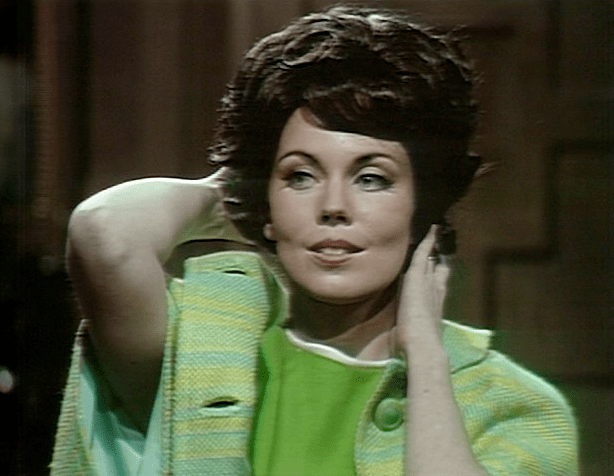
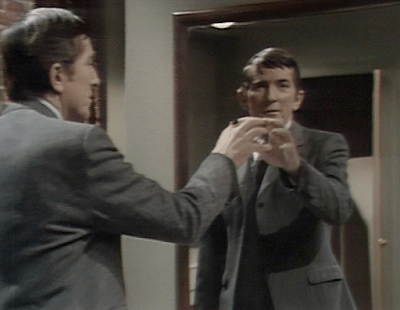

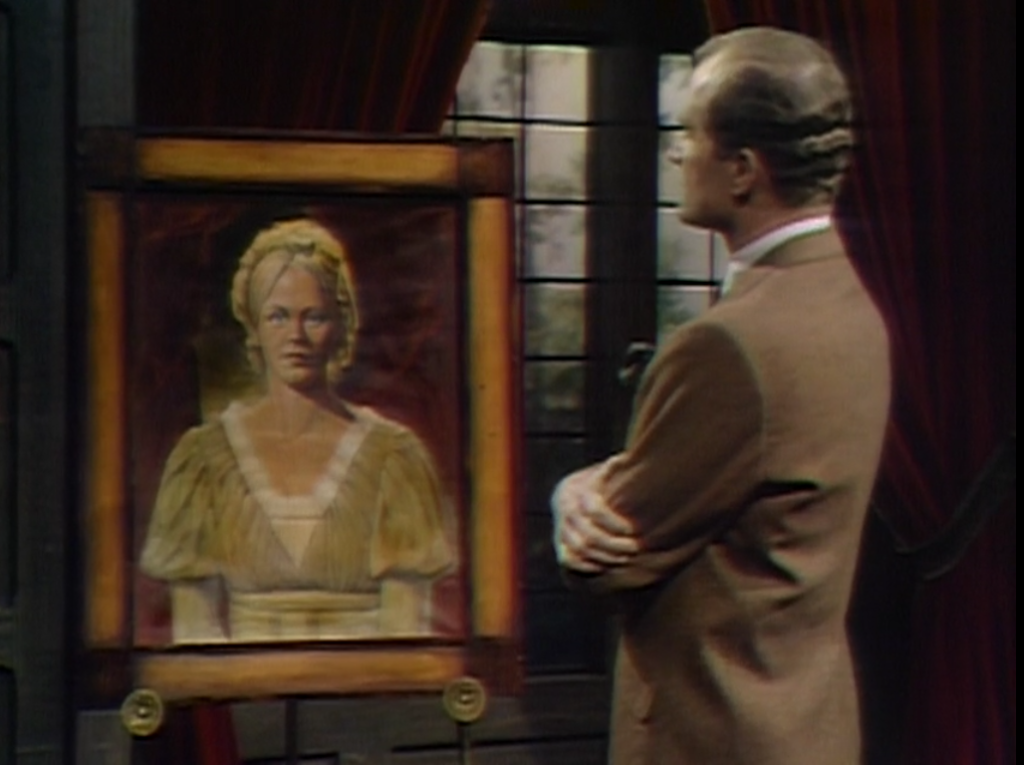


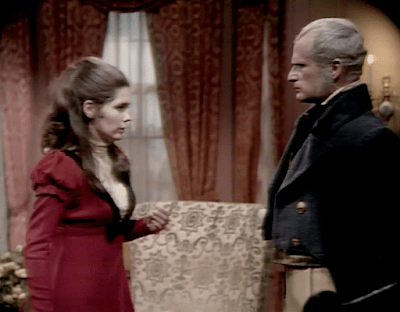

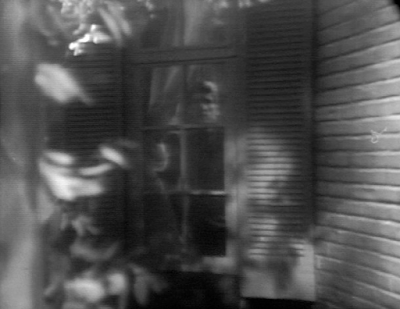


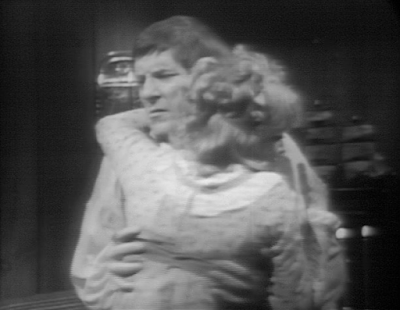

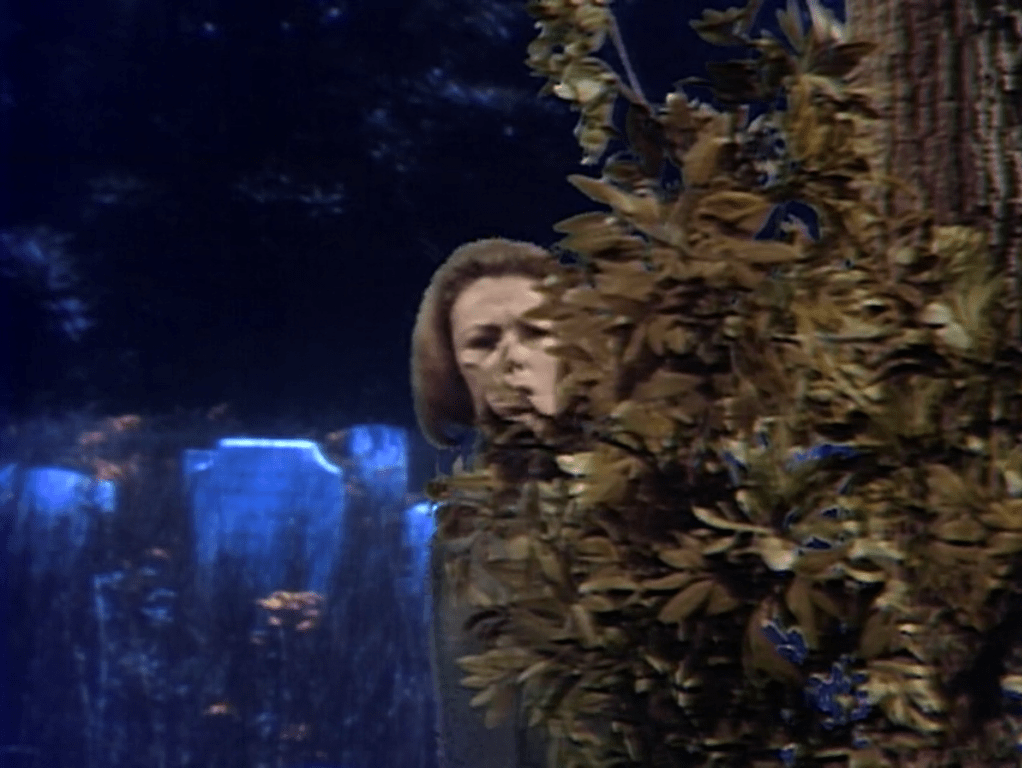


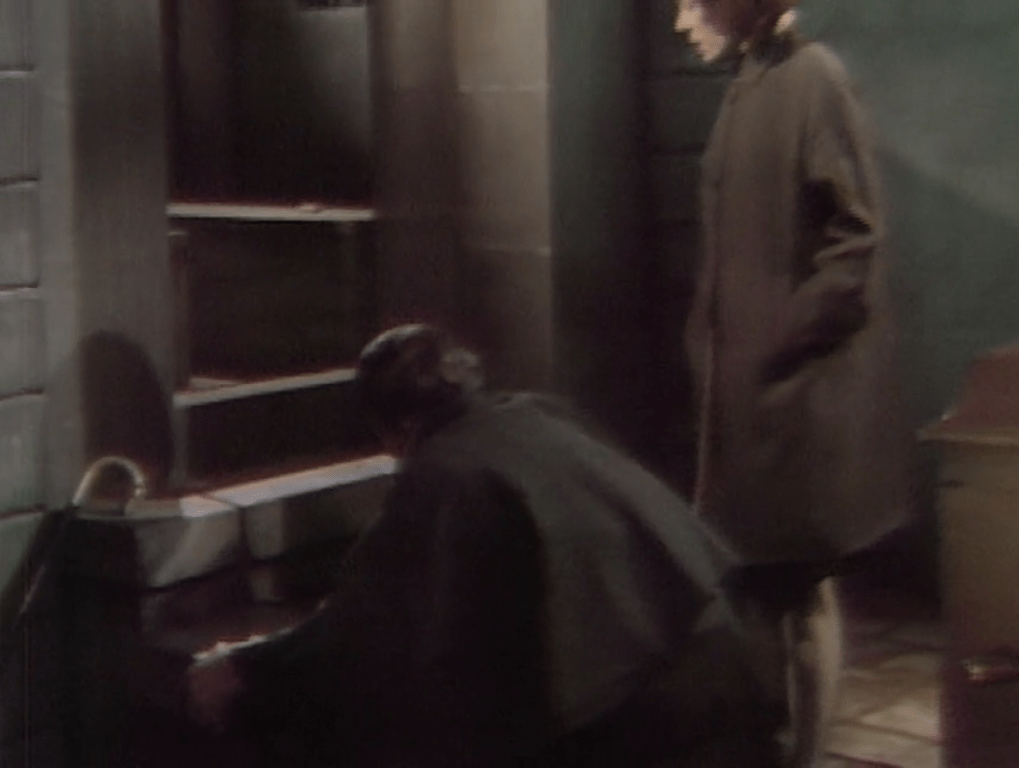
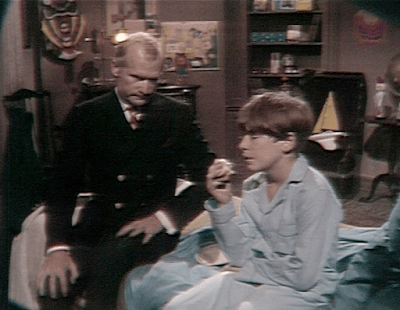
 Dark Shadows Commentary