Episode 804: He is a gem, isn’t he

The evil Count Petofi, a 150 year old sorcerer, has taken possession of twelve year old Jamison Collins and is wreaking havoc in the great house of Collinwood. Due to Petofi’s spells, Jamison’s father Edward thinks he is a valet recently separated from the service of the Earl of Hampshire. Edward’s brother Quentin tries to explain to him what is actually going on, but Edward merely concludes that he is Quentin’s valet now. When Quentin follows the Collinses’ long-established protocol for dealing with mentally ill family members and locks Edward in the tower room, Edward bangs on the door and protests that he won’t be able to do his job if he is locked up. “And I will do it!” he vows.

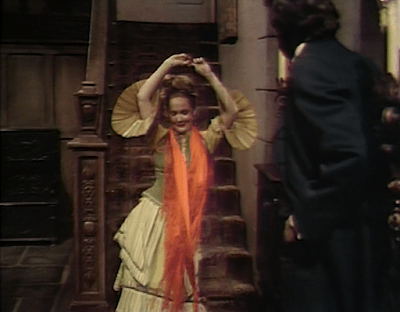
Charity Trask, disastrously uptight step-daughter of Quentin and Edward’s sister Judith, falls under Petofi’s influence and is possessed by the spirit of Cockney showgirl Pansy Faye. Pansy was on the show briefly in June. The childlike Carl Collins, brother to Judith, Edward, and Quentin, was engaged to marry Pansy before she was killed by vampire Dirk Wilkins. Pansy and Charity never met; when Carl asked Charity if she had seen Pansy, the scene was staged to make it seem absurd that the two women could exist in the same universe. Now, they exist in the same body.

Ta Ra Boom De Ayyyy… Screenshot by Dark Shadows Before I Die.

If Petofi has caused startling changes in Jamison, Edward, and Charity, the change in Quentin is perhaps the most jarring of all. He has been a ghost, a homicidal maniac, a Satanist, a zombie, and a werewolf, but always and everywhere a source of total chaos, who destroys all recognized order and is perfectly at home in the midst of sheer madness. Today, Quentin keeps making earnest attempts to restore everyone to their right minds and reestablish the proper and respectable relations within the household.

First time viewers will immediately catch on that the preteen David Henesy is not the actor who would usually play a 150 year old Hungarian nobleman, and when Nancy Barrett suddenly takes on an East London accent and enters wearing a garish costume and doing a dance with lot of hip shaking and pelvic thrusts, they will know that Charity is turning into someone else. The dialogue in the scenes involving Edward explains what is happening to him. They may not know that Quentin is not supposed to be the defender of the status quo. That information is supplied in two scenes. Charity/ Pansy receives a psychic message from the world beyond telling her that Quentin was involved in the murder of Carl, and she announces this information. Also, Quentin calls for help, and the helper who materializes is his distant cousin, Barnabas Collins the vampire.

At the end of the episode, Barnabas lays hold of Jamison/ Petofi and drags him into the secret passage leading from the drawing room to the west wing. It is usually bad news when a vampire abducts a child and shoves him into a dark space, but David Henesy brings such joy to the role of Jamison/ Petofi that we can hardly doubt that what comes next will be equally fun to watch.

Meanwhile, a painter named Charles Delaware Tate has presented himself. Tate’s first appearance will cause a sinking sensation in longtime viewers; he is played by Roger Davis, a terrible actor who delivers much of his dialogue by shouting while clenching the sphincter muscles in his buttocks, and who routinely assaults the women and children in the cast while on camera. We may have hoped we had seen the last of Mr Davis when his most recent character, Dirk, was destroyed shortly after murdering Pansy. But evidently Pansy’s return in the form of another actress has come at the price of Mr Davis’ return in the guise of another character.

For much of 1968, Mr Davis played a man known variously as Peter Bradford and Jeff Clark. His approach to characterization consisted of shouting “My name is Jeff Clark!” When this technique was played out, he took to shouting “My name is Peter Bradford!” He doesn’t shout today, mercifully. But he does say the name “Charles Delaware Tate” quite a few times.

Today’s story about Tate is potentially interesting. Jamison/ Petofi finds him when he answers the front door. Tate asks to see Jamison Collins; Jamison/ Petofi confirms that despite his appearance, he is indeed the person Tate has come to see. Tate accepts this with a blandness that suggests that he knows he is dealing with a magical personage.

Jamison/ Petofi gives Tate a photograph of Quentin and says that he wants a portrait of him. When Quentin comes to the drawing room and finds Tate sketching, he asks who he is. Again, Quentin adopts a stern tone which suits someone defending the sanctity of private property against an unknown intruder. Tate introduces himself and shows him a handwritten letter which Quentin instantly accepts as the product of his grandmother Edith. He tells Tate that Edith has been dead for some time and that he is not interested in a portrait of himself. Tate says that he has already accepted the commission and the money that Edith sent with it, and so he will rent lodgings in the village of Collinsport and finish the job regardless. Quentin does what viewers have hoped everyone who shared a scene with one of Mr Davis’ characters would do, and throws him out.

The forged letter is a fascinating touch for returning viewers. Petofi made himself welcome as a guest at Collinwood by showing Edward forged papers creating the impression that he shared Edward’s friendship with the Earl of Hampshire. That he has also created papers that Quentin immediately accepts as coming from Edith, who died long before Petofi had any reason to come to Collinwood, suggests that his powers of forgery are very extensive indeed.

Tate not only seems to know that Petofi has magical powers; he also shows an acquaintance with Petofi’s henchman Aristide.* When Tate mentions Aristide, he calls him “Aristeedy,” a sort of pet name with a diminutive suffix. This is probably just a blooper on the part of Mr Davis, but since Petofi is continually telling Aristide how lovely he is and how he is more attractive when he doesn’t speak, it does remind us of the gay subtext that runs through their scenes together. We might suspect that Petofi and Aristide’s sexuality is in one way or another one of the reasons they are connected to Tate.

The script opens all of these questions about Tate. Had he been played by an actor who was capable of depicting depth and highlighting ambiguity, it could have been a lot of fun to speculate about just what their answers might be. In #137, future movie star Frederic Forrest was a featured extra on the dance floor at The Blue Whale tavern; it’s easy to suppose he would have taken a speaking part. So when the show puts Mr Davis in front of us, I like to make the time a little more tolerable by imagining what Forrest might have brought to the role of Tate.

*His name is spelled “Aristede” in the closing credits, but it was “Aristide” in the original scripts.

Episode 774: Sometimes people change their roles in life

Tim Shaw, uptight teacher turned victim of brainwashing turned fugitive murder suspect, makes his way into an abandoned root cellar. He finds a coffin there. Naturally, he opens the coffin. That’s what everyone does on Dark Shadows when they find a coffin where one shouldn’t be. You meet the most interesting people that way.

Tim finds that the coffin is empty, and goes into a dark corner to hide. Someone comes to the door, and Tim gets up to greet whoever it might be. He hasn’t been a fugitive very long, and hasn’t quite perfected all the skills that the status calls for.

Tim sees Dirk Wilkins, a dimwitted servant of the ancient and esteemed Collins family who has been missing for several days. Tim calls out “Dirk!” This is the first time we learn the two men know each other. They are unlikely to have been friends. Tim rarely left the school where he worked. The school has been housed in a building on the Collins family’s estate for several weeks, so it makes sense that he and Dirk would have met, but Dirk has been unpleasant to everyone we have seen him with, including his employers and pretty girls he wants to attract. It is hard to imagine the painfully shy Tim befriending him.

Dirk turns out to be a vampire, and he bites Tim. We then cut back to the school. The headmaster, the overwhelmingly evil Gregory Trask, is browbeating Tim’s fellow teacher and onetime girlfriend, neurotic intellectual Rachel Drummond. Returning viewers will recall that Trask has made flagrant passes at Rachel, and also know that Trask conspired with a local Satanist to cast a spell on Tim which caused him to kill Trask’s wife Minerva. Trask is pretending to be upset about Minerva’s murder and to believe that Rachel plotted with Tim to commit it. He tells Rachel that if she does not leave the school, he will accept that she is innocent. She goes to her room, distraught. Later in the episode, Trask will telephone his co-conspirator, gloating that the authorities are on their side.

Spinster Judith Collins, sole proprietor of all her family’s great wealth, shows up to offer her condolences to Trask. They find that Rachel is gone, and he tells her that she must have gone with Tim. Trask realizes that Tim and Rachel have no money, and wonders if there is anyone who might give them enough to allow them to flee the state. Judith says that her distant cousin Barnabas Collins, who is currently staying at the Old House on the estate, is very fond of Rachel and that he might give them some money. She says that she will get in her carriage and go to the Old House before Rachel can get there. She will tell Barnabas about the murder and about Tim and Rachel’s involvement in it, thereby ensuring that he will not give them any money.

Judith consoles he new widower. Screenshot by Dark Shadows Before I Die.

Judith knocks on the front door of the Old House and gets no answer. She enters, and finds the house empty. She is still in the front parlor when Dirk enters. She chastises him for staying on her property after she dismissed him, and tells him she will call the police if he is not gone within 24 hours. He walks towards her, backing her against the wall and ignoring her demands that he let her leave. He says that he is no longer her servant, but that she will soon be his. He bites her.

Judith was right when she told Trask that Rachel would go to the Old House. Rachel does go there. She peeks in the window, sees Judith sitting in a chair, and scurries off. This is rather an odd moment- Judith told Trask just a few minutes before that she would go to the Old House in her carriage. It seems unlikely that she drove her own carriage and there is no driver waiting outside, but even if if she did the carriage must still be sitting there in full view. How did Rachel fail to notice it?

Trask comes to the Old House and tells Judith he wanted to offer her his support in her conversation with Barnabas. Trask knows how fond Barnabas is of Rachel, and may well suppose that he would want more details about Minerva’s death than Judith could offer before he agreed to regard Rachel as a criminal. Judith says Dirk’s name when Trask enters, and when Trask notices the bleeding wounds on her neck he quickly realizes that Dirk inflicted them.

We cut back to the root cellar, which we see Rachel entering. She sees the coffin, and of course opens it. That’s just good manners. She turns, and sees Dirk in the entryway.

In his post about this episode at Dark Shadows Every Day, Danny Horn transcribes a conversation among Roger Davis, Jerry Lacy, and director Lela Swift captured on video when the three were on a panel at a convention:

Roger Davis:  I do remember being very excited when I got to be a vampire on the show, so excited, and the first person that I got to bite was Joan Bennett, and I was so enthusiastic and excited I knocked her over — flat on her back!

Jerry Lacy:  I remember when you did it, it was rehearsal in the morning.

Roger:  Was it?

Jerry:  Yeah. You grabbed her, and you bit her, and then you just threw her. And she was already sixty years old then.

Lela Swift:  Then we had to pick Joan up and put her together again.

Danny Horn, “Episode 774: What’s Up, Dirk,” posted at Dark Shadows Every Day, 21 November 2015.

To which my comment is, fuck that guy. I don’t make a habit of swearing, but there are not enough curse words in the language to express my reaction to Mr Davis chortling through his reminiscences of physically abusing his female scene partners. He can fuck off straight to hell.

This story gives an extra dimension to the scene between Judith and Trask in the Old House. Mr Lacy plays Trask’s relentless evil so effectively that he is difficult to watch; my wife, Mrs Acilius, refuses to watch his episodes this time through the series. It usually makes a viewer’s skin crawl to see Trask posing as a representative of something good. But knowing that behind Trask in the position of standing by Judith after she had been attacked by Dirk was Jerry Lacy standing by Joan Bennett after she had been attacked by Roger Davis, our response is much more complex. After all the times we might have wondered how anyone could fail to see through Trask’s blatant hypocrisy, this time enough of the thoroughly decent humanity of Jerry Lacy peeks through that we can understand why Judith has been so supportive of Trask.

The cast went into makeup after the morning rehearsal. From the looks of Dirk’s fake mustache and artificial pallor, makeup artist Vincent LoScalzo must not have brought his usual enthusiasm to his work when Mr Davis sat in his chair. The mustache in particular is so crudely affixed that it looks like Mr Davis might have done his own makeup today.

Episode 769: All dead things look the same

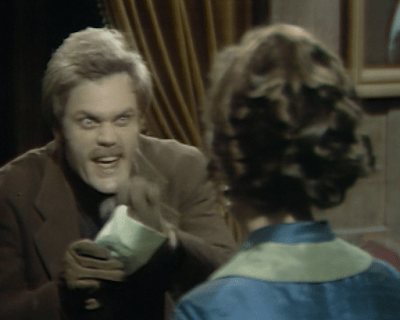
Second consecutive episode ruined by Roger Davis’ performance as crazed groundskeeper Dirk Wilkins. Crazy Dirk has more fans than do any of Mr Davis’ other roles on Dark Shadows, which I do not understand. He is such a swivel-eyed loon from the first shot to the last that he is useless as a character- he doesn’t respond to anything anyone else does or says, just carries on with a chortling mania. The unvarying bombast suggests a desperate actor, and it leaves Mr Davis’ scene partners with nothing to do.

Roger Davis attempts to act. Screenshot by Dark Shadows Before I Die.

In a comment I left under Danny Horn’s post about the episode on Dark Shadows Every Day, I talked about my mental habit of imagining different actors playing parts that were not well executed:

I  amuse myself during weak bits by wondering how characters would have come off if played by other actors. A character as well-written as Dirk, played by an actor as competent as Robert Rodan? Second only to Quentin Collins among the fans! Played by David Groh? Bigger breakout star than Barnabas! Played by Harvey Keitel? Such a hit the show is still in production!

Who knows how they would actually have done- maybe they would have made some kind of unfortunate choice and bungled it. And who knows what effect they would have had on the rest of the show- maybe if Dirk had been a massive hit and they’d rebuilt Dark Shadows around him, the result would have been a less interesting show. But the imaginary show in my head is good enough to get me through some pretty dire segments.

This time through I’ve been imagining Edward Marshall, who wore some of the wardrobe that became Dirk’s when he was cast as petulant ex-convict Harry Johnson in #669, in Mr Davis’ place. Mr Marshall took over the part of Harry from the not reliably brilliant Craig Slocum. He preserved the attitude and a great many of the mannerisms Slocum had given the part, but was substantially more interesting than Slocum ever was. Before he became violently insane, Dirk shared so many of Harry’s qualities that Mr Marshall would have been an obvious choice for the role. I’m sure he would have been better than Mr Davis, though perhaps not on a par with Robert Rodan, David Groh, or Harvey Keitel.

Today’s big plot point comes when Dirk tells twelve year old Jamison Collins that he has killed Barnabas Collins and that Barnabas was a vampire. Dirk is mistaken about the first of these points; he did not harm Barnabas at all. But he is right that he is a vampire.

This part of Dark Shadows is a costume drama set in the year 1897. Barnabas traveled to that year from 1969 while doing battle with some supernatural menaces. In the parts of the show set in the 1960s, the adults in the great house of Collinwood are Jamison’s daughter Liz and son Roger. Liz and Roger have accepted Barnabas’ story that he is their distant cousin from England and have let him take up residence in the Old House on the estate. If Jamison finds out that Barnabas is actually a bloodsucking ghoul, it is unlikely that his children will be sufficiently hospitable to him to allow the parts of the show in contemporary dress to exist. So when Jamison goes to the Old House to check on Dirk’s story and finds a coffin in the basement, we know that something will have to change if the show is to continue.

Episode 768: Some kind of exhibit

For most of its run, Dark Shadows was made with severely limited access to videotape editing equipment. If something went wrong, the only way to fix it was to start over. So even spectacular mistakes stayed in, especially if they took place near the end of the episode. Today there is a blooper in the opening voiceover- yesterday’s episode centered on a prophetic dream that twelve year old Jamison Collins had about his future descendant David, but the narrator names the dreamer as “David.”

It doesn’t get much better from there. The episode is a showcase for the acting of Roger Davis as crazed groundskeeper Dirk. Unfortunately Mr Davis is the sort of actor who needs close guidance from a director, and the directors on Dark Shadows famously gave their male performers a great deal of latitude. So he hams up his every scene, often interrupting himself with sounds that are variously transcribed as “huh?” or “hyunh!” or “hyuk hyuk!” He ruins every shot he is in.

Roger Davis at his most understated. Screenshot by Dark Shadows Before I Die.

The only Davis-free scenes are interactions between maidservant Beth and the show’s two breakout stars, her boyfriend Quentin and her vampire master Barnabas. The writing staff has figured out a way to work around Terrayne Crawford’s limitations as an actress; Beth is always very earnest and straightforward. That is a great relief after the first weeks of the part of Dark Shadows set in 1897, when they gave Beth the same rich and complex motivations they lavished on everyone else and she fell disastrously flat every time. Still, Beth’s emotional transparency does not give David Selby or Jonathan Frid much for Quentin or Barnabas to play off of, so that they seem to be explaining the plot to her.

Quentin at one point slaps Beth in the face today. It used to be extremely rare for male character to slap female ones on the show, but these incidents are have started to come thick and fast since writer violet Welles joined the staff. Miss Welles was far and away the best writer of dialogue on Dark Shadows, and I suppose she must have had a reason for showing us all these women getting hit by men, but I for one am eager for it to stop.

Barnabas bit Dirk a while ago, but before he did that Dirk was already enslaved by undead blonde fire witch Laura. So rather than becoming a blood thrall, Dirk reacted to Barnabas’ bite by going nuts. At the end of today’s installment, Dirk is trying to kill Barnabas. Dirk has yet to find a task so simple he can succeed in it, so we leave without much suspense that he will manage to kill off the main protagonist. I suppose it will do for a Wednesday cliffhanger.

Episode 759: It’s not our fault, what we are

Dark Shadows‘ first supernatural menace, on the show from December 1966 to March 1967, was undead blonde fire witch Laura Murdoch Collins. In those days, we learned that at intervals of exactly 100 years Laura incinerated herself and her young son, always a boy named David, and that she (but not the Davids) rose from the ashes as a humanoid Phoenix. Well-meaning governess Victoria Winters led the resistance to Laura.

The story came to its climax as Laura she tried to take her son, Vicki’s charge David Collins, to the fate that had claimed David Stockbridge in 1767, David Radcliffe in 1867, and who knows how many other Davids in the preceding centuries. At the final moment, David Collins ran from the burning shack to which Laura had brought him and found his way to Vicki’s arms. With that, he chose Vicki and life over his mother and death, and Dark Shadows 1.0 reached its conclusion.

Dark Shadows 2.0 picked up immediately after, and focused on another supernatural villain, vampire Barnabas Collins. There isn’t an established mythology for filicidal humanoid Phoenixes, so the writers had leaned heavily on Bram Stoker’s Dracula and on stage and film adaptations of the novel for the structure and details of the Laura story. For example, in many scenes they went out of their way to show that Laura never eats or drinks. They eventually established that Barnabas doesn’t eat or drink either, but when he first came on they had to show that they were not just repeating what they had done so shortly before. So in #221, Barnabas clearly drinks a cup of coffee.

The original plan had apparently been that Barnabas would wreak terror for thirteen weeks while Vicki gradually figured out what was going on, organized a force to do battle with him, and then staked him in #275, destroying him in the last episode the ABC network was likely to air before cancelling the show. But Barnabas brought a new audience with him, prompting ABC to renew for another thirteen weeks. So his destruction had to be postponed indefinitely, and Vicki wound up on the margins of the story. She became Barnabas’ friend and stalwart defender before ultimately disappearing altogether.

Since then, Dark Shadows has been reinvented several times. Version 3.0 ran from November 1967 through March 1968; it was a costume drama set in the 1790s, to which Vicki had been transported by the mysterious powers represented by the ghost of Barnabas’ little sister Sarah. Version 4.0 ran from March through November 1968; it was a Monster Mash in which a variety of vampires, Frankensteins, witches, and other refugees from the Universal Studios back catalog stumbled over each other in an ever-more futile search for a coherent plot. Version 5.0 began in November 1968 with two stories revolving around nine year old Amy Jennings. These were the Haunting of Collinwood by the malign ghost of Quentin Collins, who represented a special threat to Amy, and the Werewolf Curse on Amy’s big brother Chris. I don’t know what was in the original flimsies, but I suspect this portion of the show was originally meant to be much shorter than it is and to serve as a prologue to Version 5.0.1, a costume drama set in 1897, when Quentin was alive and the werewolf curse began. It shows signs of having been greatly extended when Quentin’s ghost started to attract a large and fervent fan-base and the producers were unsure whether he could keep that following as a living being.

We finally went back to 1897 in #701, twelve weeks ago. Barnabas, who at the beginning of the Monster Mash period was freed of the effects of the vampire curse, tried to save Amy, Chris, and everyone else at Collinwood by doing some mumbo-jumbo, and found himself transported back in time. Having traveled to the past, he has once again become a vampire.

Among the many people Barnabas has met during his uncertain and frightening journey to the past is another iteration of Laura. It turns out that he remembers her from 1767, when he was a child and she was married to his uncle. She at first accepted his story that he was the great-grandson of the original Barnabas. He was a small boy when she burned that time, and all she can see is that her new acquaintance has a family resemblance to that boy. But he knew that she was planning to incinerate her children, among them the ancestor of the Collinses whom he knows at Collinwood in the 1960s, and he has been flagrantly aggressive in his opposition to her. She has learned that he is a vampire, and has tried to destroy him.

The highlight of today’s episode comes when Laura enters the foyer of the great house and Barnabas pops up to greet her. He calls her Laura Stockbridge, and she begins talking about what he was like as a boy. She refers to their similarity, implying that she is herself a type of vampire. She tells him he shouldn’t oppose her, and he says that he would want her to stop him if he were about to do what she is planning. She says that he cannot know what her plans are. He assures her he does know, and she lists all the people with whom he may have discussed her, dismissing each in turn as an unreliable source. Barnabas keeps smiling. For a thrilling moment, we wonder if his key informant was Vicki. Perhaps she told him about her encounter with the Laura of 1966-1967, and he knows everything she figured out in those days.

Hello, Auntie! Screenshot by Dark Shadows Before I Die.

Alas, it is not so. Barnabas opens a door and reveals the slumped figure of Laura’s dimwitted thrall Dirk. Earlier Barnabas, in bat form, had attached Dirk to prevent him bringing a letter to the house that would have exposed Barnabas’ secret. Barnabas tells Laura he hasn’t killed Dirk, merely bitten him and questioned him. In the first two-thirds of the episode, Dirk, played by the always-regrettable Roger Davis, kept grabbing Laura and pawing at her; at one point Diana Millay does an adroit little judo move to block his hand before he can put it on her left breast. As a result of these scenes and countless others in which Mr Davis engaged in similar behavior, many in the audience will groan with disappointment when Barnabas says that Dirk is not dead.

Millay and Jonathan Frid are wonderful in this scene. Laura’s lines are perfectly suited to display Millay’s gift for subtle emotional transitions, and Frid’s delivery shows what he can do when he has time to learn his part and the lines do not require him to verbalize the character’s every thought. Mr Davis is also well within his range, playing as he does an unconscious and apparently dead body. He should have specialized in that, it’s the first thing we’ve seen him do really well in all of his many appearances on the show.

Episode 742: Barnabas, Quentin, and the advantage of being seen together

We open in the cottage on the grounds of the estate of Collinwood, where the rakish Quentin Collins has triumphantly confronted his sister-in-law and sometime lover, Laura Murdoch Collins, with a telegram from the authorities in Alexandria, Egypt, declaring that she died in that city the year before. Laura points out that the fact that she is standing in front of him and breathing would tend to limit the credence such a document might be expected to command. Quentin hadn’t thought of that. He looks puzzled for a moment, then says that even if no one else is convinced, he is now sure that she is dead.

Laura, unable to believe that Quentin really is this stupid. Screenshot by Dark Shadows Before I Die.

Viewers who have been with Dark Shadows from the beginning will particularly enjoy this exchange. Another iteration of Laura, also played by Diana Millay, was on the show from December 1966 to March 1967, when the dramatic date was contemporary with the broadcast date. In those days, the authorities in Phoenix, Arizona, kept sending messages to the residents of the great estate of Collinwood concerning their reasons for believing that Laura was dead. Most of those messages were received with a laugh, then with irritation that a bunch of brain-dead bureaucrats wouldn’t stop pestering them with reports that were obviously false. But there were a few times when characters took them with an inexplicable seriousness. It’s a relief to see that this part of the show, set in the year 1897, will not include any of those jarringly foolish reactions.

Quentin and Laura argue about her children. She wants to take them and leave Collinwood; he asks what she will accept instead. Quentin’s pretense that he would have anything to offer her that might be tempting so amuses Laura that she doesn’t bother to be insulted. When he says that he will give her money, she laughs. The penniless Quentin says that he will steal any amount she names. He claims to “have powers.” Before Laura returned to Collinwood in #729, we twice saw Quentin take part in unholy summoning rituals on this set (#711 and #718,) each of which did result in communication with the spiritual forces of darkness. It does seem to be a bit of an exaggeration for him to claim to “have powers,” though. Especially so when he is talking to someone whom he believes to have transcended death.

A male servant comes to the door. Quentin believes this man to be Laura’s lover, and nearly says so today. In fact, Quentin has severely underestimated Laura in every way. She did die in Alexandria. But she has also died in other places, at other times, and will do so again. She is an undead fire witch who periodically incinerates herself and rises from the ashes as a humanoid Phoenix. The man is not her lover in any human sense. Rather, one of the ways she keeps herself more or less alive is by draining heat from his body in a kind of dry vampirism.

Quentin leaves Laura alone with the servant. Opposite David Selby, Diana Millay had shown her gift for dry comedy to great advantage. Once he exits and she is alone with the servant, her manner shifts abruptly. She suddenly starts overacting and sounding false. I think that is down to the actor who plays the servant, Roger Davis. Mr Davis was notoriously abusive of his female scene partners, and she has to play her scene in his arms. It would have been difficult for anyone to relax sufficiently to give a good performance when she was stuck in that unenviable position.

Laura is not the only vampiric presence at Collinwood these days. Time-traveler Barnabas Collins is the old-fashioned blood-sucking kind, and we see him rise from his coffin. He summons his blood thrall Charity Trask to come to him at the Old House on the estate. Charity comes. Several of Barnabas’ female victims have gone through a particular series of stages. First, they are elated at their new connection with Barnabas, and want to devote themselves to him as slavishly as possible. Then, they become reluctant to go on serving as his breakfast, and make anguished protests about wanting to return to their previous lives. Finally, they rebel. Charity has entered the second stage. She says that her father expects her. Barnabas has seen all this before, and has learned to have fun with it. He tells Charity that he needs her more than her father does. He bares his fangs and bites her, after which she is back to elated servility.

Barnabas tells Charity that she will be assisting him in a ceremony. She waits in the Old House while Barnabas goes to the great house on the estate to fetch something he needs for that ceremony.

We cut to Quentin’s room in the great house, where we see a mirror. It shows the reflection of Quentin kissing maidservant Beth. When we first saw them talk to each other in #701, Beth was fighting her attraction to Quentin and trying to resist his attempts to seduce her. That’s what was supposed to be going on, anyway, but we didn’t actually see it. Terrayne Crawford played Beth’s lines according to the literal meaning of the words, with the result that for the first six weeks of the part of Dark Shadows set in 1897 Beth seemed sincerely uninterested in Quentin, and his overtures were just sexual harassment. Now Ms Crawford no longer has to play conflicting emotions. Beth is simply in love with Quentin. She gets that point across adequately.

Beth pulls away from Quentin, explaining that she has to get back to work. He talks about ending his marriage so that they can be together permanently; he says that it may serve their cause to stop being so discreet, since a little scandal may prompt the rest of his family to drop their opposition to any change in the status quo. While they get ready to part, we see the window, outside of which a bat is squeaking incessantly. They exit, and Barnabas appears.

Barnabas rummages through Quentin’s desk and finds a book. Beth reenters and catches him. He tells her he came for the book and was planning to leave a note. A smirk on her face, Beth says that it will not be necessary to do so, as she will tell Quentin all about what she has seen.

Beth goes downstairs and meets Quentin in the foyer. Quentin asks what book it was Barnabas took. She says that all she saw of the title was the word “dead.” Evidently Quentin has quite a few books with the word “dead” in the title, because he has to ask where exactly Barnabas found it. She says it was in the desk, and he rushes off to the Old House.

It was the Egyptian Book of the Dead, and Barnabas used it to perform a rite calling on Amun-Ra to cause the spirit of one of Laura’s previous incarnations to appear before him. At that, we cut to the cottage, where the currently alive-ish Laura grows weak and vanishes. Back in the Old House, we see the ghost take shape. Charity sees it too, and runs screaming out the front door. Quentin enters just in time to see the end of Barnabas’ conversation with the phantasmal Laura. The phantom looks at Quentin, screams, and disappears.

On Friday, Laura said that no one knew just how deeply Quentin was obsessed with the occult. His own absurd claim today to “have powers” so great that he could make it worth Laura’s while to leave without her children confirms that he is very far gone in this obsession. So when he sees that Barnabas is not only doing battle with the same adversary whom he is trying to confront, but is also able to conjure up spirits from the vasty deep, we can be confident that Quentin’s hostility to his recently arrived “cousin from England” will soon be evaporating. As Tony Peterson might say, I think this is the beginning of a beautiful friendship.

Episode 738: The rest of the truth

This episode ends with one of the most thrilling moments in all of Dark Shadows.

The show’s first supernatural menace was undead blonde fire witch Laura Murdoch Collins, who was on it from December 1966 to March 1967. Its second was vampire Barnabas Collins, who first appeared in April 1967. Laura herself was presented with many tropes that conventionally mark vampires; for example, they laid great emphasis on the fact that Laura was never seen eating or drinking. And Laura’s story was structured very much like Bram Stoker’s Dracula, with well-meaning governess Vicki taking Mina’s role as the driving force behind the opposition to her. Presumably, if Barnabas had been staked and destroyed as the original plan envisioned, Vicki would have led the fight against him as well, and in #275 driven the stake into his heart. But Barnabas brought the show a new audience, and so Vicki was never called on to go to battle with him. Her character withered and was written out, and he replaced her as its chief protagonist.

In early 1967, Vicki learned that Laura had appeared at least twice before, and had died in strikingly similar ways each time. In 1767, Laura Murdoch Stockbridge was burned to death with her young son David; in 1867, Laura Murdoch Radcliffe was burned to death with her young son David; and in 1967, Vicki found Laura Murdoch Collins beckoning her young son David to join her in the flames consuming a wooden building. At the last second, Vicki broke through David’s trance and he ran to her, escaping the flames.

In November 1967, the show established that Barnabas lived on the great estate of Collinwood as a human in 1795, and that he became a vampire as a result of the tragic events of that year. If Barnabas were the same age in 1795 that Jonathan Frid was in 1967, he would have been born late in 1752, meaning that he would have been a teenager when Laura Murdoch Stockbridge and little David Stockbridge went up in smoke. The Stockbridges were a very wealthy family, so they would likely have been on familiar terms with Barnabas and the other rich Collinses of Collinsport, and the deaths of Laura and David would have been one of the major events in the area in those days. So longtime viewers have been wondering ever since whether Barnabas knew Laura, and if so what he knew about her.

Now Barnabas has traveled back in time to the year 1897, and there he meets another incarnation of Laura. He is thunderstruck at the sight of her. In her bland, enigmatic way, she expresses curiosity about his reaction, and he collects himself sufficiently to make some flattering remarks about her beauty. As soon as he is alone with his blood thrall, Miss Charity Trask, he declares that Laura has been dead for over a hundred years. So has he, but apparently when a woman rises from the dead to prey on the living that’s different, somehow. We saw this same old double standard a couple of weeks ago, when libertine Quentin Collins expressed shock at Laura’s return from the dead, when he himself had died and been a zombie just the week before.

If Laura did know Barnabas when she was as she is now and he was an adolescent, it is no wonder she does not seem to recognize him. She knows that there is a Barnabas Collins on the estate, and has heard that he is a descendant of the eighteenth century bearer of the same name. She would expect him to resemble the boy she knew, but would not necessarily know what that boy looked like when he was in his forties.

This is the first time we’ve seen Charity since Barnabas bit her in #727. She lives in the town of Rockport, which in the 1960s was far enough away from Collinwood that in #521 it was worthy of note that you could dial telephone numbers there directly. In 1897, when automobiles were rare and roads weren’t made for the few that did exist, a long-distance relationship between vampire and blood thrall would seem quite impractical. Still, in #732 we saw a character make two round trips between Rockport and Collinwood in a single evening, so I suppose it could be managed.

Barnabas’ recognition of Laura is a fitting conclusion to a fine episode. Much of it is devoted to a three-cornered confrontation between Laura, her twelve year old son Jamison Collins, and her brother-in-law/ ex-lover/ mortal enemy, Quentin. Danny Horn analyzes this in his post about the episode at Dark Shadows Every Day. I recommend that post highly. All I would add is that as it plays out today, the confrontation makes me suspect that the writers of the show may have done more planning than Danny usually credits them with. Jamison is the only person Quentin loves, and so far we have seen that Jamison loves Quentin back. When he learns that Quentin is his mother’s foe, Jamison turns against Quentin. Barnabas traveled back in time after Quentin’s ghost had made life impossible for everyone in 1969. The evil of Quentin’s spirit fell heaviest on David Collins, whom Quentin had possessed, turned into another version of Jamison, and was in the process of killing. Nothing yet has explained why Quentin’s ghost would focus its malignity on the image of Jamison. Actress Diana Millay used to claim that Laura was added to the 1897 segment at the last minute because she told Dan Curtis she wanted to work, but Millay famously enjoyed testing the credulity of Dark Shadows fans with outlandish remarks. I wonder if a falling-out between Quentin and Jamison over Laura was in the flimsies all along.

Charity makes her first entrance in the great house of Collinwood. Quentin is apologizing to her for some boorish behavior when he realizes she hasn’t been listening to him at all. She is completely absorbed in the eighteenth century portrait of Barnabas that hangs in the foyer. She excuses herself and wafts out the front door.

In Barnabas’ house, Charity says that he makes her feel beautiful, and that she wants to see herself in a mirror. Barnabas is a bit sheepish about the particulars of vampirism, and so he changes the subject. We cut from this exchange to Laura’s room in the great house, where she is with a servant named Dirk whom she has enthralled to serve as a source of body heat. That scene opens with a shot in a mirror, making the point that Laura’s relationship with Dirk is a reflection of Barnabas’ relationship with Charity. Earlier, there had been a clumsy attempt at an artsy shot of Laura reflected in Quentin’s sherry glass. That does show us that Laura casts a reflection and that her relationship with Quentin has been affected by his drinking, but it calls too much attention to itself to do much more than that.

The portrait in the foyer is hugely important to Barnabas. It made its debut on the show in #204, the day before his name was first mentioned and more than a week before he himself premiered. His thralls stare at it and receive his commands through it. He himself uses it as a passport, appealing to his resemblance to it as proof that he is a descendant of its subject and therefore a member of the Collins family. Today, Barnabas is surprised when Charity comes to his house; he wasn’t transmitting a message through the portrait summoning her. Instead, it was functioning as another mirror, in which Charity, who has become a part of Barnabas, could see the motivating force within her own personality.

Dirk is played by Roger Davis, a most unappealing actor. At one point he makes this face while Dirk is involved in some kind of mumbo-jumbo:

Screenshot by Dark Shadows Before I Die.

At one point today, Quentin tells Jamison that he shouldn’t be afraid of telling the servants what to do, since after all he will someday be the master of Collinwood. Jamison takes this altogether too much to heart, and spends the rest of the episode ordering everyone around. David Henesy is a good enough actor to extract the comic value from this. For example, when he turns to Quentin, says “I’ll talk to you later!,” and keeps walking, we laughed out loud.

Episode 737: The suffering of some people

Laura Collins is the estranged wife of stuffy Edward and the mortal enemy of Edward’s brother, libertine Quentin. Only Quentin knows that Laura is an undead fire witch. He has found the Egyptian urn housing the magic flame that gives life to Laura, and has extinguished the flame.

In the great house of Collinwood, Quentin and Edward’s spinster sister Judith notices that Laura has taken ill. Judith goes off to order a servant to prepare a hot cup of tea for Laura, and is alarmed when she returns to the drawing room and finds that Laura has gone. Quentin enters, and Judith asks him if he saw Laura. Judith explains that Laura is ill, and is appalled at Quentin’s indifference.

Laura has gone to the gazebo on the grounds, where she hid her urn under an armillary sphere. She finds that the urn is gone. Surly groundskeeper Dirk Wilkins chances upon her; she clutches at him. He is shocked at how cold she is, and is afraid of how the scene would be interpreted if anyone saw them in each others’ arms.

Dirk takes Laura back to the great house. Quentin insists on walking her upstairs to her bedroom. While she lies in bed, he taunts her with her doom, reminding her that she had treated him the same way a few nights ago when she thought he was dying. Quentin’s behavior is really abominable in this scene, but as David Selby plays him he keeps the audience’s affection. He visibly thinks about each line before he says it, so that we can really believe he is finding his way through what is after all a bizarre situation and is deciding what to say to Laura. He is relaxed and easy in his physical movement, and modulates his delivery subtly in response to every cue.

After Quentin leaves, Laura prays to the gods of ancient Egypt to take possession of Dirk and send him to her room. They oblige; Dirk finds himself standing by the fire in the drawing room and speaking a few words of old Egyptian, then heads upstairs.

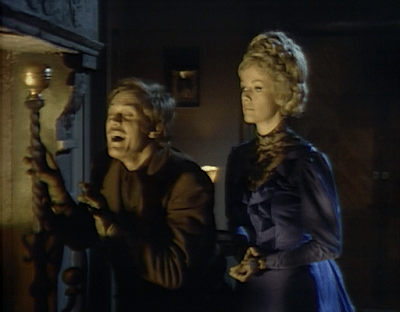
Dirk and Laura take hold of each other while she is in bed. There are a few moments of dissonance when Diana Millay has to reposition herself to get Roger Davis’ hands onto more broadcast standards-friendly parts of her body while Laura insists Dirk hold her ever closer and he protests he must not, but it isn’t as bad as we might expect considering Mr Davis’ usual practice of assaulting his female scene partners. They speak each line more rapidly and more breathily than the one before. Mr Davis has both feet on the floor, but the result is still the most sex-like encounter we have seen so far on Dark Shadows.

Dirk takes hold of Laura while she is in bed. Screenshot by Dark Shadows Before I Die.

Mr Davis’ performance is the opposite of Mr Selby’s. He is as stiff as Mr Selby is relaxed, holding himself rigidly still even when he is grappling with Diana Millay in bed. He tends to take a deep breath and deliver each speech as a single exhalation, making it impossible for him to show thought or adjust his approach while speaking. So even though today’s action shows us Quentin at his most despicable and Dirk at his most innocent, our loyalties are firmly with Quentin.

Joan Bennett famously said that Mr Davis was show business’ answer to the question “What would Henry Fonda have been like if he had had no talent?” Not only does his face resemble Fonda’s, but by his own admission he often mimicked Fonda while acting. There is nothing wrong with mimicry- John Gielgud was as good an actor as any, and he used to say that from the time he first saw Claude Rains in a play, his acting style consisted of imitating Claude Rains. He also said that imitating Rains was a great improvement over his previous style, which was imitating Noel Coward. Mr Davis’ readings of his one-line speeches today are distinctly Fonda-like, and the longer speeches may also have been if he had been breathing normally while delivering them. Today Mr Selby also sounds very much like the actor he tends to mimic, Joseph Cotten. I suspect Cotten would have been more flattered than Fonda had the two of them watched this episode!

Episode 721: If he stays dead now

Well-meaning time-traveler/ bloodsucking fiend Barnabas Collins enters a cottage on the grounds of the estate of Collinwood to find thuggish groundskeeper Dirk Wilkins standing over the freshly stabbed corpse of the rakish Quentin Collins. Since Quentin’s cause of death is a long-bladed thrusting dagger, a weapon also known as a “dirk,” it would seem clear that Wilkins is the culprit. But as it happens, Barnabas saw Wilkins enter the cottage a moment before, so he can be fairly sure he did not kill Quentin.

Nonetheless, Barnabas threatens to go to the police and accuse Wilkins unless he answers “a lot of questions.” Barnabas doesn’t have any witnesses to back up his version of events, and though he claims to be a relative of the ancient and esteemed Collins family he only arrived in town a few weeks before. But Wilkins isn’t hard to intimidate, so he answers some of Barnabas’ questions about madwoman Jenny Collins. Most importantly, he tells Barnabas that Jenny is the estranged wife of Quentin, not of Quentin’s brother Edward as the audience had been led to believe in the four weeks leading up to Friday’s episode.

As Wilkins, actor Roger Davis has been getting very careless with his lines. Jonathan Frid always had a lot of trouble with his own dialogue, but he is clearly sticking with the script in an exchange like this:

Wilkins: Mr. Collins, you gotta understand that she’s crazy in the head! She could hurt herself — or somebody!

Barnabas: Who do you mean by “we”?

This comes to a head with one of Dark Shadows‘ most famous bloopers:

Barnabas: Tell them that you saw no one here.
Wilkins: Oh, that’s fine. What am I gonna tell ’em?
Barnabas: That you saw no one here!

Jenny is being kept in a cell in the basement of the great house on the estate. Wilkins and maidservant Beth were assigned to watch her. On Friday Jenny bashed Wilkins on the head with her dinner tray, unfortunately not hard enough to kill him and get the odious Mr Davis off the show. She did knock him out, though, and ran off to the cottage to stab Quentin. We cut to the cell, where Jenny is babbling to Beth. It gradually dawns on Beth that Jenny is telling her she stabbed Quentin and killed him. Beth locks Jenny in the cell and rushes off to the cottage.

In the cottage, Barnabas has summoned wicked witch Angelique and asked her to bring Quentin back to life. Angelique points out some of the flaws in Barnabas’ plan, and tells him that even if she does grant his wish the price for her services will be very high. They seem to be approaching a tentative agreement when Beth arrives at the door and Angelique vanishes.

Beth finds Barnabas in the cottage. He tries to keep her out. It has long since been established that, as a vampire, Barnabas is far stronger than any mortal man, yet Beth pushes past him without apparent difficulty. For that matter, we also know that he is as capable as Angelique of vanishing into thin air, yet he hangs around while Beth sees Quentin’s body. Barnabas insists she tell no one what she saw in the cottage, and he is staring at her with the same intensity that has sometimes exerted an hypnotic effect on people. This doesn’t work on Beth. She says that she will tell Judith Collins, the mistress of the estate, that Quentin is dead and that Barnabas was with him. Barnabas just watches Beth go. Evidently he has given up on using his vampiric powers. Terry Crawford’s literal acting style doesn’t win her much enthusiasm from the fans of Dark Shadows, but it does add a touch of humor to a scene like this. Vampire? What’s that? Sounds like bullshit, I’m gonna report this to the boss.

We cut to the drawing room of the great house, where Quentin’s body is laid out in a coffin with candles burning on high stands by its head and foot. Barnabas and Beth are there. Beth tells Barnabas she has not yet spoken to Judith. Apparently she just took Quentin’s body to the great house on her own? And found a coffin? And carried it into the drawing room where she put Quentin in it? And that’s how the family is going to find out Quentin is dead, by seeing him lying in state in the middle of the house?

I have questions. Screenshot by Dark Shadows Before I Die.

Barnabas and Beth exit, and Angelique enters. She tells the corpse that she will raise him from the dead, and that once she does Barnabas will really be sorry.

Episode 719: Every person has a theme of music

Most of the characters in the part of Dark Shadows set in the year 1897 are villains of one sort of another, but we are supposed to take pleasure in watching them. One exception is the loutish Dirk Wilkins, groundskeeper on the estate of Collinwood. Dirk is humorless, unimaginative, violent, and surly. He is unpleasant to everyone, even his employers. When spinster Judith Collins, the owner of the estate, tells Dirk today that she has an opportunity for him to make some extra cash, he virtually sneers his acceptance. He says in so many words that all he cares about is money, and that he will do anything to get it.

The show didn’t really need to work so hard to make Dirk unlikeable. They’ve already cast instantly detestable actor Roger Davis in the part. But we can see why it was important to them that we have no sympathy for him. Judith hires Dirk to keep an eye on a madwoman named Jenny, whom she and her brother Edward are secretly keeping locked up in a cell in the basement of the great house. We know that Jenny is eagerly looking for someone to stab to death, and so we might be inclined to make excuses for her captors, no matter how screwy their approach. But when Jenny tricks Dirk into looking away from her and slams her dinner tray down on his head, she wins our enthusiastic support. We don’t particularly want her to kill anyone other than Dirk, but we cannot be satisfied with her situation.

Go Jenny go! Screenshot by Dark Shadows Before I Die.

The reason Dark Shadows is now a costume drama set in 1897 is that the evil ghost of Quentin Collins overwhelmed every plot point in 1969. So well-meaning time traveler/ bloodsucking fiend from beyond the grave Barnabas Collins did some mumbo-jumbo and brought us back here. Part of Quentin’s reign of terror in the late 1960s was causing a sickly little waltz to resound incessantly throughout the halls of the great house. It turns out the living Quentin is equally insistent on playing the same crepuscular tune on his gramophone to the annoyance of everyone around him. Today Judith declares that the waltz is driving her mad. Quentin apparently thinks he is on a prime-time show where every character has a dedicated musical cue, and declares that “every person has a theme of music” and this creaky jingle is his, so he refuses to stop running it into the ground.

Judith can’t do anything to stop Quentin from playing the waltz over and over, but she isn’t the only one whom it bothers today. The sound of the gramophone leaks from Quentin’s room down to Jenny’s cell, and drives her into the homicidal frenzy that will carry through from her assault on Dirk to the the end of the episode, when she will be holding Quentin’s dagger and wearing a blissful grin. Quentin is so much fun to watch that even his unrelenting playing of the waltz isn’t enough to make us want Jenny to kill him, but if she could chop up his record player that’d be great.