Most of the characters in the part of Dark Shadows set in the year 1897 are villains of one sort of another, but we are supposed to take pleasure in watching them. One exception is the loutish Dirk Wilkins, groundskeeper on the estate of Collinwood. Dirk is humorless, unimaginative, violent, and surly. He is unpleasant to everyone, even his employers. When spinster Judith Collins, the owner of the estate, tells Dirk today that she has an opportunity for him to make some extra cash, he virtually sneers his acceptance. He says in so many words that all he cares about is money, and that he will do anything to get it.
The show didn’t really need to work so hard to make Dirk unlikeable. They’ve already cast instantly detestable actor Roger Davis in the part. But we can see why it was important to them that we have no sympathy for him. Judith hires Dirk to keep an eye on a madwoman named Jenny, whom she and her brother Edward are secretly keeping locked up in a cell in the basement of the great house. We know that Jenny is eagerly looking for someone to stab to death, and so we might be inclined to make excuses for her captors, no matter how screwy their approach. But when Jenny tricks Dirk into looking away from her and slams her dinner tray down on his head, she wins our enthusiastic support. We don’t particularly want her to kill anyone other than Dirk, but we cannot be satisfied with her situation.
The reason Dark Shadows is now a costume drama set in 1897 is that the evil ghost of Quentin Collins overwhelmed every plot point in 1969. So well-meaning time traveler/ bloodsucking fiend from beyond the grave Barnabas Collins did some mumbo-jumbo and brought us back here. Part of Quentin’s reign of terror in the late 1960s was causing a sickly little waltz to resound incessantly throughout the halls of the great house. It turns out the living Quentin is equally insistent on playing the same crepuscular tune on his gramophone to the annoyance of everyone around him. Today Judith declares that the waltz is driving her mad. Quentin apparently thinks he is on a prime-time show where every character has a dedicated musical cue, and declares that “every person has a theme of music” and this creaky jingle is his, so he refuses to stop running it into the ground.
Judith can’t do anything to stop Quentin from playing the waltz over and over, but she isn’t the only one whom it bothers today. The sound of the gramophone leaks from Quentin’s room down to Jenny’s cell, and drives her into the homicidal frenzy that will carry through from her assault on Dirk to the the end of the episode, when she will be holding Quentin’s dagger and wearing a blissful grin. Quentin is so much fun to watch that even his unrelenting playing of the waltz isn’t enough to make us want Jenny to kill him, but if she could chop up his record player that’d be great.
Governess Rachel Drummond has figured out that her employers, the Collins family of Collinwood, are keeping someone locked in the room atop the tower in the great house on the estate. Rachel has seemed frightened ever since we first saw her, in #705, and this information has added to her fear considerably. Rachel recently came to the conclusion that some unknown person was trying to harm her. She then let Romani stereotype Magda Rákóczi talk her into believing that the prisoner in the tower room was that person, and that her only hope was to choose the time of their confrontation.
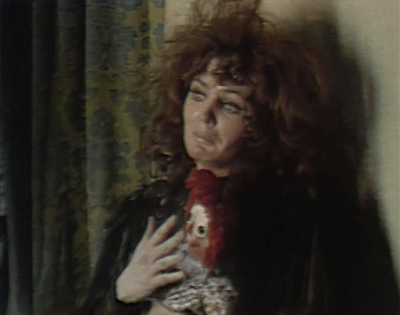
Today, Rachel opens the door to the room and goes in. We know that the enemy Rachel ought to fear is wicked witch Angelique, and we can tell that the person in the room is not her. Instead, she is a madwoman named Jenny, and she is tall with red hair. Jenny attacks Rachel, pushes her back in the room, and flees, locking the door behind her and trapping Rachel.
The show has been dropping broad hints that Jenny is the estranged wife of stuffy Edward Collins and the mother of Edward’s children, Rachel’s charges Jamison and Nora. Once she is on the loose, Jenny slips into Nora’s room and looks at a framed picture of Edward there, expressing her hatred for him. Nora has been outside; she had a dream that her missing mother came home, and she went out to look for her. When Nora comes back into the room, Jenny dares not show herself, but stays in the shadows and longingly caresses a doll.
Jenny, in 1897, with a Raggedy Ann doll, first made in 1918. Screenshot by Dark Shadows Before I Die.
A servant named Dirk Wilkins figures in the episode a couple of times. He finds Nora outside, picks her up, and with considerable roughness carries her into the house. Perhaps this roughness is only apparent, but actor Roger Davis was notorious for physically abusing his scene-mates on camera, especially women and children. He may well have been even harder on Denise Nickerson than Dirk is on Nora.
One of my ways of making the show tolerable to watch when Mr Davis is on camera is to imagine someone else playing his part. Dirk is supposed to be unlikable; he sneers at everyone, even his employers. In the part of Dark Shadows set in 1968, a character named Harry Johnson had a similar manner, and even wore a costume like Dirk’s. The first actor to play Harry was Craig Slocum, who was pretty bad, but the second, Edward Marshall, took the same personality and made it quite amusing to watch. Mr Marshall might have made a fine Dirk. Other accomplished performers had small turns as background players on Dark Shadows and surely would have been glad to accept speaking roles. Among these, Harvey Keitel (Dancer at Blue Whale in #33) and David Groh (Ghost of One-Armed Man in #544 and Hangman’s Assistant in #664) went on to do outstanding work playing ill-tempered men, so in either of their hands Dirk might have become a breakout star.
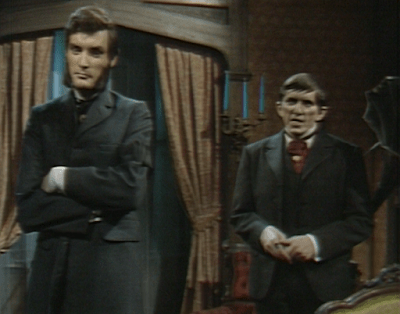
Vampire Barnabas Collins has traveled back in time to the year 1897 where he hopes to prevent his distant cousin, libertine Quentin, from becoming a ghost who will ruin things for everyone in 1969. Barnabas knows that if events play out as they did originally, Quentin will die soon. He tells him today that it is his understanding that people become ghosts when they leave unfinished business behind them. He does not know what business Quentin originally left unfinished, or how he can keep him from dying without finishing it on this iteration of the timeline. So you might think that his first priority would be to get as close as possible to Quentin and learn as much as he can about what he wants.
Instead of doing this, Barnabas has gone out of his way to antagonize Quentin by accusing him of stealing his grandmother Edith’s will. Quentin and his siblings are all frenziedly searching for the will, but it is of no concern to Barnabas. Edith cannot possibly have left him any money, and he knows that the original timeline worked out so that the Collins family assets wound up in the hands of people who were oblivious to his sinister nature and happy to let him make his home on their estate. Showing interest in the will can do nothing but raise suspicions as to who this stranger really is and why he showed up when he did.
Quentin did in fact steal the will. Edith’s ghost may be at work in the house- her glove mysteriously shows up in the corridor near Quentin’s room, the furniture in the room is turned upside down, and before the end of the episode Quentin alone can hear the pounding of an enormously amplified heartbeat emanating from the walls of his room. But Quentin accuses Barnabas of planting the glove and disordering his room, and in #538 we saw that Barnabas is capable of making people with guilty consciences have hallucinations of just this kind. Barnabas is also frequently seen reading, and it is certainly possible he might have read Edgar Allan Poe’s “Tell-Tale Heart” and decided to make it come to life. He may not even have needed to read the story- we saw in #442 that in 1796, early in his career as a vampire, he bricked up an enemy of his in the style Poe would describe in his 1846 story “The Cask of Amontillado.” Evidently his imagination and Poe’s ran along similar lines.
Barnabas meets governess Rachel Drummond. He is immediately attracted to Rachel, unsurprising since she is played by the lovely Kathryn Leigh Scott. He tells Rachel that she strongly resembles the portrait of Josette Collins, and he relates some facts about Josette’s life and death that did not make it into the family history. Indeed, Miss Scott played Josette in the part of Dark Shadows set in the 1790s.
Yesterday, Barnabas met unethical lawyer Evan Hanley, played by Humbert Allen Astredo. His reaction to Evan was not inappropriate, but the same reaction would also have been fitting had Barnabas thought Evan was Astredo’s previous character, warlock Nicholas Blair. This may have reminded longtime viewers of the 1790s segment, when time-traveling governess Vicki alienated the audience by time and again telling the characters that they were being played by actors who had other parts in the first 73 weeks of the show. Do the characters not look alike to Barnabas, or does he simply have the presence of mind not to waste everyone’s time with tedious drivel about who used to be who? We now know that in Rachel’s case, at least, it is the latter.
Quentin has a scene with his sister Judith in which he tells her that he did not like to play with her when they were children, because she was a “scaredy-cat.” Joan Bennett was 31 years old when David Selby was born, a fact of which the original audience would have been well aware since she was already a major star of motion pictures at the time. Indeed, her father Richard Bennett had been so big on Broadway that her birth was announced on the front pages of the New York papers, so that she never bothered to be coy about her age. But she and Mr Selby are such strong actors that it doesn’t raise an eyebrow when we hear that Judith and Quentin were children together.
Not everyone we see today merits such high praise, alas. Executive producer Dan Curtis was friendly with a man called Roger Davis, and he often let Mr Davis come on the set of Dark Shadows and assault the actors while they were trying to work. Unfortunately this happens today. Mr Davis is usually presented as if he were himself an actor playing a part. His idea of acting is simple enough. For example, he was once supposed to play a character named Jeff Clark, and his approach involved shouting “My name is Jeff Clark!” every episode or two. More recently, he was credited with a role called Ned Stuart, and he went around saying “My name is Ned Stuart!” That’s one way of attempting characterization, I suppose.
Today he is supposed to be someone named Dirk Wilkins. Regular viewers keep waiting for him to yell “My name is Dirk Wilkins!,” but he neglects to do so. He has a mustache, perhaps he thought that was sufficient. He finds Terry Crawford playing maidservant Beth Chavez, grabs her and yells in her face. Mr Selby interrupts this encounter. In character as Quentin, he makes some flip remarks and walks away, and Mr Davis resumes abusing Ms Crawford. Later he finds Ms Crawford on another set and grabs her again. Finally he walks into the set representing Quentin’s room while David Selby is trying to show us Quentin’s panicked response to the sound of the heartbeat. Mr Davis makes some nasty remarks, and when Mr Selby tries to involve him in the scene by tussling with him as Quentin might under those circumstances, it looks like Mr Davis gives him a real punch in the midsection. Mr Selby goes on acting, but the assault takes the audience out of the story. The ABC network really should have posted security guards outside the studio to keep this sort of thing from happening.
Barnabas Collins, old world gentleman extraordinaire, and Julia Hoffman, MD, are helping mysterious drifter Chris Jennings cover up the fact that he is a werewolf, responsible for a great many violent deaths. Lately Chris has started transforming into his lupine shape even on nights when the moon is not full, and this morning they find that he has not changed back even after dawn.
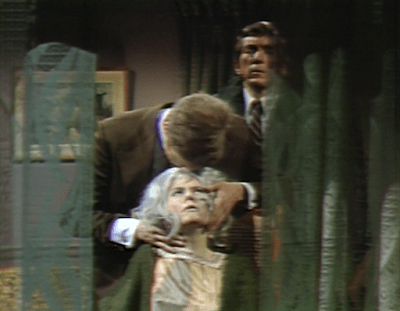
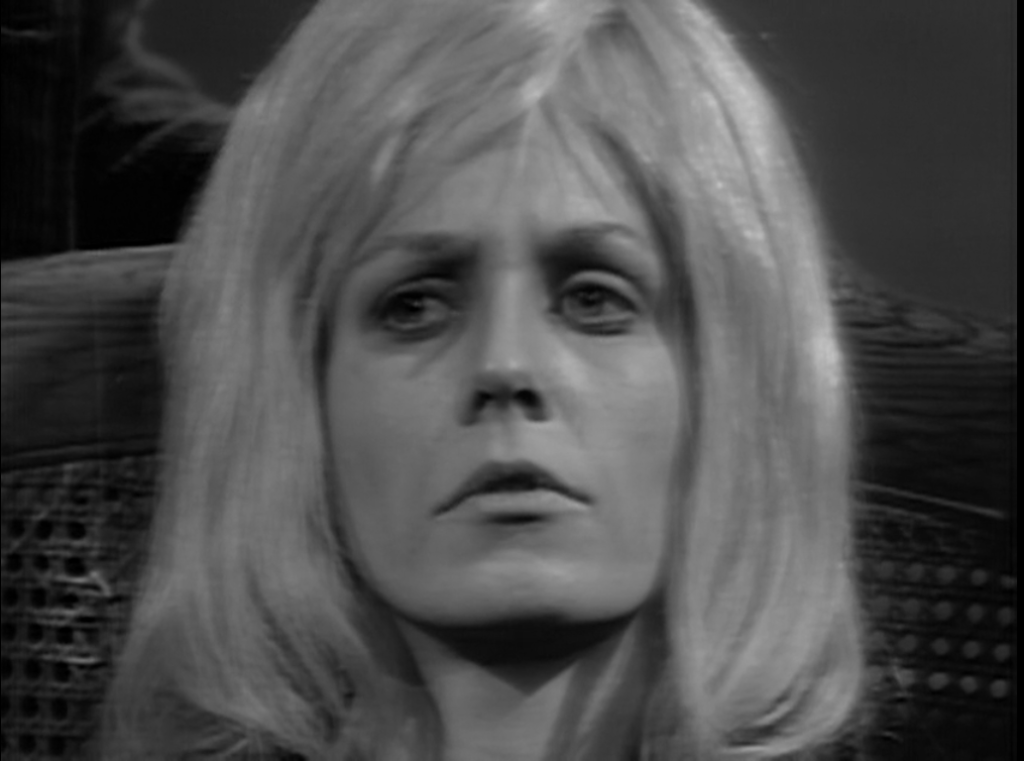
As if that did not present enough difficulty to Julia and Barnabas, one of Chris’ surviving victims is in town. She is his onetime fiancée, Sabrina Stuart. Two years ago, Sabrina saw Chris as the werewolf. She hasn’t told anyone about him, because she hasn’t been able to speak since. Her hair turned white, her skin turned pale, and she has been nearly catatonic.
Others have encountered the werewolf, and none has had this reaction. It’s true that Chris’ cousin Joe had to be taken to a mental hospital after he saw the transformation, but Joe had just been through a very long train of supernaturally induced traumas that had shattered his sensibilities and taken away everything he cared about. Seeing Chris change was just the last step in that process. Sabrina, as we see in a flashback segment today, was fine until she encountered Chris as the werewolf, and she didn’t even see the transformation itself. Yet here she is two years later, unspeaking, immobilized, and wearing the same makeup that Eli Wallach wore as Mr Freeze in the 1960s Batman TV show.
In a comment on Danny Horn’s post about this episode at Dark Shadows Every Day, “Cole” speculates that the show might have meant to tell us that the real reason Sabrina’s condition is less to do with what happened that on night in Chris’ apartment than with her brother and sole caretaker, Ned, played by Roger Davis:
I am once more getting through the Ned/Sabrina scenes thanks to this blog and the comments here; and although I still have to frequently avert my eyes from the screen to hold back the nausea, I keep concentrating on the dialogue while speculating further on JRM’s theory.
It does seem that we– and Julia– might be meant to feel especially concerned by Ned’s refusal to even consider allowing Sabrina to stay at Windcliff. He even says (or, rather, since it is Roger Davis, he SCREAMS), ”I won’t be separated from her!”
I don’t think his character is meant to be overly suspicious of Julia and Barnabas so the vehemence behind his already rather alarming declaration becomes more baffling unless the viewer concludes he has … extremely unnatural feelings of possessiveness towards sad, PTSD-afflicted Sabrina.
It is almost half as frustrating as it is disturbing because, with any other actors, we would surely know for certain how to interpret these scenes.
We would perhaps recognize that when Sabrina stares pleadingly at Julia once Ned leaves the room, that her muteness is caused as much by her horror at being an ongoing victim of her brother’s unspeakable abuse as by having once witnessed Chris’s transformation into a werewolf. We wouldn’t wonder, instead if the actress, Lisa Richards, is actually pleading with Hall to help her endure Davis’s deliberate act of molesting and assaulting her through out these scenes.
If it wasn’t Roger Davis in this role, we would know who Ned is really meant to be since there is no way any of the other regular male cast members would willingly subject their costars to type of abuse Davis is inflicting on Richards.
If it were … say, Jerry Lacy who was currently playing “Ned Stuart” in a manner even remotely similar to Roger Davis’s ‘interpretation’ of the role, we would recognize at once that the character of Ned is obviously scripted to be an incestuous rapist (and I am sure Lacy would still keep his hands professionally and respectfully away from Lisa Richards’s/”Sabrina’s” breasts, instead using actual acting techniques to portray his character’s warped nature). But with Davis ..
It really could be, as Mary commented below, that he is trying to get the poor actress to break character. And how could we expect other than that he would use his usual disgusting and violent Drumph-like/”‘you can grab them by the pussy” sense of Curtis-granted entitlement to assault her as “Ned,” regardless of the intent of the writer and director.
Either way, what a horrifically mistaken choice in casting.
Lisa Richards: fifty years later, I am thinking of you and hoping you weren’t forced to endure PTSD after filming these scenes with Davis.
Comment left 29 August 2021 by “Cole” on “Episode 698: Sister Act,” Dark Shadows Every Day, Danny Horn, 8 August 2015
When I mentally recast the many parts Roger Davis played on Dark Shadows, I divide them between two men who were background players in the show’s first months. I imagine Fredric Forrest playing the two characters with aliases, Peter Bradford (a.k.a. Jeff Clark) and Charles Delaware Tate (a.k.a. Harrison Monroe.) Forrest excelled both as a quietly intense man under pressure and as a sweet, goofy, overgrown kid. In the hands of an actor who, unlike Mr Davis, could project those qualities, those two unloved characters might both have become fan favorites. His other two parts, Ned Stuart and Dirk Wilkins, would have been perfect for Harvey Keitel, who is unsurpassed as a man who is agitated by a deep anger that he himself barely understands and that he certainly cannot explain to anyone else. Not that it’s any secret why Ned is angry at Chris, but when he takes a break from pawing at Sabrina’s face and breasts he handles her so roughly that he is obviously angry with her, and that is something he isn’t going to be giving any thought.
Mr Davis’ behavior wasn’t much better in episodes directed by Lela Swift and others, but it is little surprise director Henry Kaplan didn’t rein him in. Kaplan directed with a conductor’s baton, and actresses complain that he would jab them with it. When the person in charge has that light a regard for women’s personal space, it’s no wonder a creep like Mr Davis felt free to rub himself all over Ms Richards.
Chris Jennings is a werewolf, a fact which old world gentleman Barnabas Collins is helping him conceal. Two years ago, Chris’ fiancée Sabrina Stuart chanced to see him transform; she hasn’t been able to speak since. Her hair turned white, and she is in a nearly catatonic state. Sabrina’s brother, a very loud man named Ned, has brought her to the village of Collinsport and keeps demanding that Chris visit them and explain what happened.
There is a full moon tonight, so Barnabas has sealed Chris up in the secret chamber hidden in the old Collins family mausoleum. He tells Chris that he will try to persuade the Stuarts to leave town and forget about him. Chris tells him that is impossible; Barnabas seems to believe he can pull it off.
In the Stuarts’ suite at the Collinsport Inn, Barnabas tells Ned that he is harming Sabrina by taking her along on his mission to confront Chris and that he ought to take her home and move on with his life. Preposterous as this is, Ned makes it seem credible. To be more precise, it is actor Roger Davis who makes it seem credible. He rubs himself all over Lisa Blake Richards’ scalp, face, and chest while she is required to remain motionless. To the extent that we accept them as their characters, we are forced to think of Ned as a caretaker who abuses his disabled sister sexually; to the extent that we recognize Mr Davis’ behavior as typical of his previous performances on Dark Shadows, we wonder how bad things were for women in show business in the late 1960s that Miss Richards didn’t contact the union and bring him up on charges. It isn’t every performer who can make an audience sympathize with an ex-vampire’s attempt to keep a woman in a comatose state lest she endanger his werewolf buddy, but you can always trust Mr Davis to enlist the viewers’ support for any plot development that will get him off the screen.
I wonder how much of that look is Barnabas reacting to Ned’s story and how much is Jonathan Frid wondering if he should stop tape and call Equity. Screenshot by Dark Shadows Before I Die.
There are also some indications that the show is firming up some of its world-building. For the first time, we hear the name “Edward Collins” as the grandfather of the senior generation now resident at the great house of Collinwood. We hear that Edward was the father of Jamison Collins and the brother of Quentin Collins. Quentin was first mentioned months ago as Jamison’s uncle, but on Friday Barnabas had a line identifying him as his brother, suggesting some behind-the-scenes wavering about this point. Quentin’s ghost is the chief villain in the current A story, and we heard several weeks ago that he wants to turn strange and troubled boy David Collins into a replica of Jamison, so these relationships are important to the action.
Longtime viewers will have fond memories when stuffy Roger Collins sees a book open by itself on the table in the drawing room of the great house. The same book opened itself on the same table in #52, one of the first unmistakable signs that ghosts were at work. No one but the audience was around to see that, but when it happened again in #182, Roger was there. It jolted him out of his refusal to face the facts about the supernatural menace operating at that time.
There are two ongoing narrative threads in this part of Dark Shadows. One is the story of mysterious drifter Chris Jennings. Mad scientist Julia Hoffman knows Chris to be a werewolf and she is trying to help him. The other is the story of Quentin Collins, a ghost who is gradually gaining power and planning to drive everyone away from the great estate of Collinwood so that he can have the place to himself. Chris’ story had been the fast-paced A plot that kept expanding to involve more and more characters, while Quentin’s was the slow-paced B plot that consistently involved only Chris’ nine year old sister Amy, strange and troubled boy David Collins, and their governess Maggie Evans, with intermittent small parts for other established characters and the occasional chance for a day player to act a death scene. That changed yesterday, when Quentin decided that he had grown so strong he no longer needed to conceal himself from matriarch Elizabeth Collins Stoddard or the other adults in the great house. Quentin’s story is now the main topic, and Chris is the secondary feature.
We open today with Liz telling Julia what happened the night before. Julia tells Liz that she and old world gentleman Barnabas Collins had suspected that an evil ghost was at work in the house, and that they have seen another spirit that seems to be opposed to it. Liz says she has called occult expert Timothy Eliot Stokes. Stokes arrives and questions everyone.
Liz is alone at the desk in the drawing room when a secret panel leading to a passage to the long-deserted west wing opens. A cutout meant to suggest a disembodied hand appears on the screen. It picks up a letter opener from the desk and is about to stab her when Stokes enters.
Stokes shouts. The hand drops the letter opener and vanishes. He tells Liz what he saw. He notices the panel is open, and asks Liz about it. She says that it leads to the west wing, but that, as far as she knows, no one has used it in years. That answers a question that has been on the audience’s minds since October 1966. In that month, we saw Liz’ brother, high-born ne’er-do-well Roger, use the panel to play a dirty trick on well-meaning governess Victoria Winters. The panel was not seen or mentioned again until David and Amy started using it to do Quentin’s bidding several weeks ago. This line is our first confirmation that Liz knows that the panel and the passage behind it exist. Stokes asks Liz’ permission to perform an exorcism.
Meanwhile, Julia gets a telephone call from Chris. Liz’ daughter, heiress Carolyn Collins Stoddard, has taken a fancy to Chris and installed him in a cottage on the estate. Chris tells her that he is facing an emergency. Someone has come to the village of Collinsport who might know his secret.
In the cottage, Chris tells Julia that an unpleasant man named Ned Stuart has brought his sister Sabrina to the village and that he is demanding Chris meet with Sabrina. Chris had assumed Sabrina was dead, because she was in the room with him one night two years before when he underwent the transformation into his lupine form. Ned had told Julia and Barnabas that he was looking for Chris because he wanted to know what happened to his sister; he had always referred to Sabrina in the past tense, leading them to assume she was dead. Now Chris is in a panic, convinced that Sabrina will tell the police about him and that he will be punished for the many, many homicides he has committed as the werewolf.
Julia points out that if Sabrina were going to do that, she could have done so at any time. He would already have been arrested. Sabrina must not have told Ned or anyone else what she saw, and Ned must be telling the truth when he says he does not know what happened the last time Chris and Sabrina were together. She persuades Chris to go to visit the Stuarts in their suite at the Collinsport Inn.
Julia accompanies Chris on the visit. Ned is irritated that Chris did not come alone. His remarks are uncomfortable to hear, chiefly because of actor Roger Davis’ habit of clenching his anal sphincters when he raises his voice, making him sound like he is suffering from agonizing constipation.
After Ned makes this fingernails-on-a-blackboard noise for a couple of minutes, he lets Chris and Julia into Sabrina’s room. She is in a catatonic state. Her hair is white, and her face is tinged with light blue makeup. The makeup makes her look haggard in color, but most TV sets in the USA in the 1960s received only in black and white. In black and white, the makeup is not very effective.
Ned says that Sabrina was like that when he found her, the morning after she paid her last visit to Chris’ apartment. Several takes of a framed copy of actress Lisa Blake Richards’ professional headshot invite us to imagine the before-and-after. Ned calls Sabrina’s attention to Chris; she rises from her chair, starts towards him, and collapses.
We open with governess Maggie Evans entering the bedroom of strange and troubled boy David Collins. She had heard David’s screams and a man’s laughter coming from the room; the man is gone, and David is unconscious on the floor. He has a nasty burn on his arm, and as he is coming to he pleads with “Quentin” not to hurt him.
Once David is fully awake, Maggie asks who Quentin is. David frantically denies that there is any such person, and claims that the laughter she heard was his own voice as he was playing a make-believe game. She says that she knows he couldn’t have made those sounds. He points out that they are the only people in the room. Maggie does not even try to explain how anyone could have left the room unseen; she seems already to have concluded that Quentin is a supernatural being. Maggie identifies Quentin with a strange and frightening man she and housekeeper Mrs Johnson have both seen. David keeps trying to deny everything, and Maggie keeps telling him she wants to help. David sobs, and Maggie holds him.
Maggie holds David.
Quentin is indeed a ghost who is taking possession both of David and of Maggie’s other charge, nine year old Amy Jennings. With their help, Quentin has so far killed two people, tried to kill two others, and set about trying to drive everyone off the estate of Collinwood. Up to this point, Maggie has failed completely to represent any sort of obstacle to Quentin. She is a poor disciplinarian who lets the children run rings around her even when they are themselves, and is altogether at sea when they are doing Quentin’s bidding. This scene promises a breakthrough. Maggie is the first of the adult characters to learn Quentin’s name, she does not flinch from the evidence of his uncanny nature, she vows to fight him, and David finds comfort in her arms.
The breakthrough does not come today, however. After a moment, David declares that no one can help him, and he rushes out of the room. He goes downstairs to the foyer and hears a knocking at the door. He opens it and sees notoriously abusive actor Roger Davis standing there. He reacts to that sight as anyone might, running away without a backward glance.
Maggie follows David downstairs. There is again some question as to how much of the body language in the next scene is the blocking the director gave as an interpretation of Maggie’s response to the character Ned Stuart and how much is Kathryn Leigh Scott’s reaction to Mr Davis. Maggie tells Ned she can’t talk because she must go out in search of David; as she prepares to exit, she circles around with as much space as possible between her and him, never quite making eye contact but glancing back every time he moves towards her. This is not a pattern of movement we have seen before on the show, even when a character was dealing with a vampire or some other murderous foe. Miss Scott looks very much like a woman alone with a man whom she does not trust not to assault her. If he had, it wouldn’t be the first time he has physically abused a castmate on camera.
She keeps her eyes on his hands
A child’s voice is heard, singing the song “Inchworm.” It is Amy, and she is working a jigsaw puzzle in the drawing room. The drawing room brings out Amy’s musical side. She played “London Bridge” on the piano there in #656 and tapped a few random keys on the same instrument in #676. She is quite a good singer, perhaps not surprising since actress Denise Nickerson had been in the cast of the short-lived James Lipton/ Laurence Rosenthal Broadway musical Sherry! in 1967.
Ned enters and introduces himself to Amy. His lines are all perfectly polite and friendly. Amy is supposed to gradually sense that Ned is hostile to her big brother Chris and to become uncomfortable around him, but that is supposed to come at the end of their time together. As it plays out, she already seems uncomfortable when he first enters. A minute or so into the scene, Amy smiles at Ned. Nickerson was remarkably good at flashing quick smiles, but it doesn’t work this time. She looks like she is displaying her teeth to the dentist. When Amy is supposed to start edging away from him, Nickerson turns around and proceeds to her next mark at full speed. The camera pans back, but does not capture her movement- she has gone clean out of the shot, leaving Mr Davis alone in the frame.
She goes as far as she can as fast as she can.
Ned approaches Amy; he grabs her by the shoulders and pulls her back into the shot. Chris enters. Amy starts to warn him against Ned, and he tells her not to be afraid for his sake. Indeed, Chris is safe. It is only women and children who have to be afraid of Roger Davis.
Ned confronts Chris. Evidently something bad happened to Ned’s sister Sabrina. She can’t tell Ned what it was, but he thinks Chris is responsible and wants him to go with him to the Collinsport Inn to see her. Returning viewers know that Chris is a werewolf and that Sabrina saw him transform. He assumed that he had killed her while in his beastly form, and he is surprised to learn from Ned that she is still alive. Chris is a character we are supposed to sympathize with, so it is a bit disturbing that he does not seem particularly relieved to find that he did not kill Sabrina.
In the woods, Amy finds David. She learned some days ago that Quentin wants to hurt Chris, and she has been resisting Quentin’s influence ever since. She and David talk about ways they can work together to fight him. David says that he has decided to tell Maggie what has been happening; Amy objects that this is too dangerous. They seem to be getting somewhere when Quentin appears to them. They are terrified, and then resign themselves to their fate.
Later, the children are in the drawing room with Maggie. Amy is still working her jigsaw puzzle, and David is staring into the fireplace. Longtime viewers will remember that this is something his mother used to do. She was the show’s first supernatural menace and tried to lure David to his doom. Maggie’s predecessor, well-meaning governess Vicki, led the other characters in the campaign that saved David then. We wonder if Maggie will be able to match her success.
Maggie admires the puzzle and calls David over to look at it. David makes a show of being bored, leading Amy to remark airily that boys don’t like jigsaw puzzles. David complains that there is nothing to do. Maggie suggests the three of them sit down together for a heart-to-heart talk, an idea the children reject. They suggest a variety of games they might play. Maggie notices that their manner is quite different than it was earlier in the day. David is more assertive, Amy supercilious. She finally agrees to let them play dress-up.
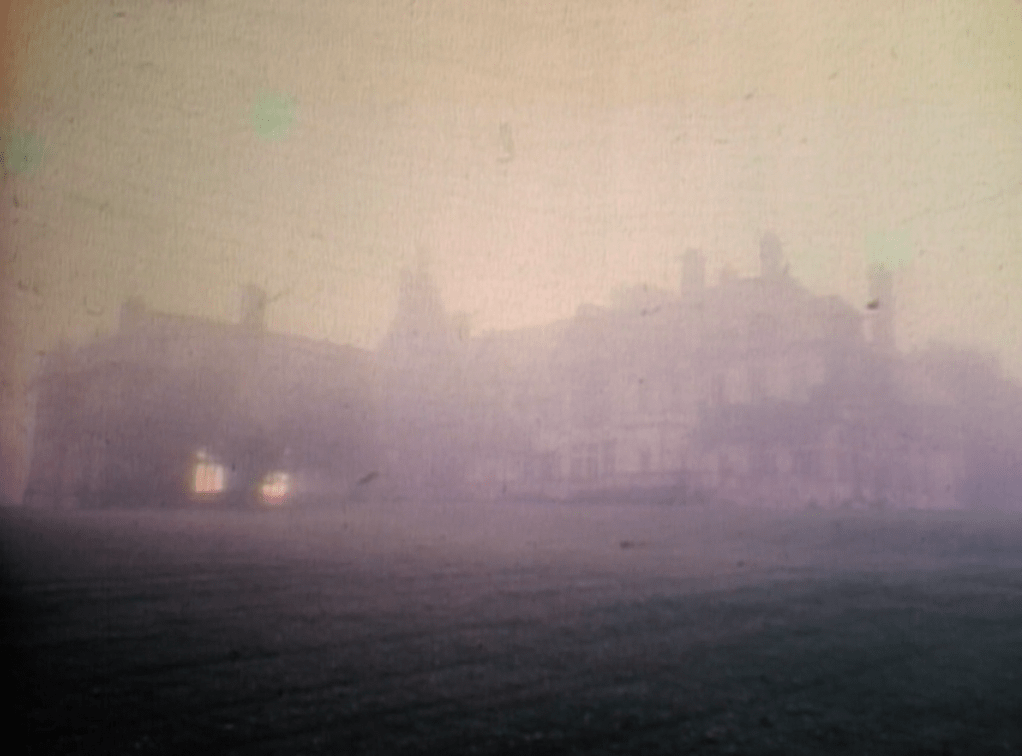
In the first year of the show, the opening voiceovers often involved a weather report. “A cold wind blows from the sea to the great house of Collinwood, but the fog still hangs heavy on its vast lawns” that sort of thing. They stopped doing that some time ago, but today they slip in an almost comically detailed bit about atmospheric conditions- “Soon dark, threatening clouds will gather over Collinwood, and long, ever-lengthening shadows will creep menacingly toward the great house. By late afternoon, rain will come, a rain that will begin slowly but steadily increase into a raging storm.” You expect them to go on with “Expect cooler temperatures and clear skies after 8 PM, with a chance of frost in the morning.” But the rain, at least, plays a part in the story. It explains why David and Amy have to stay indoors, and a roar of thunder gives Amy a chance to sneeringly ask Maggie if she is frightened. It also occasions the use of this still of the exterior of the house, one which I do not believe we have seen before:
We don’t usually see that much of the lawn.
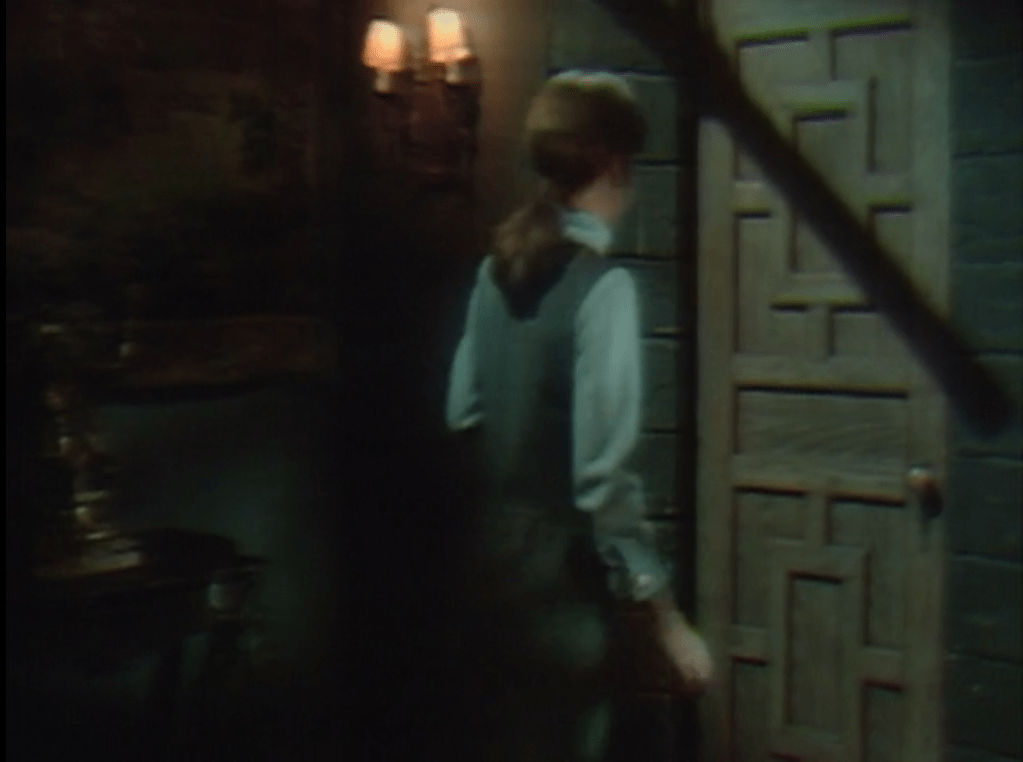
Later, Maggie goes to look for the children. She enters the study. This set has been familiar since early 1967, but today is the first time we see the outside of its door. Lately we have been seeing more of the little spaces that are supposed to join one room to another, part of a strategy to make the house seem like a bigger place.
The sequence before this suggests Maggie is heading into the long-deserted west wing, but once she goes through the door it is clearly the study.
Once in the study, Maggie hears Amy and David calling to her from no particular direction while Quentin laughs. She is bewildered, then the children join Quentin in laughing. His laughter is hearty, theirs is maniacal. Maggie goes out into the corridor, sees something frightening, and retreats into the study. She is only there for a moment when the doorknob starts turning. We end with Maggie staring directly into the camera, its lens representing the point of view of whatever it is that is terrifying her.
Maggie terrified.
This is the first of only two episodes credited to writer Ralph Ellis. Dark Shadows never had more than three writers on staff at any time. I often wish they had had many more. Ellis is one of those whom I would have liked to see as a senior writer on the show right the way through. The episode is well-paced, the characters are clearly defined, and the dialogue is smooth with just a touch of wit. If he had been in charge of, let’s say, every Monday’s script, the whole series would have been a cut above what it actually was. Since he only contributed two scripts, it is especially sad that Roger Davis had to crap on one of them, but even when Mr Davis is on camera you can still tell that Ellis did his job well.
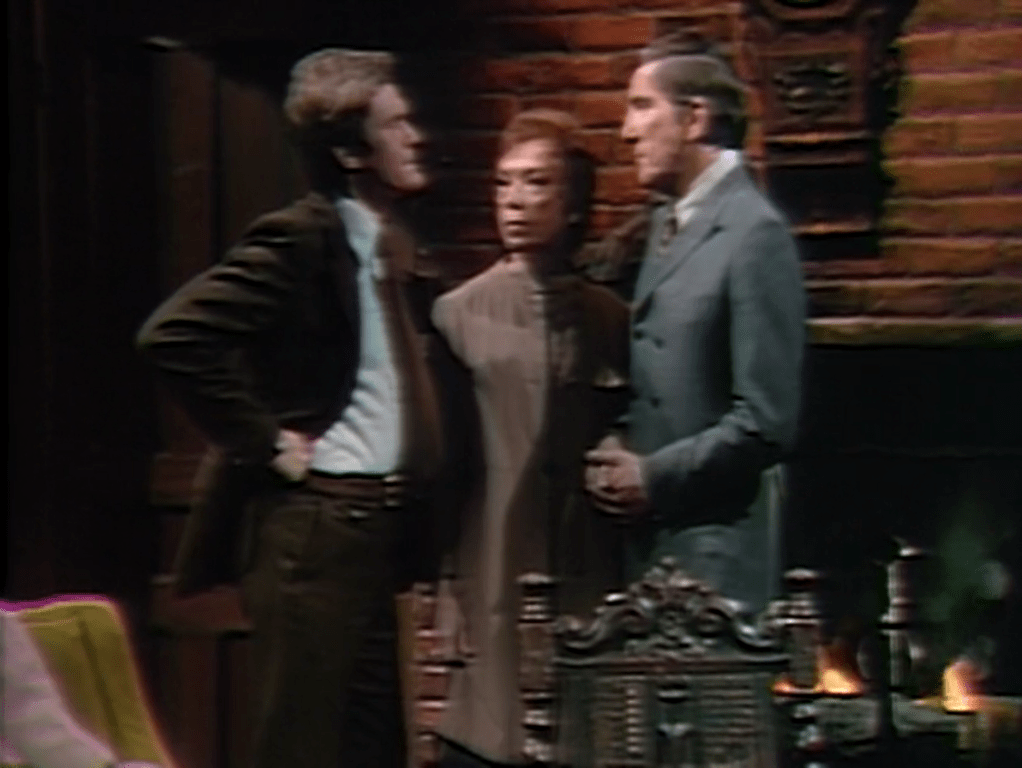
Actor Roger Davis rejoined the cast yesterday, after an absence of not nearly long enough. He has an interminable scene with Grayson Hall and Jonathan Frid, during which he thrusts his arm onto the mantel immediately behind Hall, effectively putting his arm around her shoulders. She visibly flinches at this invasion of her personal space. When he exits she sighs “Oh, I thought we’d never get rid of him.” Frid says that he thought the same thing. They then get back into character and play out the scene in the script.
Roger Davis imposes himself on Grayson Hall and Jonathan Frid.
Later, Kathryn Leigh Scott is on a set representing the woods, and she sees Mr Davis. She reacts with a shout of “Don’t come near me! Stay where you are!” When she demands to know “Why have you come back?,” he reminds her that the camera is on and he is playing a character named “Ned Stuart.” She goes into character and says her lines, keeping as much distance from him as the 4:3 aspect ratio of 1960s US television would allow.
The parts of the episode that are not ruined by Mr Davis’ odious presence tell a story about ghosts and werewolves. Frid and Hall play Barnabas Collins and Julia Hoffman, friends of werewolf Chris Jennings. The other day Barnabas and Chris dug up an unmarked grave and found that it contained the remains of a baby wearing an apotropaic device meant to ward off werewolves. We saw the ghost of Quentin Collins watching as they did so, a sad look on his face. Later, we learned that Quentin paid for the apotropaic device, proving that there was a werewolf in the area when he was alive and that he had some connection with the baby.
Strange and troubled boy David Collins is under Quentin’s influence. After Quentin imposes himself on him, David writes a story about a werewolf who tried to keep from hurting anyone by locking himself in a room, but who was let out of that room and killed by a hunter. Barnabas has indeed locked Chris in the secret room of the old Collins family mausoleum.
Julia finds the story and shows it to Barnabas. They fear that David has somehow learned of Chris’ secret. As Barnabas and Julia are aware, David is one of the few people who know about the secret room. And indeed, at the end of the episode, we see him about to open the panel that leads to it.
But that may not be the story’s whole meaning. Regular viewers know something that Julia and Barnabas do not. David and his friend, Chris’ nine year old sister Amy, first came into contact with Quentin when they made their way into a room hidden behind a wall in the long-deserted west wing of Collinwood. They found a decayed skeleton seated in a chair there, wearing Quentin’s clothes. Evidently Quentin was locked in that hidden room, and Amy and David let him out. Perhaps the story David wrote is a suggestion that Quentin was a werewolf, and that by letting him out he and Amy exposed him to hunters.
Werewolf Chris Jennings finds that his curse is no longer effective only on the nights of the full Moon, but that he can transform on other nights as well. Also, the evil ghost of Quentin Collins takes steps to foil the efforts of old world gentleman Barnabas Collins and permanent houseguest Julia Hoffman to prevent him from destroying the living members of his family.
So far, so much fun to watch. But there is also bad news. Actor Roger Davis rejoins the cast. Mr Davis ruined dozens of episodes in 1968, many of them by whining angrily when people called his character “Peter,” saying he preferred the name “Jeff.” Now he is greeted as “Jeff,” only to respond with a demand that he be called “Ned.” The character has some different story around him than did Peter/ Jeff, but he has the same irritating voice, the same uptight walk, the same handsiness with his female cast-mates, and the same incessantly violent temper Mr Davis showed in his previous role.
Ned shows up at the great house of Collinwood at 1:10 in the morning. He walks past heiress Carolyn Collins Stoddard when she opens the front door and takes up a position in the foyer, peppering her with his questions and refusing to answer hers. When she objects to his aggression, he sneers about the unfriendliness of New Englanders. He tells her he wants to see Chris. She reaches for the telephone to call Chris at his cottage. Ned rushes over and puts his hand on hers, keeping the receiver on the hook. She gives him a startled look, but does not raise an explicit objection to this violation of her autonomy.
Carolyn is befuddled by Ned’s jerkiness.
In #684, Quentin took the same telephone from the hand of twelve year old David Collins, who vigorously protested that he had no right to do so. Indeed, restraining a person from calling for help can be an element of kidnapping, and Ned has every reason to believe that Carolyn wants to enlist help dealing with his intrusion. Both Quentin’s relationship to David and Ned’s presence in the house at this moment have strong kidnap vibes.
The last time someone tried to confine Carolyn within the main part of the house was in #204, when dangerously unstable ruffian Willie Loomis blocked the door and kept her from leaving the drawing room. Carolyn responded to that move by pulling a loaded gun on Willie, with salutary results. We might hope she will use the same weapon to bring Mr Davis’ return to the show to an abrupt conclusion, but alas, it is not to be.
Version 4.0 of Dark Shadows began in #466 when old world gentleman Barnabas Collins was cured of vampirism and ended in #637 when Barnabas and his friend, mad scientist Julia Hoffman, found that witch-turned-vampire Angelique had departed the scene. That version was a Monster Mash in which the main attractions of all Universal Studios horror hits of the 1930s found their counterparts. Version 5.0 is focused on just two monsters, a werewolf and a ghost. The werewolf is Chris Jennings, brother of nine year old Amy. The ghost is Quentin Collins, who is obsessing Amy and her friend, strange and troubled boy David Collins.
Today is taken up with two problems of plot mechanics. First, Barnabas is the undisputed star of the show, and he does not have any particular connection to either of the ongoing stories. Second, well-meaning governess Vicki is too familiar with the supernatural, too secure in her place in the great house of Collinwood, and too familiar to the audience to permit Amy and David to figure in a story based on Henry James’ The Turn of the Screw, even if that story is inverted so that it is the children who see the ghosts and the governess who doubts them.
Today, Vicki’s husband, a repellent man known variously as Peter and Jeff, returns from the dead and takes her with him. He materializes in her bedroom, takes her by the hands, and they both vanish while Barnabas and matriarch Elizabeth Collins Stoddard look on. That solves the second problem.
Peter/ Jeff and Fake Vicki vanish as Barnabas and Liz look on. Screenshot by Dark Shadows Before I Die.
Liz’ brother Roger solves the first problem when he asks Barnabas to hang around the house while he is away on a business trip to London. Barnabas will therefore be on the spot while the children cope with “The Haunting of Collinwood.”
The opening narration is delivered by Roger Davis, who plays Peter/ Jeff. This not only produces a sinking feeling in regular viewers who recognize Mr Davis’ voice and realize that his absence these last few weeks was only a temporary reprieve, it also spoils the surprise when Peter/ Jeff shows up.
This is the last of Betsy Durkin’s 10 appearances as Vicki. The part originated in #1 as the audience’s main point of view character; then and for the next 126 weeks, she was played by Alexandra Moltke Isles. By the time Mrs Isles left the show, Vicki had long since run out of story, and was saddled with the hopelessly unappealing Mr Davis as her primary scene partner. Inheriting those difficulties, Miss Durkin never had a chance to establish herself as part of the show.










 Dark Shadows Commentary