We open in the woods on the estate of Collinwood, where a young woman in heavy makeup and bright clothing is crying. Another woman in even heavier makeup and even brighter clothing approaches and asks her what is wrong. The first woman says that she had a vision which told her that the rakish Quentin Collins will die of stab wounds twelve days from now, on 10 September 1897.
The first woman used to be Charity Trask, the miserably repressed daughter of the evil Gregory Trask. She is now possessed by the spirit of Cockney showgirl Pansy Faye. Charity knew that Quentin was a werewolf, and wanted nothing to do with him. Evidently Pansy did not acquire that knowledge when she took up residence in Charity’s body, and has decided that she will marry Quentin. Quentin has no interest in either Charity or Pansy, and already has two other fiancées, one of whom he loves, at least after his fashion, and the other of whom is sealed to him by a pact with the Devil. Yesterday Charity/ Pansy learned of the second engagement, and tried to kill Quentin to prevent it coming about; week before last, she tried to end the first engagement by killing the fiancée. Pansy had her faults, but she wasn’t inclined to physical violence. That part seems to be Charity’s contribution to the symbiont.
The other woman is broad ethnic stereotype Magda Rákóczi. Magda was the one who made Quentin a werewolf in the first place. She cursed him for murdering his wife Jenny, who was her sister. It was only after she had placed the curse that Magda learned that Jenny had given birth to Quentin’s twin children, a boy and a girl. Since the curse is hereditary, Magda is now desperate to lift it, and she and Quentin have become allies.
Some time ago, we learned that if Quentin dies, there will be no hope of lifting the curse. So Magda is terrified when Charity/ Pansy tells her of her vision of Quentin’s death. She takes her back home to the great house on the estate, where her father and Quentin are bickering while they recap yesterday’s story. Trask tries to deny that Charity/ Pansy is insane or that she is capable of killing, but when she enters and announces that she will murder the first person who comes between her and Quentin he has to admit that it might be time to find a place for her in residential care.
We turn our attention to the upstairs of the great house. We see Charity/ Pansy in bed, with Magda sitting in a chair beside. The gramophone is playing a record of Pansy Faye’s theme song. Regular viewers will wonder where Charity/ Pansy could possibly have found such a thing. Charity never met the living Pansy, who was killed the very evening she arrived at Collinwood. Perhaps Pansy’s fiancé, the childlike Carl Collins, bought the record when he met Pansy in Atlantic City and brought it back with him. Carl himself was killed well before the possession began, but perhaps Charity or Charity/ Pansy found it among Carl’s effects.
Charity asks Magda if she likes the tune. “I only like Gypsy music,” she replies. Charity/ Pansy and Quentin both reiterate their theme songs endlessly, but few other characters in the 1897 segment have so much as a dedicated entrance cue. This line of Magda’s makes us wonder what the show might have been like if they had given every major character a theme song.
Trask has a crisis in the drawing room. He hears a ghostly voice warning him that there will be another killing soon. He starts shouting the name “Minerva!” and pleading for mercy. First time viewers might not know what to make of this. Those who have been with the show for a while know that Minerva was Trask’s wife and Charity’s mother, and that he instigated a plot to murder her so that he could marry wealthy spinster Judith Collins and become master of Collinwood. When the voice starts to talk about “the beast that walks like a man,” Trask says “You’re… not Minerva?” Jerry Lacy is an expert comic actor, and his delivery of that line is laugh-out-loud funny.
The same ghost appears visibly to Quentin in his room. He recognizes it as that of Tessie Kincaid, a woman he killed in a recent fit of lycanthropy. He knows that she is appearing to him because tonight there will be a full Moon.
Magda enters and finds Quentin writing a suicide note. She tells him he must not kill himself. She chains him to a post in his room and stands by with a pistol. Trask enters and finds them in this compromising position. Mrs Acilius and I laughed as we imagined how Magda and Quentin might have claimed they were planning to spend the evening.
But there is no point in lying to Trask. Between what Tessie’s ghost told him and what he overheard while eavesdropping on a conversation Quentin and Magda had earlier in the drawing room, he has figured out Quentin’s problem. He takes the gun from Magda and recognizes the bullets with which it is loaded as silver. He announces that he will wait until the Moon rises and see what happens.
Tessie’s turn today marks Deborah Loomis’ third and final appearance on Dark Shadows. Miss Loomis didn’t get to do very much, but she made the most of all of it, and I wish we had seen more of her.
Dark Shadows fans like to make jokes about the inefficiency of law enforcement in the fictional town of Collinsport, but in this episode we see that the sheriff and his men really never had a chance. The ancient and esteemed Collins family controls everything in the area, and they will go to any lengths to keep the police from obtaining the information they need to do their job effectively.
Stuffy Edward Collins invokes the police when he demands that broad ethnic stereotype Magda Rákóczi vacate the Old House on the estate of Collinwood. Magda laughs and says that if the police show up, she will tell them that Edward’s distant cousin Barnabas is a vampire. Horrified at the damage it would do to the Collins family name were word of Barnabas’ condition to get out, Edward backs down. Barnabas is at large and has been responsible for at least six homicides since traveling through time to the year 1897, including the murder of Edward’s brother Carl in the drawing room of their home just the other day. But evidently that is a small matter to Edward compared to the danger that the sheriff might be indiscreet.
Barnabas materializes at the police station, where a werewolf is being held in custody. A deputy is startled to see Barnabas in front of him all of a sudden. For only the third time in the series, Barnabas says “Look into my eyes!” and induces an hypnotic trance in someone not his blood thrall. It is the first time he has exercised this power on someone other than Edward’s nine year old daughter Nora. Barnabas tells the deputy that once he has completed his task, he will remember nothing. So he is following the family policy with regard to keeping the police in total ignorance.
Edward shows up and sees Barnabas. Edward is wearing a cross and holding a revolver loaded with six silver bullets, which on Dark Shadows are as effective against vampires as they are against werewolves. Barnabas hides behind the deputy and tells Edward that he is acting in the interests of the future of the Collins family. Edward says that he belongs to the past, not the future. Barnabas doesn’t explain anything; he vanishes.
Not exactly an heroic look for ol’ Barney. Screenshot by Dark Shadows Before I Die.
Barnabas’ post-hypnotic suggestion has its effect, and the deputy is bewildered to find himself face to face with Edward. Edward tells him that they must watch the werewolf. The deputy starts to say something about the sheriff, and Edward replies “The sheriff doesn’t realize what this animal is!” Of course he doesn’t, no one will tell him anything about it.
Back in the Old House, Barnabas and Magda lament their failures. He could not take the werewolf from the cell in the police station to the cell in the basement of the house; she could not persuade lawyer/ Satanist Evan Hanley to return a severed hand he stole from them. They wanted to do these things because the werewolf is Edward’s brother Quentin, whom Magda is trying to free from his curse by means of the hand’s magical powers. Barnabas knows that if they do not succeed, terrible consequences will ensue in 1969.
Closing Miscellany
It is a serious mistake to show the werewolf when he is not in the act of committing a spectacular homicide. They didn’t have the budget to put him in full-body makeup, so he wears a tidy little suit, complete with a watch fob. He is so well put together that it is difficult to imagine him inspiring any fear other than the fear that one will not meet his apparently rather exacting standards of attire.
There is a noteworthy blooper in this one. Magda confronts Evan, declaring “The book, I know you took it from the Old House!” Usually actors roll with each other’s bobbled lines, but this is far enough out that Humbert Allen Astredo obviously has no idea where Grayson Hall is in the script. All he can do is ask “The book?” “The hand!” she corrects.
They also make a goof in the closing credits. This is one of three consecutive days when Louis Edmonds is billed not as Edward, but as Roger Collins, the role he plays in the parts of Dark Shadows set in the 1960s. He’s been identified correctly throughout the first seventeen weeks of the 1897 segment and everyone else is identified correctly in these episodes, so it is not clear what happened.
Danny Horn’s posts at Dark Shadows Every Day are often laugh-out-loud funny, and the one for this episode is especially so. His description of the scene between Magda and Evan has some big laughs, and when he imagines the sheriff’s deputies trying to catch the werewolf by “putting on their alluring lady-werewolf disguises a la the Warner Brothers cartoons,” well that’s just super how could anyone improve on it.
When vampire Barnabas Collins first appeared on Dark Shadows in April 1967, regular viewers may have thought they knew what to expect. They had just spent four months focused on undead blonde fire witch Laura Murdoch Collins, mother of strange and troubled boy David. David’s well-meaning governess Victoria Winters gradually realized that Laura was a deadly threat to him. After some initial confusion, Vicki rallied the other characters in opposition to Laura. Ultimately Laura went up in smoke and David escaped her clutches, choosing Vicki and life over his mother and death.
In many ways, the Laura story was modeled on Bram Stoker’s Dracula. So when Laura’s successor as supernatural menace was an out and out vampire, we may have expected further mining of that source. Barnabas bit and abducted Vicki’s friend Maggie Evans. As the daughter of drunken artist Sam, Maggie had played a key role in the “Revenge of Burke Devlin” storyline. But that storyline fizzled in the show’s early months, and by #201 even Burke Devlin lost interest in it. Maggie was at that point surplus to requirements, and when Barnabas added her to his diet we might have suspected that she would die and rise as a vampire. As Mina and the group she led in Dracula had to destroy her friend Lucy when Lucy rose as “the Bloofer Lady,” so Vicki and her friends would have to destroy Maggie. Vicki herself would then stake Barnabas. The average viewer would have expected this to be the sign to move on to the next menace; those who were aware of TV ratings and programming decisions might think it would be Dark Shadows‘ way of going out with a flourish before its impending cancellation.
Barnabas turned out to be a hit. The idea of a vampire on a daytime soap was such an oddity that a sizable new audience tuned in out of curiosity, and Jonathan Frid’s portrayal of Barnabas’ scramble to impersonate a living man native to the twentieth century resonated with so many of them that he became a breakout star. So they had to figure out a way to make him a permanent part of the cast. That meant Maggie couldn’t die. In the first place, they couldn’t risk making Barnabas responsible for the death of so likable a character. Second, as the survivor of the horrendous abuse Barnabas inflicts on her Maggie would have a new function, as the witness who might emerge to expose him and wreck the show. Third, while Maggie was in Barnabas’ clutches Kathryn Leigh Scott proved herself such a versatile actress that it would obviously damage the show to lose her. So Barnabas not only failed to kill Maggie, he completed only two homicides in the whole of 1967. Each of his two victims was a male character who had run out of story. As a result, the killings and the victims were quickly forgotten.
Barnabas’ nonlethal vampirism made it easier to keep the cast intact, but it also drained him of the lurid novelty that had made him such a draw. To reassure the audience that Barnabas really was a bloodthirsty fiend from the depths of Hell, the show had Vicki come unstuck in time in #365. She found herself in the 1790s, when Barnabas first became a vampire. That gave us a whole cast of characters whom we did not expect to see again once the show returned to contemporary dress. So Barnabas was free to slaughter people to his heart’s content.
The 1790s flashback was a hit in the ratings. When Vicki brought us back to 1968 in #461, the makers of the show had to figure out a way to keep the momentum going. They cured Barnabas of the effects of the vampire curse and surrounded him with a hectic parade of other refugees from 1930s horror movies- mad scientists, Frankensteins, witches, werewolves, and a couple of fresh vampires. After that Monster Mash period exhausted itself, they took us through a long, deliberately paced segment focusing on just two stories, one about a tormented werewolf and the other about a ghost who takes possession first of two young children, then of the whole estate of Collinwood. Barnabas, who has come to see himself as a good guy and the protector of the family, tries to cure the werewolf and reason with the ghost. His efforts instead transport him back in time to 1897.
In that year, Barnabas is a vampire again. He keeps saying that his only goal is to prevent the evils that will befall the family in 1969, but he is as uninhibitedly murderous as he ever was in the periods when he was unambiguously a villain. In Friday’s episode, he murdered one of the principal members of the Collins family, prankster Carl Collins, uncle of the Jamison Collins whose daughter and son are the adults at Collinwood in the 1960s. Barnabas had become so careless after so many killings that he left Carl’s body propped up behind the curtains in the windows of the drawing room, where it fell into plain view moments after Barnabas’ foe the Rev’d Gregory Trask entered. In this episode, Trask enlists Edward Collins, brother of Carl and father of Jamison, to help him hunt Barnabas.
My wife, Mrs Acilius, points out that when we see a character closing the doors to the drawing room, that person is in charge of the house. So in the early months of the show matriarch Liz was the one to close the doors; when Liz was taken to a hospital and her daughter Carolyn was in charge, Carolyn closed the doors. When Vicki was fully in command of the campaign against Laura, she closed the doors to consult privately with her lieutenants. When Trask and Edward go into the drawing room to discuss the situation, it is Trask who closes the doors. Vicki was good, so consistently so that she had to be written out of the show months ago. But Trask is overwhelmingly evil. That he has ascended to the rank of door-closer means that virtue has no stronghold anywhere.
Edward and Trask go to the Old House on the estate, where Barnabas has been staying. They find Barnabas’ reluctant sidekick, broad ethnic stereotype Magda Rákóczi. Magda denies that Barnabas is in the house and pretends not to know what Trask and Edward are talking about when they say that Barnabas is a vampire. Trask slaps Magda in the face; we have seen many face-slaps on Dark Shadows, but so far as I can recall this is the first delivered while the slap-ee has her back to the camera. Since he does not have to swing his hand very close to Grayson Hall’s face, Jerry Lacy can therefore put full force into the gesture, making it look like Trask is delivering a truly brutal blow to Magda. Afterward, Magda rubs her face and vows revenge on Trask. She quotes a rather confusing “old gypsy saying”: “Walk fast and the Devil will overtake you; walk slow and misfortune will catch you. You’d better not walk slow, because I will never be far behind.”
Edward and Trask search the Old House and find nothing. At dusk, Barnabas emerges from the secret room behind the bookcase in the front parlor. Magda hadn’t thought to look there, and Trask and Edward didn’t know the room existed. Barnabas says he will have to find a new hiding place for his coffin. Magda says she will do whatever she can to help him. Barnabas is surprised at her support for him; after all, he has bitten and enslaved her husband Sandor, and his destruction would mean Sandor’s restoration. Magda has an atypical moment of speechlessness, after which she says that Trask is an “animal” and must be punished at all costs.
Trask and Edward went back to the main house early in the morning to look for the plans to the Old House. It apparently took them all day to find them. By the time they have gone through them and identified all of its secret rooms, Barnabas is already up. They come back to the Old House and find the empty coffin in the secret room. Trask says that he will make the coffin “unusable” for Barnabas before daybreak. He leaves Edward, who is carrying a gun loaded with silver bullets, to guard the house.
Barnabas goes to one of his blood-thralls, Trask’s daughter Charity. He tells Charity that he is “in serious trouble” and commands her to go to the basement of the Old House. There, she will find some soil from his original grave, which he needs to prepare his new resting place. He tells her about a tunnel from the beach to the basement which she can use to elude detection by Edward. Since Barnabas has just materialized in Charity’s room and will shortly materialize in the secret room in the Old House while Edward is standing on the other side of the bookcase, we wonder why he can’t use that same power to get into the basement himself.
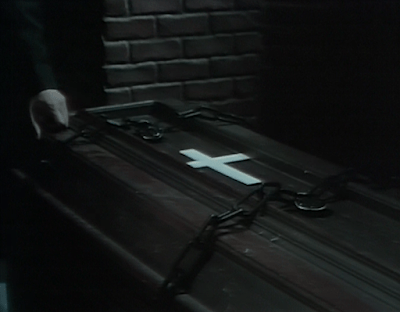
Barnabas finds that the coffin is topped with a cross. He can’t get close enough to take hold of the coffin and move it, so presumably even after he gets the soil he needs he will have to plunder a mortuary showroom to get a fresh resting place before dawn.
Charity does go to the basement. She puts some soil in her purse, then knocks over a crate, attracting Edward’s attention. She does not run away, but merely hides in an alcove until Edward comes down, sees her in shadow, and orders her to show herself.
Vampire Barnabas Collins happens upon his unwilling sidekick, ethnic stereotype Magda Rákóczi, after she has fired a silver bullet at his distant cousin, werewolf Quentin Collins. He sternly forbids her to finish Quentin off, and for some reason she decides he is right.
Back in human form, Quentin is haunted by the ghost of Dorcas Trilling, a woman he killed in his first night as a werewolf. He has been telling himself that the evil deeds of the werewolf are not his own responsibilities, but that “he” is the culprit. That comforts him, but Dorcas isn’t having it. So he instantly collapses into, “All right, I did, but I couldn’t help it!” That doesn’t go over any better.
Unfortunately, this is Gail Strickland’s final appearance on Dark Shadows. Screenshot by Dark Shadows Before I Die.
Barnabas and Quentin have a confrontation. Barnabas tells Quentin that he knows his secret and says that he wants only to help him; Quentin angrily responds that he cannot trust Barnabas, who refuses to tell him anything about himself. He does ask Barnabas to kill him if it is the only way to keep him from turning into the werewolf again, so I suppose that is a step towards friendship.
In the spring of 1969, the twin crises created by the malign ghost of Quentin Collins and the werewolf curse upon drifter Chris Jennings had combined to kill a number of people, bring others to the point of death, and make life on the estate of Collinwood utterly intolerable. Recovering vampire Barnabas Collins and his friends found some I Ching wands in Quentin’s old room and tried to use them to communicate with the ghost. Instead, they caused Barnabas to come unstuck in time. In #701, Barnabas found himself in the year 1897, his own curse of vampirism once again in full force.
Today, Barnabas bites Quentin’s girlfriend, maidservant Beth Chavez, and makes her tell him everything she knows about the werewolf curse. He was in a position to know all of this before he bit her; much of it he could have figured out if he had been paying attention to the information available to him in the late 1960s. But the show has been gaining lots of new viewers lately, and they probably appreciate the recap.
Quentin was married to a woman named Jenny, who unknown to him was the sister of ethnic stereotype Magda Rákóczi. Quentin left Jenny in 1895. Neither Quentin nor Magda knew at that time that Jenny was pregnant. Quentin’s siblings Edward and Judith put the story out that Jenny had gone away, and locked her up in a room hidden in the house. They enlisted Beth, her former maid, to be Jenny’s keeper. By the time she gave birth to boy-girl twins, Jenny had gone entirely insane.
In #720, Jenny escaped and stabbed Quentin. She escaped again in #748, and Quentin strangled her. When Magda found out that Quentin had killed Jenny, she cursed him and his male descendants to be werewolves. In #763, Beth told Magda about the twins; Magda’s reaction made it clear to Beth that she was powerless to lift the curse. Regular viewers already know that. The audience first heard Magda’s name months before she appeared on the show, when she spoke at a séance in #642 and expressed deep regret about “my currrrrse,” which we knew to be connected to both Quentin and the werewolf. In #684 and #685, Barnabas found a silver pentagram that Quentin and Beth bought in 1897 on a chain around the neck of a dead baby, and identified it as an amulet to ward off werewolves. Barnabas learned yesterday that Beth had bought the pentagram, and she confirms today that it is for Quentin’s son to wear. She also bought a similar pendant for herself, and is wearing it.
There is a full moon tonight, and most of the episode is taken up with the mechanics of people getting ready to go into the woods to hunt the werewolf, coming back from the woods where they have been hunting the werewolf, and telephoning to ask others to join in hunting the werewolf.
Magda has a pistol and loads it with silver bullets. Some wonder where Magda came up with silver bullets, but in a comment on Danny Horn’s post about the episode at Dark Shadows Every Day someone posting as “cslh324” reminds us that in #757 Magda persuaded undead blonde fire witch Laura to give her the money to buy silver bullets with which to shoot Barnabas. One of Magda’s purposes in putting this plan forward was to get Laura to leave her alone in the room so that she could steal a magical doodad from her, but it turns out Magda really did buy the silver bullets.
The werewolf gets into the great house of Collinwood and attacks Judith. Beth shows up in the nick of time and shows the werewolf her pentagram. He flees. Judith asks why the werewolf would run away from her, and Beth refuses to explain. At first she denies that it happened, then she asserts that the werewolf is probably as afraid of them as they are of him.
The confrontation between Judith and the werewolf includes a spectacular stunt. The werewolf jumps over the railing on the walkway above the foyer and holds a stationary two-point landing on the floor twelve feet below. Alex Stevens deserves high praise for that.
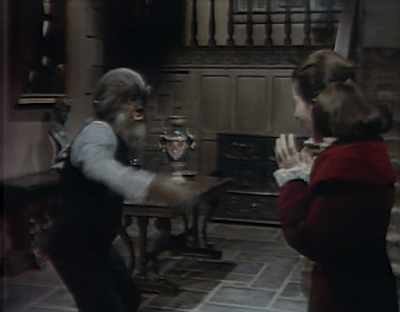
When we hear the sound effects associated with the werewolf or see the consequences of his attacks or catch a glimpse of him as a blur in the middle of a cloud of shattering glass, we can be afraid of him. Unfortunately, the show often gives us a long look at him, and he is not scary at all. They didn’t have the schedule or the makeup budget to cover his whole body in fur, so he wears Quentin’s suit. Seeing him standing there in that little outfit you don’t want Magda to shoot him with her silver bullets. At most, you might swat him with a rolled-up newspaper and tell him he is a bad doggie.
You have to stop killing people, or you won’t get any more bickies! Screenshot by Dark Shadows Before I Die.
Beth does not want Judith to suspect that Quentin is the werewolf, but it really doesn’t make any sense that she won’t tell her about the apotropaic power of the silver pentagram. You’d think she would want everyone on the estate and in the neighboring village of Collinsport to wear such pendants for the duration of Quentin’s curse. Surely she could come up with some explanation as to how she knew about the silver pentagram that wouldn’t invite questions she couldn’t answer.
Undead blonde fire witch Laura is in the act of driving a stake into the heart of vampire Barnabas when she is interrupted by another undead blonde fire witch, Angelique. Angelique announces that she will always be there to thwart any attempt to stake Barnabas, which rather tends to deflate the suspense inherent in having a protagonist who is a vampire. The two of them exchange threats, and Laura finds that she can hold Angelique at bay by generating the right kind of fire.
Laura leaves Barnabas’ house. His unwilling sidekick, thoroughly human witch Magda, sees her and asks what she was doing there. Laura does not answer, but Angelique enters and tells her. Angelique says that Barnabas would doubtless wreak a terrible vengeance if he found out what had happened while Magda was away. Angelique orders Magda to go to the great house of Collinwood and fetch a fourth witch, black magic enthusiast Quentin. Magda complies reluctantly.
Quentin is falling down drunk, which is not unusual. He has a better excuse than he typically does, however, since he just found out that Magda turned him into a werewolf. He is furious to see her. He says that no matter what she thinks, he will not “lie down and die!” This elicits a laugh from Magda, who points out that he can barely stand up. She tells him that Angelique has ordered him to come to Barnabas’ house, and that he cannot oppose her.
In the house, Angelique tells Quentin he must help her defend Barnabas from Laura. Quentin moans that he is in no condition to help anyone, which only makes Angelique impatient. Unlike her and Magda, Quentin does not know that Barnabas is a vampire, so Angelique keeps reminding herself to say that Barnabas has gone away for the day and that Laura will be a threat to him when he comes back tonight. Quentin tells Angelique about a trinket Laura received from some of the gods of ancient Egypt that keeps her alive, and she sends Magda to steal it from her.
Magda goes to Laura’s cottage. Magda tells Laura that she has more reason to hate Barnabas than she does, since Barnabas enslaved her husband Sandor. She wants Barnabas to be destroyed, but if Laura tells the authorities about him Sandor, too, will be killed. The dramatic date is 1897, and the state of Maine abolished the death penalty in 1887, so Magda is afraid of an extrajudicial killing rather than an execution for complicity in Barnabas’ murders.
Laura tells her that it is necessary to expose Barnabas if he is to be destroyed, but Magda tells her of another way. She says that vampires can be killed by silver bullets through the heart. Laura goes to get money for Magda to buy silver and have it made into bullets. While she is out of the room, Magda steals the trinket. It seems that Magda has given herself a chance to get rid of both Laura and Barnabas.
Once Angelique has the trinket, she tells Quentin that he will have to perform a ceremony using his copy of the Egyptian Book of the Dead. He is still heavily hungover and balks at the orders, but she gives him no choice. Once he starts his incantation, he breaks into a big smile, clasps the book to his chest, and preaches the phrases like a megachurch pastor when the collection plates are circulating. We cut to Angelique. Her expression is so admiring it is hard to tell whether the reaction is the character’s or the actress’. Angelique does some mumbo-jumbo with objects in the fireplace.
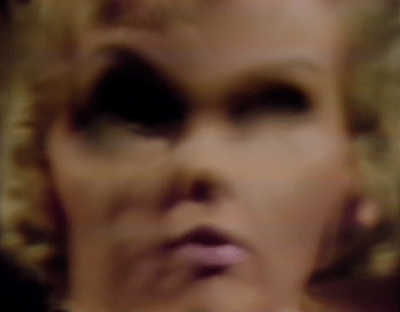
In her cottage, Laura struggles. She looks frantically for the trinket, then prays to Amun-Ra. The final shot of her is filtered to distort her image. It turns her eyes into little black coals, which is an effective visual metaphor.
Laura has been important in the history of the show and is key to this little period of the plot, but it is fairly clear that she is a short-timer now. All she cares about is taking her children away and burning them to death so that she can renew her own existence, and she keeps saying she is on a tight deadline for that project. We can be sure she won’t succeed, and even if she does she will be off the show. So she really could die, making the cliffhanger more suspenseful than usual.
Soaps classically divided the days of the week so that very little happened on Tuesday or Wednesday, Thursdays were devoted to plot mechanics setting up a big development, Fridays would show that big development and end with a memorable cliffhanger, and Mondays would resolve the cliffhanger and give a lot of recap to bring new viewers up to speed. Dark Shadows never followed this formula. These last three episodes are a case in point. #755 was all about Laura trying and failing to figure out whether Barnabas was a vampire. That was a mid-week throwaway if ever there was one, but it aired on a Friday. Yesterday she got confirmation that he was, and we ended with a fine cliffhanger with her holding the stake and mallet beside Barnabas’ open coffin. That aired on Monday, but was a perfect Thursday scene-setter. Today, a Tuesday, we have a whiz-bang battle of the witches, with new alignments and new dangers, a great Friday climax with a cliffhanger fitting for the end of any week.
Violet Welles was far and away the best writer of dialogue on Dark Shadows, and today’s script is so full of gems that even the plot summary on the Dark Shadows wiki is full of quotes. I can hardly blame the editor for that deviation from the usual format, there is so much good stuff I would have been tempted to transcribe the entire script if someone else had not already done so.
Dark Shadows has two ongoing storylines at this point. Mysterious drifter Chris Jennings came to town a couple of months ago and turned out to be a werewolf. Heiress Carolyn Collins Stoddard does not know of Chris’ curse. She has taken a fancy to him and set him up in the caretaker’s cottage on the estate of Collinwood. Old world gentleman Barnabas Collins and mad scientist Julia Hoffman do know that Chris is a werewolf, and they are working to help him. Barnabas has found a place to keep him confined on the nights of the full Moon, and Julia is trying to develop a medical intervention that will keep him in his human form.
Meanwhile, Chris’ nine year old sister Amy has taken up residence in the great house on the estate. She and her twelve year old friend, strange and troubled boy David Collins, are falling under the power of the evil spirit of the late Quentin Collins. At first Amy could communicate with Quentin more clearly than David could. This made David envious. In #640, David complained that Amy could hear his voice and he could not, even though “Quentin Collins is my ancestor.” That suggested to the audience that Quentin would turn out also to be Amy and Chris’ ancestor, joining the werewolf story with the Haunting of Collinwood.
Today, Barnabas and Chris have dug up a spot on the ground to which the ghost of a mysterious woman had led Chris. They find a tiny coffin holding the remains of an infant. They discover that the infant was wearing a medallion in the shape of a silver pentagram. The sight of the dead baby shocks Barnabas right away; Chris keeps his composure at first, but seems close to tears a moment later. Quentin stands in the shrubbery and watches Barnabas and Chris.
Barnabas has not seen Quentin and does not know who he is. Others have seen him and described him to Barnabas and Julia. They and those others suspect that he is a malevolent ghost with designs on David and Amy. No one has yet made a connection between Quentin and the werewolf story, however.
Julia and Barnabas have also seen the mysterious woman who led Chris to the baby’s grave. They know that she is a ghost and that she has helped Chris, and they also know that her clothing is of the same vintage as is the clothing which Quentin wears. But they do not know what, if anything, the two ghosts have to do with each other. The audience knows that the female ghost’s name is Beth and that she was with Quentin in the little room in the long deserted west wing of the great house when the children first met him.
Barnabas tells Chris that the pentagram can only be a device to ward off a werewolf, so that there must have been a werewolf in the area when the baby was buried. He also tells Chris that the mysterious woman would not have led him to dig up the grave unless what they found in the coffin would be of help to him.
While Barnabas inspects the pentagram in the drawing room of the great house, David throws darts at a board propped up on a chair nearby. The audience knows that David is under Quentin’s control, so it is obvious to us that the dart playing is an attempt to distract Barnabas and keep him from figuring out the meaning of the pentagram. Lacking our knowledge, Barnabas is merely annoyed with David. Jonathan Frid and David Henesy expertly develop the comedy in Barnabas’ fast-burn reaction to David’s behavior.
Heiress Carolyn Collins Stoddard interrupts the scene. She notices what Barnabas is doing. He shows her the pentagram, and she recognizes the jeweler’s mark as that of Braithwaite’s silver shop in the village of Collinsport. While Barnabas telephones Braithewaite’s and arranges to take the pentagram there to see if the proprietor can give him any information about it, Carolyn tells David she wants to have a conversation with him about some cryptic remarks he made earlier. David refuses, saying that he has homework to do. Carolyn argues with him briefly, but finally gives up and leaves. Barnabas is still involved in his conversation with Mr Braithwaite when David hides the pentagram behind his dartboard.
Barnabas gets off the phone, and David resumes throwing darts. Barnabas asks him why he isn’t doing the homework he was just telling Carolyn presented such an urgent obligation that he could not talk with her. He launches into a shaggy dog story, the upshot of which is that he has to wait for Amy.
More exasperated than ever, Barnabas turns to the desk and sees that the pentagram is gone. He demands David return it. David denies having it. He says that it may have vanished on its own. After all, unaccountable things happen at Collinwood all the time, as Barnabas is in a position to know. The way he says “You should know that” reminds longtime viewers that David has more than once shown signs of figuring out more about Barnabas’ own connections to the supernatural than have any of his adult relatives. In #316, he pointed out that none of the Collinses really knows anything about Barnabas- “He just showed up one night.” And in #660, he told Amy that “Barnabas knows a lot of things he doesn’t tell anybody.” At moments like these, we wonder just how much information David really has at his disposal. Perhaps he secretly knows everything, and has just decided there’s no point in notifying the authorities.
David invites Barnabas to search him. He lists the contents of his pockets, and turns the right front pocket inside out. He tells him that he has a pack of chewing gum, which he got from Amy. He specifies that he traded her a box of raisins for it. As David Henesy delivers the line and Jonathan Frid shows us Barnabas’ reaction, this detail is laugh-out-loud funny. Barnabas surrenders and apologizes to David, fretting about the pentagram’s absence.
Barnabas takes a sketch of the pentagram to Braithwaite’s. In the first months it was on the air, Dark Shadows took us to New York City twice, to Bangor, Maine several times, and to Phoenix, Arizona once. But now that both stories center on characters all of whom dwell in one or another of the houses at Collinwood, it is as rare to leave the estate and go into the neighboring village as it was then to go on those remote excursions.
Old Mr Braithwaite tells Barnabas that the shop has been in operation since 1781 and has been providing fine silver to the Collins family the whole time. Regular viewers know that Barnabas was alive then, and lived in Collinsport. A curse made him a vampire in the 1790s, and he was under its power until he was freed early in 1968. So he must have been quite familiar with Braithwaite’s in its early years. What is more, in #459 we saw that in the first months of Barnabas’ career as a vampire his father Joshua learned of his curse and commissioned a local craftsman to make silver bullets with which he could put Barnabas out of his misery. That craftsman must have been one of the first Mr Braithwaites.
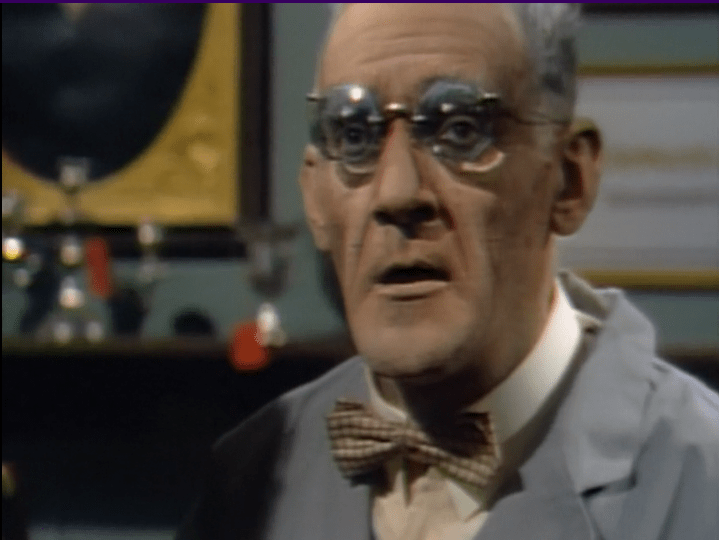
The incumbent Mr Braithwaite tells Barnabas he will consult his records as soon as the shop closes and telephone him if he finds anything. When the call comes, David answers. Mr Braithwaite tells David that he can’t imagine why he forgot about the pentagram since it was one of the very first he made himself, back in 1897. Quentin appears, takes the phone from David, and hears Mr Braithwaite say he will stop by Collinwood with the ledger shortly.
Mr Braithwaite almost remembers.
David protests that Quentin had no right to take the phone from him. Quentin turns to him, gives him a menacing look, and walks toward him. David backs away and and takes a place on the stairs, still objecting loudly to what Quentin did.
Closing Miscellany
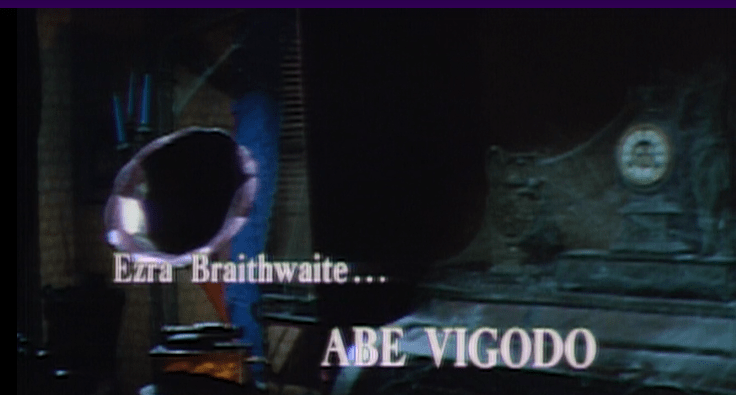
The closing credits list the actor who plays Ezra Braithwaite as “Abe Vigodo.” Perhaps in some parallel time-band there was a man of that name who played Tossio in The Good Father and Detective Fosh in Barney Moeller, but this is in fact Abe Vigoda.
“Abe Vigodo”
In his 1977-1978 ABC TV series Fish, Vigoda’s character was married to a woman played by Florence Stanley. Stanley was also a Dark Shadows alum, as a voice actress. She provided sobbing sounds heard in #4, #98, #515, #516, and #666. Vigoda once appeared on the panel at a Dark Shadows convention; his main statement was “I don’t remember much about it.” I can’t find evidence that Stanley ever appeared in such a setting. I would love to imagine that Vigoda and Stanley compared notes about their experiences on Dark Shadows between setups on Fish, but I would be astonished to learn that ever happened.
Vigoda always played old men. The second screen credit on his IMDb page is a 1949 episode of Studio One in which he took the role of “Old Train Passenger.” At that time, he was 28. Vigoda was a marathon runner, a form of exercise that tends to burn out all the fat under the skin of the face. And of course he was a very strong actor, easily able to convince us that he is of a great age. So even though Vigoda was only three years older than Jonathan Frid, and about 175 years younger than Barnabas, it isn’t quite as funny as it might be to hear him call Barnabas one of “you young people.”
Danny Horn devotes his post about this episode on his great Dark Shadows Every Dayto three points. The first is his exultation that his least favorite writer, Ron Sproat, was credited with his final script yesterday, so that today is the first day of the Sproatless Dark Shadows. The second is that the show is finally joining the werewolf story with the Haunting of Collinwood. The third is a point I have some reservations about. He says that this is the first episode where Quentin “has a feeling,” and therefore declares it to be Quentin’s debut as a real character. “It’s nice to meet you Quentin. Welcome to the show,” he concludes.
It’s true that Quentin shows a wider range of feelings today than he had previously, but I think it is an exaggeration to say that we are only now seeing his feelings. For example, when in #680 Quentin agrees to Amy’s demand that he stop trying to kill Chris, he looks very much like a man humiliated to find that he has to capitulate to a nine year old girl. In the same episode he showed amusement and anger at appropriate points. Those three responses may not sound like much, but David Selby’s face is a magnificent instrument, one he plays it expertly. For him, they are more than enough to make Quentin into a real person.
Chris and Carolyn have a brief scene in the drawing room as they are getting ready to go on a date. Chris defuses a potentially awkward conversation about his previous failures to respond to Carolyn’s hints that she was interested in him by saying “Oh, I didn’t notice that” in the W. C. Fields imitation he had used with Amy in #677. She chuckles delightedly. This is not implausible. Not only can we imagine her being relieved that the topic didn’t ruin their evening, but W. C. Fields was very much in vogue in the late 1960s, so much so that a fashionable young woman might have chuckled when a man briefly imitated him.
David and Carolyn have an exchange that longtime viewers will find less plausible. He asks her if she has ever seen a ghost; she responds by asking if he has. But each of them knows perfectly well that the other has seen ghosts. David spent the first year of the show on intimate terms with the ghost of the gracious Josette, and he and Carolyn both saw and had substantive conversations with the ghost of Barnabas’ little sister Sarah. In #344, Carolyn told David that when she was a little girl her best friend was the ghost of a boy named Randy. It’s just trashing character development to retcon all that away.
Barnabas says something that will catch the ears of properly obsessed fans. When he is in the shop, he tells Mr Braithwaite that he will gladly drive back from Collinwood whenever he has any information for him. There have been some suggestions lately that Barnabas has learned to drive and has come into possession of a car, but this is the first definite confirmation of that point.
In May 1967, seagoing con man Jason had for long months been blackmailing matriarch Liz into letting him stay at the great house of Collinwood. He told Liz that people in the village of Collinsport were starting to talk about the presence of an unmarried man in her house. He informed Liz that they would solve this problem by getting married. She laughed in his face, but he pressed his threats to expose her terrible secret, and they were in the middle of a wedding ceremony when Liz broke down and announced her secret to everyone. It then turned out that there never really was a secret- the whole thing was a sort of misunderstanding. A few days later, Jason was dead, and he hasn’t been mentioned since March 1968.
Today, Liz’ brother Roger shows up at the Old House on the estate, home of their distant cousin Barnabas. He is looking for Julia, a permanent houseguest who settled in at the great house a few weeks after Jason disappeared. Barnabas, a bachelor, tells him that Julia is staying with him for a few days. Roger’s startled response makes it clear that the mores Jason mentioned in #243 have not changed. But Roger is not in a position to insist on propriety, and he has come on an urgent matter. Liz has escaped from Windcliff, the mental hospital of which Julia is the nominal director, and he wants her to come back with him at once to the great house so that she can consult with her staff on the telephone.
Roger is momentarily stunned to learn that Julia is sleeping at Barnabas’ house.
Barnabas tells Roger that Julia is ill and cannot help him. He insists, so Barnabas goes up to her bedroom. Not only does he tell her about Roger and his news, but he also informs her that he earlier found an unpleasant man named Peter who prefers to be called Jeff in the basement. Since the basement houses a lot of technical equipment and a stolen corpse which they are planning to use as material for a Frankenstein’s monster, Julia finds this alarming. But Barnabas has talked Peter/ Jeff into helping them with their little arts & crafts project, and he assures her that he has Peter/ Jeff under control.
Julia is in fact ill, and she tells Barnabas she cannot see Roger. Julia has been bitten by a vampire named Tom. Barnabas, a recovering vampire himself, plans to use her as bait to lure Tom into the bedroom tonight so that he can shoot him with a silver bullet. He explains to her that he took a candlestick to the local silversmith earlier this morning and that the silversmith melted it down and forged five silver bullets. No wonder people are reluctant to leave Collinsport, even much bigger places don’t have same-day service like that.
We cut to the basement, where Julia is wearing her lab coat. Barnabas tells her it is 5 PM. There is no sign they have been working on the project; for all we can tell, they waited around her bedroom all day and decided to get to work shortly before sundown. Peter/ Jeff enters and reports for work. They tell him to work on a particular piece of equipment. Barnabas takes Julia back up to her bedroom, leaving Peter/ Jeff alone with the corpse. Since he was just recruited for the project, this shows a remarkable degree of confidence in his loyalty.
Julia is sitting in a chair and Barnabas is hiding in the closet when Tom materializes. Julia puts herself between Barnabas and Tom, and Tom vanishes. Julia apologizes; Barnabas knows enough about the compulsions that afflict the vampire’s victim that he does not seem to be really upset with her. He frets that they will never have such a good shot at Tom again now that he knows to be on his guard. He looks out the window and thinks he sees Tom on the lawn. He turns, and finds that Julia, too, is gone. He realizes that she must now be alone with Tom.
In his Dark Shadows Daybook post about this episode, Patrick McCray makes some apt remarks about the acting. As Barnabas, Jonathan Frid starts the episode with an unusually self-assured tone in his confrontation with Peter/ Jeff. That’s what the scene calls for, since we need to believe that Barnabas’ force of personality is sufficient to overpower Peter/ Jeff’s aversion to the gruesome project. But it all falls apart about halfway through, when Frid has some line trouble, and as a result we wind up listening to the arguments with which Barnabas defends his position. Patrick doesn’t say anything about those arguments, but on Dark Shadows Every DayDanny Horn does a fine job explaining how utterly unconvincing they are.
Playing Julia as an addict needing a fix, Grayson Hall falls far short of her usual standard, but Patrick doesn’t blame her: “These are the heavy blinking, o-mouthed, head vacillating performances that critics of Hall use against her. I don’t call it bad acting… there’s only so much you can do with a cartoon. But seeing Julia like that is always evidence of a questionable match.” I like the tenderness Barnabas and Julia show each other in their scenes yesterday and today; for me, Barnabas’ earnest concern for Julia and her quiet trust in him outweigh the deficiencies in Frid’s memory for dialogue and Hall’s attempt to show Julia’s weakness. But those deficiencies are impossible to overlook, unfortunately.
Like every episode of Dark Shadows, this one begins with a voiceover by a member of the cast. Unlike all the preceding voiceovers, this one is delivered by a man. Thayer David does the honors.
We open in the drawing room of the great house of Collinwood. For the first time in months, Barnabas Collins is there. Barnabas died and rose as a vampire in January, and has been concealing his existence since. But now his secret is known to several people in the house. One of those, his mother Naomi, reacted to the knowledge by taking poison. In his agony, Barnabas is pacing the floor, complaining to his friend, much put-upon servant Ben, that the doctor hasn’t come. Barnabas’ father Joshua comes downstairs and announces that there is no longer any need for a doctor- Naomi has died.
Joshua dismisses Ben and talks with Barnabas. He confesses his doubts that he is able to love anyone. Barnabas tells him that such a disability might save his life- the curse wicked witch Angelique placed on him means that everyone who loves him will die. Joshua says that he must end the curse, and will do so by destroying Barnabas. Barnabas asks if he will drive a stake through his heart. Joshua replies that he found a book in Boston that tells of another way. Come morning, he will fire a silver bullet through Barnabas’ heart.
This is the first we have heard that silver bullets will kill vampires. There is some lore that suggests vampires avoid silver, but we know that doesn’t apply to Barnabas- one of his chief trademarks is a cane with a mostly silver handle. The 1941 film The Wolf Man established silver bullets as a means of killing werewolves, and the Lone Ranger fires silver bullets to knock the guns out of the bad guys’ hands, so I guess they might have come to mind in the 1960s if you were thinking of exotic weaponry.
Barnabas has plans for his final night. It was naval officer/ sleazy operator Nathan Forbes who led Naomi to discover Barnabas’ secret, and who is to that extent responsible for her death. Ben enters to inform Joshua and Barnabas of another item to add to the list of Nathan’s misdeeds. Nathan has evidently apprehended bewildered time traveler Victoria Winters and taken her into town, where she faces death on the gallows after being unjustly convicted of witchcraft. The Collinses knew Vicki to be innocent and had been harboring her since shortly after she escaped from gaol. Joshua and Barnabas are certain that Nathan turned her in solely to collect the reward that has been posted for her capture. Barnabas vows to kill Nathan, and Joshua can’t talk him out of it.
We cut to Nathan in the Eagle tavern, where he is spending the money he sold Victoria for. The Eagle has changed pretty dramatically in the last several weeks. In #419, bartender Mr Mooney greeted a female patron with the announcement that the Eagle did not admit unaccompanied women. Since the Eagle is a public house on the waterfront, the management evidently thought this policy was necessary to keep the place from becoming a headquarters for the sex workers of Collinsport.
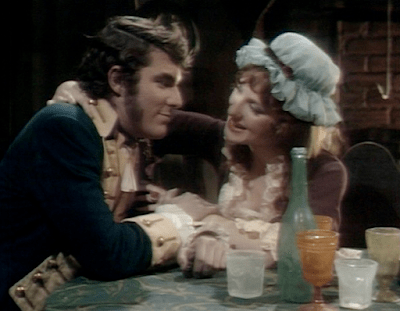
Now Mr Mooney is nowhere to be seen, and the only person in the barroom with Nathan is identified in the closing credits as “Barmaid.” She is played by Rebecca Shaw, whom we saw the other day as a streetwalker whom Barnabas was about to bite when good witch Bathia Mapes summoned him away with a magical incantation. She is sitting with Nathan, drinking with him, and flirting with him pretty heavily. A bat squeaking at the window frightens her, and when she catches her breath she announces that she will be leaving him alone in the bar for a bit while she lies down. Nathan replies to that by saying he will see her soon, and she turns to take a look at him, apparently expecting him to follow her to bed. It seems possible she is the same character who was working the docks, now employed in a similar capacity in the Eagle. If this is the person who has taken over from Mr Mooney, the management must have given up the hopes it formerly had for its reputation.
Once the woman leaves Nathan alone, Barnabas appears. He confronts Nathan about his many crimes. Nathan pulls a gun and tells Barnabas he will take him to the constable and turn him in as the Collinsport Strangler. Barnabas jeers. Nathan shoots, and Barnabas keeps standing there. He declares that Nathan cannot kill him, because he is already dead. He then informs Nathan that he will wait until 9 pm to kill him. Since it is now 8:30, this does not give Nathan a great deal of time.
At 8:45, Nathan appears at Collinwood. He finds Joshua and Ben in the drawing room, and tells them what has happened. They are neither surprised nor sympathetic. Joshua leaves the room, explaining that he would prefer not to see a gruesome murder. Ben is willing to stay for a while. When Nathan asks how Barnabas can be destroyed, Ben decides to have a little fun. He tells him that if he finds Barnabas resting in his coffin after sunrise and drives a wooden stake through his heart, that will take care of it. Ben is quite jolly when he points out that Nathan will be dead long before sunrise, so that this information would seem to be of little practical use to him. Ben then decides that he doesn’t want to watch the murder either, so he also takes his leave of Nathan.
With five minutes to go, Nathan tells himself that Barnabas will not kill him if Joshua is in the room. He finds Joshua in the study. He begs Joshua to stay. As Joshua is refusing, Nathan looks at the wall and sees a crossbow mounted there, with three wooden bolts next to it. Suddenly his cowardice gives way to wild hope. He tells Joshua he will wait in the study for Barnabas. Joshua goes.
Nathan takes a practice shot at the door, then stands waiting. Barnabas does open the door, Nathan does release another bolt, and does strike him in the chest, a bit to the left of the sternum. Barnabas cries out in pain, and as the episode ends it looks very much as if Nathan may have managed to stake him.
Barnabas is the reason the show is a hit, so we can be quite sure he won’t actually die. Still, the episode is good enough that it feels for a moment that he might. The contrast between the prospect of Joshua killing Barnabas in the stately manner he described earlier in the episode and the idea of Nathan killing him is instructive. Had Joshua carried out his plan or even attempted it, the result would have been what Aristotle was talking about in his Poetics when he described the majestic terror of tragedy. It would have been at once horrifying and awe-inspiring to see a father duty-bound to kill his son. But Nathan is a cheap bum, trying only to save himself so that he can live to abuse and exploit more people. When we root against Nathan destroying Barnabas, we do not want only to continue the pleasure of watching the show. We are rejecting a resolution that would be unworthy of what we have seen so far.
Nathan, indeed, is unworthiness incarnate. When he was first on the show, Nathan was a likable rogue, but in recent weeks he has become both cruel and dreary. So cruel that he has tried to arrange the murder of an eleven year old; so dreary that he works through a conspicuously dim-witted, relentlessly unappealing henchman. Many fans complain about Nathan’s turn, and some speculate that the show just ran out of villains sinister enough to be worthy of Barnabas’ vengeance. On that theory, Nathan’s grave crimes are a last-minute, slapdash invention.
I don’t agree. We met Nathan before Angelique came to Collinwood. In those days, there was room for light comedy, for grand gestures, for dashing heroism, for fairy tale whimsy, and for tender romance. But as her curses have done their work, everyone and everything has been ground down. The ceiling has been lowered, and there is no longer space for the bouncy good cheer of the Old Nathan, much less for the Satanic majesty of villains like Angelique or that Rev’d Mr Trask. The whole world is pervaded by cheapness and sordidness now, and growing more so by the minute.
The only grandeur left is in The Tragedy of Joshua Collins. Were Nathan to destroy Barnabas, that grandeur would vanish, not in sublime pity, but with a taunt. That would be a harsh ending indeed.







 Dark Shadows Commentary