Episode 831: The most loquacious people I know

Sorcerer Count Petofi enters the great house of Collinwood, carrying a large painting covered with a cloth. He finds the hypocritical Rev’d Gregory Trask, who is at the moment master of the house, standing in the drawing room, dazed. Petofi realizes that Angelique the witch cast cast a spell on Trask, and that this spell is part of her effort to obstruct his own evil plans.

Petofi meets broad ethnic stereotype Magda Rákóczi in the foyer. He forces her to tell him that Angelique is upstairs, in Quentin Collins’ suite. He exits, taking the painting with him.

Angelique is casting a spell, ordering Trask to point a revolver at his temple. She is about to make him squeeze the trigger when Petofi surprises her. He overpowers her, both physically and in terms of the spell, and frees Trask.

Petofi dominates Angelique. Screenshot by Dark Shadows Before I Die.

Quentin is in the prison cell in the basement. Together with the scene between Petofi and Angelique, this circumstance will ring bells for longtime viewers. We first saw this cell in #401, when the show was set in 1795. In that part of the series, Thayer David played much-put-upon indentured servant Ben Stokes, who was a plaything in Angelique’s hands. Ben was the first prisoner confined to the cell, when haughty overlord Joshua Collins was punishing him for some or other things he had been powerless to prevent. Now, the dramatic date is 1897, and the same actor is playing Petofi, who stands at the opposite extreme from Ben. Angelique is not much better able to resist Petofi than Ben had been to resist her, and so far from being a place where he will be imprisoned the cell is just another place for him to exercise his power over everyone else.

Quentin is in the cell because he is a werewolf, and this is the night of a full Moon. The closing cliffhanger comes when Trask, released from Angelique’s spell, comes and tells him he will watch him transform into the animal, then go get the police.

Episode 829: Miss Moon Eyes

The dramatic date is 28 August 1897. On 23 July, in #803, sorcerer Count Petofi cast a spell on stuffy Edward Collins. Ever since, Edward has believed he was a valet recently separated from the service of the Earl of Hampshire. This led Edward’s brother, the rakish Quentin, to follow the Collinses’ long-established procedure for responding to mental illness and lock him up in the room on top of the tower in the great house of Collinwood.

In #816, broadcast on 11 August 1969 and therefore set on 11 August 1897, Petofi brought something even stranger on Edward’s twelve year old son Jamison. He called the spirit of Jamison’s grandson David to project itself from 1969 and to take possession of Jamison. In 1969, David is deathly ill because Quentin’s ghost had besieged him and everyone else at Collinwood. Now, Jamison too is dying, and in the moments he has been able to speak he has let the living Quentin in on the fact that he will eventually become a family-annihilating ghost.

Wicked witch Angelique has made a bargain with Quentin. She will try to restore Jamison and Edward to their usual selves, and if she succeeds Quentin will marry her. We see her beside Jamison, talking earnestly with him, praying loudly to “the Master of Darkness” to cure him and Edward so that she and Quentin can devote themselves to the service of that supernatural personage. In 1968, when the show was in contemporary dress, Angelique and others used a lot of euphemisms like “Master of Darkness,” but lately the ratings are high enough that the ABC network’s office of Standards and Practices has been letting them say the name “Satan.” I suppose Angelique’s persistence in the former phrasing shows that she’s still devoted to the old time religion.

Satan comes through, and Jamison and Edward are freed. This leads to a bit of awkwardness in each case. Quentin and Edward’s step-niece Charity Trask has lost her personality as the result of another of Petofi’s spells, and is now hosting that of the late Pansy Faye, Cockney showgirl and onetime fiancée of Quentin and Edward’s late brother Carl. Charity/ Pansy is exploring the great house when she comes to the locked door of the tower room. She hears Edward inside calling for help. He is still in his valet persona, and he is delighted with her when she promises to get a key and let him out. Edward returns to himself, with no memory of anything that has happened since 23 July, while Charity/ Pansy is away. When she comes back up and opens the door, she finds that he is in a foul mood and that he disapproves of her intensely. She is understandably miffed at his apparent fickleness and ingratitude.

For his part, Jamison’s quite different experience has left him with some memories. He tells Angelique of images that are floating around in his mind. She recognizes them as things associated with Petofi, and is distressed. She tells him he is better off not knowing what they are. Quentin is more distressed when Jamison looks at him and asks why he is trying to kill David Collins. Jamison can’t explain who David Collins is or how he learned that Quentin was trying to kill him, but this does confirm everything Quentin has gathered about his post-mortem destiny.

While Edward comforts Jamison in the study, Quentin and Angelique meet in the drawing room. She asks if he will honor his end of their deal; he says that he will, though he makes abundant protests about his reluctance to do so. Charity/ Pansy eavesdrops at the door. She has decided that she will marry Quentin, and is horrified to hear this conversation.

Edward enters and asks Angelique to excuse him and his brother. She exits, and Edward declares that the first order of business must be to hunt and destroy vampire Barnabas Collins. Quentin is appalled at this. He tries to tell Edward that Petofi is their most immediate threat; after he explains who Petofi is, Edward agrees that they will get around to fighting him at the appropriate time, but he insists that Barnabas is their main concern.

Edward exits, and Charity/ Pansy enters. She tells Quentin that she overheard his conversation with Angelique. She says that he will not marry Angelique. Quentin bitterly responds that he will, and that there is nothing she can do to stop it. At this, Charity/ Pansy picks up a knife and tries to stab Quentin. Quentin holds her at bay, and Edward enters in time to see what is happening and to get Charity/ Pansy off of Quentin. Quentin says that Charity/ Pansy’s condition is further evidence of the need to focus on fighting Petofi, but Edward will not swerve from his determination to concentrate on Barnabas. Moreover, he decides that he will now quiet Charity/ Pansy himself. He sends Quentin out of the room and prepares to give Charity/ Pansy a stern talking-to.

Charity/ Pansy’s attempt to prevent Quentin’s marriage to Angelique by stabbing him is of a piece with her attempt to break up Quentin’s relationship with maidservant Beth in #823/824 by poisoning Beth’s brandy. The original Pansy, whom we saw as a live person in #771, was not exactly nice. She was cold, hard, and cynical, trying to exploit the childlike Carl. But she didn’t seem to be bent towards physical violence. That appears to be Charity’s contribution to the composite being that the two of them now make up.

Before Edward can deliver whatever lecture he had planned to give Charity/ Pansy, she goes into a trance. The live Pansy had done a stage act as a “mentalist” and fortune teller, and was astonished in #771 when she tried to do her act at Collinwood and found herself actually channeling spirits from the great beyond. Now Charity/ Pansy routinely acts as a medium.

Charity/ Pansy announces that something terrible will happen on 10 September. Countdowns don’t usually work as a source of suspense on soaps. They might be all right in a play or a feature film, where we know that there will be a final curtain or a last frame after which the imaginary universe will cease to exist, but so long as the series is scheduled to come on every weekday at 4 PM, we know that there is always going to be room to move any deadline a little further out. Besides, since Dark Shadows was done virtually live to tape, they could rarely predict with any accuracy just how many ticks of the clock it would take to get all the movements made and dialogue spoken before the crisis is supposed to be reached. But “10 September” is in a slightly different category. Quentin explicitly says on screen that today is 28 August, which was indeed the original broadcast date in 1969. And when Edward says that his last memories are of 23 July, he is indeed referencing the original broadcast date of #803. So when Charity/ Pansy says “10 September,” she is committing the show to something in the real world. We may well sit up and take notice.

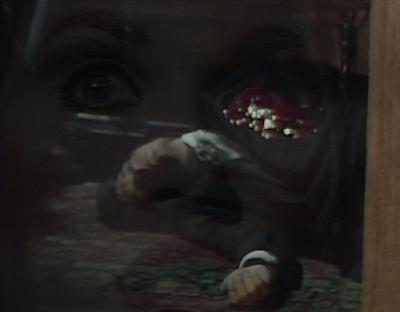
Charity/ Pansy has a vision of what will happen on that date. She sees Angelique looking at a portrait of Quentin in the drawing room. Red paint is dripping from the figure’s chest into a pool on the floor. That pool is next to a trail of other drops of red. In her mind’s eye, Charity/ Pansy follows the drops into the foyer, up the stairs, and into the tower. There, she sees Angelique opening the door to the tower room and finding Quentin sprawled, a sheet of red plastic, or perhaps construction paper, on his chest. Charity/ Pansy screams and runs out. From the dramatic music and Charity/ Pansy’s agitated reaction, I take it the object lying on Quentin’s chest is meant to suggest blood.

Through Charity/ Pansy’s eyes. Screenshot by Dark Shadows Before I Die.

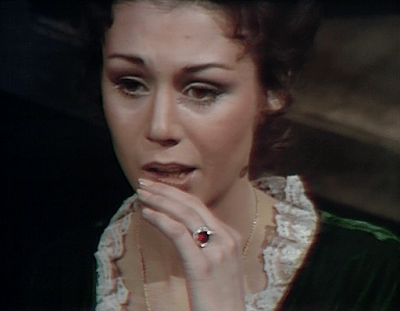
The acting is all very strong today. I was fascinated with Nancy Barrett’s use of her face to highlight Charity/ Pansy’s makeup. She relaxes her jaw muscles slightly more than usual, causing the dark treatment around her eyes to stand out. That in turn creates a visual metaphor labeling Charity/ Pansy a “painted lady.”

My wife, Mrs Acilius, was particularly impressed with Louis Edmonds’ realization of Edward. When the spell breaks and he becomes himself again, Edward is alone in an empty room. He has no dialogue, no props, and no scene partner to work with. Yet he instantly conveys what has happened. Even first time viewers will understand that the obliging servant has now become a stuffy authority figure.

Edward’s towering indignation when Quentin first tells him he was the one who locked him in the tower room gives way instantly when Quentin explains that he was under a delusion at the time. Edmonds executes that transition so smoothly that first time viewers will not notice the oddness of it, but longtime fans who remember the many previous occasions when the Collinses locked each other there as a response to mental illness will chuckle.

One of the prominent features of Edward’s personality is his warm relationship with his children. This sets him apart from the first two characters Louis Edmonds played on the show, high-born ne’er-do-well Roger Collins and haughty overlord Joshua Collins. Edward’s dialogue in his scene alone with Jamison involves several discrete points of information, and it would have been understandable if the affection he displays for Jamison while he getting all of those words across had been either perfunctory or mawkish. But he and David Henesy get the emotions exactly right while also delivering the lines very clearly.

Edward’s preoccupation with Barnabas is a delicious little bit of commentary on the show itself. Dark Shadows‘ ratings, chronically low during its first 42 weeks on the air, perked up when it added Barnabas to the cast in April 1967. That summer, schoolkids curious to see a vampire on daytime TV made it into a hit, and not long after Barnabas became one of the pop culture sensations of the 1960s, instantly recognizable to many millions of people who never watched the show. To this day, people who have heard of Dark Shadows are likely to refer to it as “the vampire soap opera from the 60s.” It was Barnabas who took us with him to 1897, when he traveled back in time in the course of his attempt to rescue David from Quentin’s ghost, and for the first months of the 1897 storyline he was the only character who knew what was at stake for the 1969 version of the Collinses in the events going on around him.

But now Barnabas is on the fringes of the story, and Quentin, Angelique, and Petofi all know about 1969. Edward’s idea that the action has to focus on Barnabas is evidence that he hasn’t been watching the show. Petofi is the principal antagonist now, Quentin the chief protagonist, and Barnabas can be absent for weeks at a time while they and others find all sorts of things to do. This represents, not Barnabas’ failure, but his ultimate success. Before he was introduced, every story revolved around well-meaning governess Vicki, the main character. A soap opera can’t really have a main character. It needs to keep multiple storylines running at once, occasionally intersecting with each other, often running for long periods with little or no interaction. When one person had to be at the center of every development, the result was slow and claustrophobic.

Barnabas blew that confining structure open, because as a vampire his function in the story was not to solve problems, but to create problems for other people to solve. So no matter how much time they spent focusing on him, he always directed our attention towards everyone else. We wondered who would catch on to his secret, who would fall victim to his malign intentions, who would find a way to fight him, etc. When a mad scientist managed to free Barnabas of the effects of the vampire curse, he retained his function as a problem-maker, even when he set out to be a problem solver. Every time he announced that he had a plan, we looked forward to seeing how the rest of the cast would react to that plan’s rapid and catastrophic collapse.

Barnabas is as hapless in 1897 as he has been in every other time period, as witness the fact that he has been exposed as a vampire and driven into hiding. But he isn’t even the show’s Screw-Up-in-Chief now. That title belongs to broad ethnic stereotype Magda Rákóczi. In #807, Petofi compelled Magda to review the preceding 22 weeks of the show and admit that she had precipitated every plotline. The first of those was the release of Barnabas into the world of 1897, so that his crimes and misadventures are just a subcategory of hers. Since Magda is played by Grayson Hall, who in her original role of Julia Hoffman is waiting for us in 1969, we can be confident she won’t be coming back to contemporary dress with us, but for the moment she has relegated Barnabas to the status of a secondary character.

Episode 828: Sovereign of the worms

In 1897, King Johnny Romana is the hereditary chieftain of a Rroma tribe that has long been at war with ancient sorcerer Count Petofi. King Johnny is at the supreme moment of his destiny, standing over Petofi with his scimitar raised, ready to deal the ultimate blow, when a creepy little guy ruins it all for him. Petofi’s henchman Aristide throws a knife and catches King Johnny in the back. Aristide has a dagger with a curved blade that he sometimes calls “The Dancing Girl,” other times “The Dancing Lady”; he makes a big deal of it, the thing fascinates him. But when he kills King Johnny, Aristide doesn’t even use his special knife. It’s a brutal anticlimax for King Johnny.

King Johnny does live long enough to tell Petofi that he isn’t safe yet. After nine days pass, he will appear to another Rroma, somewhere in the world, and will pass on to that person his immunity to Petofi’s magical powers and his mission to kill him. After Aristide buries King Johnny, he finds that the scimitar has vanished. Evidently it will go to the new avenger.

Meanwhile, at the great house of Collinwood, twelve-year old Jamison Collins is dying. Petofi cast a spell causing Jamison to be possessed by the spirit of his grandson David Collins, who will live in 1969. But David won’t live at all unless the spell is broken, because it is killing Jamison. Jamison’s devoted uncle, rakish libertine Quentin Collins, makes a deal with wicked witch Angelique. He will marry her if she manages to break Petofi’s spell and save Jamison. They made a similar bargain previously, but that time her magic failed.

Petofi senses that his spells are being challenged. He marches to Collinwood and orders Quentin to make Angelique stop what she is doing. Angelique herself enters; she and Petofi confront each other, then she goes back to the study to resume her attempts to free Jamison. We end with Petofi preparing to cast a spell against her.

Petofi confronts Angelique in the drawing room at Collinwood while Quentin looks on. Screenshot by Dark Shadows Before I Die.

This is an entertaining, fast-paced episode. It’s too bad it is the final appearance of actor Paul Michael in the series. He played the most unpromising part of King Johnny so skillfully that we barely noticed he was little more than a menacing pose, an evil laugh, and an ethnic stereotype. He does return with a small part in the feature film House of Dark Shadows, but it would have been fun to see what he could do with a really meaty role.

Episode 796: Don’t sound human

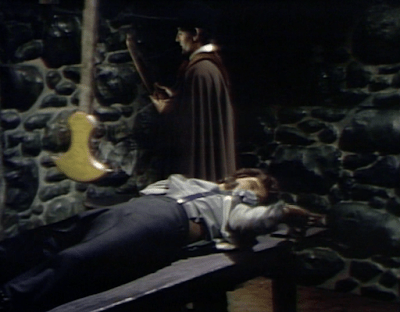
Quentin Collins is strapped to a table under a descending pendulum which supposedly has a razor sharp blade. His captor, a strange man named Aristede, tells wicked witch Angelique that Quentin will die in minutes unless she gives him the severed hand of Count Petofi, which has magical properties. Aristede is under the impression that Quentin and Angelique are engaged, and he has set the blade to strike Quentin’s body at a point causing the maximum wedding night-related inconvenience.

A little off the top I can understand, but this is ridiculous! Screenshot by Dark Shadows Before I Die.

Meanwhile, Quentin’s distant cousin Barnabas Collins has the hand and is hoping it will cure Quentin of a curse under which he is laboring. Rroma maiden Julianka claims that she knows how to use the hand to relieve lycanthropy. Her great-grandmother cured Count Petofi himself of that condition, and took the hand from him as payment for doing so. She is the only living person who knows the procedure, and no one else will know it until her daughter is born.

Barnabas and Angelique have a scene which ends with a decision to go to Aristede together. Barnabas tries to use his vampire powers to hypnotize Aristede; if he had been thinking logically, he could just have taken his bat form and flown around the meeting place, since Quentin can’t be very far from it if Aristede is going to be able to take the hand and stop the pendulum in the few minutes remaining. Instead, he lets Aristede lead him far in the wrong direction. When it seems to be too late, Aristede taunts Barnabas by telling him where to find Quentin’s body. To his consternation, Barnabas then vanishes and the squeaking of a bat rings out. Barnabas rescues Quentin at the last possible second, of course.

In #767, Quentin’s nephew Jamison dreamed that Quentin told him three things would happen that would spell his doom. The first was the discovery of a silver bullet on the great estate of Collinwood. That happened in that very episode. The last would be when the one person Quentin truly loved turned against him. We know that Jamison is the only person Quentin loves, so we know what to look for there. But the second has been a mystery up until now. Quentin said that the only person who could help him would be murdered. It has not been clear until now that there is one and only one person who can relieve Quentin of his curse. Now that Julianka has been identified as that person, viewers who remember back that far will not be surprised that at the end of the episode she is lying in the woods, a mysterious mark on her forehead, unable to move.

Diana Davila plays Julianka with her eyes always wide open. She does not blink, and when she looks from side to side she turns her whole head. The rest of her body is rigid, too, and she maintains a heightened tone throughout. This is quite effective for Julianka as written; she is supposed to seem distant and unapproachable. Miss Davila bobbles over a few too many of her lines for the performance to reach its full potential, but you can see what she was going for, and it was terrific.

Episode 793: All the revolted spirits

When wicked witch Angelique first turned Barnabas Collins into a vampire in the 1790s, he went to the waterfront and preyed on the women he found spending their nights there. When Barnabas traveled in time from the 1960s to the year 1897, he again made his way to the waterfront. Whether he bit the women or not, he choked them to death, earning the sobriquet “The Collinsport Strangler.”

Once he had become a vampire, Barnabas displayed so many traits he had come to have in common with Angelique that we suspect he is not only cursed by her, but possessed by her. More precisely, it often seems that when Angelique made Barnabas a vampire she created a copy of her own personality and put it in his mind, where it took control of him. We have further support for that interpretation in today’s opening reprise. We see Angelique on the same set where Barnabas has several times been the last person a young woman would encounter. This time, she encounters a young man. He flirts with her, as the women flirted with Barnabas. Before long, he is choking and within seconds of death because of her action. In this case, she has taken his handkerchief and is tightening it around the neck of a toy soldier that once belonged to Barnabas. She is threatening to kill him unless he tells her where he has hidden the legendary “Hand of Count Petofi.”

The man’s name is Aristide. He capitulates, telling her he buried the hand at the old cemetery, in a grave marked with a stone bearing the name of Townsend. She gives the handkerchief another tug, and he falls down, unconscious.

Later, we are in the great house on the estate of Collinwood. Angelique comes down the stairs, carrying the box in which the hand is kept. Stuffy Edward Collins sees her. Regular viewers have seen the box on a table in the upstairs hallway many times, from the first week of the show onward. It is rather odd that Edward doesn’t ask her why she is carrying it around. Even if we decide to forget that the prop is familiar and decide to treat it as representing something Edward hasn’t seen before, people don’t usually walk around carrying wooden boxes in front of themselves.

Still, Edward does have other matters on his mind. Angelique had been introduced to the family as Barnabas’ fiancée, at a time when all the Collinses knew about Barnabas was that he was their distant cousin. She disappeared when he was exposed as a vampire. Edward tells her that the family’s lawyer, Evan Hanley, told him that he knew her before she met Barnabas, and that he believes that her association with him was innocent. Edward also says that he cannot believe that this is true. Angelique tells Edward a story about Barnabas biting her and making him her slave; Edward is convinced instantly, and declines her offer to leave at once. He urges her to stay at Collinwood until she can make new plans.

Meanwhile, we have learned that Aristide is alive and not seriously injured. A man in a set of whiskers that represent the aesthetic sensibilities of the late Victorian era developed to their uttermost extremity finds Aristide crumpled on the ground, rouses him from unconsciousness, and responds to his story about Angelique almost killing him with dismay that she stopped short. He tells Aristide not to do anything more. His own credentials are in order, and he will present them at Collinwood as he sets about his second attempt to get the hand.

The man does go to Collinwood. He gives Edward a letter from their “mutual friend,” the Earl of Hampshire. It attests to the good character of its bearer, Victor Fenn Gibbon. Edward insists that Fenn Gibbon stay in the house, and he accepts.

Angelique emerges from the drawing room, still carrying the box. Edward continues to ignore it; Fenn Gibbon can’t take his eyes off it. Edward introduces her as Angelique Duvall. This is the first time we have heard the name “Duvall” in connection with her; when we met her in the part of the show set in the 1790s, her name was Angelique Bouchard, and when she turned up in 1968 she called herself Cassandra Blair. Fenn Gibbon asks if she is French. She says that she was born in the USA, but that her forebears were French people who lived on Martinique. Indeed, when she was known as Angelique Bouchard she lived on that island, and it was there she met Barnabas. Fenn Gibbon tells her that lovely as France’s colonial possessions may be, none is as “exquisite” as she. She is charmed, and excuses herself. She leaves the house, taking the box with her.

While Fenn Gibbon regales Edward with tales of derring-do from the battle of Khartoum, Angelique takes the box to the Old House. There, she meets the rakish Quentin Collins, whose desperately handsome face has been severely disfigured by a previous encounter with the hand. Angelique dismisses Quentin’s girlfriend, maidservant Beth, telling her that she cannot be present during what she must now do for Quentin. Beth leaves, Angelique shows Quentin the hand, and Quentin demands that Angelique set to work curing him. She says there will be a price for her services. If she cures him, he will have to marry her. He has nothing to lose, and she looks exactly like Lara Parker, so of course he agrees.

Angelique picks up the hand and gets to work casting a spell, but the hand quickly escapes her control. She turns to find that it is on Quentin and he is in agony. He pleads with her to help, she cries out that she can do nothing, and we see Fenn Gibbon peering in through the window.

Fenn Gibbon looks on. Screenshot by Dark Shadows Before I Die.

Fenn Gibbon* is the fifth role Thayer David played on Dark Shadows. The first, second, and fourth were all closely associated with the Old House. They were crazed handyman Matthew Morgan, who holed up there after he killed local man Bill Malloy; much-put-upon indentured servant Ben Stokes, who lived and worked there; and broad ethnic stereotype Sandor Rákóczi, who with his even more offensively conceived wife Magda lives at the Old House in 1897. With this iconography behind David, regular viewers will know that when they see Fenn Gibbon in the window of the Old House, they are seeing a man who knows his way around the place.

David’s third role sheds even more light on Fenn Gibbon. In the parts of the show set in 1968 and subsequent years, he plays Professor Timothy Eliot Stokes, expert on the occult and descendant of Ben. Unlike most of the characters who made a splash on the show, Stokes has a functioning conscience. He does not always live within the law, but he always strives to do what is right. When we see that Fenn Gibbon knows about the hand and has orchestrated a criminal conspiracy to obtain it, we see that he is an evil version of Stokes. At once this makes him fascinating to regular viewers. Stokes himself is a reimagining of the show’s first academic specialist in the paranormal, Dr Peter Guthrie, who was killed by a witch in #186. He is a jovial and talkative eccentric, where Guthrie was a tight-lipped and understated Yankee. Fenn Gibbon seems to have inherited Stokes’ whimsical bent and exaggerated manner; we now have to wonder what Stokes would be like as a villain.

Even those who joined the show after it went to 1897 and who therefore do not know about Stokes will be intrigued when they see David as Fenn Gibbon. Sandor hasn’t appeared since #750, but he is still alive. This marks the first time Dark Shadows has cast the same actor as two living characters in the same time frame.** Sometimes an actor has doubled as a living character and as a ghost, or has appeared in two roles in parts of an episode set in different periods of history. But this is a new frontier for doubling on the show. Sandor is always a lot of fun, so we might hope that he will be back and that he and Fenn Gibbon just won’t have scenes together. But coming on the heels of his long absence, it does have an ominous ring.

In #758, Quentin backed Angelique against a wall and asked her why she preferred Barnabas to him. That was a very good question. The two of them are obviously attracted to each other, and have a lot of fun every time they are alone together. By contrast, the only emotions Barnabas has ever shown in response to Angelique are glumness and rage. Her maniacal insistence that Barnabas should love her drove Angelique to wreak immense havoc in the 1790s, and also motivated some story in 1968. But there is nothing to it beyond his misery and her self-absorption. When we see her turn her attentions to Quentin, longtime viewers will cheer at the hope that we are about to be freed from that dead end once and for all.

*He introduces himself today as “Fenn Gibbons,” which is how he is almost always addressed. But the closing credits leave the S off his name. The closing credits have been unreliable lately, identifying Edward as his grandson Roger and misspelling Aristide’s name. Still, “Fenn Gibbon” sounds better to me; “Fenn Gibbons” suggests a group of small apes found in a peat bog.

**Don Briscoe briefly played both werewolf Chris Jennings and Chris’ brother Tom, but that is only a partial exception- Tom was a vampire at that time.

Episode 792: No place. And every place.

Quentin Collins has devoted himself to the pursuit of evil, and as a result he has two intractable problems. When Quentin murdered his wife Jenny, her sister, broad ethnic stereotype Magda Rákóczi, turned him into a werewolf. Magda later found out that Jenny had borne twins to Quentin, and since the curse is hereditary she tried to lift it. She placed the magical “Hand of Count Petofi” on Quentin before his transformation. That didn’t stop him becoming a wolfman, but it did cause his face to be severely disfigured when he returned to human form.

Now Quentin has made his way to the house of Evan Hanley, his onetime friend and partner in Satanism. Evan had recently been disfigured in the same way Quentin is disfigured, also as a result of contact with the hand, and Quentin knows that Evan stole the hand from Magda to use in an attempt to de-uglify himself. When Quentin sees that Evan is handsome again, Evan denies that he used the hand to restore his looks. He claims not to know what happened. That is as frustrating for the audience as it is for Quentin. We were sure Evan would start looking like himself again, and they went to enough trouble to show that he was not able to correct his appearance by himself that we were expecting the cure to involve a significant plot point. When Evan presents us with “It just happened” as his explanation of how he got his old face back, we are quite sympathetic to Quentin’s decision to grab a blunt instrument and knock him out.

Quentin finds the hand in a box in Evan’s desk, and a strange man immediately enters. He demands Quentin give him the hand at once. Quentin is willing to surrender the hand once he has used it to become his desperately handsome self again, but the man will not wait. He pulls a knife to underline his point. The knife is a flat piece of wood cut in a shape with some pronounced curves and no sharp edges, and the man holds it loosely at the end of an arm that is directly over the box Quentin could easily raise to disarm him. So the audience has to help a bit to make the confrontation credible. Still, the acting is very good, and the dialogue, in which the man combines lethal threats with apparently sincere expressions of sympathy for Quentin’s plight and jokes at his expense, is complex and lively enough that we are glad to make the effort. Besides, the man goes to the trouble of telling Quentin that the knife is named “The Dancing Girl” and that it was made long ago by a Persian swordsmith, so he’s giving our imaginations something to work with. I, for one, didn’t have any trouble keeping a straight face when Quentin lost the fight and the man left with the box containing the hand.

Kids, if you are going to rob someone at knife-point, do not imitate what Aristide is doing here. Screenshot by Dark Shadows Before I Die.

Quentin goes to Magda at the Old House on the estate of Collinwood and reports what happened. She is frightened, since she herself stole the hand from a Romani chieftain/ organized crime boss named King Johnny Romana. When he says that a strange man came to take the hand, she assumes that he is an emissary of King Johnny’s, and that his next stop will be to kill her. When Quentin says that the man was young, Magda is puzzled- the recognized norms dictate that King Johnny send “an elder of the tribe” to complete such a task. She sets aside her plan to flee, and agrees to help Quentin in his attempt to summon wicked witch Angelique.

Quentin and Evan conjured Angelique up in #711. In previous segments of the show, when it was set in the 1790s and in the 1960s, Angelique established herself as one of its principal sources of action. But she hasn’t had much to do in 1897. She had a showdown with fellow undead blonde fire witch Laura Murdoch Collins back in May, and has barely been seen since. Quentin and Magda speak for the audience when they wonder where she is and what she has been doing. They speculate that she might have gone home to the depths of Hell, and light some black candles to accompany an incantation meant to call her thence.

Angelique does appear, but not at the Old House. Evan finds her in his parlor when he comes to. One of the possible explanations for the restoration of Evan’s good looks was that he made some kind of bargain with Angelique; this is excluded, not only when he is surprised to see her, but when she asks questions that make it clear she knows nothing about the hand or anything that has happened since Magda brought it back with her. Angelique orders Evan to give her a complete briefing, and we cut back to the Old House.

Quentin is still in front of the black candles, fervently reciting his mumbo-jumbo, and Magda is telling him they have failed. After a moment, Angelique enters. Quentin jubilantly declares that he has succeeded in summoning her, and Angelique says that she is not aware of that. She tells him she was with Evan, and asks about the hand. Quentin tells her it was taken from him, and asks for her assistance. She says she is willing to help him, for a price, and that as a token of her good faith she will retrieve the hand. But first she insists he tells her everything he knows. We cut to the waterfront.

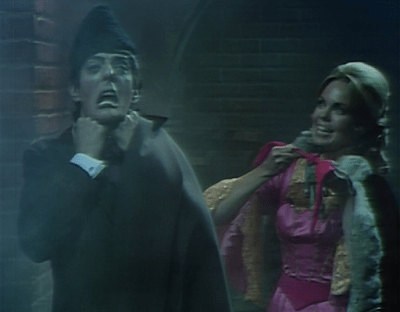
There, the man who took the hand from Quentin is standing alone in the fog. Angelique enters and flirts with him. He gives his name as Aristide. She says she is a puppeteer, and that if he lends her his handkerchief she will perform a trick. She wraps his handkerchief around the neck of a doll depicting a Continental soldier, a familiar prop from 1967 that became prominent during the 1790s segment, and squeezes it. Aristide begins choking, and Angelique orders him to give her the hand before he dies.

The Collinsport Strangler strikes again? Screenshot by Dark Shadows Before I Die.

The closing credits bill Michael Stroka as playing “Aristede,” an unusual spelling. The following item, posted in the comments under Danny Horn’s post about this episode at Dark Shadows Every Day, confirms my resolution to stick to the conventional spelling:

Factoid… I have the original script for episode 808, and Aristede is spelled throughout as Aristide.

Comment left 3 September 2017 by “Isaac from Studio 16 on W 53rd” on Danny Horn, “Episode 792: Dances with Wolves,” Posted at Dark Shadows Every Day, 19 December 2015.

In the same comment thread, Carol Zerucha goes on at length about Stroka’s ethnicity. He was Slovak, as she is, and she had a big crush on him when she was a kid watching the show. The characters in today’s episode assume that Aristide is Roma, but Ms Zerucha points out that we have no reason to assume they are right, and that he, too, might be Slovak.

Also in that thread, FotB “Straker” says that Aristide looks like William F. Buckley, Jr. I agree. I wish they had at some point cast him as a character who leaned way back in his chair and used polysyllabic words.

Episode 791: Roomful of spirits

The evil Gregory Trask coerced lawyer/ Satanist Evan Hanley into helping him murder his wife, Minerva, so that he could marry wealthy spinster Judith Collins. Now Trask and Evan have conjured up a magical simulacrum of Minerva and caused it to hang around Judith. They claim they can’t see it, which, coupled with some other troubles Judith has had, leads her to believe that she has lost her mind. Trask and Evan strong-arm Judith into signing a paper, Trask locks her up in the tower room, and Evan makes the simulacrum disappear.

In case you can’t tell, these guys are villains. Screenshot by Dark Shadows Before I Die.

Meanwhile, Judith’s brother Quentin is at large. Quentin is a werewolf, and when he returned to human form this morning his face was disfigured. This worked to his advantage. He was in jail at the time, and he was being watched. The sheriff’s deputy had not recognized Quentin’s brother Edward when he came to jail that night, so it isn’t so surprising he doesn’t recognize Quentin, even though he is six foot four, has a distinctive hairdo and prominent mutton chop sideburns, and is wearing the same blue suit with a frock coat that he always wears. It is surprising that Edward doesn’t recognize him either, but this may be the result of a congenital problem the Collinses have. Not only was Quentin himself stumped when the equally identifiable Evan had a similar glob of makeup on his face recently, but Judith fails to recognize Quentin today when he comes to the drawing room. When Judith found him, Quentin was listening to his favorite record and reciting its lyrics in his unaltered voice, and he identified himself to her by name. Still, she couldn’t see it.

Quentin bursts into Evan’s room shortly after he finishes dissolving the simulacrum of Minerva. He sees that Evan’s face is no longer disfigured, and assumes that he used the magical Hand of Count Petofi to restore his appearance. Evan tells him he did not- he can’t explain why his face reverted, it just did so on its own. This does not satisfy Quentin, and it will not satisfy returning viewers. We saw Evan struggle to fix his problem for some time, and when he found himself in a crisis situation he suddenly turned up looking like his old self. So we’ve been in suspense for several days wondering what the explanation would be for his cure, and we are no more inclined to settle for a non-explanation than is Quentin.

Quentin knocks Evan out with a candlestick; the background music is a cue we have previously heard during on-camera murders, leading us to wonder if Evan will survive the blow. Quentin rummages around for a moment and finds the hand. He is looking at it, wondering how to use it to restore his appearance, when a man in a wool cap enters and orders him to surrender the hand at once.

This episode features one of Dark Shadows‘ all-time great goofs. When Evan is casting the spell to dissolve the simulacrum, a black-clad figure dashes past in front of him. A voice can be clearly heard exclaiming “Jesus, Lacy!” Evidently actor Jerry Lacy was in such a hurry to get from one set to another that he didn’t realize he was crossing a live camera.

Episode 789: We are going to create a thing

In #762, the Rev’d Mr Gregory Trask walked in on lawyer Evan Hanley and handsome rake Quentin Collins as they were performing a Satanic rite. Trask’s response was to blackmail Evan. Trask wanted his wife Minerva out of the way so that he could marry rich spinster Judith Collins, Quentin’s sister. Threatened with exposure, Evan cast a spell on an unfortunate young man named Tim Shaw. He brainwashed Tim into reenacting the plot of The Manchurian Candidate, with Trask in the Angela Lansbury role and Evan as the People’s Republic of China. As Evan and Trask planned, Tim killed Minerva. Shortly after, Trask married Judith.

On their wedding day, Judith saw Minerva’s ghost in the corner of the drawing room in the great house of Collinwood. In yesterday’s episode, Minerva’s ghost took possession of Judith, and the closing cliffhanger showed the possessed Judith about to stab Evan with a letter opener to avenge Minerva’s death. As we open today, Judith’s brother Edward enters and prevents the stabbing, and Judith is released from possession. She can remember nothing that happened while she was under Minerva’s power, and Edward is convinced that she has gone mad.

Edward takes Judith to her room, and Trask enters. Evan tells him that Minerva’s ghost has been in touch with Judith. The ghost knows what they did, and if the contact continues Judith will know as well. Trask demands that Evan do something to prevent that, and Evan says that he can cast a spell that may turn the haunting to their advantage and neutralize Judith permanently.

The plan turns out to be the creation of a “black ghost.” The only Black actor to have had a speaking part on Dark Shadows was Beverley Hope Atkinson, who played an unnamed nurse in one scene in #563, almost a year ago. Humbert Allen Astredo, who plays Evan, was also in that scene, playing suave warlock Nicholas Blair. Atkinson was terrific, and it would be great to see her again, but it turns out that the “black ghost” is not actually black. Nor is it a ghost. This misnamed entity is a simulacrum of Minerva, a kind of supernatural hologram that Evan will fabricate and that will appear when Judith is around. This will lead Judith to believe that she is insane, thereby causing her actually to become insane and to cease to be an obstacle to Trask’s enjoyment of her wealth.

The simulacrum first shows up in a transparent form in Judith’s bedroom. Judith screams. In the drawing room, Trask and Edward hear her scream and break off a conversation in which Edward has been urging Trask to agree to annul his marriage to the obviously disturbed Judith. Judith comes downstairs. She is reluctant to explain why she screamed, and tells Edward and Trask that nothing is wrong. She and Trask go to the drawing room and talk privately. He has to prod her a bit before she will admit she saw Minerva. He tells her it was just her imagination. She considers this; after all, she was in bed when she saw the image, so it may have been a dream. But then the simulacrum appears in the drawing room, near the spot where she saw Minerva’s ghost on her wedding day. Judith sees Minerva sitting quietly and sewing. Trask pretends he does not see anything; after a bit, Judith pretends she can’t see the image either. Trask leaves Judith alone with the simulacrum. Judith goes upstairs, and the simulacrum follows her. When they reach the top of the staircase, Judith cries out in fear and tells the simulacrum to stay away from her.

Though it is disappointing to be reminded that Beverley Hope Atkinson isn’t coming back, it is always good to see Clarice Blackburn. In her interviews with the authors of the book Barnabas and Company, Nancy Barrett said that Blackburn was the best performer in the entire cast of Dark Shadows. She doesn’t have a lot to do today- she delivers the opening voiceover, we see a snapshot of her, and as the simulacrum she stands motionless in a corner, sews placidly, then is seen from behind as she follows Judith up the stairs. But if there ever was a case to prove the old cliche that no part is small when a big enough actor plays it, Blackburn makes each of these little turns into a moment viewers will remember.

As Judith, Joan Bennett also deserves a great deal of credit for getting the gaslighting plot off to a good start. For example, there is an embarrassingly ill-written scene when Judith is in her room, pacing back and forth while some vibes play on the soundtrack. A knock comes at the door, and the music stops. Judith opens the door, and no one is there. The music resumes, and she starts pacing again. There is another knock. Again the music stops, again Judith opens the door, and again no one is there. The music resumes, and she’s back to pacing. The knock comes a third time. A third time the music stops, and a third time Judith turns to the door. This time she asks who’s there. It’s Trask. She lets him in, and he denies having knocked before. Knocking on doors and running away is a pretty crude tactic even on a show with an audience consisting largely of kids aged twelve and under, and the apparent complicity of the music in Trask’s plot is the kind of thing they ridiculed in Looney Tunes cartoons. But Bennett’s soulful performance holds our attention throughout.

This is the second time Dark Shadows has shown us an adventurer trying to gaslight his new wife so that she will go away and give him unfettered access to her fortune. The first time was in March 1968, when the show was set in 1796. Naval officer/ sleazy operator Nathan Forbes had married fluttery heiress Millicent Collins. Nathan discovered that Millicent had transferred all her assets to her little brother Daniel. Nathan then set about driving Millicent out of her mind so that he could take her place as Daniel’s legal guardian. That plot also featured some weak writing, but Joel Crothers and Nancy Barrett were so irresistible as Nathan and Millicent that it hardly mattered. Perhaps the writers wanted to revisit the gaslighting theme to show that this time they could consistently write scripts worthy of their outstanding cast.

Episode 757: All of them witches

Undead blonde fire witch Laura is in the act of driving a stake into the heart of vampire Barnabas when she is interrupted by another undead blonde fire witch, Angelique. Angelique announces that she will always be there to thwart any attempt to stake Barnabas, which rather tends to deflate the suspense inherent in having a protagonist who is a vampire. The two of them exchange threats, and Laura finds that she can hold Angelique at bay by generating the right kind of fire.

Laura leaves Barnabas’ house. His unwilling sidekick, thoroughly human witch Magda, sees her and asks what she was doing there. Laura does not answer, but Angelique enters and tells her. Angelique says that Barnabas would doubtless wreak a terrible vengeance if he found out what had happened while Magda was away. Angelique orders Magda to go to the great house of Collinwood and fetch a fourth witch, black magic enthusiast Quentin. Magda complies reluctantly.

Quentin is falling down drunk, which is not unusual. He has a better excuse than he typically does, however, since he just found out that Magda turned him into a werewolf. He is furious to see her. He says that no matter what she thinks, he will not “lie down and die!” This elicits a laugh from Magda, who points out that he can barely stand up. She tells him that Angelique has ordered him to come to Barnabas’ house, and that he cannot oppose her.

In the house, Angelique tells Quentin he must help her defend Barnabas from Laura. Quentin moans that he is in no condition to help anyone, which only makes Angelique impatient. Unlike her and Magda, Quentin does not know that Barnabas is a vampire, so Angelique keeps reminding herself to say that Barnabas has gone away for the day and that Laura will be a threat to him when he comes back tonight. Quentin tells Angelique about a trinket Laura received from some of the gods of ancient Egypt that keeps her alive, and she sends Magda to steal it from her.

Magda goes to Laura’s cottage. Magda tells Laura that she has more reason to hate Barnabas than she does, since Barnabas enslaved her husband Sandor. She wants Barnabas to be destroyed, but if Laura tells the authorities about him Sandor, too, will be killed. The dramatic date is 1897, and the state of Maine abolished the death penalty in 1887, so Magda is afraid of an extrajudicial killing rather than an execution for complicity in Barnabas’ murders.

Laura tells her that it is necessary to expose Barnabas if he is to be destroyed, but Magda tells her of another way. She says that vampires can be killed by silver bullets through the heart. Laura goes to get money for Magda to buy silver and have it made into bullets. While she is out of the room, Magda steals the trinket. It seems that Magda has given herself a chance to get rid of both Laura and Barnabas.

Once Angelique has the trinket, she tells Quentin that he will have to perform a ceremony using his copy of the Egyptian Book of the Dead. He is still heavily hungover and balks at the orders, but she gives him no choice. Once he starts his incantation, he breaks into a big smile, clasps the book to his chest, and preaches the phrases like a megachurch pastor when the collection plates are circulating. We cut to Angelique. Her expression is so admiring it is hard to tell whether the reaction is the character’s or the actress’. Angelique does some mumbo-jumbo with objects in the fireplace.

In her cottage, Laura struggles. She looks frantically for the trinket, then prays to Amun-Ra. The final shot of her is filtered to distort her image. It turns her eyes into little black coals, which is an effective visual metaphor.

Screenshot by Dark Shadows Before I Die.

Laura has been important in the history of the show and is key to this little period of the plot, but it is fairly clear that she is a short-timer now. All she cares about is taking her children away and burning them to death so that she can renew her own existence, and she keeps saying she is on a tight deadline for that project. We can be sure she won’t succeed, and even if she does she will be off the show. So she really could die, making the cliffhanger more suspenseful than usual.

Soaps classically divided the days of the week so that very little happened on Tuesday or Wednesday, Thursdays were devoted to plot mechanics setting up a big development, Fridays would show that big development and end with a memorable cliffhanger, and Mondays would resolve the cliffhanger and give a lot of recap to bring new viewers up to speed. Dark Shadows never followed this formula. These last three episodes are a case in point. #755 was all about Laura trying and failing to figure out whether Barnabas was a vampire. That was a mid-week throwaway if ever there was one, but it aired on a Friday. Yesterday she got confirmation that he was, and we ended with a fine cliffhanger with her holding the stake and mallet beside Barnabas’ open coffin. That aired on Monday, but was a perfect Thursday scene-setter. Today, a Tuesday, we have a whiz-bang battle of the witches, with new alignments and new dangers, a great Friday climax with a cliffhanger fitting for the end of any week.

Violet Welles was far and away the best writer of dialogue on Dark Shadows, and today’s script is so full of gems that even the plot summary on the Dark Shadows wiki is full of quotes. I can hardly blame the editor for that deviation from the usual format, there is so much good stuff I would have been tempted to transcribe the entire script if someone else had not already done so.

Episode 742: Barnabas, Quentin, and the advantage of being seen together

We open in the cottage on the grounds of the estate of Collinwood, where the rakish Quentin Collins has triumphantly confronted his sister-in-law and sometime lover, Laura Murdoch Collins, with a telegram from the authorities in Alexandria, Egypt, declaring that she died in that city the year before. Laura points out that the fact that she is standing in front of him and breathing would tend to limit the credence such a document might be expected to command. Quentin hadn’t thought of that. He looks puzzled for a moment, then says that even if no one else is convinced, he is now sure that she is dead.

Laura, unable to believe that Quentin really is this stupid. Screenshot by Dark Shadows Before I Die.

Viewers who have been with Dark Shadows from the beginning will particularly enjoy this exchange. Another iteration of Laura, also played by Diana Millay, was on the show from December 1966 to March 1967, when the dramatic date was contemporary with the broadcast date. In those days, the authorities in Phoenix, Arizona, kept sending messages to the residents of the great estate of Collinwood concerning their reasons for believing that Laura was dead. Most of those messages were received with a laugh, then with irritation that a bunch of brain-dead bureaucrats wouldn’t stop pestering them with reports that were obviously false. But there were a few times when characters took them with an inexplicable seriousness. It’s a relief to see that this part of the show, set in the year 1897, will not include any of those jarringly foolish reactions.

Quentin and Laura argue about her children. She wants to take them and leave Collinwood; he asks what she will accept instead. Quentin’s pretense that he would have anything to offer her that might be tempting so amuses Laura that she doesn’t bother to be insulted. When he says that he will give her money, she laughs. The penniless Quentin says that he will steal any amount she names. He claims to “have powers.” Before Laura returned to Collinwood in #729, we twice saw Quentin take part in unholy summoning rituals on this set (#711 and #718,) each of which did result in communication with the spiritual forces of darkness. It does seem to be a bit of an exaggeration for him to claim to “have powers,” though. Especially so when he is talking to someone whom he believes to have transcended death.

A male servant comes to the door. Quentin believes this man to be Laura’s lover, and nearly says so today. In fact, Quentin has severely underestimated Laura in every way. She did die in Alexandria. But she has also died in other places, at other times, and will do so again. She is an undead fire witch who periodically incinerates herself and rises from the ashes as a humanoid Phoenix. The man is not her lover in any human sense. Rather, one of the ways she keeps herself more or less alive is by draining heat from his body in a kind of dry vampirism.

Quentin leaves Laura alone with the servant. Opposite David Selby, Diana Millay had shown her gift for dry comedy to great advantage. Once he exits and she is alone with the servant, her manner shifts abruptly. She suddenly starts overacting and sounding false. I think that is down to the actor who plays the servant, Roger Davis. Mr Davis was notoriously abusive of his female scene partners, and she has to play her scene in his arms. It would have been difficult for anyone to relax sufficiently to give a good performance when she was stuck in that unenviable position.

Laura is not the only vampiric presence at Collinwood these days. Time-traveler Barnabas Collins is the old-fashioned blood-sucking kind, and we see him rise from his coffin. He summons his blood thrall Charity Trask to come to him at the Old House on the estate. Charity comes. Several of Barnabas’ female victims have gone through a particular series of stages. First, they are elated at their new connection with Barnabas, and want to devote themselves to him as slavishly as possible. Then, they become reluctant to go on serving as his breakfast, and make anguished protests about wanting to return to their previous lives. Finally, they rebel. Charity has entered the second stage. She says that her father expects her. Barnabas has seen all this before, and has learned to have fun with it. He tells Charity that he needs her more than her father does. He bares his fangs and bites her, after which she is back to elated servility.

Barnabas tells Charity that she will be assisting him in a ceremony. She waits in the Old House while Barnabas goes to the great house on the estate to fetch something he needs for that ceremony.

We cut to Quentin’s room in the great house, where we see a mirror. It shows the reflection of Quentin kissing maidservant Beth. When we first saw them talk to each other in #701, Beth was fighting her attraction to Quentin and trying to resist his attempts to seduce her. That’s what was supposed to be going on, anyway, but we didn’t actually see it. Terrayne Crawford played Beth’s lines according to the literal meaning of the words, with the result that for the first six weeks of the part of Dark Shadows set in 1897 Beth seemed sincerely uninterested in Quentin, and his overtures were just sexual harassment. Now Ms Crawford no longer has to play conflicting emotions. Beth is simply in love with Quentin. She gets that point across adequately.

Beth pulls away from Quentin, explaining that she has to get back to work. He talks about ending his marriage so that they can be together permanently; he says that it may serve their cause to stop being so discreet, since a little scandal may prompt the rest of his family to drop their opposition to any change in the status quo. While they get ready to part, we see the window, outside of which a bat is squeaking incessantly. They exit, and Barnabas appears.

Barnabas rummages through Quentin’s desk and finds a book. Beth reenters and catches him. He tells her he came for the book and was planning to leave a note. A smirk on her face, Beth says that it will not be necessary to do so, as she will tell Quentin all about what she has seen.

Beth goes downstairs and meets Quentin in the foyer. Quentin asks what book it was Barnabas took. She says that all she saw of the title was the word “dead.” Evidently Quentin has quite a few books with the word “dead” in the title, because he has to ask where exactly Barnabas found it. She says it was in the desk, and he rushes off to the Old House.

It was the Egyptian Book of the Dead, and Barnabas used it to perform a rite calling on Amun-Ra to cause the spirit of one of Laura’s previous incarnations to appear before him. At that, we cut to the cottage, where the currently alive-ish Laura grows weak and vanishes. Back in the Old House, we see the ghost take shape. Charity sees it too, and runs screaming out the front door. Quentin enters just in time to see the end of Barnabas’ conversation with the phantasmal Laura. The phantom looks at Quentin, screams, and disappears.

On Friday, Laura said that no one knew just how deeply Quentin was obsessed with the occult. His own absurd claim today to “have powers” so great that he could make it worth Laura’s while to leave without her children confirms that he is very far gone in this obsession. So when he sees that Barnabas is not only doing battle with the same adversary whom he is trying to confront, but is also able to conjure up spirits from the vasty deep, we can be confident that Quentin’s hostility to his recently arrived “cousin from England” will soon be evaporating. As Tony Peterson might say, I think this is the beginning of a beautiful friendship.