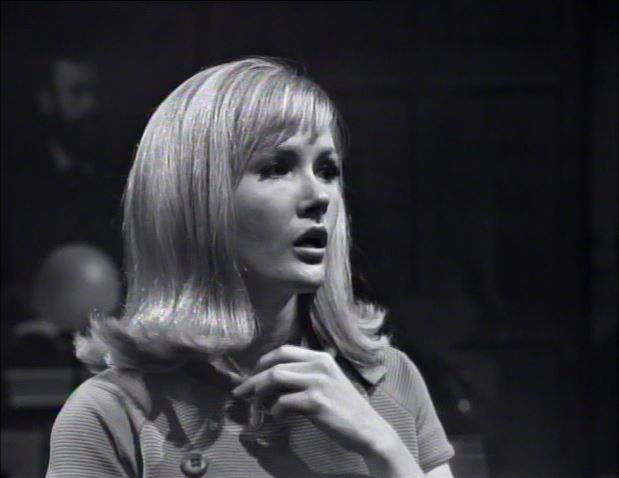
Episode 306: Private little investigations

Sarah Collins has taken her friend and distant cousin, strange and troubled boy David Collins, home with her. Since Sarah is a ghost, her home is in a mausoleum. She has decided to show David one of the most interesting features of the place.

As we open, David is following Sarah’s instructions. He is standing on the sarcophagus of her mother and pulling a metal ring in the mouth of a stone lion’s head. The ring comes forward and a panel opens, revealing a room that was hidden for more than a century and a half.

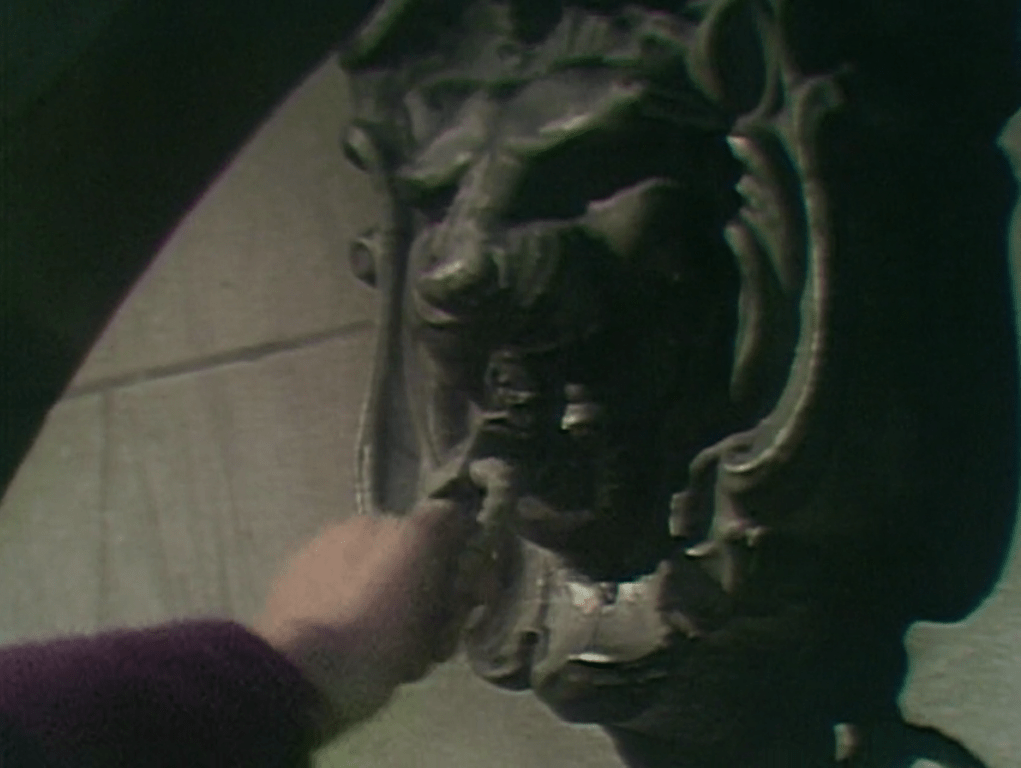
The lion’s head.
Pulling the ring
The panel opens

The first time we saw the panel open was in #210, when dangerously unstable ruffian Willie Loomis happened upon the ring and ended up releasing vampire Barnabas Collins from his coffin in the hidden room. Now that we see this gimmick again and see it in color, it’s starting to seem odd that all you have to do to open the panel is pull the ring. The ring stands out as the only piece of metal in the tomb. Anyone entering the space would be tempted to tug on it, if only to polish it. If you’re wanting to make sure your vampire doesn’t get loose, I’d think you’d install a more secure system. Maybe you could add two or three additional decorative doodads to the wall, one of which you turn, say, three quarters of the way to the left, the other of which you turn some other way, and between them they release the ring.

Be that as it may, Barnabas’ old coffin is still in the hidden room. Sarah announces they will be opening it, and David resists the idea. He debates with Sarah for a while before curiosity gets the better of him.

Sarah the psychopomp.
David wants to let the dead rest.
David’s resistance crumbles.

He is shocked to see that it is empty. David asks Sarah why an empty coffin would be put in such a place, and she happily tells him that it wasn’t always empty. There was someone in it once, but he got up and left. David protests that the dead don’t walk away, to which Sarah replies that “Sometimes they do.”

David is shocked.
Nobody’s home.

When David first met Sarah in #256, she was outside Barnabas’ house, puzzled that she couldn’t find her parents or anyone else she knew. Now it is starting to seem that she knows that she is a ghost haunting a time long after her own, but Sarah’s lines here are the first clear indication that she knows what is going on with her brother Barnabas.

David’s bafflement that the coffin is empty echoes #273. In that episode, matriarch Liz was shocked to find that the chest seagoing con man Jason McGuire buried in her basement did not contain the murdered remains of her husband. Liz kept asking “Why is there nothing there?” David seems almost as appalled as his aunt had been at the sight of some clean fabric unadorned with a rotting corpse. A few days after Liz found out Jason hadn’t really buried her husband in her basement, Barnabas killed Jason. Regular viewers will already have this story in mind, because in #276 Barnabas and his sorely bedraggled blood thrall Willie buried Jason in the floor of the very room David and Sarah are visiting at this moment. Clearly Barnabas would not be happy were he to find out that David knows about the room.

That wasn’t the first vacant grave in Dark Shadows. From #126 to #191, the show was mainly about David’s mother, undead fire witch Laura Murdoch Collins. As the Laura arc progressed, graves of various women named Laura Murdoch were revealed to be empty. Now Laura’s son is coming face to face with an unoccupied coffin, suggesting to loyal fans that he may yet learn something about his own origins.

To Sarah’s consternation, David says he has to go home. He tells her that if he does not, his governess, the well-meaning Vicki, will be upset with him. He simply refers to Vicki by name, as if Sarah already knows who she is. Regular viewers have reason to believe she does know who Vicki is, but it is not clear why David assumes that he can just say “Vicki” without explaining to Sarah who he means. Sarah swears David to secrecy about the existence of the room.

By the time David gets back to the great house of Collinwood, it is 9:30 PM and Vicki is indeed worried about him. Apparently no one else is at home; certainly, no one else has missed David. Vicki sits David down on a seat that’s been in the foyer from the beginning of the series, but which has only been used once or twice before. They have an earnest little talk that recalls the scenes they shared in the first 39 weeks of Dark Shadows, when their complicated relationship was the one storyline that consistently worked.

Rarely used seat.

David describes Sarah to Vicki. It finally dawns on her that Sarah is the little girl she saw on top of the stairs at Barnabas’ house in #280. When the light flashed in Vicki’s eyes, my wife, Mrs Acilius, shouted at the screen “Tell him!” Vicki and David again look like the fast friends they had become by #140, so we would indeed expect her to tell David that she thinks she has seen Sarah, and to tell him where and when she saw him. If she and David join their lines of inquiry and work together to find out about Sarah, the plot will move more quickly and on a much bigger scale than it can so long as everyone pursues their own questions in isolation.

Vicki catches on.

But, Vicki is also very fond of Barnabas, and reluctant to believe anything bad about him. Sarah has been seen in several places connected to the abduction of Maggie Evans, The Nicest Girl in Town. Vicki doesn’t want anyone to add Barnabas’ house to that list, so perhaps it is not a “Dumb Vicki” moment when she decides to keep the information to herself.

Meanwhile, Barnabas is at home. He is irritated with mad scientist Julia Hoffman. Julia is attempting to cure Barnabas of vampirism, and he is dissatisfied with the progress of the treatment. He is also irked that Sarah broke Maggie out of the mental hospital where Julia was keeping her locked up, and blames Julia for failing to ghost-proof the place. He declares that Julia is “a meddlesome and domineering woman,” and that he, as a native of a different century, has no intention of tolerating such a person.

Barnabas and Julia discuss Vicki’s depressing boyfriend Burke. Burke has been investigating Barnabas, and his operatives have come upon some information that would raise questions Barnabas would have a hard time answering. Julia agrees that Burke must be stopped, and urges Barnabas to let her handle the matter. He says that he will take care of it, and that he will do so with “finesse” of a sort unfamiliar to the loutish inhabitants of the twentieth century.

Barnabas’ masterful finesse consists of telling Vicki what Burke is doing and asking her to make him stop. Those eighteenth century guys must have been amazing, to come up with something so complex and subtle in just a couple of days.

Julia comes into the great house as Barnabas is leaving. She asks Vicki if David is back yet. Vicki tells her that he had been out playing with Sarah in some location he refuses to disclose. Barnabas tries to conceal his alarm with a laughing remark about leaving Vicki and Julia to investigate the mystery of David’s playmate.

David comes out of his room to ask for food. While Vicki goes to fetch the housekeeper for him, Julia meets him at the top of the stairs and they talk about Sarah. David points out that she is repeating questions she has asked in previous episodes. He tells her that he doesn’t mind questions and neither does Sarah, but cautions her that the answers Sarah gives don’t make much sense.

The stained glass windows at the top of the stairs look great in color, and it is a relief when David shares the audience’s awareness that we’ve heard Julia’s lines before. Even so, the scene is a disappointment. David and Julia were fun to watch in their previous scenes because they were so relaxed together. Perhaps that was because David Henesy and Grayson Hall understood each other right away. Not only did they have similar ways of working as actors, but her son Matthew is about his age, so she might already have been familiar with a lot of things in his life that the other adults on set wouldn’t have known about.

Today, though, they are both having trouble with their lines. That keeps them from making enough eye contact with each other to sell the scene. David Henesy keeps looking at the teleprompter, which he could evidently read from the top of the stairs with only a little squint; Grayson Hall couldn’t read from that distance, but she does tilt her head back and look up when she’s searching her memory for her next line. Since the characters aren’t looking at each other, we don’t feel an emotional connection between them.

Hall has to thread a particularly small needle in this scene. Julia is trying to make her interest in Sarah seem casual in the same way Barnabas affected a lack of interest in her, by delivering lines about her with a jokey inflection. We know that she is urgently concerned with finding Sarah, and her efforts have to leave David unsure whether she really is the easygoing adult he has so far taken her to be or whether she is trying to pull a fast one.

In the course of a friendly chat between two people who obviously like each other, onetime Academy Award nominee and frequent Broadway luminary Hall could certainly have accomplished all of this. But in the course of this awkward encounter, it all falls flat. Especially so with Julia’s last line to David. After he has told her how difficult it is to get a straight answer from Sarah, she puts on a goofy voice and says that she’ll keep that in mind if she ever meets her. Since she isn’t looking at him when says this, it comes off not as an affectionate gesture acknowledging that they’ve run out of things to say, but as a high-handed dismissal. Even though she pats him on the shoulder and he smiles after that line, it still doesn’t seem that David would come away from the interaction with as complex an emotional response as he is supposed to have. Most likely he would just be irritated with Julia, as indeed the audience is likely to be.

“I’lll kee-e-ep that in mind.”
Departure.

We end back at Sarah’s place. Barnabas is in the cemetery looking pathetic. He hears the strains of “London Bridge” coming from the mausoleum. We see Sarah sitting on her mother’s sarcophagus moving her fingers on her recorder far more rapidly than the music we hear would call for. She looks more like she’s playing a rock ‘n’ roll number.
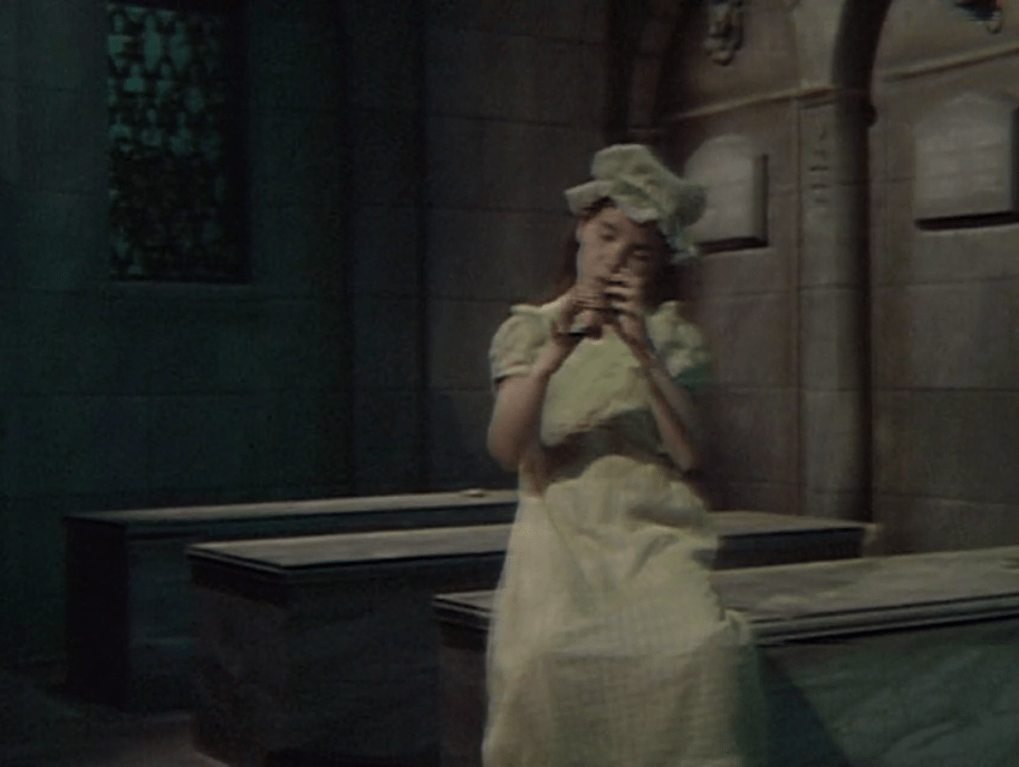
Jammin’ with the Junior Funky Phantom of 1967.

Barnabas calls out to Sarah. He identifies himself as her brother and says that he has come to take her home. He goes into the mausoleum only to find that she has vanished. Wracked with sorrow, he pleads with her to come back, saying that he loves her and needs her. He touches the plate marking her grave. This underscores the futility of his desire to take her home. Leading him here, it is she who has brought him to what is in fact her home, and what ought also to be his.

Sad Barney.
The impassable barrier.

This shows us a Barnabas we can sympathize with, but it also sets him on a collision course with David. Barnabas has been so harmless lately that we might wonder if his part is going to be recast with a purple felt puppet counting “Vun peanut butter saand-veech!” If he sets out to kill a child, he’ll be back on track as a horrifying menace.

Besides, David is not just any child- as the last bearer of the Collins name, David’s survival has a great symbolic importance to the show. He was central to everything that happened on Dark Shadows in its first 39 weeks. So if Barnabas becomes a threat to David, it will be a case of conflict between the current main character and the previous main character. Since Vicki originally represented the audience’s point of view and is still a major character, the divided loyalties between Barnabas and David that we first see influencing her behavior today could create a high level of dramatic tension. Especially so if Barnabas turns her into a vampire, and she winds up like Lucy in Dracula, the “Bloofer Lady” who herself preys on children.
Episode 165: It feels like someone was here

Our point of view character is well-meaning governess Vicki. Vicki believes that her charge, strange and troubled boy David, is in danger from his mother, blonde fire witch Laura. Today we see several weaknesses in Vicki’s position against Laura.

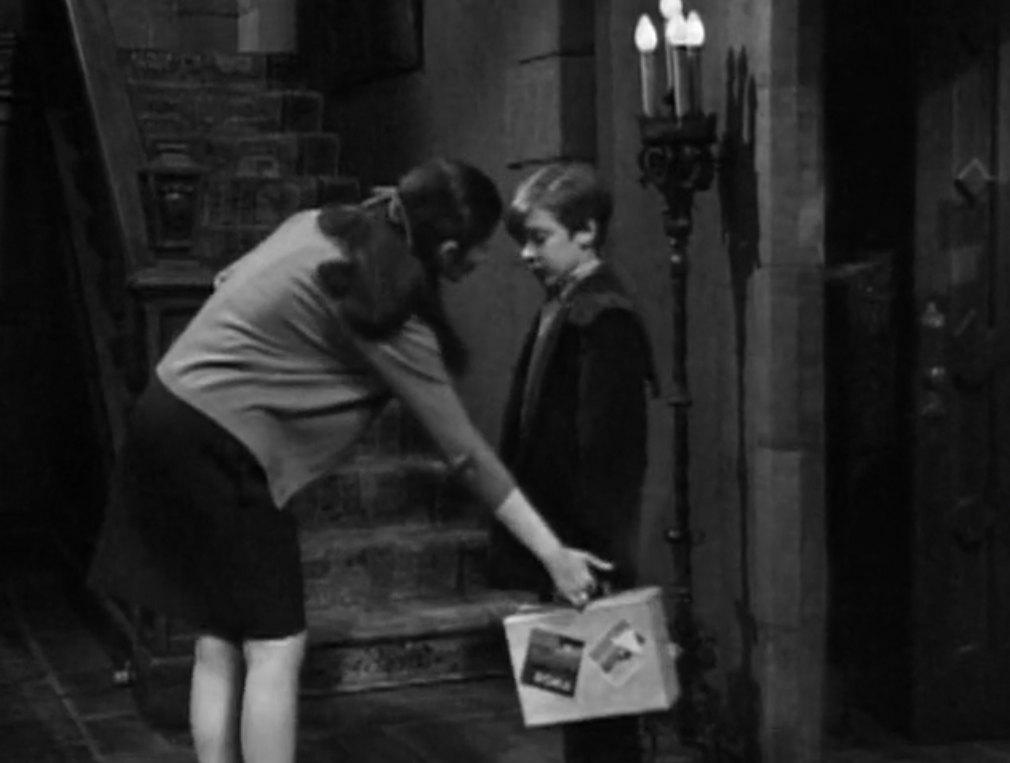
The opening sequence shows that physical force is useless to Vicki. David comes down the stairs in the great house on the estate of Collinwood carrying a small cardboard suitcase. Vicki sees him and asks where he is going. He tells her he is going to the cottage on the estate to spend the night with his mother. Vicki tells him he is not. She grabs at his suitcase.

Vicki grabs for the suitcase

Vicki is not given to clutching at David or his possessions. The last time they had a physical confrontation comparable to this was in #68. In that one, David was throwing a tantrum, and Vicki’s attempt to restrain him only led him to escalate his violent behavior:

From episode 68. Screen capture by Dark Shadows from the Beginning

Today, Vicki’s intrusion into David’s personal space backfires just as badly. She inadvertently knocks the suitcase open, dumping his pajamas on the floor. She is shocked to see what she has done:

Vicki sees what she has done

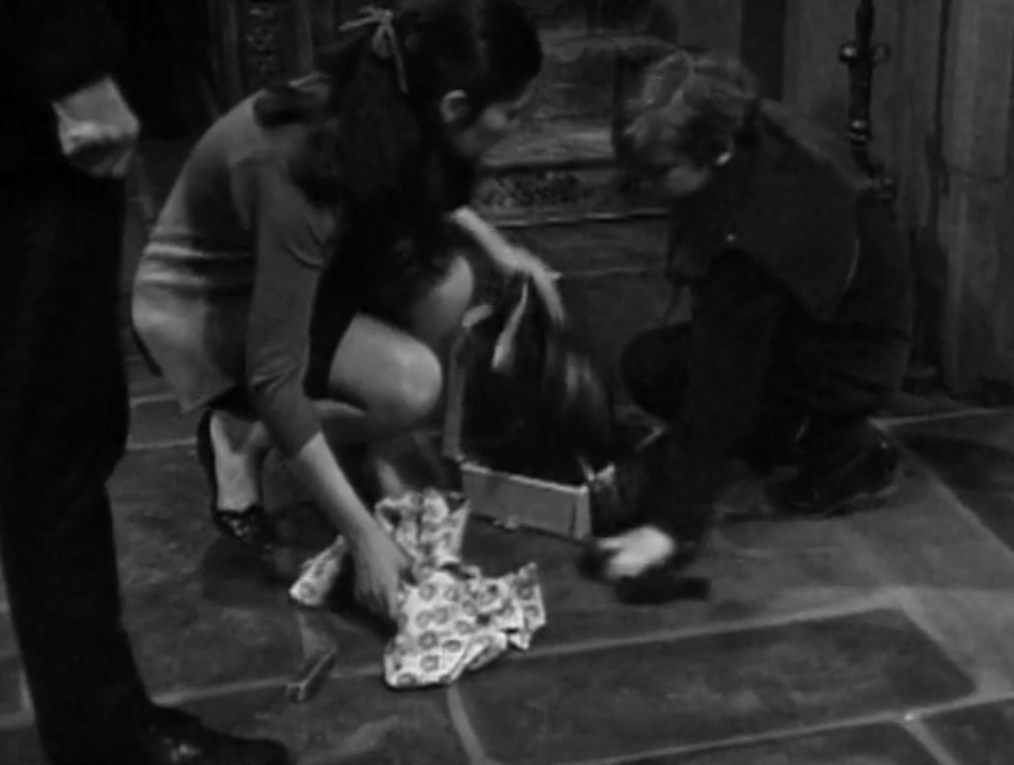
She tries to undo the damage by picking up the contents of the suitcase. That requires her to crouch down before David, destroying whatever authority she may have had over him at the beginning of the encounter:

Kneel before D’vod!

Making matters even worse, David’s father, high-born ne’er-do-well Roger, shows up and stands over Vicki while she and David are on the floor. Roger wants David to go away, and since Laura wants to take him he is working with her. As David’s governess, Vicki has no legal right to oppose the wishes of his parents, and in a conversation that begins with her in this position it is going to be psychologically difficult for her even to voice her objections:

Roger stands over Vicki and David

Vicki does insist Roger meet with her alone in the drawing room while David waits upstairs, and she makes her case valiantly. But that conversation only shows that Roger is as useless to Vicki as is brawn. He ignores every consideration that does not advance his own interest, and his interest now is getting rid of David.

Flighty heiress Carolyn comes into the room and supports Vicki. Roger won’t budge. He gives a long speech about his position as David’s father, a speech which actor Louis Edmonds takes straight off the teleprompter. He delivers it with as much conviction and brio as if he had actually learned it. At the end of his dramatic reading, Nancy Barrett and Alexandra Moltke Isles bite their fingers and Mrs Isles finally turns her back to the camera, so we don’t see either of them laughing.

The finger-biters
Mrs Isles gives up and laughs silently

In Laura’s cottage, David complains to his parents about Vicki’s attempts to keep him from his mother and mentions that his father stood up for him. Roger, rather surprisingly, rises to Vicki’s defense, denying that there was any need for standing up to anyone- he claims that Vicki simply did not realize that he had given David permission to spend the night with Laura, and that they had talked about improving communication to avoid similar confusions in the future. Laura isn’t fooled by Roger’s covering up his conflict with Vicki- she clearly knows that Vicki is her adversary. Nor is the audience encouraged to believe that Roger will support Vicki when it counts. He simply thinks that he has her under control.

When Roger leaves David and Laura alone in the cottage, he says good night. He turns and walks out the door as they watch him. Neither of them says anything. This is the sort of thing that often happens in plays, less often on screen, and almost never in real life. I suppose it’s hard to make the sorts of fumbling exchanges people actually have in those moments fit into a drama, but still, it would have avoided a distracting moment to have Laura and David say good night in reply.

Back in the great house, Vicki talks with Carolyn and visiting parapsychologist Dr Guthrie. They tell Carolyn that Laura was lying when she denied having seen Carolyn’s mother, reclusive matriarch Liz, on the day when Liz was stricken with the mysterious ailment that has sent her to the hospital. Dashing action hero Burke Devlin has told Vicki that Liz came upon him and Laura in Laura’s cottage shortly before Liz’ first attack, and that Liz and Laura were still together when Burke left them.

Carolyn has been madly in love with Burke, unable to think about anything else when she is reminded of him. She does initially react to his name with “You talked to Burke?” in the same dreamy tone of voice she has used hithertofore, but quickly resumes her focus on the business at hand. Her feelings for him have not vanished, but she has matured sufficiently that she can set them aside while she deals with a crisis.

That is not to say that Carolyn is entirely grown-up in her behavior. When she learns that Laura has lied about Liz, Carolyn wants to march down to the cottage at once and confront her with “absolute proof that she is responsible for my mother’s illness.” Vicki points out that Laura’s lie is by no means proof of any such thing, and Guthrie says that he doesn’t want Laura to know how much the three of them know.

Having learned that Vicki and her allies have nothing to hope from either physical force or from Roger, we then discover that they can’t count on the writers either. Carolyn asks why Guthrie wants to hide their knowledge from Laura. The audience knows that they are in conflict with Laura and will have to be careful with any information that might enable them to catch her off-guard at a strategic moment. That Carolyn does not know this makes her sound like an idiot.

Guthrie’s response makes this bad situation worse. He makes the nonsensical claim that they should try to keep Laura from realizing that they are suspicious of her. Carolyn is openly hostile to Laura, Vicki has had to tell Laura repeatedly that she is trying to keep her son from her, and Laura treated Guthrie frankly as an enemy when they met yesterday. Considering that the only thing that has happened so far this week is that Dr Guthrie has been brought up to date with the story, seeing him presented to us as someone unable to hold onto information or process it gives the audience the feeling that we’ve just wasted a whole lot of time.

In the course of this miserable conversation, Guthrie does disclose a fateful plan. He says that he is considering organizing a séance. That marks the first utterance of what will, in the years to come, become perhaps the single most important word in all of Dark Shadows. In this instance, it is obscured by Guthrie’s inexplicable idea that Laura might agree to join them as a participant in their séance.

In the cottage, Laura’s behavior towards David is quite peculiar and seems to unsettle him. He was sitting next to her on the couch she has made up for a bed when she suggested he go get a book and read to her. When he found the book and sat down where it had been, she at once pleaded with him to come back and sit by her again. After expressing his puzzlement, David humors her. She squeezes him while he holds a smile. In an extended closeup, that smile shows several emotions- pleasure and self-satisfaction are in there, but so are confusion, discomfort, and loneliness.

Mixed feelings
Mixed feelings
Mixed feelings

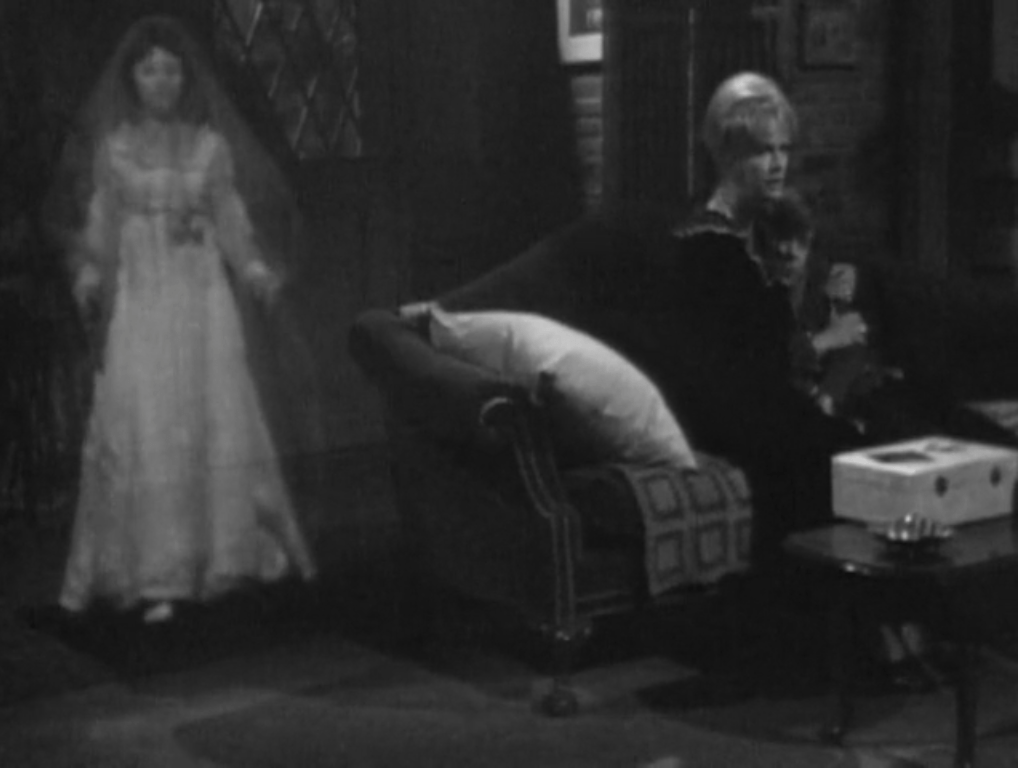
David drifts off, and a visitor comes to the cottage. Laura calls to her before we can see her. “Josette! I know you’re here!” David has a friendly relationship with the ghost of his ancestor, Josette Collins. Apparently Laura is also on a first name basis with Josette. For some time now, the show has emphasized that Josette never appears to more than one person at a time. Though Laura and David are both in the room, Josette manifests:

Manifestation

Laura orders Josette to go away, and she does. After she has gone, David wakes up. He says that “It feels like someone was here.”Laura tells him no one was, and he goes back to sleep.

Laura has her back to Josette, and David is unconscious. So perhaps that’s why she is able to break her usual rule and appear when more than one person is in the room.

Or perhaps there isn’t more than one person in the room. We know that Laura is not quite human, and not exactly alive. In her previous star turn, when she rescued Vicki from the crazed Matthew Morgan in #126, Josette was accompanied by the ghosts of beloved local man Bill Malloy and the Widows of Collinsport. Perhaps we are to conclude that Laura, like them, has erupted into the narrative from the supernatural back-world.

As we opened with a demonstration of the protagonists’ weaknesses, so Josette’s retreat exposes a further weakness. Josette has been established as the mighty supernatural protectress of David, Vicki, and the rest of the household. Yet Josette cannot overpower Laura. If there is to be a happy ending for David, Vicki will have to marshal her forces with care.

Episode 152: Woman in the cottage

The mysterious and long-absent Laura Collins is sitting motionless by the fire in her current residence, the cottage on the grounds of the great estate of Collinwood. A knock sounds at the door. As always in this situation, it takes Laura a moment to rouse herself and begin moving. When she does, her movements are disconnected and robotic, as if she is reassembling herself. This image, coupled with what regular viewers have seen in previous episodes, suggests that what we see when we look at Laura is never more than half of a person. Part of her, maybe most of her, exists in the form of energy that somehow inheres in the fire.

Laura opens the door to instantly forgettable young lawyer Frank Garner. Frank identifies himself as the representative of Laura’s estranged husband, high-born ne’er-do-well Roger Collins, in their divorce. She tells him she doesn’t want any money or property. All she wants is custody of their son, strange and troubled boy David. Since Roger is eager to see David go with her, she doesn’t see the need for a lawyer of her own.

Frank points out that as one of the heirs to the Collins interests, David stands to become a “very wealthy young man.” Laura suggests that all of David’s assets be put in a trust that she cannot access. When Frank asks how she will support David until he comes into his legal majority, she says vaguely “I have… resources.” When he presses the point, she assures him that “where I plan to take [David,] he’ll have no need for anything the Collins family could give him.” Since the Collins family is presented in this episode as “very wealthy,”* that would suggest she is taking him someplace where money cannot be exchanged for goods and services. This is, to put it mildly, an intriguing prospect.

Throughout her talk with Frank, Laura makes it clear her priority is to settle the divorce and leave with David as soon as possible. Frank says that lawyers can usually settle business among themselves more quickly than they can with people unrepresented by counsel and asks if she wants the matter settled quickly. Laura answers that she wants that “more than he can realize.” She asks Frank to represent both her and Roger, to draw up the papers to finalize what they have discussed, and to get it over with.

Before he can leave the cottage, Frank has to break some bad news to Laura. The police in Phoenix, Arizona, are still investigating a fire that destroyed the apartment where she lived in that city and killed an unidentified woman who had a key to it. There might be a hearing. If so she will have to return to Phoenix to testify, perhaps on short notice.

Laura chose to live in Phoenix. She has told versions of the legend of the phoenix both to David (#140) and to Maggie Evans (#128,) who was waiting on her table at the restaurant in the Collinsport Inn. Furthermore, Maggie’s father, drunken artist Sam, knew Laura when she lived in town ten years before and hasn’t been in touch with her since. When Maggie told him that a customer had told her the legend of the Phoenix, he clearly knew that Maggie was talking about Laura. So she has been fascinated with the story for years. In the version of the legend she related to David, it was in the context of a description of a mystical land like those which figure in the stories of the Holy Grail, which “some call Paradise,” and which is her true home. So when Laura implies that she plans to take David someplace where there is no buying or selling, we listen up.

Frank leaves, but before Laura can resume her stupor beside the fire someone else knocks. It is well-meaning governess Vicki. Vicki tells her that her boss, reclusive matriarch Liz, has ordered her to keep Laura away from David. Laura asks if Vicki will obey this command. Vicki says she has no choice. It’s her job, after all, and besides, Liz has been very nice to her.

Laura asks how someone who herself grew up in a foundling home can keep a child from his mother. Vicki recaps all the strange things that have happened since Laura came back. Regular viewers know that these events are signs of supernatural activity. We know this because we’ve seen transparent figures superimposed over shots and have heard theremin music playing on the soundtrack. But Vicki hasn’t been watching the show, so even though she tells Laura almost everything she has seen and heard Laura can provide more-or-less plausible explanations for all of it.

Vicki is unconvinced, but still goes back to the great house and tells Liz that she won’t be able to follow her orders. Laura is David’s mother, after all, and does have her rights. Liz is so angry that she can’t look at Vicki, and stares directly at the teleprompter throughout the entire scene.

Liz demands that Vicki say she will do as she has commanded. Vicki looks down, and even after Liz has repeated herself more than once she still doesn’t say that she will. The closeup on Vicki before Liz sends her away to check in on David is quite a powerful moment. In a couple of seconds, Alexandra Moltke Isles shows very clearly that Vicki is ashamed to be disobeying Liz, embarrassed to be yelled at in the drawing room, and yet determined to continue in her course of action.** It’s a remarkably efficient performance.

Vicki being yelled at

Vicki leaves the room. The camera stays on Liz as we hear voices in the foyer. Roger crosses paths with Vicki. He enters the drawing room and asks Liz why Vicki is upset. Liz dismisses the question, and Roger compares her to Lucrezia Borgia. Irritated, Liz says she is in no mood for his jokes. “Who’s joking?” he replies.

That’s a startling moment. Roger spent the first several months of the show trying to get Vicki out of the house, if necessary by manipulating David into murdering her (#68.) Now, he’s expressing sympathy for Vicki, apparently spontaneously. It’s true that the motive for that hostility was rooted in a storyline that has been partially resolved, but it is still interesting that Roger actually seems to like Vicki now.

A knock sounds. Again the camera stays on Liz in the drawing room while we hear Roger greet Frank in the foyer. It was a week ago, in #147, that we first heard characters speaking while off-camera. I wish they had done that more often. They need all the tricks they can find to create a sense of space, to make us feel that their little sets are actually a huge mansion, a rolling estate, and a whole town.

Frank tells Roger and Liz about his conversation with Laura. Roger is delighted that the only thing Laura wants is custody of David and urges Frank to draw up the papers at once. Liz, outraged, declares that custody of David is the one thing Laura can’t have, and forbids him to draw the papers up at all. Faced with this disagreement between Roger, his client of record, and Liz, who is actually paying his fee, Frank can do nothing. He excuses himself. On his way out, Roger whispers to him that he should prepare the papers- he promises to handle Liz.

The telephone rings. It is a report that the authorities in Phoenix have examined the charred corpse found in the burned ruins of Laura’s apartment. They are positive that it is the body of Laura herself. Roger and Liz are bewildered by the news.

*In other episodes, especially those focusing on the “Revenge of Burke Devlin” storyline, they seem to be gasping along on the brink of total financial ruin. But today, we hear about nothing but how terribly rich they are, so that’s what we’ll go with.

**This is puzzling for regular viewers. In #148, Vicki expressed a determination to keep Laura away from David. The information she shares with Laura is the basis for that determination. It isn’t at all clear why she doesn’t stick with it. For that matter, if she can tell Laura everything she knows when she regards Laura as a menace, why can’t she tell her benefactress Liz that she is thinking the same way she is? It could be that Ron Sproat, who wrote #148, and Malcolm Marmorstein, who wrote this one, didn’t talk to each other, and the producer was too busy with other things to catch the inconsistency. Whatever the cause, Mrs Isles gives such strong performances in both episodes that I’m inclined to treat them as self-contained stories so far as Vicki is concerned.

Episode 44: Casually, and in passing

Even the dullest, most routinely soap operatic episodes of Dark Shadows have a couple of moments when you can tell they were being made by people with artistic ambition. This one is a case in point. Bill brings Liz some unwelcome information. Look at the composition of the shot:

Screenshot by Dark Shadows From the Beginning

They hold it like that for about a minute, and Joan Bennett’s response to the closeup really shows you how she came to be the movie star she was in the 1940s. It really is great.

In the same sequence, Carolyn hears for the first time that her adored Uncle Roger is in trouble. They cut to her for just a fraction of a second, which makes her reaction all the more effective:

Screenshot by Dark Shadows From the Beginning

The last shot is also a fine bit of visual story-telling. After his attempt to get Liz to face facts, Bill returns to the Blue Whale, and takes a seat in an even danker part of the bar than he’d occupied previously.

Screenshot by Dark Shadows From the Beginning

There’s also a good moment when the banker is presenting his visit as routine and Liz, who in the episodes earlier this week had been shown time and again to be in a precarious financial state, combines a faultlessly well-composed smile with hands trembling so hard her teacup almost cracks against its saucer.

And that’s it. The story points are a lot of tedious stuff about people we’ve never seen and relationships that aren’t going anywhere. Most of the actors do their best, but even in that department there is one notable exception.

The banker is played by Patrick McVey, a veteran character actor who could usually be relied upon to turn in a solid performance. He does well enough with the lines he remembers, but he takes most of his dialogue straight off the TelePrompTer. Marc Masse counts 22 shots of McVey catching up on his reading. That takes you out of the show, so that you start noticing everything else that’s wrong. In particular, the banker at one point tells Liz that anyone who might buy up her outstanding notes could put her out of business in a moment, and that in fact someone has been looking into the price of those notes. She asks who, he says “I don’t remember his name.” Mrs Acilius and I laughed out loud at that, saying to the screen “Isn’t it printed on the TelePrompTer?” Obviously the script called for the banker to deliver that line, and maybe if McVey had known his part we could have overlooked the absurdity of it, but as it stands, it is the most memorable moment of the entire episode.

Episode 912: Blink

In which I identify the ultimate Dark Shadows supercouple- greater than Barnabas/ Julia, greater than Barnabas/ Angelique, greater than Quentin/ Whoever, is the immortal and unchallengeable love of Jonathan Frid and the TelePrompter. 

Episode 912: Blink