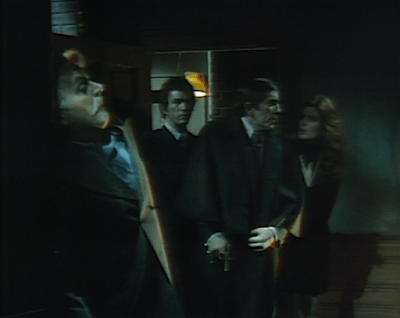
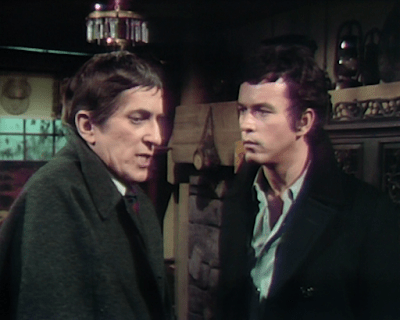
Old world gentleman Barnabas Collins has become the leader of a mysterious cult. Antique shop owners Megan and Philip Todd are members of the cult, and they have a magical baby who materialized after Barnabas gave them a sacred box. Inside the box was a book that is also of tremendous importance to the cult. Philip and Megan left the book on a table in their shop, so that it appeared to be for sale. Yesterday strange and troubled boy David Collins stole the book. In its absence, the baby has developed a high fever. When Megan and Philip found that the book was gone, they flew into a panic and declared that they would have to kill the person who took it.
Many stories on Dark Shadows start with David, so it could be that the uncanny and sinister forces behind the cult want him to have the book. If so, Barnabas doesn’t know any more about it than do Philip and Megan. He finds out today that the book is missing, and takes Philip to a cairn in the woods. He tells him he will have to be punished for losing it.
When Philip first saw the cairn, he remarked that he had been that way before, but never noticed it. Barnabas explains that only people connected with the Leviathan cult can see it. This casts the minds of returning viewers to heiress Carolyn Collins Stoddard, Barnabas’ distant cousin. In #888, Carolyn saw the cairn and ran into a prowler there. The prowler refused to identify himself to her; the closing credits told us he was Paul Stoddard, Carolyn’s long missing father. We had seen him from behind the day before, when he saw the cairn materialize, then simply walked off. His blasé response told us that he expected to see what he saw, which can only mean he was connected with the cult. Carolyn doesn’t know anything about the Leviathans, but what Barnabas says to Philip today confirms that she is nonetheless associated with them in some sense. Indeed, Barnabas has been very solicitous of Carolyn’s well-being ever since he joined up with the Leviathans and keeps telling her that she has an extraordinary future.
There is also some business going on between Paul and Carolyn. On the surface it would seem to be a typical soap opera story, in which the daughter is trying to reintroduce her errant father into the family circle and has to keep secrets from her mother and young cousin to pull it off. Given what we know about Paul’s awareness of the Leviathans and their interest in Carolyn, we can see that it is in fact part of the supernatural A story.
There are no closing credits today, only the logo of Dan Curtis Productions. The Dark Shadows wiki says that this one was directed by Henry Kaplan. I am certain this is false. Kaplan was very clumsy with the camera, resorting to closeup after closeup and then to ever-more extreme closeups until you have scenes played by one actor’s left ear opposite another’s right nostril. Today, there is a scene between Carolyn, David, and Barnabas in the drawing room of the great house at Collinwood, a scene in which Carolyn presses David with questions about the book, that is so expertly choreographed that only Lela Swift could have blocked it. My wife, Mrs Acilius, marveled at the dance that Nancy Barrett, David Henesy, and Jonathan Frid execute so flawlessly.
This episode is double numbered to make up for a planned pre-emption, when the ABC television network showed football at 4 PM on the afternoon of Thanksgiving Day. Every Friday’s episode was supposed to have a number that ended with a five or zero, so that all you had to do was divide by five and you would get the number of weeks the show had been on. That didn’t work this time, because there was also an unplanned pre-emption when the network’s nes division took the 4 PM slot to cover the return of the Apollo 12 mission. They are producing episodes well ahead of their airdates at this point, in a couple of cases over five weeks ahead, so it will be a long while before they can get back in sync.
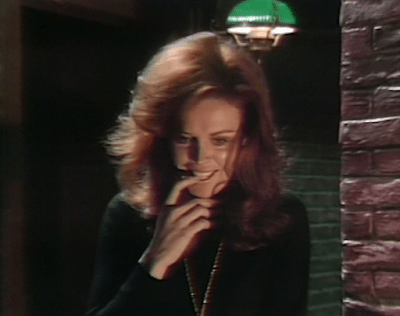
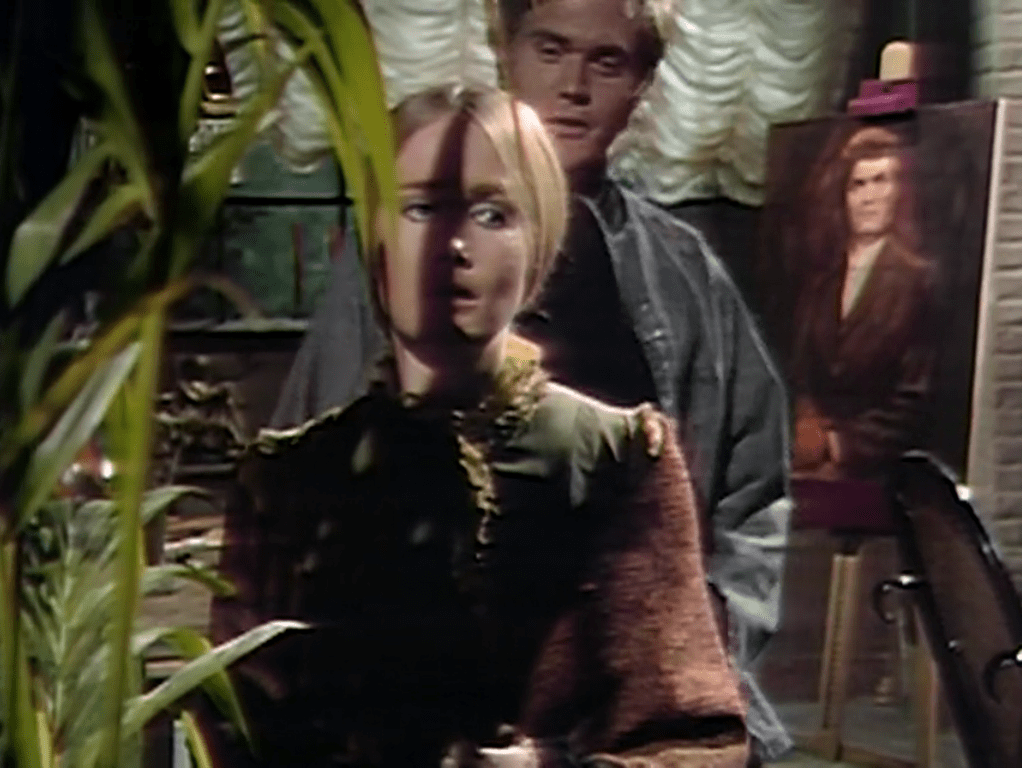
Like many episodes of Dark Shadows, this one ran long and ended with credits only for the cast and for Dan Curtis Productions. The entry on the Dark Shadows wiki says that the director was Lela Swift. I am sure that it was in fact directed by Henry Kaplan. This shot of Nancy Barrett as heiress Carolyn Collins Stoddard is proof positive:
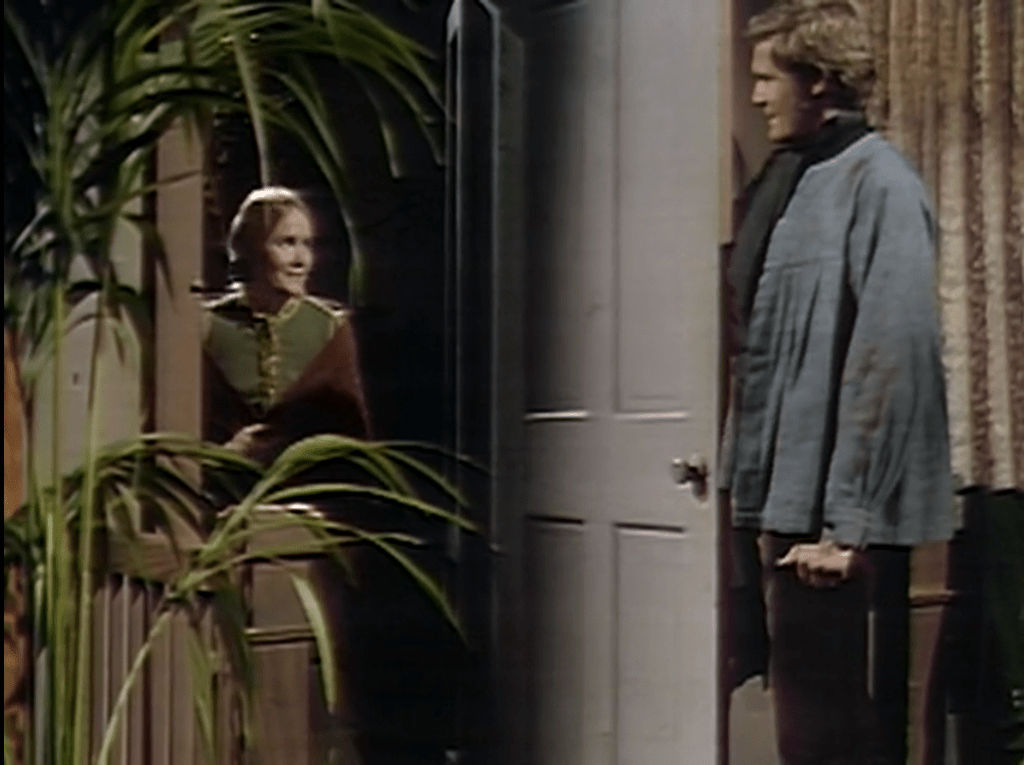
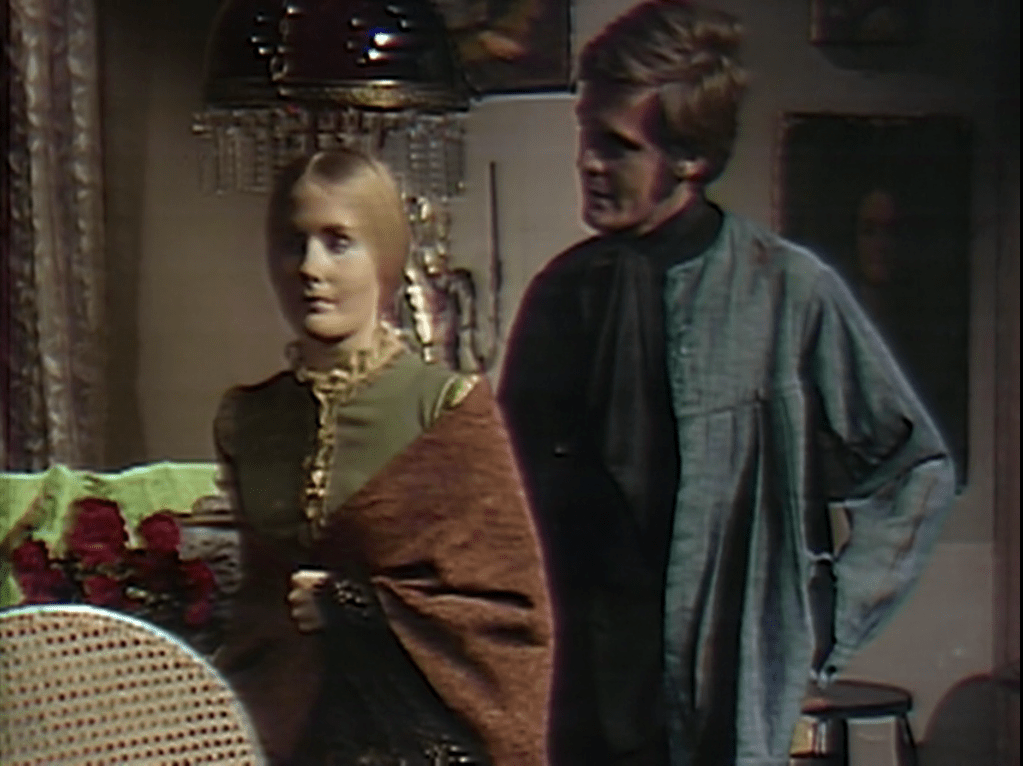
There is another flagrant Kaplanism in today’s first scene between antique shop owners Philip and Megan Todd (Christopher Bernau and Marie Wallace.) Philip enters from upstairs. He stops with his waist at the top of the frame. That’s where he stays for the first part of the scene, ending with Megan raising a paper that covers part of her face. Evidently what’s happening between the characters is none of the audience’s business.
Philip makes an entranceMegan interacts with Philip
Swift was a talented and ambitious visual artist, Kaplan a sloppy and unimaginative one. He relied heavily on closeups. When it dawned on him that it was dull to hold the frame just beyond the edges of an actor’s face, his response was to zoom in and give us an extreme closeup of some part of the actor’s face. It’s above average for him that the first shot above includes Miss Barrett’s eyes- he specialized in shots displaying the face from the nostrils down, and often held them even after the actors had to move, leaving us with the sight of an ear drifting out of our view.
Even when Kaplan’s tight little frames do not keep us from figuring out what is happening in a scene, they deprive us of the energy that comes from seeing the players interact with each other. We don’t get statements and reactions simultaneously, and we don’t see the actors using the space between them to tell us how the characters feel about each other. Kaplan was also a pretty bad director of actors, regularly poking them with a stick as his way of telling them he wanted them to play a scene differently and on one occasion fastening a handle to a child actor so that he could physically place him on his mark during rehearsal. So perhaps his mania for closeups reflected a lack of awareness of what actors do and how the choices they make contribute to the audience’s experience. As a result of his insensitivity to these and other visual aspects of the medium, Kaplan’s episodes would often be better suited to radio than to television.
Fortunately, the dialogue today is peppered with snappy lines. So Danny Horn devotes his post about the episode on his great Dark Shadows Every Dayto a selection of memorable pieces of dialogue. That also makes me suspect the wiki is not entirely correct. It attributes the script to Gordon Russell, an able writer overall but one who is not at all given to bons mots. I use bits of dialogue whenever possible as the titles of these posts, and I often have to search very hard through Russell’s to find suitable ones. It was Violet Welles who excelled at producing those. Russell and Welles often collaborated, so it could be that he wrote a draft to which she added the quotable quotes.
The current story centers on a mysterious cult that has sent time traveler Barnabas Collins back to 1969 from a long sojourn in 1897, by way of a couple of days in 1796. Under the influence of the cult, Barnabas is being a real jerk to his friend, mad scientist Julia Hoffman. Barnabas was a vampire for a long time, and even when he is free of the effects of that curse he habitually resorts to murder to solve his problems. But the victims of those murders are imaginary, played by actors who will go on to find other work, so we don’t usually stay mad at him for any length of time when he commits them. His friendship with Julia, on the other hand, is the emotional core of the show. Barnabas’ coldness to her in yesterday’s episode and today’s leads us to see what the cult is doing to him as the greatest crime anyone has ever committed on Dark Shadows.
Barnabas was a pop culture phenomenon familiar to many millions of people who never saw a single minute of Dark Shadows. The show’s fanbase largely consisted of his devoted followers. So a story about a cult which co-opts him as its leader and changes his personality so that he is impossible to get along with directly addresses a fear that must have blacked out the mind of Dan Curtis every time the postal service truck loaded with Jonathan Frid’s fan mail backed up at ABC Studio 16.
Barnabas brought a box with him from his visit to the eighteenth century, and it is of the utmost importance to the vast eternal plan the cult is working on that the box not be opened until the right time. So Barnabas put it on the mantel in his living room, and when Julia was standing a few inches from him he lifted it from the mantel and placed it on a table in the middle of the room. When she asked what it was, he became flustered and refused to answer any questions about it.
When Julia left the house, Barnabas left the room, with the front door unlocked and the box still on the table. Today, we open with Julia coming back in, hearing the sound of breathing coming from the box, finding its key on the table next to it, and placing the key in its lock. Barnabas comes in just in time to stop her opening it, but we can see that the cult probably could have chosen an agent with a better sense of operational security. Barnabas’ function in the story is to make messes that other people will have to clean up, so as soon as we heard that the box must not under any circumstances be opened we expected him to leave it where it would inevitably fall into the hands of someone bent on opening it, though it is a bit disappointing he has done so this quickly.
After he has taken the box from her, Barnabas berates Julia, orders her from his house, and tells her he owes her nothing. He abruptly sweetens up and tells her that he is only carrying on that way because of some kind of temporal jet lag. He reminds her that when she traveled back in time in September, she was very ill for a while; he suggests that his surly mood might be the result of the same shock that caused that reaction. About a minute after he starts on this new tack, just as Julia has started smiling again, a knock comes at the door. It is Carolyn.
We don’t know what effect the cult’s co-optation of him has had on Barnabas, but regular viewers know that characters on Dark Shadows are always acquiring one magical power and losing another. For the last few months of the 1897 segment, the show’s main villain was sorcerer Count Petofi. One of Petofi’s signature moves was to become aware of visitors shortly before they arrived. It could be that the writers have decided to give the cultified Barnabas that power, and that it was because Carolyn was on her way that he wanted to put Julia in a good mood.
That interpretation is supported by what follows. Carolyn is delighted to see Barnabas; she hadn’t known he was back from his trip to 1897. She hugs him and he smiles, a stark contrast to his icy reaction when Julia hugged him yesterday. She wants to talk about Chris Jennings, a young man she dated a few times and whom she has been told is dangerous. Julia and Barnabas have befriended Chris and know that he is a werewolf. Julia thinks she can somehow control Chris’ transformations, and she urges Carolyn to think well of him. Barnabas tells her to trust her instincts and to avoid Chris. He keeps telling her that she is too important to be allowed to come to harm. Later, he visits Carolyn in her home, the great house on the estate of Collinwood, and he keeps going on and on about how important she is and how confident he is about her future. He also gives her a silver pentagram, an amulet to ward off werewolves, and urges her to wear it at all times. He subsequently has another scene with Julia in his own house, and he is just as cold and dismissive as he was in the first scene, exploding at her for being “irrational.” Evidently the cult has plans for Carolyn, but not for Julia.
Julia bought a painting from the Todds the other day, and now they have received a telegram offering to buy it regardless of price. Julia goes to their shop and discusses the telegram with them. She believes that the telegram, which is signed “Corey,” may actually be from Quentin Collins, a distant cousin of Barnabas’ whom he befriended during his time in 1897 and who may have been immortalized by a magical portrait painted by the same artist responsible for the picture Julia bought. She tells the Todds that she is not certain she wants to part with the painting, but that she would very much like to meet “Mr Corey,” and that she believes others in town would also like to do so. She urges them to reply to the telegram with an invitation.
Barnabas stands over the box. We hear his thoughts as he mulls over his questions about it. He suddenly declares “It is time!” Then he goes to his chair and sits down. Evidently, it is time to take a load off.
Barnabas has a vision of one of the hooded figures who inducted him into the cult. The figure, a man named Oberon, addresses him as “Master” and tells him that he is to give the box to people who wake him by knocking at his door. There is a knocking, he does awaken, and he goes to the door.
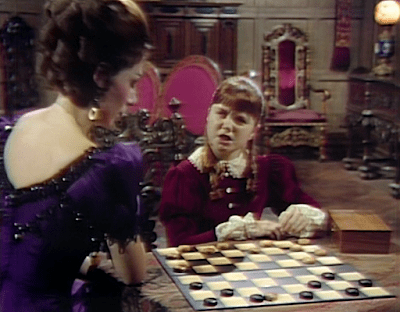
Nine year old Nora Collins enters the drawing room of the great house of Collinwood. She walks in on her father, the stuffy but lovable Edward, embracing Kitty Soames, the dowager countess of Hampshire. She gives them a dirty look and says she supposes Edward is too busy to join her in a game of checkers. He says he does have to run an errand, but suggests that Nora play with Kitty.
Kitty is eager to ingratiate herself with Nora, who clearly wants nothing to do with her. Nora asks, in an icy voice, if the reason Kitty wants to be her friend is that she is planning to marry her father. Returning viewers suspect she is right. Kitty and Edward have more in common than they know. Both are penniless, each is sure the other is very rich, and each imagines marriage to the other will solve all their problems. Kitty can’t very well level with Nora about this, so she claims that the women in the Collins family, being outnumbered by the men, have to stick together. Nora does not hide her distaste at Kitty’s inclusion of herself among the women of the family. Kitty asks Nora if she wants her father to be happy. Nora drills her eyes into Kitty’s face and says in a firm, flat voice “I want that.”
Nora asks Kitty if she is just letting her win at checkers. While she is asking this, Nora moves twice in one turn and takes three of Kitty’s pieces. Kitty watches this without protest and denies that she is letting her win. She then says she wants to concede the game and listen to whatever information Nora is willing to share about the family.
Edward comes back from his errand to find Nora packing up the checkers and the board. He asks if she enjoyed her game with Kitty. Not looking up, Nora says they never finished it. Kitty hastens back in and asks if she wants to finish it now. Edward points out that it is getting close to Nora’s bedtime. He kisses her, and bids her say goodnight to Lady Hampshire. Kitty asks Nora to call her by her first name. Nora pointedly says “Good night, Lady Hampshire.”
It doesn’t show in her scenes with Nora, but Kitty seems to be suffering from a severe mental health crisis. Returning viewers know that the ghost of Josette Collins is taking possession of her, and suspect that she will turn out to be a reincarnation of Josette. Edward knows enough about the supernatural doings on the estate of Collinwood that he might give Kitty the benefit of the doubt when, for example, she comes running in today and is shrieking about a haunted house, a vanishing woman, and a curse that follows her everywhere. But she is so often so highly distraught that Nora must have noticed that she is not right in the head, and she can hardly look forward to having such a person as a stepmother.
Shortly before Nora enters, Edward calls Kitty “Katie.” This is a small enough slip of the tongue, but Kathryn Leigh Scott’s friends call her Katie, so it is a case of an actor’s name in place of the character’s. I think I can see Louis Edmonds blush a little when he realizes what he has done.
This episode marks the final appearance of Nora, and very nearly the last time we will hear Nora’s name. I think she was badly underused, disappointingly so after the outstanding work Denise Nickerson did as Amy Jennings in the months leading up to the segment set in 1897. She will be back later, in other parts.
Director Henry Kaplan was not much of a visual artist, and his deficiencies are particularly glaring today. Especially during Kitty and Nora’s first scene, the camera keeps drifting up to the actors until we see a randomly selected two-thirds of their faces in extreme closeup. Once the shot excludes the eyes or the mouth, it abruptly pulls back. Even the successfully framed closeups are rarely in focus, and you can forget about finding coherent visual storytelling in any kind of shot other than a closeup. The actors themselves do a good job, in spite of Kaplan’s notoriously unpleasant behavior towards them, but aside from a few evocative facial expressions, most of them by Nickerson, it may as well have been a radio play.
The disastrously repressed Charity Trask knows that rakish libertine Quentin Collins is a werewolf, and she wants to warn everyone about him without actually saying the facts out loud. She corners maidservant Beth Chavez in the drawing room of the great house at Collinwood and urges Beth to end her romance with Quentin.
Charity keeps saying that there is something about Quentin that Beth does not know. In fact, Beth not only knows everything Charity does about Quentin’s curse, but a great deal more. She was the very first person to know that Quentin was a werewolf, before Quentin himself knew. She was with him the first time he transformed, and when he became human again in the morning she refused to tell him what she had seen. She had previously seen Quentin murder his wife Jenny, she knows that Jenny’s sister Magda placed the curse as vengeance for that murder, and she was the one who told Magda that Jenny had borne children to Quentin who would inherit their father’s curse. Beth is the foremost authority on Quentin’s condition. But she is protecting him anyway.
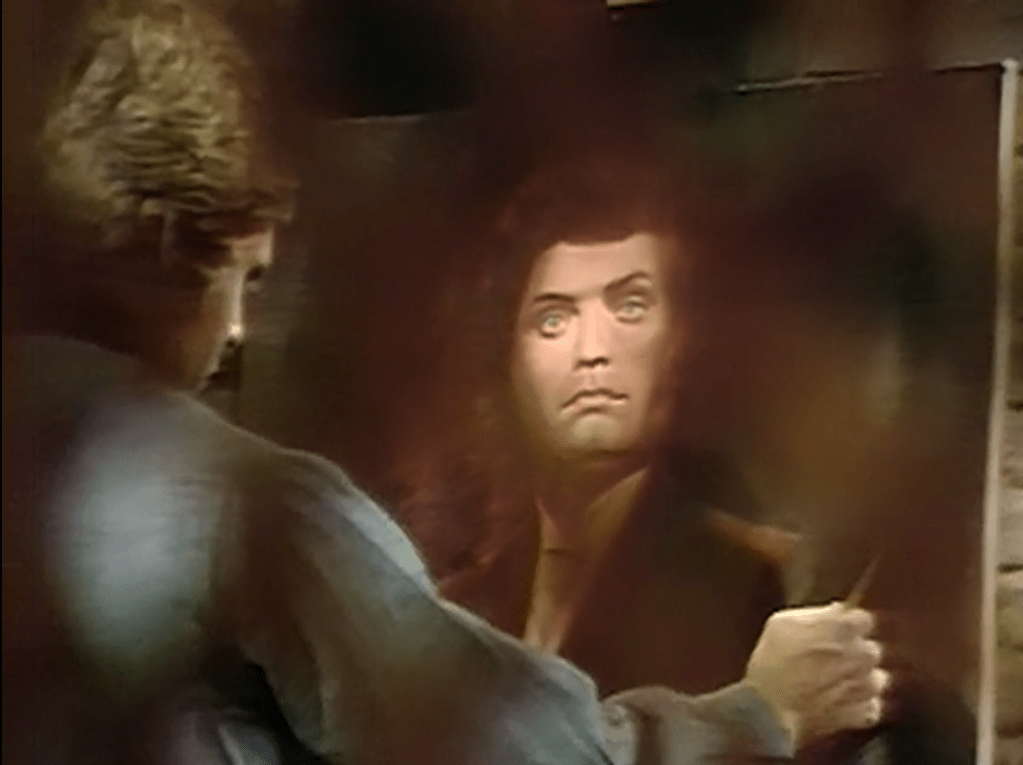
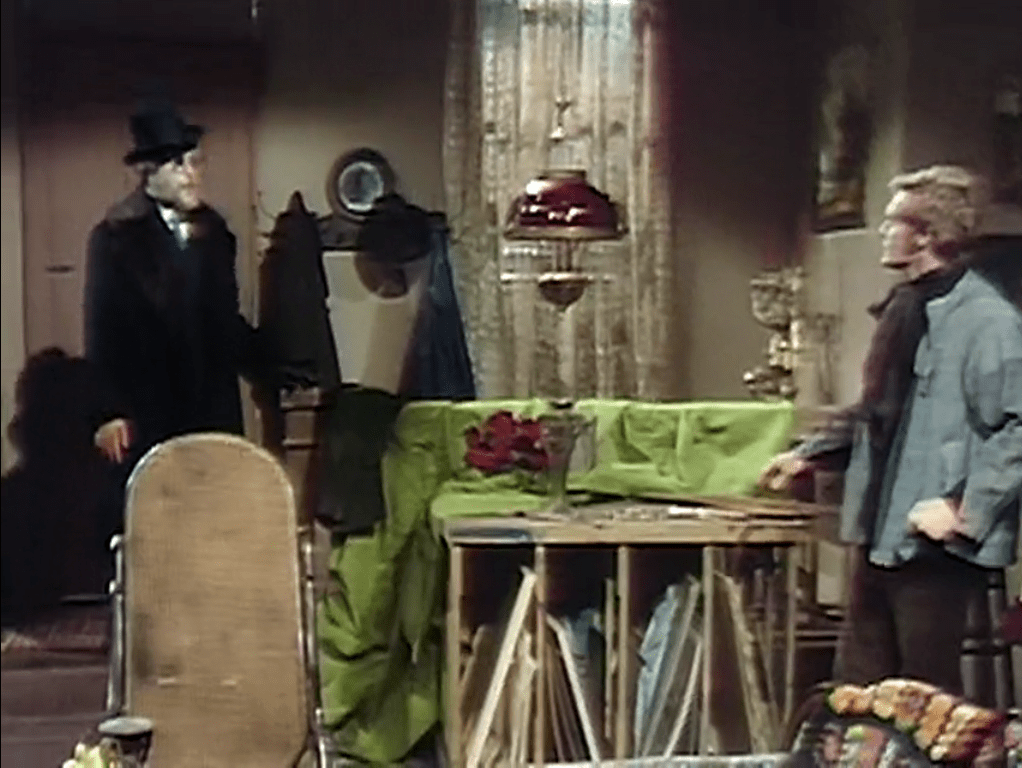
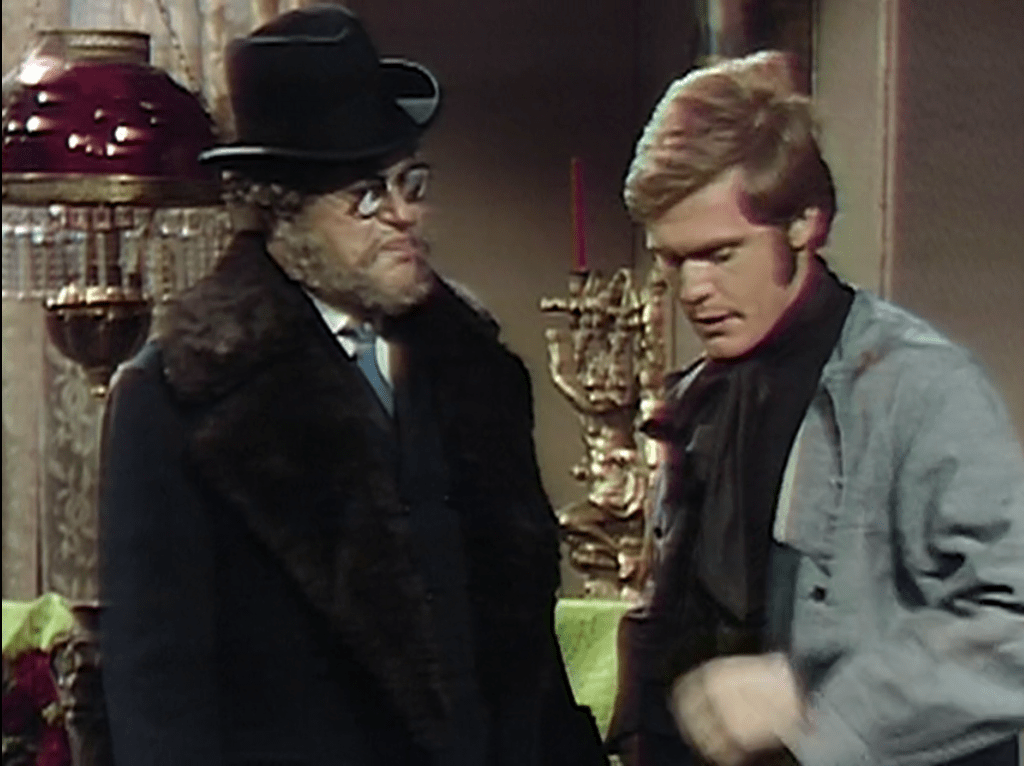
Charity then goes to a set known to longtime viewers as the Evans cottage. In the parts of Dark Shadows set between 1966 and 1968, this set is home to artist Sam Evans and his daughter Maggie, The Nicest Girl in Town. Today the dramatic date is 1897, but the cottage is already an artist’s studio. It is occupied by Charles Delaware Tate, a nationally renowned painter who was commanded by the evil sorcerer Count Petofi to execute Quentin’s portrait. When we first saw Tate in the cottage, he said that he rented it because he’d heard about it from a friend who had stayed there some time before.
The cottage is full of paintings and sculptures. This is odd for a rental. Several possible explanations come to mind. Did Tate bring a dozen or more of his own works to keep him company? Did his friend or other artists who had rented it leave their completed pieces behind? Did the landlords display their own collection there for the edification of their tenants? Easy as these explanations are to think of, none of them seems very likely, and the question is never addressed in the show. The out-of-universe explanation is of course that when the audience looks at an artist’s studio, it expects to see a lot of artwork, and the artwork here gives director Lela Swift a chance to make good use of color.
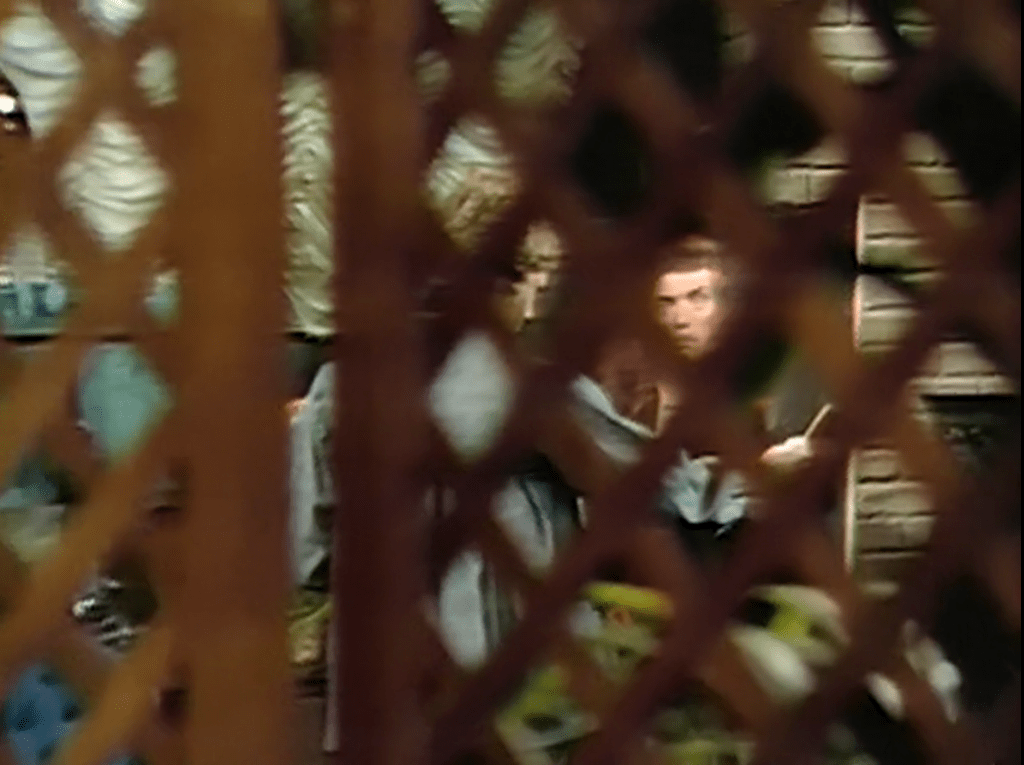
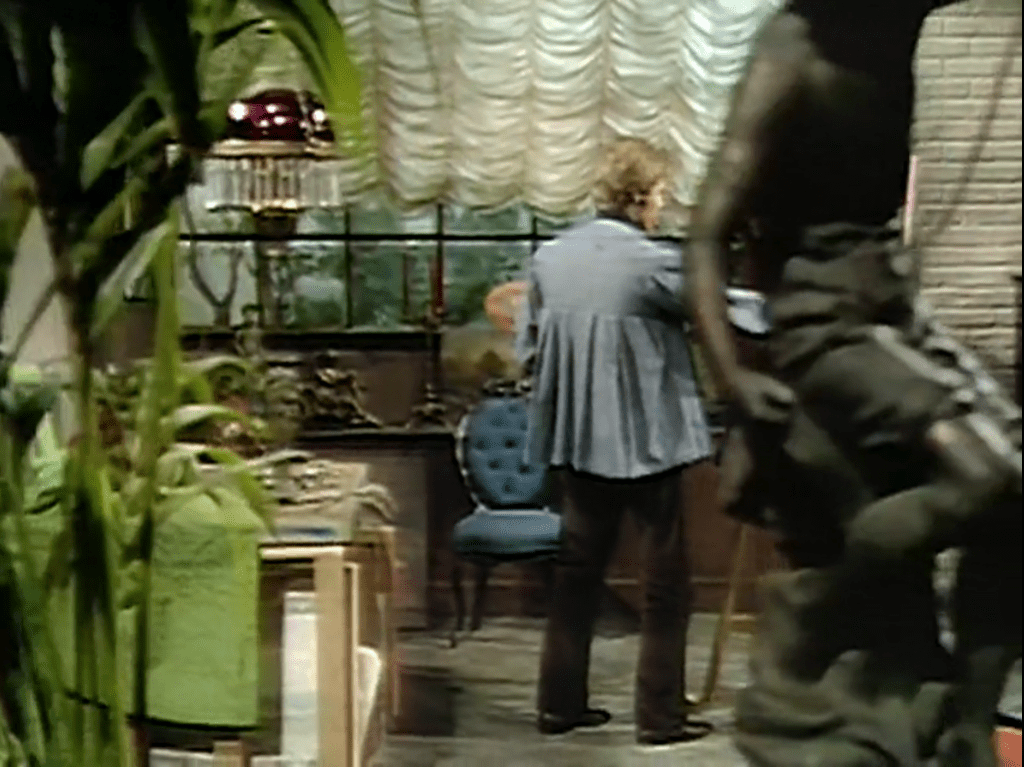
At any rate, the set is gorgeous today, full of bright greens and mixed reds. Swift was a highly ambitious visual artist, and she outdoes herself here. The first shot in the cottage begins with a closeup of the portrait of Quentin. It then pulls back further than any previous shot of this very familiar set, showing us a lattice that used to be part of the set representing the kitchen/ breakfast nook area at Collinwood. Behind it is a plant with some large, intensely green foliage. We then track around the set to see several sculpted pieces in black, paintings in a variety of tones, and a whole array of vivid colors in the furniture and other decorations. Dark Shadows has come a long way from the clumsiness that marked its use of color when it first switched from black and white in #295.
Charity is unaware that she and Tate are not alone. Tate’s master, Petofi, is in the next room eavesdropping. Charity is horrified to see the portrait of Quentin, and reminds Tate that she saw Quentin’s features in the portrait change into those of a wolf when she visited the cottage on the night of a full Moon. Tate tries to convince her she did not really see such a thing, but she will not have it. Charity gives Tate a warning somewhat less incoherent than the one she had given Beth. After she exits, Petofi and Tate talk. Tate had suspected Quentin was a werewolf, and now is sure. Petofi says that his plans for Quentin are none of Tate’s concern.
Petofi goes to the great house. Quentin confronts him there, demanding to know by what gods he swears. He replies “I have but one, and his name is Petofi!” Charity sees Petofi and vehemently demands he leave. I don’t know why she does this. As far as I can recall, Charity knows Petofi only as Victor Fenn-Gibbon, an honored guest of the Collins family. He did cast rather a nasty spell on her when he was using that alias, but I don’t see why she would realize that he was to blame for it, or for any of his other misdeeds.
Whatever the motive for Charity’s angry reaction to him, Petofi responds by magically robbing her of the power of speech. When he tells her that he has a healing touch, his manner and the background music indicate that after he touches her, what Charity will say will never again be up to her.
In 281 of the posts that follow, I link to comments I made on Danny Horn’s blog, “Dark Shadows Every Day.”
Not all of these comments were absolutely unique. Several times I brought up the contribution Lela Swift made to Dark Shadows. Swift directed 595 of the show’s 1225 episodes, including the first and last installments, and she also served as line producer of the last 127 episodes. Only series creator and executive producer Dan Curtis could be said to have had more impact on Dark Shadows than did Swift, and very few people could be said to have had as much.
Danny’s background, like mine, is in literary study. I know I have a tendency to overemphasize the writer’s contribution to a dramatic work at the expense of the director and other visual artists, and I think he does too. Many of my remarks about Swift reflected my conscious effort to overcome this bias of mine, and incidentally involved my disagreeing with him.
Here’s a comment I made about episode 299. In the original post, Danny argued that the writers must by that point have intended to present mad scientist Dr Julia Hoffman as suffering from unrequited love for vampire Barnabas Collins. Some posters in the comment thread pointed out the visual similarity between the scene from which Danny draws his evidence and a scene in The Sound of Music in which a love triangle is developed. I tried to make the point that these similarities are more to do with elements under the control of the director than of the writers. So, while there is a reason to think that there was an intention to tell that story, we can’t be sure exactly whose intention that was:
THE SOUND OF MUSIC was such a big hit, so fresh in people’s minds in 1967, and the way the actors are positioned on this new set looks so much like it that I can’t believe the resonance wasn’t intentional. I don’t know if that means that the Barnabas/ Vicki/ Julia love triangle was already intentional at this point on the part of the writers, but it is strong evidence that it was on the part of director Lela Swift.
In a comment on episode 1116, I say that the new burst of energy that many in the comment threads had found at the beginning of the segment of the show set in the year 1840 came just as Swift was made producer, and suggest that she may deserve credit for it.
In a comment on episode 1166, I rebut one of her detractors:
“If Lela had been the executive producer, Dark Shadows would have been off the air after the first 13 weeks.” Perhaps so. But without her as the principal director, it’s doubtful there would have been a single episode anyone would have remembered. The endlessly ambitious visual compositions and the hyper-intense acting style originated with her, and she had as much as anyone to do with the fact that there was always an episode in the can ready to go on the air at 4 PM five days a week.
In a comment on episode 1244, I compare Swift to the only other director on Dark Shadows in its dying days, the woefully inept Henry Kaplan:
This episode and the one before also show that, even though television is famously Not A Director’s Medium, a director can have great importance from time to time. Episode 1243 was really rather good, and that is entirely to the credit of Lela Swift. The pacing is rapid, the visual composition tells as much of the story as we could want it to do, and she elicits good performances from all the actors, even Keith Prentice.
In this one, Henry Kaplan keeps moving the actors around in tight little spaces, with the result that they have to shuffle from one set of marks to another. Even worse, he indulges himself in a series of dissolves, each of which would probably have looked cluttered and been distracting under the best of circumstances, but with the camera faults in this episode it’s as if the TV screen is at the bottom of a pond. Poor Keith Prentice, finally doing a good job of acting for a second consecutive episode, winds up looking like the world’s biggest idiot when a closeup of him laughing in wicked triumph dissolves to a shot of the cobwebbed room.