Gallant gentleman Barnabas Collins discovered that his wife, Angelique, was a wicked witch and a deadly threat to his true love, the gracious Josette. He did not tell anyone what he knew about Angelique, but did persuade Josette to flee. Today, Angelique discovers that Josette is beyond the range of her powers.
In her rage, Angelique takes a doll belonging to Barnabas’ little sister Sarah. She sticks pins in it; Barnabas has learned that this causes Sarah to become ill. Angelique is about to stick a pin into the doll’s heart when Barnabas takes a dueling pistol and shoots Angelique.
Angelique drops the doll; Barnabas takes the pins from it. Angelique presses her hand to her shoulder while delivering a long, bombastic speech. Barnabas has plenty of time to reload the pistol and shoot her again, but chooses just to stand there and listen to her. This turns out to be a bad decision when she ends the speech by placing a curse on him. He will spend all eternity unable to rest, and everyone who loves him will die. Having completed her death scene, she ostentatiously collapses.
We hear a window smashing. A bat appears. It approaches Barnabas. He yells at it, flails his arms, and walks backward. This is an echo of #330, which ended with strange and troubled boy David Collins reacting the same way when the same puppet appeared in his bedroom. David was a neurotic and isolated pre-teen who had been through a lot of trauma, so that was an effective scene. Barnabas is a grown man who has been trying to function as an action hero. Seeing him as the equivalent of a cartoon lady standing on a chair screaming because she saw a mouse rather undercuts this. Anyway, the bat bites Barnabas on the neck, so now he’s going to be a vampire.
The bite. Not Barnabas’ cloak in the background, playing the role of The Grim Reaper. Screenshot by Dark Shadows Before I Die.
In #330, it was Barnabas who sent the bat against David. This is one of many indications that the vampire Barnabas we knew from April to November of 1967 was not only under Angelique’s curse, but that he was in some sense a manifestation of Angelique. Maybe when she casts a spell, she breaks off a chunk of herself and that chunk goes about the world pursuing its own objectives. The image of a supernatural being as a complex of vaguely related but independent phenomena has been standard in Dark Shadows since undead fire witch Laura Murdoch Collins first appeared on the show in December of 1966, so regular viewers are prepared to learn that the vampiric Barnabas is a subcategory of the syndrome known as “Angelique.”
This episode explains how a couple of the more important props got to be in the places we are used to seeing them. Early in the episode, Barnabas gives Josette a music box. This music box figured heavily in the story from May to August 1967 as a symbol of Josette and as a vehicle for some kind of magic spell that was supposed to turn other people into her. A bit later, we see that Barnabas has hung the portrait of Josette over the mantle in the front parlor of the Old House. It was there when we first saw the Old House in #70, and was the focus of all supernatural phenomena on the show from then until Barnabas reclaimed the Old House in #212.
Well-meaning governess Vicki is in jail, about to be tried on a capital charge of witchcraft. That couldn’t happen in the New England that existed in 1795 in our timeband, but many things were possible in the world of Dark Shadows that we don’t see in ours.
Gallant gentleman Barnabas Collins has figured out that Vicki is innocent and that the real witch is his new wife, Angelique. Rather than go to the authorities with his evidence, he decides to take a more direct approach and murder Angelique. That won’t be much use to Vicki, but Barnabas can’t be bothered with details.
The longest sequence of the episode is a farce in which Barnabas pours two glasses of sherry, puts poison in the one he then gives Angelique, and tries to get her to drink. They don’t do “the old switcheroo” and mix up the glasses, but instead go with an equally hoary device of having Barnabas’ mother show up and take Angelique’s glass. Barnabas has to claim the glass is cracked and knock it from her hand.
After the failure of his attempt to poison Angelique, Barnabas opens a hidden compartment of his desk and takes out a dagger. If it weren’t for Robert Cobert’s solemn musical score, the effect would be that of seeing Wile E. Coyote open yet another crate from the Acme Corporation. He goes up to Angelique’s bedroom and lifts the dagger. Since there has been no indication that she has got into her bed, and all we see on it are a lump of covers, the audience has no reason to suppose she is in there. We end with the distinct impression that Barnabas, having barely avoided matricide, is stabbing a mattress.
We first knew Barnabas in the year 1967, when he will be a vampire and will develop from a profoundly bleak presence and an urgent threat to our favorite characters into a comic villain for whom we can’t help but feel a kind of affection as we watch him fail again and again in his elaborate schemes. In that way, his maladroit attempts on Angelique’s life today are entirely typical of the Barnabas we had met before Vicki traveled back in time in November.
In another way, this episode represents one of the biggest retcons in the whole series. Throughout his first eight months on the show, Barnabas nursed a bitter hatred for his uncle Jeremiah Collins. In the first weeks of the 1795 segment, we saw that Jeremiah eloped with Barnabas’ beloved fiancée, the gracious Josette, and that Barnabas responded to this betrayal by killing Jeremiah in a duel. When Barnabas is talking today about Angelique’s black magic, he realizes that Jeremiah and Josette ran off together only because they were under a spell, and that neither was responsible for betraying him. He has no hostility left for Jeremiah.
In the various accounts the vampire Barnabas gave in 1967 of his last years as a living being, he never mentioned Angelique. Nor did he ever say that he, Josette, or Jeremiah had been the victim of witchcraft. Instead, he had indicated that he himself had gotten involved in black magic. In #345, he told his sometime friend, mad scientist Julia Hoffman, that he became a vampire after trying to gain eternal youth, and that Josette killed herself when he offered her that eternal youth. In #358, he uses “the secret magic number of the universe,” which he had learned while studying witchcraft under a warlock on Barbados, to torment Julia. The Barnabas we met when we came to 1795 hadn’t done any of that. Until he learned the truth about Angelique, Barnabas was a man of the Enlightenment and didn’t believe that witches even existed.
Perhaps this is a change Vicki’s arrival and her bizarre behavior have wrought. The stories Barnabas tells in #345 and #358 both took place years after Josette and Jeremiah were married. So perhaps in the original timeline, with no one around yammering about what the first 73 weeks of the show were like, events moved much more slowly. The change of loves took place gradually enough that Barnabas did not feel he had to challenge Jeremiah to a duel, but he was still full of hatred and resentment. Angelique was able to cover her tracks so that no one suspected witchcraft was underway. She gradually lured Barnabas into the occult arts, perhaps giving up the idea of marrying him at some point, certainly losing his attention. By the time he brought the vampire curse on himself, the version of Barnabas in that timeline would have forgotten Angelique and would have come to be consumed by his grievance against Jeremiah. That fits far better with the April-November 1967 Barnabas than does the character we have seen so far in 1795.
Barnabas asks a key question in this episode. When Angelique says that she will always love him, he asks her what she thinks love is. She answers “Why of course I do!,” which probably means that the script called for him to ask if she knew what love was, but “What do you think love is, Angelique?” is a better question. She’s been destroying every relationship that makes him the man he is in order to have him all to herself, suggesting that if Barnabas pressed Angelique to explain what love is, she would wind up saying that it means having total control over someone. As a vampire, that’s going to be Barnabas’ working definition too, suggesting that he will be more like Angelique then than he already is now.
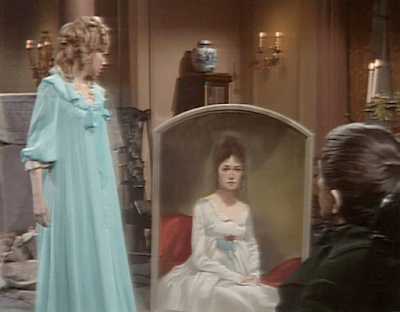
In this episode, the portrait of Josette is delivered to Barnabas’ home, the Old House on the estate of Collinwood. This portrait, haunted by Josette’s ghost, was the dominant presence in the Old House from its first appearance in #70 until Barnabas moved back in there in #221, and was important as a symbol of Barnabas’ obsession with Josette thereafter. The makers of the show left it on the wall of Josette’s bedroom at the beginning of the 1795 segment; we see it there in #374, but they replace it with a different portrait in #377. It’s hard to understand why it would already have been there before Josette formally became a member of the family- perhaps it was just a slip-up that it was there in #374, and they’d always planned to show its arrival at Collinwood.
At the top of the episode, much-put-upon servant Ben is locked in a barred cell in the basement of the great house of Collinwood. Haughty overlord Joshua Collins and his family just moved into the house a week or two ago, and parts of it are still under construction. Evidently the basement cells are an essential part of any well-appointed home in the area, and had to be among the first amenities installed.
Until November of 1967, Dark Shadows was set in contemporary times, largely in this house. We saw the basement several times, but never had any indication that there were prison cells there. The old manor house had a cell in its basement, and in June 1967 vampire Barnabas Collins kept the lovable Maggie Evans prisoner in that cell. Maggie escaped when the ghost of Barnabas’ little sister Sarah appeared to her in #260 and told her a riddle that pointed to a secret passage out of it. Sarah told Maggie that her father had forbidden her to tell anyone about the passage, and that even Barnabas doesn’t know about it.
Joshua is Sarah and Barnabas’ father, so when he, they, and their mother Naomi moved out of the Old House in #393 without any reference to the cell downstairs we wondered if the show had decided to retcon away Sarah’s knowledge of it. The first indication that there were not going to do this came in #399, when Sarah visited her sometime governess, Vicki. Vicki had been accused of witchcraft and was hiding in the Old House as the guest of Barnabas, who is at this time alive and gallant. During their conversation, Vicki needs a place to hide while the house is being searched, and Sarah leads her to a room upstairs that Sarah says “everyone else has forgotten about- even Barnabas.” That Sarah knows parts of the house that are secret even from Barnabas is an unmistakable reference to #260, and shows that her knowledge was not a postmortem development. When we see today that Joshua has installed a cell in the basement of the new house, it is confirmed for us that there is one in the basement of the Old House as well.
Dark Shadows is set in and near the fictional town of Collinsport, Maine. This segment of the show takes place in 1795, when Maine was part of Massachusetts. Slavery was abolished in Massachusetts in the early 1780s, at which point the Old House would have been in use for many years. It is never made clear whether the Collinses held any African or indigenous people as slaves, but indentured servants like Ben were subject to beatings and confinement at the command of those who had purchased their labor. Their obligation was limited to a term of years and was not passed on to their offspring, unlike the status of slavery, but the treatment Joshua routinely metes out to Ben makes it clear that he was accustomed to regarding humans as his property. So it is hardly surprising that he maintains a dungeon to which he confines members of his household establishment who have displeased him.
Vicki has been caught and is now a prisoner in Collinsport’s public jail. Barnabas meets her there. He has come to suspect that his new wife, Angelique, is the real witch. During their visit, Vicki makes some remarks which convince him that this is so.
Barnabas believes that Angelique has put a spell on Ben to force him to do her bidding. The audience knows that this is correct. He finds Ben hiding in a fishing shack on the Collins family property. Angelique’s spell prevents Ben from speaking her name, but he does manage to draw her initial in the dust on a barrel top when Barnabas asks him to indicate the real witch’s name.
We spent a fair bit of time in the fishing shack in February and March of 1967. It was introduced in #173 as a favorite haunt of strange and troubled boy David Collins, and in #191 David’s mother, undead fire witch Laura Murdoch Collins, tried to burn him to death in the flames which destroyed the shack. There was a clear echo of #191 at the moment when Vicki was captured in Friday’s episode, and the return of the fishing shack today amplifies that echo for regular viewers. Today’s script is credited to Ron Sproat, the only writer from those days who was still with the show at this point. Sproat would have remembered that #191 marked the end of the first version of Dark Shadows, and would have known that by invoking it he would be telling regular viewers that the events taking place in these episodes are going to have major consequences for the show.
Sproat’s script is clean and direct, one of his best contributions. Lela Swift’s direction is typically crisp and tight. But what really elevates this episode is Jonathan Frid’s performance. Barnabas is alternately transparent and opaque. In the first scene he is open with Ben about his doubts concerning Vicki and Angelique. In the second he talks with Joshua and holds back all the most important information. In the third he is open with Vicki about his problems with her story. In the last, he knows exactly what he wants from Ben, and gets it by deceiving him about his attitude towards Vicki and Angelique. Whether Barnabas is showing his mental processes or hiding them, he is equally fascinating. In the transparent scenes, he draws us into his struggle to choose between two apparently impossible alternatives, and in his guarded ones he prompts us to try to discern his hidden thoughts. It’s a wonderful job, and well worth seeing.
Danny Horn’s post about this episode on his Dark Shadows Every Day is an essay about the similarities between Angelique on Dark Shadows and Samantha on Bewitched. He provides such an extensive and detailed list that there can be no doubt that the connection was intentional and that the audience was supposed to recognize it. I’m not sure what the makers of Dark Shadows wanted us to think when they drew so heavily on that popular prime-time show; in tone, Bewitched was light and silly, Dark Shadows absurdly serious, so I guess it could have been whatever the opposite of satire is. Or the reference to Bewitched could be a sign to the audience that Angelique’s relationship with Barnabas, horribly and all-consumingly destructive as it is now, might eventually settle into something that will run for years and years, as that show already had.
It is 1795. In the foyer of the great house of Collinwood, young gentleman Barnabas Collins stands on the staircase, his father Joshua stands on the floor. Joshua forbids Barnabas to marry lady’s maid Angelique on pain of disinheritance; when Barnabas declares he will marry her anyway, Joshua announces that they are no longer father and son.
In 1967, Barnabas will return to Collinwood as a vampire. In that year, in episode #214, he will take well-meaning governess Vicki on a guided tour of the foyer of the old manor house, indicate the staircase there, and say that “On these stairs, a father and son hurled words at each other, words that would lead to the death of the son.” He will then begin laughing maniacally and repeat the words “The death!,” seeing the desperate irony of referring to his own death in the past tense.
By today’s episode, the Collinses have moved out of the old manor house without any shocking scenes between Barnabas and Joshua playing out on the stairs there. That isn’t so surprising- that one remark eight months ago was the only reference to the stairs as the site of a fateful quarrel between Barnabas and Joshua, and the writer responsible for that day’s script, Malcolm Marmorstein, has been gone and forgotten since August. Neither today’s screenwriter, Gordon Russell, nor his colleague, Sam Hall, was with the show when Barnabas gave that speech to Vicki, and the third member of the writing staff, Ron Sproat, has been in the background for most of the 1795 segment so far.
But they do go out of their way to put Barnabas on the stairs of the new house for his showdown with Joshua today. It seems likely that they are hoping that at least some viewers will remember Barnabas’ remark in #214 and look for a significance in the connection. They did that sort of thing all the time in the early months of the show. For example, when they were developing a murder mystery about the death of beloved local man Bill Malloy in the last four months of 1966, they would show us a clock face in one episode, then weeks later have a character lie about the time established by that clock. Sproat more or less put a stop to those kinds of wild over-estimations of the audience’s attention span when he joined the writing staff near the end of 1966, but ever since the vampire story began in April of 1967 they had acquired obsessive fans who sent letters and gathered outside the studio. So they do have a reason to try to close the loop on a very long and very slender thread. What might the significance be of this particular nod to Barnabas’ first days on the show?
The 1795 segment began when the ghost of Barnabas’ little sister Sarah took possession of Vicki at a séance in #365, announced she wanted to “tell the story from the beginning,” and hurled Vicki back to her own time as a living being. But it is not simply a flashback explaining what made Barnabas a vampire. Vicki has completely failed to adapt to her new environment, and as a result has made significant changes to the timeline. She is now in hiding, suspected of witchcraft because of her endless stream of bizarre words and actions.
In fact, there is a witch at Collinwood. It is Angelique. Presumably, the first time these events took place Angelique pinned responsibility for her crimes on Sarah’s proper governess, Phyllis Wick. We caught a glimpse of Phyllis in #365; we could tell, not only that she was indigenous to the eighteenth century, but that she was quite cautious about anything that might suggest the paranormal. It would have taken Angelique some time and effort to set Phyllis up as a patsy, while Vicki volunteered for the role without any action at all on Angelique’s part. So maybe Vicki has speeded everything up. Maybe the family was still in the Old House when Joshua disowned Barnabas in the original sequence of events, but Vicki’s blunderings have accelerated matters so that they moved out before the conflict between them came to a head.
There is another puzzle about the writers’ intentions in this episode. It is established that without his inheritance or his position in the family business, Barnabas will be in a most parlous state. In separate scenes, both Barnabas and Joshua talk about the impossibility of Barnabas finding a job in Collinsport. Barnabas tells Angelique they will have to go at least as far as Boston before they can find anyone who will risk Joshua’s displeasure by hiring him. Later, Joshua tells Naomi that Barnabas won’t even be able to reach Boston- he doesn’t have enough money and won’t be able to get enough credit to stay in an inn, and he has no friends who will so much as put him up for a night if they know he doesn’t have an inheritance coming.
Barnabas’ mother, Naomi, has a solution to his financial problems. She gives him the Old House. The Old House is supposed to be a huge mansion, which it takes a very substantial income to maintain. How a man who can’t even afford a room for the night is going to meet those expenses is not made clear.
The frustrating thing about this is that they dwell at such length about the hard realities of dollars and cents immediately before, and then again after, Naomi makes her gift. By the laws of Soap Opera Land, a character who possesses a symbol of wealth such as a mansion does not need an income. We can accept that convention, and do in the 1967 segment, when a moneyless Barnabas occupies the Old House and can pay for all sorts of expensive things. But today they keep rubbing our faces in the implausibility of it.
My wife, Mrs Acilius, suggested they could have presented both themes if they’d dealt with the realistic financial problems in one episode and in a subsequent episode had gone back to the fantasy world. Maybe Joshua disinherits Barnabas on a Friday, he worries about getting a job on Monday, Tuesday we watch someone try to introduce Vicki to the concept of “lying,” Wednesday we see caddish naval officer Nathan woo feather-headed heiress Millicent, Thursday much-put-upon servant Ben Stokes tries to escape from the spell with which Angelique controls him, and then comes another Friday, when Naomi waves her magic wand and gives Barnabas the house. But as it stands, Barnabas talks to Angelique about how they have to go hundreds of miles to eke out a bare subsistence, Joshua talks to Naomi about Barnabas’ impending poverty, and then all of a sudden they remember that none of that matters, sorry sorry we shouldn’t have bothered you with it.
There were times in 1966 and 1967 when Dark Shadows only had one viable storyline, and no readily apparent means of starting others. But now they have several stories in progress, and an abundance of lively characters with whom they can make as many more as they like. There is no need for events in any one plot-line to move so quickly that incompatible themes crash into each other with such an unfortunate result.
Naomi’s gift to Barnabas was legally impossible in 1795. Until 1821, Maine was part of Massachusetts, and married women could not own property in Massachusetts until 1822. Maine did not pass its own Married Women’s Property Act until 1844. The show never brings this up, so it isn’t the same kind of problem as Barnabas’ lack of income.
Still, it does represent a missed opportunity. If Naomi’s family of origin had owned the house, they might have placed it in a trust over which she would have enough influence to deliver it to her son against her husband’s wishes. In fact, the show never makes the slightest allusion to where Naomi came from. If they’d given her relatives of her own, she would have had potential allies in a clash with Joshua and potential goals to pursue independently of him. As it stands, they have put her firmly in his shadow, so that the category of possible stories about Naomi is a subset of stories about Joshua. That’s a sad situation for a character who is capable of the dynamism she shows today, and a criminal waste of the talents of an actress as accomplished as Joan Bennett.
In 2021, I left a comment on Danny Horn’s blog post about episode 256. I found great significance in the introduction of the ghost of ten year old Sarah Collins:
I’d say Sarah’s introduction is the single most important moment in the whole show, more important than Barnabas coming out of the box, more important even than Barnabas’ first decision not to kill Julia.
From the beginning they’d been playing with the idea that there was another cast of characters hidden behind the characters we’ve been watching, supernatural characters who can make their influence felt at certain moments. The most prominent of these was the ghost of Josette. This ghost is a serene, distant, imperturbable. When her ghost and the ghosts of the widows rescue Vicki from Matthew in 126, there is an amused smile in Josette’s voice, the sound of someone for whom nothing very important is at stake in the affairs of this world.
When David sees Maggie in Josette’s clothes and mistakes her for the ghost of Josette in 240 and 241, it is clear that if the ghost of Josette returns, it will not be in that mode. After that sight, Josette’s ghost can return only as a terrifying spirit of vengeance. And David’s confrontation with Willie in 253 makes it clear that the protecting ghost will not return at all.
So the show has discarded the old supernatural realm of Josette and the widows, a realm that was, as you say, never more than slightly accessible. With Sarah’s appearance, we are introduced to an entirely new part of the show. Once again we have a set of characters hidden in the supernatural background, but they can interact with the characters from the main continuity more directly and at greater length than Josette and the widows ever could.
The puzzle of Sarah’s connection to Barnabas, and her talk about looking for the members of her family, indicates that this new order of supernatural beings have complex and unsettled relationships with each other, and that characters from the main continuity can have an influence on those relationships. We will have to figure those relationships out in the weeks and months to come, but as soon as Sarah demands Maggie not tell her big brother that she saw her, we know that they might come to enmesh the living beings. Every scene with Sarah, then, is a step leading directly to the time-travel and parallel universe storylines that will come to define the show.
By the end of last week, Dark Shadows had, for the second time in its 73 weeks on the air, run out of stories to tell. When Dark Shadows 1.0 ended with the disappearance of blonde fire witch Laura Murdoch Collins in #191 and #192, the way forward was clear- introduce another supernatural menace to succeed Laura. That came in the form of vampire Barnabas Collins. As people tuned in to see how a daily soap opera could fit a vampire into its pattern, Dark Shadows 2.0 became a bona fide hit and a major pop culture phenomenon.
The first version of the show came to an end because none of the non-Laura stories ever really took off and the only danger Laura presented was that she would incinerate her son David when she herself vanished in flames. Once that was prevented, her threat profile was closed and the show needed to start over.
The second version crackled along quite well for months. It’s true that a number of the storylines had reached their natural conclusions, but they made little to no effort to replace them. On the contrary, they went out of their way to close off possible narrative directions. While even the slowest parts of Dark Shadows 1.0 left us guessing what might come next, the final weeks of Dark Shadows 2.0 present us with nothing but a series of blank walls. The first time I saw the show, I watched #365 without a single idea as to what they could do in #366.
What they actually do is to launch Dark Shadows 3.0 by flipping the back-world of the dead past into the foreground, while the characters and events of 1967 are thrust behind the action into a realm only we and Vicki know anything about. Indeed, it is Sarah who executes the switch.
We had a glimpse of what that might look like in #280, when Barnabas hosted a party in the Old House on the estate of Collinwood, restored in an eighteenth century style, to which the living members of the Collins family came dressed as their ancestors of that period. In Friday’s episode, we saw a séance in the great house on the estate on a dark and stormy night. Sarah spoke through well-meaning governess Vicki and said she would “tell the story from the beginning.” At that, Vicki vanished from the table, her eighteenth century counterpart Phyllis Wick appeared in her place, and Vicki found herself outside the Old House on a sunny day in the year 1795. Today, she meets the living versions of Barnabas and Sarah, as well as some of those who were impersonated at Barnabas’ costume party.
The first person Vicki meets in 1795 is Barnabas. She has spent a great deal of time with him in 1967, so she assumes he is just in costume. He is startled by her clothing- she is still dressed as she was at the séance. He assures her they have never met, and when she keeps insisting they have he begins to suspect that she is insane.
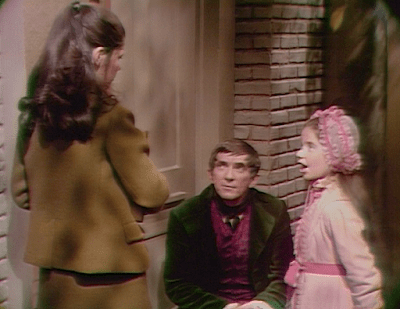
Sarah meets them and declares that Vicki is her new governess. Evidently she had some kind of premonition as to what her new governess would look like, and Vicki meets the description. Barnabas brightens and asks Vicki if she is a governess. She acknowledges that she is. Before she can explain that she is governess to a boy who won’t be born for 160 years, he ushers her into the house.
The writers faced a thorny problem with this segment of the series. Vicki has spent a great deal of time with Barnabas and has seen Sarah, so she must recognize them. On the other hand, most of the rest of the people she meets in 1795 will be played by the actors who have played characters she knew in 1966 and 1967. When Victoria is alone in the front parlor of the house, we find out how they have decided to handle this situation. Joel Crothers, who in the contemporary segment of Dark Shadows played hardworking young fisherman Joe Haskell, enters in the character of bon vivant naval officer Nathan Forbes. Vicki throws herself in his arms and gushes about how happy she is to see him. Nathan is quite happy to see her, since she is a remarkably beautiful young woman and extremely friendly, but he is puzzled that she insists on calling him Joe.
The scene between Nathan and Vicki is pretty funny, and it’s understandable that Vicki would react as she does. But it’s also ominous. When we see actors at work, we may remember other parts they have played, but we don’t expect their scene-mates to bring them up. They are just supposed to accept them as whoever they are supposed to be at that moment. When Joan Bennett enters, not as twentieth-century matriarch Elizabeth Collins Stoddard, but as Liz’ ancestor Naomi Collins, we wonder how Vicki will react to her. Indeed, she does slow things down with a lot of wailing about how she can’t believe she isn’t Mrs Stoddard, a person of whom Naomi has never heard. It then dawns on us that every time Vicki meets anyone, she’s going to drag us through this same business where she mistakes them for another character the actor has played. That’s going to annoy us and make the other characters think she is deranged.
One of the reasons Vicki’s yelling about the cast’s resumes annoys us so much is that we all know how to look at the various characters an actor has played and see how they illuminate each other. We don’t need her to tell us to do that. Academics put that into a category of practices called “iconography,” which is shorthand for the idea that we remember what we’ve seen more than once in various kinds of movies and shows and notice when we see it again.
As Liz, Joan Bennett was the sort of imposing matriarch she often played as a major star of feature films and the Broadway stage. Virtually every event we saw in the first 25 weeks of Dark Shadows had its origins in Liz’ reactions to the events around her, and she was still the single most powerful figure in the whole gallery of characters for 30 weeks after that, right up to the death of seagoing con man Jason McGuire in #275. Everyone else was dependent on her, in one way or another.
Naomi is the lady of the manor in 1795, as Liz is in the 1960s. But we quickly learn that she is at the opposite extreme from her descendant. When invitations come for Barnabas’ upcoming wedding, she asks Nathan to read them to her. While Liz dominates the family and the town from her desk, Naomi is entirely illiterate.
This is something of an anachronism. Colonial New England was founded by Puritans who thought everyone ought to read the Bible, and so provided elementary schooling for all children, boys and girls. Scholars estimate that by the end of the eighteenth century, over 90 percent of men and about half of women in that region would have been able to read the Bible easily. A woman as wealthy as Naomi would certainly have had this ability, and the basic literacy which Naomi lacks would have been a rarity at any level of society. Perhaps the writers and producers of Dark Shadows were unaware of this history. Perhaps they are suggesting that she, like her son’s fiancée Josette DuPrés, came from some part of the world that valued literacy less highly than did New England. In any case, they do show us how severely disadvantaged she is in any disagreement with the men in her life, and how narrowly the bounds of her activities are circumscribed.
Barnabas comes back with the news that the carriage bringing Sarah’s governess overturned. The governess herself is missing from the scene of the accident; the other three people aboard were killed. When Phyllis Wick appeared in Vicki’s place at the séance, she did indeed say that she had just been in a carriage wreck, so this news will not come as a complete surprise to returning viewers.
This brings up a question and points to a missed opportunity. The question is whether Phyllis’ carriage had overturned in the original course of events. If so, perhaps she was killed along with the other three, and Sarah never did get a new governess. If not, then Sarah’s ghost killed three people when she sent Vicki back in time. Sarah has always been nice to people we liked, and has declared her allegiance to goodness. But she is also pretty clumsy, so she might have killed them inadvertently.
The missed opportunity is that Vicki could have entered 1795 at the scene of the accident. Had she been found in the wreckage, in Phyllis’ dress, with a wound that kept her from speaking for the first week of the segment, it would make sense that she was taken for the new governess. Of course, we wouldn’t have to see a carriage- some sound effects and a shot of Vicki on the ground, with some smudges on her face and the rim of a wagon wheel partly visible near her, would have been plenty. Surely the budget would have allowed that much.
Had Vicki been mute for the first week of the story, we could have seen her face and heard her thoughts in pre-recorded voiceovers as she saw Barnabas and Sarah and recognized them; we could have seen her face but not heard her thoughts as she saw other familiar actors in new roles, leaving it open whether she saw them as the same people she knew in the 1960s. By the time she had regained the ability to speak, she would have caught on that she had to pretend to be Phyllis Wick, to be a native of the eighteenth century, and to be new to Collinsport.
That way, she would start off with a reasonable chance of making a go of life in that era. Moreover, as we were drawn to Barnabas when we watched him trying to pass as a native of the twentieth century, we could be excited to see Vicki try to present herself as a native of the eighteenth. As it is, she is constantly drawing attention to herself as an alien, so much so that it is hardly likely the Collinses would want her in their house in any capacity, certainly not as tutor to their beloved daughter. Moreover, starting Dark Shadows 3.0 with Vicki doing what Barnabas did in Dark Shadows 2.0, while Barnabas would take the role Vicki played in their relationship then, as a benevolent if uncomprehending friend, would shed new light on both characters and on their stories. What she does instead is to annoy us and make it difficult to care about her at all.
We do get a brief inversion of Vicki’s relationship with her charge from the 1960s, strange and troubled boy David Collins. When Vicki first met David in #4, he greeted her with “I hate you!” and she assured him that they were going to be good friends. Vicki certainly does not hate Sarah, but she would appear to any observer who did not know what we know about her to be mentally ill, just as David appeared to be when first we saw him. It is little Sarah who cheerfully assures Vicki that they will be good friends. As her mental health is the least of Vicki’s problems now, so it turned out in 1966 that David’s difficulties stemmed, not from delusions, but from an all-too-accurate understanding of his metaphysical relationship to the world he lived in. Vicki rose to the challenge and became the companion and supporter David needed. In Sarah’s prediction that she and Vicki will be good friends, we therefore hear a promise that the show will develop a relationship between the two of them in which Sarah will emerge as Vicki’s confidant and protector.
The series was made with very little advance planning. Just a few weeks ago, we heard about a painting or drawing depicting Barnabas and Sarah as children of about the same age, yet today we see the forty two year old Jonathan Frid playing Barnabas as a fatherly figure to Sarah as played by ten year old Sharon Smyth. Still, they’ve put so much into the costumes and so much thought into the new characters that they must have meant for this segment to last more than a couple of weeks. Having Vicki insistently call everyone by the wrong names and then run around idiotically announcing information that she knows only because she is from 1967 puts her on the express train towards an insane asylum. If they don’t stop her doing those things right quick, they will have written themselves into a corner before they’ve got their money’s worth out of the work they have already done.
The episode looks very different from anything we’ve seen on Dark Shadows before. The series has been in color for months now, but there have only been one or two days when they managed to use color as anything more than an occasional special effect. Today, they are working from a palette of pinks and greens that give a sense of lightness and good cheer that is altogether new to the show. It doesn’t really play out in the visual strategy of the episode- the story they are telling in pictures is aimed chiefly at the majority of viewers who are watching on black and white sets. But for those who do have color television, it is unmistakable that this is not the same show that ended on Friday.
A few days after Dark Shadows began, we learned that high-born ne’er-do-well Roger Collins had squandered his entire inheritance. He and his son, strange and troubled boy David, then moved into Roger’s childhood home, the great house of Collinwood. The house belongs to Roger’s sister Liz. Roger lives there as her guest, and draws a salary from her business as an employee.
Time and again, Liz tells Roger that he must behave himself; time and again, she shields him from the consequences of his actions. Liz may want to believe that she is a model of adult authority, but in fact their relationship is one of Bossy Big Sister and Bratty Little Brother.
Liz extends that enabling behavior to the rest of the family. In episode #10, David overheard Roger in the drawing room, telling Liz that he wanted to send him away to school. Liz refused, because she saw that as Roger’s attempt to resign his responsibilities as a father. For his part, David reacted by tampering with the brakes on Roger’s car so that they would fail when he was driving down a steep hill and kill him. His murder plan failed. When Liz discovered it in #32 she lied to the sheriff in order to keep the whole thing quiet, and a few days later she ordered the family’s handyman to take the blame for the crash.
David had no big sister. Liz’ daughter Carolyn would later become a surrogate sister to him, but through the first months of the show she took no interest at all in her cousin. David spent his time with his well-meaning governess, Vicki. David was certainly bratty towards Vicki, trying to frame her for his attempt on Roger’s life in #27, and making an attempt on hers in #84. But while Vicki was glad to be sisterly towards David, she did not fall into the same pattern with him that traps Liz and Roger. She listened to him patiently, and enforced rules firmly. In response, David not only stopped committing crimes against Vicki, but when his mother, undead fire witch Laura Murdoch Collins, tried to claim him, he chose life with Vicki over death with her. Episode #191, the last installment of Dark Shadows 1.0, ends with David in Vicki’s arms, his new mother consoling him for the loss of his original mother.
Roger and Liz are minor characters in Dark Shadows 2.0, and Vicki is fast fading into the background as well. But #332 and #333 take us back to the first weeks. Yesterday, David again overheard his father in the drawing room saying he wanted to send him away to “a special school” where psychotherapy can cure him of his weird ideas. But Vicki’s influence has realigned David from evil to good, so that instead of trying to kill his father, he tries to collect evidence that his ideas are not a product of mental illness. In that effort, he went to the Old House on the estate and came upon the coffin in which his cousin Barnabas Collins, a vampire, rests during the day. Barnabas found him there and was closing in on him when mad scientist Julia Hoffman came into the house.
“Are you afraid of me?”
Julia and Barnabas are at the center of the show now, and they reproduce Liz and Roger’s Bossy Big Sister/ Bratty Little Brother dynamic. When Barnabas announces that someone or other “must die!,” Julia talks him out of doing anything to bring that death about. Sometimes she threatens to expose him, sometimes she promises to cure him of vampirism, sometimes she wears him down with lists of the practical difficulties of the murders he would like to commit.
But Julia also conceals and destroys evidence of Barnabas’ crimes. She induces grave amnesia in his victim Maggie Evans, and lets his sorely bedraggled blood thrall Willie Loomis take the blame for abducting Maggie. In fact, she very nearly killed Willie when it looked like he might not go down quietly. She may have rescued David today, but she protects Barnabas all the time, and it seems to be just a matter of time before she becomes an active participant in a murder for his sake.
Back in the great house, local man Burke Devlin is conferring with Dave Woodard, MD. Burke says that he is worried about David’s “fantasies,” to which Woodard replies “If they are fantasies.” Woodard is coming to believe that Barnabas is an uncanny being responsible for Maggie’s abduction and the other troubles the town of Collinsport has seen recently, and he takes everything David says very seriously. When David comes home and announces that he found the coffin, that Barnabas tried to kill him, and that Barnabas is a dead thing that can move around at night, Woodard listens intently.
Julia comes in, as does Roger. Julia dismisses all of David’s assertions. She claims to have seen Barnabas’ basement, and to know that there is no coffin there. David looks at Julia, and asks in an oddly calm voice “Why are you lying?” Roger is appalled at this question, but Woodard studies David carefully as he asks it and studies Julia’s reaction just as closely afterward.
“Why are you lying?”
In #331, Woodard gave David a sleeping pill and asked him questions about the strange goings-on. Robert Gerringer and David Henesy played that scene marvelously. Gerringer showed Woodard’s struggle, as a man of science, to come to terms with a set of facts that made logical sense only in a world where supernatural forces are at work, while Mr Henesy showed David’s desperation to find a responsible adult who will listen to what he knows. Gerringer also showed Woodard’s tender affection for David, tugging the covers of his bed over him when he fell asleep. As Woodard watches David today, we see the same intellectual crisis and the same tenderness that he played then.
Roger demands David apologize to Julia. He will not. Woodard says they ought to go look at Barnabas’ basement and see if there really is a coffin there. Roger is horrified by the implied insult to his cousin, and forbids any such thing. Burke points out that Roger is in no position to forbid it, and accompanies Woodard to the Old House.
There, Barnabas presents himself as shocked that Burke and Woodard want to search his basement. Woodard is polite about the whole thing, but Burke is an utter swine, declaring that they won’t leave until Barnabas submits to their demand. This is not the first time returning viewers have seen Burke impose himself as an unwanted house-guest, and it doesn’t get more attractive the more we see it. When Barnabas orders them to leave, Burke says they will come back “with a search warrant!” Even under the law codes of soap opera land, this would seem to be an empty threat- neither of them is a police officer, and while it may be eccentric to keep a vacant coffin in your basement I can’t think of a reason to suppose it would be a crime. Watching this scene, my wife, Mrs Acilius, said that Burke is so obnoxious that he makes us root for Barnabas despite everything we know.
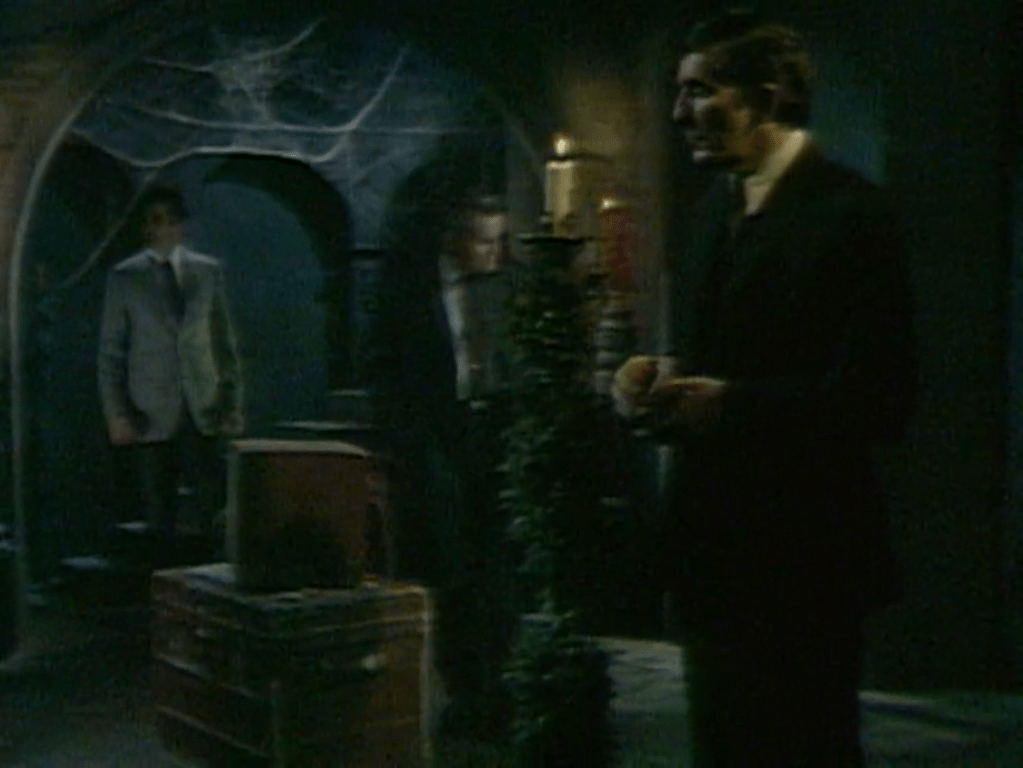
Burke and Woodard start to go, and Barnabas relents. He takes them to the basement. The coffin is usually in the main area at the foot of the stairs, but when the three of them get there some crates and a trunk are stacked up on that spot.
No coffin.
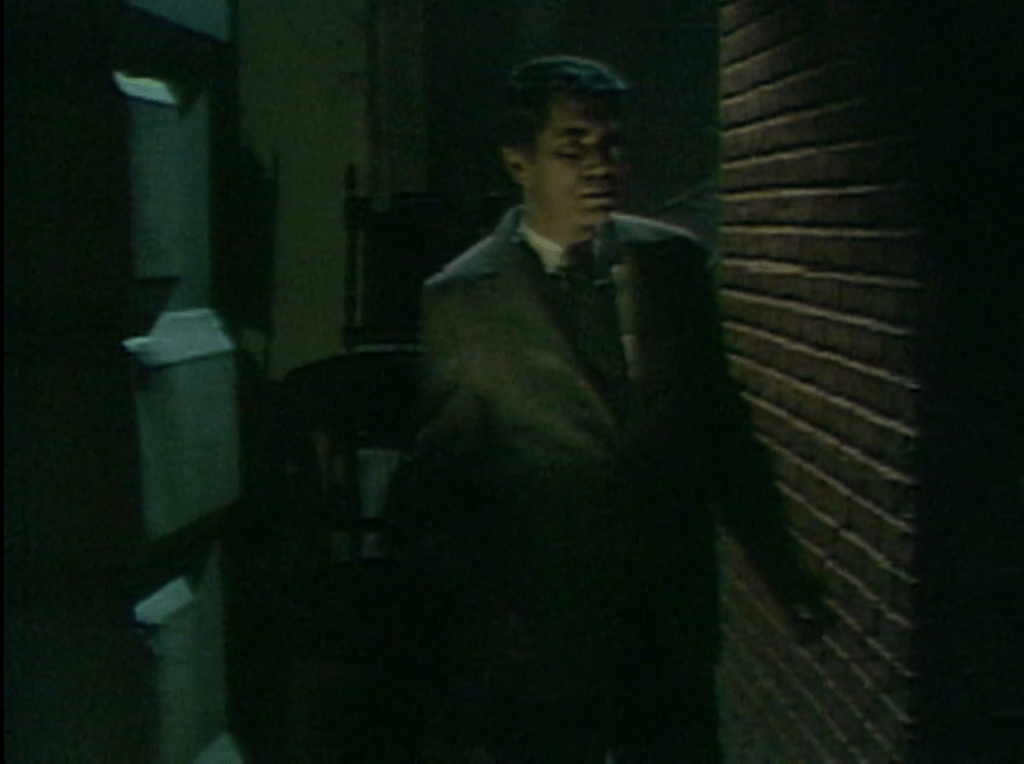
Burke goes down a little corridor and sees nothing there, either.
Burke in the corridor.
Burke and Woodard are embarrassed, and Barnabas grins. We know that he had moved the coffin so that when someone came to check out David’s story they would see nothing, and that his resistance to Burke and Woodard’s requests to search was put on for effect. Barnabas spends most of his time with other people pretending to be a living man born in the twentieth century; his grin is that of an actor who finds he has given a particularly convincing performance.
Receiving his ovation.
We had seen corridors in the basement when Barnabas was holding Maggie prisoner there. We saw them most prominently in the episode that ended with her escape, #260. In that one, they looked very extensive. He had kept Maggie in a prison cell at the end of one of those corridors. That cell had been there since Barnabas’ time as a living being in a previous century, but none of the many people who had visited the basement before Barnabas moved in, including Burke in #118, had seen the cell. So there must be quite a bit of space down there that only Barnabas knows about, but he has chosen to put his most embarrassing possession in the one place no one coming to the basement could fail to notice. It’s like the old days, when you’d go to visit a single guy at home and find that he had left sexually explicit magazines or videos on his coffee table.
Dangerously unstable ruffian Willie Loomis spent a week staring at the eighteenth century portrait of Barnabas Collins in the foyer of the great house of Collinwood back in April, then tried to rob Barnabas’ grave. That turned out to be an awkward situation when Willie found that Barnabas wasn’t entirely dead. Barnabas was a vampire who bit Willie, turned him into his sorely bedraggled blood thrall, and had lots of conversations with him. Yesterday, Willie was written out of the show.
Today we open with strange and troubled boy David Collins staring at the same portrait. As Willie was obsessed with the idea that there were jewels hidden in the Collins mausoleum in the old cemetery north of town, where in fact Barnabas’ coffin was hidden, so David is preoccupied with the idea that Barnabas has something terrible stashed in the basement of the Old House on the estate, where in fact his new coffin is hidden. As Willie sneaked off to the cemetery on his ill-starred expedition, David will sneak off to the Old House today and try to search Barnabas’ basement.
Unlike Willie, David is not driven by greed. He is afraid of Barnabas, and his friend, the ten year old ghost of Barnabas’ sister Sarah, has told him that he must not go to the Old House. But his aunt Liz and his father Roger dismiss his attempts to warn them about Barnabas, and he thinks it is his duty to provide them with evidence. So he screws up his courage and makes his way across the property.
David lets himself into the Old House by opening the parlor window. Not only have we seen David do this before, but Willie’s sometime friend, seagoing con man Jason McGuire, got into the house the same way in #274. Barnabas would kill Jason when he reached the basement in #275, so you might think he’d have put a lock on that window by now.
Jason’s fate is certainly on the minds of returning viewers when David tries to open the basement door. It comes as a relief when he finds the door locked. Barnabas’ co-conspirator, mad scientist Julia Hoffman, catches him there.
Julia demands to know what David is doing in the house, and he tries to brazen it out. He claims that he has a right to be there, since it belongs to his Aunt Liz. This is a bit of a murky point- we never see Liz transfer title to Barnabas, but she and others act as if he owns the place and its contents. Julia doesn’t clarify it when she responds that Liz gave the house to Barnabas- she doesn’t deny that it still belongs to Liz, only says that it also belongs to Barnabas.
Back in the great house, Roger is banging away at the piano. We saw Liz play the piano in #47 and #91, a reference to the conception of her character writer Art Wallace developed in his original story bible, titled Shadows on the Wall, in which she, like similar characters in a couple of TV plays he wrote in the 1950s under the title “The House,” gave piano lessons. Since then, Liz’ daughter Carolyn tried her hand at “Chopsticks” in #119 and used the piano as a prop in a teen rebel scene in #258, and Jason poked at a few keys in #198. Roger isn’t exactly Vladimir Horowitz, but he’s the first one we’ve seen who actually achieves a melody.
Liz comes in and tells Roger that David isn’t in his room. They fret over David’s attitude towards Barnabas. Julia brings David home and tells Liz and Roger where she found him. After an angry scene between father and son, David goes upstairs, and Liz scolds Roger for his inept parenting. In these as in all of Liz and Roger’s scenes together, we see a bossy big sister who tries to govern her bratty little brother, but who ultimately abets all of his worst behavior.
In the Old House, Barnabas notices that Julia is troubled. He keeps asking what’s on her mind, and she has difficulty deflecting his questions. This is odd- Julia has been established as a master of deception, and Barnabas is the most selfish creature in the universe. All she has to do is start talking about something that does not affect him directly, and he will lose interest at once. Rather than talk about her personal finances, or the job from which she is apparently on an indefinite leave of absence, or some ache or pain she might have, or how sad she is to miss her Aunt Zelda’s birthday, she brings up Willie. That does get Barnabas’ mind off her tension, but it also reminds him of David. He thinks David knows too much about him, and is thinking of murdering him. Julia assures him that the boy doesn’t know so very much, that whatever he does know he hasn’t told anyone, and that if he does say something his reputation as an overly imaginative child will lead the adults to ignore him.
From the beginning of the series, we’ve heard people say that David is “imaginative.” The audience finds an irony in this, since we have never seen David show any imagination whatsoever. All his stories of ghosts are strictly literal accounts of apparitions he has seen. We’ve seen some drawings he has done and heard quotes from some essays he has written. Some of these are technically accomplished for a person his age, but they are just as literal as his ghost stories. And when he tells lies to cover his various misdeeds, he tells simple little tales that fall apart at once.
In #327, well-meaning governess Vicki became the first character to dissent from the “David is a highly imaginative child” orthodoxy. Liz and local man Burke Devlin were dismissing David’s laboriously accurate account of his latest encounter with Sarah as a sign of his “imagination,” and Vicki interrupted with “I don’t think it has anything to do with his imagination.” Now, Barnabas goes a step further. After pronouncing the word “imaginative” in a truly marvelous way that makes it sound like something I’ve never heard before, he tells Julia that she has given him an idea. Frightened, she asks what he means. All he will say is “You’ll see.”
Roger goes to David’s room and has a friendly talk with his son. Throughout the conversation and afterward, David is thinking intensely, trying hard to figure out what his next step should be.
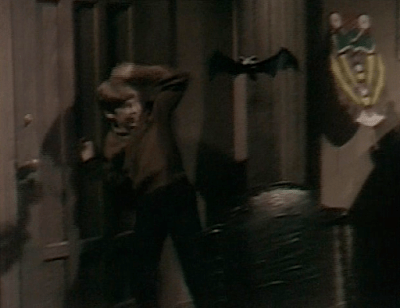
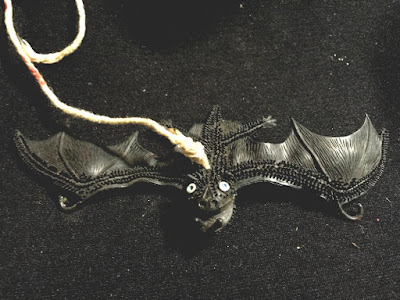
Once he is alone in the room, the window blows open and a bat enters. More precisely, a bat-shaped marionette is brought in on clearly visible strings by a pole that casts a shadow we can see the entire time, but no one who has been watching the show up to this point will doubt for a second that David’s fear, as depicted by David Henesy, is fully justified. David tries to flee from the bat, but he cannot open the door to escape from his room. His back against the door, David slides onto the floor and screams as the bat comes near him.
When Barnabas is about to attack someone, dogs start howling. Sometimes this works to his advantage, but it so often puts his intended victims on their guard that it doesn’t really seem to be something he is doing on purpose. So this bat represents something new. Perhaps Barnabas is using magic to control a bat- if so, it marks the first time we have seen Barnabas use magic to project influence over something other than a human mind. Or perhaps he himself has assumed the form of a bat. If so, that is the first indication we’ve had that he has shape shifting powers. In either case, Barnabas’ powers have just gone up a level.
Closing Miscellany
The bat was created by famed puppeteer Bil Baird. Most famous today for the puppets he created for “The Lonely Goatherd” sequence in The Sound of Music, Baird was a frequent guest on television programs like The Ed Sullivan Show, and Jim Henson cited Baird’s own TV series, the short lived Life with Snarky Parker, as a major influence on the Muppets. In December 1966, Baird opened a marionette theater in New York City, at 59 Barrow Street in Greenwich Village; it operated until 1978, and many leading puppeteers, including dozens who would go on to work with Henson, were members of its company in those years.
This is the last episode to end with ABC staff announcer Bob Lloyd saying “Dark Shadows is a Dan Curtis production.” We do hear the announcement again in February of 1969, but that won’t be because Lloyd has returned- they used an old recording for the music under the closing credits that day, and they picked one with him on it.
Fans of Dark Shadows will often talk about “the early episodes” which ended with Lloyd making that announcement. So I suppose #330 is the last of “the early episodes.”
Danny Horn’s post about this one on Dark Shadows Every Dayincludes a morphology of episode endings. He divides them into five categories, Haiku,* Restatement of Threat, ** New Information,*** Crisis Point,**** and Spectacle.***** It’s an intriguing scheme, and he makes a good case for it.
*Danny explains that “Haiku” “aren’t necessarily recognizable as endings in the traditional sense, because nothing is resolved and no progress is made. It’s just a little moment when a character pauses, and possibly has a feeling about something… In some extreme cases, the audience may not realize that the episode is over until halfway through The Dating Game.”
**Restatement of Threat, at this period of Dark Shadows, usually means Barnabas looking at us through his window and saying that someone or other “must die!” Which of course means that you can safely sell a million dollar life insurance policy to that character.
***”A New Information ending provides an actual plot point, which either advances the story another step, or tells us something that we didn’t know.”
****”The Crisis Point cliffhanger is the big game-changer, and for best effect, it should come at the end of a sequence that’s been building up for a while. This is a big turn in the story, and it should feel satisfying and thrilling… The defining feature of a Crisis Point ending is that the resolution marks a change in the status quo, ending one chapter and setting up the next.”
***** “Obviously, plot advancement is always welcome, but every once in a while the show needs to set its sights a little higher. These are the moments when the show goes above and beyond, in order to surprise and dazzle you… The point of a Spectacle is: You can’t take your eyes off the screen. Housewives in the audience have put down the iron, and switched off the vacuum. Teenagers have stopped swatting at their siblings… A Crisis Point cliffhanger will bring you back for the next episode, because you want to see what happens next. But a Spectacle cliffhanger is bigger than that — you’ll be coming back for the next episode, but it’s because you can’t believe what you’re seeing, and maybe tomorrow they’ll do it again.”
Vampire Barnabas Collins is giving a costume party using clothes that belonged to members of his family in the century when he was alive. It isn’t exactly a wild evening. Barnabas doesn’t appear to have planned any activities beyond mutual admiration of the costumes and a guided tour of his house. Moreover, four of the five guests live together and the fifth is fake Shemp Burke Devlin.
My wife, Mrs Acilius, said that the first time we watched the episode it was enough for her to see the actors dressed in antique clothes. But this time, she couldn’t help but notice their awkward pauses as they sit around with nothing to do.
There are some red herrings that particularly bothered her. For example, when the other guests left for the party while well-meaning governess Vicki waited for Burke, the show dwelt on Vicki for quite some time, leading us to expect that her separation from the group would cause something dramatic to happen. When Vicki and Burke arrive shortly after the other guests, Barnabas is startled by the sight of Burke in his costume. For a moment it seems that this might be the dramatic thing we were led to expect, but Barnabas recovers his composure right away and Burke doesn’t seem to be offended. Everyone forgets about it instantly. Vicki and Burke might as well have come with everyone else.
Amid the boredom, the guests start to notice cold spots in the room and other traditional indications of ghostly presences. Roger Collins gets a bright idea. There is no electricity and are therefore no light bulbs in Barnabas’ house, so the idea is represented by a candle above his head.
Roger has an idea
Roger suggests they hold a séance to contact any ghosts who might be in the room. Everyone is reluctant, especially Barnabas, but Roger gets his way. After a lot of grumbling from around the table, well-meaning governess Vicki goes into a trance. Roger announces that a visitor from the world of the dead is about to deliver a message. The closing credits roll.
Closing Miscellany
This episode was taped on the Fourth of July. I can’t help but suspect that the characters’ impatience with Barnabas’ snoozer of a party may reflect the cast’s frustration at having to work on a holiday.
As the party begins, a bell tower strikes eleven. We’ve heard this chiming in Barnabas’ house before. Barnabas identifies it as the bells of “the chapel in the valley,” and matriarch Liz remarks that she hadn’t realized you could hear it so clearly in his house.
So much emphasis is placed on Liz’ resemblance to Barnabas’ mother and Vicki’s to Josette Collins that we wonder if Joan Bennett and Alexandra Moltke Isles will play their ghosts in upcoming episodes. Barnabas mentions that Roger doesn’t look as much like his father as Liz looks like his mother, so any plans they did have along those lines evidently did not include Louis Edmonds.
This is the third séance we’ve seen on Dark Shadows. In #170 and #171, the ghost of Josette spoke through Vicki, and in #186 someone named David Radcliffe spoke through strange and troubled boy David Collins. Roger had been a staunch opponent of those earlier séances, a fact he acknowledges in passing as he begins his pitch today.
In its first months, Dark Shadows spent a fair bit of time on the business interests of the ancient and esteemed Collins family. In those days, the Collinses were running out of money and their old nemesis, Burke Devlin, had come back to town with a plan to strip them of their remaining assets and drive them into poverty. The “Revenge of Burke Devlin” storyline never really took off, and was eventually subsumed into the tale of blonde fire witch Laura Murdoch Collins. Shortly after Laura disappeared, Burke formally gave up on his revenge. With that, the business stories ended, and there was no particular reason for Burke to stick around.
On Tuesday, Burke was recast. However little his character may have had to do on the show or however much he may have had to drink before he arrived at the studio, Mitch Ryan was always interesting to watch. Anthony George couldn’t match Ryan’s charisma, but by 1967 he had been a familiar face in feature films and primetime television for years. The original audience, even if they couldn’t remember George’s name, would have recognized him as a famous actor and assumed that his casting meant that something big was in store for Burke.
Today, we have two hints that business stories might be making a comeback as well. Seagoing con man Jason McGuire is blackmailing reclusive matriarch Liz into marrying him. Vampire Barnabas worries that the cozy little home he has made for himself in the Old House on the estate of Collinwood might be threatened if Jason takes control of the family’s holdings. He asks Liz’ brother, high-born ne’er-do-well Roger, to look at the original deeds for the Old House and the great house to see if there is some provision he might be able to use to defend his interests against Jason. That Barnabas asks about the deeds would suggest that he has acquired some form of ownership in the Old House. We’ve never seen him buy the house from Liz or receive it as a gift from her, but if both deeds are still in Liz’ name, he could hardly use their wording to claim a right to stay there. So when Roger goes off to look for the deeds, there is a chance he will come back with a story about real estate.
The second hint comes in Barnabas’ confrontation with Jason. Barnabas takes a very aggressive tone with Jason, who responds by asking Barnabas where he goes in the daytime and where his money comes from. “You have no accounts in the bank in town, and I know you don’t operate a business…” If Barnabas is going to be on the show for the long haul, as the ratings clearly indicate we should expect him to be, Jason will not be the last person to ask these questions. We might wonder how exactly he will forestall them.
If we have been watching from the beginning, the likeliest answer would involve Burke. When was a major character, Burke was presented as an inexhaustibly rich man who knew his way around some of the shadiest places in the world. If Burke happens upon Barnabas’ secret, we could expect Barnabas to bite him and thereby bring him under his power. With his money, Burke could set up plenty of bank accounts and businesses in Barnabas’ name. With his contacts in the demimonde, he could secure whatever papers Barnabas needs to establish his identity. Even a photo ID- Burke could easily hire a Barnabas lookalike to pose for a British passport.*
During the “Revenge of Burke Devlin” arc, Burke bought up a lot of Liz’ debts. In particular, he held enough notes payable on demand that she feared he might be able to put her out of business at any time. That hasn’t been mentioned for a long while, but if Barnabas takes control of Burke he could take those notes and exchange some of them for outright ownership of the Old House.
Barnabas could also compel Burke to fabricate some fraudulent papers that would make it look as if he were deeply in debt to Barnabas. When Barnabas got around to killing Burke, those papers would come to light. Liz and Roger would be grateful to Barnabas for taming their old adversary and clearing out some debts that posed a danger to their financial position, while well-meaning governess Vicki would be grateful to him for helping her boyfriend save his face after his business went south. As a result, his position at Collinwood would be unassailable.
Closing Miscellany
There is a location insert of Roger walking to the Old House, a flashlight in hand. I don’t think we have seen this footage before.
Until today, Barnabas has tried to be very suave with everyone who doesn’t know that he is a vampire. Since he has nothing to say to Jason that will intimidate him, he might as well continue that approach in his scene with him, or at least play dumb. But instead, he is openly, and self-defeatingly, hostile. This will become a pattern in future episodes. Time and again, Barnabas will greet a potential adversary with an immediate declaration of war, often before the adversary even knows who he is, thereby forfeiting whatever element of surprise he might have on his side.
Barnabas catches a glimpse of the ghost of his sister Sarah. He only sees her as a figure moving in the distance as he is looking out the window, and has no idea who she is. But it does confirm that he is able to see her, something we had not known he could do.
Maggie Evans, The Nicest Girl in Town, has been a prisoner of vampire Barnabas Collins for a long time now. Barnabas is planning to kill her tonight. We spend the opening scene with Barnabas’ sorely bedraggled blood thrall, Willie Loomis. We hear Willie’s thoughts as he does the housekeeping. Willie wishes he could save Maggie, but Barnabas has too much power over him. The most he can do is bring her a poisoned glass of milk and invite her to drink it if she wants to die an easy death.
Willie is not Maggie’s only friend. The ghost of Barnabas’ nine year old sister, Sarah, materializes in Maggie’s cell. Sarah asks Maggie why she is crying. Maggie tells her that if she doesn’t get out of the cell very soon, she will die. Sarah is distressed to hear this- “You mustn’t die- I don’t want you to die.”
Maggie hasn’t figured out that Sarah is a ghost, and keeps asking her how she manages to get in and out of the cell. Sarah usually evades this question, but now she says that there is a way. She came upon it accidentally, long ago, and her father ordered her not to tell anyone, not even her brother. She will be punished if she tells. If her father put her in the prison cell in their basement intentionally, Sarah’s fear of punishment is quite understandable.
Sarah overcomes her fear sufficiently to share a riddle with Maggie which she says will give her the answer:
One, two, away they flew.
Three, four, by the door.
Five, six, count the bricks.
Seven, eight, the clue is “grate.”
Nine, ten, home again.
Maggie asks Sarah to repeat the riddle, and she says she can only say it once. Maggie tells her where to find her own father, Sam Evans, and asks her to tell Sam that she has seen her. Sarah disappears.
Sarah’s fear of punishment will ring a bell for regular viewers. Strange and troubled boy David Collins is so intensely afraid that his father, high-born ne’er-do-well Roger, will punish him by sending him away to a boarding school or a jail that he tried to murder Roger. Later, David left his favorite person, well-meaning governess Vicki, to be decapitated by crazed handyman Matthew Morgan because he was afraid that if he helped Vicki his father would find out he had earlier defied him and would punish him. Now, Maggie is in mortal danger because another Collins child, one who lived in a previous century, has a similar fear of punishment. The cell in the basement of the Old House was there before slavery was abolished in the area in 1783; perhaps Sarah’s fear and David’s are a bequest from the slaves and indentured servants whom their forebears locked up in it.
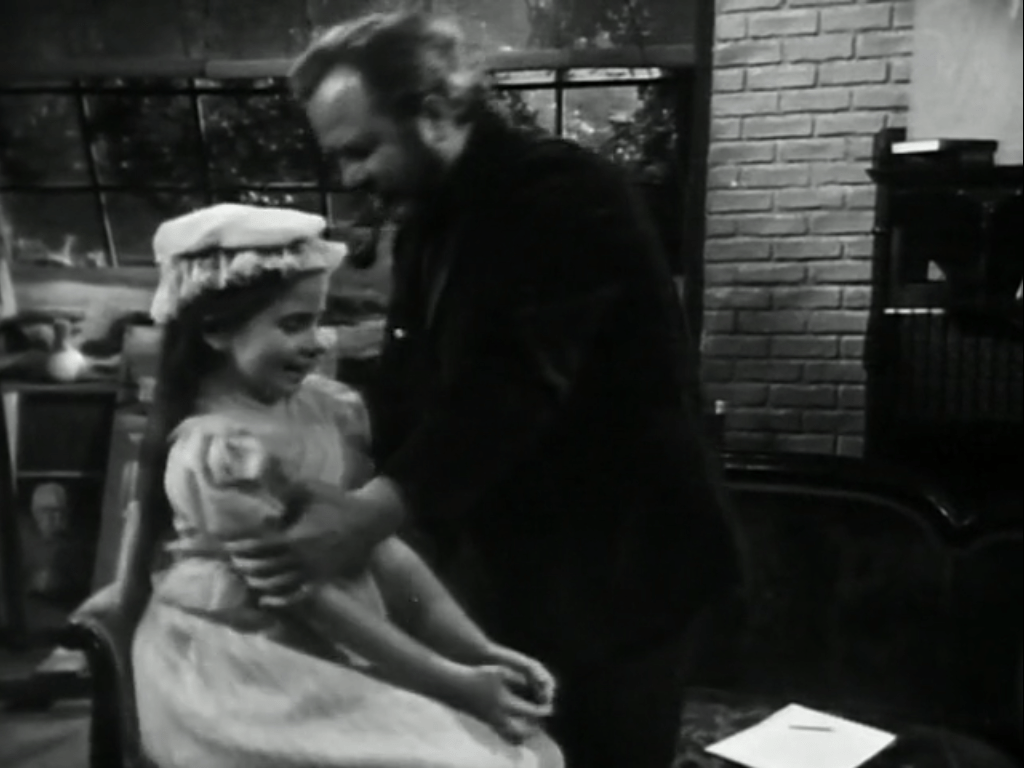
We cut to the Evans cottage. Sam is an artist, and is working. Sarah materializes in the living room. Sam had locked the door and Sarah won’t explain how she got in, but he seems to be delighted with her anyway. She is impressed with his paintings and asks him to paint a picture of her. He offers a drawing instead. When she agrees, he picks her up and sets her on a stool. She flashes a grin at being picked up. She asks if she can keep the drawing when he is done with it.
The most fun Sarah has had the whole time she’s been dead
Sam tells Sarah that her dress is very pretty. He then mentions that you don’t see many dresses in its style. She asks if that means he doesn’t like it. When Sam says that all he means is that it isn’t the sort of thing other little girls wear, she says she doesn’t play with other little girls so she doesn’t care what they wear. She seems to be getting worked up about this, so Sam calms her down with, “All right, all right, I see.” This little exchange gave my wife, Mrs Acilius, a laugh. Sarah may have been born in the same year as Jacob Grimm, but she is very much a nine year old girl.
While Sam draws Sarah, she steers the conversation to Maggie. She asks Sam if he looked for Maggie on the beach under Widow’s Hill. He says he’s looked everywhere he could. She repeats her suggestion that he look for her on the beach. He says he is sure he won’t find her there. She responds “You might, if you go there tonight.” Disturbed by this, Sam looks up, and finds that Sarah has vanished.
This surprises us almost as much as it surprises Sam. Sarah had made it clear that she very much wanted to keep the drawing, yet she disappears before Sam is finished. Evidently, it wasn’t within her power to stay.
Back in the cell, we see Maggie and hear her thoughts as she tries to remember Sarah’s riddle. Like Willie’s voiceover internal monologue in the opening scenes, Maggie’s goes on too long. We can see that Maggie is in an upsetting situation and understand why Sarah’s presence confuses and distracts her. That makes it clear she would have difficulty remembering the exact wording of the riddle, but we really don’t need to hear her go over every part of it.
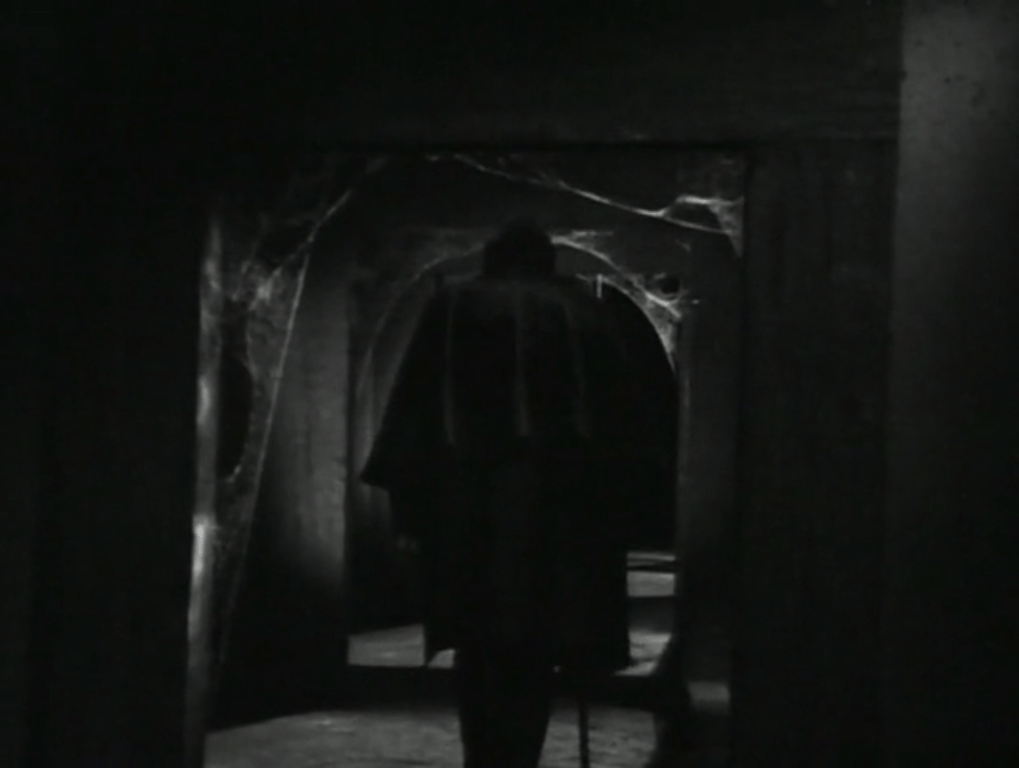
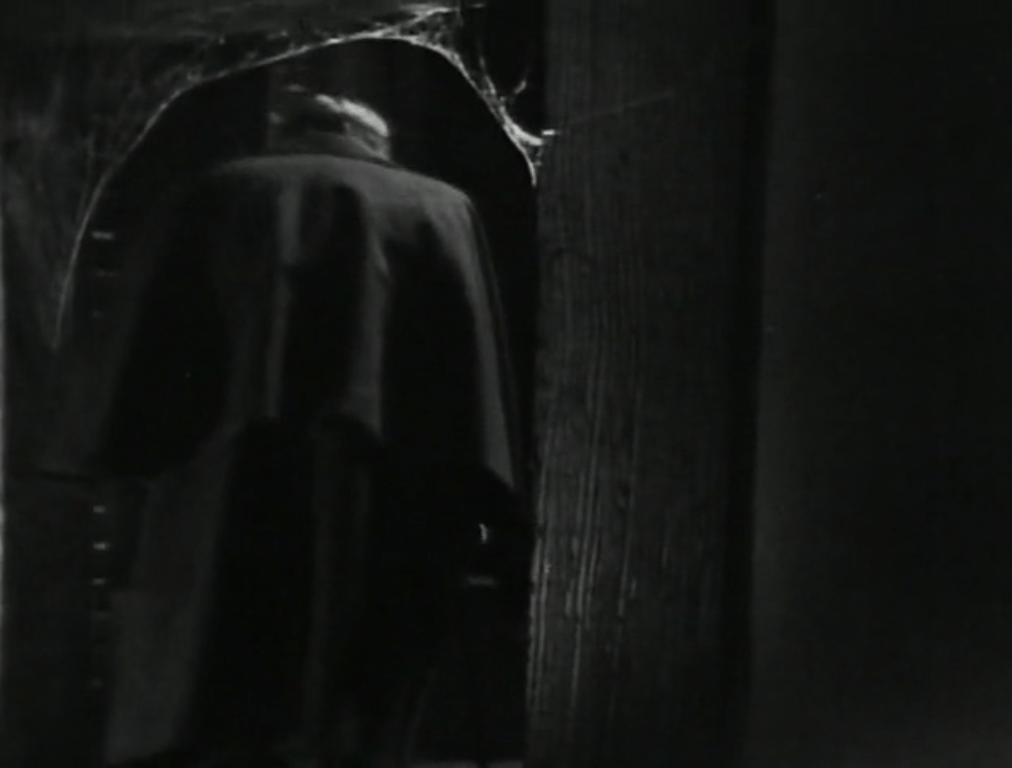
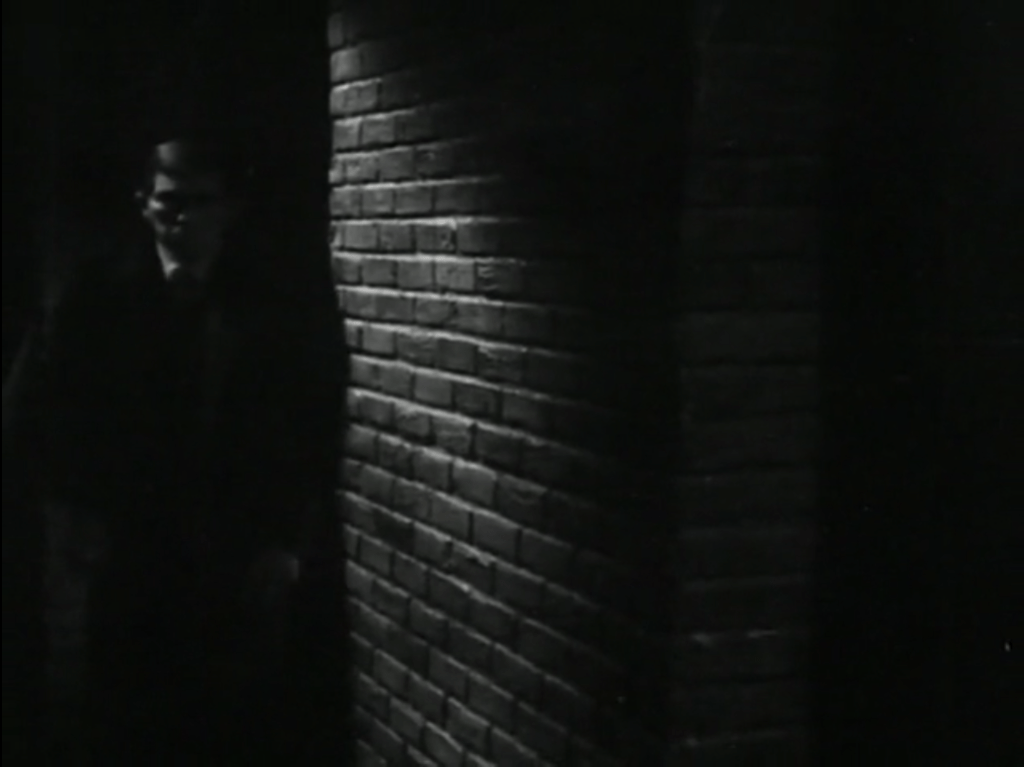
By the time Maggie finds the loose brick that triggers the opening of the secret panel, Barnabas is already rising from his coffin. We cut between Barnabas walking through the basement and Maggie struggling to open the panel. It may sound like we’re describing filler when we say that we see Barnabas traversing three distinct corridors between his coffin and Maggie’s cell, but it doesn’t feel that way. Not only do these shots build suspense as we wonder if Maggie will get out before he reaches her, but in Barnabas shown as a hunched, solitary figure in narrow spaces sketched in shades of gray we see the representative of a world bleak beyond endurance. We can see why the first serious feature film about a vampire, F. W. Murnau’s Nosferatu (1922), devoted so much screen time to showing Count Orlok skulking about the corridors of his castle.
First corridorSecond corridorThird corridor
Maggie crawls into the secret passage. She doesn’t close the panel behind her. Not only doesn’t Maggie know that Sarah is a ghost, she doesn’t know that Barnabas is Sarah’s brother. When Sarah says that not even her brother knows about the secret panel, she is telling us, but not Maggie, that Barnabas is unfamiliar with this way. We know that if Maggie had closed the panel, Barnabas wouldn’t have known where to look for her, and so we might yell at the screen urging her to do that. But since it is his house, she has to assume that he does know about the panel, and she knows that he might be at the door any second. So it is rational for her to forget the panel and use all of her time moving forward.
The gap between Maggie’s knowledge and ours again adds to the suspense as we watch her flee from Barnabas through the twisting passages beyond the panel. We only see one path, but the looks on the actors’ faces as they look from side to side tell us that there are several. Maggie is moving cautiously, choosing her way with care, the sensible thing to do if Barnabas is familiar with the passages. Since we know that it is new to him as it is to her, we want her simply to pick a path and run.
Maggie beholding the paths before her
Maggie finds two heavy doors, both of them apparently stuck. Barnabas looks around, seems bewildered, and takes a breath. He shouts a speech at Maggie, claiming that she has no chance of escape because he can hear her. He can’t hear much while he’s shouting, so we want her to take advantage of that and bash away at one of the doors during his speech.
Barnabas wondering at part of his house he never knew existedMaggie with two closed doors in front of her and an angry vampire behind her
This episode ends the 52nd week of Dark Shadows. When ABC* picked the series up in 1966, it gave executive producer Dan Curtis a 26 week commitment, carrying production to #130. After that, the network renewed it for the then-standard 13 week period. The first renewal carried them to #195, the second to this episode. Until just a couple of months ago, the ratings were so low that no one thought it was likely that it would get a third renewal. When the vampire was introduced in April, viewership started to pick up, preventing cancellation and requiring them to come up with a story that they could keep telling.
I do think we can see traces here and there of the original plan. The first part of the plan seems to have been to copy Bram Stoker’s Dracula far more thoroughly than they wound up doing.
The two female characters on the show who had or were about to have boyfriends when Barnabas was introduced were Maggie and Vicki, who are both seeing men who are cut out to be stout-hearted action heroes. The two female characters in Bram Stoker’s Dracula who had boyfriends were Lucy Westenra and Mina Murray, who were both seeing men who emerge as stout-hearted action heroes. Dracula feeds on Lucy, prompting several other people to band together to try to save her. Dr John Seward, MD, contacts his old Professor, the brilliant Abraham Van Helsing, to advise the group. Despite their best efforts, Lucy dies and rises as a vampire, the “Bloofer Lady” who feeds on the children of east London. Lucy’s boyfriend has to destroy her body to free her soul of the vampire curse.
If the show was about to be canceled, it would have been a favor to Kathryn Leigh Scott to have Maggie suffer Lucy’s fate. Going out with a splash like that would certainly have given her something to lead with as she looked for her next job. But once it was decided that the show would continue beyond #260, it was out of the question to lose a character as popular and versatile as Maggie. When the network ordered 65 more episodes, Maggie had to be saved.
The Van Helsing analogue was actually named on screen. In #242, the show’s equivalent of Dr John Seward, addled quack Dr Woodard, said that he was going to call in a specialist to consult on Maggie’s case, a Dr Hoffman, who is “one of the best men in the field.” We haven’t heard about this man since Dan Curtis found out the show was going to be renewed, suggesting that they’ve abandoned the idea to hew quite so closely to Dracula.
In Stoker’s novel, once Van Helsing has corrected the group’s knowledge deficits concerning vampires, Mina emerges as its leader. Attempting to be gallant, the men cut Mina out of their operations, with the result that Dracula escapes them and bites her. Mina is able to resist his influence so far that she can play a pivotal role in the Count’s final destruction.
The first time Dark Shadows modeled a storyline on Dracula, the menace was not a vampire, but undead fire witch Laura Murdoch Collins. In that arc, the men formed a group of stout-hearted heroes advised by Dr Peter Guthrie and led by well-meaning governess Vicki. Guthrie and Vicki were plainly Van Helsing and Mina. Laura killed Guthrie, so he can’t come back to help in the fight against Barnabas, but Vicki is still around, still the chief protagonist, and still the one likeliest to lead the opposition to a villain.
Indeed, Barnabas has expressed interest in Vicki as a replacement for Maggie, and in #233 he blurted out an obvious threat when he realized she was getting uncomfortably close to figuring out the truth about him. So, had Dark Shadows ended with this episode, it is likely that it would have ended with Vicki overcoming Barnabas’ power and driving a stake through his heart.
Of course, the vampire is the source of the ratings, and Vicki and Maggie are needed for future story development. So the makers of the show can’t use any of those plot elements. What in the world they can do is a question that does not, as yet, have a clear answer. So they have been stalling and stalling. Sooner or later, the stalling will have to end.
*The American Broadcasting Company, that is, not the Australian Broadcasting Corporation.












 Dark Shadows Commentary