Episode 759: It’s not our fault, what we are

Dark Shadows‘ first supernatural menace, on the show from December 1966 to March 1967, was undead blonde fire witch Laura Murdoch Collins. In those days, we learned that at intervals of exactly 100 years Laura incinerated herself and her young son, always a boy named David, and that she (but not the Davids) rose from the ashes as a humanoid Phoenix. Well-meaning governess Victoria Winters led the resistance to Laura.

The story came to its climax as Laura she tried to take her son, Vicki’s charge David Collins, to the fate that had claimed David Stockbridge in 1767, David Radcliffe in 1867, and who knows how many other Davids in the preceding centuries. At the final moment, David Collins ran from the burning shack to which Laura had brought him and found his way to Vicki’s arms. With that, he chose Vicki and life over his mother and death, and Dark Shadows 1.0 reached its conclusion.

Dark Shadows 2.0 picked up immediately after, and focused on another supernatural villain, vampire Barnabas Collins. There isn’t an established mythology for filicidal humanoid Phoenixes, so the writers had leaned heavily on Bram Stoker’s Dracula and on stage and film adaptations of the novel for the structure and details of the Laura story. For example, in many scenes they went out of their way to show that Laura never eats or drinks. They eventually established that Barnabas doesn’t eat or drink either, but when he first came on they had to show that they were not just repeating what they had done so shortly before. So in #221, Barnabas clearly drinks a cup of coffee.

The original plan had apparently been that Barnabas would wreak terror for thirteen weeks while Vicki gradually figured out what was going on, organized a force to do battle with him, and then staked him in #275, destroying him in the last episode the ABC network was likely to air before cancelling the show. But Barnabas brought a new audience with him, prompting ABC to renew for another thirteen weeks. So his destruction had to be postponed indefinitely, and Vicki wound up on the margins of the story. She became Barnabas’ friend and stalwart defender before ultimately disappearing altogether.

Since then, Dark Shadows has been reinvented several times. Version 3.0 ran from November 1967 through March 1968; it was a costume drama set in the 1790s, to which Vicki had been transported by the mysterious powers represented by the ghost of Barnabas’ little sister Sarah. Version 4.0 ran from March through November 1968; it was a Monster Mash in which a variety of vampires, Frankensteins, witches, and other refugees from the Universal Studios back catalog stumbled over each other in an ever-more futile search for a coherent plot. Version 5.0 began in November 1968 with two stories revolving around nine year old Amy Jennings. These were the Haunting of Collinwood by the malign ghost of Quentin Collins, who represented a special threat to Amy, and the Werewolf Curse on Amy’s big brother Chris. I don’t know what was in the original flimsies, but I suspect this portion of the show was originally meant to be much shorter than it is and to serve as a prologue to Version 5.0.1, a costume drama set in 1897, when Quentin was alive and the werewolf curse began. It shows signs of having been greatly extended when Quentin’s ghost started to attract a large and fervent fan-base and the producers were unsure whether he could keep that following as a living being.

We finally went back to 1897 in #701, twelve weeks ago. Barnabas, who at the beginning of the Monster Mash period was freed of the effects of the vampire curse, tried to save Amy, Chris, and everyone else at Collinwood by doing some mumbo-jumbo, and found himself transported back in time. Having traveled to the past, he has once again become a vampire.

Among the many people Barnabas has met during his uncertain and frightening journey to the past is another iteration of Laura. It turns out that he remembers her from 1767, when he was a child and she was married to his uncle. She at first accepted his story that he was the great-grandson of the original Barnabas. He was a small boy when she burned that time, and all she can see is that her new acquaintance has a family resemblance to that boy. But he knew that she was planning to incinerate her children, among them the ancestor of the Collinses whom he knows at Collinwood in the 1960s, and he has been flagrantly aggressive in his opposition to her. She has learned that he is a vampire, and has tried to destroy him.

The highlight of today’s episode comes when Laura enters the foyer of the great house and Barnabas pops up to greet her. He calls her Laura Stockbridge, and she begins talking about what he was like as a boy. She refers to their similarity, implying that she is herself a type of vampire. She tells him he shouldn’t oppose her, and he says that he would want her to stop him if he were about to do what she is planning. She says that he cannot know what her plans are. He assures her he does know, and she lists all the people with whom he may have discussed her, dismissing each in turn as an unreliable source. Barnabas keeps smiling. For a thrilling moment, we wonder if his key informant was Vicki. Perhaps she told him about her encounter with the Laura of 1966-1967, and he knows everything she figured out in those days.

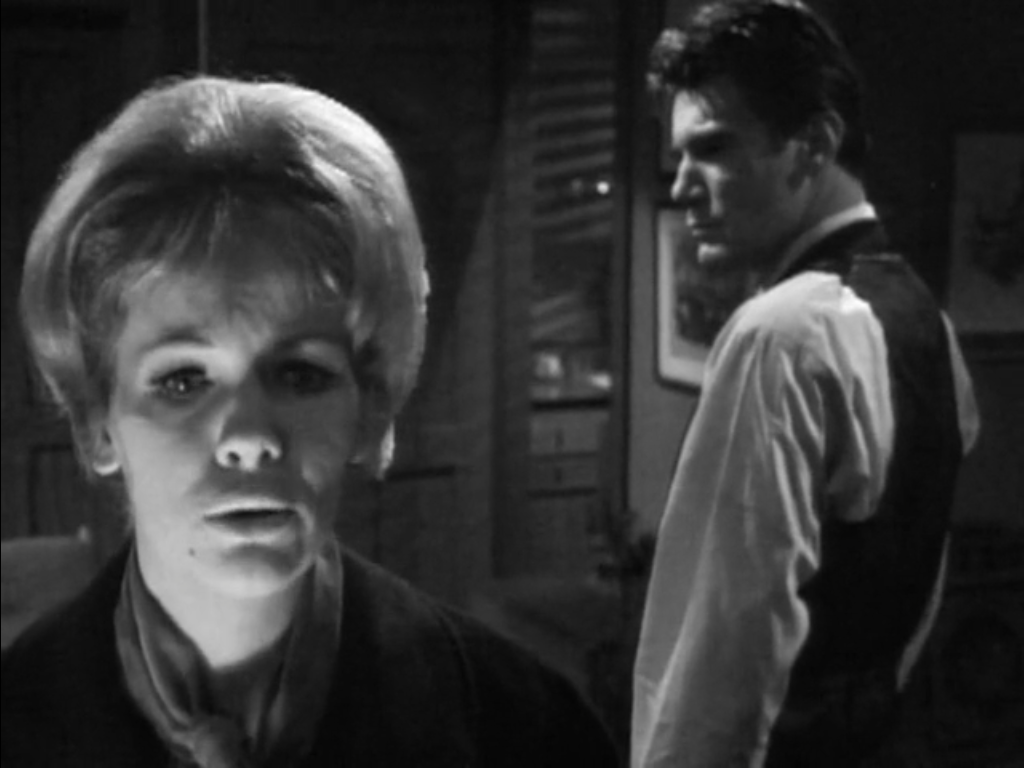
Hello, Auntie! Screenshot by Dark Shadows Before I Die.

Alas, it is not so. Barnabas opens a door and reveals the slumped figure of Laura’s dimwitted thrall Dirk. Earlier Barnabas, in bat form, had attached Dirk to prevent him bringing a letter to the house that would have exposed Barnabas’ secret. Barnabas tells Laura he hasn’t killed Dirk, merely bitten him and questioned him. In the first two-thirds of the episode, Dirk, played by the always-regrettable Roger Davis, kept grabbing Laura and pawing at her; at one point Diana Millay does an adroit little judo move to block his hand before he can put it on her left breast. As a result of these scenes and countless others in which Mr Davis engaged in similar behavior, many in the audience will groan with disappointment when Barnabas says that Dirk is not dead.

Millay and Jonathan Frid are wonderful in this scene. Laura’s lines are perfectly suited to display Millay’s gift for subtle emotional transitions, and Frid’s delivery shows what he can do when he has time to learn his part and the lines do not require him to verbalize the character’s every thought. Mr Davis is also well within his range, playing as he does an unconscious and apparently dead body. He should have specialized in that, it’s the first thing we’ve seen him do really well in all of his many appearances on the show.
Episode 754: A place with special people

Twelve year old Jamison Collins has run away from the unspeakably horrible boarding school where he has been imprisoned, and erstwhile lady’s maid Beth Chavez thinks he might be in the woods on the grounds of the great estate of Collinwood. Beth knows that her boyfriend, Jamison’s uncle Quentin, is in those woods. She also knows that Quentin is a werewolf, so she has gone out with a gun to protect Jamison from him. She does not know that the gun will stop a werewolf only if it fires silver bullets, so she is in trouble when she comes face to face with Quentin in his lupine form.

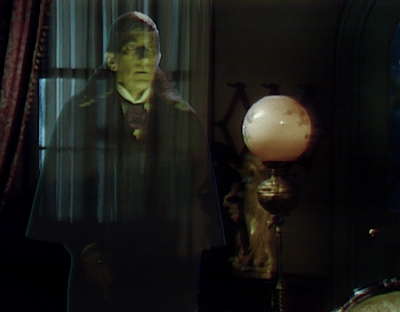
Luckily for Beth, Jamison’s father, the stuffy Edward, and his distant cousin, the mysterious and recently arrived Barnabas, happen by. They distract the werewolf, and Barnabas beats him with the silver head of his cane. The werewolf runs off, and Barnabas gives chase. Edward calls him back. Edward tells Barnabas he will need a gun to fight the werewolf, and Barnabas replies that the head of the cane will be enough. Edward demurs, saying that will work only once. Barnabas can’t very well tell the quotidian Edward that silver is the only weapon that is effective against werewolves, still less that he learned this while fighting a werewolf in the year 1969 and that he has traveled back in time to 1897 to stop the werewolf curse at its origin. Even if he somehow convinced Edward of this lunatic story, he would only increase the likelihood that a further uncanny truth would be revealed, namely that he himself is a vampire. So Barnabas helps Edward carry Beth back to the great house on the estate.

There, Barnabas decides that Jamison has probably gone to visit his mother Laura, who is staying in the groundskeeper’s cottage due to her estrangement from Edward. Indeed, we have seen Jamison there, talking with Laura about going away from Collinwood with her. Barnabas suspects what the audience is in a position to know, that Laura is an undead blonde fire witch who periodically incinerates herself and her children so that she, but not they, may rise and live again as a humanoid Phoenix. Another iteration of Laura was on Dark Shadows from December 1966 to March 1967, when the show took place in a contemporary setting. When Laura tells Jamison about the place to which she will take him, longtime viewers will hear echoes of what that other Laura told her son David in #140 about a land that “some call Paradise.”

A bat squeaks outside the window of the cottage, and Barnabas materializes inside. They haven’t tried this effect in quite a while. When they did it in #341, they superimposed the image of Barnabas in the wrong place on the screen, so that he looked like he was about four feet tall. That Mini-Bar was not very intimidating. But they get it right this time, and it makes for an effective moment.

Barnabas materializes inside the cottage. Screenshot by Dark Shadows Before I Die.

Laura emerges from the bedroom, and is indignant to see Barnabas. He bluntly tells her that he knows she is a mortal threat to her children, Jamison and his sister Nora. He tells her he will take them from her. She says she is sure that he is capable of “tricks,” but says that she has some of her own. She causes him to suffer intense heat. He recovers, and a groggy Jamison comes staggering out of the bedroom. Barnabas grabs Jamison and sets out for the great house. When Laura again mentions her “tricks,” he replies menacingly that “You have not known mine!” Laura vows to have her revenge.

The original 1966-1967 Laura story was the first plot on Dark Shadows to be driven by a supernatural character from beginning to end, and it did involve some confrontations between Laura and the ghost of the gracious Josette. But it was nearly as slow-paced, understated, and heavily atmospheric as were the relatively naturalistic stories that preceded it. That other Laura was the right menace for a show like that. She did not come with the established imagery of familiar movie monsters like vampires and werewolves, nor was there any reason to expect her to generate a lot of violent confrontations or special effects. Despite her association with fire, Laura was a cool presence on screen. She fit with a sedate tone and appealed to an adult audience interested in the long arcs of character development. When the 1897 Laura zaps a vampire who himself just fought a werewolf, there is no coolness anywhere. The show is meant primarily for children now, and they want the heat action and imagery generate when they are packed tight into each minute. Diana Millay is certainly up to the job, though it is a shame she doesn’t have the same opportunities she had in early 1967 to display her gifts for dry comedy and subtle psychological drama.

Episode 735: Defenseless souls

The highlight of today’s episode is a confrontation between two of Dark Shadows‘ most effective villains.

Laura Murdoch Collins (Diana Millay) was on Dark Shadows from December 1966 to March 1967, when the show took place in a contemporary setting. She emerged from the supernatural back-world behind the action, and at first she was as vague and indefinite as are the beings who lurk out of our sight there. Eventually she took on a forceful enough personality that Diana Millay could display her gift for dry comedy, but that personality was only a mask that Laura wore. The real Laura was something entirely different, unreachable, unknowable. The visible Laura marks the boundary between the world we can hope to understand and one where humans would find no points of reference, no standards of comparison. As such, she represents the danger that we might lose our way and find ourselves in a place where our minds will be useless to us. That is to say, she inspired the fear that comes from a well-told ghost story.

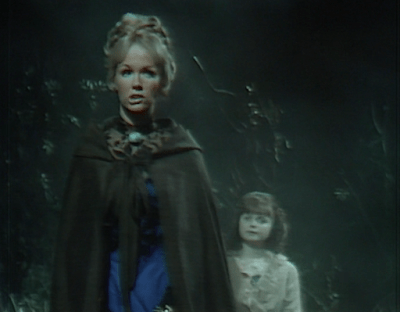
Now the dramatic date is 1897, and another iteration of Laura is the mother of twelve year old Jamison and nine year old Nora. Laura’s estranged husband, the stuffy Edward Collins, and Edward’s sister, spinster Judith, have sent Jamsion and Nora to Worthington Hall, a boarding school which doubles as a particularly cruel cult. Laura’s plans for Nora and Jamison require them to be home on the estate of Collinwood, and so she sets out to release them from Worthington Hall.

The headmaster/ cult leader of Worthington Hall is the vile Gregory Trask (Jerry Lacy.) Trask is at the opposite pole from Laura. She is terrifying because we can never understand her or the realm whose existence she implies; he is an overpoweringly oppressive presence because he is so thoroughly comprehensible. It is perfectly obvious what Trask has done, what he plans to do next, and why he wants to do it, but knowing all that is of absolutely no use in stopping him.

In today’s opening scene, Trask confronted fugitive teacher Rachel Drummond, whom he is extorting into coming back to work at Worthington Hall. He kept sidling up to Rachel and touching her, telling her that perhaps the two of them were destined to change each other. He could not make it clearer that he wants to exploit his power over Rachel to coerce her, not only into returning to her old job, but into a sexual relationship.

Trask has been in a position of authority over Rachel since she was a small child, suggesting that his unrelentingly punitive approach to his students and the undisguised joy he takes in being cruel to them are also sexual in their origin. Rachel even used the word “sadist” to describe Trask the other day, a word coined only in 1892. Someone using it in 1897 would certainly have seen it in its original clinical context, and the neurotic intellectual Rachel undoubtedly understood it very well in its technical sense.

We see Laura on a dark set. She looks at a candelabra. She points at its three candles, one by one. As she points at each candle, it lights. Thus first time viewers learn that Laura is a supernatural being with a relationship to fire.

At Worthington Hall, Nora wanders into a room where a fireplace is alight. Nora can hear her mother’s voice urging her to look into the flames, but cannot see her. She is afraid until she looks into the flames and sees Laura’s face. Nora begins to enter a deep trance. Before she can, a teacher finds her and interrupts her. We cut back to Laura, who is pleading with Nora not to look away from the fire. Nora does, and the candles on Laura’s candelabra go out.

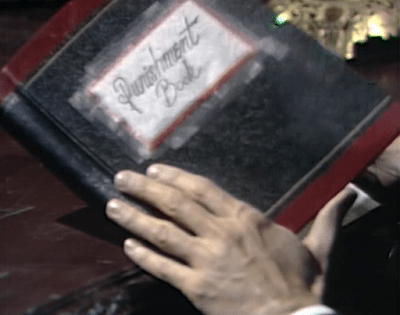
We see Trask in his study, browsing through a Bible. He returns that to his bookshelf and finds more congenial reading. He picks up a ledger and brightens. We see its cover, on which is taped a label reading “PUNISHMENT BOOK.” Trask smiles blissfully and sits down to examine its contents.

The volume that takes Trask to his happy place. Screenshot by Dark Shadows Before I Die.

A knock comes at the door, pulling Trask out of his sun-kissed dream of past cruelties. Irritated, he demands to know who it is, but receives no answer. When the knocking continues, he opens the door and sees Laura.

LAURA: Are there no servants at Worthington Hall? I’m not accustomed to letting myself in.

Longtime viewers will remember that when Laura was first on the show, they made a big deal out of the fact that she never ate or drank. So much so that they had the next uncanny menace, Barnabas Collins, drink a cup of coffee in #221. Even though Barnabas was a vampire and Laura was not, they had used up the traditional indicator of vampirism. non-consumption of food or drink, on Laura. Laura’s inability to open the door herself may be another borrowing from the same stock of imagery, from the idea that the vampire cannot cross a threshold without being invited.

TRASK: Who are you?

LAURA: I am Laura Collins and I come for my children. You are Mr. Trask, of course.

TRASK: Reverend Trask!

LAURA: Anyone can call themselves anything. I knew a woman in Brooklyn, once. Insisted she was a countess.

This is an inside joke. There was quite a well-known fashion correspondent-turned-executive in Brooklyn in 1969 named Mabel Wilson Gross. Mrs Gross’ first husband was a Danish nobleman named Count Carl Adam von Moltke, known to his friends as “Bobby.” Mrs Gross was known professionally as “Countess Mab Moltke.” She and “Bobby” were the parents of Alexandra Moltke Isles, who appeared in 333 episodes of Dark Shadows as well-meaning governess Vicki. I don’t believe Mrs Isles has ever used the title “Countess” herself, though under the laws of Denmark she would have the right to do so. Since it was Vicki who led the battle against Laura in 1967, a remark from Laura twitting Mrs Isles and her family might raise quite a laugh from longtime viewers who get the reference.

LAURA: (Goes to Trask’s desk and leafs through the “Punishment Book.”) But you are Trask. Yes, there’s no doubt about that.

TRASK: But you could be anyone as far as I’m concerned, anyone at all. I have too much respect for the defenseless souls in my charge.

LAURA: Oh, please, don’t be dreary.

TRASK: Dreary, Madam?

LAURA: Surely you know the word. Simply have my children brought down here, if there’s anyone to bring them.

TRASK: And how am I to know that you are their mother?

LAURA: Oh, what a trusting man you are.

TRASK: There is no question of the children leaving the school.

LAURA: Jamison possibly. Nora will leave here tonight. I’m willing to take them one at a time.

TRASK: As far as I know, Madam, their mother is away.

LAURA: You should keep more in touch.

TRASK: My wife returned from Collinwood this afternoon. She made no mention of your return.

LAURA: Hmm. How odd. I thought her a great gossip.

TRASK: Minerva? Madam.

That Minerva appeared to be “a great gossip” will also amuse longtime viewers. She is played by Clarice Blackburn, who in the parts of Dark Shadows set in the 1960s played housekeeper Mrs Johnson. After a brief period in which Mrs Johnson was supposed to be a spy planted in the house by an enemy of the Collins family, she settled into the role of a benevolent but excitable woman whose chief function was to blab everything she knew to the character likeliest to use the information to advance the plot.

LAURA: Now, will you have Nora sent down.

TRASK: I will not. Not without proper orders from Miss Judith Collins or Mr. Edward Collins. I shall call Collinwood and verify your strange appearance.

LAURA: Do.

(TRASK picks up the telephone receiver. Shows pain and drops it.)

LAURA: What’s wrong, Mr. Trask?

TRASK: It burned my hand.

LAURA: I’ve always thought the telephone an instrument of the devil, haven’t you?

TRASK: I have not!

Many times on Dark Shadows, as recently as this week, we have seen men forcibly intervene to stop a woman from talking on the telephone. I believe this is the first time we have seen a woman turn the tables and do this to a man.

TRASK: What a ridiculous conversation. I don’t know what I could have been thinking of to call Mr. Edward Collins. We have rules at Worthington Hall, Madam.

LAURA: Ah, rules are made to be broken.

TRASK: Not here. The children are asleep. They shall remain asleep. We do not encourage visits even from members of the immediate family unless of course it’s an emergency.

LAURA: Then you won’t reconsider?

TRASK: No.

LAURA: Not wise. Not wise at all.

TRASK: Are you threatening me?

LAURA: My children will not spend one more night in this school.

Laura remains perfectly calm throughout this conversation. Even her closing threat is delivered in a light tone, with an easy smile. Trask is agitated at the outset, and becomes ever more so as he realizes he cannot intimidate Laura. Since Diana Millay and Jerry Lacy are two of the most capable comic actors on Dark Shadows, the result is hilarious.

We first saw the effect of Laura’s imperturbability on an earnest interlocutor in #183 and #184, when she confronted a profoundly different character. In those installments, visiting parapsychologist Peter Guthrie called on Laura at the same cottage where she is staying in 1897. He introduced a new word to Dark Shadows‘ lexicon when he told her that he had concluded that she was “The Undead.” He said that he knew of her evil intentions, and said that if she abandoned them and turned to good, he would make every effort to help her live a different kind of life. Guthrie’s offer meant exactly nothing to Laura, and she responded to it with the same sardonic indifference Trask elicits from her today. Her next act was to cast a spell that caused Guthrie to crash his car and die in a ball of flame.

Trask gets off easier. Laura just sets his school on fire. The closing shot shows Nora apparently surrounded by flames. Laura does not want to burn Nora to death, at least not yet, but she is not one of your more detail-oriented otherworldly menaces. It will not surprise longtime viewers that she is blithely assuming that her children will somehow escape alive from the blaze she has started.

Episode 730: The very same dream

When Laura Murdoch Collins first appeared on Dark Shadows in December 1966, it was far from clear what sort of being she was. From the beginning, there were definite hints that she had emerged from the supernatural back-world of ghosts and presences lurking behind the action, but as those ghosts and presences were undefined and vague, so Laura herself was undefined and vague when we met her. We couldn’t even tell how many of her there were- there was a charred corpse in Phoenix, Arizona, a phantom flickering on the front lawn of the great estate of Collinwood, two graves of Laura Murdochs from previous centuries, a woman who turns up in various places that serve food but never eats or drinks, and a series of dream visitations and inexplicable compulsions. Some of those were Laura, maybe all of them were, but how they were connected to each other, if they were connected at all, was anyone’s guess. Diana Millay’s performance reflected that uncertainty. Her Laura was initially blank and distant.

As her storyline went on, Laura came into ever sharper focus. By the time we realized that she was a humanoid Phoenix, an undead fire witch who had returned to Collinwood to take her son, strange and troubled boy David Collins, into the flames with her so that she could renew her life, she had become a dynamic character. As Laura gained force, Millay had the chance to reveal a talent for sarcastic dialogue rivaling that of Louis Edmonds, who played Laura’s estranged husband Roger Collins. Before Laura went up in flames in March 1967, we wished we could have seen a whole series featuring Millay and Edmonds as an unhappily married couple sniping at each other.

In those days, Dark Shadows was set in contemporary times. Now, its dramatic date is 1897, and Edmonds plays Roger’s grandfather, the stuffy Edward Collins. As in the first 24 weeks of Dark Shadows we saw that the name of Roger’s estranged wife was taboo in the great house of Collinwood, so in the first six weeks of the 1897 segment Edward has been furiously insistent that his estranged wife should never be mentioned. When Laura turns up, bearing the same name and played by the same actress as Edward’s granddaughter-in-law, we know what we are in for.

The show moves a lot more quickly now than it did when it debuted. David had shown signs of a psychic connection with Laura from #15 in July 1966, over 21 weeks before she arrived. Edward and Laura’s nine year old daughter Nora had dreams, visions, and an episode of automatic writing directed by Laura yesterday and the day before, and Laura herself shows up today. At first she meets Nora on the peak of Widow’s Hill, as a dream had told her she would. Laura comes to the house and sees Edward the following afternoon. Edward is horrified to see her; she is understated and cool at the beginning of their scene, but by the end of it she is in tears, pleading with Edward to be allowed to see their children, Nora and twelve year old Jamison. She thus recapitulates within minutes a progression that in 1966 and 1967 took months.

Laura trying to figure out what to say to Nora. Screenshot by Dark Shadows Before I Die.

When Laura saw Nora on Widow’s Hill, she swore her to secrecy, forbidding her to tell anyone but Jamison that she is back. Nora did try to tell Jamison, only to find that he wouldn’t believe her. She showed him a broach Laura gave her which bears an Egyptian symbol that popped into her head yesterday; Jamison is entirely unimpressed.

We learned the other day that when Edward’s brother Quentin was banished from Collinwood a year before, Laura followed him. The two wound up in Alexandria, Egypt, together. Jamison and Nora come to Quentin’s room today; Quentin sees the broach and flies into a panic. He searches through a book, then demands to know where Nora got the broach. She says only that she found it in the woods, and he keeps asking if someone gave it to her. She keeps denying that anyone did, and he rushes downstairs, looking for Edward.

In the drawing room, Quentin sees Laura. He is utterly shocked. “You’re dead!” he exclaims. “I saw you die!” Last week, Quentin himself died and came back to life. When he told Edward about his death and resurrection, he laughed delightedly. When Edward asked for an explanation, Quentin dismissed the whole subject, having exhausted his interest in it with his laughter. Yet now he is stunned out of his wits to see that Laura too has returned from the dead. Seems to be quite a double standard at work.

Every character we see in this episode bears the surname “Collins.” I believe this is the first episode we have seen with an all-Collins cast.

Episode 728: Mother is coming home

Repressed patrician Edward Collins enters his study in the great house on the estate of Collinwood and finds his brother, libertine Quentin, riffling through his desk. Quentin does not feel an obligation to apologize for going through Edward’s things since Edward is among the conspirators holding Quentin’s estranged wife, madwoman Jenny, prisoner somewhere in the house. Quentin learned that Jenny was around only when she escaped from her cell and stabbed him. He is looking for information about where she is now so that she will not get another chance at him. Edward says that Quentin does not need to know where Jenny is, since he is confident she will not escape again.

Quentin is not at all reassured by Edward’s promise. He brings up another topic, Edward’s own estranged wife. For the first several weeks of the portion of Dark Shadows set in the year 1897, the audience was led to believe that Jenny was Edward’s wife, and the mother of his children, twelve year old Jamison and nine year old Nora. When we found out that Jenny was Quentin’s wife, we wondered not only who Edward was married to, but also whether Jenny had borne children by Quentin. After all, she is obsessed with her “babies,” and in #707 we learned that the enterprise of concealing Jenny’s presence in the house involved taking substantial sums of money into the village of Collinsport and giving them to a Mrs Fillmore. Perhaps Mrs Fillmore is taking care of Jenny and Quentin’s children.

Today, Quentin mentions that Edward’s wife, whom Edward said in #705 and says again today “no longer exists” as far as he is concerned, is named Laura. This rings a very loud bell for longtime viewers. The first supernatural menace to dominate the plot of Dark Shadows was Laura Murdoch Collins, estranged wife of high-born ne’er-do-well Roger Collins. That Laura was on the show from December 1966 to March 1967. In the first week of the show, newly hired governess Vicki was surprised to learn that Roger’s wife was still alive, and was told in no uncertain terms that she was not to be discussed. In #705, during the first week of the 1897 portion, newly hired governess Rachel Drummond was surprised to learn that Edward’s wife was still alive, and was told in no uncertain terms that she was not to be discussed. Like Roger, Edward is played by Louis Edmonds. When we learn that Edward’s wife, too, is named Laura, we can only assume that she, too will prove to be an undead fire witch out to incinerate her children for the sake of her own immortality.

Quentin reminds Edward that Laura followed him the year before when he was banished from Collinwood. Indeed, Laura followed Quentin all the way to Alexandria, Egypt. The other day, Quentin admitted to Jamison that he had been a police spy in that city. Edward does not want to hear about any of it.

Nora enters. She asks Edward if she can use his desk to draw with crayons. Edward says that he was just leaving, and she can do what she wants. Quentin stays behind with her for a moment. Nora asks her uncle if he thinks her mother will come back. He looks uncomfortable, says he doesn’t know, and exits.

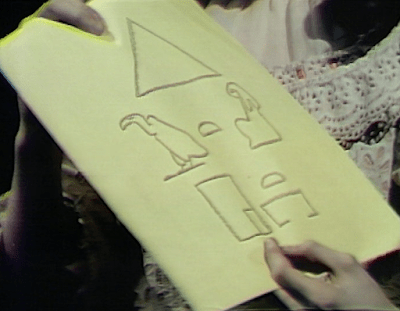
Barnabas Collins, a distant cousin recently arrived from someplace far away, enters. He looks at what Nora has drawn and recognizes Egyptian hieroglyphics. He asks if she copied them out of a book; she says that they just popped into her head. He says he wonders what they mean; she looks directly into the camera and tells the audience she knows exactly what they mean. They say that her mother is coming home soon. And indeed, they do include actual hieroglyphic symbols for “Mother,” “Come,” and “Home.”

Nora is quite the scribe. Screenshot by Dark Shadows Before I Die.

Nora starts talking about her mother. Barnabas encourages her to continue with the topic, and Edward enters. Edward is quite stern with Barnabas; he had made it clear that his wife was not to be discussed with anyone in the house, least of all with his children. Barnabas explains that Nora brought her mother up. He goes on to show Edward the drawing and tell him that he finds it profoundly disturbing. Edward accepts that as a sufficient excuse for going along with Nora while she talks about her mother, but he attributes the drawing to Quentin’s influence.

Whenever we saw Laura alone indoors during the “Phoenix” storyline, she was staring blankly into a fire burning in a hearth. She kept urging her son, strange and troubled boy David, to join her in this pastime, and every time he did we were led to believe that she had taken a sizable step towards her terrible goal. Now we see Nora in the drawing room, staring into the fire that always burns in its hearth.

Nora hears gurgling noises, like indistinct voices rising from below or behind the fire. Frightened, she runs into the foyer, into her father’s arms. She tries to explain to Edward what she heard, and he insists there is nothing to be afraid of. He carries her into the drawing room, where he declares they will look into the fire together and will both realize that nothing out of the ordinary is going on. His plan fails when Nora sees a face wearing a blonde wig starting to take shape in the flames. Nora cries out that it is her mother’s face. We pan to Edward. He is also looking into the fire, and he looks shocked. We wonder whether he is shocked because he can also see the face, or if he is merely alarmed by Nora’s reaction.

Roger and his sister Liz, the adults in the generation of Collinses who live at Collinwood in the 1960s, are Jamison’s children. So Edward and Laura are their grandparents. If this Laura is indeed the same immortal humanoid Phoenix who was David’s mother, Roger therefore married his own grandmother. In #313, Roger had a line about his “ancestors,” which Louis Edmonds bobbled. When he said “incestors,” he giggled, repeated the misspoken word, then corrected himself, calling the maximum possible attention to his error. Many fans bring that rather bizarre blooper up when we come to this story. The writing staff picked up ideas wherever they could, and I suppose the cast’s line difficulties might have been as good a source as any.

Episode 724: There has to be truth to make a story

Ethnic stereotype Magda Rákóczi is at home in the Old House on the great estate of Collinwood when Rachel Drummond, governess to the children in the great house on the same estate, comes to the door. Rachel says that the late Quentin Collins has risen from the dead and attacked her. Quentin was about to bury Rachel in his own disused grave when Magda’s husband Sandor showed up. Sandor fought Quentin, enabling Rachel to escape. Rachel cannot satisfactorily answer Magda’s questions about whether Sandor survived the fight, and Magda will not honestly answer Rachel’s questions about how Sandor knew to come to her aid.

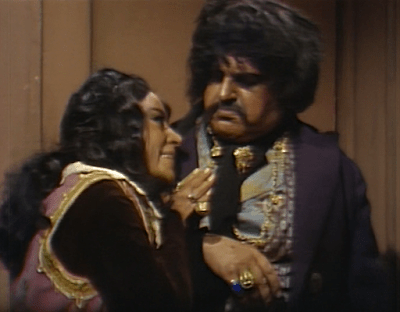
Sandor makes his way back. Magda is overjoyed to see him and throws herself at him with undisguised affection. He responds with his usual grumpiness. At the end, she remembers that they are not alone, and she reverts to their usual form of pretend-quarreling. Their dialogue is great fun, and Grayson Hall and Thayer David make the most of every laugh line:

Magda overjoyed to be reunited with Sandor. Screenshot by Dark Shadows Before I Die.

Magda: Oh, the hero!

Sandor: I am all right.

Magda: Oh, my big, bad, bold hero.

Sandor: Oh, shut up. I cannot hit you. My arm is too sore.

Magda: Oh, what a brave man you are.

Sandor: Yes.

Magda: What a brave man to fight a zombie, a brave, foolish man.

Rachel: He is a brave man. Thank you, Sandor.

Sandor: I don’t like to see a beautiful lady getting buried before her time.

Magda: But you could have been killed.

Sandor: Yes, that at least would have made you cry. Get me some hot water. My wrist is beginning to swell.

Magda: Oh, so now, I have to nurse you. It is better he should have finished you!

Sandor and Magda are the first happily married couple we have seen on Dark Shadows, and this scene shows them at their very happiest. It is not only a good bit of comedy, it is quite lovely.

Rachel is bookish and intellectually ambitious, very much the sort of young lady you might expect to find in charge of the education of the children in a wealthy family in the late Victorian age. She tells Sandor that she cannot accept that Quentin has risen from the dead and is roaming about as a zombie, even though she has encountered as much evidence of the fact as anyone could want. When Sandor urges Rachel to believe what she has seen, she asks what she will have to believe in next- “Ghosts? Witches? Werewolves?” Sandor affirms that he believes in all of those things, and Rachel replies that she cannot.

Well might Sandor believe in such beings. He is under the power of the new master of the Old House, Barnabas Collins, a vampire. Barnabas rises from his coffin in the basement at dusk, when Rachel is upstairs sleeping. Barnabas knows that Angelique, the same witch who made him into a vampire in the 1790s, is controlling Quentin and persecuting Rachel. When Quentin turns up in the basement, Barnabas remembers a ceremony he saw on Angelique’s home island of Martinique that reunited a zombie’s soul with his body and made him once more a living man. He sends Sandor to the attic to retrieve a packet of letters he wrote to his uncle Jeremiah in those days, describing the ceremony.

Jeremiah’s name will jolt longtime viewers. Angelique raised Jeremiah from his grave as a zombie in #393. Over the next five episodes he initially did Angelique’s bidding, then turned on her. They never did tell us that Jeremiah had returned to his grave, in spite of Angelique’s phenomenally vehement exhortations to him to do so. It’s too bad Barnabas didn’t remember these letters then, he might have been able to un-kill Jeremiah.

Or perhaps not. The ceremony is a total failure today, so maybe Barnabas just doesn’t have what it takes to reunite a soul with a body.

When Sandor and Quentin are fighting in the graveyard, we see a tombstone labeled “Laura Murdoch Radcliffe, born 1840.” The Oxford English Dictionary doesn’t have any examples of the phrase “Easter Egg” meaning hidden content of special interest to devotees until 1986, and for that matter this episode aired a few days before Easter began in 1969. So it is doubly premature to call this an Easter Egg. We learned in #181 that a woman named Laura Murdoch Radcliffe died (by fire!) in 1867, with her young son David in her arms; other Laura Murdochs have died that way in other years, and in #187 the residents of the great house decide that Laura Murdoch Collins is likely to take her own young son David to the same fate. The show has been dropping reminders of the Laura story lately, and any longtime viewers who can read this tombstone will appreciate the reference.

I suspect that the original audience for this particular Easter Egg was pretty nearly limited to the set decorators. The inscription is on screen for less than a second, and it is as clear as it is in the capture above for only a small fraction of that time. It’s hard to see even on a modern television; on a 1960s-vintage TV set tuned to an ABC affiliate, many of which had the worst reception in their markets, it must have been totally illegible to something like 99% of the audience. Moreover, it comes at the end of the fight scene, when most eyes were focused on Sandor’s falling figure. Not very many of the few thousand people who might have had a good enough picture to read the inscription would have been looking at it. And most of the audience who were tuning in at this point had joined the show after Barnabas was introduced, the month after Laura went up in smoke, her name unmentioned since. But in the age of streaming and DVDs, we can all appreciate the reference.

Episode 231: Anyone’s blood

Today is only the second time we hear a voice announce a recast over the opening title. The first time was in #35, when David Ford took over the part of drunken artist Sam Evans from wildly incompetent actor Mark Allen. This time Robert Gerringer is taking over the part of addled quack Dr Woodard from Richard Woods. Woods only played the role twice, and neither time could he find a way to distract the audience from the ignorance of medicine that the writers showed in their scripts.

Gerringer’s lines don’t make much more sense than did the ones they dumped on Woods, but he acts up a storm. Woodard is examining Sam’s daughter Maggie Evans, The Nicest Girl in Town. Unknown to Sam or Woodard, vampire Barnabas Collins has been sucking Maggie’s blood. Woodard is firm with Maggie when she resists his examination. He seems to be somewhat on edge, just enough that we wonder if there is more to it than the difficulties we can see Maggie giving him. Perhaps he is thinking something he isn’t saying. Woods never managed to make us wonder if his version of the doctor was doing that.

When Woodard and Sam leave Maggie’s room, Woodard assumes an alarmed tone. He tells Sam that Maggie is on the point of death and needs a blood transfusion at once. By showing us that Woodard was concealing the true nature of his concern when he was with Maggie, Gerringer gives substance to our hopes that the character’s nonsensical words and deeds will turn out to be a screen hiding something interesting.

Maggie’s boyfriend, hardworking young fisherman Joe, joins Sam and Woodard. Woodard asks if either Sam or Joe has blood type A. Joe does. Woodard doesn’t ask about Rh factors or Joe’s medical history or anything else, he simply marches Joe into Maggie’s room and the bodily fluids start pumping right away. Joe holds Maggie’s hand at first, but her violent protests force him to let go.

Transfusion

In Bram Stoker’s Dracula, Professor Van Helsing and Dr John Seward give blood transfusions to the vampire’s victims. That novel was written in 1897, and blood types weren’t discovered until 1900, so Van Helsing and Seward take blood indiscriminately from all the men cooperating in the effort to defeat Dracula. Van Helsing is particularly enthusiastic when he learns that Arthur Holmwood has given blood to Lucy Westenra, because Arthur “is the lover of her!” Van Helsing is Dutch, and speaks in a vaguely comical broken English. Woodard doesn’t seem particularly excited that Joe is “the lover of her,” but audiences who had read the book will recognize the allusion.

At this point in the production of Dark Shadows, the tentative plan was that Dr Woodard would become something like the expert on paranormal dangers that Dr Peter Guthrie had been during the Phoenix storyline, and that Barnabas would be destroyed in episode 275. Like Stoker’s Dracula, the Phoenix arc had featured a group of stout-hearted men and one valiant young woman coming together to do battle with an undead menace. Dr Guthrie had been their Van Helsing, an expert from out of town who leapfrogs over some weaknesses in the evidence actually available to the protagonists to get them to the same level of understanding that the audience has been given. Also like Van Helsing, Guthrie is the first to realize that the one female member of the team is the key to the success of their efforts, and so he insists on putting her in situations the other men regard as too dangerous for her. As Mina had been instrumental in the destruction of Dracula, so well-meaning governess Vicki is the person who finally thwarts the plans of the Phoenix.

If Woodard and Vicki are going to destroy Barnabas in #275, we have to wonder what story the show will have to tell in #276. The only other plotline going at the moment is the blackmail of reclusive matriarch Liz by seagoing con man Jason McGuire, and that can’t continue indefinitely. Not only will Liz run out of things for Jason to take away from her, but Dennis Patrick, the actor playing Jason, will leave the show no later than the end of June. Since the end of June is when #275 will be airing, we can hardly expect Jason to take the show over after that time.

In fact, Jason is an in-betweener brought on the show to clear away the last non-paranormal plot elements left over from the period before the show became a supernatural thriller in December 1966. By the time he leaves, both the reason for Liz’ long self-immuration in the great house of Collinwood and the identity of Vicki’s parents are supposed to be laid bare for all to see. Neither of those secrets ever generated an interesting story, but as long as they are around it is at least theoretically possible that the show will become a conventional daytime soap opera again. Without them, they are altogether committed to the spook show route. Destroy Barnabas, and you just have to come up with yet another menace from beyond the grave.

I remember Gerringer’s acting style from the first time I saw Dark Shadows. That was back in the 90s, when it was on what was then called the SciFi Channel. He so perfectly represented the doctor characters on the soaps my mother used to watch when I was a kid twenty years before that seeing him in the middle of a story about a vampire told me everything about the strangeness of a conventional daytime serial switching to a horror theme. If that guy is the one to drive the stake through Barnabas’ heart, or if he is even part of the team that finishes him off, it will be a statement that the makers of Dark Shadows have decided to stop being silly and start imitating The Guiding Light.

My wife, Mrs Acilius, was particularly frustrated with the dialogue in this episode. As Maggie, Kathryn Leigh Scott does a good job with nonverbal communication creating the image of a reluctant patient trying to get out of her skin, but her lines consist chiefly of repeating whatever is said to her. The other members of the cast are equally effective at projecting concern for a loved one whose grave illness they don’t understand and can’t help, but their lines too are so heavily loaded with repetition that we started to suspect that Malcolm Marmorstein was writing for a cast of myna birds. In particular, Woodard’s lines to Sam in the living room repeat the word “shock” so many times that they start to sound like he’s stuttering.

The original choices for the roles of Sam, Joe, Dr Woodard, and Maggie.
Photo by Bird Ecology Study Group

In his post about this episode, Danny Horn complains that there is not a single interesting still image in it. I agree with that, though I would say that the actors’ movements tell a story. Granted, it is a story that could have been told in a tiny fraction of the actual running time, but they deserve credit for holding the show together when the script gave them zero support.

Danny says that the episode would have been just as good if it were a radio show. Mrs Acilius says that it would have been “a thousand times better” than it is if it were a silent movie. Maybe they could compromise, and it could be presented with neither audio nor video, and the audience could spend the 22 minutes doing something else.

Episode 221: A new Collins in Collinsport

Maggie Evans, The Nicest Girl in Town, is closing up shop in the restaurant at the Collinsport Inn. A stranger startles her. He is the mysterious Barnabas Collins. Barnabas recently left his long-time residence in the cemetery five miles north of town and has been hanging around the great estate of Collinwood, but this is the first time we’ve seen him in Collinsport proper.

In the opening months of Dark Shadows, the restaurant, like the rest of the inn, was coded as the base from which dashing action hero Burke Devlin mounted his campaign to avenge himself on the ancient and esteemed Collins family. As the Revenge of Burke Devlin storyline ran out of steam, the restaurant emerged as a neutral space where new characters could be introduced without defining their relationships to the established cast all at once. In that period, Maggie was Collinsport’s one-woman welcoming committee.

Now, even Burke has given up on his storyline. The only narrative element of the show with an open-ended future is Barnabas, and once the audience has figured out that he is a vampire there’s no such thing as a neutral space where he is concerned. So it is not clear what, if any, role the restaurant will have from now on.

Barnabas asks if it is too late to get a cup of coffee. Maggie tells him it is, but relents after about a minute and reopens to serve him. She is charmed by his old-world manners and excited to learn that “there is a new Collins in Collinsport.” He tells her he is staying at the long-abandoned Old House on the grounds of Collinwood, prompting her to marvel at the idea of someone living in a dilapidated ruin that is probably haunted. When she admires his cane, he explains that it is not only quite valuable, but is also a family heirloom and on that account his most prized possession.

Barnabas appears to drink the coffee, as he appeared to drink the sherry his distant cousin Roger served him when he visited Collinwood in #214. Usually vampires are supposed to limit their diet strictly to human blood, but just a few weeks ago Dark Shadows wrapped up a long story about Laura Murdoch Collins, a humanoid Phoenix, who raised everyone’s suspicions by never being seen to eat or drink. So they may have thought that it would be repetitious to follow the Laura arc so closely with another undead menace who betrays himself with the same sign.

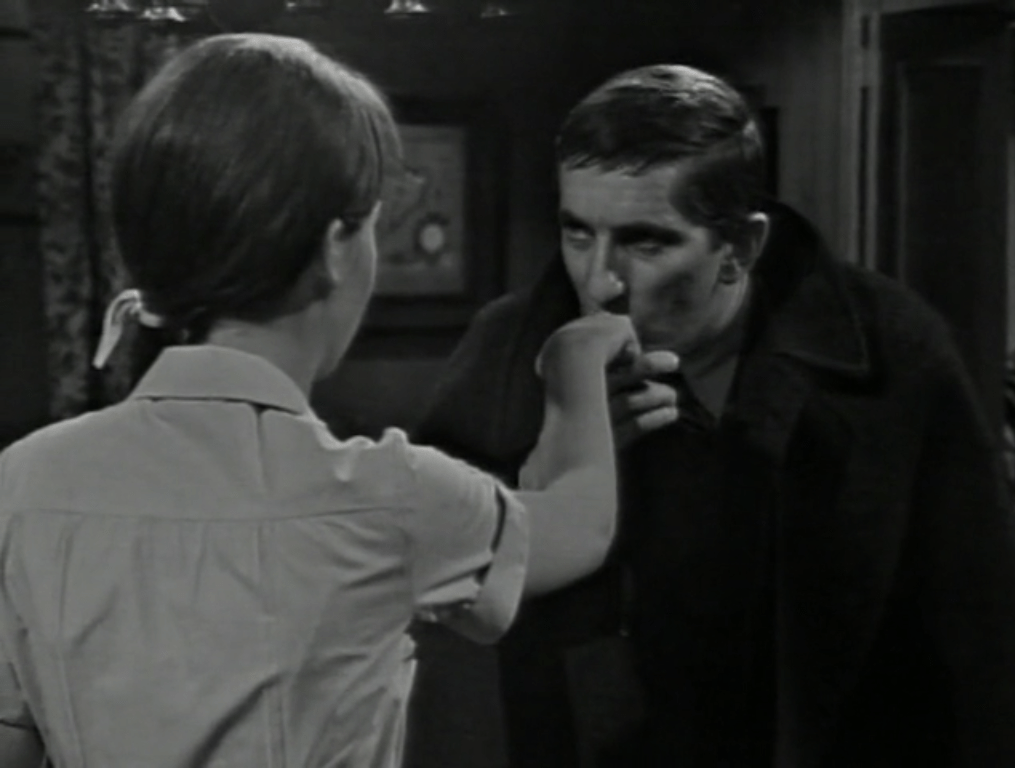
Barnabas kisses Maggie’s hand in farewell

Maggie’s boyfriend, hardworking young fisherman Joe, comes bustling into the restaurant seconds after Barnabas leaves. Maggie is surprised that Joe and Barnabas didn’t pass each other, and puzzled when Joe tells her there was no one in sight anywhere near the inn. Neither of them had heard of Barnabas before.

Joe tells Maggie that a woman named Jane Ackerman had an unpleasant run-in with a man she couldn’t see earlier in the night. The fellow retreated before doing her any serious harm, but Joe seems fairly sure that whoever it was is a real threat to the women of Collinsport. So he wants to keep Maggie company. Maggie doesn’t seem worried, either for her own sake or for Jane’s. She’s just happy to see Joe, and gladly agrees when Joe suggests they go to the local tavern, the Blue Whale.

As Dark Shadows’ principal representatives of Collinsport’s working class, Maggie and Joe illustrate the point the opening voiceover made when it said that people “far away from the great house” of Collinwood would soon be “aware of” Barnabas and of “the mystery that surrounds him.” As a name we have never heard before and are unlikely to hear again, “Jane Ackerman” reminds us that there is a whole community of people for Barnabas to snack on.

As Joe and Maggie are heading out of the restaurant, she notices that Barnabas left his precious cane behind. She wants to go straight to the Old House to return it to him. Joe would rather wait until morning, but Maggie explains that she doesn’t want to be responsible for it overnight. This is a bit odd- they are in a hotel, after all, a business that specializes in keeping valuable property safe while its owners sleep.

Perhaps Maggie wants to see the Old House. Joe has been there many times. When we saw him there with Burke, searching for well-meaning governess Vicki in #118, he mentioned that when he and flighty heiress Carolyn were children, they would occasionally play there. He returned there during the Laura storyline. Even Maggie’s father has visited the Old House, participating in a séance there in #186 and #187. Maggie has never been there at all. So perhaps she just feels left out.

Maggie and Joe knock on the doors of the Old House. No one comes. As they turn to go, there is a closeup of the door knobs turning. Maggie and Joe hear a door open, and go in. They don’t see anyone, but candles are burning and Joe remarks that the front parlor has been fixed up. Joe goes upstairs and leaves Maggie behind, explaining that he knows his way around the place and it isn’t safe up there for someone who doesn’t.

Once Maggie is alone, Barnabas appears next to her. She is startled and cannot see how he could have got there without her knowing. He apologizes for once more catching her unawares. He seems surprised that she is not alone. When Joe comes downstairs, he is exceedingly polite to both of them.

After Maggie and Joe excuse themselves, Barnabas’ blood-thrall, the sorely bedraggled Willie Loomis, appears. With obvious difficulty, Willie forces out one word after another, and manages to ask Barnabas what he plans to do to Maggie. Barnabas is displeased with Willie’s presence and with his presumption that he has the right to question him. He climbs the stairs and looks down at Willie, full of menace and demanding that he go out and do the work Barnabas has ordered him to do. Willie tries to refuse, but cannot stand the look Barnabas is giving him.

Barnabas gives Willie his orders

During this staring contest, Barnabas and Willie are standing on the spots where strange and troubled boy David Collins and Barnabas had stood when we first saw Barnabas in the Old House in #212. In that scene, David and Barnabas were more or less eye-to-eye, and for a moment it seemed that Barnabas was contemplating violence against David. In this scene, Barnabas shows how committed he is to violence. He has a power over Willie that he gained by the extreme violence of drinking Willie’s blood, and Willie’s inability to resist Barnabas’ stare shows that power in use. Willie’s horror at the task Barnabas has assigned suggests that it also is violent.

My wife, Mrs Acilius, believes that the confrontation between Willie and Barnabas solves one of the behind-the-scenes mysteries about Dark Shadows. Why was James Hall replaced by John Karlen in the role of Willie? She points out that Hall, while he is a fine actor, had a lot of trouble with Willie’s lines, particularly in the long he shared with Dennis Patrick’s Jason McGuire. By the time Willie was recast, Jonathan Frid had been attached to the role of Barnabas for some days, and Frid never made it a secret that he was a slow study. So if there were going to be a lot of long conversations between Willie and Barnabas, Willie had to be played by an actor who could get his dialogue letter perfect day after day. That was John Karlen.

After Willie scurries off to do whatever evil chore Barnabas has ordained for him, Barnabas wanders over to the window. On his way, we see that the portrait of Josette Collins is no longer hanging in the spot over the mantle where we have seen it since our first look at the Old House in #70. At the end of that episode, Josette’s ghost emanated from the portrait and danced around the outside of the house. From that point, the Old House was chiefly a setting for Josette. Crazed handyman Matthew Morgan learned that to his cost when he tried to hold Vicki prisoner there and Josette and other ghosts ganged up on him and scared him to death in #126. Laura knew that she was entering the territory of a powerful enemy when her son David took her to the Old House in #141, and when Vicki had formed a group to oppose Laura’s evil plans she and parapsychologist Dr Guthrie went there to contact Josette. In #212, Barnabas addressed the portrait and told Josette that her power was ended and he was now the master of the house. Removing the portrait tells us that Barnabas is confident that he is not only a new Collins in Collinsport, but that he is now the Collins at Collinwood.

Barnabas then does something Laura did several times- he stares intently out his window. When Laura stared out her window, David would be violently disturbed, no matter how far away he was or how many obstacles were between him and his mother. These incidents were a big enough part of Laura’s story that regular viewers, seeing Barnabas stare out the window, will expect someone at a distance from him to react intensely.

We cut from Barnabas to Joe and Maggie at her house. Joe asks what time he should pick Maggie up tomorrow, and Maggie suddenly becomes disoriented. Kathryn Leigh Scott has a sensational turn playing that moment of lightheadedness, creating the impression that she is having a scene with Barnabas. As she recovers, she explains to Joe that she has the feeling she is being stared at. Then we dissolve to Barnabas in his window. Barnabas may not be Maggie’s mother, but apparently there is some kind of link between them. Perhaps kissing Maggie’s hand in the restaurant was enough to give Barnabas the power to creep her out even when he is miles away from her.

Episode 186: An extraordinary ordinary life

Hardworking young fisherman Joe Haskell is having a drink at the bar in Collinsport’s tavern, The Blue Whale. Dashing action hero Burke Devlin enters and annoys Joe by sitting next to him. Burke and Joe had some conflicts earlier in the series, and Joe had formed a decided dislike of Burke in those days. The conflicts are no longer generating any action, so Burke has been trying to befriend Joe. Joe isn’t having it.

Burke tells Joe that he hears he has been having some adventures. Joe says that he doesn’t know what Burke is talking about, and isn’t sure he cares. Burke says that he has heard that Joe and parapsychologist Dr Guthrie went to the old graveyard north of town, opened a couple of graves, and found them empty. This is true, and since the only people who knew about it were either sworn to secrecy or strangers to Burke Joe is mystified as to how he found out.

Burke tells him that well-meaning governess Vicki told him. “Vicki wouldn’t tell you that,” says Joe. Burke explains that she had to tell him, because she needed his help. Strange and troubled boy David Collins adores Burke, and Vicki is the leader of a group who are afraid that David’s mother, blonde fire witch Laura Murdoch Collins, is going to burn David alive.

Burke dated Laura years ago, and was still hung up on her when she came back to town. He’d been urging David to get closer to his mother and to go live with her. He several times made it clear that he hoped to marry Laura and become David’s stepfather. Vicki laid out the evidence that she, Dr Guthrie, and the rest of her group have assembled in support of their view about Laura’s unearthly nature and horrifying plans. Since he heard Vicki out, Burke has joined her side.

Joe is taking all this in when we hear a tinkling sound and a muffled voice. The bartender comes to him and says “Mr Haskell, there’s a call for you.” I believe this is only the third time we’ve heard the bartender speak, after #3 and #156.

We see Joe take the call. He is shocked by what he hears. He returns to his spot and tells Burke that Dr Guthrie is dead. His car ran off the road and burst into flames.

Joe mentions Vicki and David, and Burke is alarmed at the thought that Vicki and David might have been with Guthrie. Joe calms him, explaining that Guthrie was on his way to meet Vicki and David. They, along with drunken artist Sam Evans, are waiting for Guthrie at the long-abandoned Old House on the grounds of the estate of Collinwood. They planned to hold a séance there to contact the ghost of Josette Collins, in hopes that Josette, who has been giving them hints and clues all along, will be able to tell them how to defeat Laura. Burke insists on going to the Old House with Joe.

Joe and Burke exchange all this information in normal conversational tones punctuated with shouts. We don’t see any other customers, but the bartender is right there, and while they are on the way out we even see him react to their mention of the séance.

Bob the bartender, wishing those two would keep their gobs shut

I’m sure they are relying on the bartender’s professional discretion. Still, they are catching on that Laura is extremely dangerous, participating in séances can wreck the reputation of people in the businesses Joe and Burke are in, and Joe and Guthrie’s grave-opening expedition was quite obviously something that could get them sent to jail. You’d think they would want to spare him the responsibility for so much sensitive information. It’s just inconsiderate to dump all that on a guy in return for the tips you give him for two beers.

At the Old House, Vicki, David, and Sam spend more than one scene waiting for Guthrie to show up. There is quite a bit of filler in this episode; when Sam says “I hate waiting like this!,” we can sympathize. Even after Joe and Burke show up with the news of Guthrie’s death, there is yet another scene of filler, in which Sam rants about Laura as the cause of Guthrie’s death and can’t decide whether he is willing to join Vicki and David in going through with the séance.

Of course they do go through with it. A ghost begins speaking through David, but it is not the spirit of Josette. It is David Radcliffe.

David Collins had not heard of David Radcliffe, but Vicki and others know that in 1867, Laura Murdoch Radcliffe burned herself alive with her young son David. A contemporary newspaper account reported that David Radcliffe happily joined his mother in the flames, refusing to be rescued. Vicki and her group believe that the current Laura Murdoch Collins is a reincarnation of that other Laura Murdoch, and that, as a humanoid Phoenix, she achieves a cyclical immortality by burning herself alive and rising from the ashes. They fear that Laura Murdoch Collins will take David Collins into the flames with her, and that he, like his namesake, will choose to burn to death.

They do not know whether David Radcliffe shared his mother’s immortality, or whether David Collins will rise again if he burns with his mother. The show has repeatedly identified ghosts as unquiet spirits of the dead, so David Radcliffe’s appearance as a ghost speaking through David Collins would by itself militate against the idea that Laura’s resurrections are shared by her sons. In his speech, David Radcliffe describes himself being held by his mother while the fire rages and wanting to be with her forever, but ends with an tortured cry as he asks where she has gone. In agony, David screams and collapses.

This scene is a remarkable tour de force for David Henesy, and completes the audience’s understanding of what Laura is and what danger she represents. Her son is a means to the end of her own immortality, not a partner in that immortality. That Laura Murdoch Collins gave her son the same name her previous incarnation gave to the son she killed for her own sake shows that it was her plan all along to make him a human sacrifice to her inhuman survival. If Vicki can rescue David from the fate Laura has in store for him, she will not only prolong his life, but give him an altogether new life and give him herself as the mother of that life.

So, there are two sources of suspense. First, what further obstacles will Vicki encounter on the way to rescuing David, and what will be lost as she makes her way through them? There might be further deaths- Guthrie might have been the most readily disposable character on the show at the end of last week, but there are several others without whom Dark Shadows could go on just fine. There could also be lots of changes in relationships among characters, or in the personalities of characters we like as they are.

That brings us to the second source of suspense. It is a question that has been on the minds of regular viewers since the Phoenix story began approaching its climax. What will the show be about once Laura is gone? The only consistently interesting relationship on Dark Shadows so far has been that between Vicki and David, and once Vicki has established herself as David’s de facto mother that is going to be defined pretty securely. There might be periodic threats to their friendship, but once Vicki has managed to replace David’s mother there won’t be much doubt that she can overcome any lesser disruptions.

Art Wallace’s original story bible for the series, Shadows on the Wall, called for Laura Robin Collins to die under mysterious circumstances and for Vicki to be put on trial for her murder. That does not sound promising. We’ve spent months of episodes, most of them dismally slow-paced, figuring out information about Laura. Most of the characters now know as much about her as we do. An entire narrative arc spent rehashing what they’ve already rehashed beyond endurance would be impossible for even the most devoted fans to watch.

Vicki is to some extent based on Jane Eyre, a governess who ends by marrying her charge’s father, Mr Rochester. David’s father is named Roger, which is as close as they could get to “Rochester” without making people miss Eddie Anderson. They brought up the idea of Vicki and Roger going on dates in #72, #78, and #96, but in each case Roger was merely trying to keep Vicki from making trouble for him, very possibly by killing her.

Further, the show has been hinting very heavily from the first day that Roger is Vicki’s uncle, the biological daughter of his sister Liz. Wallace McBride mentions the single most compelling piece of evidence:

In Dark Shadows, your reflection always tells the truth.

Duality was a series theme from the very first episode, which implemented a shocking amount of symbolism in its photography. As a daily series, it was never designed to withstand the scrutiny of re-runs, let alone the far-flung fantasy concept of “home video.” The series was as disposable as a newspaper, something to be enjoyed for a few minutes and then forgotten. The writers and directors of Dark Shadows did not get that memo, though, and set about creating afternoon entertainment that was more psychologically complex than it had any right to be.

The first episode established this dynamic immediately. Victoria Winters is riding on a train through the night, her reflection in the glass beside her. We discover that she’s a “foundling,” anonymously abandoned to the state as an infant. She’s traveling to Collinsport, Maine, to take a job — and to learn the truth about her own mysterious past.

In other words, she’s looking for the real Victoria Winters — represented throughout this episode by her own reflection. We see Victoria reflected back in the window of the train carriage, the mirror in the restaurant of the Collinsport Inn, and in a mirror (in a flashback!) at her bedroom at the foundling home.

Most telling is the reveal in the episode’s final scene. When she arrives at her destination, the doors of Collinwood open to show Elizabeth Collins-Stoddard standing in the entrance, looking very much like Victoria’s reflection. (For me, this is all the evidence I’ve ever needed that Liz was Victoria’s mother.)

In Dark Shadows, Your Reflection Always Tells the Truth.” Wallace McBride, Collinsport Historical Society, 18 April 2020

Among soap opera characters, attempted murder is frequently a prelude to romance, and an engagement between two people who are, unknown to themselves, closely related can build suspense as we wonder whether a third person who does know the truth will tell before it is too late.

But as Roger’s character develops it becomes ever clearer that he is not interested in marrying anyone. He is a narcissist, a coward, and devoid of family feeling. Worst of all, he’s spent all of his money. If she marries him, Vicki will either join him as his sister Liz’ charity case or get a blue-collar job and support him in a style to which he has no conceivable intention of becoming accustomed. That might work on another show, but it doesn’t sound at all right for Dark Shadows.

There are some odds and ends lying around from previous storylines, but those didn’t take off the first time we saw them and aren’t likely to be any more exciting now. Why is Liz a recluse? They haven’t shown us anyplace she’d be interested in going. Will Burke be avenged on Roger? Not if it requires writing Roger off the show- he’s hilarious. Will Joe marry Maggie Evans, The Nicest Girl in Town and daughter of Sam? Why not, they’re happy together and no one is against it. Will a serious romance blossom between Vicki and instantly forgettable young lawyer Frank? That’s such an urgent question that no one has noticed Frank isn’t on the show anymore. There just isn’t an episode’s worth of story in any of those questions. You may as well ask whether any more of Burke’s custom-made fountain pens will show up in town, or what happened to the dartboard Roger used to have in his office, back when he had an office.

Once it finishes with Laura, Dark Shadows is going to need a reboot. Both Laura’s storyline and the one that immediately preceded her, that of crazed groundskeeper Matthew Morgan, led us into the supernatural back-world of the show’s universe. That’s clearly where Dark Shadows 2.0 will be heading, and probably in a way too dynamic for the wispy presences of Josette and the Widows to survive. There may also be an attempt to mine some of the leftover pieces from Shadows on the Wall, but it’s hard to see how anything in there will get you very far.

Episode 183: Listening to reason

Blonde fire witch Laura Murdoch Collins opens the front door of the great house of Collinwood. Housekeeper Mrs Johnson intercepts her. Laura wants to see her son, strange and troubled boy David Collins. Mrs Johnson tells her that David has gone to town with well-meaning governess Vicki to buy shoes. Laura objects that she was supposed to take David to get new shoes, and is quite upset that Vicki has taken this from her. She is even more upset when Mrs Johnson says she is under orders to keep David in the house unless he is with Vicki or flighty heiress Carolyn. Laura asked who gave those orders, and is shocked to hear that it was her estranged husband, high-born ne’er-do-well Roger.

Laura shouts for Roger, who comes downstairs to see her. In the drawing room, she demands to know why he is keeping David from her. At first he repeats Vicki’s old line that David is falling behind in his studies, but when Laura dismisses this he tells her that he is suspicious of her because of all the strange goings-on that started when she came back to town. They quarrel about this for some time, and Roger holds his ground.

Laura goes to the Collinsport Inn, where her ex-boyfriend, dashing action hero Burke Devlin, is in residence. Burke also refuses to help her. He tells her that she is not at all the same person he was in love with ten years before. She protests that everyone gets older, and he says it isn’t that. She has somehow become a stranger to him.

Yesterday, visiting parapsychologist Dr Guthrie had laid out the case against Laura to Roger, while Vicki presented the same facts to Burke. Roger resisted until the ghost of Josette Collins intervened to present him with some particularly hair-raising information. Today, we see that Josette and Guthrie have combined to carry their point, and have enlisted Roger in the fight against Laura.

After Vicki had told Burke why she regards Laura as a threat to David, Burke had said that he thought he ought to go along with her request that he stop urging David to leave with his mother. But he admitted that Laura has such a strong emotional effect on him that he couldn’t promise that he would be able to follow that resolution. In the scene between Burke and Laura, Burke alternately gives Laura hard stares and avoids eye contact altogether, turning his back on her and edging away whenever possible. Returning viewers will appreciate the effort he is making to keep his feelings from overwhelming him. By the time the scene ends, the two most important men in David’s life are both on the team opposing Laura.

Laura loses her last ally, Burke breaks his own heart

Back at Collinwood, Guthrie talks briefly with Roger. For the first time, Roger speaks respectfully to Guthrie, whom he has always before disdained as a quack. Roger leaves, and Guthrie has a few words with Mrs Johnson. Mrs Johnson mentions that when she was cleaning the cottage where Laura is staying, she made a move to extinguish the fire in the hearth. Laura responded with terror, frantically demanding that she leave the fire alone. At this news, Guthrie decides to pay a call on Laura.

In the cottage, Guthrie says that it is very warm and makes a move to put the fire out. He observes Laura’s panicked reaction. He asks her why fire is important to her; she says she merely dislikes cold rooms. He asks if she derives a power from fire; she says she doesn’t know what he’s talking about.

Laura asks Guthrie if he is the one who talked Roger into keeping her from seeing David. Guthrie says yes. She asks why, and he tells her he thinks she is a danger to her son. She asks what danger she could be to David, and he asks her who she really is. When he says that she is not the woman Roger married, she ridicules the idea that an impostor could fool all the people who have identified her as Laura. He says that he doesn’t mean that she is an impostor. When she asks what he does mean, he asks if she really wants him to say the words. She says yes. He tells her “You, Laura Murdoch Collins, are the undead.”*

*If I recall correctly, that marks the first time the phrase “the undead” is spoken on Dark Shadows.