A cult devoted to the service of supernatural beings known as “the Leviathan people” is secretly establishing itself in and around Collinsport, Maine. Antique shop owners Megan and Philip Todd are members of the cult. Its acting leader, old world gentleman Barnabas Collins, has entrusted them with several items sacred to the cult. The Todds are responsible for a scroll, a box, a book, and a baby. Now the book has gone missing, and the baby is sick. Yesterday, Barnabas responded to this situation by brainwashing Philip into killing Megan. Today, we open with Philip entering the antique shop and choking Megan.
Megan is Marie Wallace’s third character on Dark Shadows. Her first, fiancée of Frankenstein Eve, was strangled by her intended spouse Adam in #626. Her second, madwoman Jenny Collins, was strangled by her estranged husband Quentin in #748. The murder of Eve came at the end of the Monster Mash period of the show that stretched throughout most of 1968, while the murder of Jenny marked a turning point in the eight-month costume drama segment set in the year 1897. The Leviathan arc is just beginning, and Miss Wallace’s character is already being strangled by her husband. If we were hoping for fresh new story ideas, we couldn’t be more disappointed.
Until, that is, the strangulation is called off. Philip is holding Megan by the neck, reiterating that “There is no margin for error! Punishment is necessary!,” when strange and troubled boy David Collins appears on the staircase and announces “punishment is no longer necessary.” Philip releases Megan, and David informs them that he is now “the keeper of the book, and the protector of the baby.” He gives Megan and Philip medicine that will cure the baby of his illness. He tells them that if they need him, he will know and will appear.
Barnabas was a vampire when he joined the cast of characters in April 1967. As a villain he was unrivaled at giving everyone else things to do, whether as his victims, his accomplices, or his would-be destroyers. In March 1968, his curse was put into abeyance and he became human. He set out to be the good guy, but still had the personality of a metaphor for extreme selfishness. As a result, Barnabas the would-be hero created at least as many disasters as Barnabas the monster ever did. He thus remained the driving force of the show, as well as its star attraction.
While Barnabas can keep things going from day to day, Philip’s attack on Megan suggests that he cannot take the story in new directions. From episode #1, that has been David’s forte. The series began when well-meaning governess Vicki was called to Collinwood to take charge of David’s education, took its first turn towards grisly tales when David tried to murder his father, became a supernatural thriller when David’s mother the undead blonde fire witch came back for him, began its first time travel story when Barnabas was planning to kill David in November 1967, and was launched into both the “Haunting of Collinwood” that dominated the show from December 1968 through February 1969 and the 1897 segment that followed it by David’s involvement with the ghost of Quentin Collins. David was not always a highly active participant in the stories that began with him; indeed, he sometimes disappeared altogether for months at a time. But even from the outside, he is the instrument by which the basic architecture of the show is reshaped. Now that he is, apparently, the leader of the Leviathans, we can renew our hopes that something we haven’t seen before is still in store for us.
David is still in the shop when a gray-haired man enters. David greets him as “Mr Prescott,” the name by which he heard his cousin Carolyn address the man when he met her in the shop the other day. David has a smug look on his face that suggests he knows this is an alias. Indeed, we already know that the man is connected with the Leviathan cult, so the leader of the cult may well recognize him as Paul Stoddard, Carolyn’s long-missing father.
Paul asks the Todds to give a note to Carolyn. David says that he will be going home to the great house of Collinwood in a few minutes, and volunteers to take the note to her there. Paul gladly hands it to him.
At Collinwood, permanent houseguest Julia Hoffman is conferring with mysterious drifter Chris Jennings. Yesterday, Jenny’s ghost appeared to Chris and told him that Quentin could help him with his big problem, which is that he is a werewolf. Jenny did not identify herself, and Chris had no clue who she was.
Julia shows him a Collins family photo album. She shows him a picture of maidservant Beth Chavez and asks if that is who he saw. He says it wasn’t, and they keep turning pages. It is interesting for regular viewers that they take a moment to put Beth’s picture on the screen and to make some remarks about her. Beth appeared several times during the “Haunting of Collinwood” segment, and was a major character during the 1897 flashback. The sight of her picture is the first reason we have had to suspect that either she or actress Terrayne Crawford will be back.
Chris and Julia look through a Collins family photo album. Screenshot by Dark Shadows Before I Die.
When Chris recognizes Jenny’s picture, Julia breaks the news to him that Jenny and Quentin were his great-grandparents, and that Quentin was the first to be afflicted with the werewolf curse. We know that Quentin and Jenny’s daughter was named Lenore, and that she was raised by a Mrs Fillmore. Chris confirms that his grandmother’s maiden name was Lenore Fillmore. Wondering how Quentin could help Chris, Julia decides they will hold a séance and contact Quentin’s spirit.
David enters, looking for Carolyn. Julia asks him to participate in the séance. He agrees, with the blandness appropriate in a house where séances have become almost routine. When Julia tells him that the spirit they are trying to reach is that of Quentin Collins, David becomes alarmed. As well he might- we left 1969 at the beginning of March, but in #839, broadcast and set in September, we saw that the haunting continued in the absence of the audience, and that Quentin’s ghost had killed David. That episode took place on the anniversary of an event in 1897 that was changed by time travelers from the 1960s, and so David came back to life and the haunting ended. But everyone at Collinwood still remembers the ten months that Quentin exercised his reign of terror, and David does not want to return to it.
Julia assures David he has nothing to be afraid of. She says that the past was changed as of September 1897/ September 1969, and that Quentin’s ghost was laid to rest forever. This doesn’t fit very well with her plan to disturb that rest, but David is still ready to go along with the plan.
When they have the séance, David goes into the trance. He speaks, not with Quentin’s voice, but with that of Jamison Collins, his own grandfather and Quentin’s favorite nephew. Jamison says that Quentin’s spirit is no longer available for personal appearances. He doesn’t know more than that, and excuses himself. When David comes to and asks what happened, Julia says she will tell him later and sends him to bed. Once he is gone, she tells Chris that she thinks Quentin may still be alive.
Quentin was a big hit when he was on the show as an unspeaking ghost during the “Haunting of Collinwood,” and became a breakout star to rival Barnabas when he was a living being during the 1897 segment. So the audience is not at all surprised that he will be coming back. But David’s behavior before, during, and after the séance is quite intriguing. He is not simply possessed by some spirit that is part of whatever it is the Leviathan cult serves. He is still David, is still afraid of Quentin’s ghost, and is still fascinated by séances. During the 1897 segment, Jamison was a living being; like David Collins, he was played by David Henesy. That Jamison can speak through his grandson and not express discomfort at the unfamiliarity of the atmosphere suggests that there are sizable expanses inside David which are still recognizably him.
There is a similar moment between Philip and Megan. She smiles at him and in a relaxed voice says she understands why he had to do what he did. Philip has no idea what she is talking about. She reminds him that he tried to strangle her earlier in the evening, and he suddenly becomes highly apologetic. She tells him he has nothing to apologize for, that it was his duty as a servant of their cause. He is still anguished about it. They share a tender embrace. Again, while the force that animates the Leviathan cult may have the final say over what Megan and Philip do, their personalities are still there, and the loving couple we met a not so long ago still exists. There is still something for us to care about concerning them.*
Paul also has a lot of activity today. He goes to the cairn in the woods that is the ceremonial center of the Leviathan cult and that only people associated with it can see. He wonders why he keeps being drawn to it. When he first returned to Collinwood in #887, he was watching when the cairn materialized in its place out of thin air. He didn’t react at all, but merely turned and continued on his stroll. That led us to believe he knew a great deal about the cult, enough that he not only expected to see this extraordinary sight, but knew he need take no action regarding it. But evidently his connection is more subtle, and he does not understand it himself.
In his hotel room, Paul goes into a trance and circles the date 4 December 1969 on his calendar. That was when the episode was first broadcast, so the original audience would have assumed he was merely circling the current date. But when it was taped, the makers of Dark Shadows had expected the episode to be shown on 3 December. In between, there had been a pre-emption when the ABC television network gave its news department the 4:00 PM timeslot to cover the end of the Apollo 12 lunar landing mission. So the intention had been that we would share Paul’s puzzlement as to what was so special about the next day.
Paul is already worked up because some unknown person left him a note at the antique shop reading “Payment Due, 4 December 1969.” By the end of the episode, he notices that a tattoo has appeared on his wrist. It is a symbol that the show refers to simply as “the Naga,” a group of intertwined snakes that represent the Leviathan cult. All of this combines to get him into quite a state.
* I should mention that Danny Horn made the same point in his post about the episode on his great Dark Shadows Every Day: “And then they kiss, and the creepy thing is that I think they’re actually in there… So far, I’ve been critical of Chris Bernau, but he’s the one who pulls this moment together. As far as he’s concerned, the unpleasant incident is entirely forgotten — but when Megan brings up the fact that he was seconds away from killing her, his apology is entirely sincere.” Danny Horn, “Episode 989: Executive Child,” on Dark Shadows Every Day, 12 July 2016.
Dark Shadows committed itself to supernatural stories in late 1966 and early 1967, when the chief villain was undead blonde fire witch Laura Murdoch Collins. Since the usual laws of nature weren’t going to restrain Laura, they needed another set of rules that could predict her behavior sufficiently to create suspense. One of the things they settled on was that the barrier between past and present grows thin on the anniversaries of deadly events. So when well-meaning governess Vicki and the team she had assembled to fight Laura discovered that, in a previous iteration, she had taken a young son of hers to his fiery death “exactly one hundred years ago,” they knew that the crisis was at hand.
Anniversaries continued to have this effect in subsequent periods. So when in January 1969 recovering vampire Barnabas Collins wanted to take a day trip to the 1790s, he stood in a graveyard and shouted at a man who had died exactly 172 years previously to ask for a ride. It worked.
Barnabas was using a different form of mumbo-jumbo at the end of February, trying to contact the ghost that had made the great house of Collinwood uninhabitable, when he came unstuck in time and found himself in the year 1897.
In the middle of Barnabas’ long stay in 1897, the show decided to take its conceit that two events occurring on the same date in different years were mystically connected and show us both sides of the link. In #835, Barnabas was locked up in a cell with a secretary cabinet that he knew would be in the front parlor of his home, the Old House at Collinwood, in 1969. He wrote a letter to his friend, mad scientist Julia Hoffman, and hid it in a secret compartment of the secretary. We cut to the front parlor in 1969, exactly 172 years later, where a series of events leads Julia to discover the letter, travel back in time, and precipitate Barnabas’ rescue.
By #839, the events of 1897 had played out differently enough from whatever happened the first time through that year that the ghosts found peace. As we cut back and forth between that year and 1969, we saw that the 1960s characters remembered the haunting and the disasters that accompanied it and were relieved that they were over.
That gives us the present as the result, not of any one series of events in the past, but of a composite of many separate and mutually incompatible pasts. This idea is the logical culmination of substituting anniversaries for natural laws. In the first part of Barnabas’ trip to 1897, he had not yet done enough to lay the ghosts to rest. So the haunting continued, because it was happening on the anniversaries of events that were much the same as those that took place originally. By the time the living people of 1897 who would become the ghosts of 1969 had changed enough that they were no longer doomed to haunt the house, the date was one that would fall almost ten months into the haunting. In #836, Julia had a conversation in which one of the ghosts tells her about events in 1897 that could not have happened in the original timeline without Barnabas’ intervention, and which do not happen in #838 after Julia herself travels to that year. So each anniversary creates another past that becomes another ingredient in the stew that makes up the present.
This conception of the relationship between past and present shows the difference between a set of fantastic tales like Dark Shadows and a science fiction story exploring more-or-less plausible consequences of open questions in science. The “Copenhagen Interpretation” of quantum mechanics posits that the cosmos is made up of countless parallel universes, and that everything that could ever have happened did happen in at least one of those universes. Since that is a defensible position within science, an author can incorporate as much fact and reality as s/he likes in a story based on it. But since the idea that one period of history is the result of a confluence of many conflicting pasts is not only not a live option in science, but does not really make any practical sense except as a metaphor, the logic that really matters is dream logic. As dreams seem perfectly convincing to us when the only connections that lead from one moment to another are random similarities in names or shapes, so all that matters in a fantastic tale is that there is a pattern the audience can follow, whether or not that pattern corresponds to anything in the world where we spend our waking hours.
Now Barnabas has returned to 1969, brought back by a mysterious cult that has brainwashed him and adopted him as its leader. The characters he knew before he left are delighted to see him again. Today, matriarch Elizabeth Collins Stoddard comes to the Old House and is overjoyed that the haunting is over and that she and her family have been able to return to the great house. She is grateful to Barnabas for undertaking his harrowing journey back in time.
Liz and Barnabas talk about Chris Jennings, a young man in whom Liz’ daughter Carolyn is interested. Barnabas gives it as his firm opinion that Carolyn should avoid Chris, and he urges Liz to encourage her to do this. Barnabas knows that Chris is a werewolf, and we saw last week that the cult that has co-opted him has plans for Carolyn which do not include her death as one of Chris’ victims, so this will not surprise returning viewers.
Chris himself is another example of the weird metaphysics the show has stumbled upon. When Barnabas left 1969 for 1897, Chris was in his wolfish form all the time, apparently never to become human again. We learned during the 1897 segment that his lycanthropy is a curse inherited from his forebear, Quentin Collins. The version of 1897 we saw was changed sufficiently from the original that Quentin avoided his own death and was for a time relieved of the effects of the werewolf curse, though at the end of the segment it looked like they might be on their way back. That he is now human part of the time but still subject to transformation suggests that the difference in Quentin’s experiences in the later part of the 1897 stories had some effect on him. It’s unclear whether Chris’ condition fluctuated every time the date marked the 72nd anniversary of something happening to Quentin that hadn’t happened when he was living in a Barnabas-free zone, but it wouldn’t contradict anything we’ve seen if it did.
The Time to Come
Barnabas brought one object back with him from the past, a wooden box. The box must be opened only at a certain time, by certain people, for the cult’s plan to take effect. Today, Barnabas receives a visit from the people. They are Megan and Philip Todd, owners of the new antique shop in the village of Collinsport. Carolyn sent them, thinking that Barnabas would likely have some things they could add to their inventory. He sees that Megan is wearing a necklace with a symbol representing intertwined snakes, which Barnabas calls a “Naga.” When Megan is unable to explain just how she came into possession of the necklace, he shows them the box, which is topped with an oval in which the same symbol is carved. They are both thrilled at the prospect of buying the old furniture he has in the upstairs rooms of his house, but Megan is particularly fascinated by the box.
Later, Philip and Megan are back in their shop. They are confident they can buy a great deal of furniture from Barnabas, but are also sure that they wouldn’t be able to afford the box, even if he were willing to part from it. This is a bit odd- we get a good look at the box, and it is absolutely nothing special. The actors manage to sell the scene, but it would be better if they had either invested in a showier prop or been more sparing about putting it on camera.
Barnabas comes to the shop and gives Megan and Philip the box as a present. After he goes, Megan is overwhelmed by an urge to open the box, which is locked. She is so consumed by this urge that she actually says “Let’s force it!” Since they had just minutes before been talking about it as if it were more expensive than anything they have for sale in their shop, this is a startling line. But when Philip opens the envelope Barnabas left to look at the list of furniture he is willing to sell them, he finds a key.
Philip is reluctant to open the box, having a strange feeling that if they do, nothing will ever be the same for them again. The other day it was Megan who had a strange feeling of impending doom. She wanted to sell the shop and flee Collinsport forever, lest they suffer an irretrievable disaster. That time it was Philip’s turn to urge her to set her misgivings aside. We’ve seen this kind of back and forth before. At the end of 1968, the great house of Collinwood was coming under the control of ghosts. Children Amy Jennings and David Collins kept trading the roles of possessed agent of the ghosts and unwilling sidekick. That alternation showed that the ghosts were not yet powerful enough to possess both children at once, and it faded as the haunting became more intense. It built suspense by suggesting that possible avenues of escape were gradually but inexorably closing.
As Philip and Megan begin to open the box, there is a whistling sound. They are unsettled, but decide they have to finish opening it anyway. They do, and we see their reaction to whatever is inside. Longtime viewers have seen similar reactions as cliffhangers many times; always before, they have indicated amazement that the container is empty.
New People
One of the less appealing villains of the 1897 segment was magically gifted artist/ surly criminal lowlife Charles Delaware Tate. Tate lived in a house that in the parts of Dark Shadows set in the 1960s was known as “the Evans Cottage,” home to drunken artist Sam Evans and his daughter Maggie, The Nicest Girl in Town. The cottage burned down in #883, leading us to wonder if it would still be there when the show returned to 1969.
Sam died last year, and Maggie now lives at Collinwood, where she is David and Amy’s governess. Today she goes to the cottage to prepare it for some tenants to whom she will be renting it. Evidently it must have been rebuilt before the Evanses moved in.
The only movable property in the cottage is a portrait of Maggie’s mother which her father painted. That portrait also appeared in the cottage a few times when Tate was living there; that was just carelessness on the part of the production staff, but it is kind of reassuring to see it again.
A man who has been in a couple of episodes knocks on the door. He identified himself as a friend of Sam’s and is saddened to hear of his death. He enters and asks Maggie to do him a favor. He keeps refusing to give her his name. We haven’t heard his name at all; evidently his identity is supposed to be a mystery to us. Word of that apparently did not reach the department responsible for making up the credits; they’ve been billing actor Dennis Patrick as Paul Stoddard, whom regular viewers know as the long-missing husband of matriarch Liz and father of Carolyn. They do that again today.
This is the last time we will see the Evans Cottage. In 1966 and 1967, the set was a symbol of the village of Collinsport, and scenes there showed the consequences that the doings of the rich people in the big house on the hill had for the working class who live in its shadow. By the time Maggie moved into Collinwood, they had long since given up on those kinds of stories. Dark Shadows is sometimes called “Star Trek for agoraphobes”; as we go, less and less of the action takes place anywhere other than Collinwood, and eventually they won’t even let us outside.
Liz agreed to let Barnabas live in the Old House in #218; by #223, she was talking about it, not only as his home, but as if he owned it and its contents. For while they went back and forth on the question of Barnabas’ legal status regarding the property, but when, at the suggestion of Liz’ daughter Carolyn, he gives the Todds a list of its furnishings that he is prepared to sell to them, I think we can take it for granted that Liz no longer has any claim on it.
In #701, broadcast at the beginning of March 1969, recovering vampire-turned-bumbling protagonist Barnabas Collins was trying to solve some problems his distant cousins were having, and inadvertently came unstuck in time. He found himself in the year 1897, where his vampirism was once more in full force. Barnabas spent the next eight months in that year, precipitating one disaster after another around the estate of Collinwood and the village of Collinsport.
As summer gave way to fall of 1897, Barnabas’ friends managed to put his vampirism back into remission. In #844, he met Kitty Soames, the dowager countess of Hampshire. Despite what her title would suggest, Kitty was an American woman in her twenties. Barnabas recognized her as the reincarnation of his lost love Josette. In February of 1796, Josette found out that Barnabas had become a vampire and that he wanted to kill her and raise her from the dead as his vampire bride. She flung herself to her death from the cliff on Widows’ Hill rather than let him do that to her.
In the eight weeks following Kitty’s first appearance, Josette’s personality irrupted into her conscious mind more and more frequently. Josette wanted to live again and to be with Barnabas. By last week, Kitty could hear Josette’s voice talking to her through the portrait of her that hangs in the Old House on the grounds of Collinwood. Josette suggested that if Kitty stopped resisting her, the two of them could both live, resolving themselves into a composite being.
In Thursday’s episode, the boundary between Kitty and Josette had become very indistinct. As Kitty, she agreed to marry Barnabas that night, later to wonder why she had done so. She was holding Josette’s white dress in her hand and struggling with the idea of putting it on when she abruptly found herself wearing it. Barnabas entered the room just in time to see her bodily assumed into the portrait. He reached up to the moving image of Kitty overlaid on the painted likeness of Josette, and both he and Kitty vanished at the same instant.
In Friday’s episode, Barnabas found himself lying on the ground, wearing clothes he had last put on in 1796. He learned that it was the night of Josette’s death. He is a vampire in this period, but he is confident he can again be free of the effects of the curse. He does not want to kill Josette, but to take her back to 1897 with him. His efforts to that end were not at all successful, and Friday ended with her on the edge of the cliff. She hears footsteps, which she and the audience have every reason to think are Barnabas’. If she sees him, she is prepared to jump.
Neither Kitty’s assumption into the portrait nor his own translation to 1796 prompt Barnabas to ask a single question about what forces are at work around him. Regular viewers would not expect him to. He lives in a universe where time travel is easy. Not only did he travel from March 1969 to 1897 without even trying to do so, but in #661 he managed to get from January 1969 to 1796 by standing in a graveyard at night and shouting for one of the residents to give him a ride. And in #365, he was present at a séance where the ghost of his little sister Sarah, speaking through well-meaning governess Vicki Winters, said that she would “tell the story from the beginning.” Vicki then vanished from the circle and Sarah’s governess, Phyllis Wick, materialized in her place. For the next four months the show was a costume drama set in the 1790s, where Vicki flailed about helplessly while Barnabas became a vampire, Sarah died of exposure, and Josette jumped off Widows’ Hill.
Barnabas and we also know that portraits are powerful in the universe of Dark Shadows. When he is in full vampire-mode, he communicates with his victims and potential victims through a portrait of him that hangs in the foyer of the great house of Collinwood. Much of the action in the 1897 segment had to do with a magical portrait that keeps Barnabas’ distant cousin Quentin from turning into a werewolf. Quentin had a romance with Amanda Harris, a woman who came to life when another magical portrait was painted.
Barnabas knows, not only that portraits in general have power, but also that Josette’s portrait in particular is powerful. In his second episode, #212, he went to the Old House and talked with strange and troubled boy David Collins, who often communed with Josette through her portrait. After David left him alone there, Barnabas addressed the portrait and told Josette that she would no longer function as the tutelary spirit of the Collins family. At that point Josette was supposed to be Barnabas’ grandmother who sided against him in a fateful family battle, but even after she was retconned as his lost love he felt the portrait’s power. So in #287, Vicki had invited herself to spend the night at Barnabas’ house. While she slept, Barnabas entered the room, intending to bite her. But he looked at the portrait of Josette and found that something was stopping him from doing so.
Barnabas would not have any way of knowing it, but in #70 Dark Shadows‘ first major special effect came when we saw Josette’s ghost take shape in front of her portrait and take three steps down from it to the floor of the room where it was hanging then, the front parlor of the Old House. She then turned, looked at the portrait, and went outside, where she danced among the columns of the portico. Longtime viewers will see Kitty’s assumption into the portrait as a reversal of this momentous little journey.
Most people nowadays who have been watching the show for some time will therefore take the strange goings-on as much in stride as Barnabas does. But viewers at the time may have had a different reaction. Friday’s episode and today’s originally ended with announcements over the closing credits. These announcements were not on the original master videotapes from which Amazon Prime Video and Tubi and the other streaming apps take their copies of the episodes, and so most viewers these days don’t hear them. But evidently one of the DVD releases reproduces them as they were preserved on some kinescopes. One promises that in Tuesday’s episode “one of the most terrifying tales ever told” will begin; the other, that it will be “one of the most unusual tales ever told.”
A terrifying tale suggests a mighty villain. By the end of the 1897 segment, all the villains have either turned into protagonists, as Barnabas, Quentin, and wicked witch Angelique had done; been heavily defeated, as sorcerer Count Petofi had been; or were dead and forgotten. So “one of the most terrifying tales ever told” would seem to require a new villain, or perhaps a new group of villains. And if it is also “one of the most unusual tales ever told,” those villains will have to be strikingly different from anything we have seen before.
So, having heard those announcements, we will be less inclined to chalk Barnabas’ latest adventure in anachronism up to the usual way things are on Dark Shadows. We will be looking for signs that some previously unknown and hugely formidable malevolent force is luring him into a trap.
At first, no such signs seem to be forthcoming. The footsteps that alarm Josette turn out not to be Barnabas’, but those of her aunt, the Countess DuPrés. The countess talks Josette down and takes her back to the great house of Collinwood. Having saved Josette’s life, the countess takes her to a room occupied by fluttery heiress Millicent Collins. The countess asks Millicent to sit with Josette while she runs an errand.
Millicent means well, but always makes everything hilariously worse. Seeing that Josette is shaking, she observes that she is suffering a shock. She asks very earnestly “Was your shock a romantic one?” Josette responds by wailing. Millicent keeps talking about the dangers of love, causing Josette to get more and more upset. Longtime viewers will remember that Millicent will turn from a comic figure to a tragic one soon after this, when she falls in love with an evil man. That tinges our reaction with sadness, but Millicent’s total insensitivity to the effect she is having on Josette makes for an effective comedy scene. No matter how much the oblivious Millicent is worsening Josette’s mood, this hardly seems likely to be part of a grand evil scheme.
It turns out that the errand the countess had to run was a visit to Barnabas, who is waiting in Josette’s room. This time Barnabas has actually had a sensible idea. Rather than go to Josette on top of the cliff as he did the first time through these events, he asked the countess to go. The countess confronts him about his status as a walking dead man. Barnabas will not explain- how could he? He asks the countess if she thinks he is a ghost; she does not answer. He insists on seeing Josette; she says she will not allow it. He says he does not want to force her to help him; she declares that he cannot force her. Finally, he ends the exchange by biting her.
The countess goes to Millicent’s room and tells Josette to go back to her own room. Millicent is surprised the countess doesn’t go with her, protesting that Josette is in no condition to be left alone. The countess responds numbly.
The countess is one of three characters we have so far seen Grayson Hall play. The first, mad scientist Julia Hoffman, offered herself to Barnabas as a victim in #350; he declined the offer. Julia was motivated by a mixture of despair over the failure of her first attempt to cure Barnabas’ vampirism, an obligation to prevent him harming others, and her own unrequited love for him, so she was disappointed when he said no. The other, broad ethnic stereotype Magda Rákóczi, told Barnabas to “Bite me!” when they were at the grave of her husband, his onetime blood thrall. He refused to do that, too. Magda was angry and defiant, wanting to get something horrible over with, so her reaction was more ambiguous. The countess didn’t know Barnabas was a vampire until his fangs were in her neck, so she is just dazed.
That Hall’s other characters expected Barnabas to bite them, and in Julia’s case hoped he would do so, shows that no new force is needed to explain why he bites the countess. And bad as a vampire’s bite is, from what we have seen in previous segments of the show we can be sure that the countess will forget all about her experience as Barnabas’ victim once he leaves. Besides, when he came back in time in January Barnabas triggered a chain of events that led to the countess’ death- we can assume that whatever he has put in motion this time will have a different outcome for her. So while the bite still has its echoes of rape and is therefore a horror, it in no way shows the presence of any fresh villain that is about to set off “one of the most terrifying tales ever told.”
Josette is in her room. The secret panel opens, and Barnabas enters. She is shocked to see him. He assures her that he does not want to kill her and raise her as his vampire bride; after a bit of prodding, she gets him to admit that this was, at one point, his plan. He starts explaining to her that he has come to her after a sojourn in the 1890s. She reacts with disbelief and confusion. He keeps talking. He asks her if she remembers Kitty Soames. At first the name does not ring a bell, but as he goes on she recognizes what she had thought to be a dream in which she was talking with her portrait. He tells her that it was no dream, but that just a few hours before they were together in that other century.
Finally, Barnabas persuades Josette to meet him at the Old House. He says they must go separately, since he has to go to his friend Ben Stokes and ask him to stand guard for them while they disappear into the portrait. She wants to say goodbye to her aunt the countess, and Barnabas tells her to write a note. They kiss passionately. One wonders if Josette notices the taste of her aunt’s blood on Barnabas’ lips.
Barnabas’ decision to go to Ben and send Josette to the house on her own doesn’t make much sense. This is the first we have heard they need someone to stand guard, and there is no apparent reason why they should. Moreover, the countess is right there in the house with them, and she is under Barnabas’ power. The three of them can go to the house together, Josette can say goodbye to her there, and if they need someone to stand guard she can do it. Afterward she can tell Ben what she saw and tell lies to anyone else who has questions about where Josette went. Besides, regular viewers of Dark Shadows know that when two people are supposed to go to a place separately, they never actually meet there. A smart character who understood how things work in this universe would know that Barnabas’ decree that he and Josette must take their own paths to the house means that they are doomed. But contrary to the glimmers of brainpower Barnabas showed earlier, he has never been that smart. He is so much a creature of habit that his decision to send Josette to the Old House by herself bears no traces at all of any outside influence, least of all the influence of the new villain we are looking for.
Barnabas is on his way across the grounds of Collinwood to meet Ben when it dawns on him that he is lost. This is the first thing he has done today that is out of character. He has been on the estate for centuries, and knows it surpassingly well. He looks around and sees a cairn, a large stone structure. The cairn has a flat surface in the middle and is flanked with torches and decorated with carvings resembling coiled serpents. Though he does not know where he is, he knows he has been following the same path he used shortly before, and that no such thing was there at that time or in the area ever before. Hooded figures approach, a man and a woman. They make gestures that he cannot understand. He cannot see or feel anything binding him, but neither can he move his feet or use his vampire powers to dematerialize. At last we have encountered the new presence that is supposed to deliver “one of the most terrifying tales ever told.”
Back in the great house, Millicent and the countess discover that Josette is gone. They read the note. When Millicent reads that Josette has gone to be with Barnabas, she is puzzled. All she knows is that Barnabas is dead. As a visitor from light comedy, she assumes that death is a full-time occupation. She tells the countess that to be with Barnabas, Josette will have to die. The countess replies that “Many have died for love.” Millicent is shocked by the countess’ resigned tone, and declares that she will not give up on Josette even if the countess does.
It would have been impossible for Barnabas to explain the situation to the countess while she was actively opposing him, but one might have thought that after he had bitten her and broken her will he might have tried to reassure her that his plans for Josette were now benevolent. The utter hopelessness in her voice when she says that no one can help Josette suggests he didn’t even try. Again, it wouldn’t have taken the influence of any outside force to cause Barnabas to skip this. As a vampire, he is a metaphor for extreme selfishness, and when he is pressed for time he is especially unlikely to take other people’s feelings into account in any way. Though it is a bit of a shame he didn’t try to smooth things over with the countess, there is nothing in his behavior that needs explaining, and too little at stake here for us to imagine that the mysterious forces launching “one of the most terrifying tales ever told” would care much about it.
In the Old House, Josette is looking at her portrait and wondering why Barnabas is late. She talks herself into believing that he was lying when he told her the story about 1897. She jumps to the conclusion that he really is going to turn her into a vampire, and declares she has nothing left to live for. She takes out a vial she had with her when she was with Millicent and drinks it. It is poison, and she dies.
Back in the mysterious clearing in the woods, Barnabas loses consciousness. The hooded figures say some prayers to Mother Earth, then lay him on the cairn. They place some foliage on him. This action recalls the sprinkling of grain on the necks of animals led to altars in ancient Indo-European paganism, an act known in Latin as sacrificium- it was this ritual act, not the killing of the animal, that made the animal sacer, that is, set aside for the gods. The man declares that when Barnabas awakens he will recognize him and the woman, and that he will then lead them “to a new and everlasting life.” My wife, Mrs Acilius, and I reacted to the idea of Barnabas as a guide to enlightenment the same way every regular viewer of Dark Shadows would, viz. with gales of laughter.
If the hooded figures represent the force that has directed the events of this episode and Friday’s, the force that we have been promised will bring us “one of the most terrifying tales ever told,” then something that happened in them must have been a necessary precondition for the sacrifice of Barnabas. After all, that force had him under its power when he disappeared from 1897 and found himself lying on the ground. He could just as easily have materialized on the cairn, accompanied by the hooded figures with their foliage.
The only development in these two installments that would seem to be significant enough to qualify as such a precondition is Josette’s poisoning of herself. That Josette jumped to her death from Widows’ Hill is one of the most firmly established parts of the show’s continuity. Artist Sam Evans told Vicki about it in #5. In #185, a very different version of Sam saw Josette’s portrait for the first time and identified her as “the lady who went over the cliff.” In #233, Barnabas gave a vivid and rather indiscreet account of Josette’s death to Vicki and heiress Carolyn. We saw Josette make her leap in #425, and in #876 the leap was reenacted with maidservant Beth Chavez in Josette’s role and Quentin in Barnabas’. So having Josette poison herself instead of taking the jump is an example of something Dark Shadows did several times in the later phases of the 1897 segment, making a retcon into a self-conscious plot point. That leaves us with a puzzle. Why does it matter so much just how Josette went about killing herself?
Josette’s original death was a desperate flight from vampirism. It barely qualified as a suicide at all. Josette was cornered at the edge of the cliff, seeing no way but a mortal leap to escape transformation into a bloodsucking fiend. She went over the cliff in a spontaneous act that prevented the killings and enslavements that she would have inflicted on others had Barnabas succeeded in making her into the same kind of monster he was. This time, she has been keeping a vial of poison with her, so that her suicide is a premeditated act. Moreover, she drinks it when she is still alone, motivated not by a clear and present danger but by her purely intellectual, and as it so happens faulty, analysis of the situation. She still has options, and she is helping no one. So it could be that “one of the most terrifying tales ever told” is supposed to begin with the audience disapproving of Josette’s suicide on moral grounds.
This doesn’t seem very promising, but we should mention that writer Sam Hall probably did not approve of suicide. He was a churchgoer, serious enough about his Lutheran faith that he insisted Shirley Grossman convert from Judaism before they married and she became Grayson Hall. Christians have traditionally regarded despair as a sinful state and suicide as a religious offense. And Hall does seem to have been in a religious mood at this period. Lately his episodes have shown evidence that he was reading the novels of George MacDonald, a nineteenth century Congregationalist minister whose works of fantastic fiction were enormously popular in their day, but which are suffused with such a heavily Christian atmosphere that by the late 1960s their readership was a subset of that of such self-consciously Christian fans of MacDonald’s as C. S. Lewis, J. R. R. Tolkien, and W. H. Auden. Indeed, the three priests who hosted the podcast God and Comics admitted in a 2022 installment of their show that MacDonald’s novels reminded them a little too strongly of their day jobs to count as fun reading for them.
If Hall was feeling pious enough to keep reading MacDonald, he may well have seen Josette’s intentional and unnecessary self-poisoning as a prelude to “one of the most terrifying tales ever told.” Still, nothing we have seen so far explains just how that would work. Maybe we will find out later that Josette’s soul is in need of some kind of intervention from the other characters to avoid damnation. Lutherans aren’t supposed to think in those terms, but not even MacDonald, churchy as he was, ever let any kind of orthodoxy get between him and a good story.
Today marks the final appearance of both Millicent and the countess. It is also the last time we will visit the 1790s.
The hooded figures Barnabas meets today are identified in the credits as Oberon and Haza. Oberon, King of the Fairies, was a figure in medieval and Renaissance folklore whom Shakespeare used as a character in A Midsummer Night’s Dream. Also, MacDonald mentioned Oberon occasionally in his novels. I don’t know where Hall came up with “Haza.” Bookish people pick up vocabulary items all the time, so any of the various words in the world that take that form might have popped into his head when he was writing this episode.
Oberon is played by Peter Kirk Lombard, Haza by Robin Lane. Miss Lane’s acting career seems to have peaked with her turn as Haza, but for the last six years she has been releasing videos on various platforms under the title Badass Women 50+. As of this writing, her bio on YouTube says that she is 89 years old. Until 2022, her videos ran on a cable TV service in NYC, where she was still living then and for all I can tell is still living now.
Peter Lombard died in 2015. He worked steadily on Broadway for a couple of decades. From the point of view of a Dark Shadows enthusiast, the most interesting work he did there was in the original production of 1776, a cast which also included Dark Shadows alums David Ford, Daniel F. Keyes, Emory Bass, and Virginia Vestoff. Those four were all principal members of the cast, while Lombard was a stage manager and Ken Howard’s understudy in the role of Thomas Jefferson. When the cast appeared on The Ed Sullivan Show, Howard was absent, but the part of Jefferson was played not by Lombard, but by Roy Poole. I think I can spot Lombard in the background in the costume worn by Poole’s main character, Stephen Hopkins of Rhode Island.*
The old age makeup makes it impossible to be sure, but I suspect this is Lombard as Stephen Hopkins.
Lombard bore a resemblance to Carel Struycken, the actor who played the very tall man in Twin Peaks. So much so that when I first saw this episode I was certain he was the same person. But they aren’t related. I do wonder if David Lynch or Mark Frost or casting director Johanna Ray saw this episode and had Lombard in mind when they cast Mr Struycken as “The Fireman,” who like Oberon appears unexpectedly and represents a remote and mysterious world.
*Stephen Hopkins is not only a character in 1776, but also figures in H. P. Lovecraft’s “The Strange Case of Charles Dexter Ward.” Lovecraft says that (the fictional) Joseph Curwen had been a friend and supporter of his when (the historical) Hopkins was first governor of Rhode Island, but that when Curwen was exposed as a menace Hopkins personally took part in the raid on Curwen’s place. Since the story beginning today is based on another of Lovecraft’s tales, a connection between Lombard and Stephen Hopkins qualifies as a mildly amusing coincidence.
We open with a reprise of yesterday’s closing scene. It is November 1897, and time traveler/ recovering vampire Barnabas Collins is about to be reunited with his lost love, Josette DuPrés, who threw herself to her death from the cliff on Widows’ Hill in February 1796. Josette is now reincarnated in the person of Kitty Soames, the dowager countess of Hampshire. Josette’s personality has been emerging from the substrata of Kitty’s unconscious mind in the eight weeks she has been staying at the great estate of Collinwood. Now Kitty and Josette are merging into a symbiont, and that combined being has agreed to marry Barnabas tonight. Kitty/ Josette is in the Old House on the estate, in the bedroom once meant for Josette, waiting for Barnabas to return from the great house where he has told his distant cousin Judith of their wedding plans.
Barnabas enters the bedroom just in time to see Kitty/ Josette assumed bodily into the portrait of Josette that hangs over the mantel. He reaches up to touch Kitty/ Josette, and the two of them both vanish.
Barnabas finds lying himself on the ground, wearing clothes he last put on in the 1790s. He stands up and calls out for Kitty. “Kitty! Kitty! Where are you, Kitty?” He calls her name several more times. Oddly, he stops short of calling out “Here, Kitty, Kitty, Kitty!” In a comment on Danny Horn’s post about the episode at his great Dark Shadows Every Day, user “kosmo13” wrote “It would’ve been cool if they’d had a cat wander into the scene at that moment and had Barnabas say ‘No. Not you!'”*
Barnabas comes face to face with Ben Stokes, who was his indentured servant and fanatically devoted friend in the 1790s. Ben has no idea why Barnabas is talking as if they haven’t seen each other for a long time- they saw each other last night, as far as he is concerned. Barnabas realizes that he has traveled back in time again. He was in 1897 after being dislocated from the 1960s. Now he has returned to February 1796, to the very night Josette killed herself.
Barnabas tries frantically to keep Josette from repeating her suicide. He sends Ben to the great house of Collinwood to see if Josette is in her room there, as she is supposed to be. He is concerned that, since the trip through the portrait left him on the ground near the woods, there is no telling where it may have dropped Kitty/ Josette.
He needn’t have worried about that. We see Josette in bed, as she was in #425, the first time the show took us through this night. Her aunt Natalie, the Countess DuPrés, is with her, and is intensely afraid of a prophecy foretelling Josette’s death this night. That much is identical to what we saw in the previous timeline, when the show was set in the 1790s in February 1968. Josette does tell the countess that she had an odd dream in which she was wearing an unfamiliar dress and having a conversation with a portrait; that dream, which Josette herself dismisses as not at all important, is evidently the only trace of Kitty left in Josette’s conscious mind.
This scene plays on the iconography of these two actresses. From the moment Kathryn Leigh Scott showed up as Kitty in #844, her title has reminded us of Josette’s aunt. So it is with a nice sense of inevitability that we see the show’s first countess again. Moreover, Miss Scott first joined the cast as Maggie Evans, The Nicest Girl in Town; Grayson Hall as Maggie’s psychiatrist, Julia Hoffman, MD. So it seems right to us when the countess becomes a therapist and listens intently to Josette’s account of her dream, growing only more interested as Josette insists that the dream was unimportant.
The first time through, Barnabas was trying to kill Josette and turn her into his vampire bride. Wicked witch Angelique, who had made Barnabas a vampire in the first place, lured Josette to the top of Widows’ Hill and showed her a vision of herself as a vampire. When Barnabas showed up, Josette ran from him and jumped off the cliff, flinging herself to a death on the rocks below rather than let him make her what he was.
This time, Barnabas wants Josette to live. He knows what Angelique is planning. During his eight months in 1897, he and Angelique became allies, almost friends. So it is logical that he meets with her and asks her to leave Josette alone. But this is Angelique as she was in #425. She is enraged with Barnabas, and full of hate for Josette. She does listen to him, and for a moment she seems to be considering his request that she stay with him through the night. One wonders how she would have reacted had Barnabas leveled with her about what happened in 1897, explaining why he thinks they can be something other than enemies. But he holds back, telling her nothing. She makes a hostile remark, and vanishes.
Angelique does just what she did the first time- she tricks the countess into leaving Josette’s room, projects a voice that Josette mistakes for Barnabas’ voice calling her to go to Widow’s Hill, and causes Josette to see a vision of herself as a vampire once she is on top of the hill. At the end, we hear footsteps approaching. The last we saw Barnabas, he announced he was hastening to Widows’ Hill to keep Josette from jumping; if he arrives now, that is exactly what he will prompt her to do.
In the 1897 segment, Grayson Hall played broad ethnic stereotype Magda Rákóczi and also had a few weeks as Julia. Today she returns to the cast after an absence of more than five weeks. She spent that time in Excelsior Springs, Missouri, where she had a part in a movie called Adam at 6 AM. The cast included Michael Douglas, Joe Don Baker, Dana Elcar, Louise Latham, and Meg Foster. Actor Steve McQueen was one of the producers. Hall and Elcar were the only Dark Shadows alums in the company, though Foster later played an ultra-soapy story opposite David Selby in a miniseries called Washington: Behind Closed Doors.
We haven’t seen the countess since #666. In that one, Barnabas had traveled back to a night a few weeks after the one he arrives in today. He made a terrible mess of things, which is his function on the show, and Ben wound up inadvertently killing the countess. Seeing her today, regular viewers can hope that, whatever misfortunes Barnabas brings with him this time, at least that won’t happen. The countess is a likable character, and while there was a point to showing Ben becoming a murderer it is a point they have already made. They won’t lose anything if they imply that the events we are about to see prevent it from happening.
*Posted 25 December 2024 on Danny Horn, “Not in Canvas Anymore,” Dark Shadows Every Day, 21 June 2016.
In October 1897, sorcerer Count Petofi has used his magical powers to swap bodies with Quentin Collins. I refer to the villainous Petofi who looks like Quentin as Q-Petofi, and to the forlorn Quentin who looks like Petofi as P-Quentin.
Q-PetofiP-Quentin
We open with Q-Petofi meditating on a lineup of I Ching wands. He goes into a trance which unlocks a cosmic force that transports him to the great house of Collinwood in 1969. He wanders into the drawing room, finds a newspaper dated 28 October of that year, and starts exulting. Maggie Evans, governess in the great house in the late 60s, hears him and comes downstairs.
As the segment of Dark Shadows set in 1897 winds down, we’ve been thinking of ways they might have moved forward. Some of the possibilities involve splitting the week between episodes set in 1897 and others set in 1969. Maggie has been on the show from episode #1, and has been central to several of the storylines that take place in contemporary dress. The last of these stories before the move to 1897 centered on Quentin’s malevolent ghost haunting Collinwood and making it impossible for anyone to live there. In the course of that, he appeared to Maggie several times. In #682, Maggie had a dream in which Quentin’s ghost strangled her to death. Though the events we have seen in 1897 have changed the future, we saw in #839 that the 1960s characters remember Quentin’s haunting. So when Maggie is on her way to meet someone who is to all outward appearances Quentin, we have a hint that a story might be brewing in which Q-Petofi finds himself carrying the can for all of the horrors Quentin’s ghost wrought between December 1968 and September 1969.
Alas, it is not to be. By the time Maggie reaches the drawing room, Q-Petofi has vanished. A few moments after he left 1897, maidservant Beth scattered the wands and brought him back. He is furious when he comes to, and she explains that she had to do it. The magical portrait that keeps Quentin, and presumably also Q-Petofi, from becoming a werewolf is not in the suitcase Q-Petofi gave her earlier in the evening to bury. Q-Petofi has been in possession of Quentin’s body and of his portrait for weeks, and he has vast powers of sorcery, so you’d think he would have hidden the portrait long before. His magic powers would seem to give him the ability to do anything at all to hide it. My favorite idea is that he would impose onto Quentin’s portrait an exact copy of the portrait that hangs above the mantel in the drawing room of the great house and hang it in its place, so that it would be hidden in plain sight for years to come.
Besides, if Q-Petofi was going to bury the portrait surely he would at least have put it in something airtight and made of metal, not a wooden suitcase that doesn’t close all the way and that will likely rot to dust in a year or two. Apparently he isn’t as big on long-term plans as he led us to believe when he claimed he was working on a design to become the ruler of the cosmos.
Q-Petofi orders Beth to bring Pansy Faye, a deceased Cockney showgirl/ mentalist who has for some time been inhabiting the body once occupied by the stunningly dreary Charity Trask, to Quentin’s room at Collinwood. He demands information which she refuses to give. She storms out.
Pansy has a dream in which she and Quentin dance in the drawing room of Collinwood while a specially recorded version of her song, I Wanna Dance for You, featuring the voices of Nancy Barrett and David Selby, plays in the background. Colors flare on the screen while we hear them sing. Miss Barrett was an excellent singer, Mr Selby an adequate one. He does speak a few of his lines, which damages the rhythm of the song, and the flaring colors often obscure the actors completely. Mr Selby and Miss Barrett are so lovable that we very much want to overlook these flaws in the number’s conception.
The dream ends with Quentin turning into Petofi and laughing evilly at Pansy. She awakes in horror. She has known for some days that Q-Petofi isn’t Quentin, and she knows enough about Petofi that it is strange she hasn’t already figured out that he is the one hiding inside his body. But when she sits up with a gasp, we know that she has finally put it all together.
Time-traveler Barnabas Collins, a recovering vampire, meets Q-Petofi in the drawing room at Collinwood. Q-Petofi is convinced that Barnabas stole the portrait of Quentin, and is very aggressive about pressing his suspicions. Barnabas has been playing dumb ever since his vampirism went into remission, but after a couple of minutes of Q-Petofi’s hectoring he addresses him as “Count Petofi.” When Barnabas cannot tell him what he wants to hear, Q-Petofi declares that he will restore the vampire curse to its full potency. He touches Barnabas’ forehead with the right hand in which his powers are concentrated. Barnabas squeezes his eyes shut for a moment, then opens them with a look of triumph. He asks Q-Petofi what has become of his powers.
The rest of the episode revolves around yet another possessed person. Kitty Soames, a young American woman who is the dowager countess of Hampshire, is also Josette DuPrés, who plunged to her death from the cliff at Widow’s Hill 101 years before. Barnabas was supposed to marry Josette at one point, and he has been obsessed with recreating her ever since.
In May and June of 1967, when the show was set in the present, Barnabas abducted Maggie and tried to brainwash her into becoming Josette. In those days, the show was ambiguous about why Barnabas picked Maggie. Strange and troubled boy David Collins was an intimate friend of Josette’s ghost, and when he saw Maggie in Josette’s dress in #240 and #241, he thought she was Josette, looking just as she always did. Indeed, Miss Scott had played the ghost a few times, always behind a veil. When Barnabas was about to give up on Maggie in #260 he very earnestly told her “But you are Josette!” Yet after Maggie escaped, he picked another girl and planned to repeat the experiment with her, explaining to his sorely-bedraggled blood thrall Willie in #274 that all you have to do is “Take the right individual, place her under the proper conditions and circumstances, apply the required pressure, and a new personality is created.”
But when the show made its first trip back in time, visiting the 1790s from November 1967 to March 1968, Kathryn Leigh Scott played Josette. That was a bold move. Longtime viewers were left with the uncomfortable feeling that Barnabas may have had a point when he devised the horrifying program of torture that made the show so terribly bleak for several weeks. When we see Miss Scott playing Kitty, who really is Josette and really does have to accept that fact, longtime viewers can only squirm as they remember Barnabas shoving Maggie into his old coffin and later walking down the long gray corridors of his basement on his way to the prison cell where he was going to murder her. We’ve since come to know Barnabas as an endearingly ineffectual comic villain, but it is a stretch to remind us of him as he was in those grim days and ask us to concede that he was in any sense right.
Kitty confronts Barnabas at Collinwood and accuses him of orchestrating her Josettifying psychosis. He denies that he is responsible, and claims to know that Josette’s spirit lives in her and that she ought to yield to it. When she asks how he knows, he makes up a story about being a boy in England, falling in love with a portrait of Josette, and reading her diaries. She is unconvinced.
Later, Josette goes to P-Quentin in Petofi’s old squat, the abandoned mill on the North Road. She believes he is Petofi, and asks him to use his power to resolve her identity crisis. He tries to explain that he only looks like Petofi, and has none of his power, but she refuses to believe him. Having nothing to lose, he decides to play along. He tells the right hand to tell Kitty the truth about herself, and touches her forehead. She suddenly realizes that she is both Josette and Kitty. P-Quentin just as suddenly realizes that Petofi’s power has returned to the body in which he is now an unwilling tenant.
Kitty/ Josette keeps telling P-Quentin that she remembers what he was able to do with his right hand when he was staying with her and her late husband in England a few years before. This is a pretty bad continuity error. For eight weeks from #778, the most dynamic story on the show centered on the fact that Petofi’s hand was cut off in 1797 and kept in a box by a Romani tribe for the hundred years since, until broad ethnic stereotype Magda Rákóczi stole it in an attempt to lift the werewolf curse from Quentin. It was only in #815, in August, that Petofi reattached his hand and with it regained the bulk of his power. Granted, #815 is eleven and a half weeks ago, but the show now takes so little time to onboard new viewers by recapping that the writers are clearly counting on the audience to have a great deal of information about the story so far in their heads. As such, it is very surprising that they would break from established continuity on such a major point of the recent months.
At the beginning of March 1969, recovering vampire Barnabas Collins meditated on some I Ching wands and found himself transported back in time to 1897. Ever since, Dark Shadows has been a costume drama set in that year. For the first several months of the 1897 arc, there were multiple intertwined storylines, each involving several characters, threatening to negate the version of the Collins family we see in the parts of the show set in the 1960s, and requiring a lot of intricate action to unravel.
Now, the original stories are all resolved. Most of the things keeping us from returning to a contemporary setting qualify as fairly minor loose ends- we can see that Judith Collins will get rid of her evil husband Gregory Trask one way or another, and we can see that Kitty Soames, a young American woman who is the dowager countess of Hampshire, will realize she is really the reincarnation of Barnabas’ lost love Josette and will then become unavailable to him. Both of these could be wrapped up in the same episode, and the fates of the other characters don’t need any further explanation. The one exception is the story about sorcerer Count Petofi and rakish Quentin Collins. Petofi has used his magic powers to swap bodies with Quentin. I refer to the villainous Petofi who has hijacked Quentin’s body as Q-Petofi, and to the forlorn Quentin trapped in Petofi’s aging form as P-Quentin.
Now, Q-Petofi has found out that meditating on the right lineup of I Ching wands releases powers that can transport a person to a different period of history, and he makes arrangements for a departure to 1969. Barnabas tries to stop him, but at the end of the episode we see him standing in the drawing room of Collinwood in that year.
Episodes like this present a challenge to someone blogging about the 1897 segment of Dark Shadows. It’s taken up with intricate plot mechanics that depend on story points that would sound ridiculous if you explained them to someone who hasn’t been watching for the last few months, and as Danny Horn explains in his post about the episode on his great Dark Shadows Every Day, many of the scenes don’t make logical sense if you stop and think about them. But it is well-paced, the dialogue is good, the through-line of Q-Petofi’s busyness and Barnabas’ scheming is effectively realized, Nancy Barrett has some charming scenes as Cockney showgirl/ mentalist Pansy Faye, and the image of Q-Petofi in 1969 is a strong ending. So it really is a half hour well spent, but if you aren’t going to watch it you will just have to take my word for that.
The drawing room figures in five scenes set in 1897 before it appears in its 1969 configuration. Since the show was done live-to-tape, the stage hands had to change the furniture gradually in between those scenes. Danny lists the changes we can see:
The drawing room set changes from the 1897 set to the 1969 set over the course of the episode, but the change actually happens in stages rather than all at once. The couch and chairs are replaced while they’re still doing 1897 scenes, and then the lamps, telephone and desk are changed for the final scene.
There are six scenes set in the drawing room, but in some of them, you only see a small part of the set, so it’s hard to say exactly when the switches are made. But here’s what you can see:
Act 1, Tate tells Pansy that he’s seen the future: She’s sitting on a red couch. There are red padded chairs facing the couch. Various round lamps around the room, old telephone on the credenza. Act 2 picks up with Tate and Pansy again, no visible change to the set dressing.
Act 3, Barnabas tells Pansy a secret: They huddle in a corner of the drawing room, where you can’t see much. It’s all shot by one camera.
Act 3, Petofi and Pansy drink champagne: The couch has changed from the 1897 red couch to a green 1969 model. We still see the round lamps and the old telephone.
Act 3, Barnabas finds Pansy’s drunk the rest of the champagne: There are now green chairs facing the green couch. There’s also a sideboard with a clock and a green shaded lamp.
Act 3 finish, Petofi enters the 1969 drawing room: All of the lamps have been changed to modern style, and the old telephone has become a modern telephone. The green chairs are facing the green couch. The sideboard has been replaced with a desk, holding some books, a lamp, and the newspaper.
Danny Horn, “Episode 872: Tick Tock,” posted 4 June 2016 on Dark Shadows Every Day.
There is one important set decoration they left in its 1897 position. In the 1960s, a portrait of Jeremiah Collins hangs above the mantel; in 1897, a portrait identified in #3 as that of Isaac Collins hangs there. Isaac is still in place when Q-Petofi enters the 1969 drawing room.
Sorcerer Count Petofi has forced the devastatingly handsome Quentin Collins to trade bodies with him. So Thayer David is now playing Quentin, a forlorn and helpless figure who goes around begging people to listen to his lunatic story, while David Selby plays Petofi as a gleefully cruel young man who takes advantage of all the pleasures available to Quentin. I will refer to Thayer David’s character as P-Quentin and David Selby’s as Q-Petofi.
P-QuentinQ-Petofi
Q-Petofi goes to Beth Chavez, who used to be a maidservant in the great house of Collinwood and is now one of Quentin’s fiancées, more or less. Beth is in what she identifies as her room. It looks very much like the set that represented her room in the servants quarters of Collinwood, but it is explicitly stated that this room is somewhere else. Maybe she took it with her as part of her severance package.
Beth is terrified of the count, whose slave she was for a while after she left Collinwood. P-Quentin manages to get her to take note of his words, though she seems sure that what he is saying is another of the count’s tricks. He tells the story of how twelve year old Jamison Collins found her about to commit suicide because of what his Uncle Quentin did to her and has refused to speak to him since. He pleads with her to go to Collinwood and see if the man who appears to be Quentin knows the same story.
Beth does go, and she does put Q-Petofi to the test. He has no idea what she is talking about, and tries to bluff his way out by saying that Jamison’s estrangement from him is too painful to discuss. He then yells at Beth, declaring that he knows the count put her up to asking him about Jamison. That means that he and Beth both know that he failed the test. Beth might become P-Quentin’s first ally. Unless, that is, Q-Petofi kills her before she can- there doesn’t seem to be anything stopping him.
P-Quentin does have other potential allies. One is Julia Hoffman, MD. A mad scientist from the twentieth century, Julia followed her friend, vampire Barnabas Collins, after he had traveled through time from the year 1969 here to 1897. An experimental treatment briefly freed Barnabas from the effects of vampirism in the spring of 1968; when she arrived from the future, Julia began trying to replicate that treatment. Most people now think that Barnabas has been destroyed, staked in his coffin in #845. But in #849 we saw that Julia was still working on the treatment, and in #853 someone named Kitty Soames barged into Julia’s hiding place and, possessed by the ghost of Barnabas’ lost love Josette, identified the room where Barnabas was hiding. Quentin, at that time still occupying his own body, was with Kitty at the time and realized that she was right. This alarmed Julia, because even though she and Barnabas regarded Quentin as a friend, they knew that he was already under Petofi’s influence and could not be trusted to keep a secret from him.
Another person who might come to P-Quentin’s aid against Q-Petofi is Angelique, the wicked witch who made Barnabas a vampire in the first place. At this point in 1897, Angelique is another of Quentin’s fiancées. Resenting Petofi’s influence over her prospective husband, she met with Julia in #842 and devised the plan they have been following since. Angelique has a couple of scenes with Q-Petofi in the drawing room at Collinwood today; she notices that his behavior is very different from what Quentin’s has been, but does not suspect that it is Petofi’s mind behind the face.
Angelique calls on Julia in her hiding place. Julia keeps hearing some sound effects we last heard during The Experiment, a storyline that ran through May and June of 1968, when she was building a Frankenstein’s monster in order to permanently cure Barnabas’ vampirism. She describes them as sounding like wind. Angelique cannot hear them, nor can she hear the voices which Julia also hears. When Julia recognizes the voices as occult expert Timothy Eliot Stokes and sarcastic dandy Roger Collins, she realizes that they are coming from 1969. The reason she can hear them and Angelique cannot is that she has a physical body in that year, while Angelique is all here, in 1897. Julia tells Angelique she cannot stay in 1897 much longer, and Angelique agrees to take over her part in what remains of their plan.
After Angelique has left her alone, Julia finds that Stokes and Roger can hear her if she shouts. This only lasts for a moment. The sounds fade, and she loses the connection altogether.
P-Quentin comes to Julia’s place. Thinking he is Petofi, she declines to speak to him. He insists he is Quentin. When he tells her some information they had shared privately, she decides he is telling the truth and starts calling him Quentin. In fact, she calls him “Quentin, Quentin,” as she often calls Barnabas “Barnabas, Barnabas.” She is about to tell him the next steps of the plan when she vanishes.
The first time traveler we saw vanish in this way was an unpleasant man named Peter Bradford whose personality largely consisted of yelling at people that he preferred to be called “Jeff Clark.” Peter/ Jeff was from the 1790s, but tried everyone’s patience for much of 1968, when the show took place in a contemporary setting. He faded away, returning to his own time, in #637. We didn’t hear any sound effects before he disappeared. The Experiment was still very fresh in our minds at that point, so the sound effects we hear today would not have been available, and besides, no one cares what the world sounds like to Peter/ Jeff. It was just a relief that he was finally gone.
Julia is as appealing a character as Peter/ Jeff was repellent, and it’s sad to see her go. We’ve had some signs lately that the 1897 segment will soon be ending, but we’ve had those signs before, and they’ve kept restarting it. If Julia isn’t coming back to this period, we can only hope that if it goes on much longer, they will find a way to intercut episodes set in 1897 with others set in 1969, where we will be able to spend time with her.
Barnabas Collins went into a trance at the end of February 1969 and came to in March 1897, a time when he was a vampire. Barnabas took the audience with him, so that Dark Shadows has been a costume drama set in 1897 ever since. We’ve had a few glimpses of 1969- we can see that time is passing there, that twelve year old David Collins has been saved from death, that the ghosts of rakish libertine Quentin Collins and maidservant Beth Chavez have stopped haunting the great house of Collinwood, and that Barnabas’ physical body has vanished, leaving him no avenue of return to the 1960s. We’ve also had indications at several points that the show was about to put the 1897 segment into its climactic crisis, each of which was followed by a restart of that segment. Some of those false signs probably reflected long-range plans that were abandoned when they saw how popular 1897 was.
Now, they are in a position when they can go back to 1969 whenever they wish. There are only a few unresolved story points in 1897. Most of those can be wrapped up quickly, and the rest can be forgotten. If they wanted to, they could write a single slam-bang episode in which the evil Gregory Trask is forced to accept the annulment of his marriage to Judith Collins and to relinquish control of Collinwood, the family is persuaded that Barnabas never really was a vampire after all, and Kitty Soames, the dowager countess of Hampshire, turns into Barnabas’ lost love Josette and finds a way to leave him that will make him even more miserable than he already is. Sorcerer Count Petofi might be left watching helplessly as Barnabas, his friend Julia Hoffman, and the living Quentin all escape into the future. We could then assume that the rest of the characters just toddled off and led quiet lives.
They could equally well take another tack on their way back to contemporary dress. Barnabas and Julia came to 1897 separately; there is no reason why they, or any other characters, should have to go to 1969 together. Today, Petofi is performing some kind of mumbo-jumbo that is supposed to lead to a body swap that will cause him to trade forms with Quentin. After that, he is confident he will travel to 1969 and be safe from his foes, the Rroma people. He seems to be succeeding. So perhaps a Petofi who looks and sounds like Quentin will appear in 1969, in a Collinwood based on the events that have taken place so far in 1897.
In that pocket universe, Collinwood would be known as Traskwood. Its owner in 1969 would be Trask’s son by a subsequent marriage. Call him Gregory, Junior. It would be unclear at first what happened to Judith and to her presumptive heir, her twelve year old nephew Jamison. The revelation of their fates could set us up for some big twists and the introduction of new characters with familiar faces.
Since Gregory, Junior would be in his sixties, he could have a couple of adult children who would carry on some story points. Gregory III could be played by Jerry Lacy without old age makeup, and could be a morally ambiguous character who might emerge as a protagonist and would certainly become prominent in the pages of the fan magazines. None of the Trasks would have any legal obligation to let Quentin stay in any of their houses or to work for any of their businesses, nor would any surviving Collinses. Moreover, everyone in the area would know full well that there used to be a vampire on the estate named Barnabas Collins, and no one would ever have heard of Julia.
If the show goes that direction, we could spend half of each week with Petofi-as-Quentin while he makes a place for himself in that pocket universe version of 1969, while we would spend the other half with Barnabas and perhaps Julia back in 1897, where they are in an uneasy alliance with wicked witch Angelique as they try to set history right. Kitty’s Josettification would threaten to destroy this alliance, since Barnabas is obsessed with his love for Josette and Angelique is equally obsessed with her hatred for her.
The body-swap theme of today’s episode, along with the emphasis on the procedure Petofi is following, will remind longtime viewers of The Experiment, a theme that ran from April to May 1968. Barnabas and Julia built a Frankenstein’s monster with the intention of killing Barnabas and bringing him to life again in the new body. Some viewers may have wondered if Jonathan Frid was actually going to leave the show, and if the actor playing the monster was going to take over the role of Barnabas.
This time a larger fraction of the viewers are likely to think the transfer might work, since it would not require a popular star to leave the show. On the contrary, casting David Selby as Petofi in an altered twentieth century would give him the chance to wear up-to-date clothing, have magical powers, inflict cruel punishments on people who get in his way, run con games, hint at an ambiguous sexual orientation, and generally have a wonderful time. Since Mr Selby had by this point become the pin-up of a huge percentage of America’s teenaged and preteen girls, that sounds like a recipe for sky-high ratings. Meanwhile, casting Thayer David as a Quentin estranged from his body and his social environment would present an expert character actor with a challenge worthy of his skills.
It might sound like it would be too confusing to intercut between a parallel version of 1969 and a continuation of 1897, but the show will try almost exactly the same tactic a couple of years from now, as they set up for the storyline that carries the series through its final nine weeks. That closing bit is not widely regarded as one of the better phases of Dark Shadows, but the intercutting timelines that lead to it are an intriguing gambit. Maybe the idea for it came when they were trying to figure out how to get from 1897 back to 1969, in which case it is possible that the scenario I have outlined above may be very much like what the writers had in mind at some point in the development of the story.
Corridors of Trial and Error
We do get a few hints today about what we might see in the 1897 half of the show if it does split. Broad ethnic stereotype Magda Rákóczi shows up for the first time since #834, before Julia came to 1897. We had begun to fear we wouldn’t see her again. It’s good to have her back, but since Magda is also played by Grayson Hall, it raises the possibility that Julia might go away for a long time. Maybe the action will be split between 1897 and 1969 for some months, and during those months Julia will be in 1969, running her hospital, entirely unaware that there ever was a Barnabas Collins.
Beth is a servant of Petofi’s now, and she spends the episode bickering with her colleague Aristide. It turns out that she still has feelings for Quentin. At the end, she runs out of Petofi’s lair to try to help Quentin. This suggests that Beth’s conflicted loyalties will be a source of drama. Aristide shouts after her not to go, then says that “You’ll ruin everything.” He delivers this line in such a mild tone that the resulting laugh must have been intentional. This raises the possibility of Aristide emerging as a source of laughs. In the hands of actor Michael Stroka, that is a distinct possibility.
Quentin rambles into the Blue Whale, the tavern in the village of Collinsport. It’s after hours, and the only person in the barroom to tell him to stop knocking on the door is cabaret performer Pansy Faye, whose body Quentin first met when it was occupied by Trask’s daughter Charity. He still calls her Charity, which she overlooks because she has the hots for him. Pansy lets Quentin in, and invites him to her place.
Charity lived at Collinwood with her father, and after Pansy took over she stayed on there for some time. The other day she talked about wanting to leave Collinwood and go “home,” but it was not at all clear what that meant. Her invitation to Quentin is the first time she explicitly says that she has her own apartment now. Perhaps, if we stay in 1897, we will see that apartment. Maybe when Thayer David takes over the part of Quentin, Pansy’s psychic gifts will enable her to recognize who he really is, and she will take him in. In those days, of course, a man and a woman would have to get married to rent a lodging, so presumably that would have involved a wedding. Since Quentin would appear to be Petofi, Pansy would thereby become a countess, Kitty’s equal in rank. It already makes Kitty exceedingly uncomfortable to be around Pansy, so that would be an occasion for a great deal of comedy. Moreover, any viewer who saw that both women had the same title and both were involved in supernatural changes of personality would be convinced that the writers had planned that phase of their story all along.
Pansy goes into her act. She sings her song; Quentin is seized with a fit of brio. He gives a little speech addressed to the absent bartender, picks Pansy up, spins her around, kisses her passionately, then sits down at the piano and bangs out the tune of her song. She admires his piano playing and he says that he used to be able to play quite well, before “they” came. Then he suddenly sinks back into his previous depression. He denies that he ever played the piano in his life. We know that it was Petofi who had that moment of brightness, and that Petofi’s mood darkened when he remembered the Rroma who cut his hand off 100 years before. Quentin has no recollection of anything his body does or says when Petofi is using it.
A piano is prominently featured in the drawing room at Collinwood in the 1960s- perhaps there will also be one there when the estate is renamed Traskwood, and when Petofi, as played by David Selby, wangles an invitation to the great house, he will play it. That might set us up for a moment when Quentin returns to his proper body, tries to explain what has happened, and finds that his inability to play the piano marks him as an impostor. You could build a lot of story on that- you might make it look for a while like Quentin could find a home in the Traskwood universe, then show that no, the people back in 1897 have to reset the past before anything can work again.
In #836, the ghost of maidservant Beth Chavez appeared to Julia Hoffman in the year 1969. Beth told Julia what happened on the night in 1897 when she shot the rakish Quentin Collins to death.
Regular viewers would have recognized the events Beth described as different from what would have happened when Quentin originally died in 1897. For the last 28 weeks, the show has been set in that year because Julia’s friend, recovering vampire Barnabas Collins, accidentally traveled back in time while trying to figure out why Quentin had become a ghost bringing death and misery to everyone on the estate of Collinwood. In 1897, Barnabas met the living Quentin and befriended him, but also changed the history of the period substantially. So a wicked witch named Angelique, who was not at Collinwood the first time through 1897, is there on this iteration of events. Beth’s night took the turn that would lead her to shoot Quentin when Angelique told her that her engagement to Quentin was off and that Angelique would be marrying Quentin instead.
After Beth told her what happened in the latest version of 1897, Julia herself traveled back in time, determined to rescue both Quentin and Barnabas. Once she got to her destination, she was too dazed to speak. But Quentin found a letter in her pocket that Barnabas had written, and it led him to Barnabas. Barnabas was able to tell Quentin that he was fated to be killed tonight, after his nephew Jamison rejected him. He had no more to tell him, nor could he restore Julia’s ability to speak.
We open today with Quentin holed up in his room, waiting for midnight to come and go. Sorcerer Count Petofi knocks on his door; Quentin jumps to the conclusion that it is Petofi who will kill him. In fact, Petofi has learned of Quentin’s current fate, and offers to help save him. Quentin has ample reason to distrust Petofi, and refuses the offer.
Jamison then knocks. Quentin lets him in; the two have a happy talk about how much they enjoy each other’s company, and Quentin decides he won’t stay in his room after all. This leads directly to the reenactment of the scenes Beth had described, including Beth’s conversation with Angelique, Jamison’s discovery of Beth in the act of attempting suicide, Jamison’s consequent rejection of Quentin, and Beth’s pointing a loaded pistol at Quentin while she declares that she has decided to kill him.
Quentin’s time in his room shows that his behavior afterward is the direct result, not only of Barnabas’ intervention, but of Julia’s as well. So what we are seeing today is not what happened the first time through 1897 or the second, but is yet a third version of events. It does end quite differently- Petofi turns up in the nick of time and prevents Beth from shooting Quentin. The whole basis of the fantasy of going back in time to change events is the experience of rewriting stories, of what fandoms call “retroactive continuity” (“retcons” for short.) In the contrast between the two versions of the night of 10 September 1897 that Dark Shadows shows us, and in the contrast between each of those and the original events that we never saw, the story merges into the process of writing the scripts, and the characters explicitly create their own retcons.
Petofi tells Beth that she ought to leave Collinwood at once and go as far away as possible, because “Your part in this drama is ended.” The incorporation of retcons as an overt story element shows that metatheatricality can be fun, but I have to say it was pretty cold of Dan Curtis to delegate the job of firing actress Terrayne Crawford to the character Petofi.
Count Petofi tells Terrayne Crawford she won’t be getting another contract.
Petofi then goes to Quentin’s room and tells him the price for his services- Quentin must betray Barnabas. Quentin resists this demand until Petofi shows what else he has already done for him. Petofi commissioned a portrait of Quentin. Quentin saw the portrait the other night when there was a full Moon, and he was horrified by what he saw. The portrait bore, not his usual features, but those of a wolf. Since Quentin is a werewolf, he thought the portrait was a cruel reminder of his curse. But when Petofi bids him look at the portrait again tonight, Quentin sees his accustomed face. Petofi explains that the reason Quentin remained human that previous night was that the portrait changed, and that as long as the portrait remains intact Quentin will be free of the effects of the curse. Quentin’s blissful reaction to that news suggests that Petofi was right to tell him that he belonged to him now and would be able to refuse him nothing.
Sadly, this episode marks the last appearance of the character Jamison Collins. David Henesy plays the same scenes with the same dialogue he had on Monday, but he did a great job then and does an equally great one today. He’ll be back tomorrow for a brief appearance as his 1960s character, David Collins, then will be absent from the cast for almost 11 weeks. We’ll miss him while he is away.
Stuffy Edward Collins arrives at the cottage in the village of Collinsport which artist Charles Delaware Tate is currently occupying. He has come in response to an invitation apparently from Tate.
Tate lets Edward into the cottage, but he cannot explain what occasioned the invitation. Another man enters and says that it was he, not Tate who sent the invitation. Edward is visibly displeased.
Edward once knew the man as Victor Fenn-Gibbon, friend of the English aristocracy, but subsequently learned that he was actually Count Andreas Petofi, Hungarian nobleman and reputed sorcerer. When Edward tells Petofi that his brother Quentin Collins told him that he was the cause of the spells that have recently been cast on many members of the Collins family, including himself and his son, Petofi asks him if he believes everything Quentin says. That earns him a hearing.
Petoi tells Edward that he knows the greatest threat to the Collinses is one of their own number- Barnabas Collins. Edward insists on playing dumb, and Petofi has to say out loud that Barnabas is a vampire. We see Tate eavesdropping on this conversation, and wonder what effect it will have on the story that he now knows Barnabas’ secret.
Edward agrees to work with Petofi to find and destroy Barnabas. Meanwhile, we see that Barnabas is hiding out under Edward’s own roof, in the great house of Collinwood. He and broad ethnic stereotype Magda Rákóczi are in Quentin’s room. They know that Quentin is a werewolf, Quentin and Magda know that Barnabas is a vampire, and all of them are working together to frustrate justice and keep the show fun.
Barnabas and Magda see a portrait that Tate painted of Quentin. There is a full Moon tonight; Quentin did not change. But the portrait did. The year is 1897, and The Picture of Dorian Gray has been in the bookstores for seven years. Moreover, Barnabas is a time traveler from the 1960s, so he had even more opportunity to read it. He catches on right away, and explains to Magda that from now on it will be the portrait that changes, while Quentin remains the same.
Barnabas made his voyage from 1969 by accident. Collinwood was uninhabitable because Quentin’s ghost was haunting it so aggressively that everyone was dying. Barnabas went to Quentin’s old room, and found some I Ching wands. Under the guidance of occult expert Timothy Eliot Stokes, he cast the wands, meditated on them, and his “astral body” found itself animating the physical body that lay in a hidden, sealed coffin in 1897. Now Barnabas looks through the room again, searching for the wands. He finds them, and with Magda goes to the basement of the Old House on the estate. He explains that this is where he did his thing in 1969, and that he will do the same thing on the same spot in order to contact Quentin’s ghost in 1969 and ask him what’s going to happen next. He also says that his physical person will be sitting there motionless, perhaps for several days. Since Edward and Petofi are on their way, and they both know that the basement of the Old House is Barnabas’ very favorite hangout, this would seem to be rather a hazardous plan.




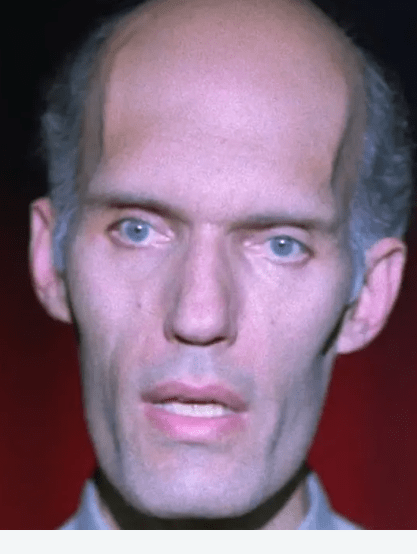

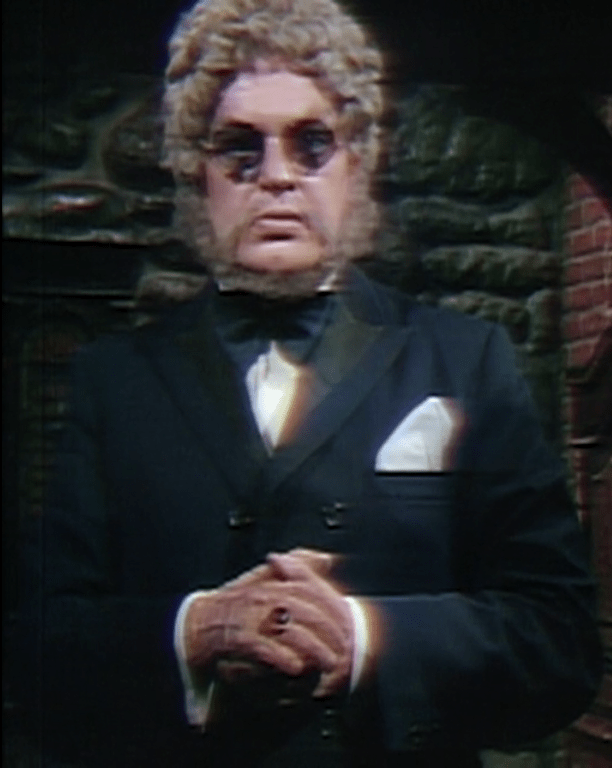


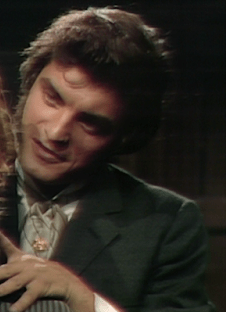


 Dark Shadows Commentary