Angelique, lady’s maid/ wicked witch, has cast a spell over kindly indentured servant Ben Stokes, making him her slave in an even deeper sense than he was already Joshua Collins’ slave. She gives Ben various tasks in support of her current project, black magic that will make the lovely Josette forget her fiancé Barnabas and conceive a mad passion for Barnabas’ uncle and dear friend Jeremiah. Most notably, she needs an unbroken spider web from an oak tree, and Ben brings her one.
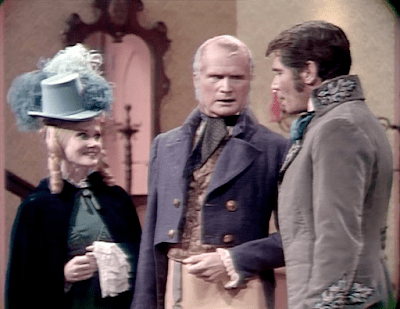
Meanwhile, cousin Millicent Collins has come to the estate of Collinwood. Millicent is giggly, afraid of germs, and very, very rich. Joshua means for his bachelor brother Jeremiah to marry Millicent, a prospect that repels Jeremiah.
Time-traveling governess Vicki enters. When she sees Millicent, Vicki calls her “Carolyn,” because she is played by Nancy Barrett, who plays a character named Carolyn in the parts of Dark Shadows set in the twentieth century. The makers of the show wanted Vicki to keep the audience up to date on the cast members’ resumés, even though it makes all the other characters think she is a lunatic.
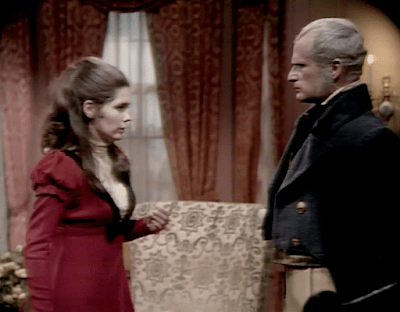
Alone with Vicki, Jeremiah confides that he does not want to marry Millicent. Vicki had studied Collins family history when she was living in the 1960s and has an idiotic compulsion to verbalize her every thought, so she declares that Millicent will never marry. Jeremiah remarks that she says the strangest things.
This scene is more tolerable than the others in which Vicki blurts out information she wouldn’t know if she belonged in 1795 because of the casting of Anthony George as Jeremiah. George was a cold actor who kept the audience guessing what was going on inside his characters’ heads. That made him a disaster as the second to play the hot-blooded Burke Devlin, but when we see him as Jeremiah we take his ready acceptance of Vicki’s bizarre behavior as a sign that he has something up his sleeve. If they can stop giving Vicki such tiresome lines, Jeremiah might be a promising love interest for her.
Time-traveling governess Victoria Winters sees a man fueling the fireplace in the front parlor of the manor house on the estate of Collinwood. As she has done several times since arriving in the year 1795, she jumps to the conclusion that he is the character the same actor played in the 1960s. In fairness to Vicki, a couple of the people are the same- young gentleman Barnabas Collins will become a vampire and meet her in her own time, and Barnabas’ ten year old sister Sarah will die soon and her ghost will haunt Collinwood and its environs in 1967. So it’s tricky to handle the repertory theater aspect of the rest of the cast, and, by having Vicki freak out and shout about the main time period every time she meets someone, the show has chosen the most irritating possible way of addressing this problem.
The man Vicki meets today is indentured servant Ben Stokes, and the man she mistakes him for is gruff groundskeeper Matthew Morgan. Since Matthew held her prisoner in this very house and tried to decapitate her here in 1966, her misidentification of Ben leads Vicki to scream and holler and bring the master of the house to ask what is going on. Ben responds that he did nothing at all, Vicki volunteers that it was all her fault and tries to explain.
The master, haughty overlord Joshua Collins, is ever mindful of Ben’s status as a felon entrusted by the state to his custody, and declares that Ben is forbidden to speak to any woman for any reason. Vicki is appalled by this, but as governess she is a servant herself, so Joshua orders her to be silent. Besides, her protestations don’t make any sense to anyone who didn’t see episodes #108-#126 of Dark Shadows. Since it is 1795, Joshua doesn’t have access to the show on streaming or even on cable. He tells Matthew he won’t get the day off he’d asked for tomorrow.
Before Joshua dismisses Vicki to return to her duties, he mentions that his second cousins Millicent and Daniel Collins will be arriving soon and staying for the month leading up to the wedding of Joshua’s son Barnabas to Josette duPrés. Daniel is a child the age of Joshua’s daughter Sarah, and will be joining Sarah as Vicki’s charge during his stay at Collinwood. Joshua mentions that Millicent is a lovely young woman, and that from her early childhood it had been understood that she would marry Joshua’s younger brother Jeremiah. Joshua is quite pleased with this prospect, not least because Millicent has inherited a considerable fortune.
Vicki’s compulsion to keep the audience up to date on the resumés of the actors is mirrored by a compulsion to blurt out information she knows only because she comes from 1967. She had studied the Collins family history, so when Joshua talks of Millicent’s prospective marriage to Jeremiah she shouts “Millicent never married!” Joshua is puzzled by this idiotic remark, but quick to accept Vicki’s explanation that she had read a novel about a spinster named Millicent and couldn’t help but yell about it.
During the first year of Dark Shadows, Vicki was, on balance, one of the smartest characters and was the one who made the most important things happen. So it is distressing to see her verbalizing her every thought, including irrelevancies about the actors’ other roles and information that would tend to expose her secret. If she is going to survive in this past world, she’s going to have to regain enough brain power to keep her mouth shut. Moreover, even when she was at her smartest Vicki was always a conspicuously inept liar. Joshua is fundamentally uninterested in a person of her apparently low social status, and so he accepted the story she made up to cover herself this time. But someone more willing to pay attention to her might very quickly conclude that Vicki is a strange and dangerous person.
Meanwhile, lady’s maid/ wicked witch Angelique is in the woods gathering noxious weeds to use in an evil potion. Ben catches her there, and warns her that the plants she has in her basket are poisonous. She drops them, thanks him, and strikes up a conversation. He tells her Joshua has forbidden him to talk to women. She says this is horribly cruel, and Ben agrees. He goes, and she picks the deadly leaves back up.
In the servants’ quarters, Vicki enters Angelique’s room. She sees some things of Barnabas’ that Angelique had used to cast a spell on him the other day. When Angelique comes in, Vicki tells her that Josette was asking for her. Vicki then asks how Barnabas’ things got to be in Angelique’s room. She says she doesn’t know, then puts the blame on Sarah. Vicki says she will scold Sarah for carrying Barnabas’ things around the house, and Angelique begs her not to. She says she is afraid that if she does, Sarah won’t visit her anymore.
Angelique has no way of knowing it, but this is the perfect lie to tell Vicki. For months before she left 1967, everyone was eager for Sarah’s ghost to come and visit them. Indeed, Vicki was at a séance called to contact Sarah when Sarah took possession of her, said through her that she would tell the “story from the beginning,” and yanked her back to this time. So, when Angelique presents herself as afraid that Sarah will stop visiting her, Vicki cannot refuse her request.
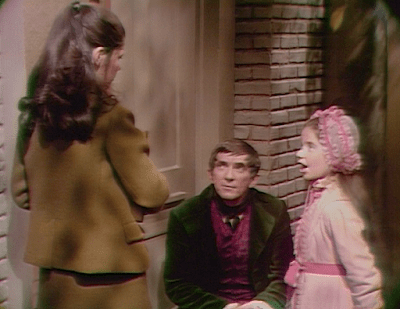
Angelique decides she needs a helper to keep herself from being suspected. We cut between the outdoors, where we see Ben chopping wood, and the servant’s quarters, where Angelique is mixing up a potion. Vicki comes to Ben, and we wonder which of them will be Angelique’s target.
Vicki apologizes to Ben. He just wants her to go away- he’s got into enough trouble for talking to her once, the last thing he wants is to be caught repeating the offense. She says that she knows that Joshua “can seem stern,” to which Ben reacts with disbelief. He says that Joshua is far worse than stern.
Again, this is Vicki failing to distinguish characters from the actors who play them. Louis Edmonds plays Joshua in 1795, and high-born ne’er-do-well Roger Collins in the parts of Dark Shadows set in the twentieth century. For the first 25 weeks of the show, Roger was the villain, and he tried to kill Vicki once or twice. By the time his ex-wife Laura went up in smoke in #191, Roger was no threat to anyone. When Sarah brought Vicki back here, Roger had long since been reduced to occasional comic relief.
Joshua is as selfish and cold as Roger at his worst, but where Roger is cowardly, weak, and shameless, Joshua is bold, imperious, and utterly convinced that he is right. Roger is what Joshua might become after a long period of continual degeneration and degradation, a grotesque parody of his ancestor. He has Joshua’s style, but none of his strength. He is reminiscent of the “Last Men” in Nietzsche’s Also Sprach Zarathustra, who were strangers to every consideration but their own immediate comfort. Even so, enough of Louis Edmonds’ wit and personality come through that we always enjoy seeing Roger, and we can understand why Vicki likes him. Edmonds is so good that we are sure we will enjoy watching Joshua as well, but he is clearly never going to become a lovable squish.
Ben is trying to orient Vicki to the current phase of the show when we cut to Angelique in her room. She calls Ben’s name. Suddenly Ben seems to have taken ill. He finally persuades Vicki to leave him alone before he gets caught talking to her again. Once Vicki is gone, he sees a vision of Angelique calling to him and sets off.
When Ben gets to Angelique’s room, he tells her he has no idea what he is doing there. She tells him he is there because she wanted him. This means only one thing to him, so he lifts his arms and steps forward, obviously intending to brighten the day with some rapid love-making. She pulls back and tells him to take a drink first. The beverage she offers him is readily identifiable to a modern audience as Coca-Cola.
In the 1960s, Coca-Cola may have been the pause that refreshes, but in 1795 it had more drastic effects. After Ben drinks it, he staggers back and Angelique tells him that he no longer has a will of his own and will be her slave forevermore. He doesn’t make love to her, either, so no matter how tasty the Coke was the visit would have to be reckoned a loss from Ben’s point of view.
In 2021, I left a comment on Danny Horn’s blog post about episode 256. I found great significance in the introduction of the ghost of ten year old Sarah Collins:
I’d say Sarah’s introduction is the single most important moment in the whole show, more important than Barnabas coming out of the box, more important even than Barnabas’ first decision not to kill Julia.
From the beginning they’d been playing with the idea that there was another cast of characters hidden behind the characters we’ve been watching, supernatural characters who can make their influence felt at certain moments. The most prominent of these was the ghost of Josette. This ghost is a serene, distant, imperturbable. When her ghost and the ghosts of the widows rescue Vicki from Matthew in 126, there is an amused smile in Josette’s voice, the sound of someone for whom nothing very important is at stake in the affairs of this world.
When David sees Maggie in Josette’s clothes and mistakes her for the ghost of Josette in 240 and 241, it is clear that if the ghost of Josette returns, it will not be in that mode. After that sight, Josette’s ghost can return only as a terrifying spirit of vengeance. And David’s confrontation with Willie in 253 makes it clear that the protecting ghost will not return at all.
So the show has discarded the old supernatural realm of Josette and the widows, a realm that was, as you say, never more than slightly accessible. With Sarah’s appearance, we are introduced to an entirely new part of the show. Once again we have a set of characters hidden in the supernatural background, but they can interact with the characters from the main continuity more directly and at greater length than Josette and the widows ever could.
The puzzle of Sarah’s connection to Barnabas, and her talk about looking for the members of her family, indicates that this new order of supernatural beings have complex and unsettled relationships with each other, and that characters from the main continuity can have an influence on those relationships. We will have to figure those relationships out in the weeks and months to come, but as soon as Sarah demands Maggie not tell her big brother that she saw her, we know that they might come to enmesh the living beings. Every scene with Sarah, then, is a step leading directly to the time-travel and parallel universe storylines that will come to define the show.
By the end of last week, Dark Shadows had, for the second time in its 73 weeks on the air, run out of stories to tell. When Dark Shadows 1.0 ended with the disappearance of blonde fire witch Laura Murdoch Collins in #191 and #192, the way forward was clear- introduce another supernatural menace to succeed Laura. That came in the form of vampire Barnabas Collins. As people tuned in to see how a daily soap opera could fit a vampire into its pattern, Dark Shadows 2.0 became a bona fide hit and a major pop culture phenomenon.
The first version of the show came to an end because none of the non-Laura stories ever really took off and the only danger Laura presented was that she would incinerate her son David when she herself vanished in flames. Once that was prevented, her threat profile was closed and the show needed to start over.
The second version crackled along quite well for months. It’s true that a number of the storylines had reached their natural conclusions, but they made little to no effort to replace them. On the contrary, they went out of their way to close off possible narrative directions. While even the slowest parts of Dark Shadows 1.0 left us guessing what might come next, the final weeks of Dark Shadows 2.0 present us with nothing but a series of blank walls. The first time I saw the show, I watched #365 without a single idea as to what they could do in #366.
What they actually do is to launch Dark Shadows 3.0 by flipping the back-world of the dead past into the foreground, while the characters and events of 1967 are thrust behind the action into a realm only we and Vicki know anything about. Indeed, it is Sarah who executes the switch.
We had a glimpse of what that might look like in #280, when Barnabas hosted a party in the Old House on the estate of Collinwood, restored in an eighteenth century style, to which the living members of the Collins family came dressed as their ancestors of that period. In Friday’s episode, we saw a séance in the great house on the estate on a dark and stormy night. Sarah spoke through well-meaning governess Vicki and said she would “tell the story from the beginning.” At that, Vicki vanished from the table, her eighteenth century counterpart Phyllis Wick appeared in her place, and Vicki found herself outside the Old House on a sunny day in the year 1795. Today, she meets the living versions of Barnabas and Sarah, as well as some of those who were impersonated at Barnabas’ costume party.
The first person Vicki meets in 1795 is Barnabas. She has spent a great deal of time with him in 1967, so she assumes he is just in costume. He is startled by her clothing- she is still dressed as she was at the séance. He assures her they have never met, and when she keeps insisting they have he begins to suspect that she is insane.
Sarah meets them and declares that Vicki is her new governess. Evidently she had some kind of premonition as to what her new governess would look like, and Vicki meets the description. Barnabas brightens and asks Vicki if she is a governess. She acknowledges that she is. Before she can explain that she is governess to a boy who won’t be born for 160 years, he ushers her into the house.
The writers faced a thorny problem with this segment of the series. Vicki has spent a great deal of time with Barnabas and has seen Sarah, so she must recognize them. On the other hand, most of the rest of the people she meets in 1795 will be played by the actors who have played characters she knew in 1966 and 1967. When Victoria is alone in the front parlor of the house, we find out how they have decided to handle this situation. Joel Crothers, who in the contemporary segment of Dark Shadows played hardworking young fisherman Joe Haskell, enters in the character of bon vivant naval officer Nathan Forbes. Vicki throws herself in his arms and gushes about how happy she is to see him. Nathan is quite happy to see her, since she is a remarkably beautiful young woman and extremely friendly, but he is puzzled that she insists on calling him Joe.
The scene between Nathan and Vicki is pretty funny, and it’s understandable that Vicki would react as she does. But it’s also ominous. When we see actors at work, we may remember other parts they have played, but we don’t expect their scene-mates to bring them up. They are just supposed to accept them as whoever they are supposed to be at that moment. When Joan Bennett enters, not as twentieth-century matriarch Elizabeth Collins Stoddard, but as Liz’ ancestor Naomi Collins, we wonder how Vicki will react to her. Indeed, she does slow things down with a lot of wailing about how she can’t believe she isn’t Mrs Stoddard, a person of whom Naomi has never heard. It then dawns on us that every time Vicki meets anyone, she’s going to drag us through this same business where she mistakes them for another character the actor has played. That’s going to annoy us and make the other characters think she is deranged.
One of the reasons Vicki’s yelling about the cast’s resumes annoys us so much is that we all know how to look at the various characters an actor has played and see how they illuminate each other. We don’t need her to tell us to do that. Academics put that into a category of practices called “iconography,” which is shorthand for the idea that we remember what we’ve seen more than once in various kinds of movies and shows and notice when we see it again.
As Liz, Joan Bennett was the sort of imposing matriarch she often played as a major star of feature films and the Broadway stage. Virtually every event we saw in the first 25 weeks of Dark Shadows had its origins in Liz’ reactions to the events around her, and she was still the single most powerful figure in the whole gallery of characters for 30 weeks after that, right up to the death of seagoing con man Jason McGuire in #275. Everyone else was dependent on her, in one way or another.
Naomi is the lady of the manor in 1795, as Liz is in the 1960s. But we quickly learn that she is at the opposite extreme from her descendant. When invitations come for Barnabas’ upcoming wedding, she asks Nathan to read them to her. While Liz dominates the family and the town from her desk, Naomi is entirely illiterate.
This is something of an anachronism. Colonial New England was founded by Puritans who thought everyone ought to read the Bible, and so provided elementary schooling for all children, boys and girls. Scholars estimate that by the end of the eighteenth century, over 90 percent of men and about half of women in that region would have been able to read the Bible easily. A woman as wealthy as Naomi would certainly have had this ability, and the basic literacy which Naomi lacks would have been a rarity at any level of society. Perhaps the writers and producers of Dark Shadows were unaware of this history. Perhaps they are suggesting that she, like her son’s fiancée Josette DuPrés, came from some part of the world that valued literacy less highly than did New England. In any case, they do show us how severely disadvantaged she is in any disagreement with the men in her life, and how narrowly the bounds of her activities are circumscribed.
Barnabas comes back with the news that the carriage bringing Sarah’s governess overturned. The governess herself is missing from the scene of the accident; the other three people aboard were killed. When Phyllis Wick appeared in Vicki’s place at the séance, she did indeed say that she had just been in a carriage wreck, so this news will not come as a complete surprise to returning viewers.
This brings up a question and points to a missed opportunity. The question is whether Phyllis’ carriage had overturned in the original course of events. If so, perhaps she was killed along with the other three, and Sarah never did get a new governess. If not, then Sarah’s ghost killed three people when she sent Vicki back in time. Sarah has always been nice to people we liked, and has declared her allegiance to goodness. But she is also pretty clumsy, so she might have killed them inadvertently.
The missed opportunity is that Vicki could have entered 1795 at the scene of the accident. Had she been found in the wreckage, in Phyllis’ dress, with a wound that kept her from speaking for the first week of the segment, it would make sense that she was taken for the new governess. Of course, we wouldn’t have to see a carriage- some sound effects and a shot of Vicki on the ground, with some smudges on her face and the rim of a wagon wheel partly visible near her, would have been plenty. Surely the budget would have allowed that much.
Had Vicki been mute for the first week of the story, we could have seen her face and heard her thoughts in pre-recorded voiceovers as she saw Barnabas and Sarah and recognized them; we could have seen her face but not heard her thoughts as she saw other familiar actors in new roles, leaving it open whether she saw them as the same people she knew in the 1960s. By the time she had regained the ability to speak, she would have caught on that she had to pretend to be Phyllis Wick, to be a native of the eighteenth century, and to be new to Collinsport.
That way, she would start off with a reasonable chance of making a go of life in that era. Moreover, as we were drawn to Barnabas when we watched him trying to pass as a native of the twentieth century, we could be excited to see Vicki try to present herself as a native of the eighteenth. As it is, she is constantly drawing attention to herself as an alien, so much so that it is hardly likely the Collinses would want her in their house in any capacity, certainly not as tutor to their beloved daughter. Moreover, starting Dark Shadows 3.0 with Vicki doing what Barnabas did in Dark Shadows 2.0, while Barnabas would take the role Vicki played in their relationship then, as a benevolent if uncomprehending friend, would shed new light on both characters and on their stories. What she does instead is to annoy us and make it difficult to care about her at all.
We do get a brief inversion of Vicki’s relationship with her charge from the 1960s, strange and troubled boy David Collins. When Vicki first met David in #4, he greeted her with “I hate you!” and she assured him that they were going to be good friends. Vicki certainly does not hate Sarah, but she would appear to any observer who did not know what we know about her to be mentally ill, just as David appeared to be when first we saw him. It is little Sarah who cheerfully assures Vicki that they will be good friends. As her mental health is the least of Vicki’s problems now, so it turned out in 1966 that David’s difficulties stemmed, not from delusions, but from an all-too-accurate understanding of his metaphysical relationship to the world he lived in. Vicki rose to the challenge and became the companion and supporter David needed. In Sarah’s prediction that she and Vicki will be good friends, we therefore hear a promise that the show will develop a relationship between the two of them in which Sarah will emerge as Vicki’s confidant and protector.
The series was made with very little advance planning. Just a few weeks ago, we heard about a painting or drawing depicting Barnabas and Sarah as children of about the same age, yet today we see the forty two year old Jonathan Frid playing Barnabas as a fatherly figure to Sarah as played by ten year old Sharon Smyth. Still, they’ve put so much into the costumes and so much thought into the new characters that they must have meant for this segment to last more than a couple of weeks. Having Vicki insistently call everyone by the wrong names and then run around idiotically announcing information that she knows only because she is from 1967 puts her on the express train towards an insane asylum. If they don’t stop her doing those things right quick, they will have written themselves into a corner before they’ve got their money’s worth out of the work they have already done.
The episode looks very different from anything we’ve seen on Dark Shadows before. The series has been in color for months now, but there have only been one or two days when they managed to use color as anything more than an occasional special effect. Today, they are working from a palette of pinks and greens that give a sense of lightness and good cheer that is altogether new to the show. It doesn’t really play out in the visual strategy of the episode- the story they are telling in pictures is aimed chiefly at the majority of viewers who are watching on black and white sets. But for those who do have color television, it is unmistakable that this is not the same show that ended on Friday.
For the fourth time, Dark Shadows is about to show us a séance. Each of the previous séances served to accelerate an ongoing storyline. The first, held in the drawing room of the great house at Collinwood, took place in #170. It had become clear to the audience and to well-meaning governess Vicki that Laura Murdoch Collins, estranged wife of high-born ne’er-do-well Roger and mother of strange and troubled boy David, was part of a complex of inexplicable phenomena. The ghost of grand lady Josette Collins spoke through Vicki and warned the company that a boy was in danger. Laura first interrupted the séance, then joined it and did occult battle with Josette’s ghost for control of Vicki’s voice. The séance marked the moment at which those phenomena coalesced into a purposive unit, all embodied in Laura.
The second séance was held in the front parlor of the long-abandoned Old House on the grounds of Collinwood in #185 and #186. There, Vicki, David, and artist Sam gathered. The spirit of David Radcliffe, a boy whom Laura had killed in one of her earlier incarnations, spoke through David Collins and led Vicki to believe that his fate lay in store for David unless she and her friends could save him. That took place while Laura was casting a spell that killed Dr Peter Guthrie, a parapsychologist whom Vicki had brought in as the Van Helsing figure in what had by then become Dark Shadows’ first pass at a dramatization of Bram Stoker’s Dracula. It brought the Laura story to its climactic phase.
The third séance was held in #280 and #281, again in the front parlor of the Old House. No longer is the Old House the long-abandoned wreck over which the ghost of Josette long presided. Now it is home to Barnabas Collins, a distant relative of the family in the great house and, unknown to them, a vampire. Barnabas and his blood thrall Willie have restored the house to its eighteenth century magnificence, and the Collinses have gathered there to celebrate their work. They are costumed as people who lived in the house in the days when Barnabas was alive. Over Barnabas’ objections, they hold a séance in which Josette again speaks through Vicki. After Vicki comes out of the trance, she sees the ghost of Barnabas’ ten-year old sister Sarah at the top of the stairs. This begins a period of the show when Vicki’s relationship to Barnabas is unsettled and drives much of the action.
Now, there is no ongoing story to intensify. The only open question is whether Barnabas will kill his sometime friend, mad scientist Julia Hoffman. He has spent enough time scheming to do Julia in that he would lose credibility as a villain if he didn’t, but he is so much more interesting with her to talk to and plot with and be cruel to that if she does disappear from the show they will have to replace her with another character who will be as much like her as possible. So the question of Julia’s fate is as much a dead end as are all the other exhausted narrative elements lying around.
It is a dark and stormy night. Gathered around the table in the drawing room of the great house are Vicki, Barnabas, blonde heiress Carolyn, Julia, matriarch Liz, and Liz’ brother Roger. They are attempting to contact the ghost of Sarah.
Carolyn, who has settled comfortably into a new life as Barnabas’ blood thrall, pretends to speak for Sarah. Vicki goes into the trance and speaks, not with the voice of Josette this time, but with that of Sarah. She says that Carolyn is lying. Carolyn tries to keep up her act, but her mother Liz scolds her; she has fooled no one. Through Vicki, Sarah declares that she will never appear to any of the company again. She drifts in and out of engagement with the séance, several times talking, not to Barnabas as he is sitting at the table, but to him as he was in the eighteenth century. She says that perhaps she will be able to accomplish something if she can tell the whole story “from the beginning.”
Watching this episode for the first time on cable TV in the 1990s, I was gripped by the panache with which they did the whole thing, but I could not see any possible way forward for the story. I couldn’t imagine what Sarah meant by telling the whole story from the beginning- was she about to give a multi-hour recital through Vicki there in the drawing room? That didn’t sound very likely, but I could not think of anything else it could mean.
What actually happens is that the candles go out and the room is plunged into complete darkness. Liz directs Barnabas to switch the lights on. When he does, we see that Vicki is gone. In her place is a woman we have not seen before, wearing a dress from the eighteenth century. She identifies herself as Phyllis Wick, come to be governess of Sarah Collins, and she is appalled by the outlandish clothing of the people around her.
For her part, Vicki finds herself outdoors, in broad daylight. She is holding a large book and looking at the Old House. She notices that the Old House looks somehow different. She has no idea how she got there or what is going on. When I first saw the show, I was as bewildered as she was.
Many in the original audience might not have been as baffled by this ending as I was. ABC ran a promotional spot for the show for some time before this episode aired giving away the big surprise that Vicki is about to have. I, for one, am glad that I had not seen that spot and was caught absolutely unprepared.
Mad scientist Julia Hoffman has been trying to cure Barnabas Collins of vampirism. We open today with Julia fleeing from Barnabas in terror. You’d think he’d be used to this reaction, but she’s been pretty cozy with him for a long time, so he knows she isn’t doing it for the usual reason. He demands to know why, and she tells him it’s to do with his appearance. He can’t use a mirror, so he touches his face. He realizes that, as an unforeseen side effect of Julia’s treatments, he is starting to look his age. Considering that he’s about 200 years old, the typical look would be a pile of dust, so he is quite upset about the situation.
Barnabas accuses Julia of intentionally botching the experiment because he refused to let “our relationship become all you wanted.” For the last couple of weeks, Julia has been responding to the realization that she is going to be connected to Barnabas for the rest of her life by trying to fall in love with him. He has observed this attempt, and answers it by pouring scorn on her. The other day, we saw her struggling to hold back tears at the end of an episode. She keeps her cool this time, and dismisses this particular accusation quickly.
One of the aspects of Barnabas’ sudden aging that bothers him the most is that he will have to cancel a date to watch the sun rise with well-meaning governess Vicki. Julia can hardly keep from laughing out loud when she says that “Foregoing an appointment with Vicki must be a bitter pill.” Barnabas responds “Spare me your sarcasm!” Even before she decided she would have to cultivate a romantic interest in Barnabas, Julia often showed signs of impatience when conversing with Vicki. She often rolled her eyes as soon as Vicki wasn’t looking, and sometimes plastered on a smile and spoke to her very slowly. But this is our first direct confirmation that Julia thinks Vicki is an idiot.
The Vicki/ Julia relationship is the first time on Dark Shadows that one major character is oblivious of the fact that another holds her in disdain. That adds a fresh wrinkle to their scenes together, as we wonder if Vicki will catch on to Julia’s real attitude towards her.
Barnabas orders Julia to run up to the great house of Collinwood and tell Vicki that he won’t be able to watch the sunrise with her. Julia opens the front door to comply, and sees Vicki standing there. She has overheard the last part of their conversation. Barnabas sits in a high-backed armchair with his back to her and claims that he has an illness he is afraid she will catch if she comes too close to him. He also claims that he will be leaving town on a long business trip later in the morning. When Vicki points out that these two things don’t fit together, he makes a lot of statements that don’t add up to much more than throat-clearing.
It’s also odd that Vicki, who like the other residents of the great house of Collinwood does not know that Julia is a doctor, doesn’t seem to notice that she’s wearing a lab coat, much less to wonder what she’s doing in Barnabas’ house in the pre-dawn hours. The whole scene is so ridiculous that the comedy must be intentional, on the part of the director and the actors if not of writer Ron Sproat.
After Vicki goes, Barnabas says he will have to save himself by reverting to his bloodsucking ways. Julia is shocked by the thought that the horrors will resume, and laments that she will be “partially responsible” for them.
Julia’s shock doesn’t last long. She urges Barnabas to choose Vicki as his first victim. She is absolutely gleeful about this idea.
Barnabas is miserable- he has already passed up several prime opportunities to bite Vicki, including an occasion when she invited herself over to spend the night in his house and one on the terrace of the great house when she virtually pressed her neck into his mouth. There have been times when we have expected Vicki to draw an arrow on her neck and write next to it the words “MR VAMPIRE, BITE HERE!” But Barnabas doesn’t want to let go of the fantasy that Vicki’s personality will somehow disappear and be spontaneously replaced with that of his lost love Josette. His attachment to this fantasy suggests that Barnabas is as bored with the actually existing Vicki as is Julia.
Back in the great house, Vicki tells heiress Carolyn that Barnabas was in a strange mood. Carolyn says that Vicki has become quite fond of Barnabas, and Vicki says that she is more than fond of him. She has come to rely on him. Since Vicki’s depressing fiancé, Burke, is missing and presumed dead, there is no reason why this shouldn’t mean that Vicki will fall in love with Barnabas. No reason, that is, except Barnabas’ obvious lack of interest in her.
Later, we see Carolyn and her old friend, hardworking young fisherman Joe, sitting at the Blue Whale tavern. Yesterday, Carolyn had a visit from the ghost of ten year old Sarah Collins. As a result, she believes that her young cousin, strange and troubled boy David, was probably telling the truth when he claimed to have seen various weird things.
Carolyn tries to enlist Joe in an effort to investigate David’s stories, but he won’t have it. He admits that Sarah exists. He has to- lots of people have seen her and she has made several observable things happen. Besides, Joe himself encountered the ghost of Josette in #179, so he can’t very well deny that there are such things as ghosts. But like other characters who have admitted that one or another supernatural being exists, he snaps right back to a frame of reference that doesn’t allow for the supernatural, or even for the unusual. Joe asks Carolyn if she really believes that there is “something sinister about Barnabas,” as David’s visions would imply. She admits that she doesn’t.
While Vicki sleeps, Barnabas materializes in her room. He stands there watching her, as he has done before. This time, his wizened appearance shows that it is a matter of urgency that he feed on someone. But he still can’t bring himself to bite her. Even when his existence is hanging in the balance, he just isn’t into Vicki.
After Barnabas loiters for a while trying to talk himself into doing what he so plainly has no desire to do, Carolyn comes to Vicki’s door. She apologizes for waking Vicki, and explains that she thought she heard someone in the room. Vicki isn’t upset at the interruption, but grateful for Carolyn’s concern. The two are startled when they see the silhouette of a giant bat outside Vicki’s window.
In the great house of Collinwood, well-meaning governess Vicki is worried about her depressing fiancé Burke, who is missing and feared dead after a plane crash in Brazil. Permanent houseguest Julia Hoffman enters and shows her a piece of crystal. Julia says that she thinks the crystal might have been part of a chandelier that hung in the foyer of the long-abandoned west wing of the house. Vicki plans to restore the west wing and hopes to live there with Burke, so this is of interest to her.
Julia tells Vicki to peer into the center of the crystal. As she complies, Julia stares directly into the camera and continues to give instructions. The Federal Communications Commission was very nervous about hypnosis in the 1960s, so much so that even indirect references to the process would draw memos from the television networks’ Standards and Practices offices warning producers that they must not put anything on the air that could hypnotize the audience. Apparently ABC’s Standards and Practices office wasn’t vigilant enough about the daytime dramas, because after a while we hear the tinkling sound Julia tells us we will hear and instead of the picture we see a kaleidoscope effect. By the time we come out of the trance, Julia and Vicki are in the basement of the Old House on the estate.
The Old House is home to Old World gentleman Barnabas Collins. Vicki sees a coffin in the basement, and Julia orders her to open it. After a long display of reluctance, she does. She finds Barnabas inside, apparently dead. Julia shows her the crystal again. Once more the screen shows the kaleidoscope pattern, and next thing we know Julia and Vicki are returning to the drawing room of the great house.
There, Vicki is about to say that she wants to show the crystal to her dear friend Barnabas, only to find that she has an unaccountable difficulty bringing herself to say Barnabas’ name. Later, Barnabas comes to the house and asks Vicki to watch the sunrise with him. He is diffident about the invitation, and she is uncomfortable with him. Actor Jonathan Frid may have had some difficulty with Barnabas’ lines at this point, but if so, his stumbles dovetail so well with Barnabas’ own display of shyness that they don’t hurt the scene.
Vicki overcomes her discomfort and agrees to meet Barnabas at dawn. He is about to shake her hand when she notices that there is something wrong with his hand. He looks at it and is shocked. He says something about having injured it this morning. She pleads with him to stay and let her put something on his hand, but he rushes out.
Unknown to Vicki, Barnabas is a vampire and Julia is a mad scientist trying to turn him back into a human. The night before, Julia had given him an accelerated treatment that initially caused numbness in his hand, but that later gave him such a sense of well-being that he thought he would be free of his curse by the time the sun came up. After leaving Vicki, he returns to Julia’s laboratory in the basement of his house and shows her his hand, which has aged enormously.
Also unknown to Vicki, Barnabas has designs on her and sees Burke’s absence as a sign that he should move quickly to win her affections. That’s why he ignored Julia’s objections and insisted on the accelerated treatment. In the last few episodes, the show has put heavy emphasis on Julia’s wish to start a romance of her own with Barnabas and his scornful response to this wish; perhaps she took Vicki to Barnabas’ coffin to keep her from becoming a rival for his affections. Or perhaps her motives were altruistic- even if Barnabas weren’t a vampire, there would still be plenty of reasons why a woman would be well-advised to steer clear of him.
Well-meaning governess Vicki has learned that her depressing fiancé Burke probably died in a plane crash yesterday. His body hasn’t been found yet, and she still hopes he will turn out to be alive.
We open with a dream sequence. Vicki finds herself in the Old House on the great estate of Collinwood. She is in the bedroom once occupied by legendary grande dame Josette, restored to its original condition by the house’s current occupant, Old World gentleman Barnabas Collins. Barnabas enters, accompanied by permanent house guest Julia Hoffman. As is usual in dreams, much of it is a rehash of the dreamer’s recent experiences. Vicki had met Barnabas and Julia the preceding night while on a walk and told them that Burke was missing and feared dead. Barnabas told Julia that it was too cold for her to be outdoors and sent her home, then he told Vicki that he was sure she would be a bride soon. These same lines occur in the dream.
The dream deviates from the waking scene in three key ways. First, Barnabas addresses Julia as “Doctor.” In fact, Julia is a medical doctor, a mad scientist who has come to Collinwood with an experimental treatment intended to cure Barnabas of a chronic ailment, vampirism. But Vicki doesn’t know that Julia is a doctor, any more than she knows Barnabas is a vampire. Still less does she know that Barnabas always addresses Julia as “Doctor” when they are alone. That suggests that it is not a normal dream, but is a message from the supernatural.
Second, Julia looks humiliated when Barnabas tells her she is suffering from the cold and orders her to leave. That did happen in yesterday’s encounter, but Vicki didn’t see it. So that is further evidence that the dream is a transmission from worlds beyond.
Third, while Barnabas yesterday encouraged Vicki to believe that Burke was alive, in this dream he shows her a shrouded figure on the bed and identifies it as Burke. He still insists that she will be a bride. When she says that she can never be a bride if Burke is dead, Barnabas adopts a chipper tone and says that he doesn’t see why. She is saying “He is dead, he is dead” and the camera is focused on Barnabas when the dream ends. Evidently the message is something to do with Barnabas being dead, as he is during the daylight hours, and therefore being an unsuitable groom for her.
Later, we cut back to Josette’s room, where we see Julia standing around and hear her thoughts in an extended voiceover. She has resigned herself to spending the rest of her life linked to Barnabas, and has decided that she may as well fall in love with him. For his part, he is still hung up on his long-dead love Josette and believes that Vicki will someday turn into Josette and come to him. Julia is ruminating about this crackpot notion when she senses a ghostly presence. She wonders if it is Josette. Indeed, for 28 weeks, from #70 to #210, Josette’s ghost was the foremost supernatural presence on Dark Shadows, and it was based in the Old House. But Julia resists the idea that it could be her.
In her resistance, we can hear one of the themes the show has been exploring lately. Even characters who have accepted the reality of particular supernatural phenomena don’t have a frame of reference for those phenomena. They keep snapping back to Logical-Explanation-Land and trying to find mundane answers to unearthly questions. Julia is personal physician to a vampire, and even she starts telling herself that she’s being silly to expect to see a ghost.
There is a good deal of noise from off-screen, and Julia finally accepts that there is a ghost in the room. She says aloud that it is not Josette’s ghost, it is a man’s. She thinks it is the ghost of Dave Woodard, her old medical school classmate, whom she and Barnabas murdered a week ago. She is calling out “Dave!” when she hears Vicki in the hallway outside.
Julia calls to Vicki, who joins her in Josette’s room. Vicki tells her that after she left them the night before, Barnabas volunteered to help her restore the west wing of the great house of Collinwood. Vicki wants to accept that offer. Julia becomes angry and says that Barnabas is much too busy to do any such thing, and that if he offered to do it he was only being polite.
Later, Vicki is back in the great house. Barnabas visits her there. When she tells him what Julia said and how agitated she was when she said it, he assures that he sincerely wants to help her with the project, and they speculate that Julia is working too hard.
Julia joins them. She is carrying flowers and in an abashed mood. She apologizes to Vicki for raising her voice and says that she must have been working too hard. Vicki goes to get a vase, leaving Julia and Barnabas alone in the drawing room.
Barnabas demands that Julia put her feelings to one side and approach their relationship simply as one of doctor and patient. He doesn’t ignore her feelings, nor does he make the slightest attempt to be gallant about them; he speaks of her attraction to him as if it were a mildly ridiculous offense against good manners. I suppose if someone treated you that way, it would be relatively easy to get over your unrequited passion for them, but Julia is stuck with Barnabas. When he tells her to stop being foolish and keep their relationship simple, she says that it is too late for that. Barnabas understands that as a reference to their murder of Woodard, which has indeed cut her off from any other potential life partner for the foreseeable future.
This whole conversation is conducted in loud stage voices with the doors wide open. Vicki walks in as Barnabas and Julia are in the middle of a fairly incriminating topic. She is sufficiently absorbed in her worries about Burke that it is believable that her only reaction would be a startled look after she enters the room and sees Barnabas and Julia in an intense confrontation, but they really are being remarkably careless.
Vicki finds that the flowers, which were in full bloom when she left the room a few minutes before, are now dead and shriveled. Barnabas had held the flowers briefly; evidently the vampire’s touch drained them of life. He squirms and looks up, the picture of someone embarrassed by his failure to control a bodily function in a social setting.
Looks like David Ford isn’t the only one whose metabolism creates awkward moments.
Back in the Old House, Barnabas and Julia are in the basement laboratory. She is preparing to give him an injection. He wants her to accelerate the treatments so that he can woo Vicki now, while she is lonely and confused. In case Burke does come back, Barnabas wants to have established a foothold from which to compete with him for Vicki’s affections. Julia is nervous, fumbling with the needle and complaining about the way Barnabas is looking at her. When she is about to give him the shot, he stops her, telling her that he suspects her jealousy will lead her to do something to harm him. He warns her against any such attempt. After this last moment of unrelenting hostility, we end with a closeup on Julia, her lower lip trembling.
In Dark Shadows #3, man of mystery Burke Devlin mentioned that he started on the path to riches when he was in a bar in South America. Since then, he has mentioned his business interests on that continent several times, and the old standard “Brazil” has emerged as his informal theme song. Yesterday’s episode, one of the finest in the series, called back to the early days of the show several times, and today they close the loop on Burke’s connection to Brazil. His plane crashes in that country, and he dies there.
We learn of Burke’s fatal accident when housekeeper Mrs Johnson tells her employer, Elizabeth Collins Stoddard, that she has heard a radio report of an aviation disaster in Brazil. Mrs Johnson first came to work in Liz’ home, the great house of Collinwood, in #81. At that time Burke had sworn to wreak a terrible vengeance on the Collinses and Mrs Johnson was his secret agent. Burke renounced his quest for vengeance in #201, which was just as well, since it was never very interesting anyway. But they never told us that he had stopped paying Mrs Johnson or that she had stopped funneling information to him. So viewers who have been watching all along may wonder if she really did just happen to be listening when the radio announced that a Varig flight had gone down outside Belém. Maybe she was in touch with some associate of Burke’s who told her more than she could repeat to Liz. Or maybe not, but in any case it is satisfying to be reminded of the connection.
Burke was engaged to marry one of Collinwood’s residents, well-meaning governess Vicki. When she is told that Burke is missing and presumed dead, Vicki declares that she is certain he will come back. Vicki was originally the audience’s point of view character, an outsider to whom everything we did not know had to be explained. We now know many things she does not, but in this declaration she once more seems to be closer to us than to the other characters in her knowledge. She knows, as we do, that she lives in a soap opera and no major character is likely to stay dead permanently, especially not when his death is supposed to be the result of a plane crash in a faraway jungle.
On the other hand, Burke has been fading in importance for a long time. After his revenge story fizzled, he never really found a new reason to be on the show. His relationship with Vicki might have made things happen when he was still in conflict with the Collinses. She would then have found herself torn between her lover and the family that had all but adopted her. But once Burke and the Collinses patched things up, there was no obstacle between him and Vicki. In the last few days, it has seemed that she might even be able to stay in the house and keep her job after marrying him. There has been a theme where Burke tried to gaslight Vicki out of believing in supernatural phenomena that he himself had plenty of evidence to suppose were real, but that was less a storyline than a speed bump. Burke’s part was recast after the charismatic Mitch Ryan showed up for #252 too drunk to work; since then he has been played by the woefully miscast Anthony George, and it has been obvious that the character needed to be written out of the show before he did permanent damage to George’s career. So maybe Burke won’t come back after all.
Meanwhile, in the Old House on the same estate, vampire Barnabas Collins is moping around while mad scientist Julia Hoffman works on her notes about her attempt to turn him into a real boy. When she asks if there is anything she can do to lighten his mood, he sarcastically suggests that they play a game of cards or of cribbage. She’s up for either one, but he says that he won’t be happy until Vicki comes to him. He doesn’t know about Burke’s accident, but has somehow convinced himself that Vicki’s personality will eventually disappear and be replaced with that of his long-lost love Josette, and that as Josette she will be his bride. Barnabas goes on so long about how wonderful it will be when the Josettified Vicki is in the house that we start to wonder just how the two of them will pass the time. The day may come when Barnabas is glad of a cribbage board.
Julia only recently committed her first murder. She and Barnabas killed her old medical school classmate Dave Woodard a week ago, and she is still reeling from the shock of it. One thing she has settled on is the fact that she is going to be linked to Barnabas for the rest of her life. It doesn’t seem likely that she will ever be able to tell anyone else about Woodard, and being a murderer is, like it or not, an important part of her identity. So no one other than Barnabas can ever really know her. She’s making the best of this by trying to fall in love with him, but his sick obsession with reenacting the plot of the 1932 film The Mummy with himself in the Boris Karloff role and a woman in her early twenties in Zita Johanns’ double role as the dead princess and her reincarnation would seem to leave her at an impasse.
Julia presses Barnabas about his relationship with Josette. When he keeps insisting that the Josettified Vicki will come to him of her own free will, she asks if the original Josette ever did that. Barnabas’ silent grimace answers her question. She goes on to ask why Josette is so important to him if he was never very important to her. He says he will explain it all to her, but that they must have the proper setting. He leads her to the place of Josette’s death, the cliff at Widows’ Hill.
Barnabas has given us at least two versions of his relationship with Josette. In #212, he gave a speech to her portrait which implied that she was his grandmother, and that she sided with his father her son when he and Barnabas had a fateful clash. Soon after, Josette was retconned into Barnabas’ lost love. In #236, Barnabas was trying to brainwash Maggie Evans, The Nicest Girl in Town, into thinking that she was Josette. He told her then that he had sailed with Josette from her home in the French West Indies to Collinwood, where she was to marry his uncle Jeremiah Collins. It was his task to teach her English on the voyage. Aboard ship, they fell in love. This reenactment of the tale of Tristan and Isolde ended as sadly as did the original, though the particulars of the story were not the same.
Now, Barnabas tells Julia that he met Josette for the first time when she arrived at Collinwood. He had taken no interest in his uncle’s betrothed until he saw her, but was stunned by her beauty and quickly fell in love with her. He found himself compelled to be “her good and faithful friend Barnabas,” a position he found humiliating. As a vampire, Barnabas is a metaphor for selfishness and cruelty, and so it is hardly surprising that he confines Julia to the same position with regard to himself and that he openly delights in her humiliation. It is a bit dizzying that she expresses so much sympathy for him, telling him in this scene that he never seems more human than when he talks about Josette.
In telling this latest version of the story, Barnabas says that as Josette came to feel that her youth was wasted on the elderly Jeremiah, it dawned on him that there was a way he could offer her eternal youth. This harks back to #233, when Barnabas told Vicki and Liz’ daughter Carolyn the story of Josette’s death, that she leapt off the cliff because she was being pursued by her lover. So we are to assume that Josette killed herself rather than let Barnabas turn her into a vampire. But it might suggest more than that. Whenever Barnabas met Josette, and whether it was aboard ship or on her arrival, he was not yet a vampire. We have not heard how he turned into one. Perhaps he involved himself in some kind of black magic in an attempt to keep himself and Josette young forever, and as a result he became a vampire and she fled from him to her death.
Vicki shows up and tells Barnabas and Julia about Burke. They are stunned. Julia’s reflex is to lean in and touch Vicki’s arm, Barnabas’ is to stagger back.
Shocked.
Barnabas quickly senses opportunity, and he shoos Julia away. He says that she was complaining of the cold and that for the sake of her health she ought not to stay. She is so obviously humiliated that only Vicki’s absorption in her own distress keeps her from noticing.
Barnabas plays the “good and faithful friend,” and Vicki looks over the edge of the cliff. She talks about the widows who have thrown themselves to their deaths from it over the years. She says that she had at first assumed that they were just “make-believe creatures,” but that if she thought Burke were really gone she would throw herself after them. Barnabas grabs her and urges her to stop such talk.
As this goes on, we hear the “Widows’ Wail,” a sound effect prominent in the early months of the show that the uninitiated mistake for wind, but that indicates something terrible is about to happen. When Vicki and Burke had their final conversation yesterday, they heard it, and he refused to admit its meaning. Vicki and Barnabas hear it now. The Widows bewail upcoming disasters, and Burke is already dead. Barnabas tells Vicki that she will be a bride very soon, and she nods and repeats, “A bride… very soon.” As she does, the Wail sounds louder than before.
“A bride… very soon.”
Closing Miscellany
This episode includes one of the most famous bloopers in the entire series. When Liz is on the telephone getting the news about Burke’s plane crash, she refers to “That place in Brazil… (long pause)… (separate, equally long pause)… (fidget)… (different kind of pause)… Belém!” It is a wonder to behold.
This episode was taped on 16 October 1967. On the 28th of that month, Alexandra Moltke married Philip Isles. So, whether or not Vicki was going to become “a bride very soon,” her player was. The wedding announcement in The New York Timesdoesn’t mention Dark Shadows; it does mention that “Mrs David Ford” was part of the bridal party. That Mrs David Ford was Nancy Barrett, who played Carolyn, and her Mr Ford played Maggie’s father Sam.
From The New York Times, 29 October 1967
Neither Mrs Isles’ marriage to Philip nor Miss Barrett’s to David Ford lasted very long. Mrs Isles is still known as Mrs Isles, even though she was married to a doctor named Alfred Jaretzki for 33 years, ending with his death in 2014. By the time she met Jaretzki, she was a nationally known documentary filmmaker, and there is her son Adam Isles, the father of her three grandchildren and a former high official of the US government. So I suppose it made sense to stick with that name. In any case, I doubt very much that the widows were wailing for her.
My wife, Mrs Acilius, mentioned that even though we have seen the whole series before, she fully expected Barnabas to push Julia off the cliff. The episode pulled her in so completely that she didn’t stop to tell herself that she would have remembered if he’d done that.
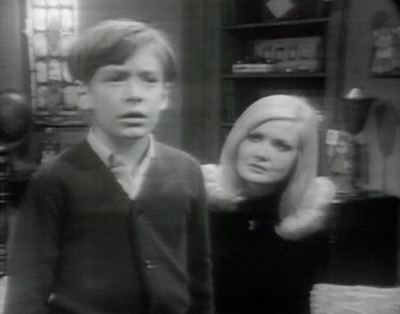
Strange and troubled boy David Collins is sitting on his bed. The ghost of his cousin Sarah is with him, playing “London Bridge” on her flute. She has told him that local physician Dave Woodard is dead, and he is depressed. She explains that she thought she had to tell him.
Sarah says she thinks that Woodard’s death was a terrible one and that it shouldn’t have happened. She denies knowing any more than that, and when David presses her for further information she becomes uncomfortable and vanishes.
David’s aunt, matriarch Liz, comes into his room to break the news to him about Woodard. She is startled to find that he already knows. She is distressed at his attitude of complete resignation. Woodard was the only adult who believed all of the facts about the supernatural menace looming over the great estate of Collinwood and the town of Collinsport that David and Sarah have shared with each other, and when David last saw him Woodard was trying to do something about that menace. David takes Woodard’s death as the end of all hope.
Downstairs, Liz meets her daughter Carolyn and well-meaning governess Vicki. She tells them how sad David is, and Carolyn goes up to see him. She starts talking about imaginary friends, and David asks if she means Sarah. Carolyn says that she doesn’t think Sarah is imaginary, and David replies “You don’t have to pretend. I don’t care.” He isn’t the least bit angry with her- he means exactly what he says when he tells her he doesn’t care how she feels about him.
Viewers who have been with the show from the beginning could see that reaction coming. For the first 24 weeks or so, Carolyn was a flighty heiress, a self-centered young woman who took no interest at all in her little cousin. Since then they have discarded that theme and Carolyn has become a mature and caring person. She and David have had some moments where she has seemed like a big sister. Still, she is still far less involved with him than is Vicki, and David doesn’t have any hopes that even Vicki will listen to him when he tells the truth about the strange goings-on. So when David says “I don’t care,” Carolyn is hit by a freight train that we’ve seen coming for a long time.
This new Carolyn won’t give up on David. She confides that when she was nine years old, she had a friend named Randy, a little boy who always wore a red sweater and who may or may not have existed. Carolyn admits that Randy may have been a ghost, and there is a moment when, as Danny Horn puts it on his Dark Shadows Every Day, “David stands up, and he looks at her, as if they’re really seeing each other for the first time in a long while.” The first time ever, I’d say- David and his father Roger only moved into the house a month or so before the show started, and by that time Carolyn was the character we first saw.
This isn’t the first time the audience has seen this side of Carolyn. In the opening weeks of Dark Shadows, she was one of several characters who had brief conversations with Vicki about the legendary ghosts of Collinwood, and she was the most persistent about laughing those legends off. But before the show had been on the air for five weeks, Carolyn admitted to Vicki that the legends were all true, and that she had tried to downplay them only because she liked Vicki and wanted her to stay.
That development is recapitulated in this scene. Where Vicki had reacted with confusion, telling herself that she ought to be concerned about Carolyn’s mental health but unable to quash a sickly feeling that she might be right, David reacts with wonderment. He is beyond trying to do anything about the horrors that he knows are in progress, let alone appealing to anyone to join him in fighting them, but we can see him absorbing the information that Carolyn is not at all the person she had led him to believe she was.
Once Carolyn stops pretending she does not believe in ghosts, we see why she and the other adults in the family are so insistent about keeping the door shut on the supernatural back-world behind the main action. “London Bridge” starts playing on the soundtrack; Carolyn and David can both hear it. As it goes on, David declares that something terrible is about to happen. It will be an accident- no one will cause it, no one wants it to happen. But it can’t be stopped. Carolyn asks how he knows, and he says he just does.
The little girl we saw in the opening is Sarah, but in this moment we realize she is not the whole of Sarah. The girl is only one manifestation of an unfathomably vast complex of phenomena. The world in which the action appears to be taking place is a tiny, fragile thing by comparison with forces like Sarah. If the characters stray from their little paths of denial and evasion the whole thing may at any moment dissolve altogether, thrusting the back-world into the foreground and leaving them adrift. After a few minutes of David’s soothsaying, Carolyn protests that “None of this is real, it can’t be!” But it’s too late- she knows that it is all too real, and the world of love affairs and hotels and motorcycles and dress shops and restaurants in which she has spent the last 69 weeks trying to find a place is a dream from which she is already starting to awaken.
Meanwhile, Vicki and her depressing fiancé Burke have declined Liz’ offer to live in the west wing of Collinwood when they are married. Liz had hoped to keep Vicki around so that she could help with David. When Burke asks if he should talk to David, Liz tells him not to bother. Carolyn already talked to him, Liz explains, and so far from calming David down she got herself upset too.
That response would suggest that Liz wants to tranquilize David, not to communicate with him. On the heels of the scene between David and Carolyn, it tells us more. Liz has lived in Collinwood longer than anyone, and she has struggled harder than anyone to keep the non-supernatural fore-world in operation. After Carolyn’s experiment in facing facts comes so close to sweeping the “logical explanations” away once and for all, we can see what Liz is trying to protect by keeping David quiet.
Burke is leaving the house, about to go on a business trip to South America, when David emerges from his room and says goodbye. David’s tone makes it clear that it is a final farewell. Burke keeps telling David that he will come back, but David is certain that Burke will die. Burke is shocked by David’s attitude, and says that perhaps they should live in the west wing after all. Vicki is thrilled by the idea.
Burke and Vicki go to a terrace outside the house. There, they hear the wind whistling through the rocks along the shore. On Vicki’s first night in the house, she heard from Liz’ brother Roger the legend of “The Widows’ Wail,” according to which this sound is a warning from the spirits of the widows who haunt the area. In those days, Vicki had little patience for ghost stories, and the “Widows’ Wail” seemed to be the easiest of all the legends to dismiss. But the wind blows every night, and she’s only heard it make that sound on a handful of occasions, usually right before something terrible happens. She’s also seen multiple ghosts, done battle with a humanoid Phoenix, and encountered what anyone with access to old movies would recognize as evidence that a vampire is operating in the vicinity. So she hears the Widows’ Wail the same way regular viewers of the show do, as the sound of the supernatural back-world blasting through and knocking everything else down.
When Vicki pleads with Burke not to go to South America, he replies “Don’t tell me you’re starting to believe all that stuff!” For months now, Burke has been gaslighting Vicki, pretending that she is crazy for believing in supernatural phenomena, including phenomena he himself witnessed and previously acknowledged. But hearing the Widows’ Wail, which was a prominent topic in the early days, and seeing the black and white imagery of the kinescope, we can remember a more appealing version of Burke. Back then, Burke was one of several longtime residents of Collinsport who used the word “ghost” figuratively in conversation with Vicki, each time prompting her to exclaim “Surely you don’t believe in ghosts!?,” to which he would reply that it was entirely possible that there were literal ghosts at Collinwood. For a moment, we see that Burke, and forget the gaslighting abuser. That moment lasts just long enough that we can share David’s sorrow and Vicki’s terror at Burke’s imminent death.
Vampire Barnabas Collins is in a chirpy mood. He and his associate, mad scientist Julia Hoffman, have just committed the premeditated murder of Julia’s medical school classmate Dave Woodard. As we saw when Barnabas made his sorely bedraggled blood thrall Willie to help him hide the corpse of seagoing con man Jason McGuire, nothing makes him happier than forcing someone to help with the killing of a former friend.
I think the actors were placed behind the laboratory apparatus intentionally, to highlight the characters’ helplessness and isolation.
Today, Julia wants to stop her attempt to cure Barnabas of vampirism, but he won’t hear of it. When she tells him she might try to kill him instead of curing him, Barnabas relishes telling her that he trusts her completely. She does knock him out of his blissful state when she suggests that if she manages to turn him into a real boy, he might have a conscience. He gives a little speech in which he says some brave things about being willing to accept the punishment fitting a man who had done the things he has done if he also gains the ability to love as a man can love. Jonathan Frid puts enough into this speech that it is possible to sympathize with Barnabas in the moment that he is delivering it.
That moment doesn’t last very long. By the end of the episode, we are back on this set, where Julia says that “someone” might love Barnabas as he is, and he takes delight in her humiliation as he makes it obvious that he knows she is referring to herself.
Some say that Barnabas’ speech about wanting to love is meant to make the character more likable, but it has the opposite effect when he so smoothly transitions back into this gleeful cruelty. The other day, Julia told Barnabas that she had wondered whether he was capable of feeling any emotions at all, but we see in this scene what we’ve seen all along, that he is nothing but emotion. Except when he is acting, trying to convince the living members of the Collins family that he is their long-lost cousin from England, his feelings are right on the surface. For a minute or two, he has some feelings about love and justice, and we see those very clearly. But that is a brief interlude in the middle of his entirely gratuitous torture of Julia. We are left in no doubt that he takes an utterly unmixed pleasure in causing her pain. We’ve already seen very cold villains on Dark Shadows and before the series ends we will see more, but by the end of this scene Barnabas claims the crown of most detestable character ever to appear on the show. It’s so hard to imagine how he could possibly sustain such a level of malignity that it’s no wonder viewers still keep tuning in to see what he will do next.
The main theme of the episode is the contrast between Barnabas’ relationship with Julia and his relationship with well-meaning governess Vicki. For the first 39 weeks of Dark Shadows, Vicki was the audience’s main point-of-view character; now Julia is the one who knows what we know, and who makes things happen when she learns new information. Seeing Barnabas first with one woman, then with the other, we see how the show has been changing since he joined the cast.
Barnabas eavesdrops on Vicki’s conversation with her depressing fiancé Burke on the terrace at the great house of Collinwood, then slides in and claims to have inadvertently overheard the last few words of their conversation. Burke gives Barnabas a dirty look, then excuses himself to do some telephoning while Vicki and Barnabas stay on the terrace and talk for a little while.
Barnabas has some vague idea of seducing Vicki, an idea he has been remarkably desultory about pursuing. In this scene, he does the only thing he has ever really got round to doing about it, which is to listen sympathetically while Vicki tells him her troubles. This time, she’s trying to convince herself that she wants what Burke wants, which is to get away from Collinwood and start a new life somewhere else. It isn’t an exciting situation, but Alexandra Moltke Isles delivers her lines with so much urgency that it holds our attention.
Vicki shares her anguish with her kindly friend Barnabas
Julia eavesdrops on this conversation. She looks miserable. Whatever she may have had in mind when she first came to Collinwood, Julia is stuck with Barnabas for the foreseeable future. Not only has Julia murdered one of her oldest friends for Barnabas’ sake, she has involved herself so deeply in so many of his activities that it is unclear how she would go back to the successful professional life she had before she met him even if he were destroyed. If he is going to spend his time hanging around other women, she faces a drab prospect.
Julia contemplates a lonely future
In the drawing room, Burke, Vicki, and Julia talk about the death of Dr Woodard. Julia can’t bear the topic, and excuses herself to go out to the terrace. There, she catches a glimpse of Woodard’s ghost. Julia screams, Burke and Vicki come, and all she can do when they ask what’s wrong is to keep jabbering that “he wasn’t there.”
There are some rough patches in the script today. For example, in the opening, Julia is touching the equipment when Barnabas exclaims “Don’t stop!” This is puzzling- she doesn’t appear to be stopping anything. And when Julia says “He wasn’t there,” Vicki has to ask “Who wasn’t there?” A person might reflexively say such a thing, and Mrs Isles’ rapid delivery of the line and simultaneous movement of the neck and the shoulders suggest such a reflex. That’s probably the best choice any actor could have made, but the line still gets a bad laugh. Barnabas and Julia’s successive eavesdropping expeditions also come off as some kind of joke, and all the scenes take too long. The whole thing could have used another trip through the typewriter. Still, writer Joe Caldwell was at his best with miniature character studies, and while he may not have had the time he needed to give this one his usual polish, the actors still have more than enough to show what they can do. It’s a fairly good outing, all things considered.







 Dark Shadows Commentary