Episode 651: The tomb is ready, and I am ready

Mysterious drifter Chris Jennings telephones the great house of Collinwood. Old world gentleman Barnabas Collins answers. Chris asks to speak to permanent houseguest Julia Hoffman, MD. Barnabas tells him Julia is busy with a patient, and Chris says that it is extremely urgent Julia call him back the moment she is free.

Julia comes downstairs. She had been tending to matriarch Elizabeth Collins Stoddard. Liz is mentally ill. She is deeply depressed and fixated on the idea that she will soon be buried alive. Barnabas starts talking about the witch whose spell started Liz’ illness; Julia points out that the origin doesn’t really matter. Indeed it does not. Liz’ condition is quite logical when we realize that she has been exposed to a long series of traumatic events of supernatural character. Of course she feels helpless- her world really does not make rational sense, and there really are forces beyond her control that are determined to bring misery to her and those she loves. And of course she is preoccupied with death- she is surrounded, not only by people in mortal jeopardy, but also by figures who are at once dead and alive. Unknown to her, Barnabas is one of these- he died in the 1790s, became a vampire, and was restored to humanity less than a year ago. The story of Liz’ depression is not really a tale of the supernatural, but of a person responding to her environment in a perfectly natural way.

Liz’ depression is not exactly a fun story, and the show hadn’t done anything with it for months. We might have hoped it was all over. What has brought it back is the disappearance of well-meaning governess Victoria Winters. The other day, Vicki embraced her husband, an unpleasant man known variously as Peter and Jeff, and vanished into thin air as Barnabas and Liz watched. She and Peter/ Jeff were traveling back in time to the 1790s, never to return. Liz was very close to Vicki; the show spent its first year hinting heavily that she was Vicki’s biological mother, though they never got round to saying so explicitly or telling us anything about Vicki’s father. Now that Vicki is gone, Liz is inconsolable.

That is the in-universe explanation for Liz’ trouble. There are two real-world reasons. First, Joan Bennett was going away for a few weeks to do a play in Chicago, and the show needed to explain why Liz wasn’t going to be around when so much of the action was taking place in her house. Second, the key figure in both of the ongoing storylines is Chris’ eleven year old sister Amy, who is staying at Collinwood. Barnabas is the show’s chief protagonist, and so far he does not have any particular connection to either of those stories. Plunging Liz into a paralyzing depression completes the task they started by sending her brother Roger on a business trip overseas. It means that Barnabas has a reason to camp out in the main house and act as a father figure to Amy.

Barnabas had a vague notion about a romance with Vicki, though he did almost nothing to develop such a relationship. His basic feeling towards her seems to have been that he might want her someday, and so he reacted with petulant anger to any person or event that made her unavailable to him. Thinking about Vicki’s departure with Peter/ Jeff, he spends several minutes pouting while Julia tries gently to reason with him.

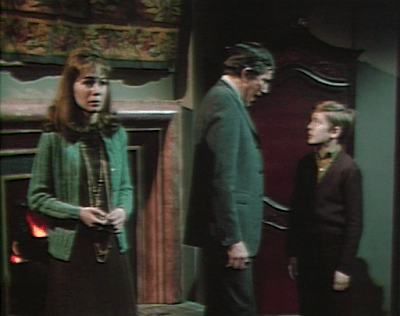
Barnabas is very upset that Vicki was so inconsiderate as to move on with her life when he might someday have wanted her. Screenshot by Dark Shadows Before I Die.

At the end of his tantrum, Barnabas declares that he and Julia should go back upstairs and talk with Liz. As they are going, he sees the telephone and says “Oh. By the way, Chris Jennings called. He said it was urgent.” It’s even funnier that Barnabas remembers this call so late in the scene than it would be if he had forgotten it altogether. Chris may use words like “emergency” and “extremely urgent,” but in Barnabas’ world there is only one truly urgent matter, and that is whatever his feelings are at the moment.

Vampires are metaphors for extreme selfishness. Barnabas may not be a vampire anymore, but he is still very selfish. But perhaps is attitude towards Vicki is not so unsympathetic as I have made it out to be. When he was still under his curse, he thought he might be able to remake Vicki as an eighteenth century woman, then turn her into a vampire and take her as his bride. Vicki did indeed have an attachment to that era, so much so that she traveled back in time to the 1790s. And when he became human again, Barnabas was immediately embroiled with a succession of witches and monsters, to none of whom did he want to expose Vicki. He wanted to clear them out of the way so his life could start, and once it did he would be free to approach her. But her life was already underway, and of course his was too. The nemeses Barnabas and Julia fought together throughout 1968 are gone now, but so is Vicki, and it is the two of them who are alone together.

The other day, Chris dropped by to ask Julia for sedatives. She was unimpressed with his drug-seeking behavior, and so when Barnabas tells her about Chris’ call she says that he can wait. What she does not know is that Chris is a werewolf, and he was hoping that strong enough pills could knock him out throughout the night of the full moon.

Chris and Amy’s cousin Joe Haskell has been trying to fill in for Chris in the big brother role. He and Amy have gone to the movies, and we see them on their way back to the great house, looking at the moon. Amy tells Joe that she is terribly afraid of the moon, for reasons she can’t explain. Joe asks if she really saw a pentagram on his face in #648; she confirms that she did. Joe knows that someone else saw it too, visiting medium Janet Findley. He also knows that when he told Chris about it he was terribly upset. Neither Joe nor Amy knows what Chris and Madame Findley knew, that it is the sign that he will be the werewolf’s next victim.

Amy is alone in the foyer of the great house when Liz comes down the stairs, apparently in a trance. She does not respond when Amy calls out to her, but walks out into the night. Amy is standing in the open doorway, watching her, when Barnabas comes and asks what she is doing. She tells Barnabas what happened. He tells her to go to bed; she refuses. He then decides it will be good enough if she waits in the drawing room until he brings Liz back. She goes to the drawing room, but when he goes off to tell Julia what has happened she slips out to look for Liz. Barnabas learns that she has left when Julia, whom he has sent to sit with her, reports that she is not in the drawing room.

Barnabas is out looking for Liz and Amy when Chris comes to Collinwood. He is upset that Julia did not call him back; she is skeptical of him. He tries to give a reasonable-sounding explanation; if only he knew of her background treating vampires and Frankensteins, he would realize that he has everything to gain by telling her the truth. She finally gives him a bottle of sleeping pills, along with a wary look and an injunction to use the pills only as directed.

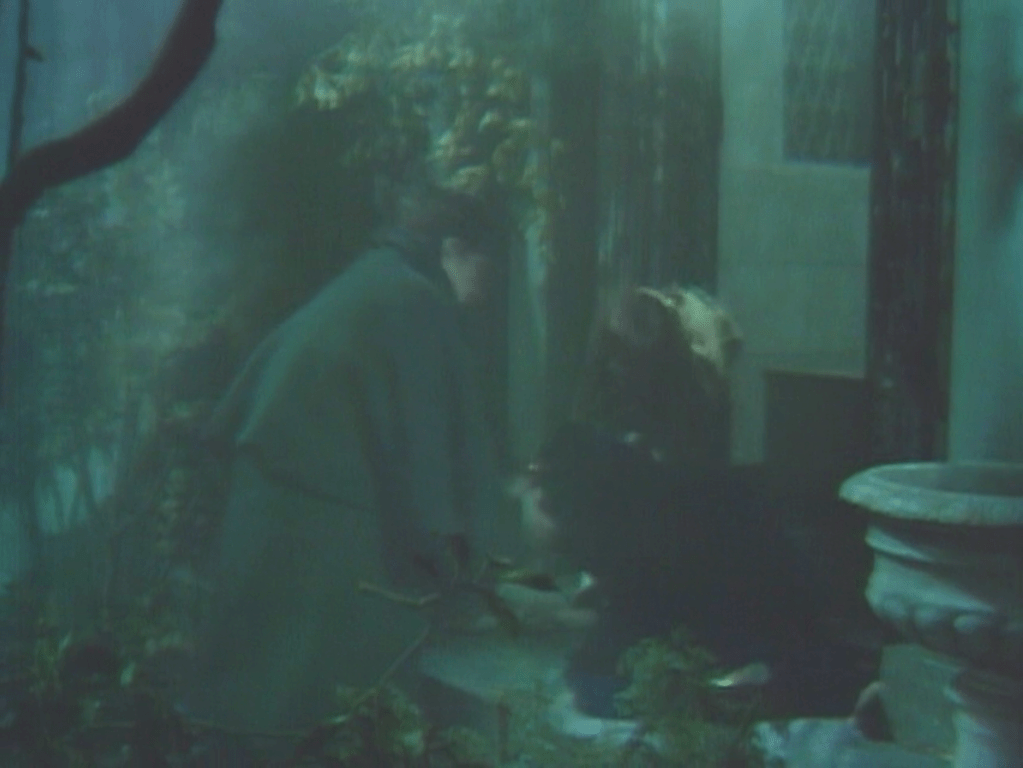
Liz goes to the old Collins family mausoleum. Barnabas’ parents and sister are buried there, and he was himself trapped there for 172 years when he was a vampire. She thinks of it now as her tomb, and tells herself that she is ready to be buried there now. She collapses. Amy finds her, fears that she is dead, and cries out. Her voice brings Barnabas, who tells Amy that Liz is alive. He also says that they must get her back to the house at once. Barnabas puts his arms under Liz’ left side, Amy puts hers under her right, and they lift her. This brief glimpse of the two of them working together goes a long way towards establishing Barnabas’ closeness to Amy.

I’ve altered the saturation and exposure a bit in this still. Though the original is darker and the fog machine was working overtime, in the moving image you can see what Amy is doing clearly enough.

Joe pays another visit to Chris’ room. Chris has taken a bunch of sleeping pills from the bottle Julia gave him. Joe scolds Chris for his failure to visit Amy. Chris knows that he could transform at any time, and is desperate to get Joe to leave. Joe does leave. Chris goes to bed. He falls asleep. The camera pans to his hand, which has already become a werewolf’s paw.

Episode 650: I must see to my luggage

Version 4.0 of Dark Shadows began in #466 when old world gentleman Barnabas Collins was cured of vampirism and ended in #637 when Barnabas and his friend, mad scientist Julia Hoffman, found that witch-turned-vampire Angelique had departed the scene. That version was a Monster Mash in which the main attractions of all Universal Studios horror hits of the 1930s found their counterparts. Version 5.0 is focused on just two monsters, a werewolf and a ghost. The werewolf is Chris Jennings, brother of nine year old Amy. The ghost is Quentin Collins, who is obsessing Amy and her friend, strange and troubled boy David Collins.

Today is taken up with two problems of plot mechanics. First, Barnabas is the undisputed star of the show, and he does not have any particular connection to either of the ongoing stories. Second, well-meaning governess Vicki is too familiar with the supernatural, too secure in her place in the great house of Collinwood, and too familiar to the audience to permit Amy and David to figure in a story based on Henry James’ The Turn of the Screw, even if that story is inverted so that it is the children who see the ghosts and the governess who doubts them.

Today, Vicki’s husband, a repellent man known variously as Peter and Jeff, returns from the dead and takes her with him. He materializes in her bedroom, takes her by the hands, and they both vanish while Barnabas and matriarch Elizabeth Collins Stoddard look on. That solves the second problem.

Peter/ Jeff and Fake Vicki vanish as Barnabas and Liz look on. Screenshot by Dark Shadows Before I Die.

Liz’ brother Roger solves the first problem when he asks Barnabas to hang around the house while he is away on a business trip to London. Barnabas will therefore be on the spot while the children cope with “The Haunting of Collinwood.”

The opening narration is delivered by Roger Davis, who plays Peter/ Jeff. This not only produces a sinking feeling in regular viewers who recognize Mr Davis’ voice and realize that his absence these last few weeks was only a temporary reprieve, it also spoils the surprise when Peter/ Jeff shows up.

This is the last of Betsy Durkin’s 10 appearances as Vicki. The part originated in #1 as the audience’s main point of view character; then and for the next 126 weeks, she was played by Alexandra Moltke Isles. By the time Mrs Isles left the show, Vicki had long since run out of story, and was saddled with the hopelessly unappealing Mr Davis as her primary scene partner. Inheriting those difficulties, Miss Durkin never had a chance to establish herself as part of the show.

Episode 641: Your time is now

In #2, high-born ne’er-do-well Roger Collins saw governess Victoria Winters standing at the edge of a high cliff overlooking the ocean. She didn’t know he was there until he startled her by asking her if she was planning to jump. As the weeks go on, Vicki will learn of other women who have leapt to their deaths from that spot, including a story that over the years two governesses were among them and that legend says a third will someday follow suit. The cliff is the face of Widows’ Hill, named after women whose husbands never returned home from the sea; several times during storms an eerie note sounds in the wind, a note known as “The Widows’ Wail,” which the locals believe to be the ghosts of the Widows announcing that a tragic death will soon take place.

Vicki stands at the edge of the cliff again at the end of this installment while the Widows’ Wail sounds. She is distraught that she has herself become a widow and is dwelling on the idea that she can be reunited with her husband in death.

Though occult expert Timothy Eliot Stokes told her earlier in the episode that “Your time is now!,” Vicki’s time as a lively part of the show in fact ran out in March 1967, with the resolution of the story about her effort to befriend her charge, Roger’s strange and troubled young son David. Actress Alexandra Moltke Isles finally gave up on the character and left Dark Shadows after #627. Her successor in the role, Betsy Durkin, has essentially nothing to work with. We do not share her grief for the husband she is mourning; he was one of Dark Shadows‘ most repellent characters, and it is such a relief that he is away that we sympathize only too much with everyone who tells her to stop bringing him up. Nor do we have any other reason to care about her, since she is relevant to no ongoing plotlines. Even longtime viewers who remember the foreshadowing of Vicki’s possible death by a jump off the cliff will not react strongly to the sight of her there, since Miss Durkin is not Mrs Isles and does not bring her screen iconography to the reprise of the theme.

This phase of the show actually belongs to a character introduced in #632, eleven year old Amy Jennings. When Amy meets Stokes today she announces that she likes him because he is funny; he replies that he is pleased to find that “My appeal extends to all ages now.” Indeed it does; in its first year, Dark Shadows was very much aimed at adults, some of whom remembered Joan Bennett as one of the great movie stars of the 1930s and 1940s and were impressed by her presence in the cast as matriarch Liz, some of whom appreciated it as a specimen of slow-paced, highly atmospheric Gothic romance, and some of whom were fascinated by the story of Vicki and David and its theme of a grownup trying to make a difference in the life of a troubled child. But by the time Stokes arrived in #464, Dark Shadows had become a kids’ show. As Thayer David plays him, Stokes is amusing enough that anyone can like him, but the absolute seriousness with which he regularly expounds the most preposterous mumbo-jumbo is designed to make him a favorite of the very young.

Amy likes Stokes. Screenshot by Dark Shadows Before I Die.

Amy’s friendship with David develops in scenes that kids will find engaging, as they go exploring the big haunted house of Collinwood and find their way into spooky adventures. She also takes the lead in her relationships with adults more consistently than David ever did. While in the first year and a half of the show David often knew things the adults didn’t know, that was usually because he accepted the facts they refused to see. No matter what he said or did, he couldn’t move them from their habits of denial and evasion. But Amy has sources of information that the grownups around her don’t have. So today she has a vision of her brother Chris in some kind of terrible trouble. When she tells Vicki and Liz about her vision, Liz tries to telephone Chris and is deeply disturbed when he doesn’t answer. As my wife, Mrs Acilius, pointed out, it is after one o’clock in the morning, so you wouldn’t expect her to attach great importance to his failure to pick up the phone. That she does suggests that she is taking Amy seriously.

Returning viewers know that Amy’s vision is correct. Chris is a werewolf, and he just killed a barmaid. That Amy not only has a paranormal means of knowing how Chris is doing, but that she is also able to get through to the adults and influence their actions, suggests that she will have a major impact on the werewolf story as long as it continues. Indeed, she already has- the werewolf was about to eat Liz the other day, but backed off when he saw Amy nearby.

Amy is central to the other storyline that is beginning at this point. That is “The Haunting of Collinwood,” in which the ghost of Liz and Roger’s’ great-uncle Quentin Collins is going to be creating difficulties for everyone. Amy and David went into the long-deserted west wing of the house and retrieved an antique telephone from a room there. Though its cord is cut, Amy can sometimes hear Quentin’s voice through its receiver. When she is alone and worried about Chris, she picks the telephone up and asks for Quentin. She is disappointed he does not answer. None of the adults knows about Quentin’s ghost or the telephone. Not even David has heard more than Quentin’s breathing through the receiver. Again, Amy is uniquely positioned to understand and affect the action.

According to the closing credits, this week’s five episodes were directed by “Penberry Jones.” The name “Penberry Jones” is unknown to Google aside from these credits, and it sounds like a joke of some sort. Though the fansites all mention the improbability of Jones’ name and the likelihood that it is a pseudonym, none that I could find offers any clue as to who might have been behind that pseudonym. From the early 1970s until the quarantines of Covid-19 in 2020, Dark Shadows fans would organize festivals a couple of times every year at which panels of people who had been involved in making the show took questions from the audience. If any of those audiences asked who Penberry Jones was, either they did not get an answer or that answer was not recorded.

The name “Penberry” may remind longtime viewers of Dark Shadows of episode #83, which is about Roger burying a pen. Roger was a major villain then, and his part gave actor Louis Edmonds an opportunity to show what he could do. Roger has long since been demoted to occasional comic relief; one might imagine that Edmonds wanted to take a turn in the director’s chair, and that he chose his whimsical pseudonym as a nod to his character’s origins. Appealing as that idea may be, it does not seem at all likely. So many of the panel discussions among cast members abounded in fond stories about Edmonds that surely someone would have mentioned it if he had directed five episodes.

Indeed, most of the longer-lived members of the cast participated in so many of those panels that they all had moments when they had to grope more or less desperately for something fresh to say. If anyone whose name fans would recognize and who worked closely with the cast were “Penberry Jones,” it’s hard to imagine that one or another of them wouldn’t have brought it up in one of those moments.

Whoever it was must have been known to executive producer Dan Curtis and line producer Bob Costello, and probably quite well known to them. The Directors Guild of America does allow its members to change the names under which they are credited, as for example John Walter Sullivan was allowed to direct several episodes of Dark Shadows as “Jack Sullivan” and several more as “Sean Dhu Sullivan.” But it does not allow them simply to use pseudonyms at will. It wasn’t until 1969 that directors working in features could be billed as “Alan Smithee,” and then they had to prove that they did not really have control of the final product before they were allowed to substitute that name for their own. The first television production credited to “Alan Smithee” didn’t appear until 1970. So it is unlikely that “Penberry Jones” directed any screen productions under any other name. Curtis and Costello probably wouldn’t have chosen a first-time director with no imminent prospects of other screen work unless it were someone they already knew and trusted.

If “Penberry Jones” didn’t cover anyone the cast knew well or a director who worked under another name, but was someone who was close to Dan Curtis or Bob Costello, it should be possible to compile a short list of suspects. I’m not so deeply immersed in the behind-the-scenes lore that I can compile that list myself, but maybe you are. If so, I’d like to hear from you in the comments!

The director’s name isn’t the only puzzle in the closing credits. Every previous episode of Dark Shadows ended with the credits playing in front of a stationary shot of one or another set. It was always one shot per closing credits sequence. This time they start with a stationary shot of Vicki’s room, then cut to a stationary shot of the foyer. It’s hard to see what the point of that transition is. Perhaps we could ask “Penberry Jones,” if we had any idea who that was.

Episode 637: Too late for anything to happen

Well-meaning governess Vicki ran out of story in #191, and has been at the fringes of the show ever since. Since March, Vicki has been stuck in a relationship with an unpleasant man named Peter who preferred to be called Jeff.

As long as Alexandra Moltke Isles played Vicki, longtime viewers could hold onto some sliver of hope that she would eventually reconnect with an interesting plotline. Mrs Isles’ last episode was #627, and the part was taken over by Betsy Durkin, who stresses random words in her lines (such as, “Jeff, you’ve got to stop thinking about the past!,”) keeps looking at her scene partners with her face still for a few seconds too long after delivering her lines, and moves about awkwardly, as if she were afraid of tripping over her costume. For his part, Peter/ Jeff is played by Roger Davis, a highly trained actor who doesn’t do any of those things, but who routinely assaults actresses on camera and who clenches his rectal sphincters whenever he raises his voice, causing him to sound like he is struggling with constipation. Miss Durkin and Mr Davis are a difficult pair to watch, and since there is no reason in the story for either fake Vicki or Peter/ Jeff to be on the show their scenes are an unwelcome intrusion.

Today, fake Vicki and Peter/ Jeff get married. The morning after their wedding, he fades into nothingness while she watches, which considering his personality is the best case scenario for her.

We spend the middle of the episode with recovering vampire Barnabas and mad scientist Julia, who unlike fake Vicki and Peter/ Jeff are actually characters on Dark Shadows. Barnabas and Julia enter the great house of Collinwood. They have been at pains to keep the residents of the great house from finding out about any of the supernatural doings, yet when they walk in the front door they blab about everything in nice loud voices.

Matriarch Liz comes in and tells Barnabas and Julia that Vicki has married Peter/ Jeff. Once Liz leaves, Barnabas, stunned and dejected, moans “Julia, why did she do it? Why did Vicki marry him?” Barnabas has often claimed to be in love with Vicki, but in fact takes remarkably little interest in her, so it is no surprise that less than a minute goes by before he shrugs the whole thing off with “I’ll accept it and pray that she’ll be happy with it.”

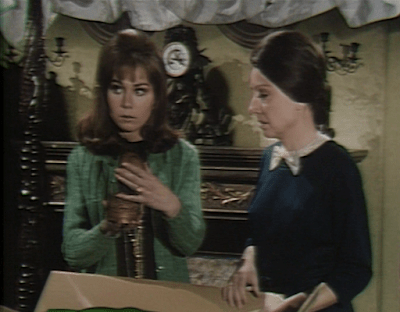
Julia reacts to Barnabas’ reaction to the news of Vicki’s wedding. Screenshot by Dark Shadows Before I Die.

Barnabas and Julia go off to drive a stake through the heart of witch-turned-vampire Angelique. It’s a rule on Dark Shadows that a wedding scene leads to the exposure of an empty coffin, so it will be no surprise to longtime viewers that when Barnabas and Julia open Angelique’s coffin they find she isn’t in today. Barnabas fears that she has changed in some way that will make her even more dangerous when she eventually returns.

Angelique and Peter/ Jeff were the last loose ends left over from the big collection of storylines introduced in the spring of 1968; her absence and his vanishing wrap up the Monster Mash period that constituted Dark Shadows 4.0. The only indication we have had so far as to what version 5.0 will turn out to be was a scene in #632 between werewolf Tom Jennings and his sister Amy. It remains to be seen how the Jenningses will connect with the Collinses and what other characters will join them.

Pre-emption Day: Adam in New York

No episode of Dark Shadows premiered 56 years ago today. That was Thanksgiving, and ABC was showing football at 4 PM.

At this point, Alexandra Moltke Isles had left the part of well-meaning governess Victoria Winters, marking the last step in the character’s long decline from her original position as the show’s chief protagonist. Vicki spent her childhood in a foundling home where she was left as a newborn with a note reading “Her name is Victoria. I cannot take care of her.” During Dark Shadows‘ first months, Vicki was on a quest to find out who her parents were. The show hinted pretty heavily that her mother was reclusive matriarch Elizabeth Collins Stoddard and her father was someone other than Liz’ long-missing husband, the scoundrelly Paul Stoddard, but the whole thing was dropped without any real resolution long ago.

In yesterday’s episode, Frankenstein’s monster Adam was on his way to Vicki’s room, apparently meaning to kill her. We understand Adam’s violence too well to regard him as a very cold villain. Most of the harm he has done is the result of his not knowing his own strength, and the rest is the predictable consequence of the abominable education he has received from his creators, mad scientist Julia Hoffman and recovering vampire Barnabas Collins, and from suave warlock Nicholas Blair. To longtime viewers, Vicki has been important enough for long enough that we do not see any prospect that a character as sympathetic as he is will become her murderer. On the other hand, Nicholas has now left the show, and there is nowhere for Adam to go within any of the ongoing storylines. If he simply disappears, he will be another significant loose end.

In September 2023, I left a long comment on Danny Horn’s Dark Shadows Every Day describing a fanfic idea that would at one stroke answer the questions of Vicki’s origin and of Adam’s fate. Below is a lightly edited version of that comment:

Here’s an idea I had today for a story that would save Vicki.

It would be a TV movie airing late in 1969. Start with a prologue set in Collinwood at that time. Adam returns, looking for Barnabas and Julia. He’s very well-spoken and accomplished now, but still socially awkward, still prone to fits of anger, and in need of help to get papers that he needs to establish a legal identity.

He finds that Barnabas and Julia are gone. He also happens upon some mumbo-jumbo that dislocates him in time and space.

It plops him down in NYC in 1945. With his facial scars, everyone assumes he’s a returning GI injured in the war. He meets a young woman, supporting herself working at a magazine about handheld machines, trying to establish independence from her wealthy family back in Maine. This woman, played by Alexandra Moltke Isles, is Elizabeth Collins.

Adam and Elizabeth slide into a love affair. She has another boyfriend, a dashing young naval officer named Paul Stoddard (Ed Nelson.)

Ed Nelson as the Paul Stoddard of 1945
Dennis Patrick as the Paul Stoddard of 1969

Elizabeth is frustrated with both Adam and Paul; Adam refuses to talk about his background, and while Paul says many words when asked about himself, he doesn’t really give significantly more information than Adam does. Paul is slick, charming, and familiar with all the most fashionable night spots, but he does show signs of a nasty side. Besides, he rooms with a disreputable young sailor named Jason McGuire (John Connell) who keeps turning up at the most disconcerting moments.

From #143, John Connell, suggesting the Jason McGuire of 1945
Dennis Patrick as the Jason McGuire of 1967

For his part, Adam is sincere, passionate, and attentive, but given to quick flashes of anger. He’s just as quick to apologize and sometimes blubbers like a giant baby with remorse for his harsh words, but he’s so big and so strong that when he is carried away in his fits of anger Elizabeth can’t help but be afraid of him. Besides, he’s not a lot of fun on a Saturday night. He doesn’t have a nickel to his name, and his idea of an exciting weekend is an impromptu seminar on Freud’s TOTEM AND TABOO, followed by a couple of games of chess.

Elizabeth’s mother (Joan Bennett) comes to town. Mrs Collins is appalled by Adam’s scars, impatient with his refusal to discuss his background, and contemptuous of his obvious poverty. Paul’s effortless charm and sparkling wit, packaged in the naval dress uniform he makes sure he’s wearing when she first sees him, fit far more tidily into her vision of a son-in-law. Mrs Collins presses her daughter to spurn Adam and pursue Paul, and for a time Elizabeth tries to comply with her wishes.

Yet she cannot forget Adam. Paul realizes this, and sees his chance at an easy life slipping away. We see him in a dive in Greenwich Village telling Jason McGuire that Elizabeth and her inheritance are going to end up with the scar-faced scholar. He and McGuire review Adam’s weaknesses, and decide they can exploit Elizabeth’s concern about his temper. They trick her into believing that Adam is on the run from the law, having beaten his wife to death. They lead her to believe that it’s just a matter of time before his occasional verbal outbursts give way to physical abuse, and that when that happens it will be too late- he will kill her. Believing this, Elizabeth gives Paul another chance, but still cannot break things off with Adam.

Adam does not know what Paul and Jason have led Elizabeth to believe. He knows only that she has become distant from him, and that she is still seeing Paul. He becomes angry and shouts at Elizabeth. He reaches for an object; she believes it is a blunt instrument with which he will kill her. In a moment of panic, she grabs a gun she has been studying for an article the magazine has assigned her to write and shoots him. As he lies motionless on her floor, she discovers that he wasn’t reaching for a weapon at all- he was reaching for a love letter that he had written to her. She realizes that he was no threat to her, that she has shot him for no reason.

She flees to Paul and Jason’s apartment, telling them that she has killed Adam. Paul calms her and promises to take care of matters so that she will not be suspected of any crime. Paul and Jason go to her apartment and find it empty. There are bloodstains on the carpet where Adam fell, and a trail of bloodstains leading down the hallway out the front door. They follow the stains and find Adam nursing a serious, but clearly not fatal, wound. They lead Adam back to Elizabeth’s apartment. They draw on their naval training to remove the bullet, clean and dress the wound. After a conversation. Adam admits that there is no point in his pursuing Elizabeth, and he agrees to leave town. Paul gives Adam some money and promises to tell Elizabeth that he is all right and that he doesn’t hold a grudge. Adam shakes Paul’s hand and leaves.

Paul and Jason clean the bloodstains. They then return to their own apartment. On the way they exchange a look that begins as nervous, and ends with two broad grins. Elizabeth asks why they were away so long. They tell her that it takes quite a while to dispose of a corpse. She sobs. Paul holds her.

Paul and Elizabeth announce their engagement. A few weeks later, the doctor informs Elizabeth that she is pregnant. The child must be Adam’s. Paul is not interested in raising any child, and certainly not interested in splitting the estate with a child not even his own. He orders Elizabeth to give the baby up. She refuses. He points out that she wouldn’t be able to do much mothering if she were in prison for murder. She sobs. In the final scene, we see Elizabeth outside on a snowy day, holding a basket and writing a note. In voiceover, we hear the contents of the note: “Her name is Victoria. I cannot take care of her.”

Episode 631: The curse of the undead

Old world gentleman Barnabas Collins, himself a recovering vampire, bursts into well-meaning governess Victoria Winters’ bedroom just in time to prevent another vampire from claiming her as his victim.

Once the coast is clear, Barnabas explains to Victoria what happened, using the word “vampire” and telling her what it means. For the first 40 weeks Barnabas was on the show no one used that word, and even when Victoria was briefly Barnabas’ victim in March 1968 it seemed she didn’t understand what it was all about. The scene of Barnabas bringing Victoria up to date is interesting, but it could have been so much more. Victoria is played today by Betsy Durkin, making her second appearance in the role. Had Alexandra Moltke Isles still been in the part, it would have been electrifying to see Victoria reconnected with the plot after her long exile. Miss Durkin does what she can, but as a new face she simply does not bring the iconography of all those hundreds of episodes in which we saw Mrs Isles held at arm’s length from the story.

Barnabas and Victoria identify the vampire as the late Tom Jennings. Victoria tells Barnabas that she had, earlier that evening, gone to see suave warlock Nicholas Blair and confront him about his plans to marry Maggie Evans, The Nicest Girl in Town. Barnabas is shocked to learn of this plan, and agrees with Victoria’s surmise that Nicholas must have made Tom a vampire and sent him to kill her. He promises to take care of the problem, but won’t tell her how.

For his part, Nicholas is dealing with a visit from Tom’s brother, the mysterious Chris Jennings. Chris was introduced in #627, Mrs Isles’ last episode as Vicki. He is a drifter who refuses to answer any questions about himself, but he has plenty of questions for other people about what happened to his brother. While Nicholas is dodging Chris’ inquiries, he glances out the window and sees Tom. This implies videotape editing, since Tom and Chris are both played by Don Briscoe and Tom’s makeup is slightly different than Chris’. Chris himself notices a figure at the window, but does not get a good enough look to know who it is.

Later, Barnabas comes to see Nicholas. Nicholas has extorted Barnabas and his friend Julia Hoffman, MD, to perform an experiment. Only they can do the experiment, and if it is not completed, Nicholas’ boss, Satan, will punish him. Barnabas says that he and Julia will not continue working unless Nicholas can assure him that neither Victoria nor Maggie will be harmed and that Tom Jennings will be destroyed. Nicholas gives him those assurances, and he leaves. As dawn approaches, Barnabas slips back into Nicholas’ house. He meets Tom there. He uses two candlesticks to make a cross, and at the sight of it Tom is immobilized. The sun rises, and Tom vanishes, destroyed forever.

Drac on Drac violence. Screenshot by Dark Shadows Before I Die.

Episode 630: Held back by something that is over

Well-meaning governess Victoria Winters ran out of story at the end of #191, but they kept putting her on the show. Frustrated by her character’s uselessness, Alexandra Moltke Isles finally gave up and left Dark Shadows last week, but not even that sufficed to get the point across to its producers. Today they bring in one Betsy Durkin as a fake Shemp to postpone the character’s departure.

Vicki’s big scene today is a confrontation with suave warlock Nicholas about his plans to marry Maggie, The Nicest Girl in Town. In the course of it, Vicki says “I know you’re going to say it’s none of my business, and it isn’t. Except I’m making it my business!” In other words, Vicki has to meddle in other people’s affairs, since she is not involved in any ongoing story that the audience could possibly care about.

Vicki tells Nicholas everything she knows about him and everything she suspects, leaving the audience with no questions about what is in her mind. Nicholas points out that Maggie would laugh uproariously if Vicki repeated her speech to her. Vicki does not deny this, but nonetheless says she will to go to Maggie unless Nicholas breaks his engagement to her.

This blatantly empty threat draws a contrast between Vicki, who is powerless to change the direction of any story she might join, and mad scientist Julia, who in #619 faced Nicholas down in this same room. Julia also began by ignoring Nicholas’ display of geniality, stating the facts about his nature, and declaring her hostility. But Julia had information Nicholas didn’t have, and when she revealed it to him she knocked him off his guard and took charge of the situation. Vicki has no such cards to play, and comes out of the scene looking more foolish and helpless than ever. Considering these scenes side by side, it is no surprise that Julia has taken over as the audience’s main point-of-view character, a function Vicki served in the show’s first year.

Nicholas does not use his magical powers against Vicki, and after she leaves his house he wonders why he did not. Again the contrast with Julia shows why this is so bad for Vicki’s character. When Julia brought Nicholas news about trouble he did not know he was in, he couldn’t be sure he would not need her help to get out of it. That not only explained how she managed to get out of his house without being turned into a toadstool, it also helped cement her status as Dark Shadows’ most dynamic protagonist. But when the only explanation Nicholas can find for his failure to brush Vicki aside is that he is ceasing to be much of a villain, he is telling the audience in so many words that Vicki is not worth their time.

Nicholas decides that he really ought to do something with Vicki after all. He goes to his basement and rips the tiles out of the floor. Longtime viewers will remember #273, when the flooring in the basement of the great house of Collinwood was torn to reveal that no corpse was buried there. That brought one of the principal storylines of the show’s first year, matriarch Liz’ long seclusion in the great house, to a ridiculous anticlimax.

Now the result is rather different. Nicholas drags a coffin up out of the hole he makes in his basement floor, opens it, and exposes a body with a stake in its chest. It is the body of Tom Jennings, who became a vampire in #564 and was staked in #571. Tom’s body disappeared shortly after the staking, and Nicholas was in the area at the time, so we were warned that he may not have been truly destroyed. Today we find that Nicholas did in fact preserve Tom, when he pulls the stake out of Tom’s heart and declares himself to be his master. At the end of the episode, Vicki is in bed when Tom crawls in through her window and bares his fangs at her.

The unstaking feels like a cheat, despite the earlier warning Tom might return. It looks silly when Nicholas pulls the stake out. Vampires are important enough in the world of Dark Shadows that they really oughtn’t to be things you can turn on and off like an electric light.

Nicholas reaches for Tom’s power switch. Screenshot by Dark Shadows Before I Die.

But the shot of Tom crawling into Vicki’s room is pretty effective, suggesting that he is a feral beast. It makes a nice counterpoint to the scene of ex-vampire Barnabas crawling out of a cell in #616, when Barnabas was reduced to a very basic psychological condition. Barnabas disappeared after his crawl, but Don Briscoe follows Tom’s by wiggling his tongue at the camera in his final closeup, making it look like he is super-excited to drink Vicki’s blood.

Nicholas and Maggie have a funny scene. Yesterday his boss, Satan, ordered Nicholas to sacrifice Maggie in a Black Mass so that she could join him in Hell. Today, Nicholas shows her an ancient cup. He tells her it was made “before your Christ* was born.” Maybe Maggie knows Nicholas isn’t Christian, but certainly she doesn’t know that he isn’t human, much less that he is a minion of the Devil. So you might think that she would react to the bizarre formulation “your Christ,” but she doesn’t seem to pick up on it at all. When Nicholas uses the cup for a little fortune-telling trick and tells her she will have a long and happy life, she does notice that he sounds disappointed.

*The first mention of that title on the show. Dark Shadows is in a weird little quasi-Christian phase at this point.

Episode 627: Her name is Victoria. I cannot take care of her.

Dan Curtis often said that the idea for Dark Shadows came to him in a dream about a girl with long black hair taking a journey by train. When he persuaded ABC-TV to let him make a pilot for a series, the most difficult part of the casting process was finding the actress who would embody that girl, whose name came to be Victoria Winters. Alexandra Isles, then still known as Alexandra Moltke, finally emerged as the one person who combined the right physical appearance with a mysterious, otherworldly quality that suggests a figure from a dream.

From Episode 1: The girl on the train. Reflected in the window behind her is Burke Devlin, her original love interest.

Mrs Isles’ casting had an immediate effect on the underlying story in Art Wallace’s original series bible, Shadows on the Wall. Wallace projected a puzzle about Vicki’s origins that would be resolved when it was revealed that she was the child of an extramarital liaison between Paul Stoddard, the long-missing husband of matriarch Elizabeth Collins Stoddard, and some unknown woman. Liz’ guilty feelings about Paul would explain her concern for Vicki and her decision to bring her to the great house of Collinwood as governess for her nephew, strange and troubled boy David Collins. Since Vicki would not be a blood relative of the Collins family, it would also leave an option for Vicki to develop a romance with David’s father, Liz’ brother Roger.

From Episode 1: The front doors of Collinwood open for the first time. Liz and Vicki come face to face, and each sees her own reflection in the other.

Wallace did include a note saying that if it was more story-productive, it could turn out that Liz was Vicki’s mother. Liz was played by Joan Bennett, whom Mrs Isles strongly resembled. When Bennett first saw Mrs Isles, she famously mistook her for her own daughter. From the first episode on, the show heavily signaled that Vicki was Liz’ daughter by a man other than Paul. Liz soon treats Vicki so much like a daughter that the only events that would follow from confirming the relationship would be to make some changes to Liz’ will. Since the business aspects of the characters’ lives ceased to generate action after the first few months, that would have been a severe anti-climax. So they wound up dropping the question altogether.

For the first 39 weeks of Dark Shadows, Vicki was its main protagonist. Not many of the storylines worked in those days; the only scenes that reliably clicked were those between Vicki and David. Even though their dialogue was as dreary as anything else in those early scripts, Mrs Isles and David Henesy managed to use their physical movements and the spaces they occupied to tell the story of a young woman persuading a boy to trust her. That version of the show ended with #191, when David ran from the mother who was trying to lure him to his death and flung himself into Vicki’s arms. That completed their story, and left neither character with a clear path forward.

From Episode 191: David turns from his mother and death, embracing Vicki and life.

After #191, the show was on course for the introduction of vampire Barnabas Collins. Vicki kept trying to get close to Barnabas; she even invited herself to spend the night at his house in #285 and #286. But he wouldn’t bite her, and she couldn’t get a foothold in the A-story otherwise. There was an odd meta-fictional side to Vicki in this phase. In-universe, she didn’t know that Barnabas was a vampire, and she certainly didn’t know that she was a character on a soap opera that was coming to be all about him. But her behavior made sense only if she did know those things and was making an effort to reestablish herself as a central figure in the action. I don’t know whether Mrs Isles or any other particular person was lobbying the writers to present her that way, or if it was a response to fan mail. It happened so often and led to so little that it did seem to be coming from somewhere outside the usual creative process behind the scripts.

In November 1967, Vicki came unstuck in time and found herself in the year 1795. She took the audience with her, and for several months the show was a costume drama set in the late eighteenth century. On balance, the result was a triumph. By the time Vicki and the show came back to contemporary dress in March 1968, Dark Shadows had become a real hit, and Barnabas had become one of the major pop culture phenomena of the 1960s. But Vicki did not benefit from that success. When the costume drama insert started, fans had every reason to expect it would revive her character. Barnabas spent most of his time in 1967 scrambling to impersonate a native of the twentieth century; Jonathan Frid would always say that it was in that scramble that he found Barnabas, and that he thought of him first and foremost as a liar. When Vicki turns up in Barnabas’ original period, we look forward to seeing her doing what he did, and trying to pass as his little sister’s governess. Remembering how well Mrs Isles did during the 39 weeks she carried the show on her shoulders, we look forward to her showing us what Vicki can do when she has to think fast.

But that was not to be. Instead, Curtis and his staff chose to write Vicki as an intolerable moron. She introduced herself to every new person by telling them that they are being played by actors who had other parts in the first 73 weeks of the show. Tedious as that habit was, it was compounded when she made one inexplicably idiotic decision after another as she failed utterly to adapt to her new surroundings. That would have been a difficult role to make appealing even if she had shared her screen time with a partner as capable as David Henesy. It became utterly impossible when Vicki made the least intelligible move of all and fell in love with her jailer/ lawyer/ boyfriend/ accomplice Peter Bradford, played by the abusive and shouty Roger Davis. Marooned in scene after scene with Mr Davis, Mrs Isles withered and Vicki became a cipher. By the time the court sentenced Vicki to be put to death for her many crimes, half the audience was on their side.

Shortly after Vicki returned to the 1960s, Barnabas finally bit her. Each of Barnabas’ victims reacted to his bite differently; Vicki’s reaction was perhaps the most unexpected, and certainly the funniest. She was just sort of chill about the whole thing. She showed up when Barnabas summoned her and didn’t object when he told he her she would become his vampire bride for all eternity, but first she had some errands to run, and she was irritated with him when he tried to get her to skip them. When a doctor saw the bite marks on her neck, she did not react with the fear or defensiveness of other victims, but innocently asked “Why are they bad?” She seemed to regard them as just another hickey, the result of Barnabas’ peculiar make-out technique.

Unfortunately, Peter came back to life and ruined Vicki’s relationship with Barnabas. He jumped out in the road in front of her car while she was driving off with Barnabas, causing her to crash. Vicki and Barnabas were taken to the hospital. There, one of the doctors turned out to be a mad scientist who cured Barnabas of vampirism. Once the cure took hold, Vicki forgot all about her time as Barnabas’ victim, and she sunk into a relationship with the irredeemably repellent Peter. Every time we’ve seen her in recent months, she has dragged Peter back to our attention. Mrs Isles has found ways to liven up Vicki’s scenes; she always projected a forceful personality when she was standing near the clock in the foyer of the great house of Collinwood, and she has even managed to coax Roger Davis into playing a couple of scenes competently. Mr Davis never had quite as much to offer as did the clock, but when Mrs Isles could raise her voice and fix him with a steely stare it does seem to have come back to him that he had had a lot of acting lessons and could deliver dialogue interestingly.

Today is Mrs Isles’ last day on the job. We open with a reprise of the end of yesterday’s episode, when Vicki finds the corpse of a strangled woman in the closet in Peter’s room. Peter assures her he doesn’t know how the corpse got there. She tells him they have to call the police. He says he needs time to figure out what happened before they can involve the police; she points out that delaying will only make him look guiltier in their eyes. He tells her that she should leave so that her name won’t be connected with the case; she tells him it is too late for that. We can see why Vicki has faded- she is thinking like a rational person from our world, not like anyone you would meet in Soap Opera Land.

Vicki goes home to Collinwood and tells permanent houseguest Julia Hoffman that Peter is in jail, suspected of murder. She explains that the dead person is a woman Peter knew only as Eve. Julia reacts with shock to the name; Vicki asks if she knew Eve. Julia says of course not, and Vicki tells her she will go wake Roger and ask him to help arrange bail for Peter. She goes into the door leading to the bedrooms, never to be seen again.

In her final appearance, Vicki talks with Julia, her successor as the principal audience-identification character.

Viewers who have been with the show from the beginning will see a loop closing in the idea of Vicki going to Roger’s bedroom while he sleeps. In #4, Roger had tried to let himself into Vicki’s bedroom at night, only to be caught with his hand on the doorknob by Liz. In response to Liz’ threats, Roger told her not to bother him about his “morals,” a choice of words that made it clear that his intentions with regard to Vicki were of a sexual nature. Later in the episode, he and Vicki bantered flirtatiously after he offered her a snifter of brandy; for the first and last time, Vicki sounded like what she was supposed to have been, a street kid from NYC. Roger has long since been stripped of all his villainous qualities; in #585, he and Vicki even shared a scene in her bedroom while she was in her nightgown, and it was all perfectly innocent. In that scene, we not only saw that the old menacing Roger was gone forever, but that Vicki was also reduced to such a humdrum status that a man can enter her bedroom at night without raising an eyebrow. Now that Julia sees nothing out of the ordinary in Vicki dropping in on Roger while he sleeps, that humdrum status is reinforced.

When Vicki first arrived in the village of Collinsport in #1, she met her original love interest, dashing action hero Burke Devlin. Burke told her she had found her way to “the beginning and the end of the world.” We are reminded of the beginning of the world since we know that the man who killed Eve was named Adam. This Adam and Eve are no one’s parents; they share nothing but hostility and death. The episode ends with the wicked Angelique trying to summon up the Devil, a symbol of the end of the world. She herself disappears, apparently destroyed. Burke’s description is finally fulfilled.

The part of Vicki will be recast twice in the months ahead, but those actresses never had a chance to breathe any life into her. The character had lost any reason to be on the show long before Mrs Isles’ departure. In #87, David had trapped Vicki and left her to die; wondering where she was, Roger said, “She came to us from nowhere, and now it seems she has disappeared into nowhere.” And so, at last, it has come to be. The long-haired girl from Dan Curtis’ dream, the image that started it all, has vanished, never to be seen again.

Episode 626: The sad case of Victoria Winters and Peter Bradford

From November 1967 to March 1968, Dark Shadows was a costume drama set in the years 1795 and 1796. Well-meaning governess Vicki had come unstuck in time, found herself in that period, and failed utterly to adjust to her new surroundings. While she was in gaol charged with witchcraft, she befriended an unpleasant man named Peter, who served as her defense attorney. Peter handled the case so badly that he and Vicki were both sentenced to hang, but they nonetheless fell in love with each other.

Shortly after Vicki was whisked back to the 1960s, she found that Peter had also come back to life. Unfortunately, he had total amnesia covering everything prior to his arrival in the twentieth century, and he became belligerent every time Vicki tried to tell him about himself. These traits did nothing to improve Peter’s already repellent personality, but having fallen in love with him once Vicki remained grimly determined to make a life with him.

The other day, Peter and Vicki were about to get married when a mysterious woman known as Eve presented Peter with evidence that what Vicki has been telling him is true. He ran off to exhume the grave marked with his name and found that the coffin was empty. For some reason he took this to mean that he shouldn’t marry Vicki after all. He has gone back to his room, where he is packing his bags and looking at a train schedule.

Unknown to Peter, there have been two visitors in his room while he was away. Eve came in and called for him, saying aloud that she would “make it all right” for him. A man known as Adam followed her in and overheard this. Adam thus learned that, despite their names, he and Eve would never be a couple. He asked if, when “yesterday, you made me happy- that was a lie, wasn’t it?” She confirmed that it was, that she would never love him, that she had always hated him, and that she found him ugly. That last apparently struck a nerve, because Adam responded with great rage. He choked Eve, and she collapsed.

Vicki drops in on Peter while he is getting ready to leave town. He tells her they cannot be together, and she insists on giving their relationship a second chance. Peter opens his closet to get some more clothes to pack, only to close it quickly. Vicki opens it, and finds Eve’s strangled corpse crumpled on the floor.

There is a genuinely horrifying moment in this episode. Vicki thinks back to the night in the 1790s when she was taken to the gallows, and we see events from her point of view. At one point we see Peter’s face looming towards the camera with his lips puckered. We’ve seen how Roger Davis manhandles his female scene partners, and in particular how miserable Alexandra Moltke Isles is when he kisses her. The sight of him coming at us for a kiss is enough to make even the most seasoned horror viewer flinch.

Get away from me. Screenshot by Dark Shadows Before I Die.

Mrs Isles read the opening narration of episodes 1-274 in character as Vicki. After she lost her monopoly on the opening narrations, she read more than 100 others, no longer as part of that role. This is the final time she takes on that task. It is also the first time “and Alexandra Moltke as Victoria Winters” is followed on screen by other acting credits.

Episode 625: Dead man’s wedding

The first time we might have expected to see a wedding on Dark Shadows was in #270, when reclusive matriarch Liz was supposed to marry seagoing con man Jason in the drawing room of the great house of Collinwood. That wedding was called off when Liz, rather than saying “I do,” announced “I killed Paul Stoddard and that man was my accomplice!” It turned out that Liz didn’t actually kill Paul after all. She only stunned him, and he and Jason connived to trick her into thinking she had killed him so that she would give them a lot of money. The two of them buried an empty trunk in the basement of the great house and Jason told Liz that Paul’s corpse was in it. Liz’ refusal to be blackmailed into marrying Jason led to the exhumation of that empty trunk.

The next time there was supposed to be a wedding at Collinwood was in #380, when the show was a costume drama set in the 1790s. Scion Barnabas was supposed to marry the gracious Josette, but wicked witch Angelique cast a spell that caused Josette to elope with Barnabas’ uncle Jeremiah. We did not see their wedding, but we did see Barnabas and Angelique get married in #397. We also saw them on their wedding night, when Barnabas left Angelique in her bedroom and retired to his, without so much as a goodnight handshake between them. As Jason’s attempt to marry Liz ended with the exposure of a vacant coffin, so these marriages led to vacant coffins as well. Barnabas killed Jeremiah in a duel in #384, and Angelique raised him from the dead in #392. It does not appear he ever did go back to his grave. He opened his own coffin in #397 and tried to bury Angelique alive in it.

When Barnabas found out that Angelique was the witch responsible for Jeremiah and Josette’s elopement and all the misery afterward, he tried to kill her, and she retaliated by turning him into a vampire. His coffin was empty every night for a while, but in March 1968, shortly after Dark Shadows left the 1790s and returned to contemporary dress, he became human again. Now Angelique is a vampire, and it is her coffin that is regularly vacant.

Today, another wedding is scheduled for the drawing room of the great house. Well-meaning governess Vicki is supposed to marry an unpleasant man known variously as Peter and Jeff. A mysterious woman with two names of her own, Eve and Danielle, shows up while Peter is smoking on the terrace.

Peter/ Jeff and Eve/ Danielle both lived in the 1790s, and both have come back to life in 1968. Peter/ Jeff is in deep denial about his own status as a revenant, and gets even more obnoxious than he usually is whenever anyone brings it up. Eve/ Danielle remembers him from their previous lives, and is, inexplicably enough, in love with him. She brings him a note that she acquired on a recent trip through time. In Peter’s handwriting, under the salutation “Dear Danielle,” it says that he would rather go to the gallows on the off chance that in some future life he will be with Vicki than go away with Danielle. Somehow, Danielle takes Peter’s willingness to face death in hopes of reunion with Vicki to mean that he should now leave Vicki and go away with her. The logic may escape the viewer, but evidently it convinces Peter/ Jeff. He leaves Collinwood to go dig up his grave. He finds the coffin vacant. It is unclear whether this means he will reunite with Eve/ Danielle, but apparently it convinced him he should not marry Vicki.

Nobody’s home. Screenshot by Dark Shadows Before I Die.

Liz’ aborted wedding to Jason marked the end of the blackmail arc, which was itself an extended in-betweener meant to clean up the last non-supernatural stories, introduce the vampire, and give the rest of the cast something to do while Barnabas was settling in. The aborted wedding of Barnabas and Josette marked the end of the part of the 1795 segment in which most of the characters don’t know that there is a tragedy brewing, while Barnabas and Angelique’s wedding told the audience that the preliminaries were over and they were about to explain how Barnabas became a vampire. Vicki and Peter/ Jeff’s attempted wedding today marks another ending. Alexandra Moltke Isles will leave the role of Vicki after the episode coming up on Tuesday. Vicki started moving to the sidelines once undead fire witch Laura went up in smoke in #191, and she has long been a secondary character. But she was the main protagonist for the first 39 weeks of Dark Shadows, and Mrs Isles carried the show very capably during those days. It was disappointing when she moved so far out of the main current of the action, and sad to see her go.