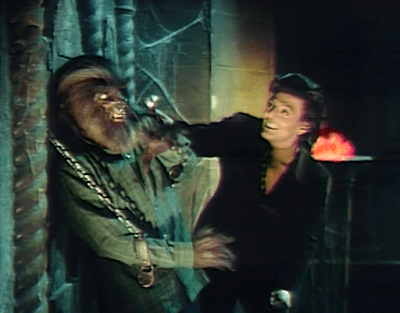
Episode 905: My darling now

Heiress Carolyn Collins Stoddard has been hung up on mysterious drifter Chris Jennings for a while. Unknown to Carolyn, Chris is her third cousin, the great-grandson of her great-great uncle Quentin Collins. That is a distant enough relation that it needn’t be an obstacle to romance. But Chris is keeping another secret that presents a more definite obstacle. He inherited from Quentin a curse that makes him a werewolf.

From March to November 1969, Dark Shadows was a costume drama set in 1897. Old world gentleman Barnabas Collins and mad scientist Julia Hoffman traveled back in time from 1969 to that year, and befriended the living Quentin. They learned that Quentin had been freed of the effects of the werewolf curse when a magical portrait was painted of him. As long as the portrait remains intact, Quentin will not only retain his human form on the nights of the full moon, but will also be immune to injury, aging, and death. Julia and Barnabas know of Chris’ condition, and early in 1969 they were working together to cure him of it. Julia now hopes that another portrait can be painted to do for Chris what his great-grandfather’s portrait did for him.

Barnabas came back from the past wanting nothing to do with Chris. He has secretly been absorbed into a cult devoted to mysterious supernatural beings called the Leviathan people. When Barnabas first saw Chris after his return to 1969, he told him there was no hope for him. Since then, he has been cold and distant both to Chris and to Julia. He has urged Carolyn to forget Chris, and keeps telling her that she has a great future in store for her. We have had other indications that this future will involve a special role in the Leviathans’ plan to take over the world.

Now, Carolyn has met the living Quentin and become smitten with him. She does not know his true identity, but did tell Barnabas about him and that he was coming to meet her. Barnabas’ response was to run Quentin over with his car, claiming afterward that it was an accident.

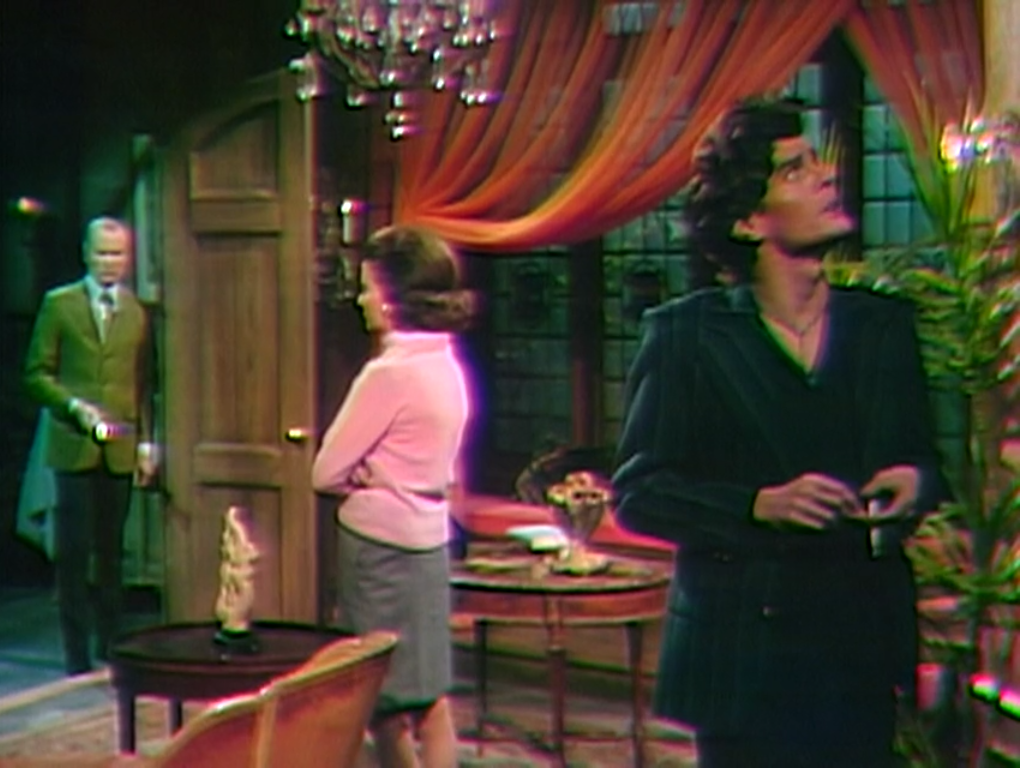
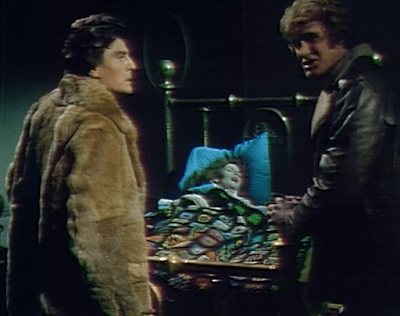
Now, Quentin is in the hospital with a bandage on his head. He does not speak in today’s episode, but anyone who has seen a soap opera knows that a bandage wrapped around the head is a sure sign of amnesia. Indeed, when Julia addresses him as “Quentin,” he looks at her blankly.

Quentin wearing the amnesia badge. Screenshot by Dark Shadows Before I Die.

In his post about the episode on his great blog Dark Shadows Every Day, Danny Horn reminds us of another amnesia plot that followed a time travel story. That one dragged on for eight months, was never at all interesting, and ended with the two characters most directly involved being hustled off the show. Remembering it, longtime viewers will shudder at the sight of Quentin’s bandage. But amnesia stories are a staple of soaps, and Danny explains how they can work well by imagining a different version of that dismal flop:

Jeff Clark… might or might not have been a reincarnation of Peter Bradford, Vicki’s boyfriend from 1795. Somehow, they managed to spin that mystery out for a full eight months, until they finally decided that nobody cared, and then they wrote Jeff, Peter and Vicki off the show forever.

The real problem with the Jeff/Peter mystery — and this is important, for the Quentin/Grant Douglas conundrum — is that Jeff Clark was just an empty suit of clothes. Jeff had no memories, and he arrived on the scene with no family, and very little in the way of a storyline.

Worst of all, Jeff’s primary characteristic — being in love with Vicki — was also Peter’s primary characteristic, so it was a distinction without a difference. It didn’t really matter whether he was called Jeff or Peter, so they could just let it drift for month after month, with no appreciable impact on story progress.

Here’s how you do the amnesia story: Think of it as two people inhabiting the same body, and create a conflict between those people. If Peter’s in love with Vicki, then “Jeff” should be cold and distant. “Jeff” didn’t experience any of the events that brought Vicki and Peter together, so her clumsy attempts to revive his memory should upset and frustrate him.

At that point, you can take as long as you’d like to bring his memory back, because the longer this goes on, the more damage “Jeff” can do to Peter’s life. The ideal way to end that story is to have “Jeff” fall in love with Vicki’s worst enemy, and news of their engagement makes Vicki turn to someone new for support and understanding.

Then it should be obvious to everyone that his memory comes back on the day of his wedding, during or immediately after the vows. Suddenly, “Jeff” is Peter again, horrified to discover that he’s married to someone that he doesn’t like, and the love of his life is involved with somebody else.

That’s how you do the amnesia story.

Danny Horn, “Episode 905: Waiting for Quentin,” posted 27 July 2016 on Dark Shadows Every Day.

The sheer fact that Quentin is in a coma as a result of a collision with a car is a puzzle for attentive fans. In #844, sorcerer Count Petofi scraped Quentin’s cheek with a jagged piece of glass. That did not leave a mark on Quentin himself, but a scar appeared on the portrait in the place corresponding to the spot Petofi scratched. Since violence against Quentin leaves him as he was but marks the portrait, why is he hurt now? One of Danny’s commenters tackled this problem:


Yeah, why is he even hurt at all? The painting should have absorbed all the trauma of Barnabas’ reckless attempt at mayhem; the portrait should have amnesia. (Oh, but then it wouldn’t be protecting Quentin any more, since it wouldn’t remember who it’s a picture OF – which is why Quentin has the amnesia and injuries! How’s that for a fanwank?)…

Is it explained later just WHY Quentin thinks he’s Grant Douglas? Did he already have amnesia? And now he has double amnesia? (If I remember sitcom amnesia correctly, the second trauma should have reversed the first – but soap opera amnesia may be different.)

Comment left 29 December 2018 by “John E. Comelately” on Danny Horn, “Episode 905: Waiting for Quentin,” posted 27 July 2016 on Dark Shadows Every Day.

Later, Carolyn is at the antique shop where she has been working. The shop’s owner, Carolyn’s friend Megan Todd, makes a bunch of cryptic remarks about having discovered something greater than happiness. Carolyn wonders about the baby that Megan and her husband Philip have been looking after. She hears a ball bouncing in the upstairs room where the baby has been sleeping, and Megan orders her to ignore it. Eventually the ball comes rolling downstairs, and an eight year old boy follows it. Megan declares the boy to be her darling.

Returning viewers know that the baby was in fact some kind of creature associated with the Leviathans, and Megan has a scene in which Barnabas tells her that the creature is going to be undergoing a change. So we know that this boy and the baby are in fact one and the same.

That two consecutive men who attracted Carolyn turned out to be werewolves is interesting in light of the frequent references to the big plans the Leviathans have for her. The Leviathans have clearly not been giving their devotees a lot of background information about the tasks they make them perform, so that even if Barnabas did not know who Quentin was when he tried to kill him, the unseen forces manipulating him may have been well aware of that. Perhaps the show is suggesting that there is some kind of enmity between the Leviathans and werewolves.

Quentin’s ghost haunted the great house of Collinwood from December 1968 to September 1969 and wrought great havoc there. The haunting broke on the anniversary of an event in 1897 that went differently than it had originally because Barnabas and Julia had traveled back in time. But it was made clear when we returned to contemporary dress that the 1960s characters all remember the events of those ten months, and that Quentin’s ghost still frightens them. Carolyn was one of the few major characters who did not see the ghost, so I suppose it makes sense she isn’t afraid when she sees the living Quentin. But one does wonder what the reaction will be when the other residents of the great house meet him.

The Leviathan boy is played by David Jay, and is named in the credits as “Alexander.” Born in 1961, Mr Jay is the youngest person ever to have appeared on Dark Shadows. He acted off and on until the early 1980s. Evidently he is alive and well, but he never appeared at any of the Dark Shadows conventions and does not do the podcasts on which other cast members occasionally guest. Not one for the fandom, he.

Episode 900: Precious possession

We open with the sight of a man (Dennis Patrick) sitting nervously on a chair placed in the middle of a pentagram marked on a rug. At each point of the pentagram there is a candle. The man is Paul Stoddard.

Paul’s precarious pentagram perch. Screenshot by Dark Shadows Before I Die.

Regular viewers will remember #752, in which Quentin Collins was told to sit on a chair in the middle of a similar pentagram. Quentin’s friend, amateur warlock Evan Hanley, told him that by doing this he could keep from turning into a werewolf. Paul isn’t afraid of turning into a werewolf, and he doesn’t have a friend like Evan. His worry is vague, but urgent- he knows that someone is after him, that if that someone catches up to him they will do something horrible, and that whoever it is keeps sending him messages that it is time for him to pay his debt. But he has no idea who that is, what they will do, or what the debt they are talking about. Sitting in the pentagram was a suggestion that came from a sailor who cruised him in a gay bar met him in a local tavern.

Paul’s pursuers are a cult associated with mysterious beings known as “the Leviathan people.” It has been made clear to us that both Paul and his daughter, heiress Carolyn Collins Stoddard, are, unknown to themselves, part of its orbit. In #888, Paul and Carolyn ran into each other at a cairn that is the cult’s ceremonial center and looked at it. Carolyn had been on its site many times, and could not understand why she had not seen it before. In #894/895, the cult’s acting leader, Carolyn’s distant cousin Barnabas Collins, took antique shop owner Philip Todd to the cairn. Philip told Barnabas he had walked past the site a few days before and that the cairn was not there then; Barnabas explained that only those connected with the Leviathan cult can see it. Barnabas has also been highly solicitous of Carolyn’s well-being since he became part of the cult, and he keeps telling her that he knows she has an extraordinary future ahead of her. So we know that the cult has plans for her, and Paul’s distress suggests that they have less attractive plans for him.

Paul sees the doorknob turning. He is terrified. Instead of the enemy Paul expects, Carolyn enters. He yells at her to leave. She stays. When he is unable to explain what he is afraid of, but that the pentagram on the floor will protect him, she notices that it is the same as the symbol she has been wearing on a chain around her neck. Barnabas gave it to her some days ago and urged her to wear it always. The audience knows, but she does not, that he intends it to protect her from the local werewolf. When she sees the similarity, the show invites us to wonder what the Leviathans have to do with werewolves. Carolyn tells Paul that if the symbol will protect him from his enemies in the form of chalk or gaffer tape on the floor, it will also protect him when it is composed of a silver pendant. He puts the pendant on and declares that he feels much better. He can no longer hear the voices that have been telling him his payment is due immediately. He embraces Carolyn and tells her he trusts only her.

When Carolyn mentioned Barnabas to Paul, he responded “Who is Barnabas?” Carolyn seems surprised he does not know, since she saw him near Barnabas’ house. Indeed, we saw him enter Barnabas’ house and wander through it the night he first returned to Collinwood, after an absence of twenty years. But he doesn’t remember anything about that.

Not that Carolyn’s own long acquaintance with Barnabas is all that enlightening to her just now. Ever since the Leviathans adopted him as one of their own, he has not been himself at all. We see him in his front parlor with mad scientist Julia Hoffman, who has for a year and a half been his inseparable best friend. She is trying to interest him in some information she has gathered about another storyline, and he makes it clear he could not be less interested in it or in her. She demands to know what he is interested in, and he refuses to answer. Carolyn enters, and suddenly Barnabas is all ears. Julia, frustrated, snaps that now she can see what he does care about.

In the autumn of 1967, Barnabas was a vampire and Julia had failed in an attempt to make him human again. He bit Carolyn and made her his blood thrall. He also decided that he would kill Julia to prevent her exposing him. Julia soon learned that Carolyn was both a wily operator and a most devoted servant. Julia had already realized that she was in so deep with Barnabas that she would be unlikely ever to make a life with anyone else, and so she conceived an unrequited love for him. In her dealings with Carolyn in those days, terror mingled with jealousy. Her bitter remark when she sees that Barnabas, who has been so dismissive of her, is now so concerned with Carolyn, reminds longtime viewers of that jealousy. Combined with the story of a daughter reunited with her long-absent and none too respectable father, this faint suggestion of a love triangle is enough to remind us that we are watching a daytime soap.

For her part, Carolyn was freed of her subservience to Barnabas as soon as he was freed of the effects of the vampire curse in March 1968. For some time, Nancy Barrett went out of her way to play Carolyn in a way that left us wondering if Carolyn remembered her time in his power. The scripts didn’t give her a lot of support in that endeavor, but the closeness she feels towards him combines with Julia’s jealousy to bring it back to our minds.

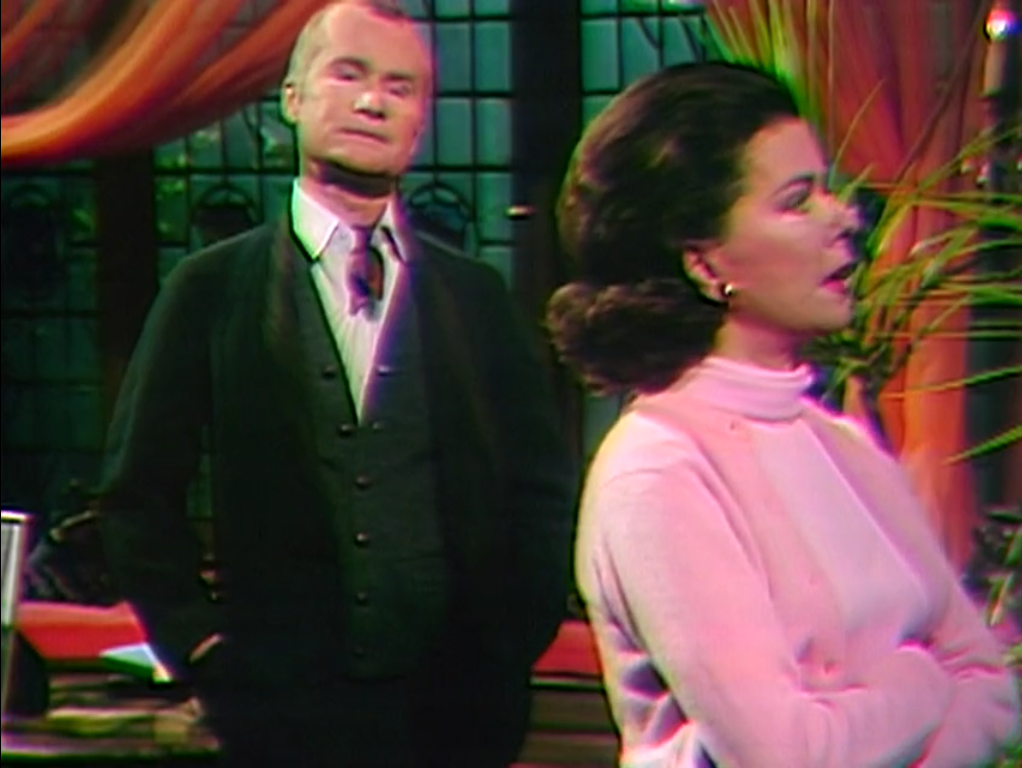
Carolyn has come to ask Julia to help Paul. Julia is back in the great house of Collinwood getting her medical bag to take to Paul’s hotel room when Paul himself bursts in. He demands to see Carolyn. Julia tells him that she left a little while ago to go to his hotel, and is probably there now. The telephone rings. Julia answers it, and tells Paul it is for him. This doesn’t strike her as odd, even though he hasn’t set foot there in twenty years, not since the night he left his wife Liz thinking she had killed him. Julia hands the phone to Paul. He expects to hear Carolyn, but instead hears the same voice that has been taunting him, saying that his bill is due now. He hangs up, and it starts ringing again. He forbids Julia to answer it, and runs out. We cut to his hotel room, and see that this time it is Carolyn trying to reach her father. Later, Carolyn will come home and Julia will tell her that Paul doesn’t seem to want help, however much he may need it.

Paul goes back to his room, and hears the phone there ringing. Terrified, he runs out, returning to the bar where he’d picked up trade met a new friend the night before. He sees another stranger sitting at a table, looking him over and beckoning him by rolling back one finger. The stranger is Barnabas.

Barnabas beckons Paul. Screenshot by Dark Shadows Before I Die.

Paul reluctantly goes to the table, and Barnabas introduces himself. Paul says he doesn’t know Barnabas, but Barnabas makes it clear he knows all about Paul. He asks him to think back to the night he left Collinwood in 1949. We dissolve to a flashback.

Paul is at the bar, and another strange man strikes up a conversation with him. The man encourages him to assume that he has the power to grant any wish Paul might make in return for a price they would agree on. Paul says that in that case, he will ask for twenty years of boundless prosperity. At the end of those twenty years, Paul will give up anything he has, even his “most precious possession.” They shake hands on this deal. Paul laughs, and says he has won the game. He said that he would surrender anything he has, present tense- not anything he might gain in the course of his successful future, but anything he has as of 4 December 1949. On that date, Paul assures the man, he has nothing anyone could possibly want. The man laughs, and wants to drink to congratulate Paul on his cleverness.

Back in the present, Barnabas is laughing as heartily as the other man did twenty years before. He finds it preposterous that Paul could have forgotten such an important encounter. Paul can’t see anything important in it- it was just a silly little game, and its only consequence was that a strange man bought him a drink. Barnabas says that on the contrary, the bargain he struck was quite real. The Leviathans kept their side of it by giving him the success he has had over the last twenty years. Now that the twenty years are up, the time has come for them to claim the most precious possession he had the night he fled Collinwood.

Paul says that he supposes Barnabas is talking about his soul. He laughs heartily at that, and tells Barnabas that he is welcome to it. He is telling Paul that that is not what he meant as Carolyn enters. Paul is still laughing, and is delighted to see his daughter. She says she is relieved that the two of them found each other, and he tells her everything will be all right now. Barnabas says that Carolyn is her father’s most precious possession.

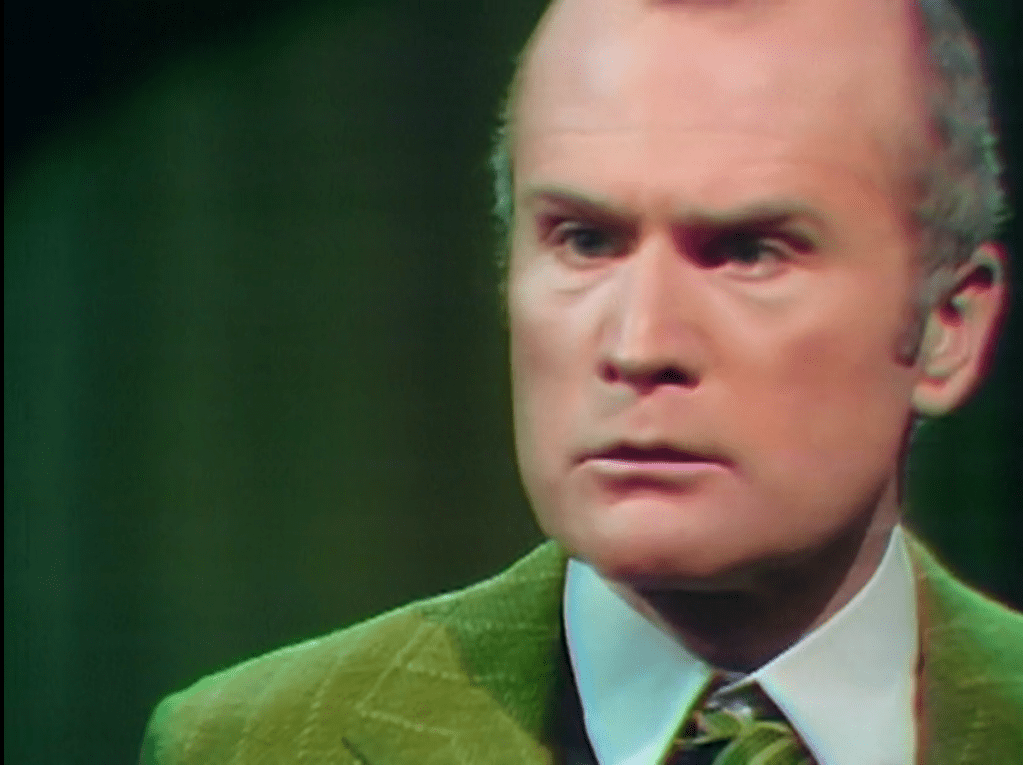
The scenes of Paul rushing around in a steadily mounting panic he is unable to explain are highly reminiscent of The Twilight Zone. The last line is a twist worthy of that classic series, especially as delivered by Jonathan Frid. His icy performance as Barnabas in these early episodes of the Leviathan arc not only recalls the malign representatives of alien powers on that show, but is superb in itself. He stumbles a little over his words in Barnabas’ scene with Julia, but is perfectly composed otherwise, and the effect is quite frightening.

I remarked on the gay subtext of the barroom scenes in the comment thread on Danny Horn’s post about the episode at his great Dark Shadows Every Day:

So far, this has been the gayest storyline the show has taken on yet.

In 899, the sailor offers to buy Paul a drink, and Paul shouts “I buy my own drinks!” This isn’t subtext- any man getting that reaction in a bar will know that the other fellow has interpreted his offer as including more than the drink. Paul apologizes and becomes friendly, indicating that he is willing to abandon that interpretation and set aside the hostility that accompanied it.

In this episode, we’re back in the same bar. Barnabas beckons Paul to his table with his index finger. I invite any man who doesn’t think we are intended to read this as a reference to a sexual come-on to try that move on a homophobic tough guy in a bar.

Paul’s face shows his inner struggle as he tries to resist Barnabas’ advances, but he can’t. Barnabas coaxes him into reminiscing about yet another night in the same bar, when a casual encounter with yet another guy led to something that seemed at the time like a little harmless tomfoolery, but that has now grown into a threat to his relationship with his family, his standing in the community, his physical well-being, and everything else.

Comment by “Acilius,” left 12 December 2020 on Danny Horn, “Episode 900: The Long Con,” posted on Dark Shadows Every Day, 18 July 2016.

In response to someone who said some kind words about that comment, I made a remark that I no longer think is very good:

Thanks! It’s a bit of a puzzle- so far as I know, none of the writers on the show at this time was gay, so I’m not sure why they decided to go so deep into these themes just then.

Comment by “Acilius,” left 11 April 2021 on Danny Horn, “Episode 900: The Long Con,” posted on Dark Shadows Every Day, 18 July 2016.

What I think now, and probably would have thought then if I had stopped and considered it for a minute before I hit “Post Comment,” is that the writing staff’s sexuality has nothing to do with it. They were worldly, sophisticated people with long experience in the theatrical profession in New York City. They all probably had many gay friends, and when they are called upon to write a story about people being drawn into a secret underworld and learning uncomfortable truths about themselves in the process their minds will naturally turn to themes having to do with closeted homosexuality. Granted, that doesn’t fully account for Christopher Bernau’s decision to play Philip as a much queenier version of Paul Lynde, but it is hardly a “puzzle” that the writers would draw on motifs suggestive of the closet when that’s the story they have to work with.

The man who met Paul in the bar in 1949 is unnamed in today’s dialogue, but will later be referred to as Mr Strak. Strak is played by John Harkins, who appeared in #174 as Lieutenant Costa of the Arizona State Police and in #878, 879, 880, 881, and 883 as Garth Blackwood, formerly the keeper of England’s Dartmoor Prison, and by that time a creature raised from Hell to wreak vengeance on an escaped prisoner and anyone else who caught his attention.

Strak’s name may remind longtime viewers of another minor character whom we saw in episodes #1 and #2, Wilbur Strake, private eye. We saw Strake in this same bar, where he gave reports about Carolyn and other members of the Collins family to his employer, Burke Devlin. Like Strak, Strake was a rather smug, sardonic sort. Add to this the rarity of the names “Strak” and “Strake” and the fact that they sound so much alike, and it seems obvious that there is an intentional reference of some kind. Paul’s presence in this storyline is the result of the writers reaching back to the show’s early days to find a loose end they could attach to this storyline to incorporate it into the Collins family saga, so they probably were looking through the scripts from the first week. Still, I can’t imagine they thought many people would remember Wilbur Strake by this point. Likely the reference is an inside joke, but who was on the inside and what the point of the joke was, I can’t begin to guess.

I wasn’t writing detailed posts with background information when I covered the first weeks of the show, so I will mention here Strake was played by Joseph Julian, who later became a regular on Somerset, a soap that aired on NBC opposite Dark Shadows for the last year of its run. The cast of Somerset included several Dark Shadows alums, including Dennis Patrick, Joel Crothers, and Christopher Pennock in major roles, and, as day players, Dolph Sweet and Humbert Allen Astredo.

Episode 890: They will be strangers, but you will know them

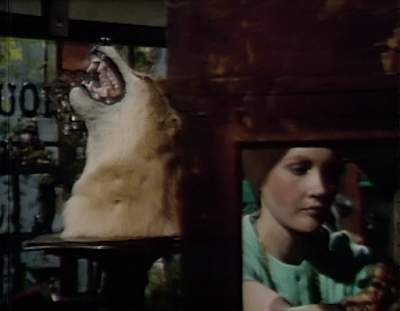
Like many episodes of Dark Shadows, this one ran long and ended with credits only for the cast and for Dan Curtis Productions. The entry on the Dark Shadows wiki says that the director was Lela Swift. I am sure that it was in fact directed by Henry Kaplan. This shot of Nancy Barrett as heiress Carolyn Collins Stoddard is proof positive:

There is another flagrant Kaplanism in today’s first scene between antique shop owners Philip and Megan Todd (Christopher Bernau and Marie Wallace.) Philip enters from upstairs. He stops with his waist at the top of the frame. That’s where he stays for the first part of the scene, ending with Megan raising a paper that covers part of her face. Evidently what’s happening between the characters is none of the audience’s business.

Swift was a talented and ambitious visual artist, Kaplan a sloppy and unimaginative one. He relied heavily on closeups. When it dawned on him that it was dull to hold the frame just beyond the edges of an actor’s face, his response was to zoom in and give us an extreme closeup of some part of the actor’s face. It’s above average for him that the first shot above includes Miss Barrett’s eyes- he specialized in shots displaying the face from the nostrils down, and often held them even after the actors had to move, leaving us with the sight of an ear drifting out of our view.

Even when Kaplan’s tight little frames do not keep us from figuring out what is happening in a scene, they deprive us of the energy that comes from seeing the players interact with each other. We don’t get statements and reactions simultaneously, and we don’t see the actors using the space between them to tell us how the characters feel about each other. Kaplan was also a pretty bad director of actors, regularly poking them with a stick as his way of telling them he wanted them to play a scene differently and on one occasion fastening a handle to a child actor so that he could physically place him on his mark during rehearsal. So perhaps his mania for closeups reflected a lack of awareness of what actors do and how the choices they make contribute to the audience’s experience. As a result of his insensitivity to these and other visual aspects of the medium, Kaplan’s episodes would often be better suited to radio than to television.

Fortunately, the dialogue today is peppered with snappy lines. So Danny Horn devotes his post about the episode on his great Dark Shadows Every Day to a selection of memorable pieces of dialogue. That also makes me suspect the wiki is not entirely correct. It attributes the script to Gordon Russell, an able writer overall but one who is not at all given to bons mots. I use bits of dialogue whenever possible as the titles of these posts, and I often have to search very hard through Russell’s to find suitable ones. It was Violet Welles who excelled at producing those. Russell and Welles often collaborated, so it could be that he wrote a draft to which she added the quotable quotes.

The current story centers on a mysterious cult that has sent time traveler Barnabas Collins back to 1969 from a long sojourn in 1897, by way of a couple of days in 1796. Under the influence of the cult, Barnabas is being a real jerk to his friend, mad scientist Julia Hoffman. Barnabas was a vampire for a long time, and even when he is free of the effects of that curse he habitually resorts to murder to solve his problems. But the victims of those murders are imaginary, played by actors who will go on to find other work, so we don’t usually stay mad at him for any length of time when he commits them. His friendship with Julia, on the other hand, is the emotional core of the show. Barnabas’ coldness to her in yesterday’s episode and today’s leads us to see what the cult is doing to him as the greatest crime anyone has ever committed on Dark Shadows.

Barnabas was a pop culture phenomenon familiar to many millions of people who never saw a single minute of Dark Shadows. The show’s fanbase largely consisted of his devoted followers. So a story about a cult which co-opts him as its leader and changes his personality so that he is impossible to get along with directly addresses a fear that must have blacked out the mind of Dan Curtis every time the postal service truck loaded with Jonathan Frid’s fan mail backed up at ABC Studio 16.

Barnabas brought a box with him from his visit to the eighteenth century, and it is of the utmost importance to the vast eternal plan the cult is working on that the box not be opened until the right time. So Barnabas put it on the mantel in his living room, and when Julia was standing a few inches from him he lifted it from the mantel and placed it on a table in the middle of the room. When she asked what it was, he became flustered and refused to answer any questions about it.

When Julia left the house, Barnabas left the room, with the front door unlocked and the box still on the table. Today, we open with Julia coming back in, hearing the sound of breathing coming from the box, finding its key on the table next to it, and placing the key in its lock. Barnabas comes in just in time to stop her opening it, but we can see that the cult probably could have chosen an agent with a better sense of operational security. Barnabas’ function in the story is to make messes that other people will have to clean up, so as soon as we heard that the box must not under any circumstances be opened we expected him to leave it where it would inevitably fall into the hands of someone bent on opening it, though it is a bit disappointing he has done so this quickly.

After he has taken the box from her, Barnabas berates Julia, orders her from his house, and tells her he owes her nothing. He abruptly sweetens up and tells her that he is only carrying on that way because of some kind of temporal jet lag. He reminds her that when she traveled back in time in September, she was very ill for a while; he suggests that his surly mood might be the result of the same shock that caused that reaction. About a minute after he starts on this new tack, just as Julia has started smiling again, a knock comes at the door. It is Carolyn.

We don’t know what effect the cult’s co-optation of him has had on Barnabas, but regular viewers know that characters on Dark Shadows are always acquiring one magical power and losing another. For the last few months of the 1897 segment, the show’s main villain was sorcerer Count Petofi. One of Petofi’s signature moves was to become aware of visitors shortly before they arrived. It could be that the writers have decided to give the cultified Barnabas that power, and that it was because Carolyn was on her way that he wanted to put Julia in a good mood.

That interpretation is supported by what follows. Carolyn is delighted to see Barnabas; she hadn’t known he was back from his trip to 1897. She hugs him and he smiles, a stark contrast to his icy reaction when Julia hugged him yesterday. She wants to talk about Chris Jennings, a young man she dated a few times and whom she has been told is dangerous. Julia and Barnabas have befriended Chris and know that he is a werewolf. Julia thinks she can somehow control Chris’ transformations, and she urges Carolyn to think well of him. Barnabas tells her to trust her instincts and to avoid Chris. He keeps telling her that she is too important to be allowed to come to harm. Later, he visits Carolyn in her home, the great house on the estate of Collinwood, and he keeps going on and on about how important she is and how confident he is about her future. He also gives her a silver pentagram, an amulet to ward off werewolves, and urges her to wear it at all times. He subsequently has another scene with Julia in his own house, and he is just as cold and dismissive as he was in the first scene, exploding at her for being “irrational.” Evidently the cult has plans for Carolyn, but not for Julia.

Julia bought a painting from the Todds the other day, and now they have received a telegram offering to buy it regardless of price. Julia goes to their shop and discusses the telegram with them. She believes that the telegram, which is signed “Corey,” may actually be from Quentin Collins, a distant cousin of Barnabas’ whom he befriended during his time in 1897 and who may have been immortalized by a magical portrait painted by the same artist responsible for the picture Julia bought. She tells the Todds that she is not certain she wants to part with the painting, but that she would very much like to meet “Mr Corey,” and that she believes others in town would also like to do so. She urges them to reply to the telegram with an invitation.

Barnabas stands over the box. We hear his thoughts as he mulls over his questions about it. He suddenly declares “It is time!” Then he goes to his chair and sits down. Evidently, it is time to take a load off.

Barnabas has a vision of one of the hooded figures who inducted him into the cult. The figure, a man named Oberon, addresses him as “Master” and tells him that he is to give the box to people who wake him by knocking at his door. There is a knocking, he does awaken, and he goes to the door.

Episode 830: Up in the tower room, all bloody

We open in the woods on the estate of Collinwood, where a young woman in heavy makeup and bright clothing is crying. Another woman in even heavier makeup and even brighter clothing approaches and asks her what is wrong. The first woman says that she had a vision which told her that the rakish Quentin Collins will die of stab wounds twelve days from now, on 10 September 1897.

The first woman used to be Charity Trask, the miserably repressed daughter of the evil Gregory Trask. She is now possessed by the spirit of Cockney showgirl Pansy Faye. Charity knew that Quentin was a werewolf, and wanted nothing to do with him. Evidently Pansy did not acquire that knowledge when she took up residence in Charity’s body, and has decided that she will marry Quentin. Quentin has no interest in either Charity or Pansy, and already has two other fiancées, one of whom he loves, at least after his fashion, and the other of whom is sealed to him by a pact with the Devil. Yesterday Charity/ Pansy learned of the second engagement, and tried to kill Quentin to prevent it coming about; week before last, she tried to end the first engagement by killing the fiancée. Pansy had her faults, but she wasn’t inclined to physical violence. That part seems to be Charity’s contribution to the symbiont.

The other woman is broad ethnic stereotype Magda Rákóczi. Magda was the one who made Quentin a werewolf in the first place. She cursed him for murdering his wife Jenny, who was her sister. It was only after she had placed the curse that Magda learned that Jenny had given birth to Quentin’s twin children, a boy and a girl. Since the curse is hereditary, Magda is now desperate to lift it, and she and Quentin have become allies.

Some time ago, we learned that if Quentin dies, there will be no hope of lifting the curse. So Magda is terrified when Charity/ Pansy tells her of her vision of Quentin’s death.  She takes her back home to the great house on the estate, where her father and Quentin are bickering while they recap yesterday’s story. Trask tries to deny that Charity/ Pansy is insane or that she is capable of killing, but when she enters and announces that she will murder the first person who comes between her and Quentin he has to admit that it might be time to find a place for her in residential care.

We turn our attention to the upstairs of the great house. We see Charity/ Pansy in bed, with Magda sitting in a chair beside. The gramophone is playing a record of Pansy Faye’s theme song. Regular viewers will wonder where Charity/ Pansy could possibly have found such a thing. Charity never met the living Pansy, who was killed the very evening she arrived at Collinwood. Perhaps Pansy’s fiancé, the childlike Carl Collins, bought the record when he met Pansy in Atlantic City and brought it back with him. Carl himself was killed well before the possession began, but perhaps Charity or Charity/ Pansy found it among Carl’s effects.

Charity asks Magda if she likes the tune. “I only like Gypsy music,” she replies. Charity/ Pansy and Quentin both reiterate their theme songs endlessly, but few other characters in the 1897 segment have so much as a dedicated entrance cue. This line of Magda’s makes us wonder what the show might have been like if they had given every major character a theme song.

Trask has a crisis in the drawing room. He hears a ghostly voice warning him that there will be another killing soon. He starts shouting the name “Minerva!” and pleading for mercy. First time viewers might not know what to make of this. Those who have been with the show for a while know that Minerva was Trask’s wife and Charity’s mother, and that he instigated a plot to murder her so that he could marry wealthy spinster Judith Collins and become master of Collinwood. When the voice starts to talk about “the beast that walks like a man,” Trask says “You’re… not Minerva?” Jerry Lacy is an expert comic actor, and his delivery of that line is laugh-out-loud funny.

The same ghost appears visibly to Quentin in his room. He recognizes it as that of Tessie Kincaid, a woman he killed in a recent fit of lycanthropy. He knows that she is appearing to him because tonight there will be a full Moon.

Tessie appears to Quentin. Screenshot by Dark Shadows Before I Die.

Magda enters and finds Quentin writing a suicide note. She tells him he must not kill himself. She chains him to a post in his room and stands by with a pistol. Trask enters and finds them in this compromising position. Mrs Acilius and I laughed as we imagined how Magda and Quentin might have claimed they were planning to spend the evening.

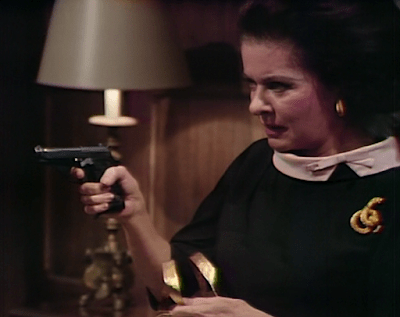
But there is no point in lying to Trask. Between what Tessie’s ghost told him and what he overheard while eavesdropping on a conversation Quentin and Magda had earlier in the drawing room, he has figured out Quentin’s problem. He takes the gun from Magda and recognizes the bullets with which it is loaded as silver. He announces that he will wait until the Moon rises and see what happens.

Tessie’s turn today marks Deborah Loomis’ third and final appearance on Dark Shadows. Miss Loomis didn’t get to do very much, but she made the most of all of it, and I wish we had seen more of her.

Episode 809: Back from your evening revels

Charity Trask finds Quentin Collins unconscious and disheveled in the woods. She kneels beside him in a show of concern, then notices a woman on the ground near him. The woman’s face is covered with what on a black and white television look like slash marks and her clothing is badly torn. She regains consciousness just long enough to say Quentin’s name. Charity notices that Quentin is holding a scrap of cloth that matches the woman’s dress, and realizes that he is the werewolf who has been terrorizing the area.

Quentin comes to, and Charity tells him they must get help for the injured woman. Quentin’s response is to threaten to kill Charity if she says anything to anyone about what she has seen. He says that he will look after the woman, and repeats his death threats to Charity.

Charity goes home to the great house of Collinwood, where her father, the overbearingly evil Gregory Trask, orders her to marry Quentin by the end of the week. She is horrified and tells him she will not. She cannot explain why. Before Gregory can corner Charity and force her to give him information, twelve year old Jamison Collins enters. Jamison reports seeing the injured woman in the woods, and says that Gregory must go to her at once if she is to survive. Gregory dismisses this as a “tall tale” and says he will not be distracted from punishing Jamison for his long unexplained absence from the house. Charity, on the point of sobbing, urges Trask to take Jamison seriously, and he reluctantly goes to see if there really is a woman in the woods.

We know more than do Charity or Trask. We saw Jamison meet Quentin in the woods next to the woman’s body, and talk to him in an amiable and condescending tone about the possibility of turning this unfortunate incident to their mutual advantage. He also makes it clear that, despite his appearance, he is not simply Jamison. He is a sorcerer named Count Petofi, in possession of Jamison and acting through his body. When Charity asks Jamison/ Petofi if the woman was alone when he found her, he replies that of course she was. Smiling, he asks who she thought he might have seen. Terribly agitated, she soon excuses herself and goes into the foyer. Jamison/ Petofi looks directly into the camera and smiles. David Henesy was the first actor on Dark Shadows to use this technique, back in 1966 when he was playing strange and troubled boy David Collins. He’s been doing it a lot lately, and is still very good at using it to unsettle the audience.

He looks young for 150, but he’s grown quite a bit since 1966. Screenshot by Dark Shadows Before I Die.

Quentin comes down the staircase, wearing a tidy new suit. Charity is shocked that he did nothing to help the injured woman; he resumes his menacing tone and demands to know whether she kept her side of the bargain. He eventually deduces that she did not tell what she saw, and allows her to go upstairs to her bedroom. Quentin is usually charming, often funny, and occasionally aligned with good against evil, but even before he became a monster he was established as a homicidal maniac. When we first met Quentin, he was a ghost haunting Collinwood in the late 1960s and he kept killing people there. The first week of our trip back in time to 1897, we saw him trying to strangle his grandmother in her bed. And his sister-in-law turned him into a werewolf as revenge after he murdered his wife Jenny. Since we are focused on the horror of Charity’s situation as her father is pressuring her to marry Quentin, of course his bloodthirstiness is the aspect of his personality we see most clearly today.

Trask returns, carrying the injured woman. Quentin asks if she was conscious. Trask says she is not conscious. Quentin specifies that he wants to know if she has been conscious at any point while with Trask. This arouses Trask’s suspicions; Quentin protests that it is information he will need when he telephones the doctor. Trask says that she was not, and carries her upstairs.

Quentin goes to the drawing room. Jamison/ Petofi is there, and has some business to discuss. Quentin is too unsettled by the fact of the possession to talk candidly. Jamison/ Petofi decides to humor him. “I’ll become that beautiful child you so want to see… Can we play a game, Uncle Quentin?” Quentin is stunned by Jamison/ Petofi’s sudden change of tone and bearing. It is indeed impressive to see David Henesy drop his mimicry of Thayer David as Petofi and resume his usual approach to the role of Jamison. We’d forgotten just how deeply he had come to inhabit that imitation.

Jamison/ Petofi declares that they will have a treasure hunt. He gives Quentin a series of clues in the form of cryptic rhymes. Quentin is completely stumped by all of them. Finally Jamison/ Petofi just points at the desk drawer he wants Quentin to open and tells him there is a document in it that he can use against Trask. Quentin opens the drawer and pulls out heap after heap of paper, then declares “There’s no paper here!”

Quentin is not especially brainy; much of his appeal comes from the joy David Selby, Ph.D., took in playing a character who at no point says or does anything to demonstrate intellectual prowess. But we are not supposed to believe that he is stupid, at least not so stupid that it is plausible that “There’s no paper here!” was the scripted line. Maybe it was a blooper for “There’s no paper like that here!” or “There’s no paper here I haven’t seen before!” or something like that.

A document bearing a wax seal and a couple of signatures materializes on top of the papers Quentin has pulled out of the desk. He reads it, and sees that it is a full confession to the murder of Trask’s first wife, signed by Trask and lawyer Evan Hanley. All Jamison/ Petofi has to say is “It can be very useful, can’t it? Especially since it’s true… Aren’t games fun, Uncle Quentin?” and Quentin catches on that the document gives him power he can use against Trask.

Meanwhile, the injured woman has briefly regained consciousness in the upstairs bedroom where Trask and Charity are attending her. She spoke Quentin’s name, and Trask sent Charity to fetch him. Trask confronts Quentin about this. Quentin says that the woman’s name is Tessie, that he talked to her a couple of times when they ran into each other at the Blue Whale tavern, and that he knows nothing more about her. He admits he didn’t call the police after he called the doctor; he claims he simply forgot, in the confusion of the moment. Trask says that he will go and make the call. In an accusing tone, he asks “Most unfortunate, isn’t it, that you were the one who forgot?” He leaves Quentin alone with Tessie.

Tessie regains consciousness, looks at Quentin, and reacts with dismay. He tells her he didn’t mean to do it. She moans and dies. As she flops over, her right breast comes perilously close to springing out of her décolletage. When he realizes she has died, Quentin says “Tessie!” with a note of exasperation, as if she’s always doing inconvenient things like that. Mrs Acilius and I laughed out loud.

Downstairs, we see that Trask did not call the police after all. Charity is doing it from the telephone in the drawing room. Quentin enters through the secret panel behind her. We first saw him use this panel in #685, when it was 1969 and he was a silent but peculiarly corporeal ghost. He let himself into the drawing room and strangled silversmith Ezra Braithwaite, played by Abe Vigoda. A bit of an eldritch moment that the killer of Tessie is also the killer of a character played by the actor who would go on to play Tessio in the 1972 film The Godfather.

In Vigoda’s last scene in that movie, Tessio and Corleone Family consigliere Tom Hagen are at pains to assure each other that Tessio’s impending murder and the events that led up to it were strictly business, and that Tessio and his murderers still have the warmest regards for each other. Quentin’s attempt to deny his guilt to Tessie is of that same sort- he didn’t have any hostility towards her, his nature as a werewolf simply required that he kill the nearest person.

By contrast, Quentin’s interaction with Charity is intensely personal and intensely unpleasant. He takes the telephone out of her hand, something that men often do to women on Dark Shadows when they are trapping them, and moves deep into her personal space as he demands to know why she would want to call the police. She tells him her father ordered her to make the call; he says that Tessie will tell the police nothing now, because she is dead. Charity shouts that he killed Tessie, and that she will tell everything.

Danny Horn devotes much of his post about the episode at his great blog Dark Shadows Every Day to the absurdity of Quentin making a date with Tessie on a night when the Moon was full. In a comment, I pointed out that we have no reason to think he did make a date with her:

I don’t think it’s so hard to explain why Tessie was in the woods at dawn, though it does require a little fanfic.

Charity was in Quentin’s room in 806, inviting him to go for a walk on the beach when he’s busy getting drunk and listening to the same dreary little waltz over and over. To get Tessie into the woods, all we have to do is assume that shortly after that scene Quentin ran out of booze before he was drunk enough to stop caring about the upcoming full moon. Not wanting to deal with the Trasks, he didn’t go to the mansion’s liquor pantry, but staggered down to the Blue Whale.

There, Quentin met Tessie. She was upset with him for missing several dates in the last few days. He can’t very well explain what he’s been doing lately, and his refusal to answer Tessie’s questions angers her. She’s about to give Quentin a piece of her mind when he realizes that it will be dark soon, and rushes from the bar.

Now Tessie is really furious. She follows Quentin to the estate. Once there, she sees him change into the werewolf, and hides in terror for most of the night. Shortly before dawn, she thinks he is gone and leaves her hiding place. The werewolf appears and slashes away at her for a few minutes before changing back into human form and collapsing beside her.

And that’s when Charity finally takes her walk, and finds out.

Comment left 17 November 2020 by “Acilius” on Danny Horn, “Episode 808: Twice Burned,” Dark Shadows Every Day, 18 January 2016

Tessie is played by Deborah Loomis, and is the earliest screen credit on her IMDb page. Her next role listed there was in Hercules in New York, a 1970 film which also featured fellow Dark Shadows day player Erica Fitz Mears, who appeared in #594 and #595 as Leona Eltridge. Neither Miss Loomis nor Mrs Mears stuck with acting after the middle of the 1970s, but the two top billed members of the cast worked steadily for some years after. The first name in the credits was comedian Arnold Stang, who was best known at the time for a series of TV commercials for window screens ending with the tag “Arnold Stang says don’t get stung!” Second billed was Arnold Strong, a bodybuilder from Austria making his acting debut. Under his birth name of Arnold Schwarzenegger, Arnold Strong would go on to roles in several later films. I know of no evidence he ever auditioned for a part on Dark Shadows.

Episode 808: The mysterious shadow he can cast

Sorceror Count Petofi has taken possession of twelve year old Jamison Collins. He has also cast a spell on broad ethnic stereotype Magda Rákóczi, compelling her to lead him and his henchman Aristide to the hiding place of vampire Barnabas Collins.

Magda, Jamison/ Petofi, and Aristide. Screenshot by Dark Shadows Before I Die.

Jamison/ Petofi and Aristide are ready to drive a stake through Barnabas’ heart. They open his coffin and find that he is away from home today. Magda does not know where his other hiding place is. Jamison/ Petofi becomes intrigued with Barnabas and decides to search through Magda’s home, the Old House on the estate of Collinwood, for papers that might give him information about Barnabas.

He and Aristide find a book published in 1965. Since the dramatic date is currently 1897, this seems to be a matter of some interest. Jamison/ Petofi calls for Magda, who tells him that Barnabas told her that the book had been brought back in time from the 1960s by “a girl named Vicki.” Barnabas’ utterance of the name “Vicki” in #797 was the first reference to well-meaning governess Victoria Winters in the 1897 segment, and this is the second. Vicki was the main character of the show for its first year, and remained in the cast for over a year after that. That the name “Vicki” would be heard only in rare and trivial echoes is not something longtime viewers would likely have predicted before she was written out of the show last year.

Magda goes on to explain that Barnabas himself traveled back in time from 1969. She has a vague idea that he was trying to save a dying child, and hasn’t the faintest clue how he made this remarkable journey. Jamison/ Petofi says that they will get the rest of the story from Barnabas himself. He also says that if he can travel in time, he will be able to live forever, a proposition which would seem to require further explanation.

Jamison/ Petofi is satisfied Magda is telling them everything she knows, but Aristide keeps making threats. The most intriguing refers to something Petofi might do to her: “You’ve heard of his powers. Hasn’t anyone in your tribe ever told you about the mysterious shadow he can cast? The shadow that isn’t your own that follows you?” Writer Sam Hall was probably familiar with a novel called Phantastes by George MacDonald, a bestseller of the nineteenth century that was influential among English fantasy writers of the first half of the twentieth century. It tells of a character named Anodos, who is tormented by a malicious shadow that moves by itself and won’t leave him alone. So perhaps Hall is planning to mine MacDonald’s works for an upcoming story.

Meanwhile, in the great house on the estate, Charity Trask has a dream. She sees Jamison/ Petofi with a portrait of rakish libertine Quentin Collins. The portrait is identical to the one she saw turn into a picture of a werewolf the night before, and she asks Jamison/ Petofi if he saw the same thing. He laughs, then tells her Quentin is a lost soul.

Quentin shows up. Charity’s father, the evil Gregory Trask, has directed her to marry Quentin, and she has set out to comply with this command. Quentin has never shown the slightest interest in her in their time awake together, and he isn’t much friendlier in this dream. He asks her to do something to lighten his mood. “Can’t you be happy? Can’t you be gay?  Don’t you want to make me happy?” We’ve never seen her happy; as Gregory’s daughter, it’s hard to see how she could be. She has probably never tried to be gay, either, but it would have to be better than marrying Quentin. She does try to make him happy by imitating Cockney showgirl Pansy Faye, whom she never met or saw or heard, but whose spirit has been possessing her off and on for several days now. She sings Pansy’s theme song and does the highly suggestive dance that goes with it, only to find that Quentin has vanished.

Charity turns and finds Quentin embracing and kissing another girl. They are laughing. Quentin tells Charity that, as she can see, she has succeeded in cheering him up, and therefore she should run along. He and the girl then disappear and Magda enters. Magda tells Charity that she should forget Quentin, because he has a terrible secret. She leaves, and Quentin and the other woman reappear, still laughing at Charity.

Charity decides to ask Magda to explain the dream. Before she reaches the Old House, she finds Quentin and the girl from the dream lying on the ground in the woods. Quentin’s clothing is torn and he is unconscious, but he does not appear to be injured. The girl’s face is covered with what in black and white look like slash marks, but in color are obviously purple makeup. She opens her eyes and gasps Quentin’s name. Whether she was calling for Quentin because he was with her when they were attacked or crying out because he is the one who attacked her would not be clear to first time viewers, though returning viewers know that Quentin is a werewolf and will assume he was the attacker.

Episode 807: An award-winning performance, wouldn’t you say?

From #1 to #274, each episode of Dark Shadows began with a voiceover narration by Alexandra Moltke Isles, usually in character as well-meaning governess Vicki. This identified Vicki with our point of view and suggested that she would sooner or later learn everything we knew.

Jonathan Frid joined the cast as vampire Barnabas Collins in #211, and quickly became the show’s great breakout star. If the upright Vicki found out what we knew about Barnabas, one of them would have to be destroyed. Vicki was the favorite of longtime viewers and Barnabas was attracting new ones, so that was out of the question. Therefore, other members of the cast started taking turns reading the voiceovers, and doing so not as their characters, but in the role of External Narrator.

Today marks the first time Frid himself reads the narration. His training first in Canada, then at Britain’s Royal Academy of Dramatic Arts, and later at Yale School of Drama prepared Frid well in the art of dramatic reading, and in later years he would concentrate on that aspect of his craft. Several of his colleagues are his equals in these voiceovers- I would particularly mention Kathryn Leigh Scott, whose conception of The Narrator is always arresting, and Thayer David, who could consistently achieve the most difficult of all effects in voice acting, a perfectly simple reading. So I can’t say I wish Frid had done all of them, but he is always good, and today’s performance is among his most gorgeous.

The action opens on a set known to longtime viewers as the Evans cottage, where from 1966 to 1968 artist Sam Evans and his daughter Maggie served as Dark Shadows‘ principal representatives of the working class of the village of Collinsport. In those days, it was on this set that we saw how the misdeeds of the ancient and esteemed Collins family had consequences that spilled out of the estate of Collinwood and warped the lives of people trying to make a more or less honest living nearby.

Now the dramatic date is 1897, and Sam hasn’t been born yet. But the cottage is already an artist’s studio. It is temporarily occupied by the nationally famous Charles Delaware Tate, who is painting a portrait of rakish libertine Quentin Collins at the behest of evil sorcerer Count Petofi. Charity Trask, a resident of the great house of Collinwood, is visiting Tate in the cottage when she sees the face in the portrait change from that of Quentin. It takes on a great deal of fur and long fangs, and reminds Charity of a wolf.

By the time Tate looks at the painting again, it has resumed its normal appearance. He tells Charity that the transformation must have been in her imagination. She is willing to consider the possibility, but we know better. Quentin is a werewolf, a condition Petofi knows how to cure. Portraits on Dark Shadows have had supernatural qualities at least since #70, including portraits we saw Sam execute on this set in 1966, 1967, and 1968, and the show has borrowed from The Picture of Dorian Gray before. Moreover, Tate’s reaction to Charity is one of barely controlled panic. Nancy Barrett has to ramp up Charity’s own emotional distress to the limit to make it plausible she would not notice Tate’s extreme agitation. Perhaps if Tate were played by a better actor than the ever-disappointing Roger Davis, his response might have been ambiguous enough that Miss Barrett could keep the tone a bit lower, but his unequivocal display of alarm leaves her nowhere to go but over the top.

Mr Davis was under no obligation to play the scene transparently, since Tate later goes to Petofi’s henchman Aristide and lays out in so many words his precise relationship to Petofi’s operations and his knowledge of them. Tate’s career is his reward for selling his soul to Petofi, and he has already experienced great sorrow as a result of that bargain. Tate knows that the portrait changed to reflect the full Moon’s influence on Quentin and that Petofi is currently in possession of twelve year old Jamison Collins. Aristide tells us that Petofi’s own body is in suspended animation while he acts through Jamison. He also says that it was in 1797 that Petofi’s right hand was cut off, and that if he does not reclaim the hand in a few weeks, by the date of the one hundredth anniversary of the amputation, he will die and so will Tate.

Jamison/ Petofi is in the prison cell in the basement of the Old House on the estate of Collinwood. Barnabas has traveled back in time from the 1960s with some vaguely good intentions and is hanging around 1897 causing one disaster after another. Now, he is doing battle with Petofi and has locked him, in the form of Jamison, in the cell. Barnabas’ reluctant sidekick, broad ethnic stereotype Magda Rákóczi, guards Jamison/ Petofi during the day. Early in the episode, Jamison/ Petofi calls Magda and pleads with her to release him. He tells her that he is “just a little boy” and that she is a “rather heartless creature.” She says she wishes he were a little boy again, but that she isn’t stupid and he won’t fool her. Indeed, the phrase “rather heartless creature” and Jamison/ Petofi’s manner in delivering it sound so much like Thayer David as Petofi that they hardly count as an attempt to deceive Magda.

Later, Jamison/ Petofi casts a spell to summon Aristide, then calls to Magda again. When Magda arrives, Jamison/ Petofi gives himself a better script than the one from which he had acted in his previous scene with her. He pretends not to remember how he got into the cell and to be shocked that Magda knows he is there. Perhaps the utter transparency of his earlier pleadings was an attempt to get Magda to underestimate his abilities as a trickster.

In #803, we saw that when Petofi took possession of him Jamison’s right hand disappeared from his wrist, matching Petofi’s own mutilated condition. When Jamison/ Petofi feigns the amnesia that might come upon recovery from possession, we might therefore expect Magda to demand that he remove his gloves to prove that he is himself again. But he plays the part of Jamison so convincingly that we are not really surprised he does fool Magda. She goes into the cell, embraces Jamison/ Petofi, and he kisses her on the cheek. It is this kiss that spreads his magical power, and she realizes too late that she has been had.

Aristide arrives a moment later, and Jamison/ Petofi calls his portrayal of an innocent boy “an award-winning performance.” Indeed, if there had been daytime Emmys in 1969, David Henesy might have won one for his portrayal of Thayer David playing Petofi playing Jamison.

Aristide wants to kill Magda; Jamison/ Petofi forbids this. Under his power, she announces that she is responsible for all the evil that has happened in 1897. She was responsible for releasing Barnabas and therefore for all the murders and other harm he has done; she made Quentin a werewolf, and is to blame for his killings in his lupine form and for the curse his descendants will inherit; she stole Petofi’s severed hand and is at fault for the deaths of Rroma maiden Julianka and of her own husband Sandor that resulted from the hand’s presence. She even takes the blame for Quentin’s murder of her sister Jenny, the act for which the werewolf curse was meant as vengeance. Magda says she must be punished. Jamison/ Petofi tells her that he is not interested in punishing her. He has another use in mind for Magda She will lead him and Aristide to Barnabas’ coffin today, and they will destroy him.

Longtime viewers will perk up twice when Aristide says that Petofi lost his hand in 1797 and that he has exactly one hundred years to recover it. From December 1966 to March 1967, Dark Shadows’ first supernatural menace was undead blonde fire witch Laura Murdoch Collins, who at intervals of exactly one hundred years incinerated herself and a young son of hers, who was always named David, in an unholy ceremony that renewed her existence, but not that of the Davids. Since the usual laws of nature don’t apply, the show needs some other causal mechanism to create suspense, and anniversaries will do as well as anything else. Another iteration of Laura was on earlier in the 1897 segment. It was fun to see her again, but they could shoehorn her into that year only by retconning away the one hundred year pattern in her immolations. It’s reassuring in a way to see that Petofi is bringing centenaries back.

The date 1797 is also significant. It was in 1796 that Barnabas died and became a vampire. We flashed back to that period for the show’s first costume drama segment in November 1967 to March 1968, and Barnabas went back to 1796 for a week in January 1969. So we may go back again some day, and if Petofi was alive and in his prime in 1797, we might run into him there.

Barnabas and Petofi are not the only characters from the 1790s who might be on the minds of attentive longtime viewers. Barnabas’ little sister Sarah died in 1796, and as a ghost was an extremely important part of the show from June to November 1967. We’ve been getting reminders of Sarah for the last several days. In #792 wicked witch Angelique produced a toy soldier of Barnabas’ that Sarah gave to strange and troubled boy David in #331. In #805, Charity found Sarah’s recorder, a prop that often served as Sarah’s calling card in 1967, and talked about learning to play it. And today, we see a portrait standing on the floor of the Evans cottage, a set which Sarah visited in #260, depicting a girl wearing a bonnet very much like the one Sarah wore as a ghost in 1967 and a pink dress just like the one she wore when we saw her as a living being in the flashback to the 1790s.

Portrait at the cottage.

I wonder if, when they were making up the flimsies for this part of the show, they had thought of reintroducing Sarah. That would have required a recasting of the part- Sharon Smyth was noticeably older when we saw Sarah die in January 1968 than she was when Sarah was a ghost in June 1967, and by now we would wonder what she has been eating in the afterlife that has made her get so much taller. Besides, Miss Smyth* had stopped acting by this point.

The process of planning the stories was in two stages, a rough sketching of themes six months in advance, and a capsule of each episode written thirteen weeks ahead of time. There was a lot of flexibility when it came to putting those plans into effect. Some stories that were supposed to end within thirteen weeks were extended over years, while others that were expected to be a big deal petered out before they got going. In an interview preserved by Danny Horn at his great blog Dark Shadows Every Day, writer Violet Welles said that many of the moments on the show that made the least sense were those written when the plans hadn’t worked out: “toward the end of the cycle, you’d have characters who were really not a lot of interest who had to play scenes with other characters who really didn’t have a lot of interest, dealing with things that basically didn’t concern them. Those were hard to write.”  

This episode was taped on 25 July 1969; thirteen weeks before that was 21 May. Six months before was 25 January. By 25 January, Denise Nickerson had been on the show for two months as Amy Jennings. Nickerson was actually born on 1 April 1957, but they several times say that Amy is nine years old. When the show goes to 1897, Nickerson plays Nora Collins, who is also nine. On 19 May, Nickerson taped #761, the last episode she would appear in until #782. She is currently in the middle of a second long absence from 1897, unseen between #783 and #812. Her characters were so important in the months leading up to the 1897 segment and she played them so well that we wonder what they were thinking leaving her in the background so long.

Maybe they were thinking of bringing her back as Sarah. Nickerson didn’t look all that much like Sharon Smyth, and was a far more accomplished young actress than was Miss Smyth, but she did have brown hair, and the show prioritized hair color above all else in recasting parts. For example, two actresses followed Mrs Isles in the role of Vicki, neither of whom had much in common with her either in acting style or in looks, but who both had black hair. So perhaps there was a time when they intended to travel between 1897 and the 1790s and to meet Sarah, played by Denise Nickerson. If Nickerson were still alive, perhaps someone would ask her if she posed for the portrait that is standing on the floor of the Evans cottage today.

*She’s been using her married name for decades now, but when talking about her as a child it’s pretty weird to refer to her as “Mrs Lentz.” Since I use surnames for people associated with the making of the show and attach courtesy titles to surnames of living people, I have to call her “Miss Smyth.”

Episode 806: You’re not thinking of the foolish things

Charity Trask walks into the drawing room of the great house on the estate of Collinwood and finds a paper on the desk. It is a full confession to the murder of her mother, the late Minerva Trask, signed by her father Gregory and by Collins family attorney Evan Hanley. It also bears a red seal.

Trask enters and Charity tells him what she has read. He rants and raves for a while, claiming that she must be under the Devil’s power if she believes the confession. He forces her onto her knees and orders her to pray, then tries to destroy the paper.

Charity prays. Screenshot by Dark Shadows Before I Die.

Later, Gregory Trask is alone in the drawing room. It goes dark, a violent storm suddenly breaks out, the windows blow open, and the flames surge much higher in the fireplace than we have ever seen them. Trask cries out for Minerva to leave him alone. When he calls himself an innocent man, the storm rages more fiercely than ever.

The storm ends as quickly as it began, and a man appears in the doorway. He asks who Trask was talking to, and Trask denies that he was talking to anyone. Trask mentions the storm, and the man says there hasn’t been a bit of wind all day. Trask turns and sees that the window is closed and there is no sign of a storm outside.

The man identifies himself as Charles Delaware Tate. Trask recognizes the name as that of a nationally famous painter. Tate explains that the late Edith Collins commissioned him to paint a portrait of her grandson, Quentin Collins, but that Quentin has refused to sit for him. He asks Trask for a photograph of Quentin. Trask remembers that there is such a photograph in a drawer in the desk. When he opens the drawer, the confession falls out, undestroyed.

Returning viewers know that Tate is associated with a 150 year old sorcerer known as Count Petofi. We also know that Petofi is currently residing in the body of twelve year old Jamison Collins and is casting spells to expose the secrets of various people connected with Collinwood. Jamison’s distant cousin Barnabas Collins the vampire is doing battle with Petofi, and has locked Jamison/ Petofi in the prison cell in the basement of the Old House on the estate. That has done little to curb his power; from the cell, he was able to project himself into a dream of Evan’s, cast a spell on him, and compel him to draw up the paper Trask keeps trying to destroy. Jamison/ Petofi does seem anxious to get out of the cell, however. He offers to cure Quentin of lycanthropy if he lets him out. When broad ethnic stereotype Magda Rákóczi talks Quentin out of accepting the offer, Jamison/ Petofi growls a threat at her.

We do not know why Petofi wants Tate to paint a portrait of Quentin, but we get a clue at the end of the episode. Tate has rented a house which longtime viewers will recognize as the Evans cottage. For the first two years of the show, the Evans cottage was a frequent set. It was home to artist Sam Evans and his daughter Maggie, The Nicest Girl in Town. In December 1966 and January 1967, an unseen force compelled Sam to paint portraits of undead blonde fire witch Laura Murdoch Collins. Those portraits had supernatural powers. They were not alone. Portraits have been a prominent part of the show’s set decoration from the very beginning, and have been a gateway between the world of the living and the world of the dead since #70. We may well assume, then, that Tate’s portrait of Quentin will also have uncanny powers.

Charity is visiting Tate in the cottage and looking at the portrait. He has only been working for a day or two, and he says it will take him about two weeks to finish. Yet the figure is almost finished now. As Charity studies it, Quentin’s face turns into that of the werewolf. In May and June of 1968, they did a story partly based on Oscar Wilde’s The Picture of Dorian Gray, and in #701, the very first episode in which he could speak, Quentin compared pictures and people, saying that one changes while the other stays the same. So we are prepared to see Quentin’s curse transferred from his body to his portrait.

Episode 794: The hand doesn’t always bring out the best in people

Soap operas usually have at least one set representing a public gathering place where characters can meet one another unexpectedly. By this point in the development of Dark Shadows, the population of its universe is so heavy with monsters and witches that unexpected meetings usually take place in graveyards, or basements, or out in the woods someplace. But for the first seventy three weeks of the show, one of the most important meeting places was a tavern called The Blue Whale, and as the bartender Bob O’Connell was a significant, though almost always silent, presence.

The Blue Whale has been mentioned occasionally since those days, most recently in #704, shortly after vampire Barnabas Collins traveled back in time to the year 1897. Today is the first time we visit the Blue Whale in the 1897 segment, and the first time we have seen Bob O’Connell as the man pouring since #439, when Dark Shadows was set in the 1790s. In those days, the tavern was called The Eagle and O’Connell’s character’s name was Mr Mooney.

When we arrive at the tavern today, there is only one customer, a young man sitting at a table. When the bartender sets a drink in front of him, he orders a Chartreuse. The bartender moves to take the drink he has just served, apparently thinking the young man changed his mind, but the young man explains that he is waiting for someone else. This man, a heavyset fellow with gray side whiskers, enters a moment before the bartender brings his liqueur.

The bartender wonders if Aristide still wants the drink he originally ordered. Screenshot by Dark Shadows Before I Die.

The younger man is known to returning viewers as a knife-wielding criminal named Aristide, the older as his master, who calls himself Victor Fenn Gibbon. The two urgently discuss a woman named Angelique. Fenn Gibbon tells Aristide that he can almost forgive him for being so distracted by Angelique’s beauty that he allowed her to take “the Hand” from him, and furthermore that she appears to have magical powers. He says that he showed forged papers to one Edward Collins, and that on the basis of those papers Edward concluded that he was “a member of the British aristocracy” and invited him to stay at the great house on the estate of Collinwood. Aristide will have to stay in the village of Collinsport, since Fenn Gibbon does not want their association to become known to the Collinses. Aristide is bitterly disappointed.

This will remind longtime viewers of seagoing con man Jason McGuire and his sidekick, dangerously unstable ruffian Willie Loomis. Jason turned up in March 1967 with a sinister plan and soon took up residence as a guest at Collinwood. Shortly afterward, Willie joined him. At first Jason insisted Willie stay in town. He made that insistence while sitting at virtually the same spot Fenn Gibbon and Aristide occupy today, and Willie reacted with the same disappointment Aristide shows when he was told to stay in a flophouse when his co-conspirator was to be a guest in a mansion.

When Fenn Gibbon tells us that the letters he showed Edward were forgeries, he raises the question of his real name. He seems to have a whimsical sense of humor, and a double barreled name that sounds like a species of small ape found in a peat marsh would appeal to someone trying to test the credulity of an American impressed by the naming conventions of the British upper classes. And indeed, returning viewers know that Edward lacks a sense of humor, is quite a snob, and displays all the tell-tale signs of a hopeless case of Anglophilia.

A small young woman takes her place at the bar. Fenn Gibbon recognizes her as of Romani extraction. He becomes agitated and leaves, but directs Aristide to get to know her. Aristide, whom returning viewers saw meet with misfortune when he tried to pick up Angelique, gladly complies. She responds to his initial approach with a flat declaration that she isn’t interested, but when he mentions the other Romani people in the area, she perks up. She gives her name as Julianka, and asks if he knows a woman named Magda. He says he has met her.

This will intrigue returning viewers. The other day, Aristide robbed Edward’s brother Quentin of the legendary “Hand of Count Petofi,” a severed appendage which broad ethnic stereotype Magda Rákóczi had stolen from Romani chieftain/ organized crime boss King Johnny Romana and which she plans to use to lift a curse she had placed that made Quentin a werewolf. When Quentin told Magda what had happened, he described Aristide only as a “young man.” If Magda really has met Aristide, Quentin’s reticent reply would have cost him an opportunity to help Magda figure out who her enemies really are.

Whether or not Aristide has met Magda, he does know where she lives. He escorts her to the grounds of the Old House at Collinwood. He does not offer to accompany her into the house, but asks her to meet him later at the Blue Whale. As Angelique had responded to Aristide’s overtures by choking him within an inch of his life, Julianka responds to them by drawing a dagger. Aristide just doesn’t have game.

After Aristide parts from Julianka, the werewolf pounces on him. He is about to be devoured when Fenn Gibbon shows up. The sight of pretty little Julianka drove Fenn Gibbon away in a barely concealed panic, but the werewolf doesn’t scare him a bit. He talks calmly to the werewolf, and says that he has orders for him. The werewolf docilely complies. This would be a much bigger surprise if the werewolf were not an adorable little doggie wearing a tidy suit with a watch fob, but it still sends the message that Fenn Gibbon has very extensive powers.

In the Old House, Julianka meets Barnabas. She says that she can use the Hand of Count Petofi to cure Quentin. She also says that Magda’s husband Sandor is in Montreal. This point will be of interest to regular viewers. We haven’t seen Sandor since #750. We may well have been wondering whatever happened to him. We are particularly likely to have been wondering about that this week, since Thayer David, who plays him, is playing Fenn Gibbon. They don’t usually double actors within a time period, and so Fenn Gibbon’s introduction might have suggested they wanted us simply to forget about Sandor. If they are going to take the trouble to tell us he is in Montreal, perhaps we can hope he will return before long, and simply not share scenes with Fenn Gibbon.

Barnabas is in a glum mood. He always is, more or less, but especially so when he has had to deal with Angelique. She told him earlier that she has moved on from her centuries-long fixation on him and now wants to marry Quentin. Barnabas responds with disbelief, declaring that the only reason she would do that is to spite him. Since her obsession led her to turn him into a vampire and kill everyone he ever loved, you can see that Barnabas would have mixed feelings when she tells him that she is looking for a fresh start. On the one hand, it suggest the possibility that he might achieve some kind of freedom. But he’s still a bloodsucking ghoul, his sister and mother and true love and uncle and aunt and countless others are still dead, and the person behind all that doesn’t even care about it anymore.

My wife, Mrs Acilius, points out that it is only appropriate that Angelique made Barnabas a vampire. Angelique too is phenomenally selfish, and whatever she creates becomes a replica of herself. So of course her greatest achievement is to turn a man into a metaphor for extreme selfishness. Barnabas’ selfishness tempers his rage at Angelique’s news; when Julianka comes to him, he is deep in thought, no doubt brooding about what it all means for him.

In his post about this episode at Dark Shadows Every Day, Danny Horn shows that the relationship between Fenn Gibbon and Aristide is modeled on that between Gutman and Wilmer in The Maltese Falcon, and he and his commenters demonstrate that that novel and its 1941 film version included explicit hints that Gutman and Wilmer were occasional sex partners. Aristide has been so eager to connect with the ladies that it’s hard to see much gay subtext between him and Fenn Gibbon so far, but it’s early days for them on the show. Moreover, the echo of Jason and Willie reminds us of the hints the show dropped that those two had shared more than a firm handshake at some point in their seafaring days. The original series bible and the early drafts of the first scripts had referred to The Blue Whale as “The Rainbow Bar”; maybe Aristide and Fenn Gibbon are destined to bring that name back.

Episode 787: You said that, I said nothing

Dark Shadows fans like to make jokes about the inefficiency of law enforcement in the fictional town of Collinsport, but in this episode we see that the sheriff and his men really never had a chance. The ancient and esteemed Collins family controls everything in the area, and they will go to any lengths to keep the police from obtaining the information they need to do their job effectively.

Stuffy Edward Collins invokes the police when he demands that broad ethnic stereotype Magda Rákóczi vacate the Old House on the estate of Collinwood. Magda laughs and says that if the police show up, she will tell them that Edward’s distant cousin Barnabas is a vampire. Horrified at the damage it would do to the Collins family name were word of Barnabas’ condition to get out, Edward backs down. Barnabas is at large and has been responsible for at least six homicides since traveling through time to the year 1897, including the murder of Edward’s brother Carl in the drawing room of their home just the other day. But evidently that is a small matter to Edward compared to the danger that the sheriff might be indiscreet.

Barnabas materializes at the police station, where a werewolf is being held in custody. A deputy is startled to see Barnabas in front of him all of a sudden. For only the third time in the series, Barnabas says “Look into my eyes!” and induces an hypnotic trance in someone not his blood thrall. It is the first time he has exercised this power on someone other than Edward’s nine year old daughter Nora. Barnabas tells the deputy that once he has completed his task, he will remember nothing. So he is following the family policy with regard to keeping the police in total ignorance.

Edward shows up and sees Barnabas. Edward is wearing a cross and holding a revolver loaded with six silver bullets, which on Dark Shadows are as effective against vampires as they are against werewolves. Barnabas hides behind the deputy and tells Edward that he is acting in the interests of the future of the Collins family. Edward says that he belongs to the past, not the future. Barnabas doesn’t explain anything; he vanishes.

Not exactly an heroic look for ol’ Barney. Screenshot by Dark Shadows Before I Die.

Barnabas’ post-hypnotic suggestion has its effect, and the deputy is bewildered to find himself face to face with Edward. Edward tells him that they must watch the werewolf. The deputy starts to say something about the sheriff, and Edward replies “The sheriff doesn’t realize what this animal is!” Of course he doesn’t, no one will tell him anything about it.

Back in the Old House, Barnabas and Magda lament their failures. He could not take the werewolf from the cell in the police station to the cell in the basement of the house; she could not persuade lawyer/ Satanist Evan Hanley to return a severed hand he stole from them. They wanted to do these things because the werewolf is Edward’s brother Quentin, whom Magda is trying to free from his curse by means of the hand’s magical powers. Barnabas knows that if they do not succeed, terrible consequences will ensue in 1969.

Closing Miscellany

It is a serious mistake to show the werewolf when he is not in the act of committing a spectacular homicide. They didn’t have the budget to put him in full-body makeup, so he wears a tidy little suit, complete with a watch fob. He is so well put together that it is difficult to imagine him inspiring any fear other than the fear that one will not meet his apparently rather exacting standards of attire.

Whoooo’s a well-dressed doggie? You are! Screenshot by Dark Shadows Before I Die.

There is a noteworthy blooper in this one. Magda confronts Evan, declaring “The book, I know you took it from the Old House!” Usually actors roll with each other’s bobbled lines, but this is far enough out that Humbert Allen Astredo obviously has no idea where Grayson Hall is in the script. All he can do is ask “The book?” “The hand!” she corrects.

They also make a goof in the closing credits. This is one of three consecutive days when Louis Edmonds is billed not as Edward, but as Roger Collins, the role he plays in the parts of Dark Shadows set in the 1960s. He’s been identified correctly throughout the first seventeen weeks of the 1897 segment and everyone else is identified correctly in these episodes, so it is not clear what happened.

Danny Horn’s posts at Dark Shadows Every Day are often laugh-out-loud funny, and the one for this episode is especially so. His description of the scene between Magda and Evan has some big laughs, and when he imagines the sheriff’s deputies trying to catch the werewolf by “putting on their alluring lady-werewolf disguises a la the Warner Brothers cartoons,” well that’s just super how could anyone improve on it.