
Episode 38: The Count in his castle

Vicki first met Matthew in the basement of Collinwood, back in episode 6. So the basement is Matthew’s territory. Not even the cottage where he lives is more so. Before we ever saw it, we heard him go on about how it was a gift from Liz. When we do see him there he’s having an uncharacteristic moment, baking muffins. The basement is the dusty, forbidding workspace is where we expect to find a dusty, forbidding workman like Matthew.

In his remarks on episode 37, Patrick McCray complained about “writing shortcuts that occasionally make Victoria look like a moron.” I didn’t quote him in my post on that episode, because I don’t agree with his assessment of the scene- he thinks Vicki is falling for Roger’s obvious lies, I think she is disregarding them because she knows she has him where he wants him and is about to squeeze some information out of him. But this opening scene is definitely a case of Idiot Plot. Vicki chased David into the basement in episode 6, only to be menaced by Matthew and scolded by Elizabeth; she followed the sound of the sobbing woman there in 37, to be yelled at by Roger. Those were moments of hot pursuit, when she could claim that in the heat of the moment she forgot Elizabeth’s prohibition on going to the basement. But now, she’s just looking for some books. There’s no reason she couldn’t have asked Liz about the books before going to the basement. What’s more, she’s going after those books only because David, last seen telling her he’d make her wish she had never come to the house, suggested she go after them. I realize she’s had a stressful few days, but unless she’s had a massive head injury off-camera, going to the basement at David’s suggestion is inexplicable.

Of course, the out-of-universe explanation is obvious- a new actor is taking over the role of Matthew, and they want to introduce him on this set. On the one hand, the scene is a reprise of the first introduction of Matthew, thereby making it clear that this is a new start for the character. On the other hand, because it is his territory, and our point of view character is trespassing there, he is all the more menacing to us than he would be if we met him in someone else’s space.

I think Danny Horn described Thayer David’s acting style well when he said that “He’s loud, and disruptive, and he plays to the balcony. Not this balcony, naturally; I mean the balcony in the theater next door.” He’s relatively subdued in his first outing as Matthew, but the appliances the makeup shop constructed on his face prepare us for the titanic approach he’ll be taking in the weeks ahead.

Matthew goes upstairs. In the foyer, a more or less neutral space among the residents of the estate, Liz gives him a shopping list to take into town. She then asks him into the drawing room, her home base. There, she asks him to do something horrible- take the blame for Roger’s car crash. He is shocked at the request, and asks for an explanation. She doesn’t give him one, but he agrees anyway. Thayer David’s anguished face shows the terrible price Matthew is paying for Liz’ insistence on covering up what really happened between David and Roger.

This encounter closes the story of Roger’s crash. Along with the Mystery of the Locked Room, Vicki’s search for something David might like, and the talk about ghosts, it ties Thayer David’s Matthew in to four of the stories we’ve been following.

We next see him in town, ordering coffee at the restaurant in the Collinsport Inn. There he’s tied in to a fifth story, The Revenge of Burke Devlin. The Inn is Devlin’s territory, and Matthew encounters him there. Still unhappy because of Liz’s shocking request, Matthew is in no mood to be diplomatic with the known enemy of the family he is sworn to serve. He tells Devlin that if he makes trouble for Liz, “I’ll kill you.” Devlin tries to reason with him, asking if it makes a difference whether the family deserves trouble, to which Matthew does not respond kindly.

Even before Matthew came to town, Devlin had met another Collinwood resident at the restaurant. Carolyn sits at his table and notices he is reading The Count of Monte Cristo. She summarizes the plot, and realizes that it is one of the sources of The Revenge of Burke Devlin story-line. She’s so self-aware it wouldn’t be surprising if she and Burke started gossiping about what the new writers coming on board next week have in mind for their characters. She drops the subject, and immediately starts wheedling him for a date. When he begs off, she deliberately leaves a ring behind.

Back at Collinwood, Carolyn and Vicki talk on the landing overlooking the foyer. This is the first conversation we’ve seen in that space. A couple of times, we’ve seen David Collins standing up there by himself, looking menacing, or as menacing as a not-very-tall nine year old boy could. In the years to come, a succession of villains will take turns declaring themselves to be Master of Collinwood by standing on this spot and looking at the camera. The last of these will be the ghost of Gerard, played by an adult actor about the same height as the nine year old David.

This time, the space is not being used to suggest menace, even though the camera is shooting up at the same drastic angle. Instead, it is a relatively intimate place, separated from the public-facing foyer by the stairs and leading to the bedrooms. Carolyn and Vicki are there because they are at home. Carolyn confides in Vicki about her plan to leave the ring where Burke would find it, obligating him to call her and return it. Vicki confides in Carolyn about the sobbing woman, and Carolyn admits to having heard her many times, and to having lied when Vicki asked her about the sounds her first morning in Collinwood. The friendship between Carolyn and Vicki is settling in as a wide-open information exchange, a regular channel not only to keep the audience up to date on what’s happened in previous episodes, but to make it possible for characters to learn enough about what’s going on to make plans and take action.

Back down in the foyer, Liz talks to Vicki about the basement. Vicki tells her that she can’t believe in ghosts; Liz assures her there’s no one being held in the locked room. Liz offers Vicki the key to the room and invites her to let herself into it and search it. Vicki declines the offer. Liz repeats it, doing everything she can to show that she has nothing to hide. Vicki declines again, and turns away. As soon as Vicki can’t see her, Liz’ face resolves into an expression of immense relief.

Over the closing credits, ABC staff announcer delivers the usual blurb for “Where the Action Is.” He trips over the title. It sounds like he’s stifling a laugh or is distracted or something. Unusual to hear him commit a blooper!

Episode 37: Fatigue lines

Roger’s mounting anxiety about what Burke may learn from Sam leads him to alternate in each scene between yelling and begging. Depicting this, Louis Edmonds’ chews the scenery so hard that he momentarily loses track of Roger’s mid-Atlantic accent and slips into his native Louisiana drawl, yelling at Vicki “Jes supposin’ you a-tell me how long you wah standin’ in that doah-way?” Perhaps this is Marc Masse’s “David Ford Effect”– Ford came to the show from a long engagement as Big Daddy in Cat on a Hot Tin Roof, maybe they’ve decided to transport Collinsport from Maine to the Mississippi Delta.

At the Evans cottage, Sam gives Maggie a sealed envelope to be opened in event of his death. Maggie is bewildered and upset. Surmising that her father’s trouble is to do with Collinwood, she wishes that the mansion would burn to the ground. Sam waxes philosophical, opining that “Ghosts of the past don’t live inside a home. They live inside each man. They fight for his soul.. twist it into something unrecognizable.”

Moments later we find out that Sam is wrong, ghosts totally live inside a home. In the middle of the night, Vicki is awakened by the same strange sobbing she had heard in episode 4. She follows it to the basement. Last time she was in the basement, in episode 6, Matthew found her there and spoke sharply to her. Now Roger finds her there and yells at her. As she had stood up to Roger in the drawing room earlier, so she stands up to him now. After their showdown, he even admits that he has heard the sobbing woman many times, and says that she may be “one of our ghosts.”

I divide the series into several periods, the first of which I call “Meet Vicki.” The major story-lines of the Meet Vicki period are all in a down-cycle during this episode. Roger’s panic and Sam’s melancholy are part of the Revenge of Burke Devlin story, but Roger’s activities today do nothing to advance that story, and Sam’s letter will become one of the most tedious MacGuffins in a series that is notorious for forcing the audience to sit through overlong contemplation of its MacGuffins. Roger’s angry reaction to finding Vicki in the basement touches on the Mystery of the Locked Room, which is connected with the question of why Liz became a recluse. Those stories haven’t advanced for weeks. The sobbing woman revives the question of whether the house is haunted. While Roger’s admission that he has heard the sobbing marks the first time one character knows what another is talking about concerning the ghostly happenings, it does not prompt any further action. The question of Vicki’s origins is at a stalemate, the romance between Carolyn and Joe is dead in the water, and David is so alienated right now that they can’t do much with Vicki’s attempts to befriend him.

So the Meet Vicki period has reached a dead end. Tomorrow we’re going to meet someone else, and a new period is going to begin.

Episode 36: Politeness is a passing phase

The actors all go big in this one. Marc Masse calls it “The David Ford Effect” and concentrates on Louis Edmonds’ thunderous performance in Roger’s confrontation with Liz, but since the entire cast has turned up the volume, I think it is more likely a response to direction coming from the people who hired David Ford (and, to be seen in a couple of days, Thayer David) than to David Ford himself.

Masse isn’t the only commentator who tends to ignore the directors and producers as influences on the acting. Perhaps that tendency goes back to an interview John Karlen gave in which he says that he doesn’t recall ever getting any direction at all on Dark Shadows. His first day, Lela Swift said “Go!” and that was it, he just did whatever he wanted for the next four years. On the other hand, Joel Crothers said that he left the show because the directors were so busy with special effects they no longer had any time to work with actors, implying that they had worked with them at one point. Since Crothers was there from the beginning and Karlen joined the cast ten months in, I can only assume that it was during these first months that the directors told the actors what they wanted.

Why would Lela Swift and the other masterminds behind the scenes start hiring actors like David Ford and Thayer David and tell the existing cast members to start hamming it up at this point? Well, the saga of the bleeder valve has wrapped up, and there is no other story going on that wasn’t there in episode 1. Some of those stories are starting to look pretty pointless. There’s “The Revenge of Burke Devlin”- they haven’t told us what exactly he wants revenge for, but if he ever takes it we will see either the death of Roger, which would have the disastrous effect of requiring Louis Edmonds to leave the show, or Burke taking control of the Collins family assets, which will bring the equally disastrous requirements of a showing a bunch of episodes about various forms of debt and building a new set for Joan Bennett to play her scenes on. So we’re starting to suspect that Burke will just keep going in circles. Roger’s angry scene with Sam in this episode is fun to watch because Edmonds and Ford play well off each other, but as part of The Revenge of Burke Devlin story it doesn’t take us to any new ground.

There’s “Vicki Seeks Her Origin.” We might expect that one to lead somewhere, eventually, but if that happens it won’t be for a good while. In this one, Vicki tells Liz that she’s decided she can’t help David and replies to Liz’ plea with her to stay with “Why am I so important?” She doesn’t renew her inquiries into how Liz knew about her and why she hired her. Of course not- that was getting tedious. So Alexandra Moltke Isles and Joan Bennett just emote furiously while exchanging lines that don’t add up to much.

We don’t see Carolyn or Joe in this one, but their romance is another dead end. Joe is a nice guy who wants to get married, Carolyn is a rich girl who doesn’t. There aren’t that many ways to make a story out of that.

The one story that works in the first 42 weeks is the growing friendship between Vicki and David. Right now there isn’t much to do with that one, either. David has just been caught trying to murder his father- he isn’t going to be particularly reachable. Today, he openly threatens Vicki at the beginning of the episode, then comes out of hiding after Liz persuades her to stay and declares that he doesn’t want her to stay. We have to see them at rock bottom today for the gradual rise in the months ahead to grip us the way they will, but not a lot happens while you’re at rock bottom.

So, maybe the producers and directors decided to dial the acting up to 11 because they knew they didn’t have much of a story to tell. This is Art Wallace’s final week as the sole credited writer on the show; I don’t know how much help he had in those first eight weeks, how much involvement he really had in episodes attributed to him in the nine weeks after, and whether anyone is already around whose name will be printed on the screen in that period. But they don’t have a story to tell right now. So it falls to the cast to distract us while they wait for the next phase.

Episode 35: I got a million recipes how to cure it. None of ’em work.

David Ford joins the cast as Sam Evans, replacing the woeful Mark Allen. Ford was always one of my favorites. He was one of the reasons I started watching the show when it was on the Sci-Fi channel in the 90s- I remembered him from one of my favorite movies, the musical 1776, where he plays John Hancock.

Marc Masse made a point in his Dark Shadows from the Beginning that I hadn’t thought of before. I’d always thought of Thayer David as the founder of the Dark Shadows house style of acting (“Go back to your grave!”) That isn’t wrong, as we will see when Thayer David joins the cast next week. But David Ford made a much bigger contribution than I realized. Several members of the cast, especially Louis Edmonds and Nancy Barrett,* tend to play their roles in a big, stagy manner, but Ford represents a step beyond them.

Masse writes:

To this point Dark Shadows has been written, directed, and acted solely as a vehicle for television.

Here in episode 35, the style of acting on Dark Shadows takes a theatrical turn with the debut of David Ford, who, with one grand and sweeping wave of the arm and eloquent turn of phrase, will single-handedly transform the acting approach from that of a standard television show to that of a teleplay:

“A façade, my dear boy!”

David Ford_gesturing GIF_ep35

You have to wonder if that line was an ad lib; it fit in perfectly with the gesture, and thus far Art Wallace has never written with such a fanciful flourish.

Masse also gives some very interesting information about what Ford was doing when he landed the role of Sam Evans, information that points towards an approach to casting that will become a marked feature of the show in the years ahead:

In the year preceding Dark Shadows, Ford was performing on the Hartford Stage in a successful production of the Tennessee Williams play Cat on a Hot Tin Roof in the role of Big Daddy. That’s why when he first appears on Dark Shadows he has that half a beard type style, having fashioned his performance of Big Daddy after the one made famous in the 1958 motion picture adaptation, especially the way he scrunches up his eyes for the effect of dramatic intensity, giving it his best Burl Ives.

There is indeed a good deal of Burl Ives in today’s iteration of Sam, enough that we can assume that Ford was hired in part as a Burl Ives imitator. In future years, we’ll see Jonathan Frid, who looks like Bela Lugosi and walks and talks like Boris Karloff, playing a character who is a mashup of Lugosi’s Dracula and Karloff’s Imhotep.** And Jerry Lacy, who was most famous for his Humphrey Bogart imitation, and whose first role on the show was as a Bogart-inflected lawyer. And David Selby, who, if you listen to him with your eyes closed, you’d swear was Joseph Cotten. And Roger Davis, who Joan Bennett famously described as show business’ answer to the question “What would Henry Fonda be like if he had had no talent?” Ford is the first of that company of mimics, and among the best.

This is also the first episode where Carolyn and David have a scene together, rather odd considering we’ve had 34 episodes mostly set in the house where they are two of the five residents. Carolyn can’t stand the boy to start with, and in this one she’s just found out he tried to murder his father, her beloved uncle Roger. Besides, she’s in a bad mood because Joe called her up and told her he found Vicki in Burke’s hotel room. So they have a shoving match, she tells him he’s a monster, etc. Nancy Barrett and David Henesy ham these scenes up so grandly that it’s hard to imagine why they haven’t been on camera together before, it’s tremendous fun.

This is a bad episode for Alexandra Moltke Isles. Carolyn is nasty to Vicki about Burke, then apologizes and gets mad at herself, all while Vicki stands perfectly still with a smile plastered on her face. Vicki’s own lines are patronizing and inappropriate, starting with “Carolyn, you idiot” and going downhill from there. When Carolyn makes the painful admission that she has a tendency to grab for everything, Vicki delivers a smugly sanctimonious “That’s a good way to end up with nothing.” At the end of the episode, Vicki has a brief confrontation with David, which Mrs Isles plays well enough, but there isn’t much to it.

I think Mrs Isles’ technique was to start with the emotions the character was supposed to be feeling and to project those through whatever dialogue she is given. That’s served her well so far. Dark Shadows was her first professional acting job, and she fits right in with old pros like Joan Bennett and Broadway up-and-comers like Mitch Ryan. But she’s just awful in these scenes. My guess is that she couldn’t figure out what Vicki was feeling or thinking, since no one would do or say the things she does or says in today’s show, and so she just tried to stay out of Nancy Barrett’s way. Or maybe she read the script, thought Vicki was being an ass, and decided to play the character in the most asinine way possible. Either way, I winced to see it.

*Both natives of Louisiana. I doubt that means anything, but as the series goes on and gradually loses all interest in creating an illusion of being Down East someplace near Bar Harbor, I get more and more interested in the geographical origins of the actors. I’ll try to confine that topic to footnotes for the next three years, but when we hear David Selby’s voice we’re going to talk about the idea of a New England Brahmin with a West Virginia accent.

**Imhotep is the title character from The Mummy. Originally I was going to say that Frid moves and sounds “like Boris Karloff’s Mummy,” but that rather overstates the feminine side of his role.

Episode 34: You amaze me, Miss Winters

Everyone who is going to know that David tried to kill his father now knows it, and Liz has decreed that the incident will have no consequences. So we’re back to the basic story elements laid out in week one, as modified in subsequent episodes to make sure everyone had plenty of people to talk to.

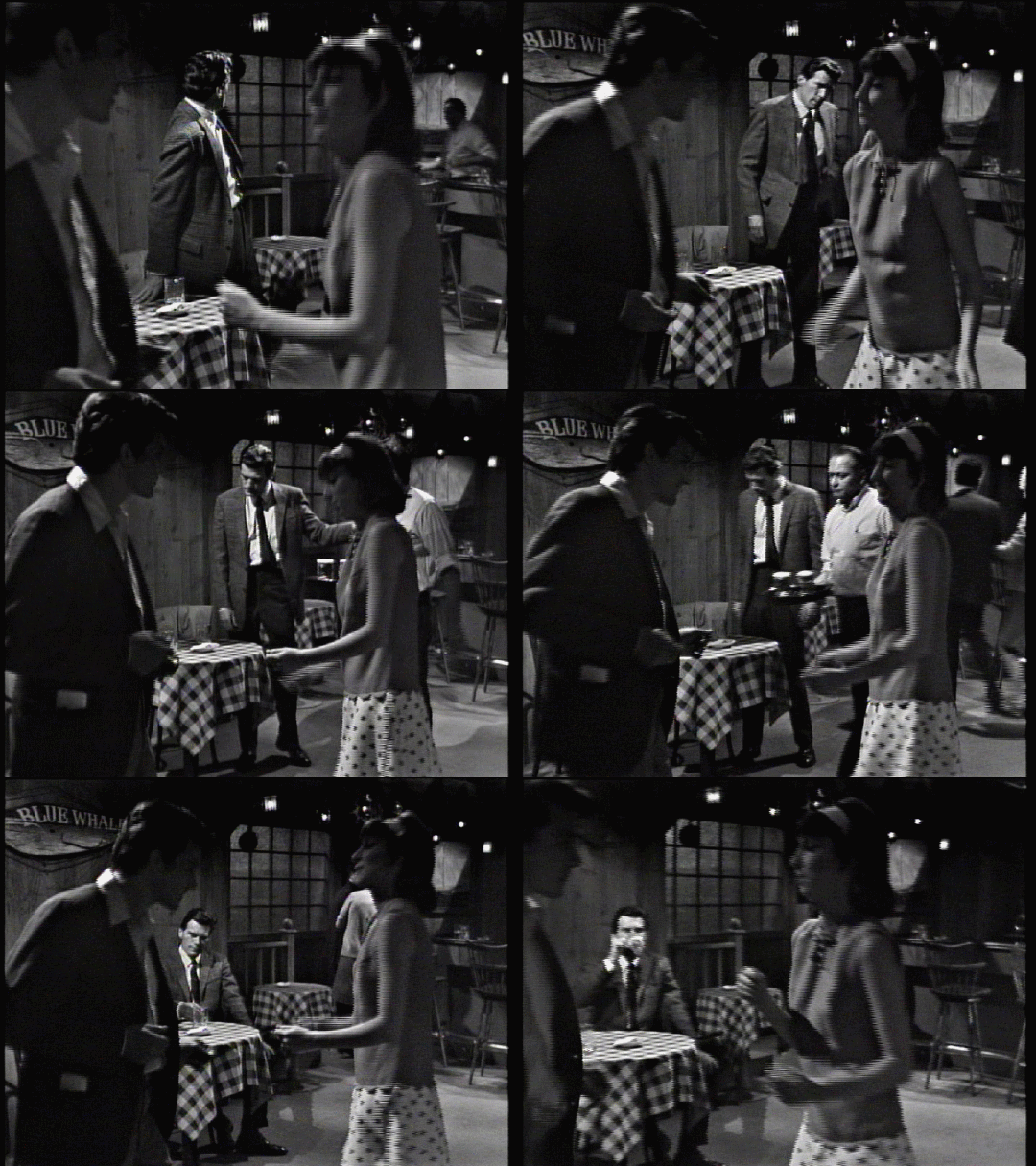
Vicki is at the Blue Whale. Harvey Keitel is gone, but Burke is still there, so she sits with him. He asks her why she joined him. She looks off into space and says “Inches, feet, miles.” He tells her she reminds him of a drink that fizzes and foams, but he isn’t sure what kind. He asks what she’d like to have for dinner. She replies “I’d rather go to your hotel room.” He flashes the same dopey grin any fellow would in this situation, and says “You amaze me, Miss Winters.”

Vicki is supposed to be a street kid from NYC, so we can assume she knows how to go about finding inches when she wants them, and that she’s no stranger to feet, either. Miles may be in short supply in the city, but she’s willing to learn. It turns out that all she wants from Burke is a look at the report his private investigator prepared about her. In the hotel room, she tells him what the audience knows about her origins and about Liz’s refusal to give a straight answer to the question of why she hired her. She looks through the report, and says it doesn’t tell her anything she didn’t already know. He orders two steak dinners from the hotel restaurant.

A knock comes on the door. It isn’t room service; it’s Joe, come to repay Burke for settling his bar tab. Joe is about to tell Burke he still doesn’t like him, when Vicki comes out of the bathroom. Joe excuses himself, startled to see her. Vicki goes a moment later, leaving Burke alone, waiting for two steak dinners.

I summed up my reaction to this episode in a comment on John and Christine Scoleri’s Dark Shadows Before I Die:

“Miss Winters, you amaze me.” Me too! Any woman as young and attractive as Vicki in a town as small and gossipy as Collinsport would be the scandal of the month if she went unchaperoned to a bachelor’s hotel room. When the woman lives with and works for the richest family in town and the bachelor is their sworn enemy, “indiscreet” isn’t any fraction of the word needed to describe her boldness.

Burke has time and again talked about how gossipy Collinsport is. For example, in episode 27, he seemed almost unhinged as he told his associate Bronson about how deeply secretive his investigations of the Collins family holdings would have to be, since anything that happens in or near the town of Collinsport is immediately known to everyone there. So we have to assume that he plans to get everyone talking about his evening with Vicki.

At this point in the show, we usually have to guess what Burke’s plans are, and even when they are revealed we can’t decide whether they are good or evil. In the case of his attempt to get rumors going about himself and Vicki, I think it’s a little more straightforward. He keeps telling her she should get away from the Collinses and leave town. If the Collinses think she’s involved with Burke, Vicki is very likely to find herself on a train back to New York. Maybe not to the Hammond Foundling Home- Burke might have a little apartment in the East Village where Vicki can stay until she finds something…

Episode 33: The one with Harvey Keitel

At Collinwood, Liz tells Carolyn that David won’t be going away just because he tried to murder his father. “Things will go on just as before.” On the other hand, Carolyn should marry Joe and leave the house, because “You’re the only one of us who can have a sane, happy life.” I suppose we’ve all seen that in real life, someone swinging wildly between deep denial and exaggerated despair. Two forms of learned helplessness, I guess.

At the Blue Whale, Joe is getting well and truly sloshed. Burke joins him at his table, interrupting a conversation between Joe and his whiskey glass. Joe tells Burke that he doesn’t like him, expresses his frustration with Carolyn’s refusal to get married, then goes to Collinwood, roaring drunk, and tells Carolyn, Liz, and Vicki what he thinks of them.

One thing Joe thinks is that Carolyn is doomed to be a spinster. Considering that she’s supposed to be about seventeen, that does call to mind Barnabas’ line to Carolyn in the 2012 Dark Shadows movie, “Fifteen? And no husband?

Marc Masse brings this point out well on his Dark Shadows from the Beginning, and argues that the depiction of Carolyn may be one of the things that sunk the show with young viewers between the end of the first month and the introduction of the vampire:

You have to wonder what kind of impression the character of Carolyn Stoddard would have made to young viewers in 1966. Here she is having grown up in a mansion with forty rooms and her only option in life is to be married off before her eighteenth birthday to a local fisherman, or else face a life of lonely spinsterhood. In that respect, Dark Shadows seems to belong to the sensibilities of previous decades.

This paragraph is part of an in-depth discussion of Dark Shadows’ place on ABC’s schedule, its ratings, the show that preceded it in its time-slot, and Art Wallace’s rather antiquated view of the world. It’s all very informative, highly recommended.

When Joe passes out on the couch, Vicki goes to town. She goes to the Blue Whale, where Burke asks if she’s looking for someone. “I just found him,” she replies. Obviously, she’s talking about Harvey Keitel, who is dancing a few feet away from her.

That Harvey Keitel was once an extra on Dark Shadows is pretty interesting. If he took that job, clearly he would have taken a speaking part. I gave some thought to parts I wish he had taken in comments on Danny Horn’s Dark Shadows Every Day four times: here (on episode 470,) here (on episode 769,) here (on episode 1057,) and here (on episode 1137.)

Episode 32: Where all criminals belong

In today’s compare-and-contrast, we see the sheriff and Bill Malloy demonstrating how mentally healthy people might react to the idea that a nine year old boy has devised and executed a plan to murder his father. Then we go to Collinwood, where we see how Liz and Roger react to the idea.

The sheriff can’t bring himself to say out loud what the evidence is leading him to suspect David has done. Bill can say it only in part, and then only to express shock and bewilderment.

The scenes between Liz and Roger in this episode are among the strongest in the entire series. Roger is quite drunk, almost giddy, almost laughing at the fact that his son tried to kill him. Liz cycles through a half dozen intense emotions before finally accepting the fact that David is the culprit. She orders Roger to lie to the sheriff and say that what happened to his car was a simple accident, that no one was at fault.

In response to her explanation that this is the sort of thing the Collinses have always done, Roger brings up his suspicion that David may not be a Collins at all. David was born less than nine months after Roger and Laura* were married; she’d been Burke’s girl… Liz won’t hear such things, and insists that David is a Collins, that he belongs to all of the ancestors. She blames Roger for raising David in a home where he knew nothing but hate from the moment he was born, hate he couldn’t understand or cope with.

Roger insists that David be sent away to a mental hospital; Liz says no, that he will stay in the house, that “Miss Winters and I” will give him the home life he needs. Her mention of “Miss Winters” in this connection makes it clear that Vicki is central to Liz’ plans for the future, whatever those might be.

The sheriff shows up. He’s taking his time to get to the point. Roger cuts him off: “Is it about David?” At that, even the background music falls silent. The sheriff starts talking. Liz jumps in and says that the sheriff should drop the investigation, that it was all just an accident. The sheriff looks uneasily from Liz to Roger and back again, and finally agrees to do so.

In the coda, Roger tells Liz that she will regret covering up for David. He gives her a look of contempt that is among the most powerful things I’ve ever seen on a screen. Liz is totally alone now; Roger will obey her, but he’ll never respect her again. Joan Bennett was pushed to the margins of the show in later years, but she really did fill her “Starring” credit in these first months. It isn’t every show that would present us the leading lady devastated like this.

*Aside from the prologue delivered by Alexandra Moltke Isles, there are no surviving cast members in this episode. As of 9 August 2022, it is the earliest episode of which that can be said.

**Laura’s name is first mentioned here.

Episode 31: The judgment of the gods

Burke makes up a story about finding the bleeder valve on the side of the road leading to Collinwood, another lie to go along with the lie he told about finding David on a sidewalk in town. In the minutes before both of these lies collapse, he and David sit on the staircase in the foyer. He tells David that they’re still friends- after all, if he were really mad at David for trying to frame him for attempted murder, he’d have told Roger the truth.

That placates David, who likes Burke and is desperate for a friend. It doesn’t do much for us, though- the lies collapse so quickly that a crafty operator like Burke can’t have thought he was giving David much cover, and he’s observed the Collinses closely enough to know that they will go to any lengths to keep a family scandal from becoming public. So we are still undecided as to what Burke wants to do and whether he is right to do it.

David’s confidence in Burke allows him to talk openly, admitting that his murder plot was “stupid” and declaring that he’s going to get back at Vicki. Burke doesn’t like that idea, but David is still on the rampage when Vicki tries to talk to him. He says that he hopes “a thousand ghosts come and strangle you and make you dead!” Burke warns her that if she’s going to keep living in the same house as David, she ought to stay away from open windows.

It may be hard for the other characters to understand why Vicki wants to stay on as David’s governess, but the audience should understand it. It only took a few minutes with the warm, upbeat Burke Devlin before David was jumping up, making jokes and laughing. Vicki has spent her whole life at the Hammond Foundling Home, at first as a resident, then as staff. Her great achievement is connecting with troubled children. If she can get David past the idea that he is working with her father to lock him up, she should be able to get at least as good a reaction from him as Burke did.

Episode 30: What monsters we create

Thunder rumbles. The lights go out at Collinwood. Alone in the drawing room, Vicki lights a candle. The doors swing open, and a darkened figure stands in shadow. Vicki calls to the figure. It does not respond. The lights come back on. The figure has vanished. Roger happens by; he is the only other person in the house, but he is too tall to have been the figure.

This is the second occurrence in the series that is either a supernatural manifestation or an elaborate Scooby Doo-esque prank on Vicki. The first time, in episode 14, happened when David had taken the bleeder valve from the braking system on his father’s car, an event that would have dire consequences. We can assume that this second occurrence is telling us that we are about to see events that will stir up the supernatural back-world of Josette, the Widows, and heaven knows who else.

David had planted the bleeder valve in Burke’s room, trying to frame the family’s enemy for his own crime. When he spends a few minutes with Burke and takes a liking to him, he tries to retrieve the valve, not knowing that Burke has already found it and that he is carrying it in his pocket. In Burke’s car on the way to Collinwood, he pleads with Burke to go back to the hotel. He can’t give an explanation for his plea, and Burke refuses to turn back without one.

Vicki tells Roger that she had found the bleeder valve in David’s room, and Roger quickly accepts that his son had tried to murder him. When Burke brings David home, Roger takes David into the drawing room and demands he confess to his crime. Burke refuses to leave the house. Roger calls Vicki into the room; Burke insists on joining them. David calls Vicki a liar, Roger continues to browbeat him. We see a reaction shot of Burke in profile, standing in the doorway, watching the scene intently. Roger mentions the bleeder valve; Burke steps forward, and with a flourish produces the valve from his pocket. David’s face crumbles into absolute dejection.

Has Burke really betrayed David? Or is he playing some other game? We have to tune in next time to find out.

So, we begin with an indication that what follows will stir up the back-worlds, and then see an episode about the relationship between Burke and David. Roger describes Burke and David as “the two people I dislike the most.” Something Burke and David have in common, something that Roger cannot forgive, is going to bring the ghosts out of the woodwork and into the foreground.

Episode 29: The Burke Devlin Special

Today’s exercise in the Art Wallace school of compare-and-contrast juxtaposes Burke Devlin’s hotel room with the interiors of Collinwood. Burke is a bouncy, cheerful host to an unannounced visitor, David Collins; after a short time, David is happy and exuberant, the first time we’ve seen him smile about something other than hatred and murder. Vicki, Carolyn, and Liz are thoroughly miserable.

Liz still refuses to believe that David could be the one who sabotaged his father’s car, at one point suggesting that Vicki might have done it. That idea crumbles immediately in the face of Carolyn’s disbelief, and Liz offers Vicki an apology. But she still clings to the thought that David might somehow be innocent. Her refusal to face facts takes a depressing situation and robs it of all hope for improvement.

David has gone to Burke’s room to hide the incriminating bleeder valve there. He had originally set out a few episodes before, after Vicki found the valve in his own room but before the sheriff had searched Burke’s room. He was caught trying to sneak into Burke’s room before the sheriff got there, so it’s really too late for his plan to work. He goes ahead with it anyway, but tries to retrieve the valve from the cushion after Burke wins him over. That attempt fails as well- unknown to David, Burke has already found the valve and has it in his pocket.

I suppose a definition of “dashing” is a fellow capable of great charm who makes things happen, things which we cannot predict and of which, even when they have happened, we can’t be sure whether we approve. By that definition, Burke is at his most dashing in this episode and the next.