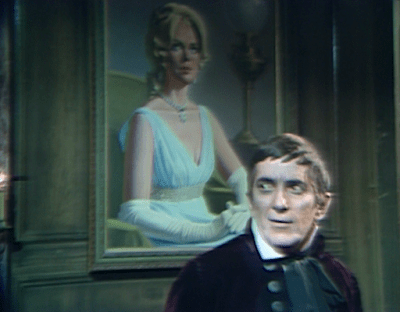
Vampire Barnabas Collins discovers that the woman introduced to him as Alexis Stokes, identical twin sister of the late Angelique Stokes Collins, is in fact Angelique herself risen from the grave. He confronts Angelique, and the two find themselves at a stalemate. Angelique calls her stepfather, Tim Stokes, tells him who she really is, and enlists his help against Barnabas. Angelique’s widower, drunken sourpuss Quentin Collins, comes home to the great house on the estate of Collinwood and refuses to have an adult conversation with his current wife, the former Maggie Evans, about his temper tantrums and other bad habits that are ruining their marriage.
Meanwhile, mad scientist Cyrus Longworth, who has been conducting a Jekyll and Hyde experiment on himself, transforms into his Hyde form in front of his fiancée Sabrina Stuart. She tries to reason with him, and he responds with a lot of sneering and threats. Cyrus sneaks into the great house and lets himself into the master bedroom while Maggie is asleep there. He tricked Maggie into meeting him on the waterfront last week, and tried to rape her there. Apparently he has decided to make another attempt.
Writer Joe Caldwell takes a surprising approach to tying this big bundle of disparate content together. In each encounter, he has the characters talk about the way they are looking at each other. This sounds extremely unpromising, like a recipe for the dullest possible essay about literary theory, but when they put the script on its legs it works well enough.
Barnabas learns Angelique’s secret by going to her old bedroom in the east wing of the great house and staring really hard at the eyes in the portrait of Angelique that hangs there. “Alexis” comes running in, wailing that he is staring into her eyes and it burns. Barnabas goggles at her and she admits to being Angelique come back to life. He refuses to explain his powers of remote viewing.
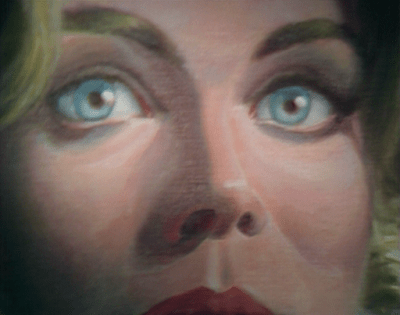
Angelique telephones Stokes, who was named in #981 as her father but whom we see for the first time today. He thinks she is Alexis. He wearily tells her there is no point in the two of them having a conversation. She tells him she has something to tell him about Angelique, and he comes right over.
In her room, Angelique identifies herself to Stokes. He is overjoyed that the twin he liked is alive. She tells him that when she rose from the grave, she drained the warmth from Alexis’ body, killing her. Stokes frowns and says he didn’t want Alexis to die. He seems genuinely sad for a period. I timed this period; it lasts precisely four seconds. That season of mourning complete, Stokes and Angelique are again beaming and laughing and moving about in a circular pattern that looks very much like a dance around the May pole.
This scene includes some deeply puzzling information. Stokes says that he was stepfather to Alexis and Angelique. The other day, Angelique told Barnabas that her family’s burial grounds is the final resting place of her namesake, a woman named Angelique who came to Collinwood in the late eighteenth century as a domestic, and that another servant at Collinwood in those days, Ben Stokes, was her several times great-grandfather in the male line. Perhaps Angelique’s remarks about Ben and her namesake are being retconned away, but there doesn’t seem to be any point in doing so.
For its first 196 weeks, Dark Shadows was set in an alternate universe. The show insists on calling the current continuity “Parallel Time.” Stokes’ counterpart in the other universe, Professor Timothy Eliot Stokes, is a descendant of his version of Ben, though that Ben never married his coeval Angelique. Professor Stokes is an expert on the occult and a good guy, and it was he who first explained the theory of “Parallel Time” when characters started catching glimpses of it through a warp in Angelique’s bedroom here. Now the same warp is making the original continuity visible to the current characters, and it falls to Tim Stokes to explain the same theory to his (step)daughter. The Parallel Time phenomenon, like Barnabas’ remote viewing of Angelique through her portrait, is a case of one-way visibility. When the warp occurs, people can see into the other universe, but the people they are watching are not aware of them.
Shortly before dawn, Stokes lets himself into the Old House on the estate, where Barnabas is staying. Barnabas sees Stokes in the parlor. Barnabas asks Stokes who he is and what he is doing alone in someone else’s house at such an unusual hour. Stokes responds to these questions as he sees fit, then asks if he and Barnabas have met before. He characterizes Barnabas’ look upon seeing him as one of recognition. Barnabas replies that on the contrary, it was the shock of non-recognition. One does not expect to see a stranger in such circumstances. This little conversation about the act of seeing turns out to be the main part of the scene.
Quentin shows up in the master bedroom and stares at Maggie while she sleeps. She wakes up and is relieved to see that he is back. Then they have their frustrating little conversation. Maggie may as well have kept sleeping; at least Quentin wasn’t making things between them worse when she didn’t know he was there.
After he attacked Maggie on the docks, Cyrus threw away the potion that turns him into his Mr Hyde form, which he calls “John Yaeger.” He does not have the means to make more of it, since he murdered the chemist who alone was able to supply one of the key ingredients. He uses the same potion to re-Jekyllize himself, and since he had already transformed spontaneously once before it seems pretty reckless to throw it out. Sabrina is with Cyrus in his laboratory when the transformation happens again. She is horrified to discover that Yaeger, whom she has met and has reason to hate, is in fact Cyrus in disguise.
In the other universe, Sabrina’s counterpart was engaged to another murderous shape-shifter, a werewolf named Chris Jennings. When the other Sabrina saw Chris change into his lupine form, her hair turned white and she lost the power of speech for several years. This Sabrina is more resilient, and she tries to reason with Cyrus. He keeps telling her how dumb she is, then leaves. At the end, we see him standing where Quentin had stood earlier, at the foot of Maggie’s bed, watching while she sleeps. We hear his internal monologue as he tells himself “Now, John Yaeger, now!”
This episode was made not long after the feature film House of Dark Shadows finished principal photography. The very large number of story points crammed into its 22 minutes may show the influence of that production. It wouldn’t be unusual to see this much action in two reels of a theatrical release, but it is far more than we are accustomed to seeing at 4 PM on weekdays.