Episode 444: What if she doesn’t?

This one made us think about the nature of suspense. Yesterday, naval officer/ sleazy operator Nathan Forbes schemed with his henchman, the unsightly Noah Gifford, to trick fluttery heiress Millicent Collins into thinking that her second cousin Barnabas was trying to kill her.

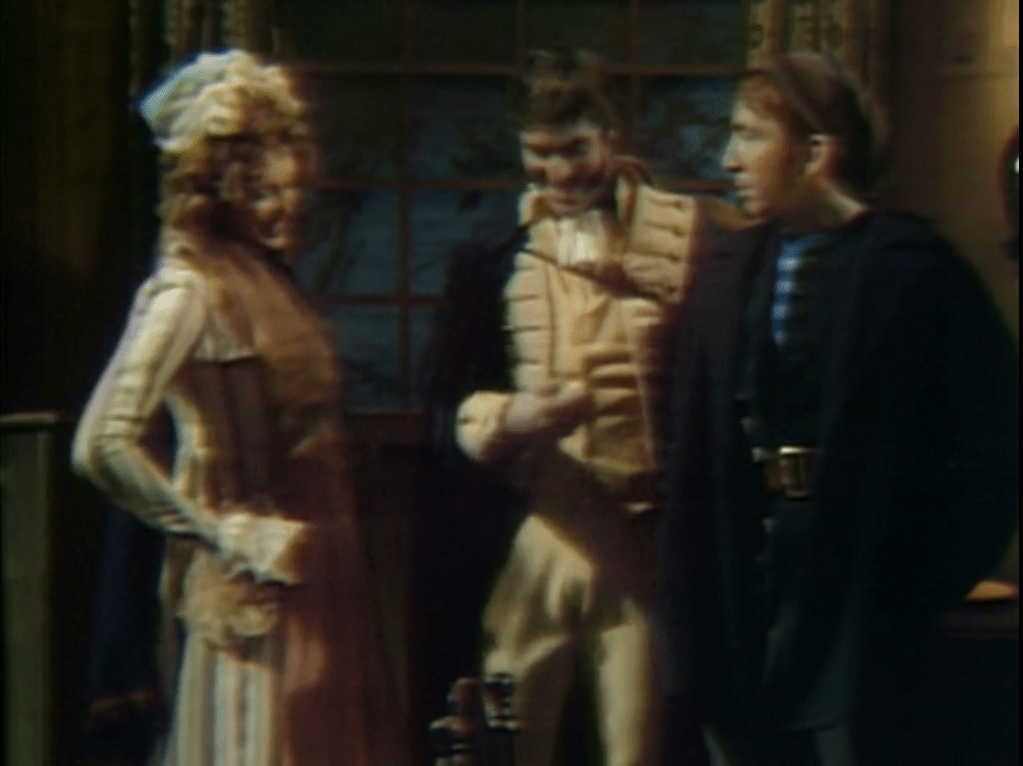
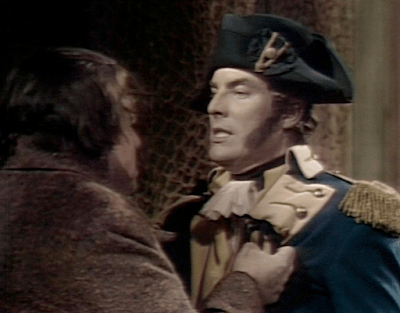
Today, we see that plan unfold just as Nathan had hoped it would. Millicent goes to the gazebo on the estate of Collinwood, having received a message asking her to go there. The message appeared to be from Barnabas, but was actually from Nathan. Noah, wearing a Zorro costume and carrying Barnabas’ highly recognizable cane, springs out of the bushes. He attacks Millicent with the cane, then Nathan appears. The men pretend to fight, Noah pretends to lose, and he runs off into the night. Millicent thanks Nathan profusely and wonders why Barnabas would want to hurt her.

Noah really should wear that mask all the time, he has the face for it.

Millicent and Nathan are so interesting to watch together that we can’t stop ourselves hoping Nathan’s scheme works. On the other hand, we know that Nathan is only after Millicent’s money, and that if she marries him he will make her and the rest of the Collinses miserable. So when Barnabas’ mother Naomi shows up and asks Nathan what he was doing on the grounds of the estate of Collinwood, our hope for more Millicent/ Nathan scenes competes with a hope that Naomi will follow up Nathan’s answers with questions that will expose his plot. It would be easy enough to do- he says he was hoping to see Millicent, but how could he know she would be at the gazebo? And how could he have failed to see the assailant, considering that they arrived there at virtually the same moment?

Naomi and her husband Joshua have been telling everyone that Barnabas left for England several weeks ago. Nathan and Millicent both know this is false, because both have seen him since. Nathan has figured out that Barnabas is the serial killer preying on the women of Collinsport, and is apparently planning to use this information to blackmail Joshua. At the moment the Collinses are not afraid of being blackmailed with information about anything Barnabas has done lately. They spread the story about England because Barnabas had died. They thought he died from the plague, and Joshua feared that if that became known the men would not report to work at the family’s shipyard.

What neither Nathan nor any of the Collinses know is that Barnabas has become a vampire. Naomi is depressed that her son has died and that she cannot talk freely about his death with anyone. She is miserable when Millicent keeps claiming it was Barnabas who attacked her, and tries desperately to stop her from talking about him at all. Naomi and Millicent are both good-hearted people, of the sort we would like to see come to happy endings. They also make the most of the dramatic values in this situation. Again, we find ourselves in suspense generated by our conflicting desires. We have a rooting interest in the characters’ well-being, but we want to see a lively story, and the tragedy in which they are locked is providing that. So we can see any number of possible developments that would disappoint us, either by hurting characters we like or by short-circuiting a plot we are enjoying.

A very pure example of suspense comes in a scene between Nathan and Noah in Nathan’s room at a local inn. Noah refuses to leave until Nathan pays the money he owes him; Nathan says he has no money and that he isn’t likely to get any unless Noah leaves at once, since Millicent is on her way and will get suspicious if she sees him there. Noah doesn’t understand this, and Nathan has to keep repeating the point. When Millicent knocks on the door, Noah finally agrees to hide. On his way to let Millicent in, Nathan realizes Barnabas’ cane is in plain view in the middle of the room, and hides it under his bed.

The only danger in this scene is that the Nathan/ Millicent story will end abruptly, but we are sufficiently invested in watching that story play out that our irritation at Noah’s stupidity is combined with suspense as we fear that he will ruin the scheme. Nathan’s success with Noah and his last-second concealment of the cane come as a relief. Again, the suspense is entirely contained within our role as the audience, and is not a product of any concern we have for the characters or anything they represent to us.

Episode 443: Masculine details

Naval officer/ sleazy operator Nathan Forbes seemed to have lost his best chance at getting rich quick when his fiancée, fluttery heiress Millicent Collins, discovered that he was already married when they got engaged. Since then, he has figured out that Millicent’s second cousin, Barnabas Collins, did not go to England as the family has been telling everyone, but that he is still lurking about the village of Collinsport and has murdered several people there. Among Barnabas’ victims was Nathan’s wife Suki.

Widower Nathan has a plan to profit from this information. Today, we see the first step in Nathan’s plan. He persuades his henchman, commercial mariner Noah Gifford, to wear a mask, carry Barnabas’ cane, and assault Millicent while he lies in wait. Apparently he will rescue her, and she will tell her family both that Nathan was the hero of the incident and that the attacker carried Barnabas’ instantly recognizable cane.

The whole episode is full of comic moments, and the climactic scene of the assault at the gazebo had my wife, Mrs Acilius, laughing out loud and making comparisons to A Funny Thing Happened on the Way to the Forum. That reaction shows that Nathan and Noah are a more successful rewriting of Dark Shadows‘ first seagoing con man, Jason McGuire, and his henchman Willie Loomis. Jason was supposed to be a comic villain, but the writers never gave him much that was funny to do or say. Actor Dennis Patrick was such a talented comic that he could pad his part with facial expressions, tones of voice, and gestures that got laughs, especially in his scenes with Willie. But it was never at all clear why he needed Willie, and most of the time he was on camera Jason was grinding the other characters down with a depressing blackmail scheme. But Nathan keeps scrambling to find his way into his marks’ good graces, and he and Noah get up to all sorts of high-jinks. Regular viewers will be happy to see a demonstration of what Jason and Willie might have been had Dark Shadows been able to employ a better writing staff in 1967.

Another major improvement over the period when Dark Shadows was set in 1966 and 1967 is the show’s use of Joel Crothers. He did what he could with the part of hardworking young fisherman Joe Haskell, but since Joe’s only note is earnestness he always winds up as less of a character than a function. But Nathan is always working an angle, is never quite predictable, and is tremendously fun to watch. The prospect of seeing Crothers return to the role of Joe is one of the major reasons the audience might want to prolong our stay in the eighteenth century.

Closing Miscellany

Noah remarks on one of the odd quirks of the Collins family when he mentions that the vacant Old House on their property is still full of all sorts of valuable objects. From the first week of the show, we’ve seen that disused parts of their estate are heavily stocked with high-priced antiques. This acknowledgement of the oddness of that fact leaves us wondering if the show is going to change it.

Today marks the only appearance on Dark Shadows of actress Charlotte Fairchild. Fairchild plays a downstairs maid who tells Millicent that a man has brought her a fan. Her angular figure and pale complexion made her a perfect choice to play an eighteenth century servant, and she does a fine job with the dialogue.

Millicent and the downstairs maid. Screenshot by Dark Shadows Before I Die.

Episode 442: For the love of God, Montresor!

When vampire Barnabas Collins rose from his grave to prey upon the living in April 1967, he was a bleak, frightening presence. As the show went on, we saw him spend a great deal of time ruminating on murders he might like to commit, but he had few opportunities to act on those thoughts. By November, when well-meaning governess Vicki came unstuck in time and wound up in the year 1795, Barnabas had killed only two people, only one of them with premeditation. Both of those victims, seagoing con man Jason McGuire and addled quack Dave Woodard, had long since lost their relevance to the plot, and neither has been mentioned more than a few times since his death. As a result, Barnabas’ talk of killing comes to seem like nothing more than a series of hostile fantasies.

Soon, Dark Shadows will have to return to a contemporary setting. It was the frightening impression Barnabas created in his first weeks that made Dark Shadows a hit, and to keep it going the show will have to make him seem dangerous again. In the fifteen and a half weeks they have been in the 1790s, he has killed at least six people, including his uncle, his aunt, his wife, two streetwalkers, and a woman named Suki. That’s an adequate rate of murders to reestablish Barnabas as a fiend, but volume will only get you so far. They need to give us some shocking images of cruelty, preferably as the result of crimes committed with slender motives, to get him back in place as a truly scary creature.

Today, the show addresses both that need and the need to give a fitting sendoff to a character who has been one of the standouts of the eighteenth century flashback. The Rev’d Mr Trask, visiting witchfinder, was, along with repressed spinster Abigail, one of the two bright lights of the show’s otherwise dreary reworking of Arthur Miller’s The Crucible. Now the witch trial is over, Vicki has been convicted, and she is waiting to be hanged. In #437, Vicki gave a speech which left little doubt that at the moment appointed for her execution she would return to the 1960s and the costume drama period would end. Therefore, Trask can hardly reopen the case without confusing the whole plot. As a personality totally warped by fanaticism, he can’t very well branch out into other kinds of stories without a long buildup, much longer than they are likely to stay in the 1790s. Yet Trask has been so much fun that the audience would feel cheated if he simply went back where he came from.

So Barnabas lures Trask to his basement, ties him to the ceiling, and seals him up behind a brick wall. Unfortunately, this homage to Edgar Allan Poe’s “Cask of Amontillado” does not adapt the most celebrated line of that story and have Trask cry out “For the love of God, Mr Collins!”

Barney’s bricklaying project. Screenshot by Dark Shadows Before I Die.

Closing Miscellany

In a moment of black humor, the closing credits run over an image of the completed brick wall. We might imagine Jerry Lacy still dangling from the ceiling behind the wall. Mr Lacy was often a model of an actor’s devotion to his craft, but I very much doubt that even he took matters that far.

Hey Jerry, you OK in there until tomorrow? Screenshot by Dark Shadows Before I Die.

A recording of Jonathan Frid reading “The Cask of Amontillado” made in the spring of 1992 can be found on YouTube, posted by Frid’s longtime business partner Mary O’Leary.

In #264, high-born ne’er-do-well Roger Collins visited Barnabas at home. When it was time for a drink, Barnabas offered him a glass of amontillado. Poe’s story is so famous and amontillado is such an unusual variety of sherry that it must have been a deliberate reference. Perhaps the idea of Barnabas sealing someone up behind bricks was floating around among the writing staff for months and months.

Several fansites label it a continuity error that Trask reacts to the sight of Barnabas by exclaiming that he is dead. The family has been covering up Barnabas’ death, putting word about that he went to England. Many think Trask should not be among those privy to the Collinses’ secret. But as Danielle Gelehrter points out in a comment on Danny Horn’s Dark Shadows Before I Die, Trask and the gracious Josette discussed Barnabas’ death in #412.

I am writing this post on 19 February 2024. In a bit of synchronicity, yesterday, I saw this post on the site that all normal people still call Twitter:

Episode 441: The subject of vicious gossip

When well-meaning governess Vicki came unstuck in time and found herself in the year 1795, regular viewers of Dark Shadows could expect certain plot points to be resolved before she returned to the 1960s. We would learn how Barnabas Collins became a vampire, and how he wound up trapped in a chained coffin in the secret chamber of the Collins family mausoleum. We would learn how Barnabas’ little sister Sarah died. We would see Barnabas’ lost love, gracious lady Josette, marry his uncle Jeremiah Collins. We would see Josette jump to her death from the precipice atop Widows’ Hill. And we would see Vicki escape from some dangerous situation and find herself back in her own time.

Now, the only items on that list left unresolved are Barnabas’ chaining and Vicki’s return. The show has made it clear to people paying close attention how each of those events will happen, and they could fit them both into one episode. Into any given episode, in fact- they’ve given us all the foundation we need for both stories.

But they aren’t going home to a contemporary setting quite yet. The eighteenth century segment has been a ratings hit, Dan Curtis Productions owns the period costumes, and several fun characters are still alive. So they have decided to restart some storylines they had shut down earlier and to build up some new ones.

The main thing that happens today is the first step towards restarting an apparently concluded story. Fluttery heiress Millicent Collins had shared a series of wonderful comedy scenes with untrustworthy naval officer Nathan Forbes, become engaged to him, and discovered that he was already married to someone else. Since that discovery, Millicent has been grimly determined to exact revenge on Nathan, and the rest of the Collins family has regarded him with icy disdain.

Nathan has made a discovery of his own. He has learned that Barnabas did not go to England, as his family has been telling everyone, but that he is still in Collinsport, and is the serial killer preying on the young women of the town. Last week, he made it clear to the audience he had a plan to turn this information into money, apparently by blackmailing the Collinses. Today, we learn that his plans are more complicated, and involve a renewal of his relationship with Millicent. Late at night, he shows up at the lodgings of a visiting witchfinder, the Rev’d Mr Trask. He asks Trask to take a letter to Millicent.

Trask does not want to let Nathan into his room, since the corpse of a prostitute is sprawled across his bed. She is Maude Browning. Barnabas murdered her in Friday’s episode. As part of his campaign to make life difficult for Trask, he deposited her remains at his place.

Nathan won’t take no for an answer, so Trask throws a blanket over Maude and lets him in. Nathan notices Maude’s arm sticking out from under the blanket and is delighted to think that Trask is not the fanatical ascetic he seems to be. Trask breaks down and starts telling Nathan what happened. He tells him that he was astounded to find Maude’s body on his bed, and he asks him to help get rid of it. Nathan agrees to do so on condition he deliver the letter to Millicent.

The scene is just marvelous. Danny Horn devotes most of his post about this episode on Dark Shadows Every Day to a rave review of it, to which I happily refer you.

We then cut to the great house at Collinwood, where Millicent is studying a layout of Tarot. All the Dark Shadows fansites point out that Millicent misidentifies the Queen of Cups as the High Priestess. This is not the fault it is often made out to be. On Dark Shadows Before I Die, Christine Scoleri reminds us that the Countess DuPrés made the same mistake in #368. Since the countess introduced the Tarot to Collinwood and presumably taught Millicent how to read the cards, it would have been a break in continuity had she called it anything else.

Millicent looks at the cards and addresses the absent Nathan, telling him that she is filled with hatred for him and that he faces certain destruction as punishment for his mistreatment of her. Naomi Collins, mistress of the house, enters and asks Cousin Millicent to whom she is speaking. When she answers that she is talking to Nathan, Naomi tells her Nathan is not there. Millicent replies that he does not need to be present to hear her voice. Since Barnabas was able to magically project his own taunting voice across space into Trask’s hearing in Thursday and Friday’s episodes, this claim of Millicent’s has a curious resonance for returning viewers.

Trask shows up with Nathan’s letter. He wants to meet with Millicent alone in the drawing room to give it to her, but Naomi insists on being present. They stay in the foyer. When Naomi forces Trask to tell them that the letter is from Nathan, Naomi takes it and tears it to pieces. Millicent says that she approves of Naomi’s action, but we can see a flicker in her eye and hear a quiver in her voice that suggest the hatred of Nathan she spoke of a few minutes before may not be quite so undiluted as she would like to believe. Trask leaves the house, Naomi leaves the foyer, and Millicent gathers up the shredded pieces of the letter.

Back in his room, Trask goes to sleep. He has a dream. The dream sequence begins with an image reminiscent of pieces moving in a kaleidoscope.

Trask goes into a dream world. Screenshot by Dark Shadows Before I Die.

That kaleidoscopic pattern was part of a visual effect we saw when Dark Shadows was still set in 1967. That effect introduced scenes that took place in #347, #352, and #354, when mad scientist Julia Hoffman hypnotized Vicki and took her to the Old House at Collinwood. At Collinwood, Barnabas’ helper Carolyn spotted Julia and Vicki, putting Julia in great danger.

The echo of those episodes is startling coming on the heels of the scene we just saw, in which Millicent figures as a student of the countess. Julia and the countess are both played by Grayson Hall, and Millicent and Carolyn are both played by Nancy Barrett. The relationships between their characters are different now, shifted as the colored pieces shift in a turning kaleidoscope. But remembering those earlier episodes, we might remember that what is seen in a semiconscious state might be a message sent to manipulate and deceive, and we certainly remember that people who go to the Old House are in danger from Barnabas.

Trask’s dream brings him face to face with the ghost of Maude, accusing him of having her remains dumped in the sea, so that she cannot rest. She predicts that everyone will learn that her dead body was in his bed. He denies both her accusation and her prediction, but does not convince either her or himself.

The ghost of Maude tells Trask the score. Screenshot by Dark Shadows Before I Die.

Another ghost then appears. It is that of Trask’s great supporter, repressed spinster Abigail Collins. Trask tries to tell Abigail that he is innocent of Maude’s charges, but she tells him she has no idea what he is talking about. She wants to tell him that there is a great evil he must destroy. Trask has a vision telling him the evil is lurking in the Old House. He resolves to go there.

All of the acting is excellent in this one. That’s no more than we would expect from most of the cast members we see today, but Vala Clifton’s two turns as the living Maude were pretty bad, so that it is a pleasant surprise that she is so good as Maude’s ghost. The physical space gives her a hard job. She is standing a very few feet in front of Jerry Lacy with only a couple of wispy stage decorations indicating that she is separated from him, but she strikes a pose and maintains a degree of stillness that really does create the sense that she is speaking to him from another realm. She also manages to keep up an ethereal quality while making it clear that Maude is determined to be avenged. I wonder what her first appearances would have been like if she had had more time to rehearse. If they had been as good as this one, Ms Clifton and Maude would be among the more fondly remembered parts of the eighteenth century segment.

Episode 440: You’re bein’ more stupid now

Vampire Barnabas Collins arises from the dead, goes to the front parlor of his house, and finds a friend of his passed out drunk in an armchair. The friend, much put-upon servant Ben Stokes, had left the house the night before after saying that he would no longer help Barnabas in his murderous schemes. Barnabas brings this up, but apparently Ben has decided he has nowhere else to go, so he’s back.

Barnabas tells Ben that he has two projects going at the moment. He dropped his cane with its instantly recognizable silver handle in the shape of a wolf’s head at the scene of an attempted murder last night; the victim, a streetwalker named Maude Browning, screamed and someone came running. Barnabas orders Ben to find the cane and bring it back before it leads to his exposure.

The other project is Barnabas’ attempt to take revenge on the Rev’d Mr Trask, a visiting witchfinder who has wrought considerable havoc in town. Barnabas recently discovered he had some magical powers, and he has been using those powers to drive Trask insane. He says that he will stay in the house and cast more spells on Trask while Ben goes to Maude’s room over the feed store to look for the cane.

In his room at a local inn, Trask can’t keep a candle lit. He hears Barnabas’ laughter, and declares that it is the voice of the Devil. Or as Trask calls him, THE DE-VILLL!!!! A knock comes at the door. Trask is fearful, but answers when the knocker identifies himself as naval officer Nathan Forbes.

Trask believes hapless time traveler Vicki Winters to be the witch. A court has agreed with him, convicting Vicki of witchcraft and sentencing her to hang. Trask tells Nathan that the witch has started tormenting him. Since Nathan testified against Vicki, Trask warns that she might do the same to him next. When Nathan takes Trask’s warning lightly, he responds with some overheated rhetoric. To this, Nathan remarks that it’s never man-to-man with Trask. When he listens to him, he gets the feeling that sitting in a pew and that the rest of the congregation is absent.

Trask then tries to tell Nathan about the terrible visions he has been suffering. While he does so, he hears Barnabas’ voice and sees his hand. Nathan, of course, can neither see nor hear these manifestations.

Lately Nathan has established himself as a rather cold villain, but he used to be a good-hearted sort, though with some glaring personality defects. We catch another glimpse of the friendly Nathan when he tells Trask the trial must have taken a toll on him. He offers to take Trask out of his room and give him a place to rest. Trask responds indignantly to this offer, and demands Nathan leave him alone.

We cut to Ben searching Maude’s room. When Ben leaves, Nathan catches sight of him. Nathan follows Ben back to Barnabas’ house. Nathan stands at the window and eavesdrops as they talk about Ben’s search of the docks and of Maude’s room, of his failure to find the cane, and of the drunken ramblings with which Maude has been confusing the barroom patrons who want her to tell them about the attack she suffered.

Nathan eavesdrops on Barnabas and Ben. Screenshot by Dark Shadows Before I Die.

When the show was set in 1967, we saw several characters stand at this window and listen as Barnabas held incriminating conversations with his henchmen. Most notably in #274, seagoing con man Jason McGuire eavesdropped as Barnabas handled a box of jewelry and told his sorely bedraggled blood thrall Willie Loomis of his evil plans for Vicki. As Nathan has become more and more a villain, he has become more and more reminiscent of Jason. The night after Jason listened to Barnabas and Willie, Barnabas killed him. Seeing Nathan in this position, regular viewers will wonder if it implies that his death is as near today as Jason’s was then.

Barnabas and Ben leave the house. Ben suggests they leave Collinsport and go someplace where Barnabas will not be recognized. Barnabas will not hear of it. He moans that the house is the place where he and his lost love Josette were supposed to live and be happy. Ben pleads with him to let go of the memory of Josette. Having seen Barnabas in 1967, we know that this plea will fall on deaf ears. Barnabas calls himself “stupid” for leaving the cane at the scene of the crime; the ever-forthright Ben tells him he’s being more stupid now. None of Barnabas’ twentieth century confederates would have dared say a thing like that to him, making Ben’s boldness a refreshing change for regular viewers.

We cut back to Maude’s room. Nathan is bringing Maude home. She is much the worse for drink. He urges her to stay in her room with the door and window locked, then goes.

A bat squeaks at the window, Maude panics, and Barnabas materializes in the room. He asks her about the cane. She tells him she doesn’t have it, and he strangles her. It’s one of the most brutal on-screen murders we have seen so far.

From Maude’s room, we cut to the door to Trask’s. He stands in front of it and we hear him deliver a monologue in a recorded voiceover. This is the first time we have heard an interior monologue from Trask. He shouts so much that it often seems that if you could read his mind you’d see nothing but all-caps disquisitions about THE ALMIGHTY! and THE DE-VILLL! But in fact, he’s telling himself that Nathan must have been right and that all the visions he saw and voices he heard must have been the result of nervous strain brought on by his hard work during Vicki’s trial. He goes into his room, telling himself to calm down. He looks at his bed, and finds Maude’s strangled corpse sprawled there.

Episode 439: Whose cane this is

The opening voiceover is delivered by Vala Clifton, who makes her debut today as Maude Browning, a young lady whose profession it is to make herself agreeable to the gentlemen she meets. This marks the first time since episode #1 that the first voice we have heard was that of someone we had not seen previously. The rule lately has been that the introduction is always delivered by a woman who appears in the episode. Today, that leaves Ms Clifton as the only candidate.

At the top of the episode, vampire Barnabas Collins tells his friend, much put-upon servant Ben Stokes, of his plans for revenge on the Rev’d Mr Trask, a visiting witchfinder responsible for much misery and injustice. When he makes it clear that he plans to murder Trask and to do it in an especially atrocious manner, Ben puts his foot down and says that he will no longer help Barnabas in any way. Barnabas threatens to kill Ben if he doesn’t come back with the implements he has ordered. Ben says that he may as well kill him right away. He stands still and squeezes his eyes shut, evidently expecting Barnabas to accept the invitation. Barnabas does put on his strangling face and move towards Ben, but at the last second he relents.

We then see Ben at The Eagle tavern, demanding “More rum!” Maude is at his table, trying to engage him in conversation. He warns her against going out at night, bringing up Ruby Tate, a woman who died on the docks some nights before. Maude has already said that she arrived in town the day of Ruby’s death, but when she is explaining why she isn’t afraid to go out alone at night she suddenly becomes the expert on Ruby’s ways. “She talked to anyone. I don’t.” This is a delicious little moment, reminding us of all the people we’ve known who make up little stories to persuade themselves that they are immune from the misfortunes that have befallen others.

Untrustworthy naval officer Nathan Forbes enters the tavern accompanied by a man in sailor’s togs. Maude gives up on Ben and leaves his table; she chats with Nathan for a moment, her eyes on the bulge in his pants most of the time. That’s understandable, it’s rather a conspicuous bulge.

Maude leaves the tavern, and Nathan directs his companion to sit with Ben and to get information from him about Barnabas Collins. The man introduces himself to Ben, giving his name as Noah Gifford. Noah claims to be looking for work on the great estate of Collinwood. Ben tells Noah to stay away from there and to go back to the sea. He is drunk enough to mention Barnabas’ name, but doesn’t say much about him. He says that he wishes he could go to sea himself. He says that he likes tea, and wants to go to China to get a nice strong cup of it.

In #363, the ghost of Barnabas’ little sister Sarah mentioned that her father and his friends were always going to China on their ships. When Ben brings up China, regular viewers might remember that, and take it as confirmation that the Collinses were involved in trade with China in the 1790s.

Right before we watched this episode, I was reading an article by Amitav Ghosh in the 23 January 2024 issue of The Nation magazine about trade between the USA and China. Mr Ghosh says that between 1784 and 1804, the USA shipped a wide variety of products to China, but that from 1805 on Americans sold nothing to China but opium. He likens the label “China trade” for that commerce to calling Pablo Escobar’s business “the Andean trade.” Right up to the beginning of the flashback in #365 the show was equivocating on whether Barnabas, Sarah, and the rest of them lived in the eighteenth century or in the 1830s. Choosing 1795-1796 as the setting for this segment turns out to be a way of lightening one of the darker shadows the history we know from our time-band might otherwise have cast over the world of the show.

Nathan’s connection with Noah will sound another echo in the minds of longtime viewers. The first unsavory mariner on the show was seagoing con man Jason McGuire, who spent several months in 1967 blackmailing reclusive matriarch Liz. Jason was accompanied by a henchman, dangerously unstable ruffian Willie Loomis. Nathan at first seemed to be a good-natured and likable fellow, if a bit free with the servant girls and regrettably mercenary in his engagement to marry heiress Millicent Collins. But ever since it turned out that he already had a wife and that she was blackmailing him into splitting Millicent’s inheritance with her, Nathan has been reminding us more and more of the sinister Jason. When he turns up with Noah in tow, the resemblance is complete. We can only wonder if Noah will follow Willie’s lead and get into some kind of terrible trouble at the Collins family mausoleum in the cemetery north of town.

On the docks, Barnabas meets Maude. He goes through the same struggle to keep himself from biting her that he had gone through with Ruby in #414. He is so slow to move in for the kill that she has time to scream and attract Nathan’s attention. Barnabas hears someone running towards them, drops his cane, and runs off.

Nathan sends Maude back to the tavern. He finds the cane and recognizes his old friend Barnabas’ signature wolf’s head handle. In the tavern, he asks Maude to describe her assailant. She mentions that the man wore a gold ring with a large black stone. Knowing that Barnabas always wore such a ring, Nathan is convinced that he did not go to England as his family has been telling everyone, but that he is in Collinsport and is the strangler who has been terrorizing the community.

Nathan seemed most virtuous when Barnabas was alive and he was his more or less loyal friend. So it is a jolt that his reaction to the idea that Barnabas might be a serial killer is to tell Ruby that, lucky as she was to escape the Collinsport Strangler, she “may not be the only lucky one tonight.” Since he has not made any move to contact the authorities, there can be little doubt that his luck is not an opportunity to stop the killings, but the discovery of information he can use to blackmail the Collins family out of every penny they have. He has completed his transformation from a good guy with a rakish side into a deep-dyed villain.

Closing Miscellany

As Nathan enters the waterfront scene, we see a sign behind him labeled “Greenfield Inn.” We saw weeks ago that the Collinsport Inn, familiar from the first year of the show, already exists in the 1790s, so evidently this is a different hostelry. In #214, when Barnabas had returned to Collinsport in 1967, high-born ne’er-do-well Roger Collins did mention that any place in town other than the Collinsport Inn where there were rooms for rent would hardly “qualify as a flophouse”; perhaps the Greenfield Inn is the ancestor of one of these frightful places.

Greenfield Inn. Presumably not the front entrance.

Originally broadcast on 29 February 1968, this was the only episode of Dark Shadows to air on a Leap Day. One of the reasons I started the episode summaries this blog when I did is that the calendars for the years 2022-2027 match those for 1966-1971, so that I can post on the 56th anniversary of each original broadcast, matching not only the date but also the day of the week.

Episode 438: A night he will never forget

Dark Shadows often signaled a commercial break by playing an ominous three note motif on the soundtrack. Even in 1968, DUN DUN DUNNNN! was a pretty corny way to punch up your dramatic values. It was even cornier when, as was often the case, it followed a three syllable clausula. So today’s first act ends with vampire Barnabas Collins vowing that he will kill the Rev’d Mr Trask, a visiting witchfinder whose fanatical pursuit of bewildered time-traveler Vicki has helped precipitate many disasters. After Barnabas says Trask is “Going To Die!,” Mrs Acilius and I sang along with the motif- “Going- To- Die!” The missus pointed out that many among the 8-13 year olds who made up so much of the show’s original audience probably sang exactly the same refrain when the episode was first broadcast.

There are a couple of missing transitions in quick succession today. The opening scene between Barnabas and Ben takes place in the Old House on the estate of Collinwood; they take care to show a clock to establish the time of this scene as 4:00 AM. We then cut to the great house on the same estate, where it appears to be dark out. A knock comes at the door; the mistress of the house, Naomi Collins (Joan Bennett,) answers and finds Trask. It isn’t 4:00 AM anymore- Ben enters after a moment, and mentions that the sun is about to set. Inserting a still photo of a daytime scene would have been enough to tell us that many hours have passed, and the lack of that insert really is confusing.

Trask has come demanding the keys to the Old House so that he can gather Vicki’s things and burn them. A different kind of transition is omitted in the scene this demand initiates. Lately, Naomi has become assertive and independent, primarily in her refusal to go along with the persecution of Vicki. She does that for a while in her response to Trask, ordering him to leave, telling him he disgusts her, slapping him in the face, and daring him to hit her. But when Trask threatens to go to her husband, haughty tyrant Joshua, and enlist him against her, she gives in immediately, without any visible change in affect. That is puzzling, and not at all in keeping with Joan Bennett’s usual style. Typically, she makes the most of every chance she gets to show us why she was one of the biggest movie stars of the late 1930s.

Rough patches like these, along with the many many line bobbles from all the actors throughout the episode, make me wonder if writer Gordon Russell was late delivering the script. The show never had more than three credited writers at a time, and there must have been occasions when they couldn’t get the documents to the directors and actors early enough that they could get everything nailed down. It would take considerable thought for any performer to choose the best way to play a brief moment within which Naomi moves from fearless defiance to capitulation. Perhaps the reason she wound up doing nothing was that she didn’t have time to think about the question.

Ben accompanies Trask to the Old House. While Trask goes to Vicki’s old room, Ben meets Barnabas emerging from the basement and apprises him of the situation. We see Trask upstairs and hear Ben and Barnabas’ voices in the distance. Trask reacts, but goes ahead with his mission. He waits until he is downstairs with all of Vicki’s stuff in a bundle before confronting Ben and demanding to know who else is in the house. Ben claims that he was talking to himself. Trask is unconvinced.

Later, we see Trask in his own room at a nearby inn. He hears the rattling of chains and the disembodied voice of Barnabas taunting him. After a while, Barnabas’ hand comes floating towards him. When this happened, Mrs Acilius called out “Got your nose!” We both burst out laughing and were still laughing hard when the closing credits started to roll.

Trask talks to the hand. Screenshot by Dark Shadows Before I Die.

Despite the rough spots and the bad laugh at the end, this installment was a lot of fun. I can’t give it the “Genuinely Good Episode” tag, but we won’t be tempted to skip it if we do another watch-through of the series someday.

Episode 437: It’s gone on too long

Bewildered time traveler Vicki tells her lawyer/ gaoler/ boyfriend/ accomplice/ therapist/ assailant Peter that her time in the late eighteenth century seems like a nightmare. She then does something she often did in the early months of Dark Shadows, reminiscing about her childhood as an inmate of the farcically horrible Hammond Foundling Home. She says that she had so many nightmares when she was there that she became a connoisseur of nightmares. When she realized she was having a bad dream, she would choose to remain asleep right up to the moment she was about to be killed so that she could see how the whole thing would play out. I suppose that might have been useful training for a career as a character in a horror story, but if so Vicki has not benefited from it. She’s done nothing but make matters worse for herself since she arrived in the year 1795, and she is now in her last day as the defendant in a witchcraft trial which has been going very badly for her.

During this scene, Vicki gets very upset. Peter demands that she calm down and slaps her in the face when she doesn’t. That was a time-honored form of treatment for anxiety in fiction back then. It’s always gross to see, but is especially bad when the actor administering the slap is Roger Davis. Mr Davis was, shall we say, uninhibited in his physicality when dealing with his female scene partners. In his post about the episode on Dark Shadows Every Day, Danny Horn includes screenshots of 10 distinct moments in this episode when Mr Davis aggressively rubs himself all over Alexandra Moltke Isles. Later in the series, he would, in separate incidents, hurt both Terrayne Crawford and Joan Bennett while on camera. His fake slap does not make contact with Mrs Isles today, but his sense of personal boundaries is so severely underdeveloped that we can hardly blame her for visibly ducking to avoid his hand.

Seriously, who needs that guy? Screenshot by Dark Shadows Before I Die.

Vicki takes the stand and says that she is a native of the twentieth century, whisked back in time by what force she knows not. Cross-examined by visiting witchfinder/ fanatical bigot/ prosecuting attorney Rev’d Trask, Vicki admits that her last memory of 1967 was when she was at a séance, and that this was not the first séance she had taken part in. Trask declares that this is an admission of witchcraft, which, if you think about it, it is. Vicki becomes upset, and we cut directly to a commercial break without a musical sting. This is a technique the show very rarely uses, and it is always effective when it does.

One of the witnesses against Vicki, untrustworthy naval officer Nathan, has a scene alone with Trask while they are waiting for the verdict. Nathan tells Trask he never thought he would meet a preacher whose specialty was blackmail. Trask denies that he blackmailed Nathan into testifying against Vicki. He has a point- it was more a matter of extortion, followed up with bribery. Anyway, actors Jerry Lacy and Joel Crothers were sensational together. Mr Lacy is exciting to watch when he’s wound up tight, the usual condition of a character on Dark Shadows, and Crothers always moved loosely and fluidly. The two of them strike an ideal balance.

The episode ends with the judges finding Vicki guilty and sentencing her to hang by the neck until dead. If we take her recollection of her childhood nightmares as a programmatic statement, we should expect her to mount the gallows and stick her head in the noose, then immediately find herself back at the séance.

Episode 436: Thin air

Bewildered time traveler Vicki Winters is on trial for witchcraft, and it is not going well. Her lawyer/ gaoler/ boyfriend/ whatever else they don’t have the budget to hire another actor to play, an unpleasant young man named Peter, says that he wants the judges to see her as he does, as “a lovely girl who isn’t capable of witchcraft or anything else.” Unfortunately, Peter is right about Vicki’s capabilities- ever since she came unstuck in time and found herself in the year 1795, Vicki hasn’t done a thing worth mentioning.

Later, Peter catches up to much put-upon servant Ben Stokes. He persuades Ben to take him to the unmarked grave of wicked witch Angelique. Peter digs up the grave, but Angelique isn’t in at the moment, and there is no place to leave a message. Peter goes back to Vicki’s gaol cell and tells her that she may as well take the stand at her trial and tell the judges that she is a refugee from the 1960s.

In between these scenes, untrustworthy naval officer Nathan Forbes finds Ben and tries to pay him for information about a man who was once their mutual friend, Barnabas Collins. Ben indignantly refuses the money. When Nathan keeps trying to talk him into it, Ben handles him roughly, then stalks off.

Ben shows Nathan he is not for sale. Screenshot by Dark Shadows Before I Die.

This exchange will be of some interest to those who have been watching Dark Shadows from the beginning. Nathan is played by Joel Crothers, who in the parts of Dark Shadows set in the 1960s plays hardworking young fisherman Joe Haskell. In #3, hard-charging businessman Burke Devlin found Joe and tried to pay him for information about the Collins family. Joe indignantly refused the money.

It’s interesting to see Crothers reprising the situation, playing the opposite role. Burke had poured on a heavy display of oily charm in response to Joe’s quiet stiffening, telling a rather alarming story about the beginning of his rise to wealth and inviting Joe to adopt him as a father figure. By contrast, Nathan retreats rather quickly in response to Ben’s angry outburst, but then rephrases the offer in a hale and hearty tone, trying to assure Ben that he sees him as an equal and wants to be his buddy.

Neither Burke nor Nathan gets anywhere with his persistence, but each man’s approach is typical of him. As a man born into the working class of Collinsport who became a millionaire, Burke proceeds from an ironclad certainty that every wage earner in town wants to follow his example. He cannot doubt that Joe will jump at the chance to take his money and his advice. As a self-involved navy officer, Nathan believes that enlisted sailors will be sincerely grateful to him if he acts like their friend, and extends that belief to include governesses, ladies’ maids, bartenders, streetwalkers, indentured servants, and everyone else he sees as his inferior.

Ben’s angry response to Nathan’s proposition also echoes the early days of the show. When Dark Shadows was set in 1966, Thayer David played violently irritable handyman Matthew Morgan. When Ben lunges at Nathan today, he is the very image of Matthew lunging at Burke in #64. But where Matthew had to be restrained by bystanders and threatened by the sheriff before he settled down, Ben quickly backs off.

The contrast between Matthew and Ben goes to the heart of the eighteenth century flashback. Each is a formidable fighter. Each is excessively devoted to a member of the Collins family, Matthew to reclusive matriarch Elizabeth Collins Stoddard, Ben to Barnabas. Each lands himself in trouble because of that devotion. But Matthew grew up in a Collinsport that had been laboring under a curse for many generations. He is unstable, irrational, dangerous. But for Ben, the curse just began a few months ago, long after his adult personality was fully formed. He is a sane man, and a good one. We can hope that he will emerge from Barnabas’ shadow and make a bright future. In that hope, we can see what the curse will cost not only the Collinses, but all the people of Collinsport.

Episode 435: No next witness

For the second Friday in a row, the identity of the actress delivering the opening voiceover ruins what is supposed to be the big surprise at the end of the week. Last Friday, we were supposed to be shocked when the ghost of gracious lady Josette appeared at the end, but when we heard Kathryn Leigh Scott at the beginning we knew she was coming. Today, we are supposed to be surprised that a phantom of wicked witch Angelique manifests at the trial of bewildered time traveler Vicki, but when Lara Parker gives the narration we know she will be along.

Until #274, all the opening voiceovers were delivered by Alexandra Moltke Isles in character as Vicki. From #275, other actresses would deliver them if Mrs Isles was not in the episode, and they were usually given in the third person. Mrs Isles lost her place as the show’s default narrator starting with #332, in which she appeared but which Grayson Hall narrated. Not until #459 will a man read the opening voiceover. Vicki and Angelique are both in this episode; Mrs Isles does sound like she has a cold, but surely it would be better to have her deliver the introduction even if she were struggling than it is to spoil the surprise by giving it to Parker.

Angelique shows up at Vicki’s trial to undercut a witness for the defense. Much put-upon servant Ben Stokes, once Angelique’s unwilling catspaw, has testified that he knows Vicki is not a witch, because he saw Angelique casting the spells for which Vicki is being blamed. He explains to the court that he went along with Angelique because he was himself subject to one of her spells. When he is asked why he is free of her power now, he finds himself in a tricky position. Ben knows that Angelique is dead. Barnabas Collins killed Angelique when he realized she had turned him into a vampire, and as Barnabas’ loyal friend Ben buried her body. Ben doesn’t want to expose Barnabas, so he can’t tell that story. He says that he supposes that he is free of her because she “went away.”

Angelique materializes outside the courtroom and enters. Shocked to see Angelique, Ben points at her and shouts that she is dead. She takes the stand as a witness for the prosecution and recaps some plot points from the episodes where Vicki was arrested. Everything she says is true, and she shows no animus towards Vicki, but her appearance both discredits Ben and adds to the case for the prosecution. She leaves the room and dematerializes. When everyone is gone, she rematerializes and laughs merrily.

Angelique takes satisfaction in a job well done. Screenshot by Dark Shadows Before I Die.

When Angelique was alive, she never took much interest in Vicki. It wasn’t even her idea to frame Vicki for her crimes- Vicki stumbled into the witchcraft charge by her own foolish behavior, and Angelique just helped the prosecution along a couple of times. So it is a bit odd that she bothers to come back from the dead, however briefly, to ensure Vicki’s conviction. No doubt we are supposed to think she is doing it because Barnabas wants Vicki to be acquitted, and she wants to deny Barnabas any happiness. But a more intriguing interpretation is possible. In a comment on Danny Horn’s post about this episode on Dark Shadows Every Day, “Jason” writes:

I don’t really understand the confusion over Angelique”s motive. This Angelique is from the future. She knows that Barnabas is in love with Victoria in 1967. In fact I would argue that is the entire reason Vicki went back in time. Angelique orchest rated it to get rid of Vick either as part of curse or to get Barnabs when she return’s to 1968.

Comment by “Jason,” left at 12:30 AM Pacific time 10 September 2019 on Danny Horn, “Episode 435: Next Stop Kansas,” Dark Shadows Every Day

This idea was enlarged in a followup comment, apparently by the same person:

The reason it has to be Angelique from the future is this never happened the first time. So obviously thI’d Angelique is from the future. The only way this storyline makes sense!

Comment by “Jas,” left at 12:36 AM Pacific time 10 September 2019 on Danny Horn, “Episode 435: Next Stop Kansas,” Dark Shadows Every Day

When Vicki went back in time in #365, the ghost of Barnabas’ little sister Sarah was speaking through her at a séance, saying that she ought to “tell the story from the beginning.” In the months leading up to that episode, we had seen that Sarah was the face of an enormously powerful complex of supernatural phenomena, so it made sense that she would be the one to rend the fabric of time and space and turn the show into a costume drama set in the late eighteenth century. But we won’t be seeing Sarah again, not least because the actress isn’t ten years old anymore and ghosts aren’t allowed to grow up. So we’re going to tend towards other ways of thinking about the temporal disruptions. Angelique can stick with the show for the long term, and she’s already been built up as the biggest of all the Big Bads. So “Jason’s” theory is likely to become more appealing as we go.