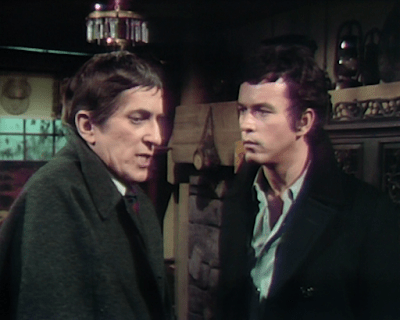
Episode 899: How well I remember that charm of yours

When Dark Shadows debuted in June 1966, matriarch Elizabeth Collins Stoddard (Joan Bennett) had not left the estate of Collinwood in eighteen years. We soon gathered that Liz was afraid that if she strayed far from the house someone might open the locked room in the basement and discover that her husband Paul was buried there, dead of a blow she dealt him when he was trying to run off with a chunk of her patrimony.

Liz’ reclusiveness was a major theme of Dark Shadows‘ first 55 weeks. After the show committed itself to becoming a supernatural thriller with the story of Laura the humanoid Phoenix, which ran from December 1966 to March 1967, they brought in Paul’s old friend and partner in crime Jason McGuire (Dennis Patrick) as an in-betweener to sweep away the few miscellaneous this-worldly narrative threads not already subsumed in the Laura story and to help introduce the next uncanny Big Bad, vampire Barnabas Collins.

It turned out Jason was the one who agreed to bury Paul for Liz, in return for the money Paul had been trying to steal from her. Upon his return to Collinwood, Jason blackmailed Liz with this information. Time and again she caved in to his demands. Liz let him stay in the great house, gave him money, hired him for a lucrative non-job in the family business, let his rapey sidekick Willie Loomis stay in a room just down the hall from those occupied by her daughter Carolyn Stoddard and her all-but-acknowledged daughter, well-meaning governess Victoria Winters, and was in the middle of a wedding ceremony meant to unite her with Jason when she finally burst out with the truth. When she did that, Carolyn dropped the loaded pistol with which she had planned to prevent Jason becoming her stepfather. For his part, Jason said that Paul wasn’t dead, and that he hadn’t buried him. Perhaps the whole thing started when Jason said “cranberry sauce,” and Liz misheard it as “I buried Paul.” With that, the wedding was off, and a few days later Barnabas killed Jason. Since Jason was on his way out of town and had no friends left, no one missed him. He has barely been mentioned since.

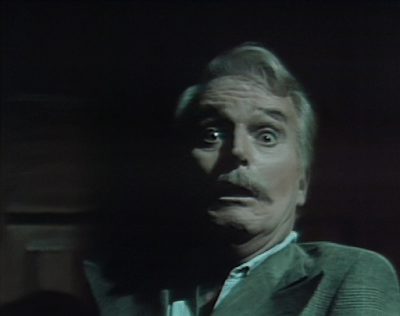
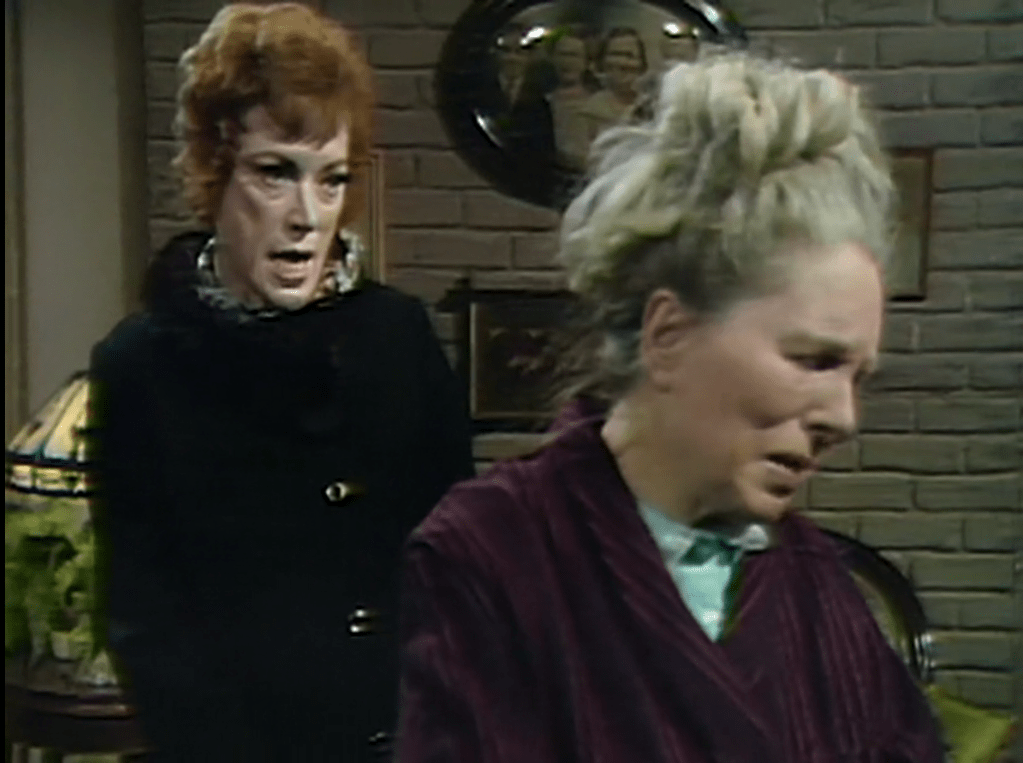
Now, Paul himself has come back. Like Jason, he is played by Dennis Patrick. He has charmed Carolyn into thinking he had nothing to do with faking his own death, and she is falling over herself in her eagerness to establish a relationship with the father who left the family when she was an infant. Carolyn and Liz are on their way out the front door of the great house, heading to a committee in charge of raising funds for the hospital, when the phone rings. It is Paul, asking Carolyn to come to his hotel room at once. She agrees. She gives her mother a vague excuse, irking her, and the women leave the house separately.

In the hotel room, Paul tells Carolyn that he is in some kind of trouble that he can’t explain. Someone is trying to do something terrible to him, but he does not know who or what. Carolyn takes a firm tone when she urges him to tell her what he does know, and when she tells him that whatever is happening she will help him.

Father and daughter embrace, and Liz enters. She is furious to see Paul. She demands Carolyn leave the room. Only when Paul says that he and Liz need a moment together does Carolyn comply. The ex-spouses have a confrontation in which Liz gets to voice her righteous indignation with Paul. She tells him that she expects him to be on the next train out of town. She lists some of the people she will call if he isn’t. Among these is the proprietor of the hotel, who will presumably throw him out in the street at her behest.

In its first months, Dark Shadows tended to attract an aging audience, largely composed of people who still thought of Joan Bennett as the star she was in the late 1930s and early 1940s. Now, with its cast of vampires and werewolves and witches and ghosts and zombies and mad scientists and heaven knows what, it is more of a kid’s show. By the end of the costume drama segment set in the year 1897 that ran from March to November of 1969, viewers over the age of twelve would find themselves reacting to more and more episodes with little more than an indulgent chuckle.

Now that they have returned to contemporary dress, they have swung sharply back towards an adult audience. Carolyn was supposed to be a teenager when the show started; Nancy Barrett was significantly older than the character, and they let Carolyn catch up to her age after a while. But having her spend her evenings serving alongside her mother on the hospital’s fundraising board suggests that they’ve aged her up quite a bit further than that, foreclosing any youth-oriented stories. The conventionally soapy situation the Stoddards find themselves in today is of course something that will be of little interest to the elementary school students who are running home to see the show at this period. And while the main overall story is supernatural, about a cult controlled by unseen beings called the Leviathans that assimilates to itself one character after another, it is understated in tone, allegorical in development, and densely allusive in its relation to its literary antecedents. However many older viewers the show may have lost in the second half of the 1897 segment, they are in danger of shaking off an even larger number of their very young fans if they continue down this road.

In Art Wallace’s original story bible for Dark Shadows, titled “Shadows on the Wall,” the blackmail story was to be followed immediately by Paul’s return. Wallace called for Paul to be a man pursued by dark forces from his past. They made major changes to “Shadows on the Wall” long before they taped the first episode, and it has been almost entirely forgotten for years now. Indeed writer Ron Sproat, who was with the show from October 1966 to January 1969, said that executive producer Dan Curtis told him when he joined the staff that they were going to be leaving “Shadows on the Wall” behind and never let him see it. But they did dip into it in the case of Paul’s return- he is indeed being pursued by dark forces from his past. The Leviathan cult is after him.

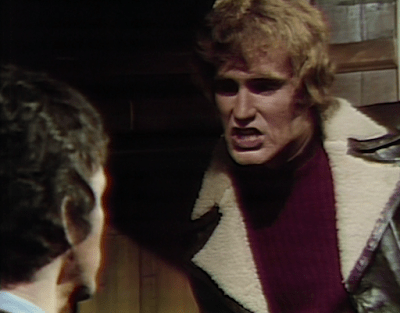
After his confrontation with Liz, we see Paul sitting at the bar in the Blue Whale tavern. The jukebox plays a tune familiar from the early days of the show, when the Blue Whale was a frequent set and there were usually extras dancing in the background. Today the only people we see there are Paul and a middle aged sailor sitting next to him.

The sailor keeps looking at Paul. We hear Paul’s thoughts as he wonders if the sailor is “one of them.” Paul irritably asks him why he is looking at him. The sailor says that he wants to buy Paul a drink. Paul angrily snaps back that “I buy my own drinks!” After some sharp words, the two men warm to each other. They wind up getting handsy with each other and disappear for some private time together.

Paul and his new fella. Screenshot by Dark Shadows Before I Die.

This scene turns out to be motivated by the two men’s mutual awareness of the Leviathan cult. Over the years, I’ve seen lots of guys in bars interact with each other in exactly this way. I don’t know what that’s all about, maybe the Leviathans are real.

Since I mentioned “Shadows on the Wall” above, I should say that the tavern figures in there as well. Only it isn’t called “The Blue Whale,” but “The Rainbow Bar.” I don’t know, somehow I think Paul and the sailor might not have got off to such a rocky start if the show had gone with that name. Sounds friendlier, somehow, at least to lonesome sailors and the mature men for whom they want to buy drinks.

Paul’s new buddy, unnamed in the dialogue, is identified in the closing credits as “Jack Long.” He is played by Kenneth McMillan, in his first screen credit. In the 1970s and 1980s, McMillan was one of the busiest television actors in the USA. I always mixed him up with Dolph Sweet, who was a similar physical type. Sweet appeared on Dark Shadows once, in #99. He played Ezra Hearne, the most loyal employee at Liz’ cannery. Sweet was a tremendous actor, McMillan a very good one, and they occasionally worked together. So long as they are doing normal soap opera stuff, it would have been nice if they could have had a little story about Ezra’s reunion with his long-lost cousin Jack. Maybe Jack could have introduced Paul to Ezra, we could have seen how he’d fit in with the family.

Episode 898: The keeper of the book

A cult devoted to the service of supernatural beings known as “the Leviathan people” is secretly establishing itself in and around Collinsport, Maine. Antique shop owners Megan and Philip Todd are members of the cult. Its acting leader, old world gentleman Barnabas Collins, has entrusted them with several items sacred to the cult. The Todds are responsible for a scroll, a box, a book, and a baby. Now the book has gone missing, and the baby is sick. Yesterday, Barnabas responded to this situation by brainwashing Philip into killing Megan. Today, we open with Philip entering the antique shop and choking Megan.

Megan is Marie Wallace’s third character on Dark Shadows. Her first, fiancée of Frankenstein Eve, was strangled by her intended spouse Adam in #626. Her second, madwoman Jenny Collins, was strangled by her estranged husband Quentin in #748. The murder of Eve came at the end of the Monster Mash period of the show that stretched throughout most of 1968, while the murder of Jenny marked a turning point in the eight-month costume drama segment set in the year 1897. The Leviathan arc is just beginning, and Miss Wallace’s character is already being strangled by her husband. If we were hoping for fresh new story ideas, we couldn’t be more disappointed.

Until, that is, the strangulation is called off. Philip is holding Megan by the neck, reiterating that “There is no margin for error! Punishment is necessary!,” when strange and troubled boy David Collins appears on the staircase and announces “punishment is no longer necessary.” Philip releases Megan, and David informs them that he is now “the keeper of the book, and the protector of the baby.” He gives Megan and Philip medicine that will cure the baby of his illness. He tells them that if they need him, he will know and will appear.

Barnabas was a vampire when he joined the cast of characters in April 1967. As a villain he was unrivaled at giving everyone else things to do, whether as his victims, his accomplices, or his would-be destroyers. In March 1968, his curse was put into abeyance and he became human. He set out to be the good guy, but still had the personality of a metaphor for extreme selfishness. As a result, Barnabas the would-be hero created at least as many disasters as Barnabas the monster ever did. He thus remained the driving force of the show, as well as its star attraction.

While Barnabas can keep things going from day to day, Philip’s attack on Megan suggests that he cannot take the story in new directions. From episode #1, that has been David’s forte. The series began when well-meaning governess Vicki was called to Collinwood to take charge of David’s education, took its first turn towards grisly tales when David tried to murder his father, became a supernatural thriller when David’s mother the undead blonde fire witch came back for him, began its first time travel story when Barnabas was planning to kill David in November 1967, and was launched into both the “Haunting of Collinwood” that dominated the show from December 1968 through February 1969 and the 1897 segment that followed it by David’s involvement with the ghost of Quentin Collins. David was not always a highly active participant in the stories that began with him; indeed, he sometimes disappeared altogether for months at a time. But even from the outside, he is the instrument by which the basic architecture of the show is reshaped. Now that he is, apparently, the leader of the Leviathans, we can renew our hopes that something we haven’t seen before is still in store for us.

David is still in the shop when a gray-haired man enters. David greets him as “Mr Prescott,” the name by which he heard his cousin Carolyn address the man when he met her in the shop the other day. David has a smug look on his face that suggests he knows this is an alias. Indeed, we already know that the man is connected with the Leviathan cult, so the leader of the cult may well recognize him as Paul Stoddard, Carolyn’s long-missing father.

Paul asks the Todds to give a note to Carolyn. David says that he will be going home to the great house of Collinwood in a few minutes, and volunteers to take the note to her there. Paul gladly hands it to him.

At Collinwood, permanent houseguest Julia Hoffman is conferring with mysterious drifter Chris Jennings. Yesterday, Jenny’s ghost appeared to Chris and told him that Quentin could help him with his big problem, which is that he is a werewolf. Jenny did not identify herself, and Chris had no clue who she was.

Julia shows him a Collins family photo album. She shows him a picture of maidservant Beth Chavez and asks if that is who he saw. He says it wasn’t, and they keep turning pages. It is interesting for regular viewers that they take a moment to put Beth’s picture on the screen and to make some remarks about her. Beth appeared several times during the “Haunting of Collinwood” segment, and was a major character during the 1897 flashback. The sight of her picture is the first reason we have had to suspect that either she or actress Terrayne Crawford will be back.

Chris and Julia look through a Collins family photo album. Screenshot by Dark Shadows Before I Die.

When Chris recognizes Jenny’s picture, Julia breaks the news to him that Jenny and Quentin were his great-grandparents, and that Quentin was the first to be afflicted with the werewolf curse. We know that Quentin and Jenny’s daughter was named Lenore, and that she was raised by a Mrs Fillmore. Chris confirms that his grandmother’s maiden name was Lenore Fillmore. Wondering how Quentin could help Chris, Julia decides they will hold a séance and contact Quentin’s spirit.

David enters, looking for Carolyn. Julia asks him to participate in the séance. He agrees, with the blandness appropriate in a house where séances have become almost routine. When Julia tells him that the spirit they are trying to reach is that of Quentin Collins, David becomes alarmed. As well he might- we left 1969 at the beginning of March, but in #839, broadcast and set in September, we saw that the haunting continued in the absence of the audience, and that Quentin’s ghost had killed David. That episode took place on the anniversary of an event in 1897 that was changed by time travelers from the 1960s, and so David came back to life and the haunting ended. But everyone at Collinwood still remembers the ten months that Quentin exercised his reign of terror, and David does not want to return to it.

Julia assures David he has nothing to be afraid of. She says that the past was changed as of September 1897/ September 1969, and that Quentin’s ghost was laid to rest forever. This doesn’t fit very well with her plan to disturb that rest, but David is still ready to go along with the plan.

When they have the séance, David goes into the trance. He speaks, not with Quentin’s voice, but with that of Jamison Collins, his own grandfather and Quentin’s favorite nephew. Jamison says that Quentin’s spirit is no longer available for personal appearances. He doesn’t know more than that, and excuses himself. When David comes to and asks what happened, Julia says she will tell him later and sends him to bed. Once he is gone, she tells Chris that she thinks Quentin may still be alive.

Quentin was a big hit when he was on the show as an unspeaking ghost during the “Haunting of Collinwood,” and became a breakout star to rival Barnabas when he was a living being during the 1897 segment. So the audience is not at all surprised that he will be coming back. But David’s behavior before, during, and after the séance is quite intriguing. He is not simply possessed by some spirit that is part of whatever it is the Leviathan cult serves. He is still David, is still afraid of Quentin’s ghost, and is still fascinated by séances. During the 1897 segment, Jamison was a living being; like David Collins, he was played by David Henesy. That Jamison can speak through his grandson and not express discomfort at the unfamiliarity of the atmosphere suggests that there are sizable expanses inside David which are still recognizably him.

There is a similar moment between Philip and Megan. She smiles at him and in a relaxed voice says she understands why he had to do what he did. Philip has no idea what she is talking about. She reminds him that he tried to strangle her earlier in the evening, and he suddenly becomes highly apologetic. She tells him he has nothing to apologize for, that it was his duty as a servant of their cause. He is still anguished about it. They share a tender embrace. Again, while the force that animates the Leviathan cult may have the final say over what Megan and Philip do, their personalities are still there, and the loving couple we met a not so long ago still exists. There is still something for us to care about concerning them.*

Paul also has a lot of activity today. He goes to the cairn in the woods that is the ceremonial center of the Leviathan cult and that only people associated with it can see. He wonders why he keeps being drawn to it. When he first returned to Collinwood in #887, he was watching when the cairn materialized in its place out of thin air. He didn’t react at all, but merely turned and continued on his stroll. That led us to believe he knew a great deal about the cult, enough that he not only expected to see this extraordinary sight, but knew he need take no action regarding it. But evidently his connection is more subtle, and he does not understand it himself.

In his hotel room, Paul goes into a trance and circles the date 4 December 1969 on his calendar. That was when the episode was first broadcast, so the original audience would have assumed he was merely circling the current date. But when it was taped, the makers of Dark Shadows had expected the episode to be shown on 3 December. In between, there had been a pre-emption when the ABC television network gave its news department the 4:00 PM timeslot to cover the end of the Apollo 12 lunar landing mission. So the intention had been that we would share Paul’s puzzlement as to what was so special about the next day.

Paul is already worked up because some unknown person left him a note at the antique shop reading “Payment Due, 4 December 1969.” By the end of the episode, he notices that a tattoo has appeared on his wrist. It is a symbol that the show refers to simply as “the Naga,” a group of intertwined snakes that represent the Leviathan cult. All of this combines to get him into quite a state.

* I should mention that Danny Horn made the same point in his post about the episode on his great Dark Shadows Every Day: “And then they kiss, and the creepy thing is that I think they’re actually in there… So far, I’ve been critical of Chris Bernau, but he’s the one who pulls this moment together. As far as he’s concerned, the unpleasant incident is entirely forgotten — but when Megan brings up the fact that he was seconds away from killing her, his apology is entirely sincere.” Danny Horn, “Episode 989: Executive Child,” on Dark Shadows Every Day, 12 July 2016.

Episode 897: Restore our flesh and bones

The Trouble with David

Yesterday we saw strange and troubled boy David Collins (David Henesy) go to a mysterious cairn in the woods, the ceremonial center of the cult of the Leviathan people, and announce that he was now one of the cult. The cairn then opened, revealing a little gap. David crawled into the gap. The gap was not quite big enough for him, so that the episode ended with an extended sequence of David Henesy wiggling his rear end at the camera while he tried to wedge himself into place.

Today we learn that the carpenters were not the only ones who haven’t caught on that Mr Henesy isn’t nine years old anymore. David has followed the gap to an underground chamber with a steaming cauldron. He takes some vegetation out of the cauldron and recites a cryptic poem, all the while staring portentiously off into space. His manner, words, and actions would be effective as part of a creepy little kid sequence, but the thirteen year old Mr Henesy looks mature enough that we just chalk him up as one more member of the Leviathan cult.

The Trouble with Chris

Heiress Carolyn Collins Stoddard calls on drifter Chris Jennings in his cottage. They talk about someone named Sabrina who has told Carolyn that while Chris is a nice enough guy, he will, in spite of himself, kill her if she keeps hanging around him. Chris tells Carolyn that this is true and that he is “a monster.” He does not explain. She leaves, and he takes out a pistol. First-time viewers will wonder if Chris has a compulsion to fire his pistol at people. Regular viewers know that he is a werewolf, and that his particular case of lycanthropy is so advanced that he sometimes transforms even when the moon is not full. We can assume that he plans to use the pistol to put himself out of his misery.

Regular viewers also know that Chris was safely confined to a mental hospital until he checked himself out recently. When he returned to the great house of Collinwood, he told his psychiatrist, permanent houseguest Julia Hoffman, that he just couldn’t stand the conditions at the hospital. Since leaving the hospital means that Chris will resume killing at least one random person a month, this decision just about completely erased any sympathy we might have for him as a character. It also undercuts his motivation in this scene. If Chris really wants to stop killing, he is free to go back to the hospital at any time.

The ghost of Chris’ great-grandmother, Jenny Collins (Marie Wallace,) appears. She tells him not to commit suicide. Dark Shadows was a costume drama set in 1897 from March to November 1969; in those days, we got to know Jenny as “Crazy Jenny,” who played nothing but one mad scene after another. She was sane and well-put-together just once, when she appeared as a ghost in #810 and #811. In this second postmortem appearance, Jenny is extra mad, wearing a disheveled wig that reaches heights few hairpieces have dared. She does not tell Chris to return to the hospital, but to find his great-grandfather, Quentin Collins. She says that she cannot help him, but Quentin can.

This confirms what the show has been hinting, that Quentin is alive. Chris doesn’t know that, nor does he know of his relationship to Quentin. He is left bewildered and helpless by Jenny’s pronouncement. His response would no doubt be more complex if he were up to date, but he has been so ineffective at managing his curse and so irresponsible generally that we can’t imagine he would do anything constructive even if he knew everything we do. The character seems to have reached a dead end.

The Trouble with Barnabas

Upset by her conversation with Chris, Carolyn goes to her distant cousin, old world gentleman Barnabas Collins. She enters his home, the Old House on the estate of Collinwood, and finds the front parlor empty. She hears Barnabas’ voice coming from behind a bookcase, repeating over and over that “There is no margin for error. Punishment is necessary.”

Longtime viewers know, not only that a room is hidden behind this bookcase, but that Carolyn knows about that room. Her friend, David’s well-meaning governess Vicki, was held prisoner there by a crazy man in December 1966, several months before Barnabas joined the show. Carolyn is moving her hands, as if she is looking for the release that makes the bookcase swing open, when Barnabas comes downstairs.

When Carolyn says that she heard his voice, Barnabas explains that he was simply keeping busy by “conducting an experiment in electronics.” The candles around the room will suffice to show that the house doesn’t have electricity, and even if Barnabas weren’t so resolutely technophobic it would still require explanation that the text he set his speakers to reproduce over and over was “There is no margin for error. Punishment is necessary.” Moreover, Carolyn knows Barnabas well, and she can’t have overlooked that he is not his usual self these days. He is distant, calm, and utterly self-possessed, a far cry from the fussy, excitable chap who so often stumbles over his words. He remains formidably well-composed as he reiterates his position that Chris is a dangerously unstable person whom Carolyn should avoid, and that she has a bright future ahead of her. He gently but firmly guides her to the front door, and she is out of the house in record time.

Carolyn does not know that Chris is the werewolf, but at least she knows that there is a werewolf. She does not know that the Leviathan cult exists, and so it is understandable that she does not suspect that Barnabas is acting as its leader. But as the story unfolds, others will no doubt catch on that something is up, and so many people have spent so much time with Barnabas that it is difficult to see how they can all fail to notice the drastic change in his personality and to connect it with the strange goings-on. Putting him in this position makes it likely that the writers will have a harder time managing the story’s pace than they would if his involvement were more subtle.

Once Carolyn has exited, Barnabas opens the bookcase and reveals Philip Todd, antique shop owner. He rewinds a reel-to-reel tape and replays “There is no margin for error. Punishment is necessary.” Philip and his wife Megan are members of the cult, entrusted with the care of many of its most sacred items. Yesterday Barnabas found out that one of these, a book, had gone missing. He summoned Philip to the cairn, and it seemed he might be about to kill Philip. But now, he sends Philip off to administer the punishment to someone else, presumably Megan.

The Trouble with Megan

Megan (Marie Wallace) has been in an extremely overwrought state ever since she found that the book was gone. Today’s episode ends with a long scene in which she is alone in the shop, feeling that someone is coming to kill her, reacting sharply to every noise.

Danny Horn devotes most of his post about the episode on his great Dark Shadows Every Day to reasons why this scene does not work, among them the fact that a depiction of a person descending into madness requires that the person start off as something other than over-the-top loony. Megan has been so frenzied for the last few days that Miss Wallace has nowhere to go when she hears the ominous noises. Moreover, her first two characters on Dark Shadows, fiancée of Frankenstein Eve and Crazy Jenny, were both intense, overbearing characters who were so inflexible that they had little opportunity to respond to anything their scene partners might do. Longtime viewers therefore expect to see Miss Wallace screaming and carrying on by herself, so nothing she does here will unsettle us. They lampshade this iconography problem by showing us Crazy Jenny’s ghost today, but that doesn’t help at all.

Many fans compare this scene to episode #361. Most of #361 is devoted to a one-woman drama in which Julia is tormented by sights and sounds in her bedroom, suggesting that her mind is collapsing. I don’t think that episode is a success, but because Julia had always been in control of herself up to that point we can see what is supposed to be at stake in it. That’s more than we can say for Megan’s fearful turn.

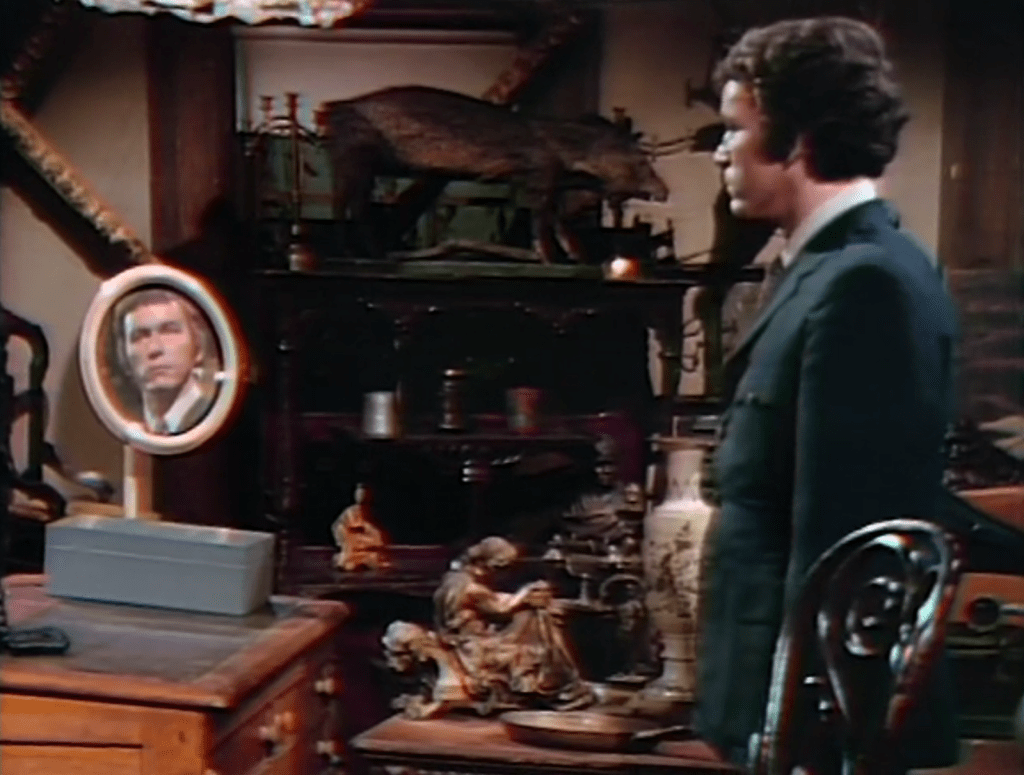
In John and Christine Scoleri’s post about the episode on Dark Shadows Before I Die, Christine points out the prominence of the taxidermied animals in the background, and speculates that the scene is an homage to The Night of the Living Dead. I wouldn’t have guessed that director Lela Swift or writer Violet Welles would have studied that film, but Christine provides screenshots from it and from the episode, and the parallels are so striking that I can’t see how she could be wrong.

Closing Miscellany

I think the tape recorder is the same one we saw in the summer of 1968, when it was part of the Frankenstein story. It also appears to be the one that parapsychologist Peter Guthrie brought to Collinwood early in 1967.

Her haunting of Chris marks Jenny’s final appearance. Miss Wallace reprised the role decades later in a couple of the Big Finish audio dramas.

During Megan’s big scene, the camera swings a bit to the left and we can see beyond the edge of the antique shop set. We get a good look at a tree that stands near the cairn in the woods. Making matters worse, when they turn the camera away from the tree they go too far right, showing a stage light on the other side.

The antique shop and the cairn. Screenshot by Danny Horn, Dark Shadows Every Day.

As the opening credits begin to roll, the camera is pointed a bit too far to the right and a stagehand is visible, adding dry ice to the steaming cauldron in the underground chamber.

Closing credits blooper. Screenshot by Danny Horn, Dark Shadows Every Day.

Episode 896: Those who have been hidden shall show themselves

David and the Book

Strange and troubled boy David Collins has stolen an old book from an antique shop. He didn’t want the book, but had damaged it slightly and was terrified that he would be punished if this was discovered and his father had to pay for the rare volume.

David’s friend and fellow resident of the great house of Collinwood, Amy Jennings, catches him with the book in the drawing room. He tells her he is going to burn it in order to conceal his crime. She points out that this will make a bad situation much worse. As a creature of Soap Opera Land, David can have no higher calling than to make bad situations worse, so this does not deter him.

While Amy offers to take the book to the nearest grownup and to claim that she was the one who stole it, David opens it to a page depicting a group of intertwined snakes, a symbol the show refers to simply as “the Naga.” He is transfixed by the symbol. His whole manner changes. His posture becomes more rigid, his voice grave and authoritative. He tells Amy he no longer wants to burn the book. Instead, he will read it. Since the book is written in a script neither of them has seen before, Amy tells David he cannot read it, but he assures her he can. She asks him to read it to her, and he says that it is forbidden for her to hear any of it. She says that she doesn’t like the game David is playing and would rather turn to another; he says it is no game. She leaves him alone with the book.

The book was not in fact part of the antique shop’s merchandise, though it was on a display table there. The owners of the shop, Megan and Philip Todd, have been inducted into a mysterious cult led by David’s distant cousin, old world gentleman Barnabas Collins, and the book is one of that cult’s most sacred objects. The Todds flew into a panic when they realized the book was missing, and Barnabas told Philip that he faced a severe penalty for losing it. Those reactions make it hard to understand why Philip and Megan left the book on the table in the first place.

Longtime viewers know that many of the major plot-lines on Dark Shadows start with David. So we may suspect that the supernatural forces behind the cult, unknown to Barnabas or the Todds, caused the book to be left on the table and led David to take it so that he could become part of the story. Indeed, once he is alone with the book David intones a statement from it: “And then those who have been hidden so long shall rise and show themselves, and the others will know their time is ended and the time of the people of the Leviathan will begin.” Later, he goes to the mysterious cairn in the woods that is the center of the Leviathan cult’s ceremonial activity, and announces that he is one of them now. The stones at the bottom of the cairn part, revealing a small opening. David crawls into it. The words are solemn, the music melodramatic, the action of the boy stuffing himself into the little hole preposterous. It is the perfect Dark Shadows sequence.

David Henesy was nine years old when the show started, and was thirteen by this time. It would seem no one told the carpenters he had grown in the interval. That gap is such a tight fit for him that he has to wiggle his rear end at the camera for quite a while as he tries to wedge himself into it. Screenshot by Dark Shadows Before I Die.

We Actresses are Vain

As David is leaving to go to the cairn, he has to refuse a request from permanent houseguest Julia Hoffman. Julia wants him to go to the Old House on the estate and give a note to Barnabas. She keeps telling him that it is urgent, but he tells her he is already on his way to do something urgent.

Julia does not know about the Leviathan cult, much less about Barnabas’ connection with it. All she knows is that Barnabas has been her best friend for a year and a half, and when last they had a chance to spend time together they were concerned with the rakish Quentin Collins, whose whereabouts they do not know. Now it is 4:45 PM, and Julia is expecting a Mr Corey to come to the house at 5:00 and look at a painting she bought from the Todds a little while ago. She thinks this Mr Corey might be Quentin, and is keen for Barnabas to meet him.

When David cannot help her, Julia decides to take the note to the Old House herself. The show is usually fairly vague and inconsistent about the geography of Collinwood, but several times they have said that it takes about fifteen minutes to walk between the great house and the Old House. They stick with this today. Julia leaves at 4:45, and returns as the clock is striking 5:15. Barnabas was not at home, so she just turned right around.

Julia hears voices in the drawing room. They are heiress Carolyn Collins Stoddard and another woman. Julia gathers that Mr Corey is actually Ms Olivia Corey. When she enters the room, she sees that Olivia is a dead ringer for Amanda Harris, a woman who lived in 1897. Julia became aware of Amanda in September, when she and Barnabas were traveling in time and met each other in that year. Julia did not meet Amanda, but evidently must have seen at least one of the many portraits of her that magical artist/ dreary goon Charles Delaware Tate painted. She mentions these portraits to Olivia, who claims that Amanda was her grandmother. Amanda was in love with Quentin, and Julia takes an excited breath when she asks Olivia who her grandfather was. Olivia gives his name as Langley. Quentin may well have used an alias, so that doesn’t rule out the possibility that Olivia may be his granddaughter, though Dark Shadows fans looking back in these later days will think of another member of the Collins family when they hear that name.

Olivia is a famous New York actress. Julia tells her that she has seen her on stage and has seen her photograph in the newspapers, but that she never noticed her resemblance to Amanda. Olivia asks where Julia heard about Amanda; she says that she must have read about her somewhere in connection with one of the portraits. She also tells Olivia that she isn’t likely to want the painting, since it is not a portrait. Olivia says that she wants any painting of Tate’s she can get. Julia tells her there is no portrait of Quentin Collins in the house; Olivia pauses for a fraction of a second, then blandly asks if she is supposed to know who that is.

Some of Tate’s paintings had supernatural effects. When Tate painted pictures of his ideal woman, Amanda came into being as their embodiment, like Galatea emerging from Pygmalion’s statue. And when he painted Quentin’s portrait, Quentin was freed of the effects of the werewolf curse. Like a Halloween version of The Picture of Dorian Gray, the portrait turned into a wolf on the nights of the full moon, while Quentin remained human.

As long as the portraits of Amanda and Quentin are intact, they themselves will remain alive and well and youthful. So Julia’s hope that Quentin might still be traveling the world and using false names 72 years after the period when she and Barnabas knew him is not ill-founded, and her surmise that Olivia might be, not Amanda’s granddaughter, but Amanda herself, is also plausible.

Episode 894/ 895: The time of the Leviathan people

Old world gentleman Barnabas Collins has become the leader of a mysterious cult. Antique shop owners Megan and Philip Todd are members of the cult, and they have a magical baby who materialized after Barnabas gave them a sacred box. Inside the box was a book that is also of tremendous importance to the cult. Philip and Megan left the book on a table in their shop, so that it appeared to be for sale. Yesterday strange and troubled boy David Collins stole the book. In its absence, the baby has developed a high fever. When Megan and Philip found that the book was gone, they flew into a panic and declared that they would have to kill the person who took it.

Many stories on Dark Shadows start with David, so it could be that the uncanny and sinister forces behind the cult want him to have the book. If so, Barnabas doesn’t know any more about it than do Philip and Megan. He finds out today that the book is missing, and takes Philip to a cairn in the woods. He tells him he will have to be punished for losing it.

When Philip first saw the cairn, he remarked that he had been that way before, but never noticed it. Barnabas explains that only people connected with the Leviathan cult can see it. This casts the minds of returning viewers to heiress Carolyn Collins Stoddard, Barnabas’ distant cousin. In #888, Carolyn saw the cairn and ran into a prowler there. The prowler refused to identify himself to her; the closing credits told us he was Paul Stoddard, Carolyn’s long missing father. We had seen him from behind the day before, when he saw the cairn materialize, then simply walked off. His blasé response told us that he expected to see what he saw, which can only mean he was connected with the cult. Carolyn doesn’t know anything about the Leviathans, but what Barnabas says to Philip today confirms that she is nonetheless associated with them in some sense. Indeed, Barnabas has been very solicitous of Carolyn’s well-being ever since he joined up with the Leviathans and keeps telling her that she has an extraordinary future.

Philip and Barnabas at the cairn. Screenshot by Dark Shadows Before I Die.

There is also some business going on between Paul and Carolyn. On the surface it would seem to be a typical soap opera story, in which the daughter is trying to reintroduce her errant father into the family circle and has to keep secrets from her mother and young cousin to pull it off. Given what we know about Paul’s awareness of the Leviathans and their interest in Carolyn, we can see that it is in fact part of the supernatural A story.

There are no closing credits today, only the logo of Dan Curtis Productions. The Dark Shadows wiki says that this one was directed by Henry Kaplan. I am certain this is false. Kaplan was very clumsy with the camera, resorting to closeup after closeup and then to ever-more extreme closeups until you have scenes played by one actor’s left ear opposite another’s right nostril. Today, there is a scene between Carolyn, David, and Barnabas in the drawing room of the great house at Collinwood, a scene in which Carolyn presses David with questions about the book, that is so expertly choreographed that only Lela Swift could have blocked it. My wife, Mrs Acilius, marveled at the dance that Nancy Barrett, David Henesy, and Jonathan Frid execute so flawlessly.

This episode is double numbered to make up for a planned pre-emption, when the ABC television network showed football at 4 PM on the afternoon of Thanksgiving Day. Every Friday’s episode was supposed to have a number that ended with a five or zero, so that all you had to do was divide by five and you would get the number of weeks the show had been on. That didn’t work this time, because there was also an unplanned pre-emption when the network’s nes division took the 4 PM slot to cover the return of the Apollo 12 mission. They are producing episodes well ahead of their airdates at this point, in a couple of cases over five weeks ahead, so it will be a long while before they can get back in sync.

Episode 893: We serve him now

Heiress Carolyn Collins Stoddard is sitting at a table in the Blue Whale, a tavern. A man who refused to give his name when she caught him trespassing on her property invites himself to sit down with her. She objects to this. He identifies himself as her father, the long-missing Paul Stoddard. She objects far more strenuously to that. Not only did Paul leave the family when Carolyn was an infant, he and his friend Jason McGuire faked his death. Jason convinced Carolyn’s mother, Liz, that she had killed Paul and he had buried the corpse in the basement. In response, Liz immured herself in the house for nineteen years. Only after Jason came back and was blackmailing Liz into marrying him did the truth come out and Liz break free of her reclusive ways.

Paul tells Carolyn that he didn’t know Jason told Liz that she had killed him. Longtime viewers may suspect this is a lie, not least because Paul and Jason are both played by Dennis Patrick. Nonetheless, Carolyn falls for it. Soon she is agreeing to sound Liz out to see how she might react were she to hear that Paul had returned. He walks her home to the great house on the estate of Collinwood. He can’t go in, but gives her a goodnight kiss on the forehead.

Carolyn’s young cousin, strange and troubled boy David Collins, sees Paul kissing her. When she goes inside, he asks who her new boyfriend is. Carolyn is vexed. She refuses to tell David anything, and sends him to bed.

Carolyn’s friend Philip Todd comes to the door. He tells her that he and his wife Megan want Carolyn to work at their antique shop in the village. It may seem rather odd for the keeper of a little shop to go to a vast mansion and ask the daughter of its proprietor to take a job as his assistant, but Carolyn loves the shop and was volunteering there yesterday. She agrees happily, and mentions that a man might be leaving messages for her there.

In the shop the next morning, Carolyn sees that Megan has a baby. Megan says it is her sister’s son. Carolyn asks his name. Megan thinks for quite a while before coming up with “Joseph!”

Carolyn is alone in the shop when David comes in with his friend and fellow resident of Collinwood, Amy Jennings. We haven’t seen Amy since #835; that in turn was her first appearance since #700. For eight months, from #701 to #884, Dark Shadows was set in the year 1897, with only a few brief glimpses of the 1960s. In the 1897 segment, Denise Nickerson played Nora Collins, whose own final appearance was in #859. Both Nora and Amy had long absences from the cast, and were usually unmentioned while they were away. So we’ve been afraid that we wouldn’t see Amy or any other Nickerson character again. It’s good to have her back. She even pulls her signature move and gives a meaningful look directly into the camera at one point.

A Nickerson special.

Amy and David see a doll that longtime viewers will recognize as Samantha, favorite plaything of the late Sarah Collins both when we saw her as a living being in the 1790s from November 1967 to March 1968 and before that, when she was a ghost haunting Collinwood and its environs in 1967. There are also a couple of toy soldiers from “The Regiment,” which Sarah’s brother Barnabas played with when he was a young boy and which Sarah gave to people in 1967 as protection against Barnabas, who was at that time a vampire. Barnabas did sell a bunch of things to Megan and Philip the other day, but neither Samantha nor the members of The Regiment were in Barnabas’ possession when last we saw them. Presumably the camera lingers on the toys, not because we are supposed to know how Philip and Megan got them, but because we are supposed to be pleased with ourselves for recognizing them.

Paul comes into the shop. David recognizes him as the man he saw kissing Carolyn. Carolyn addresses Paul as “Mr Prescott,” sends him into a back room, and hustles the children out of the shop. She tells Paul who David is, and explains that he saw them together, complicating their plans.

When Carolyn was minding the shop yesterday, her friend Maggie noticed an old book on a table. Neither of them knew what it was, but viewers knew it was an object of great importance to a cult into which Philip and Megan have been inducted. It seemed inexplicable that they would leave it on a table in their shop, as if it were for sale. We get a hint today as to what they may have been thinking. In his room at Collinwood, David shows Amy that he has stolen the book. She asks why he would want it. He explains that Carolyn said that if they damaged anything in the shop, his father, Roger, would have to pay for it, and he creased a page in the book. David’s fear that his father would punish him drove several stories in the early months of the show. Roger has mellowed enormously since then, but evidently David is still so afraid of him that he will make a bad situation worse rather than face his wrath.

Indeed, many major storylines have begun with David. The 1897 flashback started because Barnabas was trying to keep a ghost from killing David, as the 1790s segment started when David’s governess Vicki participated in a séance meant to solve a mystery concerning him. For that matter, the whole show started when Vicki was summoned to Collinwood to take charge of David’s education. David doesn’t always have a lot to do in the stories, and when they are over it is often as not forgotten that he was in peril when they began. But he is so often the catalyst that we can suppose that David was supposed to find the book so that the current story could move into its major phase.

If that was the intention, Megan and Philip didn’t know about it. When they discover that the book is gone from the shop, they fly into a panic and declare that whoever took it must be killed. It may turn out that the mysterious forces behind the cult want David to become involved and that they created a situation in which he would find the book and take it with him, but if so, those forces are operating outside the cognizance of anyone in today’s episode.

Episode 892: The chosen room

Old world gentleman Barnabas Collins has given a present to antique shop owners Megan and Philip Todd. It is a wooden box. This box has a strange effect on the Todds, filling them with a mixture of irresistible fascination and nameless dread.

When the Todds go to open the box, it makes a whistling noise. They find a book inside it. The book is noticeably larger than the box. It is written in a script they do not recognize. There is also a scroll. That is in English, but may as well not be- neither Philip nor Megan can understand it, though Megan does say that she feels as if she almost can.

Later, Megan has a dream. It is the sort of dream people had in the first year of the show, before there were special effects. Like the dreams in ancient Greek literature, it takes the form of someone standing by the bed and making a speech. The speaker is Barnabas, and he tells Megan to empty the bedroom of furniture, board up its windows, and let no outsiders enter it. She calls him “master,” and he tells her she will not recognize him as such when she is awake. When she does wake up, she finds that Philip is already following the instructions, and realizes they had the same dream.

Downstairs, heiress Carolyn Collins Stoddard is minding the antique shop. She receives a telephone call from someone wanting to buy a cradle that is on the shop floor. At the end of the call, we hear Carolyn’s thoughts as she congratulates herself on making a sale. She is shocked when Megan comes down and tells her the cradle is not for sale. Philip comes afterward, and with a blank expression on his face carries the cradle upstairs. Carolyn is left to call the buyer back and apologize.

The chosen room, ready for the cradle. Screenshot by Dark Shadows Before I Die.

Philip and Megan set the cradle in the special room. They are apparently in awe. They look like any new parents stunned by the fact that they have brought a new life into the world, but the cradle is empty. After they leave the room, it starts rocking by itself.

The cradle is an interesting choice of prop. It was important early in 1969 in the “Haunting of Collinwood” story, when it was associated with the ghosts and rocked by itself. We then saw it a couple of months later in the 1897 flashback, when we learned why it was haunted. Those stories have been resolved in such a way that it won’t occur to us that the consequences of the same tragic events are animating it this time. The cradle seems to have become a generic symbol of spookiness. Considering that its back is coffin-shaped, that’s an understandable association.

Meanwhile, Maggie Evans, The Nicest Girl in Town, has come into the shop. Maggie is the governess in Carolyn’s home, the great house on the estate of Collinwood, and they are friends. Maggie notices the sacred book on a table and asks Carolyn what it is. Carolyn doesn’t know anything about it. Why the Todds would leave such a thing on a table in their shop, a placement that implies it is for sale, is not explained.

Maggie tries on a feather boa. Like the cradle, this prop was significant in the 1897 segment. In that part of the show, Nancy Barrett, who plays Carolyn, was introduced as a woman named Charity Trask. Charity’s body was eventually taken over by late Cockney showgirl/ mentalist Pansy Faye. She wore the boa to indicate that she was Pansy. We last saw Charity/ Pansy, boa and all, in #883, and heard her voice in #887, so when we see it in the shop regular viewers will have fresh memories of her. We may well hope Carolyn will put it on and start singing Pansy’s song. But Maggie is the only one who is interested in the boa, and she doesn’t seem possessed at all. She wants to buy it, but Megan comes in and prevents her doing even that. She declares she is going to be closing the shop early.

Maggie leans very heavily on Carolyn to join her for a drink at the local tavern, The Blue Whale. Even after she drags Carolyn there, Maggie keeps pressuring her to stay for another drink. This is not at all typical of Maggie. When we find out her reason, it turns out to be even less characteristic. A mysterious gray-haired man who has been lurking around Collinwood lately wants to sit with Carolyn. When he comes to the table, Maggie gets up and leaves Carolyn alone with him. She has a self-satisfied smirk on her face as she does so, not a look we have ever seen her give before.

The man introduces himself to Carolyn as Paul Stoddard, her father. Paul abandoned the family when Carolyn was an infant, in the process faking his own death and prompting Carolyn’s mother Liz to believe that she had killed him. That belief led Liz to confine herself in her home for nineteen years, terrified that she would be caught. So it is simply inexplicable that Maggie would think Carolyn would be happy about having this bomb dropped on her.

Paul’s introduction of himself to Carolyn is the first time he is identified in a scene, but it is not the first time viewers have been told who he is. His name appeared in the closing credits for #887 and #891, ruining the surprise that is supposed to give a punch to the ending of today’s episode.

Episode 891: The only one there is

About Time

Dark Shadows committed itself to supernatural stories in late 1966 and early 1967, when the chief villain was undead blonde fire witch Laura Murdoch Collins. Since the usual laws of nature weren’t going to restrain Laura, they needed another set of rules that could predict her behavior sufficiently to create suspense. One of the things they settled on was that the barrier between past and present grows thin on the anniversaries of deadly events. So when well-meaning governess Vicki and the team she had assembled to fight Laura discovered that, in a previous iteration, she had taken a young son of hers to his fiery death “exactly one hundred years ago,” they knew that the crisis was at hand.

Anniversaries continued to have this effect in subsequent periods. So when in January 1969 recovering vampire Barnabas Collins wanted to take a day trip to the 1790s, he stood in a graveyard and shouted at a man who had died exactly 172 years previously to ask for a ride. It worked.

Barnabas was using a different form of mumbo-jumbo at the end of February, trying to contact the ghost that had made the great house of Collinwood uninhabitable, when he came unstuck in time and found himself in the year 1897.

In the middle of Barnabas’ long stay in 1897, the show decided to take its conceit that two events occurring on the same date in different years were mystically connected and show us both sides of the link. In #835, Barnabas was locked up in a cell with a secretary cabinet that he knew would be in the front parlor of his home, the Old House at Collinwood, in 1969. He wrote a letter to his friend, mad scientist Julia Hoffman, and hid it in a secret compartment of the secretary. We cut to the front parlor in 1969, exactly 172 years later, where a series of events leads Julia to discover the letter, travel back in time, and precipitate Barnabas’ rescue.

By #839, the events of 1897 had played out differently enough from whatever happened the first time through that year that the ghosts found peace. As we cut back and forth between that year and 1969, we saw that the 1960s characters remembered the haunting and the disasters that accompanied it and were relieved that they were over.

That gives us the present as the result, not of any one series of events in the past, but of a composite of many separate and mutually incompatible pasts. This idea is the logical culmination of substituting anniversaries for natural laws. In the first part of Barnabas’ trip to 1897, he had not yet done enough to lay the ghosts to rest. So the haunting continued, because it was happening on the anniversaries of events that were much the same as those that took place originally. By the time the living people of 1897 who would become the ghosts of 1969 had changed enough that they were no longer doomed to haunt the house, the date was one that would fall almost ten months into the haunting. In #836, Julia had a conversation in which one of the ghosts tells her about events in 1897 that could not have happened in the original timeline without Barnabas’ intervention, and which do not happen in #838 after Julia herself travels to that year. So each anniversary creates another past that becomes another ingredient in the stew that makes up the present.

This conception of the relationship between past and present shows the difference between a set of fantastic tales like Dark Shadows and a science fiction story exploring more-or-less plausible consequences of open questions in science. The “Copenhagen Interpretation” of quantum mechanics posits that the cosmos is made up of countless parallel universes, and that everything that could ever have happened did happen in at least one of those universes. Since that is a defensible position within science, an author can incorporate as much fact and reality as s/he likes in a story based on it. But since the idea that one period of history is the result of a confluence of many conflicting pasts is not only not a live option in science, but does not really make any practical sense except as a metaphor, the logic that really matters is dream logic. As dreams seem perfectly convincing to us when the only connections that lead from one moment to another are random similarities in names or shapes, so all that matters in a fantastic tale is that there is a pattern the audience can follow, whether or not that pattern corresponds to anything in the world where we spend our waking hours.

Now Barnabas has returned to 1969, brought back by a mysterious cult that has brainwashed him and adopted him as its leader. The characters he knew before he left are delighted to see him again. Today, matriarch Elizabeth Collins Stoddard comes to the Old House and is overjoyed that the haunting is over and that she and her family have been able to return to the great house. She is grateful to Barnabas for undertaking his harrowing journey back in time.

Liz and Barnabas talk about Chris Jennings, a young man in whom Liz’ daughter Carolyn is interested. Barnabas gives it as his firm opinion that Carolyn should avoid Chris, and he urges Liz to encourage her to do this. Barnabas knows that Chris is a werewolf, and we saw last week that the cult that has co-opted him has plans for Carolyn which do not include her death as one of Chris’ victims, so this will not surprise returning viewers.

Chris himself is another example of the weird metaphysics the show has stumbled upon. When Barnabas left 1969 for 1897, Chris was in his wolfish form all the time, apparently never to become human again. We learned during the 1897 segment that his lycanthropy is a curse inherited from his forebear, Quentin Collins. The version of 1897 we saw was changed sufficiently from the original that Quentin avoided his own death and was for a time relieved of the effects of the werewolf curse, though at the end of the segment it looked like they might be on their way back. That he is now human part of the time but still subject to transformation suggests that the difference in Quentin’s experiences in the later part of the 1897 stories had some effect on him. It’s unclear whether Chris’ condition fluctuated every time the date marked the 72nd anniversary of something happening to Quentin that hadn’t happened when he was living in a Barnabas-free zone, but it wouldn’t contradict anything we’ve seen if it did.

The Time to Come

Barnabas brought one object back with him from the past, a wooden box. The box must be opened only at a certain time, by certain people, for the cult’s plan to take effect. Today, Barnabas receives a visit from the people. They are Megan and Philip Todd, owners of the new antique shop in the village of Collinsport. Carolyn sent them, thinking that Barnabas would likely have some things they could add to their inventory. He sees that Megan is wearing a necklace with a symbol representing intertwined snakes, which Barnabas calls a “Naga.” When Megan is unable to explain just how she came into possession of the necklace, he shows them the box, which is topped with an oval in which the same symbol is carved. They are both thrilled at the prospect of buying the old furniture he has in the upstairs rooms of his house, but Megan is particularly fascinated by the box.

Later, Philip and Megan are back in their shop. They are confident they can buy a great deal of furniture from Barnabas, but are also sure that they wouldn’t be able to afford the box, even if he were willing to part from it. This is a bit odd- we get a good look at the box, and it is absolutely nothing special. The actors manage to sell the scene, but it would be better if they had either invested in a showier prop or been more sparing about putting it on camera.

Megan and Philip with the box. Screenshot by Dark Shadows Before I Die.

Barnabas comes to the shop and gives Megan and Philip the box as a present. After he goes, Megan is overwhelmed by an urge to open the box, which is locked. She is so consumed by this urge that she actually says “Let’s force it!” Since they had just minutes before been talking about it as if it were more expensive than anything they have for sale in their shop, this is a startling line. But when Philip opens the envelope Barnabas left to look at the list of furniture he is willing to sell them, he finds a key.

Philip is reluctant to open the box, having a strange feeling that if they do, nothing will ever be the same for them again. The other day it was Megan who had a strange feeling of impending doom. She wanted to sell the shop and flee Collinsport forever, lest they suffer an irretrievable disaster. That time it was Philip’s turn to urge her to set her misgivings aside. We’ve seen this kind of back and forth before. At the end of 1968, the great house of Collinwood was coming under the control of ghosts. Children Amy Jennings and David Collins kept trading the roles of possessed agent of the ghosts and unwilling sidekick. That alternation showed that the ghosts were not yet powerful enough to possess both children at once, and it faded as the haunting became more intense. It built suspense by suggesting that possible avenues of escape were gradually but inexorably closing.

As Philip and Megan begin to open the box, there is a whistling sound. They are unsettled, but decide they have to finish opening it anyway. They do, and we see their reaction to whatever is inside. Longtime viewers have seen similar reactions as cliffhangers many times; always before, they have indicated amazement that the container is empty.

New People

One of the less appealing villains of the 1897 segment was magically gifted artist/ surly criminal lowlife Charles Delaware Tate. Tate lived in a house that in the parts of Dark Shadows set in the 1960s was known as “the Evans Cottage,” home to drunken artist Sam Evans and his daughter Maggie, The Nicest Girl in Town. The cottage burned down in #883, leading us to wonder if it would still be there when the show returned to 1969.

Sam died last year, and Maggie now lives at Collinwood, where she is David and Amy’s governess. Today she goes to the cottage to prepare it for some tenants to whom she will be renting it. Evidently it must have been rebuilt before the Evanses moved in.

The only movable property in the cottage is a portrait of Maggie’s mother which her father painted. That portrait also appeared in the cottage a few times when Tate was living there; that was just carelessness on the part of the production staff, but it is kind of reassuring to see it again.

A man who has been in a couple of episodes knocks on the door. He identified himself as a friend of Sam’s and is saddened to hear of his death. He enters and asks Maggie to do him a favor. He keeps refusing to give her his name. We haven’t heard his name at all; evidently his identity is supposed to be a mystery to us. Word of that apparently did not reach the department responsible for making up the credits; they’ve been billing actor Dennis Patrick as Paul Stoddard, whom regular viewers know as the long-missing husband of matriarch Liz and father of Carolyn. They do that again today.

This is the last time we will see the Evans Cottage. In 1966 and 1967, the set was a symbol of the village of Collinsport, and scenes there showed the consequences that the doings of the rich people in the big house on the hill had for the working class who live in its shadow. By the time Maggie moved into Collinwood, they had long since given up on those kinds of stories. Dark Shadows is sometimes called “Star Trek for agoraphobes”; as we go, less and less of the action takes place anywhere other than Collinwood, and eventually they won’t even let us outside.

Liz agreed to let Barnabas live in the Old House in #218; by #223, she was talking about it, not only as his home, but as if he owned it and its contents. For while they went back and forth on the question of Barnabas’ legal status regarding the property, but when, at the suggestion of Liz’ daughter Carolyn, he gives the Todds a list of its furnishings that he is prepared to sell to them, I think we can take it for granted that Liz no longer has any claim on it.

Episode 890: They will be strangers, but you will know them

Like many episodes of Dark Shadows, this one ran long and ended with credits only for the cast and for Dan Curtis Productions. The entry on the Dark Shadows wiki says that the director was Lela Swift. I am sure that it was in fact directed by Henry Kaplan. This shot of Nancy Barrett as heiress Carolyn Collins Stoddard is proof positive:

There is another flagrant Kaplanism in today’s first scene between antique shop owners Philip and Megan Todd (Christopher Bernau and Marie Wallace.) Philip enters from upstairs. He stops with his waist at the top of the frame. That’s where he stays for the first part of the scene, ending with Megan raising a paper that covers part of her face. Evidently what’s happening between the characters is none of the audience’s business.

Swift was a talented and ambitious visual artist, Kaplan a sloppy and unimaginative one. He relied heavily on closeups. When it dawned on him that it was dull to hold the frame just beyond the edges of an actor’s face, his response was to zoom in and give us an extreme closeup of some part of the actor’s face. It’s above average for him that the first shot above includes Miss Barrett’s eyes- he specialized in shots displaying the face from the nostrils down, and often held them even after the actors had to move, leaving us with the sight of an ear drifting out of our view.

Even when Kaplan’s tight little frames do not keep us from figuring out what is happening in a scene, they deprive us of the energy that comes from seeing the players interact with each other. We don’t get statements and reactions simultaneously, and we don’t see the actors using the space between them to tell us how the characters feel about each other. Kaplan was also a pretty bad director of actors, regularly poking them with a stick as his way of telling them he wanted them to play a scene differently and on one occasion fastening a handle to a child actor so that he could physically place him on his mark during rehearsal. So perhaps his mania for closeups reflected a lack of awareness of what actors do and how the choices they make contribute to the audience’s experience. As a result of his insensitivity to these and other visual aspects of the medium, Kaplan’s episodes would often be better suited to radio than to television.

Fortunately, the dialogue today is peppered with snappy lines. So Danny Horn devotes his post about the episode on his great Dark Shadows Every Day to a selection of memorable pieces of dialogue. That also makes me suspect the wiki is not entirely correct. It attributes the script to Gordon Russell, an able writer overall but one who is not at all given to bons mots. I use bits of dialogue whenever possible as the titles of these posts, and I often have to search very hard through Russell’s to find suitable ones. It was Violet Welles who excelled at producing those. Russell and Welles often collaborated, so it could be that he wrote a draft to which she added the quotable quotes.

The current story centers on a mysterious cult that has sent time traveler Barnabas Collins back to 1969 from a long sojourn in 1897, by way of a couple of days in 1796. Under the influence of the cult, Barnabas is being a real jerk to his friend, mad scientist Julia Hoffman. Barnabas was a vampire for a long time, and even when he is free of the effects of that curse he habitually resorts to murder to solve his problems. But the victims of those murders are imaginary, played by actors who will go on to find other work, so we don’t usually stay mad at him for any length of time when he commits them. His friendship with Julia, on the other hand, is the emotional core of the show. Barnabas’ coldness to her in yesterday’s episode and today’s leads us to see what the cult is doing to him as the greatest crime anyone has ever committed on Dark Shadows.

Barnabas was a pop culture phenomenon familiar to many millions of people who never saw a single minute of Dark Shadows. The show’s fanbase largely consisted of his devoted followers. So a story about a cult which co-opts him as its leader and changes his personality so that he is impossible to get along with directly addresses a fear that must have blacked out the mind of Dan Curtis every time the postal service truck loaded with Jonathan Frid’s fan mail backed up at ABC Studio 16.

Barnabas brought a box with him from his visit to the eighteenth century, and it is of the utmost importance to the vast eternal plan the cult is working on that the box not be opened until the right time. So Barnabas put it on the mantel in his living room, and when Julia was standing a few inches from him he lifted it from the mantel and placed it on a table in the middle of the room. When she asked what it was, he became flustered and refused to answer any questions about it.

When Julia left the house, Barnabas left the room, with the front door unlocked and the box still on the table. Today, we open with Julia coming back in, hearing the sound of breathing coming from the box, finding its key on the table next to it, and placing the key in its lock. Barnabas comes in just in time to stop her opening it, but we can see that the cult probably could have chosen an agent with a better sense of operational security. Barnabas’ function in the story is to make messes that other people will have to clean up, so as soon as we heard that the box must not under any circumstances be opened we expected him to leave it where it would inevitably fall into the hands of someone bent on opening it, though it is a bit disappointing he has done so this quickly.

After he has taken the box from her, Barnabas berates Julia, orders her from his house, and tells her he owes her nothing. He abruptly sweetens up and tells her that he is only carrying on that way because of some kind of temporal jet lag. He reminds her that when she traveled back in time in September, she was very ill for a while; he suggests that his surly mood might be the result of the same shock that caused that reaction. About a minute after he starts on this new tack, just as Julia has started smiling again, a knock comes at the door. It is Carolyn.

We don’t know what effect the cult’s co-optation of him has had on Barnabas, but regular viewers know that characters on Dark Shadows are always acquiring one magical power and losing another. For the last few months of the 1897 segment, the show’s main villain was sorcerer Count Petofi. One of Petofi’s signature moves was to become aware of visitors shortly before they arrived. It could be that the writers have decided to give the cultified Barnabas that power, and that it was because Carolyn was on her way that he wanted to put Julia in a good mood.

That interpretation is supported by what follows. Carolyn is delighted to see Barnabas; she hadn’t known he was back from his trip to 1897. She hugs him and he smiles, a stark contrast to his icy reaction when Julia hugged him yesterday. She wants to talk about Chris Jennings, a young man she dated a few times and whom she has been told is dangerous. Julia and Barnabas have befriended Chris and know that he is a werewolf. Julia thinks she can somehow control Chris’ transformations, and she urges Carolyn to think well of him. Barnabas tells her to trust her instincts and to avoid Chris. He keeps telling her that she is too important to be allowed to come to harm. Later, he visits Carolyn in her home, the great house on the estate of Collinwood, and he keeps going on and on about how important she is and how confident he is about her future. He also gives her a silver pentagram, an amulet to ward off werewolves, and urges her to wear it at all times. He subsequently has another scene with Julia in his own house, and he is just as cold and dismissive as he was in the first scene, exploding at her for being “irrational.” Evidently the cult has plans for Carolyn, but not for Julia.

Julia bought a painting from the Todds the other day, and now they have received a telegram offering to buy it regardless of price. Julia goes to their shop and discusses the telegram with them. She believes that the telegram, which is signed “Corey,” may actually be from Quentin Collins, a distant cousin of Barnabas’ whom he befriended during his time in 1897 and who may have been immortalized by a magical portrait painted by the same artist responsible for the picture Julia bought. She tells the Todds that she is not certain she wants to part with the painting, but that she would very much like to meet “Mr Corey,” and that she believes others in town would also like to do so. She urges them to reply to the telegram with an invitation.

Barnabas stands over the box. We hear his thoughts as he mulls over his questions about it. He suddenly declares “It is time!” Then he goes to his chair and sits down. Evidently, it is time to take a load off.

Barnabas has a vision of one of the hooded figures who inducted him into the cult. The figure, a man named Oberon, addresses him as “Master” and tells him that he is to give the box to people who wake him by knocking at his door. There is a knocking, he does awaken, and he goes to the door.

Episode 889: Remember the night

The Departures

At the end of 1968 and beginning of 1969, two supernatural menaces were growing in tandem. The malign ghost of Quentin Collins was becoming steadily more powerful until it made the estate of Collinwood uninhabitable. As Quentin’s power grew, the curse that made Chris Jennings a werewolf also gained force, so that Chris could no longer be sure of keeping his human form even on nights without a full Moon. By the end of February, the Collins family had evacuated the great house on the estate, and Chris was in his lupine form permanently.

Trying to contact Quentin’s ghost, recovering vampire Barnabas Collins meditated on a set of I Ching wands. To his surprise, Barnabas found himself relocated in time to the year 1897, when he was a vampire and Quentin was a living being. Over the next eight months, Dark Shadows was a costume drama set in that year. Barnabas learned that Quentin had been a werewolf, and that he was Chris’ great-grandfather. He also learned that a magical portrait painted by an artist named Charles Delaware Tate had freed Quentin of the effects of the werewolf curse. In #839, we saw that the characters in the 1960s are aware of time passing in Barnabas’ absence; we also saw the haunting of Collinwood break in that episode. The characters remember what happened in the previous episodes, and are relieved that Quentin has found peace and they can now move back into the great house. We did not hear anything about Chris at that time. Last we saw him he was locked up in the hidden chamber inside the old Collins mausoleum in the cemetery north of town. For all we know, he’s still there.

When Barnabas went to the past, his entranced body remained in place sitting before the I Ching wands in the basement of his home, the Old House on the grounds of Collinwood. In September, mad scientist Julia Hoffman and Professor Timothy Eliot Stokes were visiting the basement and saw Barnabas’ body vanish before their eyes. Julia then sat down to meditate on the wands, and found herself transported back to 1897. She was there for a couple of weeks, during which time she initiated a treatment for Barnabas like the one that had freed him of the effects of the vampire curse for a while early in 1968. She snapped back to 1969 before the treatment was completed, but other friends of his were able to pick up where Julia left off and finish it successfully.

The portrait of Quentin would appear to have been destroyed in a fire in #883. Some unspecified supernatural agency whisked Barnabas out of the year 1897 at the end of #884, but it did not send him to 1969. Instead, he found himself in 1796, the year he first became a vampire. Amid some sinister doings, Barnabas found himself in a mysterious clearing in the woods where he saw a massive stone structure. Two hooded figures stood by this cairn. He was unable to resist or escape them. He lost consciousness, and they laid him on the cairn. They used it as an altar, covering him with foliage and consecrating him to whatever unknown beings they served. When he awoke, he knew all about the hooded figures and the cult they represented. They greeted him as their master. He spoke a ritual formula, gave some orders, and prepared to leave the eighteenth century.

The Returns

On Tuesday, we saw that Julia has been hanging around the Old House for the five weeks since she returned to 1969. She explained to heiress Carolyn Collins Stoddard that Barnabas would have to reappear in the place from which he disappeared. So she locked the basement from the outside, evidently expecting to hear Barnabas calling to be let out. There is another way out of the basement, a tunnel from the prison cell there to the beach outside, but Julia must have forgotten about that.

At the opening of today’s episode, we learn that Julia was right about Barnabas reappearing in the place from which he disappeared. But she does not know that the last place the audience saw him was at the cairn. The cairn opens, and Barnabas materializes in front of it. He delivers an incantation, and goes on his way.

We cut to the great house at Collinwood, where Julia is showing Stokes a painting she bought yesterday. It is one of Tate’s works, a landscape painted sometime around 1949. Seeing that Tate was still doing work as good as any he ever did only twenty years ago, Julia wonders if he might still be alive in 1969. Stokes scoffs at this possibility, since Tate would be a hundred years old or more, but Julia is determined to search for him. When Stokes asks why she is so interested, she says that she cannot tell him, because it is a confidential favor she is doing for a friend.

While Stokes knows about the haunting of Collinwood and about Barnabas’ trip back in time, he does not know that Chris is the werewolf. If he did, he would probably turn him in to the police. So Julia can’t very well tell him that she is hoping Tate will be able to paint a portrait that will do for him what Quentin’s portrait did 72 years earlier. Fortunately for her, Stokes readily accepts her refusal to explain herself.

Stokes tells Julia about a project of his own. He says that local physician Dr Reeves has enlisted him to help with a patient. Stokes is a scholar of occult lore, not a clinician or therapist of any kind. Reeves’ decision to enlist Stokes’ aid would admit of either of two possible explanations. It could be something that often happens on soap operas, a genre in which all forms of authority tend to become interchangeable with each other, so that scholars can function as doctors, doctors can function as lawyers, and anyone who dresses up for work can function as a cop. The other possibility is that Reeves has caught on that the village of Collinsport is rife with supernatural phenomena and has decided that Stokes’ expertise might enable him to diagnose his patient. Julia’s amused disbelief when Stokes announces that he is going to see “a patient” counts against the first possibility. She is closer than any other character in the parts of Dark Shadows to a representative of the audience’s point of view, so if she is still aware of Stokes as someone whose competence is limited to a specific field we are as well. So we can assume that Dr Reeves has concluded that there is something uncanny about what ails his patient.

Stokes identifies the patient to Julia as Sabrina Stuart, a young woman who, a few years previously, was discovered with a head of white hair and without the ability to speak. He says that he and Reeves have managed to get her to start saying words but that she cannot describe the origin of her trauma. Julia knows that Sabrina’s trouble began when she saw Chris transform into the wolf, and so she is alarmed at the prospect that she will begin talking. She tries to persuade Stokes to give up, but he is nothing daunted.

Stokes exits, and Chris enters. Julia scolds him for having checked himself out of Windcliff, the mental hospital she controls. This is the first we learn that he left the hidden chamber in the mausoleum; it is also the first we learn that he has reverted to human form. He acknowledged that he can change back to the wolf at any time, and that something has to be done, but he can’t take solitary confinement any longer. Longtime viewers, remembering that every time he changes he kills people, will find this to be a stupefyingly selfish decision. It alienates whatever sympathy we may have for Chris.

Chris tells Julia that even if he is cured, he will not be truly free so long as Sabrina is around. He does not say what he plans to do about Sabrina, but if he is willing to commit all the murders that will surely follow from his decision to leave the hospital we can’t help but suspect it won’t be good for her.

We cut to Sabrina’s room in the facility where she is staying. Stokes is providing her with a sort of therapy. The audience will be surprised to see Sabrina again. Sabrina, played by Lisa Blake Richards, appeared in episodes #692, #697, and #698. The show went to 1897 in #701; Miss Richards could easily have been cast in a part in the costume drama segment, but was not. Surely no one could have expected that she would be waiting for us when we returned to contemporary dress, but here she is.

Miss Richards is pleasant enough, but she bears an ill omen. Julia and Stokes talk about Sabrina’s brother Ned, to whom Stokes refers as “a rather surly fellow.” That’s putting it mildly. Not only does he shout at his scene partners and violate their physical space, traits common to all characters played by Roger Davis, but he had a habit of groping his sister’s breasts and rubbing his cheeks on her face. These habits led us to wonder how much of Sabrina’s catatonia was a symptom of the shock of seeing Chris’ transformation and how much was the result of her brother’s constant abuse. Julia is already threatening to bring back Tate, another of Mr Davis’ characters. If Roger Davis winds up playing two parts concurrently, the show might become entirely unwatchable.

Dr Reeves is another character we haven’t seen for a long time. Fred Stewart appeared as Dr Reeves in #17, where he treats Roger Collins after an auto wreck, and in #158, where he examines Elizabeth Collins Stoddard after she has fallen down the stairs. Actors have been returning from long absences lately; Miss Richards’ surprising reappearance today reminds us of all-time champ Alfred Hinckley, unseen since his turn as a train conductor in episode #1, who came back as a doctor in #868, and of John Harkins, who played a policeman in a scene set in Phoenix, Arizona in #174 and returned as a very different law enforcement officer from another faraway place in #878. Perhaps the reference to Dr Reeves means that Stewart will rejoin the cast. Stewart didn’t have much to offer, but I’ll take a thousand of him over one Roger Davis any day.

Be that as it may, what I really wonder about is where writer Gordon Russell found Dr Reeves’ name. Neither he nor any other member of the writing staff was connected with the show when Dr Reeves appeared, and line producer Peter Miner just started three weeks ago. Executive producer Dan Curtis and director Lela Swift were with the show from the beginning, but Curtis was busy getting ready to make the feature film that became House of Dark Shadows at this time, and Swift doesn’t seem to have interacted much with the writers. Even Harriet Rohr, Costello’s assistant who often attended table reads and seems to have helped with continuity, wasn’t around much at this period. So there must have been pieces of paper floating around listing seldom-seen characters and other points of trivia for the writers’ reference. I’m sure fandom would go nuts if those papers ever turned up!

During their therapy session, Sabrina suddenly looks at Stokes and asks him who Carolyn Stoddard is. She then declares that Carolyn is in danger, and demands to meet with her at once.

As it happens, Carolyn dated Chris for a while around New Year’s 1969. Stokes knows Carolyn well enough that he must have been at least dimly aware of this. Ned is obsessed with his hostility to Chris and is rarely far from Sabrina, so Stokes must have heard about Chris and Sabrina’s relationship. But Stokes does not make the connection. He can’t imagine why Sabrina is suddenly talking about Carolyn.

Back at the great house, Chris and Carolyn have a conversation. She is irked that he went away for so long without a word to her. It’s understandable he does not want her to know that he is the werewolf, but why can’t he tell her he was confined to a mental institution? It isn’t as if he is worried about making a good impression on her. On the contrary, everything he says to her is part of his effort to convince her he does not want to renew their relationship.

That terrible beating

By this time, Julia has moved on to her chief concern. She has heard a heartbeat pounding from the portrait of Barnabas that hangs in the foyer of the great house, a sign that he is near. Julia goes to the Old House and finds Barnabas coming down the stairs. She is delighted to see him, but puzzled he is not locked in the basement. He tells her he returned by means of the I Ching. She is sure this cannot be true.

Julia had already returned to 1969 when sorcerer Count Petofi used the I Ching to project himself into that year for a few minutes in #872 and #873 in a way altogether unlike the one Barnabas had used. No one in 1969 saw Petofi while he was then, nor did Barnabas or any of his allies know about the trip. But Julia herself went back to 1897 by yet another radically different I Ching-mediated path, and both of them really ought to be aware that they are dealing with forces that work unpredictably. So it does not make much sense that Julia is so certain whatever it is that is released when one contemplates the I Ching could send Barnabas only to the basement.

Barnabas does not return any of Julia’s warm emotional displays. When she bursts into a smile and hugs him, he stands still and stares icily ahead. This is quite startling to regular viewers, who have seen the two of them grow quite cozy over the last year and a half.

Julia welcomes Barnabas back to the 1960s. Screenshot by Dark Shadows Before I Die.

Barnabas also refuses to answer any of Julia’s questions about what happened in the last weeks of the 1897 story. This will be even more startling. Barnabas and Julia gave each other huge amounts of information even when they first met and he saw her as an enemy. Since they became fast friends in the summer of 1968, their conversations have been the heart of the show. The show burned through so much story in the final weeks of the 1897 segment that it brings us up very short when Barnabas declares that he is too tired to talk about any of it. He won’t even say that everything was settled- his only explanation of anything is that he returned because he wanted to. For all he tells Julia today, their enemies might have triumphed completely in 1897.

While Julia is looking at him, Barnabas picks up a box that he has placed on the mantel. This seems to be a way of calling her attention to it, so she politely asks what it is. He becomes flustered and demands she disregard it. Returning viewers know that it is the one thing he brought with him from his encounter with the hooded figures in 1796. In his conversation with them, he said that it must not be opened until the proper time, lest their whole vast eternal plan come to ruin. Barnabas’ function in the story is to make a mess of everything, so of course he leaves the box out in the open and waves it in front of the face of the world’s most inquisitive person.

Meanwhile, Carolyn visits Sabrina. Sabrina insists Stokes leave them alone; when he does, she insists Carolyn not repeat their conversation to Stokes. She tells Carolyn that Chris, even though he is good, will kill her if they stay together.

We would be hard put to defend the idea that Chris is good, or to regret it if Stokes or any other law-abiding person were in a position to end his reign of terror. It is also surprising that Sabrina, who can barely say her own name when Stokes is working with her, talks quite fluently once he is out of the room. Maybe Dr Reeves was not so wise to choose him as Sabrina’s therapist.

Back in the Old House, Julia tells Barnabas that “Today, I was given reason to believe that Charles Delaware Tate may still be alive.” Barnabas replies “There’s no reason to believe that’s true.” That flat contradiction, with the jarring repetition of the word “reason,” shows that Barnabas is not only evading Julia’s questions, he is rejecting her personally in a way that he did not do even before they became friends, when he kept plotting to kill her. At least in those days he always listened closely to what she said, knowing that her great intelligence made her a danger to him. In this exchange he is treating her as if her words were beneath notice.

Julia sticks with the topic, and Barnabas says that even if Tate were still alive he would be “a hundred and totally useless!” That’s pretty rich coming from Barnabas, who himself is at least twice that age and would be in an awkward spot if he had to explain what use he is to anyone. But Julia only says that they must look into the matter.

A careless lie

Chris enters. He is delighted to see Barnabas, on whom he has pinned all his hopes. Barnabas tells him that “In all the time I was in the past, I found no solution for you. I am afraid there’s nothing that I can possibly do.” He follows that with “I must ask you to excuse me, I’m very tired,” and toddles off to bed.

Julia and Chris leave the house together. She tells him why she thinks Barnabas was lying. Chris goes home, and Julia goes back into the house, through the unlocked front door. She picks up the box, which is still on the table in the middle of the living room. As she heard Barnabas’ heartbeat coming from his portrait in the great house, so she hears breathing coming from inside the box. One wonders what other bodily functions will audibly manifest in objets d’art around Collinwood.