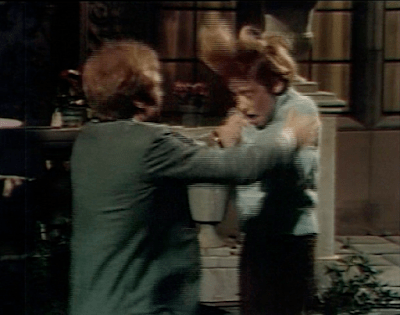
Episode 840: A man who has betrayed a friend

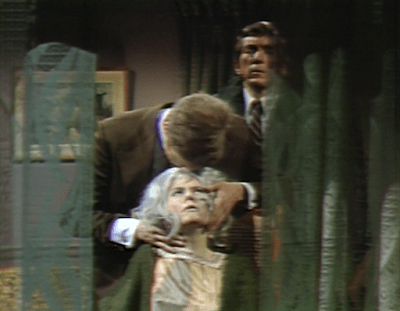
Artist Charles Delaware Tate goes to the great house of Collinwood, where he interrupts a passionate kiss between handsome rake Quentin Collins and mystery woman Amanda Harris. Quentin is getting pretty serious about Amanda. That is to say, one of his two fiancées tried to kill him the other day, so that engagement is off, leaving him with some free time.

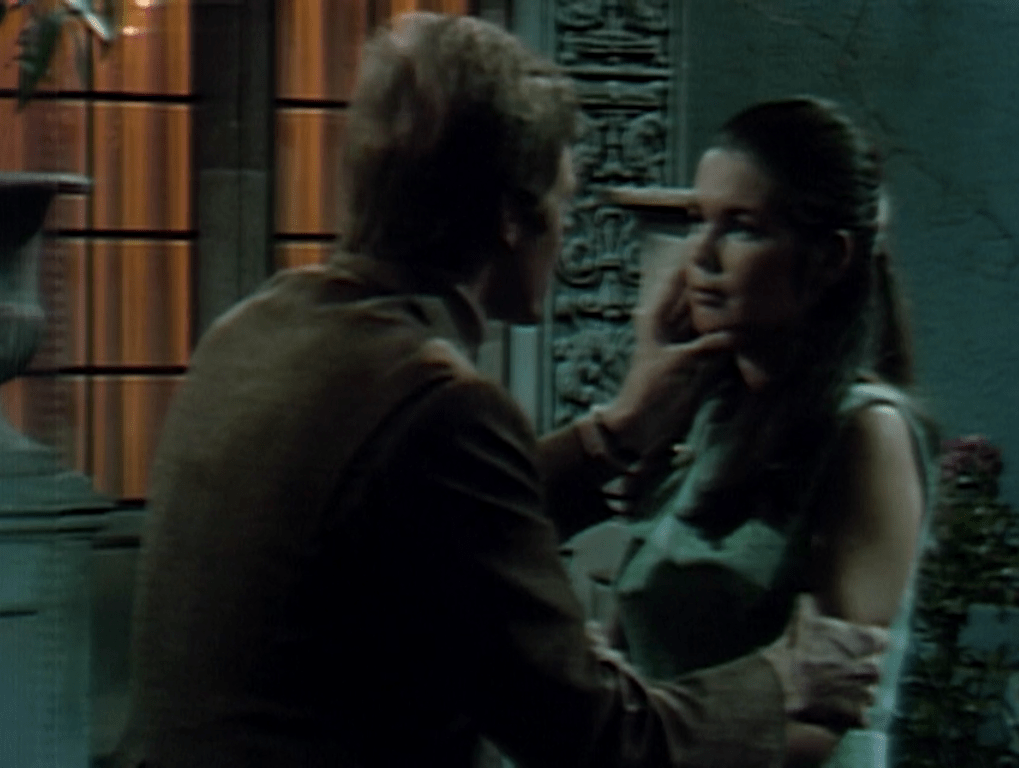
Tate has been commissioned to paint a portrait of Amanda, and he leverages that fact to bully Quentin into leaving him alone with her. Tate goes on a lunatic rant, claiming that he caused Amanda to exist by painting a picture of her two and a half years before, in the spring of 1895. As returning viewers know, this happens to be true, but it sounds preposterous and Tate has no way of getting past Amanda’s instant rejection of it. He doesn’t help his cause when he keeps pawing at her and shouting in her face.
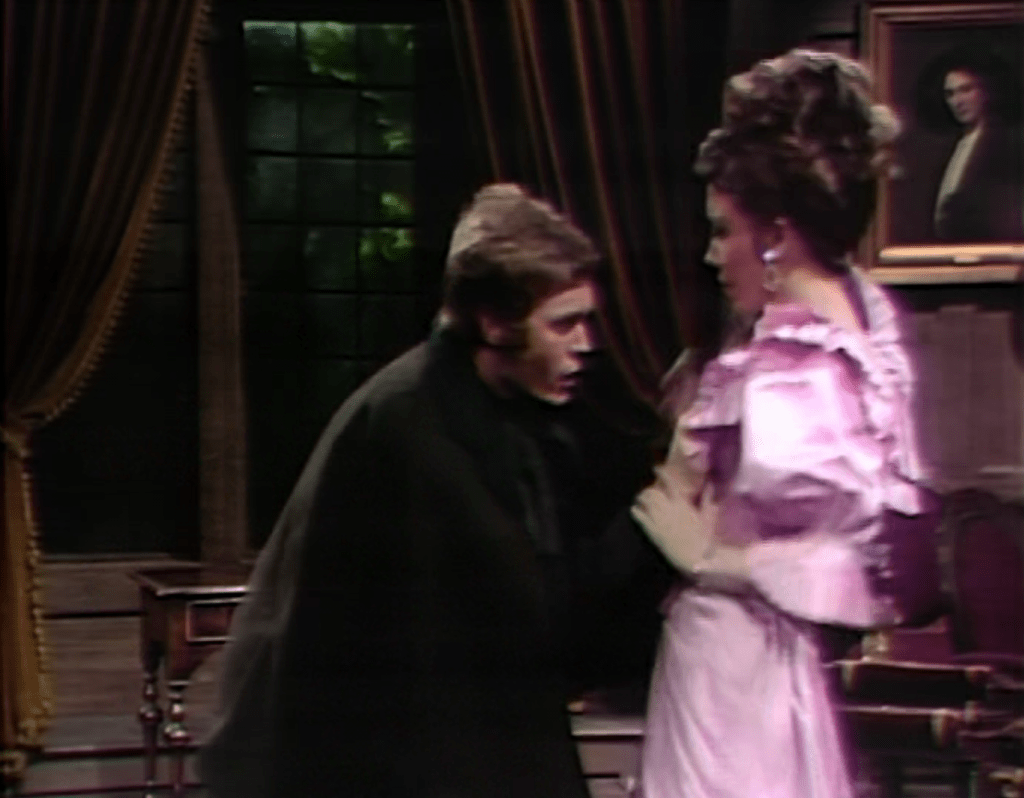
Unclear how much of the reaction is Amanda thinking Tate is a crazy man and how much of it is Donna McKechnie shocked that Roger Davis is groping her breasts on camera. Screenshot by Dark Shadows Before I Die.

Amanda runs out of the room. She passes Quentin on the staircase. He asks what Tate did to her; she refuses to talk about it and keeps running. Quentin confronts Tate, who tells him that he will know all about it soon enough, since he, like Tate, is now under the thumb of sorcerer Count Petofi.

Petofi is staying in an abandoned mill nearby. This was originally a hiding place, but virtually everyone on the show has visited him there by now. He may as well move someplace more comfortable. We saw in #813 that the Collinsport Inn already houses the restaurant which was often featured in the first year of the show, when it was set in contemporary times; if he stayed there, at least he’d be able to get something to eat.

Tate calls on Petofi at the old mill. He tests him, and finds that even though Petofi gave him his skills as an artist he does not realize that he conjured up Amanda and that he can do the same with inanimate objects. Regular viewers have already heard Petofi admit to his henchman Aristide that he does not fully understand his own magical powers, and we have seen him attempt tricks that have not worked very well. So, while Petofi is mighty indeed, his powers have some very definite limits. Perhaps Tate will draw Petofi helpless before one of his enemies.

The enemies Petofi most fears are the Rroma people, to whom he always refers as “Gypsies.” He narrowly escaped death at the hands of Rroma chieftain/ New England crime boss King Johnny Romana in #827 and #828. King Johnny had caught up to Petofi and was about to use his sacred scimitar on him when Aristide threw a knife and got him in the back. With his dying breath, King Johnny told Petofi that another Rroma would be along soon.

Petofi thinks he has hit upon the perfect means of escaping from the Rroma. He has learned that vampire Barnabas Collins traveled to 1897 from the year 1969, and now Barnabas’ friend, mad scientist Julia Hoffman, has followed him. Petofi is convinced Barnabas must have known what he was doing, and that he must have a means of returning to the future. But regular viewers know that Barnabas never knows what he is doing. He stumbled into the past while trying to do something else, and hasn’t the faintest clue how to get back to the 1960s. He has told Petofi as much, and Petofi flatly refused to believe him.

Petofi has Julia in custody. He forces her to tell him that she and Barnabas both traveled back in time using the I Ching. Barnabas cast a particular hexagram, meditated on it, and found himself in 1897. The wands were still in place some time later, and Julia meditated on them with the same result.

Petofi goes to Collinwood and visits Quentin in his room. He knows that Quentin has a set of I Ching wands, the very set Barnabas and Julia used to make their journeys, and he wants to borrow them on the assumption that while meditating on them he will be able to will himself into the 1960s.

Quentin is unhappy to see Petofi. As Tate said, Quentin is under Petofi’s control. Petofi forced him to reveal Barnabas’ hiding place; that’s how he was able to abduct Julia. Quentin rails against the injustice of all this, and declares that he won’t do any more favors for Petofi. But Petofi tells him that he is his slave now. Petofi gloats that while Quentin hasn’t always been a slave, he himself has always been a master. Quentin winds up telling him where the wands are.

Back in the old mill, Julia gives Petofi some pointers about the I Ching. She reads from the Book of Changes, and when she gets to a part that makes it clear it is not a tool that can be used to gain control of anything, he angrily orders her to stop. He casts the wands, meditates on them, and his “astral body” passes through a door. The door leads to a chamber where he sees a hand raising the scimitar King Johnny had wielded.
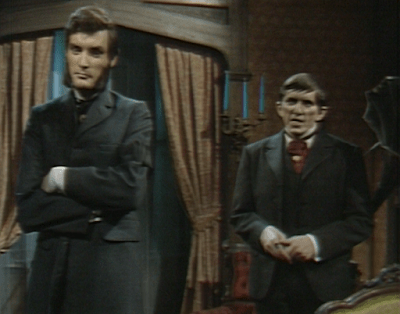
Episode 709: You are the ghost

Vampire Barnabas Collins has traveled back in time to the year 1897 where he hopes to prevent his distant cousin, libertine Quentin, from becoming a ghost who will ruin things for everyone in 1969. Barnabas knows that if events play out as they did originally, Quentin will die soon. He tells him today that it is his understanding that people become ghosts when they leave unfinished business behind them. He does not know what business Quentin originally left unfinished, or how he can keep him from dying without finishing it on this iteration of the timeline. So you might think that his first priority would be to get as close as possible to Quentin and learn as much as he can about what he wants.

Instead of doing this, Barnabas has gone out of his way to antagonize Quentin by accusing him of stealing his grandmother Edith’s will. Quentin and his siblings are all frenziedly searching for the will, but it is of no concern to Barnabas. Edith cannot possibly have left him any money, and he knows that the original timeline worked out so that the Collins family assets wound up in the hands of people who were oblivious to his sinister nature and happy to let him make his home on their estate. Showing interest in the will can do nothing but raise suspicions as to who this stranger really is and why he showed up when he did.

Barnabas confronts Quentin. Screenshot by Dark Shadows Before I Die.

Quentin did in fact steal the will. Edith’s ghost may be at work in the house- her glove mysteriously shows up in the corridor near Quentin’s room, the furniture in the room is turned upside down, and before the end of the episode Quentin alone can hear the pounding of an enormously amplified heartbeat emanating from the walls of his room. But Quentin accuses Barnabas of planting the glove and disordering his room, and in #538 we saw that Barnabas is capable of making people with guilty consciences have hallucinations of just this kind. Barnabas is also frequently seen reading, and it is certainly possible he might have read Edgar Allan Poe’s “Tell-Tale Heart” and decided to make it come to life. He may not even have needed to read the story- we saw in #442 that in 1796, early in his career as a vampire, he bricked up an enemy of his in the style Poe would describe in his 1846 story “The Cask of Amontillado.” Evidently his imagination and Poe’s ran along similar lines.

Barnabas meets governess Rachel Drummond. He is immediately attracted to Rachel, unsurprising since she is played by the lovely Kathryn Leigh Scott. He tells Rachel that she strongly resembles the portrait of Josette Collins, and he relates some facts about Josette’s life and death that did not make it into the family history. Indeed, Miss Scott played Josette in the part of Dark Shadows set in the 1790s.

Yesterday, Barnabas met unethical lawyer Evan Hanley, played by Humbert Allen Astredo. His reaction to Evan was not inappropriate, but the same reaction would also have been fitting had Barnabas thought Evan was Astredo’s previous character, warlock Nicholas Blair. This may have reminded longtime viewers of the 1790s segment, when time-traveling governess Vicki alienated the audience by time and again telling the characters that they were being played by actors who had other parts in the first 73 weeks of the show. Do the characters not look alike to Barnabas, or does he simply have the presence of mind not to waste everyone’s time with tedious drivel about who used to be who? We now know that in Rachel’s case, at least, it is the latter.

Quentin has a scene with his sister Judith in which he tells her that he did not like to play with her when they were children, because she was a “scaredy-cat.” Joan Bennett was 31 years old when David Selby was born, a fact of which the original audience would have been well aware since she was already a major star of motion pictures at the time. Indeed, her father Richard Bennett had been so big on Broadway that her birth was announced on the front pages of the New York papers, so that she never bothered to be coy about her age. But she and Mr Selby are such strong actors that it doesn’t raise an eyebrow when we hear that Judith and Quentin were children together.

Not everyone we see today merits such high praise, alas. Executive producer Dan Curtis was friendly with a man called Roger Davis, and he often let Mr Davis come on the set of Dark Shadows and assault the actors while they were trying to work. Unfortunately this happens today. Mr Davis is usually presented as if he were himself an actor playing a part. His idea of acting is simple enough. For example, he was once supposed to play a character named Jeff Clark, and his approach involved shouting “My name is Jeff Clark!” every episode or two. More recently, he was credited with a role called Ned Stuart, and he went around saying “My name is Ned Stuart!” That’s one way of attempting characterization, I suppose.

Today he is supposed to be someone named Dirk Wilkins. Regular viewers keep waiting for him to yell “My name is Dirk Wilkins!,” but he neglects to do so. He has a mustache, perhaps he thought that was sufficient. He finds Terry Crawford playing maidservant Beth Chavez, grabs her and yells in her face. Mr Selby interrupts this encounter. In character as Quentin, he makes some flip remarks and walks away, and Mr Davis resumes abusing Ms Crawford. Later he finds Ms Crawford on another set and grabs her again. Finally he walks into the set representing Quentin’s room while David Selby is trying to show us Quentin’s panicked response to the sound of the heartbeat. Mr Davis makes some nasty remarks, and when Mr Selby tries to involve him in the scene by tussling with him as Quentin might under those circumstances, it looks like Mr Davis gives him a real punch in the midsection. Mr Selby goes on acting, but the assault takes the audience out of the story. The ABC network really should have posted security guards outside the studio to keep this sort of thing from happening.

Episode 698: The kind of scene you should be avoiding

Barnabas Collins, old world gentleman extraordinaire, and Julia Hoffman, MD, are helping mysterious drifter Chris Jennings cover up the fact that he is a werewolf, responsible for a great many violent deaths. Lately Chris has started transforming into his lupine shape even on nights when the moon is not full, and this morning they find that he has not changed back even after dawn.

As if that did not present enough difficulty to Julia and Barnabas, one of Chris’ surviving victims is in town. She is his onetime fiancée, Sabrina Stuart. Two years ago, Sabrina saw Chris as the werewolf. She hasn’t told anyone about him, because she hasn’t been able to speak since. Her hair turned white, her skin turned pale, and she has been nearly catatonic.

Others have encountered the werewolf, and none has had this reaction. It’s true that Chris’ cousin Joe had to be taken to a mental hospital after he saw the transformation, but Joe had just been through a very long train of supernaturally induced traumas that had shattered his sensibilities and taken away everything he cared about. Seeing Chris change was just the last step in that process. Sabrina, as we see in a flashback segment today, was fine until she encountered Chris as the werewolf, and she didn’t even see the transformation itself. Yet here she is two years later, unspeaking, immobilized, and wearing the same makeup that Eli Wallach wore as Mr Freeze in the 1960s Batman TV show.

In a comment on Danny Horn’s post about this episode at Dark Shadows Every Day, “Cole” speculates that the show might have meant to tell us that the real reason Sabrina’s condition is less to do with what happened that on night in Chris’ apartment than with her brother and sole caretaker, Ned, played by Roger Davis:

I am once more getting through the Ned/Sabrina scenes thanks to this blog and the comments here; and although I still have to frequently avert my eyes from the screen to hold back the nausea, I keep concentrating on the dialogue while speculating further on JRM’s theory.

It does seem that we– and Julia– might be meant to feel especially concerned by Ned’s refusal to even consider allowing Sabrina to stay at Windcliff. He even says (or, rather, since it is Roger Davis, he SCREAMS), ​”I won’t be separated from her!”

I don’t think his character is meant to be overly suspicious of Julia and Barnabas so the vehemence behind his already rather alarming declaration becomes more baffling unless the viewer concludes he has … extremely unnatural feelings of possessiveness towards sad, PTSD-afflicted Sabrina.

It is almost half as frustrating as it is disturbing because, with any other actors, we would surely know for certain how to interpret these scenes.

We would perhaps recognize that when Sabrina stares pleadingly at Julia once Ned leaves the room, that her muteness is caused as much by her horror at being an ongoing victim of her brother’s unspeakable abuse as by having once witnessed Chris’s transformation into a werewolf. We wouldn’t wonder, instead if the actress, Lisa Richards, is actually pleading with Hall to help her endure Davis’s deliberate act of molesting and assaulting her through out these scenes.

If it wasn’t Roger Davis in this role, we would know who Ned is really meant to be since there is no way any of the other regular male cast members would willingly subject their costars to type of abuse Davis is inflicting on Richards.

If it were … say, Jerry Lacy who was currently playing “Ned Stuart” in a manner even remotely similar to Roger Davis’s ‘interpretation’ of the role, we would recognize at once that the character of Ned is obviously scripted to be an incestuous rapist (and I am sure Lacy would still keep his hands professionally and respectfully away from Lisa Richards’s/”Sabrina’s” breasts, instead using actual acting techniques to portray his character’s warped nature). But with Davis ..

It really could be, as Mary commented below, that he is trying to get the poor actress to break character. And how could we expect other than that he would use his usual disgusting and violent Drumph-like/”‘you can grab them by the pussy” sense of Curtis-granted entitlement to assault her as “Ned,” regardless of the intent of the writer and director.

Either way, what a horrifically mistaken choice in casting.

Lisa Richards: fifty years later, I am thinking of you and hoping you weren’t forced to endure PTSD after filming these scenes with Davis.

Comment left 29 August 2021 by “Cole” on “Episode 698: Sister Act,” Dark Shadows Every Day, Danny Horn, 8 August 2015

When I mentally recast the many parts Roger Davis played on Dark Shadows, I divide them between two men who were background players in the show’s first months. I imagine Fredric Forrest playing the two characters with aliases, Peter Bradford (a.k.a. Jeff Clark) and Charles Delaware Tate (a.k.a. Harrison Monroe.) Forrest excelled both as a quietly intense man under pressure and as a sweet, goofy, overgrown kid. In the hands of an actor who, unlike Mr Davis, could project those qualities, those two unloved characters might both have become fan favorites. His other two parts, Ned Stuart and Dirk Wilkins, would have been perfect for Harvey Keitel, who is unsurpassed as a man who is agitated by a deep anger that he himself barely understands and that he certainly cannot explain to anyone else. Not that it’s any secret why Ned is angry at Chris, but when he takes a break from pawing at Sabrina’s face and breasts he handles her so roughly that he is obviously angry with her, and that is something he isn’t going to be giving any thought.

Mr Davis’ behavior wasn’t much better in episodes directed by Lela Swift and others, but it is little surprise director Henry Kaplan didn’t rein him in. Kaplan directed with a conductor’s baton, and actresses complain that he would jab them with it. When the person in charge has that light a regard for women’s personal space, it’s no wonder a creep like Mr Davis felt free to rub himself all over Ms Richards.

Episode 697: He was so cold and evil, he touched me.

Chris Jennings is a werewolf, a fact which old world gentleman Barnabas Collins is helping him conceal. Two years ago, Chris’ fiancée Sabrina Stuart chanced to see him transform; she hasn’t been able to speak since. Her hair turned white, and she is in a nearly catatonic state. Sabrina’s brother, a very loud man named Ned, has brought her to the village of Collinsport and keeps demanding that Chris visit them and explain what happened.

There is a full moon tonight, so Barnabas has sealed Chris up in the secret chamber hidden in the old Collins family mausoleum. He tells Chris that he will try to persuade the Stuarts to leave town and forget about him. Chris tells him that is impossible; Barnabas seems to believe he can pull it off.

In the Stuarts’ suite at the Collinsport Inn, Barnabas tells Ned that he is harming Sabrina by taking her along on his mission to confront Chris and that he ought to take her home and move on with his life. Preposterous as this is, Ned makes it seem credible. To be more precise, it is actor Roger Davis who makes it seem credible. He rubs himself all over Lisa Blake Richards’ scalp, face, and chest while she is required to remain motionless. To the extent that we accept them as their characters, we are forced to think of Ned as a caretaker who abuses his disabled sister sexually; to the extent that we recognize Mr Davis’ behavior as typical of his previous performances on Dark Shadows, we wonder how bad things were for women in show business in the late 1960s that Miss Richards didn’t contact the union and bring him up on charges. It isn’t every performer who can make an audience sympathize with an ex-vampire’s attempt to keep a woman in a comatose state lest she endanger his werewolf buddy, but you can always trust Mr Davis to enlist the viewers’ support for any plot development that will get him off the screen.

I wonder how much of that look is Barnabas reacting to Ned’s story and how much is Jonathan Frid wondering if he should stop tape and call Equity. Screenshot by Dark Shadows Before I Die.

There are also some indications that the show is firming up some of its world-building. For the first time, we hear the name “Edward Collins” as the grandfather of the senior generation now resident at the great house of Collinwood. We hear that Edward was the father of Jamison Collins and the brother of Quentin Collins. Quentin was first mentioned months ago as Jamison’s uncle, but on Friday Barnabas had a line identifying him as his brother, suggesting some behind-the-scenes wavering about this point. Quentin’s ghost is the chief villain in the current A story, and we heard several weeks ago that he wants to turn strange and troubled boy David Collins into a replica of Jamison, so these relationships are important to the action.

Longtime viewers will have fond memories when stuffy Roger Collins sees a book open by itself on the table in the drawing room of the great house. The same book opened itself on the same table in #52, one of the first unmistakable signs that ghosts were at work. No one but the audience was around to see that, but when it happened again in #182, Roger was there. It jolted him out of his refusal to face the facts about the supernatural menace operating at that time.

Episode 688: Why have you come back?

Actor Roger Davis rejoined the cast yesterday, after an absence of not nearly long enough. He has an interminable scene with Grayson Hall and Jonathan Frid, during which he thrusts his arm onto the mantel immediately behind Hall, effectively putting his arm around her shoulders. She visibly flinches at this invasion of her personal space. When he exits she sighs “Oh, I thought we’d never get rid of him.” Frid says that he thought the same thing. They then get back into character and play out the scene in the script.

Roger Davis imposes himself on Grayson Hall and Jonathan Frid.

Later, Kathryn Leigh Scott is on a set representing the woods, and she sees Mr Davis. She reacts with a shout of “Don’t come near me! Stay where you are!” When she demands to know “Why have you come back?,” he reminds her that the camera is on and he is playing a character named “Ned Stuart.” She goes into character and says her lines, keeping as much distance from him as the 4:3 aspect ratio of 1960s US television would allow.

The parts of the episode that are not ruined by Mr Davis’ odious presence tell a story about ghosts and werewolves. Frid and Hall play Barnabas Collins and Julia Hoffman, friends of werewolf Chris Jennings. The other day Barnabas and Chris dug up an unmarked grave and found that it contained the remains of a baby wearing an apotropaic device meant to ward off werewolves. We saw the ghost of Quentin Collins watching as they did so, a sad look on his face. Later, we learned that Quentin paid for the apotropaic device, proving that there was a werewolf in the area when he was alive and that he had some connection with the baby.

Strange and troubled boy David Collins is under Quentin’s influence. After Quentin imposes himself on him, David writes a story about a werewolf who tried to keep from hurting anyone by locking himself in a room, but who was let out of that room and killed by a hunter. Barnabas has indeed locked Chris in the secret room of the old Collins family mausoleum.

Julia finds the story and shows it to Barnabas. They fear that David has somehow learned of Chris’ secret. As Barnabas and Julia are aware, David is one of the few people who know about the secret room. And indeed, at the end of the episode, we see him about to open the panel that leads to it.

But that may not be the story’s whole meaning. Regular viewers know something that Julia and Barnabas do not. David and his friend, Chris’ nine year old sister Amy, first came into contact with Quentin when they made their way into a room hidden behind a wall in the long-deserted west wing of Collinwood. They found a decayed skeleton seated in a chair there, wearing Quentin’s clothes. Evidently Quentin was locked in that hidden room, and Amy and David let him out. Perhaps the story David wrote is a suggestion that Quentin was a werewolf, and that by letting him out he and Amy exposed him to hunters.

Episode 622: A position to help each other

Well-meaning governess Vicki is on the terrace of the great estate of Collinwood. A man known variously as Peter and Jeff keeps clutching at Vicki’s arms so sharply that her biceps pulse, then holds her with one hand and paws her with the other as she stands rigidly still. First time viewers, knowing only that Dark Shadows features stories of monsters and crime, would think that the man had some power over the woman and that they were seeing him abuse that power. They would be right. Unfortunately, the man and woman are not Peter/ Jeff and Vicki, but actors Roger Davis and Alexandra Moltke Isles. Vicki is supposed to be in love with Peter/ Jeff and reluctant to part from him, but the instant she has spoken her last line she turns her face from him and runs away, without the slightest attempt to suggest that she wants to linger.

Roger Davis has his fun.

After Vicki escapes from Peter/ Jeff’s repellent attentions, a woman named Eve emerges from the bushes. Peter/ Jeff is angry with her. He grabs her roughly and throws her out of the frame. Peter/ Jeff then stalks off. Eve comes back into the frame. It’s a relief to see her upright and well-put-together- Mr Davis shoved Marie Wallace so hard she had to struggle to right herself as she spun out of view. It looked like she might have slammed her head against the floor.

Marie Wallace using her arm to regain her balance and keep from sustaining a serious injury.

In a comment on Danny Horn’s post about this episode on his blog Dark Shadows Every Day, Marc Masse reports what happened when this scene came up at a panel discussion at a Dark Shadows convention many years later:

This was the episode where Grabby Davis got so overly excited in his scene with Marie Wallace on the terrace that he grabbed her by the arms and threw her completely out of frame. You see her struggling to remain on her feet as she stumbles off to the right. Some 20 years later at a fan convention (it’s in Dark Shadows 25th Anniversary Special from the disc set that has the last episode of the series), Marie Wallace brought this up as Roger Davis was telling the audience of how they (or rather he) would cut up and laugh and have fun while they were making the episode, and of how they would just laugh off their flubs. Wallace then broke in to remind Davis of episode 622 as she recalled, “Hey, Roger? I didn’t laugh when you threw me out of frame in that scene, on camera. Remember that? Several times?” She explained to the audience how all during dress rehearsal he’d never touch her and then when he’d done it on camera he’d come up to her and apologize profusely, but Wallace told him then and there at the convention that she never believed him.

Marc Masse, as “Prisoner of the Night,” in a comment left 8 April 2015 on “Episode 622: Heated Conversations on Somebody Else’s Lawn,” Danny Horn, Dark Shadows Every Day, 8 April 2015.

In a response to another post of Danny’s, Marc added that in the same video you can see actress Donna Wandrey’s appalled reaction to Mr Davis’ statement, and her increasingly visible disdain for him as Miss Wallace makes her case against him.

After Peter/ Jeff is gone, another visitor comes and addresses Eve by name. She is Angelique. Angelique is not a Roger Davis character, she is merely a vampire, so everyone can relax.

Regular viewers have been wondering what would happen when Angelique shared a scene with Eve. Marie Wallace’s style as Eve relies on many of the same techniques Lara Parker uses as Angelique. Both use an elevated style with many catches of breath, changes of volume in mid-sentence, and striking of oratorical poses. Each was capable of making this exaggerated method work, but no one could conceal its profound silliness, and a scene consisting of two characters both using it would be too ridiculous even to make a good joke in a cartoon. What actually happens is that Parker demonstrates the quietest possible version of the style, while Miss Wallace shows a more typically brassy version. Recognizing their approaches as two poles of the same axis, we are not only interested in their encounter, but also in what they show us about the craft of acting.

Angelique persuades Eve to join her in an alliance against warlock Nicholas. This might be an exciting development. Nicholas is the show’s chief villain at the moment, and between them Angelique and Eve just might be able to bring him down. It is also the first alliance we have seen take shape in a long time. Many characters have tried to control other characters, to deceive them, to imprison them, to enslave them, to brain-wash them. But the only group working towards a common end is made up of old world gentleman Barnabas, mad scientist Julia, occult expert Stokes, and servant Willie. That team formed long ago, has not managed to get anywhere lately, and is, at the moment, immobilized by Barnabas’ absence. Yesterday Julia tried to form an alliance with Nicholas against Angelique, but at the last minute his inability to talk with her forthrightly aborted that effort. So it is refreshing to see that the show is still capable of imagining a new alliance.

Danny’s post about this one is one of his very best, a composition in free verse weaving together quotes from the dialogue with retellings of the overarching narrative with meditations on a number of topics that the episode touches on. If you are a Dark Shadows fan and haven’t read Dark Shadows Every Day, this is a fine post to start with. It’s like a song- you may not understand all the lyrics the first time you hear it, but the sound of it will carry you along.

The comments below it include some great stuff too. I’ve already mentioned Marc Masse’s remark about Marie Wallace’s confrontation with Roger Davis. There are also two fanfic ideas about how the show might have resolved the question of who Vicki’s parents were. Someone posting under the name “William” had this plausible one:

My own theory: Victoria the daughter of Jamison Collins and Betty Hanscomb. So she’s Roger and Liz’s half-sister. Liz knows and Roger doesn’t.

Jamison aggressively seduces Betty, on whom Roger had teenage crush. He makes her pregnant and then coldly casts her out. A pregnant Betty shows up at Collinwood and tells Liz and Roger about what happened.

Roger confronts his father in a fit of rage in the Tower Room during one of Collinwood’s famous storms.

Jamison Collins has a heart attack during the confrontation, and Roger leaves him in the room to die. Roger staggers out, and Liz finds her father dead.

Roger has a complete breakdown and is sent to Windcliff, where Dr. Julius Hoffman, uncle of Julia Hoffman, wipes out his memory of that night in the summer of 1946.

Liz, with the help of new guy in town Paul Stoddard, pays off Betty Hanscomb to leave town and arranges for her half-sister to be raised at the foundling home in New York. Grateful to Paul for his help, Liz starts to fall for his charms …

(And this is why Liz is so fond of Victoria, but not like she is with Carolyn. And this is why she refuses to tell Roger anything about why she brought Victoria back).

–“William,” in a comment left 22 August 2016 on “Episode 622: Heated Conversations on Somebody Else’s Lawn,” Danny Horn, Dark Shadows Every Day, 8 April 2015.

That has a lot of potential. Liz doesn’t seem ever to have loved Paul, she did marry him shortly after her father’s death, and Roger’s attitude towards Vicki in the first months of the show was a strange mixture of extreme hostility and obvious attraction. “William’s” story would account for all of those things. But it doesn’t hold a pale blue candle to this theory posted by Pedro Cabezuelo:

Everybody, we’re missing the obvious! Vicki IS Betty Hanscombe!!!!! Somehow she managed to time travel AGAIN and ended up in Collinsport circa the 1940s and adopted the Betty Hanscombe identity, working her way as a servant at Collinwood. She had an affair with Paul Stoddard, gave birth to herself (at which point the adult Vicki ceased to exist) and THAT’S what caused all the irreperable harm to the time stream/parallel time/anything else you want to blame on Vicki.

Pedro Cabezuelo, in a comment left 10 April 2015 on “Episode 622: Heated Conversations on Somebody Else’s Lawn, Danny Horn, Dark Shadows Every Day, 8 April 2015.

I have my own fanfic idea about Vicki’s origin. I’ve shared it here before, and will again. But Pedro’s is so good I want it to be the last word today.

Episode 609: For want of a fig leaf

Adam and Eve are discussing the Fall, comparing their incomplete memories of what came before it. This is not a flashback. The Adam and Eve we see today are Frankenstein’s monsters, and they do not live in exile from Eden when the world was young, but in the town of Collinsport, Maine in 1968. The Fall they have in mind is the one that is also known as Autumn. Adam is ashamed, not because he is naked, but because Eve accuses him of preferring life in captivity. He is not naked at all, even though Eve walks in on him and sees his Harry Johnson. Harry Johnson is the man to whom Adam has entrusted a letter, but since Adam’s favorite pastime is studying the works of Sigmund Freud, and since by 1968 “johnson” had been a familiar English slang word for “penis” for over a century, he would likely have been the first to make the connection to the predicament of their Biblical namesakes.

Adam takes Eve to his old home, a dusty room in the long-deserted west wing of the great house of Collinwood. Heiress Carolyn hid him there for a period that seemed so long the audience might feel that the original Adam and Eve were probably still around when it started. Carolyn greets them there. She is happy to see Adam again and eager to befriend Eve. Adam wants that too, but Eve isn’t having it. She quarrels with Adam and storms out, leaving Carolyn in an awkward position.

On the terrace outside the great house, an unpleasant man named Peter who prefers to be called Jeff is waiting for his date, well-meaning governess Vicki. Vicki has kept him waiting for an hour. Vicki’s charge, young David, happens by. Peter/ Jeff immediately makes it clear why Vicki is in no hurry to see him. He greets David with an accusation that he was hiding from him. When David denies this, Peter/ Jeff demands that he tell him who he was hiding from. Peter/ Jeff may have forgotten who is a guest in whose house, but David hasn’t, and he turns to go. Peter/ Jeff stops him, asking “We’re friends, aren’t we?” David doesn’t explicitly agree that they are, but he stays.

Peter/ Jeff starts to talk about his plans to marry Vicki. David calls him “Peter,” and since the closest thing he has to a personality is his insistence on being called “Jeff” he grabs David and shakes him violently. Watching this scene today, my wife, Mrs Acilius, said one word- “Psycho.” She wasn’t talking about Peter/ Jeff, but about actor Roger Davis. When one character shakes another, it is usually the actor playing the shakee who makes all the movements, while the shaker just mimes the action without actually touching them. Not so Mr Davis- he really did rattle David Henesy around hard enough that it’s pure luck he didn’t give him a concussion. That’s typical of the approach Mr Davis took to his performances on Dark Shadows, in the course of which he assaulted several women on camera. Mr Henesy is uncharacteristically tense throughout this scene, does not sustain eye contact with Mr Davis, and when the scene ends he rushes off stage.

Roger Davis has his fun. Screenshot by Dark Shadows Before I Die.

In his dialogue, Peter/ Jeff makes some pretty bizarre remarks:

You know, David, pretty soon, you’re gonna find out that love isn’t something you can remember. Sixteen years old… You know when you’re sixteen, you can really love somebody. And then you come back ten years later and you wouldn’t even notice her.

At this, David gives Peter/ Jeff a look that accords with Mrs Acilius’ one word assessment of Roger Davis. “Love isn’t something you can remember”? Which item on the sociopathy screening test is that? And what does “Sixteen years old” have to do with anything? David is twelve, Peter/ Jeff and Vicki are in their twenties, no one mentioned the number sixteen. And David would be doing Vicki a solid if he told her that her fiancé won’t remember her in ten years.

David Collins wonders what the #%*^ is wrong with Peter/ Jeff, while David Henesy recovers from Roger Davis’ assault on him. Screenshot by Dark Shadows Before I Die.

David leaves, and Eve shows up. She recognizes Peter/ Jeff and addresses him as “Peter Bradford!” The closing credits start rolling before Peter/ Jeff can shake her violently while whining that he wants to be called “Jeff Clark.” Eve is the reincarnation of an eighteenth century homicidal maniac; she hasn’t killed anyone since she was brought to life the other day, and Peter/ Jeff would be an excellent choice for her first victim. If she does kill him, I would be “Team Eve” all the way.

Episode 437: It’s gone on too long

Bewildered time traveler Vicki tells her lawyer/ gaoler/ boyfriend/ accomplice/ therapist/ assailant Peter that her time in the late eighteenth century seems like a nightmare. She then does something she often did in the early months of Dark Shadows, reminiscing about her childhood as an inmate of the farcically horrible Hammond Foundling Home. She says that she had so many nightmares when she was there that she became a connoisseur of nightmares. When she realized she was having a bad dream, she would choose to remain asleep right up to the moment she was about to be killed so that she could see how the whole thing would play out. I suppose that might have been useful training for a career as a character in a horror story, but if so Vicki has not benefited from it. She’s done nothing but make matters worse for herself since she arrived in the year 1795, and she is now in her last day as the defendant in a witchcraft trial which has been going very badly for her.

During this scene, Vicki gets very upset. Peter demands that she calm down and slaps her in the face when she doesn’t. That was a time-honored form of treatment for anxiety in fiction back then. It’s always gross to see, but is especially bad when the actor administering the slap is Roger Davis. Mr Davis was, shall we say, uninhibited in his physicality when dealing with his female scene partners. In his post about the episode on Dark Shadows Every Day, Danny Horn includes screenshots of 10 distinct moments in this episode when Mr Davis aggressively rubs himself all over Alexandra Moltke Isles. Later in the series, he would, in separate incidents, hurt both Terrayne Crawford and Joan Bennett while on camera. His fake slap does not make contact with Mrs Isles today, but his sense of personal boundaries is so severely underdeveloped that we can hardly blame her for visibly ducking to avoid his hand.

Seriously, who needs that guy? Screenshot by Dark Shadows Before I Die.

Vicki takes the stand and says that she is a native of the twentieth century, whisked back in time by what force she knows not. Cross-examined by visiting witchfinder/ fanatical bigot/ prosecuting attorney Rev’d Trask, Vicki admits that her last memory of 1967 was when she was at a séance, and that this was not the first séance she had taken part in. Trask declares that this is an admission of witchcraft, which, if you think about it, it is. Vicki becomes upset, and we cut directly to a commercial break without a musical sting. This is a technique the show very rarely uses, and it is always effective when it does.

One of the witnesses against Vicki, untrustworthy naval officer Nathan, has a scene alone with Trask while they are waiting for the verdict. Nathan tells Trask he never thought he would meet a preacher whose specialty was blackmail. Trask denies that he blackmailed Nathan into testifying against Vicki. He has a point- it was more a matter of extortion, followed up with bribery. Anyway, actors Jerry Lacy and Joel Crothers were sensational together. Mr Lacy is exciting to watch when he’s wound up tight, the usual condition of a character on Dark Shadows, and Crothers always moved loosely and fluidly. The two of them strike an ideal balance.

The episode ends with the judges finding Vicki guilty and sentencing her to hang by the neck until dead. If we take her recollection of her childhood nightmares as a programmatic statement, we should expect her to mount the gallows and stick her head in the noose, then immediately find herself back at the séance.