The late Dr Eric Lang built a Frankenstein’s monster with the intention of draining the “life force” from recovering vampire Barnabas Collins into it. Wicked witch Angelique turned Barnabas into a vampire in the first place, and has returned to the scene to thwart this experiment and make Barnabas once more an undead abomination preying upon the living. Angelique struck Lang dead with one spell, and with another has started a “Dream Curse” that has for the moment compromised the ability of the senior mad scientist in town, Barnabas’ best friend Julia Hoffman, to pick up where Lang left off.
In Lang’s laboratory, Julia and Barnabas recap the plot. Under the stress of the Dream Curse, Julia is having trouble controlling her emotions. At one point she refers to her crush on Barnabas. Every time she has mentioned this before, Barnabas has been a huge jerk about it, ridiculing her and reminding him of the crimes they have committed together, including murder. This time, he is warm and kindly. His non-obnoxious response marks a significant change in their relationship.
Lang left an audio message for Julia on his tape recorder. He said that if she does the experiment and Barnabas and the Frankenstein’s monster, whose name is Adam, both live, neither Barnabas nor Adam will be a vampire. But if Adam dies, Barnabas will revert. His recovery is already hanging by a thread, as he feels ever stronger cravings for blood.
Julia and Barnabas play the tape today, but leave the room before it gets to the part with the message. Lang’s voice plays to an empty set. Addison Powell didn’t do a very good job playing Lang on screen, and he’s no better as a voice actor. Powell appeared in a number of feature films, including hits like The Thomas Crown Affair and Three Days of the Condor, but is best remembered for a series of commercials he did in the 1980s as “The Gorton’s Fisherman.” I remember those spots- I thought he was an actual fisherman they’d hired to read copy. Usually I’m uneasy with the idea of taking a job away from an actor, since I know lots of very talented people who have spent years training in that craft, never to make a living at it. But Powell was so bad I wish my original impression had been correct.
Julia has reached out to Professor Timothy Eliot Stokes, a scholar of the occult, for help with the Dream Curse. When she met with him yesterday, she did not identify Angelique as the witch. She couldn’t tell him anything about the experiment or about Barnabas’ vampirism without confessing to her many crimes. Today, Stokes is trying to fill in the blanks Julia left so that he can help to oppose the Dream Curse. He calls on Barnabas at Lang’s house. He breaks down Barnabas’ resistance and learns that the witch is Angelique, whom he knows under her alias of Cassandra Blair Collins.
Stokes next calls on Maggie Evans, The Nicest Girl in Town, at her house. Maggie was the first person to have the dream, and she gives Stokes a detailed description of it. This gives Kathryn Leigh Scott an opportunity to look into the camera and emote, which is always worth seeing.
There are a lot of shots today using mirrors. In their post on Dark Shadows Before I Die, John and Christine Scoleri include several screenshots of these and of ambitious camera angles from other episodes.
Mad scientists Julia Hoffman (Grayson Hall) and Eric Lang (Addison Powell) are conferring in Lang’s lab. Lang is putting the finishing touches on a Frankenstein’s monster into which he plans to transfer the “life force” of recovering vampire Barnabas Collins. Julia, Barnabas’ best friend, has been opposed to this experiment, but now has accepted that she can’t stop Barnabas and Lang from going through with it. She volunteers to assist.
Lang is having trouble concentrating because of a nightmare he had last night. Unknown to him, the nightmare was part of the Dream Curse, a dead end storyline about wicked witch Angelique sending a dream that each of a series of people will have. When the last person has the dream, Barnabas is supposed to revert to full-on vampirism.
Lang tells Julia about his nightmare. He says that she was in it. When he tells her that she did not speak, she smiles comfortably and says that that was proof that it was a dream. This is not only a genuinely funny line as Grayson Hall delivers it, but it is an extraordinary moment of self-awareness from Julia, a character who usually exists at the outer edge of heightened melodrama. It’s a shame that Addison Powell doesn’t know how to get out of Hall’s way for the half second it would take for it really to land with the audience.
Barnabas and his ex-blood thrall Willie are at home in the Old House on the great estate of Collinwood. Willie is smirking and Barnabas is rigid with embarrassment while the dogs howl outdoors. Willie laughs a little as he makes a remark about how Barnabas hasn’t changed as much as he thought he had. This exchange reminds us of the moment in #346 when Julia and well-meaning governess Vicki noticed that some fresh flowers Barnabas touched had died and shriveled up. Like the howling of the dogs when Barnabas feels bloodlust, the shriveling of the flowers was a consequence of his vampirism, effectively a bodily function that he cannot control. He squirmed when Julia and Vicki looked at him then, and he is stiff and flustered when Willie laughs at him now.
Barnabas orders Willie to take a letter to matriarch Liz at the great house on the estate. It will explain that he is going away on a long trip, and that Adam Collins, a young cousin from England, will be coming to stay in the Old House. Willie is alarmed by this.
Willie asks what Barnabas will do if Liz won’t let him stay in the Old House when he is in the form of Adam. Barnabas is sure she will, and dismisses Willie’s doubts. This is an interesting sequence to regular viewers. The show has never made it clear whether Liz still owns the house or has signed it over to Barnabas. A whole year ago, in #223, Liz was talking to strange and troubled boy David as if the Old House and its contents were Barnabas’ legal property. Since then, there have been moments that tend to confirm that impression, as when Barnabas takes Liz’ keys to the house away from David and does not give them back to her, and other moments that conflict with it. Willie’s question and Barnabas’ response would seem to prove that the house still belongs to Liz.
Another question we might ask is why Barnabas doesn’t go to Liz himself. Certainly she will be unhappy that he went away without saying goodbye to her. Moreover, when he showed up at the great house in April 1967, Barnabas told Liz that he was the only survivor of the English branch of the family. Liz will be skeptical if another member of this imaginary branch presents himself and expects to take possession of a big mansion on her property. She has had unpleasant experiences with Willie, so much so that a letter he delivers seems unlikely to allay that skepticism.
When Willie gets to the great house, Angelique herself opens the door. She is living there under the name Cassandra. She has cast a spell on Liz’ brother, sarcastic dandy Roger, and married him so that she will have a residence at Collinwood while she works to restore Barnabas’ curse to its full potency. Showing his typical degree of strategic ability, Barnabas has not bothered to tell Willie about any of this.
Angelique/ Cassandra ushers Willie into the drawing room, sits him down, and chats with him. Willie answers her questions about Barnabas, not realizing that he has any more reason to be discreet with her than with anyone else. He tells her that Barnabas has been spending his days with Lang. Angelique/ Cassandra already knows that it was Lang who gave Barnabas the treatments that put his vampirism into remission and that Lang is preparing further treatments for him. Barnabas should know that she knows this, since she went to Lang’s house and tried to kill him. Willie also tells her that sometimes Barnabas doesn’t seem to have changed as much as you might expect. Angelique/ Cassandra’s reaction makes it clear this is new information to her, and that it might help her in her efforts.
The scene raises yet another question. Barnabas had expressed the hope that once the experiment was complete, Angelique would see that his old body was dead, would assume that meant that he no longer existed in any form, and that she would then go away and leave him alone. But he knows that she knows about Lang, and now he is planning to come back to Collinwood, where she lives, as another “cousin from England.” The question is this- how dumb does Barnabas think Angelique is?
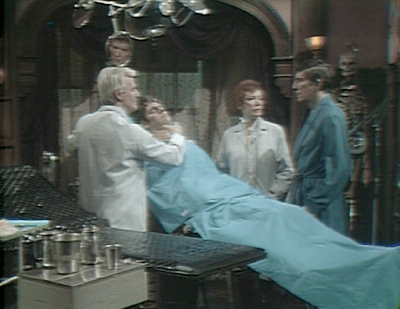
Back in the lab, Lang and Julia are preparing for the experiment. Barnabas shows up. When he talks with the doctors, his face is reflected in the mirror above Lang’s creature. Not only does this suggest the idea of his personality moving into the creature’s body, it also reminds us that until Lang gave him his first course of treatment, Barnabas did not cast a reflection. The whole idea of Barnabas’ reflection will remind longtime viewers of #288, when Julia first confirmed her suspicion that Barnabas was a vampire by peeking at the mirror in her compact and not seeing him. That draws a contrast between Lang, whose initial success with Barnabas appears to be leading to disaster because his impersonal, hyper-masculine approach leaves him unable to recognize the threat Angelique poses, and Julia, whose own attempts to cure Barnabas of vampirism did not match Lang’s spectacular results, but whose femininity, as symbolized by the compact, represents a fighting chance against the forces that really govern this universe.
Barnabas takes his place on a bed. He tells Julia he is glad she is with him, and she smiles at him with the sad tenderness of someone saying a final farewell to a loved one. As with her self-deprecating joke in the opening part of the episode, this smile shows a new side of Julia. For a time in October 1967 she tried to launch a romance with Barnabas, and he rejected her. Hall played Julia’s unrequited love in the same larger-than-life style that the rest of her action called for. Her feelings seemed to be an outgrowth of despair- she was by that point so deeply entangled with Barnabas that there was little hope she could ever make a life with anyone else, so even though he was an active vampire, she had little to lose by committing herself to him. But this sweet little exchange is played so gently that it opens a window on a more complex inner life for Julia.
As Lang starts the experiment, we cut to Angelique in the drawing room at Collinwood. She is talking to a clay figure, calling it “Dr Lang,” and saying that it cannot overcome her powers, for they were a gift to her from the Devil himself. She jabs at the clay figure. In the lab, Lang writhes in pain, interrupting the experiment.
It was not until #450 that Dark Shadows let on that there might be anything to Christianity. In that episode, good witch Bathia Mapes held Barnabas at bay by showing him a cross. Up to that point, Barnabas had many times strolled comfortably through the old cemetery north of town, where half the grave markers are in the shape of the cross, and they hadn’t bothered him a bit. The only representatives of the faith who figured in the story were repressed spinster Abigail Collins and fanatical witchfinder the Rev’d Mr Trask, both of whom were fools whom Angelique easily twisted to her own purposes. Now we have a character named Adam, a New Adam through whom a resurrection is supposed to take place, and he is wearing a headpiece that is photographed to look like a crown of thorns. Angelique’s reference to the Devil suggests that she can be defeated only through the aid of a being more powerful than the Devil, and since we haven’t heard about Ahura-Mazda or any other non-Christian deities who represented a supreme principle of good pitted against an otherwise irresistible evil, it looks like we’re drifting Jesus-ward.
It is daring to take that direction, even if it is only for a little bit. Vampire legends are pretty obviously an inversion of the Christian story, in which a man comes back from the dead, not having destroyed the power of death once and for all, but only to die again every time the sun rises. While Jesus feeds us with his body and blood in the Eucharist and thereby invites us to share in his eternal life, the vampire feeds himself on our blood and thereby subjects us to his endlessly repeated death. That’s why Bram Stoker’s Dracula has all those crosses and communion wafers, because it is a religious story of the triumph of the promise of resurrection in Christ over the parody of that resurrection that the vampire has settled for. It also explains why Dark Shadows so studiously avoided Christian imagery for so long. Christianity is such a powerful part of the culture that once you let any of it in, it tends to take over the whole story.
There are many reasons the makers of the show would want to avoid that fate. Not least is the tendency of religions to fracture and stories based on their teachings to become sectarian. Dracula itself is an example of that; the vampire is a Hungarian nobleman from Transylvania, connected with the Szekely clan. There really was such a clan, and like other Hungarian nobles in Transylvania its members were Calvinists, supporters of the same version of Christianity that Abigail and Trask represented. Stoker was a Roman Catholic from Ireland, a country where most Protestants are Presbyterians, a tradition that grew out of Calvinism, and so his depiction of the vampire is clearly driven by sectarian animus. The Collinses have an Irish surname, settled in New England when that region was officially Calvinist, and did very well there. So it would be easy to present their troubles as a cautionary tale about Calvinism. That would seem to be a surefire way to shrink the audience drastically. Not only are there millions of Calvinists whom it would offend, there are billions of people to whom Calvinism means nothing at all, and they would be utterly bored by a denunciation of it.
The episode is daring in several other ways as well. When Barnabas and Willie were first on the show, ABC-TV’s office of Standards and Practices kept worrying that viewers might interpret their relationship, which was founded on Barnabas’ habit of sucking on Willie and swallowing his bodily fluids, as somehow homosexual. Not only is the scene between them at the Old House reminiscent of the scenes that attracted memos from that office in the spring and summer of 1967, but the whole idea of Barnabas draining his “life force” into the body of Adam would seem to invite the same concerns.
The experiment scene would only intensify such concerns. The experiment is a medical procedure that is supposed to bring a new life into the world, which by 1968 was how Americans usually thought of the process of birth. Barnabas is the patient, he is lying down, and the doctors sedate him. Thus he takes on all the medicalized marks of a mother-to-be. Julia asked Lang if the process would be painful for Barnabas; he does not disappoint, but ends the episode screaming in response to labor pains. Not only does turning Barnabas into Adam’s mother invert the expected gender performance, but it also introduces a homosexual side to Barnabas’ relationship with Lang, who is Adam’s other parent.
Somebody ought to be there telling Barnabas he’s doing great and urging him to push. Screenshot by Dark Shadows Before I Die.
Christian imagery and gender-nonconformity would have been rather a queasy combination for most Americans in 1968. That’s unusual, in historical terms. Before modern times, Christians didn’t hesitate to discuss ways that familiar gender roles break down in the relationship of humans to Christ. The “Fathers of the Church,” the prominent Christian intellectuals of the fourth and fifth centuries, talked about that all the time, going into depth not just with the image of the Church as the Bride of Christ but of each human soul, whether male or female, as one of Jesus’ wives, and of the physical contact between humans and Jesus in the Eucharist as a consummation of their marriage.
For their part, Calvinists tended to be skeptical of the physical aspect of the sacraments, but that didn’t mean that they shied away from conjugal metaphors to describe the relationship between the soul and Jesus. John Donne, like most priests in the Church of England in the 16th and early 17th centuries, was basically a Calvinist, yet his sonnet “Batter my heart, three-person’d God” is one of the most vivid and uncompromising statements of the ancient idea of an erotic dimension to Christian life that transcends the binaries between masculine and feminine, male and female. That tradition makes today’s conjunction of Christian and homoerotic themes all the bolder- imagine if Dark Shadows wrote itself into a corner where they had no choice but to explain nuptial imagery and mystical eroticism in the writings of Saint Ambrose. The whole audience could fit into a seminar room.
Closing Miscellany
Lang and Julia wear white lab coats. This is the first time Julia has worn a white coat. Her previous lab coat was light blue, which looks white on the black and white TV sets most households had in 1968, but now that the show is being produced in color they are buying costumes and props for color televisions.
The idea of a machine that would cause a person to go to sleep in one body and wake up in another was a big deal on TV in the 1960s. Just today I saw this screenshot from The Avengers on Tumblr:
This episode marks the first appearance of Robert Rodan. When Adam was a nameless heap of flesh under a blanket, he was played by a stand-in named Duane Morris. Rodan had a few small parts on TV shows in 1963 and 1964 and was in a couple of commercials between 1964 and 1968. Adam was his first, and last, recurring role on a series. In 1969, he appeared in a little-seen feature film called The Minx, then spent the rest of his life selling real estate in Southern California.
In April 1967, dangerously unstable ruffian Willie Loomis inadvertently freed vampire Barnabas Collins to prey upon the living. Barnabas made Willie his blood thrall, and reduced him to a sorely bedraggled state. As spring turned to summer, Barnabas added Maggie Evans, The Nicest Girl in Town, to his diet. When Barnabas first held her captive in his house, Maggie was dazed and submissive, but as he tried to brainwash her so that her personality would disappear and that of his lost love Josette would take its place, she began to rebel. Maggie and Willie formed a strange friendship as he did what he could to protect her from Barnabas. Eventually she escaped, and mad scientist Julia Hoffman erased her memory of what Barnabas did to her. When Willie tried to warn Maggie that Barnabas might attack her again, the police jumped to the conclusion that it was he who had abducted her. They shot him. He was declared insane and sent to Windcliff, a mental hospital of which Julia is the director.
A few weeks ago, another mad scientist, Eric Lang, gave Barnabas a treatment that put the symptoms of his vampirism into remission. At the time he was feeding on two women, heiress Carolyn and well-meaning governess Vicki. When Barnabas gained the ability to go around in the sunlight, cast a reflection, and eat solid food, Carolyn and Vicki’s bite marks disappeared. It is unclear whether either of them remembers that Barnabas was a vampire, but their personalities certainly went back to what they were before he bit them. That leaves us wondering about Willie. When Barnabas responded to Lang’s treatment, did Willie revert to the violent personality he had in his first full week on the show, when on Tuesday he menaced Maggie in a barroom, on Wednesday he cornered Vicki in the study at Collinwood, and on Thursday would have raped Carolyn if she hadn’t drawn a gun on him? Did he become some version of the deeply troubled young man who was desperate to help Maggie but powerless to resist Barnabas? Or did he become something else entirely?
Today, in furtherance of Lang’s evil plans, Barnabas wants to free Willie from Windcliff and bring him back to his house on the great estate of Collinwood. Julia has become Barnabas’ best friend, but she is firmly opposed to his association with Lang. So Barnabas lies and tells her that he wants to free Willie because his conscience is plaguing him. Julia knows that isn’t true, and points out that he never visited Willie at Windcliff. Barnabas replies that when he was in the full grip of the curse, he could move about only after dark, and says that he could hardly show up at the hospital to visit Willie in the middle of the night. Julia says that she would have arranged it had he asked. He doesn’t have an answer to this, and she doesn’t fall for any of Barnabas’ other fabrications. But she can’t figure out what he really is doing. She plays along with him, and the two of them go to see Willie at Windcliff.
This is the first time we have seen Barnabas outside of a little orbit composed of Collinwood, the village of Collinsport, and the cemetery north of town. Not only was Barnabas’ ability to travel limited while the symptoms of the curse were manifest, he often lost interest in people when they left the area. So in the fall of 1967 he was obsessively hostile to strange and troubled boy David and obsessively indecisive about Vicki until the two of them went to Boston, at which point he seemed to forget they existed. It’s too bad the set representing the waiting area at Windcliff isn’t more visually striking- Barnabas’ first trip out of the Collinsport area marks a significant change in the character’s possibilities, and it would be good if it came with an image that would stick with us.
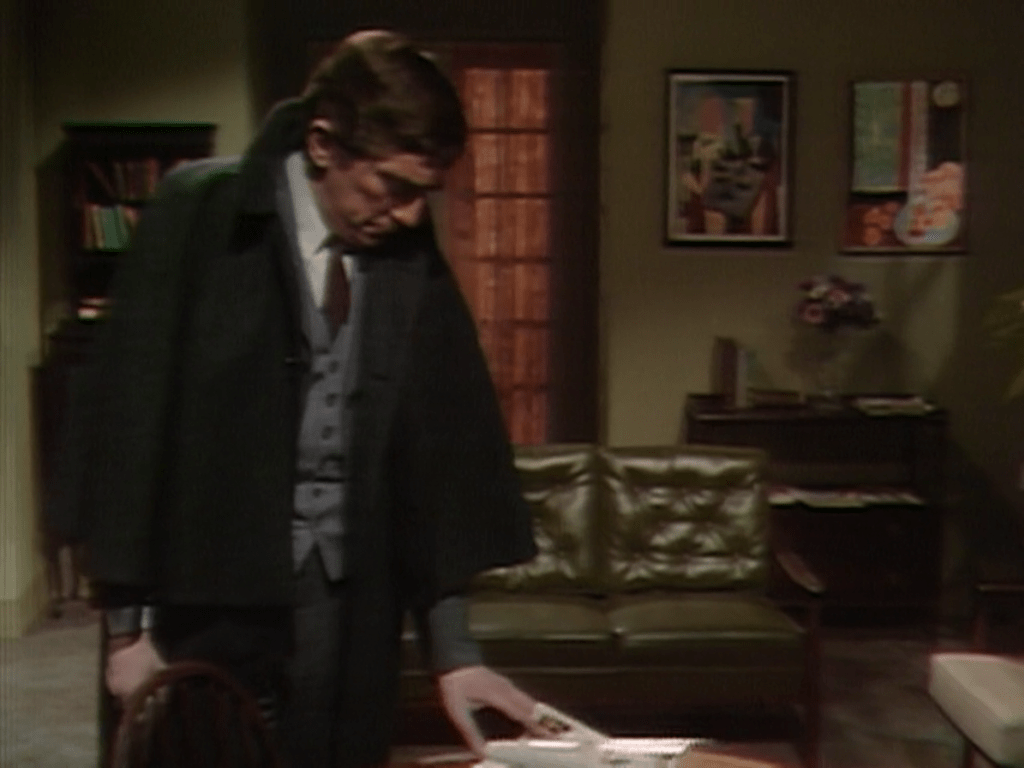
While Barnabas waits, a glossy magazine catches his attention. He picks it up and leafs through it. Since we are about to see Willie for the first time in several months, there is a good chance that this little bit of stage business will remind regular viewers of a peculiar remark Barnabas made shortly before the last time we saw Willie. Shifting the blame for his own crimes onto Willie, Barnabas planted Maggie’s ring in Willie’s room. When he came up with this plan, Barnabas remarked that the cheaper sort of tabloids say that criminals sometimes hold onto morbid mementos of their crimes, prompting us to picture Barnabas reading a cheap tabloid. That incongruous image comes to life here:
Julia joins Barnabas in the waiting room. They talk for a moment, then a nurse ushers Willie in.
At first, Willie is silent, a confused look on his face. He walks slowly towards Barnabas. Barnabas asks Willie if he recognizes him. In this moment we pick up exactly where we left off in #329, when Willie was a patient in another hospital and did not remember who Barnabas was.
This time Willie does recognize Barnabas. But as he did at the end of #329, he seems happy and untroubled. He is positively childlike in his eagerness to go back to Barnabas’ house and work for him again. He says that he and Barnabas were friends and that he always enjoyed their time together, a statement that dumbfounds Julia, as it dumbfounds anyone who remembers the show from April to September 1967. Even when Barnabas wasn’t bashing Willie across the face with his cane, Willie was miserable beyond words and hated everything Barnabas forced him to do.
Julia sends Willie back to his room, and Barnabas proclaims that Willie is entirely cured. Julia sarcastically thanks him for his diagnosis, calling him “DOCTOR Collins!” This too harks back to #329, which ended with Willie asking Barnabas if he were a doctor, to which Barnabas replied, “That’s right. I am a doctor!”
Barnabas takes Willie back to his house and tells him that for the time being, he must not so much as go outside by himself. Willie accepts Barnabas’ explanation that many people in the area will have to be prepared for his return before they see him. Willie gladly agrees to stay in the house. Barnabas leaves him alone, and he immediately slips out. He is heading for Maggie’s place.
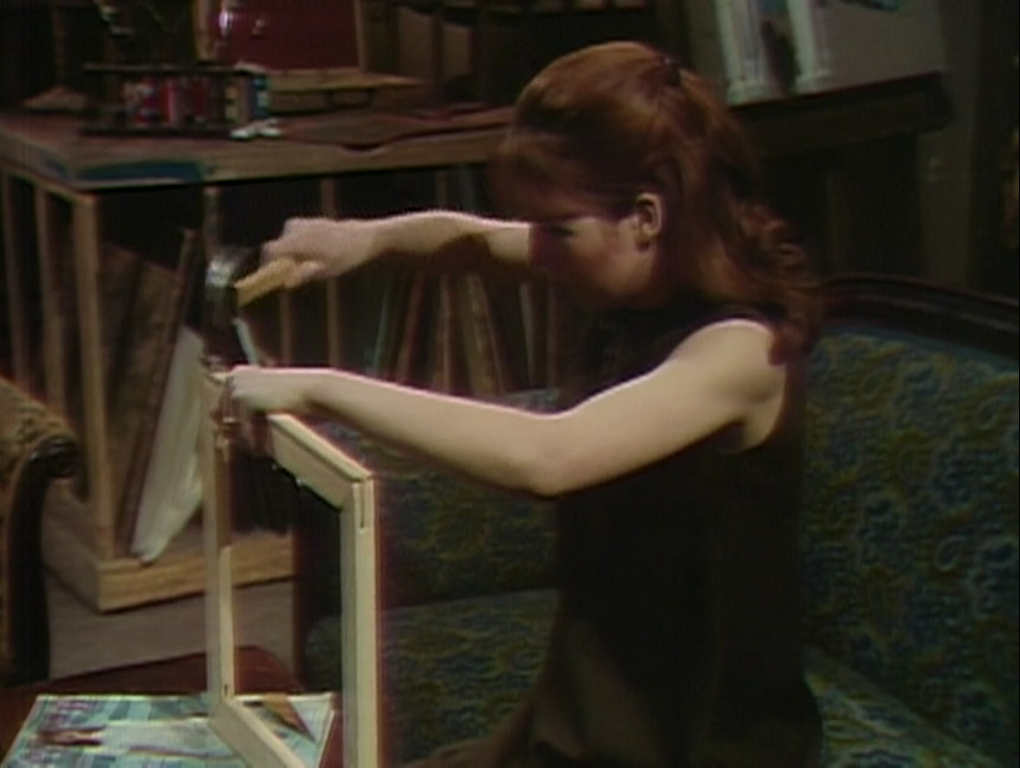
Maggie’s father Sam is a painter, a fact advertised by the canvases around the cottage they share. When we cut to the cottage, she is making a frame. This is rather an obvious visual metaphor. The last time Willie came to the cottage, he inadvertently framed himself for Barnabas’ crimes against Maggie.
Of course Maggie is horrified to see Willie at the door; of course she demands he leave; of course she threatens him with her hammer when he insists on staying and telling her he is innocent; of course she cries for help when her boyfriend Joe comes to the door; of course Willie runs off when Joe enters. Willie puts himself in the frame again, this time as an ongoing threat to Maggie and all the women of Collinsport.
Joe goes to Barnabas’ house and demands to see Willie. At first Barnabas plays dumb, but Joe doesn’t give an inch. Barnabas then admits that he persuaded Julia to let Willie out of the hospital, but assures Joe that Willie is no longer dangerous and tells him that he will see to it that Willie behaves himself. Joe says that Barnabas has already failed in his responsibility, since Willie just went to Maggie’s house and scared her. Joe says that he will kill Willie if he goes near Maggie again. He repeats that assurance, and his voice is pure steel.
Joe exits the house. We see him outside, walking away. Willie emerges from the shadows with a rifle. He takes aim at Joe and squeezes the trigger. The gun isn’t loaded, so Willie makes nothing more than a click. Apparently that was enough for him. He grins maniacally.
On their Dark Shadows Every Day, John and Christine Scoleri point out that the the gleeful face Willie flashes after he clicks his rifle at Joe is the same expression he showed in the frenzied crimes he committed before he came under Barnabas’ power. They back this observation up with a pair of screenshots, one of Willie immediately after he pretended to kill Joe, one from his last moment before he released Barnabas and lost his freedom:
Indeed, the whole episode replays Willie’s character arc from April to September in reverse. He starts as the crushed little thing we had seen at the end of #329, becomes Maggie’s tormented and misunderstood would-be protector, then ends as the dangerously unstable ruffian who followed seagoing con man Jason McGuire to town. If the episode were a few minutes longer, John Karlen might have had to take a break and let James Hall play the last scene. This recapitulation heightens the initial suspense generated by the question of how Willie would be after Barnabas had lost his vampire powers. Whatever effect the change in Barnabas has had on Willie has certainly not made him less complex or more predictable. We can’t tell when he is being sincere and when he is faking. Based on what we see today, it’s possible he is being sincere the whole time, but that he is just extremely impulsive, and equally possible that everything he does and says is a fake meant to cover up something we don’t yet know enough to guess at.
The actors are uniformly excellent today. John Karlen has to recreate the three faces of Willie in quick succession, and executes each of them clearly and memorably. Almost all of Grayson Hall’s dialogue is expository, but while delivering it she shows us all of Julia’s complicated feelings about Barnabas and lets us into her attempt to solve the riddle of his plans for Willie. Kathryn Leigh Scott is only on screen for a few minutes, beginning with her absorbed in carpentry and proceeding directly to screaming and running around and clutching at her male scene partners, but still makes it clear that Maggie is a strong and level-headed person who has been forced into frantic behavior by circumstances no one should have to face.
In the confrontation with Barnabas, Joel Crothers shows us a new side of Joe. Always loyal, always honest, always hardworking, Joe has up to this point been soft-spoken and self-effacing, deferential towards members of the ancient and esteemed Collins family. The only time he broke that deference was when he spoke some harsh words to matriarch Liz in #33, and he had to get thoroughly drunk to manage that. There is no trace of drink in him now, and he does not regard himself as anything less than Barnabas’ equal. For the first time since Burke Devlin lost his connection with the plot and shriveled so drastically that he ceased to be Mitch Ryan and became Anthony George, Dark Shadows has a plausible action hero in its cast.
The part of Barnabas is especially challenging today; he tries and fails to fool Julia in the beginning and Joe at the end, and in between may or may not have fooled Willie. So Jonathan Frid must show us what it looks like when Barnabas does an unsuccessful job of acting. He chooses to do that by having Barnabas overact. My wife, Mrs Acilius, pointed out that Frid’s own performance in the role of a man who is severely overacting is in fact exceptionally restrained and precise. Frid bobbles his lines as he usually does, but never makes a wrong physical move, and not for one second does he miss the perfect tone for Barnabas’ lines. The result is simply outstanding.
The more efficient a means of communication is, the sooner it is likely to be choked with unwanted messages, some of them harmful to recipients who engage with them. We describe this tendency by saying that eventually, everything turns into email.
One of the most potent means of communication on Dark Shadows have been dream visitations from supernatural beings. As early as #10, matriarch Liz, who in waking life resolutely denied that any paranormal phenomena could be found on the estate of Collinwood, writhed as she slept in her armchair, muttering about ghosts. Since then, we’ve seen undead fire witch Laura Murdoch Collins and the spirit of the benevolent Josette send competing dreams to influence strange and troubled boy David; the mysterious Widows have beckoned Liz to a watery grave; the ghost of little Sarah Collins visited David and told him all about her big brother, then-vampire Barnabas; revenant Jeremiah Collins and phantom Nathan Forbes have given important information to well-meaning governess Vicki; and several characters have had vivid dreams of unspecified, but obviously supernatural, provenance.
Today, wicked witch Angelique visits Barnabas in a dream and tells him that she is launching a malware attack on the dreamers of Collinsport. It’s going to be sequential; it will take over each user’s wetware in turn, compelling them to forward it to someone else. With each iteration, the worm will become more complex, until it reaches Barnabas in a dream of his own. When he accesses it, he will revert to vampirism.
On his Dark Shadows Every Day, Danny Horn made a detailed comparison of Angelique’s explanation of the Dream Curse with the introduction to the 1931 film Frankenstein. He’s convinced me that the reference was intentional. Since there is a version of Frankenstein playing out on Dark Shadows right now, they are assuring us that the Dream Curse storyline will intersect with that one.
Angelique’s explanation only takes up the last act of the episode. There is a lot of other good stuff in the earlier parts, most revolving around Jerry Lacy’s character Tony Peterson. Tony was first introduced as a showcase for Mr Lacy’s famous Humphrey Bogart imitation; he has discarded that now. He still wears a brown suit and a tan overcoat, but sounds like Jerry Lacy.
Tony quarrels with heiress Carolyn about her relationship with Barnabas. She tells him that she and Barnabas have no romantic interest in each other, and tells him to go ask Barnabas if he doesn’t believe her. He goes to Barnabas’ house, and gives Jonathan Frid a rare opportunity to play intentional comedy.
Angelique, who, under the name Cassandra, has married sarcastic dandy Roger Collins and is living with him in the great house at Collinwood, steals Tony’s lighter and uses it to cast a spell on him. She needs a helper, and has decided to enslave Tony. Mr Lacy and Lara Parker are such fun together that, decades after the show, a company called Big Finish brought them back as Tony and Cassandra in a series of audio dramas. Called The Tony and Cassandra Mysteries, they were among the most popular of the Dark Shadows-themed plays Big Finish put out. I haven’t heard any of them- I’m too stingy to pay $37.41 to download an audio file- but if the scene the two of them play in the gazebo at Collinwood today is any indication, I’m sure they’re wonderful.
The very beginning of the episode is good too. Carolyn is coming back from a trip and has her hands full of luggage, so she knocks on the front door of the great house rather than look for her key. Angelique/ Cassandra answers. Carolyn has no idea who she is. When Angelique/ Cassandra identifies herself as Roger’s wife, Carolyn is shocked that Roger has remarried. She is even more shocked when Angelique/ Cassandra says that she and Roger had known each other only a day when they were married. Nancy Barrett is a high-energy actress, and a tightly-focused one. Her reactions to Angelique/ Cassandra’s successive announcements are like a laser light show on the theme of stunned disbelief.
Carolyn mentions that David decided to stay on in Boston for a few days. Since David is about ten years old, we might expect some explanation as to his lodging, but none is forthcoming. Some time ago we heard about an “Aunt Catherine” in Boston; I suppose he might be at her house, but hey, if the alternative is Collinwood he wouldn’t be any less safe if he were roughing it around Mass and Cass.
Wicked witch Angelique (Lara Parker,) pretending to be named Cassandra, met sarcastic dandy Roger Collins (Louis Edmonds) one day and married him the next. Roger’s sister, matriarch Liz (Joan Bennett,) confronts Angelique/ Cassandra. Liz tells her that Roger has not been well and urges her to annul their marriage.
In the course of her confrontation with Liz, Angelique/ Cassandra reveals that she is not all-knowing. She thinks that Roger owns the great estate of Collinwood and the family’s business. Liz quickly explains that Roger owns nothing. He lives as a guest in her house and works as an employee of her company. Angelique/ Cassandra takes this in stride, and stands up to Liz’ insistence that the marriage must end. The only sign that Liz’ words are having an effect on anyone at all comes in the very last syllable of the scene. Unfortunately for Liz, it is not Angelique/ Cassandra who is intimidated by her, but Lara Parker who is intimidated by Joan Bennett. Angelique/ Cassandra’s mid-Atlantic accent vanishes and the purest musical note of Parker’s native Tennessee sounds as the word “you” emerges as “yeww.” If there had been another page or two of dialogue, she might have ended with a honeyed smile and a lethal “Bless your heart!”
From #395 to #461, Dark Shadows was a costume drama set in the late 1790s. In that segment, Angelique came to Collinwood as a servant girl and used her magical powers to manipulate scion Barnabas Collins (Jonathan Frid) into marrying her. Barnabas’ parents, Joshua (Louis Edmonds) and Naomi (Joan Bennett) were unhappy about the marriage. Joshua demanded that it be annulled, as Liz today demands Roger and Angelique/ Cassandra’s marriage be annulled. Naomi took a more conciliatory approach. Advocating Joshua’s position and but showing Naomi’s temperament, Liz combines two challenges Angelique has already shown herself able to overcome easily. Returning viewers will therefore have little hope that Liz will be able to stave off the disasters Angelique has in mind for the Collinses.
Angelique/ Cassandra is eager to get to work on the evil plans she has for the people at Collinwood, and so she is trying to stop Roger taking her on a honeymoon. She contrives to injure her ankle. We see permanent houseguest/ medical doctor/ mad scientist Julia Hoffman (Grayson Hall) in the bedroom Angelique/ Cassandra will be sharing with Roger, bandaging her ankle. Angelique/ Cassandra asks a series of questions about old world gentleman Barnabas Collins (Jonathan Frid,) making Julia visibly uncomfortable.
Barnabas is the same man Angelique married in the 1790s. He is here in 1968 because she turned him into a vampire then. He was relieved of the symptoms of vampirism only a couple of weeks ago. He and Julia are becoming fast friends, and on Tuesday he told her all about Angelique. He identified her as the woman in a portrait that has obsessed Roger, and expressed his belief that Roger’s obsession was a sign that Angelique herself was returning to Collinwood. Julia can see how strongly Cassandra resembles the portrait, and knows that Roger’s obsession led directly to his marrying her, so she really ought to have figured out by now that she is Angelique.
Like the scene between Angelique/ Cassandra and Liz, the scene between her and Julia makes an instructive comparison with the parts the same actresses played in the 1790s segment. Angelique was originally lady’s maid to the Countess DuPrés. We saw her helping the Countess put herself together in a bedroom that was a different dressing of the set on which Julia is now attending to her foot. This apparent reversal of roles illuminates the extent to which Angelique’s command of black magic always made her a mightier figure than her nominal mistress. As a mad scientist, Julia is far more formidable than was the countess, but this scene leaves us wondering if she will be able to stand up to Angelique for any longer than could her counterpart.
Well-meaning governess Vicki (Alexandra Moltke Isles) had traveled back in time and was at Collinwood through the 1790s segment. She recognizes Angelique, knows well how dangerous she is, and is desperate to stop her. She tries to tell Liz about the situation, but Liz has a very limited tolerance for information about the supernatural. Vicki later meets Julia at the gazebo on the grounds of the estate and shares her information with her. Julia knows as much as anyone about the strange goings-on, and what Vicki tells her confirms what she already has reason to suspect. However, Julia pretends to have trouble believing Vicki.
This pretense enables Julia to probe the limits of Vicki’s own knowledge. Barnabas and Julia do not want Vicki to know any of Barnabas’ secrets. Julia incredulously asks Vicki if she thinks the Barnabas Collins of 1968 is the same person she knew in the eighteenth century. Vicki turns away from Julia, looks troubled, and says that she does not believe this. Vicki has encountered plenty of evidence to that effect, not least when Barnabas bit her and sucked her blood, and the audience wonders what she knows. We see Julia studying her, trying to find the answer to the same question. In the first year of Dark Shadows, Vicki represented the audience’s point of view, the resolutely normal outsider getting to know the Collinwood crazies. In this moment, we see Vicki through Julia’s eyes. We identify, not with any sane person from the world of sunlight and natural laws, but with a mad scientist who has cast her lot with a vampire.
Vicki thinking about Barnabas, with a facial expression straight out of MAD magazine. Screenshot by Dark Shadows Before I Die.
Angelique/ Cassandra and Roger chat in their bedroom. He seems utterly delighted to be married to her, until she slips something into his drink. Suddenly he starts having doubts. Nothing we have seen leads us to expect she would want him to feel this way. The scene leaves us scratching our heads.
We end with Angelique/ Cassandra alone in the foyer of the great house, looking at the portrait of Barnabas that hangs there and vowing to restore the curse that had made him a vampire. We know that she is Angelique and that such is her goal, so her speech doesn’t set up any new story points.
It does give us some world-building information. Angelique says that the only way she knew that Barnabas was walking among the living in the 1960s was that Vicki had traveled back in time to the 1790s and told her. That explodes a theory some fans like that Angelique herself called Vicki back in time. When Vicki left the 1960s in #365, it was quite clear that the ghost of Barnabas’ little sister Sarah was sending her on the journey. Sarah has been fading steadily from our awareness, not least because child actress Sharon Smyth aged out of the part, and so it is not surprising that people expect a retcon to attribute the time travel story to a different force. But not only does Angelique rule herself out with this line, Sarah’s name comes up in the conversation between Julia and Vicki, reminding regular viewers of the original explanation.
More importantly, it confirms that once one person has made a wrong-way journey through time, a gate opens through which other unexpected things may come. To some extent we saw this when Barnabas himself was released from his coffin and Sarah’s ghost began showing up around the estate. The cosmological point will become extremely important for the rest of Dark Shadows, as one time-travel story keeps leading to another. Dark Shadows is often described as the story of the house, and so I can’t resist an inelegant metaphor from the building trades. It’s as if Vicki wrecked the plumbing of the universe when she went through the pipes backwards and then abruptly forward. Time will never flow the right way again.
The opening teaser is a reprise of the last scene of Friday’s episode. Dr Eric Lang is trying to convince his patient, recovering vampire Barnabas Collins, to participate in an experiment he wants to start. He addresses him as “Barnabas Barnabas.”
It had been a quirk of Barnabas’ previous physician, Julia Hoffman, to repeat Barnabas’ first name, and as Julia, Grayson Hall manages to put a fresh inflection on “Barnabas, Barnabas” every time she says it. But as Lang, Addison Powell simply says “Barnabas Barnabas” without a pause, as if he were saying a compound name like “Jean-Claude” or “Jim Bob.” He even calls him “Mr Barnabas” at his exit, as if he thinks his full name was “Barnabas Collins Barnabas.” This is by no means the worst thing about Powell’s performance, but it is such an obvious contrast with Hall that it is as if the makers of Dark Shadows are sticking a thumb in our eye and taunting us with his inferiority to her.
As if that weren’t bad enough, Powell has competition for the title of worst actor in this episode. Craig Slocum washes up in the role of ex-con Harry Johnson. Well-meaning governess Vicki is the first to see Harry; she immediately screams in horror and starts to sob, the correct reaction to the sight of Slocum in any role.
At least there is a silver lining to Harry. He is the son of housekeeper Mrs Johnson, played by the estimable Clarice Blackburn. From November 1967 to March 1968, Dark Shadows was a costume drama set in the late eighteenth century, and Blackburn played repressed spinster Abigail Collins. Abigail was a triumph, an irresistible comic villain who was the highlight of every episode she was in. Mrs Johnson’s scenes today are the first we’ve seen of Blackburn since the show returned to contemporary dress, and she is razor-sharp. She is intriguingly sheepish when she asks matriarch Liz if her son Harry can stay with her for a little while, and alarmingly quick to assure Liz that Harry won’t make trouble. When she hears Vicki scream, Mrs Johnson comes hurrying in, is unsurprised to see that Harry is the source of Vicki’s panic, and cuts Harry off before he can offer a defense. She takes Harry into the drawing room while Liz calms Vicki upstairs, and tells him that he is one false move away from going back to prison forever.
Blackburn is so much fun as the unillusioned mother that it is a terrible shame Slocum never manages to read a line or move a muscle in a way that a living person might in the given situation. She gets laughs in spite of him, but with a competent actor in his part the scene where Harry faces his mother would be some of the best intentional comedy in the whole series.
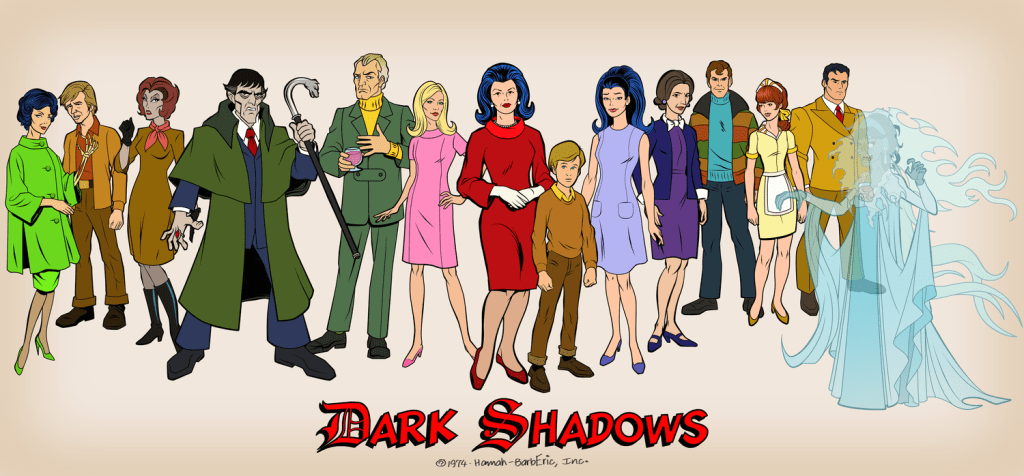
There is one other thing about Harry that makes me smile. On the blog of the Terror at Collinwood podcast, Danielle Gelehrter posted an article some time ago about some concept artwork Eric Marshall did for a hypothetical Dark Shadows animated show in the style of early 1970s TV cartoons such as Scooby Doo or Filmation’s adaptations of Star Trek or My Favorite Martian or Gilligan’s Island. The show Marshall imagines features Harry. Personally, I would have chosen motorcycle enthusiast Buzz, who dated heiress Carolyn for a couple of hilarious weeks in 1967, since his outlandish appearance makes him so much more obvious a choice for animation, but at least Harry’s presence suggests that had such a show been made Clarice Blackburn might have been in the cast and had the chance to do some comedic voice acting.
Eric Marshall’s proposed cast for an animated Dark Shadows that might have been made in the 1970- everyone but Harry. Posted at Terror at Collinwood. Eric Marshall reminds us that Mrs Johnson’s first name is supposed to be “Sarah.” Posted at Terror at Collinwood.
There is some nice stuff in the drawing room between Barnabas and his sometime victim/ fiancée Vicki. Vicki has figured out that the spirit of wicked witch Angelique is once more at work in the great house of Collinwood and that it will take a great effort to stop Angelique from finishing the destruction of the Collins family that she began in the 1790s. If Vicki ever knew that Barnabas was a vampire, she has forgotten it, and Barnabas cannot confess it to her now. He certainly cannot tell Vicki that it was Angelique who made him one. So he listens to her report, but cannot accept her help in the battle against Angelique.
Quite the contrary. Barnabas looks at the spot on Vicki’s neck where he used to take his meals and feels the old hunger coming on. He says he must go to see Lang. Vicki protests that he should stay and let her tend him while they wait for Lang to come to them, but Barnabas insists.
Barnabas goes to Lang’s house. Lang tells Barnabas that if he participates in his experiment, he will not only be entirely free of the vampire curse, but that he might also have the physical appearance of Peter Bradford, alias Jeff Clark, an unpleasant young man who is more or less Vicki’s new boyfriend. This intrigues Barnabas, but Lang will not explain what he means. Since we know that Lang is a mad scientist who is forcing Peter/ Jeff to steal parts from newly interred bodies, we can assume that he will eventually be constructing a Frankenstein’s monster. Presumably he means that the finished product will look like Peter/ Jeff, and Barnabas will somehow live inside it. Since the creature is being built from parts, to look like Peter/Jeff it would have to be finished with salvage from Peter/ Jeff’s corpse. How Peter/ Jeff will be converted from his present state of living and obnoxious to dead and recyclable is what awaits explanation.
Well-meaning governess Vicki and mad scientist Julia have gone to the Collins family mausoleum in the old cemetery north of town. Vicki wants to see whether her memory is correct and there is a chamber hidden behind a secret panel in the mausoleum, and Julia is trying to limit what Vicki can find. As they enter the mausoleum, Vicki shines a flashlight directly into the camera, then sees a man lurking in a dark corner of the mausoleum.
Vicki assures us that, no matter how much the show might have changed since last summer, it’s still Dark Shadows.
The man is Peter, an unpleasant fellow with whom Vicki unaccountably fell in love when she met him on an unscheduled journey through time to the 1790s. For no reason that will ever be of interest to the audience, Peter keeps insisting that his name is Jeff and that he is not a time traveler. Yet he is the one who finds the mechanism to open the secret panel and expose the hidden chamber where Vicki and Peter once found refuge. Even after that he keeps wasting our time with his pointless denials of the obvious facts.
While they inspect the chamber, Vicki realizes that Julia knew it was there. She confronts her about it, and Julia feigns ignorance. Vicki points out that Julia tried everything she could to keep her from going to the mausoleum and that when those efforts failed she insisted on accompanying her there. Vicki is taking a breath, apparently about to list further evidence supporting the same conclusion, when she glances at Peter and changes the subject.
Vicki remarks that the only way the room has changed since she was there in the late eighteenth century is that there is now a coffin in the middle of it. Julia knows that it is the coffin in which vampire Barnabas Collins was confined from the 1790s until 1967. Barnabas bit Vicki several days ago, but it didn’t really take, and he has since been cured of vampirism. So Vicki probably doesn’t know that Barnabas ever was a vampire, and certainly doesn’t know that it is his coffin. Peter opens the coffin. The empty interior of the coffin dissolves to Barnabas in his hospital bed.
Mid-dissolve.
Barnabas sits up by bending from the waist, showing that old habits die hard. He cries out for the doctor who rehumanized him, Eric Lang. A look of panic spreads across his face.
Terrified Barnabas
He is alarmed to hear hounds baying outside his window. He goes out on the terrace of his hospital room and touches its stone balustrade.
What, your hospital room doesn’t have a terrace with a stone balustrade?
Barnabas goes back inside and continues crying for Lang. When Lang shows up, he explains that the cure isn’t quite complete. There will be occasional relapses of varying intensity, and further treatments are necessary. Barnabas throws a tantrum in response to this news, pouting that if he has to keep taking medicine he may as well go back to being an undead abomination who preys upon the living. Lang talks him down, telling him that he is confident he will be able to effect permanent remission.
We see Julia standing in the rain beside a sign for the Collinsport Hospital, looking up at Barnabas’ silhouette in the window behind his balustrade. She walks away. We then see Lang at a desk in a large wood-paneled room. There is a knock. Lang gives a self-satisfied smirk as he looks at his watch, then opens the door to let Julia in. We see that the wood paneling continues in the corridor behind her. In later episodes we will learn this is in Lang’s house. In that case, the paneling in the corridor behind Julia makes it clear someone has already let her in. At this point, a viewer would naturally assume that it is Lang’s office in the hospital. Wood paneling may not be standard for doctors’ offices in hospitals, but neither are terraces with stone balustrades standard for patient rooms.
Julia looking innocent.
Julia had been treating Barnabas’ vampirism in 1967, and wants to reclaim the case. She and Lang sit across from each other and engage in a verbal fencing match. Lang uses many of the ploys we have seen Julia use to keep control of the situation. On his great blog Dark Shadows Every Day,Danny Horn speculates that the audience’s revulsion at the prospect of Lang replacing Julia was the intended reaction. It cements our sympathy for Julia as a trickster figure and as the de facto protagonist of the chief storylines.
I agree with Danny’s assessment of the scene’s effect, but I doubt it was fully intentional. When I imagine the scene played with Howard da Silva instead of Addison Powell as Lang, I see the audience conflicted and in suspense. We are invested in Julia and her relationship with Barnabas, and so we don’t want Lang to push her aside. But an actor like da Silva would be so intriguing that we couldn’t help but be curious how it would play out if he did. It is only the severity of Powell’s professional deficiencies that causes us to see Lang as nothing but a threat. Compared with the more complex reaction a da Silva could have generated, this scene falls flat.
As Julia is leaving Lang’s office, Peter barges in. Julia’s eyes widen when she sees that the two are connected. Lang realizes that she is likely to make good use of this information, and is furious with Peter for exposing it to her.
It becomes clear that Peter has been implicated in a homicide, that he is suffering from amnesia, and that Lang is blackmailing him into stealing body parts from a nearby cemetery. When Peter says he will no longer help Lang, Lang threatens to send him back to the institution for the criminally insane where he found him. He also forbids Peter to see Vicki again, telling him that Barnabas Collins wants to marry Vicki and that Barnabas’ happiness is important to his plans.
In yesterday’s episode, Peter talked to Lang about his hope that he might be able to learn something about himself from Vicki. This reminds longtime viewers of the first year of Dark Shadows, when Vicki’s motivation for staying in the great house of Collinwood was her hope that she would learn who her biological parents were and why she was left as a newborn at the Hammond Foundling Home. Peter even uses the same phrases Vicki had used in expressing the desire to learn more about himself. Moreover, Vicki, like Peter, has an important gap in her memory, having forgotten key details of her time in the eighteenth century.
That Lang has plans for Vicki was strongly suggested last time, when he told her that he expected her to have an extremely significant future. When we see what future he has decreed for a character who is in a position so similar to Vicki’s, and that the future he has in mind for her includes marriage to Barnabas, we can have little doubt that his plans for her are most evil.
The scene between Lang and Peter is a very efficient piece of exposition, but it is poorly executed as drama. Addison Powell keeps pulling funny faces for no apparent reason, does not appear to have any control over the volume of his voice, and alternately drifts off his mark and stands unnaturally still. Roger Davis is a highly trained professional actor, but he must have skipped the day when his acting teachers covered means of shouting without sounding constipated. The two of them together are not very easy to watch. I get through their scenes with a further bit of imaginary recasting, picturing a onetime Dark Shadows extra like Harvey Keitel as Peter opposite da Silva’s Lang.
Vampire Barnabas Collins, desperate to save his own life after he aged extremely rapidly as the result of an attempt mad scientist Julia Hoffman had made to turn him into a real boy, bit his distant cousin Carolyn Collins Stoddard and enslaved her in #351. In #462, Barnabas was afraid that well-meaning governess Vicki Winters had learned his secret, so he bit her as well. As it happens, Vicki had not figured out that Barnabas was a vampire, so the bite was unnecessary. That was lucky for Barnabas. After he bit her, Vicki was noticeably less interested in Barnabas and less deferential to him than she had been at any point in the year or so she had known him.
Now, Barnabas has happened upon another mad scientist, Eric Lang. Lang has apparently succeeded where Julia had failed. Barnabas can go around in the daytime and do other things humans do. What’s more, Lang takes a look at Vicki’s neck and sees that the marks of Barnabas’ bite have vanished. Vicki remembers having the bites. Even after Lang has told her that they vanished because the reason for them no longer exists, she has an enigmatic look on her face when she stares into the mirror and studies the spot where they used to be. It was never clear what she made of Barnabas’ biting her and sucking her blood- maybe she just thought he favored an aggressive make out technique. She looks deeply puzzled now, but what exactly she is trying to understand is a mystery. She looks away from the mirror, then looks down, defeated in her attempt to find sense in her memories. Finally, she turns her back on the mirror and goes resolutely about her business.
For her part, Julia is in the great house of Collinwood with Carolyn. Julia is surprised that Carolyn is talking to her in a friendly manner, as she did before she and Barnabas “became so close.” Carolyn removes her scarf, glances in the mirror, and is delighted to see that the marks on her neck are gone. Carolyn asks what that means. Julia says that it means that she is free, as free as Barnabas, and that it must continue to be so.
Unlike Vicki, Carolyn had a full briefing from Barnabas about his condition and its requirements, and she was deeply involved in his criminal enterprises for some weeks. Her joyous reaction to the disappearance of the marks leaves no doubt that she remembers something about this experience. There is nothing in any script after this to tell us what, but we will often notice actress Nancy Barrett giving a line reading or showing an unquiet reaction that suggests she remembers everything. I suppose you could say she was padding her part with these little signs, but the directors obviously didn’t object and it will be quite a while before the writers give her dialogue which forces her to stop doing it.
There’s also a lot of business in this episode with Vicki and an unpleasant man named Peter. Lately, Peter has been pretending to be someone else, even though the audience and Vicki know perfectly well who he is. Today the show suggests that this irritating little storyline is the consequence of Peter having amnesia. The episode ends with him, Vicki, and Julia opening the secret panel that reveals the hidden chamber in the Collins family mausoleum where Barnabas was trapped from the 1790s until 1967. That proves that Vicki traveled back in time to the 1790s and that Peter knew her in that era. Since the audience already knows both of those facts and none of the characters directly involved in the action has any reason to doubt either of them, it’s an anticlimactic conclusion.
When Vicki and Julia are entering the mausoleum, Vicki shines a flashlight directly into the camera. In at least eleven of the episodes made when the show was in black and white, characters entering darkened spaces did this with flashlights, often creating elaborate halo effects. Sometimes this appeared to be a blooper, several times it was obviously intentional. We’ve only seen it once or twice, briefly, since the show went to color in the summer of 1967. It’s nice to see it again.
In a room at the Collinsport Hospital, very loud physician Eric Lang (Addison Powell) opens the curtains to show his patient, old world gentleman Barnabas Collins, that it is a sunny afternoon. It takes Barnabas a moment to realize that this is Lang’s way of showing him that he has cured him of his longstanding affliction, vampirism. Once he figures it out, Barnabas is very happy to be human again.
Barnabas talks with Lang about the origins of his vampirism. At one point Lang says “Ah, so a curse was responsible.” You know how doctors are, always coming out with the same cliches. Lang does say something novel when he remarks on Barnabas’ “pulsebeat.” That specimen of Collinsport English will be back.
In the great house of Collinwood, Barnabas’ distant cousins Roger and Liz are at odds. Roger keeps having conversations with a portrait, in the course of which he loses track of the time. The correct time is 1968, and he keeps thinking it is 1795. When he does that, he mistakes himself for his collateral ancestor Joshua Collins and his sister Liz for Joshua’s wife Naomi. Today, Liz has to slap Roger to get him back to himself. Louis Edmonds’ alternation between Joshua and Roger is masterful, one of the outstanding moments of acting in the whole series.
The portrait is of Angelique, the wicked witch who made Barnabas into a vampire in the first place. At the hospital, it becomes clear that Angelique’s spirit is controlling Roger through it. He is cold and distant, staring out the window when Barnabas tells Liz he wants to take up gardening, refusing to say a word when Lang enters the room. When he takes his leave, Roger looks at Barnabas and declares “It’s not this easy.” We realize that he is a puppet for Angelique. Roger steals Lang’s cartoonish mirror-bearing headpiece.
We cut back and forth between Barnabas’ hospital room and the drawing room at Collinwood. At Collinwood, Roger shows the headpiece to the portrait and explains that it was Lang’s. He starts to twist it. In the hospital, Lang suddenly leaps up with a splitting headache. Roger stops twisting, and Lang says he’s better. He resumes twisting, and Lang resumes suffering. Roger tells the portrait he cannot obey its command to put the headpiece in the fire, and throws it across the room. In the hospital, Lang suddenly recovers from his headache. Barnabas tells him it was Angelique’s doing, and says that he will have to become a vampire again to spare Lang her attentions.
On his blog Dark Shadows Every Day, Danny Horn identified Addison Powell as “THE WORST ACTOR EVER TO APPEAR ON DARK SHADOWS.” I don’t agree with that. In yesterday’s episode, for example, Powell attained a level that could fairly be described as “competent,” a label that forever eluded figures like Mark Allen (Sam Evans #1,) Michael Currie (Constable/ Sheriff Carter,) and Craig Slocum (Noah Gifford and, later, Harry Johnson.) And there will be times when his ludicrous overacting lends just the note of camp that turns a scene from a tedious misfire to an occasion for chuckling. But he is pretty bad today. When an actor gets to be depressing to watch, I sometimes make his scenes bearable by trying to imagine what it might have been like if, instead of casting him, they had chosen someone else who might have been available.
So many members of the original Broadway cast of the musical 1776 appeared on Dark Shadows at one time or another that I tend to assume that any of them would have accepted any part on the show. Howard da Silva played Benjamin Franklin in 1776, and he is my imaginary Dr Lang.
You can see da Silva’s Franklin in the 1972 movie version of 1776, where he plays the Sage of Philadelphia with frequent chortles that suggest a mad scientist gleefully working to release a murderous nightmare on the world, which is more or less the show’s vision of the founding of the USA. That isn’t Franklin’s only note- he has occasion to speak earnestly about the British Empire’s mismanagement of its North American possessions, and sorrowfully about the need to leave slavery alone while concentrating on the fight for independence. Those who have seen da Silva play subtle and powerfully compassionate men in his other work, for example as the psychiatrist in the 1962 film David and Lisa and as the defense attorney in the 1964 Outer Limits episode adapting Isaac Asimov’s story “I, Robot,” will hardly be surprised that he could be effective in those moments.
So when Powell overdoes the shouting, I imagine da Silva in his place, going through his bag of tricks to show us a man who might be taking a maniacal satisfaction in his blasphemous labors, who might be profoundly devoted to the relief of suffering, and who might be both at once. Sometimes I get a pretty clear image of what that would have been like, and when that happens the show in my head is hard to beat.
At the end of Friday’s episode, the well-meaning Vicki Winters was driving her car and bickering irritably with her passenger, Barnabas Collins the vampire. Barnabas wants to elope with her, which she doesn’t object to doing. But first she insists on running an errand in his old neighborhood, the deserted cemetery north of town, and he hates that idea.
A pedestrian wandered into the middle of the road. To keep from hitting him, Vicki had to slam the brakes so hard she lost control of the car and crashed. At least she learned the lesson of the cowardly Roger, who ran over a pedestrian years before the show even started and as punishment was condemned to spend months looking for some guy’s fountain pen.
Today, Vicki and Barnabas are in the hospital. We see Barnabas in bed, moaning alternately for Vicki and his long-lost love, the late Josette. It doesn’t bode well for the planned elopement that in his delirium Barnabas gives Vicki only equal time to Josette. We then see Vicki in her bed, moaning for Peter, an unpleasant young man she got to know recently while visiting the late eighteenth century. She doesn’t mention Barnabas’ name at all.
Vicki comes to and finds Peter at her bedside. He denies that he is Peter, claiming merely to be a strange man who let himself into her room to watch her sleep. She recognizes him not only as her boyfriend from the 1790s, but also as the wayward pedestrian involved in the crash. He admits to this, but will not answer any of her questions.
A nurse enters and finally gets Peter to leave Vicki’s room. Perhaps he will let himself into other girls’ rooms and stare at them while they sleep. The doctor, a man named Lang, comes in.
Dr Lang asks Vicki if she knows Barnabas well. This is an interesting question. Before he bit her on Tuesday, Vicki definitely did not know that Barnabas was a vampire. Her behavior towards him since has been so blasé, not only by contrast with the behavior of his other victims but also by contrast with the eager friendliness and habitual deference she had always shown him in the many months they have known each other, that we can’t tell if she has learned that he is one even now. Indeed, we have no idea what Vicki thinks is going on between her and Barnabas, and as a result their scenes together have been pure comedy.
Vicki nibbles on her index finger and thinks for a moment about Lang’s question. Since they were going off to spend the rest of eternity together, it would be pretty embarrassing for her to admit that she doesn’t really have much understanding of Barnabas, so she says that she does know him well. As she does so, she glances away for a moment, and the light flashes off her eye, emphasizing her unease.
Vicki talking through her hand
Lang asks about Barnabas’ health before the crash. Vicki puts her hands down and stutters slightly as she says “He was in excellent health.” A note of uncertainty gives her voice a childlike quality. When Lang replies with “Really?,” her voice sounds even more childlike when she answers “Y-yes, have you discovered something Mr Collins didn’t know about?” Lang says that he thinks Barnabas knew about it.
Lang looks at Vicki’s neck and finds the marks of Barnabas’ bite. They are just two dark dots, not conspicuously different from the last stages of an ordinary hickey.
The bite marks.
When Lang asks about the marks, Vicki’s grogginess suddenly vanishes and she becomes hyper-alert. Since Vicki has been so bland about her experience with Barnabas, returning viewers might well expect her to answer Lang’s questions about the bite marks by saying that Barnabas gave them to her when they were making out. Instead, she gets defensive, at first denying that she remembers how she got the marks and then asking “What’s wrong with them? Why are they so bad, please tell me?” Alexandra Moltke Isles reads that line brilliantly. There is a touch of defiance in her voice, but also a sincere question- she genuinely does not see any reason she should have to hide the marks or explain them to anyone.
Early in the episode, the telephone rang at the great house of Collinwood, and long-term houseguest Julia Hoffman answered. It was the nurse, reporting that Vicki and Barnabas had been brought in after a traffic accident and that “Mr Collins is on the critical list.” Now Julia is in Barnabas’ room trying to arrange transport to his house. Lang comes in and is astounded at the thought of taking an unconscious patient, who is in critical condition, out of the hospital.
Lang and Julia have a showdown. Lang makes it clear that he knows that Barnabas is a vampire, and has deduced that Julia, who is a doctor doubly qualified to practice as a psychiatrist and a blood specialist, has been trying to cure him. Lang marvels that Julia has been treating “a legendary condition.” He asks to examine her neck; she never removes her scarf, surprising returning viewers who know that Barnabas has not bitten her. He continues to pose direct, well-informed questions, which she continues to parry with lies and evasions. She grits her teeth when he refers to Barnabas as “our patient.” At the last, she agrees to go, and he agrees to keep the room dark.
Barnabas awakens and sees Lang. He becomes agitated and demands to be released. Lang refuses. Lang tells him the time is nearly four o’clock. Dawn broke in central Maine at 4:33 on the morning of 8 April 1968, so Barnabas has little more than a half hour to get back home to his coffin. It is no wonder that Barnabas puts on his murdering face when Lang will not let him go. Lang backs away and says he must explain something Barnabas does not understand. Lang reaches the window. As he opens the heavy curtains, he intones, “Yes, it is four o’clock! But it is FOUR O’CLOCK- IN THE AFTERNOON!!” The sunlight floods the room. Barnabas screams and covers his eyes with his hands. But he does not turn to dust- he is no longer a vampire.
This marks the end of the epilogue to the 1795 segment, and with that the end of Dark Shadows 3.0. Unlike version 1.0, which ended with no unresolved story threads of any interest, and version 2.0, which ended at a moment when the only way forward was the annihilation of all the characters, they have cued up at least three major storylines. Eventually Peter will stop pretending to be someone else and something will happen between him and Vicki; Roger will bring wicked witch Angelique home with him; Lang and Julia will work together to manage Barnabas’ aftercare. There are several other characters available for story-building. We have met kindly eccentric Professor Stokes and expect him to contribute to some or all of these storylines. We do not know how Barnabas’ cure will affect his blood thralls Vicki and Carolyn. Carolyn’s relationship with Humphrey Bogart-esque lawyer Tony is in an awkward spot, and Tony is in a position to trigger a major storyline if he starts telling people what he thinks he knows about Carolyn and Barnabas.
On his blog Dark Shadows Every Day, Danny Horn often identified Addison Powell, who plays Lang, as “THE WORST ACTOR EVER TO APPEAR ON DARK SHADOWS.” I don’t think he deserves that title. In fact, he isn’t even the worst actor in this episode. I’m sure the Nurse was written to be pretentious and silly, but Katharine Balfour’s stiffness and relentlessly exaggerated vocal mannerisms are simply excruciating. Powell isn’t great, and will get much, much worse, but he is basically competent today. Mrs Isles, Jonathan Frid, and Grayson Hall all do excellent work in their scenes with him, and he never once gets in their way. But when Balfour is on stage, the others can do nothing but stop and wait for her to leave. She had an extensive stage career, so I suppose she must have played many parts well, but she is stupefyingly bad today.
After Lang’s big “FOUR O’CLOCK- IN THE AFTERNOON!!,” we cut to the closing credits. Under them is a set where a clock’s hands indicate four. From April 1967 to July 1968, ABC suggested its affiliates run Dark Shadows from 3:30 to 4:00 PM. There were a great many stations which insisted on showing it at 10:30 AM. While it was a hit by this point in the 3:30 slot, its ratings were always rock bottom where it was shown in the mornings, so the great majority of viewers would have seen the correct time as they read the names of the people who worked on the show.








 Dark Shadows Commentary