The first time we might have expected to see a wedding on Dark Shadows was in #270, when reclusive matriarch Liz was supposed to marry seagoing con man Jason in the drawing room of the great house of Collinwood. That wedding was called off when Liz, rather than saying “I do,” announced “I killed Paul Stoddard and that man was my accomplice!” It turned out that Liz didn’t actually kill Paul after all. She only stunned him, and he and Jason connived to trick her into thinking she had killed him so that she would give them a lot of money. The two of them buried an empty trunk in the basement of the great house and Jason told Liz that Paul’s corpse was in it. Liz’ refusal to be blackmailed into marrying Jason led to the exhumation of that empty trunk.
The next time there was supposed to be a wedding at Collinwood was in #380, when the show was a costume drama set in the 1790s. Scion Barnabas was supposed to marry the gracious Josette, but wicked witch Angelique cast a spell that caused Josette to elope with Barnabas’ uncle Jeremiah. We did not see their wedding, but we did see Barnabas and Angelique get married in #397. We also saw them on their wedding night, when Barnabas left Angelique in her bedroom and retired to his, without so much as a goodnight handshake between them. As Jason’s attempt to marry Liz ended with the exposure of a vacant coffin, so these marriages led to vacant coffins as well. Barnabas killed Jeremiah in a duel in #384, and Angelique raised him from the dead in #392. It does not appear he ever did go back to his grave. He opened his own coffin in #397 and tried to bury Angelique alive in it.
When Barnabas found out that Angelique was the witch responsible for Jeremiah and Josette’s elopement and all the misery afterward, he tried to kill her, and she retaliated by turning him into a vampire. His coffin was empty every night for a while, but in March 1968, shortly after Dark Shadows left the 1790s and returned to contemporary dress, he became human again. Now Angelique is a vampire, and it is her coffin that is regularly vacant.
Today, another wedding is scheduled for the drawing room of the great house. Well-meaning governess Vicki is supposed to marry an unpleasant man known variously as Peter and Jeff. A mysterious woman with two names of her own, Eve and Danielle, shows up while Peter is smoking on the terrace.
Peter/ Jeff and Eve/ Danielle both lived in the 1790s, and both have come back to life in 1968. Peter/ Jeff is in deep denial about his own status as a revenant, and gets even more obnoxious than he usually is whenever anyone brings it up. Eve/ Danielle remembers him from their previous lives, and is, inexplicably enough, in love with him. She brings him a note that she acquired on a recent trip through time. In Peter’s handwriting, under the salutation “Dear Danielle,” it says that he would rather go to the gallows on the off chance that in some future life he will be with Vicki than go away with Danielle. Somehow, Danielle takes Peter’s willingness to face death in hopes of reunion with Vicki to mean that he should now leave Vicki and go away with her. The logic may escape the viewer, but evidently it convinces Peter/ Jeff. He leaves Collinwood to go dig up his grave. He finds the coffin vacant. It is unclear whether this means he will reunite with Eve/ Danielle, but apparently it convinced him he should not marry Vicki.
Liz’ aborted wedding to Jason marked the end of the blackmail arc, which was itself an extended in-betweener meant to clean up the last non-supernatural stories, introduce the vampire, and give the rest of the cast something to do while Barnabas was settling in. The aborted wedding of Barnabas and Josette marked the end of the part of the 1795 segment in which most of the characters don’t know that there is a tragedy brewing, while Barnabas and Angelique’s wedding told the audience that the preliminaries were over and they were about to explain how Barnabas became a vampire. Vicki and Peter/ Jeff’s attempted wedding today marks another ending. Alexandra Moltke Isles will leave the role of Vicki after the episode coming up on Tuesday. Vicki started moving to the sidelines once undead fire witch Laura went up in smoke in #191, and she has long been a secondary character. But she was the main protagonist for the first 39 weeks of Dark Shadows, and Mrs Isles carried the show very capably during those days. It was disappointing when she moved so far out of the main current of the action, and sad to see her go.
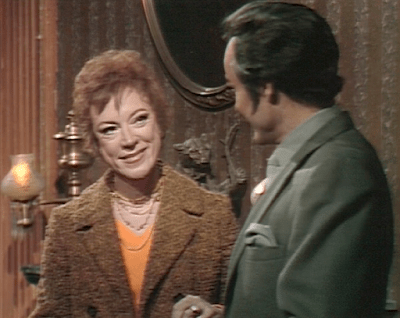
Today, we open with well-meaning governess Vicki in her room in the great house of Collinwood, wearing her wedding dress. Matriarch Liz enters, gives her a peck on the cheek, and tells her what a lovely bride she will be. Everything in their words and actions suggests to first-time viewers that they are mother and daughter; the strong resemblance between Joan Bennett and Alexandra Moltke Isles would tend to corroborate this impression. In a later scene, we hear Vicki call Liz “Mrs Stoddard.” Thus we learn she is one of the household staff.
Meanwhile, Frankenstein’s monsters Adam and Eve share a moment. Eve was created to be Adam’s mate, but she has wanted nothing to do with him. She has gone so far as to tell him to his face that she hates him and will kill him. Today, suave warlock Nicholas has ordered Eve to make nice with Adam, and so she tells him to forget all about her previous remarks. They sit facing each other on the floor in front of the fire, the first time we have seen potential lovers do that on Dark Shadows. They kiss.
A jump cut indicates the passage of time, and we see Adam and Eve snuggling on a little sofa and being pleasant to each other. We are free to surmise that they had sex. Perhaps there will be Frankenbabies after all. Adam leaves. In his absence, Eve again says that she cares nothing for him, but only for someone named “Peter.” Since Peter is the man Vicki is supposed to marry today, that sets up a conflict.
Back at Collinwood, Vicki opens a wedding gift she finds disturbing. The card enclosed is simply labeled “Peter” in all caps. In fact, Eve sent it, but Peter is such a tedious character that it is easy to imagine that he has never learned to use lower-case letters or to write more than his first name, so we can understand Vicki’s reaction.
Well-meaning governess Vicki is on the terrace of the great estate of Collinwood. A man known variously as Peter and Jeff keeps clutching at Vicki’s arms so sharply that her biceps pulse, then holds her with one hand and paws her with the other as she stands rigidly still. First time viewers, knowing only that Dark Shadows features stories of monsters and crime, would think that the man had some power over the woman and that they were seeing him abuse that power. They would be right. Unfortunately, the man and woman are not Peter/ Jeff and Vicki, but actors Roger Davis and Alexandra Moltke Isles. Vicki is supposed to be in love with Peter/ Jeff and reluctant to part from him, but the instant she has spoken her last line she turns her face from him and runs away, without the slightest attempt to suggest that she wants to linger.
Roger Davis has his fun.
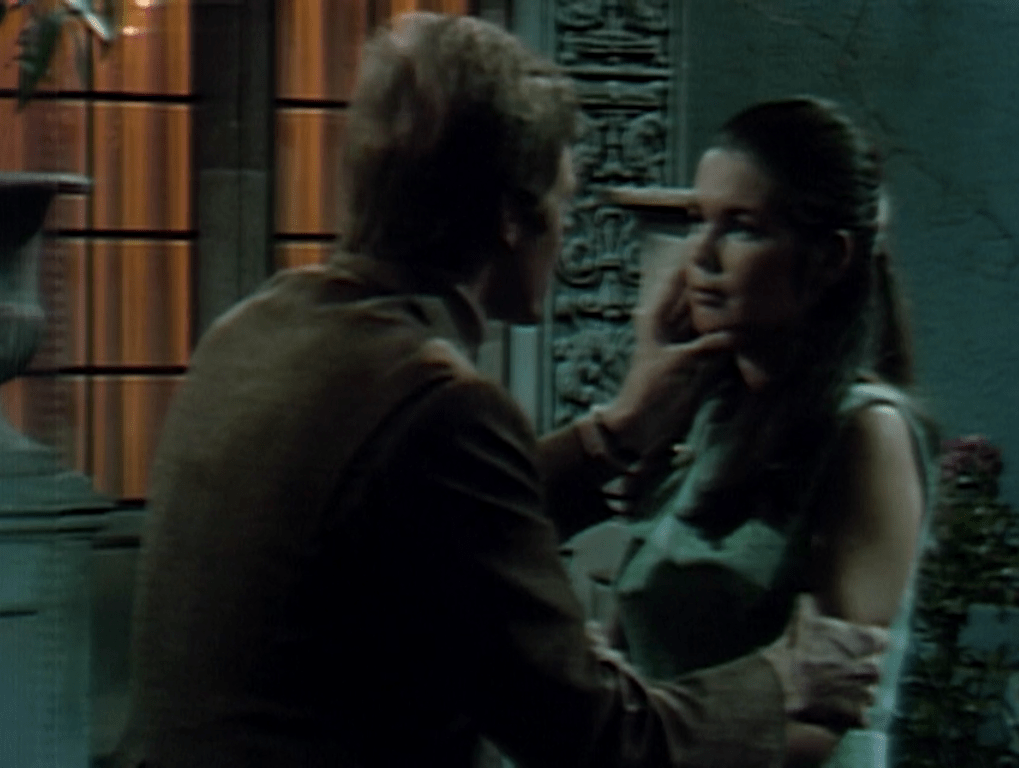
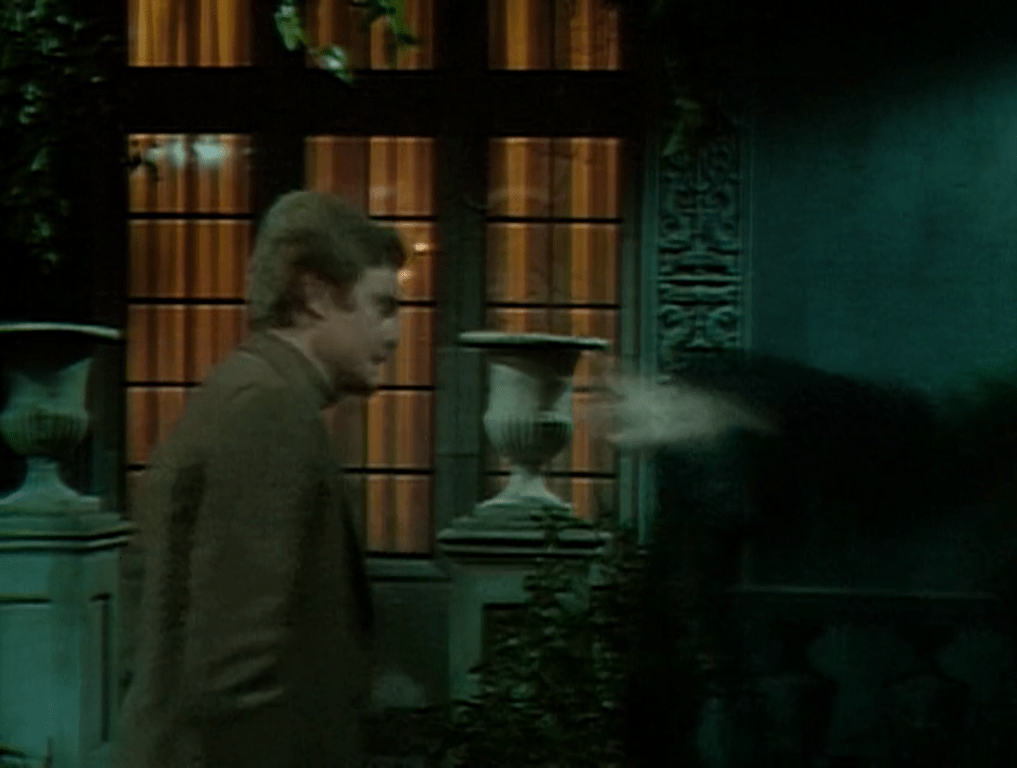
After Vicki escapes from Peter/ Jeff’s repellent attentions, a woman named Eve emerges from the bushes. Peter/ Jeff is angry with her. He grabs her roughly and throws her out of the frame. Peter/ Jeff then stalks off. Eve comes back into the frame. It’s a relief to see her upright and well-put-together- Mr Davis shoved Marie Wallace so hard she had to struggle to right herself as she spun out of view. It looked like she might have slammed her head against the floor.
Marie Wallace using her arm to regain her balance and keep from sustaining a serious injury.
This was the episode where Grabby Davis got so overly excited in his scene with Marie Wallace on the terrace that he grabbed her by the arms and threw her completely out of frame. You see her struggling to remain on her feet as she stumbles off to the right. Some 20 years later at a fan convention (it’s in Dark Shadows 25th Anniversary Special from the disc set that has the last episode of the series), Marie Wallace brought this up as Roger Davis was telling the audience of how they (or rather he) would cut up and laugh and have fun while they were making the episode, and of how they would just laugh off their flubs. Wallace then broke in to remind Davis of episode 622 as she recalled, “Hey, Roger? I didn’t laugh when you threw me out of frame in that scene, on camera. Remember that? Several times?” She explained to the audience how all during dress rehearsal he’d never touch her and then when he’d done it on camera he’d come up to her and apologize profusely, but Wallace told him then and there at the convention that she never believed him.
Marc Masse, as “Prisoner of the Night,” in a comment left 8 April 2015 on “Episode 622: Heated Conversations on Somebody Else’s Lawn,” Danny Horn, Dark Shadows Every Day, 8 April 2015.
In a response to another post of Danny’s, Marc added that in the same video you can see actress Donna Wandrey’s appalled reaction to Mr Davis’ statement, and her increasingly visible disdain for him as Miss Wallace makes her case against him.
After Peter/ Jeff is gone, another visitor comes and addresses Eve by name. She is Angelique. Angelique is not a Roger Davis character, she is merely a vampire, so everyone can relax.
Regular viewers have been wondering what would happen when Angelique shared a scene with Eve. Marie Wallace’s style as Eve relies on many of the same techniques Lara Parker uses as Angelique. Both use an elevated style with many catches of breath, changes of volume in mid-sentence, and striking of oratorical poses. Each was capable of making this exaggerated method work, but no one could conceal its profound silliness, and a scene consisting of two characters both using it would be too ridiculous even to make a good joke in a cartoon. What actually happens is that Parker demonstrates the quietest possible version of the style, while Miss Wallace shows a more typically brassy version. Recognizing their approaches as two poles of the same axis, we are not only interested in their encounter, but also in what they show us about the craft of acting.
Angelique persuades Eve to join her in an alliance against warlock Nicholas. This might be an exciting development. Nicholas is the show’s chief villain at the moment, and between them Angelique and Eve just might be able to bring him down. It is also the first alliance we have seen take shape in a long time. Many characters have tried to control other characters, to deceive them, to imprison them, to enslave them, to brain-wash them. But the only group working towards a common end is made up of old world gentleman Barnabas, mad scientist Julia, occult expert Stokes, and servant Willie. That team formed long ago, has not managed to get anywhere lately, and is, at the moment, immobilized by Barnabas’ absence. Yesterday Julia tried to form an alliance with Nicholas against Angelique, but at the last minute his inability to talk with her forthrightly aborted that effort. So it is refreshing to see that the show is still capable of imagining a new alliance.
Danny’s post about this one is one of his very best, a composition in free verse weaving together quotes from the dialogue with retellings of the overarching narrative with meditations on a number of topics that the episode touches on. If you are a Dark Shadows fan and haven’t read Dark Shadows Every Day, this is a fine post to start with. It’s like a song- you may not understand all the lyrics the first time you hear it, but the sound of it will carry you along.
The comments below it include some great stuff too. I’ve already mentioned Marc Masse’s remark about Marie Wallace’s confrontation with Roger Davis. There are also two fanfic ideas about how the show might have resolved the question of who Vicki’s parents were. Someone posting under the name “William” had this plausible one:
My own theory: Victoria the daughter of Jamison Collins and Betty Hanscomb. So she’s Roger and Liz’s half-sister. Liz knows and Roger doesn’t.
Jamison aggressively seduces Betty, on whom Roger had teenage crush. He makes her pregnant and then coldly casts her out. A pregnant Betty shows up at Collinwood and tells Liz and Roger about what happened.
Roger confronts his father in a fit of rage in the Tower Room during one of Collinwood’s famous storms.
Jamison Collins has a heart attack during the confrontation, and Roger leaves him in the room to die. Roger staggers out, and Liz finds her father dead.
Roger has a complete breakdown and is sent to Windcliff, where Dr. Julius Hoffman, uncle of Julia Hoffman, wipes out his memory of that night in the summer of 1946.
Liz, with the help of new guy in town Paul Stoddard, pays off Betty Hanscomb to leave town and arranges for her half-sister to be raised at the foundling home in New York. Grateful to Paul for his help, Liz starts to fall for his charms …
(And this is why Liz is so fond of Victoria, but not like she is with Carolyn. And this is why she refuses to tell Roger anything about why she brought Victoria back).
–“William,” in a comment left 22 August 2016 on “Episode 622: Heated Conversations on Somebody Else’s Lawn,” Danny Horn, Dark Shadows Every Day, 8 April 2015.
That has a lot of potential. Liz doesn’t seem ever to have loved Paul, she did marry him shortly after her father’s death, and Roger’s attitude towards Vicki in the first months of the show was a strange mixture of extreme hostility and obvious attraction. “William’s” story would account for all of those things. But it doesn’t hold a pale blue candle to this theory posted by Pedro Cabezuelo:
Everybody, we’re missing the obvious! Vicki IS Betty Hanscombe!!!!! Somehow she managed to time travel AGAIN and ended up in Collinsport circa the 1940s and adopted the Betty Hanscombe identity, working her way as a servant at Collinwood. She had an affair with Paul Stoddard, gave birth to herself (at which point the adult Vicki ceased to exist) and THAT’S what caused all the irreperable harm to the time stream/parallel time/anything else you want to blame on Vicki.
Pedro Cabezuelo, in a comment left 10 April 2015 on “Episode 622: Heated Conversations on Somebody Else’s Lawn, Danny Horn, Dark Shadows Every Day, 8 April 2015.
They gave a number to each episode of Dark Shadows reflecting its place in broadcast order. They skipped the numbers for the days the show wasn’t on, so that episode #620 was actually the 613th episode. Fascinating, I know. Even more interesting, there were a total of 1225 episodes, making this one the exact middle of the series.
When Dark Shadows started in June 1966, its undisputed star was Joan Bennett as matriarch Elizabeth Collins Stoddard. Describing Dark Shadows’ overall narrative structure, Bennett said “We ramble around.” At its beginning, the show was heavily atmospheric and slow paced, with stories very much aimed at an adult audience who remembered Bennett’s heyday in the 1930s and her father’s in the early twentieth century. As it developed, supernatural elements that had at the outset lurked in the background came to the fore and attracted a much younger audience. By this time, Dark Shadows is a slam-bang kid’s show with a cliffhanger at every commercial break and a cast including witches, vampires, mad scientists, and Frankenstein’s monsters. So it is appropriate that the episode at its chronological center is in a way the most unrepresentative of them all. Dark Shadows tended to go to great lengths to avoid anything that would get the audience thinking about Christianity. Yet this outing is all about the saving power of the cross.
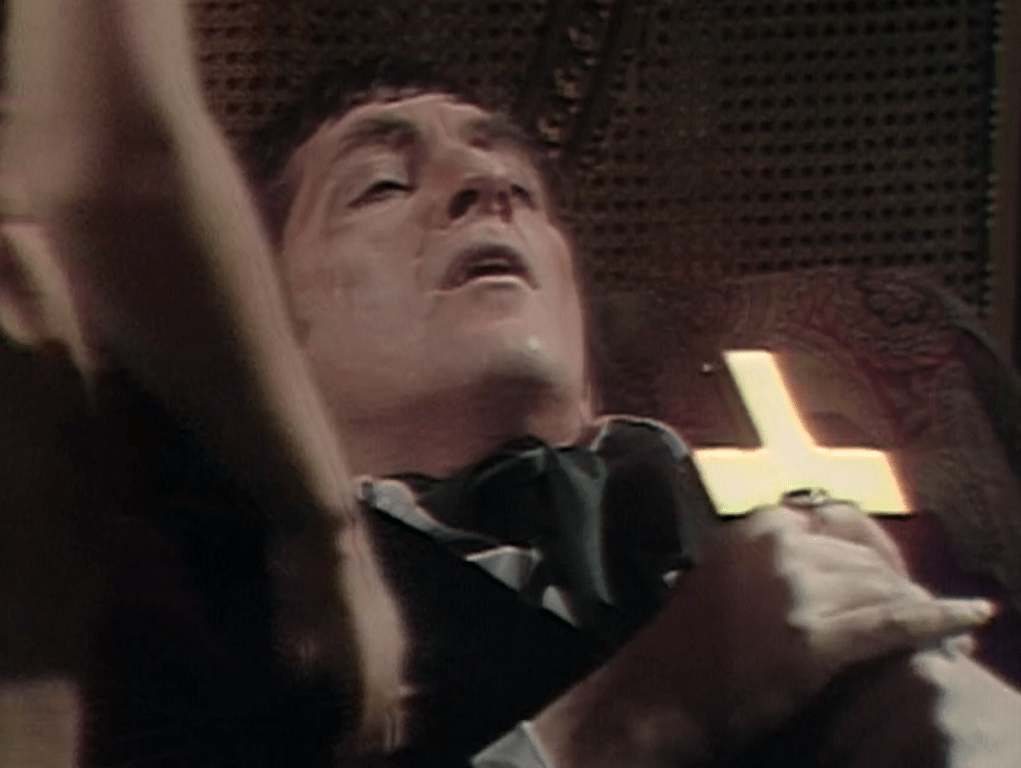
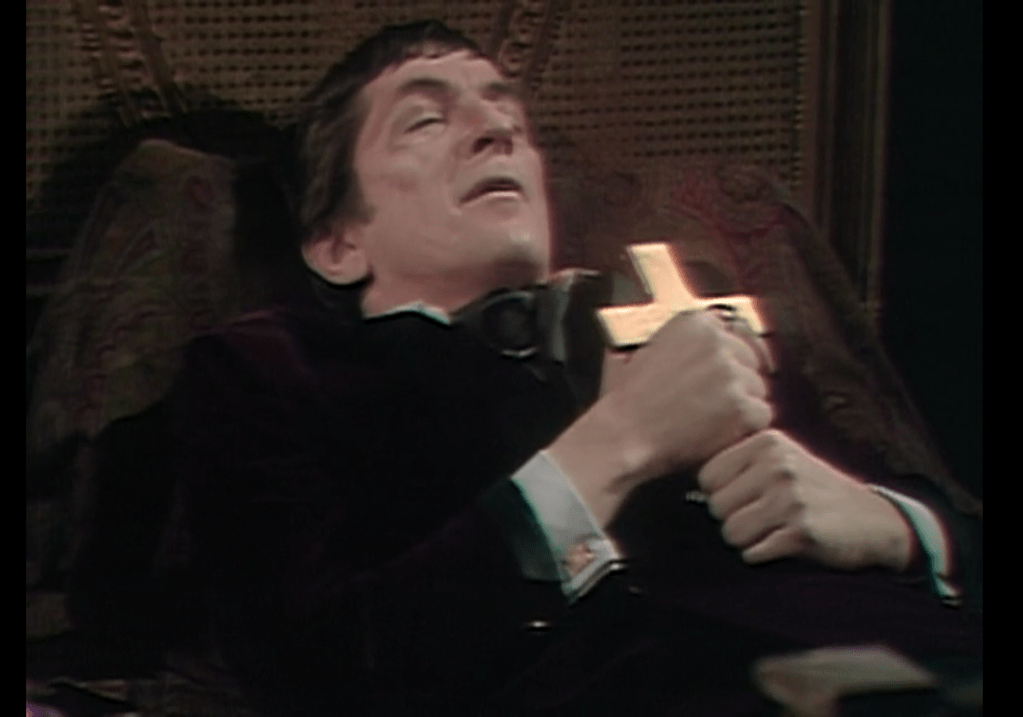
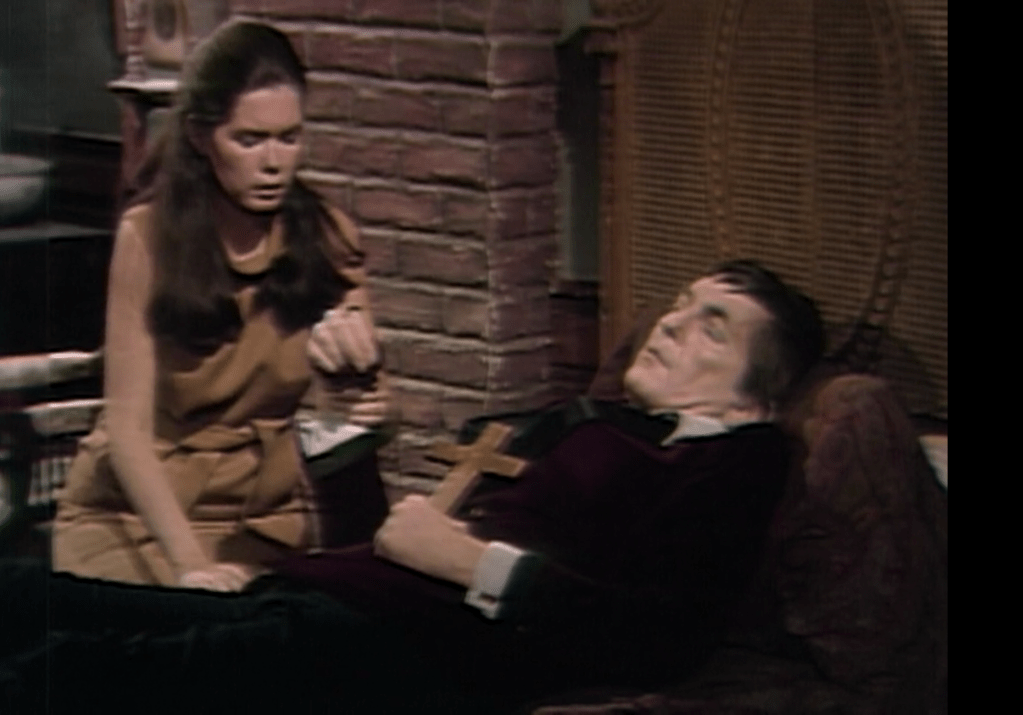
Old world gentleman Barnabas is hiding in the long deserted west wing of the great house of Collinwood. Well-meaning governess Vicki took him there after finding him lying on the ground in the woods, grievously injured. Vicki does not know that Barnabas is the victim of a vampire, and so she does not know why he is anxious that she bring him a cross. When he sees that she has brought one, he mutters “The cross… I need it so.” He clutches it to him and tells her “I need no one but you, and nothing but this.” At the middle of the episode, he is going on about this again, saying “No one frightens me… All I need is the cross. The cross!”
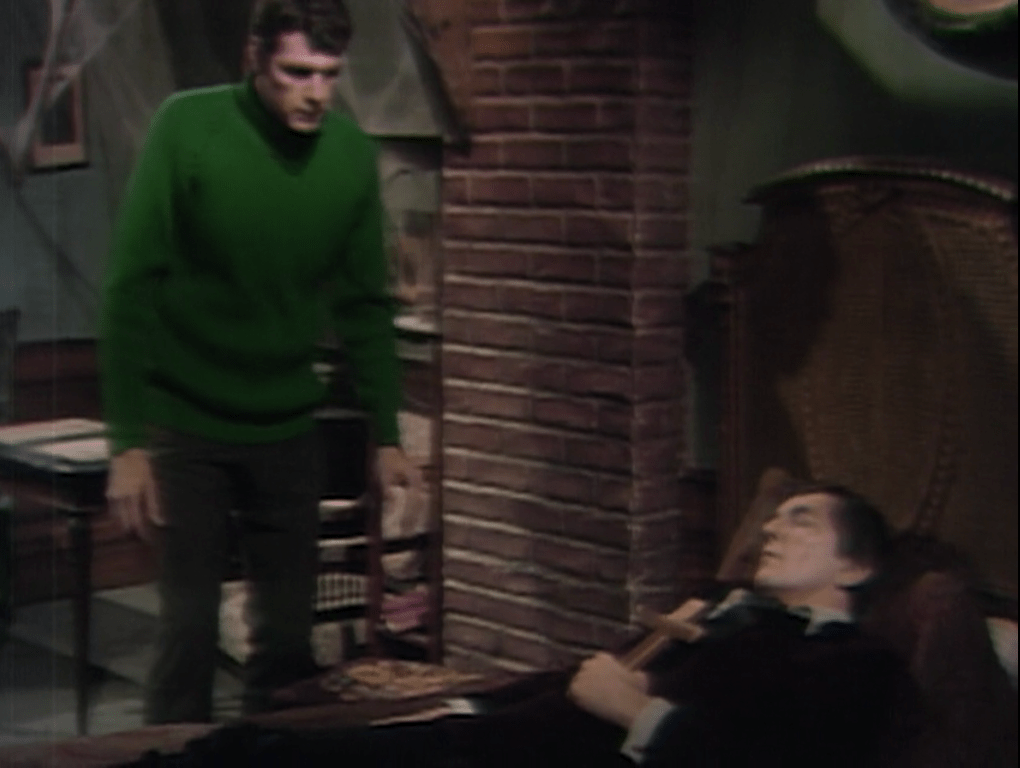
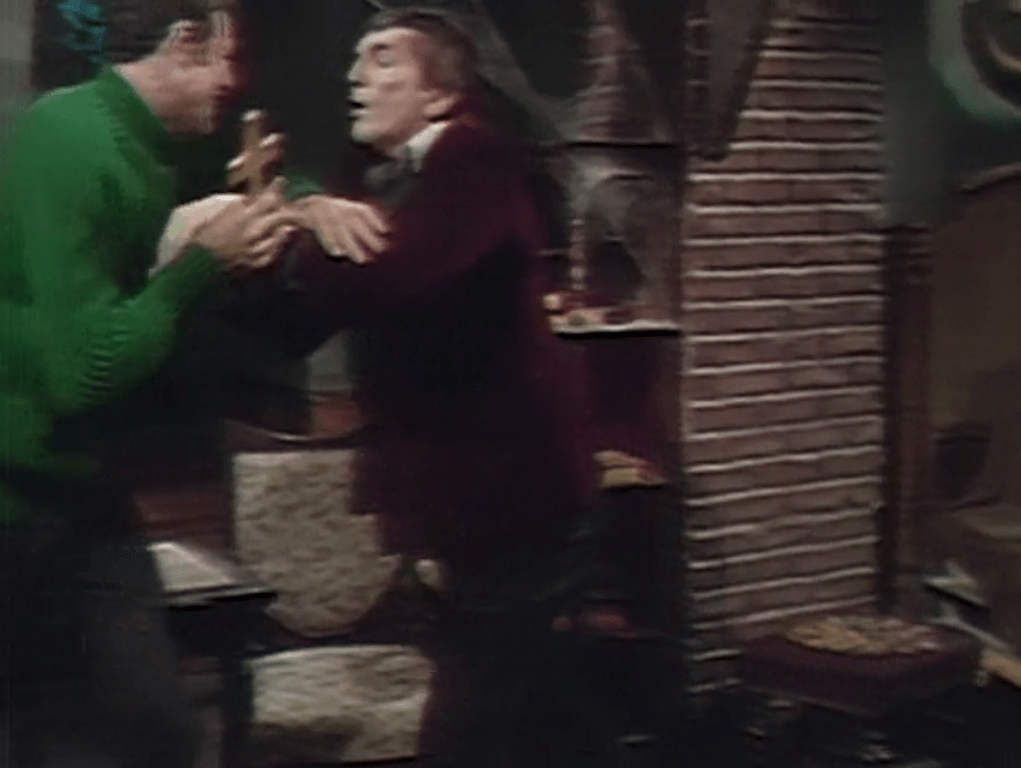
When the vampire’s helper Adam comes to steal the cross from him, Barnabas exclaims “The cross! The cross, it will save us both!” Adam takes the cross back to the vampire. He offers it to her. She recoils from it and tells him to destroy it. She runs away, and he looks at it in wonder, not knowing what it is. We are left to ask if he will find out what gives the cross its power, and if learning about it will indeed bring salvation both to him and Barnabas.
Over the next few weeks, much will change on Dark Shadows. There will be major changes in the cast, several storylines will be resolved, new storylines will start, and the pacing will become more deliberate. As that goes on, the show will curve back around to something at once more reminiscent of its early days and more suggestive of what is to come than is this utterly zany period. Not that it will stop being weird- the weirdness will just be developed in greater depth over longer periods. I would say that this bizarre detour into Christian piety marks the most remote point it ever reached in its rambling away from its original concept.
Well-meaning governess Vicki has found a grievously injured Barnabas Collins in the woods. Barnabas insists Vicki not take him to a doctor or anyone else, but hide him somewhere no one will find him. She thinks of a secret door to the long-abandoned west wing of the great house of Collinwood, and uses that to take him to a hiding place there.
For the first year of Dark Shadows, the west wing was strongly associated with Vicki. In #14, she alone saw the locked door separating the bedrooms from the west wing open and close, apparently by itself. That was the first unequivocal evidence of supernatural activity on the show. In #84, Vicki’s charge, strange and troubled boy David, led her into the west wing, the first time we had seen its interior. He then trapped her in a room there, hoping she would die. She would languish in that room until David’s father, high-born ne’er-do-well Roger Collins, rescued her in #87. When Vicki was engaged to Roger’s nemesis Burke Devlin in #338, matriarch Liz offered to restore the west wing and let Vicki and Burke live there. After Burke died in a plane crash in #345, Vicki vowed to go on with the project of restoring the west wing. In #347, permanent houseguest Julia Hoffman, MD, exploited Vicki’s interest in the west wing to get her to stare into a crystal supposedly taken from a chandelier there until she is in a state of deep hypnosis.
More recently, Frankenstein’s monster Adam stayed in the west wing for many weeks as the guest of heiress Carolyn. Vicki’s connection with the wing was renewed when Adam abducted her and hid her there for a few days starting in #553. Today, Vicki hides Barnabas in Adam’s old room, re-establishing the west wing as her space. Thus we loop back to a theme that goes back to the third week of the show.
Later in the episode, Barnabas wakes up and is distressed to find that it is almost sunset. He pleads with Vicki to bring him a cross as quickly as possible. The audience knows, but Vicki does not, that Barnabas is the victim of vampire Angelique. Vicki’s ignorance of this point reminds us that she has been excluded from the show’s A-plots ever since #211, when Barnabas was introduced, himself in those days a vampire. Her calm departure to go fetch a cross reminds us that she knows this part of the house well. Every room in it is stuffed with bric-a-brac, undoubtedly she will have seen something nearby that is in the shape of a cross.
Meanwhile, Julia is in a hospital room, visiting local man Joe Haskell. Julia has become Barnabas’ inseparable friend, and Joe is Angelique’s other victim. She does not know that Angelique is the vampire, though she had surmised as much in #608. She questions Joe. At first he denies everything, but after she discloses that she was for a time the victim of yet another vampire he tells her that she must know why he can’t tell her who has been sucking his blood. She asks if the suave Nicholas Blair is hiding the vampire. Joe closes his eyes and scoffs at the idea. This reaction does nothing to curtail Julia’s suspicions of Nicholas.
Julia goes to Nicholas’ house. He genially escorts her into his living room. There, he takes a seat while she stalks about the room and tells him what she knows about him. Barnabas has a self-defeating habit of showing his cards to his adversaries, and longtime viewers may at first be afraid Julia has picked it up from him. Since Nicholas is a warlock who not only controls Angelique but has a wide range of magical powers that he uses to promote Satan’s interests on Earth, he is not an opponent with whom one can afford to make mistakes. Angelique herself was once a witch who, in #378, was able to turn a man into a cat at a moment’s notice. Nicholas’ command of the black arts goes far beyond Angelique’s. He was able to strip Angelique of her powers, raise her from the dead at least twice, and turn her into a vampire. Julia is simply a mad scientist, and she does not have any equipment with her. There’s no telling what Nicholas might do to Julia if their interview displeases him.
On his great blog Dark Shadows Every Day,Danny Horn lists three reasons why we know Julia will survive this confrontation without being turned into a toadstool:
Really, the thing that everybody wants to know is: why can’t the Stormtroopers shoot straight in Star Wars? It turns out there are three simple answers. #1. Stormtroopers shooting laser bolts are more interesting to look at than Stormtroopers who stand around complaining. #2. Shooting Luke Skywalker in the head halfway through the first movie is going to leave a rather obvious gap in the trilogy. #3. ‘Strong Guy Kills Weak Guy’ is not headline news.
Danny Horn, Dark Shadows Every Day, “Episode 619: The Gunslinger,” posted 4 April 2015
This is all very true- of course Nicholas and Julia will not leave each other alone indefinitely, of course the show cannot spare her, of course she will overcome her disadvantages and come away from their showdown with the upper hand. But it misses the point. Suspense comes when we know what must happen, but cannot see any way it might happen. What makes the scene work is the moment when Julia tells Nicholas that Barnabas is missing. That is news to him, and as Danny says elsewhere in his post, it is “the first sign of a crack that’s going to bring his entire operation crashing down,” as his shocked reaction suggests it might be.
The scene is one of the best in the series, though it is marred by a miscalculated ending. In the early part, we see Julia making an effort to keep her cool while Nicholas sits watching her smugly. She succeeds in keeping her brave face on until she senses that she has Nicholas off guard, at which point she moves in for the kill and tells him about Barnabas. She is then firmly in command. He composes himself and dismisses her.
That’s when it goes wrong. When Julia is heading out the door, Nicholas recovers his smugness and tells her that he must admit that he admires her for coming to see him. She looks alarmed and asks why. He replies, in a half-whisper, “You know.” She hastens out. I can see that this ending may have seemed like a good idea. We clearly saw in the beginning how hard it was for Julia to keep her fear in check and how easy it was for Nicholas to bask in the superiority his powers give him over a mere mortal. Though Julia has emerged as the winner in this engagement, she still has grounds for immense fear, and he for boundless self-confidence. But it is so broadly drawn as to be confusing. Has Nicholas already found a way to turn Julia’s success against her? Has she realized too late that she has made a mistake we aren’t aware of?
We learn shortly after that neither of these things has happened. Angelique comes upstairs. She sees Nicholas being very still. She makes several attempts to engage him in conversation. He finally approaches her and strikes her across the face. He then orders her to undo what she has done to Barnabas before it ruins his plans.
This is the second time Nicholas has slapped a woman in the face. The first time was in #610, when he struck Frankenstein’s monster Eve. Humbert Allen Astredo and Marie Wallace executed that business well, as he and Lara Parker execute it well today. For that matter, Grayson Hall and Lara Parker had done a good job when Julia slapped Angelique in the face in #535. Watching them, you can admire trained professionals practicing a specialized aspect of their craft. But since Nicholas has such vast powers, he is persuasive as a villain only when we are left guessing about just what he is up to. When we see him is reduced to hitting a woman, he shrinks from avatar of Satan to cheap pimp.
After Julia leaves Nicholas’ house, she lingers in the woods outside, watching his front door. She sees Nicholas leave the house, then sees Angelique and realizes that she is the vampire.
Julia is the most intelligent character on the show, and while we watch her in the woods her face suggests that she is thinking clever thoughts. Unfortunately, we hear her interior monologue in a recorded voiceover, and her lines are remarkably obtuse. On the heels of her overdone fear on the way out of Nicholas’ house, it does as much to undercut Julia’s image as a smart person who can win a duel with the Devil as Nicholas’ physical abuse of Angelique undercuts his image as a demonic sorcerer.
Well-meaning governess Vicki Winters came to the great house of Collinwood in #1, called to take charge of the education of strange and troubled boy David Collins. Vicki’s attempt to befriend David was the only theme that consistently generated interesting scenes in the first several months of Dark Shadows, largely because Alexandra Moltke Isles and David Henesy were able to overcome weak writing by subordinating their dialogue to a story they were telling with body language, facial expressions, and tones of voice. Often as not, they used their lines as devices to switch meaningful silences off and on.
Another arc that occasionally brought some life to Dark Shadows in those early days was the conflict between David’s father, high-born ne’er-do-well Roger Collins, and the family’s sworn nemesis, Burke Devlin. Vicki and Burke came to town on the same train, and a romance would bud between them. But Vicki is, after all, modeled on Jane Eyre, and it is not for nothing that her charge’s father has a name that sounds rather like “Rochester.”
Several times in the early days, it seemed that something might take shape between Vicki and Roger. They bantered suggestively in #4, went on a date in #78, and when they found themselves alone in an abandoned house in #96 Roger joked about carrying her over the threshold. In the original series bible, Shadows on the Wall, writer Art Wallace gave it as the first option that when Vicki’s mysterious origins were revealed, we would learn that she was the daughter of Roger’s brother-in-law, the estranged husband of his sister Liz. Wallace allowed that it might be more story-productive to have her be Liz’ daughter, and from the time Mrs Isles was cast, her strong resemblance to Joan Bennett pointed the show in that direction. The advantage of making Vicki the daughter of the unseen Paul Stoddard would be that she and Roger could marry. Of course, it is a soap opera, so if she were Liz’ unacknowledged daughter, that fact would come out when she and Roger were about to marry.
Nothing did come of Vicki and Roger’s flirtations. The relationship between Vicki and David and that between Roger and Burke were subsumed in the first of the show’s major supernatural storylines, the tale of David’s mother, Laura the immortal Phoenix. In the course of that storyline, the question of Vicki’s parentage was, for the last time, unceremoniously dropped. By the time Laura vanished in a cloud of smoke in #191, there was nothing left unresolved in Dark Shadows 1.0, and it was time to bring on the vampire.
Vicki never really found her footing thereafter. For a while vampire Barnabas Collins kept saying to his sorely bedraggled blood thrall, Willie Loomis, that he planned to make Vicki his next victim, but he didn’t get around to biting her, not even when she invited herself to spend the night sleeping at his house in #286.
Vicki traveled back in time in #365, taking us with her to the year 1795 and turning Dark Shadows into a costume drama.Vicki’s displacement in time raised the hopes of longtime viewers that she would do what Barnabas had done in the previous several months and scramble to pretend that she was native to the alien period of history in which she had suddenly materialized. But that didn’t happen. Instead, the show turned her into an intolerable moron, yammering at the actors about the roles they had played in the first 73 weeks of the show. By the time the people of Collinsport finally sent her to the gallows in #460, much of the audience was on their side.
After Vicki and Dark Shadows came back to contemporary dress in March 1968, Barnabas finally did bite her, but her time as his victim only lasted a few days. He was cured of vampirism in #466. Shortly after, Vicki found herself in a romance with an angry little man named Peter who prefers to be called Jeff. Peter/ Jeff is exceedingly unpleasant to watch, and Vicki shares more and more of her scenes with him. Fortunately, Peter/ Jeff does not appear today, but Vicki spends most of her time talking about him, reminding us of the dead end where she has ended up.
Yesterday, Roger saw Peter/ Jeff locked in a passionate kiss with another woman while Vicki was in the next room. He yielded to Peter/ Jeff’s demand that he not tell Vicki about this, then had a nightmare in which Vicki turns into a skeleton during her wedding to Peter/ Jeff.
Today, Roger tells Vicki about the dream and declares it to be a sign that she must not marry Peter/ Jeff. She is puzzled. Roger habitually scoffs at dreams and the supernatural, so she cannot understand why he would take this nightmare so seriously. She asks if he has other reasons for opposing her marriage. He flashes a pained expression, indicating his regret that he did not tell her what he saw Peter/ Jeff doing and his sense that he is honor-bound not to tell her now. He says no, the dream is all there is. Vicki does not accept this. She says “Well, I think there has to be. And I don’t think it’s anything to do with the way you feel about me, so that only leaves Jeff. Why do you feel hostilities toward him?”
Anyone who remembers the early Jane/ Rochester hints and is still shipping Vicki/ Roger (there are some even now) will be disappointed by the utter blandness of Vicki’s “I don’t think it’s anything to do with the way you feel about me.” I sympathize- Vicki and Roger would be a lot of fun to watch as an unhappily married couple, certainly more fun than anything involving Peter/ Jeff.
Meanwhile, Barnabas has himself become the victim of a vampire, his ex-wife Angelique. She has dragged him off to some spot in the woods and told him she will turn him back into a vampire in a few days. She leaves him alone at dawn, but he is too weak from loss of blood to go far. He wonders who can help him; he decides that he cannot call on any of the friends who have been helping him in his ongoing battles, since Angelique would think of them as soon as she arises. Vicki comes to mind as someone Angelique would not associate with him. There is some verbiage about his tender regard for Vicki suggesting he would not involve her in anything so dangerous, but of course the real point is that Vicki is not part of Barnabas’ story. Just as the scenes with Roger loop back to the failure of the Jane/ Rochester romance to take wing, so Barnabas’ decision to turn to Vicki loops back to her exclusion from the vampire story.
Barnabas is staggering through the woods, calling Vicki’s name. She is far away in the great house, but has a telepathic sensation that he is on the move. She goes into a mild trance and leaves the house. Evidently the connection they established during the brief period when he was sucking her blood has not vanished entirely. In the woods, Barnabas falls to the ground, and a moment later Vicki finds him there. He is happy to see her, but says she has come “too late.” Barnabas seems to fade out of consciousness. Vicki leans down to cradle his head in her hands, and exclaims “It can’t be! It can’t be!”
The audience wouldn’t have known it in 1968, but it was most definitely too late for Vicki. Mrs Isles had already decided to leave the show; her last episode would be recorded on 12 November 1968, less than a week after this one aired. In one of the MPI interviews, she said that this was because she was going to have a baby. “I was getting pregnanter and pregnanter,” she said, and “no one was making any moves” to write Vicki out of the show. Considering that Rosemary’s Baby was a big hit at the time, she was worried “that my pregnancy might be a convenient element to the plot,” so she took steps. Eventually the part would be recast, first with Betsy Durkin, then with Carolyn Groves. Vicki barely had any reason to be on the show even when Mrs Isles was playing her, and those other actresses didn’t get any more opportunities to contribute. Her departure was the true end of the character.
An autumn dusk has settled over Collinwood, bringing with it not the fear of night but a renewed hope of happiness for a young woman long acquainted with the terrors that have plagued these premises. But as the deepening dark surrenders to the night, a new threat, evil in its creation and awesome in its consequence, will reveal its final purpose, the destruction of Victoria Winters.
We then cut to a scene of Vicki with the evil creation that is destined to destroy her, her fiancé Peter. In place of a personality, Peter has a compulsion to insist that no one use his right name. Instead, he wants to be called “Jeff.” He also has a habit of pawing his scene partners and occasionally jerking them around violently. This loathsome man continually fondles Vicki in their scenes together, each time prompting Alexandra Moltke Isles first to stiffen, then to force an awkward smile when she remembers that her character is supposed to like the creep. It is painful to watch, and the more scenes Vicki has with Peter/ Jeff the sooner we hope she will leave the show.
A woman named Eve has seen Peter/ Jeff and recognized him from their previous acquaintance. She finds Peter/ Jeff alone on the terrace outside the great house of Collinwood and confronts him. He looks as uncomfortable alone with her as Vicki does alone with him. It is satisfying to see Peter/ Jeff get a taste of his own medicine, all the more so for regular viewers who know that Eve is a homicidal maniac and hope she will do him in before he blights any more episodes.
Eve has been kissing Peter/ Jeff passionately for several seconds when sarcastic dandy Roger Collins speaks up and says that he has not been introduced to her. She runs off, and Peter/ Jeff demands that Roger not tell Vicki what he has seen. Roger will not agree to that, but once the two of them are alone with Vicki in the drawing room he backs down and lets Peter/ Jeff off the hook. When Peter/ Jeff realizes Roger will keep his secret he breaks into a gleeful smile. Evil has triumphed once more.
Roger consigns Vicki to her fate, while her destroyer chortles with glee. Screenshot by Dark Shadows Before I Die.
In the early days of Dark Shadows, Roger was rather a dangerous villain. One of his crimes was perjury in a case that sent another man, one Burke Devlin, to prison for a homicide in which they were both implicated. In #201, Roger admitted to that perjury in front of Burke in this very room. That admission came after a long story arc involving the return of Roger’s estranged wife Laura to Collinwood. The Laura story absorbed all the dramatic significance of the conflict between Roger and Burke, leaving Burke nothing to do in response to Roger’s admission but to peace out. To viewers who remember that Vicki was once an interesting character and still have hopes that she will shake free of Peter/ Jeff’s baleful presence, Roger’s concession to Peter/ Jeff is an even bigger disappointment than was the too-late resolution of the Roger vs Burke story.
At the end, Roger has a dream in which it is revealed to him that if Vicki marries Peter/ Jeff, she will die. We suspect that he has missed his last chance to prevent this happening.
A woman named Eve sees a man standing on the terrace of the great house of Collinwood. She addresses the man as “Peter Bradford.” Regular viewers know that this is indeed his name, but we also know that he prefers to be called “Jeff Clark.” Peter/ Jeff has died and came back to life since he was first known as “Peter Bradford,” so I suppose you could say that’s a case of deadnaming. But while most transfolk tend to be patient when people inadvertently deadname them, Peter/ Jeff is a huge jerk about correcting people who use his former name. Yesterday twelve year old David Collins called him “Peter Bradford,” and he grabbed the boy and shook him until it looked like he had given him a concussion.
Eve is also a returnee from the world of the dead. Doubly so; her body is a Frankenstein creation made of parts salvaged from corpses, while her memories and personality are those of eighteenth century homicidal maniac Danielle Roget. Peter lived in that same era, and when Eve/ Danielle recognizes him we learn that they knew each other then. Peter/ Jeff doesn’t assault her as he did David; she’s his own size. He doesn’t recognize her, which she attributes to the fact that she looks different than she did when they knew each other. He keeps whining that his name is “Jeff Clark,” but she isn’t having it.
Meanwhile, Peter/ Jeff’s fiancée, well-meaning governess Vicki, is in the drawing room, having a conversation with matriarch Liz. There is a blooper in the middle of this conversation. Liz is supposed to say something like “Then you’ve resolved all your difficulties,” but Joan Bennett stumbles over the words. Alexandra Moltke Isles improvises a response that makes sense of it. That response is smooth enough, but she delivers the rest of her lines very quickly and with unusually little eye contact with her scene partner. Perhaps that is because she was afraid the improvised line was going to put the scene over time, or maybe she realized she had called attention to Bennett’s flub and was nervous because she had embarrassed a big star.
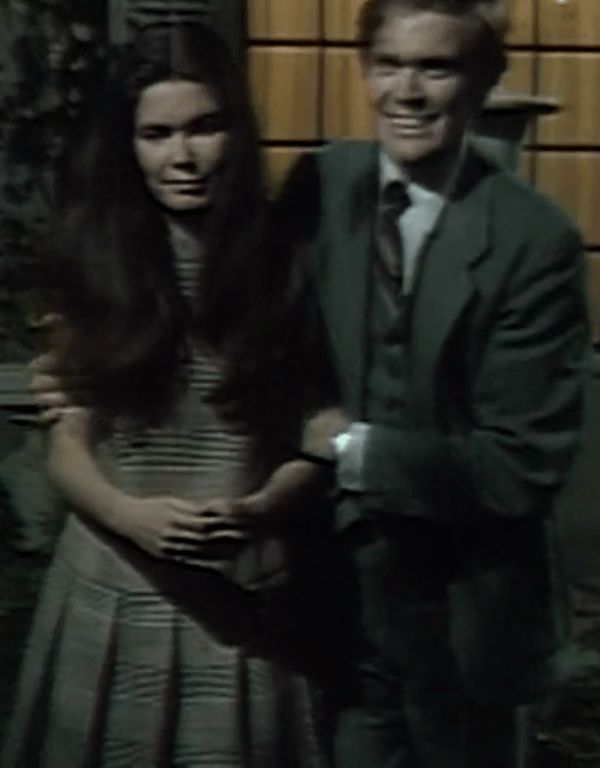
Or maybe Mrs Isles was nervous because her next scene was going to be with Peter/ Jeff, and she knew it would involve Roger Davis putting his hands on her. As they exit, Peter/ Jeff clutches Vicki by wrapping his arms around her in a remarkably awkward fashion, and she visibly squirms. This is most likely Mrs Isles’ discomfort arising from Mr Davis’ habit of physically assaulting his scene partners. A charitable viewer just might be able to believe that it is Vicki’s discomfort because Peter/ Jeff just spent the whole scene telling her transparent lies. He doesn’t want to tell her about his encounter with Eve/ Danielle, and makes up totally unconvincing excuses for his distracted state. Perhaps Mrs Isles channeled her unhappiness at being yoked with Mr Davis into her expression of Vicki’s dissatisfaction with the loathsome little man she is engaged to marry.
Peter/ Jeff steers Vicki offscreen.
Once Vicki and Peter/ Jeff are gone, Eve/ Danielle emerges from the bushes whence she had been spying on them. Liz comes out to the terrace and sees Eve/ Danielle. She asks who she is. When she does not answer, Liz tells her that she knows- she is the angel of death. Eve/ Danielle is startled by this, and hurries away.
The next scene takes place in the house of suave warlock Nicholas Blair. Nicholas has been keeping Eve/ Danielle there since she came to life. She has returned from Collinwood. Nicholas is upset with her for going out without his permission. She taunts him, and he slaps her. He threatens to kill her, and she says that while she does not know what his plans are, it is clear to her that she figures too prominently in them for him to do that.
Coming so shortly after we saw an actress give strong signs of unease at contact with Roger Davis, Nicholas’ slap to Eve/ Danielle’s face is a lesson in how professional actors handle scenes involving physical violence. Eve/ Danielle is relaxed before the slap and in shock after it. Her reaction gives the scene its energy. If Marie Wallace had reason to believe Humbert Allen Astredo would actually hit her, she may well have been as tense before the slap as Mrs Isles was before Roger Davis slithered his arms around her, and the scene would have dribbled out as lifelessly as does Peter/ Jeff’s scene with Vicki.
Once Nicholas concedes that Eve/ Danielle is important to his plans, she relaxes again and decides she may as well tell him about her encounter with Peter/ Jeff. Nicholas is intrigued, and disturbed. He tells Eve/ Danielle that “If it is true that they are one and the same, then there are forces at work here that I don’t know about.” Eve/ Danielle’s memory of her previous existence is very incomplete, and she wants Nicholas to help her to learn more about herself. Once he has heard about Peter/ Jeff, he is eager to oblige. He hypnotizes her.
At this point, my wife, Mrs Acilius, expressed frustration. “He’s going to hypnotize her and afterward she won’t remember anything! It’s only interesting if she remembers.” Eve/ Danielle does have a flashback to 1795, but at the end she seems to come out of the trance on her own. She turns to Nicholas, calls him by name, and says that she remembers Peter Bradford and she loves him. Since Nicholas doesn’t give her a post-hypnotic suggestion and snap his fingers, it seems likely she will remember her past with Peter.
When Danielle was introduced, I assumed that the name “Roget” was a case of deadline-induced selection. She is based on Madame DuFarge from A Tale of Two Cities, so she had to be French. But the writer didn’t have a list of French surnames at his fingertips, so he looked at his desk, saw a copy of Roget’s Thesaurus, and went with that. Perhaps that was what happened, but today Eve/ Danielle lives up to her namesake and goes into the synonym business. She calls Peter/ Jeff by his original name. She is on the receiving end of synonymy from Liz, since “the angel of death” is as good a name for her as any. And one of the memory gaps Eve/ Danielle wants Nicholas to help her fill is her previous name.
Marie Wallace plays Danielle in the flashback, even though she had mentioned in the first act that she looked different in those days. This occasions much discussion on the fansites. Here is the debate on the Dark Shadows Wiki:
During the fiashback scene, Danielle Roget should have been played by Erica Fitz instead of Marie Wallace. Fitz had previously portrayed Danielle Roget in episode 594, so it would have made sense and for character continuity to continue using the same actress. [Addendum: There are strong reasons to argue otherwise as well. One could argue that this is a memory that Nicholas is conjuring in Eve, so it’s from Eve’s perspective, and she would naturally see herself in her current guise, not even knowing what Danielle Roget looked like. This is also a reasonable place for dramatic license to prevail. The scene is very short, and it wouldn’t have been especially practical to have an additional actress. It’s also possible that viewers may have been confused if another actress was in the scene–Erica Fitz was on the show for only two episodes, so viewers at the time might not even have seen or not fully remembered what she looked like. Aside from that, it’s also possible Erica Fitz was not available.]
Discussion under “Bloopers and Continuity Errors” in “610” on The Dark Shadows Wiki.
In a comment on his own post about the episode on Dark Shadows Every Day, Danny Horn puts it more succinctly:
Yeah, I think the in-universe explanation is that the flashback pictured at the top of this post is Eve’s hypnosis-assisted memory of the event, so she’s picturing herself as she is now.
The real-world explanation is that Marie Wallace is playing Eve/Danielle now, and exactly nobody wants Erica Fitz to come back and appear in the flashback.
Comment left 23 March 2015 by Danny Horn on “Episode 610: Inexplicable You,” Dark Shadows Before I Die, 21 March 2015.
For my part, I’m sure Erica Fitz Mears is a very nice lady, and we should all give her money to help with her health problems. But no, she was not a good actress and I do not regret that she did not get more work on screen. Since Mrs Mears was only in two episodes, today’s flashback might have been an opportunity to give some other actress a chance to show what she could do as Danielle. But Miss Wallace does a very good job, and rounding the episode with two confrontations between the same pair of performers does a great deal to strengthen its structure. It would probably have been a mistake to cast anyone else in the flashback.
The flashback scene does come as bad news to longtime viewers, for reasons that have nothing to do with the casting of Danielle. When in November 1967 the show needed to develop a backstory for vampire Barnabas Collins, it took us back to 1795 and introduced Angelique, a maniacal ex-girlfriend who was determined to disrupt Barnabas’ new romance. That was a triumph that turned Barnabas from a stunt that boosted their ratings sufficiently to ward off cancellation into one of the major pop-culture phenomena of the 1960s, and Angelique herself became one of the show’s most important characters. That they are trying the same tactic with Peter/ Jeff, right down to a dramatic date of 1795, leads us to fear that they see him as a permanent part of the cast, and that they want to tie Eve/ Danielle as closely to him as Angelique is tied to Barnabas.
Today is devoted to non-supernatural stories. More precisely, we should call them post-supernatural, because they show people dealing with the aftermath of spells and curses.
The episode consists largely of solo performances. As troubled matriarch Liz, Joan Bennett has two scenes in which she is alone with her own voice in a recorded monologue. Dark Shadows has long used these monologues when characters were alone on screen and their faces would silently show how they felt about the thoughts their voices expressed on the soundtrack, but recently it has been experimenting with new ways of deploying them. For example, #581 marked the first time this device was used to share the thoughts a character was having in the middle of a conversation. Today Liz has a remarkably intense debate with her own recorded voice, first in her bedroom, later in an old graveyard.
Some time ago, wicked witch Angelique cast a spell causing Liz to be obsessed with death. Since then, Angelique lost her power and died. But Liz had been the victim of similar spells before, and is prone to depression in any case, as witness the fact that she once holed up in her house for eighteen years. So even if the spell broke when Angelique was de-witched, it makes sense Liz would continue to suffer the psychological damage it inflicted on her.
Between Liz’ two solo scenes, her brother Roger knocks on her bedroom door, This scene lasts less than a minute, but Louis Edmonds shows us a variety of emotions as he talks to Liz through the door, then opens it and finds she is not there. His discovery that he was giving a soliloquy when he thought he was having a conversation makes for a different kind of solo scene.
The other post-supernatural story concerns well-meaning governess Vicki and her ex-fiancé, an unpleasant man named Peter who insists on being called Jeff. Angelique became a vampire after her most recent death, and for a time she took Peter/ Jeff as her victim. The effects of the vampire’s bite made it impossible for Peter/ Jeff to sustain his relationship with Vicki. Peter/ Jeff has been freed from Angelique’s influence, and even his memory of the experience has been erased. Today he comes to ask Vicki to take him back. But he can explain nothing to her about what happened to him. Vicki is frustrated with Peter/ Jeff. Feeling that he does not trust her enough to tell her what happened, Vicki rejects Peter/ Jeff’s attempt at reconciliation. Alexandra Moltke Isles plays Vicki’s frustration with great force. Considering that her scene partner is the lamentable Roger Davis, this, too, qualifies as a solo performance.
Dark Shadows never had more than three credited writers producing scripts at a time. Often it had only two, and there were stretches when a single writer would have to crank out a script every day for weeks. Since they worked under those conditions, the writers’ methods would often be made obvious. So, Art Wallace, who was credited as the writer of the first 40 episodes, started by crafting the structure of an episode, and fitted incidents and information into that structure as time permitted. Ron Sproat, another very prolific contributor, also put structure first, sometimes resulting in a slow-paced script. Today’s author, Gordon Russell, seems to have taken the opposite approach, cramming each script with action and letting the material shake itself out as best it could. So there is some interesting stuff in this one that doesn’t really connect to anything.
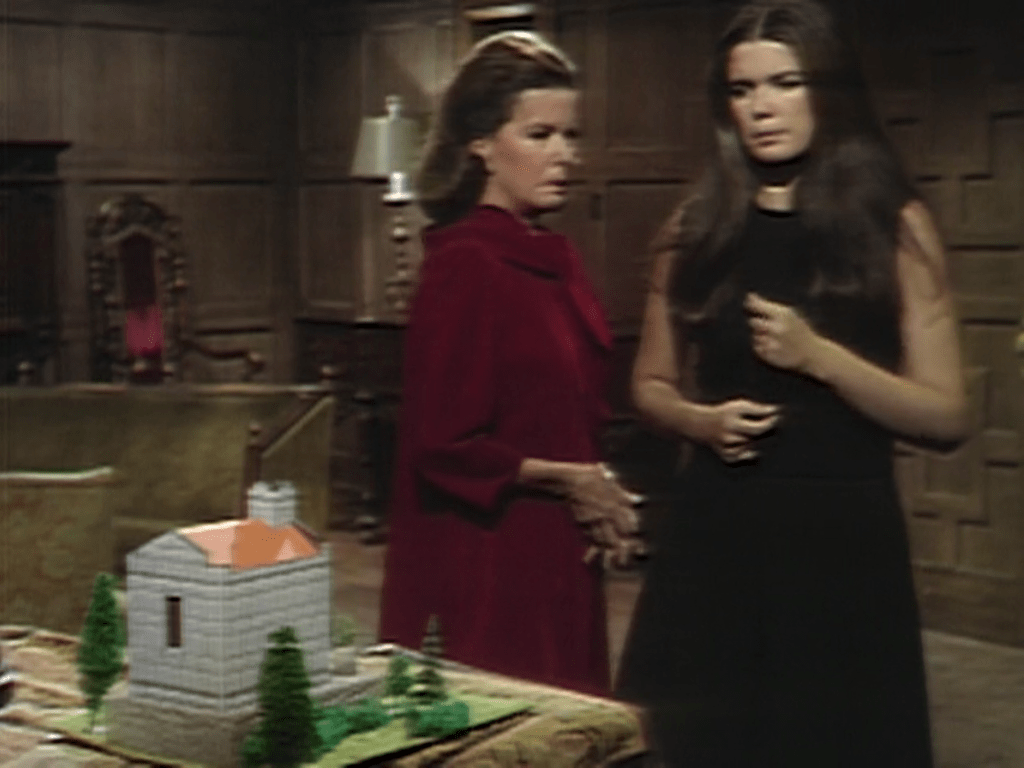
For example, we open today with Liz contemplating an architects’ model of a mausoleum. It really is a lovely little thing.
We have a scene where Vicki is horrified by the idea of the mausoleum. Liz insists Vicki be her voice after her death and stand up to her family for her, seeing to it that she is buried in the mausoleum as she wishes. The show hinted very heavily for a long time that Vicki is Liz’ unacknowledged daughter, but they dropped that a long time ago. As it stands, Vicki is a member of the household staff. As such, she would put herself in an awkward position were she to oppose the family’s wishes after Liz’ death.
Roger enters, demands that Liz forget about everything related to death, and smashes the model. That’s all very dramatic, but it doesn’t make any sense. Though he might well be distressed at Liz’ fixation on the idea that she will soon be buried alive, everyone dies eventually, and rich people often build elaborate mausoleums. Roger’s assertion that the architects must think they are humoring an insane woman and the villagers are all laughing at her is just as nonsensical as his domineering attitude is unconnected to his character as it has been developed up to this point. All of it is entirely irrelevant to the progress of the story.
After that, Liz leaves the room, and Roger talks to Vicki for a bit. He says that Liz’ trouble seemed to start when he married a woman named Cassandra. Unknown to him, Cassandra was actually Angelique in a wig. He tells Vicki “We’ve never been very lucky in love, you and I, have we?,” and edges closer to her. This may come as a bit of a jolt to longtime viewers. In the early days of Dark Shadows, there were a few hints that Vicki and Roger, who are after all modeled on Jane Eyre and Mr Rochester, might strike up a romance. Since they are both single, all of a sudden it seems possible they might get together after all.
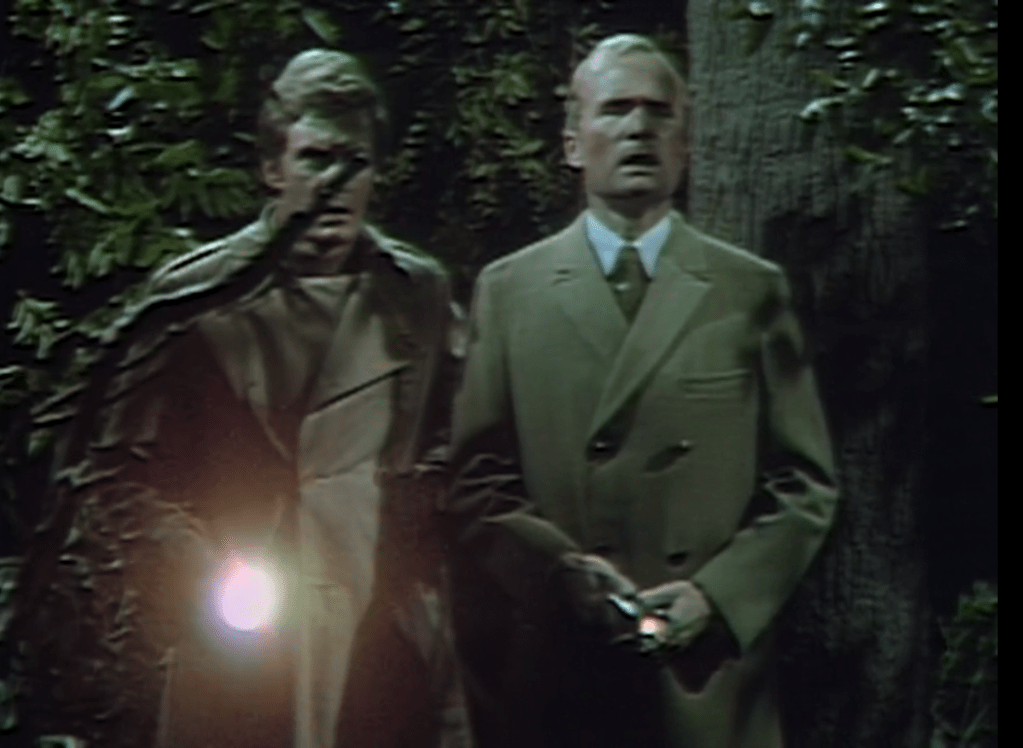
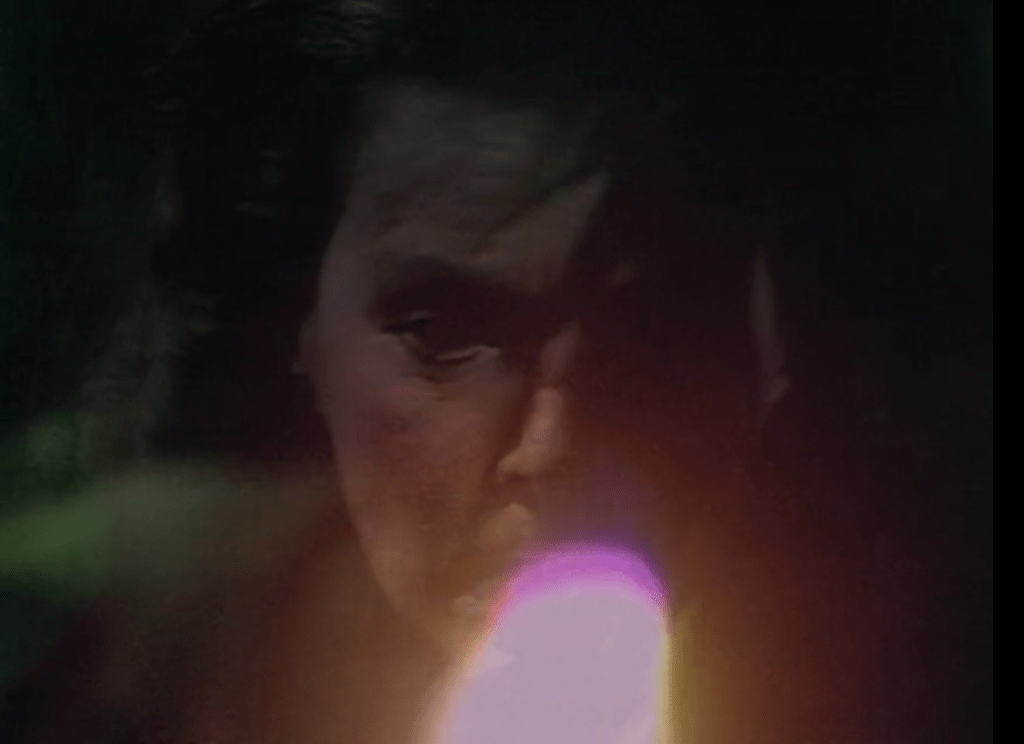
Later, Roger and Peter/ Jeff are outdoors looking for Liz. Each of them shines his flashlight directly into the camera. This is a Dark Shadows trademark. Sometimes it is clearly accidental; Peter/ Jeff does it once, briefly, and that may be an accident. But Roger does it twice, and each time the camera lingers on it. The first time comes as we cut from Liz in the graveyard to Roger and Peter/ Jeff, the second time as we dissolve from them back to Liz.
Cut to a closeup on Roger’s flashlightPeter/ Jeff accidentally shines his flashlight directly into the cameraDissolve to Liz from a second closeup on Roger’s flashlight
Liz is at the grave of Peter Bradford, which is to say Peter/ Jeff. He died in the 1790s and returned from the dead in March, a fact which is obvious to the audience and to Vicki but which he persistently denies. These denials are pointless and dull, but are the closest thing Peter/ Jeff has to a personality, so we can’t very well blame him for sticking to them. Peter/ Jeff finds Liz at his grave; she recognizes him as the dead man and faints. He carries her home. If there is any significance to any of this, it is apparently none of the audience’s business. The script certainly isn’t going to show us what it is.
Friday’s episode ended with Frankenstein’s monster Adam in the act of strangling well-meaning governess Vicki as she lies in her bed at the great house on the estate of Collinwood. In today’s opening Adam goes on throttling Vicki for quite a while. At length heiress Carolyn and recovering vampire Barnabas mosey into Vicki’s room. Adam is long gone, and Vicki is still alive. Permanent houseguest Julia is a doctor, and we hear a report of her prognosis that Vicki will be all right. Carolyn has been hiding Adam in a spare room; suave warlock Nicholas shows up and does some damage control. He suggests to Carolyn that Adam might not be guilty of the attempted strangulation, then goes to Adam’s room to talk with him while they wait for Carolyn to come. By the time she gets there, Adam and Nicholas have their story straight. Carolyn accepts Adam’s denials. At that point, everyone loses interest in Vicki and what happened to her.
Nicholas had put Adam up to demanding that Barnabas and Julia build him a mate. Adam had threatened to kill Vicki if they did not comply. Yesterday, he concluded that they were not taking him seriously, and that was his motive for the murder attempt. At the end of today’s episode, Barnabas goes back home to the Old House on the estate and finds Adam waiting for him. Adam tells Barnabas that he has decided they should use Carolyn as the donor of the “life force” that will bring the mate to life.
Adam’s attack on Vicki was Friday’s week-ending cliffhanger. It might have generated substantial suspense, as it has been so long since Vicki has had much to do on the show that it is possible we might be seeing the last of her. But, as Danny points out, they botch the scene badly:
I mean, there is obviously no way that she could have survived this attack. Adam is an enormous Frankenstein creature; it’s been established that he can bend steel bars just by giving them a stern look. Even for a soap heroine, there’s no way that Vicki could maintain structural integrity under these circumstances. She’s just not built for it.
It’s quite a grisly little scene, actually, because it happens so quickly. She doesn’t really get a chance to react. She was sleeping, and then Adam put his hands around her neck, and now she’s dead, and she doesn’t even know what’s going on…
By the time Carolyn returns to the scene of the crime, Julia’s already been and gone — the invisible off-screen soap doctor who doesn’t actually appear in this episode.
Barnabas tells Carolyn that Vicki’s alive, but she’s in shock. I am too, actually; our lame Frankenstein monster can’t even kill a governess at point-blank range.
Danny Horn, “Episode 586: The Invisible Woman,” posted 17 February 2015 on Dark Shadows Every Day.
Danny revisits this point later in his post:
Problem number one is the lack of consequences. They actually opened the week with the murder of a main character — and ten minutes later, everyone’s back to starting positions. Vicki’s not dead, and Adam’s not even being blamed for the assault.
Now, I’m not complaining that Adam hurt somebody and isn’t expressing any noticeable remorse. It’s true that today’s felony places Adam squarely in the villain column, but that’s fine. Fantasy-adventure stories need villains, and villains are supposed to do villainous things.
The consequences issue is that Adam basically just killed Vicki, and it hardly even registers as a plot point. There’s no investigation, no confession, and no character development; it’s just a thing that happened, and we can all forget about it.
Danny Horn, “Episode 586: The Invisible Woman,” posted 17 February 2015 on Dark Shadows Every Day.
Adam’s threat to kill Vicki never seemed to fit with his personality, but considering that he accidentally killed his friend Sam because he didn’t know his own strength, we could at least imagine that he might inadvertently carry it through. And as Danny says, the brevity and simplicity of the scene add to its force if we think it might actually show Vicki’s death. She was the show’s protagonist for its first 38 weeks and an important part of it for a long time after, and for her life to end so abruptly that she doesn’t even have a chance to scream, for the sake of a plot point that isn’t even her killer’s own idea, would be shocking in the pointless, unsatisfying way that violent deaths are shocking in real life. But if Adam can shake Vicki by the neck from the opening teaser through the first scene without seriously injuring her, he clearly isn’t going to kill anyone, and Barnabas and Julia may as well go off and do something else.
Nicholas is Dark Shadows’ main villain at this point; he is supposed to seem so powerful that we can’t imagine how the other characters will overcome him, and so wicked that we will forgive them for any expedient they can find that will work against him. This is currently the show’s main source of suspense. As Danny explains, they do serious damage to that today:
Nicholas is supposed to be the real mastermind behind this operation, so Adam still ends up reduced to being the dumb muscle, rather than a strategic thinker.
Unfortunately, Nicholas’ management skills are also kind of questionable at the moment. We see him scolding Adam for trying to kill Vicki, but where has Nicholas been for the last couple weeks?
It’s up to Adam to fill Nicholas in on the latest plot development — that Barnabas has chosen Maggie to be the sacrificial victim in their Bride of Frankenstein mad science experiment, giving her “life force” so Adam’s new mate can live.
Nicholas has a crush on Maggie, so he’s furious about this, but it’s a hollow moment. If Nicholas is the manipulative wizard running the show, then he should have known that they spent a good chunk of last week discussing this.
Dude, you have a magic mirror that can show you anything that’s going on at the Old House. You should have been on top of this. It’s just irresponsible.
Danny Horn, “Episode 586: The Invisible Woman,” posted 17 February 2015 on Dark Shadows Every Day.
A third major flaw with the episode comes with Carolyn’s role. Danny explains:
I know that it’s odd to say, “This storyline about creating a female love-slave for a violent psychopath isn’t particularly strong on women’s issues,” but Dark Shadows isn’t just a fantasy-adventure story, where you can marginalize all the female characters and move on to the car chase. It’s also a soap opera, and soap operas are supposed to be about women, and women-related subjects like feelings and consequences.
But here we are, watching an episode of daytime television that begins with strangling a woman who doesn’t struggle or even cry out, and then the rest of the time is mostly Carolyn talking to a series of men who lie to her and boss her around.
This is a real problem, and it’s going to come up again. The Bride of Frankenstein story has turned into a reverse beauty pageant, where the guys get together and argue about which woman they’re going to sacrifice on the altar of mad science. This hot potato is going to be tossed around between Carolyn, Vicki and Maggie all week.
Julia is the one female character in the story who actually has agency of her own, but she’s kind of sidelined too — mostly just turning the knobs and flipping the switches while the guys decide whose life force they’re going to extract. The fact that they can have this whole episode with Julia off-camera pretty much says everything.
Danny Horn, “Episode 586: The Invisible Woman,” posted 17 February 2015 on Dark Shadows Every Day.
Danny goes so far as to say that the gullibility Carolyn has to display when Adam and Nicholas lie to her “actually threatens to break the show,” and he is right. The failure to take female characters seriously not only disrespects the show’s core demographic, but specifically makes it harder to tell a suspenseful story. We can see why when Carolyn asks Barnabas why he believes Adam attacked Vicki. At this point Barnabas knows that Carolyn is hiding Adam, and he believes that Carolyn, like everyone else in the great house, is in danger from him. He therefore has every reason to confide in her, and since she can’t go to the police, no reason to hold back even the parts of the story that would incriminate him. But he flatly refuses to tell her anything at all. Ever since March 1967, the rule on Dark Shadows has been that only the villains are allowed to know what is going on. That cramps the action seriously, and when they add further restrictions on who can participate, it limits the possible outcomes of any situation so severely that it becomes all too predictable.
The scene in which Barnabas refuses to tell Carolyn what he knows brings up yet a fourth problem, one Danny does not mention. Barnabas takes such an indefensible position that he winds up seeming ridiculously weak. The main villain already looks weak, so when the principal protagonist does too, we have little reason to hope for an exciting story.
What keeps this episode from the “Stinkers” bin is Robert Rodan’s performance as Adam. In his early days, when Adam knew only a few words, Rodan managed to play on our sympathies, but had little opportunity to do more. Now the character speaks fluently and the actor delivers his lines with remarkable precision. Danny calls it a blooper when, during the three-scene in Adam’s room, Nicholas tells Carolyn that Adam is growing used to being blamed, and he responds by shouting all but the last word of “I am not used to… it.” I disagree. The dropping of his voice shows that there is a great deal Adam is not used to and does not plan to get used to, more than he can put into words.
The final scene in Barnabas’ house is also a fine turn for Rodan. Barnabas finds Adam waiting for him in his front parlor. We had seen Adam there in his first weeks as an inarticulate, raging creature; now he is well-spoken and very much in control of himself as he presents Barnabas with an impossible demand implicitly backed by a horrifying ultimatum. The contrast is chilling. I particularly relished Rodan’s rendering of this little speech:
Barnabas, please sit down.
When I first knew you,
I never thought I could be the gentleman that you are.
You are a very imposing man, Barnabas.
I still find it difficult not to be frightened by your manner.
Adam does not make threats in this scene; he creates a frightening situation simply by the imperturbable calm with which he issues his commands. It is Rodan’s finest moment so far.
Nicholas tells Carolyn that he is concerned about what happens on the estate of Collinwood since “I live here too.” When he first moved into the house he now rents from the Collins family, it was on the other side of the village of Collinsport from their home. A week or two ago, the opening voiceover referred to it as “another house on the estate,” and we’ve been hearing people around Collinwood refer to it as “very near.” So that’s a retcon. Since Adam has been coming and going between Collinwood and Nicholas’ house without being seen, I suppose it is a logical one, but it does make you wonder what they were thinking when they originally made it so clear it was some distance away.
Barnabas asks Carolyn if there is a way into Vicki’s room than her locked door. He knows very well that there is, since he himself used a secret passage to get into that room twice when Dark Shadows was a costume drama set in the 1790s and the gracious Josette slept there.










 Dark Shadows Commentary