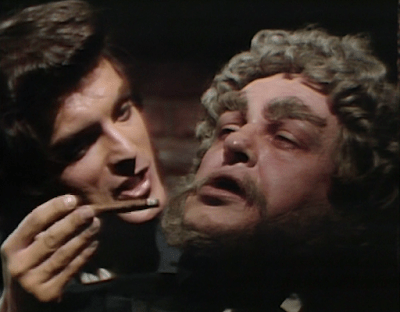
Episode 898: The keeper of the book

A cult devoted to the service of supernatural beings known as “the Leviathan people” is secretly establishing itself in and around Collinsport, Maine. Antique shop owners Megan and Philip Todd are members of the cult. Its acting leader, old world gentleman Barnabas Collins, has entrusted them with several items sacred to the cult. The Todds are responsible for a scroll, a box, a book, and a baby. Now the book has gone missing, and the baby is sick. Yesterday, Barnabas responded to this situation by brainwashing Philip into killing Megan. Today, we open with Philip entering the antique shop and choking Megan.

Megan is Marie Wallace’s third character on Dark Shadows. Her first, fiancée of Frankenstein Eve, was strangled by her intended spouse Adam in #626. Her second, madwoman Jenny Collins, was strangled by her estranged husband Quentin in #748. The murder of Eve came at the end of the Monster Mash period of the show that stretched throughout most of 1968, while the murder of Jenny marked a turning point in the eight-month costume drama segment set in the year 1897. The Leviathan arc is just beginning, and Miss Wallace’s character is already being strangled by her husband. If we were hoping for fresh new story ideas, we couldn’t be more disappointed.

Until, that is, the strangulation is called off. Philip is holding Megan by the neck, reiterating that “There is no margin for error! Punishment is necessary!,” when strange and troubled boy David Collins appears on the staircase and announces “punishment is no longer necessary.” Philip releases Megan, and David informs them that he is now “the keeper of the book, and the protector of the baby.” He gives Megan and Philip medicine that will cure the baby of his illness. He tells them that if they need him, he will know and will appear.

Barnabas was a vampire when he joined the cast of characters in April 1967. As a villain he was unrivaled at giving everyone else things to do, whether as his victims, his accomplices, or his would-be destroyers. In March 1968, his curse was put into abeyance and he became human. He set out to be the good guy, but still had the personality of a metaphor for extreme selfishness. As a result, Barnabas the would-be hero created at least as many disasters as Barnabas the monster ever did. He thus remained the driving force of the show, as well as its star attraction.

While Barnabas can keep things going from day to day, Philip’s attack on Megan suggests that he cannot take the story in new directions. From episode #1, that has been David’s forte. The series began when well-meaning governess Vicki was called to Collinwood to take charge of David’s education, took its first turn towards grisly tales when David tried to murder his father, became a supernatural thriller when David’s mother the undead blonde fire witch came back for him, began its first time travel story when Barnabas was planning to kill David in November 1967, and was launched into both the “Haunting of Collinwood” that dominated the show from December 1968 through February 1969 and the 1897 segment that followed it by David’s involvement with the ghost of Quentin Collins. David was not always a highly active participant in the stories that began with him; indeed, he sometimes disappeared altogether for months at a time. But even from the outside, he is the instrument by which the basic architecture of the show is reshaped. Now that he is, apparently, the leader of the Leviathans, we can renew our hopes that something we haven’t seen before is still in store for us.

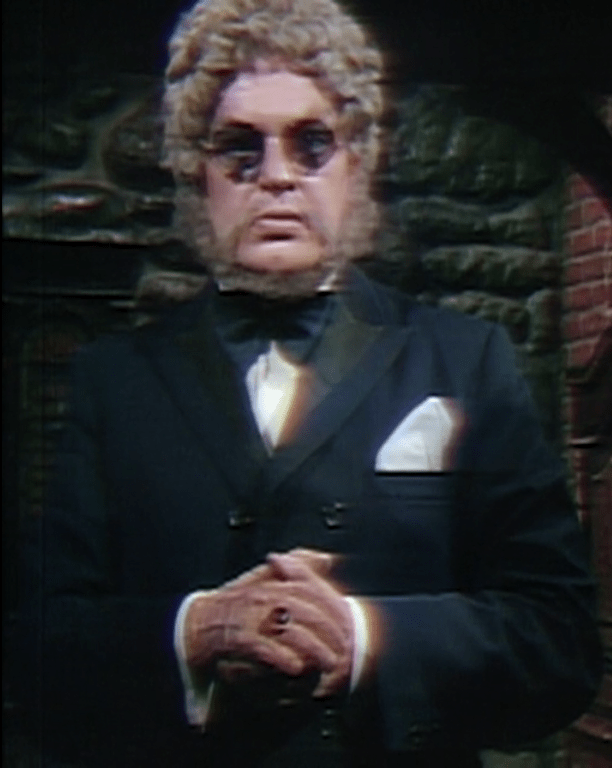
David is still in the shop when a gray-haired man enters. David greets him as “Mr Prescott,” the name by which he heard his cousin Carolyn address the man when he met her in the shop the other day. David has a smug look on his face that suggests he knows this is an alias. Indeed, we already know that the man is connected with the Leviathan cult, so the leader of the cult may well recognize him as Paul Stoddard, Carolyn’s long-missing father.

Paul asks the Todds to give a note to Carolyn. David says that he will be going home to the great house of Collinwood in a few minutes, and volunteers to take the note to her there. Paul gladly hands it to him.

At Collinwood, permanent houseguest Julia Hoffman is conferring with mysterious drifter Chris Jennings. Yesterday, Jenny’s ghost appeared to Chris and told him that Quentin could help him with his big problem, which is that he is a werewolf. Jenny did not identify herself, and Chris had no clue who she was.

Julia shows him a Collins family photo album. She shows him a picture of maidservant Beth Chavez and asks if that is who he saw. He says it wasn’t, and they keep turning pages. It is interesting for regular viewers that they take a moment to put Beth’s picture on the screen and to make some remarks about her. Beth appeared several times during the “Haunting of Collinwood” segment, and was a major character during the 1897 flashback. The sight of her picture is the first reason we have had to suspect that either she or actress Terrayne Crawford will be back.

Chris and Julia look through a Collins family photo album. Screenshot by Dark Shadows Before I Die.

When Chris recognizes Jenny’s picture, Julia breaks the news to him that Jenny and Quentin were his great-grandparents, and that Quentin was the first to be afflicted with the werewolf curse. We know that Quentin and Jenny’s daughter was named Lenore, and that she was raised by a Mrs Fillmore. Chris confirms that his grandmother’s maiden name was Lenore Fillmore. Wondering how Quentin could help Chris, Julia decides they will hold a séance and contact Quentin’s spirit.

David enters, looking for Carolyn. Julia asks him to participate in the séance. He agrees, with the blandness appropriate in a house where séances have become almost routine. When Julia tells him that the spirit they are trying to reach is that of Quentin Collins, David becomes alarmed. As well he might- we left 1969 at the beginning of March, but in #839, broadcast and set in September, we saw that the haunting continued in the absence of the audience, and that Quentin’s ghost had killed David. That episode took place on the anniversary of an event in 1897 that was changed by time travelers from the 1960s, and so David came back to life and the haunting ended. But everyone at Collinwood still remembers the ten months that Quentin exercised his reign of terror, and David does not want to return to it.

Julia assures David he has nothing to be afraid of. She says that the past was changed as of September 1897/ September 1969, and that Quentin’s ghost was laid to rest forever. This doesn’t fit very well with her plan to disturb that rest, but David is still ready to go along with the plan.

When they have the séance, David goes into the trance. He speaks, not with Quentin’s voice, but with that of Jamison Collins, his own grandfather and Quentin’s favorite nephew. Jamison says that Quentin’s spirit is no longer available for personal appearances. He doesn’t know more than that, and excuses himself. When David comes to and asks what happened, Julia says she will tell him later and sends him to bed. Once he is gone, she tells Chris that she thinks Quentin may still be alive.

Quentin was a big hit when he was on the show as an unspeaking ghost during the “Haunting of Collinwood,” and became a breakout star to rival Barnabas when he was a living being during the 1897 segment. So the audience is not at all surprised that he will be coming back. But David’s behavior before, during, and after the séance is quite intriguing. He is not simply possessed by some spirit that is part of whatever it is the Leviathan cult serves. He is still David, is still afraid of Quentin’s ghost, and is still fascinated by séances. During the 1897 segment, Jamison was a living being; like David Collins, he was played by David Henesy. That Jamison can speak through his grandson and not express discomfort at the unfamiliarity of the atmosphere suggests that there are sizable expanses inside David which are still recognizably him.

There is a similar moment between Philip and Megan. She smiles at him and in a relaxed voice says she understands why he had to do what he did. Philip has no idea what she is talking about. She reminds him that he tried to strangle her earlier in the evening, and he suddenly becomes highly apologetic. She tells him he has nothing to apologize for, that it was his duty as a servant of their cause. He is still anguished about it. They share a tender embrace. Again, while the force that animates the Leviathan cult may have the final say over what Megan and Philip do, their personalities are still there, and the loving couple we met a not so long ago still exists. There is still something for us to care about concerning them.*

Paul also has a lot of activity today. He goes to the cairn in the woods that is the ceremonial center of the Leviathan cult and that only people associated with it can see. He wonders why he keeps being drawn to it. When he first returned to Collinwood in #887, he was watching when the cairn materialized in its place out of thin air. He didn’t react at all, but merely turned and continued on his stroll. That led us to believe he knew a great deal about the cult, enough that he not only expected to see this extraordinary sight, but knew he need take no action regarding it. But evidently his connection is more subtle, and he does not understand it himself.

In his hotel room, Paul goes into a trance and circles the date 4 December 1969 on his calendar. That was when the episode was first broadcast, so the original audience would have assumed he was merely circling the current date. But when it was taped, the makers of Dark Shadows had expected the episode to be shown on 3 December. In between, there had been a pre-emption when the ABC television network gave its news department the 4:00 PM timeslot to cover the end of the Apollo 12 lunar landing mission. So the intention had been that we would share Paul’s puzzlement as to what was so special about the next day.

Paul is already worked up because some unknown person left him a note at the antique shop reading “Payment Due, 4 December 1969.” By the end of the episode, he notices that a tattoo has appeared on his wrist. It is a symbol that the show refers to simply as “the Naga,” a group of intertwined snakes that represent the Leviathan cult. All of this combines to get him into quite a state.

* I should mention that Danny Horn made the same point in his post about the episode on his great Dark Shadows Every Day: “And then they kiss, and the creepy thing is that I think they’re actually in there… So far, I’ve been critical of Chris Bernau, but he’s the one who pulls this moment together. As far as he’s concerned, the unpleasant incident is entirely forgotten — but when Megan brings up the fact that he was seconds away from killing her, his apology is entirely sincere.” Danny Horn, “Episode 989: Executive Child,” on Dark Shadows Every Day, 12 July 2016.

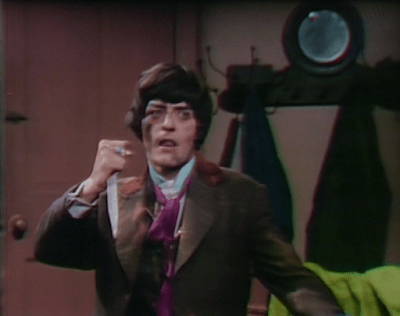
Episode 880: I like all of my stories to have endings

Collinwood: Judith, Trask, Beth, Quentin

In November 1897, wronged woman Judith Collins Trask has had her husband, the odious Gregory Trask, bricked up in her brother Quentin’s bedroom. While Gregory is taking this in, the ghost of another wronged woman appears to him. She is Quentin’s ex-fiancée Beth Chavez. Beth is looking for Quentin. Trask is initially frightened, but then urges Beth to go to Quentin and tell him to come up to the room.

Quentin is in the drawing room, and Beth does appear to him. She says that she cannot rest in peace until she has given him a message. We wonder if she is about to tell him about Trask, but no such thing. Instead, she tells Quentin she forgives him. Then she vanishes, and he shouts that he can’t forgive himself.

We first saw Beth and Quentin at the same time, when their ghosts appeared to children David Collins and Amy Jennings in Quentin’s room in #646. That was broadcast and set in December 1968. Since the show went to 1897 in March, the living beings Quentin and Beth have attracted very different responses from the audience. Quentin has become a huge breakout star, while Beth has faded into the background. She died Monday; this is her first return as a ghost, and her final appearance overall. It rounds things off nicely that her departure begins in the room where we first saw her.

Quentin’s skeleton had been in the room in late 1968. David and Amy removed it and buried it on the grounds. Now history has been changed. Trask’s skeleton may take its place when the show returns to contemporary dress, behind a brick wall there that wasn’t there before. In #839, we saw that while the changes in 1897 have brought peace to the ghosts of Quentin and Beth in 1969, the characters in that year still remember the haunting. So you’d expect the wall to be a puzzle to them, and if they tear it down the skeleton will be as well.

Judith enters and tells Quentin that he can’t go to his room, or to any other room in the west wing of the house. She explains that it cost a fortune to keep that wing open, so she has had it sealed off. She has moved all of his things to a bedroom in the main part of the house. Quentin asks Judith where Trask is; she claims he ran out in pursuit of two violent men who forced their way into the house and hasn’t been seen since, and asserts that she is terribly worried about him. She sounds sincere, but Quentin isn’t fooled. He smiles and asks if he is right to believe that Trask’s story is ended. Judith says that it isn’t, not quite.

Collinwood is supposed to be an immense house, literally. After the first year of Dark Shadows, when a story about the Collinses running out of money was complemented with some specifics about the size of the place,* they have been making it out to be unknowably large. So it seemed inexplicable yesterday that Judith would choose Quentin’s room as Trask’s place of immurement. We learn what her plans were today. There is a telephone in the room; that telephone had been important during the Haunting of Collinwood story. Evidently Judith has rigged it to receive incoming calls only. It rings, and Trask can hear her taunting him. He cannot call out to summon help.

In the first 55 weeks of Dark Shadows, Joan Bennett’s character Elizabeth Collins Stoddard was a recluse who hadn’t left Collinwood in 18 years, believing that she had killed her lousy husband and that his body was buried in a locked room in the basement. It turned out that she hadn’t killed him at all, and the whole recluse theme, and the blackmail plot that it led to, were just one big dead end. As Judith, Bennett is making up for Liz’ lost time.

Outside: Petofi, Aristide, Garth Blackwood, the Widow Romana**

Sorcerer Count Petofi has tired of his unreliable servant, a bungling sadist named Aristide. He has conjured up the ghost of the man Aristide most fears, a jailer named Garth Blackwood whom Aristide killed while escaping from Dartmoor Prison. Blackwood is now hunting Aristide. Blackwood and Aristide were the two violent men who surprised Judith in her bedroom, though Trask never went in pursuit of them.

Aristide ducks into an abandoned mill on the old North Road where he and Petofi had squatted. He hears someone hiding in the back room. A woman jumps out with a knife. Aristide disarms her. He realizes she is the widow of King Johnny Romana, a Rroma chieftain/ organized crime boss whom he killed in #827. Rather than killing her with her own knife, Aristide offers to betray Petofi to the Widow Romana if she will let him join her tribe. He gives her directions to Petofi’s current location. On her way there, she crosses paths with Blackwood, who kills her. Blackwood then makes his way to the mill, where we see him grabbing Aristide.

Aristide draws a map for the Widow. Screenshot by Dark Shadows Before I Die.

When King Johnny died, we learned that in a few days another Rroma somewhere would inherit his immunity to Petofi’s spells and his mission to kill him. That was eleven weeks ago, and we’ve been waiting. The Widow Romana’s appearance today is a gesture towards tying up that loose end.

*In #2, Liz tells well-meaning governess Vicki that there are a total of 40 rooms, most of them in the closed-off parts of the house; in #87, the opening voiceover says that there are 80 rooms.

**Her name is given in the credits as “The Widow Romano,” but “Romana,” which we had heard as King Johnny’s surname in earlier episodes, is a likelier Romany name.

Episode 876: The gift again

In #425, broadcast in February 1968 and set in February 1796, the gracious Josette was near the cliff on the top of Widow’s Hill when she saw her lost love, Barnabas Collins. Wicked witch Angelique had turned Barnabas into a vampire, and Barnabas planned to kill Josette and raise her from the dead with the same curse. Angelique sent a vision to Josette of what her existence would be like after she rose from the grave to prey on the living. While Barnabas watched helplessly, Josette flung herself to her death onto the rocks far below the cliff.

Barnabas spent the next centuries telling himself that Josette’s suicide was the result of a misunderstanding. In #233, broadcast and set in May 1967, he was masquerading as his own descendant, a cousin from England come to visit the Collinses of Collinsport, Maine. He told heiress Carolyn Collins Stoddard and well-meaning governess Vicki Winters that Josette jumped from the cliff because she did not realize that her lover had come with only good intentions for her. By that time, it seemed he might actually have convinced himself it was true.

Today, it is 1897, and rakish libertine Quentin Collins and his sometime lover, maidservant Beth Chavez, reenact Josette’s suicide. They, however, follow the script which had previously applied only in Barnabas’ head. For several weeks, sorcerer Count Petofi has been occupying Quentin’s body, having confined Quentin to his own aging form. Beth was for a time in thrall to Petofi, and is terrified of him. Petofi was still Quentin-shaped yesterday when he chased Beth onto the top of Widows’ Hill. He collapsed in the woods, and a moment later the spell was broken and the body was Quentin’s again. Quentin, restored to his own person, wanders up to the summit and is surprised to see Beth there.

Quentin tries to tell Beth that he is himself, but she is not disposed to listen. Thinking that he has come to do something worse than simply kill her, she leaps from the cliff.

Terry Crawford says that when they first did this scene, they wanted her to emphasize the drama of Beth’s suicide by really flinging herself down hard. Since the floor was only a couple of feet below the set, the springy mattress that she flung herself on bounced her back into the frame, and they had to retake the shot. I wish we had that out-take, it must have been hilarious.

Quentin returns to the great house of Collinwood, in shock. He doesn’t notify the police or anyone else of Beth’s death- apparently the seascape just isn’t complete without a dead maidservant or two strewn carelessly about.

Barnabas, who has traveled back in time from 1969 to 1897 and who is currently free of the effects of the vampire curse, enters. He has befriended Quentin, and is at war with Petofi. He knew about the body swap, and had urged Quentin to make the effort that reversed it. He does not know how that effort turned out. He is happy to hear that Quentin is himself again, unhappy to learn of Beth’s demise, and insistent that Quentin must go far away before Petofi can get at him again.

We cut to a studio occupied by artist Charles Delaware Tate, a stooge of Petofi’s. We can see that Tate stole the magical portrait that keeps Quentin from turning into a werewolf. He covers the portrait with white paint. A visitor enters. It is Petofi’s servant Aristide. Aristide’s face is covered with dirt. Petofi has turned against Aristide, who has been in hiding. Tate agrees to help Aristide get a bath and clean clothes, but will not intercede with Petofi on his behalf.

Aristide does not know that the body swap is over. He goes to Collinwood, finds Quentin, and assumes that he is Petofi. When he offers to do whatever is necessary to restore himself to his master’s good graces, Quentin tells Aristide to find the man who appears to be Petofi and kill him. Aristide, a sadistic fiend, is delighted to receive this sort of command. He goes back to Tate’s, finds the real Petofi there, and stabs him in the chest.

Aristide getting ready to stab Petofi. Still not using his favorite knife, “The Dancing Girl” (alias “The Dancing Lady.”) Screenshot by Dark Shadows Before I Die.

Episode 875: Barnabas, Quentin, and the difficulty of being oneself

This is the first episode credited to Peter Miner as line producer. Dark Shadows was being taped way out of sequence at this period, so Robert Costello’s name will appear in the credits several more times in the next few weeks. The role of the line producers is one of the most under-discussed aspects of the show’s history; writer Ron Sproat, for example, was in a 1985 festival appearance unable to remember ever receiving any input from Costello. So far as he could recall, the writers interacted exclusively with executive producer Dan Curtis.

Even if Sproat’s memory were accurate, I suspect that much of Curtis’ own time working on the show was spent in meetings with Costello. He was there from the beginning, and was around throughout the long periods when Curtis was away in London and other places working on other projects. When the show makes deep cuts into its early stages of development, referring to story points that played out long before any of the current staff of writers came aboard, I always suspect it was Costello who suggested the idea. Now that he is leaving, we will see if those references become rarer. If they don’t, maybe it is Curtis’ own memory that has been at work. On the other hand, even if they do dry up it may just be that they had run out of things to say about those old themes. Whatever happens, Costello had a hard job and clearly did it better than almost anyone else could have, it’s sad to see him go.

Today’s story is about the results of a spell that 150 year old sorcerer Count Petofi cast a few weeks ago. Petofi forcibly swapped bodies with handsome young Quentin Collins. I refer to the villainous Petofi who looks like Quentin as Q-Petofi, and to the forlorn Quentin who looks like Petofi as P-Quentin.

Yesterday, maidservant Beth Chavez found out about the body swap. In love with Quentin and terrified of Petofi, she was horrified by it. Today, she searches desperately for someone she can trust, and makes the singularly unfortunate choice of weak-willed schoolteacher turned unscrupulous adventurer Tim Shaw. She goes to Tim’s hotel room, tells him the story, and asks for help. Uncharacteristically, he does not look for a way to sell the information Beth gives him. He simply goes to Q-Petofi, whom he believes to be Quentin, in what can only be a sincere effort to do the right thing. He brings Q-Petofi back to his room, where Beth is waiting. She soon manages to escape, and Q-Petofi chases her.

For his part, P-Quentin made a happy discovery yesterday and the day before. When Petofi executed the body swap, he took his powers with him into Quentin’s form. But now P-Quentin finds that the powers have returned to Petofi’s own rightful body, which is to say to him. After consulting with his friend and distant cousin, recovering vampire Barnabas Collins, P-Quentin decides to will himself back into his own body.

This works. Quentin awakes as himself, in the woods on Widows’ Hill. He finds Beth at the summit of the hill, near the cliff from which so many people have leapt or fallen to their deaths. She thinks he is Petofi, and flees to the edge while he tries to reassure her of his true identity. The closing cliffhanger leaves her inches from death.

A few years ago, I posted a fanfic idea in the comments on Danny Horn’s post about this episode at his great Dark Shadows Every Day. I still like it:

This is one of the episodes that could have been novelized by “Marilyn” Ross under the title “Barnabas, Quentin, and the Dumbest Possible Plan.” Rather than will himself into his own body right away, thus returning Petofi to his body and for all they know to his full powers, a character with brains might have tried swapping places with someone relatively harmless. Beth would seem to be the obvious person. If she comes to in Petofi’s body, Beth would seem to be the person most likely to accept the situation and least likely to use the powers of Petofi to destroy Our Heroes. Playing Quentin may have been just the challenge Terry Crawford really needed to show off her acting talents, and I’m sure Thayer David would have done wonders as Beth.

Quentin/ Beth/ Petofi could have been the first in a whole series of body swaps. Some of those swaps could have led to villains getting their comeuppance, helping to clear the decks for the end of the 1897 segment. So, while inhabiting the body of a villain, Quentin tries to do something heroic, winds up in mortal peril, and at the last second snaps back to his previous host, just in time for the villain to be the one who dies.

Comment posted 6 December 2020 on Danny Horn, “Episode 875: Switchback,” Dark Shadows Every Day, 8 June 2016.

Fans if the original Star Trek will recognize the source of my inspiration. The episode titled “Return to Tomorrow” features a malevolent alien squatting in Mr Spock’s body. Spock hides his consciousness in the brain of Nurse Christine Chapel, whom the alien once controlled, as Petofi once controlled Beth, and who has a crush on Spock as Beth does on Quentin. And Spock and Nurse Chapel, as a composite being, deliver the fatal blow that kills the alien.

Episode 873: Charming and exquisitely dangerous

In October 1897, sorcerer Count Petofi has used his magical powers to swap bodies with Quentin Collins. I refer to the villainous Petofi who looks like Quentin as Q-Petofi, and to the forlorn Quentin who looks like Petofi as P-Quentin.

We open with Q-Petofi meditating on a lineup of I Ching wands. He goes into a trance which unlocks a cosmic force that transports him to the great house of Collinwood in 1969. He wanders into the drawing room, finds a newspaper dated 28 October of that year, and starts exulting. Maggie Evans, governess in the great house in the late 60s, hears him and comes downstairs.

As the segment of Dark Shadows set in 1897 winds down, we’ve been thinking of ways they might have moved forward. Some of the possibilities involve splitting the week between episodes set in 1897 and others set in 1969. Maggie has been on the show from episode #1, and has been central to several of the storylines that take place in contemporary dress. The last of these stories before the move to 1897 centered on Quentin’s malevolent ghost haunting Collinwood and making it impossible for anyone to live there. In the course of that, he appeared to Maggie several times. In #682, Maggie had a dream in which Quentin’s ghost strangled her to death. Though the events we have seen in 1897 have changed the future, we saw in #839 that the 1960s characters remember Quentin’s haunting. So when Maggie is on her way to meet someone who is to all outward appearances Quentin, we have a hint that a story might be brewing in which Q-Petofi finds himself carrying the can for all of the horrors Quentin’s ghost wrought between December 1968 and September 1969.

Alas, it is not to be. By the time Maggie reaches the drawing room, Q-Petofi has vanished. A few moments after he left 1897, maidservant Beth scattered the wands and brought him back. He is furious when he comes to, and she explains that she had to do it. The magical portrait that keeps Quentin, and presumably also Q-Petofi, from becoming a werewolf is not in the suitcase Q-Petofi gave her earlier in the evening to bury. Q-Petofi has been in possession of Quentin’s body and of his portrait for weeks, and he has vast powers of sorcery, so you’d think he would have hidden the portrait long before. His magic powers would seem to give him the ability to do anything at all to hide it. My favorite idea is that he would impose onto Quentin’s portrait an exact copy of the portrait that hangs above the mantel in the drawing room of the great house and hang it in its place, so that it would be hidden in plain sight for years to come.

Besides, if Q-Petofi was going to bury the portrait surely he would at least have put it in something airtight and made of metal, not a wooden suitcase that doesn’t close all the way and that will likely rot to dust in a year or two. Apparently he isn’t as big on long-term plans as he led us to believe when he claimed he was working on a design to become the ruler of the cosmos.

Q-Petofi orders Beth to bring Pansy Faye, a deceased Cockney showgirl/ mentalist who has for some time been inhabiting the body once occupied by the stunningly dreary Charity Trask, to Quentin’s room at Collinwood. He demands information which she refuses to give. She storms out.

Pansy has a dream in which she and Quentin dance in the drawing room of Collinwood while a specially recorded version of her song, I Wanna Dance for You, featuring the voices of Nancy Barrett and David Selby, plays in the background. Colors flare on the screen while we hear them sing. Miss Barrett was an excellent singer, Mr Selby an adequate one. He does speak a few of his lines, which damages the rhythm of the song, and the flaring colors often obscure the actors completely. Mr Selby and Miss Barrett are so lovable that we very much want to overlook these flaws in the number’s conception.

The dream ends with Quentin turning into Petofi and laughing evilly at Pansy. She awakes in horror. She has known for some days that Q-Petofi isn’t Quentin, and she knows enough about Petofi that it is strange she hasn’t already figured out that he is the one hiding inside his body. But when she sits up with a gasp, we know that she has finally put it all together.

Time-traveler Barnabas Collins, a recovering vampire, meets Q-Petofi in the drawing room at Collinwood. Q-Petofi is convinced that Barnabas stole the portrait of Quentin, and is very aggressive about pressing his suspicions. Barnabas has been playing dumb ever since his vampirism went into remission, but after a couple of minutes of Q-Petofi’s hectoring he addresses him as “Count Petofi.” When Barnabas cannot tell him what he wants to hear, Q-Petofi declares that he will restore the vampire curse to its full potency. He touches Barnabas’ forehead with the right hand in which his powers are concentrated. Barnabas squeezes his eyes shut for a moment, then opens them with a look of triumph. He asks Q-Petofi what has become of his powers.

The rest of the episode revolves around yet another possessed person. Kitty Soames, a young American woman who is the dowager countess of Hampshire, is also Josette DuPrés, who plunged to her death from the cliff at Widow’s Hill 101 years before. Barnabas was supposed to marry Josette at one point, and he has been obsessed with recreating her ever since.

In May and June of 1967, when the show was set in the present, Barnabas abducted Maggie and tried to brainwash her into becoming Josette. In those days, the show was ambiguous about why Barnabas picked Maggie. Strange and troubled boy David Collins was an intimate friend of Josette’s ghost, and when he saw Maggie in Josette’s dress in #240 and #241, he thought she was Josette, looking just as she always did. Indeed, Miss Scott had played the ghost a few times, always behind a veil. When Barnabas was about to give up on Maggie in #260 he very earnestly told her “But you are Josette!” Yet after Maggie escaped, he picked another girl and planned to repeat the experiment with her, explaining to his sorely-bedraggled blood thrall Willie in #274 that all you have to do is “Take the right individual, place her under the proper conditions and circumstances, apply the required pressure, and a new personality is created.”

But when the show made its first trip back in time, visiting the 1790s from November 1967 to March 1968, Kathryn Leigh Scott played Josette. That was a bold move. Longtime viewers were left with the uncomfortable feeling that Barnabas may have had a point when he devised the horrifying program of torture that made the show so terribly bleak for several weeks. When we see Miss Scott playing Kitty, who really is Josette and really does have to accept that fact, longtime viewers can only squirm as they remember Barnabas shoving Maggie into his old coffin and later walking down the long gray corridors of his basement on his way to the prison cell where he was going to murder her. We’ve since come to know Barnabas as an endearingly ineffectual comic villain, but it is a stretch to remind us of him as he was in those grim days and ask us to concede that he was in any sense right.

Kitty confronts Barnabas at Collinwood and accuses him of orchestrating her Josettifying psychosis. He denies that he is responsible, and claims to know that Josette’s spirit lives in her and that she ought to yield to it. When she asks how he knows, he makes up a story about being a boy in England, falling in love with a portrait of Josette, and reading her diaries. She is unconvinced.

Later, Josette goes to P-Quentin in Petofi’s old squat, the abandoned mill on the North Road. She believes he is Petofi, and asks him to use his power to resolve her identity crisis. He tries to explain that he only looks like Petofi, and has none of his power, but she refuses to believe him. Having nothing to lose, he decides to play along. He tells the right hand to tell Kitty the truth about herself, and touches her forehead. She suddenly realizes that she is both Josette and Kitty. P-Quentin just as suddenly realizes that Petofi’s power has returned to the body in which he is now an unwilling tenant.

Kitty/ Josette keeps telling P-Quentin that she remembers what he was able to do with his right hand when he was staying with her and her late husband in England a few years before. This is a pretty bad continuity error. For eight weeks from #778, the most dynamic story on the show centered on the fact that Petofi’s hand was cut off in 1797 and kept in a box by a Romani tribe for the hundred years since, until broad ethnic stereotype Magda Rákóczi stole it in an attempt to lift the werewolf curse from Quentin. It was only in #815, in August, that Petofi reattached his hand and with it regained the bulk of his power. Granted, #815 is eleven and a half weeks ago, but the show now takes so little time to onboard new viewers by recapping that the writers are clearly counting on the audience to have a great deal of information about the story so far in their heads. As such, it is very surprising that they would break from established continuity on such a major point of the recent months.

Episode 858: Despite all appearances

Sorcerer Count Petofi has forced the devastatingly handsome Quentin Collins to trade bodies with him. So Thayer David is now playing Quentin, a forlorn and helpless figure who goes around begging people to listen to his lunatic story, while David Selby plays Petofi as a gleefully cruel young man who takes advantage of all the pleasures available to Quentin. I will refer to Thayer David’s character as P-Quentin and David Selby’s as Q-Petofi.

Q-Petofi goes to Beth Chavez, who used to be a maidservant in the great house of Collinwood and is now one of Quentin’s fiancées, more or less. Beth is in what she identifies as her room. It looks very much like the set that represented her room in the servants quarters of Collinwood, but it is explicitly stated that this room is somewhere else. Maybe she took it with her as part of her severance package.

Beth is terrified of the count, whose slave she was for a while after she left Collinwood. P-Quentin manages to get her to take note of his words, though she seems sure that what he is saying is another of the count’s tricks. He tells the story of how twelve year old Jamison Collins found her about to commit suicide because of what his Uncle Quentin did to her and has refused to speak to him since. He pleads with her to go to Collinwood and see if the man who appears to be Quentin knows the same story.

Beth does go, and she does put Q-Petofi to the test. He has no idea what she is talking about, and tries to bluff his way out by saying that Jamison’s estrangement from him is too painful to discuss. He then yells at Beth, declaring that he knows the count put her up to asking him about Jamison. That means that he and Beth both know that he failed the test. Beth might become P-Quentin’s first ally. Unless, that is, Q-Petofi kills her before she can- there doesn’t seem to be anything stopping him.

P-Quentin does have other potential allies. One is Julia Hoffman, MD. A mad scientist from the twentieth century, Julia followed her friend, vampire Barnabas Collins, after he had traveled through time from the year 1969 here to 1897. An experimental treatment briefly freed Barnabas from the effects of vampirism in the spring of 1968; when she arrived from the future, Julia began trying to replicate that treatment. Most people now think that Barnabas has been destroyed, staked in his coffin in #845. But in #849 we saw that Julia was still working on the treatment, and in #853 someone named Kitty Soames barged into Julia’s hiding place and, possessed by the ghost of Barnabas’ lost love Josette, identified the room where Barnabas was hiding. Quentin, at that time still occupying his own body, was with Kitty at the time and realized that she was right. This alarmed Julia, because even though she and Barnabas regarded Quentin as a friend, they knew that he was already under Petofi’s influence and could not be trusted to keep a secret from him.

Another person who might come to P-Quentin’s aid against Q-Petofi is Angelique, the wicked witch who made Barnabas a vampire in the first place. At this point in 1897, Angelique is another of Quentin’s fiancées. Resenting Petofi’s influence over her prospective husband, she met with Julia in #842 and devised the plan they have been following since. Angelique has a couple of scenes with Q-Petofi in the drawing room at Collinwood today; she notices that his behavior is very different from what Quentin’s has been, but does not suspect that it is Petofi’s mind behind the face.

Angelique calls on Julia in her hiding place. Julia keeps hearing some sound effects we last heard during The Experiment, a storyline that ran through May and June of 1968, when she was building a Frankenstein’s monster in order to permanently cure Barnabas’ vampirism. She describes them as sounding like wind. Angelique cannot hear them, nor can she hear the voices which Julia also hears. When Julia recognizes the voices as occult expert Timothy Eliot Stokes and sarcastic dandy Roger Collins, she realizes that they are coming from 1969. The reason she can hear them and Angelique cannot is that she has a physical body in that year, while Angelique is all here, in 1897. Julia tells Angelique she cannot stay in 1897 much longer, and Angelique agrees to take over her part in what remains of their plan.

After Angelique has left her alone, Julia finds that Stokes and Roger can hear her if she shouts. This only lasts for a moment. The sounds fade, and she loses the connection altogether.

P-Quentin comes to Julia’s place. Thinking he is Petofi, she declines to speak to him. He insists he is Quentin. When he tells her some information they had shared privately, she decides he is telling the truth and starts calling him Quentin. In fact, she calls him “Quentin, Quentin,” as she often calls Barnabas “Barnabas, Barnabas.” She is about to tell him the next steps of the plan when she vanishes.

The lady vanishes. Screenshot by Dark Shadows Before I Die.

The first time traveler we saw vanish in this way was an unpleasant man named Peter Bradford whose personality largely consisted of yelling at people that he preferred to be called “Jeff Clark.” Peter/ Jeff was from the 1790s, but tried everyone’s patience for much of 1968, when the show took place in a contemporary setting. He faded away, returning to his own time, in #637. We didn’t hear any sound effects before he disappeared. The Experiment was still very fresh in our minds at that point, so the sound effects we hear today would not have been available, and besides, no one cares what the world sounds like to Peter/ Jeff. It was just a relief that he was finally gone.

Julia is as appealing a character as Peter/ Jeff was repellent, and it’s sad to see her go. We’ve had some signs lately that the 1897 segment will soon be ending, but we’ve had those signs before, and they’ve kept restarting it. If Julia isn’t coming back to this period, we can only hope that if it goes on much longer, they will find a way to intercut episodes set in 1897 with others set in 1969, where we will be able to spend time with her.

Episode 856: Like a new man

Evil sorcerer Count Petofi has cast a spell causing his mind to take over the body of rakish Quentin Collins, while Quentin is confined to Petofi’s own body. So David Selby begins playing a youthful and handsome Petofi, while Thayer David plays an aging and pudgy Quentin.

In their post about the episode on Dark Shadows Before I Die, John and Christine Scoleri use a wide variety of expressions to refer to the characters Thayer David and David Selby play today. I will just call Thayer David’s character P-Quentin and David Selby’s Q-Petofi.

Both of those actors give superb performances today; David Selby makes Q-Petofi’s preening arrogance suitably repellent, while the 42 year old Thayer David shows us P-Quentin reduced to the total helplessness of a despised man in extreme old age. There is a scene that Mrs Acilius and I found particularly hard to watch when Q-Petofi’s henchman Aristide takes the thick glasses without which P-Quentin is effectively blind and holds them away from him.

Q-Petofi and Aristide’s gleeful cruelty to P-Quentin make us wonder how the count and his henchman feel about the body they are looking at. The show’s earlier body swap story, in which vampire Barnabas Collins had hoped to die and come back to life in the form of Frankenstein’s monster Adam, led Adam to ask Barnabas in #587 “How could you hate yourself so much that you wanted to change your body?” We hadn’t known that that the count hated himself at all until we saw this scene, but he must have done to take such delight in tormenting P-Quentin, and Aristide’s revelry shows that he, too, harbors more hostility to his master than he ever dared expose.

Q-Petofi taunts P-Quentin. Screenshot by Dark Shadows Before I Die.

P-Quentin staggers away from the lair of Q-Petofi and Aristide and meets broad ethnic stereotype Magda Rákóczi in the woods. He tries to explain his true identity to Magda, who has experience with magic and has for some time now been his ally. But Magda’s fear of the count keeps her from listening to the far-fetched tale, and she rushes off.

P-Quentin makes his way to the door of his home, the great house of Collinwood. He stands there, and we hear his thoughts, in David Selby’s voice. He tells himself he cannot go in, because no one there would believe him if he told them who he was. He slinks off to the caretaker’s cottage, where he meets maidservant Beth, who is his sometime fiancée. He tries to tell her the story, but she too is terrified of the count. When Q-Petofi shows up, she leaves with him.

Magda is a wonderful character, and what we have seen has given us every reason to hope she will be a substantial part of the show for a while yet. Unfortunately, this is her final on-screen appearance. We will hear her voice once more, six weeks from now. The show has always been visually ambitious, and lately they’ve managed to pull some neat tricks with videotape that led me to hope we would see at least one scene in which Grayson Hall appears opposite herself as both Magda and time-traveling physician Julia Hoffman. When Hall appeared in the 1970 film End of the Road, she said that it was a relief from playing Julia, to whom she apparently referred as “that tight-ass doctor.” Magda is earthy enough that it would have been fun to see how Hall would have used her to demonstrate the same attitude towards Julia, even if she had to stick to words approved by the ABC network’s Standards and Practices office, and Julia’s reaction to Magda would doubtless have been just as much fun.

Episode 843: The meaning of shadows

Beth and Petofi

This night in 1897, Beth Chavez has lost both her job as a maid in the great house on the estate of Collinwood and her hopes of marrying rakish libertine Quentin Collins. She goes to the lair of sorcerer Count Petofi and volunteers to work for him. Petofi makes it clear that the position Beth is applying for is that of slave. She accepts without hesitation, and he has her do some mumbo-jumbo on his behalf.

This story point would make sense if Beth were a deeply dependent person who couldn’t imagine life without Quentin or her old job. But we’ve known Beth for months and months, and this is the first we’ve heard that she is like that. Terrayne Crawford’s acting ability was limited to embodying one feeling at a time, and in no scene was she assigned to demonstrate “corrosive sense of personal incompleteness.” So we know she is hung up on Quentin and we know she likes her job, but we also know that as one event follows another she responds with the emotion we would expect a level-headed person to have. Even when she got carried away the other day and tried to shoot Quentin, it didn’t seem to be a sign of mental breakdown. After Petofi showed up and stopped her, he pointed out that the way Quentin treats women, it is a marvel that none of them had tried to kill him before. If anything, her attempt on Quentin’s life suggested Beth has enough strength of character to leave Collinsport and make a fresh start.

Tate and the Creatures

For much of 1968, when Dark Shadows was in a contemporary setting, Roger Davis played a man named Peter Bradford who very loudly insisted that everyone call him Jeff Clark. Peter/ Jeff had no memory of his life more than a year or two before the present. Well-meaning governess Vicki knew that Peter/ Jeff had lived in the 1790s, and his shouting about his preferred name often came in response to Vicki’s attempts to tell him what she knew. Peter/ Jeff was convinced that if there were something supernatural about him, he would be incapable of loving anyone or of being loved.

Peter/ Jeff spent most of 1968 entangled with the story of Frankenstein’s monster Adam. Peter/ Jeff had assisted mad scientist Eric Lang in digging up the corpses from which Lang assembled Adam’s body. After Lang’s death, another mad scientist, Julia Hoffman, completed his work, attaching the body of recovering vampire Barnabas Collins to the body to provide the “life force.”

Mad scientists and vampires are two metaphors for extreme selfishness, so it was no surprise that Julia and Barnabas were the worst parents the newborn Adam could possibly have had. Within an hour of Adam’s awakening, Barnabas had loaded a gun and was on his way to kill him. When he relented from that plan, he and Julia took Adam to the prison cell in the basement of Barnabas’ house, where they locked his ankle in a fetter chained to the wall. They kept him within the blank walls of that cell for weeks on end, giving him nothing to play with, nothing to learn from, and nothing soft to touch. Nor did they ever allow him human contact for more than a few minutes at a time. They delegated Adam’s feeding to Barnabas’ servant Willie, who taunted him cruelly. Unsurprisingly, when Adam escaped from the cell he was rough with everyone he met, and when he found someone he liked he abducted her and found a place to lock her up. That was the only form of human interaction the big guy had ever known.

Now, the show is set in 1897, and Mr Davis plays artist Charles Delaware Tate. Tate combines the most disagreeable elements of all the characters involved in the story of Adam. Like Lang and Julia, he has the power to bring people to life without the usual processes of reproduction and growth. In his case, he simply draws or paints someone, and they pop into existence. He did that two years ago, in 1895, with a beautiful young woman he had imagined. He made a sketch and then a painting, and suddenly there she was, walking along a sidewalk in New York City. She took the name Amanda Harris, and has recently made her way to Collinsport.

Tate wasn’t there to see Amanda’s instantiation. But he recognized her when he did see her, and he has since drawn some inanimate objects that he saw come into being. So he figured out what Amanda’s origin must have been, and he has been shouting at her about it for a while. As Peter/ Jeff did not want to believe Vicki when she told him he was not native to the twentieth century, so Amanda does not want to believe Tate when he tells her that she came into being in the way that, in Greek myth, Pygmalion brought the lovely Galatea to life. But yesterday Amanda went to Tate’s studio, and he drew an imaginary man. That man appeared while Amanda watched.

We open today in Tate’s studio. Amanda is gone, and Tate is screaming at the man and declaring that he will kill him. The man is just standing there- he is fully grown, apparently in his mid-twenties, but in reality he is only a few minutes old. He doesn’t seem to be able to talk. He reacts to Tate’s extreme hostility with bafflement.

Tate rips up the drawing, and is disappointed the man does not die. A knock comes at the door. He shoves the man in the closet and locks him in there. Within moments, he reenacts Barnabas’ attempt to shoot Adam and his confinement of Adam to the cell. Tate had not been written as especially evil before this, but now he takes his place among Dark Shadows‘ cruelest villains. We may wonder if the character would have been developed differently had he not been played by the bombastic Mr Davis. Perhaps if the writers had been scripting a role for a more pleasant actor, they could have let Tate be a relatively nice guy.

Tate opens the door. Amanda is there, standing behind her traveling companion and sometime partner-in-crime, adventurer Tim Shaw. Amanda has told Tim what Tate did, and Tim demands to see the man. Tim sees the closet doorknob turning, and insists Tate unlock it. Tate at first denies that he has a key, but Tim pulls a gun and forces him to comply. In his post about the episode on his great Dark Shadows Every Day, Danny Horn has a funny bit about this moment:

Now, if life was like a Tex Avery cartoon, and I think we can all agree that it should be, then Tate’s next move would be to grab his sketchpad and draw an even bigger gun. Then Tim would reach into his pocket and pull out a machine gun, and Tate would draw a rocket launcher, and we could go back and forth like that until somebody pushes down on a plunger detonator, and there’s an explosion that cracks the Earth in two. That would be a good scene.

Danny Horn, “Episode 843: I Can Make You a Man,” posted to Dark Shadows Every Day, 19 March 2016.

As it is, Tate just hands over the key. Tim unlocks the door, finds the man, and loses all interest in Amanda. He tells Tate that he is sure he will take good care of Amanda as he leaves with the man.

Tim is delighted with his new toy. Screenshot by Dark Shadows Before I Die.

Tate shouts at Amanda and grabs various parts of her body, adjusting their position as if she were an action figure. He’s hollering something about love when she pulls away from him and declares that, as an unnatural creature, she can neither love nor be loved. Again, longtime viewers remember Mr Davis as Peter/ Jeff, yelling the same sentiment. But Amanda goes further than Peter/ Jeff ever did with the affable Vicki. She says that can hate, and that she hates him very cordially indeed.

In his hotel room, Tim is trying to coax the man Tate created into speaking. The man tries to make a sound, but fails. Tate himself comes barging in. He has a gun, and points it at the camera. He announces that the man will never speak, because he is going to murder him forthwith.

In the comments section of Danny’s post, I left a long comment which is I suppose a first draft of this post. You can read it there.

Episode 838: Your part in this drama is finished

In #836, the ghost of maidservant Beth Chavez appeared to Julia Hoffman in the year 1969. Beth told Julia what happened on the night in 1897 when she shot the rakish Quentin Collins to death.

Regular viewers would have recognized the events Beth described as different from what would have happened when Quentin originally died in 1897. For the last 28 weeks, the show has been set in that year because Julia’s friend, recovering vampire Barnabas Collins, accidentally traveled back in time while trying to figure out why Quentin had become a ghost bringing death and misery to everyone on the estate of Collinwood. In 1897, Barnabas met the living Quentin and befriended him, but also changed the history of the period substantially. So a wicked witch named Angelique, who was not at Collinwood the first time through 1897, is there on this iteration of events. Beth’s night took the turn that would lead her to shoot Quentin when Angelique told her that her engagement to Quentin was off and that Angelique would be marrying Quentin instead.

After Beth told her what happened in the latest version of 1897, Julia herself traveled back in time, determined to rescue both Quentin and Barnabas. Once she got to her destination, she was too dazed to speak. But Quentin found a letter in her pocket that Barnabas had written, and it led him to Barnabas. Barnabas was able to tell Quentin that he was fated to be killed tonight, after his nephew Jamison rejected him. He had no more to tell him, nor could he restore Julia’s ability to speak.

We open today with Quentin holed up in his room, waiting for midnight to come and go. Sorcerer Count Petofi knocks on his door; Quentin jumps to the conclusion that it is Petofi who will kill him. In fact, Petofi has learned of Quentin’s current fate, and offers to help save him. Quentin has ample reason to distrust Petofi, and refuses the offer.

Jamison then knocks. Quentin lets him in; the two have a happy talk about how much they enjoy each other’s company, and Quentin decides he won’t stay in his room after all. This leads directly to the reenactment of the scenes Beth had described, including Beth’s conversation with Angelique, Jamison’s discovery of Beth in the act of attempting suicide, Jamison’s consequent rejection of Quentin, and Beth’s pointing a loaded pistol at Quentin while she declares that she has decided to kill him.

Quentin’s time in his room shows that his behavior afterward is the direct result, not only of Barnabas’ intervention, but of Julia’s as well. So what we are seeing today is not what happened the first time through 1897 or the second, but is yet a third version of events. It does end quite differently- Petofi turns up in the nick of time and prevents Beth from shooting Quentin. The whole basis of the fantasy of going back in time to change events is the experience of rewriting stories, of what fandoms call “retroactive continuity” (“retcons” for short.) In the contrast between the two versions of the night of 10 September 1897 that Dark Shadows shows us, and in the contrast between each of those and the original events that we never saw, the story merges into the process of writing the scripts, and the characters explicitly create their own retcons.

Petofi tells Beth that she ought to leave Collinwood at once and go as far away as possible, because “Your part in this drama is ended.” The incorporation of retcons as an overt story element shows that metatheatricality can be fun, but I have to say it was pretty cold of Dan Curtis to delegate the job of firing actress Terrayne Crawford to the character Petofi.

Count Petofi tells Terrayne Crawford she won’t be getting another contract.

Petofi then goes to Quentin’s room and tells him the price for his services- Quentin must betray Barnabas. Quentin resists this demand until Petofi shows what else he has already done for him. Petofi commissioned a portrait of Quentin. Quentin saw the portrait the other night when there was a full Moon, and he was horrified by what he saw. The portrait bore, not his usual features, but those of a wolf. Since Quentin is a werewolf, he thought the portrait was a cruel reminder of his curse. But when Petofi bids him look at the portrait again tonight, Quentin sees his accustomed face. Petofi explains that the reason Quentin remained human that previous night was that the portrait changed, and that as long as the portrait remains intact Quentin will be free of the effects of the curse. Quentin’s blissful reaction to that news suggests that Petofi was right to tell him that he belonged to him now and would be able to refuse him nothing.

Sadly, this episode marks the last appearance of the character Jamison Collins. David Henesy plays the same scenes with the same dialogue he had on Monday, but he did a great job then and does an equally great one today. He’ll be back tomorrow for a brief appearance as his 1960s character, David Collins, then will be absent from the cast for almost 11 weeks. We’ll miss him while he is away.

Episode 836: The grownup world

It is 8 September 1969, and the ghost of Quentin Collins has rendered the great house of Collinwood uninhabitable. The family, including permanent house guest Julia Hoffman, have been staying at the Old House on the estate while recovering vampire Barnabas Collins is on a trip back in time to 1897, when Quentin was killed and the trouble started. But Julia has received a letter Barnabas wrote to her in September 1897 indicating that, as of that date, his mission was about to end in total failure, and so she decides to take matters into her own hands. First, she must learn exactly how and when Quentin died.

Julia goes to the great house and follows the sound of Quentin’s theme song to the tower room. There, she finds the ghost of maidservant Beth, who was one of Quentin’s many lovers. When Beth is in a shadowy corner, she puts on a ghostly voice and tells Julia that her name would mean nothing to her. As soon as she comes into the light, Julia says that they’ve met several times, and soon she is calling her by name. Along with the fact that, as Beth, Terrayne Crawford is just standing there in the same light as Grayson Hall, with no practical effect whatsoever to suggest ghostliness, this deflates whatever feeling we are supposed to have that we are witnessing an encounter with the supernatural.

Julia insists Beth tell her how Quentin died. When the ghost of Barnabas’ nine year old sister Sarah Collins was on the show from June to November 1967, she would often insist on the Ghost Rules and vanish if people put direct questions to her. But Beth just wanders around a little, moans to Quentin that she has no choice but to tell Julia what she wants to know, and starts dishing. Again, they aren’t making ghosts like they used to.

Beth tells Julia that on 10 September 1897, she found out Quentin was going to marry a woman named Angelique. Quentin did not tell her this news himself; he left it to Angelique to do so, making the blow fall all the more heavily. This will remind longtime viewers of #392, when Barnabas could not bring himself to tell his ex-fiancée Josette that he was engaged to Angelique, leaving Angelique to tell Josette herself in #393. Josette waited until #425 to leap to her death from the cliff at Widows’ Hill, but things move faster now. Beth went straight from her conversation with Angelique to her room, where she had a bottle labeled “Poison.”

Sensible shopper that she is, Beth buys her poison in the Generic section of the murder weapon store. Screenshot by Dark Shadows Before I Die.

Before she could do away with herself, Beth was interrupted by a knock on the door from twelve year old Jamison Collins. Jamison came in to show her a puzzle he had solved, then saw the bottle. He demanded to know what was going on, and she admitted that she was planning to kill herself because Quentin was going to marry Angelique. He stopped her doing that, but after he left to confront Quentin she took a loaded revolver out of her dresser.

Jamison found Quentin in the drawing room, in Angelique’s arms. Angelique at first dismissed Jamison, saying that his uncle was too busy to speak with him, but Jamison held his ground and insisted on seeing Quentin alone. Quentin obliged, but would answer Jamison’s questions only with airy assertions that he is too young to understand the situation. Jamison is so composed and forceful, and Quentin’s behavior is so flagrantly irresponsible, that we might expect Jamison to ask to be spared lectures on maturity from a man so much more childish than he. Instead, Jamison simply becomes angry and tells Quentin that after what he has done to Beth, he wants nothing more to do with him.

In #767, Jamison had a dream in which Quentin’s ghost said that his death was preceded by three events. The first two events happened shortly after. The third event was that Jamison rejected him. This has now happened, and in the dream Quentin said that once that took place “There was almost no time left for Quentin Collins.” Indeed, shortly after Jamison stalks off Beth shows up with her revolver and shoots Quentin. He staggers from the drawing room and goes upstairs. Since the staircase is made of eleven steps and is eight feet tall, that’s some pretty fancy staggering for a man who has just taken a round to the midsection. Quentin keeps staggering all the way to the tower room, where Beth shoots him a few more times.

We cut back to 1969, where Beth tells Julia she killed herself the day after she killed Quentin. She doesn’t seem to be done talking when Julia excuses herself. Say what you will about Sarah, she always left them wanting more.

Julia finds twelve year old David Collins, Jamison’s grandson, in the drawing room with Quentin’s ghost. Since Barnabas took us back in time with him in #701, we’ve got to know the living Quentin quite well, and he is a charming rascal who has very little in common with the silent, family-annihilating ghost we saw late in 1968. Beth’s story does very little to explain how the one turned into the other. The ghost has been draining the life from David; Julia orders David to come away from him, and he does. David lies down on the couch, and Julia examines him. She finds that he is weak, but resting comfortably.

Occult expert Timothy Eliot Stokes enters. Quentin’s ghost has vanished. Stokes calls Julia by her first name, something he had not done prior to this episode, and asks after David. She at first says he will be all right, then checks on him again. She cannot find a pulse, and declares him dead. Julia has performed wonders in her work as a medical doctor, but her death pronouncements are so often wrong that this does not give much grounds for alarm. However, we then hear Quentin’s voice laughing maniacally, darkening David’s prospects.

Terrayne Crawford seems to be such a nice person that it distresses me to point out that she was not a very good actress. But in this one, Beth’s lack of supernatural quality and Julia’s bland reaction to her make it seem like writer Gordon Russell and director Lela Swift were conspiring to vent their exasperation with Miss Crawford’s limits. She can play one emotion at a time, so that when Beth is shocked to learn that Quentin is going to marry someone else she is only and entirely Shocked. When Beth is suicidal, she is only and entirely Sad; when she decides to take Quentin’s life instead of her own, she is only and entirely Gleeful; when she tells Julia that her vengeance did not relieve her sorrow over Quentin, we can see that’s true, because she is only and entirely Sorrowful. The result is like looking at a series of wood block cuts illustrating various emotions. It’s all very clear and quite vivid, but there’s no sense of development from one scene to the next. Had Miss Crawford been able to lay one emotion over another and play two or more of them at a time, the grin on Beth’s face when she kills Quentin would have shown us that all the layers of complexity of feeling had finally been stripped away and only hatred was left. That would have been a tremendous climax for the character. But since there was never any such complexity to start with, it’s just another block cut.

Often when I see disappointing performances on Dark Shadows, I think of other actors in the cast and try to imagine what they would have done with the part. Gail Strickland, like Miss Crawford, is a tall, thin woman whose chin juts out on a horizontal line, and she was on the show as doomed schoolteacher Dorcas Trilling for a couple of episodes in May. Dorcas’ role would have been well within Miss Crawford’s competence, and in her long and distinguished career Miss Strickland proved she could do just about anything. So on a day like this, I envision a different, much more nuanced Beth. The episode in my imagination is really stellar, I wish you could see it.

Today, David Henesy plays both his 1897 character Jamison Collins and his 1960s character David Collins. He is not credited for either of those roles, but for Daniel Collins, whom he played when the show was set in the 1790s back in late 1967 and early 1968.