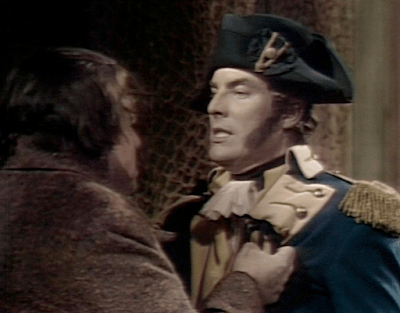
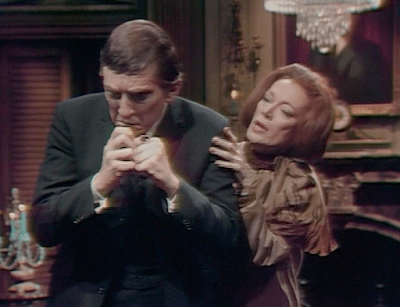
Episode 820: The music and the mirror

Help Me Return to the World of the Living

In Dark Shadows #1, set in 1966, two people came to Collinsport, Maine. They were the well-meaning Vicki Winters and dashing action hero Burke Devlin. Vicki had taken a job as the governess in the great house of Collinwood, hoping that she would find the answers to questions she had about her own mysterious origins. Those questions had left her feeling that she knew nothing about herself.

Burke was a working class boy from Collinsport who had gone to New York City five years before, fresh out of prison and penniless. By 1966 he was a corporate raider, a millionaire many times over. He came back to his hometown because he wanted revenge on high-born ne’er-do-well Roger Collins, who used Burke’s car to kill someone while Burke was passed out drunk in the backseat, then persuaded the court that Burke was solely responsible for the homicide. Burke and Vicki ultimately became a couple, but for some months Burke strung Roger’s niece Carolyn along and used her to cause trouble for the Collinses.

Now the show is set in 1897, and Burke and Vicki are both long gone. Carolyn and Roger are waiting for us when the show returns to contemporary dress, and the actors who play them are in the cast in other roles. But we’ve been reminded of Burke recently. Tim Shaw is a working class boy from Collinsport who, after spending time as a teacher at a miserable boarding school run by the evil Rev’d Gregory Trask, was chosen by Trask to take the fall for the murder of his wife, Minerva Trask. As Burke was physically present but mentally compromised at the killing for which he went to prison, so Tim was present at the killing of Minerva, but not in his right mind. The show is about the supernatural now, so it was a magic spell, not booze, that kept Tim from knowing what was going on when he poisoned Minerva. And the pace is too fast for arrests and trials, so Trask’s plan went wrong and he had to tell the police Tim wasn’t guilty after all. So Tim went straight to New York, and just a few weeks later came back to Collinsport, very rich and out for revenge.

Like Burke, Tim arrives in Collinsport with a woman. Unlike Vicki, Amanda Harris knew Tim before they got on the train. But we learn today that Amanda, like Vicki, is tormented by her ignorance of her own background. Again, the starker palette in which the show draws its stories at this period means that instead of not knowing who her birth parents were, Amanda has no memories at all prior to two years ago.

Amanda first appeared as a hardboiled operator who was attached, not to Tim, but to his money, and who gave him expert assistance in the con game he was running on Trask. As Tim was an elaboration on Don Briscoe’s W. C. Fields’ imitation, Amanda was a nod to Mae West. But the show has decided to make Amanda a long-term addition to the cast, and they already have an all-villain cast. So they soften Amanda’s edges. We see her packing her bags and telling Tim she is going to leave because he doesn’t really care about her and she can’t stand what she is doing with Trask. When she complains that Tim is just using her, she echoes speeches Carolyn made after her bitter realization about Burke’s true intentions. Now that her relationship to Tim mirrors both Vicki and Carolyn’s relationships to Burke, Amanda can inherit the goodwill longtime viewers have towards both of those characters.

To Have Something I Can Believe In

Tim’s sudden wealth came from his possession of a magical object, The Hand of Count Petofi. When Amanda first heard of the Hand, she asked if it was a piece of jewelry or some other kind of artifact. It did not occur to her that it was literally the severed hand of a Hungarian nobleman. This gruesome thing had been cut a century before, in 1797, by nine Rroma men, and had ever since been in the custody of the leader of their tribe.

In #778, broad ethnic stereotype Magda Rákóczi returned to her home in the Old House on the grounds of Collinwood. She had gone to Boston, where King Johnny Romana, possessor of the Hand, was staying with his caravan. She had pleaded with King Johnny to help her remove a curse she had placed that made rakish libertine Quentin Collins and all his male descendants into werewolves. Magda had not known when she placed the curse that Quentin was the father of her sister Jenny’s children. She hoped that King Johnny would take pity on the Rroma children and use the Hand to end the curse. When he did not, she stole it, intending to use its powers herself. Magda soon found that the Hand did no one’s bidding. It helped some people, hurt others, and was stolen by each of a long series of scheming characters.

After Tim brought the Hand back to Collinsport, it was stolen again. This time, the thief turned out to be none other than Count Petofi himself, 150 years old and on the point of death. Once he had the Hand back, it reattached itself to his wrist and he regained his health.

Petofi has some sort of plans for Quentin. He has retained one of his minions, nationally renowned artist Charles Delaware Tate, to paint a portrait of Quentin. That project is finished, but Tate is still living in a cottage he has rented in Collinsport. Today Petofi visits Tate there.

Petofi finds Tate sketching an imaginary woman, one he has been obsessively drawing and painting for about two years. Petofi sets himself up as Tate’s analyst. “Only little boys invent ideal women,” says he. He has a plan to relieve Tate’s childish fixation. It is another project. If Tate had seen A Chorus Line, he might appreciate Petofi’s theory of work as therapy, as explained in the lyric “Give me a job and you instantly get me involved, if you give me a job then the rest of the crap will get solved.” But that show won’t premiere for another 78 years, so Tate resists.

It doesn’t help that the job Petofi has in mind involves another severed hand. The Rroma are on their way, and they want the Hand back. Petofi, whose magical powers were formidable even when he was one-handed, is much mightier now, but the thought of the Rroma agitates him violently. Evidently they know about some weakness of his that enables them to defeat him. King Johnny and his men don’t know that Petofi is in Collinsport. He has cast a spell to silence Magda, but they won’t leave the area without the Hand. Several people know about Petofi and have no reason to protect him. If the Rroma start asking questions, it won’t be long before they close in. So Petofi has exhumed a recently deceased local man, cut off his right hand, and brought it to Tate for detailing.

Tate owes his talents, and his life, to Petofi, so the outcome of their meeting is never really in doubt. His next encounter does involve a surprise. Amanda comes to Petofi’s hiding place, sent by Tim, and asks for his help. Petofi tells Amanda that Tim has a poor strategic sense. Indeed, Petofi has already told Tim that, lovely as Amanda is, he has no use for her at the present time. But when he sees her face to face, Petofi recognizes her as the imaginary woman in Tate’s pictures.

Returning viewers already know that Tate’s portrait of Quentin takes on the features of a wolf when the Moon is full, so it is no surprise that his works, like several other portraits we have seen on Dark Shadows, have magical powers. When we learn that Tate first painted Amanda two years ago and she has no history prior to that time, we figure out that he inadvertently used those powers to conjure her into being.

Tate is played by Roger Davis, an unpleasant man who figured as Vicki’s love interest in her last, woefully ill-conceived storyline. In that arc, made and set in 1968, Mr Davis’ part was variously known as Peter Bradford and Jeff Clark. He had amnesia, and Vicki kept trying to help him recover memories which would prove to him that he has no roots in the 1960s, but that he is an uncanny being who was brought to life by an adventure she had outside the bounds of space and time. Once we recognize what they are suggesting about Amanda’s origin, longtime viewers might expect an inversion of that story, with Mr Davis playing the person trying to persuade his lover that he accidentally created her by a magical process he himself did not understand.

Somebody to Dance For

While all of this action is taking place downstream of Count Petofi, the person who set in motion the events that first brought Petofi to town is in big trouble. Magda comes home to find King Johnny himself waiting for her. He menaces her, calls her names, and twice hits her in the face very hard.
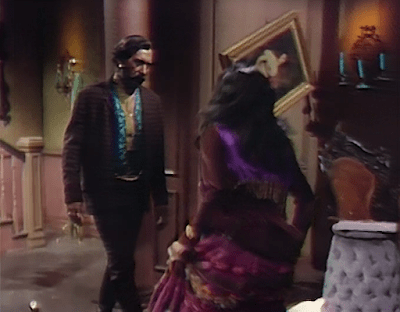
King Johnny closes in on Magda. Screenshot by Dark Shadows Before I Die.

Ever since Violet Welles joined the writing staff, men have been slapping women quite a bit on Dark Shadows. Welles was by far the best writer of dialogue on the show, but I for one could do without the slapping. Fortunately King Johnny is played by Paul Michael, a well-trained actor; no matter how brutally King Johnny abuses Magda, Grayson Hall is in no danger. One could never say the same of Mr Davis’ screen partners.

King Johnny tells Magda that he will take her back to his caravan in Boston to stand trial for the death of Julianka, a Rroma maiden whom he sent to kill her some weeks ago. Since Magda cannot say Petofi’s name, she cannot tell King Johnny that it was he who killed Julianka. Magda is terrified of the trial, and King Johnny tells her that there is a way she can avoid it. If she does not give him the Hand, he will slit her throat immediately.

King Johnny searches the house, and does not find the Hand. He is about to carry out his promise to kill Magda when he sees the wooden box in which the Hand was long kept lying on the floor. He opens it. What he sees inside resembles the Hand closely enough to convince him, and keep Magda alive for another day. Clever as she has been so far, we may wonder how many days are left for her. There doesn’t seem to be anyone around to throw Magda a rope to grab onto.

Episode 816: David Collins, who lives in the year 1969

From December 1968 to through February 1969, strange and troubled boy David Collins (David Henesy) and his friend Amy Jennings (Denise Nickerson) were falling under the power of the malign ghost of Quentin Collins. Occasionally the children were possessed by the spirits of David’s grandfather Jamison and great-aunt Nora; at other times they were possessed by Quentin’s own spirit and that of Quentin’s sometime lover, maidservant Beth. In those same days, Amy’s brother Chris (Don Briscoe) was suffering from a curse that made him a werewolf.

As Quentin’s power over David and Amy grew, so did the frequency and duration of Chris’ spells in lupine form. By #700, Quentin so dominated the great house on the estate of Collinwood that its residents fled to the Old House on the estate, home of their distant cousin Barnabas Collins. David, entirely possessed by Jamison, was close to death. For his part, Chris was stuck in wolf form, apparently permanently, and Barnabas had locked him in a secret room in the old Collins family mausoleum.

Desperate to remedy the situation, Barnabas and his associate, occult expert Timothy Eliot Stokes (Thayer David,) searched Quentin’s old room in the long-deserted west wing of the great house. They found some I Ching wands there. Under Stokes’ direction, Barnabas threw the wands, meditated on them, and found himself transported back in time to 1897. In that year, Quentin, Beth, Jamison, and Nora are alive, and Barnabas is a vampire.

Barnabas had no idea what led Quentin to become a malevolent ghost or what first brought the werewolf curse on Chris, but he had reason to believe that 1897 was an important year in the events leading up to both of those unhappy circumstances. So once he arrived in that period, he spent his nights meddling in all the affairs of the Collins family he found there. Vampires are not problem-solvers; their function in a story is to create problems that other characters will have to solve. So all of Barnabas’ well-intentioned interventions backfired badly. Even disregarding the many murders he committed for his own selfish ends, including the murder of Quentin’s brother Carl Collins, his trip would by any standard have to be considered a disaster.

Now, evil sorcerer Count Petofi (Thayer David) has found that Barnabas is a visitor from the future and is determined to go with him when he returns to 1969. When he demanded Barnabas tell him his secret, Barnabas quite truthfully told him he had no idea what was going on when he found himself transported from one period to another. Petofi did not believe him, and is trying to extort the information he wants by summoning the spirit of David to come from 1969 and possess Jamison (David Henesy) in 1897.

Not only is this an intriguing reversal of the 1968-1969 story in which the ghost of Quentin caused Jamison’s spirit to possess David, it also picks up on some recent hints that they might retcon the whole “Haunting of Collinwood” story to put Quentin’s ghost under the control of Petofi. Even if he can’t hitch a ride with Barnabas, perhaps Petofi will find a way to use Quentin to go back to 1969 with us.

Nora (Denise Nickerson) is with her brother Jamison when the possession takes hold. She is puzzled that he insists on calling her “Amy” and himself “David” and that he tells her to call Quentin on the telephone, even though he is in the house. When Quentin shows up, he recognizes the name David Collins from something Barnabas has told him about the future. But Barnabas has not told Quentin that he is fated to become a family-annihilating ghost, and so Quentin cannot understand how David knows who he is.

Meanwhile, a man named Tim Shaw (Don Briscoe) comes to the house and visits Nora in her room. Tim is Amy’s former teacher, and she considers him a friend. She does not know that since she first knew him, he has lost his moral compass, found the severed Hand of Count Petofi, stolen it, and used its magical powers to make a small fortune in New York City. Evidently all working-class Collinsport boys get rich quick when they go to NYC. In 1961, ex-fisherman Burke Devlin got out of prison and went to that city. By the time he returned to Collinsport in 1966, Burke was a big-time corporate raider who had to think for a moment when David Collins asked him if he’d already made his first $100,000,000. He answered “Not yet.” If he’d had the Hand, no doubt he would have passed that milestone long before.

A couple of days ago, Tim asked Nora to hide a box for him. Unknown to her, the box contained the Hand. Tim asks Nora to return the box to him. She tells him Jamison has it, and he flies into a rage. He gets very rough with her. Briscoe and Nickerson were both good actors, and we’ve seen them share tender moments both as Nora and Tim and as Amy and Chris, so the resulting scene is as uncomfortable as it needs to be to show us that Tim is no longer the long-suffering nice guy we once knew. Moreover, longtime viewers who recognize Tim’s echo of Burke and remember that Burke, though sometimes villainous, was always good with David, will be shocked that Tim does not mirror the earlier character’s consistent soft spot for children.

Tim roughs Nora up. Screenshot by Dark Shadows Before I Die.

Tim goes downstairs and sees Quentin coming out of the drawing room. He demands to see Jamison. Quentin tells him that Jamison is ill, and it will be impossible for anyone to talk to him. Tim starts to get ugly about it, and Quentin cuts him off, saying that Jamison doesn’t have the Hand. Tim is shocked that Quentin knows about the Hand, but recovers sufficiently to ask who does. Quentin cheerfully tells Tim that if he goes to the abandoned mill at the end of the North Road, he will find his onetime acquaintance Aristide, and that Aristide will direct him to the man who has the Hand.

Tim knows Aristide only slightly, but he has a grudge against him. Aristide attacked Tim’s girlfriend Amanda and demanded she tell him where the Hand was. Even after he realized Amanda did not know what he was talking about, he beat her and threatened to kill her, forcing her to tell him whatever she did know that would help him retrace Tim’s steps. When Tim found Amanda, Aristide had left her unconscious, and Tim feared at first she might be dead.

We cut to the hideout in the mill, where Tim is waiting with a pistol and thinking that he would be justified in killing Aristide for what he did to Amanda. When Aristide comes, Tim holds him at gunpoint and demands the Hand be returned to him. Aristide tells him that is not possible. They quarrel until another man enters. It is Petofi, who shows Tim that the Hand has resumed its place at the end of his right arm.

That suffices to show Tim that the Hand is no longer available to him. Petofi tells him he should consider himself lucky that the Hand, which followed no one’s commands, chose to make him rich and happy. Tim says he is not happy, and will not be until he can take revenge on the hypocritical Rev’d Gregory Trask and lawyer/ Satanist Evan Hanley. This again reminds longtime viewers of Burke, whose original goal in returning to Collinsport was to wreak vengeance on Roger Collins. As Trask and Evan involved Tim in a homicide when he was not in his right mind and tried to make him alone pay the legal penalty for it, so Roger killed someone with Burke’s car while Burke was passed out drunk in the back seat and saw to it that the court concluded that Burke was driving.

Petofi laughs and congratulates Tim on his choice of enemies. Tim brightens and asks if Petofi will join with him in bringing Trask and Evan down. Petofi explains that he does nothing without a price. Tim says he has a lot of money, and Petofi says he doesn’t have any use for money. Petofi brings up Amanda, only to say that he doesn’t have a use for her either, at least not at the moment. He sends Tim along his way.

Aristide is talking when Petofi dismisses him. He tells him that two visitors are coming, and that he wants to be alone when they arrive. He will not explain further, and so Aristide is in rather a huff when he leaves.

The visitors are Quentin and Jamison/ David. Quentin is carrying his nephew/ great-great-nephew. He demands that Petofi cure Jamison of the possession, which seems to be killing him. Petofi refuses. When Jamison/ David calls Quentin by name, Petofi asks him how a boy who lives in 1969 knows who he is. Quentin’s bewildered reaction leaves us wondering how he will respond if Barnabas ever tells him just why he went to the past.

In the opening teaser, Petofi stood over the coffin in which he has trapped Barnabas. He told Aristide that he and Barnabas have been at war for what even he, at his immense age, considers to be a very long time. He says that they are now engaged in the final battle of that war.

Petofi’s remarks make absolutely no sense whatever in the context of what we have seen. It has been clear so far that Petofi’s presence at Collinwood is an accident, that Barnabas never heard of him before, and that Petofi only just learned that Barnabas has traveled through time. Many of the oddest dead ends on the show were left over from advance plans that hadn’t worked out; so when they were drawing up broad outlines six months before taping, or when they were writing episode summaries (called “flimsies”) thirteen weeks before, they would often include ideas that depended on story points that they never got around to making happen or characters who never worked out. Once in a while, the writers tasked with filling in the flimsies wouldn’t be able to make up a complete 22 minute script without incorporating some of this irrelevant material. So perhaps at some point in the planning process they meant to have stories about Barnabas going back to the eighteenth century and fighting Petofi there. They may still have been kicking that idea around when they shot this installment.

Danny Horn closes his post about this episode at Dark Shadows Every Day with this little poem, which he attributes to Petofi (though it may remind some of Puck from Shakespeare’s Midsummer Night’s Dream):

If Dark Shadows has offended,
Think but this, and all is mended —
That you have but slumbered here
While these visions did appear.
And now, a word from All Temperature Cheer.

Danny Horn, “Episode 816: Midsummer,” posted 1 February 2016 at Dark Shadows Every Day.

Episode 812: The back road to salvation

Denise Nickerson joined the cast of Dark Shadows in #632 as nine year old Amy Jennings, sister of the doomed Chris (Don Briscoe.) As Amy, Nickerson was central to the show for the next fourteen weeks. In #701 we traveled back in time and Dark Shadows became a costume drama set in 1897. In that year, Nickerson is Nora Collins. Nora was in 10 episodes in the first twelve weeks of 1897, and apart from a two episode stint in #782 and #783 has been unseen and very nearly unmentioned in the ten weeks since. The 1897 segment is packed with so many lively characters that even the best of them disappear for long periods, but the extended neglect of Nora is particularly disappointing. Nickerson was an outstanding young actress, brought out interesting qualities in her scene-mates, and had drawn a significant fan base among the show’s preteen viewers.

Nickerson is back today. In Act One, she walks in on her father Edward trying to strangle her Uncle Quentin. Nora’s scream distracts Edward and saves Quentin. When Nora asks Quentin what got into her father, he tells her that it’s something like a magic spell and will end soon. He refuses to explain further. It is unclear why Nora accepts this refusal. For our part, the audience accepts it because Edward’s attack on Quentin has nothing to do with today’s episode. It’s just left over from yesterday’s cliffhanger.

Don Briscoe is also back, after an absence of twelve episodes. In 1897, he plays Tim Shaw, persecuted schoolteacher turned adventurer. As Chris, Briscoe would do a little W. C. Fields imitation from time to time, occasionally ending a sentence with Fields’ signature inflections. This would raise a smile from other characters in 1969, when such a habit was relatively fashionable. Considering that Fields’ persona was that of a man who belonged in the Gay Nineties, we should have suspected when we first saw the date 1897 that Briscoe would have an opportunity to develop his Fields imitation in greater depth. Indeed, we see him today wearing a hat and coat that might have come from Fields’ closet, accompanied by exactly the sort of woman whom Fields’ characters reliably failed to impress.

I regret to inform you that Tim does not, at any point, address Amanda as “My little chickadee.”

Tim has been in New York, where he made a great deal of money in a very short time by means of something which he keeps in a small box. Returning viewers know that this thing is The Hand of Count Petofi, and that it is the object of a desperate search by many dangerous people, including Quentin. We also know that the Hand is not subject to anyone’s control. If it has made Tim rich, that is because it wanted to do so for purposes of its own, not because Tim had any skill in manipulating it. Tim has used his riches to purchase the companionship of Amanda Harris, a cynical young woman who is impatient with him and appalled at the smallness of the village of Collinsport.

Tim and Amanda are staying at the Collinsport Inn. The Inn was a very important part of the show for its first 40 weeks, when one of the principal storylines was The Revenge of Burke Devlin. Like Tim, Burke was a working class boy from Collinsport who was framed for a homicide of which he was only technically guilty, and who then went to New York City, made a huge amount of money in a very short time, and came back to his home town to even the score with those who set him up to take the blame for a crime for which they were even more responsible than he was. Burke lived at the Inn, and it represented his territory, in opposition to the great house of Collinwood where his adversaries lived. The Revenge of Burke Devlin storyline never really took off, and by #201 Burke himself lost interest in it. Since then, we have gone months at a time without seeing the Inn. We saw a guest room there in #698, but I can’t remember the last time we saw the lobby before today.

Tim orders Amanda to hide the box in her room, then sends her off to Collinwood to make a connection with the cruel and lecherous Rev’d Gregory Trask. Amanda tells Trask that she has been under the power of an evil man and that she wants to change her ways. Trask tells her that he will give her spiritual guidance. He has his back to her when he says that his plan requires that he provide her with “private instruction”; he isn’t looking at her when she rolls her eyes at this. Back in the Inn, Amanda tells Tim that he was right, Trask is despicable.

While Amanda and Tim are taking a stroll by the waterfront, Quentin ransacks Tim’s room looking for the Hand. Quentin hears them on their way back, and leaps out Tim’s window. They’ve gone out of their way to make it clear that Tim’s room is upstairs- we heard Tim on his telephone telling the front desk to send Amanda “up” to him, and we saw him and Amanda getting on the staircase to go to the room. So they are inviting us to wonder how Quentin climbs down the side of the building.

When Tim sees the shambles in his room, he sends Amanda to her room to make sure the box is still there. It is, but he decides that the Inn is not a safe enough place for the Hand. He takes the box to Nora in her bedroom at Collinwood. Regular viewers know that Tim was Nora’s teacher, and Nora considers him her friend. It may seem odd that the person Tim turns to when he needs help with such a sensitive matter is nine years old, but longtime viewers will again remember Burke. He had a way with children; he immediately won the devotion of strange and troubled boy David Collins, and Maggie Evans, The Nicest Girl in Town, remembered him very fondly from her own childhood. Burke and David trusted each other in delicate situations more than once, and we can see the same thing happening between Tim and Nora.

Nora promises to hide the box somewhere in the house and not to tell anyone about it. Tim leaves, and Nora puts the box in her armoire. Nora is a fairly responsible person, but she is nine, and the box is wrapped like a present. As we fade to the credits, she is opening the box.

This leaves us wondering not only how Nora will react to the sight of the Hand, which is a gruesome thing, but also what effect it will have on Nora’s own appearance. In #784, lawyer/ Satanist Evan Hanley looked at the Hand, and it responded to his gaze by disfiguring his face. A few days later, it disfigured Quentin as well. Evan and Quentin have both regained their good looks, frustratingly without explanation. But it would be intensely unpleasant to see little Nora’s face mangled, even temporarily, so this is quite an effective cliffhanger for viewers who have been watching for several weeks.

This episode not only features the welcome returns of Nickerson, Briscoe, and the Inn’s lobby after their absences; it brings an equally welcome newcomer. Amanda Harris is played by Donna McKechnie, six years before she originated the role of Cassie in A Chorus Line and thereby became a permanent star of Broadway. Reviewing TV episodes on the 56th anniversaries of their original airing, recent news about the cast is often sad. For example, Lara Parker died very shortly before the 56th anniversary of the first broadcast of an episode in which she appeared as wicked witch Angelique. I call the cast members by their surnames, and put courtesy titles in front of the surnames of living people. I could have cried when I had to call her simply “Parker.” But Miss McKechnie is alive and well. Just yesterday, I saw a YouTube video (one of two posted on 23 July) of a panel featuring Miss McKechnie at a Dark Shadows convention on 19 July with Kathryn Leigh Scott, Marie Wallace, Sharon Smyth Lentz, and Matt Hall.

Episode 436: Thin air

Bewildered time traveler Vicki Winters is on trial for witchcraft, and it is not going well. Her lawyer/ gaoler/ boyfriend/ whatever else they don’t have the budget to hire another actor to play, an unpleasant young man named Peter, says that he wants the judges to see her as he does, as “a lovely girl who isn’t capable of witchcraft or anything else.” Unfortunately, Peter is right about Vicki’s capabilities- ever since she came unstuck in time and found herself in the year 1795, Vicki hasn’t done a thing worth mentioning.

Later, Peter catches up to much put-upon servant Ben Stokes. He persuades Ben to take him to the unmarked grave of wicked witch Angelique. Peter digs up the grave, but Angelique isn’t in at the moment, and there is no place to leave a message. Peter goes back to Vicki’s gaol cell and tells her that she may as well take the stand at her trial and tell the judges that she is a refugee from the 1960s.

In between these scenes, untrustworthy naval officer Nathan Forbes finds Ben and tries to pay him for information about a man who was once their mutual friend, Barnabas Collins. Ben indignantly refuses the money. When Nathan keeps trying to talk him into it, Ben handles him roughly, then stalks off.

Ben shows Nathan he is not for sale. Screenshot by Dark Shadows Before I Die.

This exchange will be of some interest to those who have been watching Dark Shadows from the beginning. Nathan is played by Joel Crothers, who in the parts of Dark Shadows set in the 1960s plays hardworking young fisherman Joe Haskell. In #3, hard-charging businessman Burke Devlin found Joe and tried to pay him for information about the Collins family. Joe indignantly refused the money.

It’s interesting to see Crothers reprising the situation, playing the opposite role. Burke had poured on a heavy display of oily charm in response to Joe’s quiet stiffening, telling a rather alarming story about the beginning of his rise to wealth and inviting Joe to adopt him as a father figure. By contrast, Nathan retreats rather quickly in response to Ben’s angry outburst, but then rephrases the offer in a hale and hearty tone, trying to assure Ben that he sees him as an equal and wants to be his buddy.

Neither Burke nor Nathan gets anywhere with his persistence, but each man’s approach is typical of him. As a man born into the working class of Collinsport who became a millionaire, Burke proceeds from an ironclad certainty that every wage earner in town wants to follow his example. He cannot doubt that Joe will jump at the chance to take his money and his advice. As a self-involved navy officer, Nathan believes that enlisted sailors will be sincerely grateful to him if he acts like their friend, and extends that belief to include governesses, ladies’ maids, bartenders, streetwalkers, indentured servants, and everyone else he sees as his inferior.

Ben’s angry response to Nathan’s proposition also echoes the early days of the show. When Dark Shadows was set in 1966, Thayer David played violently irritable handyman Matthew Morgan. When Ben lunges at Nathan today, he is the very image of Matthew lunging at Burke in #64. But where Matthew had to be restrained by bystanders and threatened by the sheriff before he settled down, Ben quickly backs off.

The contrast between Matthew and Ben goes to the heart of the eighteenth century flashback. Each is a formidable fighter. Each is excessively devoted to a member of the Collins family, Matthew to reclusive matriarch Elizabeth Collins Stoddard, Ben to Barnabas. Each lands himself in trouble because of that devotion. But Matthew grew up in a Collinsport that had been laboring under a curse for many generations. He is unstable, irrational, dangerous. But for Ben, the curse just began a few months ago, long after his adult personality was fully formed. He is a sane man, and a good one. We can hope that he will emerge from Barnabas’ shadow and make a bright future. In that hope, we can see what the curse will cost not only the Collinses, but all the people of Collinsport.

Episode 383: Between men now

In 1966 and the early weeks of 1967, the Collinsport Inn was an important place on Dark Shadows. The restaurant there, presided over by Maggie Evans (Kathryn Leigh Scott,) The Nicest Girl in Town, was a place where people could meet each other unexpectedly and characters new to town could be introduced. Dashing action hero Burke Devlin (Mitch Ryan) lived in a suite at the inn, and the place often represented his territory, the base from which he conducted his war against the ancient and esteemed Collins family.

The sign. Screenshot by Dark Shadows Before I Die.

We haven’t seen Burke’s room since #206, at which point he had given up his vendetta against the Collinses and proceeded far down the road to irrelevance. We haven’t seen the restaurant since vampire Barnabas Collins (Jonathan Frid) met Maggie there in #221. By the time Anthony George took over the part of Burke in #262, Burke seemed to live in the Blue Whale tavern. He made business calls from the pay phone there, and in one episode apparently stayed behind when the bartender locked the place up for the night.

The inn makes a return appearance at the top of today’s episode. It is 1795, and Jeremiah Collins (Anthony George) is sharing a suite with Josette DuPrés (Kathryn Leigh Scott.) They are on their honeymoon.

Jeremiah and Josette eloped from the estate of Collinwood on the night when Josette was supposed to marry Jeremiah’s nephew, kindly gentleman Barnabas Collins (Jonathan Frid.) Josette truly loved Barnabas and Jeremiah was his dearest friend, but they were under a spell cast by wicked witch Angelique, who wanted Josette out of the way so she could have Barnabas for herself. The power of the spell waxes and wanes. When Josette and Jeremiah are in the grip of it, a trident shaped mark appears on their hands; when they return to their senses, the mark disappears.

Tridents showing. Screenshot by Dark Shadows Before I Die.

When the episode begins, the tridents are showing, and the newlyweds are inflamed with passion. Shortly after, Josette’s mark is gone, Jeremiah’s still showing. She is filled with regret, he is still ardent.

Back in the manor house of Collinwood, Barnabas has a conversation with Josette’s father André and his own father Joshua. He resists André’s suggestion that Josette and Jeremiah must have left together, and resists even more strenuously Joshua’s declaration that they did so because they are the victims of witchcraft. Joshua says that his sister Abigail and André’s sister, the Countess DuPrés, found a blasphemous trinket in the quarters of governess Victoria Winters, and that a witch-hunting divine, the Reverend Trask, is coming to investigate the matter. Barnabas is appalled at the notion of an inquiry into witchcraft, and vows to defend Victoria if Trask comes. Joshua forbids him to do so.

Barnabas’ reaction to the idea of a witchcraft trial, coupled with what we have seen of him so far in the 1795 segment, looks like a retcon. In #358, only a week and a half before we began this uncertain and frightening journey to the past, vampire Barnabas told a story about studying witchcraft under a warlock on Barbados who taught him “the secret magic number of the universe.” Events are moving so fast that it doesn’t look like Barnabas will have time to sail to the Caribbean before he becomes a vampire, and he won’t be crossing any waters after that. But now he is a man of the Enlightenment, who scoffs at the idea of witchcraft today as he scoffed at the tarot when the countess introduced him to it in #368/369.

Jeremiah returns to the house. There is an exquisite little scene with a servant, Riggs, who is uncomfortable at the sight of the disgraced Mr Jeremiah. Riggs stands in for the establishment of Collinwood and the whole working class of the town of Collinsport, and in his reaction we see the disquiet that bad news from the big house on the hill would spread among the people whose livelihoods are at stake when trouble comes to the family there. Riggs makes haste when Jeremiah tells him to go out and fetch Joshua.

When Riggs is gone, Josette enters. The audience sees that the mark is gone from Jeremiah’s hand, and Josette can tell that his passion for her is gone. She tells him that he no more loves her than she loves him. He begins with a protest against this remark, but ends by saying that they must be kind to each other.

Joshua and André enter. André embraces his daughter and tells her everything will be all right; Joshua looks at his brother with distaste and demands an explanation.

Jeremiah says that he and Josette are married. He further says he realizes they are not welcome, and that they will return to the inn. This raises the prospect of a recreation of the early days, with the inn as a territory separate from and opposed to Collinwood. Joshua rejects the idea at once. He will not have the scandal of Jeremiah and his new wife living in town because they have been estranged from the rest of the Collinses. He decrees that they will live at Collinwood and put on a happy face for the townsfolk.

Barnabas enters. Joshua tells him that Jeremiah and Josette are married. He refuses to believe it until Josette confirms it herself. He takes the glove from Jeremiah’s hand and slaps him in the face. He gives him a choice of weapons.

Dueling may have been as alien to the ideals of the Enlightenment as were Barbadian warlocks, but so too is Joshua’s plan of forcing the whole family to commit itself to a massive lie in order to preserve its hereditary privileges. Joshua, the proud apostle of Jeffersonian republicanism, is simply being a hypocrite, but Barnabas is a more complicated figure. Seeing his every hope turned to dust before him, his ideals have become useless. He has only a moment to choose among the evils the Enlightenment had promised to stamp out, and he chooses the most macho one available.

Joshua forbids the duel, but Barnabas disregards his father’s authority and insists on it. In 1795 and for some time after, dueling was widely practiced in much of the United States, and particularly in the South and West a gentleman lost face if he refused a challenge. No such stigma attached in New England, where dueling was condemned by law and religion. Had Joshua or Jeremiah gone to the police, Barnabas would have been arrested. In 1719, Massachusetts, of which Maine was a part until 1821, passed a law making it an offense punishable by a fine of £100 (equivalent to about $7000 today) to challenge someone to a duel. Massachusetts law already considered it murder to kill someone in a duel, and prescribed death by hanging as punishment. Of course, Joshua’s declaration that Jeremiah and Josette will live in the house and the family will present a “united front” to deter scandal makes it clear he will never turn his son over to the police, and the pattern of cover-up with the support of law enforcement we saw among the Collinses in 1966 and 1967 leads us to doubt that anything a member of the family does will ever be a matter for the courts to judge.

There is a missed opportunity in the show’s lack of interest in Massachusetts’ actual laws about dueling. The 1719 law was amended to be even stricter in 1730. Among the provisions added to the law at that time was a requirement that anyone who had either been killed in a duel or been put to death for winning a duel would “be given an unchristian burial at a gallows or crossroads, with a stake driven through their body.” Since the audience knows that Barnabas is fated to become a vampire, there is a chilling irony in seeing him volunteer for a staked burial.

Episode 364: Barnabas, Barnabas

Vampire Barnabas Collins has been part of Dark Shadows at least since we first saw his portrait on the wall of the great house of Collinwood in #204, more properly since they went to great lengths to make it look like there was a portrait on that spot in #195. He is now the main force driving the action of the show, and pretty much the only reason people are tuning in to watch it. The ghost of Barnabas’ ten year old sister, Sarah, first appeared in #255; ever since, we’ve been waiting for the two of them to meet. At the end of yesterday’s installment, they finally did.

Barnabas was in his living room, trying to choke the life out of his only friend and would-be lover, mad scientist Julia Hoffman. Sarah materialized, and he let Julia go.

This echoes a scene in #341. Barnabas and Julia were in the act of murdering her medical school classmate and onetime friend, Dave Woodard, when Woodard claimed to see Sarah. At that, Barnabas almost let Woodard escape. Only when Julia called out “Stop him!” did Barnabas take hold of Woodard and kill him. Not only is he murdering a good-guy character, he has coerced Julia into taking part in the crime and will gloat over her new status as a murderer. But in the middle of all that loathsome cruelty, we see a flash of his longing for his baby sister. It is a tribute to actor Jonathan Frid that we can feel Barnabas’ loneliness and want to like him even in the middle of one of the character’s very darkest moments.

This time, Sarah really is there, and she really does stop a murder. There is a puzzle as to why. In #360 and #361, Julia knew that Barnabas wanted to destroy her, and appealed to Sarah for help. Sarah refused, saying that she liked Dr Woodard and knew what Julia did to him. We heard Sarah’s “London Bridge” theme on the soundtrack during the murder of Woodard, so it is clear that she witnessed that crime. But if she can stop Barnabas killing Julia, why couldn’t she stop him killing Woodard?

Today is only the second time Sarah has appeared to more than one person at a time. When Barnabas’ ex-victim Maggie Evans, The Nicest Girl in Town, wanted to escape from the hospital where Julia was keeping her locked up in #294, both she and her nurse could see and hear Sarah. Maybe it is difficult for Sarah to manifest herself to two people, and impossible for her to show herself to three. In that case, Julia’s presence would have stopped Sarah from saving Woodard.

It’s also possible that Sarah can’t do anything that will lead to Barnabas’ capture. She has appeared to many people and given all of them clues about the strange goings-on, but she has referred directly to Barnabas only when speaking to his partners in crime Willie and Julia. Time and again she has stopped short of giving information that would expose her big brother. When Barnabas and Julia moved against Woodard, he was calling the sheriff. Woodard might have placed himself beyond Sarah’s protection when he picked up the telephone.

Indeed, if Barnabas does kill Julia now, he will probably be caught. Julia has given a notebook full of incriminating evidence about Barnabas to a local attorney to be handed over to the authorities in case anything happens to her. Besides, everyone knows she spends a great deal of time at Barnabas’ house, so if she suddenly goes missing he will be investigated. By preventing Barnabas from killing Julia, Sarah is protecting him from exposure.

Sarah tells Barnabas that he taught her the first lessons she ever received in morality, and that he has now forgotten them himself. He begs her to stay, showing at length the vulnerability and need that have been so effective at recruiting our sympathy when we have glimpsed them before. She says she will never appear to him again, not until he learns to be good. We’ve known him long enough to know that this will be an extremely long wait.

Barnabas begs Sarah to stay while Julia looks on. Screenshot by Dark Shadows Before I Die.

Sarah vanishes. Julia sees her friend shattered. She approaches him. She addresses him, for the first time, as “Barnabas, Barnabas.” He recoils from her. He does not renew his attempt to strangle her, but he does tell her in the coldest imaginable voice that he could kill her as easily as he could crush a moth. It hasn’t been two minutes since his little sister reduced him to tears, and he has snapped back into his place as death itself.

“Barnabas, Barnabas.” Screenshot by Dark Shadows Before I Die.

Some say that Barnabas’ frequent references to his longing for Sarah during these weeks are meant to make him easier for the audience to sympathize with. I think this scene shows that the opposite is more nearly the case. They’ve undercut every other ground for liking Barnabas, leaving us only his love for Sarah. When we see that not even a visit from Sarah can thaw him out for any length of time, not only do we have to give up any hope that there is a nice guy hidden inside him, but we also hear the door slamming shut on any possibility that his character will develop in a way that will surprise us. Since he is the show, the closing of that door means that Dark Shadows 2.0 is all but over.

In the great house, matriarch Liz breaks the news to well-meaning governess Vicki learns that the authorities in Brazil have identified one of the corpses found in the wreckage of an airplane that crashed outside Belem as that of Vicki’s depressing fiancé, Burke Devlin. It has been clear for some time that Burke probably died in that crash, so Liz is worried that Vicki’s refusal to accept their verdict is a sign that she is in an unhealthy denial about the facts of the situation.

In the first 25 weeks of Dark Shadows, Burke was a major figure, the arch-nemesis of the Collins family. His storyline never really took off, though, and when undead fire witch Laura Murdoch Collins was on the show from #126-191 his issues were all absorbed into her arc. He formally renounced his grudge against the Collinses in #201, and has been surplus to requirements ever since.

There is just one thing I wish they had done differently about Burke’s death. During the early period of the show, there was a story about high-born ne’er-do-well Roger Collins trying desperately to hide a custom-made filigreed fountain pen of Burke’s. That dragged on for months, and dominated 21 whole episodes. It would have been a nice Easter egg for those of us who sat through those not-very-interesting installments if Liz had said the authorities were able to identify Burke’s body in part because that pen was on it.

There is a bit of intentional comedy this time that works very well. Telling Barnabas of Vicki’s refusal to accept Burke’s death, Liz exclaims “She can’t go on loving a dead man all her life!” Barnabas is clearly offended by this remark, quite understandably since he is deceased himself. He responds that “It has been known to happen.” But he manages to keep cool enough that Liz doesn’t notice.

“It has been known to happen.” Screenshot by Dark Shadows Before I Die.

Closing Miscellany

This episode marks the last appearance of Sharon Smyth as the ghost of Sarah Collins.

Episode 1-274 of Dark Shadows each began with the words “My name is Victoria Winters,” delivered in voiceover by Alexandra Moltke Isles and leading into a few sentences vaguely related to the plot of the show. Beginning with #275, these voiceovers might be delivered by any actress with a speaking parts in that episode, and do not involve their character’s names. Many are written in the first person, however, as is today’s:

There has been a homecoming in the great house of Collinwood, and those who have returned have found that very little has changed. We still live within a ring of fear, a fear that is generated by the one who lives in the Old House, where on this night a kind of madness prevails, a madness that will lead to the threat of murder.

Every time this happens, the Dark Shadows wiki complains that “by this time in the series, the narrations are no longer spoken in character.” That complaint might have made sense if only a few of the episodes since #275 included first person pronouns, but dozens of them do. So we would have to say that they often are spoken in character, but that it isn’t always clear who the character is. The wiki editors will be glad from now on, because this is the last time a narrator says “we.”

Episode 359: Very difficult for a girl

Carolyn Collins Stoddard has been a spoiled heiress all her life, and now is settling into a new role as blood thrall to her distant cousin, vampire Barnabas Collins. Carolyn is trying her level best to comply with Barnabas’ command to seduce lawyer Tony Peterson so that she can steal the notebook mad scientist Julia Hoffman entrusted to him. She is on a date with Tony, and they are starting to do some serious kissing.

No matter how well Carolyn serves him, Barnabas can’t keep himself out of her way. When Barnabas is upset, nearby hound-dogs start baying; Danny Horn calls the dogs Barnabas’ “backup singers.” When Carolyn hears them, her face goes blank and she forgets about Tony. Tony becomes irritated and ends their date abruptly.

Later, Julia goes to Barnabas’ house. Carolyn is there; Barnabas sends her into the next room to eavesdrop on their conversation. The shot of Carolyn in that room recalls a similar shot of housekeeper Mrs Johnson eavesdropping on Carolyn and local man Burke Devlin, on Burke’s instructions, in #69. That shot marked the beginning of the career of the previously guileless Mrs Johnson as a secret agent Burke employed to spy on the Collinses.

Mrs Johnson as Burke’s spy in #69. Screenshot by Dark Shadows from the Beginning.
Carolyn as Barnabas’ spy in #359.

As Mrs Johnson once listened to Burke pretending to a romantic interest in Carolyn, so Carolyn today listens as Barnabas pretends to a romantic interest in Julia. Julia realizes that she is unlikely ever to get Barnabas out of her life, and for a time she tried to make the best of the situation by falling in love with him. In his show of contrition and gallantry, she sees a glimmer of hope that he will reciprocate this love. Julia has seen too much to be as taken with Barnabas as Carolyn was with Burke, but she does give serious consideration to the idea that Barnabas might have given up on killing her and might be thinking of becoming her boyfriend instead.

The charmer. Screenshot by Dark Shadows Before I Die.

After Julia leaves, Carolyn comes back into the room. She objects that Barnabas was being cruel by raising Julia’s hopes that way. Again, this echoes #69. Mrs Johnson came back into Burke’s room after Carolyn left, and asked him if he thought “the girl [was] involved” in the wrongdoing they thought had taken place at the great house of Collinwood. When Burke replied that anyone in the house was “fair game,” Mrs Johnson asked “Even the girl?” To which Burke replied “Anyone!” That marked the end of the episode, so we didn’t hear how Mrs Johnson reacted to that pronouncement. But she did go on working for Burke, so apparently it didn’t bother her too much.

Barnabas calls Carolyn to him, looks into her eyes, and tells her she is tired. She smiles, and agrees that she is tired. Evidently he used his supernatural influence over Carolyn to erase her misgivings about his treatment of Julia. He hadn’t done anything supernatural to quiet Carolyn’s predecessor, the luckless Willie, on any of the countless occasions when he acted as Barnabas’ external conscience; he usually just hit him in the face with his cane. Barnabas has been picking up lots of new powers lately, gaining the ability to transform into a bat, to materialize inside closed rooms, and to cast magic spells, so it shouldn’t be much of a surprise that he now has greater control over his blood thrall than he had before.

Episode 345: That place in Brazil

In Dark Shadows #3, man of mystery Burke Devlin mentioned that he started on the path to riches when he was in a bar in South America. Since then, he has mentioned his business interests on that continent several times, and the old standard “Brazil” has emerged as his informal theme song. Yesterday’s episode, one of the finest in the series, called back to the early days of the show several times, and today they close the loop on Burke’s connection to Brazil. His plane crashes in that country, and he dies there.

We learn of Burke’s fatal accident when housekeeper Mrs Johnson tells her employer, Elizabeth Collins Stoddard, that she has heard a radio report of an aviation disaster in Brazil. Mrs Johnson first came to work in Liz’ home, the great house of Collinwood, in #81. At that time Burke had sworn to wreak a terrible vengeance on the Collinses and Mrs Johnson was his secret agent. Burke renounced his quest for vengeance in #201, which was just as well, since it was never very interesting anyway. But they never told us that he had stopped paying Mrs Johnson or that she had stopped funneling information to him. So viewers who have been watching all along may wonder if she really did just happen to be listening when the radio announced that a Varig flight had gone down outside Belém. Maybe she was in touch with some associate of Burke’s who told her more than she could repeat to Liz. Or maybe not, but in any case it is satisfying to be reminded of the connection.

Burke was engaged to marry one of Collinwood’s residents, well-meaning governess Vicki. When she is told that Burke is missing and presumed dead, Vicki declares that she is certain he will come back. Vicki was originally the audience’s point of view character, an outsider to whom everything we did not know had to be explained. We now know many things she does not, but in this declaration she once more seems to be closer to us than to the other characters in her knowledge. She knows, as we do, that she lives in a soap opera and no major character is likely to stay dead permanently, especially not when his death is supposed to be the result of a plane crash in a faraway jungle.

On the other hand, Burke has been fading in importance for a long time. After his revenge story fizzled, he never really found a new reason to be on the show. His relationship with Vicki might have made things happen when he was still in conflict with the Collinses. She would then have found herself torn between her lover and the family that had all but adopted her. But once Burke and the Collinses patched things up, there was no obstacle between him and Vicki. In the last few days, it has seemed that she might even be able to stay in the house and keep her job after marrying him. There has been a theme where Burke tried to gaslight Vicki out of believing in supernatural phenomena that he himself had plenty of evidence to suppose were real, but that was less a storyline than a speed bump. Burke’s part was recast after the charismatic Mitch Ryan showed up for #252 too drunk to work; since then he has been played by the woefully miscast Anthony George, and it has been obvious that the character needed to be written out of the show before he did permanent damage to George’s career. So maybe Burke won’t come back after all.

Meanwhile, in the Old House on the same estate, vampire Barnabas Collins is moping around while mad scientist Julia Hoffman works on her notes about her attempt to turn him into a real boy. When she asks if there is anything she can do to lighten his mood, he sarcastically suggests that they play a game of cards or of cribbage. She’s up for either one, but he says that he won’t be happy until Vicki comes to him. He doesn’t know about Burke’s accident, but has somehow convinced himself that Vicki’s personality will eventually disappear and be replaced with that of his long-lost love Josette, and that as Josette she will be his bride. Barnabas goes on so long about how wonderful it will be when the Josettified Vicki is in the house that we start to wonder just how the two of them will pass the time. The day may come when Barnabas is glad of a cribbage board.

Julia only recently committed her first murder. She and Barnabas killed her old medical school classmate Dave Woodard a week ago, and she is still reeling from the shock of it. One thing she has settled on is the fact that she is going to be linked to Barnabas for the rest of her life. It doesn’t seem likely that she will ever be able to tell anyone else about Woodard, and being a murderer is, like it or not, an important part of her identity. So no one other than Barnabas can ever really know her. She’s making the best of this by trying to fall in love with him, but his sick obsession with reenacting the plot of the 1932 film The Mummy with himself in the Boris Karloff role and a woman in her early twenties in Zita Johanns’ double role as the dead princess and her reincarnation would seem to leave her at an impasse.

Julia presses Barnabas about his relationship with Josette. When he keeps insisting that the Josettified Vicki will come to him of her own free will, she asks if the original Josette ever did that. Barnabas’ silent grimace answers her question. She goes on to ask why Josette is so important to him if he was never very important to her. He says he will explain it all to her, but that they must have the proper setting. He leads her to the place of Josette’s death, the cliff at Widows’ Hill.

Barnabas has given us at least two versions of his relationship with Josette. In #212, he gave a speech to her portrait which implied that she was his grandmother, and that she sided with his father her son when he and Barnabas had a fateful clash. Soon after, Josette was retconned into Barnabas’ lost love. In #236, Barnabas was trying to brainwash Maggie Evans, The Nicest Girl in Town, into thinking that she was Josette. He told her then that he had sailed with Josette from her home in the French West Indies to Collinwood, where she was to marry his uncle Jeremiah Collins. It was his task to teach her English on the voyage. Aboard ship, they fell in love. This reenactment of the tale of Tristan and Isolde ended as sadly as did the original, though the particulars of the story were not the same.

Now, Barnabas tells Julia that he met Josette for the first time when she arrived at Collinwood. He had taken no interest in his uncle’s betrothed until he saw her, but was stunned by her beauty and quickly fell in love with her. He found himself compelled to be “her good and faithful friend Barnabas,” a position he found humiliating. As a vampire, Barnabas is a metaphor for selfishness and cruelty, and so it is hardly surprising that he confines Julia to the same position with regard to himself and that he openly delights in her humiliation. It is a bit dizzying that she expresses so much sympathy for him, telling him in this scene that he never seems more human than when he talks about Josette.

In telling this latest version of the story, Barnabas says that as Josette came to feel that her youth was wasted on the elderly Jeremiah, it dawned on him that there was a way he could offer her eternal youth. This harks back to #233, when Barnabas told Vicki and Liz’ daughter Carolyn the story of Josette’s death, that she leapt off the cliff because she was being pursued by her lover. So we are to assume that Josette killed herself rather than let Barnabas turn her into a vampire. But it might suggest more than that. Whenever Barnabas met Josette, and whether it was aboard ship or on her arrival, he was not yet a vampire. We have not heard how he turned into one. Perhaps he involved himself in some kind of black magic in an attempt to keep himself and Josette young forever, and as a result he became a vampire and she fled from him to her death.

Vicki shows up and tells Barnabas and Julia about Burke. They are stunned. Julia’s reflex is to lean in and touch Vicki’s arm, Barnabas’ is to stagger back.

Shocked.

Barnabas quickly senses opportunity, and he shoos Julia away. He says that she was complaining of the cold and that for the sake of her health she ought not to stay. She is so obviously humiliated that only Vicki’s absorption in her own distress keeps her from noticing.

Barnabas plays the “good and faithful friend,” and Vicki looks over the edge of the cliff. She talks about the widows who have thrown themselves to their deaths from it over the years. She says that she had at first assumed that they were just “make-believe creatures,” but that if she thought Burke were really gone she would throw herself after them. Barnabas grabs her and urges her to stop such talk.

As this goes on, we hear the “Widows’ Wail,” a sound effect prominent in the early months of the show that the uninitiated mistake for wind, but that indicates something terrible is about to happen. When Vicki and Burke had their final conversation yesterday, they heard it, and he refused to admit its meaning. Vicki and Barnabas hear it now. The Widows bewail upcoming disasters, and Burke is already dead. Barnabas tells Vicki that she will be a bride very soon, and she nods and repeats, “A bride… very soon.” As she does, the Wail sounds louder than before.

“A bride… very soon.”

Closing Miscellany

This episode includes one of the most famous bloopers in the entire series. When Liz is on the telephone getting the news about Burke’s plane crash, she refers to “That place in Brazil… (long pause)… (separate, equally long pause)… (fidget)… (different kind of pause)… Belém!” It is a wonder to behold.

This episode was taped on 16 October 1967. On the 28th of that month, Alexandra Moltke married Philip Isles. So, whether or not Vicki was going to become “a bride very soon,” her player was. The wedding announcement in The New York Times doesn’t mention Dark Shadows; it does mention that “Mrs David Ford” was part of the bridal party. That Mrs David Ford was Nancy Barrett, who played Carolyn, and her Mr Ford played Maggie’s father Sam.

From The New York Times, 29 October 1967

Neither Mrs Isles’ marriage to Philip nor Miss Barrett’s to David Ford lasted very long. Mrs Isles is still known as Mrs Isles, even though she was married to a doctor named Alfred Jaretzki for 33 years, ending with his death in 2014. By the time she met Jaretzki, she was a nationally known documentary filmmaker, and there is her son Adam Isles, the father of her three grandchildren and a former high official of the US government. So I suppose it made sense to stick with that name. In any case, I doubt very much that the widows were wailing for her.

My wife, Mrs Acilius, mentioned that even though we have seen the whole series before, she fully expected Barnabas to push Julia off the cliff. The episode pulled her in so completely that she didn’t stop to tell herself that she would have remembered if he’d done that.

Episode 344: Listen to the music, listen!

Strange and troubled boy David Collins is sitting on his bed. The ghost of his cousin Sarah is with him, playing “London Bridge” on her flute. She has told him that local physician Dave Woodard is dead, and he is depressed. She explains that she thought she had to tell him.

Sarah says she thinks that Woodard’s death was a terrible one and that it shouldn’t have happened. She denies knowing any more than that, and when David presses her for further information she becomes uncomfortable and vanishes.

David’s aunt, matriarch Liz, comes into his room to break the news to him about Woodard. She is startled to find that he already knows. She is distressed at his attitude of complete resignation. Woodard was the only adult who believed all of the facts about the supernatural menace looming over the great estate of Collinwood and the town of Collinsport that David and Sarah have shared with each other, and when David last saw him Woodard was trying to do something about that menace. David takes Woodard’s death as the end of all hope.

Downstairs, Liz meets her daughter Carolyn and well-meaning governess Vicki. She tells them how sad David is, and Carolyn goes up to see him. She starts talking about imaginary friends, and David asks if she means Sarah. Carolyn says that she doesn’t think Sarah is imaginary, and David replies “You don’t have to pretend. I don’t care.” He isn’t the least bit angry with her- he means exactly what he says when he tells her he doesn’t care how she feels about him.

Viewers who have been with the show from the beginning could see that reaction coming. For the first 24 weeks or so, Carolyn was a flighty heiress, a self-centered young woman who took no interest at all in her little cousin. Since then they have discarded that theme and Carolyn has become a mature and caring person. She and David have had some moments where she has seemed like a big sister. Still, she is still far less involved with him than is Vicki, and David doesn’t have any hopes that even Vicki will listen to him when he tells the truth about the strange goings-on. So when David says “I don’t care,” Carolyn is hit by a freight train that we’ve seen coming for a long time.

This new Carolyn won’t give up on David. She confides that when she was nine years old, she had a friend named Randy, a little boy who always wore a red sweater and who may or may not have existed. Carolyn admits that Randy may have been a ghost, and there is a moment when, as Danny Horn puts it on his Dark Shadows Every Day, “David stands up, and he looks at her, as if they’re really seeing each other for the first time in a long while.” The first time ever, I’d say- David and his father Roger only moved into the house a month or so before the show started, and by that time Carolyn was the character we first saw.

This isn’t the first time the audience has seen this side of Carolyn. In the opening weeks of Dark Shadows, she was one of several characters who had brief conversations with Vicki about the legendary ghosts of Collinwood, and she was the most persistent about laughing those legends off. But before the show had been on the air for five weeks, Carolyn admitted to Vicki that the legends were all true, and that she had tried to downplay them only because she liked Vicki and wanted her to stay.

That development is recapitulated in this scene. Where Vicki had reacted with confusion, telling herself that she ought to be concerned about Carolyn’s mental health but unable to quash a sickly feeling that she might be right, David reacts with wonderment. He is beyond trying to do anything about the horrors that he knows are in progress, let alone appealing to anyone to join him in fighting them, but we can see him absorbing the information that Carolyn is not at all the person she had led him to believe she was.

Once Carolyn stops pretending she does not believe in ghosts, we see why she and the other adults in the family are so insistent about keeping the door shut on the supernatural back-world behind the main action. “London Bridge” starts playing on the soundtrack; Carolyn and David can both hear it. As it goes on, David declares that something terrible is about to happen. It will be an accident- no one will cause it, no one wants it to happen. But it can’t be stopped. Carolyn asks how he knows, and he says he just does.

David communes with the spirits. Screenshot by Dark Shadows Before I Die.

The little girl we saw in the opening is Sarah, but in this moment we realize she is not the whole of Sarah. The girl is only one manifestation of an unfathomably vast complex of phenomena. The world in which the action appears to be taking place is a tiny, fragile thing by comparison with forces like Sarah. If the characters stray from their little paths of denial and evasion the whole thing may at any moment dissolve altogether, thrusting the back-world into the foreground and leaving them adrift. After a few minutes of David’s soothsaying, Carolyn protests that “None of this is real, it can’t be!” But it’s too late- she knows that it is all too real, and the world of love affairs and hotels and motorcycles and dress shops and restaurants in which she has spent the last 69 weeks trying to find a place is a dream from which she is already starting to awaken.

Meanwhile, Vicki and her depressing fiancé Burke have declined Liz’ offer to live in the west wing of Collinwood when they are married. Liz had hoped to keep Vicki around so that she could help with David. When Burke asks if he should talk to David, Liz tells him not to bother. Carolyn already talked to him, Liz explains, and so far from calming David down she got herself upset too.

That response would suggest that Liz wants to tranquilize David, not to communicate with him. On the heels of the scene between David and Carolyn, it tells us more. Liz has lived in Collinwood longer than anyone, and she has struggled harder than anyone to keep the non-supernatural fore-world in operation. After Carolyn’s experiment in facing facts comes so close to sweeping the “logical explanations” away once and for all, we can see what Liz is trying to protect by keeping David quiet.

Burke is leaving the house, about to go on a business trip to South America, when David emerges from his room and says goodbye. David’s tone makes it clear that it is a final farewell. Burke keeps telling David that he will come back, but David is certain that Burke will die. Burke is shocked by David’s attitude, and says that perhaps they should live in the west wing after all. Vicki is thrilled by the idea.

Burke and Vicki go to a terrace outside the house. There, they hear the wind whistling through the rocks along the shore. On Vicki’s first night in the house, she heard from Liz’ brother Roger the legend of “The Widows’ Wail,” according to which this sound is a warning from the spirits of the widows who haunt the area. In those days, Vicki had little patience for ghost stories, and the “Widows’ Wail” seemed to be the easiest of all the legends to dismiss. But the wind blows every night, and she’s only heard it make that sound on a handful of occasions, usually right before something terrible happens. She’s also seen multiple ghosts, done battle with a humanoid Phoenix, and encountered what anyone with access to old movies would recognize as evidence that a vampire is operating in the vicinity. So she hears the Widows’ Wail the same way regular viewers of the show do, as the sound of the supernatural back-world blasting through and knocking everything else down.

Vicki hears the Widows’ Wail. Screenshot by Dark Shadows Before I Die.

When Vicki pleads with Burke not to go to South America, he replies “Don’t tell me you’re starting to believe all that stuff!” For months now, Burke has been gaslighting Vicki, pretending that she is crazy for believing in supernatural phenomena, including phenomena he himself witnessed and previously acknowledged. But hearing the Widows’ Wail, which was a prominent topic in the early days, and seeing the black and white imagery of the kinescope, we can remember a more appealing version of Burke. Back then, Burke was one of several longtime residents of Collinsport who used the word “ghost” figuratively in conversation with Vicki, each time prompting her to exclaim “Surely you don’t believe in ghosts!?,” to which he would reply that it was entirely possible that there were literal ghosts at Collinwood. For a moment, we see that Burke, and forget the gaslighting abuser. That moment lasts just long enough that we can share David’s sorrow and Vicki’s terror at Burke’s imminent death.

Episode 311: Attached to children

Both Danny Horn and Patrick McCray wrote fine blog posts about this episode. I have a few things to add to what they’ve said.

When vampire Barnabas Collins and his sorely bedraggled blood thrall Willie approach the Tomb of the Collinses, strange and troubled boy David hears them talking about mysterious little girl Sarah. Since Sarah had made him promise to keep her connection to the place secret, he opens the panel to the concealed chamber she had shown him and hides there. To his horror, he hears Barnabas order Willie to open the panel. Still trying to keep Sarah’s secret, he hides in the coffin in the center of the chamber while Willie and Barnabas walk around it. He hears them talk about Barnabas’ relationship with Sarah and Willie’s discomfort with the chamber.

They don’t mention that Barnabas is a vampire, or that he was the one who imprisoned Maggie Evans, The Nicest Girl In Town. But they say enough that David should be able to figure out all of Barnabas’ secrets. Once he has heard Barnabas say that he was left to comfort Sarah after their dog was put down, it isn’t much of a leap to conclude that Sarah is his little sister. And once he’s heard Barnabas ask Willie if he is frightened by the “contents” of the chamber, he should know that there is something in there more than can be seen at a first glance.

In episodes #301 and #306, we were reminded of Jason McGuire, whom Barnabas killed and forced Willie to bury in the floor of this chamber. We also saw the chamber itself in #306, so that regular viewers would be sure to think of Jason’s grave. If David should repeat Barnabas’ comment about the chamber’s “contents” at the right time, Jason might yet be exhumed. So Barnabas has created an extreme danger to himself with his big mouth. Since it does not seem that Dark Shadows could continue if either Barnabas or David were to destroy the other, we are in suspense as to how they will get out of this situation.

After Barnabas and Willie leave, David gets out of the coffin and finds he cannot open the panel from the inside. Willie had used a gadget hidden in the stairs to open it, the first time we have seen this device. As David starts to panic, he hears the strains of Sarah’s signature tune, “London Bridge.” He turns away from the panel, looks at the blank walls of the chamber, and starts calling on Sarah.

In his post, Danny Horn asks “Has David just figured out that Sarah’s a ghost?” I think it’s more complicated than that. In #288, David happily considered the possibility that Sarah might be a ghost, and throughout the series he has been on easy terms with several ghosts. So I think he has assumed she was a ghost all along, and was just too tactful to bring it up when he was talking with her.

Back in the great house of Collinwood, well-meaning governess Vicki is on the terrace, worried about David’s disappearance. Barnabas peeks at her through the gate, as he would do if he were not allowed to look at her. Then he just walks up and starts a conversation with her, leaving us to wonder what the whole peeping-Tom act was about.

Vicki is so concerned for David that she starts crying. Barnabas tells her to put her head on his shoulder, which she does. He seems to be trying to restrain himself, but she has such a long, pretty neck, and it’s right there, and he’s so very thirsty…

Snack time. Screenshot by Dark Shadows Before I Die.

Patrick McCray says of this moment:

As Barnabas lunges in to bite her, my concern and sympathy is challenged as I ponder her almost athletic lack of awareness. Of course, I’ll inevitably side with the person getting her throat ripped out… but it won’t stop me from wondering why she’s practically painting a landing strip on her neck. Vicki? You have a generation of young people idolizing you.

Today, the discussion isn’t even a metaphor. No, she’s not asking for it. No one is. So, what is the message that we’re supposed to take away from a dangerous conversation like this? For a person constantly asking questions about everything — and never understanding what she hears — Vicki is the picture of unawareness. Evil is evil. An attack is an attack. And awareness is power. Ironic that her would-be attacker, Barnabas, is frequently even more unaware than is she. However, if anyone on a soap paid attention at all, the stories would last ten minutes. But that’s the point. The more the characters lack focus, the more we learn its value. David is the most aware character on the show, and in this episode, he learns the most he ever will in one night. Pity it’s from inside a coffin.

That part of the discussion is too much metaphor to ignore.

Patrick McCray, “The Dark Shadows Daybook: August 22,” The Collinsport Historical Society, 22 August 2018.

Again, I think it’s a more complicated. I think we have to analyze Vicki’s behavior at three levels of intentionality. First, there’s the in-universe level, the sort of analysis of her motives another character in the same story might give if they had the same information we do. If that character saw Vicki’s depressing fiancé Burke angrily telling her she was crazy for saying that she had seen and heard things that we have also seen and heard, refusing to give her even the most basic information about himself and airily dismissing her questions as a morbid preoccupation with “the past,” and telling other people that her imagination will “run wild” unless he monitors and controls her, they might very well think that Vicki is tired of Burke’s abusive ways. To that character, there would be nothing “athletic” about Vicki’s failure to suspect Barnabas- it is perfectly natural for her to want to think the best of a man who has always been pleasant and respectful to her, unlike the blatant villain she is supposed to marry.

The second level of intentionality is of Vicki’s usual function in the narrative. Up to this point, every storyline has come to its climax when Vicki found out what was going on. She is still the audience’s main point of view character, and as such she naturally tends towards the center of the action. All of the action lately has been in the vampire story, so we expect her to involve herself deeply in it. In the first weeks, when it was possible that Barnabas, as the second in a parade of supernatural nemeses, would be destroyed and make way for a third as undead fire witch Laura Murdoch Collins had made way for him, we expected Vicki to be the one who drive the stake into his heart. Now that it is clear he is on the show for the long haul, we are expecting Vicki to become his victim, and presumably to become a vampire herself. As the protagonist, she is actively working to get more deeply involved with Barnabas. She hasn’t yet resorted to “painting a landing strip on her neck,” but she did invite herself to spend the night at Barnabas’ house in #285 and #286, and it wasn’t her fault she left in the morning still having all her blood.

Vicki the unappreciated fiancée wants only a friend who will respect her; Vicki the protagonist wants to be part of the main story. The tension between the incompatible goals of these two aspects of Vicki is expressed in the third level of intentionality, which Alexandra Moltke Isles expresses in the choices that make up her performance. Mrs Isles takes every opportunity to show that Vicki is more strongly drawn to Barnabas than to anyone else, most definitely including Burke. That attraction brings the character back to life. After a few days when she was trying to submit to Burke’s abuse and ignore “the past,” Barnabas asks her to intercede with Burke on his behalf and she comes roaring back, an assertive character who will not give an inch even when Burke makes some good points.

It is the sight of this strong Vicki that introduces a conflict into the audience’s feelings. On the one hand, we don’t want to lose her, and if she does not become a vampire, it’s hard to see a future for her on the show. On the other, it would be a terrible betrayal for Barnabas to repay her trust in him by doing such a thing to her. All the more so because we’ve spent so much time seeing Vicki become close to David, and if she follows the pattern set in Bram Stoker’s Dracula, vampire Vicki will be a threat to all children.

Our sadness at that betrayal would be a deep emotion of exactly the kind soap operas are supposed to create. That so shocking a crime would lead to a more meaningful and more suspenseful story and a richer part for our favorite character would guarantee that we would surprise ourselves by forgiving Barnabas for it and cheering when he and Vicki become a couple. So, I think a savvy audience watching Dark Shadows up to this point would have to expect to see just that story play out.