Episode 139: Are you going to Madagascar?

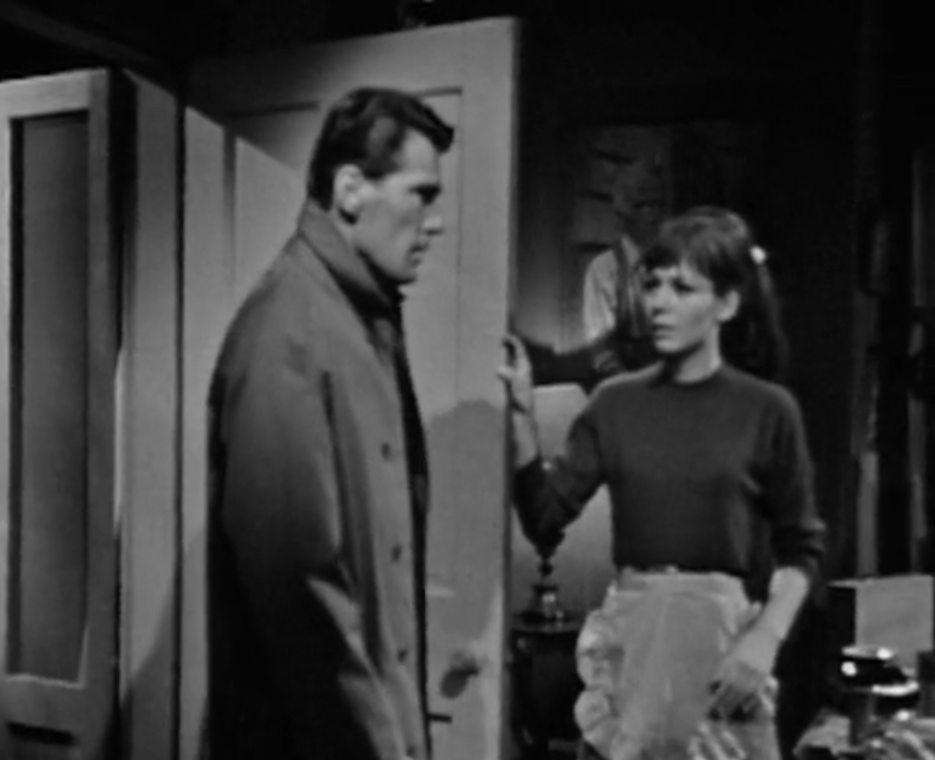
High-born ne’er do-well Roger Collins walks in on his estranged wife, the mysterious and long-absent Laura, fending off an attempt by his arch-nemesis, dashing action hero Burke Devlin, to plant a kiss on her. Roger is equipped with a bolt action rifle.

Great emphasis is placed on the rifle. The most prominent set in all of Dark Shadows is the drawing room in the great house of Collinwood, and it was altered yesterday to put a gun rack on its wall. This will startle regular viewers who remember that in episode #118 reclusive matriarch Liz had to go to the back part of the house to dig up Roger’s almost-forgotten guns. Now, those guns are on display in the family’s main dwelling place and holiest shrine.

It is 1967 and everyone associated with the creative side of the show is connected with the NYC theater world, so there is approximately a 100% chance that we are intended to read these scenes in Freudian terms. The gun is a phallic symbol, but a corrupted, sickened one- it promises, not pleasure and the creation of new life, but pain and killing. In the context of Roger and Laura’s dead marriage, it demonstrates that Roger’s sexual frustration has warped him and led him to violence.

Roger declares that Burke is trespassing on his property and bothering his wife, and declares that no court in the world would convict him of anything were he to shoot Burke to death. He also says that killing Burke would give him great pleasure. Burke asks him why he doesn’t do it, and Laura wearily complains that she had enough of these sort of encounters between them ten years ago.

Laura’s remark comes as a jolt. Ten years ago, Roger and Laura were not a long-separated couple in the process of divorcing- they were not yet a couple at all. As far as the world was concerned, she and Burke were involved with each other, and Roger was a friend who sometimes tagged along on their dates. That was the situation until a fatal hit-and-run accident involving Burke’s car. This is the first time the three of them have been alone together since that night. After the accident, Laura and Roger testified against Burke. He went to prison and they married each other. When Laura says that the way Roger and Burke are carrying on now is the way they interacted ten years ago, she is saying that even when she was ostensibly Burke’s girlfriend the two men were more excited about each other than either was about her. Perhaps Laura was the one who tagged along on Roger and Burke’s dates.

Burke grabs the gun. He and Roger struggle for it. It fires into the ceiling, and Burke tears it from Roger’s hands, flinging it to the floor. Burke picks it up. Roger rants and raves, vowing to kill Burke. Yet he does not make any protest when Burke walks off with the rifle, even though the rifle is a valuable piece of property and a central feature of Collinwood’s decor. Roger can attempt to express his masculinity only in conjunction with Burke. When Burke removes the phallic symbol and silently leaves, Roger is struck mute.

After Burke leaves, Roger and Laura continue to develop the themes of powerlessness and sterility. Having none of the influence over her an ongoing sexual relationship might give him, he complains of her disloyalty to him and of his humiliation in the eyes of those who might see her socializing with Burke. He tries to assert power over her with threats of legal consequences if she goes along with Burke’s plan to reopen the hit-and-run case. Laura agrees that she cannot help Burke without losing the one thing she wants to gain, custody of their son, strange and troubled boy David. Roger completes the image of his own emasculation with a parting remark that he will be happy to see Laura leave with their son “if David is my son.”

There is something of a fault with the production. Neither Laura nor Roger is in a position to bring new life into the world, and we are in doubt as to whether Laura is, strictly speaking, alive at all. Yet as Laura, Diana Millay is quite visibly pregnant, and she will only get “pregnanter and pregnanter” as the story goes on. Her style of acting, her personality, and her looks are so perfect for the part that it is impossible to imagine anyone else playing it, but it was very confusing to present her as an avatar of death and the unreal past when she is such a strong visual symbol of life and the growing future.

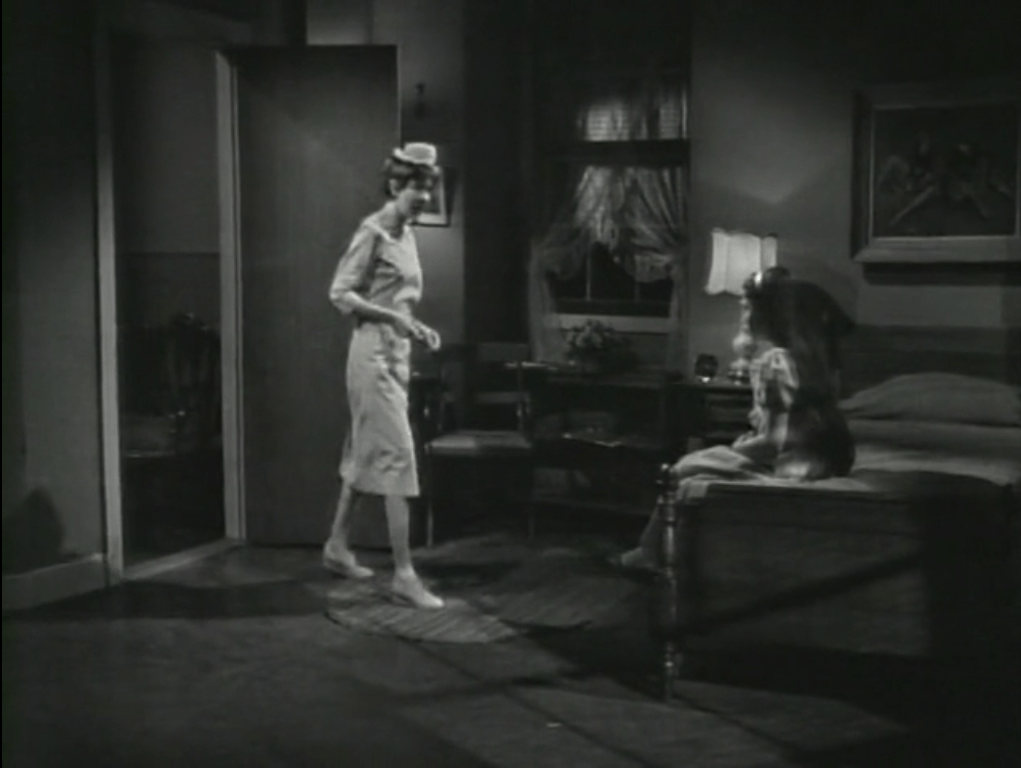
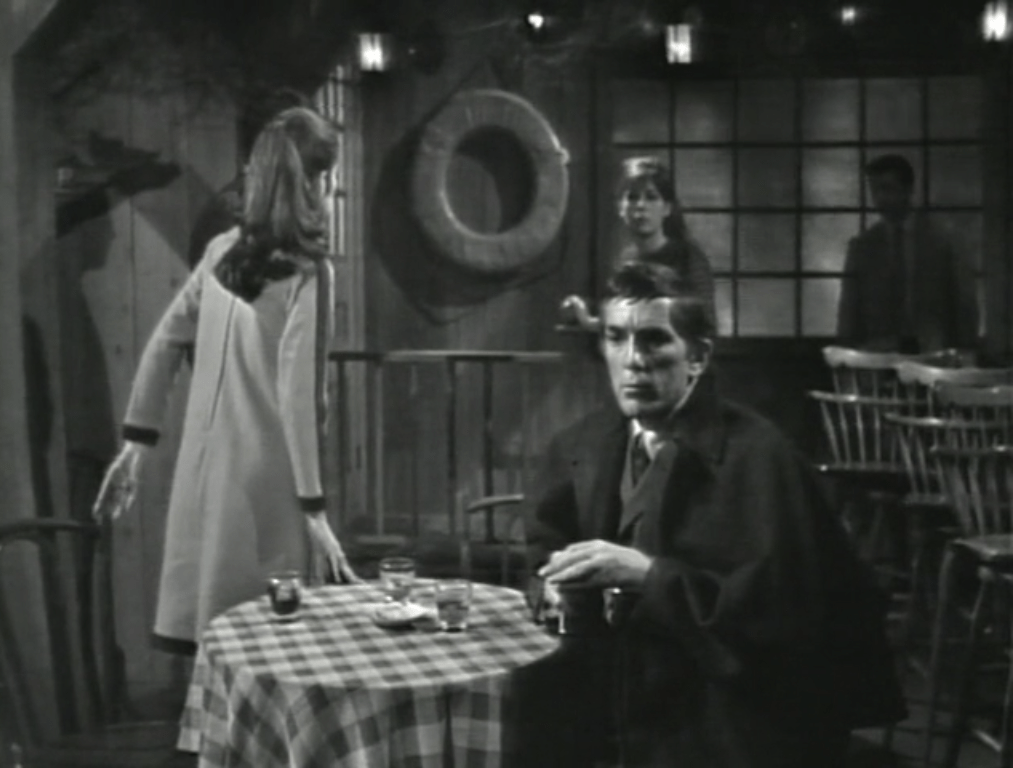
After Roger flounces out of Laura’s cottage, she goes to the window and calls to David. We see David asleep in his room in the great house. He is writhing on his bed, hearing his mother’s voice and having a nightmare. Well-meaning governess Vicki wakes David, telling him that it is 10:30 AM.* David tells her that he had the same nightmare he did the night before, in which his mother beckoned him into a firestorm. Vicki tries to assuage his fears, purring lovingly at him, but he is still deeply disturbed.

Screenshot by Dark Shadows Before I Die

Roger enters and tells David to come along and see his mother. David flies into a tantrum, insisting that he will not see her and that no one can make him. When Roger threatens to beat him, David clings to Vicki and pleads with her to stop his father from hitting him. Vicki calmly states that “No one is going to hit you,” underlining Roger’s lack of authority in his relationships with both David and the hired help. David runs off.

Vicki sits on David’s bed and tells Roger that she has a theory about David’s behavior. She believes that he really wants to see his mother and that her love is tremendously important to him, but that he has worked himself into his current state because he is afraid she will reject him. This theory has a very substantial basis in fact. When Laura first came to the house in #134, David was extremely eager to meet her, until he suddenly asked Vicki “What if I do or say something to make her hate me?” From that moment on, he has become more and more reluctant to see Laura. Vicki tells Roger that she will work to arrange a meeting between mother and son in a situation where he will not feel pressured to perform in any particular way.

Vicki shows up at the cottage carrying a tray of tea things. Laura is impressed with the breakfast. Vicki shares her idea of arranging an apparently chance meeting during the walk she and David take around the grounds every afternoon beginning at 4:30.** Laura does not eat or drink anything during her breakfast with Vicki, but she does ask a series of questions about David. Vicki enthusiastically tells her every nice thing about him she can think of, leaving out such awkward incidents as his attempts to murder Roger and Vicki herself.

Laura chooses the top of Widow’s Hill for their “chance” meeting. This is rather an odd place considering that it is likely to be getting dark by 4:30 PM in early January in central Maine, and Widow’s Hill is a place from which people famously fall to their deaths. But, Laura is the boy’s mother. Besides, the other option was the greenhouse, and they don’t have a set for a greenhouse, so Vicki goes along with it.***

At the top of the hill, David asks Vicki why she wanted to go there, and starts talking about how dangerous it is. He noodles around at the edge of the cliff, alarming her, but he says he knows the ground so well it isn’t dangerous for him. After a minute, David says it’s boring there and he wants to leave. Vicki scrambles for a reason to stay, and finds a ship on the horizon. That catches David’s attention. He watches it, wanders ever closer to the precipice, and talks about sailing around the world.

That’s when Laura shows up. In episode 2, Roger introduced himself to Vicki by startling her while she stood on the edge of the cliff, nearly prompting her to fall to her death. In #75, Vicki returned the compliment. Now, Laura simply starts talking while David is on the precipice. Shocked to hear her voice, he jumps back.

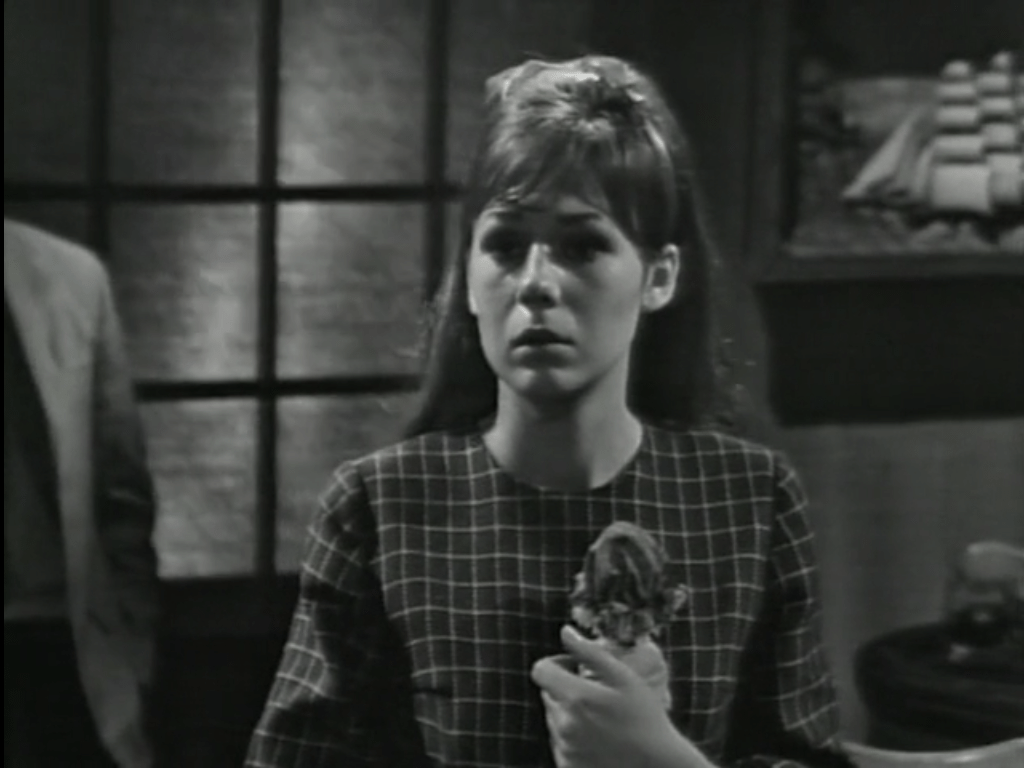
Laura goes on about how David was always interested in exotic places when he was a little boy. He looks petrified, but does agree that he remembers those conversations. She reaches out and calls him to come to her. He recoils, slips, and ends up clutching the side of the precipice. That’s what’s known as a “cliffhanger ending.”

Screenshot by Dark Shadows Before I Die.

*In many markets, ABC affiliates ignored the network’s recommendation that Dark Shadows be broadcast at 4:00 PM and showed it at 10:30 AM. Hearing Vicki mention this hour makes me wonder if we are supposed to think of the action of a soap opera taking place, not only on the date of the original broadcast, but at the time.

**4:30 was the time when Dark Shadows ended in markets where the ABC affiliate went along with the network’s recommended schedule. Mustn’t have people outdoors between 4 and 4:30!

***Mrs Acilius pointed out this consideration when we were watching the episode.

Episode 61: A sandwich for a lonely man

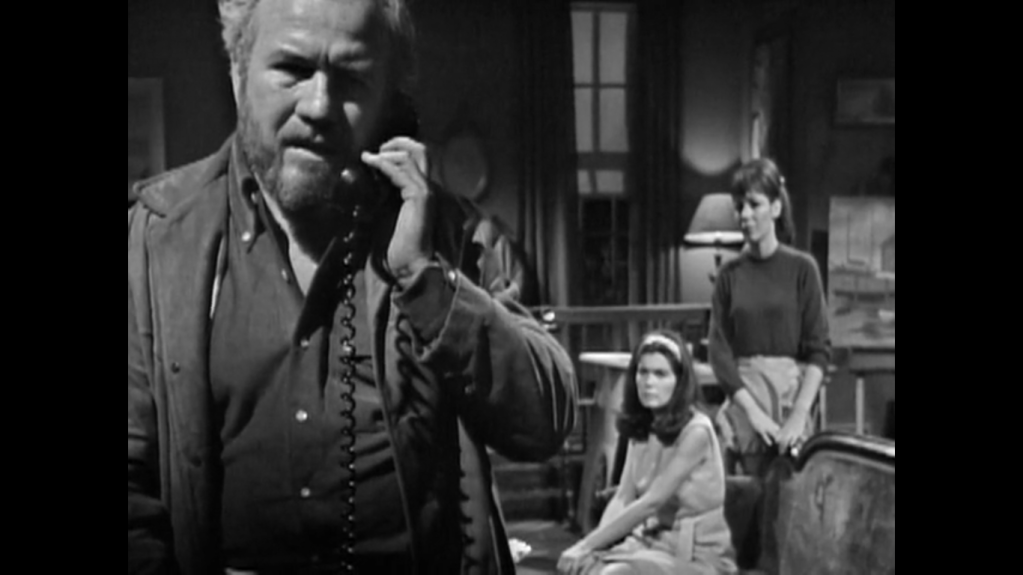
My wife, Mrs Acilius, pointed out that my post about episode 60 was unfair. She objected to the sentence “The Friday cliffhanger is Burke asking if he may join the Evanses and Vicki for dinner.” As she explained, that moment actually is an effective cliffhanger. I hadn’t mentioned that the sheriff had called drunken artist Sam Evans to warn him that dashing action hero Burke Devlin might be coming to his house, that he urged Sam to call back if Burke did come, and that actor David Ford played Sam’s reaction to this call with a convincing display of terror.

Sam on the phone
Sam trying to conceal his fear from the women behind him and the man on the other end of the call

I also failed to mention the shot when Burke enters the room. Before Sam can get the words out to tell his daughter Maggie not to open the door, Burke has burst in. The scenes in the Evans cottage have been dimly lit, with all three figures moving before dark backgrounds. When the light colored door swings open, its relative brightness feels for a second like a flash, and when he stands in front of it Burke cuts a stark figure. We see him in contrast with Maggie, who stands against a dark background, wearing a dark top and a stunned expression:

Burke enters
Burke enters the Evans cottage

Throughout the episode, Sam had failed repeatedly to exercise any measure of control even in a social situation in his own home where the only other people are his daughter Maggie and well-meaning governess Vicki, the two kindliest characters on the show. The irruption of Burke into that setting is indeed a formidable moment for Sam.

So yes, that was a more plausible Friday cliffhanger than I allowed. Perhaps I was prejudiced against it because I remembered this episode. The purpose of a cliffhanger is to bring the audience back for the next installment. Typically, the next installment will begin by resolving the cliffhanger as quickly and unceremoniously as possible. But today, Burke’s intrusion into the Evans cottage drags on and on. In the process, it does serious harm to Burke’s character.

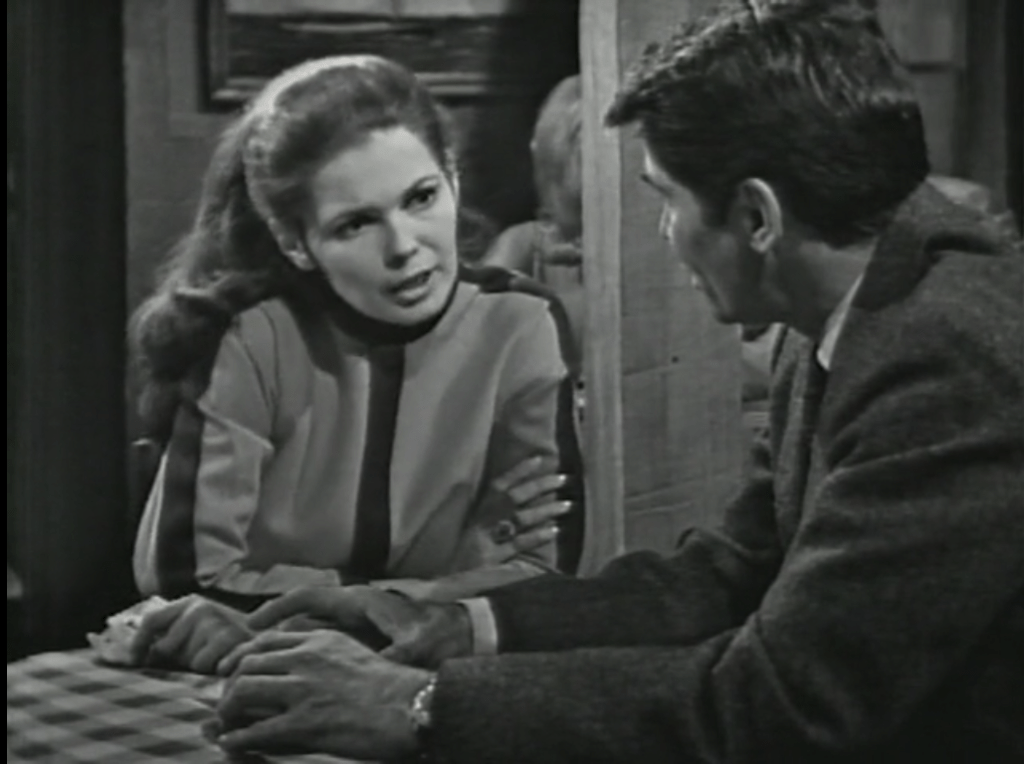
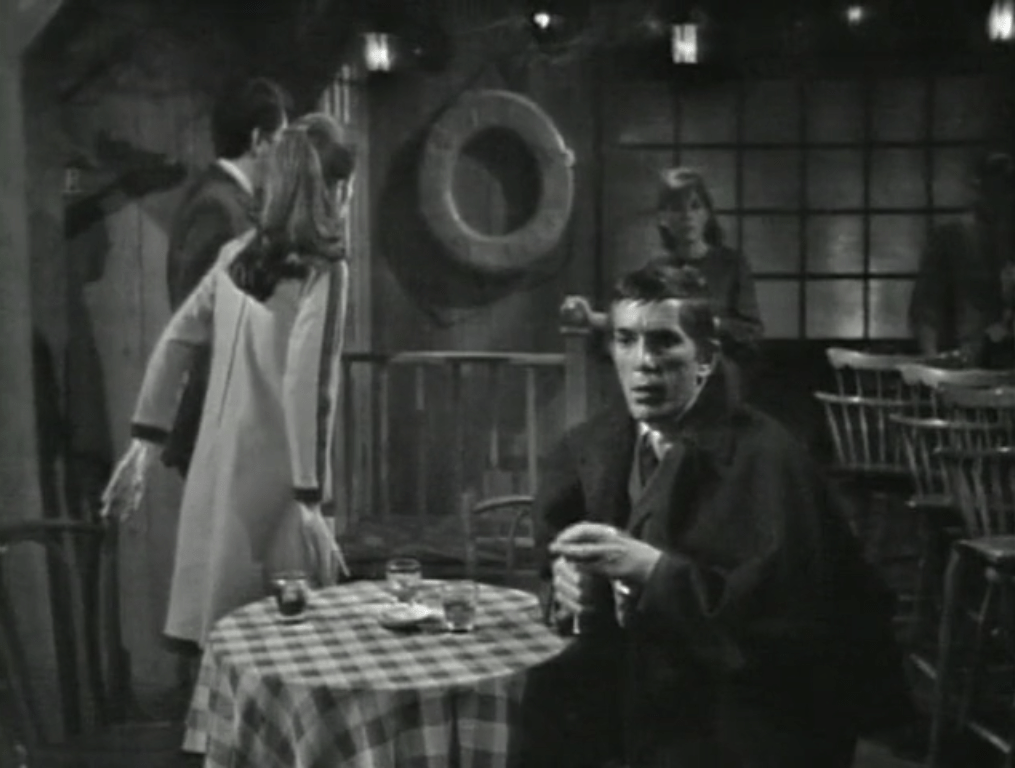
After rushing into the Evans cottage, Burke defies Sam and Maggie to say that he isn’t welcome. Maggie, unaware of the sheriff’s call urging Sam to let him know if Burke shows up, breaks down and says that of course Burke is welcome. Burke then tries to order Vicki and Maggie into the kitchen so that he can be alone with Sam. Neither woman is at all meek, however, and they stand up to Burke’s browbeating admirably.

Not so Sam. He takes the first opportunity to run away. We know that Sam has his guilty secrets, but he is a likable character, and it is hurts to imagine the pain that will await him the rest of his life whenever he remembers the night he left his daughter and her sweet young friend to face an angry man alone in his house. Sam doesn’t even call the sheriff. Instead, in his panic he goes to the hotel to try to retrieve a sealed envelope he had Maggie leave in the safe there. That gives us a scene with Conrad Bain as hotel manager Mr Wells. Bain is always a delight, and his little business about the envelope is certainly the most pleasant part of the episode. At the end of the episode, Sam will meet Burke at the hotel and ask to talk with him alone in his room, leaving us with the image of him trying to redeem himself in his own eyes.

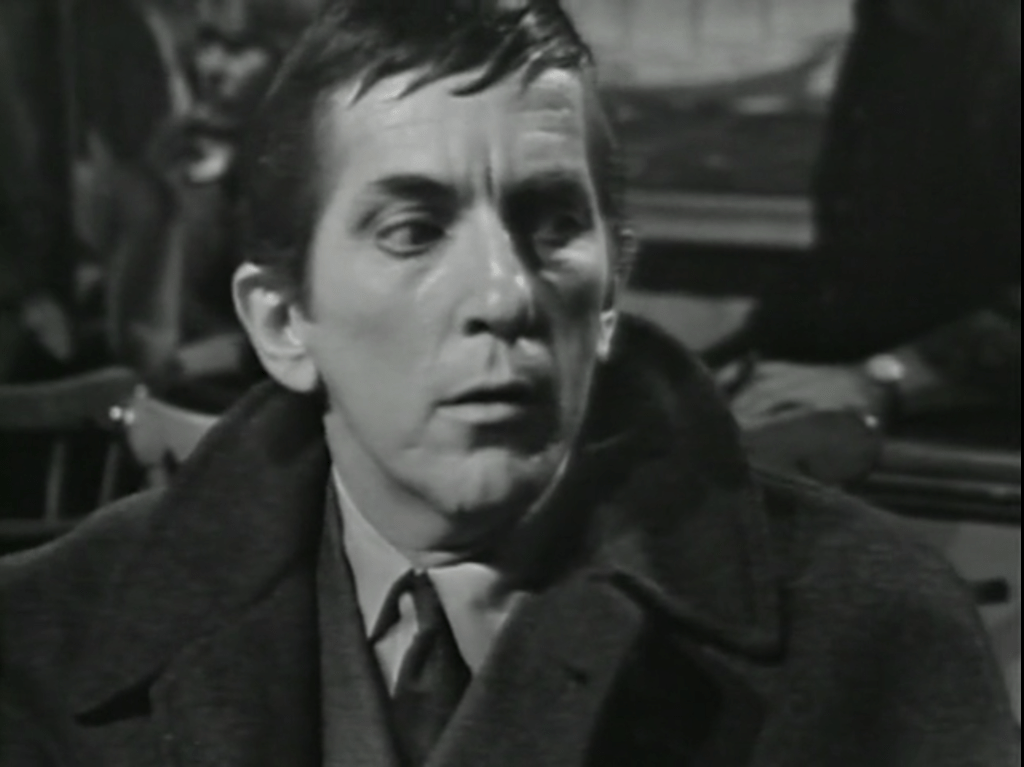
Before that end comes, however, we have much, much more of Burke trying to bully the young women in the cottage. He won’t let them eat dinner. He harangues them about his manslaughter conviction. In the course of that harangue, it becomes clear that he isn’t thinking at all clearly. “I was drunk and don’t remember too much about that night, but I do remember Roger Collins taking over the wheel.” That’s just delicious- he was hopelessly drunk, blacked out in fact, but he’s pretty sure he remembers giving the keys to someone else before the fatal collision. The fact that his substitute driver was just as drunk as he was doesn’t seem to occur to him as a flaw in his “defense,” nor does the fact that this one convenient piece of information is the only thing to surface from his alcoholic stupor. That sort of thinking runs at such an oblique angle to reality that there would be nothing to say to Burke even if he were willing to listen to you. He goes on to suggest to Maggie that her father may have killed their old friend Bill Malloy, and refuses to leave the house when Maggie tells him to do so.

Burke’s abuse of Sam, Maggie, and Vicki makes it hard for us to like Burke as much as the show needs us to like him. We’re supposed to perk up when he’s on screen, not only because we don’t know what he might do next, but also because we don’t know whether we will approve of whatever surprising thing he makes happen. Even when he is trying to destroy the family to which our point of view character, Vicki, owes her loyalty, we’re supposed to want to see more of him. But when we see him treat Vicki and Maggie the way he does here, the image of him as a grinning thug sticks in the mind, and it is hard to want more of that.

All the more so, perhaps, because of his ineffectiveness as a thug. Our first concern with the show is that it should tell an interesting story, and Burke earns our attention by providing exciting story points. We can like even a very evil character who makes exciting things happen, but someone who simply shows up at your house when you’re about to eat, keeps you from your dinner, rambles on with a lot of nonsense, insults your father, and refuses to leave is just testing your patience for bad conduct.

We can compare Burke as the villain of this episode to another, more interesting villain. Throughout 1966, Mitch Ryan was not only playing Burke on Dark Shadows, but was also on Broadway in Wait Until Dark. In that play, he was one of the con men who, under the control of a mysterious figure calling himself Harry Roat, junior (and senior, but that’s another matter,) talk their way into a blind woman’s apartment and try, at first by trickery and then by threats of murder, to get her to hand over something valuable that she hadn’t realized she had in her possession. Like Maggie and Vicki, the heroine of the play stands up to Ryan’s character and the other villains. She ultimately triumphs over them. Unlike Burke, who is simply indulging on rage for its own sake and boring everyone as he does so, Roat has devised a brilliantly clever scheme to trick his victim, a scheme which fails only because she is his equal in brilliance and his superior in other ways. Wait Until Dark was a major hit in that original Broadway run, as was the movie version the next year and as many revivals of it have been in the years since. If Roat’s activities were as pointless in the play as Burke’s are in this episode, I very much doubt it would have been produced at all.