Dark Shadows fans like to make jokes about the inefficiency of law enforcement in the fictional town of Collinsport, but in this episode we see that the sheriff and his men really never had a chance. The ancient and esteemed Collins family controls everything in the area, and they will go to any lengths to keep the police from obtaining the information they need to do their job effectively.
Stuffy Edward Collins invokes the police when he demands that broad ethnic stereotype Magda Rákóczi vacate the Old House on the estate of Collinwood. Magda laughs and says that if the police show up, she will tell them that Edward’s distant cousin Barnabas is a vampire. Horrified at the damage it would do to the Collins family name were word of Barnabas’ condition to get out, Edward backs down. Barnabas is at large and has been responsible for at least six homicides since traveling through time to the year 1897, including the murder of Edward’s brother Carl in the drawing room of their home just the other day. But evidently that is a small matter to Edward compared to the danger that the sheriff might be indiscreet.
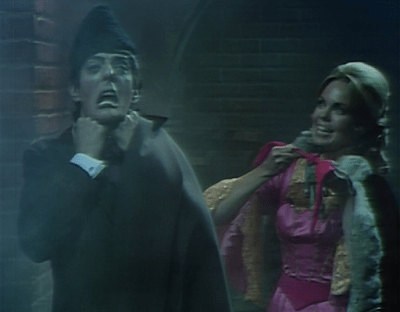
Barnabas materializes at the police station, where a werewolf is being held in custody. A deputy is startled to see Barnabas in front of him all of a sudden. For only the third time in the series, Barnabas says “Look into my eyes!” and induces an hypnotic trance in someone not his blood thrall. It is the first time he has exercised this power on someone other than Edward’s nine year old daughter Nora. Barnabas tells the deputy that once he has completed his task, he will remember nothing. So he is following the family policy with regard to keeping the police in total ignorance.
Edward shows up and sees Barnabas. Edward is wearing a cross and holding a revolver loaded with six silver bullets, which on Dark Shadows are as effective against vampires as they are against werewolves. Barnabas hides behind the deputy and tells Edward that he is acting in the interests of the future of the Collins family. Edward says that he belongs to the past, not the future. Barnabas doesn’t explain anything; he vanishes.
Not exactly an heroic look for ol’ Barney. Screenshot by Dark Shadows Before I Die.
Barnabas’ post-hypnotic suggestion has its effect, and the deputy is bewildered to find himself face to face with Edward. Edward tells him that they must watch the werewolf. The deputy starts to say something about the sheriff, and Edward replies “The sheriff doesn’t realize what this animal is!” Of course he doesn’t, no one will tell him anything about it.
Back in the Old House, Barnabas and Magda lament their failures. He could not take the werewolf from the cell in the police station to the cell in the basement of the house; she could not persuade lawyer/ Satanist Evan Hanley to return a severed hand he stole from them. They wanted to do these things because the werewolf is Edward’s brother Quentin, whom Magda is trying to free from his curse by means of the hand’s magical powers. Barnabas knows that if they do not succeed, terrible consequences will ensue in 1969.
Closing Miscellany
It is a serious mistake to show the werewolf when he is not in the act of committing a spectacular homicide. They didn’t have the budget to put him in full-body makeup, so he wears a tidy little suit, complete with a watch fob. He is so well put together that it is difficult to imagine him inspiring any fear other than the fear that one will not meet his apparently rather exacting standards of attire.
There is a noteworthy blooper in this one. Magda confronts Evan, declaring “The book, I know you took it from the Old House!” Usually actors roll with each other’s bobbled lines, but this is far enough out that Humbert Allen Astredo obviously has no idea where Grayson Hall is in the script. All he can do is ask “The book?” “The hand!” she corrects.
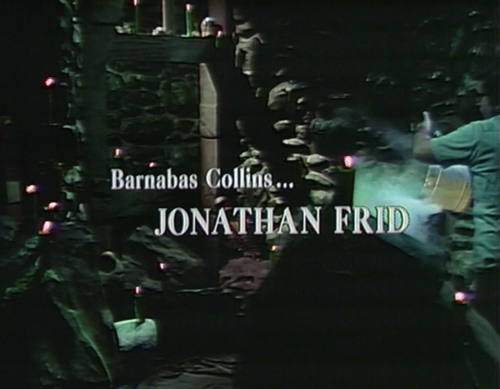
They also make a goof in the closing credits. This is one of three consecutive days when Louis Edmonds is billed not as Edward, but as Roger Collins, the role he plays in the parts of Dark Shadows set in the 1960s. He’s been identified correctly throughout the first seventeen weeks of the 1897 segment and everyone else is identified correctly in these episodes, so it is not clear what happened.
Danny Horn’s posts at Dark Shadows Every Day are often laugh-out-loud funny, and the one for this episode is especially so. His description of the scene between Magda and Evan has some big laughs, and when he imagines the sheriff’s deputies trying to catch the werewolf by “putting on their alluring lady-werewolf disguises a la the Warner Brothers cartoons,” well that’s just super how could anyone improve on it.
Diana Millay’s Laura Murdoch Collins was instrumental in two of the most important turns in the development of Dark Shadows. When she was on the show from December 1966 to March 1967, she was its first supernatural menace, marking its transition from the Gothic melodrama of its first months to the monster-driven thriller it became. And in her current tour of duty, in April and May of 1969, it is while doing battle against Laura that Barnabas and Quentin Collins become friends, a friendship that will be central to the show from now on.
Today is Laura’s final appearance. Her sendoff is startling. After she bursts into flames, we cut directly to the closing credits, already in progress with Jonathan Frid’s credit for the part of Barnabas scrolling over an image of the outside of the great house typically shown during the opening voiceover. The bottom of the image is atypically cut off, creating a letterbox effect. None of this is in itself spectacular, but each part of it is a deviation from the usual format. Taken together, it leaves us with the feeling that Laura must have exited by way of the control room.
In the opening reprise, Laura thinks she is waking her son Jamison. She pulls the covers back from Jamison’s bed, and finds that she has been talking to a pile of pillows. In the corner of the room, Laura’s fellow undead blonde fire witch Angelique bursts out laughing.
Well might Angelique laugh. Not only is it ridiculous to see an ancient and terrible creature like Laura fall for so childishly simple a trick, but heaping up pillows under covers to make it look like someone is in bed is a favorite practice of Angelique’s. In #402, Barnabas went to Angelique’s bedroom intending to stab her, only to find her in the corner laughing at him after he had chopped up some pillows under her blanket.
It is fitting that Angelique is the one who destroys Laura. Matthew Hall, son of Sam and Grayson Hall, writes in the essay he contributed to The Dark Shadows Companion that when he and his father were among the writers developing the reboot of Dark Shadows that aired briefly on NBC early in 1991, the idea of including a version of Laura was rejected because “the Phoenix was virtually a test run of all the ideas that would subsequently reach fruition in the character of Angelique. Thus: Laura’s ability to cast spells that set fire to distant things is but one if Angelique’s large arsenal of tricks. Of course, on the original show, advantage was taken of how evenly matched these two characters were: they fought viciously during one episode.” There are some odd things in this assessment, but it is certainly that a character like Laura, who was frightening precisely because she herself was unknowable and her presence implied a world that humans could never hope to understand, had no place on a show where the supernatural is represented by figures like Angelique and Barnabas, whose feelings and intentions are overwhelmingly obvious and all too relatable.
Laura’s children are hidden from her in a room in the east wing of Collinwood. It is in this room, in front of them, that she burns up. The east wing has been mentioned only a few times, mostly by actors who were supposed to say “west wing.” This is the first episode with a scene set in the east wing.
When vampire Barnabas Collins first came to the great house of Collinwood in April 1967, the living members of the Collins family were embattled, isolated, and desperate for friendship. In 1966, one of the major themes of Dark Shadows had been that the Collinses were running out of money and their nemesis, dashing action hero Burke Devlin, was using his own fortune to buy up their outstanding debts and alienate the people of the village of Collinsport from the Collinses. Everywhere they turned, they met hostility in one form or another. Their two most devoted employees had been plant manager Bill Malloy and handyman Matthew Morgan; in a fit of rage, Matthew killed Bill, and went on to abduct and try to kill well-meaning governess Victoria Winters. Roger Collins’ estranged wife, Laura Murdoch Collins, showed up; she turned out to be an undead blonde fire witch out to kill their son, strange and troubled boy David. No sooner had Victoria rescued David from Laura than seagoing con man Jason McGuire presented himself and set about blackmailing matriarch Elizabeth Collins Stoddard. Jason even forced Liz to give the bedroom next to her daughter Carolyn to his rapey sidekick, dangerously unstable ruffian Willie Loomis.
So when a man knocked on the door who looked exactly like the portrait of an ancestor who lived in a previous century and introduced himself as a distant cousin from England, a wealthy eccentric with courtly manners who wanted only to spend time on the estate where his forebears lived long ago, Liz and Roger were delighted to host him. Barnabas spent most of 1967 as a comic villain scrambling to maintain the pretense that he was native to the twentieth century, but as far as the adult residents of the great house were concerned his authenticity was established beyond doubt the first moment they saw him.
Now Barnabas has traveled back in time to the year 1897. In this period the Collinses of Collinwood are rich, powerful, and paranoid. Unknown to Barnabas, a woman named Magda Rákóczi, whom he had given a ruby ring as a bribe to secure her help after she learned that he was a vampire and that her husband Sandor was his blood thrall, had preceded him to the great house. Magda did not know why Barnabas had come to Collinwood, but she knew that he had some objective and that he would likely leave as soon as he had accomplished it. When Barnabas told Magda that he would keep giving her jewels as long as she helped him, he therefore gave her an incentive to slow him down as much as possible. She therefore told repressed spinster Judith Collins and Judith’s brother, libertine Quentin Collins, that they should beware of a “creature of darkness” who would be calling on them after sundown and who would claim to be “a friend, or perhaps a relative.”
Neither Judith nor Quentin has any respect for Magda, as much because of her Romani ethnicity as because of her mercenary ways. But when Barnabas introduces himself, Judith is deeply shaken. Quentin mocks her, suggesting that the resemblance between Magda’s prediction and Barnabas’ identification is as likely to be a coincidence as anything else, but as soon as he is alone with Barnabas Quentin pulls a sword, holds it at Barnabas’ throat, tells him he knows he is an impostor, and demands the truth within “five minutes” or he will run him through.
With this act, Quentin shows as little strategic nous as Barnabas had shown when he led Magda to believe that it was in her interest to make sure he stayed around for a while. Quentin does not know that Barnabas is a vampire, so that running him through with a sword would do nothing but give whoever saw it a story that he could not tell without branding himself a lunatic. But he does know that he is the black sheep of the family, and that his brothers and sister are eager to get him out of the way before their grandmother dies and her will goes into probate. If he kills a man in cold blood, they would have an excellent reason to have him committed to an asylum and whatever legacy he receives placed in a conservatorship they would control.
So Quentin’s threat is an empty one. Had Barnabas caved in and made a confession that he was a fraud, only Judith would have known of Quentin’s triumph, and she has made it clear that she is not about to yield a penny of her inheritance to him no matter what he does. At most, Quentin would have given Judith a new esteem for Magda, who herself has no use at all for him. And when Barnabas holds his ground, all Quentin can do is back down, losing face and making himself permanently ridiculous in his eyes.
The particulars of the scene are interesting, as well. Quentin tells Barnabas that he has “five minutes” to explain himself. When we heard that, my wife and I laughed out loud. Are we about to be treated to five minutes of silence while they hold their poses? Surely, we thought, it was a blooper- the scripted line must have been “five seconds.” But no! A moment later, Quentin says that “five minutes can go by rather quickly, when a man is about to die.” Had Barnabas been struck with terror at the sight of the weapon so close to him, he might have started confessing as soon as he saw it, but by the time Quentin doubles down on this “five minutes” it is obvious he has already lost the game.
Quentin tells Barnabas that he has just returned from a visit of about six months in England, during which time he discovered that he had no relatives there named Collins. This gives Barnabas an opportunity to insult Quentin, saying that his reputation may have preceded him and driven his relatives to make sure he did not find out about them. This stuns Quentin satisfactorily, but is not strictly necessary. There had been a great deal of migration from Ireland to England by the 1890s, more than enough that an Irish name as widespread as Collins would have been very familiar there. It is hardly likely that even if he had spent six months doing nothing but tracking down every Collins family in the country Quentin would have been able to have confidence that he had not overlooked some descendant of a Collins who had left Collinsport generations before. After all, they didn’t have ancestry dot com back then! It is clear that he must be lying.
Worst of all from Quentin’s perspective, he is still holding the sword at Barnabas’ throat when Judith comes in. At that sight, she has no choice but to set aside her own doubts about Barnabas. She demands Quentin apologize to Barnabas. Barnabas tells them that he can assure Quentin that he does not want any of the family’s money; in fact, he says, the English Collinses are quite comfortable financially and he plans to make some investments in local businesses while he is in Collinsport. Quentin perks up at this, no doubt seeing Barnabas as a possible mark for his next con game. Longtime viewers will remember that when Barnabas introduced himself to the 1960s iteration of the family, Roger was extremely interested in his apparent wealth and had several ideas about how he might help himself to a share of it.
Judith offers Barnabas a room at the great house. He says he would rather stay at the Old House on the estate. Judith breaks it to him that the current head of the family, dying nonagenarian Edith Collins, has let “Gypsies” live there. She makes it sound like a whole Romani clan has settled in, but in fact it is just Magda and Sandor. Barnabas feigns surprise, but still asks permission to inspect the house. Judith consents, and he sets out, alone
Danny Horn’s post about the episode on his Dark Shadows Every Dayfocuses on the ways it makes Quentin look like a child. I’d say it makes Judith look equally childish, even though she is clearly senior to Quentin. The two of them model one of Dark Shadows‘ signature pairings, that of Bossy Big Sister and Bratty Little Brother. Even when the big sister is in a position to exercise authority, as in the 1960s Liz was in a position to exercise authority over Roger, she winds up being merely bossy because however flagrantly he disobeys her, in the end she covers up his misdeeds and protects him from the punishment they merit. Longtime viewers suspect Judith will find herself doing the same.
In yesterday’s episode, Quentin entered maidservant Beth’s room and found her getting ready to go out. He asked if it was her day off; she said Judith gave her permission to run personal errands in town. He grabbed at her things and found an envelope with $300 cash. She claimed she saved this out of her salary, an obvious lie. He made leering insinuations about her relationship with his oldest brother Edward; she slapped his face.
Now, Beth is on her way back to Collinwood from her mysterious errand. Barnabas sees her in the woods and addresses her by name. She asks who he is and how he knows her. He introduces himself, and explains that he saw her photograph in an album at Collinwood. In fact, his friend Julia Hoffman saw such a photograph in 1969 and described it to him; Barnabas himself never saw it, but he did see Beth’s ghost. Evidently the photo had already been taken and put into the album, because Beth smiles when Barnabas talks about it. He asks Beth about the children at Collinwood. She mentions two; he asks about a third, and she says there is no third. He asks why he thought there was, and she seems uncomfortable. After she leaves, we hear his thoughts in a voiceover monologue. In 1969, Beth’s ghost led Barnabas’ friend Chris Jennings to an infant’s coffin; he wonders if that child has already died, and looks around, as if he might be standing on its grave.
Barnabas’ next stop is at the waterfront. When he was first a vampire in the late eighteenth century, Barnabas once found himself on the docks by chance and was overcome with thirst for the blood of the streetwalkers who worked there. This time he must have made a conscious decision to find a sex worker to drain of blood. Some wonder why he does not feed on Sandor and Magda, but longtime viewers know the answer to that one. When Barnabas was first on the show, Willie was his blood thrall, and each bite left Willie critically ill throughout the daylight hours. Barnabas needs Sandor and Magda to guard him during the day, so others will have to suffer to provide him with blood.
Barnabas picks up a small object from the pavement. He hears a soprano voice nearby, calling for an unseen “Charlie!” to help her find her lost makeup compact. The owner of the voice comes into view and introduces herself to Barnabas as Sophie Baker.* Barnabas gives her the compact. She thanks him and says it was a gift from a dear man, a Captain Strathmore. She asks Barnabas his name. He says he thinks it is best if he doesn’t give his name. “What an odd thing to say,” she responds. If she made her living the way Barnabas hoped the woman he found would make hers, it wouldn’t be odd at all; Sophie’s reaction is that of someone who has no idea that she is in a place where that trade is practiced. Evidently Sophie comes from a sufficiently comfortable background that prostitution does not impinge on her thoughts even as something other women do.
Barnabas tries to get away, and Sophie asks “Well, what’s the matter with me?” Charlie is hopelessly drunk, leaving Sophie without an escort. Barnabas is plainly alone, and the night is young. The pub is nearby- why don’t they stop in for a drink. Barnabas shows great reluctance, but finally agrees to walk Sophie to the door. She takes out her compact to freshen her face, looks in its mirror, and notices that Barnabas does not cast a reflection. She is stunned by this. Barnabas bares his fangs, and sates his bloodlust.
The compact with a mirror was apparently a new invention when one was advertised in the Sears & Roebuck catalogue in 1908, so it is an anachronism in 1897. But it is a perfect touch. Sophie’s discovery that Barnabas does not cast a reflection turns the scene from a little bit of farce into a tale of horror in a fraction of a second. That the compact allows such an efficient use of time makes it no wonder that they used the same prop in 1967, when Julia glanced in her compact to confirm her hypothesis about Barnabas’ nature in #288.
This time, the compact also goes a long way towards explaining Barnabas’ attitude towards Sophie. It shows that she can afford to buy the latest and most sophisticated trinkets, and that she expects to be seen using them. Barnabas picks the compact up and returns it to Sophie as a gentleman might a lady’s handkerchief. Sophie’s personality may have led her to match the outgoing and uninhibited manner that is a professional requirement for sex workers and that made them easy targets for Barnabas, but when he sees that she is not of their class he becomes reluctant to attack her. Thus we learn that snobbery Barnabas has shown in some of his darker moments is not just an occasional failing, but that his whole career as a vampire is primarily a war on poor people.
Back at Collinwood, Quentin spots Beth taking a tray of food upstairs. He waylays her, uncovers the tray, and demands to know who it is for. She says it is for Edith, and he declares that his grandmother is far too ill to eat so much. When he finally lets her go, Beth goes to Edith’s room and tells Judith about Quentin’s interrogation. They confer about the matter in urgent whispers. Judith tells Beth they will have to be far more discreet now that Quentin is back. She urges her to take care Quentin does not see her when she takes the rest of the food “upstairs.” Evidently there is someone in the house Quentin does not know about, and Judith and Beth are conspiring to keep it that way.
Judith leaves the room, and Quentin slips in. He pretends to be Edward. Edith is not fooled, and expresses her annoyance with him. She says she is not as far gone as he thinks she is, and he assures her that she is. She will die tonight, and will tell him the family secret before she does. He seems to be threatening to kill her himself by the time the episode ends.
Every episode of Dark Shadows begins with a voiceover delivered by a member of the cast. This one reuses yesterday’s opening voiceover. I believe this is the first time they have done this.
*The closing credits give her name as “Sophie Barnes,” but she very clearly says “Baker.”
Magda Rákóczi, preposterously broad ethnic stereotype, has discovered that the recently arrived Barnabas Collins is a vampire. Barnabas has bitten and enslaved Magda’s husband Sandor, and tells her that she, too will do his bidding. When she asks what has brought him to this conclusion, he tells her that as long as she is in his employ, he will give her jewels. He hands her a ruby ring, and she agrees.
Longtime viewers know well that Barnabas’ plans regularly backfire. Today, we see one of the reasons why. Barnabas does not tell Magda why he has come to the estate of Collinwood in the year 1897, but he does tell her that the following night he will be calling on the Collins family in the great house in order to win their acceptance of him as a distant cousin from England. For all she knows he might be able to complete his task and go back to where he came from shortly after the Collinses welcome him. That would leave her with no further jewelry. So Magda goes to the great house and tells spinster Judith Collins and her brother, libertine Quentin Collins, that a stranger will visit them after sunset. He will present himself as a “friend, perhaps a relative,” but they must not trust him. He is in fact a “creature of darkness” who means them harm.
Judith and Quentin are one of Dark Shadows‘ signature pairings of Bossy Big Sister/ Bratty Little Brother, and they bicker about whether to be disgusted or amused by what they take to be Magda’s transparently fraudulent warning. When Barnabas shows up, Judith is shaken and Quentin laughs at her for taking Magda seriously. In the last scene, Quentin does pull a sword on Barnabas and threaten to kill him on the spot unless he tells a more acceptable story, so apparently he placed a higher value on Magda’s words than he wanted to let Judith know.
Her dialogue is full of lines like “I don’t care” and “It’s none of your business,” and Terry Crawford decides that the best acting choice she could make would be to play it as if Beth sincerely means every word that she says. This is different from what a good actor would do in every respect.
She should be fencing with him, half-flirting and half-angry and half-guilty. Yes, she should be playing three halves right now; that’s the point of the scene. But Terry Crawford gives you what’s on the page, because somebody explained the concept of “subtext” to her once, while she was thinking about something else.
Alas, it is so. Appealing as David Selby’s personality is and lively as his interpretation of Quentin is, Miss Crawford’s literalism means that his efforts are largely wasted, at least in his scenes with her. With Joan Bennett’s Judith or with any of the other members of the cast, we can see that while Quentin’s behavior is inexcusable, his charm is irresistible. But Miss Crawford shows us Beth resisting it with no apparent difficulty, and that leaves him as just another jerk. As I put it in a comment on Danny’s post:
I agree about Terry Crawford. She has to do something very difficult- simultaneously show contempt for Quentin and attraction to him. She manages only the first, meaning that when he keeps at her after she tells him to leave her alone, it isn’t a game, it’s just sexual assault. That makes Quentin a lot harder to like than he needs to be.
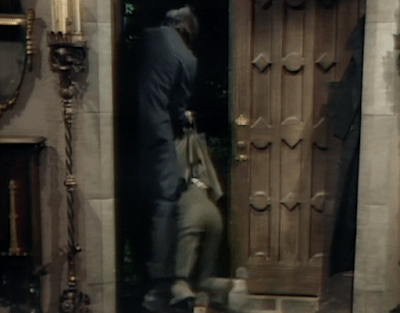
This episode ends with one of the all-time great screw-ups. A few times actors have come partly into view during the closing credits, usually just one arm briefly entering the shot. But this time Jonathan Frid comes walking right into the frame, gives a horrified reaction, and scurries off. It is a thing of beauty, enough to make you wonder how there can be people who are not fans of Dark Shadows.
A great moment in the history of television, or THE GREATEST moment in the history of television? You decide. Screenshot by Dark Shadows Every Day.
In the Old House on the estate of Collinwood, nine year old Amy Jennings pops into her governess’ bedroom in the morning. The governess, Maggie Evans, hasn’t been to bed yet. Maggie’s other charge, twelve year old David Collins, disappeared into the haunted corridors of the great house on the estate some time ago, and cannot be found. The evil spirit of the late Quentin Collins has been possessing David and Amy off and on for many weeks, and has now grown so powerful that no one dares go into the great house alone. Maggie is too worried to go to bed.
Maggie questions Amy about David and Quentin. Amy tries to deny knowing anything about Quentin, but Maggie keeps up the pressure until Amy admits she is afraid that if she talks, Quentin will do something to her big brother Chris Jennings. Permanent houseguest Julia Hoffman overhears this admission, and demands to know what Quentin has to do with Chris.
Julia knows something neither Maggie nor Amy does. Chris is a werewolf. As Quentin’s power over the children and the great house has grown, so has Chris’ lycanthropy spread over more of the month. For the past several years, Chris took his wolf form only for the two or three nights the moon was fullest, never for more than four nights, and never during any other lunar phase. Now he has started changing even when the moon is new. What is more, Julia and her friend, old world gentleman Barnabas Collins, just came from the chamber where they coop Chris up when he is the werewolf. They found that he has not changed back even though the sun has been up for two hours. They have no way of knowing when or if Chris will ever be human again.
Amy won’t tell Julia or Maggie anything more about Quentin or about Quentin’s fellow ghost, Beth. Amy has communicated with Beth, knows her name, and she and David first saw Beth with Quentin. She knows also that Beth weeps when she thinks of Chris suffering. For their part, Julia and Barnabas saw Beth when she led them to save Chris when Quentin had tried to kill him. Chris told them that Beth had appeared to him, and when he took Barnabas to the spot where that happened he and Barnabas found a shovel and excavated the unmarked grave of an infant wearing a pendant meant to ward off werewolves. Julia saw a photograph of Beth in an old Collins family album, dated 1897, the same year Quentin disappeared. If they could combine Amy’s knowledge about Beth with what they have learned from these three experiences, Barnabas and Julia might get somewhere.
Julia and Amy leave, and Maggie goes to bed. As she lies under the covers, we see visual effects that might have been impressive on daytime television in 1969, but that we all got pretty sick of seeing people use on video calls in 2020. The picture wiggles in the middle and a transparent sticker of Quentin’s face sweeps around the screen.
Maggie has a dream. Dream sequences on Dark Shadows are usually messages sent to the dreamer by some supernatural force; the sticker of Quentin’s face suggests at first that he is the sender of this message. Maggie goes to a room in the long-deserted west wing of the great house. She was in the room in #680, and saw Quentin there. When she took matriarch Elizabeth Collins Stoddard and David to the room in #681, there was a tailor’s dummy wearing Quentin’s frock coat, with a face and mutton chops painted on it. Liz was glad to believe that the dummy was what Maggie saw, and David nattered on about how he and Amy called the dummy “Mr Juggins.” In her dream, Maggie recognizes Mr Juggins, then sees an opening in the wall.
She goes through it, and finds a hidden chamber. Quentin is there. Quentin tried to strangle Maggie in #691, and earlier this week he dressed her up in a lovely outfit and did her hair in an elaborate up-do, so there’s really no telling what is going to happen when the two of them are alone together. This time, he kisses her passionately, and from the way she relaxes in his arms it is clear he is doing a great job.
Awake, Maggie tells Julia about her dream. This will bring back memories for longtime viewers. When we first saw Julia in #265, she was Maggie’s psychiatrist, and was asking her about, among other things, her dreams. The same viewers will have been marveling at the fact that Maggie is staying in the room of the Old House once occupied by the gracious Josette and now dominated by Josette’s portrait. In May and June of 1967, Barnabas was a vampire. He held Maggie prisoner in Josette’s room as part of his scheme to erase her personality and replace it with Josette’s. Julia hypnotized Maggie into forgetting that whole ordeal, and the show has recently been assuring us that they will not revisit the question of whether her memory will return. Putting her back in the room is their most heavy-handed way yet of telling us to stop wondering about that.
Maggie’s discussion with Julia also raises the question of who sent the dream. Had she responded to it by slipping out to the west wing without telling anyone where she was going, we could believe that Quentin was luring her to him by showing her what a good kisser he is. But this conference makes it clear that Maggie is not only consciously determined to do battle against Quentin, but that she is enlisting the support of the allies likeliest to make headway against him. Beth has done a great deal to warn people against Quentin, so she might have sent the dream. Since Maggie is in Josette’s room and the closing credits will run over a shot centered on Josette’s portrait, it is also possible that Josette’s ghost has returned to the business of sending dream warnings.
Once Maggie figures out where Quentin’s chamber is, she decides that David must be there. She resolves to go to the chamber and find David. Julia tells her it is too dangerous for the two of them to go to Quentin’s stronghold alone, and insists they wait until Barnabas can join them. Julia goes to fetch Barnabas. When she brings him back to the Old House, Maggie says that now she can’t find Amy. Julia decides to look for Amy while Maggie and Barnabas go to the great house.
It might seem odd that Julia thinks it is OK for Maggie to go to the great house accompanied only by Barnabas when it would have been too dangerous had she herself been Maggie’s only companion. But Julia knows that Barnabas is not an ordinary man. He has been free of the effects of the vampire curse for almost a year, but his history made it possible for him to travel back in time in #661. It seems that he retains enough connection with the supernatural to make him a more formidable adversary for Quentin than is even so adroit a mad scientist as Julia.
Amy overhears Maggie’s conversations, and she goes to the west wing. She uses a crowbar to open the panel that leads to Quentin’s chamber. She goes in and calls for David. David is not there, but Quentin is. Amy tries to tell Quentin that she had come to warn him that Maggie and Barnabas were on their way; as her attempt to lie to Maggie had crumbled when Maggie kept questioning her, so her attempt to deceive Quentin collapses as he keeps staring at her. Amy’s face goes blank, and we realize that Quentin is transmitting commands into her mind.
Barnabas and Maggie do go to the room and they do find the opening in the panel. Barnabas looks through it, and sees a door on the other side. The opening is a small one, close to the floor. The children have been crawling through it, and evidently Maggie did the same in her dream. But Barnabas does not intend to get his suit dirty. He picks up the crowbar, and says he will rip out all the panels and walk through the door.
Silversmith Ezra Braithwaite comes to the great house of Collinwood, bearing a ledger with information that old world gentleman Barnabas Collins wants. Barnabas is in the study, so twelve year old boy David Collins lets Mr Braithwaite into the house and escorts him to the drawing room. The two of them play a scene that may not have looked like much on the page, but as delivered by talented comic actors Abe Vigoda and David Henesy the lines are hilarious.
For example, Mr Braithwaite has two pairs of glasses, which he describes to David as his glasses for looking at things and his glasses for looking at people. David asks if the ones he is wearing are his “thing glasses.” We laughed out loud at that whole exchange. Mr Braithwaite asks David to go get “Uncle Barnabas”; David replies “He’s my cousin,” to which Mr Braithwaite answers “Ah, yes.” Again, that wouldn’t be a hit in a joke book, but Vigoda and Mr Henesy sell it. The purest example comes when Mr Braithwaite starts to change his glasses as he turns to the pages of the ledger and says out loud to himself “Oh, Ezra, Ezra, you already got on your reading glasses.” That is a laugh line entirely because of the way Vigoda stresses the words “got” and “on.”
There is a little exchange between Ezra and David that will stand out to longtime viewers:
Ezra: David is it? Well, I don’t remember a Collins being named David before. Now, my name is Ezra, as my father was and his father before him. You find a name like Ezra and you don’t give it up.
David: I guess not.
Ezra: Yes, now, David’s kind of a new-fangled name.
David: No, there’s King David in the Bible.
Ezra: Oh, of course, yes, yes. A good man, too.
In #153, it was established that no Collins ever bore the name “David” until undead blonde fire witch Laura Murdoch Collins insisted that her husband Roger go along with her plan to name their son “David Theodore Collins.” That turned out to be hugely important as evidence of Laura’s evil intentions. In #288, it sounded like they had decided to retcon that away when David looked in a family album, saw a portrait of a “David Collins” from a previous century, and wondered aloud if he had found his namesake. Nothing has come of that potential namesake in the 79 weeks since, and Ezra’s line that he didn’t “remember a Collins being named David before” would suggest that they’ve gone back to the original idea.
Mr Braithwaite, in his thing glasses, examines a piece of silver. David examines him. Screenshot by Dark Shadows Before I Die.
Each time Mr Braithwaite looks at someone through his “thing glasses,” we get a point of view shot showing that his eyesight is blurry. They then cut back to the other actor in regular focus. These shots are brief enough that the repetition isn’t a big problem, but it results in a series of exchanges the actors deliver to the camera rather than to each other. Those don’t work at all. Mr Henesy and Abe Vigoda had such a fine comic rhythm going that it’s a shame to break it up with this clunky stuff.
Reading the ledger, Mr Braithwaite says that the silver pentagram Barnabas wants to know about was bought in April 1897 by Miss Beth Chavez and paid for by Quentin Collins. We have seen Beth’s ghost. She is very tall and so thin you could clasp your fingers around her waist. Her complexion is pale as can be, her hair blonde, her eyes blue. I’ve met a fair number of Chavezes in my time, including a couple of Elizabeth Chavezes, and none has met this description. I have nothing to say against slender blondes, and actress Terrayne Crawford is movie-star beautiful. Still, if a fellow were excited about a blind date with a girl known to him only by the name “Beth Chavez,” he’d probably be a bit disappointed if the person who showed up met her description.
We have also seen Quentin’s ghost. Quentin is manipulating David into helping him with a number of murders he intends to commit. Beth has thwarted one of these murders so far, and is trying to prevent Quentin from achieving other evil plans of his. But Quentin is apparently more powerful than she is.
While Mr Braithwaite is alone in the drawing room, Quentin enters through a secret panel. Earlier in this episode, they made it clear Quentin can choose whether he is visible to the living people in the spaces he occupies; there is no need for him to hide. Why does he use the panel?
Longtime viewers may be able to make a surmise. We saw this panel for the first time in #87, when David’s father Roger used it for a sneaky errand. We didn’t see it or hear of it again until #643, when David told nine-year old Amy Jennings that there was a passage “very few people” knew about, and used it to lead her to the room in which Quentin was at that point confined. Quentin’s use of it will therefore suggest that he knows all the secrets of the house. It also suggests that when he dwelt there as a living being he was a naughty fellow who was in the habit of using its secret passages for the sort of underhanded mischief Roger got up to in #87 and #88.
Quentin strolls up to Mr Braithwaite and smiles at him. Mr Braithwaite is wearing his “thing glasses” and cannot see Quentin clearly. He asks Quentin if he is the friend Barnabas spoke of when he asked him about the pentagram. Quentin nods. Mr Braithwaite says that he himself made the pentagram in April 1897, when he was “fifteen and a half.” It is now February 1969, so we know that Mr Braithwaite is 87. He recognizes Quentin. Shocked to see a man who has been dead for decades apparently alive, well, and in his twenties,* Mr Braithwaite dies of a heart attack.
It’s a shame we won’t be seeing more of Abe Vigoda as Mr Braithwaite. At least they spelled his name correctly in the credits this time; yesterday he was “Abe Vigodo.”
*Two days past his 28th birthday, to be exact. Happy belated 84th to David Selby!
Dark Shadows has two ongoing storylines at this point. Mysterious drifter Chris Jennings came to town a couple of months ago and turned out to be a werewolf. Heiress Carolyn Collins Stoddard does not know of Chris’ curse. She has taken a fancy to him and set him up in the caretaker’s cottage on the estate of Collinwood. Old world gentleman Barnabas Collins and mad scientist Julia Hoffman do know that Chris is a werewolf, and they are working to help him. Barnabas has found a place to keep him confined on the nights of the full Moon, and Julia is trying to develop a medical intervention that will keep him in his human form.
Meanwhile, Chris’ nine year old sister Amy has taken up residence in the great house on the estate. She and her twelve year old friend, strange and troubled boy David Collins, are falling under the power of the evil spirit of the late Quentin Collins. At first Amy could communicate with Quentin more clearly than David could. This made David envious. In #640, David complained that Amy could hear his voice and he could not, even though “Quentin Collins is my ancestor.” That suggested to the audience that Quentin would turn out also to be Amy and Chris’ ancestor, joining the werewolf story with the Haunting of Collinwood.
Today, Barnabas and Chris have dug up a spot on the ground to which the ghost of a mysterious woman had led Chris. They find a tiny coffin holding the remains of an infant. They discover that the infant was wearing a medallion in the shape of a silver pentagram. The sight of the dead baby shocks Barnabas right away; Chris keeps his composure at first, but seems close to tears a moment later. Quentin stands in the shrubbery and watches Barnabas and Chris.
Barnabas has not seen Quentin and does not know who he is. Others have seen him and described him to Barnabas and Julia. They and those others suspect that he is a malevolent ghost with designs on David and Amy. No one has yet made a connection between Quentin and the werewolf story, however.
Julia and Barnabas have also seen the mysterious woman who led Chris to the baby’s grave. They know that she is a ghost and that she has helped Chris, and they also know that her clothing is of the same vintage as is the clothing which Quentin wears. But they do not know what, if anything, the two ghosts have to do with each other. The audience knows that the female ghost’s name is Beth and that she was with Quentin in the little room in the long deserted west wing of the great house when the children first met him.
Barnabas tells Chris that the pentagram can only be a device to ward off a werewolf, so that there must have been a werewolf in the area when the baby was buried. He also tells Chris that the mysterious woman would not have led him to dig up the grave unless what they found in the coffin would be of help to him.
While Barnabas inspects the pentagram in the drawing room of the great house, David throws darts at a board propped up on a chair nearby. The audience knows that David is under Quentin’s control, so it is obvious to us that the dart playing is an attempt to distract Barnabas and keep him from figuring out the meaning of the pentagram. Lacking our knowledge, Barnabas is merely annoyed with David. Jonathan Frid and David Henesy expertly develop the comedy in Barnabas’ fast-burn reaction to David’s behavior.
Heiress Carolyn Collins Stoddard interrupts the scene. She notices what Barnabas is doing. He shows her the pentagram, and she recognizes the jeweler’s mark as that of Braithwaite’s silver shop in the village of Collinsport. While Barnabas telephones Braithewaite’s and arranges to take the pentagram there to see if the proprietor can give him any information about it, Carolyn tells David she wants to have a conversation with him about some cryptic remarks he made earlier. David refuses, saying that he has homework to do. Carolyn argues with him briefly, but finally gives up and leaves. Barnabas is still involved in his conversation with Mr Braithwaite when David hides the pentagram behind his dartboard.
Barnabas gets off the phone, and David resumes throwing darts. Barnabas asks him why he isn’t doing the homework he was just telling Carolyn presented such an urgent obligation that he could not talk with her. He launches into a shaggy dog story, the upshot of which is that he has to wait for Amy.
More exasperated than ever, Barnabas turns to the desk and sees that the pentagram is gone. He demands David return it. David denies having it. He says that it may have vanished on its own. After all, unaccountable things happen at Collinwood all the time, as Barnabas is in a position to know. The way he says “You should know that” reminds longtime viewers that David has more than once shown signs of figuring out more about Barnabas’ own connections to the supernatural than have any of his adult relatives. In #316, he pointed out that none of the Collinses really knows anything about Barnabas- “He just showed up one night.” And in #660, he told Amy that “Barnabas knows a lot of things he doesn’t tell anybody.” At moments like these, we wonder just how much information David really has at his disposal. Perhaps he secretly knows everything, and has just decided there’s no point in notifying the authorities.
David invites Barnabas to search him. He lists the contents of his pockets, and turns the right front pocket inside out. He tells him that he has a pack of chewing gum, which he got from Amy. He specifies that he traded her a box of raisins for it. As David Henesy delivers the line and Jonathan Frid shows us Barnabas’ reaction, this detail is laugh-out-loud funny. Barnabas surrenders and apologizes to David, fretting about the pentagram’s absence.
Barnabas takes a sketch of the pentagram to Braithwaite’s. In the first months it was on the air, Dark Shadows took us to New York City twice, to Bangor, Maine several times, and to Phoenix, Arizona once. But now that both stories center on characters all of whom dwell in one or another of the houses at Collinwood, it is as rare to leave the estate and go into the neighboring village as it was then to go on those remote excursions.
Old Mr Braithwaite tells Barnabas that the shop has been in operation since 1781 and has been providing fine silver to the Collins family the whole time. Regular viewers know that Barnabas was alive then, and lived in Collinsport. A curse made him a vampire in the 1790s, and he was under its power until he was freed early in 1968. So he must have been quite familiar with Braithwaite’s in its early years. What is more, in #459 we saw that in the first months of Barnabas’ career as a vampire his father Joshua learned of his curse and commissioned a local craftsman to make silver bullets with which he could put Barnabas out of his misery. That craftsman must have been one of the first Mr Braithwaites.
The incumbent Mr Braithwaite tells Barnabas he will consult his records as soon as the shop closes and telephone him if he finds anything. When the call comes, David answers. Mr Braithwaite tells David that he can’t imagine why he forgot about the pentagram since it was one of the very first he made himself, back in 1897. Quentin appears, takes the phone from David, and hears Mr Braithwaite say he will stop by Collinwood with the ledger shortly.
Mr Braithwaite almost remembers.
David protests that Quentin had no right to take the phone from him. Quentin turns to him, gives him a menacing look, and walks toward him. David backs away and and takes a place on the stairs, still objecting loudly to what Quentin did.
Closing Miscellany
The closing credits list the actor who plays Ezra Braithwaite as “Abe Vigodo.” Perhaps in some parallel time-band there was a man of that name who played Tossio in The Good Father and Detective Fosh in Barney Moeller, but this is in fact Abe Vigoda.
“Abe Vigodo”
In his 1977-1978 ABC TV series Fish, Vigoda’s character was married to a woman played by Florence Stanley. Stanley was also a Dark Shadows alum, as a voice actress. She provided sobbing sounds heard in #4, #98, #515, #516, and #666. Vigoda once appeared on the panel at a Dark Shadows convention; his main statement was “I don’t remember much about it.” I can’t find evidence that Stanley ever appeared in such a setting. I would love to imagine that Vigoda and Stanley compared notes about their experiences on Dark Shadows between setups on Fish, but I would be astonished to learn that ever happened.
Vigoda always played old men. The second screen credit on his IMDb page is a 1949 episode of Studio One in which he took the role of “Old Train Passenger.” At that time, he was 28. Vigoda was a marathon runner, a form of exercise that tends to burn out all the fat under the skin of the face. And of course he was a very strong actor, easily able to convince us that he is of a great age. So even though Vigoda was only three years older than Jonathan Frid, and about 175 years younger than Barnabas, it isn’t quite as funny as it might be to hear him call Barnabas one of “you young people.”
Danny Horn devotes his post about this episode on his great Dark Shadows Every Dayto three points. The first is his exultation that his least favorite writer, Ron Sproat, was credited with his final script yesterday, so that today is the first day of the Sproatless Dark Shadows. The second is that the show is finally joining the werewolf story with the Haunting of Collinwood. The third is a point I have some reservations about. He says that this is the first episode where Quentin “has a feeling,” and therefore declares it to be Quentin’s debut as a real character. “It’s nice to meet you Quentin. Welcome to the show,” he concludes.
It’s true that Quentin shows a wider range of feelings today than he had previously, but I think it is an exaggeration to say that we are only now seeing his feelings. For example, when in #680 Quentin agrees to Amy’s demand that he stop trying to kill Chris, he looks very much like a man humiliated to find that he has to capitulate to a nine year old girl. In the same episode he showed amusement and anger at appropriate points. Those three responses may not sound like much, but David Selby’s face is a magnificent instrument, one he plays it expertly. For him, they are more than enough to make Quentin into a real person.
Chris and Carolyn have a brief scene in the drawing room as they are getting ready to go on a date. Chris defuses a potentially awkward conversation about his previous failures to respond to Carolyn’s hints that she was interested in him by saying “Oh, I didn’t notice that” in the W. C. Fields imitation he had used with Amy in #677. She chuckles delightedly. This is not implausible. Not only can we imagine her being relieved that the topic didn’t ruin their evening, but W. C. Fields was very much in vogue in the late 1960s, so much so that a fashionable young woman might have chuckled when a man briefly imitated him.
David and Carolyn have an exchange that longtime viewers will find less plausible. He asks her if she has ever seen a ghost; she responds by asking if he has. But each of them knows perfectly well that the other has seen ghosts. David spent the first year of the show on intimate terms with the ghost of the gracious Josette, and he and Carolyn both saw and had substantive conversations with the ghost of Barnabas’ little sister Sarah. In #344, Carolyn told David that when she was a little girl her best friend was the ghost of a boy named Randy. It’s just trashing character development to retcon all that away.
Barnabas says something that will catch the ears of properly obsessed fans. When he is in the shop, he tells Mr Braithwaite that he will gladly drive back from Collinwood whenever he has any information for him. There have been some suggestions lately that Barnabas has learned to drive and has come into possession of a car, but this is the first definite confirmation of that point.
This one survives only in a black and white kinescope. That format serves the story quite well. Five of the characters sound like they would generate fast-paced, high-pitched action- Barnabas Collins is a recovering vampire, Julia Hoffman is a mad scientist, Chris Jennings is a werewolf, Quentin Collins and his associate Beth are ghosts. But today is all about Barnabas, Julia, and Chris trying to figure out whether Quentin and Beth really are ghosts and wondering if they have something to do with Chris’ nine year old sister Amy and Amy’s twelve year old friend David Collins. They have to spend their time painstakingly chewing over the few wisps of evidence they have managed to collect. That slow story depends entirely on atmosphere and suggestion to connect with the audience, and the visual simplicity and abstraction of black and white images gives it the best chance it could have of working.
Barnabas and Julia go to Chris’ place to ask him if he knows anything about Beth. Julia hypnotizes him to make sure he isn’t blocking any memories of her; he isn’t. They leave, he goes outside alone, and he meets Beth. She points to a spot on the ground, then vanishes. He goes to get Barnabas and tell him about this encounter. They go to the spot she had indicated and find that a shovel has materialized nearby. They dig there, and turn up a child’s coffin. Barnabas is puzzled by this. He hasn’t buried any children in unmarked graves on the grounds lately, and there is nothing distinctive about the coffin itself. So he suggests they open it. The episode ends with the lid of the coffin filling the screen.
This was the last of hundreds of episodes written by Ron Sproat. When Sproat joined the show in the fall of 1966, he sorted through the storylines, discarding some that couldn’t possibly go anywhere and tightening the focus on those that seemed to have potential. He was an able technician who did a great deal to make sure that new viewers could figure out what was happening on the show. He shouldered the heaviest share of the writing burden in the period when the vampire storyline began and Dark Shadows suddenly leapt from the bottom of the ratings to become a kind of hit, and was a workhorse through the months when the show was a costume drama set in the 1790s and emerged as one of the major pop culture phenomena of the 1960s. He was the one who pushed his Yale classmate Jonathan Frid for the role of Barnabas, and he was the first person connected with the show to go to the conventions the show’s fans organized, laying the foundation for a community that brought them together with members of the cast, crew, and production staff.
Vital as his contributions were to the show and its afterlife, the brutal conditions under which Dark Shadows‘ tiny writing staff worked made it impossible to ignore Sproat’s weaknesses. When there were never more than three people involved in creating scripts for a hundred minutes a week of drama, scripts which were often produced verbatim as they came from the writer, there was nowhere to hide. So it is clear to us that Sproat’s imagination was not an especially fertile source of plot development. On his great Dark Shadows Every Day, Danny Horn frequently complained of Sproat’s habit of locking characters up in various forms of captivity so that the story would not progress and he would not run out of flimsies to fill in. Danny called these captivities “Sproatnappings.” Sproat probably should have found a different job several months ago, and certainly should have been part of a larger group of writers.
Still, we will miss him when he’s gone. Alexandra Moltke Isles played well-meaning governess Vicki from #1 to #627; for the first year, she was the main character on Dark Shadows, and she continued to be a core member of the cast until she left. Nowadays, Mrs Isles remembers that a few months after her departure she found herself free at 4 PM and tuned into the show. She couldn’t make heads or tails of what was going on. She wasn’t the only one. The staff that will take the show through its next several months- Sam Hall, Gordon Russell, and Violet Welles- would do brilliant work, on average far and away the best the show ever had, but none of them spared a thought for any but the most regular of viewers. For much of 1969, missing one episode will leave you bewildered- missing several months, well, Mrs Isles may as well have been watching a different show altogether.
Most episodes in the first 66 weeks of Dark Shadows ended with ABC staff announcer Bob Lloyd’s voice in the closing credits telling us that “Dark Shadows is a Dan Curtis production.” We hear that announcement during today’s closing credits for the first time since #330. That isn’t because they’ve brought Mr Lloyd back, but because they were using an old tape for the theme music and didn’t realize his voice was on it. You can tell it wasn’t on purpose, since the announcement comes in the middle of the credits, not in its usual place at the end when the Dan Curtis Productions logo appears.
Sometime vampire Barnabas Collins tells his best friend, mad scientist Julia Hoffman, what happened on the night in the 1790s when his father chained him in his coffin, not to be released until 1967. This story is told to the audience by a series of clips taken from episodes 456-460, with voiceover narration by Barnabas.
Barnabas wants to travel back in time to prevent one of the disasters that took place that night, the hanging of well-meaning governess Victoria Winters. He tells Julia that when he first lived through the events, he wasted his time murdering roguish naval officer Nathan Forbes. If he can get back, he will let Nathan live, but force him to help save Vicki.
At the end, Barnabas feels that he is being pulled to the past. He steps away from Julia and strikes a pose fitting for someone who is about to fade from the screen. He does not fade, but Julia and her surroundings do. We zoom in for a closeup. As we do, we hear the sound of dogs howling. Barnabas opens his mouth, and we see that he is once more a vampire.
Barnabas is surprised to see that Julia, not he, figures in the special effect. Screenshot by Dark Shadows Before I Die.
Vicki’s presence in the 1790s was the result of her own displacement from 1967 beginning with episode 365. She traded places with the original governess, a woman named Phyllis Wick. Barnabas saw Phyllis and recognized her when she appeared in Vicki’s place, and after Vicki’s return he was bewildered by her story. But today he tells the story of the fateful night as if he remembers Vicki. Perhaps the same things happened to Phyllis, and he is just filling in Vicki’s name.
As a clip show, this is the first to feature two names in the closing credits under “written by.” It should feature three- Gordon Russell and Sam Hall get credit for the clips from episodes 456, 457, and 458, but it also includes material from 459 and 460, written by Ron Sproat. The credits also fail to mention that Jonathan Frid played Barnabas, and for that matter the opening title doesn’t appear until after the closing credits, so I suppose Sproat was in good company.
Eleven year old Amy Jennings and her big brother Chris joined the show recently, and they are the stars today. Amy has discovered the ghost of Quentin Collins, who haunts a room in the long deserted west wing of the great house of Collinwood. Strange and troubled boy David Collins is rather miffed that Quentin prefers Amy’s company to his- after all, “Quentin Collins is my ancestor,” not Amy’s. They hold a séance in an attempt to bring Quentin to them. David has only participated in one séance, back in #186, when he went into a trance and gave voice to the late David Radcliffe, a boy who died (by fire!) in 1867. So he hasn’t had a chance to catch on that séances on Dark Shadows require a minimum of three people- the first to begin the ceremony and bark orders at everyone else, the second to go into the trance and act as medium, and the third to grow alarmed, try to wake the medium from the trance, and be sternly rebuked by the first. Since David and Amy have no third person, they have no chance of contacting Quentin.
Instead, a shadowy figure appears in the doorway. She is well-meaning governess Vicki, or a rough approximation thereof. David Collins’ scenes with Vicki had been the highlight of the first year of Dark Shadows, not because of the writing or the direction but entirely due to the rapport between actors David Henesy and Alexandra Moltke Isles. A few weeks ago Mrs Isles left the show, and Vicki was recast. Her brief appearance is Mr Henesy’s first scene with the new actress, Betsy Durkin. They can’t recreate his chemistry with Mrs Isles, and Vicki ran out of story long ago. As a result, the scene sounds a discordant note for longtime viewers, reminding us that Miss Durkin, whatever her talents, is here nothing more than a fake Shemp taking up screen time.
Unknown to the other characters, Chris is a werewolf. Chris accepts an offer from the Collins family to host Amy at Collinwood while he deals with his mysterious problems; in gratitude, he takes heiress Carolyn for a drink at the Blue Whale tavern. While there, he sees a pentagram on the barmaid’s face and hurriedly excuses himself. Later, he transforms into his lupine shape and returns to the barroom, not through the door this time but through the window. He kills the barmaid.
The barmaid appears only in this episode; she doesn’t even get a name. But we see her face in closeup often enough that she feels like a person. Even more importantly, she is wearing the same wig that Maggie Evans, The Nicest Girl in Town, wore in her first four episodes (#1, #3, #7, and #12.) Since Maggie was also a server, working the counter at the diner in the Collinsport Inn, this wig tells longtime viewers that the werewolf’s victim could just as easily have been Maggie, one of everyone’s favorite characters.
Don Briscoe played Chris in his human phase, Alex Stevens as the werewolf. Stevens was credited not as an actor, but as “Stunt Coordinator.” Yet today, his credit card appears in between Briscoe’s and that of Carol Ann Lewis, who was cast as the luckless barmaid. Some of the original audience may have caught on that Stevens was the man in the character makeup, but others who noticed the odd billing order would have chalked it up as another of the show’s frequent imperfections.