Mad scientist Julia Hoffman must hide her notebook from vampire Barnabas Collins and Barnabas’ blood thrall, his distant cousin Carolyn. The notebook documents Barnabas’ vampirism, and he does not want it to fall into the hands of the authorities. Once he gets hold of it, he plans to kill Julia.
The last time Dark Shadows devoted as much story time to attempts to hide and find an object as they have to this notebook was when high-born ne’er-do-well Roger Collins was frantically trying to hide local man Burke Devlin’s filigreed fountain pen, a story that dragged on from August to November of 1966. Few remember that storyline fondly, but at least the pen was a unique piece of evidence that might connect Roger to a homicide. The notebook is less satisfactory as a focus of attention, since there is nothing unique about it- Julia could easily have written a hundred documents detailing Barnabas’ secret and stashed them all over the world, and for all Barnabas knows she may have done. There are several strong episodes during this period, but the inadequacy of the notebook as a MacGuffin, combined with the fact that Julia could at any moment hop in her car and drive someplace where Barnabas wouldn’t be able to hurt her, prevents any momentum carrying over from day to day.
There are two important things about this installment. It is the first episode written chiefly by Sam Hall,* who will become far and away the most important member of Dark Shadows‘ writing staff. Hall would write hundreds of episodes, right up to the final one, would write the two theatrical features based on the show that were produced in the early 1970s, and would stick with producer Dan Curtis for years afterward, even contributing a script to the ill-fated 1991 primetime reboot of Dark Shadows. The husband of Grayson Hall, who played Julia, he would develop the show into something as different from its November 1967 incarnation as that version is from the show that premiered in June 1966.
On his blog Dark Shadows Every Day, Danny Horn argued that Hall’s contribution was to see Dark Shadows as, first and foremost, a “mashup” of various stories. The example he gives in his post about this episode are the scenes in the office of Tony Peterson, a local attorney whom Julia has hired to keep the notebook locked up in his safe. Tony is played by Jerry Lacy, who in the 1960s and 1970s was chiefly known for his Humphrey Bogart imitation. He would do that imitation on Broadway in 1969 in Woody Allen’s Play It Again, Sam and again in the 1972 film version of that play; here he is doing it in a 1980 commercial for the Long Beach California Press-Telegram.
In the scenes Danny focuses on, Mr Lacy imitates Bogart as Sam Spade or Philip Marlowe meeting a succession of mysterious women in his office. Grayson Hall plays Julia as a frightened and barely coherent client and Nancy Barrett plays Carolyn as the blonde you’d be a fool to trust, even if she does have a pair of gams that won’t quit. They’re all having a great time with their pastiche of The Maltese Falcon, The Big Sleep, and other staples of the Late Late Show.
I do have to demur from Danny’s claim that Hall pioneered Dark Shadows as a mashup. It was that from #1, when Jane Eyre met the Count of Monte Cristo and they both found Art Wallace trying to remake a script he’d already sold to television twice. Nor is he the first to mash up disparate genres. The story of Burke’s fountain pen led into a police procedural that merged with a ghost story; Burke’s typically soapy conflict with Roger dissolved into the story of Roger’s ex-wife, undead fire witch Laura Murdoch Collins, a story which was Dark Shadows’ first and most detailed adaptation of Dracula. The difference in Hall’s approach to mashups is that always before, one of the genres was Gothic melodrama. Today, a vampire story is meeting a film noir, and there are some elements of conventional daytime soap opera in the margins. Hall is letting go of Dan Curtis’ original idea of chasing viewers who read Gothic romances.
We get a clue as to what that might mean for the existing characters when Tony asks Julia if she is afraid of Roger Collins. Julia laughs loud and long at the idea that Roger is any kind of danger. For the first 25 weeks, Roger was indeed a deadly menace, but ever since Laura came through he has been reduced to occasional comic relief. Viewers who find a reminder of Burke’s fountain pen in the business with the notebook will see that even the villainous early Roger is a minor threat compared to the supernatural force Barnabas represents. So we are not to assume that any character or theme surviving from the show’s original conception is safe.
*The credits on screen say Gordon Russell wrote it, but evidently the paperwork from the show demonstrates that Hall did. Also, some of last week’s episodes sounded and felt as much like Hall’s work as this one does, but none of the experts tries to credit him with those, so I’ll defer to the consensus and say that while his influence may have been visible some days ago, this one marks his debut on Dark Shadows as the principal author of a teleplay.
Yesterday’s episode ended with vampire Barnabas Collins telling his distant cousin and newly acquired blood thrall Carolyn that he would punish his associate Julia Hoffman. Carolyn smiled delightedly when she asked “Are you going to kill her?”
Today begins with a reprise of that scene. But there is a difference. Now, it is Barnabas who brings up the idea of killing Julia. Carolyn reacts with horror, tries to talk him out of it, says she won’t be part of a murder, and only reluctantly yields to him.
This instant retcon is disappointing to regular viewers for four reasons. First, while we can accept the show changing course from time to time, we do expect the story to build on itself as a reward to us for watching every day. If they’re going to pull a U-turn as abruptly as this, it may as well be an anthology series. Second, Carolyn’s reluctance to go along with Barnabas’ evil plans is nothing new to us- even her lines are recycled from objections her predecessor Willie and Julia herself had made to Barnabas’ earlier declarations that he intended to kill someone or other. Third, Nancy Barrett was tremendously fun to watch as a happy assistant murderer. She was nowhere near done exploring the possibilities of that persona.
The fourth disappointment goes deeper. It’s easy enough to see why the writers wouldn’t want Carolyn to rejoice in her situation for an indefinitely long period. As Stephen Robinson put it in a comment on Danny Horn’s Dark Shadows Every Day, “There’s no conflict [if] Barnabas’s partner in crime is a fully willing psychopath. They would just stand around going bwah-ha-ha.” But the excitement in the first four episodes of this week came from that very lack of dramatic possibility. It was so clear Carolyn’s relationship to Barnabas could not stay as it was for very long that we’re waiting for some big event to change it at any moment. When they slide back to the same old stuff we’ve already been through with Willie and Julia, that excitement gives way to the sinking feeling that nothing much is going to change in the foreseeable future.
Nancy Barrett’s acting style is to throw herself unreservedly into whatever the script calls for her character to be doing on any given day, without regard for what the character may have done in past storylines. This turns out to be the perfect approach to playing Carolyn Collins Stoddard. In the first months of the show, flighty heiress Carolyn was fickle, capricious, and self-centered, traits that were all the more disturbing in someone who never showed any particular awareness of what she had said or done as recently as the day before.
That all changed when Carolyn shouldered responsibility for the Collins family business while her mother, matriarch Liz, was away for several weeks in February and March of 1967. After that period, her chief motivation was an earnest concern for the family’s well-being, and her chief difficulty was incomplete information. In her frustration, she tried to save her loved ones by doing just the wrong thing. So when Liz was going to marry seagoing con man Jason McGuire, Carolyn figured out that Jason was blackmailing Liz into the marriage. She also deduced that Liz’ fear was that her secret, if exposed, would ruin Carolyn’s chance at happiness. But Carolyn did not know what the secret was. So, she first tried to ruin her own happiness by dating motorcycle enthusiast Buzz, then when the prospect of Buzz as a son-in-law did not suffice to prompt Liz to stand up to Jason, Carolyn brought a gun to the wedding and planned to shoot Jason dead while he was saying his vows.
By Friday, Carolyn’s concern centered on her young cousin, strange and troubled boy David Collins. David was in touch with the supernatural, and had said that distant relative Barnabas Collins was an undead creature who posed a terrible threat to everyone. Carolyn thought Barnabas a fine and pleasant fellow, but she knew that much of what David had said was true. Though the boy kept pleading with her to forget everything he has said lest she die as the previous adult to believe him, Dr Dave Woodard, died, Carolyn could not do so. She decided to slip into Barnabas’ house to investigate David’s claims. There, she found Barnabas’ coffin. When he bit her and sucked her blood, she learned that he was a vampire.
Miss Barrett’s style usually produces a hot performance, in which she flings the character’s emotions directly before the audience. Today, though, she is playing a vampire’s newly acquired blood thrall. That is a part for a cold actor, one who keeps the audience guessing at the character’s feelings and intentions. On Friday, Barnabas told his co-conspirator, mad scientist Julia Hoffman, that if he bit her she would no longer have a will of her own; having heard that line, returning viewers are supposed to be unsure whether Carolyn even has an inner life now.
Miss Barrett rises to the challenge admirably. In her scenes with Julia at Barnabas’ house and with her mother and her uncle Roger at the great house of Collinwood, she manages to sound faraway and disconnected without seeming bored or confused; in her scenes with Barnabas, she sounds a note of unquestioning devotion without seeming robotic. All of the actors have been doing exceptional work the last few days, and with this eerie turn Miss Barrett is on a par with the very best.
Barnabas gives Carolyn two instructions. First, he tells her to convince everyone that David is mentally ill and that everything he has said should be disregarded. Carolyn smiles readily and says that this will not be difficult to accomplish. Since we have over recent months come to know Carolyn as the determined if maladroit protector of her family, and since she has been so focused on helping David, this easy acquiescence in Barnabas’ wicked plans for David comes as a heartbreak to regular viewers.
Barnabas’ second command is for Carolyn to encourage well-meaning governess Vicki to discard her personality, replace it with that of his long-lost love Josette, and come to him willingly as his bride. Carolyn is a bit puzzled by the Josettification project, but just a couple of days ago Vicki was telling her that she is “more than fond” of Barnabas. Besides, Vicki really is fascinated with Josette, and her current personality hasn’t given her much to do on the show lately. So Carolyn smiles again and says that she will see to it that Vicki comes to Barnabas.
The original videotape of this episode is lost, and the kinescope is particularly gray and scratchy. That is a happy accident. The very cheapness of its look adds to the Late Late Show quality of a story about a beautiful young blonde under the power of a vampire. The abstractness of black and white imagery also takes us out of the literal, workaday world of color pictures, into a realm of dreams and fables where we might expect to encounter vampires.
Most important, the kinescope makes a sharp contrast with images we saw last week. In #348, we got a look at Carolyn’s bedroom. It was the most brightly decorated set we have seen so far on Dark Shadows, so much so that I had to squint for a second when Carolyn switched a lamp on. In color, Barnabas’ house is drab enough, but in black and white it is so severely bleak that the idea of the resident of that glowing bedroom ending up there should give us a shudder. While Barnabas is on his way upstairs to see Carolyn, the camera lingers a bit on this shot of melted candles; for me, that was the moment that particular shudder comes hardest.
Smoldering in the ruins
Of course, a vampire’s bite is a metaphor for rape; of course, Barnabas’ investment in presenting himself as a member of the Collins family makes his attack on Carolyn a metaphorical incest. Every other Dark Shadows blogger who has posted about this episode has explored that theme- Danny Horn (and several of his commenters) here; Patrick McCray and Wallace McBride here and here; and John and Christine Scoleri here. All I have to add to that chorus of voices is that Carolyn’s role as doughty if misguided protector of her kindred makes her a particularly poignant victim of an incestuous assault.
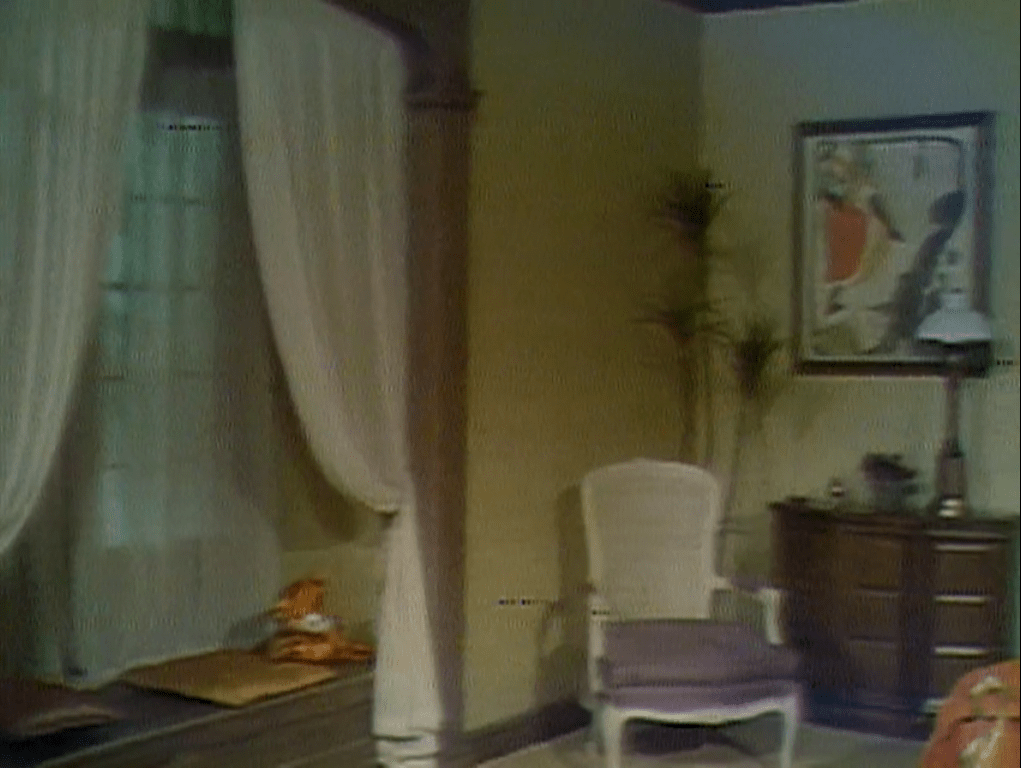
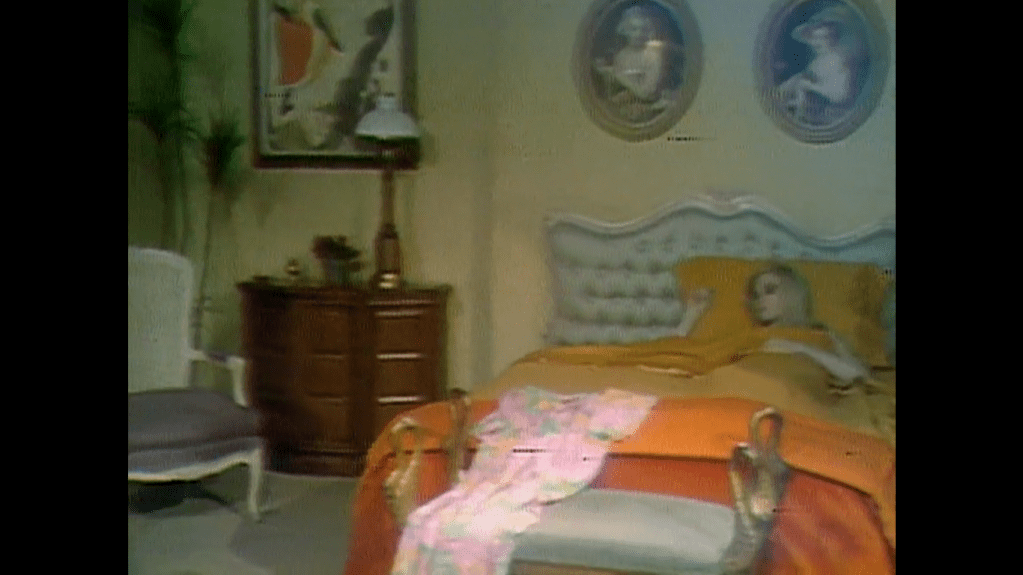
We open on a new set, the bedroom of heiress Carolyn Collins Stoddard in the great house of Collinwood. Dark Shadows has been in color since #295 in August. Though directors Lela Swift and John Sedwick were both ambitious visual artists, they haven’t been able to do much with color so far. With Carolyn’s bedroom, Swift and the staging team have accomplished one of their first real essays in color. It is composed mostly of shades of yellow, pink, and orange.
The color schemes of the other interiors we’ve seen up to this point run the gamut from sedate to subdued to drab to dank, so we already know we are in a unique space. The only other room in Collinwood that might have matched this one for brightness was the kitchen, but we haven’t seen that since #208.
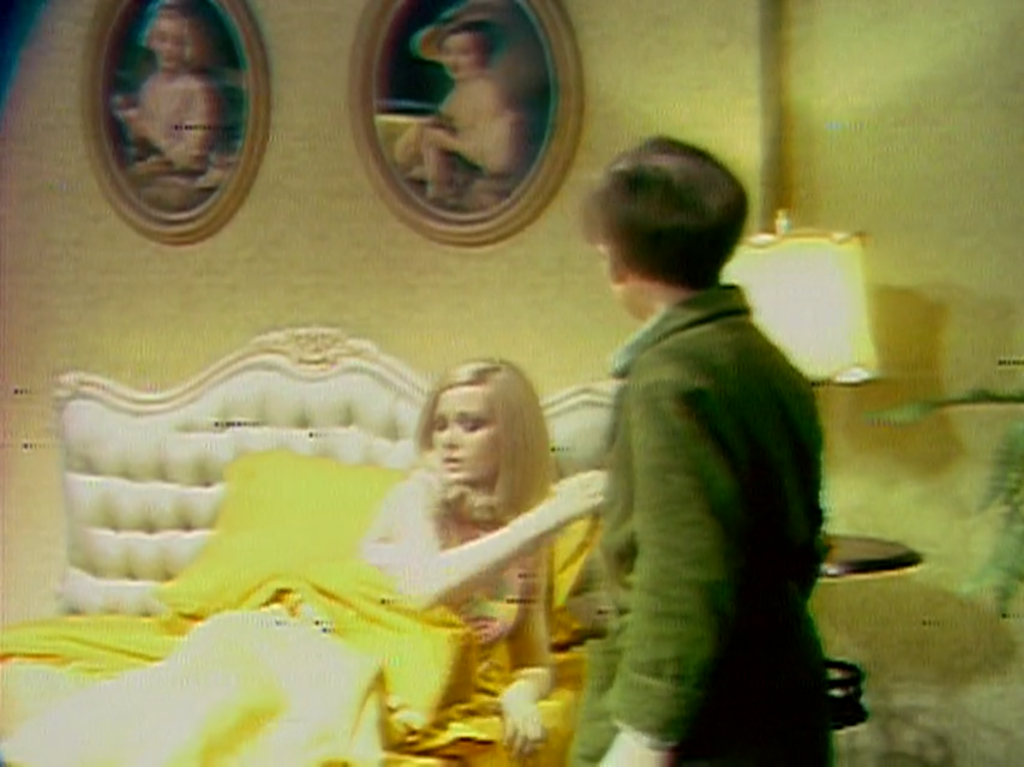
Carolyn’s young cousin, strange and troubled boy David, lets himself into her room. He touches her, and she awakes with a scream. He explains that he just dropped in to make sure she wasn’t dead. When she turns on the light, the screen is so bright that I reflexively squinted, a reaction I’d never before had to an image on Dark Shadows.
Bright room.
David can’t quite explain why he was afraid Carolyn might be dead, but he does insist that she take an antique toy soldier, saying that she will be safe if she keeps it with her. Carolyn’s mother, matriarch Liz, comes into the room to investigate Carolyn’s scream. Liz wonders what David is doing there. Carolyn hastens to say that he was just making sure she was all right.
David goes, and Carolyn tells Liz she doesn’t think anything can be done for him at home. Liz is reluctant to send him away. Regular viewers will not be surprised by this. We know that Liz took David and his father, her ne’er-do-well brother Roger, into Collinwood at the beginning of the summer of 1966 and summoned her unacknowledged daughter, well-meaning governess Vicki, to come look after David starting with #1 on 27 June 1966, so that her conviction that the family ought to look after him got the whole show started. Nonetheless, Liz is so disturbed by David’s unusual statements and depressive affect that she agrees that he needs residential care.
We cut to the Old House on the estate. Vampire Barnabas Collins is sitting in a basement room where mad scientist Julia Hoffman maintains a laboratory. The room is full of electrical equipment, a bit odd since the Old House has no electricity; the laboratory itself is lit by flaming torches. But if we’ve ever seen a Universal Studios production from the 1930s, we know that where you find a mad scientist, you will find electrical currents, so naturally things start buzzing when Julia flips a switch.
Barnabas confined
Julia is trying to implement a medical cure for Barnabas’ vampirism. In the first shot of this scene, we see a visual metaphor for that project. Barnabas, an uncanny being, is confined to a small space in the middle of an elaborate collection of technology. If Julia succeeds, the supernatural will be vanquished altogether and scientific rationality will fill the whole world. The color scheme emphasizes the contrast between Julia’s optimistic goal and the terrain on which she operates. The walls and floor are dominated by the grays and browns of the basement, but the frames and tubing of her equipment are a bright metallic hue, light plays on the glass components, and the intense greens, reds, and blues of the potions are distributed in a slightly unbalanced, lively pattern. The irregular shapes of the frames and tubing emphasize this pattern, and contrast with the solid gray of the floor and the even grid of the brickwork on the walls.
This image not only represents Julia’s plans, but also one of the major themes the show is exploring at this period. Too many characters have encountered too much evidence of supernatural forces and beings for anyone to simply deny that such things exist. But even those who have been most heavily exposed to them keep reverting to a naturalistic frame of reference. Sure, Julia spends all her time hanging around with a vampire and has encountered a couple of ghosts, but she’s determined to ring all of those phenomena around with scientific explanations and technological interventions until they yield to rational control.
Julia’s project has hit its first major setback, as the latest treatment led Barnabas’ hands to age dramatically. He expresses the fear that time will catch up with him, and his apparent age will soon catch up with his actual age, something like 200 years. Julia’s hope that her experiment will not only free Barnabas of his curse, but found a new kind of medicine that will free everyone else of aging and death, will thus be defeated.
Barnabas gives a remarkable little speech about the situation he finds himself in:
I’ve been granted privileges given to few other men… For most men, time moves slowly, so very slowly. They don’t even realize it. But time has revealed itself to me in a very special way. Time is a rushing, howling wind raging past me, withering me in one relentless blast and then continues on. I have been sitting here passively, submissive to its rage, watching its work. Listen. Time, howling, withering.
Writer Joe Caldwell has a fine sense of what actors can do, and this odd little bit of purple prose is right in Jonathan Frid’s wheelhouse. It doesn’t make a whole lot of sense, but the sound of his voice delivering it is so gorgeous it may as well be Shakespeare. Well, maybe not Shakespeare, but Ben Jonson at least.
It is possible to read this speech as a programmatic statement. Daytime soap operas of the 1960s were famously slow-paced; the old joke was that a viewer saw an episode that ended with a character hearing a telephone ring, missed four months of the show, and tuned back in to see the episode that started with the same character saying “Hello.” Even by the standards of the period, the first months of Dark Shadows were notoriously leisurely, with action often as not playing out in real time. When we are watching the 21 episodes centering on Roger’s attempts to find a fountain pen he misplaced, it is indeed the case that “time moves slowly, so very slowly.” But those days are behind us. The show is whipping through plot points at a pace that many prime time series contemporary with it would have had a hard time matching.
If the speech is programmatic, it is also autobiographical on the part of the screenwriter. A fast pace promises excitement for the viewers, but makes life hard for a writing staff that never numbered more than three. Indeed, this is the last episode Joe Caldwell will write for two and a half years. Perhaps he felt the demands of the new pace as “a relentless blast” withering his talents, and had to bow out.
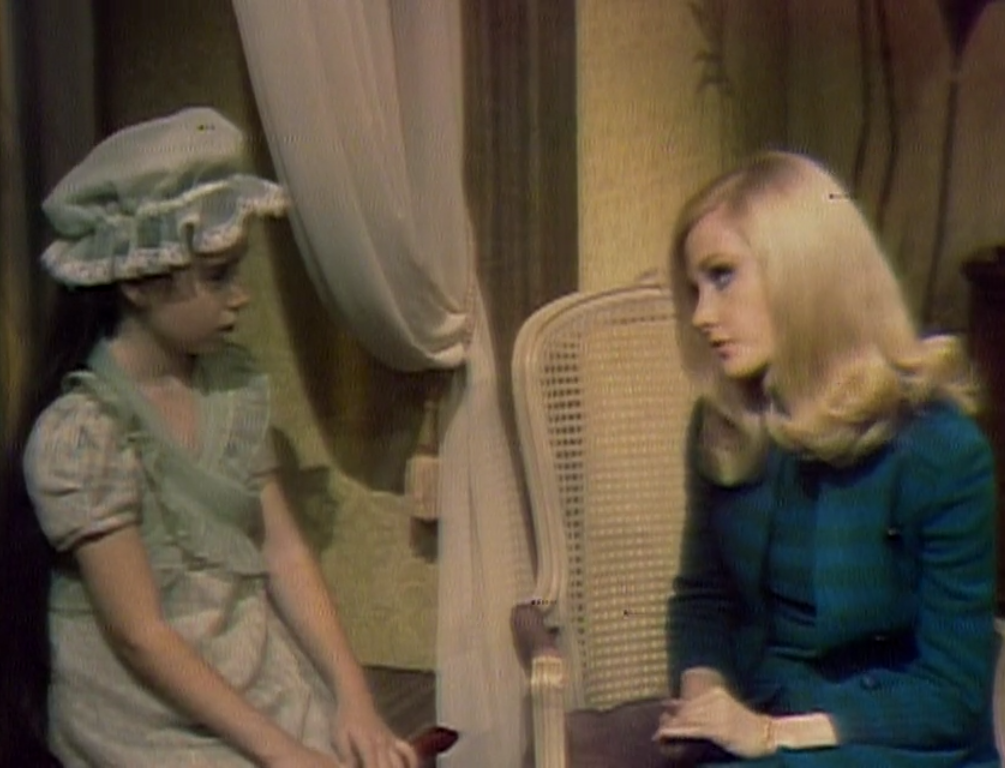
We return to Carolyn’s room. She is in front of her mirror, contemplating the toy soldier. She hears the strains of “London Bridge” playing on a wooden flute, which she has learned is a sign that the ghost of ten year old Sarah Collins is present. Carolyn grew up in this haunted house, so it may not be entirely surprising that her response is to lean back and enjoy the music. But she sits up when Sarah manifests herself in visible form.
Ghost in the mirror
Sarah speaks, and Carolyn sees her reflected in her mirror. The following scene is so extraordinary I’m going to transcribe all of the dialogue:
Sarah: David must have given you that.
Carolyn: Sarah!
Sarah: He told you my name.
Carolyn: Sarah, how did you get in here?
Sarah: Didn’t David tell you?
Carolyn: Tell me what?
Sarah: All about me.
Carolyn: I’m not sure I understand.
Sarah: I think I’m a ghost. Matter of fact, I’m sure I am.
Giving the facts
This is the first time Sarah has described herself in any terms, certainly the first time she has called herself a ghost. Her coyness about herself had left David confused about what she was; it was not until #325 that he finally concluded that she was a ghost. After that, she became more forthright with him. When he wasn’t sure what she was, she would wait until she was out of his line of sight to appear and disappear. But in #327, she fades away while he’s looking right at her.
Coming out to David not only allowed Sarah to relax around him, but has led her to discard her coyness altogether. She is startlingly blunt with Carolyn as this conversation goes on:
Carolyn: B-but- I don’t believe in-
Sarah: Yes you do. Or I wouldn’t have been able to come here. You’re not afraid of me, are you?
Carolyn: No…
Sarah: If you are, I understand.
This is the first confirmation that Sarah can appear only to those who are prepared to believe in her. It’s true that most of the people who have seen and heard her- David; Maggie Evans, The Nicest Girl in Town; Maggie’s father Sam; Vicki; Barnabas; Julia; Barnabas’ sometime blood thrall Willie; and local physician Dave Woodard- have either had extensive contact with the supernatural or had reasoned their way to the conclusion that she existed. But she also showed herself to Maggie’s nurse at the mental hospital Julia runs, and we don’t know anything about her background or beliefs. And local man Burke Devlin heard Sarah when she and David were talking in #327. While Burke has had plenty of contact with supernatural beings and in the early days of Dark Shadows, when he was fun, was willing to believe in them, he was at that point tearing around bellowing that there were no such things as ghosts. So this is new and unexpected information.
Carolyn’s denial that Sarah frightens her is given in a trembling voice that shows it to be a lie. Still, she isn’t as frightened as she might be. The other day, in #344, Carolyn was in David’s room when Sarah manifested there, not in the visible form of a little girl, but as the sound of “London Bridge” and as information appearing in David’s mind about Burke’s imminent death. Carolyn was terrified of Sarah when she came that way.
Carolyn: Well, what do you want?
Sarah: Don’t send David away.
Carolyn: How do you know about that?
Sarah: I don’t know, I just do.
At this point, we see Carolyn’s fear fading. She is starting to react to Sarah as if she really were a ten year old girl.
Carolyn urging Sarah to be reasonable.
Carolyn: But Sarah, we have to send David away. It’s the only way we can help him.
Sarah: But if you send David away, I won’t have anyone to play with.
Carolyn: Well, maybe it isn’t good for David to play with you.
Sarah: Why do you say that?
Carolyn: Because it leads him into believing all sorts of things that aren’t true.
Sarah: How do you know they’re not true?
Carolyn: Well, they’re just not, they couldn’t be.
Sarah: He wasn’t lying about me, was he?
Carolyn: No.
Sarah: Well.. then maybe David is acting the way he is because no one will believe him.
Carolyn: But… it isn’t possible.
Sarah: People say I’m not possible, but I am. Why doesn’t that make the rest possible?
Carolyn: Sarah, maybe you don’t know the stories David’s been telling!
Sarah: Why do you think that?
Carolyn: Because they’re too fantastic! And besides, they’ve all been proved false.
Sarah: How do you know they’ve been proved false?
Carolyn: Sarah, are you trying to tell me that Barnabas actually slee-
This exchange is the ultimate example of a character accepting the existence of a particular supernatural being and then snapping back into a frame of reference that does not allow for supernatural beings. Carolyn knows that Sarah is a ghost, and starts arguing with her about how fantastic the world is permitted to be.
There comes a knock at the door. Carolyn turns away from Sarah to look at the door, and when she looks back, Sarah has vanished. Regular viewers know that Sarah was Barnabas’ little sister, that she wants to keep him from doing horrible things to people she likes, but that she will not say anything against him. So when Carolyn says Barnabas’ name, we know that Sarah is about to vanish.
Sarah’s part is an outstanding example of writing to an actor’s abilities, even more so than was Barnabas’ speech. Caldwell knew that Jonathan Frid had a flair for making flowery gibberish appealing, because that is what he has been doing the whole time he’s been on Dark Shadows. What Sharon Smyth has been doing well as Sarah is being a cutie pie and creating a vague and mysterious impression. When she has more than a few lines to deliver, things tend to get very wobbly. Today, she has to maintain a commanding tone and an adult demeanor throughout an extended patch of rapid-fire dialogue. Absolutely nothing we have seen on screen would suggest that she could handle that. But she pulls it off, more than competently. There are a few glances at the teleprompter, but at no point does she break out of the patient and authoritative manner she has to adopt. It is an impressive job of acting by any standard.
The person at Carolyn’s door is Liz. Liz is Dark Shadows‘ queen of denial. Viewers who have been with the show from the beginning have seen a few cracks in her facade of disbelief in the supernatural. In #10, she dozed off in the drawing room and started talking in her sleep about ghosts. When Vicki insisted to her in #127 that she had seen a ghost, Liz said she believed her. And in #280 and #281, Liz reluctantly agreed to participate in a séance, and afterward agreed that Vicki had been possessed by a spirit. But even in those moments Liz was fighting to keep the topic of ghosts at bay, and the rest of the time she has presented a blank wall to any attempt to face facts about the strange goings-on. So it is not surprising that Carolyn tells her mother she was talking to herself while tidying up her room.
Having talked Liz into sending David away, she now has to talk her back out of it. She manages to get her to agree to wait a few days. “London Bridge” plays. Carolyn reacts to it, Liz does not.
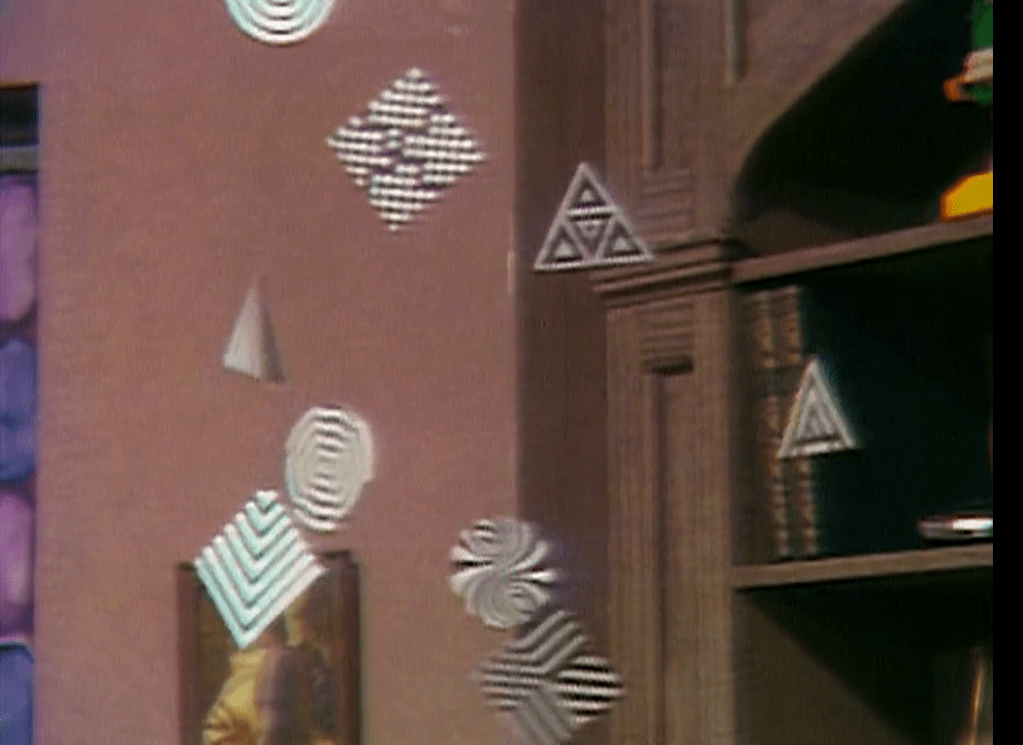
In his room, a distraught David is looking at a mobile. Its whimsical black and white markings suggest a puzzle and make a stark contrast with the vivid colors around them.*
Puzzling shapes.Back to the wall.
Carolyn comes in. She brings the toy soldier and tells David she doesn’t think she will need it. He insists that she will, but she explains that Sarah visited her and now she believes him and knows how to help him. David is horrified by this. He says that Sarah visited Dr Woodard, that Woodard believed him, and that led to his death. He begs Carolyn not to believe him and claims to have been lying. He sobs and clutches her.
Anguished embrace.
Back in the Old House, Julia prepares to give Barnabas another treatment. He snaps at her. She tells him that whatever happens, she wants him to know that she always wished him well. That prompts him to unload a further stream of sour remarks about her competence and intentions. Julia carries out the treatments, only to find that the aged appearance of Barnabas’ hands has spread to his head.
In his post about this episode on Dark Shadows Every Day, Danny Horn puts it well when he says that “This is just good soap opera construction. People that we care about, facing terrible danger, and desperate to help each other.” He’s referring specifically to the scenes between David and Carolyn and Liz, but it applies to everyone. We care not only about the good people in the great house (well, they’ve been relatively good, lately,) but also about Barnabas and Julia, evil people who are the terrible danger David and Carolyn and Liz are facing, but who make the show fun to watch. We care about Sarah too, and she’s desperately trying to accomplish exactly the result we most want to see, an outcome in which David, Barnabas, and everyone else we enjoy watching stays on the show.
*Evidently this mobile was a commercially produced item. One of the commenters on Danny Horn’s Dark Shadows Every Dayreports having had one like it as a child.
Strange and troubled boy David Collins is sitting on his bed. The ghost of his cousin Sarah is with him, playing “London Bridge” on her flute. She has told him that local physician Dave Woodard is dead, and he is depressed. She explains that she thought she had to tell him.
Sarah says she thinks that Woodard’s death was a terrible one and that it shouldn’t have happened. She denies knowing any more than that, and when David presses her for further information she becomes uncomfortable and vanishes.
David’s aunt, matriarch Liz, comes into his room to break the news to him about Woodard. She is startled to find that he already knows. She is distressed at his attitude of complete resignation. Woodard was the only adult who believed all of the facts about the supernatural menace looming over the great estate of Collinwood and the town of Collinsport that David and Sarah have shared with each other, and when David last saw him Woodard was trying to do something about that menace. David takes Woodard’s death as the end of all hope.
Downstairs, Liz meets her daughter Carolyn and well-meaning governess Vicki. She tells them how sad David is, and Carolyn goes up to see him. She starts talking about imaginary friends, and David asks if she means Sarah. Carolyn says that she doesn’t think Sarah is imaginary, and David replies “You don’t have to pretend. I don’t care.” He isn’t the least bit angry with her- he means exactly what he says when he tells her he doesn’t care how she feels about him.
Viewers who have been with the show from the beginning could see that reaction coming. For the first 24 weeks or so, Carolyn was a flighty heiress, a self-centered young woman who took no interest at all in her little cousin. Since then they have discarded that theme and Carolyn has become a mature and caring person. She and David have had some moments where she has seemed like a big sister. Still, she is still far less involved with him than is Vicki, and David doesn’t have any hopes that even Vicki will listen to him when he tells the truth about the strange goings-on. So when David says “I don’t care,” Carolyn is hit by a freight train that we’ve seen coming for a long time.
This new Carolyn won’t give up on David. She confides that when she was nine years old, she had a friend named Randy, a little boy who always wore a red sweater and who may or may not have existed. Carolyn admits that Randy may have been a ghost, and there is a moment when, as Danny Horn puts it on his Dark Shadows Every Day, “David stands up, and he looks at her, as if they’re really seeing each other for the first time in a long while.” The first time ever, I’d say- David and his father Roger only moved into the house a month or so before the show started, and by that time Carolyn was the character we first saw.
This isn’t the first time the audience has seen this side of Carolyn. In the opening weeks of Dark Shadows, she was one of several characters who had brief conversations with Vicki about the legendary ghosts of Collinwood, and she was the most persistent about laughing those legends off. But before the show had been on the air for five weeks, Carolyn admitted to Vicki that the legends were all true, and that she had tried to downplay them only because she liked Vicki and wanted her to stay.
That development is recapitulated in this scene. Where Vicki had reacted with confusion, telling herself that she ought to be concerned about Carolyn’s mental health but unable to quash a sickly feeling that she might be right, David reacts with wonderment. He is beyond trying to do anything about the horrors that he knows are in progress, let alone appealing to anyone to join him in fighting them, but we can see him absorbing the information that Carolyn is not at all the person she had led him to believe she was.
Once Carolyn stops pretending she does not believe in ghosts, we see why she and the other adults in the family are so insistent about keeping the door shut on the supernatural back-world behind the main action. “London Bridge” starts playing on the soundtrack; Carolyn and David can both hear it. As it goes on, David declares that something terrible is about to happen. It will be an accident- no one will cause it, no one wants it to happen. But it can’t be stopped. Carolyn asks how he knows, and he says he just does.
The little girl we saw in the opening is Sarah, but in this moment we realize she is not the whole of Sarah. The girl is only one manifestation of an unfathomably vast complex of phenomena. The world in which the action appears to be taking place is a tiny, fragile thing by comparison with forces like Sarah. If the characters stray from their little paths of denial and evasion the whole thing may at any moment dissolve altogether, thrusting the back-world into the foreground and leaving them adrift. After a few minutes of David’s soothsaying, Carolyn protests that “None of this is real, it can’t be!” But it’s too late- she knows that it is all too real, and the world of love affairs and hotels and motorcycles and dress shops and restaurants in which she has spent the last 69 weeks trying to find a place is a dream from which she is already starting to awaken.
Meanwhile, Vicki and her depressing fiancé Burke have declined Liz’ offer to live in the west wing of Collinwood when they are married. Liz had hoped to keep Vicki around so that she could help with David. When Burke asks if he should talk to David, Liz tells him not to bother. Carolyn already talked to him, Liz explains, and so far from calming David down she got herself upset too.
That response would suggest that Liz wants to tranquilize David, not to communicate with him. On the heels of the scene between David and Carolyn, it tells us more. Liz has lived in Collinwood longer than anyone, and she has struggled harder than anyone to keep the non-supernatural fore-world in operation. After Carolyn’s experiment in facing facts comes so close to sweeping the “logical explanations” away once and for all, we can see what Liz is trying to protect by keeping David quiet.
Burke is leaving the house, about to go on a business trip to South America, when David emerges from his room and says goodbye. David’s tone makes it clear that it is a final farewell. Burke keeps telling David that he will come back, but David is certain that Burke will die. Burke is shocked by David’s attitude, and says that perhaps they should live in the west wing after all. Vicki is thrilled by the idea.
Burke and Vicki go to a terrace outside the house. There, they hear the wind whistling through the rocks along the shore. On Vicki’s first night in the house, she heard from Liz’ brother Roger the legend of “The Widows’ Wail,” according to which this sound is a warning from the spirits of the widows who haunt the area. In those days, Vicki had little patience for ghost stories, and the “Widows’ Wail” seemed to be the easiest of all the legends to dismiss. But the wind blows every night, and she’s only heard it make that sound on a handful of occasions, usually right before something terrible happens. She’s also seen multiple ghosts, done battle with a humanoid Phoenix, and encountered what anyone with access to old movies would recognize as evidence that a vampire is operating in the vicinity. So she hears the Widows’ Wail the same way regular viewers of the show do, as the sound of the supernatural back-world blasting through and knocking everything else down.
When Vicki pleads with Burke not to go to South America, he replies “Don’t tell me you’re starting to believe all that stuff!” For months now, Burke has been gaslighting Vicki, pretending that she is crazy for believing in supernatural phenomena, including phenomena he himself witnessed and previously acknowledged. But hearing the Widows’ Wail, which was a prominent topic in the early days, and seeing the black and white imagery of the kinescope, we can remember a more appealing version of Burke. Back then, Burke was one of several longtime residents of Collinsport who used the word “ghost” figuratively in conversation with Vicki, each time prompting her to exclaim “Surely you don’t believe in ghosts!?,” to which he would reply that it was entirely possible that there were literal ghosts at Collinwood. For a moment, we see that Burke, and forget the gaslighting abuser. That moment lasts just long enough that we can share David’s sorrow and Vicki’s terror at Burke’s imminent death.
We open on a set we haven’t seen since #180, the archives of the old cemetery north of town. There, a scene plays out between two actors who aren’t really on the show. Daniel F. Keyes created the role of the Caretaker of the cemetery; Robert Gerringer took over the role of Dr Dave Woodard some months ago and did as much with it as anyone could. But neither of those men was willing to cross a picket line and break the National Association of Broadcast Engineers and Technicians strike, and so they were replaced with a couple of stooges.
The stooges are both terrible. Patrick McCray, Danny Horn, and John and Christine Scoleri all go into detail documenting non-Woodard’s incompetence, but the non-Caretaker is just as bad. Patrick McCray memorably described the Caretaker, in Keyes’ realization, as a “refugee from the EC comics universe.” This fellow has none of Keyes’ zest or whimsy; he simply recites his lines.
At one point, the non-Caretaker tells non-Woodard that it will take some time for him to locate the document he is asking about. Non-Woodard replies “Take your time!” We then have about ninety seconds of the non-Caretaker sorting through papers. The show is moving away from the real-time staging that had often marked its earlier phases, so this comes as a surprise.
The episodes in which the archive set was introduced included a lot of talk about the geography of the cemeteries around the town of Collinsport. They told us that the old cemetery north of town was the resting place of the Stockbridges, Radcliffes, and some other old families, but that most of the Collinses were buried in their own private cemetery elsewhere. They also mentioned a public cemetery closer to town where the remains of less aristocratic Collinsporters might be found. In today’s opening scene, non-Woodard tells the non-Caretaker that they had met previously in Eagle Hill Cemetery. Eagle Hill is the name now associated with the old cemetery north of town. So perhaps this building, which also houses a tomb in which several of the Stockbridges were laid to rest, is not in Eagle Hill Cemetery, but one of the others.
Reading roomStacksThe Tomb of the Stockbridges.
In his last few episodes, Robert Gerringer had a couple of scenes in which he and David Henesy established a close relationship between Woodard and strange and troubled boy David Collins. Today, non-Woodard sits on the couch in the drawing room at Collinwood and tells David he has come to believe everything he has been saying, including the stories that have led the other adults to call in a psychiatrist. As my wife, Mrs Acilius, pointed out, that would have been a great payoff from Gerringer’s earlier scenes if he had been in it. It might have been effective enough if any competent actor had played the part of Woodard. Certainly Mr Henesy’s performance gives non-Woodard plenty to respond to. But he barks out his lines as if they were written in all-caps with randomly distributed exclamation points. It is a miserable disappointment.
There is also a scene where David’s father, high-born ne’er-do-well Roger, tries to convince his sister, matriarch Liz, that they ought to send David to military school. This both harks back to the first 39 weeks of Dark Shadows, when Roger openly hated his son and jumped at every chance to send him away, and illustrates the changes that have taken place since then, as Liz acknowledges that Roger is motivated by a sincere concern for David’s well-being. The scene is intelligently written and exquisitely acted. The high caliber of their work makes it all the more distressing to see Joan Bennett and Louis Edmonds on a scab job. David Henesy was ten years old, and had a stereotypical stage mother, so you can excuse his presence and marvel at his accomplished performance. But these two old pros don’t have any business on the wrong side of a strike.
Nor does Jonathan Frid. When non-Woodard goes to confront Barnabas, there are moments when Frid seems to be showing his own irritation with his scene-mate more than his character’s with his adversary. As well he might- neither man knows his lines particularly well, but even when Frid stops and looks down he expresses emotions Barnabas might well be feeling, and he is fascinating to watch. When non-Woodard doesn’t know what words he’s supposed to bark, he drifts away into nothing. But it serves Frid right to have to play off this loser- by this point, he knows full well that without him the show wouldn’t be on the air. He had no excuse at all for crossing that picket line.
The cemetery’s combination archive/ tomb was a prominent part of the storyline of undead fire witch Laura Murdoch Collins. That storyline approached its climax in #183 when Peter Guthrie, PhD, confronted Laura in her home about being “The Undead,” prompting her to kill him. An episode beginning on that set and ending with someone holding a doctoral degree confronting an undead menace would seem to be an obvious callback to that story. Guthrie’s confrontation had a point- he wanted to offer to help Laura find a place in the world of the living if she would desist from her evil plans, an idea which Woodard’s old medical school classmate Dr Julia Hoffman picked up in her quest to cure Barnabas of vampirism. By contrast with Guthrie and Julia, Woodard is just being a fool.
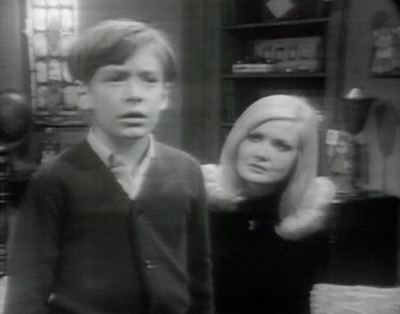
Strange and troubled boy David Collins is at his wit’s end. A bat entered his room and menaced him. He can’t even convince the adults in the great house of Collinwood that the bat existed. Still less can he get a hearing for his correct surmises that his cousin, courtly gentleman Barnabas Collins, used magical powers to send the bat against him.
David’s aunt and father call the family doctor, addled quack Dave Woodard. Woodard gives David a sleeping pill, waits a few minutes, and starts asking him questions. David tells him about his friend, mysterious girl Sarah. He asks if Woodard believes that Sarah is a ghost. Several times, the audience has seen Woodard wrestle with evidence pointing in this direction, so we know that he is telling the truth when he answers David’s question with “I don’t know what I believe.” Robert Gerringer does a fine job of acting today, and draws the audience into Woodard’s struggle to come to terms with the idea that he lives in a world where supernatural forces are at work.
Later, Sarah wakes David up. She says she’s angry with him. In her last apparition, she specifically told him to stay away from Barnabas’ house, but the very next morning he went there, sneaked in through a window, and was trying to get into the basement when Barnabas’ co-conspirator Julia Hoffman caught him. He keeps asking for more information, and she complains that he asks too many questions. She keeps insisting that he stay away from Barnabas’ house.
Sarah gives David an antique toy soldier and tells him to keep it with him. She says it belonged to someone who played with it long ago, and that it will keep David safe as long as he has it with him. Returning viewers know that Sarah is the ghost of Barnabas’ sister, so the “someone” must be Barnabas himself. Also, we saw Sarah give a doll of her own to Maggie Evans, The Nicest Girl in Town, with the same instructions, so we know this is her usual mode of operation.
When Sarah is complaining that David asks too many questions, she says that she isn’t always sure of the answers. This makes an interesting contrast with Woodard’s earlier remark that she seems to know everything. It also brings up a mystery from recent episodes. In #325, David had a dream in which Sarah led him to a basement where they saw Barnabas rise from a coffin. This must have been a dream visitation, since it includes information only she would have. But in #327, David sees Sarah in the woods and surprises her when he tells her about the dream. Later in that same episode, she makes it clear that she does not want him to know the information he gained from it.
The sight of Sarah in the corner of David’s room, lit from below, might cast the minds of regular viewers back to the first supernatural being to make an entrance in that spot. David’s mother, undead fire witch Laura Murdoch Collins, drove the story from #126 to #191. In the early part of the Laura arc, the show made a great deal out of the uncertainty about how the various events and appearances associated with her related to each other. There was a more or less substantial, apparently living woman who comes to stay in the cottage on the estate of Collinwood; an image of the same woman that occasionally flickers on the lawn of the estate; and a scorched corpse in the morgue in Phoenix, Arizona. These three, and an undetermined number of other phenomena, might all be aspects of the same being, or they may not. They may be pursuing the same objective, or they may be working at cross-purposes. They may be organs of a single mind, or they may be entirely unaware of each other. As the story went on, Laura became an ever-more dynamic personality, but it was never made altogether clear just how many of her there were.
The difference between the Sarah who led David to Barnabas in his dream and the Sarah who demands that he stay away from Barnabas when he is awake raises the same question. Sarah used to be a little girl, and she still looks and sounds like one. But she isn’t really that, nor is she anything else that belongs in our world anymore, and she can’t be expected to follow any rules we can understand. She is a focal point around which uncanny phenomena gather, and through which information passes into our world from an alien plane of existence. Sarah is not only a messenger- she is herself the message.
The uncertainty Sarah admits to today, along with our uncertainty about how her various manifestations fit with each other, show that David is wrong if he finds her a reassuring presence. She is part of a world in which the living have no place, and her irruption into David’s experience thrusts him into the company of the dead. David cannot fully understand Sarah’s world, much less control it. If he keeps trying to find his own way to safety, he will quickly meet his doom.
Dangerously unstable ruffian Willie Loomis spent a week staring at the eighteenth century portrait of Barnabas Collins in the foyer of the great house of Collinwood back in April, then tried to rob Barnabas’ grave. That turned out to be an awkward situation when Willie found that Barnabas wasn’t entirely dead. Barnabas was a vampire who bit Willie, turned him into his sorely bedraggled blood thrall, and had lots of conversations with him. Yesterday, Willie was written out of the show.
Today we open with strange and troubled boy David Collins staring at the same portrait. As Willie was obsessed with the idea that there were jewels hidden in the Collins mausoleum in the old cemetery north of town, where in fact Barnabas’ coffin was hidden, so David is preoccupied with the idea that Barnabas has something terrible stashed in the basement of the Old House on the estate, where in fact his new coffin is hidden. As Willie sneaked off to the cemetery on his ill-starred expedition, David will sneak off to the Old House today and try to search Barnabas’ basement.
Unlike Willie, David is not driven by greed. He is afraid of Barnabas, and his friend, the ten year old ghost of Barnabas’ sister Sarah, has told him that he must not go to the Old House. But his aunt Liz and his father Roger dismiss his attempts to warn them about Barnabas, and he thinks it is his duty to provide them with evidence. So he screws up his courage and makes his way across the property.
David lets himself into the Old House by opening the parlor window. Not only have we seen David do this before, but Willie’s sometime friend, seagoing con man Jason McGuire, got into the house the same way in #274. Barnabas would kill Jason when he reached the basement in #275, so you might think he’d have put a lock on that window by now.
Jason’s fate is certainly on the minds of returning viewers when David tries to open the basement door. It comes as a relief when he finds the door locked. Barnabas’ co-conspirator, mad scientist Julia Hoffman, catches him there.
Julia demands to know what David is doing in the house, and he tries to brazen it out. He claims that he has a right to be there, since it belongs to his Aunt Liz. This is a bit of a murky point- we never see Liz transfer title to Barnabas, but she and others act as if he owns the place and its contents. Julia doesn’t clarify it when she responds that Liz gave the house to Barnabas- she doesn’t deny that it still belongs to Liz, only says that it also belongs to Barnabas.
Back in the great house, Roger is banging away at the piano. We saw Liz play the piano in #47 and #91, a reference to the conception of her character writer Art Wallace developed in his original story bible, titled Shadows on the Wall, in which she, like similar characters in a couple of TV plays he wrote in the 1950s under the title “The House,” gave piano lessons. Since then, Liz’ daughter Carolyn tried her hand at “Chopsticks” in #119 and used the piano as a prop in a teen rebel scene in #258, and Jason poked at a few keys in #198. Roger isn’t exactly Vladimir Horowitz, but he’s the first one we’ve seen who actually achieves a melody.
Liz comes in and tells Roger that David isn’t in his room. They fret over David’s attitude towards Barnabas. Julia brings David home and tells Liz and Roger where she found him. After an angry scene between father and son, David goes upstairs, and Liz scolds Roger for his inept parenting. In these as in all of Liz and Roger’s scenes together, we see a bossy big sister who tries to govern her bratty little brother, but who ultimately abets all of his worst behavior.
In the Old House, Barnabas notices that Julia is troubled. He keeps asking what’s on her mind, and she has difficulty deflecting his questions. This is odd- Julia has been established as a master of deception, and Barnabas is the most selfish creature in the universe. All she has to do is start talking about something that does not affect him directly, and he will lose interest at once. Rather than talk about her personal finances, or the job from which she is apparently on an indefinite leave of absence, or some ache or pain she might have, or how sad she is to miss her Aunt Zelda’s birthday, she brings up Willie. That does get Barnabas’ mind off her tension, but it also reminds him of David. He thinks David knows too much about him, and is thinking of murdering him. Julia assures him that the boy doesn’t know so very much, that whatever he does know he hasn’t told anyone, and that if he does say something his reputation as an overly imaginative child will lead the adults to ignore him.
From the beginning of the series, we’ve heard people say that David is “imaginative.” The audience finds an irony in this, since we have never seen David show any imagination whatsoever. All his stories of ghosts are strictly literal accounts of apparitions he has seen. We’ve seen some drawings he has done and heard quotes from some essays he has written. Some of these are technically accomplished for a person his age, but they are just as literal as his ghost stories. And when he tells lies to cover his various misdeeds, he tells simple little tales that fall apart at once.
In #327, well-meaning governess Vicki became the first character to dissent from the “David is a highly imaginative child” orthodoxy. Liz and local man Burke Devlin were dismissing David’s laboriously accurate account of his latest encounter with Sarah as a sign of his “imagination,” and Vicki interrupted with “I don’t think it has anything to do with his imagination.” Now, Barnabas goes a step further. After pronouncing the word “imaginative” in a truly marvelous way that makes it sound like something I’ve never heard before, he tells Julia that she has given him an idea. Frightened, she asks what he means. All he will say is “You’ll see.”
Roger goes to David’s room and has a friendly talk with his son. Throughout the conversation and afterward, David is thinking intensely, trying hard to figure out what his next step should be.
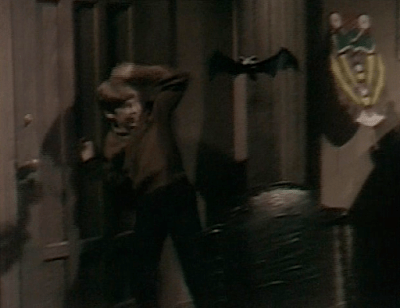
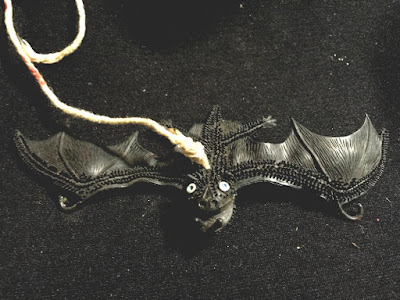
Once he is alone in the room, the window blows open and a bat enters. More precisely, a bat-shaped marionette is brought in on clearly visible strings by a pole that casts a shadow we can see the entire time, but no one who has been watching the show up to this point will doubt for a second that David’s fear, as depicted by David Henesy, is fully justified. David tries to flee from the bat, but he cannot open the door to escape from his room. His back against the door, David slides onto the floor and screams as the bat comes near him.
When Barnabas is about to attack someone, dogs start howling. Sometimes this works to his advantage, but it so often puts his intended victims on their guard that it doesn’t really seem to be something he is doing on purpose. So this bat represents something new. Perhaps Barnabas is using magic to control a bat- if so, it marks the first time we have seen Barnabas use magic to project influence over something other than a human mind. Or perhaps he himself has assumed the form of a bat. If so, that is the first indication we’ve had that he has shape shifting powers. In either case, Barnabas’ powers have just gone up a level.
Closing Miscellany
The bat was created by famed puppeteer Bil Baird. Most famous today for the puppets he created for “The Lonely Goatherd” sequence in The Sound of Music, Baird was a frequent guest on television programs like The Ed Sullivan Show, and Jim Henson cited Baird’s own TV series, the short lived Life with Snarky Parker, as a major influence on the Muppets. In December 1966, Baird opened a marionette theater in New York City, at 59 Barrow Street in Greenwich Village; it operated until 1978, and many leading puppeteers, including dozens who would go on to work with Henson, were members of its company in those years.
This is the last episode to end with ABC staff announcer Bob Lloyd saying “Dark Shadows is a Dan Curtis production.” We do hear the announcement again in February of 1969, but that won’t be because Lloyd has returned- they used an old recording for the music under the closing credits that day, and they picked one with him on it.
Fans of Dark Shadows will often talk about “the early episodes” which ended with Lloyd making that announcement. So I suppose #330 is the last of “the early episodes.”
Danny Horn’s post about this one on Dark Shadows Every Dayincludes a morphology of episode endings. He divides them into five categories, Haiku,* Restatement of Threat, ** New Information,*** Crisis Point,**** and Spectacle.***** It’s an intriguing scheme, and he makes a good case for it.
*Danny explains that “Haiku” “aren’t necessarily recognizable as endings in the traditional sense, because nothing is resolved and no progress is made. It’s just a little moment when a character pauses, and possibly has a feeling about something… In some extreme cases, the audience may not realize that the episode is over until halfway through The Dating Game.”
**Restatement of Threat, at this period of Dark Shadows, usually means Barnabas looking at us through his window and saying that someone or other “must die!” Which of course means that you can safely sell a million dollar life insurance policy to that character.
***”A New Information ending provides an actual plot point, which either advances the story another step, or tells us something that we didn’t know.”
****”The Crisis Point cliffhanger is the big game-changer, and for best effect, it should come at the end of a sequence that’s been building up for a while. This is a big turn in the story, and it should feel satisfying and thrilling… The defining feature of a Crisis Point ending is that the resolution marks a change in the status quo, ending one chapter and setting up the next.”
***** “Obviously, plot advancement is always welcome, but every once in a while the show needs to set its sights a little higher. These are the moments when the show goes above and beyond, in order to surprise and dazzle you… The point of a Spectacle is: You can’t take your eyes off the screen. Housewives in the audience have put down the iron, and switched off the vacuum. Teenagers have stopped swatting at their siblings… A Crisis Point cliffhanger will bring you back for the next episode, because you want to see what happens next. But a Spectacle cliffhanger is bigger than that — you’ll be coming back for the next episode, but it’s because you can’t believe what you’re seeing, and maybe tomorrow they’ll do it again.”
We open in the Old House on the great estate of Collinwood, home to courtly gentleman Barnabas Collins. In a bedroom there occupied by Barnabas’ servant Willie, Sheriff George Patterson and artist Sam Evans have found evidence that convinces them they have solved the case of the abduction of Sam’s daughter Maggie. They found Maggie’s ring hidden in a candlestick. The room is in Barnabas’ house and he has unlimited access to it. Further, the house is the only place Willie could possibly have kept Maggie if he had held her prisoner. But for some unexplained reason, they are sure that the ring proves that Willie and only Willie abducted Maggie. When Barnabas says that he feels somehow responsible, Sam rushes to tell him that he mustn’t blame himself.
The sheriff says that he will be going to the hospital, where Willie is recovering from gunshot wounds the sheriff’s deputies inflicted on him when they were looking for a suspect. Barnabas hitches a ride with him.
At the hospital, Willie’s doctor, addled quack Dave Woodard, is conferring with his medical colleague Julia Hoffman. When he steps out of the room for a moment, we hear Julia’s thoughts in voiceover. She is thinking about killing Willie before he can regain consciousness and tell a story that will make it impossible for her ever to practice medicine again. She thinks of Barnabas’ voice demanding that she kill Willie. She is reaching for the catheter through which Willie is receiving fluids when Woodard comes back in. She tells him she was checking it, and he is glad when she confirms it is working correctly.
Returning viewers know that Barnabas is the one who abducted Maggie and committed the other crimes of which Willie is suspected, that he is a vampire, that Julia is a mad scientist trying to cure him of vampirism, and that in pursuing her project she has become deeply complicit in Barnabas’ wrongdoing. We also know that she has several times told him that she will draw the line at killing anyone herself, but that she has involved herself in so many other evil deeds that it was just a matter of time before she found herself on the point of crossing that line.
Barnabas and the sheriff arrive at the hospital. In the corridor, Barnabas is bewildered to find that the sheriff will not allow him to be present while he questions Willie. The sheriff has been so careless about treating miscellaneous people as if they were his deputies- for example, enlisting Sam yesterday to help him search Willie’s room- that Barnabas’ puzzlement is understandable. The conversation goes on for quite a while.
Note the poster that reads “Give Blood.” That’s a message Barnabas could endorse. Screenshot by Dark Shadows Before I Die.
The sheriff enters Willie’s room, and greets Julia as “Dr Hoffman.” Woodard thinks Julia has come to Collinsport to investigate Maggie’s abduction, and so he has agreed to keep her professional identity secret from most people in town, including the sheriff for some reason. Therefore, she is startled at this form of address. Woodard explains that now that Maggie’s abductor has been identified, he doesn’t see a point in keeping law enforcement in the dark.
Julia meets Barnabas in the corridor. When she tells him that she didn’t kill Willie, he fumes and calls her a “bungling fool.” He says he will do the job himself, but Julia points out that Woodard and the sheriff are in the room with Willie now. They wind up staring at the clock for hours.
Willie regains consciousness. He doesn’t recognize Woodard. When the sheriff shows him Maggie’s ring, his eyes gleam and he claims that it is his. Returning viewers will remember that before Willie ever met Barnabas, he was obsessed with jewelry. He is terrified when he learns that it is night-time, and says that he knows why he is afraid.
The sheriff and Woodard go out into the corridor to talk with Julia and Barnabas. Woodard tells Julia that she was right- Willie is hopelessly insane. Apparently when they asked him what he was afraid of, he mentioned “a voice from a grave. Nothing else made more sense than that.”
Julia and Barnabas go into Willie’s room. He looks at Barnabas and asks “Who are you?” Barnabas shows surprise that Willie doesn’t know him. Willie asks if he is a doctor. “Yes,” replies Barnabas. “I am a doctor.”
Sheriff Patterson is played by Dana Elcar today. It is Elcar’s 35th and final appearance on Dark Shadows. He would go on to become one of the busiest and most distinguished character actors of his generation.
Elcar had his work cut out for him with the part of Sheriff Patterson. If a police officer on the show ever solved a case, or followed any kind of rational investigative procedure, or interpreted a clue correctly, the story would end immediately. So all the sheriffs and constables and detectives have to be imbeciles. Elcar reached into his actorly bag of tricks almost three dozen times, and always came out with some way to make it seem as if something more was going on in Sheriff Patterson’s mind than we could tell.
My wife, Mrs Acilius, exclaimed “I’m so glad Dana Elcar is playing this scene!” when Barnabas and the sheriff had their long conversation in the hospital corridor. This week’s episodes were shot out of sequence, so yesterday’s was made after Elcar had left. It featured Vince O’Brien as Sheriff Patterson. O’Brien was by no means a bad actor, but he didn’t make the character seem any smarter than the script did. Elcar seems so much like he has something up his sleeve that Jonathan Frid’s insistent pleading makes sense as a cover for a mounting panic. Without Elcar to play against, it might just have come off as whining.
With the conclusion of Willie’s story, this is John Karlen’s last appearance for a long while. Beginning shortly after Barnabas’ introduction to the show in April, his conversations with Willie have been the main way we find out what he is thinking and feeling. More recently, Willie and Julia have been having staff conferences in which they come up with new ideas and add a new kind of flexibility and dynamism to the vampire storyline. From time to time, Willie’s conscience gets the better of him, and he adds an unpredictable element to the story as he tries to thwart one of Barnabas’ evil plans. For all these reasons, removing Willie from the show drastically reduces the number of possible outcomes in any situation they might set up involving Barnabas. His departure, therefore, seems to signal that some sort of crisis is at hand.
In fact, Karlen wanted to leave Dark Shadows because he had a better offer from a soap called Love is a Many Splendored Thing. But the producers knew that no one else could play Willie after the audience had got used to Karlen, and so they wrote the character out until they could get him back. Still, losing Willie puts Barnabas’ story on a much narrower track. So far, each development has led us to speculate about an ever-growing list of directions the story might possibly take. From now on, we are entering a phase where we will often be stumped as to what might be coming next.
In the Old House on the great estate of Collinwood, vampire Barnabas Collins frets that his sorely bedraggled blood thrall, Willie Loomis, is failing to die. A couple of weeks ago, the police shot Willie and jumped to the conclusion that he was responsible for the abduction of Maggie Evans, The Nicest Girl in Town, among many other crimes that Barnabas actually committed. He’s been in a coma ever since, and if he dies, Barnabas will be off the hook.
Barnabas tells his co-conspirator, mad scientist Julia Hoffman, that he will go to the hospital and murder Willie. Her assurances that Willie will soon die of natural causes don’t stop Barnabas, but her news that the sheriff is on his way to the house does. Barnabas then orders her to go to the hospital and carry out the murder, but she refuses.
Meanwhile, Sheriff George Patterson, addled quack Dr Dave Woodard, and Maggie’s father Sam are hanging around Willie’s hospital room recapping the story so far. The sheriff wonders where Willie could have kept Maggie during the weeks she was held prisoner. Willie lives in Barnabas’ house and does not appear to have access to any other building. You might think this would be grounds for suspecting Barnabas of involvement, but no such thought crosses the minds of any of the three luminaries keeping Willie company. They just take it for granted that no crime could have taken place in Barnabas’ house.
George, Dave, and Sam, or their intellectual equivalents.
Back in the Old House, Barnabas has had an inspiration. He took a ring from Maggie in #253, and today he hides it in a candlestick in Willie’s bedroom. When the sheriff and Sam come to search that room (but no other part of the house,) Barnabas watches until they’ve given up, then knocks the candlestick over and exclaims in a ridiculously fake voice “Look! A ring!” Sam recognizes it as Maggie’s, and he and the sheriff are convinced it is conclusive evidence of Willie’s guilt.
For her part, Julia has made her way to Willie’s hospital room. She is there with Woodard when Willie shows signs of regaining consciousness. Woodard rushes out to tell the deputy to get the sheriff, and leaves Julia alone with Willie. She looks at Willie’s IV and remembers Barnabas urging her to kill him.
The sheriff and Sam are leaving Barnabas’ house with the ring when the deputy comes to the front door. He announces that Willie is coming to and is likely to start talking at any moment. We end with a closeup of a horrified Barnabas.
During the opening titles, announcer Bob Lloyd tells us that the part of Sheriff Patterson will be played by Vince O’Brien. This week’s episodes were shot out of broadcast sequence, so we will see Dana Elcar as Patterson one more time. O’Brien was on the show four times in January and February of 1967 as the second actor to play Lieutenant Dan Riley of the Maine State Police, an officer attached to an investigation concerning undead fire witch Laura Murdoch Collins. Patterson isn’t much of a character, and even an actor as distinguished as Elcar had trouble making him interesting. If we remember O’Brien from his time as Dan Riley Number Two, we know that he was a competent professional, but we won’t have much hope that he will outdo Dana Elcar.
O’Brien does show beyond all doubt that he belongs on Dark Shadows, though. While the closing credits are rolling, he strolls onto the set behind technical director J. J. Lupatkin’s name.













 Dark Shadows Commentary