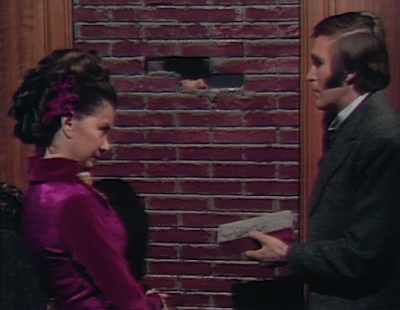
Episode 749: The kiss of death

In the parts of Dark Shadows set in the 1960s, Louis Edmonds plays Roger Collins, younger brother of matriarch Elizabeth Collins Stoddard. In 1966 and 1967, we saw that Roger had squandered his entire inheritance. He was reduced to living as a guest in Liz’ house and working as an employee for her business. Roger was the show’s first villain. His villainy was confined to a storyline known as “The Revenge of Burke Devlin.” That story never really caught on, and by #201 even Burke Devlin had lost interest in it. Roger receded to the margins, and for the rest of the series Edmonds’ gift for sarcastic dialogue kept the character alive as occasional comic relief.

From November 1967 to March 1968, Dark Shadows was a costume drama set in the 1790s. Edmonds, a costume drama specialist in his years on Broadway, came into his own as haughty overlord Joshua Collins. Joshua’s focus on moneymaking and his determination to preserve the glamour of the Collins family name at all costs placed him at the opposite pole from Roger, a blithe spendthrift pathologically lacking in family feeling. Joshua used his power to cover up all of the tragic and horrible events we saw in the 1790s segment, and imposed a false history in its place.

Now, the show is set in 1897. Edmonds plays Edward, the stuffy eldest brother of the adult members of the Collinses of Collinsport. Edward has Joshua’s imperious demeanor and his determination to conceal the family’s disgraces, but like Roger he finds himself penniless, dependent on his sister’s largess. Yesterday he learned that his youngest brother, libertine Quentin, had killed his estranged wife Jenny. So far, Quentin has been a breezily amoral wastrel, easily recognizable to longtime viewers as a kindred spirit of his great-nephew Roger. But Quentin shocked himself when he murdered Jenny, and he had a terrified look on his face as he tried to sneak out of the house afterward.

Edward intercepted him then and forbade him to go. Edward had learned from Quentin’s girlfriend, Jenny’s former maid Beth, what happened. Edward was in a high dudgeon about the mess Quentin had made, but did not seem particularly surprised or at all grieved. He was quite confident he would be able to hush the whole thing up, and fabricated a story about Jenny falling down the stairs and dying shortly after from a head injury.

What did shock Edward was Quentin’s revelation that Jenny was the sister of one of the neighbors, Magda Rákóczi. Magda is a member of the Romani people, an ethnicity against whom Edward and the rest of the Collinses are violently prejudiced. “You married a Gypsy!” he exclaims in utter disgust. He remained convinced that he could keep the whole thing quiet, and drilled Beth and Quentin in the lies they were to tell Magda and her husband Sandor.

Magda did not give Edward a chance to direct the little play he had written. She found physical evidence indicating Quentin had murdered Jenny, and accused him. When she threatened to go to the police, Edward asked her what she imagined the authorities would do when asked to choose between the word of a Collins and the word of a “Gypsy.” At that, Magda dropped her plan to go to the police and vowed to place a curse on Quentin. Edward dismissed that as “words,” but Quentin is deeply involved in the occult. He is helpless with fear.

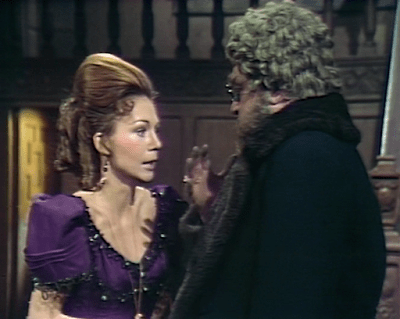
Today, Edward calls on Quentin in his room. He finds that Quentin has not slept all night. He continues to regard Quentin’s fear of Magda’s curse with total contempt, but perks up when Quentin says that he has thought of a way to escape it. Returning viewers already know that there is one way wide open to Quentin to escape the curse. He can go to the police and confess that he murdered Jenny.

This, of course, is not Quentin’s idea. He wants to offer Magda $10,000. Neither he nor Edward has that kind of money, but their sister Judith, whom their grandmother chose as her sole heiress, does. Edward says that he might be able to persuade Judith to give him that sum on one condition. Their grandmother’s will left Quentin no property or income, but it did guarantee him the right to live in the great house of Collinwood as long as he might wish. If he will sign documents renouncing that right, Judith might give him the money.

Edward embarrassed by Quentin’s craven mewling. Screenshot by Dark Shadows Before I Die.

Quentin drifts off to sleep. He has a nightmare. Sandor and Magda show him Jenny’s body and tell him he can escape punishment if he blesses it. He does so, and Jenny comes back to life. She asks for a kiss. Quentin gives it, and Magda and Sandor laugh. They say that the kiss has sealed his fate- it is “the kiss of death!”

Edward returns with word that Judith will give him his $10,000, but that she has added a condition. Not only Quentin, but Sandor and Magda too, will have to leave the area forever. Quentin promises to make that happen, and signs the papers.

Meanwhile, Magda and Sandor are at home in the Old House on the grounds of the estate. Magda has mixed a potion and told Sandor that “a very old Gypsy woman” once used it to place a terrible curse on someone called “Count Petofi.” All they have to do is trick Quentin into drinking the potion, and the same curse will befall him. Sandor disdainfully replies that he had thought Magda might have come up with a plan that had a chance of working. He can’t imagine Quentin drinking anything they might give him.

They look out the window, and see Quentin coming to the house. They are pleasantly surprised that he is delivering himself. He knocks. They open the door, and he bursts in. Magda makes a great show of telling him he is not welcome and demanding he leave. He tells them about the nightmare, and says he knows that it is part of the curse. He offers them money to lift it. Magda is at first openly offended, while Sandor behaves as if he is tempted. Quentin shows them the money, and Magda plays the part of a woman succumbing to greed. She asks Jenny’s spirit to forgive her, and takes the envelope. She makes a gesture that Quentin takes to be an act of spellcasting. While she counts the money, Sandor says they will have to share a drink to complete the deal. Quentin happily agrees.

Once Quentin has taken the drink, Magda tells him that he has been fooled. The nightmare was not part of any curse, but was simply the voice of his own conscience. She tells him that the drink brought the curse on him, and that he will begin to suffer its effects tonight. She throws the money at him and tells him to take it. He reels away, dazzled by the horror of it all.

Magda’s curse shows the limits of the Collinses’ power. Their prestige and connections enable them to intimidate the authorities so that they need not worry about an insistent police investigation. But their freedom from that concern has allowed Quentin to travel so far into depravity that he has committed murder and brought a curse upon himself. When they encounter someone who will not be intimidated, their only recourse is to money. Magda’s unwillingness to sell her sister’s vengeance for any number of dollars means that the rich Judith would be as powerless against her as are the impecunious Edward and Quentin.

Not only has the Collinses’ station led Quentin to indulge himself in one vice after another until he is so far gone he cannot imagine good behavior, it has led him to assume that everyone assigned to a humbler place in the world can be bought. Sandor and Magda are quite good actors, almost as good as Thayer David and Grayson Hall, and they look very much like people who are tempted to take the bribe Quentin is offering. But even to make the offer shows a complete lack of perspicacity. Jenny has not been dead for twenty four hours, and he somehow supposes her sister is ready to bargain away her memory.

Quentin cannot say he wasn’t warned. His dream told him that Magda and Sandor would trick him into bringing the curse on himself by leading him to believe they were giving him a way to escape the curse. He is so far gone in the symptoms of his over-privileged background that he cannot even interpret this message. Thus we see that the real curse of the Collinses, the obstacle that blocks the sunlight and casts all the dark shadows that shroud them, is their wealth and power. The first ten months of the show made some feints towards developing a social drama about the relations between the Collinses in their house on the hill and the working people in the village below. The village is mentioned nowadays only as a source for victims of the various monsters bred at Collinwood, but the price everyone pays for the Collinses’ exalted position is always front and center.

Episode 748: Here in the past

Madwoman Jenny Collins is hiding in the quarters of her formerly devoted servant, Beth. Beth enters with Jenny’s estranged husband, libertine Quentin. Jenny eavesdrops as Beth tearfully tells Quentin that she was once very close to Jenny, but that now she wishes her ill, because she is in love with him. Quentin and Beth embrace, and Jenny lunges at them with a kitchen knife.

Quentin disarms Jenny and strangles her. We were introduced to Quentin as a murderous ghost haunting the great house of Collinwood in 1969, and when we first came to the year 1897 to meet him as a living being it was a matter of minutes before he was squeezing his grandmother’s throat and threatening to kill her. Quentin has been going around the house announcing for days and days that he plans to kill Jenny, so it comes as no surprise to the audience that he puts his hands around her neck even though she has already been disarmed, fights off Beth’s attempts to stop him, and keeps choking Jenny until some time after she has stopped moving. We have been well-prepared for this unambiguous image of intentional homicide.

Once Quentin has finished his work, he runs out of the room. Beth goes to the foyer and, between sobs, tells Quentin’s stuffy brother Edward that Jenny is in her room, dead.

In Beth’s room, Edward feels Jenny’s wrist and says that she is indeed dead. Once Beth has given him a few of the salient details of the murder, he declares that he has heard enough. He orders Beth to take the knife back to the kitchen and put it where it belongs. They talk briefly about Jenny and Quentin’s children, whose existence has previously only been hinted to the audience and has been denied to other characters as recently as yesterday.

We cut to the foyer. Quentin comes creeping down the stairs, holding a bag and looking from side to side. When Quentin reaches the foot of the stairs, Edward seizes the bag and orders him to stay in the house. In the drawing room, Edward tells Quentin and Beth what story they will put about to cover up the murder and save the family name. Beth is to say that she found Jenny lying at the foot of the stairs, stunned. She helped Jenny to her room, then left her there for a moment while she went to look for help. Finding no one, she came back and saw Jenny lying on the bed. When she could not wake her, she realized she had died of the injuries she sustained in her fall.

Quentin says that the story will not work. He tells Edward that earlier in the evening, Jenny’s presence at Collinwood was revealed to three more people, distant cousin Barnabas Collins and ethnic stereotypes Magda and Sandor Rákóczi. Edward says that as a member of the family, Barnabas will not question the story, and that as “Gypsies,” Sandor and Magda will do anything in return for money. Quentin says that Magda and Sandor will not be so easy to deal with. When they learned that Jenny was in the house, Magda told Quentin something which he tells Edward and Beth “None of us ever knew,” that Jenny was her sister.

Edward is thunderstruck, and exclaims “You married a Gypsy!” Yesterday it seemed that Edward and Quentin’s sister Judith, the owner of the house, had known Jenny’s origin for some time, and that it was why she locked Jenny up in the house when she went insane rather than sending her to a mental institution where Sandor and Magda might be among her visitors. And as far back as #701, it seemed likely that Beth knew secrets relating to Jenny, to Magda, and to Romani heritage. In that episode, Quentin marveled that Beth was still around Collinwood when Jenny, who had brought her to the house as her servant, had left, and Magda taunted Beth by bringing up a bit of Romani folklore and laughing “But you wouldn’t know anything about that, would you?” So while Jenny’s background is news to Quentin and Edward, it may not be true that “None of us” knew.

Magda and Sandor come to the house. On their previous visits to the great house, they have acted like servants or like stage Gypsies come to tell fortunes and sing songs. But now that the word is out about Jenny’s true identity, they come in with their heads up and look Edward in the eye. They say that they have come to see Jenny. Edward turns away from them, and says that there has been an accident. Jenny is dead. Horrified, Magda asks where she is. Edward says that she is in Beth’s room, and offers to have Beth show them the way. Magda says that she knows where it is, and that she and Sandor want to go by themselves. Edward says “Of course,” very much in the tone a gentleman uses with his equals.

In the room, Magda notices that Jenny is holding a button in her hand. She concludes that she pulled it off the coat of a man with whom she was fighting for her life. Sandor notices heavy bruising around her neck.

Meanwhile, Edward is drilling Beth and Quentin in the stories they are to tell. Beth recites the whole thing, and he tells her to remember every word. Quentin is less cooperative, but still seems to have learned his part. He tells them not to speak until they are spoken to.

Sandor and Magda enter. She asks some questions; Edward answers, and shows offense when she tries to direct them to Beth. Before he can proceed to the next act of the little drama he has prepared, letting first Beth and then Quentin corroborate his account with the stories he has given them, Magda looks at Quentin’s coat. She can see that a button is missing and that the ones that remain match the one she found in Jenny’s hand. She calls him a murderer, and says that the police will hear of it.

Edward says that Quentin might have lost the button anywhere at any time. He asks her what the authorities in the village of Collinsport would do if asked to choose between a Romani person’s word and that of a Collins. Magda drops the idea of going to the police, and tells Quentin that she will place a curse on him that will make him suffer as Jenny suffered, but that his suffering will not be subject to the release that death has brought Jenny. Quentin is terrified, Edward dismissive.

Magda tells Quentin she will curse him. Screenshot by Dark Shadows Before I Die.

From the very beginning, one of the main themes of Dark Shadows has been denial, the psychological defense mechanism. In this one, we see that denial is, among other things, the wish that time would stop moving forward. Quentin says that he is not going to go to jail for something he did not mean to do. He obviously did mean to kill Jenny, but he does not want to accept any of the consequences that follow from that act. He wants to be frozen in his comfortable, carefree life, without punishment from the law or vengeance from Magda. Edward wants the family name to be frozen in the lofty regard in which it was held before Quentin murdered Jenny.

For her part, when Magda tells Quentin it will not be possible for him to die, she is promising to give him and Edward what they want, but not in the way they want it. A curse is a way of freezing time. The suffering it brings persists, unchanged, from year to year. It cannot be explained, it cannot be escaped, it falls on one person after another whatever their deserts. Its only logic is to renew itself endlessly.

Episode 745: What I am is what I will be

Broad ethnic stereotypes Sandor and Magda Rákóczi are in the parlor of their home, the Old House on the great estate of Collinwood, quarreling about a locket. Shortly before, Magda found maidservant Beth Chavez and libertine Quentin Collins in the parlor, and she noticed Beth snatch a locket from a table and try to hide it. Beth claimed that the locket was hers, but Magda declared that it was not, and that she knew who it really belonged to. Now Beth and Quentin have left, Magda has the locket, and Sandor is pleading with Magda to stop trying to figure out what it means that the locket is in the house. “She is far away!” he protests.

Returning viewers know that the locket belongs to madwoman Jenny, Quentin’s estranged wife. Unlike Magda, we also know that Quentin’s brother and sister, with the assistance of Beth and another servant, have been keeping Jenny prisoner in a series of cells deep in the great house ever since Quentin left her the previous year. Yesterday Jenny had a strong reaction to Magda’s name, in the course of which she started muttering about Sandor as well, hinting that the Rákóczis are of some importance to Jenny.

Sandor and Magda hear a voice from an upstairs bedroom. They go there, and are astonished to find Jenny. They ask her where she went when Quentin left her; she denies that Quentin ever did leave her, and talks about being locked up in a room. It dawns on Magda and Sandor that the Collinses locked Jenny up in the house and have been keeping her there. Jenny angrily says that yesterday she was horrified when Sandor and Magda’s caravan pulled up at the home she and her husband share, and that she told them never to speak to her again; they tell her that happened years ago. She is shocked and disbelieving.

Sandor and Magda are distressed by Jenny’s madness. Screenshot by Dark Shadows Before I Die.

Jenny sneeringly calls Magda and Sandor “Gypsies.” Magda replies “You are a Gypsy, too.” Jenny replies that “What I was is not what I am.” After a few more moments, Magda and Jenny embrace and Magda calls her sister.

The revelation that Jenny is Magda’s sister is one of the most effective twists in the whole series. When Mrs Acilius and I first watched the show through, we were thunderstruck by it. The most amazing thing is that it makes so much sense we couldn’t believe we hadn’t figured it out. The Collinses have disdain for Jenny, not only because their black sheep brother brought her into the family, but also because she is of obscure birth. So when she became mentally ill, why didn’t they just ship her off to an institution and have done with it? The answer is racism. They are not simply embarrassed that Quentin chose an unsuitable wife; they are frozen with horror that a Romani person now bears their family name. They cannot take the chance that anyone, even the staff of a discreet, high-end sanitarium, will learn of this shame, and so they hide her away in their own house.

In #701, the first episode of the part of Dark Shadows set in the year 1897, it was established that Beth came to Collinwood as Jenny’s maid and that it is surprising she stayed after Jenny ceased to be a visible member of the family. In the same episode, Magda mentioned some Romani folklore to Beth, said, “But you wouldn’t know anything about that!,” and laughed tauntingly while Beth looked alarmed. The implication that Beth has been trying to conceal her own Romani heritage, combined with her association with Jenny, was something else we were surprised we didn’t pick up on the first time through the show. Perhaps that is because of the visuals. As Sandor and Magda, Thayer David and Grayson Hall wear heavy brownface makeup and dark curly wigs. As Beth, the tall, wasp-waisted Terrayne Crawford has her own light blonde hair, pale skin, and blue eyes. So it was easy to take Magda’s line as a reflection of something that was in the flimsies months before they cast the part of Beth Chavez with an obviously Anglo actress, and to assume that we would never hear of it again.

There are some flaws on screen today. Early on, Quentin walks in front of a green-screen with a picture of the Old House, and it is ludicrously fake even by the standards of special effects on Dark Shadows.

The real house in this photo burned down about this time, perhaps because it couldn’t stand the disgrace of having appeared in this shot. Screenshot by Dark Shadows Before I Die.

Later, there are three goofs in thirty seconds. Sandor leaves Magda alone in the room with Jenny. Jenny is supposed to slam a book down on Magda’s head to stun her, but we can clearly see that the book sweeps through a space several inches to Magda’s left. When Magda falls and Jenny runs out, Sandor isn’t supposed to see Jenny, but the two of them are on screen together and their shoulders actually brush against each other. Once downstairs, Jenny is supposed to try the front door, find it locked, and look for a hiding place. But when she touches the door, it opens, and she has to pull it shut before she can play her scene about being unable to get out.

Episode 742: Barnabas, Quentin, and the advantage of being seen together

We open in the cottage on the grounds of the estate of Collinwood, where the rakish Quentin Collins has triumphantly confronted his sister-in-law and sometime lover, Laura Murdoch Collins, with a telegram from the authorities in Alexandria, Egypt, declaring that she died in that city the year before. Laura points out that the fact that she is standing in front of him and breathing would tend to limit the credence such a document might be expected to command. Quentin hadn’t thought of that. He looks puzzled for a moment, then says that even if no one else is convinced, he is now sure that she is dead.

Laura, unable to believe that Quentin really is this stupid. Screenshot by Dark Shadows Before I Die.

Viewers who have been with Dark Shadows from the beginning will particularly enjoy this exchange. Another iteration of Laura, also played by Diana Millay, was on the show from December 1966 to March 1967, when the dramatic date was contemporary with the broadcast date. In those days, the authorities in Phoenix, Arizona, kept sending messages to the residents of the great estate of Collinwood concerning their reasons for believing that Laura was dead. Most of those messages were received with a laugh, then with irritation that a bunch of brain-dead bureaucrats wouldn’t stop pestering them with reports that were obviously false. But there were a few times when characters took them with an inexplicable seriousness. It’s a relief to see that this part of the show, set in the year 1897, will not include any of those jarringly foolish reactions.

Quentin and Laura argue about her children. She wants to take them and leave Collinwood; he asks what she will accept instead. Quentin’s pretense that he would have anything to offer her that might be tempting so amuses Laura that she doesn’t bother to be insulted. When he says that he will give her money, she laughs. The penniless Quentin says that he will steal any amount she names. He claims to “have powers.” Before Laura returned to Collinwood in #729, we twice saw Quentin take part in unholy summoning rituals on this set (#711 and #718,) each of which did result in communication with the spiritual forces of darkness. It does seem to be a bit of an exaggeration for him to claim to “have powers,” though. Especially so when he is talking to someone whom he believes to have transcended death.

A male servant comes to the door. Quentin believes this man to be Laura’s lover, and nearly says so today. In fact, Quentin has severely underestimated Laura in every way. She did die in Alexandria. But she has also died in other places, at other times, and will do so again. She is an undead fire witch who periodically incinerates herself and rises from the ashes as a humanoid Phoenix. The man is not her lover in any human sense. Rather, one of the ways she keeps herself more or less alive is by draining heat from his body in a kind of dry vampirism.

Quentin leaves Laura alone with the servant. Opposite David Selby, Diana Millay had shown her gift for dry comedy to great advantage. Once he exits and she is alone with the servant, her manner shifts abruptly. She suddenly starts overacting and sounding false. I think that is down to the actor who plays the servant, Roger Davis. Mr Davis was notoriously abusive of his female scene partners, and she has to play her scene in his arms. It would have been difficult for anyone to relax sufficiently to give a good performance when she was stuck in that unenviable position.

Laura is not the only vampiric presence at Collinwood these days. Time-traveler Barnabas Collins is the old-fashioned blood-sucking kind, and we see him rise from his coffin. He summons his blood thrall Charity Trask to come to him at the Old House on the estate. Charity comes. Several of Barnabas’ female victims have gone through a particular series of stages. First, they are elated at their new connection with Barnabas, and want to devote themselves to him as slavishly as possible. Then, they become reluctant to go on serving as his breakfast, and make anguished protests about wanting to return to their previous lives. Finally, they rebel. Charity has entered the second stage. She says that her father expects her. Barnabas has seen all this before, and has learned to have fun with it. He tells Charity that he needs her more than her father does. He bares his fangs and bites her, after which she is back to elated servility.

Barnabas tells Charity that she will be assisting him in a ceremony. She waits in the Old House while Barnabas goes to the great house on the estate to fetch something he needs for that ceremony.

We cut to Quentin’s room in the great house, where we see a mirror. It shows the reflection of Quentin kissing maidservant Beth. When we first saw them talk to each other in #701, Beth was fighting her attraction to Quentin and trying to resist his attempts to seduce her. That’s what was supposed to be going on, anyway, but we didn’t actually see it. Terrayne Crawford played Beth’s lines according to the literal meaning of the words, with the result that for the first six weeks of the part of Dark Shadows set in 1897 Beth seemed sincerely uninterested in Quentin, and his overtures were just sexual harassment. Now Ms Crawford no longer has to play conflicting emotions. Beth is simply in love with Quentin. She gets that point across adequately.

Beth pulls away from Quentin, explaining that she has to get back to work. He talks about ending his marriage so that they can be together permanently; he says that it may serve their cause to stop being so discreet, since a little scandal may prompt the rest of his family to drop their opposition to any change in the status quo. While they get ready to part, we see the window, outside of which a bat is squeaking incessantly. They exit, and Barnabas appears.

Barnabas rummages through Quentin’s desk and finds a book. Beth reenters and catches him. He tells her he came for the book and was planning to leave a note. A smirk on her face, Beth says that it will not be necessary to do so, as she will tell Quentin all about what she has seen.

Beth goes downstairs and meets Quentin in the foyer. Quentin asks what book it was Barnabas took. She says that all she saw of the title was the word “dead.” Evidently Quentin has quite a few books with the word “dead” in the title, because he has to ask where exactly Barnabas found it. She says it was in the desk, and he rushes off to the Old House.

It was the Egyptian Book of the Dead, and Barnabas used it to perform a rite calling on Amun-Ra to cause the spirit of one of Laura’s previous incarnations to appear before him. At that, we cut to the cottage, where the currently alive-ish Laura grows weak and vanishes. Back in the Old House, we see the ghost take shape. Charity sees it too, and runs screaming out the front door. Quentin enters just in time to see the end of Barnabas’ conversation with the phantasmal Laura. The phantom looks at Quentin, screams, and disappears.

On Friday, Laura said that no one knew just how deeply Quentin was obsessed with the occult. His own absurd claim today to “have powers” so great that he could make it worth Laura’s while to leave without her children confirms that he is very far gone in this obsession. So when he sees that Barnabas is not only doing battle with the same adversary whom he is trying to confront, but is also able to conjure up spirits from the vasty deep, we can be confident that Quentin’s hostility to his recently arrived “cousin from England” will soon be evaporating. As Tony Peterson might say, I think this is the beginning of a beautiful friendship.

Episode 741: Death certificate follows

In its early months, Dark Shadows was set in contemporary times, and from December 1966 to March 1967 undead blonde fire witch Laura Murdoch Collins was its first supernatural menace. Now it is a costume drama set in 1897, and another version of Laura is on the show.

Well-meaning time-traveler/ bloodsucking ghoul Barnabas Collins recognized Laura from their acquaintance in the eighteenth century. Barnabas has taken it upon himself to engage Laura in battle, for no apparent reason. The scripts have also been hard to explain. At moments, they have dug deep into the old stories. So today, Laura orders ethnic stereotype Magda Rákóczi to take a portrait of her and burn it in the fireplace. Magda tells her to burn it herself, and Laura says she cannot. In her first tour of duty on the show, Laura was distressed to find herself depicted in a couple of portraits, which she was relieved to have burned. Late in the episode, a telegram comes from the authorities in Alexandria, Egypt, providing official documentation that Laura died there the year before. This echoes the police reports that kept coming to Collinsport from Phoenix, Arizona, substantiating a story that Laura had died in that city in 1966. And yesterday and today, we see Barnabas and his henchman Sandor on virtually the same set that Laura’s adversaries visited in 1967 when they looked for the tomb of her eighteenth century incarnation, and like them they open that tomb and find the coffin empty.

Laura spies on Barnabas and Sandor in the crypt. Screenshot by Dark Shadows Before I Die.

At other times, they deviate sharply from the old continuity. It was hugely important the first time that Laura’s previous dates of death were 1767 and 1867. Now they’ve changed that first date to 1785. That one is explicable as part of a doomed effort to pretend that actor Jonathan Frid was the age one would expect him to be, considering that he had somehow become a teen idol. Originally, Laura had married into a different prominent family in the Collinsport area with each incarnation. Now she always marries a Collins. That is also easy to explain. Dark Shadows has failed to develop any other prominent families, even as names of people we never see, so if she’s going to marry a rich guy the Collinses are the only game in town.

Another retcon is introduced today that is really hard to make sense of. The main thing about Laura in 1966 and 1967 was that each time she appeared, she had a son, named him David, and when he was about nine years old she incinerated herself with him so that she, but not he, would rise from the ashes as a humanoid Phoenix. In this episode, Barnabas declares that the Laura who died by fire in 1785 “had no children!”

This not only blows up the continuity completely, it also renders Barnabas’ insistence on making an enemy of Laura unintelligible. He has come to the past as part of an effort to prevent curses and hauntings that will make life impossible for everyone on the estate of Collinwood in 1969. The Laura of 1897 is the mother of Jamison Collins, a boy who will become the father of the adults at Collinwood in the 1960s. If Barnabas knew that Laura represented a danger to Jamison, we could understand his motive in undertaking this side-quest, even though his tactics would still be obviously self-defeating. But they kick that explanation away when Barnabas announces that the Laura he knew was childless. It seems they must have made a deliberate decision to deny any rational foundation for Barnabas’ behavior.

It’s true that they have established that Laura represents a danger, and that Barnabas is clearly the chief protagonist. Therefore, we expect the two of them to have a showdown sooner or later, and we might not notice if it isn’t really explained just how the two of them got on the path that leads to the climax. That would explain why they don’t wade into all the details they spent time on at the beginning of 1967. But there is no reason for them to do that. All they need are a few lines here and there affirming that the previous Lauras took their children into the flames with them, and it’s all settled. The decision to retcon David Stockbridge away really is bizarre.

Episode 740: A doll without pins in it. How unusual.

Laura Murdoch Collins, estranged wife of the stuffy Edward, is settling into the cottage on the estate of Collinwood. Broad ethnic stereotype Magda Rákóczi is acting as her servant. Laura talks quite openly with Magda about Edward’s rakish brother Quentin. When Quentin was banished from Collinwood the year before, that is to say in 1896, Laura followed him to Alexandria, Egypt. That occasioned her estrangement from Edward.

Laura knows that Quentin uses the cottage for rendezvous with the various women in his life, and has Magda go through the place looking for things of his to box up and send to him. They find a doll and a deck of tarot cards; Laura tells Magda that no one knows how thoroughly Quentin is obsessed with the occult. Magda is an expert tarot reader, and Laura asks her to read the cards for her.

Magda lays out the cards, and they keep indicating death. Laura is initially distressed by this, but brightens at the thought that they might mean that Quentin will soon die. When Magda says that the death to which the cards pertain is one that has already taken place, Laura loses all patience and dashes the cards from the table. We know that Laura is an undead fire witch who periodically incinerates herself and reemerges as a humanoid Phoenix, and so it would seem that she is upset that the cards are confirming Quentin’s story that he saw her burn to death the previous year in Alexandria.

A recently arrived, quite distant cousin of Edward’s, the mysterious Barnabas Collins, comes calling on Laura. Barnabas has come with a present. Laura at first believes that this means that her evening has taken a turn for the better, and tells Barnabas that she is glad to think they might become friends. When she unwraps the present and finds an eighteenth century oil painting that appears to be a portrait of her, she is caught off guard. She at first acknowledges the resemblance, saying that she might have sat for it herself; Barnabas agrees that she might have. When she tries to backtrack and asks Magda if her chin looks like the one in the portrait, Magda replies “They look the same to me.” After Barnabas leaves, Laura orders Magda to put the portrait in a closet.

We know that Barnabas is a vampire, who has traveled back in time to 1897 to prevent Quentin from dying and becoming a ghost who will ruin things for everyone at Collinwood in 1969. We also know that he was acquainted with Laura in the eighteenth century, when he was alive. In the early part of the episode, Magda reproached Barnabas with his carelessness, telling him he must want people to know about him. Showing Laura the portrait would seem to prove that Magda was right. It serves no purpose but to arouse her suspicions. All the more so since Barnabas’ own eighteenth century portrait hangs in the foyer of the great house at Collinwood. He has used it as evidence that he is a descendant of an ancient member of the family, and Laura has apparently accepted it as such. But now that he has confronted her with her own portrait from the same epoch, she has every reason to search for another explanation.

Laura was Dark Shadows‘ first supernatural menace, from December 1966 to March 1967. In those days a lot of details were established about her previous incarnations, many of which they have been retconning away with some violence over the last few episodes. We learned then that in each of her appearances, Laura’s maiden name was Murdoch. It is confirmed today that when Edward met her she was Laura Murdoch. We also learned then that in the eighteenth century Laura Murdoch married into the Stockbridge family, one of the most prominent in the area, and that she and her young son David Stockbridge died (by fire!) in 1767. We saw her tomb in a crypt belonging to the Stockbridges and still maintained, two centuries later, by an old caretaker.

Today, Barnabas and his blood thrall, Magda’s husband Sandor, go to the same set. But it does not represent a freestanding building, nor does it have a staff. It is in the basement of “the old meeting house.” And the stone panel sealing Laura’s tomb is quite different. The one we saw in #154 and #157 read “Here Lyes Buried The Body Of L. Murdoch Stockbridge, Born 1735, Died 1767.” Just the initial L because, as the Caretaker explained repeatedly, “The Stockbridges cared nothing for first names!” But this panel is inscribed “In Memory of Laura Stockbridge Collins, Who died in 1785.” The name “Collins” is because the show has neglected to develop any other elites in the Collinsport area, so if Laura is going to keep coming back and marrying into a leading family, she’s going to have to pick a Collins every time.

From #154. Screenshot by Dark Shadows Before I Die (picture quality modified for easier reading.)
From today’s episode. Screenshot by Dark Shadows Before I Die.

The date 1785 is just mystifying. Barnabas said yesterday that he was ten when Laura came along. In November 1968 we flashed back to the year 1795, when he was still human. Actor Jonathan Frid was just about to celebrate his 43rd birthday at that time; if Barnabas is the same age as his player, he would therefore have been born in 1752. That would make him 15 in 1767. That would give him five years to have known Laura before she took her son with her into the flames. It would also be plausible that she would not have been startled when she met Barnabas Wednesday, seeing only the resemblance to the person whom he claims was his ancestor. But if he were born in 1752 and she lived until 1785, she would certainly have realized she was looking at the same person.

It seems that the show really wants us to think that Barnabas was in his twenties in 1795. Of course life was hard back then, but the 43 year old Jonathan Frid was not going to pass for any age much less than his own.

Barnabas orders Sandor to open the wall. In the cottage, Laura can hear the chisel tapping at the stone. Magda can hear nothing. Barnabas orders Sandor to open the coffin; Laura rushes out of the cottage, leaving a bewildered Magda behind. Laura reacted when they messed with her tomb in 1967 as well, so they’ve preserved that much of the continuity, at least.

Episode 739: No one’s daughter

Well-meaning time traveler/ bloodsucking ghoul Barnabas Collins has met Laura Murdoch Collins in 1897, and has recognized her as the Laura Murdoch Stockbridge he knew when he was a ten year old boy in 1767. The audience knows that she is also the Laura Murdoch Radcliffe of 1867, and the Laura Murdoch Collins who was on Dark Shadows as its first supernatural menace from December 1966 to March 1967. We learned in that period that Laura is an undead blonde fire witch who incinerates herself and a young son of hers named David at intervals of exactly one hundred years so that she- but not the Davids- will rise from the ashes as a humanoid Phoenix.

We have already seen two major retcons of Laura’s story as it was told in 1966-1967. The precise regularity of her one hundred year cycle was stressed heavily in those days; it was not only the central piece of evidence that led the other characters to figure out what was going on and rise up against her, but was also the first instance of Dark Shadows using anniversaries as a way of creating suspense when the supernatural elements of the story meant that the usual patterns of cause and effect did not apply. Laura’s presence in 1897, thirty years off her established cycle, tosses all of that into a cocked hat.

Moreover, her identity as the wife of stuffy Edward Collins and mother of twelve year old Jamison and nine year old Nora Collins is also incompatible with the previous story. The Stockbridges were supposed to have been, in their day, among the most prominent families in the part of Maine where the great estate of Collinwood sits. But the fire in which Laura and David Stockbridge went up in smoke occurred two hundred years before. In the USA, that is a long enough interval for anything to be forgotten. Laura and David Radcliffe met their demise only half as long before, but the Radcliffes do not seem to have been quite as well-known or as close geographically to Collinwood as were the Stockbridges. So we could believe that when the twentieth century Laura Murdoch showed up in Collinsport in the 1940s or early 1950s, no one there would have remembered her namesakes. But we saw in #684 and #685 that there were still elderly people around Collinsport in the late 1960s who remembered 1897 quite well. And Jamison was himself the father of Elizabeth Collins Stoddard and Roger Collins, the adults at Collinwood in the 1960s. It is not plausible that no one would have said anything when in 1956 Roger, the only son of the family that owns the town, married a woman named Laura Murdoch who was the exact double of his grandmother who was also named Laura Murdoch.

The show doubles down on that implausibility today, when Barnabas summons his blood thrall Charity Trask to look at a portrait he has found in the Old House at Collinwood. It shows Laura Stockbridge, and is a perfect match for the Laura they have met. Barnabas says that Laura was the first wife of his uncle Jeremiah, and that he himself was ten years old when she came to Collinwood.

Barnabas shows Charity the portrait of Laura Stockbridge. Screenshot by Dark Shadows Before I Die.

This gives us a Laura who does not marry into various leading families of the region, but into the Collinses over and again. That makes a kind of sense- the show has not developed any other leading families, not even as characters who are only mentioned but never appear. The Collinses now make up the entire local upper class. In #474, permanent houseguest Julia Hoffman called the Collinses “a very inbred family”; I don’t think she meant that in quite the sense which this new version of Laura is giving it, but as they move towards a dramatis personae that is all-Collins all the time there’s no escaping it.

It also represents a reverse retcon. When Barnabas talked about Jeremiah in his first months on the show, he said that when he was a young man Jeremiah was an old one, and that Jeremiah’s beautiful young wife fell in love with him. But when from November 1967 to March 1968 Dark Shadows became a costume drama set in the 1790s, we saw that Barnabas and Jeremiah, though nephew and uncle, were virtually the same age. With Jeremiah marrying Laura when Barnabas was ten, we return to the previous conception of their ages.

Barnabas’ first conversation about Laura today with Charity is interrupted when another undead blonde fire witch turns up. She is Angelique, who in the 1790s turned Barnabas into a vampire in the first place. She introduces herself to Charity as Barnabas’ fianceé, which prompts Charity to run away and go to bed. Angelique then tells Barnabas that he ought to leave Charity alone, because her father, the Rev’d Mr Gregory Trask, can make trouble that will defeat his mission. Barnabas starts to explain how bad Trask is, to which Angelique responds that he has one job and he’d better stick to it if he is to have any hope of success. She tells him that he will have to settle for blood slaves he selects from among the girls at the docks, girls who have nothing going for them “and above all no fathers.”

Charity, asleep in an upstairs bedroom in the great house of Collinwood, has a dream in which she is getting married. She is in fact engaged to marry a man named Tim, but in the dream Angelique tells her that she is not marrying Tim. She is, instead, to be the bride of Death. This is a very old image indeed; one of the main motifs that runs throughout Sophocles’ Antigone is that the heroine, engaged to marry Haemon, her first cousin (both simple and once removed- Antigone is the daughter of Oedipus and Jocasta, so she knows from inbred families) will instead be married to Death itself. At the climax of the dream, Barnabas bares his fangs at Charity.

Charity’s father comes to the great house. He meets Angelique, who identifies herself as Barnabas’ fiancée and charms him. She urges him to see to it that Charity marries Tim as soon as possible, and warns darkly that there are many kinds of flames burning around them.

The mistress of the house, spinster Judith Collins, then enters and explains to Trask that Charity is still in bed. Trask is shocked by this “sloth” (which he pronounces “slowth,”) but Judith explains that Charity is ill. Judith is sure Charity will be fine after a day of rest. Judith tells Trask that she is deeply saddened that his boarding school has burned down. She offers Trask a great deal of money to rebuild it, and the use of a house on the estate as temporary quarters for the school in the meantime. Trask is delighted. When Judith mentions that his wife Minerva had said that his health was poor, Trask says that it is in fact Minerva whose health is poor, and getting worse. The audience knows that Trask is evil, and many will interpret this remark as a sign that he plans to hasten the deterioration of Minerva’s physical condition.

Judith takes Trask to Charity’s bedroom. They are shocked to find her gone. Judith is sure that she wandered off in delirium, but the filthy-minded Trask raves that she must have set out on some errand of grievous sin. He’s right about the sinfulness, though wrong to focus the blame on Charity- she has answered Barnabas’ summons and is with him in the Old House.

Charity comes back to the great house. Her father is ranting at her when she collapses. He looks at her neck, and finds the bite marks. Perhaps Angelique’s warning to Barnabas came too late.

Episode 738: The rest of the truth

This episode ends with one of the most thrilling moments in all of Dark Shadows.

The show’s first supernatural menace was undead blonde fire witch Laura Murdoch Collins, who was on it from December 1966 to March 1967. Its second was vampire Barnabas Collins, who first appeared in April 1967. Laura herself was presented with many tropes that conventionally mark vampires; for example, they laid great emphasis on the fact that Laura was never seen eating or drinking. And Laura’s story was structured very much like Bram Stoker’s Dracula, with well-meaning governess Vicki taking Mina’s role as the driving force behind the opposition to her. Presumably, if Barnabas had been staked and destroyed as the original plan envisioned, Vicki would have led the fight against him as well, and in #275 driven the stake into his heart. But Barnabas brought the show a new audience, and so Vicki was never called on to go to battle with him. Her character withered and was written out, and he replaced her as its chief protagonist.

In early 1967, Vicki learned that Laura had appeared at least twice before, and had died in strikingly similar ways each time. In 1767, Laura Murdoch Stockbridge was burned to death with her young son David; in 1867, Laura Murdoch Radcliffe was burned to death with her young son David; and in 1967, Vicki found Laura Murdoch Collins beckoning her young son David to join her in the flames consuming a wooden building. At the last second, Vicki broke through David’s trance and he ran to her, escaping the flames.

In November 1967, the show established that Barnabas lived on the great estate of Collinwood as a human in 1795, and that he became a vampire as a result of the tragic events of that year. If Barnabas were the same age in 1795 that Jonathan Frid was in 1967, he would have been born late in 1752, meaning that he would have been a teenager when Laura Murdoch Stockbridge and little David Stockbridge went up in smoke. The Stockbridges were a very wealthy family, so they would likely have been on familiar terms with Barnabas and the other rich Collinses of Collinsport, and the deaths of Laura and David would have been one of the major events in the area in those days. So longtime viewers have been wondering ever since whether Barnabas knew Laura, and if so what he knew about her.

Now Barnabas has traveled back in time to the year 1897, and there he meets another incarnation of Laura. He is thunderstruck at the sight of her. In her bland, enigmatic way, she expresses curiosity about his reaction, and he collects himself sufficiently to make some flattering remarks about her beauty. As soon as he is alone with his blood thrall, Miss Charity Trask, he declares that Laura has been dead for over a hundred years. So has he, but apparently when a woman rises from the dead to prey on the living that’s different, somehow. We saw this same old double standard a couple of weeks ago, when libertine Quentin Collins expressed shock at Laura’s return from the dead, when he himself had died and been a zombie just the week before.

If Laura did know Barnabas when she was as she is now and he was an adolescent, it is no wonder she does not seem to recognize him. She knows that there is a Barnabas Collins on the estate, and has heard that he is a descendant of the eighteenth century bearer of the same name. She would expect him to resemble the boy she knew, but would not necessarily know what that boy looked like when he was in his forties.

This is the first time we’ve seen Charity since Barnabas bit her in #727. She lives in the town of Rockport, which in the 1960s was far enough away from Collinwood that in #521 it was worthy of note that you could dial telephone numbers there directly. In 1897, when automobiles were rare and roads weren’t made for the few that did exist, a long-distance relationship between vampire and blood thrall would seem quite impractical. Still, in #732 we saw a character make two round trips between Rockport and Collinwood in a single evening, so I suppose it could be managed.

Barnabas’ recognition of Laura is a fitting conclusion to a fine episode. Much of it is devoted to a three-cornered confrontation between Laura, her twelve year old son Jamison Collins, and her brother-in-law/ ex-lover/ mortal enemy, Quentin. Danny Horn analyzes this in his post about the episode at Dark Shadows Every Day. I recommend that post highly. All I would add is that as it plays out today, the confrontation makes me suspect that the writers of the show may have done more planning than Danny usually credits them with. Jamison is the only person Quentin loves, and so far we have seen that Jamison loves Quentin back. When he learns that Quentin is his mother’s foe, Jamison turns against Quentin. Barnabas traveled back in time after Quentin’s ghost had made life impossible for everyone in 1969. The evil of Quentin’s spirit fell heaviest on David Collins, whom Quentin had possessed, turned into another version of Jamison, and was in the process of killing. Nothing yet has explained why Quentin’s ghost would focus its malignity on the image of Jamison. Actress Diana Millay used to claim that Laura was added to the 1897 segment at the last minute because she told Dan Curtis she wanted to work, but Millay famously enjoyed testing the credulity of Dark Shadows fans with outlandish remarks. I wonder if a falling-out between Quentin and Jamison over Laura was in the flimsies all along.

Charity makes her first entrance in the great house of Collinwood. Quentin is apologizing to her for some boorish behavior when he realizes she hasn’t been listening to him at all. She is completely absorbed in the eighteenth century portrait of Barnabas that hangs in the foyer. She excuses herself and wafts out the front door.

In Barnabas’ house, Charity says that he makes her feel beautiful, and that she wants to see herself in a mirror. Barnabas is a bit sheepish about the particulars of vampirism, and so he changes the subject. We cut from this exchange to Laura’s room in the great house, where she is with a servant named Dirk whom she has enthralled to serve as a source of body heat. That scene opens with a shot in a mirror, making the point that Laura’s relationship with Dirk is a reflection of Barnabas’ relationship with Charity. Earlier, there had been a clumsy attempt at an artsy shot of Laura reflected in Quentin’s sherry glass. That does show us that Laura casts a reflection and that her relationship with Quentin has been affected by his drinking, but it calls too much attention to itself to do much more than that.

The portrait in the foyer is hugely important to Barnabas. It made its debut on the show in #204, the day before his name was first mentioned and more than a week before he himself premiered. His thralls stare at it and receive his commands through it. He himself uses it as a passport, appealing to his resemblance to it as proof that he is a descendant of its subject and therefore a member of the Collins family. Today, Barnabas is surprised when Charity comes to his house; he wasn’t transmitting a message through the portrait summoning her. Instead, it was functioning as another mirror, in which Charity, who has become a part of Barnabas, could see the motivating force within her own personality.

Dirk is played by Roger Davis, a most unappealing actor. At one point he makes this face while Dirk is involved in some kind of mumbo-jumbo:

Screenshot by Dark Shadows Before I Die.

At one point today, Quentin tells Jamison that he shouldn’t be afraid of telling the servants what to do, since after all he will someday be the master of Collinwood. Jamison takes this altogether too much to heart, and spends the rest of the episode ordering everyone around. David Henesy is a good enough actor to extract the comic value from this. For example, when he turns to Quentin, says “I’ll talk to you later!,” and keeps walking, we laughed out loud.

Episode 737: The suffering of some people

Laura Collins is the estranged wife of stuffy Edward and the mortal enemy of Edward’s brother, libertine Quentin. Only Quentin knows that Laura is an undead fire witch. He has found the Egyptian urn housing the magic flame that gives life to Laura, and has extinguished the flame.

In the great house of Collinwood, Quentin and Edward’s spinster sister Judith notices that Laura has taken ill. Judith goes off to order a servant to prepare a hot cup of tea for Laura, and is alarmed when she returns to the drawing room and finds that Laura has gone. Quentin enters, and Judith asks him if he saw Laura. Judith explains that Laura is ill, and is appalled at Quentin’s indifference.

Laura has gone to the gazebo on the grounds, where she hid her urn under an armillary sphere. She finds that the urn is gone. Surly groundskeeper Dirk Wilkins chances upon her; she clutches at him. He is shocked at how cold she is, and is afraid of how the scene would be interpreted if anyone saw them in each others’ arms.

Dirk takes Laura back to the great house. Quentin insists on walking her upstairs to her bedroom. While she lies in bed, he taunts her with her doom, reminding her that she had treated him the same way a few nights ago when she thought he was dying. Quentin’s behavior is really abominable in this scene, but as David Selby plays him he keeps the audience’s affection. He visibly thinks about each line before he says it, so that we can really believe he is finding his way through what is after all a bizarre situation and is deciding what to say to Laura. He is relaxed and easy in his physical movement, and modulates his delivery subtly in response to every cue.

After Quentin leaves, Laura prays to the gods of ancient Egypt to take possession of Dirk and send him to her room. They oblige; Dirk finds himself standing by the fire in the drawing room and speaking a few words of old Egyptian, then heads upstairs.

Dirk and Laura take hold of each other while she is in bed. There are a few moments of dissonance when Diana Millay has to reposition herself to get Roger Davis’ hands onto more broadcast standards-friendly parts of her body while Laura insists Dirk hold her ever closer and he protests he must not, but it isn’t as bad as we might expect considering Mr Davis’ usual practice of assaulting his female scene partners. They speak each line more rapidly and more breathily than the one before. Mr Davis has both feet on the floor, but the result is still the most sex-like encounter we have seen so far on Dark Shadows.

Dirk takes hold of Laura while she is in bed. Screenshot by Dark Shadows Before I Die.

Mr Davis’ performance is the opposite of Mr Selby’s. He is as stiff as Mr Selby is relaxed, holding himself rigidly still even when he is grappling with Diana Millay in bed. He tends to take a deep breath and deliver each speech as a single exhalation, making it impossible for him to show thought or adjust his approach while speaking. So even though today’s action shows us Quentin at his most despicable and Dirk at his most innocent, our loyalties are firmly with Quentin.

Joan Bennett famously said that Mr Davis was show business’ answer to the question “What would Henry Fonda have been like if he had had no talent?” Not only does his face resemble Fonda’s, but by his own admission he often mimicked Fonda while acting. There is nothing wrong with mimicry- John Gielgud was as good an actor as any, and he used to say that from the time he first saw Claude Rains in a play, his acting style consisted of imitating Claude Rains. He also said that imitating Rains was a great improvement over his previous style, which was imitating Noel Coward. Mr Davis’ readings of his one-line speeches today are distinctly Fonda-like, and the longer speeches may also have been if he had been breathing normally while delivering them. Today Mr Selby also sounds very much like the actor he tends to mimic, Joseph Cotten. I suspect Cotten would have been more flattered than Fonda had the two of them watched this episode!

Episode 736: Quentin and Magda find Laura’s urn

In this episode, libertine Quentin Collins teams up with broad ethnic stereotype Magda Rákóczi to find an Egyptian urn belonging to Quentin’s enemy, undead blonde fire witch Laura Murdoch Collins. Quentin has learned that the urn contains a magic fire, and that if the fire goes out Laura will die.

Quentin and Magda find the urn hidden under an armillary sphere near the gazebo on the grounds of the estate of Collinwood. Quentin takes the lid off the sphere, and the flame jumps out. He then takes some sand from a decorative pot near the gazebo and starts heaping it on the flame. If the flame keeps burning when the lid is on the urn, you’d think only magic could put it out. Then again, it is Collinwood- maybe they have magic sand around. The flame does fade from view, and we cut to a scene of Laura losing her strength.

Quentin and Magda find the urn under the armillary sphere. Screenshot by Dark Shadows Before I Die.

In a movie that runs two hours or less, the characters can be frantically absorbed in a search for any old thing. Alfred Hitchcock famously made that point when he called the objects of these searches “MacGuffins.”

But when a show that fills a thirty minute time slot five days a week and a storyline can stretch on for months, a MacGuffin has to represent something important about a character or a relationship between characters. So when, in the early days of the show, strange and troubled boy David Collins tried to kill his father Roger by sabotaging his car, it was fitting that the resulting plot spent a lot of time on the bleeder valve David removed from the car’s braking system. David is interested in mechanical work, and in his hostility to his son Roger refuses to share that interest or do anything to support it.

It was less successful when Roger was suspected of murder and the piece of evidence he spent several weeks obsessing over was a filigreed fountain pen belonging to his friend-turned-nemesis Burke Devlin. There was some obvious sexual symbolism in the question of where Burke’s pen is, and that symbolism did focus our attention on the question of what exactly Burke and Roger’s relationship was like before they turned against each other. Had writers Art Wallace and Francis Swann stayed with the show, they might have used that question to make the pen a powerfully evocative image. But Ron Sproat and Malcolm Marmorstein took over the writing duties as the fountain pen story was getting started. Sproat was gay himself, and perhaps for that reason made a point of avoiding any suggestion of homoeroticism in his work. Marmorstein was just clueless. In their hands, the pen was just a pen, and the 21 episodes devoted to the search for it were not among the great artistic achievements in the history of television.

The urn does remind us that Laura is supposed to have a mystical connection to Egypt, which is more meaning than Sproat dared or Marmorstein could attach to Burke’s pen. But her relationship to that country is not central to anything we see, as David’s relationship to his father was central to what we saw in the early days. So as metonymy for Laura and Egypt it is marginally more exciting than the pen was as a metonymy for Roger and Burke, but significantly less exciting than was the bleeder valve as a metonymy for David and Roger.

At the beginning of the episode, we have one of the most preposterously bad special effects we’ve seen so far, which is saying a lot. Teacher Tim Shaw is rescuing Laura’s daughter Nora from a burning school building. The school as seen in the green screen is hilariously unconvincing.

Screenshot by Dark Shadows Before I Die.