Episode 686: Curious so many hearts should stop in this house

When Dark Shadows began in June 1966, we were introduced to Roger Collins as a high-born ne’er-do-well with no sense of responsibility to anyone or anything. Roger had squandered his entire inheritance; his sister, reclusive matriarch Elizabeth Collins Stoddard, nearly bankrupted herself trying to buy up his half of the family business to keep it from falling into outside hands. Roger and his son, strange and troubled boy David, lived in Liz’ house as her guests. Roger drew a salary from the business, but barely pretended to do any work for it. He made absolutely no pretense of concern for David; on the contrary, he expressed his hatred for his son openly, tried to persuade Liz to send him to a boarding school or an institution or any other place that was far away, and speculated out loud that David might be the natural son of his sworn enemy, dashing action hero Burke Devlin.

David’s mother, Roger’s estranged wife Laura Murdoch Collins, was on the show from December 1966 to March 1967. Roger schemed to get her to leave and take David with her. When he discovered that Laura was an undead fire witch whose plan was to burn David alive in order to secure her own peculiar immortality, he was shocked into a display of fatherly tenderness. He’s never been quite himself since.

By April 1968, the show had long since erased all signs of the financial crisis Roger’s crapulent youth had brought upon the family. Further, Roger had by that time shown so many signs of mature responsibility in his attitudes both towards his son and towards his work that we might have wondered if they were going to retcon away all of his vices. It was a genuine surprise when, in #474, Liz told Roger’s new wife Cassandra that Roger lived in her house as her guest, worked in her business as her employee, and owned nothing himself. Roger’s spendthrift past seemed to have no place in the story by that point.

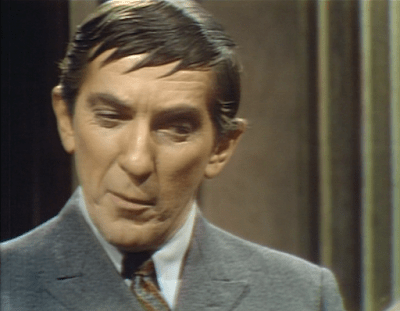
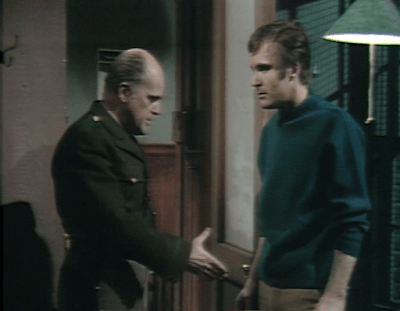
Today, Roger is at his most conventionally respectable. He comes home from a long business trip, indicating his sober devotion to the work of Collins Enterprises. He finds David in his room, struggling with distant cousin Barnabas Collins and permanent houseguest Julia Hoffman. After a commercial break, Roger says that he has heard about the many complicated events that took place while he was away. Barnabas explains that David had told him that silversmith Ezra Braithwaite came to the house to see him, bearing a ledger with information he wanted. David found Mr Braithwaite in the drawing room, dead of a heart attack. The ledger was nowhere to be found. Barnabas and Julia have come to David to ask if he can shed any light on what may have happened to the ledger, and the boy became violently upset. Roger insists Julia and Barnabas leave the room. He talks soothingly to David and tells him he does not believe any accusations against him.

Later, Roger confronts Barnabas and Julia in the drawing room. He finds the ledger on the desk where Mr Braithwaite was sitting when he died; he does not accept Julia and Barnabas’ assurance that it was not there earlier. He dismissively asks if they are suggesting that “a ghost” put it there. He demands they apologize to David, making it a condition for their continued presence in the house that they do so.
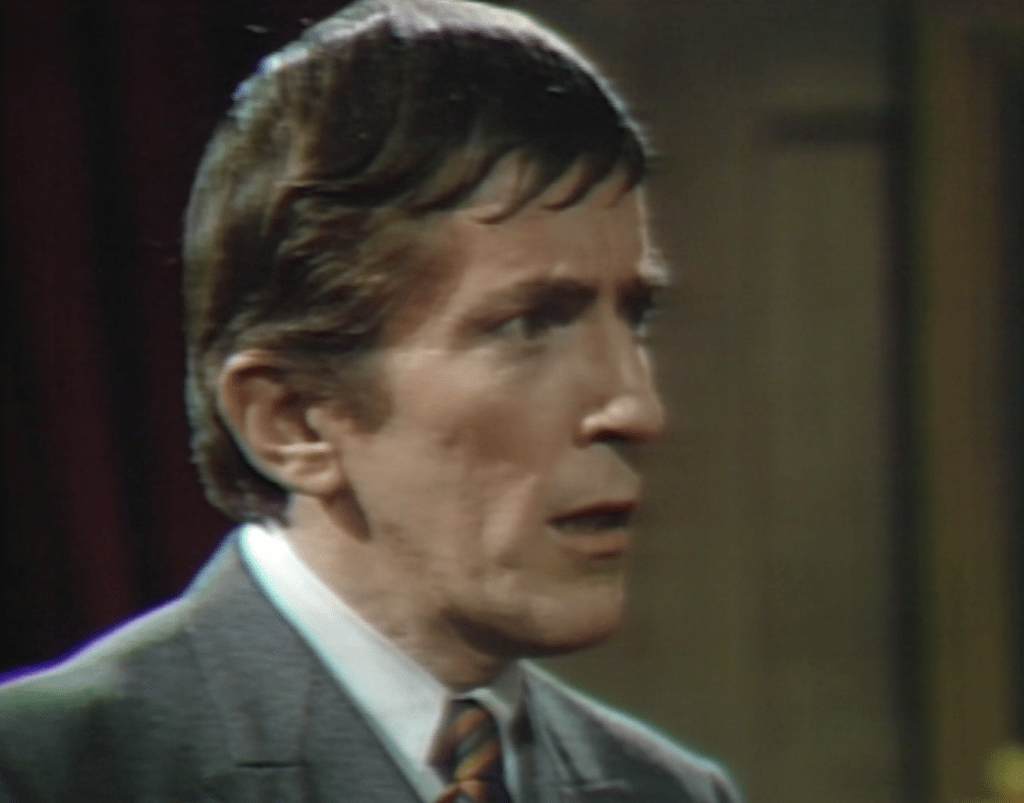
Barnabas is shocked when Roger threatens to revoke his great house privileges. Screenshot by Dark Shadows Before I Die.

As it happens, Barnabas and Julia strongly suspect that a ghost did put the ledger back on the desk, and the audience knows they are right. Roger has seen quite a bit of evidence of supernatural forces at work in and around Collinwood, as has Liz. But both of them consistently refuse to acknowledge this evidence. Each of them has had moments when the wall of denial started to crumble; notably in #88, Roger said to Liz, “I’ve seen and felt things, things I couldn’t actually explain. You can’t tell me it hasn’t happened to you, because I know better.” But they always snap back to form sooner or later, no matter how obvious the truth is, and there would obviously be no point in laying the facts before Roger when he is in this mood.

Julia and Barnabas have asked Liz to show them the old family archives. It is the middle of the night, everyone is very tired as the result of the fuss and bother that occurs when a corpse has to be removed from the house by lawful means, they will not tell her what topic they are researching, and they insist on starting work immediately. She asks if they expect her to go along with them on this basis, prompting Barnabas to smile as genially as he can and say “Of course!” You can’t expect to persuade crazy people to behave reasonably, so she gives in.

The archives are a dusty room somewhere in the great house that Julia somehow failed to enter during the months when she was staying at the house under the pretense of being an historian looking into the early years of the Collins family. The first book Julia picks up is an old photo album, and one of the first pages she turns to is a photograph of a woman whose ghost she and Barnabas saw the other night. The photo is dated 1897. The woman looks just as she did in her ghostly form, suggesting that she died not much later than that. There is some business with doors slamming shut and windows blowing open to fill the last thirty seconds of the episode, and the closing credits roll.

My wife, Mrs Acilius, pointed out that Roger’s defensiveness concerning David serves the same purpose in the plot as does Barnabas and Julia’s ludicrously cack-handed approach to questioning him. The evil ghost is still quite weak, the ghost of the woman opposes him, and David and his friend Amy Jennings are desperate to escape from his influence. If any of the adults caught on to what was happening at this point, they could cut the Haunting of Collinwood story short. But it is just getting interesting, and there is only one other plot ongoing now. So we don’t want that. Roger and Liz have to be in full denial mode, Julia and Barnabas have to be terrible at talking with kids, and governess Maggie Evans has to be a squish who doesn’t know the first thing about discipline for the plot to work.

Fortunately, we have ample foundation for each of these character developments. Roger’s origin as a shockingly indifferent father makes it understandable that he would swing to the opposite extreme and treat David with excessive indulgence. As a former vampire and a mad scientist, Barnabas and Julia are metaphors for extreme selfishness, and when they were called upon to act as parents to Frankenstein’s monster Adam in April 1968 they did the worst possible job. Maggie is brand new to governessing; she has been on the show since #1, so we know that she was good at running the coffee shop in the Collinsport Inn, at containing the damage her father did by his alcoholism, at escaping from vampires and mad scientists, and at miscellaneous other tasks involving other adults. But she has never been responsible for children or trained as a teacher, and so it neither surprises us nor alienates us from her that she is bad at the job.
Episode 685: Barnabas, Quentin, and the Thing Glasses

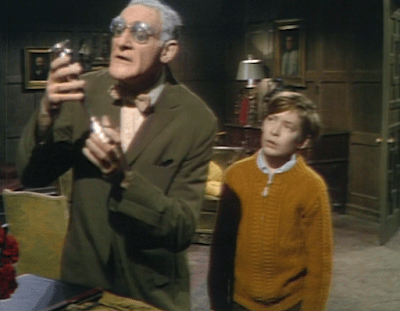
Silversmith Ezra Braithwaite comes to the great house of Collinwood, bearing a ledger with information that old world gentleman Barnabas Collins wants. Barnabas is in the study, so twelve year old boy David Collins lets Mr Braithwaite into the house and escorts him to the drawing room. The two of them play a scene that may not have looked like much on the page, but as delivered by talented comic actors Abe Vigoda and David Henesy the lines are hilarious.

For example, Mr Braithwaite has two pairs of glasses, which he describes to David as his glasses for looking at things and his glasses for looking at people. David asks if the ones he is wearing are his “thing glasses.” We laughed out loud at that whole exchange. Mr Braithwaite asks David to go get “Uncle Barnabas”; David replies “He’s my cousin,” to which Mr Braithwaite answers “Ah, yes.” Again, that wouldn’t be a hit in a joke book, but Vigoda and Mr Henesy sell it. The purest example comes when Mr Braithwaite starts to change his glasses as he turns to the pages of the ledger and says out loud to himself “Oh, Ezra, Ezra, you already got on your reading glasses.” That is a laugh line entirely because of the way Vigoda stresses the words “got” and “on.”

There is a little exchange between Ezra and David that will stand out to longtime viewers:

Ezra: David is it? Well, I don’t remember a Collins being named David before. Now, my name is Ezra, as my father was and his father before him. You find a name like Ezra and you don’t give it up.

David: I guess not.

Ezra: Yes, now, David’s kind of a new-fangled name.

David: No, there’s King David in the Bible.

Ezra: Oh, of course, yes, yes. A good man, too.

In #153, it was established that no Collins ever bore the name “David” until undead blonde fire witch Laura Murdoch Collins insisted that her husband Roger go along with her plan to name their son “David Theodore Collins.” That turned out to be hugely important as evidence of Laura’s evil intentions. In #288, it sounded like they had decided to retcon that away when David looked in a family album, saw a portrait of a “David Collins” from a previous century, and wondered aloud if he had found his namesake. Nothing has come of that potential namesake in the 79 weeks since, and Ezra’s line that he didn’t “remember a Collins being named David before” would suggest that they’ve gone back to the original idea.

Mr Braithwaite, in his thing glasses, examines a piece of silver. David examines him. Screenshot by Dark Shadows Before I Die.

Each time Mr Braithwaite looks at someone through his “thing glasses,” we get a point of view shot showing that his eyesight is blurry. They then cut back to the other actor in regular focus. These shots are brief enough that the repetition isn’t a big problem, but it results in a series of exchanges the actors deliver to the camera rather than to each other. Those don’t work at all. Mr Henesy and Abe Vigoda had such a fine comic rhythm going that it’s a shame to break it up with this clunky stuff.

Reading the ledger, Mr Braithwaite says that the silver pentagram Barnabas wants to know about was bought in April 1897 by Miss Beth Chavez and paid for by Quentin Collins. We have seen Beth’s ghost. She is very tall and so thin you could clasp your fingers around her waist. Her complexion is pale as can be, her hair blonde, her eyes blue. I’ve met a fair number of Chavezes in my time, including a couple of Elizabeth Chavezes, and none has met this description. I have nothing to say against slender blondes, and actress Terrayne Crawford is movie-star beautiful. Still, if a fellow were excited about a blind date with a girl known to him only by the name “Beth Chavez,” he’d probably be a bit disappointed if the person who showed up met her description.

We have also seen Quentin’s ghost. Quentin is manipulating David into helping him with a number of murders he intends to commit. Beth has thwarted one of these murders so far, and is trying to prevent Quentin from achieving other evil plans of his. But Quentin is apparently more powerful than she is.

While Mr Braithwaite is alone in the drawing room, Quentin enters through a secret panel. Earlier in this episode, they made it clear Quentin can choose whether he is visible to the living people in the spaces he occupies; there is no need for him to hide. Why does he use the panel?

Longtime viewers may be able to make a surmise. We saw this panel for the first time in #87, when David’s father Roger used it for a sneaky errand. We didn’t see it or hear of it again until #643, when David told nine-year old Amy Jennings that there was a passage “very few people” knew about, and used it to lead her to the room in which Quentin was at that point confined. Quentin’s use of it will therefore suggest that he knows all the secrets of the house. It also suggests that when he dwelt there as a living being he was a naughty fellow who was in the habit of using its secret passages for the sort of underhanded mischief Roger got up to in #87 and #88.

Quentin strolls up to Mr Braithwaite and smiles at him. Mr Braithwaite is wearing his “thing glasses” and cannot see Quentin clearly. He asks Quentin if he is the friend Barnabas spoke of when he asked him about the pentagram. Quentin nods. Mr Braithwaite says that he himself made the pentagram in April 1897, when he was “fifteen and a half.” It is now February 1969, so we know that Mr Braithwaite is 87. He recognizes Quentin. Shocked to see a man who has been dead for decades apparently alive, well, and in his twenties,* Mr Braithwaite dies of a heart attack.

It’s a shame we won’t be seeing more of Abe Vigoda as Mr Braithwaite. At least they spelled his name correctly in the credits this time; yesterday he was “Abe Vigodo.”

*Two days past his 28th birthday, to be exact. Happy belated 84th to David Selby!

Episode 683: The children themselves

This one survives only in a black and white kinescope. That format serves the story quite well. Five of the characters sound like they would generate fast-paced, high-pitched action- Barnabas Collins is a recovering vampire, Julia Hoffman is a mad scientist, Chris Jennings is a werewolf, Quentin Collins and his associate Beth are ghosts. But today is all about Barnabas, Julia, and Chris trying to figure out whether Quentin and Beth really are ghosts and wondering if they have something to do with Chris’ nine year old sister Amy and Amy’s twelve year old friend David Collins. They have to spend their time painstakingly chewing over the few wisps of evidence they have managed to collect. That slow story depends entirely on atmosphere and suggestion to connect with the audience, and the visual simplicity and abstraction of black and white images gives it the best chance it could have of working.

Barnabas and Julia go to Chris’ place to ask him if he knows anything about Beth. Julia hypnotizes him to make sure he isn’t blocking any memories of her; he isn’t. They leave, he goes outside alone, and he meets Beth. She points to a spot on the ground, then vanishes. He goes to get Barnabas and tell him about this encounter. They go to the spot she had indicated and find that a shovel has materialized nearby. They dig there, and turn up a child’s coffin. Barnabas is puzzled by this. He hasn’t buried any children in unmarked graves on the grounds lately, and there is nothing distinctive about the coffin itself. So he suggests they open it. The episode ends with the lid of the coffin filling the screen.

The latest exhumation. Screenshot by Dark Shadows Before I Die.

This was the last of hundreds of episodes written by Ron Sproat. When Sproat joined the show in the fall of 1966, he sorted through the storylines, discarding some that couldn’t possibly go anywhere and tightening the focus on those that seemed to have potential. He was an able technician who did a great deal to make sure that new viewers could figure out what was happening on the show. He shouldered the heaviest share of the writing burden in the period when the vampire storyline began and Dark Shadows suddenly leapt from the bottom of the ratings to become a kind of hit, and was a workhorse through the months when the show was a costume drama set in the 1790s and emerged as one of the major pop culture phenomena of the 1960s. He was the one who pushed his Yale classmate Jonathan Frid for the role of Barnabas, and he was the first person connected with the show to go to the conventions the show’s fans organized, laying the foundation for a community that brought them together with members of the cast, crew, and production staff.

Vital as his contributions were to the show and its afterlife, the brutal conditions under which Dark Shadows‘ tiny writing staff worked made it impossible to ignore Sproat’s weaknesses. When there were never more than three people involved in creating scripts for a hundred minutes a week of drama, scripts which were often produced verbatim as they came from the writer, there was nowhere to hide. So it is clear to us that Sproat’s imagination was not an especially fertile source of plot development. On his great Dark Shadows Every Day, Danny Horn frequently complained of Sproat’s habit of locking characters up in various forms of captivity so that the story would not progress and he would not run out of flimsies to fill in. Danny called these captivities “Sproatnappings.” Sproat probably should have found a different job several months ago, and certainly should have been part of a larger group of writers.

Still, we will miss him when he’s gone. Alexandra Moltke Isles played well-meaning governess Vicki from #1 to #627; for the first year, she was the main character on Dark Shadows, and she continued to be a core member of the cast until she left. Nowadays, Mrs Isles remembers that a few months after her departure she found herself free at 4 PM and tuned into the show. She couldn’t make heads or tails of what was going on. She wasn’t the only one. The staff that will take the show through its next several months- Sam Hall, Gordon Russell, and Violet Welles- would do brilliant work, on average far and away the best the show ever had, but none of them spared a thought for any but the most regular of viewers. For much of 1969, missing one episode will leave you bewildered- missing several months, well, Mrs Isles may as well have been watching a different show altogether.

Most episodes in the first 66 weeks of Dark Shadows ended with ABC staff announcer Bob Lloyd’s voice in the closing credits telling us that “Dark Shadows is a Dan Curtis production.” We hear that announcement during today’s closing credits for the first time since #330. That isn’t because they’ve brought Mr Lloyd back, but because they were using an old tape for the theme music and didn’t realize his voice was on it. You can tell it wasn’t on purpose, since the announcement comes in the middle of the credits, not in its usual place at the end when the Dan Curtis Productions logo appears.

Episode 682: He killed me

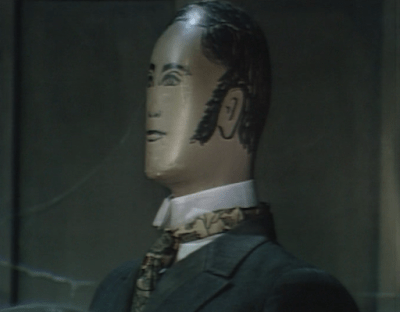
Governess Maggie Evans saw the evil spirit of the late Quentin Collins yesterday, and she tells housekeeper Mrs Johnson about it today. Mrs Johnson saw Quentin a few days ago; she and Maggie are the only adults in the great house of Collinwood who know that Quentin exists, and not even they know his name. Quentin is gradually taking control of Maggie’s charges, nine year old Amy Jennings and twelve year old David Collins. Yesterday, David led Maggie and his aunt, matriarch Elizabeth Collins Stoddard, to the room in the long deserted west wing where Maggie saw Quentin. There is a mannequin there wearing a coat like Quentin’s; David says that he and Amy call it “Mr Juggins,” and Liz chooses to believe that Mr Juggins is what Maggie saw.

We see Maggie in bed. She gets up, goes back to the room, and sees Mr Juggins. We dissolve to a shot of Quentin in Mr Juggins’ place. Horrified, Maggie watches Quentin approach with a length of fabric. He chokes her with it. She falls to the floor. She is lying there when we cut to commercial. Maggie was introduced in #1 and has for long stretches been a central character, one of the most recognizable on Dark Shadows. Kathryn Leigh Scott tells a story of going to a wilderness area in Africa when the show was a hit and being greeted with cries of “Maggie Evans!” For the moment, it looks like they have decided to kill her off in the middle of a Tuesday episode.

Of course they haven’t. We come back from the break to hear Maggie telling old world gentleman Barnabas Collins about the dream in which she was strangled. She is surprised that Barnabas believes her story about seeing the man when she was awake, shares her suspicions that David and Amy are connected with the man, and is open to the idea that the dream is “a warning.” Barnabas tells Maggie that he and his inseparable friend, permanent houseguest Julia Hoffman, MD, saw a woman dressed in clothes of the same period as Quentin’s clothes, that the woman’s presence could not be explained, and that she led them to Amy’s brother’s Chris at a moment when Chris needed medical help to save his life. Barnabas has concluded that the man and the woman are ghosts and that they represent something very dangerous.

Barnabas enlists the aid of occult expert Timothy Eliot Stokes. Stokes agrees to conduct a séance in the drawing room in the hopes of contacting Madame Janet Findley, a psychic researcher whom he brought to the house in #647 to investigate the early signs of Quentin’s haunting. Amy and David tricked Madame Findley into going to Quentin’s stronghold in the west wing in #648, and she did battle with him there in #649. After that confrontation, Madame Findley appeared at the head of the stairs in the foyer and tumbled down them, dead.

This is the tenth séance we have seen on Dark Shadows. They usually come with four roles to be filled. In all séances, someone acted as organizer and leader. In eight of the first nine séances, someone else objected to the idea of a séance, but reluctantly took a place around the table. In seven of the nine, someone went into a trance, becoming a medium. Every time the trance began, someone grew alarmed at its first signs and tried to end the séance before the dead could speak; that drew a stern rebuke from the leader. The medium then spoke, more often than not passing out after struggling to utter a few mysterious words.

The roles of reluctant participant and objector are often combined. Today, Mrs Johnson is the first to combine the role of reluctant participant and medium. This is also the first time the trance does not draw an objection from someone wanting to stop the séance. Mrs Johnson does pull her hands back early on, breaking the circle of contact, and Stokes delivers the requisite stern rebuke. But no one speaks up when she starts to moan. As Madame Findley, she at first produces the usual jumble of words (“The children! Panel! Room!”) She manages to cry out “He killed me! He killed me!” before collapsing face first onto the table in the orthodox manner.

In their post about this episode on Dark Shadows Before I Die, John and Christine Scoleri compare Mr Juggins with Otto the Automatic Pilot from the 1980 film Airplane! Perhaps inspired by the dissolve from Mr Juggins to Quentin today, they go on to Juggins-ize Otto:

The Scoleris also list all the séances on the show up to this point. They name the leaders and mediums, but not the reluctant participants or the objectors. I have added those:

Dark Shadows Before I Die Séance Tracker


Episode 170/171: Dr. Peter Guthrie conducts; Carolyn, Vicki, Roger and Laura Collins participate; Josette speaks through Vicki in French; held in the drawing room at Collinwood [Roger and Laura join reluctantly; Carolyn objects]

Episode 186: Vicki conducts; Sam and David participate; David Radcliffe speaks through David; held in the drawing room at the Old House [Sam is both reluctant joiner and objector]

Episode 280/281: Roger conducts; Liz, Vicki, Burke, Barnabas, Carolyn participate; Josette speaks through Vicki; held in the drawing room at the Old House [Liz, Burke, and Barnabas are reluctant; Barnabas objects]

Episode 365: Roger conducts; Liz, Julia, Vicki, Carolyn and Barnabas participate; Sarah Collins speaks through Vicki after Carolyn pretends Sarah is speaking through her; Vicki is transferred to 1795; held in the drawing room at Collinwood [Liz and Barnabas are reluctant; Liz objects]

Episode 449: Countess duPrés conducts; Joshua Collins participates; Bathia Mapes shows up, claiming she was called; held in the drawing room at Collinwood [Joshua is reluctant; no trance]

Episode 510/511: Professor Stokes conducts; Julia and Tony Peterson participate; Reverend Trask speaks through Tony Peterson; the basement wall breaks open to reveal his skeleton; held in the basement at the Old House [Tony is reluctant, Julia objects]

Episode 600: Professor Stokes conducts; Barnabas and Julia participate; Phillipe Cordier speaks through Barnabas; held in the drawing room at the Old House [No conspicuously reluctant participant. Julia objects]

Episode 640: David conducts; Amy participates; unsuccessful attempt to contact Quentin Collins; held in Amy’s bedroom at Collinwood [Amy is reluctant; no trance]

Episode 642: Professor Stokes conducts; Liz, Vicki, Carolyn, Chris participate; Magda speaks through Carolyn; held in the drawing room at Collinwood [Chris is reluctant and is objector]

Today’s episode: Professor Stokes conducts; Barnabas, Maggie and Mrs. Johnson participate; Janet Findley speaks through Mrs. Johnson; held in the drawing room at Collinwood [Mrs Johnson is reluctant; no objector]

This is Maggie’s first séance, and they’ve been spending a lot of time lately showing us that she is unsure of herself. So it would have been expected for her to become frightened and try to stop the séance when Mrs Johnson goes into the trance. Maybe that’s why they left it out- it was too obvious a move. But the pattern is so familiar now that it feels like they’ve forgotten something when they leave the objection out.

Episode 681: Mr Juggins

The evil spirit of the late Quentin Collins has been taking control of strange and troubled boy David Collins. David tricks his governess, Maggie Evans, into going into a room in the long-deserted west wing of the great house of Collinwood. Quentin appears to Maggie there, frightening her.

Maggie goes to matriarch Elizabeth Collins Stoddard and tells her she saw an unfamiliar man lurking in the west wing. When she says that she suspects David is in cahoots with the man, Liz becomes deeply skeptical. Her disbelief reminds longtime viewers of #27, when Maggie’s predecessor, the well-meaning Vicki Winters, discovered evidence indicating that David was behind an attempt to murder his father, Liz’ brother Roger. Desperate to escape the implication, Liz briefly went so far as to suggest that Vicki herself might be the culprit. That idea was absurd on its face, and Liz treated Vicki as a member of the family, so she dropped it almost as soon as she had put it into words. But Maggie doesn’t have anything definite to back up her suspicions of David, and Liz is no more attached to her than she might be to any other member of the household staff. She remains leery of Maggie throughout the episode.

Quentin appears to David in his room. David talks to Quentin; he praises him for a fine plan, and Quentin smiles and nods in reply. He asks him how he came up with the name “Mr Juggins” and Quentin does not react. When Liz’ daughter Carolyn and local man Chris Jennings enter, Quentin vanishes.

After Carolyn and Chris exit, David sings a song about “Mr Juggins.” Quentin reappears, quite happy. I don’t blame Quentin, the song makes me happy too. It’s sung to the tune of “Yankee Doodle”:

Mr Juggins met Miss Evans on a darkened ni-i-ight,

The poor girl fainted dead away, he gave her such a fri-i-ight.

Mr Juggins keep it up,

Mr Juggins keep it up,

Mr Juggins keep it up,

Until Aunt Liz beleeeeves me!

This is the first time we’ve heard David sing, and it is delightful. David Henesy was in the national touring company of Oliver! in 1964 and 1965, and he does a first-class job with this little ditty. The song also marks the first time David utters the name “Liz”- he has always called her “Aunt Elizabeth.”

Furthermore, the Dark Shadows Almanac, as cited on the Dark Shadows Wiki, reports that the technician responsible for holding up the boom microphones was named Max Jughans. Considering that the shadows of the boom mics appeared on screen in most episodes, the mics themselves in many, and the entire boom mic assembly on occasion, the director’s voice must have come from the control room during many a dress rehearsal calling “Mr Jughans, keep it up!” Certainly David Henesy comes very close to laughing when he first gets to the line “Mr Juggins, keep it up!”

Maggie and Liz talk to David in his room. David offers to take them to the room where Maggie saw Quentin so that he can prove a story he has been telling; Liz replies “You don’t need to prove anything.” This line shows how completely she has disregarded what Maggie has told her. David insists, and they go.

In the room, Maggie gasps. She thinks she is seeing Quentin again. In fact, it is a dummy wearing a coat like his and with a face painted to look more or less like his. David says that he calls the dummy “Mr Juggins.” Liz turns to Maggie and triumphantly asks “Could this be the man you saw?” It’s lucky for Maggie she didn’t get the job when Vicki did, or she would still be in jail for the attempt on Roger’s life.

I’m not saying Mr Juggins is the best guest star Dark Shadows ever had, only that he was one of the best. Screenshot by Dark Shadows Before I Die.

Episode 679: Your make-believe people

The spirit of the late Quentin Collins is taking possession of children Amy Jennings and David Collins, and they now realize that Quentin’s plans for them are evil. David despairs of resisting Quentin; Amy tries to tell matriarch Elizabeth Collins Stoddard what is going on, but Quentin appears to Amy and stops her before she can say anything useful. I have some miscellaneous observations to make:

Quentin scares Amy and stops her telling Liz what is happening. Screenshot by Dark Shadows Before I Die.
  1. In a comment on Danny Horn’s post about this episode at Dark Shadows Every Day, I pointed out that it is unnecessary to call the story a “metaphor for child abuse” or “allegorical child abuse.” When adults terrorize kids into harming their loved ones, that simply is child abuse. Quentin is abusing David and Amy by means that don’t seem to exist in our world, but it is very definitely abuse and it can be expected to have the same consequences that would follow if he were using more realistic methods.

2. When Quentin interrupts Amy’s attempt to tell Liz what has been going on, the show is repeating a structure it used just a few days ago, in #675. Amy’s big brother Chris was about to confess to the sheriff that he was a werewolf when a telephone call from recovering vampire Barnabas Collins gave Chris an alibi and ended the sheriff’s interest in anything he might say. In each case a confession comes right to the point of terminating one of the two major ongoing storylines and is interrupted before it can do so.

3. Liz catches David twisting Amy’s arm, covering her mouth, and yelling at her. After Liz scolds David and sends him to his room, she tells governess Maggie Evans to discipline David by any means necessary. Several times in the last couple of weeks, the show has gone out of its way to demonstrate that Maggie is a hopelessly lax disciplinarian, no obstacle at all to Quentin’s designs on Amy and David. Now we see that even the other characters have started to catch on to this fact.

4. There are a couple of sequences of coming and going from David’s room. These feature a good deal of camera movement from the inside to the hallway outside. The show has been giving us a lot more of this kind of thing lately, laboring to suggest spaces connecting one room to another. There used to be scenes set in the village of Collinsport, and characters who lived there. Maggie lived in town then, and her house was a frequent set. But now she lives in the great house on the estate of Collinwood, and the only regular character who does not live somewhere on the estate is Professor Timothy Eliot Stokes, whom we have not seen since #660. If all the action is going to shrink to Collinwood, and most of it to the great house, it makes sense they would develop a strategy to make that house seem like a bigger place.

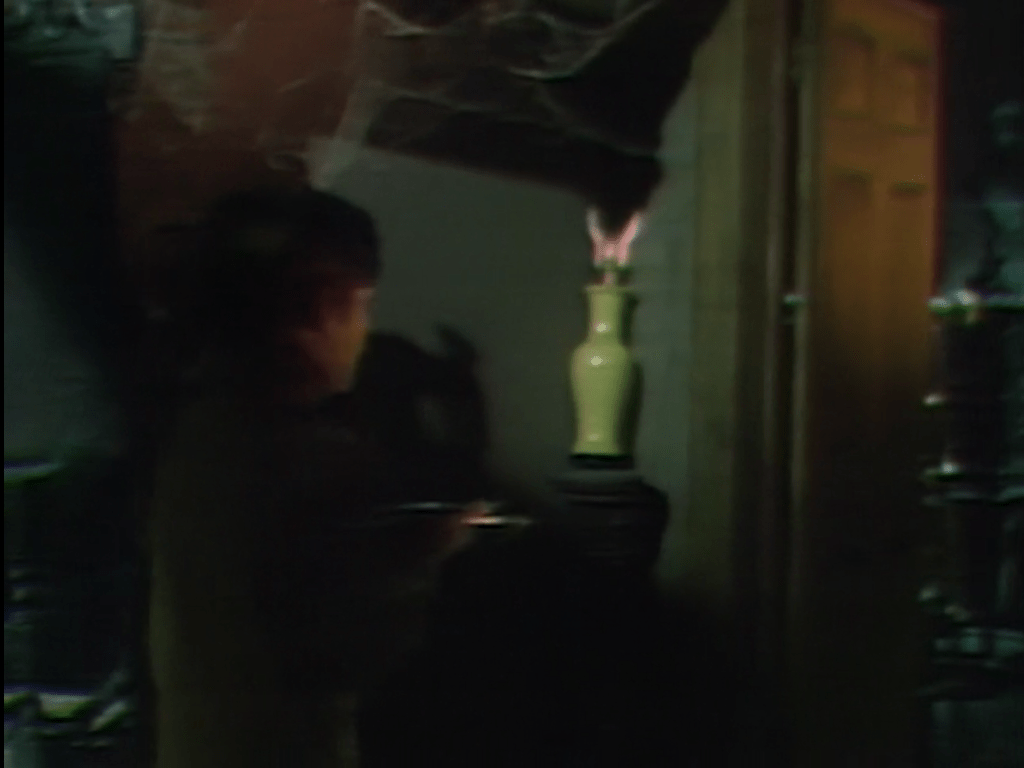
5. The show has a fondness for a particular shade of bright green at this point. You will notice it in the clothes that both Amy and Liz are wearing in the screenshot above. It also shows up towards the end of the episode. Maggie follows David into the long-deserted west wing of the great house; he is sneaking off to visit Quentin in his stronghold, a dusty little room there. The sequence again places an emphasis on the corridors. We have seen the west wing corridors several times. As before, they are draped with elaborate cobwebs but chock-full of objets d’art. There is a new one on display today, a lamp in that same bright green. It is in the center of the shot while David makes his way to the room. That helps to make the space seem bigger, as we measure David’s progress not by he slowness of his steps but by his steadily changing relationship to the lamp. The corridor is dark enough that only a brightly colored object could serve this function, but it is in focus for so long that we are left with a feeling that it must have some significance of its own.

The lamp gets its star turn.

6. When David is lying to Liz to keep her from making sense of what little Amy was able to tell her, he claims to have an imaginary friend named “Lars,” a giant who lives in “the house by the sea.” Collinsport is a coastal village, so there are lots of houses by the sea there, and for much of 1968 suave warlock Nicholas Blair lived in what was always called “a house by the sea.” But only one place has been called “the house by the sea,” a Collins family property that has been vacant since the 1870s. Well-meaning governess Victoria Winters and her fiancé Burke Devlin were interested in buying that house in September and October of 1967, but for legal reasons the sale turned out to be impossible. The business about The House by the Sea seemed very much like it was going to lead to a ghost story that would bring into view another branch of the Collins family and involve Burke and Vicki being possessed by evil spirits. Perhaps that was the intention when it was first dreamed up in the flimsies six months before, but it never went anywhere and was forgotten completely the minute it ended. This is the first reference to the house since #335. If that were at one time the plan, bringing up “The House by the Sea” today might be a way for the writers and producers to remark to each other on the fact that they are now making a story like the one they dropped back then.

Episode 678: This time, I saved him

At the estate of Collinwood, two ghosts are at odds over the fate of a werewolf. Caught in the crossfire are a mad scientist, a recovering vampire, and a couple of kids.

The ghosts are the evil Quentin Collins and a weepy woman so far known only as Beth. The werewolf is Chris Jennings, who is staying in the caretaker’s cottage on the estate. The mad scientist is Julia Hoffman, MD, a permanent guest in the great house. The recovering vampire is Julia’s inseparable friend Barnabas Collins, master of the Old House. The kids are Chris’ nine year old sister Amy and strange and troubled boy David Collins, who live in the great house.

Yesterday, Quentin went to the cottage and put strychnine in Chris’ whiskey. Beth appeared to Julia and led her and Barnabas to the cottage in time to save Chris; today, they figure out that Beth is a ghost.

Quentin has been exercising power over David and Amy, at first with Beth’s cooperation. Beth appears to Amy in a dream visitation. While she guides Amy to images of Chris and David and to the realizations that Quentin means to kill Chris and that David has tried vainly to stop him, we hear Beth speak for the first time. She says everything twice, giving her dialogue a lyrical quality that could be quite lovely. Unfortunately, Terrayne Crawford’s limitations as an actress keep that loveliness from coming through.

Barnabas and Julia know that Chris is a werewolf and have persuaded him to accept their help. They question Chris and are satisfied that he did not poison himself. When he mentions that David visited him the previous morning, Barnabas decides to go interrogate David. Longtime viewers know that David has extensive experience with ghosts, a fact of which Barnabas has at times been most uncomfortably aware. Once Barnabas has learned that Beth is a ghost, it will strike us as reasonable that he will be interested in David’s connection with the matter.

Amy goes to the cottage and sees Julia tending to Chris. They tell her he just had an upset stomach and will be fine. She does not believe them, and says she had a dream that convinced her Chris was in mortal danger. This intrigues Julia, who presses for more details about the dream. Amy clams up, but now Julia and Barnabas, the show’s two chief protagonists, have figured out that David and Amy have something to do with ghosts, and that those ghosts in turn have to do with Chris. The Haunting of Collinwood story hasn’t made any real progress for several weeks, but that can now change.

Back in the great house, Barnabas questions David about his visit to Chris. He doesn’t get any more information out of him than Julia had got out of Amy. There is a bit of intentional humor when Barnabas tells David he thought it would be pleasant to share breakfast with him and Amy. David says it isn’t so pleasant at breakfast- housekeeper Mrs Johnson is in a bad mood in the mornings. Barnabas suggests they ignore her, and David replies that it is not easy to do that. David Henesy delivers this line with perfect comic timing.

Barnabas realizes David knows more than he is telling. Screenshot by Dark Shadows Before I Die.

Amy shows up and responds favorably to Barnabas’ self-invitation to their breakfast. After Barnabas leaves the room, Amy confronts David about Quentin’s attempt to kill Chris. David has despaired of opposing Quentin, and is terrified when Amy tells him she will go tell matriarch Elizabeth Collins Stoddard everything that has been going on. He is convinced Quentin will kill them if she does this. He is pleading with her to come back when the episode ends.

Episode 676: Scared of the funniest things

Chris Jennings turns into a werewolf when the moon is full, which it is about half the time in the universe of Dark Shadows. Old world gentleman Barnabas Collins has learned of Chris’ plight and decided to help him. As they make their way through an old cemetery to the hidden chamber where Barnabas will lock Chris up so that he doesn’t hurt anyone tonight, Barnabas asks Chris to confirm that he doesn’t remember anything he does in his lupine form. Chris does, saying that waking up and not knowing what he did the night before “is the most agonizing part of the whole thing.” You might think that he would find it even more agonizing to know that he has been killing one or two random human beings a month for the last seven years, but different things bother different people.

Chris asks how Barnabas knew that he didn’t remember what he did as the werewolf. Barnabas replies “Well, it’s obvious you’ve forgotten that you attacked me in this graveyard the night before last.” Chris says that “It’s a wonder you’re still alive.” To which Barnabas replies “No, it’s a wonder YOU’RE still alive!” For a moment we wonder how long this will go on, but Barnabas explains that werewolves can be killed by silver weapons. The head of the cane he carries is silver, and he struck him with it.

Barnabas shows Chris to the hidden room in the back of the old Collins family mausoleum. Barnabas himself was kept in a chained coffin in this room for over 170 years, when he was a vampire. He tells Chris that the room was originally constructed to hide ammunition from the British during the Revolution, which we have heard before. The coffin is still there; he tells him it is empty, and denies knowing anything about it. He says that the walls of the tomb are solid granite a foot thick; this is the first we’ve heard this detail. When Chris asks if anyone else knows about the room, Barnabas concedes that “A few” do. He assures him that none of them will be around tonight. Regular viewers will start making up a list of all the characters currently on the show who know about the room; Barnabas’s friend Julia Hoffman and his servant Willie Loomis know about it, as does strange and troubled boy David Collins. Barnabas can tell Julia and Willie to stay clear, and David has no reason to come to the cemetery tonight.

Barnabas explains that he will not show Chris the mechanism that unlocks the door from the inside, but promises to come back to release him after dawn. Chris urges Barnabas to leave at once; Barnabas insists on sticking around and asking more questions, saying that the moon isn’t up yet. Chris tells him that he first transformed shortly after he graduated from architecture school. “Oh, I was going to be an architect to be reckoned with, bold, imaginative, revolutionary. I thought nothing could stand in my way. Then something did.”

After Chris delivers a monologue about what a soulful and remorseful serial killer he is, Barnabas finally does close the secret panel. He sticks around until he hears the sounds of the werewolf snarling in the hidden room.

Chris’ nine year old sister Amy is staying at the great house of Collinwood. David finds her standing outside the front door, staring at the moon. She tells him that the moon scares her sometimes. His response is “Well, then don’t look at it,” which does seem logical. But she tells him that she can’t help it. David complains about how odd she is. We will hear more of this grumbling; it makes them seem like an old married couple, and is hilarious.

Amy and David are coming under the influence of the evil spirit of the late Quentin Collins. Quentin keeps trying to get them to set various members of the Collins family up for lethal traps; they haven’t succeeded yet in killing anyone, but housekeeper Mrs Johnson has caught on that there is something peculiar going on with the two of them, and she is frightened.

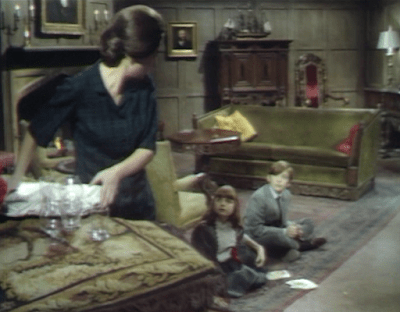
Mrs Johnson enters the drawing room to do some straightening up and finds the children playing a game with a deck of stage magician’s oversized cards. She and they stare silently at each other for a minute or two, and she protests. They say they were just watching her work, and she orders them to go to bed. They object that it isn’t bedtime yet. Of course it isn’t, Mrs Johnson doesn’t work around the clock. They get even more intensely on her nerves by bringing up a recent incident when she saw Quentin’s ghost, and in her exasperation she chases them out of the room.

Amy and David irritate Mrs Johnson. Screenshot by Dark Shadows Before I Die.

There isn’t anything about Quentin in the episode prior to that scene, so I cannot imagine what viewers would make of it. It’s late in the day, a domestic is tired, and a couple of kids are trying to annoy her. That is a relatable situation, but it doesn’t match with the heavy, melodramatic Dark Shadows music and the terrified affect with which Clarice Blackburn plays Mrs Johnson. I suppose that by January 1969, Dark Shadows was so widely known as a supernatural thriller that most people tuning in for the first time would assume that something paranormal was going on, but if they turned the television on after the opening titles and didn’t realize what show they were watching, they could only have concluded that they were witnessing an utterly ludicrous case of exaggerated seriousness. After David and Amy are out of Mrs Johnson’s sight, we see them go upstairs laughing, but that proves only that they are trying to upset her, not that they are connected to a malign power greater than themselves.

Barnabas enters and sees that Mrs Johnson is upset. She begins to tell him why, but interrupts herself to declare that he won’t believe her. He assures her that he will, and keeps asking her to go on. After she has told him everything she and the audience both know, he asks her to start over. The scene cuts out, suggesting that Barnabas is taking pains to get as much information from Mrs Johnson as he possibly can.

The children go to the little room in the long-deserted west wing of the house where they first met Quentin. Quentin is there when they arrive. This is the first time we have seen Quentin waiting for them; previously, they have had to summon him. Quentin does not speak; David can sense that he wants Amy to go back to the main part of the house so that they can talk privately.

Alone with Quentin, David asks where “the bottle” is. Quentin opens a rolltop desk, and David sees a bottle. He is shocked to find that the bottle is labeled “strychnine.” He declares that he won’t hurt Chris, and he runs out of the room.

Downstairs, Amy is in the drawing room, where she presses a few keys of the piano. We heard her play “London Bridge” in #656, but this doesn’t seem to be a part of any song. She is just idly pecking at the keyboard. When David comes, Amy complains about how long he was gone. He is distant, refusing to maintain eye contact or to answer any of her questions. He says they won’t be playing tonight.

We cut back upstairs, where Quentin is picking up the bottle of strychnine. Mrs Johnson saw Quentin in Chris’ cottage, so we know that he can go there. If David won’t poison Chris, perhaps Quentin will do it himself.

Episode 675: The best alibi you can have in this town

In #128, wisecracking waitress Maggie Evans opened a conversation in the diner at the Collinsport Inn with that old familiar ice-breaker, “Whaddaya hear from the morgue?” The show took us all the way to Phoenix, Arizona for a trip to that city’s morgue in #174, but it is only today we see the inside of Collinsport’s own morgue for the first time. Sheriff George Patterson brings heiress Carolyn Collins Stoddard in to identify a body found on her property. Carolyn is shocked to find that it is her friend, Donna Friedlander.

Last night, Carolyn and Donna were in the drawing room of the great house of Collinwood with permanent houseguest Julia Hoffman and old world gentleman Barnabas Collins, who lives in the Old House on the same estate. Also in the room was Chris Jennings, a mysterious drifter who caught Carolyn’s fancy and who now lives in the caretaker’s cottage on the estate as her guest. Barnabas invited everyone to dinner at his house. The ladies delightedly accepted, but Chris begged off, saying he would have to leave immediately to keep an important business engagement in Bangor, Maine. Donna said that she was going home to Bangor and that she was ready to leave, and asked Chris for a ride. When he tried to squirm his way out of taking her, Barnabas looked on with smug self-satisfaction.

This morning in the morgue, Carolyn tells Sheriff Patterson that the last time she saw Donna, she was leaving with Chris. But she recoils from the implication. She cannot believe that Chris had anything to do with Donna’s death.

Carolyn does not know what Barnabas has figured out. Chris is a werewolf. When Barnabas told Julia that he had come to that conclusion, she was unconvinced. Barnabas’ dinner invitation was a ploy intended to elicit just the panicked reaction Chris did have. Barnabas’ look of triumph at Chris’ frantic attempts to ensure that he is alone on this night of the full Moon reflects his belief that he has been proved right.

Barnabas went to the cottage some time after the Moon rose, intending to use his silver-headed cane to take control of Chris in his werewolf form. But he delayed too long, and by the time he got there the cottage was vacant and Donna’s mangled corpse lay in the woods nearby.

We cut to the cottage, where we see a disheveled and bloodstained Chris come home. He has just had time to change his shirt and set some furniture right side up when Carolyn drops in. She has come to warn Chris that Sheriff Patterson is coming. The sheriff is right behind her. Carolyn leaves the two of them alone. Chris refuses to allow a search of the premises; when he spots Donna’s purse on his table, he throws a newspaper over it. The sheriff somehow fails to notice this, but takes Chris to his office for questioning.

In the drawing room, Barnabas and Julia are fretting over Donna’s death. Barnabas asks “Could we have stopped it?” He decides that they could not have, and that whatever sequence of events led to the killing must have been “Donna’s fault.” It is always fun to watch the scenes where Barnabas faces the horrific results his actions have on other people, strikes a noble pose while briefly considering the possibility that he may be partially responsible for them, and then agrees with Julia that it is pointless for him to blame himself. Julia and Barnabas’ self-exculpatory attitudes are so transparently absurd that you have to admire Grayson Hall and Jonathan Frid for keeping straight faces while delivering their dialogue.

Meanwhile, Carolyn has called the Collins family lawyer, Richard Garner. Garner agrees to help Chris. We saw Garner and his son Frank a number of times in the first months of 1967, but he hasn’t been on screen since #246. He has only been mentioned a handful of times since then, most recently in #577. This is the last time his name will come up.

Back in the drawing room, Barnabas tells Julia that he can see “So many possibilities” for dealing with Chris’ problem. Frid’s delivery of this line made my wife, Mrs Acilius, shudder. She could hear the evil in his voice as he shows us Barnabas playing God.

Chris is in an interrogation room, telling Sheriff Patterson a series of mutually contradictory lies about what he did last night. The sheriff says he’s going to leave him alone for a few minutes so that he can come up with a more plausible story. You might think this was a sarcastic remark, but in this context it seems it might actually be sincere. Sheriff Patterson’s failure to notice Donna’s purse on Chris’ table is of a piece with the complete nonfeasance he has shown all along, and Vince O’Brien delivers the line so warmly it doesn’t sound like a joke. Moreover, Sheriff Patterson’s predecessor as Collinsport’s chief representative of law enforcement, Constable/ Sheriff Jonas Carter, capitulated to the Collins family’s directions to cover up a crime in his final appearance on the show, back in #32. Longtime viewers may suspect that Sheriff Patterson is as averse to the tough parts of his job as was Constable/ Sheriff Carter.

While Chris is alone in the interrogation room, he decides to tell Sheriff Patterson the truth when he comes back. He does in fact open his mouth and get the first few words of a confession out when the sheriff cuts him short. He says that Barnabas Collins called the office to tell him Chris was with him last night, and that Barnabas is “about the best alibi you can have in this town.” He shakes Chris’ hand and sends him on his way. Law enforcement characters on Dark Shadows are symbols of helplessness, and after that moment Sheriff Patterson has reached the zenith of that quality, achieving a measure of futility that cannot be surpassed. We never see him again.

Sheriff Patterson completes his quest. Screenshot by Dark Shadows Before I Die.

Chris goes home and finds Barnabas waiting for him. Chris expresses his gratitude for the alibi Barnabas gave him, but keeps trying to get him to leave before the Moon rises. Barnabas tells him that when he leaves, Chris will leave with him. Barnabas closes the episode by telling him that he knows that he is not only Chris Jennings, but that “You are also the werewolf.”

This episode marks the final appearance not only of Sheriff Patterson, but also of Vince O’Brien. O’Brien joined the show in #148 as the second actor to play Lieutenant Dan Riley of the Maine State Police. O’Brien’s stolid manner suited the role of that ineffective investigator, but he was much less fun to watch than was the man who originated the part, the charming John Connell.

O’Brien took over as the second Sheriff Patterson in #328. He was again a step down from his predecessor; the first Sheriff Patterson was Dana Elcar, an extraordinary performer who always found a way to give the audience hope that his character was only playing dumb. Other actors filled in for O’Brien a couple of times, Angus Cairns in #341 and #342 and Alfred Sandor in #615, leading some fans to refer to “the Patterson brothers” (whose parents named all of their sons George) and others to speculate that for a time Collinsport allowed any man to be sheriff who was willing to change his name to “George Patterson.” Like O’Brien, Cairns and Sandor were accomplished professionals, but none could match Elcar’s gift for overcoming bad writing and keeping our attention focused on the sheriff.

Episode 673: Urgent business

This episode rests squarely on the shoulders of eleven year old Denise Nickerson, playing the role of nine year old Amy Jennings. A performer of any age could take pride in the results.

We first see Amy in the predawn hours of a night when a werewolf is prowling the grounds of the great estate of Collinwood. The werewolf has attacked heiress Carolyn Collins Stoddard; old world gentleman Barnabas Collins is out hunting him. In the opening sequence, Barnabas fired a shotgun at the werewolf without result, then hit him with his silver-headed cane and drove him off. Barnabas is still outside, still tracking the werewolf. Barnabas’ friend, mad scientist Julia Hoffman, is nervously pacing in the drawing room of the great house.

Amy comes downstairs. Julia sees her and demands to know why she is up and dressed at such an hour. Amy says she must go to the caretaker’s cottage on the estate, where her grownup brother Chris lives. Julia forbids her to go out. Julia saw the werewolf attack Carolyn, but says nothing about the incident. She tells Amy only that it is dangerous in the woods at night. Amy says that she had a dream from which she drew the conclusion that “Something is happening to [Chris,] and it’s happening now!” Neither Amy nor Julia knows that Chris is the werewolf, but they both know that Amy has a paranormal sensitivity to whatever is going on with Chris. Julia offers to go to the cottage if Amy will stay in the house. Amy gladly agrees, and Julia gets a gun and goes.

This quarrel could have been quite annoying. Julia is withholding vital information from Amy, who is in her turn insistent on doing something she could not possibly expect to be permitted. The actresses make it interesting. Amy stands very still, locks her eyes on Julia’s, and enunciates each word carefully, showing every sign of an earnest attempt to persuade her. When she cannot, she does not display anger or frustration or irritation. The only emotion she projects is a sense of urgency. Unlike children throwing tantrums, who make conflicting demands because they are in the grip of conflicting feelings, Nickerson leads us to believe that Amy is pursuing a single coherent objective. We expect her to be part of action that will advance the story.

Grayson Hall emphasizes Julia’s attentive response to Amy’s words and her reluctance to physically restrain her. It is still inexplicable that Julia fails to tell Amy about the attack on Carolyn and about the fact that Barnabas is walking around with a gun ready to shoot at figures moving in the darkness, but those failures don’t bother us as much as we might expect them to do. We see her taking seriously information which we know to be accurate, and this gives us grounds to hope that she will do something intelligent.

Julia gets to Chris’ cottage and back without being eaten by the werewolf or shot by Barnabas. At the cottage, she finds that the furniture has all been overturned and Chris is not in. Back home, she smiles and tells Amy that she saw Chris and he was fine. Julia’s lies convince Amy. She brightens immediately and happily goes back to bed. This really is an amazing moment of acting on Nickerson’s part; Amy’s mood switches in a second from dread and gloom to a big glowing smile. Executing that lift on command is the equivalent of faking a loud laugh and having the result sound natural.

The next morning, Amy mentions to Julia that she and Carolyn have plans to go into town. That leaves Julia no choice but to level with Amy about the werewolf attack. Amy is shocked that Carolyn was hurt, and even more shocked that she might have been killed. Julia assures her that the wounds Carolyn did suffer were minor and that she will be all right after some rest, but Amy is deeply affected. She looks directly into the camera and tells the audience that she did not want Carolyn to be harmed.

Amy tells us she is sorry that Carolyn was hurt. Screenshot by Dark Shadows Before I Die.

In the first months of Dark Shadows, strange and troubled boy David Collins was the only character who looked directly into the camera. He did it several times in those days, and actor David Henesy’s talent for the role of Creepy Little Kid always made it pay dividends. He stopped looking into the camera in the autumn of 1966 when David Collins stopped being a menace, and various other actors have been called on to break the fourth wall from time to time since. Since Amy joined the show, eye contact with the audience has become her province, and Nickerson manages to deliver a jolt every time they have her do it.

First-time viewers won’t know why Amy is so eager for us to know that she did not wish Carolyn ill, but the way she addresses herself to us leaves no doubt that Julia is missing the point when she makes conventional remarks about how no one wanted anything bad to happen to Carolyn, no one could have prevented it, etc etc. The camera stays on Amy as Julia burbles through these lines, and the particular sadness on her face confirms what she indicated by looking at us, that she knows more about the incident that Julia imagines.

Returning viewers know that Amy and David are falling under the power of the evil spirit of the late Quentin Collins, and that Quentin ordered them to send Carolyn out the night before so that she would no longer obstruct his plans. We also know that Quentin, who had for many weeks been confined to the little room in the long-deserted west wing of Collinwood where David and Amy first saw him several weeks ago, was the other day able to manifest himself in Chris’ cottage. He is gaining strength, and Amy and Chris’ presence on the estate is part of the reason.

Amy talks Julia into letting her go outside. Again, this could be an annoying scene. As Julia points out, the animal that attacked Carolyn has not been captured, and Barnabas has not returned. Further, regular viewers know that Amy’s promise to stay within sight of the front door is worthless, since she and David have often broken similar promises. But Julia knows that Amy has an extraordinary awareness of the situation, and she knows also that in #639 the werewolf ran away when he saw Amy. So all Grayson Hall has to do is look at Amy with a searching gaze and talk to her in a hushed voice, and we get the idea that she has come to the conclusion that the child will be able to take care of herself.

Amy wanders deep into the woods, and comes to a spot where we earlier saw the werewolf transform back into Chris. When that happened, the camera caught the hem of a white dress and panned up to show the face of the woman wearing it. At first it was a puzzle who that might be. Wicked witch Angelique often wore white dresses, but she is not connected to the ongoing stories, and the last time we saw her she was killed in a way that suggests she won’t come back to life at least until this thirteen week cycle is over. The ghost of the gracious Josette was known in the first year of the show as “the woman in white,” but we saw her quite recently, and she doesn’t have anything to do with Chris and Amy.

The figure turned out to be the ghost of someone named Beth. We have seen her only once before, in #646. She was with Quentin, and like him could exist only in a little room in the long-deserted west wing of the great house. But now she, too, is able to roam about the estate. When Amy comes to the spot where Chris transformed, Beth appears to her. She begins crying. Amy sounds like any other sweet little girl when she urges Beth not to cry, and then suddenly becomes quite a different person. Her face goes blank, and she declares in a flat voice that she knows what she must do. This isn’t such a tricky transition as the one Nickerson achieved when Amy cheered up in response to Julia’s lie, but it certainly is effective.

Amy goes to Chris’ cottage. He is out. She finds his bloodstained shirt, puts it in the fireplace, and sets it alight. Chris comes in and sees her. She embraces him, and tells him she must be going. He asks why, and she seems genuinely surprised by the question. “Can’t you hear her?” Chris says he can’t, Amy says she can, and she hurries away.

Chris looks at the fireplace. One sleeve of his shirt is hanging out, a fire hazard; he puts it into the center of the hearth. He examines it, and with dismay exclaims “My shirt!” Don Briscoe delivers that line with the timing and inflection of Jack Benny, and it is hilarious. Mrs Acilius and I laughed long and loud at it; we are convinced that the humor must have been intentional, at least on the part of actor Don Briscoe, probably on that of director Lela Swift, and possibly on that of writer Ron Sproat as well. The episode belongs to Nickerson, but that final line leaves us with a strong memory and a deep fondness for Briscoe as well.