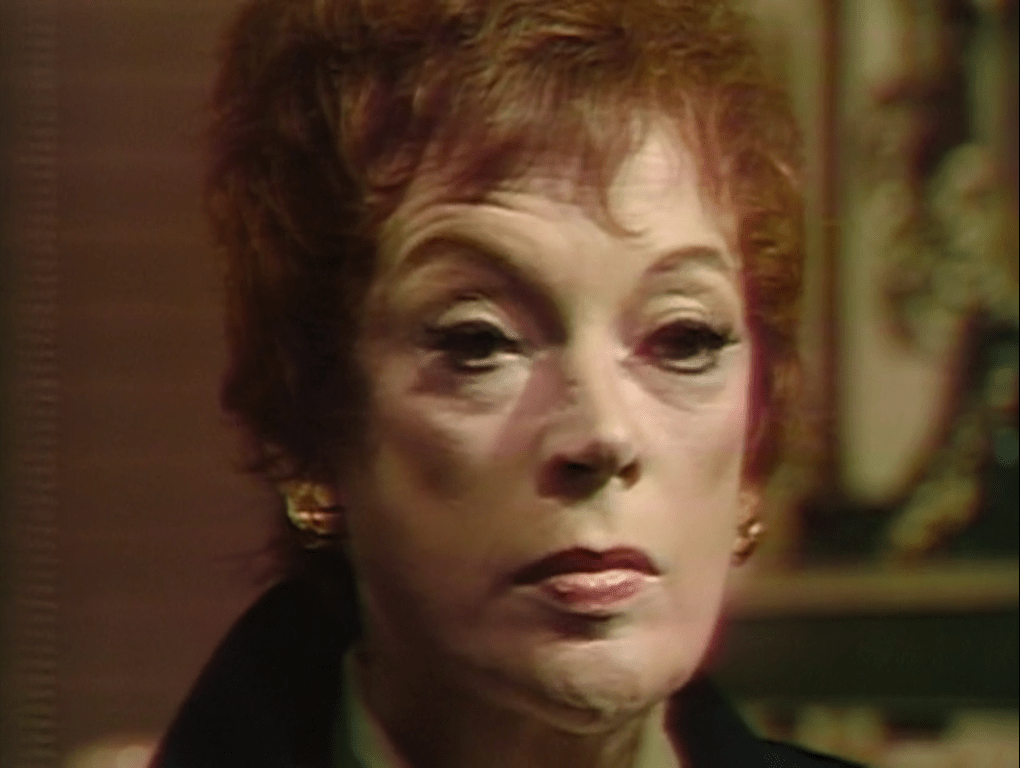
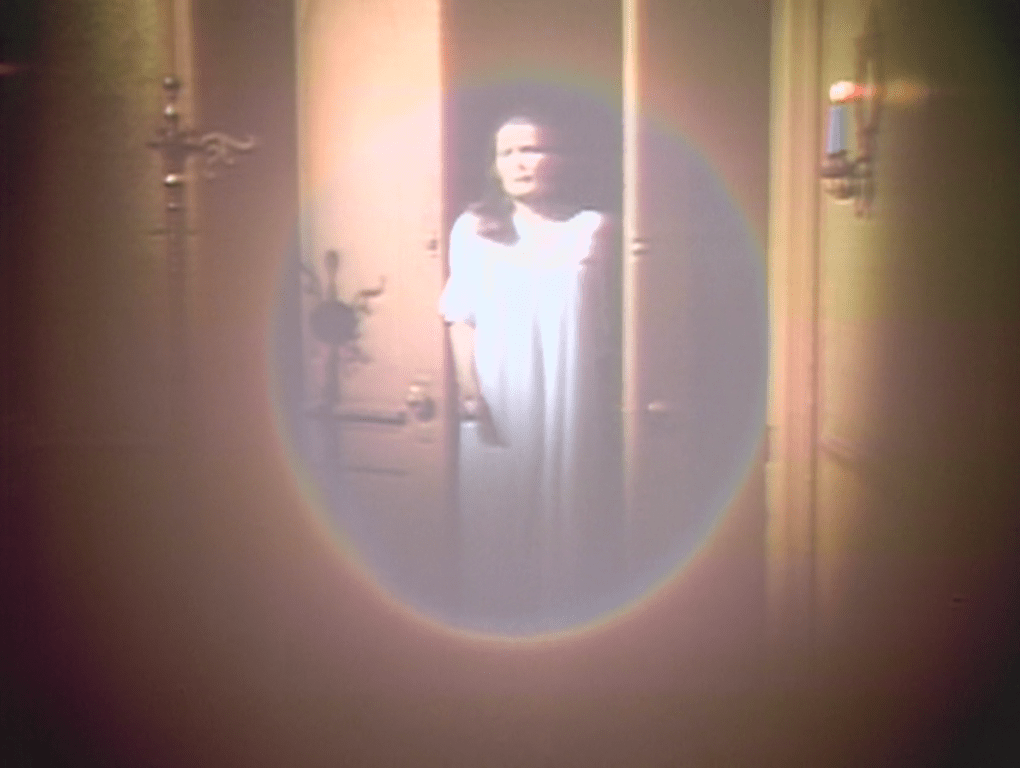
Well-meaning governess Vicki was the main character of Dark Shadows for its first year, but has been receding further and further to the margins since. Today she returns after a 14 day absence, the first time she has been off screen so long.
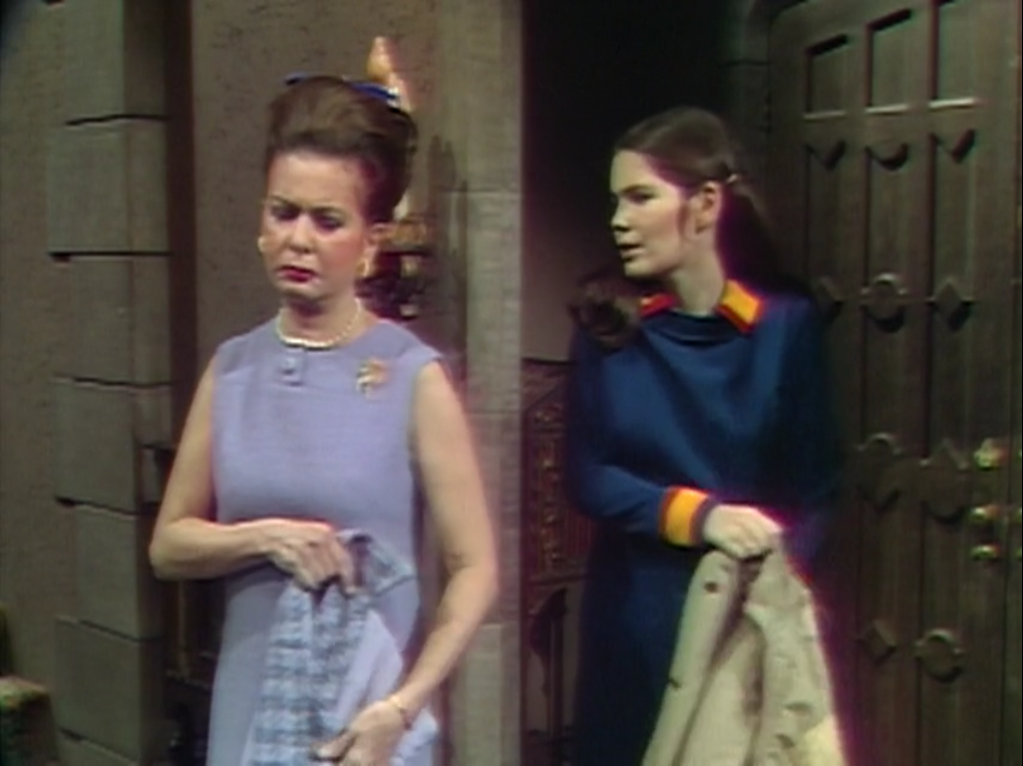
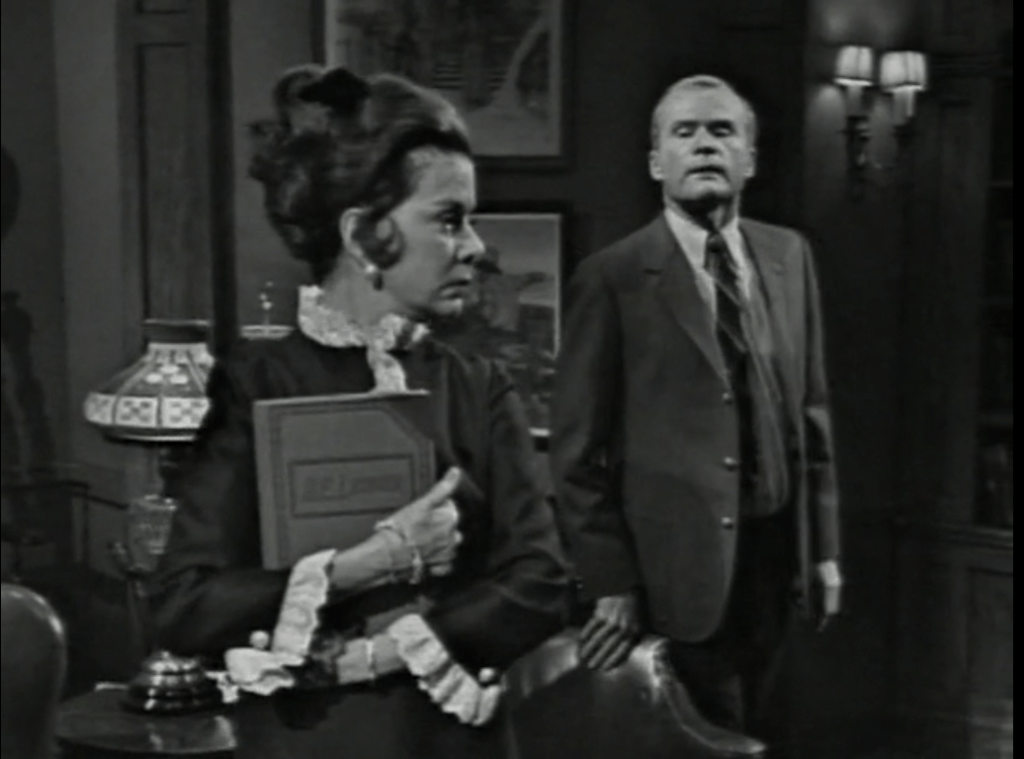
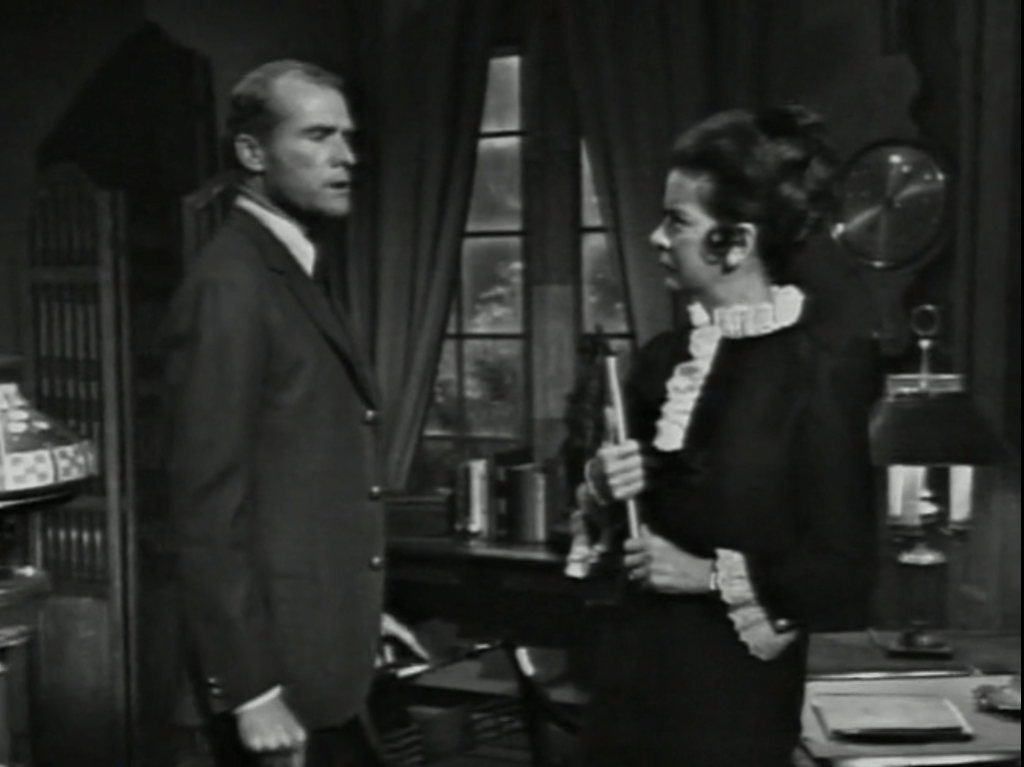
Vicki is in the drawing room of the great house of Collinwood with her employer, matriarch Liz. Liz is distraught because her daughter Carolyn has been abducted by a strange man. Liz fears that Carolyn is dead or dying; Vicki urges her to set those fears aside. The police telephone; they have captured the man, but Carolyn was not with him, and he has not answered any of their questions. Liz and Vicki set out for the gaol to see him.
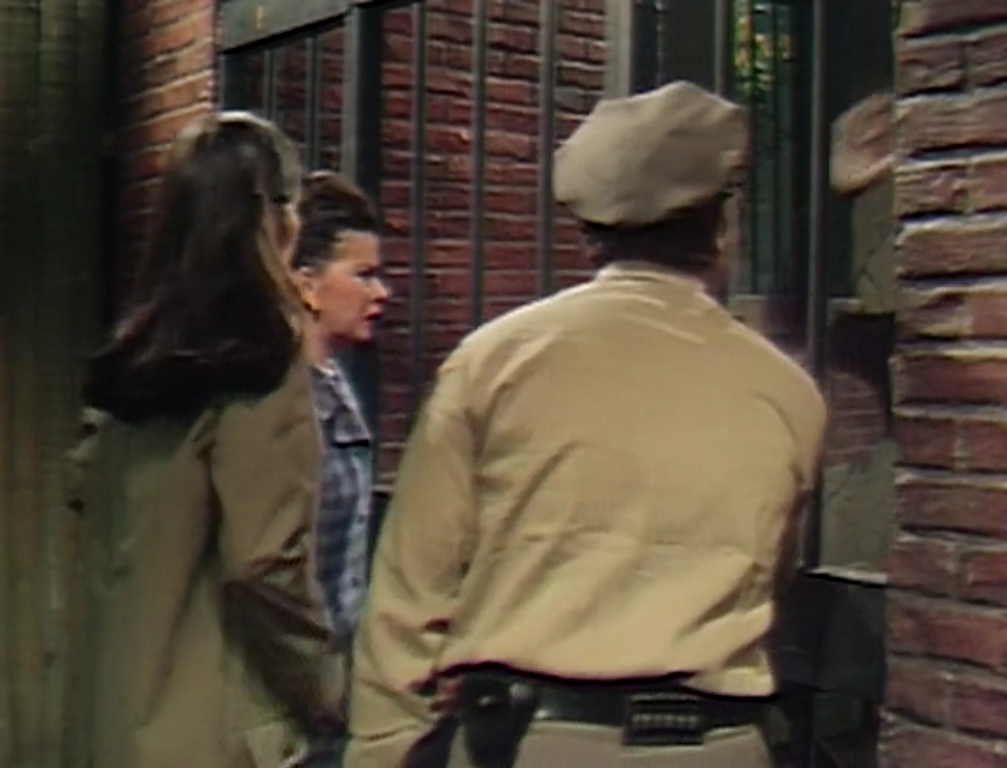
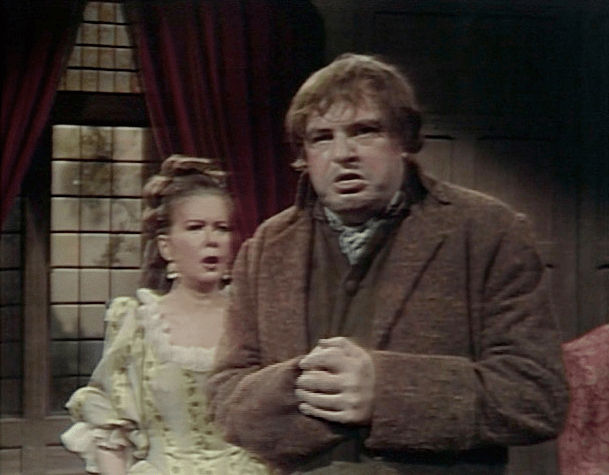
They are accompanied by a sheriff’s deputy. The Collinsport police are exceptionally useless, but even by their standards this deputy is a low performer. Though the man is so strong that it took twenty men to subdue him and bring him in, the deputy enjoys taunting him. He sticks his service revolver in the cell; the man is shackled to the wall, but he is so tall he sweeps his hand into contact with the gun. If the script didn’t say otherwise, he could easily take it from the deputy. Liz orders the deputy to stand back out of the man’s line of sight. Since she owns most of the town, he grudgingly obeys.
The deputy puts his weapon within Adam’s reach.
Yesterday, Liz went looking for Carolyn at the Old House on the estate, home to her distant cousin Barnabas. She found Barnabas’ servant Willie on the ground, suffering from a fresh head wound. Willie told her that the man had been by a few minutes before, and that he had been carrying the unconscious Carolyn. He also referred to the man as “Adam.” When Liz asked him why he used that name, he denied that he did and began jabbering about some bad dream that had frightened him. Today, Liz addresses the man as Adam, and he responds, proving that Willie does in fact know more about him that he will admit.
Liz and Vicki tell Adam that they will treat him as a friend if he tells them where Carolyn is. Adam knows the word “friend.” He repeats it, and adds “food!” Again he says “Friend, food!” The women do not know what he is driving at. They give up and go home.
Returning viewers know that Adam has stashed Carolyn in an abandoned structure that looks exactly like Fred and Wilma Flintstone’s house, that he calls Carolyn “Friend,” and that he had gone out to look for food for her when he was captured. He is dejected when he cannot make it clear that she is hungry.
Liz and Vicki return to Collinwood. They spend several seconds taking off their coats in unison. In the early days of the show, there were a number of scenes designed to emphasize Liz and Vicki’s resemblance and to present each as the other’s reflection in support of a storyline that led us to believe that Vicki was Liz’ unacknowledged daughter. That storyline was forgotten long ago, and it isn’t entirely clear what director Jack Sullivan is getting at here.
Back in the drawing room, Liz tells Vicki her reasons for believing that Barnabas knows a great deal about Adam. Apparently the doors separating the drawing room from the foyer amplify sound, because as the camera takes us from the drawing room to the foyer Liz and Vicki’s conversation only becomes more audible. Liz’ new sister-in-law is in the foyer. This woman calls herself Cassandra, but regular viewers know that she is in fact wicked witch Angelique. Vicki knows that perfectly well. Vicki traveled back in time in #365 and spent nineteen weeks living under the same roof as Angelique while Angelique wrought havoc on the Collins family of the 1790s and framed Vicki for her crimes. Angelique’s only disguise as Cassandra is a black wig- otherwise, she looks, sounds, and moves exactly as she had when Vicki knew her in the eighteenth century. As a result, Vicki is very much on her guard around her.
Angelique/ Cassandra enters the drawing room. Liz excuses herself, and Angelique/ Cassandra demands to know why Vicki doesn’t like her. When Vicki says that she resembles someone she didn’t get along with, Angelique/ Cassandra proclaims that she isn’t that person, bursts into tears, and runs out. Vicki stays in the drawing room, but the camera follows Angelique/ Cassandra to the staircase, where we see her smile gleefully.
Liz returns, and Vicki tells her she may have misjudged Cassandra. It doesn’t speak well of Vicki’s brainpower that a single display of crocodile tears would override the memory of their long and painful acquaintance, but since Barnabas and the others who are doing battle with Angelique/ Cassandra refuse to accept Vicki’s help, she may as well forget everything she knows. Liz tells her that she doesn’t think she misjudged Cassandra, and says she doesn’t trust her either.
Back in the gaol, the idiotic deputy goes back to Adam’s cell to taunt him some more. When Adam protests, the deputy opens the door and waves his baton at him. He places himself within easy reach of Adam, who grabs him and knocks him unconscious.
Yesterday, the high sheriff said “I’m not a stupid man.” He may not have been as stupid as is this grinning imbecile, but it is on his responsibility that he has a badge and a gun.
Another deputy enters. He sees his moronic colleague on the floor, the bars twisted in the window, and no sign of Adam.
Window.
Adam is 6’6″, so it’s difficult to see how he could fit through this opening. Perhaps he is not only tremendously strong, but is also a contortionist.
Sarcastic dandy Roger Collins has remarried. His previous wife, undead blonde witch Laura Murdoch Collins, was Dark Shadows’ first supernatural menace, posing a threat to the life of their son David from #123 until she vanished amid a cloud of smoke in #191. The ghost of gracious lady Josette joined in the battle against Laura. Among other things, Josette compelled artist Sam Evans to paint a series of pictures warning of Laura’s evil plans. Laura responded to those paintings in #145 and #146 by causing a fire that burned Sam’s hands so badly it seemed he might never again be able to paint.
Roger’s new wife is also an undead blonde witch, though she wears a black wig all the time. This wiggéd witch calls herself Cassandra, but is actually Angelique, who in the 1790s killed many of Roger’s ancestors and turned his distant cousin Barnabas into a vampire. Angelique/ Cassandra has returned to the world of the living because Barnabas’ vampirism is now in remission, and she is determined to restore it.
Before he met Angelique/ Cassandra, Roger became obsessed with a portrait of her. Barnabas concludes that this portrait is essential to her power. He orders his servant Willie to steal it from the great house of Collinwood. Barnabas takes the portrait to Sam and commissions him to paint over it so that Angelique will look tremendously old. He doesn’t offer Sam any explanations, but we heard him tell Willie his theory that what happens to the painting will also happen to Angelique. If her likeness is aged to reflect her actual years, then she will vanish from 1968 and be confined to the past. At the end of the episode, Angelique’s hands have aged dramatically, suggesting that Barnabas is correct.
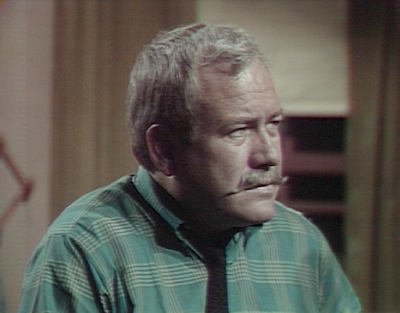
This is David Ford’s first appearance on the show since December, and he had shaved his mustache in the interim. The fake is not up to the makeup department’s usual standards. Screenshot by Dark Shadows Before I Die.
Portraits have been a very prominent part of the visual composition of Dark Shadows from the beginning, and a battlefield on which supernatural combat could be joined for almost as long. So it is hardly surprising that the show would eventually get around to doing a story based on Oscar Wilde’s The Picture of Dorian Gray.
It would seem Barnabas has little time to lose. Angelique/ Cassandra has distributed some malware to the minds of the people around Barnabas by means of a dream that one person after another will have. The first dreamer is beckoned into a Haunted House attraction by someone, opens some doors behind which there are scary images, is terrified, and cannot find relief until telling its details to the beckoner. That person then has the dream, changed in only two particulars, the identity of the beckoner and the image behind the final door. When everyone’s brain has been hacked, this worm is supposed to reset Barnabas as a vampire.
Yesterday, David had the dream, and Willie was his beckoner. Today, we open in Barnabas’ house, where Willie is paralyzed with fear. David has already told him the dream, and Willie knows he will have it. With all the previous instances of the dream, the audience had to sit through a highly repetitious dream sequence, then a scene in which the character agonizes about whether to tell the dream to the next person, and finally a speech repeating all the details of the dream. At least this time we skip the second and third of those rehashings.
Since Willie is so close to Barnabas, it seems likely that he will be the last to have the dream before it gets back to Barnabas and makes him a vampire again. So it’s no wonder that Barnabas decides it’s time for the high-stakes gamble of a burglary at Collinwood.
There’s also a scene in Barnabas’ basement. Barnabas’ vampirism is in remission because some mad scientists created a Frankenstein’s monster, whom Barnabas named Adam. They connected Barnabas to Adam in a way that drains the symptoms of the curse from Barnabas without manifesting them in Adam. Barnabas has no idea how to raise any child, let alone a 6’6″ newborn with the strength of several grown men, and so locks him up in the prison cell where he used to keep Sam’s daughter Maggie.
The imprisonment of Maggie was a dreary, unpleasant story, but Adam’s time in the cell is even harder to take. Maggie was established as a strong, intelligent person who knew her way around, she could speak, and she had many friends who cared about her. So we never quite gave up hope that she would get away and be all right in the end. But Adam has none of that. As a result, his scenes in the basement are a tale of extreme child abuse, made all the harder to watch by Robert Rodan’s affecting portrayal of the big guy’s misery.
Moreover, Maggie was a major character, introduced in the first episode and connected to everyone else. It’s unlikely they would kill her off unless the show had been canceled and they were going out with a bang. But only the people holding Adam prisoner know who he is, and Frankenstein’s monsters meet their deaths practically every time they feature in a story.
Worst of all, the show is basically very silly right now. A story about a child locked in a cell from birth can be made bearable only by joining it to some kind of deep insight into the human condition, and there is little prospect that anything like that will crop up among all the witches and vampires and other Halloween paraphernalia. My wife, Mrs Acilius, watched the whole series with me in 2020-2021. She was avidly rewatching it with me this time. But when they took Adam to the cell, she suggested I start watching it on days when I get home from work before she does. I’m sure she isn’t the only Dark Shadows fan who takes a pass on the Adam story.
This is the first episode credited to director Jack Sullivan. Lela Swift and John Sedwick took turns at the helm until #450, when executive producer Dan Curtis tried his hand at directing a week of episodes. Swift and Sedwick then returned to their usual pattern. Sedwick will be leaving in a few weeks; Sullivan, who has been with the show as an associate director since the third week, will be Swift’s alternate until November, and from #553 on will be credited as Sean Dhu Sullivan.
Naomi Collins (Joan Bennett) has learned that her son Barnabas, whom she knows to be dead, gets out of his coffin at night and kills people. At the end of yesterday’s episode, she saw Barnabas bite his second cousin Millicent on the neck and suck her blood.
The year is 1796, and Naomi has never heard of vampires. She is in a daze about the whole thing. It is clear to her that her husband Joshua has been keeping the truth about Barnabas from her. Though Joshua’s habit of concealment has led to one disaster after another, Naomi accepts that in this case it was his way of expressing love, and she embraces him. She asks Joshua to explain what has happened to their son; he says he doesn’t really understand it, and isn’t sure it would help if he did.
Naomi is hiding bewildered time-traveler Vicki. In the parts of Dark Shadows set in the 1960s, Joan Bennett plays matriarch Liz. The show has been hinting heavily since episode #1 that Vicki is Liz’ unacknowledged daughter. They never make that point explicit. They have no reason to. Liz so completely treats Vicki like a daughter that nothing of any importance would change if the biological relationship were confirmed. Nor would any particularly exciting story possibilities open up if it turned out Vicki were not Liz’ daughter. In the early days of the show, there were a few hints that Vicki might have a doomed romance with Liz’ brother Roger, but they’ve long since made it abundantly clear that no such thing was in the cards,* and nothing else about Vicki would change if she turned out to have a different mother.
Naomi’s attitude to Vicki echoes Liz’ maternal affection. Naomi stood up to the tyrannical Joshua, apparently for the first time ever, to insist that he retain Vicki as governess to their daughter Sarah. She defied Joshua again to testify on Vicki’s behalf during her trial for witchcraft. Now Vicki is a fugitive from justice, escaped from gaol and facing a death sentence, and Naomi insists on harboring her. When Naomi decides that Barnabas’ condition leaves her no choice but to commit suicide, she goes first to Vicki and then to Barnabas, speaking to each in the same motherly tone and giving each the same motherly embrace. Throughout the eighteenth century flashback, the characters have served as mirrors of those played by the same actors in the contemporary segments, and in Naomi’s effective adoption of Vicki we see a clear reflection of Liz.
Naomi’s suicide also harks back to Liz. Naval officer/ sleazy operator Nathan Forbes is using Barnabas’ condition to blackmail the family, and that blackmail is one of the things that pushes Naomi hardest towards self-destruction. From March to July of 1967, Liz was blackmailed by another maritime scalawag, seagoing con man Jason McGuire. In her despondency over what Jason was doing to her, Liz three times had to be kept from throwing herself to her death from the cliff on Widow’s Hill.
Closing Miscellany
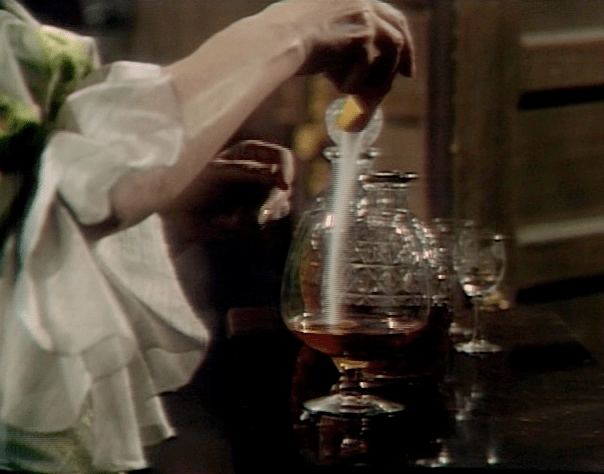
Whatever poison Naomi has decided to take must not be very potent. She pours about a cup of it into her brandy and is still able to stroll over to visit Barnabas and have a long conversation with him before she dies.
What is that, enough salt to cause a life-threatening case of high blood pressure? Screenshot by Dark Shadows Before I Die.
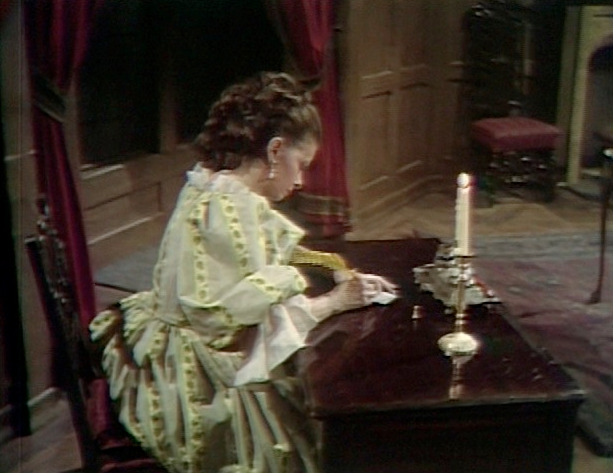
Naomi writes a suicide note and leaves it for Joshua. This raises a question. When did Naomi become literate? When first we saw her, in #366, the show went out of its way to make sure we knew that she could not read even the simplest text, but now she dashes off what appears to be a substantial message in calligraphic script. Naomi has been growing more assertive as time has gone on, but we haven’t seen her learning to read and write, as we saw Barnabas giving much put-upon servant Ben a writing lesson in #375.
When Naomi is taking poison, there is some music that I don’t remember. I’m not sure if it is new, or if we just haven’t heard it played in full for a while. It features some pretty impressive theremin playing.
*Much to the dismay of Vicki/ Roger shippers like Tumblr user WidowsHill, creator of fine artworks such as these:
Images and text by WidowsHill, posted on tumblr 17 March 2024.
This is the first episode of Dark Shadows credited to a director other than Lela Swift or John Sedwick. It is also the first production of any kind directed by Dan Curtis, the series’ creator and executive producer. Curtis’ inexperience shows at several moments when the camera is in an awkward spot or the actors are unsure what to do, and in his post about the episode on Dark Shadows Every Day Danny Horn documents several of the more egregious examples with screenshots and detailed analysis. The impossible deadlines and tiny budget on which Dark Shadows was produced meant that even Swift and Sedwick, who were seasoned professionals and ambitious visual artists, sometimes had to turn in work that wasn’t much better than what first-timer Curtis manages today, and longtime viewers of the show will take even his worst stumbles in stride.
At the top of the episode, it is daytime, and much put-upon servant Ben Stokes (Thayer David) finds the lady of the house, Naomi Collins (Joan Bennett,) standing at an open coffin that holds the corpse of her son, Barnabas. Ben knows that Barnabas is a vampire who will rise at night to prey upon the living. Naomi has never heard of vampires. All she knows is that Barnabas is dead, and that his coffin has been moved from the family mausoleum to a room atop a tower in the mansion. Ben pleads with her to leave the room and to go with him back to the main part of the house.
Naomi questions Ben. Ben tells her that Barnabas has a “sleeping sickness,” and has been in a coma ever since the night he apparently died. Ben does not like to lie to Naomi, but her husband, haughty overlord Joshua, has judged that the truth would kill her, and Ben is governed by that assessment. He does tell her that the “sleeping sickness” is a symptom of a curse, that the wicked witch who placed the curse was Barnabas’ sometime wife Angelique, and that Joshua is in Boston trying to find someone who knows how to lift it.
Ben asks Naomi how she came to be in the tower room. She tells him that naval officer/ sleazy operator Nathan Forbes told her that Barnabas was being kept there, and also that Barnabas was responsible for the series of murders that had recently taken place in the town of Collinsport. At that, Ben vows to kill Nathan. To his chagrin, Naomi forbids him to do this.
In the part of Dark Shadows set between August and December of 1966, Bennett played reclusive matriarch Elizabeth Collins Stoddard and David played her fanatically devoted handyman Matthew Morgan. When well-meaning governess Vicki came unstuck in time and arrived in the late 1790s, she at first mistook Naomi for Liz and Ben for Matthew. This scene takes longtime viewers back to the days when Matthew was always on the lookout for someone who represented a threat to Liz’ interests and she was always sternly prohibiting him from murdering anyone for her sake.
Ben is a far saner man than Matthew ever was; the contrast between them shows the effect that growing up in Collinsport, a town suffering from the consequences of a curse that has been working its way for many generations, has had on Matthew’s personality. While Ben is a brave, kind-hearted fellow whose fierce loyalties sometimes overpower his good sense, Matthew is a paranoid ogre who kills Liz’ friend Bill Malloy and tries to kill Vicki. It isn’t just one family that will be warped by Angelique’s curse. It will breed monsters everywhere the Collinses’ influence prevails.
Naomi then turns her attention to the B-plot. Nathan has married fluttery heiress Millicent Collins, only to find that Millicent has signed her share of the Collins fortune over to her little brother Daniel. Nathan responded to that news by crafting a plot to murder Daniel. His first attempt failed when Noah Gifford, the henchman he hired to abduct Daniel and drown him, fell afoul of Vicki. Vicki found Noah strangling Daniel near the place where she was hiding, having escaped from gaol, and shot him to death. After that, Daniel and Vicki went back to the mansion and told Naomi what they knew. Naomi recognized Daniel’s description of his attacker as a man she had seen with Nathan earlier, and realizes that Nathan is trying to murder the boy. So she orders Ben to take Daniel into town to stay with the Rev’d Mr Bland, a clergyman who looks like a duck.
Naomi confronts Nathan, who keeps telling her that whatever Barnabas might look like during the day, he gets up at night and goes out to murder people. She tries to shut him up, but later she is still wondering whether she should go back to the tower room after dark to check his story out.
She sees Millicent standing in the foyer, staring at the portrait of Barnabas that hangs there. The portrait of Barnabas first appeared under the closing credits in #204, and from #205 on it figured as a means through which Barnabas could communicate with the living. Barnabas bit Millicent the other day, and she hears him summoning her.
Among the 1960s characters who receive their commands from the vampire while staring at the portrait is Liz’ daughter Carolyn, who like Millicent is played by Nancy Barrett. Millicent at times evoked an early version of Carolyn. Until the spring of 1967, Carolyn was tempestuous and irresponsible, sometimes friendly to point-of-view character Vicki, sometimes hostile to her. Millicent is as timid and overly dependent as that version of Carolyn was headstrong and self-centered. One way or another, each is a Spoiled Heiress, and evidently that’s a favorite meal of Barnabas’.
Naomi follows Millicent to the gazebo on the grounds of the estate. There, she sees Barnabas. She is stunned that the son whose corpse she was looking at just a few hours before is up and moving. He bites Millicent, and Naomi lets out a scream. Barnabas looks up, and realizes that his mother has caught him in the act.
The vampire’s bite affects each victim differently. The first victim we saw was Willie Loomis, whom Barnabas’ bite transformed from a dangerously unstable ruffian to a sorely bedraggled blood thrall. Willie was at first gravely ill, then ran to Barnabas like an addict desperate for a fix, and eventually settled into life as a sorrowful servant who could not run away from Barnabas but could resist him to the point where Barnabas occasionally found it necessary to keep him in line with beatings.
The second victim we saw was Maggie Evans, The Nicest Girl in Town. She reacted very much like the first victim in the 1790s segment, gracious lady Josette, who, like Maggie, was played by Kathryn Leigh Scott. At first, those two were alternately blissful and snappish, happy to be under Barnabas’ power and defensive with anyone who might interfere with it. But each recoiled from him by the time it became clear he planned to kill her and make her into a vampire herself. Each escaped from him to the shore below Widow’s Hill- Maggie by running through an underground tunnel that rose to the shoreline, Josette by flinging herself to her death from the top of the cliff.
Later, Barnabas bit Carolyn. She initially contemplated his most gruesome crimes with pure glee and showed great energy as his protector and enforcer. Soon her conscience reappeared, but she was still doing his dirty work faithfully when Vicki disappeared into the past.
Millicent differs from all those others in that she simply continues to go about her business in between Barnabas’ meal-times. Granted, she was already deeply disturbed by that point, so that her business was conducted mostly in show-stopping mad scenes. But it’s still odd that she can talk to Nathan as if their marriage were the main thing in her life.
When we finished watching this one, my wife, Mrs Acilius, wondered if these differences were simply the result of the victims’ personalities coming through or if the vampire can pick and choose how to apply the pressure. He wanted Willie as a slave, and the reaction he produced gave him that. He wanted to turn Maggie into a reincarnation of Josette, and wound up getting the same reaction from Maggie that he had got from Josette. He bit Carolyn in a moment of desperation, with no plan in mind, and her reaction is complicated and volatile. He bit Millicent to keep her quiet, and her reaction is remarkably inconspicuous. Maybe we’re just supposed to think that Barnabas is fabulously lucky, but there is an opening there to tell a story about how him deciding what he wants to do to a person when he sucks their blood.
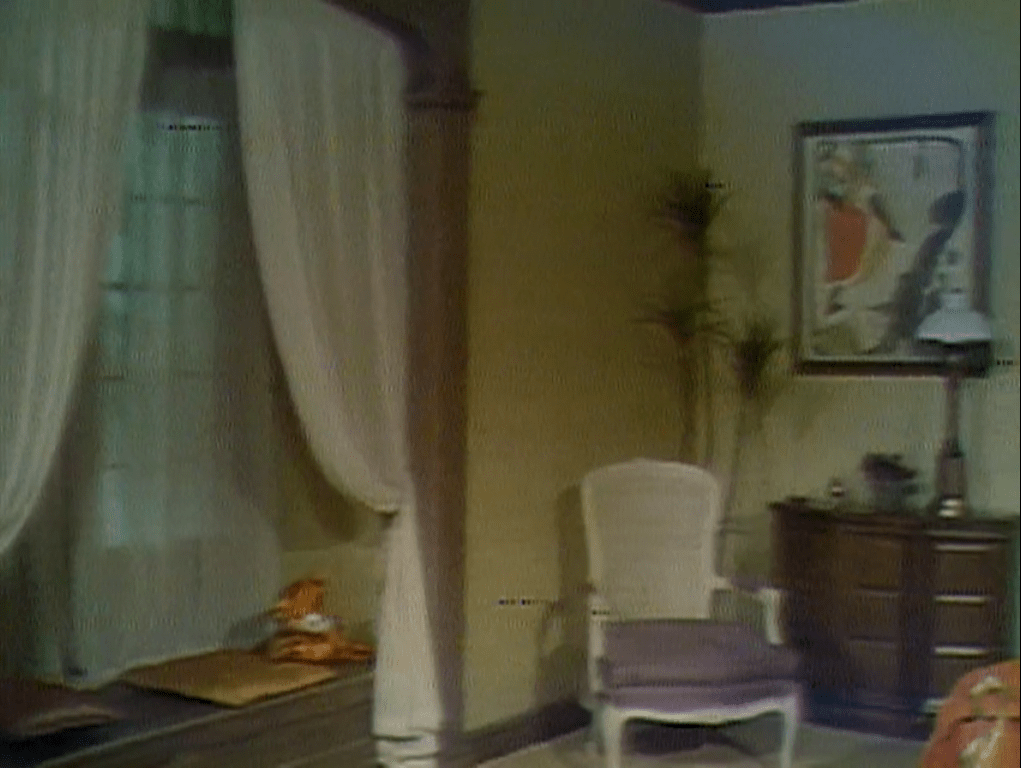
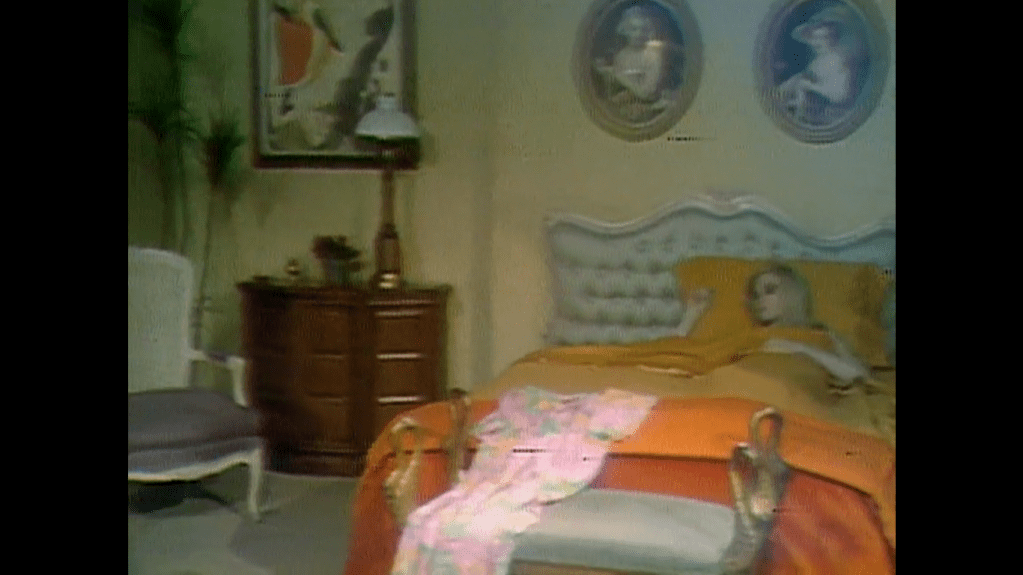
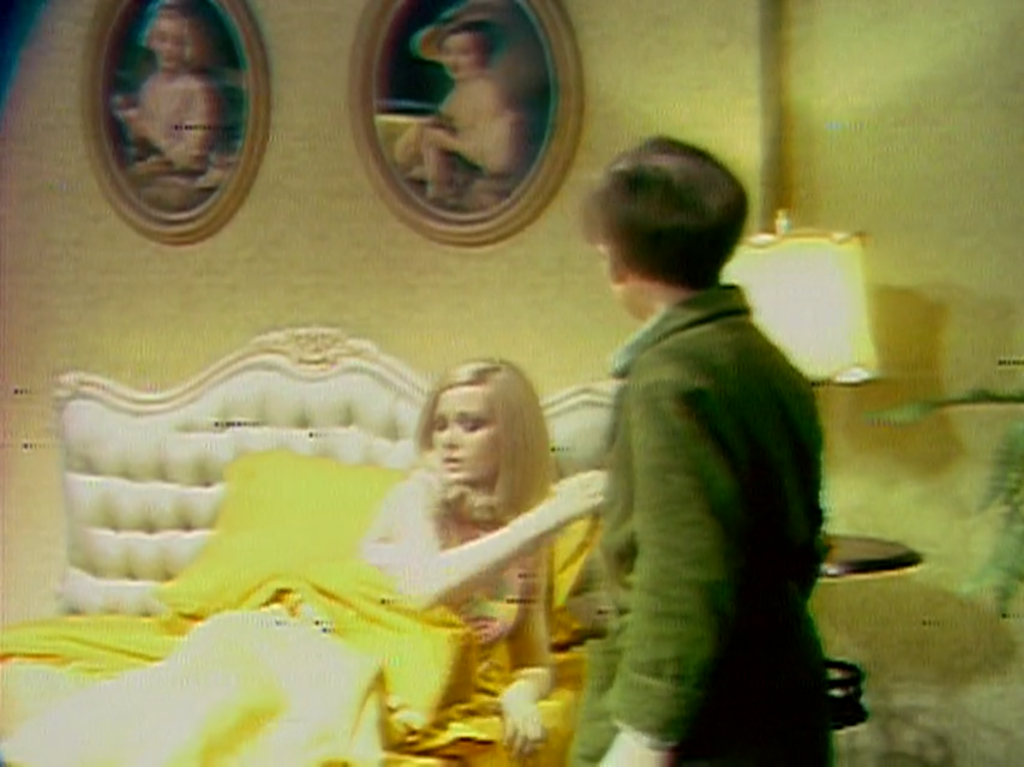
We open on a new set, the bedroom of heiress Carolyn Collins Stoddard in the great house of Collinwood. Dark Shadows has been in color since #295 in August. Though directors Lela Swift and John Sedwick were both ambitious visual artists, they haven’t been able to do much with color so far. With Carolyn’s bedroom, Swift and the staging team have accomplished one of their first real essays in color. It is composed mostly of shades of yellow, pink, and orange.
The color schemes of the other interiors we’ve seen up to this point run the gamut from sedate to subdued to drab to dank, so we already know we are in a unique space. The only other room in Collinwood that might have matched this one for brightness was the kitchen, but we haven’t seen that since #208.
Carolyn’s young cousin, strange and troubled boy David, lets himself into her room. He touches her, and she awakes with a scream. He explains that he just dropped in to make sure she wasn’t dead. When she turns on the light, the screen is so bright that I reflexively squinted, a reaction I’d never before had to an image on Dark Shadows.
Bright room.
David can’t quite explain why he was afraid Carolyn might be dead, but he does insist that she take an antique toy soldier, saying that she will be safe if she keeps it with her. Carolyn’s mother, matriarch Liz, comes into the room to investigate Carolyn’s scream. Liz wonders what David is doing there. Carolyn hastens to say that he was just making sure she was all right.
David goes, and Carolyn tells Liz she doesn’t think anything can be done for him at home. Liz is reluctant to send him away. Regular viewers will not be surprised by this. We know that Liz took David and his father, her ne’er-do-well brother Roger, into Collinwood at the beginning of the summer of 1966 and summoned her unacknowledged daughter, well-meaning governess Vicki, to come look after David starting with #1 on 27 June 1966, so that her conviction that the family ought to look after him got the whole show started. Nonetheless, Liz is so disturbed by David’s unusual statements and depressive affect that she agrees that he needs residential care.
We cut to the Old House on the estate. Vampire Barnabas Collins is sitting in a basement room where mad scientist Julia Hoffman maintains a laboratory. The room is full of electrical equipment, a bit odd since the Old House has no electricity; the laboratory itself is lit by flaming torches. But if we’ve ever seen a Universal Studios production from the 1930s, we know that where you find a mad scientist, you will find electrical currents, so naturally things start buzzing when Julia flips a switch.
Barnabas confined
Julia is trying to implement a medical cure for Barnabas’ vampirism. In the first shot of this scene, we see a visual metaphor for that project. Barnabas, an uncanny being, is confined to a small space in the middle of an elaborate collection of technology. If Julia succeeds, the supernatural will be vanquished altogether and scientific rationality will fill the whole world. The color scheme emphasizes the contrast between Julia’s optimistic goal and the terrain on which she operates. The walls and floor are dominated by the grays and browns of the basement, but the frames and tubing of her equipment are a bright metallic hue, light plays on the glass components, and the intense greens, reds, and blues of the potions are distributed in a slightly unbalanced, lively pattern. The irregular shapes of the frames and tubing emphasize this pattern, and contrast with the solid gray of the floor and the even grid of the brickwork on the walls.
This image not only represents Julia’s plans, but also one of the major themes the show is exploring at this period. Too many characters have encountered too much evidence of supernatural forces and beings for anyone to simply deny that such things exist. But even those who have been most heavily exposed to them keep reverting to a naturalistic frame of reference. Sure, Julia spends all her time hanging around with a vampire and has encountered a couple of ghosts, but she’s determined to ring all of those phenomena around with scientific explanations and technological interventions until they yield to rational control.
Julia’s project has hit its first major setback, as the latest treatment led Barnabas’ hands to age dramatically. He expresses the fear that time will catch up with him, and his apparent age will soon catch up with his actual age, something like 200 years. Julia’s hope that her experiment will not only free Barnabas of his curse, but found a new kind of medicine that will free everyone else of aging and death, will thus be defeated.
Barnabas gives a remarkable little speech about the situation he finds himself in:
I’ve been granted privileges given to few other men… For most men, time moves slowly, so very slowly. They don’t even realize it. But time has revealed itself to me in a very special way. Time is a rushing, howling wind raging past me, withering me in one relentless blast and then continues on. I have been sitting here passively, submissive to its rage, watching its work. Listen. Time, howling, withering.
Writer Joe Caldwell has a fine sense of what actors can do, and this odd little bit of purple prose is right in Jonathan Frid’s wheelhouse. It doesn’t make a whole lot of sense, but the sound of his voice delivering it is so gorgeous it may as well be Shakespeare. Well, maybe not Shakespeare, but Ben Jonson at least.
It is possible to read this speech as a programmatic statement. Daytime soap operas of the 1960s were famously slow-paced; the old joke was that a viewer saw an episode that ended with a character hearing a telephone ring, missed four months of the show, and tuned back in to see the episode that started with the same character saying “Hello.” Even by the standards of the period, the first months of Dark Shadows were notoriously leisurely, with action often as not playing out in real time. When we are watching the 21 episodes centering on Roger’s attempts to find a fountain pen he misplaced, it is indeed the case that “time moves slowly, so very slowly.” But those days are behind us. The show is whipping through plot points at a pace that many prime time series contemporary with it would have had a hard time matching.
If the speech is programmatic, it is also autobiographical on the part of the screenwriter. A fast pace promises excitement for the viewers, but makes life hard for a writing staff that never numbered more than three. Indeed, this is the last episode Joe Caldwell will write for two and a half years. Perhaps he felt the demands of the new pace as “a relentless blast” withering his talents, and had to bow out.
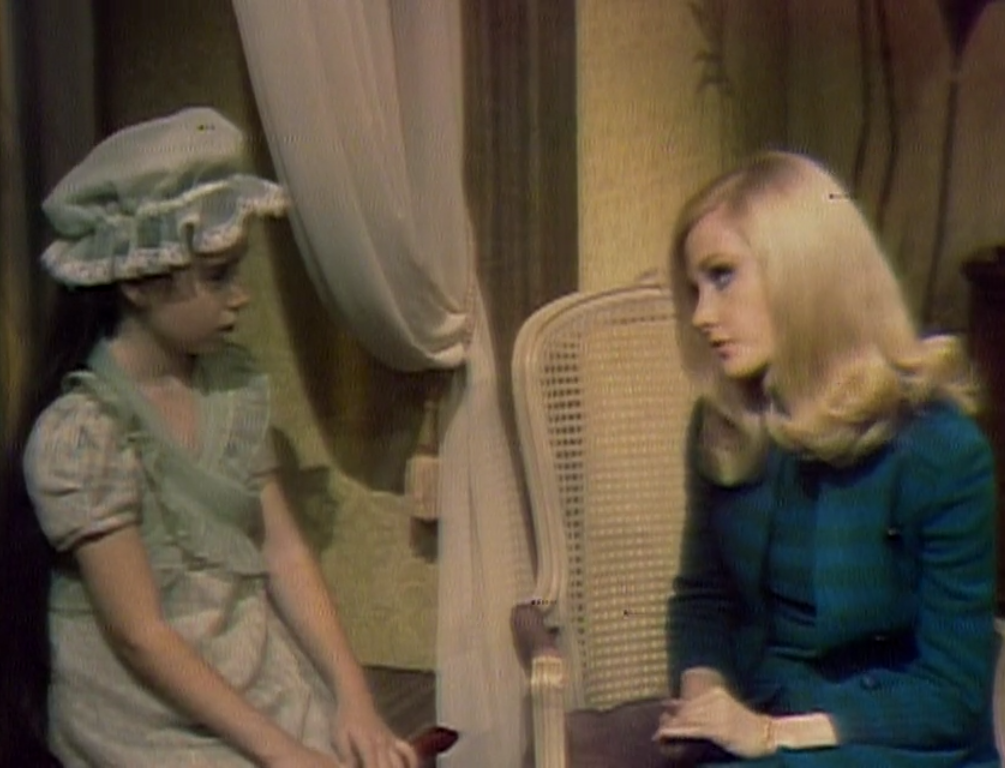
We return to Carolyn’s room. She is in front of her mirror, contemplating the toy soldier. She hears the strains of “London Bridge” playing on a wooden flute, which she has learned is a sign that the ghost of ten year old Sarah Collins is present. Carolyn grew up in this haunted house, so it may not be entirely surprising that her response is to lean back and enjoy the music. But she sits up when Sarah manifests herself in visible form.
Ghost in the mirror
Sarah speaks, and Carolyn sees her reflected in her mirror. The following scene is so extraordinary I’m going to transcribe all of the dialogue:
Sarah: David must have given you that.
Carolyn: Sarah!
Sarah: He told you my name.
Carolyn: Sarah, how did you get in here?
Sarah: Didn’t David tell you?
Carolyn: Tell me what?
Sarah: All about me.
Carolyn: I’m not sure I understand.
Sarah: I think I’m a ghost. Matter of fact, I’m sure I am.
Giving the facts
This is the first time Sarah has described herself in any terms, certainly the first time she has called herself a ghost. Her coyness about herself had left David confused about what she was; it was not until #325 that he finally concluded that she was a ghost. After that, she became more forthright with him. When he wasn’t sure what she was, she would wait until she was out of his line of sight to appear and disappear. But in #327, she fades away while he’s looking right at her.
Coming out to David not only allowed Sarah to relax around him, but has led her to discard her coyness altogether. She is startlingly blunt with Carolyn as this conversation goes on:
Carolyn: B-but- I don’t believe in-
Sarah: Yes you do. Or I wouldn’t have been able to come here. You’re not afraid of me, are you?
Carolyn: No…
Sarah: If you are, I understand.
This is the first confirmation that Sarah can appear only to those who are prepared to believe in her. It’s true that most of the people who have seen and heard her- David; Maggie Evans, The Nicest Girl in Town; Maggie’s father Sam; Vicki; Barnabas; Julia; Barnabas’ sometime blood thrall Willie; and local physician Dave Woodard- have either had extensive contact with the supernatural or had reasoned their way to the conclusion that she existed. But she also showed herself to Maggie’s nurse at the mental hospital Julia runs, and we don’t know anything about her background or beliefs. And local man Burke Devlin heard Sarah when she and David were talking in #327. While Burke has had plenty of contact with supernatural beings and in the early days of Dark Shadows, when he was fun, was willing to believe in them, he was at that point tearing around bellowing that there were no such things as ghosts. So this is new and unexpected information.
Carolyn’s denial that Sarah frightens her is given in a trembling voice that shows it to be a lie. Still, she isn’t as frightened as she might be. The other day, in #344, Carolyn was in David’s room when Sarah manifested there, not in the visible form of a little girl, but as the sound of “London Bridge” and as information appearing in David’s mind about Burke’s imminent death. Carolyn was terrified of Sarah when she came that way.
Carolyn: Well, what do you want?
Sarah: Don’t send David away.
Carolyn: How do you know about that?
Sarah: I don’t know, I just do.
At this point, we see Carolyn’s fear fading. She is starting to react to Sarah as if she really were a ten year old girl.
Carolyn urging Sarah to be reasonable.
Carolyn: But Sarah, we have to send David away. It’s the only way we can help him.
Sarah: But if you send David away, I won’t have anyone to play with.
Carolyn: Well, maybe it isn’t good for David to play with you.
Sarah: Why do you say that?
Carolyn: Because it leads him into believing all sorts of things that aren’t true.
Sarah: How do you know they’re not true?
Carolyn: Well, they’re just not, they couldn’t be.
Sarah: He wasn’t lying about me, was he?
Carolyn: No.
Sarah: Well.. then maybe David is acting the way he is because no one will believe him.
Carolyn: But… it isn’t possible.
Sarah: People say I’m not possible, but I am. Why doesn’t that make the rest possible?
Carolyn: Sarah, maybe you don’t know the stories David’s been telling!
Sarah: Why do you think that?
Carolyn: Because they’re too fantastic! And besides, they’ve all been proved false.
Sarah: How do you know they’ve been proved false?
Carolyn: Sarah, are you trying to tell me that Barnabas actually slee-
This exchange is the ultimate example of a character accepting the existence of a particular supernatural being and then snapping back into a frame of reference that does not allow for supernatural beings. Carolyn knows that Sarah is a ghost, and starts arguing with her about how fantastic the world is permitted to be.
There comes a knock at the door. Carolyn turns away from Sarah to look at the door, and when she looks back, Sarah has vanished. Regular viewers know that Sarah was Barnabas’ little sister, that she wants to keep him from doing horrible things to people she likes, but that she will not say anything against him. So when Carolyn says Barnabas’ name, we know that Sarah is about to vanish.
Sarah’s part is an outstanding example of writing to an actor’s abilities, even more so than was Barnabas’ speech. Caldwell knew that Jonathan Frid had a flair for making flowery gibberish appealing, because that is what he has been doing the whole time he’s been on Dark Shadows. What Sharon Smyth has been doing well as Sarah is being a cutie pie and creating a vague and mysterious impression. When she has more than a few lines to deliver, things tend to get very wobbly. Today, she has to maintain a commanding tone and an adult demeanor throughout an extended patch of rapid-fire dialogue. Absolutely nothing we have seen on screen would suggest that she could handle that. But she pulls it off, more than competently. There are a few glances at the teleprompter, but at no point does she break out of the patient and authoritative manner she has to adopt. It is an impressive job of acting by any standard.
The person at Carolyn’s door is Liz. Liz is Dark Shadows‘ queen of denial. Viewers who have been with the show from the beginning have seen a few cracks in her facade of disbelief in the supernatural. In #10, she dozed off in the drawing room and started talking in her sleep about ghosts. When Vicki insisted to her in #127 that she had seen a ghost, Liz said she believed her. And in #280 and #281, Liz reluctantly agreed to participate in a séance, and afterward agreed that Vicki had been possessed by a spirit. But even in those moments Liz was fighting to keep the topic of ghosts at bay, and the rest of the time she has presented a blank wall to any attempt to face facts about the strange goings-on. So it is not surprising that Carolyn tells her mother she was talking to herself while tidying up her room.
Having talked Liz into sending David away, she now has to talk her back out of it. She manages to get her to agree to wait a few days. “London Bridge” plays. Carolyn reacts to it, Liz does not.
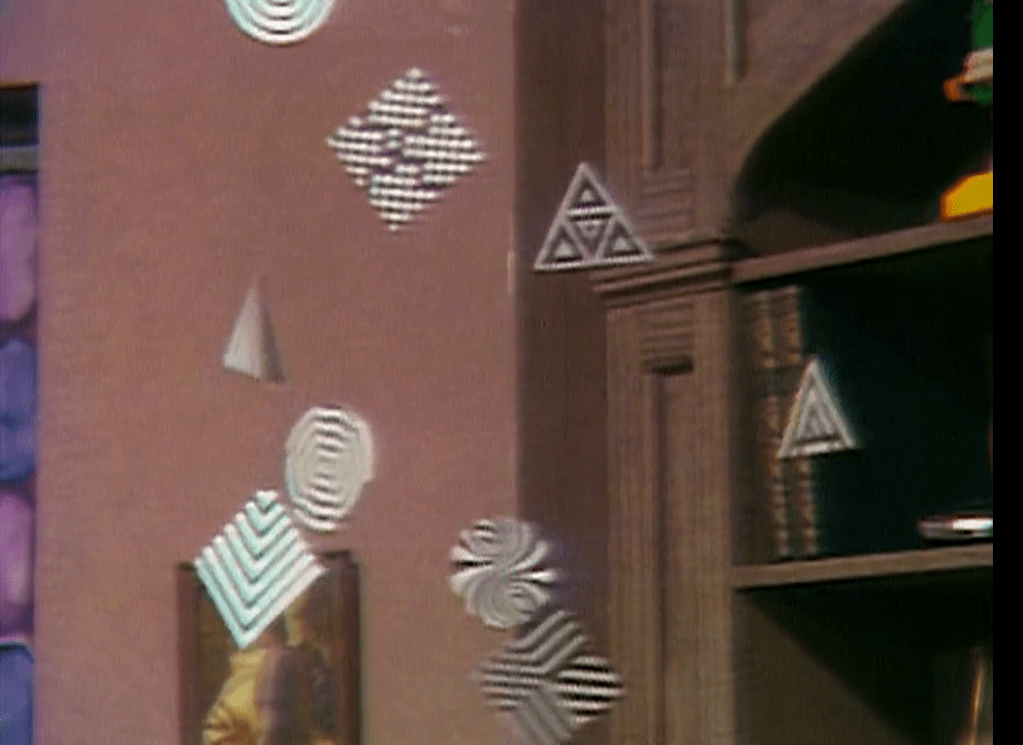
In his room, a distraught David is looking at a mobile. Its whimsical black and white markings suggest a puzzle and make a stark contrast with the vivid colors around them.*
Puzzling shapes.Back to the wall.
Carolyn comes in. She brings the toy soldier and tells David she doesn’t think she will need it. He insists that she will, but she explains that Sarah visited her and now she believes him and knows how to help him. David is horrified by this. He says that Sarah visited Dr Woodard, that Woodard believed him, and that led to his death. He begs Carolyn not to believe him and claims to have been lying. He sobs and clutches her.
Anguished embrace.
Back in the Old House, Julia prepares to give Barnabas another treatment. He snaps at her. She tells him that whatever happens, she wants him to know that she always wished him well. That prompts him to unload a further stream of sour remarks about her competence and intentions. Julia carries out the treatments, only to find that the aged appearance of Barnabas’ hands has spread to his head.
In his post about this episode on Dark Shadows Every Day, Danny Horn puts it well when he says that “This is just good soap opera construction. People that we care about, facing terrible danger, and desperate to help each other.” He’s referring specifically to the scenes between David and Carolyn and Liz, but it applies to everyone. We care not only about the good people in the great house (well, they’ve been relatively good, lately,) but also about Barnabas and Julia, evil people who are the terrible danger David and Carolyn and Liz are facing, but who make the show fun to watch. We care about Sarah too, and she’s desperately trying to accomplish exactly the result we most want to see, an outcome in which David, Barnabas, and everyone else we enjoy watching stays on the show.
*Evidently this mobile was a commercially produced item. One of the commenters on Danny Horn’s Dark Shadows Every Dayreports having had one like it as a child.
Carolyn Collins Stoddard is moping at the bar in the Blue Whale tavern. Bob the Bartender tells her she’s had enough to drink and suggests she go home. Ignoring the suggestion, she plays a Tijuana Brass-style number on the jukebox, then stands in the middle of the floor as if she were about to dance.
Bob is the second person to try to throw Carolyn out of a place today. In the opening, seagoing con man Jason McGuire caught her going through his things in search of a clue as to what he is using to blackmail her mother, matriarch Liz, into marrying him. He told her that after the wedding this evening, he will expect her to move out of what will then be his house.
Carolyn is the only customer in the Blue Whale until her ex-boyfriend, hardworking young fisherman Joe, comes in. She tells Joe she is waiting for her fiancé, motorcycle enthusiast Buzz. The last time we saw Buzz, in #262, he seemed to be losing all patience with Carolyn, and he never does show up at the tavern. It’s starting to seem as if Carolyn will soon find herself with absolutely nowhere to go.
When Joe tells her that she can’t fight McGuire, Carolyn seems to get an idea. She says that maybe she won’t marry Buzz after all. When Joe insists on driving her home, she agrees, with a flourish. We then see her back in the mansion, taking a pistol from a drawer and putting it in her purse.
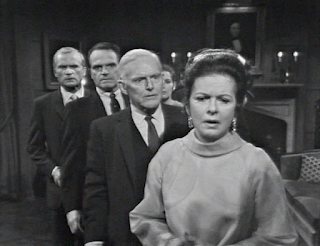
The wedding is to take place in the drawing room of the mansion. When the judge asks Liz if she will take Jason to be her lawful wedded husband, she declares that she cannot. In a beautiful piece of choreography, four actors fall into place behind her so smoothly that it looks natural for people to line up and look at each other’s backs while talking. Director Lela Swift deserves a lot of credit for finding a perfectly logical way to get people into this perfectly absurd position.
As the guests are absorbing Liz’ statement that she cannot marry Jason, she points at him and declares “I killed Paul Stoddard, and that man was my accomplice.”
Closing Miscellany
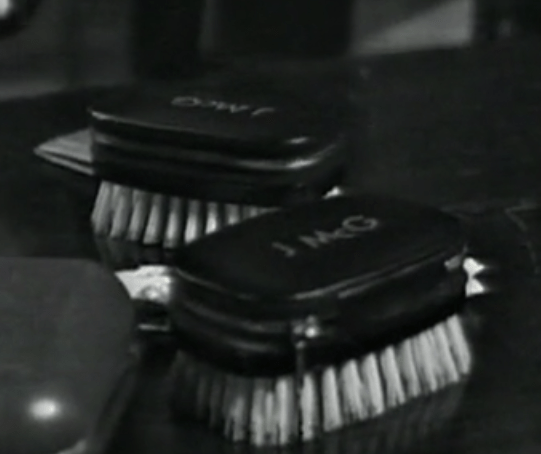
We see Jason’s initials on some shoe-brushes in his room.
Jason’s shoe brushes
We’ve seen Bob the Bartender mouthing words in the background in many of the 36 episodes he has appeared in so far, but his refusal to serve Carolyn is only the fourth time he has spoken on camera, after #3, #156, and #186.
Maggie Evans, The Nicest Girl in Town, suffered from an ailment her doctor, Dave Woodard M. D., could not identify. She then vanished from her hospital room in a manner law enforcement, led by Sheriff George Patterson, could not explain. The opening voiceover says that Maggie’s troubles “mystify the finest minds.” This is the first and last time either Woodard or Patterson is classed with “the finest minds” even among the low-functioning characters who abound in the period when Dark Shadows is being written by Ron Sproat and Malcolm Marmorstein. Well-meaning governess Vicki is still the single smartest character on the show, and she turns into an absolute moron every two or three days.
In the opening teaser, dashing action hero Burke Devlin asks Dr Woodard if his studies of Maggie’s blood samples will help find her. He says that they won’t, but that if he can diagnose her he might be able to help her after she is found. Burke asks if he is about to make a diagnosis. He says that he might be making progress towards that goal. At that point, there is a dramatic musical sting, and we cut to the credits. That’s the hook, a statement that further study is needed.
Dr Woodard tells Burke that he has contacted “Hoffman, one of the best men in the field,” and that he hopes Hoffman will be able to get things moving. Under Burke’s questioning, he admits that he is pessimistic that Hoffman will see anything he has missed. This is the first mention of the name “Hoffman” on Dark Shadows. I believe it is only the second mention* of any surname that is not derived from Irish (as are such names as Collins, Devlin, Malloy, and McGuire,) English (as are names such as Woodard, Patterson, Loomis, Johnson, Stockbridge, and Garner,) Welsh (as are names such as Evans and Morgan,) Scottish (as are the names Adair and Murdoch,) or French (as are the names La Freniere, Bilodeau, and du Près.)** It is certainly the first name we have heard that suggests there might be Jewish people in the universe of Dark Shadows.
We then cut to the study in great house of Collinwood, where high-born ne’er-do-well Roger Collins has to confront his sister, reclusive matriarch Liz. The auditors have told Roger that the books are out of balance at the family business. Roger knows that the reason for this is that Liz is giving money to buy the silence of seagoing con man Jason McGuire. He reminds Liz that he himself was afraid of blackmail for the first 40 weeks of the show, so he knows from personal experience that it is no way to live. Liz refuses Roger’s plea that she tell him her secret. As he probes and she resists, they move around the room at times like fencers, at times like dancers performing a paso doble. Their movements are easily the most interesting element of the episode, a credit to director John Sedwick.
Roger’s first approach to the shielded LizLiz parries Roger’s thrustRoger’s second approach
Roger admits that he hasn’t been much help to Liz over the years, but begs her to let him help her now. Liz won’t tell him anything, but she is touched to see her bratty brother sincerely trying to step up.
Liz goes to the drawing room. The camera is behind her as she approaches the room. Jason is standing at the fireplace under the large portrait, the spot furthest from the camera. Not only does he look as small as possible, but at the moment we first see him he is turned away from us, his head tilted far back as he takes a drink. Jason’s smallness and obscurity, coming so soon after Roger’s speech about the dreariness of blackmail, feels like an acknowledgment that Jason doesn’t have much to offer the audience.***
Coming upon Jason
Liz tells Jason she can’t give him any more money without blowing the secret they share. He amazes her by accepting this information calmly, but she is sure he is not done tormenting her.
Liz returns to the study, where Roger is still sitting. She tells him that she has talked to the auditor and straightened out the books. That sounds like something that would take quite a while, even if you are sitting across from each other, and Liz and the auditor had to do it over the telephone. So how long has Roger been sitting there?
Then we rejoin Burke and Woodard in the doctor’s office, which someone has ransacked. The perpetrator wrenched the metal bars out of the window and stole Maggie’s blood samples. Dr Woodard says that the only way the bars could have been twisted was by someone with the “supernatural strength of madness.” I’m not an expert in mental health, but that does not sound like a conventional psychiatric opinion to me.
*After Lieutenant Costa of the Arizona State Police, whom we saw when Dark Shadows took us to Phoenix in #174.
**It is pretty weird that a show set in Maine has so few French-surnamed characters. We’ve only heard of one working-class Mainer with a French name, Amos Bilodeau. La Freniere was given in #45 as the maiden name of Josette, a grand lady who came from France to marry into the Collins family in a previous century; eventually, Josette’s birth name will be retconned to du Près.
***My wife, Mrs Acilius, was the one who really noticed the visual strategy both in Liz and Roger’s first scene in the study and in Liz’ entry into the drawing room.
In 281 of the posts that follow, I link to comments I made on Danny Horn’s blog, “Dark Shadows Every Day.”
Not all of these comments were absolutely unique. Several times I brought up the contribution Lela Swift made to Dark Shadows. Swift directed 595 of the show’s 1225 episodes, including the first and last installments, and she also served as line producer of the last 127 episodes. Only series creator and executive producer Dan Curtis could be said to have had more impact on Dark Shadows than did Swift, and very few people could be said to have had as much.
Danny’s background, like mine, is in literary study. I know I have a tendency to overemphasize the writer’s contribution to a dramatic work at the expense of the director and other visual artists, and I think he does too. Many of my remarks about Swift reflected my conscious effort to overcome this bias of mine, and incidentally involved my disagreeing with him.
Here’s a comment I made about episode 299. In the original post, Danny argued that the writers must by that point have intended to present mad scientist Dr Julia Hoffman as suffering from unrequited love for vampire Barnabas Collins. Some posters in the comment thread pointed out the visual similarity between the scene from which Danny draws his evidence and a scene in The Sound of Music in which a love triangle is developed. I tried to make the point that these similarities are more to do with elements under the control of the director than of the writers. So, while there is a reason to think that there was an intention to tell that story, we can’t be sure exactly whose intention that was:
THE SOUND OF MUSIC was such a big hit, so fresh in people’s minds in 1967, and the way the actors are positioned on this new set looks so much like it that I can’t believe the resonance wasn’t intentional. I don’t know if that means that the Barnabas/ Vicki/ Julia love triangle was already intentional at this point on the part of the writers, but it is strong evidence that it was on the part of director Lela Swift.
In a comment on episode 1116, I say that the new burst of energy that many in the comment threads had found at the beginning of the segment of the show set in the year 1840 came just as Swift was made producer, and suggest that she may deserve credit for it.
In a comment on episode 1166, I rebut one of her detractors:
“If Lela had been the executive producer, Dark Shadows would have been off the air after the first 13 weeks.” Perhaps so. But without her as the principal director, it’s doubtful there would have been a single episode anyone would have remembered. The endlessly ambitious visual compositions and the hyper-intense acting style originated with her, and she had as much as anyone to do with the fact that there was always an episode in the can ready to go on the air at 4 PM five days a week.
In a comment on episode 1244, I compare Swift to the only other director on Dark Shadows in its dying days, the woefully inept Henry Kaplan:
This episode and the one before also show that, even though television is famously Not A Director’s Medium, a director can have great importance from time to time. Episode 1243 was really rather good, and that is entirely to the credit of Lela Swift. The pacing is rapid, the visual composition tells as much of the story as we could want it to do, and she elicits good performances from all the actors, even Keith Prentice.
In this one, Henry Kaplan keeps moving the actors around in tight little spaces, with the result that they have to shuffle from one set of marks to another. Even worse, he indulges himself in a series of dissolves, each of which would probably have looked cluttered and been distracting under the best of circumstances, but with the camera faults in this episode it’s as if the TV screen is at the bottom of a pond. Poor Keith Prentice, finally doing a good job of acting for a second consecutive episode, winds up looking like the world’s biggest idiot when a closeup of him laughing in wicked triumph dissolves to a shot of the cobwebbed room.