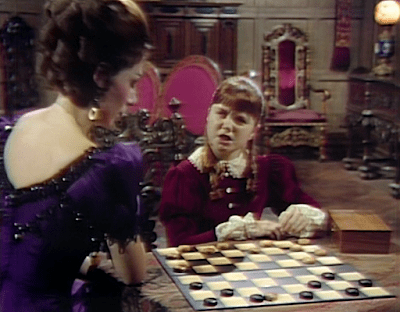
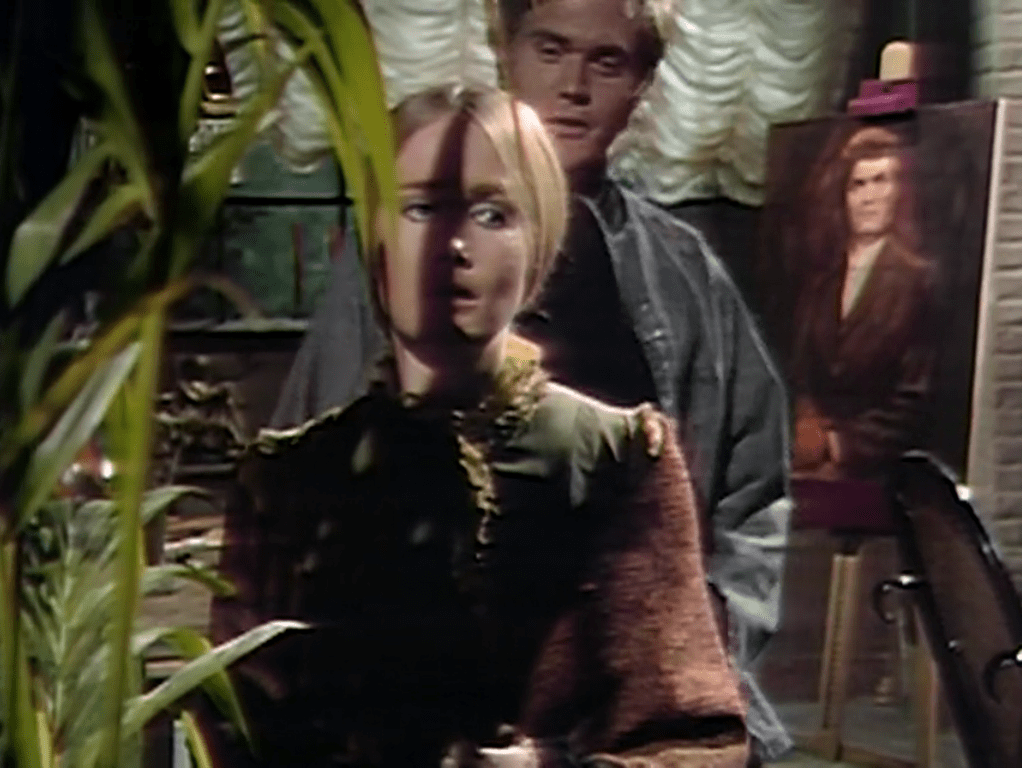
Nine year old Nora Collins enters the drawing room of the great house of Collinwood. She walks in on her father, the stuffy but lovable Edward, embracing Kitty Soames, the dowager countess of Hampshire. She gives them a dirty look and says she supposes Edward is too busy to join her in a game of checkers. He says he does have to run an errand, but suggests that Nora play with Kitty.
Kitty is eager to ingratiate herself with Nora, who clearly wants nothing to do with her. Nora asks, in an icy voice, if the reason Kitty wants to be her friend is that she is planning to marry her father. Returning viewers suspect she is right. Kitty and Edward have more in common than they know. Both are penniless, each is sure the other is very rich, and each imagines marriage to the other will solve all their problems. Kitty can’t very well level with Nora about this, so she claims that the women in the Collins family, being outnumbered by the men, have to stick together. Nora does not hide her distaste at Kitty’s inclusion of herself among the women of the family. Kitty asks Nora if she wants her father to be happy. Nora drills her eyes into Kitty’s face and says in a firm, flat voice “I want that.”
Nora asks Kitty if she is just letting her win at checkers. While she is asking this, Nora moves twice in one turn and takes three of Kitty’s pieces. Kitty watches this without protest and denies that she is letting her win. She then says she wants to concede the game and listen to whatever information Nora is willing to share about the family.
Edward comes back from his errand to find Nora packing up the checkers and the board. He asks if she enjoyed her game with Kitty. Not looking up, Nora says they never finished it. Kitty hastens back in and asks if she wants to finish it now. Edward points out that it is getting close to Nora’s bedtime. He kisses her, and bids her say goodnight to Lady Hampshire. Kitty asks Nora to call her by her first name. Nora pointedly says “Good night, Lady Hampshire.”
It doesn’t show in her scenes with Nora, but Kitty seems to be suffering from a severe mental health crisis. Returning viewers know that the ghost of Josette Collins is taking possession of her, and suspect that she will turn out to be a reincarnation of Josette. Edward knows enough about the supernatural doings on the estate of Collinwood that he might give Kitty the benefit of the doubt when, for example, she comes running in today and is shrieking about a haunted house, a vanishing woman, and a curse that follows her everywhere. But she is so often so highly distraught that Nora must have noticed that she is not right in the head, and she can hardly look forward to having such a person as a stepmother.
Shortly before Nora enters, Edward calls Kitty “Katie.” This is a small enough slip of the tongue, but Kathryn Leigh Scott’s friends call her Katie, so it is a case of an actor’s name in place of the character’s. I think I can see Louis Edmonds blush a little when he realizes what he has done.
This episode marks the final appearance of Nora, and very nearly the last time we will hear Nora’s name. I think she was badly underused, disappointingly so after the outstanding work Denise Nickerson did as Amy Jennings in the months leading up to the segment set in 1897. She will be back later, in other parts.
Director Henry Kaplan was not much of a visual artist, and his deficiencies are particularly glaring today. Especially during Kitty and Nora’s first scene, the camera keeps drifting up to the actors until we see a randomly selected two-thirds of their faces in extreme closeup. Once the shot excludes the eyes or the mouth, it abruptly pulls back. Even the successfully framed closeups are rarely in focus, and you can forget about finding coherent visual storytelling in any kind of shot other than a closeup. The actors themselves do a good job, in spite of Kaplan’s notoriously unpleasant behavior towards them, but aside from a few evocative facial expressions, most of them by Nickerson, it may as well have been a radio play.
The disastrously repressed Charity Trask knows that rakish libertine Quentin Collins is a werewolf, and she wants to warn everyone about him without actually saying the facts out loud. She corners maidservant Beth Chavez in the drawing room of the great house at Collinwood and urges Beth to end her romance with Quentin.
Charity keeps saying that there is something about Quentin that Beth does not know. In fact, Beth not only knows everything Charity does about Quentin’s curse, but a great deal more. She was the very first person to know that Quentin was a werewolf, before Quentin himself knew. She was with him the first time he transformed, and when he became human again in the morning she refused to tell him what she had seen. She had previously seen Quentin murder his wife Jenny, she knows that Jenny’s sister Magda placed the curse as vengeance for that murder, and she was the one who told Magda that Jenny had borne children to Quentin who would inherit their father’s curse. Beth is the foremost authority on Quentin’s condition. But she is protecting him anyway.
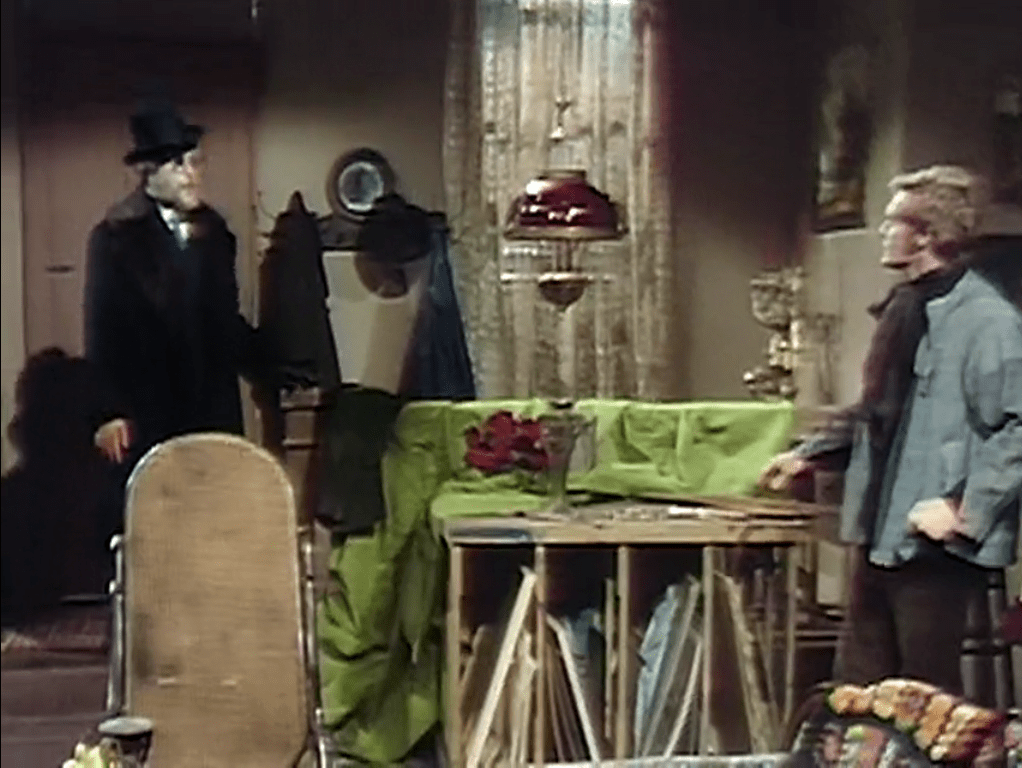
Charity then goes to a set known to longtime viewers as the Evans cottage. In the parts of Dark Shadows set between 1966 and 1968, this set is home to artist Sam Evans and his daughter Maggie, The Nicest Girl in Town. Today the dramatic date is 1897, but the cottage is already an artist’s studio. It is occupied by Charles Delaware Tate, a nationally renowned painter who was commanded by the evil sorcerer Count Petofi to execute Quentin’s portrait. When we first saw Tate in the cottage, he said that he rented it because he’d heard about it from a friend who had stayed there some time before.
The cottage is full of paintings and sculptures. This is odd for a rental. Several possible explanations come to mind. Did Tate bring a dozen or more of his own works to keep him company? Did his friend or other artists who had rented it leave their completed pieces behind? Did the landlords display their own collection there for the edification of their tenants? Easy as these explanations are to think of, none of them seems very likely, and the question is never addressed in the show. The out-of-universe explanation is of course that when the audience looks at an artist’s studio, it expects to see a lot of artwork, and the artwork here gives director Lela Swift a chance to make good use of color.
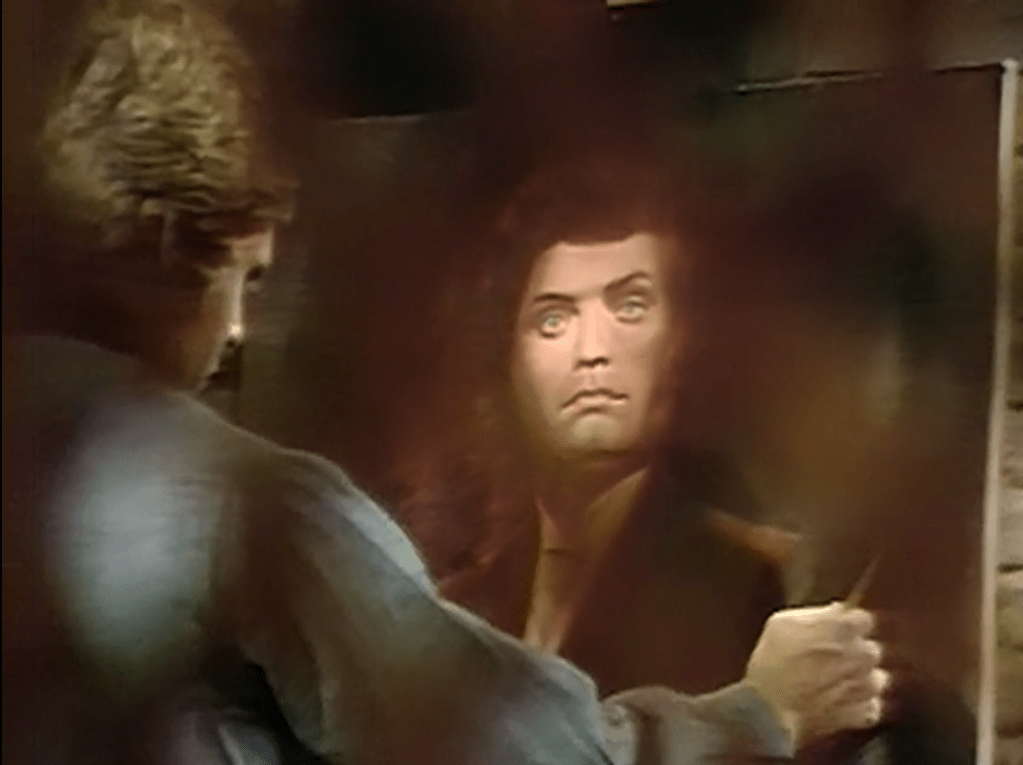
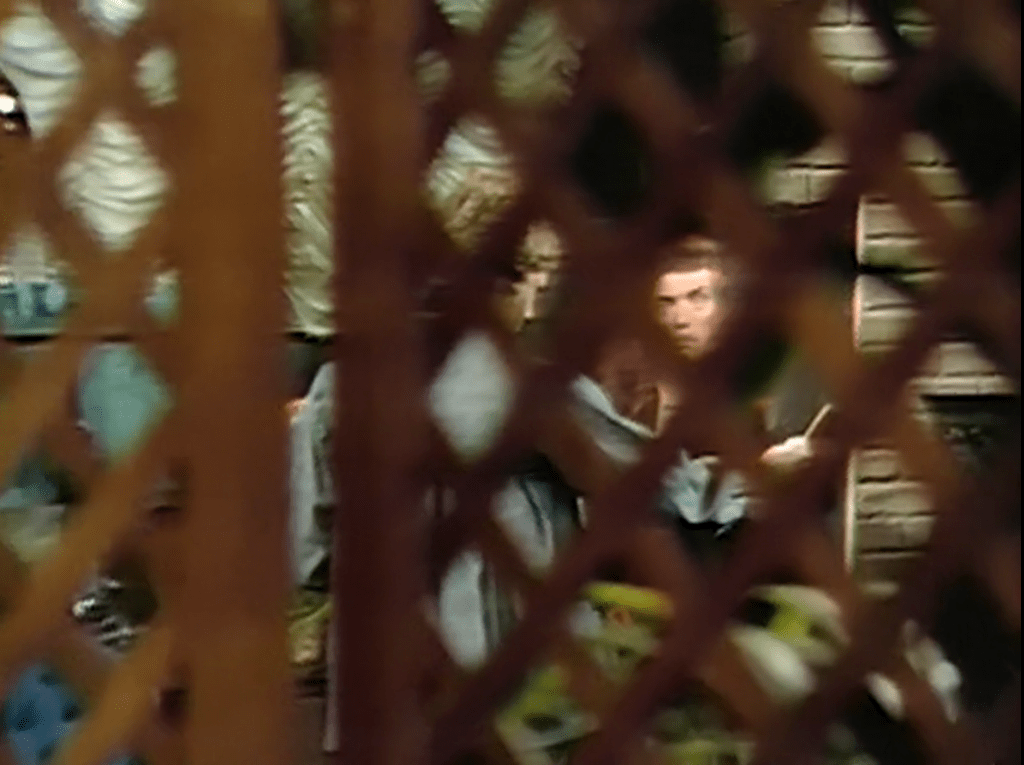
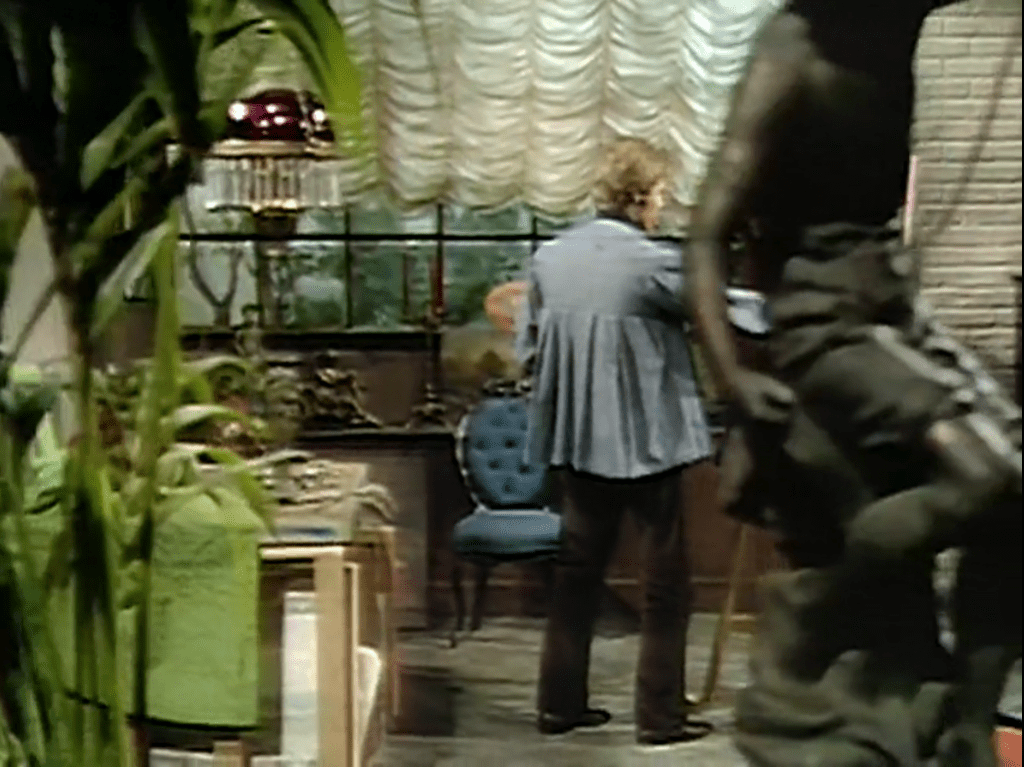
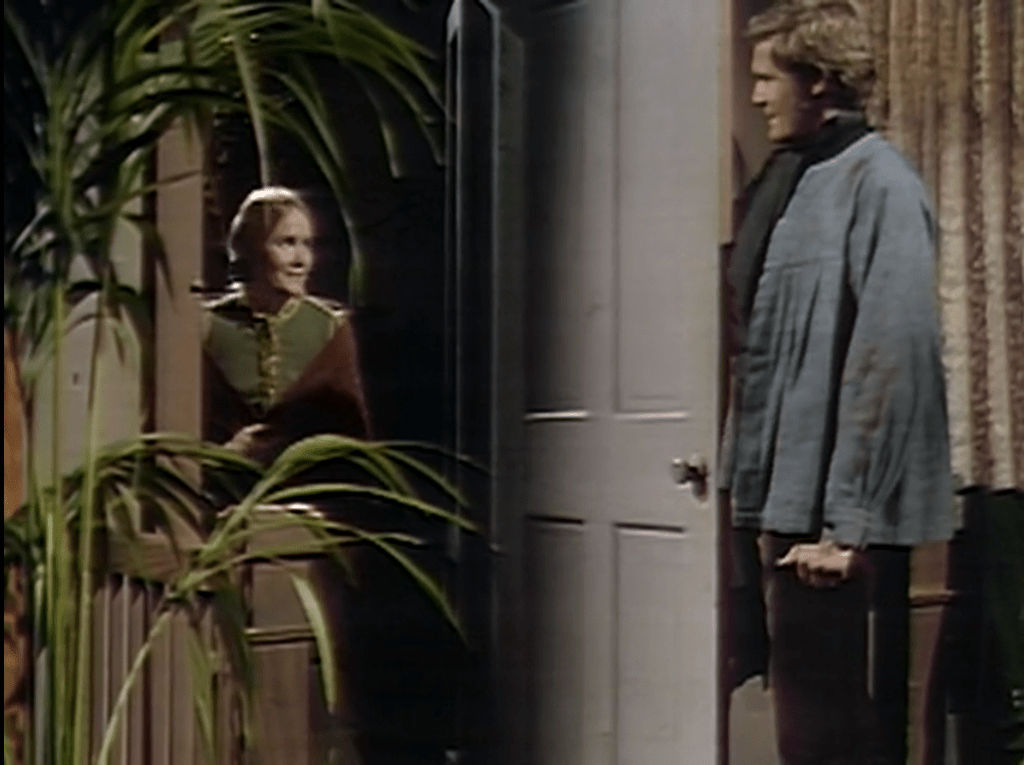
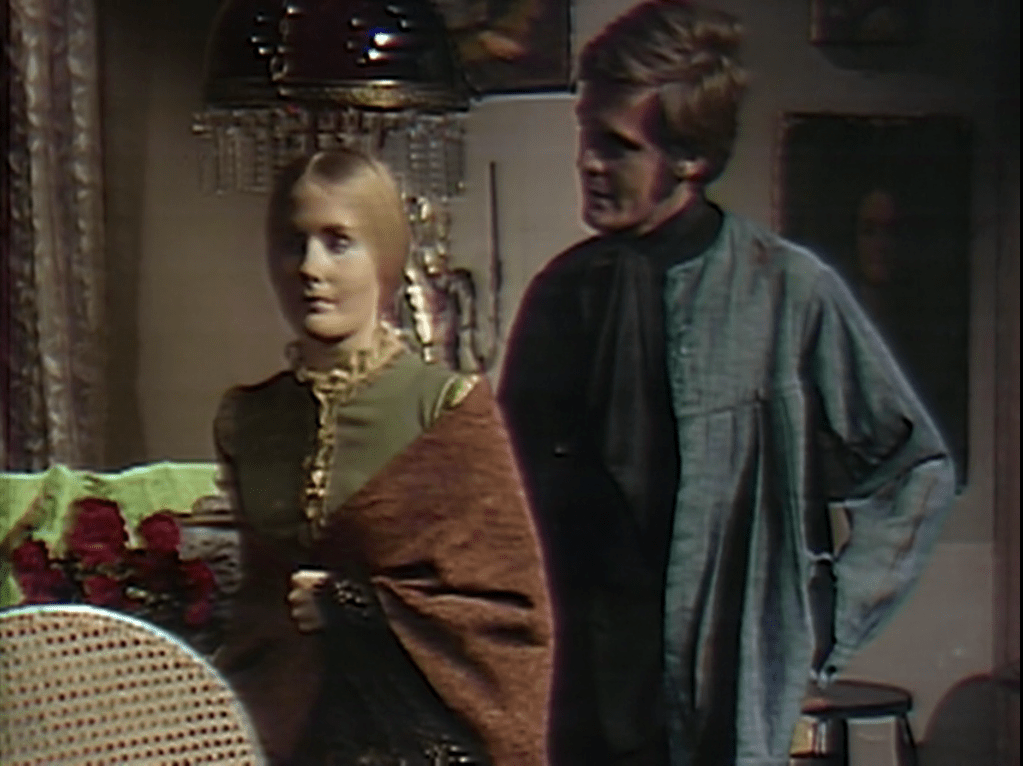
At any rate, the set is gorgeous today, full of bright greens and mixed reds. Swift was a highly ambitious visual artist, and she outdoes herself here. The first shot in the cottage begins with a closeup of the portrait of Quentin. It then pulls back further than any previous shot of this very familiar set, showing us a lattice that used to be part of the set representing the kitchen/ breakfast nook area at Collinwood. Behind it is a plant with some large, intensely green foliage. We then track around the set to see several sculpted pieces in black, paintings in a variety of tones, and a whole array of vivid colors in the furniture and other decorations. Dark Shadows has come a long way from the clumsiness that marked its use of color when it first switched from black and white in #295.
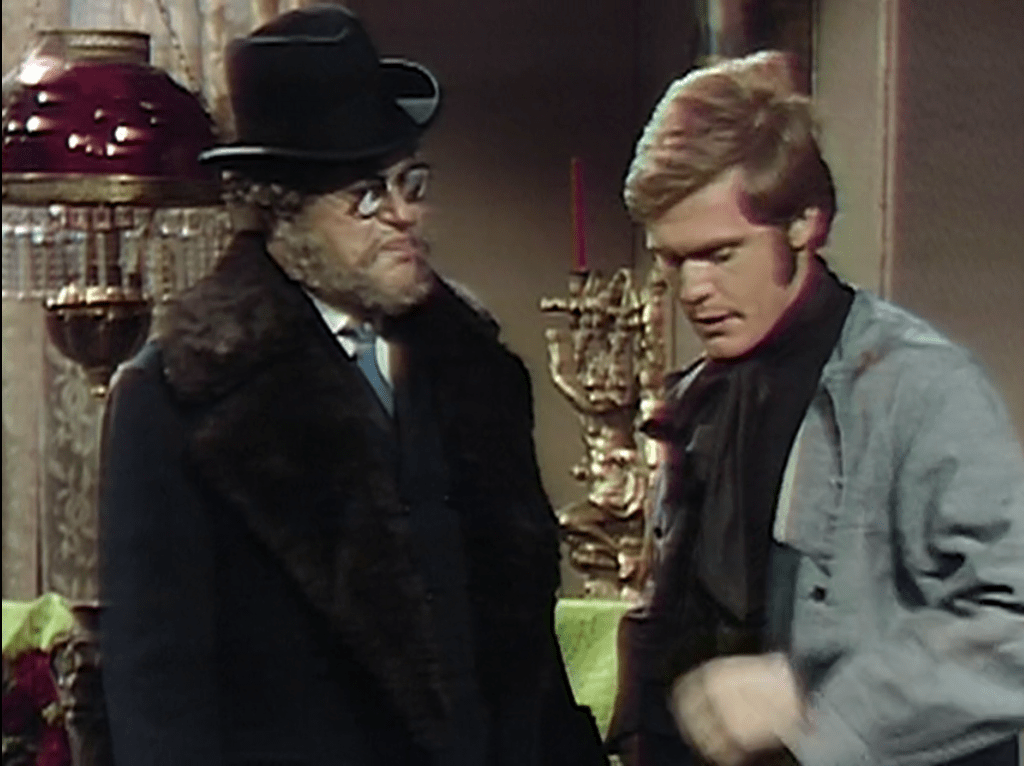
Charity is unaware that she and Tate are not alone. Tate’s master, Petofi, is in the next room eavesdropping. Charity is horrified to see the portrait of Quentin, and reminds Tate that she saw Quentin’s features in the portrait change into those of a wolf when she visited the cottage on the night of a full Moon. Tate tries to convince her she did not really see such a thing, but she will not have it. Charity gives Tate a warning somewhat less incoherent than the one she had given Beth. After she exits, Petofi and Tate talk. Tate had suspected Quentin was a werewolf, and now is sure. Petofi says that his plans for Quentin are none of Tate’s concern.
Petofi goes to the great house. Quentin confronts him there, demanding to know by what gods he swears. He replies “I have but one, and his name is Petofi!” Charity sees Petofi and vehemently demands he leave. I don’t know why she does this. As far as I can recall, Charity knows Petofi only as Victor Fenn-Gibbon, an honored guest of the Collins family. He did cast rather a nasty spell on her when he was using that alias, but I don’t see why she would realize that he was to blame for it, or for any of his other misdeeds.
Whatever the motive for Charity’s angry reaction to him, Petofi responds by magically robbing her of the power of speech. When he tells her that he has a healing touch, his manner and the background music indicate that after he touches her, what Charity will say will never again be up to her.
We begin the part of Dark Shadows set in the year 1897 with an episode featuring a glittering script, a strong cast, and a hopeless director. Henry Kaplan’s visual style consisted of little more than one closeup after another. The first real scene in the episode introduces us to Sandor and Magda Rákóczi, a Romani couple who live in the Old House on the estate of Collinwood. They bicker while Sandor throws knives at the wall. Thayer David really is throwing knives, but since we cut between closeups of the targets and of the actors we cannot see anything dynamic in that action. He may as well be whittling.
Magda ridicules Sandor’s pretensions as a knife-thrower and as a patent medicine salesman, and busies herself with a crystal ball. She tells him that when “the old lady” dies, they will have to leave Collinwood. He says he knows all about that. She wants him to steal the Collins family jewels so that they can leave with great riches. He eventually caves in and sets out for the great house on the estate, more to escape her nagging than out of greed.
Regular viewers will remember that we heard Magda’s name in December 1968. The show had introduced two storylines, one about the malevolent ghost of Quentin Collins and the other about werewolf Chris Jennings, and the characters were starting to notice the strange goings-on that Quentin and Chris generated. The adults in the great house had no idea that Quentin was haunting them or that Chris was a werewolf, so they held a séance in #642. Speaking through heiress Carolyn Collins Stoddard, Magda mentioned “My curse!” and said that “He must not come back!” It was clear in the context of the episode that the “He” who “must not come back” was Quentin. Chris was a participant in the séance, and he broke the circle before Magda could explain what she meant by her “curse.” Séances held in #170 and #281 were cut short by the person whose secret the medium was about to expose; that it is Chris who interrupts this one would suggest to longtime viewers that Magda not only knew Quentin, but that the curse she is about to explain was the one that made Chris a werewolf. Carolyn and her uncle Roger Collins talked a little about Magda in #643, and psychic investigator Janet Findley sensed the ghostly presence of a woman whose name started with an “M” in #648. We haven’t heard about Magda since.
As the living Magda, Grayson Hall manages rather a more natural accent than Nancy Barrett had when channeling her concerns about “my currrrrssssse.” The exaggerated costumes Hall and Thayer David wear make sense when we hear them reminiscing about the old days, when they made their livings as stage Gypsies with a knife-throwing act, Tarot card readings, and a magic elixir. Even the fact that Magda is peering into a crystal ball during this scene is understandable when they make it clear that they are staying in the Old House as guests of the mistress of the great house, an old, dying lady who enjoys their broadly stereotypical antics. But there is no way to reconcile twenty-first century sensibilities to Hall and David’s brownface makeup. Some time later, Hall would claim that one of her grandmothers was Romani. If that was a lie, it is telling that only someone as phenomenally sophisticated as Hall could in the 1970s see that she would need to invent a story to excuse playing such a character.
Objectionable as Sandor and Magda are, their dialogue is so well-written and so well delivered that we want to like them. Moreover, the year 1897 points to another reason fans of Dark Shadows might be happy enough to see Romani or Sinti characters that they will overlook the racist aspects of their portrayal. It was in 1897 that Bram Stoker’s Dracula was published, and it depicted the evil Count as surrounded by “Gypsy” thralls. The character who has brought us on this journey into the past is Barnabas Collins, and upon his arrival he found that he was once more a vampire.
In addition to the strengths of the dialogue, the acting, and the intertext, there is also a weakness in this episode that softens the blow of the brownface. Today the picture is so muddy that it is possible to overlook the makeup. That’s Kaplan’s fault. It would often be the case that one or the other of the cameras wasn’t up to standard, but when the director was a visual artist as capable as Lela Swift or John Sedwick, there would always be at least some shots in a scene using the good camera, and others where the lighting would alleviate some of the consequences of the technical difficulties. But Kaplan doesn’t seem to have cared at all. He had made up his mind to use a particular camera to shoot the Old House parlor with a subdued lighting scheme, and if that camera was not picking up the full range of color, too bad. He’d photograph a lot of sludge and call it a day.
Meanwhile, a man knocks on the door of the great house. He is Quentin, and the person who opens the door is Beth Chavez. We first saw these two as ghosts in #646. Beth spoke some lines during the “Haunting of Collinwood” story, but Quentin’s voice was heard only in his menacing laugh.
We already know Quentin as the evil spirit who drove everyone from the house and is killing strange and troubled boy David Collins in February of 1969. His behavior in this scene is no less abominable than we might there by have come to expect. He pushes past Beth to force his way into the foyer, does not bother to deny that he has come back to persuade his dying grandmother to leave him her money, pretends to have forgotten someone named “Jenny,” makes Beth feel uncomfortable by saying that her association with Jenny makes her position in the house precarious, orders Beth to carry his bags, twists her arm, and leeringly tells her that she would be much happier if she would just submit to his charms. David Selby sells the scene, and we believe that Quentin is a villain who must be stopped. But Mr Selby himself is so charming, and the dialogue in which he makes his unforgivable declarations is so witty, that we don’t want him to go away. He establishes himself at once as The Man You Love to Hate.
In an upstairs bedroom, the aged Edith Collins is looking at Tarot cards. Quentin makes his way to her; she expresses her vigorous disapproval of him. She says that “When Jamison brought me the letter, I said to myself ‘He is the same. Quentin is using the child to get back.'” Quentin replies “But you let me come back.” She says that she did, and admits that he makes her feel young. With that, Edith identifies herself with the audience’s point of view.
The reference to Jamison and a letter reminds regular viewers of #643, when Magda’s ghost caused a letter from Quentin to fall into Roger’s hands. It was addressed to Roger’s father, Jamison, and was written in 1887. It read “Dear Jamison, You must return to Collinwood. I need your help. You must intercede with Oscar. Only you can save me.” They’ve revised the flimsies quite a bit since then; now it is 1897, Jamison is 12, and we don’t hear about anyone named Oscar.
Not about any character named Oscar, anyway. Edith tells Quentin that “Men who live as you do will not age well.” Quentin tells Edith that she ought not to believe in the Tarot, because “This card always has the same picture and people change, even I.” On Dark Shadows, which from its beginning has taken place on sets dominated by portraits, these two lines might make us wonder what it would be like if it were portraits that changed while their subjects remained the same. Oscar Wilde’s Picture of Dorian Gray was published in serial form in 1890 and as a novel in 1891, and it was a sensation on both sides of the Atlantic. The dialogue is so witty that the characters must be well-read, making it quite plausible that Quentin’s remark was meant to remind Edith of the book. Especially so, since Wilde was released from prison in 1897, bringing him back to public notice in that year.
Edith tells Quentin that old and sick as she may be, she can still out-think him. She declares that all of her grandchildren will get what they deserve. All, that is, except Edward. Roger mentioned Edward in #697, naming him as his grandfather and Jamison’s father. Edith says that Edward is the eldest, and therefore she must tell him “the secret.” There is a note of horror in her voice as she says this; Quentin misses that note, and reflexively urges her to tell him the secret. She only shakes her head- the secret isn’t a prize to contend for, it is a burden to lament.
Isabella Hoopes plays this scene lying on her side in bed, a challenging position for any performer. Her delivery is a bit stilted at the beginning, but after she makes eye contact with David Selby she warms up and becomes very natural. I wonder if the initial awkwardness had to do with Kaplan. He held a conductor’s baton while directing, and he used to poke actresses with it. I can’t imagine a person in bed wearing a nightgown would have an easy time relaxing if her attention was focused on him. Once she can connect with Mr Selby, though, you can see what an outstanding professional she was.
Quentin goes to the drawing room, and finds Sandor behind the curtains. He threatens to call the police, and Sandor slinks back to the Old House. Magda berates him for his failure to steal the jewels, and he insists there are no jewels in the great house.
Meanwhile, Barnabas is in his coffin, trying to will someone to come and release him. In #210, dangerously unstable ruffian Willie Loomis had become obsessed with Barnabas’ portrait in the foyer of the great house, so much so that he could hear Barnabas’ heart beating through it. Barnabas called Willie to come to the secret chamber in the old Collins family mausoleum where his coffin was hidden. In his conscious mind, Willie thought he was going to steal a fortune in jewels. His face distorted with the gleeful expectation of that bonanza, he broke the chains that bound the coffin shut, and Barnabas’ hand darted out, choking him and pulling him down.
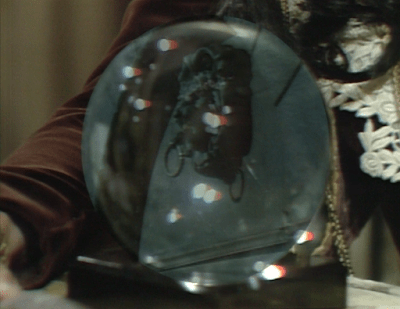
In the Old House, an image suddenly appears in the crystal ball. We can see it, the first time they have actually projected an image in such a ball since the first one made its debut in #48.
Magda notices the image, and tells Sandor to look. He recognizes the old mausoleum. She says that the jewels must be in “the room,” implying that they already know about the hidden panel and the secret chamber behind it. Sandor says it is absurd to imagine Edith going to and from the mausoleum to retrieve pieces of her jewelry collection. Magda ignores this, and urges him to go there. He reluctantly agrees to go with her.
The two of them are heading for the door when they hear a knock. It is Beth, come to say that Edith wants to see Magda. Edith wants what she always wants- to be told that Edward will return before she dies. Sandor says Magda can’t go, but Beth says she will regret it for the rest of her life if she does not. Magda tells Sandor to go on his way without her, and says that she will bring Edith some ancient Gypsy cards, cards older than the Tarot. When she talks about Romani lore, Magda taunts Beth- “but you wouldn’t know anything about that, would you?” Her sarcastic tone implies that Beth has tried to conceal her own Romani heritage.
Sandor opens the secret panel and looks at the chained coffin. He tells himself the jewels can’t be hidden there, then decides he may as well open it anyway- if he doesn’t, Magda will just send him back. Longtime viewers remembering the frenzy in which Willie opened the coffin in #210 will be struck by the utterly lackadaisical attitude with which Sandor performs the same task. Men’s lust for riches may release the vampire, but so too may their annoyance with the wife when she won’t stop carping on the same old thing.
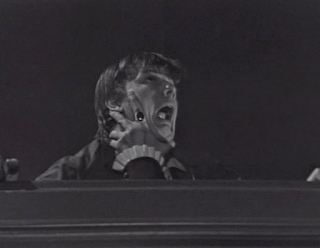
When Willie opened the coffin, it lay across the frame lengthwise and he was behind it. When he raised the lid it blocked our view of his middle. We could see only his face when he realized what he had done, and could see nothing of Barnabas but his hand. The result was an iconic image.
Farewell, dangerously unstable ruffian- hello, sorely bedraggled blood thrall. Screenshot by Dark Shadows Before I Die.
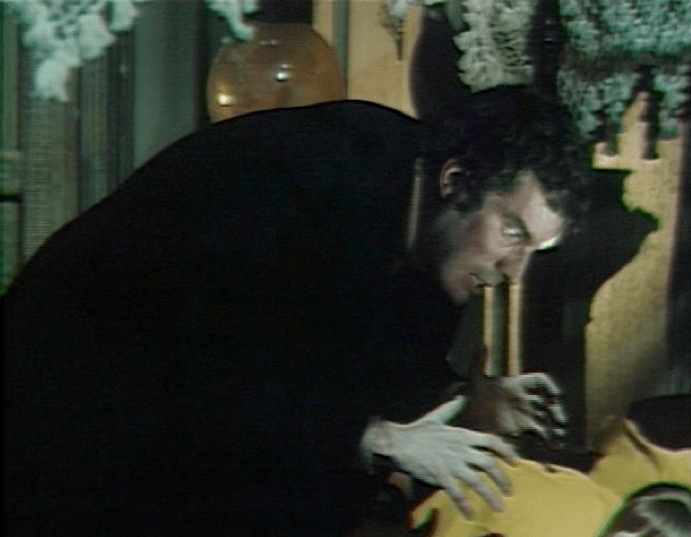
When Sandor opens the coffin, its end is toward us. We see Barnabas at the same time he does. Barnabas’ hand darts up, and also for some reason his foot. The camera zooms in as Barnabas clutches Sandor’s throat. Unfortunately, the shot is so dimly lit that not all viewers will see this. My wife, Mrs Acilius, has eyesight that is in some ways a bit below average, and she missed it completely, even on a modern big-screen television. It’s anyone’s guess how many viewers would have known what was going on when they were watching it on the little TV sets of March 1969, on an ABC affiliate which was more likely than not the station that came in with the poorest picture quality in the area. As a result, the image that marks the relaunch of Barnabas’ career as a vampire is nothing at all. There is so much good stuff in the episode that it easily earns the “Genuinely Good” tag, but Kaplan’s bungling of this final shot is a severe failure.
Strange and troubled boy David Collins and nine year old Amy Jennings are falling under the sway of the evil spirit of the late Quentin Collins. Quentin has been gaining strength gradually; at first he was confined to a small chamber hidden behind a wall in a storage room in the long deserted west wing of the great house of Collinwood, and was dependent on Amy and David to do his bidding elsewhere. Now he can move around the estate and do things for himself. He is still able to control only one of the children at a time, though, and when Amy found out that Quentin had poisoned her brother Chris she made up her mind to fight him.
Today, David goes to the west wing to tell Quentin that Amy will cooperate with him if he promises to leave Chris alone. When David puts this to Quentin, he nods in agreement. If Quentin is still weak enough that he must give in to Amy on this point, he is still weak enough to be stopped before he does any great harm. That builds suspense- the show has invested so much time in building up the threat Quentin poses that it would feel like a cheat if he were defeated now, but we can look forward to seeing him survive a series of close calls between now and the time when his storyline approaches its climax.
David was not the only one who went from the main part of the house to the west wing. Governess Maggie saw him go there, in direct defiance of her orders that he stay in his room. Maggie followed David down the corridor and saw him go into the storage room. By the time she entered that room, David had gone into Quentin’s secret chamber and closed the panel behind him, leaving Maggie baffled as to where he could be. She went back to the main part of the house to wait for David.
In David’s room, Maggie sits in the armchair by the wall. She is still there when David comes back. This recreates a pair of scenes in #667, when David sat in the chair and was still there when Amy entered. That was supposed to be a power move, and it worked, more or less. David asserted his role as Quentin’s spokesman, and Amy acquiesced.
But Maggie can’t pull it off. She doesn’t give in to David when he denies everything, tells her her eyesight must be failing, claims that she doesn’t have the right to punish him, and yells at her that he will “get even.” But her visible nervousness encourages him to try each of these tactics. It’s only when she reminds him that he had his flashlight with him when he went into the west wing and says she will look for it in the storage room that she shuts him down, and then only for a moment.
David protests his innocence to Maggie, but he tells us that the sky is falling.
Maggie goes back to the west wing, where she sees Quentin. David looks directly into the camera and recites the epigram “I do not love thee, Dr Fell.” In the first months of the show, David was the only character who made eye contact with the audience. He stopped doing that late in 1966, when he stopped being a menace, and several other characters have been called on to do it since. It’s good to see him revisit the technique, and he is quite effective at it today.
Closing Miscellany
As my screen name may have led you to suspect, I make my living as a Latin teacher. So I would be remiss if I did not mention that “I do not love thee, Dr Fell” is a translation of a piece often used on the first day of introductory Latin classes, Martial’s Epigram 32:
Non amo te, Sabidi, nec dicere possum quare.
Hoc tantum possum dicere: non amo te.
When poet Tom Brown translated the epigram in 1680, he changed the name “Sabidius” to “Dr Fell” in memory of the dean of the Oxford college which he had briefly attended. A literal translation should enable you to figure out the meaning of each of the Latin words: “I do not love you, Sabidius, and I cannot say why. I can say only this: I do not love you.”
In a conversation with housekeeper Mrs Johnson, matriarch Elizabeth Collins Stoddard says that “David is twelve years old.” This is the first time in a while David’s age has been specified explicitly.
Liz orders Mrs Johnson to take David’s dinner to him on a tray and sit in his room while he eats. Longtime viewers may remember that when Mrs Johnson started working in the house in #77 and #79, David was afraid she would be his “jailer”; in #189, she actually did sit in his room and function as his jailer for a little while. She is reluctant to do that again today, because she has caught on that David and Amy are involved with something uncanny and she is afraid of them.
Danny Horn devotes his post about this episode on his great Dark Shadows Every Day to a tour of the props and decor of David’s room. It’s a lot of fun. One of his commenters, “Jayson O’Neill,” links to a 2014 post on the Dark Shadows News blogspot page focusing on David’s posters; another, “John E. Comelately,” points out that famed rock and roll band The Turtles released a track in 1967 called “Chicken Little Was Right.” I made a comment myself finding fault with the acting and blaming director Dan Curtis for it; I don’t agree with that anymore, but you’re welcome to read it if you want.
Time-traveling fussbudget Barnabas Collins has completed the task he set for himself when he went to the year 1796, and has to find a way to return to 1969. He decides to deliberately subject himself to the process by which he was originally transferred from the 1790s to the 1960s. He is, at the moment, a vampire. He orders his servant Ben to chain him in a coffin hidden in the secret room in the back of the Collins family mausoleum, and hopes that he will be released from it in a period when he is human again.
On a sunny morning in 1969, Barnabas’ former blood thrall Willie and his best friend Julia have figured out his plan and gone to the secret room. Julia is a medical doctor; she is at once the best physician in the world, capable of assembling a human body from dead parts, bringing it to life, and thereby lifting the effects of the vampire curse from Barnabas, but simultaneously very unsteady on the question of whether any given patient she is examining is alive or dead. For example, matriarch Liz is entombed at the moment because Julia mistakenly declared her dead twice in a couple of months. Once he has opened the coffin, Willie demands Julia examine Barnabas’ body and tell him whether he is alive, and therefore human, or dead, and therefore condemned to rise at nightfall and prey upon the living. Before she can answer Willie’s question, Julia has to spend quite a bit of time going over Barnabas with a stethoscope, during which time we see his eyelids flutter and his chest move.
While Julia is trying to determine Barnabas if is alive, he sits up and starts talking. Julia and Willie urge him to lie back down, apparently concerned that if he is too active Julia won’t be able to arrive at a clear result. After a break, we see him out of the coffin, telling them about his experience in 1796. After quite a bit of back and forth, they arrive at the collective decision to continue the conversation back home, in the Old House on the great estate of Collinwood.
Barnabas, Julia, and Willie have emerged from the secret room into the publicly known part of the mausoleum and are starting to close the panel behind them when they hear the voices of people approaching. One might expect them to finish closing the panel and to greet whoever is coming as fellow pilgrims paying homage at the graves of Joshua and Naomi Collins and their daughter Sarah. After all, everyone knows that Barnabas is a direct descendant of Joshua and Naomi, that Julia has a lively interest in the past of the Collins family, and that Willie is Barnabas’ servant. They have as much right to be there as anyone.
Instead, they scurry back into the secret room and shut themselves in. They are a bit too slow. Entering are heiress Carolyn and child Amy. Amy sees the panel swinging shut. Carolyn, behind her, did not see this happen, and dismisses Amy’s claim that she did. They tap on the panel, and Amy decides that it is so solid that she may have been mistaken. The mausoleum is so dim that one can imagine a trick of the light causing a person to believe that the wall had moved, so this reaction of hers is plausible enough.
Dimness is not an exclusive property of the outer part of the mausoleum. The trio hiding in the secret panel embody dimness as they do an outstanding imitation of the Three Stooges. Willie is Larry, the universal victim; Julia is Moe, the self-appointed leader who is as lost as either of the followers; and Barnabas is Curly, the chaos agent. Willie left his bag of tools perched precariously on the steps immediately behind the panel; after Amy and Carolyn tap, the bag falls and makes a sound. Julia does not address Willie as “ya porky-pine!” and poke him in both eyes, but it would fit with the flow of the action if she did.
Carolyn and Amy both hear the sound. They puzzle over it. Carolyn suggests that the wind must be blowing a limb from a nearby tree against the outer wall. Amy can’t think of anything else it could be, and accepts the suggestion. They leave, having placed flowers on the sarcophagi.
The flowers are themselves interesting to longtime viewers. Early in the episode, we saw Carolyn arranging them on the writing table in the drawing room of the great house of Collinwood. The last time we saw someone handling flowers over that table was in #346. Barnabas grabbed those flowers out of Julia’s hand. In those days he was still a vampire, and they were enemies. After a few seconds in his grip, the flowers died. When Julia and well-meaning governess Vicki saw this, Barnabas looked embarrassed, for all the world as if he had broken wind. The analogy tends to raise a laugh, but it is apt- when he was a vampire, it was a natural function of Barnabas’ body to do things like that, and he would be expected to control that function so that others would not be aware of it. So when they show us flowers on this spot, they are telling us we ought to be in suspense as to whether Barnabas will be a vampire again.
Carolyn and Amy go back to the great house, where strange and troubled boy David is sulking. Again, longtime viewers might find this suspenseful. David found his way into the secret room in #311 and in #334 tried to show it to some adults. Barnabas had locked the panel, so they disbelieved him. If Amy tells David what she saw, he may well put two and two together and revive the stories that were in progress in those days.
But Amy doesn’t breathe a word of it, and David isn’t interested. He is preoccupied with the evil spirit of the evil Quentin Collins, who is gradually and evilly taking possession of him and Amy and, evil as he is, driving them to do something or other that has not yet been explained, but which will undoubtedly turn out to be evil. Quentin is still confined to a small room hidden in the long-deserted west wing of the house, and can only take full control of one child at a time. Today it is David who is acting as his agent; Amy flatly refuses when David tells her that Quentin wants them to “play the game.” In response, he twists her arm. Carolyn walks in on that act of violence, and orders David to go to his room and stay there for the rest of the day.
Amy speaks up for David and even asks to go to his room with him, but Carolyn stands her ground. She does leave the children alone together while she goes to tell housekeeper Mrs Johnson to take David’s meals to him on a tray.
David fumes and tells Amy that it is her fault that they won’t be able to “play the game” today. He is declaring his intention to “get even with Carolyn!” when Barnabas appears in the doorway.
Evidently David’s declaration did not bother Barnabas, because his only response is “Why so serious?” Barnabas has been pushing a plan to send David and Amy to boarding schools in Boston. Under Quentin’s influence, they have tried to thwart this plan by pretending to be all for it but secretly hanging clothes in the wrong closets. This apparently foolproof method has somehow failed, so they resort to another expedient. They tell Barnabas they would rather not go. He says that’s fine with him, and drops the whole thing.
Alone in his room, David looks angry. He throws a book to the floor. Carolyn comes in, and David tells her that he is sorry and she is right to punish him. She sees immediately that he is lying, and tells him so. The resulting brief scene is far and away the best of the episode.
Later, Amy slips in, and finds David sitting in a chair in a dark corner. In their post about the episode on Dark Shadows Before I Die, John and Christine Scoleri point out that the effect of this shot of David is a bit different on an audience now than it would have been before 1972, since it makes David look very much like Don Vito Corleone in the opening scene of The Godfather.
David is still furious about the whole situation. He tells Amy that they will “play the game” after all, and that Carolyn will play with them. The ominous music on the soundtrack is enough to tell us that this means they will try to kill Carolyn.
This episode shows something about the importance of directors in television drama. Actor Joel Crothers appeared on Dark Shadows for the last time yesterday; in an interview he gave to a fan magazine shortly after leaving the show, he complained that the directors had become so busy managing the special effects and practical effects that they didn’t have time to work with actors. Furthermore, the show never had more than three writers on staff, so scripts were sometimes delivered too close to taping for the actors to do much rehearsal on their own.
Today, each actor finds a note and sticks with it, but few performances mesh with each other sufficiently to seem to be part of the same scene. Denise Nickerson is calm and relaxed even when Amy’s arm is being twisted, David Henesy is angry and confrontational even when Barnabas is falling for David’s pretense that everything is normal, and Nancy Barrett is stern and impatient even when Carolyn is taking Amy’s claim to have seen the panel move seriously. Each of these performances is good, and Mr Henesy stands out when he gets to play “creepy.” But clearly no one gave them an idea of what they should work together to get across to the audience.
Aside from the scene where Carolyn sees that David is lying, there are just two exceptions, and they don’t really help. Committed fans may find it endearing to see the preposterous threesome hiding in the secret room of the mausoleum, but first-time viewers are likely to be put off by that scene of low comedy in the midst of an otherwise heavy and somber melodrama. Jonathan Frid is warm and inviting with the children, which does make sense when Barnabas is talking with the relaxed Amy, but their two-scene about whether he will ask Carolyn to let David out of his room is such a low stakes affair that unexcited actors cannot hope to hold our attention.
The director today was executive producer Dan Curtis. Curtis was a titanic personality and would later direct many TV movies and some features, but he seems never to have directed as much as a school play when he first took the helm of Dark Shadows for a week in 1968. This stretch of episodes marks his second time in the director’s chair. His extreme inexperience as a director of actors may well explain why the cast does not come together more cohesively.
In January 1969, old world gentleman Barnabas Collins learned that governess Vicki Winters had traveled through time to the year 1796, where she and her boyfriend Peter Bradford were hanged for their many crimes. Barnabas decided to follow Vicki to that year in order to save her and Peter. Barnabas himself lived in the 1790s, and is alive in the 1960s because for 172 of the years between he was a vampire. Once he made his way back to 1796, Barnabas reverted to vampirism.
Yesterday, Barnabas killed a streetwalker named Crystal. After he watched her corpse sink in the bay, he went home to the great house of Collinwood to get to work on his main occupation, feeling sorry for himself. To his shock and bewilderment, he found that Crystal’s body had materialized in an armchair in the study.
Today, Barnabas calls his servant Ben Stokes to help him dispose of Crystal’s body. We have seen that when characters go from the foyer to the study, they walk past the camera, exiting stage right. Once, it seemed the camera might follow a character into the space beyond the foyer. That was in #196, when matriarch Elizabeth Collins Stoddard took several steps towards the camera while telling seagoing con man Jason McGuire that if he wanted to stay at Collinwood he could use a room that direction. Jason called Liz back before she went too far, and insisted on a room upstairs. This time, Barnabas leads Ben all the way off the set. They walk through some darkened space for a couple of minutes before entering the study.
Barnabas and Ben leave the set.
The camera is tight on the two of them throughout this sequence, concealing the fact that there is no set decoration behind them. The episode was directed by executive producer Dan Curtis. Barnabas and Ben’s walk through the void bears Curtis’ directorial signature. Curtis was extremely audacious in everything he did, but had very little experience as a visual artist. He wanted to create the illusion that Collinwood was a big place, but the tight closeup results in a static composition and leaves the audience guessing where Barnabas and Ben are supposed to be. Moreover, making the sequence work at all requires that half the studio be plunged into darkness, creating problems throughout the episode.
In the study, Barnabas and Ben find that Crystal is gone and Barnabas’ ex-wife, wicked witch Angelique, is sitting in the chair. Angelique and Barnabas send Ben away so they can talk privately. Barnabas hasn’t tried to explain to Ben that he is on a return trip to the eighteenth century after 20 months in the 1960s; he hasn’t even told Vicki that he is the man she knew in her own time. But he recognizes that Angelique is not a continuation of her 1795 self, but is a fellow time traveler from 1968. Once Ben is gone, he asks her why she has returned to the era.
Barnabas and Angelique play out their big scene in the lighting dictated by the walk through the nonexistent hallway.
She explains that after she failed to advance the plot in 1968, her demonic masters punished her by sentencing her to remain in “this time forever.” It is not at all clear what that means. Will she relive the year 1796 over and over, like Bill Murray in the 1993 movie Groundhog Day? Or will she just go on living forever and experience time in the usual linear fashion? In the latter case, she would rejoin the 1960s in episodes to be broadcast in the 2130s. Not only would that negate all the timelines we’ve heard about and establish a whole new continuity, it would also mean that Lara Parker had secured the longest-term contract in the history of professional acting.
Angelique tells Barnabas she will help him free Vicki if he will agree to stay and resume their marriage. He is appalled by the notion, but she asks if he can save Vicki without her. He says that he cannot. This is a bit of a puzzle. Barnabas’ vampirism comes with a wide array of powers he could use to break someone out of jail. He could bite the jailers and establish control over them sufficient to force them to let Vicki out. If he isn’t thirsty, he has great physical strength, and is invulnerable to most weapons, so he could just force his way in to the gaol and carry Vicki off. He might not even have to bother with the front door. In #242, Barnabas ripped the iron bars out of the windows of a doctor’s office, and Vicki’s cell at the Collinsport gaol has a window with bars that can’t be much stronger than those were. But I suppose he is worried about distorting the course of subsequent history if he does something spectacular, and he certainly doesn’t want Vicki to find out that he is something other than a human. So he makes a deal with Angelique.
The idea is that Vicki will go to the gallows, appear to drop dead before the hangman does his thing, and that after Barnabas and Peter take Vicki’s body back to Collinwood Angelique will revive her. Both Peter and Ben are horrified at the idea of trusting Angelique, but Barnabas seems to think he has no choice. He insists that Vicki and Peter both wait patiently for Angelique to accomplish her part.
The hanging goes ahead as scheduled. Peter is enraged that Barnabas let Angelique cheat them out of the chance to thrash around and scream during the execution. They take the body to Collinwood and lay it out in the study, a few feet from where Crystal’s body had been at the beginning of the episode. They leave it alone, and Angelique appears. Evidently she does intend to bring Vicki back to life, but she vows that Vicki will be under her power from now on.
Hardworking young fisherman Joe Haskell has been through a lot lately, and it is taking its toll. He was bitten and enslaved by a female vampire, with the result that he lost his job and his fiancée. He was still under her power when he realized that his cousin and close friend, Tom Jennings, was also a vampire. Now he has been attacked by a werewolf and has discovered that that werewolf is, on the few nights of the month when the moon is not full, Tom’s brother Chris. Last night he saw Chris transform in his lupine shape. He took Chris’ revolver and emptied it into the werewolf’s furry chest, but that only slowed him down. Joe escaped from the werewolf’s wrath, but we see today that he is never going to be right again.
Chris’ nine year old sister Amy is staying at the great house of Collinwood as the guest of matriarch Elizabeth Collins Stoddard. As we open, Liz’ daughter Carolyn is in the drawing room, recently returned from a trip. She is terribly distraught to hear a recap of the last couple of weeks from permanent houseguest Julia Hoffman, MD. While they talk, Joe slips into the house, crazy-eyed and bent-backed.
Joe makes his way up to the bedroom where Amy is asleep. He dwells on what her brothers became, then approaches her bed with his hands in strangling position. After a commercial break, he says “Save her!,” then agrees with himself that he ought to save Amy.
Joe wakes Amy, urges her to be silent, and starts packing her clothes. She asks if they are going to join Chris, and Joe becomes violently agitated. Amy grows frightened. Joe grabs her, puts his hand over her mouth, and carries her out of the house, leaving her half-packed bag behind.
In the woods, Joe hears sounds which he believes to be the werewolf. He starts shouting that he won’t let it have Amy. He is so absorbed in this that Amy gets loose and runs from him.
Joe’s derangement is entirely explainable as a natural response to the horrible and incomprehensible traumas he has undergone. The same could be said of the other mentally ill character in today’s episode, Liz, and in Monday’s episode Julia very nearly said it. Today, however, the show raises the possibility that Liz’ trouble might be the result of ongoing persecution by the spiritual forces of darkness.
Months ago, Liz fell afoul of her brother Roger’s wife. She called herself Cassandra, but was really an evil sorceress named Angelique wearing a black wig. This wiggéd witch cast a spell that caused Liz to sink into a deep depression, obsessed with the idea she would be buried alive. Twice before, Liz has sunk into similar depressions. The first was the result of a spell cast by Roger’s previous wife, Laura Murdoch Collins, who like Angelique/ Cassandra was an undead blonde fire witch. (Roger has a type.) The second was a response to a long blackmail to which a seagoing con man named Jason McGuire subjected her. For the last several weeks it has seemed that this third bout might be lifting, but it came back with a vengeance last week when well-meaning governess Victoria Winters dematerialized before Liz’ eyes.Vicki’s departure was as much a shock to Liz, in its own way, as Chris’ transformation was to Joe. Even before any spells were cast on her, Liz had shut herself up in the house and refused to leave for eighteen years. So we know that Liz is given to depression.
Today Liz has a nightmare. The dream sequence begins with a melody that for all the world sounds like “Rock-a-bye Baby” played on a kazoo, but which turns out to be a distorted recording of Amy singing that lullaby. Liz sees Amy atop the cliff on Widows Hill, a place associated with death and peril. In the past, several women have fallen to their deaths from Widows’ Hill; we have seen Liz and Vicki attempt suicide there. Amy’s image is as distorted as is the sound of her voice. She is swaying from side to side, perhaps dancing the hula; the visual effects exaggerate this sway.
Liz is trying to get Amy away from the cliff when she sees Angelique/ Cassandra. The witch tells her that she will fulfill her curse and see that Liz is buried alive. Liz finds that she can no longer communicate with Amy, for which Angelique/ Cassandra taunts her.
Shortly after Liz wakes up from her dream, Carolyn and Julia come to her room. They hear her crying out that “she” is a danger to her, but a moment later Liz cannot remember who that was. Julia mentions to Carolyn today that multiple psychiatrists have reported that Liz cannot remember how her depression started; that she sees Angelique/ Cassandra in the nightmare but cannot remember who she was so shortly after suggests that the nightmare is part of the depression. If Angelique/ Cassandra’s continued activity is causing the one, it must therefore be causing the other.
Liz says that she is afraid for Amy and asks Carolyn to check on her. When she finds Amy missing, she asks Julia what to tell her mother. Without missing a beat, Julia says “Lie to her!” This is perfectly fitting- Julia is the show’s most fluent and most accomplished liar. Julia and Carolyn begin a search. Julia is on the phone asking for the sheriff when Amy comes in the front door, followed by Joe.
Julia is at first relieved to see Amy with good ol’ Joe. But Amy is terrified of Joe, and when she runs upstairs Julia blocks the staircase to keep him from following. Joe says that he must take Amy far away from Collinsport at once. Julia says that if he can explain why, she will let him. Nothing he can put into words makes much sense to her, and he is so obviously unhinged that there is no way anyone would think he was the right person to assume responsibility for a child. Julia tells Joe that whatever he may have encountered in the village poses no threat to Amy in the mansion. He laughs, shakes his head, and mutters “You don’t know… you don’t know…”
Julia’s attempt to reassure Joe is interrupted by a blood-curdling scream from upstairs. She hurries up to see what is happening. Joe goes on laughing and muttering, wandering out of the house. That the scream coming from upstairs, where Amy is, does not catch his attention when he is so determined to protect Amy from imminent danger shows that he is truly lost, never to recover.
Julia finds a distraught Carolyn standing over an immobile Liz. She gives Liz a quick look, and tells Carolyn that she is dead. You might think Julia would be more careful about this. She has several times made erroneous death pronouncements, most recently when she pronounced Liz herself dead in #604. That incident led Julia to conclude that Liz had an unusual disorder that could cause her to appear to be dead. Especially since Julia knows about Liz’ overwhelming fear that she will be mistakenly thought dead and be buried alive, this hasty diagnosis is bizarre. Of course we end with a shot of Liz on the floor and hear her voice on the soundtrack saying “I’m not dead! I’m not dead!”
Liz had collapsed after she had a vision of Angelique/ Cassandra appearing in her room and touching her. This would seem to be a strong suggestion that the show wants us to think that Liz is still actively hag-ridden, and that her depression is therefore among Dark Shadows‘ supernatural storylines. On the other hand, the vision might have been an hallucination on Liz’ part, and her apparent death might be the result of a psychological syndrome. There may not be any mental process in our world that can induce a seizure so complete that it would fool doctors into thinking that a patient was dead, but in the world of Dark Shadows Julia, whose abilities are all supposed to be strictly the result of her scientific training, can use hypnosis to erase and rewrite people’s memories at will. If the power of suggestion is that great in this fictional universe, it is easy to suppose that self-hypnosis could conceal anyone’s vital signs from the most sophisticated examination.
This was the first episode directed by Henry Kaplan. Lela Swift directed the first twenty episodes of the show, and half of the rest. From #21, she shared directing duties with John Sedwick, usually trading off from one week to the next. Sedwick left the show in June, and several other men have taken turns as Swift’s relief. Kaplan will occupy that spot until the end of the series.
Swift and Sedwick were both ambitious and accomplished visual artists, and the others have more or less lived up to the standard they set. Today’s episode doesn’t look particularly bad, but a great many of the hundreds of segments Kaplan would go on to direct would be made up of one closeup after another, most of them badly out of focus. Swift will continue to work at her usual high level, but the sludge Kaplan dumps on our screens day after day will go a long way towards breaking people of the habit of watching Dark Shadows and discrediting it in the eyes of critics and television professionals.
Moreover, Kaplan did not work well with actors. Many of the cast hated Kaplan for his habit of using a stick, not only to point to their marks, but often to prod them physically. Others hated him for the verbal abuse he casually heaped on them. In a recent panel discussion, Marie Wallace and Donna Wandrey share stories about the difficulties of working with this disagreeable hack. The performances in this one do not show Kaplan’s malign influence. Joel Crothers does a marvelous job as Joe. While the actresses step on each others’ lines so often that it is clear they are nervous, that is not so very unusual.
In #2, high-born ne’er-do-well Roger Collins saw governess Victoria Winters standing at the edge of a high cliff overlooking the ocean. She didn’t know he was there until he startled her by asking her if she was planning to jump. As the weeks go on, Vicki will learn of other women who have leapt to their deaths from that spot, including a story that over the years two governesses were among them and that legend says a third will someday follow suit. The cliff is the face of Widows’ Hill, named after women whose husbands never returned home from the sea; several times during storms an eerie note sounds in the wind, a note known as “The Widows’ Wail,” which the locals believe to be the ghosts of the Widows announcing that a tragic death will soon take place.
Vicki stands at the edge of the cliff again at the end of this installment while the Widows’ Wail sounds. She is distraught that she has herself become a widow and is dwelling on the idea that she can be reunited with her husband in death.
Though occult expert Timothy Eliot Stokes told her earlier in the episode that “Your time is now!,” Vicki’s time as a lively part of the show in fact ran out in March 1967, with the resolution of the story about her effort to befriend her charge, Roger’s strange and troubled young son David. Actress Alexandra Moltke Isles finally gave up on the character and left Dark Shadows after #627. Her successor in the role, Betsy Durkin, has essentially nothing to work with. We do not share her grief for the husband she is mourning; he was one of Dark Shadows‘ most repellent characters, and it is such a relief that he is away that we sympathize only too much with everyone who tells her to stop bringing him up. Nor do we have any other reason to care about her, since she is relevant to no ongoing plotlines. Even longtime viewers who remember the foreshadowing of Vicki’s possible death by a jump off the cliff will not react strongly to the sight of her there, since Miss Durkin is not Mrs Isles and does not bring her screen iconography to the reprise of the theme.
This phase of the show actually belongs to a character introduced in #632, eleven year old Amy Jennings. When Amy meets Stokes today she announces that she likes him because he is funny; he replies that he is pleased to find that “My appeal extends to all ages now.” Indeed it does; in its first year, Dark Shadows was very much aimed at adults, some of whom remembered Joan Bennett as one of the great movie stars of the 1930s and 1940s and were impressed by her presence in the cast as matriarch Liz, some of whom appreciated it as a specimen of slow-paced, highly atmospheric Gothic romance, and some of whom were fascinated by the story of Vicki and David and its theme of a grownup trying to make a difference in the life of a troubled child. But by the time Stokes arrived in #464, Dark Shadows had become a kids’ show. As Thayer David plays him, Stokes is amusing enough that anyone can like him, but the absolute seriousness with which he regularly expounds the most preposterous mumbo-jumbo is designed to make him a favorite of the very young.
Amy’s friendship with David develops in scenes that kids will find engaging, as they go exploring the big haunted house of Collinwood and find their way into spooky adventures. She also takes the lead in her relationships with adults more consistently than David ever did. While in the first year and a half of the show David often knew things the adults didn’t know, that was usually because he accepted the facts they refused to see. No matter what he said or did, he couldn’t move them from their habits of denial and evasion. But Amy has sources of information that the grownups around her don’t have. So today she has a vision of her brother Chris in some kind of terrible trouble. When she tells Vicki and Liz about her vision, Liz tries to telephone Chris and is deeply disturbed when he doesn’t answer. As my wife, Mrs Acilius, pointed out, it is after one o’clock in the morning, so you wouldn’t expect her to attach great importance to his failure to pick up the phone. That she does suggests that she is taking Amy seriously.
Returning viewers know that Amy’s vision is correct. Chris is a werewolf, and he just killed a barmaid. That Amy not only has a paranormal means of knowing how Chris is doing, but that she is also able to get through to the adults and influence their actions, suggests that she will have a major impact on the werewolf story as long as it continues. Indeed, she already has- the werewolf was about to eat Liz the other day, but backed off when he saw Amy nearby.
Amy is central to the other storyline that is beginning at this point. That is “The Haunting of Collinwood,” in which the ghost of Liz and Roger’s’ great-uncle Quentin Collins is going to be creating difficulties for everyone. Amy and David went into the long-deserted west wing of the house and retrieved an antique telephone from a room there. Though its cord is cut, Amy can sometimes hear Quentin’s voice through its receiver. When she is alone and worried about Chris, she picks the telephone up and asks for Quentin. She is disappointed he does not answer. None of the adults knows about Quentin’s ghost or the telephone. Not even David has heard more than Quentin’s breathing through the receiver. Again, Amy is uniquely positioned to understand and affect the action.
According to the closing credits, this week’s five episodes were directed by “Penberry Jones.” The name “Penberry Jones” is unknown to Google aside from these credits, and it sounds like a joke of some sort. Though the fansites all mention the improbability of Jones’ name and the likelihood that it is a pseudonym, none that I could find offers any clue as to who might have been behind that pseudonym. From the early 1970s until the quarantines of Covid-19 in 2020, Dark Shadows fans would organize festivals a couple of times every year at which panels of people who had been involved in making the show took questions from the audience. If any of those audiences asked who Penberry Jones was, either they did not get an answer or that answer was not recorded.
The name “Penberry” may remind longtime viewers of Dark Shadows of episode #83, which is about Roger burying a pen. Roger was a major villain then, and his part gave actor Louis Edmonds an opportunity to show what he could do. Roger has long since been demoted to occasional comic relief; one might imagine that Edmonds wanted to take a turn in the director’s chair, and that he chose his whimsical pseudonym as a nod to his character’s origins. Appealing as that idea may be, it does not seem at all likely. So many of the panel discussions among cast members abounded in fond stories about Edmonds that surely someone would have mentioned it if he had directed five episodes.
Indeed, most of the longer-lived members of the cast participated in so many of those panels that they all had moments when they had to grope more or less desperately for something fresh to say. If anyone whose name fans would recognize and who worked closely with the cast were “Penberry Jones,” it’s hard to imagine that one or another of them wouldn’t have brought it up in one of those moments.
Whoever it was must have been known to executive producer Dan Curtis and line producer Bob Costello, and probably quite well known to them. The Directors Guild of America does allow its members to change the names under which they are credited, as for example John Walter Sullivan was allowed to direct several episodes of Dark Shadows as “Jack Sullivan” and several more as “Sean Dhu Sullivan.” But it does not allow them simply to use pseudonyms at will. It wasn’t until 1969 that directors working in features could be billed as “Alan Smithee,” and then they had to prove that they did not really have control of the final product before they were allowed to substitute that name for their own. The first television production credited to “Alan Smithee” didn’t appear until 1970. So it is unlikely that “Penberry Jones” directed any screen productions under any other name. Curtis and Costello probably wouldn’t have chosen a first-time director with no imminent prospects of other screen work unless it were someone they already knew and trusted.
If “Penberry Jones” didn’t cover anyone the cast knew well or a director who worked under another name, but was someone who was close to Dan Curtis or Bob Costello, it should be possible to compile a short list of suspects. I’m not so deeply immersed in the behind-the-scenes lore that I can compile that list myself, but maybe you are. If so, I’d like to hear from you in the comments!
The director’s name isn’t the only puzzle in the closing credits. Every previous episode of Dark Shadows ended with the credits playing in front of a stationary shot of one or another set. It was always one shot per closing credits sequence. This time they start with a stationary shot of Vicki’s room, then cut to a stationary shot of the foyer. It’s hard to see what the point of that transition is. Perhaps we could ask “Penberry Jones,” if we had any idea who that was.
Suave warlock Nicholas has had bad news. His boss, Satan, will be recalling him to Hell, and does not plan to send him out to the world of the living again. Satan gave Nicholas two tasks to complete before his time runs out. He is to perform a Black Mass during which he will sacrifice Maggie, The Nicest Girl in Town, and afterward take her to Hell with him as his bride. He is also to complete the project he has been working on, forcing mad scientist Julia and old world gentleman Barnabas to resurrect Eve, the mate of Frankenstein’s monster Adam. Yesterday, we saw that Nicholas plans to make Barnabas and Julia use Maggie as the donor of the “life force” that will bring the mate back to life. It was entirely unclear how Maggie could both be sacrificed on Nicholas’ altar and used as the “life force.”
We open today with a reprise of yesterday’s closing sequence, showing Nicholas performing a rite while Maggie lies on his altar. We then cut to the basement of Barnabas’ house, where Eve’s body lies on a bed in a laboratory full of mad science equipment. Barnabas vows to Julia that this is the last time they will ever go through the vivification procedure; she asks “What’s the point of saying that? We’re at Nicholas’ mercy.” The other day, Barnabas confronted Nicholas with some demands, threatening to stop cooperating with his project unless he complied. Nicholas gave some ground in response, suggesting there might yet be some dramatic tension left in his relationship with Barnabas and Julia. But when Julia sounds this note of total defeat she is telling us that their conflict with Nicholas is exhausted, that the Frankenstein story has nowhere to go, and that Barnabas is therefore right and this is the last time we will see them run the experiment.
Julia looks at the body and expresses sympathy for “poor motherless Eve.” “There’s a poem about that,” she says. Indeed there is, and it is an apt reference here. Nicholas’ attachment to the ingenuous Maggie has always been jarringly out of character for him; Ralph Hodgson’s 1913 poem “Eve,” with its juxtaposition of the innocent Eve with the crafty serpent, not only tells a story that is as broadly melodramatic as any episode of Dark Shadows, but also dwells on the incongruity of Eve and the serpent, the sheer strangeness of the fact that they coexist at all. “Here was the strangest pair/ In the world anywhere.”
Yesterday we caught our first glimpse in a long time of a character who, like Maggie, was introduced in the first episode. He was Mr Wells, the innkeeper. Maggie has been with us through all of the show’s transformations, but we hadn’t seen Mr Wells since #61, when Dark Shadows was all about what went on among people while they were drinking coffee together. Seeing him again puts that 1966 show side by side with this dramatization of “The Monster Mash,” and that contrast is as jolting as anything Hodgson manages.
Visitors let themselves into the lab. First comes Nicholas. He is trying to seem cheerful. He comes down the stairs with a bounce in his step and greets Julia and Barnabas with a jokey “Why are my conspirators so reluctant?” He might be trying to evoke the same unholy jollity that we see at the end of Hodgson’s poem, “Picture the lewd delight/ Under the hill tonight/ ‘Eva!’- the toast goes round-/ ‘Eva’ again.” But the imminent prospect of his return to Hell has Nicholas in no jolly mood, and his mask of good cheer falls away the moment Barnabas complains of his untrustworthiness.
It is true that Barnabas’ complaint strikes Nicholas at a most sensitive spot. He tells him that “You seem to specialize in second chances” and gripes that he revived vampire Tom Jennings and left him to do the dirty work of ensuring Tom would never rise again. Giving second chances was the very habit for which Satan reproved Nicholas in #629 when he told him he would soon be returning to Hell. Stung by the echo of his master’s words in Barnabas’ mouth, Nicholas retorts that destroying a vampire must have been “traumatic” for Barnabas, who was until recently a vampire himself. Because of some magical business, Barnabas will revert to that condition if Adam dies, and it is Nicholas’ threat to kill Adam that has compelled him and Julia to assist in his diabolical plan. Having reminded Barnabas and Julia of the source of his power over them, Nicholas composes himself, agrees with Julia that there is no time for quarrels, and leaves the room.
A moment later, Adam enters. Adam hates Barnabas and Julia, believes that Nicholas is his friend, and looks forward to Eve’s resurrection. Barnabas tells Adam he doesn’t want him there, but Nicholas enters with the command “He stays, Mr Collins.” A third visitor follows and shocks Julia and Barnabas even more deeply. It is Maggie.
The rite on the altar dedicated Maggie to Satan, but it did not involve her death. When Julia and Barnabas see that Nicholas has brought Maggie, they declare that they will not go ahead with the procedure. But Maggie declares that she is there of her own free will. Quite calmly, she looks around the laboratory in Barnabas’ basement, and says “I’ve been here so often.” Indeed she has- in May and June of 1967, Barnabas was still a vampire, Maggie was his victim, and he kept her imprisoned in a cell here. Julia used her extraordinary hypnotic abilities to make Maggie forget her ordeal, but this line suggests that she now remembers what Barnabas did to her, and that she is, terrifyingly enough, happy about it.
When Maggie was Barnabas’ prisoner, he was trying to erase her personality and replace it with that of his lost love Josette. Later, the show took us back in time to the year 1795, where we saw Josette when she was alive and realized that she wasn’t on board with Barnabas’ plans then any more than Maggie was in 1967. But it looks like Nicholas has succeeded where Barnabas failed and remade Maggie as a companion fit for a demon. Barnabas is already miserable at being forced to toil in Satan’s cause, and now he goes nuts with jealousy.
Barnabas loudly protests that he will not be a party to the experiment. Nicholas silences him by causing Adam’s heart to beat dangerously fast. Their magic bond gives Adam and Barnabas the connection Alexandre Dumas’ Corsican Brothers had, so that Barnabas also suffers the pain. Julia was originally introduced as Maggie’s doctor, but she long ago betrayed her patient for Barnabas’ sake. She pleads with Maggie to stop Nicholas, but Maggie just smiles and asks “Why should I?” Julia tells her that otherwise Nicholas will kill both Adam and Barnabas. Perfectly relaxed, Maggie responds “Then you stop him. Do what he wants.” Julia capitulates, saying “We’ll use her.”
This glimpse of Evil Maggie is breathtaking for longtime viewers. In #1, Maggie premiered as a wisecracking waitress who was, in the words of the original series bible, “everybody’s pal and nobody’s friend.” Soon, we saw her with her father Sam, the town drunk, and she emerged very clearly as a classic Adult Child of an Alcoholic (ACoA.) In #20, Maggie left behind the short blonde wig she had worn in her first appearances, and from then on she was The Nicest Girl in Town.
When Barnabas first bit Maggie, she went through the phases the vampire’s victim usually experiences, including snappishness towards her loved ones when they try to get between her and the ghoul on whom she is becoming dependent. During her time in Barnabas’ house, her level-headedness and warm-heartedness reasserted themselves, and even when she was in the mental hospital as a psychological wreck after escaping from him she was never far from a display of kindliness. In the eighteenth century flashback, Kathryn Leigh Scott took on the part of Josette. Josette was so unfailingly virtuous that not even Miss Scott could find a way to make her interesting. This brief moment of a Maggie utterly indifferent to the value of human life, even her own, is such an extreme departure that we can immediately see a world of possibilities opening up for her as a character and for Miss Scott as a performer.
Maggie is strapped to a table and Julia and Barnabas get to work. We have seen the procedure often enough that it is far from fresh, but in-universe it is still highly experimental. The equipment doesn’t work as Julia and Barnabas expected; gauges indicate higher readings than they want, and the adjustments that are supposed to bring them down just make them go even higher.
Maggie cries out that she is dying; Eve barely moves. The readings get even worse; Barnabas shuts the apparatus down. Nicholas tries to cast a spell to immobilize Barnabas; he struggles against Nicholas’ power at first, but still smashes the equipment, and soon is free of the spell altogether. Nicholas calls out to his master and pleads “Don’t desert me now!” His powers gone, he runs to Adam and starts trying to choke him, but Adam brushes him aside easily. Nicholas runs away; Barnabas runs after him, saying that he will take the opportunity to kill Nicholas.
Adam is shocked that Nicholas attacked him. He and Julia find that nothing is left of Eve’s body but a skeleton with a wig. Adam sobs, declaring that now he has no one. Adam decides that Barnabas is to blame for Eve’s destruction. He goes upstairs, tells himself that Barnabas “doesn’t deserve to love,” then leaves the house. Later, we see him in the great house of Collinwood. Regular viewers know that Adam has in the past thought of punishing Barnabas by murdering well-meaning governess Vicki, in whom Barnabas does not actually take much interest but whom he frequently claims to love. So we can expect that Friday’s episode will involve some apparent danger to Vicki.
Julia is too busy with Maggie to take any notice of Adam’s doings. The last time Julia ran the experiment, the “life force” donor died. Julia is frightened when she cannot get Maggie to respond to any stimulus. She gives her a shot, and Maggie opens her eyes.
Longtime viewers wonder what Maggie will be like now. If Satan has lost interest in Nicholas, it seems unlikely that the heartless Maggie of a moment ago will stick around. If she returns to her usual sensibilities with her memories of Barnabas’ crimes restored, the show will no longer be able to use the sets representing the houses at Collinwood since Dark Shadows will become a prison drama about the activities of Barnabas and Julia on their respective cell blocks. If she just snaps back to the way she was before she got involved with Nicholas, it will feel like a cheat.
What they actually choose to do is to give Maggie total amnesia. She does not recognize her own name or Nicholas’, refuses to believe she has ever met Julia, and has no idea where she is. Julia tries desperately to reactivate Maggie’s memory. She takes her up to Barnabas’ living room. In a moment longtime viewers will find impossible to believe, Julia takes a music box and plays it for Maggie. She tells her that it once belonged to Josette and that Maggie has heard it many times. Indeed she has- Barnabas forced her to listen to it incessantly during the weeks when he was trying to Josettify her. Julia, who has gone to such great lengths to bury Maggie’s memory of what Barnabas did to her, is now trying to dislodge her recollection of his very worst crimes. When Maggie does not remember the music box, Julia takes her up to Josette’s bedroom, where Barnabas kept her for much of her time as his prisoner. It is simply impossible to imagine what Julia could be thinking at this point.
Meanwhile, Barnabas is skulking in the foliage near the peak of Widow’s Hill. He is eavesdropping on Nicholas, who is pleading with Satan to give him another week to get the Frankenstein project back on track. He dissolves into a process shot depicting flames, and Barnabas smiles the most evil grin anyone has ever managed.
Even though poor motherless Eve is on screen for only a minute or two, doesn’t open her eyes, has no lines, and moves only a couple of fingers and those just barely, they brought Marie Wallace back to play her. That was $333 well spent. Miss Wallace’s presence on screen convinces us that Eve is really dead and that she will not be back. Combined with Maggie’s amnesia, that leaves Nicholas without any connection to an unresolved storyline. The only former underling of his still at large is witch-turned-vampire Angelique, and she had broken from him decisively a couple of weeks ago. When he vanishes, we can accept it as a line drawn under the part of the show in which he was the principal villain.
Eve’s decomposition and Nicholas’ damnation are not the only departures today. This was the final episode directed by John Walter Sullivan. As “Jack Sullivan,” he was credited as an associate director on a great many episodes, from #15 to #549. When John Sedwick left the show in the summer of 1968, Sullivan took over his share of the directing duties, alternating with Lela Swift. He directed a dozen episodes as “Jack Sullivan,” from #504 to #580. He then took the name “Sean Dhu Sullivan,” and directed 50 more. Sullivan was not as accomplished a visual artist as either Swift or Sedwick, and the camera operators had more trouble keeping his episodes in focus than they did either Swift’s or Sedwick’s. But his scenes were never any more confusing than you would have expected, considering the ridiculously convoluted stories the scripts gave him to work with, and he seems to have been as good a director of actors as either of them. The period when he was helming segments happened to be the one when the show had its most explicitly Christian elements, which you might say made him a Sean Dhu for the Goyim,* but I doubt he had anything to do with that.
*This is my only chance to make this joke, please just let me have it.
Frankenstein’s monster Adam has threatened to go on a murder spree unless old world gentleman Barnabas and mad scientist Julia build him a mate. He has further demanded that heiress Carolyn donate the “life force” that will animate his bride. We open today with a reprise of yesterday’s ending in which the experiment begins and immediately goes wrong. Julia announces that unless the mate comes to life in the next sixty seconds, Carolyn will die. They show us a clock. Sixty seconds pass, and the mate doesn’t come to life. So I guess Carolyn is dead now.
When we return from the opening titles, Adam insists on taking Carolyn from the laboratory. Julia says that Carolyn is in a bad way. Using a bit of Collinsport English, she says that Carolyn’s “pulsebeat” is decreasing. Alarmed, Barnabas asks if she might die. Julia reluctantly admits that it is possible. Evidently the opening titles wiped their memories clean of her earlier statement about the sixty seconds that would determine Carolyn’s fate.
Adam and Carolyn share a scene in the upstairs bedroom. Robert Rodan and Nancy Barrett do a wonderful job of acting, enough to save the episode from the “Stinkers” label. As Carolyn describes what she saw while she was unconscious during the experiment, images of sculpted pieces depicting body parts are superimposed on the screen over her face. She says she “saw something in the fog… hazy forms, floating in the air. They began to take shape. A collection of dead things, disconnected, coming toward me, wanting something from me-wanting life. My life!” The superimposed images don’t lead to anything, anymore than anything else in the episode does. But they are typical of the bold visual artistry of director Lela Swift, and evocative of the sort of thing you would see in the more ambitious low-budget films of the period.
Carolyn loses consciousness just before Julia comes in with her medical bag. Julia pronounces Carolyn dead. Adam goes to the basement, where he tells Barnabas he is ready to start his murder spree. Barnabas tries to stop him, and Adam easily beats him down. Adam storms out of the house, passing Julia in the foyer on his way to the great house of Collinwood. Barnabas staggers upstairs and tells Julia what happened. She goes upstairs to retrieve her bag so she can treat his wounds, and finds that Carolyn’s body has vanished from the bed.