Episode 835: A past that runs parallel to our present

Stuffy Edward Collins was under a spell for several weeks that prevented him from keeping up with what has been happening on the estate of Collinwood in 1897. He knows that his distant cousin Barnabas is a vampire who originally died in the 1790s and has come back to prey on the living. From this, he has drawn the eminently logical conclusion that he is a character in a horror story, and that it is his responsibility to be the hero who destroys the undead ghoul.

Barnabas is beside himself. Screenshot by Dark Shadows Before I Die.

In fact, Dark Shadows stopped being that kind of show long ago. Others know that it is chiefly about time travel now. That point is made when we flash forward to the year 1969, from which Barnabas has traveled to prevent a disaster that had its roots in 1897. Barnabas’ friends Julia Hoffman and Timothy Eliot Stokes talk about the intersection of past and present, so that the events of 5 September 1897 are somehow also taking place on 5 September 1969. The show has been using anniversaries as substitutes for natural laws in this way since #157, broadcast and set in January 1967, and they spin this out much further today. In his post about the episode at his great Dark Shadows Every Day, Danny Horn writes a big prose poem about the weirdness of the show’s conception of time at this point, it’s well worth reading.

When Barnabas first came on in the spring of 1967, it was set in contemporary times and the writers had a lot of fun with characters who mistook the genre of show they were on. Dangerously unstable ruffian Willie Loomis heard the plot of Daphne du Maurier’s Frenchman’s Creek, concluded he was part of a Gothic romance, and wound up freeing Barnabas and becoming his blood thrall. That mistake continued to shape Willie’s character. Willie was forced to be Barnabas’ accomplice in the abduction and attempted brainwashing of Maggie Evans, The Nicest Girl in Town. Willie listened to Barnabas’ own rantings about his motive being an attempt to recreate his lost love Josette, and kept imagining that he would somehow overcome Barnabas to rescue Maggie and become her lover. Willie also harbored a deep hostility towards Burke Devlin, who was left over from a period when the show really was inspired by Gothic romance.

Willie’s sometime friend Jason McGuire made a similar mistake, believing that the show was still the noir crime drama it was when it spent weeks on the question of where Burke’s fountain pen had got to. So he sleuthed out signs of where Willie went when no one was looking and where Barnabas got his money. All that Barnabas could contribute to that kind of story was murder, and so he unceremoniously strangled Jason in #275.

Local physician Dr Dave Woodard thought he was on the usual daytime dramas of the period. Actor Robert Gerringer had a lot of fun playing Woodard as if he were on The Guiding Light. There were whole episodes built around that conceit- for example, we spend #235 in the Collinsport Hospital, where everyone acts just as you would expect them to on any other soap, except for Maggie, who is there being treated for vampire bites. Woodard notices that his friend Julia is growing close to Barnabas, and in #324 comes to the logical daytime conclusion- they are having an affair. Eventually Woodard finds out that he has misidentified the genre of the show, but it is too late- Barnabas and Julia murder him in #341.

Today, that is to say 5 September 1897, Edward catches Barnabas and locks him in the prison cell in the basement of the Old House at Collinwood. Barnabas kept Maggie in that cell when she was his prisoner, and the ghost of his little sister Sarah helped Maggie find a secret panel that led to a tunnel to the beach. In #260, Maggie escaped through that tunnel at the last minute before Barnabas could kill her, and Barnabas himself later used the same tunnel to escape from the cell in #616. In #781, Edward made it clear that he knew all about the tunnel and expected everyone else at Collinwood to know about it as well. So it is no surprise when he tells Barnabas that he has blocked it off. In fact, he says that he has blocked “all” of the secret passages- we may wonder just how many escape routes there are.

Edward leaves Barnabas alone in the cell, saying he will be back before dawn. There is a writing desk in the cell; Barnabas remembers that Willie moved that desk to the front parlor for him in 1967, and so he describes his predicament in a letter to Julia and closes it in a secret compartment of the desk.

In 1969, nine year old Amy Jennings is in the parlor, playing with her dolls. One of the dolls is named “Amanda”; this will catch the attention of returning viewers. The 1897 story features a character named Amanda, who is an oil painting come to life. If artist Charles Delaware Tate could make his paintings come to life, as in Greek myth the sculptor Pygmalion made a statue come to life as a woman named Galatea, then perhaps we should find out who made Amy’s doll before we let it out of our sight.

Amy first came on the show in November 1968, at the beginning of the story that led from contemporary dress to the 1897 segment. Her very first night at Collinwood, Amy went straight to the room where the magic objects were hidden that would trigger that story. She often delivers her lines directly into the camera, as if she knows perfectly well where the audience is. Amy is at the opposite pole from Edward and such earlier characters as Willie, Jason, and Woodard- she not only knows what genre the show is, she’s read the flimsies for next month’s episodes and is getting a head start on them.

Amy looks in the desk for a book to read to her dolls, and inadvertently opens the secret compartment. She eventually gives the letter to Julia; this is what prompts Julia and Stokes to have their talk about the ontological status of past events and what philosophers call “the reality of tense.” They know all about the time travel aspect of the show; Julia, in fact, has for some time been the closest thing the audience has in the parts of Dark Shadows set in the 1960s to a point of view character, one who knows everything we do. She was certainly the first one to know that the show was transitioning from vampire horror to quasi-science fiction. She surprised Barnabas in #291 with a proposal to develop a medical treatment that might put his vampirism into abeyance.

In the letter, Barnabas refers to his “secret.” Stokes does not know what this is, and is not satisfied with Julia’s lame attempts to answer his questions about it. This makes sense to regular viewers; shortly after Stokes arrived in Collinsport, another mad scientist got hold of Barnabas and succeeded where Julia had failed in putting the symptoms of the vampire curse into remission. For all the time he has known Barnabas, Stokes has seen him moving about in the day, casting reflections in mirrors, eating food not derived from human blood, etc. In 1968 and 1969, his ignorance of his Barnabas’ past vampirism is not much more serious than his ignorance of the details of the automobile accident that killed Mr Hanson in 1956. But the vampirism came back in full force when Barnabas went to the past, so Stokes is at a loss as to what the letter means.

Julia decides that she will try to travel into the past using the same mumbo-jumbo that transported Barnabas there. While Stokes reads up on that, Julia and Amy make a stop at the great house on the estate, which is impenetrably haunted by the ghost of Quentin Collins. That errand seems to be going sideways when the episode ends.

Episode 834: Gentlemanly greetings

Stuffy Edward Collins arrives at the cottage in the village of Collinsport which artist Charles Delaware Tate is currently occupying. He has come in response to an invitation apparently from Tate.

Tate lets Edward into the cottage, but he cannot explain what occasioned the invitation. Another man enters and says that it was he, not Tate who sent the invitation. Edward is visibly displeased.

Edward once knew the man as Victor Fenn-Gibbon, friend of the English aristocracy, but subsequently learned that he was actually Count Andreas Petofi, Hungarian nobleman and reputed sorcerer. When Edward tells Petofi that his brother Quentin Collins told him that he was the cause of the spells that have recently been cast on many members of the Collins family, including himself and his son, Petofi asks him if he believes everything Quentin says. That earns him a hearing.

Petoi tells Edward that he knows the greatest threat to the Collinses is one of their own number- Barnabas Collins. Edward insists on playing dumb, and Petofi has to say out loud that Barnabas is a vampire. We see Tate eavesdropping on this conversation, and wonder what effect it will have on the story that he now knows Barnabas’ secret.

Edward agrees to work with Petofi to find and destroy Barnabas. Meanwhile, we see that Barnabas is hiding out under Edward’s own roof, in the great house of Collinwood. He and broad ethnic stereotype Magda Rákóczi are in Quentin’s room. They know that Quentin is a werewolf, Quentin and Magda know that Barnabas is a vampire, and all of them are working together to frustrate justice and keep the show fun.

Barnabas and Magda see a portrait that Tate painted of Quentin. There is a full Moon tonight; Quentin did not change. But the portrait did. The year is 1897, and The Picture of Dorian Gray has been in the bookstores for seven years. Moreover, Barnabas is a time traveler from the 1960s, so he had even more opportunity to read it. He catches on right away, and explains to Magda that from now on it will be the portrait that changes, while Quentin remains the same.

Barnabas made his voyage from 1969 by accident. Collinwood was uninhabitable because Quentin’s ghost was haunting it so aggressively that everyone was dying. Barnabas went to Quentin’s old room, and found some I Ching wands. Under the guidance of occult expert Timothy Eliot Stokes, he cast the wands, meditated on them, and his “astral body” found itself animating the physical body that lay in a hidden, sealed coffin in 1897. Now Barnabas looks through the room again, searching for the wands. He finds them, and with Magda goes to the basement of the Old House on the estate. He explains that this is where he did his thing in 1969, and that he will do the same thing on the same spot in order to contact Quentin’s ghost in 1969 and ask him what’s going to happen next. He also says that his physical person will be sitting there motionless, perhaps for several days. Since Edward and Petofi are on their way, and they both know that the basement of the Old House is Barnabas’ very favorite hangout, this would seem to be rather a hazardous plan.

Barnabas settles in for a nice long sit. Screenshot by Dark Shadows Before I Die.

Episode 829: Miss Moon Eyes

The dramatic date is 28 August 1897. On 23 July, in #803, sorcerer Count Petofi cast a spell on stuffy Edward Collins. Ever since, Edward has believed he was a valet recently separated from the service of the Earl of Hampshire. This led Edward’s brother, the rakish Quentin, to follow the Collinses’ long-established procedure for responding to mental illness and lock him up in the room on top of the tower in the great house of Collinwood.

In #816, broadcast on 11 August 1969 and therefore set on 11 August 1897, Petofi brought something even stranger on Edward’s twelve year old son Jamison. He called the spirit of Jamison’s grandson David to project itself from 1969 and to take possession of Jamison. In 1969, David is deathly ill because Quentin’s ghost had besieged him and everyone else at Collinwood. Now, Jamison too is dying, and in the moments he has been able to speak he has let the living Quentin in on the fact that he will eventually become a family-annihilating ghost.

Wicked witch Angelique has made a bargain with Quentin. She will try to restore Jamison and Edward to their usual selves, and if she succeeds Quentin will marry her. We see her beside Jamison, talking earnestly with him, praying loudly to “the Master of Darkness” to cure him and Edward so that she and Quentin can devote themselves to the service of that supernatural personage. In 1968, when the show was in contemporary dress, Angelique and others used a lot of euphemisms like “Master of Darkness,” but lately the ratings are high enough that the ABC network’s office of Standards and Practices has been letting them say the name “Satan.” I suppose Angelique’s persistence in the former phrasing shows that she’s still devoted to the old time religion.

Satan comes through, and Jamison and Edward are freed. This leads to a bit of awkwardness in each case. Quentin and Edward’s step-niece Charity Trask has lost her personality as the result of another of Petofi’s spells, and is now hosting that of the late Pansy Faye, Cockney showgirl and onetime fiancée of Quentin and Edward’s late brother Carl. Charity/ Pansy is exploring the great house when she comes to the locked door of the tower room. She hears Edward inside calling for help. He is still in his valet persona, and he is delighted with her when she promises to get a key and let him out. Edward returns to himself, with no memory of anything that has happened since 23 July, while Charity/ Pansy is away. When she comes back up and opens the door, she finds that he is in a foul mood and that he disapproves of her intensely. She is understandably miffed at his apparent fickleness and ingratitude.

For his part, Jamison’s quite different experience has left him with some memories. He tells Angelique of images that are floating around in his mind. She recognizes them as things associated with Petofi, and is distressed. She tells him he is better off not knowing what they are. Quentin is more distressed when Jamison looks at him and asks why he is trying to kill David Collins. Jamison can’t explain who David Collins is or how he learned that Quentin was trying to kill him, but this does confirm everything Quentin has gathered about his post-mortem destiny.

While Edward comforts Jamison in the study, Quentin and Angelique meet in the drawing room. She asks if he will honor his end of their deal; he says that he will, though he makes abundant protests about his reluctance to do so. Charity/ Pansy eavesdrops at the door. She has decided that she will marry Quentin, and is horrified to hear this conversation.

Edward enters and asks Angelique to excuse him and his brother. She exits, and Edward declares that the first order of business must be to hunt and destroy vampire Barnabas Collins. Quentin is appalled at this. He tries to tell Edward that Petofi is their most immediate threat; after he explains who Petofi is, Edward agrees that they will get around to fighting him at the appropriate time, but he insists that Barnabas is their main concern.

Edward exits, and Charity/ Pansy enters. She tells Quentin that she overheard his conversation with Angelique. She says that he will not marry Angelique. Quentin bitterly responds that he will, and that there is nothing she can do to stop it. At this, Charity/ Pansy picks up a knife and tries to stab Quentin. Quentin holds her at bay, and Edward enters in time to see what is happening and to get Charity/ Pansy off of Quentin. Quentin says that Charity/ Pansy’s condition is further evidence of the need to focus on fighting Petofi, but Edward will not swerve from his determination to concentrate on Barnabas. Moreover, he decides that he will now quiet Charity/ Pansy himself. He sends Quentin out of the room and prepares to give Charity/ Pansy a stern talking-to.

Charity/ Pansy’s attempt to prevent Quentin’s marriage to Angelique by stabbing him is of a piece with her attempt to break up Quentin’s relationship with maidservant Beth in #823/824 by poisoning Beth’s brandy. The original Pansy, whom we saw as a live person in #771, was not exactly nice. She was cold, hard, and cynical, trying to exploit the childlike Carl. But she didn’t seem to be bent towards physical violence. That appears to be Charity’s contribution to the composite being that the two of them now make up.

Before Edward can deliver whatever lecture he had planned to give Charity/ Pansy, she goes into a trance. The live Pansy had done a stage act as a “mentalist” and fortune teller, and was astonished in #771 when she tried to do her act at Collinwood and found herself actually channeling spirits from the great beyond. Now Charity/ Pansy routinely acts as a medium.

Charity/ Pansy announces that something terrible will happen on 10 September. Countdowns don’t usually work as a source of suspense on soaps. They might be all right in a play or a feature film, where we know that there will be a final curtain or a last frame after which the imaginary universe will cease to exist, but so long as the series is scheduled to come on every weekday at 4 PM, we know that there is always going to be room to move any deadline a little further out. Besides, since Dark Shadows was done virtually live to tape, they could rarely predict with any accuracy just how many ticks of the clock it would take to get all the movements made and dialogue spoken before the crisis is supposed to be reached. But “10 September” is in a slightly different category. Quentin explicitly says on screen that today is 28 August, which was indeed the original broadcast date in 1969. And when Edward says that his last memories are of 23 July, he is indeed referencing the original broadcast date of #803. So when Charity/ Pansy says “10 September,” she is committing the show to something in the real world. We may well sit up and take notice.

Charity/ Pansy has a vision of what will happen on that date. She sees Angelique looking at a portrait of Quentin in the drawing room. Red paint is dripping from the figure’s chest into a pool on the floor. That pool is next to a trail of other drops of red. In her mind’s eye, Charity/ Pansy follows the drops into the foyer, up the stairs, and into the tower. There, she sees Angelique opening the door to the tower room and finding Quentin sprawled, a sheet of red plastic, or perhaps construction paper, on his chest. Charity/ Pansy screams and runs out. From the dramatic music and Charity/ Pansy’s agitated reaction, I take it the object lying on Quentin’s chest is meant to suggest blood.

Through Charity/ Pansy’s eyes. Screenshot by Dark Shadows Before I Die.

The acting is all very strong today. I was fascinated with Nancy Barrett’s use of her face to highlight Charity/ Pansy’s makeup. She relaxes her jaw muscles slightly more than usual, causing the dark treatment around her eyes to stand out. That in turn creates a visual metaphor labeling Charity/ Pansy a “painted lady.”

My wife, Mrs Acilius, was particularly impressed with Louis Edmonds’ realization of Edward. When the spell breaks and he becomes himself again, Edward is alone in an empty room. He has no dialogue, no props, and no scene partner to work with. Yet he instantly conveys what has happened. Even first time viewers will understand that the obliging servant has now become a stuffy authority figure.

Edward’s towering indignation when Quentin first tells him he was the one who locked him in the tower room gives way instantly when Quentin explains that he was under a delusion at the time. Edmonds executes that transition so smoothly that first time viewers will not notice the oddness of it, but longtime fans who remember the many previous occasions when the Collinses locked each other there as a response to mental illness will chuckle.

One of the prominent features of Edward’s personality is his warm relationship with his children. This sets him apart from the first two characters Louis Edmonds played on the show, high-born ne’er-do-well Roger Collins and haughty overlord Joshua Collins. Edward’s dialogue in his scene alone with Jamison involves several discrete points of information, and it would have been understandable if the affection he displays for Jamison while he getting all of those words across had been either perfunctory or mawkish. But he and David Henesy get the emotions exactly right while also delivering the lines very clearly.

Edward’s preoccupation with Barnabas is a delicious little bit of commentary on the show itself. Dark Shadows‘ ratings, chronically low during its first 42 weeks on the air, perked up when it added Barnabas to the cast in April 1967. That summer, schoolkids curious to see a vampire on daytime TV made it into a hit, and not long after Barnabas became one of the pop culture sensations of the 1960s, instantly recognizable to many millions of people who never watched the show. To this day, people who have heard of Dark Shadows are likely to refer to it as “the vampire soap opera from the 60s.” It was Barnabas who took us with him to 1897, when he traveled back in time in the course of his attempt to rescue David from Quentin’s ghost, and for the first months of the 1897 storyline he was the only character who knew what was at stake for the 1969 version of the Collinses in the events going on around him.

But now Barnabas is on the fringes of the story, and Quentin, Angelique, and Petofi all know about 1969. Edward’s idea that the action has to focus on Barnabas is evidence that he hasn’t been watching the show. Petofi is the principal antagonist now, Quentin the chief protagonist, and Barnabas can be absent for weeks at a time while they and others find all sorts of things to do. This represents, not Barnabas’ failure, but his ultimate success. Before he was introduced, every story revolved around well-meaning governess Vicki, the main character. A soap opera can’t really have a main character. It needs to keep multiple storylines running at once, occasionally intersecting with each other, often running for long periods with little or no interaction. When one person had to be at the center of every development, the result was slow and claustrophobic.

Barnabas blew that confining structure open, because as a vampire his function in the story was not to solve problems, but to create problems for other people to solve. So no matter how much time they spent focusing on him, he always directed our attention towards everyone else. We wondered who would catch on to his secret, who would fall victim to his malign intentions, who would find a way to fight him, etc. When a mad scientist managed to free Barnabas of the effects of the vampire curse, he retained his function as a problem-maker, even when he set out to be a problem solver. Every time he announced that he had a plan, we looked forward to seeing how the rest of the cast would react to that plan’s rapid and catastrophic collapse.

Barnabas is as hapless in 1897 as he has been in every other time period, as witness the fact that he has been exposed as a vampire and driven into hiding. But he isn’t even the show’s Screw-Up-in-Chief now. That title belongs to broad ethnic stereotype Magda Rákóczi. In #807, Petofi compelled Magda to review the preceding 22 weeks of the show and admit that she had precipitated every plotline. The first of those was the release of Barnabas into the world of 1897, so that his crimes and misadventures are just a subcategory of hers. Since Magda is played by Grayson Hall, who in her original role of Julia Hoffman is waiting for us in 1969, we can be confident she won’t be coming back to contemporary dress with us, but for the moment she has relegated Barnabas to the status of a secondary character.

Episode 811: A man’s investment in the future

In #797, the ghost of Rroma maiden Julianka appeared and placed a curse on her fellow grievous ethnic stereotype, Magda Rákóczi. Julianka blamed Magda for her death, and decreed that everyone Magda loved would die. Today, Magda is trying to prevent Julianka’s curse from taking the life of her desperately ill infant niece Lenore, daughter of her late sister Jenny. Magda goes to Lenore’s crib in company with Lenore’s father, Quentin Collins. Magda and Quentin try to conjure up Julianka’s ghost to plead for Lenore’s life, but instead they get the ghost of another Rroma woman- Jenny.

Jenny assumes physical form. She picks up Lenore and sings the lullaby “All the Pretty Little Horses.” We’ve heard Jenny sing this almost every time she has been on the show. It appears to be the only song she knows. For his part, Quentin has a phonograph and only one record, which he plays obsessively over and over. When they lived together, their home must have been a pretty grim place, playlist-wise.

Jenny lifts Lenore’s illness, and says that if Quentin looks into his heart he will know what he must do to ensure that Lenore has a bright future. She vanishes, and Quentin mutters dismissively at the idea that his heart will be a source of useful information.

Later, Quentin will have a dream while sleeping in the drawing room at the great house on the estate of Collinwood. Jenny visits and tells him that he must have nothing to do with Lenore and that she must grow up far from Collinwood. So far, dream sequences on Dark Shadows have always represented visits from the supernatural, but this one might be an exception. Jenny did say that the information Quentin needed to help Lenore was already in his heart. He is clearly not the stuff of which good fathers are made, and as Jenny explicitly says in the dream no one has ever been happy at Collinwood. So the advice she gives does seem to be correct. Perhaps this is just Quentin’s own knowledge taking a shape he can recognize.

Quentin goes on dreaming that his brother Edward is choking him. He wakes up to find that Edward is in fact choking him. This might seem like a prophetic dream, but it too might just be a natural expression of Quentin’s own unprocessed knowledge. Edward, because of a magic spell not directly connected with today’s events, is under the mistaken impression that he is a valet formerly in the service of the Earl of Hampshire. Quentin has followed the Collinses’ long-established protocol for dealing with mentally ill family members, and locked Edward up in the room on top of the tower in the great house. He knows this makes Edward miserable, and it is reasonable to suppose that he would expect Edward to express anger about it. Strangulation is Quentin’s own preferred method of expressing anger, especially towards members of his immediate family, so it can’t have been hard for him to see that coming.

Edward’s motivation is not as simple as Quentin’s would be if their positions were reversed. The evil Gregory Trask has been visiting Edward in the tower room, and has told him that Quentin is determined to keep him imprisoned in that room forever. He asks him to kill Quentin. Edward apparently has decided to comply.

Earlier in the episode, Edward had been more punctilious about cooperating with Trask. Trask presented him with a document to sign, promising that by signing it he would secure his freedom. Edward read the document, even after Trask very loudly insisted that it was unnecessary to do so. When Edward saw that it involved making Trask guardian of his son, Edward protested that he had no son. Trask said that this did not matter, but Edward would not be moved. Edward later tells Quentin about this encounter.

The tower room is a re-dress of the set used as the bedroom of strange and troubled boy David Collins in the parts of Dark Shadows set in the 1960s. Today it includes the bed from that set, and we see Edward trying to sleep in it. This is a powerful image for longtime viewers. Louis Edmonds plays Edward in this costume drama segment and David’s father Roger in contemporary dress. Edward is the father of Jamison, who like David Collins is played by David Henesy. Not only has the spell robbed Edward of the memory of Jamison and of his role as a father, it has reduced him to curling up in a bed made for a boy rather than a man.

Edward in the child’s bed. Screenshot by Dark Shadows Before I Die.

Roger was, for the first year of Dark Shadows, a spectacularly bad father. He openly hated David and exploited David’s miseries to try to manipulate him into doing his own criminal dirty work. He was indifferent to the family’s name and the fate of its businesses, would go to any lengths to hide from the consequences of his actions, had killed someone, and was an alcoholic. Edward shares none of these shortcomings. On the contrary, he goes to the opposite extreme. He is as brave as Roger is cowardly and tenderly loves his children, Jamison and Nora. But he is also stuffy, name-proud, and money-grubbing. The contrast with Roger shows these failings, not simply as negatives, but as the overgrowth of the virtues that separate Edward from Roger. Though Louis Edmonds and Jerry Lacy are such accomplished comic actors that Edward’s scenes with Trask are funny enough to be worthy of a staging of the Jeeves and Wooster stories, Edward’s loss of his identity as father of Jamison and Nora is a genuine tragedy.

Quentin is fond of Jamison, and once he learns that his children exist he seems to wish them well. Nonetheless, he shares most of the other vices of early Roger. As Edward shows us what Roger might have been had he had stronger moral fiber, Quentin is Roger with his vices magnified by black magic. When Jenny tells Quentin that he must not raise Lenore, longtime viewers remember Roger as he was when first we knew him, and remember how grim David’s future seemed at that time. It was only after well-meaning governess Vicki became the chief adult influence in his life that we could have hopes for David. So we cannot doubt that Jenny is right.

This is the last of 21 episodes of Dark Shadows directed by executive producer Dan Curtis. When Curtis first took the helm in #457, he had no experience as a director, and it showed. But he learned very quickly. This one looks great and the scenes play very smoothly. He would later direct the feature films House of Dark Shadows and Night of Dark Shadows, as well as six episodes of the 1991 prime time revival of Dark Shadows and many other productions.

Episode 804: He is a gem, isn’t he

The evil Count Petofi, a 150 year old sorcerer, has taken possession of twelve year old Jamison Collins and is wreaking havoc in the great house of Collinwood. Due to Petofi’s spells, Jamison’s father Edward thinks he is a valet recently separated from the service of the Earl of Hampshire. Edward’s brother Quentin tries to explain to him what is actually going on, but Edward merely concludes that he is Quentin’s valet now. When Quentin follows the Collinses’ long-established protocol for dealing with mentally ill family members and locks Edward in the tower room, Edward bangs on the door and protests that he won’t be able to do his job if he is locked up. “And I will do it!” he vows.

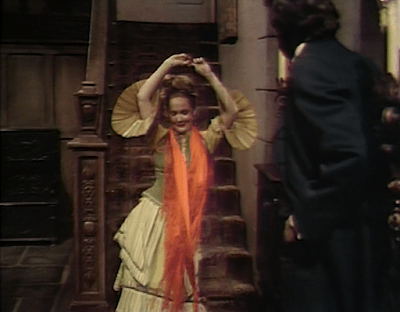
Charity Trask, disastrously uptight step-daughter of Quentin and Edward’s sister Judith, falls under Petofi’s influence and is possessed by the spirit of Cockney showgirl Pansy Faye. Pansy was on the show briefly in June. The childlike Carl Collins, brother to Judith, Edward, and Quentin, was engaged to marry Pansy before she was killed by vampire Dirk Wilkins. Pansy and Charity never met; when Carl asked Charity if she had seen Pansy, the scene was staged to make it seem absurd that the two women could exist in the same universe. Now, they exist in the same body.

Ta Ra Boom De Ayyyy… Screenshot by Dark Shadows Before I Die.

If Petofi has caused startling changes in Jamison, Edward, and Charity, the change in Quentin is perhaps the most jarring of all. He has been a ghost, a homicidal maniac, a Satanist, a zombie, and a werewolf, but always and everywhere a source of total chaos, who destroys all recognized order and is perfectly at home in the midst of sheer madness. Today, Quentin keeps making earnest attempts to restore everyone to their right minds and reestablish the proper and respectable relations within the household.

First time viewers will immediately catch on that the preteen David Henesy is not the actor who would usually play a 150 year old Hungarian nobleman, and when Nancy Barrett suddenly takes on an East London accent and enters wearing a garish costume and doing a dance with lot of hip shaking and pelvic thrusts, they will know that Charity is turning into someone else. The dialogue in the scenes involving Edward explains what is happening to him. They may not know that Quentin is not supposed to be the defender of the status quo. That information is supplied in two scenes. Charity/ Pansy receives a psychic message from the world beyond telling her that Quentin was involved in the murder of Carl, and she announces this information. Also, Quentin calls for help, and the helper who materializes is his distant cousin, Barnabas Collins the vampire.

At the end of the episode, Barnabas lays hold of Jamison/ Petofi and drags him into the secret passage leading from the drawing room to the west wing. It is usually bad news when a vampire abducts a child and shoves him into a dark space, but David Henesy brings such joy to the role of Jamison/ Petofi that we can hardly doubt that what comes next will be equally fun to watch.

Meanwhile, a painter named Charles Delaware Tate has presented himself. Tate’s first appearance will cause a sinking sensation in longtime viewers; he is played by Roger Davis, a terrible actor who delivers much of his dialogue by shouting while clenching the sphincter muscles in his buttocks, and who routinely assaults the women and children in the cast while on camera. We may have hoped we had seen the last of Mr Davis when his most recent character, Dirk, was destroyed shortly after murdering Pansy. But evidently Pansy’s return in the form of another actress has come at the price of Mr Davis’ return in the guise of another character.

For much of 1968, Mr Davis played a man known variously as Peter Bradford and Jeff Clark. His approach to characterization consisted of shouting “My name is Jeff Clark!” When this technique was played out, he took to shouting “My name is Peter Bradford!” He doesn’t shout today, mercifully. But he does say the name “Charles Delaware Tate” quite a few times.

Today’s story about Tate is potentially interesting. Jamison/ Petofi finds him when he answers the front door. Tate asks to see Jamison Collins; Jamison/ Petofi confirms that despite his appearance, he is indeed the person Tate has come to see. Tate accepts this with a blandness that suggests that he knows he is dealing with a magical personage.

Jamison/ Petofi gives Tate a photograph of Quentin and says that he wants a portrait of him. When Quentin comes to the drawing room and finds Tate sketching, he asks who he is. Again, Quentin adopts a stern tone which suits someone defending the sanctity of private property against an unknown intruder. Tate introduces himself and shows him a handwritten letter which Quentin instantly accepts as the product of his grandmother Edith. He tells Tate that Edith has been dead for some time and that he is not interested in a portrait of himself. Tate says that he has already accepted the commission and the money that Edith sent with it, and so he will rent lodgings in the village of Collinsport and finish the job regardless. Quentin does what viewers have hoped everyone who shared a scene with one of Mr Davis’ characters would do, and throws him out.

The forged letter is a fascinating touch for returning viewers. Petofi made himself welcome as a guest at Collinwood by showing Edward forged papers creating the impression that he shared Edward’s friendship with the Earl of Hampshire. That he has also created papers that Quentin immediately accepts as coming from Edith, who died long before Petofi had any reason to come to Collinwood, suggests that his powers of forgery are very extensive indeed.

Tate not only seems to know that Petofi has magical powers; he also shows an acquaintance with Petofi’s henchman Aristide.* When Tate mentions Aristide, he calls him “Aristeedy,” a sort of pet name with a diminutive suffix. This is probably just a blooper on the part of Mr Davis, but since Petofi is continually telling Aristide how lovely he is and how he is more attractive when he doesn’t speak, it does remind us of the gay subtext that runs through their scenes together. We might suspect that Petofi and Aristide’s sexuality is in one way or another one of the reasons they are connected to Tate.

The script opens all of these questions about Tate. Had he been played by an actor who was capable of depicting depth and highlighting ambiguity, it could have been a lot of fun to speculate about just what their answers might be. In #137, future movie star Frederic Forrest was a featured extra on the dance floor at The Blue Whale tavern; it’s easy to suppose he would have taken a speaking part. So when the show puts Mr Davis in front of us, I like to make the time a little more tolerable by imagining what Forrest might have brought to the role of Tate.

*His name is spelled “Aristede” in the closing credits, but it was “Aristide” in the original scripts.

Episode 803: As soon as you’re finished with the mumbo-jumbo

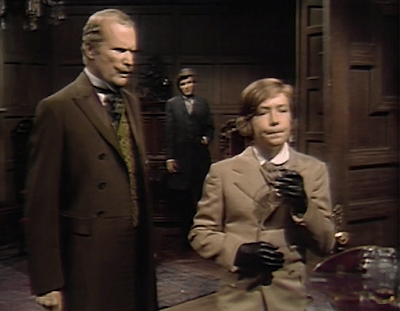
The spirit of evil sorcerer Count Petofi has taken possession of twelve year old Jamison Collins, much to everyone’s consternation. David Henesy spends most of the episode mimicking Thayer David’s Petofi, with hilarious results.

Jamison/ Petofi sipping a glass of “mineral water… for the digestion.” Screenshot by Dark Shadows Before I Die.

We see Jamison’s favorite uncle, Quentin the Satanist, trying to cast a spell to break Petofi’s possession of Jamison. As he always does when he is calling on the dark powers of the unseen realms, Quentin gets very fervent. We pan to Jamison/ Petofi, standing next to Quentin in a state of utter boredom, asking if Quentin will bring him a glass of mineral water once he’s “finished with all the mumbo-jumbo.”

Twice, Jamison/ Petofi pretends he is not possessed, but is his usual preteen self. He does this in order to trick people into letting him kiss them, which is how Petofi’s power spreads to them. This gives Mr Henesy the challenge of showing how Thayer David would play Petofi playing Jamison. That’s the sort of thing an actor needs a director’s help to pull off. Unfortunately, the woeful Henry Kaplan was at the helm today, so we discover that Petofi’s imitation of Jamison sounds exactly like the original, who is in turn uncannily like Jamison’s grandson David Collins and his great-great-grandfather Daniel Collins, who are also played by Mr Henesy.

Those whom Jamison/ Petofi kisses reveal their “true selves.” So maidservant Beth reveals that she was under the power of Jamison’s distant cousin, vampire Barnabas Collins. When Jamison’s father Edward passes this word along to Quentin, Quentin tells him is going to confront Barnabas. Edward has been hunting Barnabas, and by saying this Quentin implies that he knows where Barnabas is and that he has been helping to hide him. For some reason, Edward only smiles in response to this revelation.

Petofi wears a prosthesis in place of his right hand; Edward finds that Jamison’s right hand has also been replaced with a prosthesis. After this horrifying discovery, Jamison/ Petofi kisses Edward. Quentin returns shortly after, and finds that Edward does not recognize him or know the name of the house. Edward identifies himself as a newcomer to the area, and says that he would be glad of any work the family might hire him to do. Evidently his “true self” is a guy who needs a job. Since he has not inherited any assets or accumulated enough to live on, I don’t suppose we can disagree with whatever force it was that declared this to be Edward’s reality.

Episode 793: All the revolted spirits

When wicked witch Angelique first turned Barnabas Collins into a vampire in the 1790s, he went to the waterfront and preyed on the women he found spending their nights there. When Barnabas traveled in time from the 1960s to the year 1897, he again made his way to the waterfront. Whether he bit the women or not, he choked them to death, earning the sobriquet “The Collinsport Strangler.”

Once he had become a vampire, Barnabas displayed so many traits he had come to have in common with Angelique that we suspect he is not only cursed by her, but possessed by her. More precisely, it often seems that when Angelique made Barnabas a vampire she created a copy of her own personality and put it in his mind, where it took control of him. We have further support for that interpretation in today’s opening reprise. We see Angelique on the same set where Barnabas has several times been the last person a young woman would encounter. This time, she encounters a young man. He flirts with her, as the women flirted with Barnabas. Before long, he is choking and within seconds of death because of her action. In this case, she has taken his handkerchief and is tightening it around the neck of a toy soldier that once belonged to Barnabas. She is threatening to kill him unless he tells her where he has hidden the legendary “Hand of Count Petofi.”

The man’s name is Aristide. He capitulates, telling her he buried the hand at the old cemetery, in a grave marked with a stone bearing the name of Townsend. She gives the handkerchief another tug, and he falls down, unconscious.

Later, we are in the great house on the estate of Collinwood. Angelique comes down the stairs, carrying the box in which the hand is kept. Stuffy Edward Collins sees her. Regular viewers have seen the box on a table in the upstairs hallway many times, from the first week of the show onward. It is rather odd that Edward doesn’t ask her why she is carrying it around. Even if we decide to forget that the prop is familiar and decide to treat it as representing something Edward hasn’t seen before, people don’t usually walk around carrying wooden boxes in front of themselves.

Still, Edward does have other matters on his mind. Angelique had been introduced to the family as Barnabas’ fiancée, at a time when all the Collinses knew about Barnabas was that he was their distant cousin. She disappeared when he was exposed as a vampire. Edward tells her that the family’s lawyer, Evan Hanley, told him that he knew her before she met Barnabas, and that he believes that her association with him was innocent. Edward also says that he cannot believe that this is true. Angelique tells Edward a story about Barnabas biting her and making him her slave; Edward is convinced instantly, and declines her offer to leave at once. He urges her to stay at Collinwood until she can make new plans.

Meanwhile, we have learned that Aristide is alive and not seriously injured. A man in a set of whiskers that represent the aesthetic sensibilities of the late Victorian era developed to their uttermost extremity finds Aristide crumpled on the ground, rouses him from unconsciousness, and responds to his story about Angelique almost killing him with dismay that she stopped short. He tells Aristide not to do anything more. His own credentials are in order, and he will present them at Collinwood as he sets about his second attempt to get the hand.

The man does go to Collinwood. He gives Edward a letter from their “mutual friend,” the Earl of Hampshire. It attests to the good character of its bearer, Victor Fenn Gibbon. Edward insists that Fenn Gibbon stay in the house, and he accepts.

Angelique emerges from the drawing room, still carrying the box. Edward continues to ignore it; Fenn Gibbon can’t take his eyes off it. Edward introduces her as Angelique Duvall. This is the first time we have heard the name “Duvall” in connection with her; when we met her in the part of the show set in the 1790s, her name was Angelique Bouchard, and when she turned up in 1968 she called herself Cassandra Blair. Fenn Gibbon asks if she is French. She says that she was born in the USA, but that her forebears were French people who lived on Martinique. Indeed, when she was known as Angelique Bouchard she lived on that island, and it was there she met Barnabas. Fenn Gibbon tells her that lovely as France’s colonial possessions may be, none is as “exquisite” as she. She is charmed, and excuses herself. She leaves the house, taking the box with her.

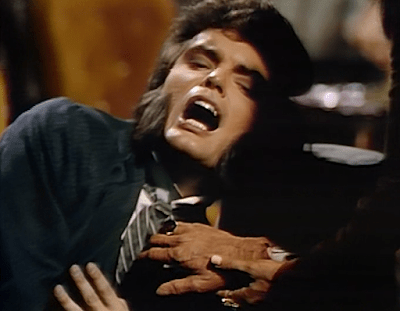
While Fenn Gibbon regales Edward with tales of derring-do from the battle of Khartoum, Angelique takes the box to the Old House. There, she meets the rakish Quentin Collins, whose desperately handsome face has been severely disfigured by a previous encounter with the hand. Angelique dismisses Quentin’s girlfriend, maidservant Beth, telling her that she cannot be present during what she must now do for Quentin. Beth leaves, Angelique shows Quentin the hand, and Quentin demands that Angelique set to work curing him. She says there will be a price for her services. If she cures him, he will have to marry her. He has nothing to lose, and she looks exactly like Lara Parker, so of course he agrees.

Angelique picks up the hand and gets to work casting a spell, but the hand quickly escapes her control. She turns to find that it is on Quentin and he is in agony. He pleads with her to help, she cries out that she can do nothing, and we see Fenn Gibbon peering in through the window.

Fenn Gibbon looks on. Screenshot by Dark Shadows Before I Die.

Fenn Gibbon* is the fifth role Thayer David played on Dark Shadows. The first, second, and fourth were all closely associated with the Old House. They were crazed handyman Matthew Morgan, who holed up there after he killed local man Bill Malloy; much-put-upon indentured servant Ben Stokes, who lived and worked there; and broad ethnic stereotype Sandor Rákóczi, who with his even more offensively conceived wife Magda lives at the Old House in 1897. With this iconography behind David, regular viewers will know that when they see Fenn Gibbon in the window of the Old House, they are seeing a man who knows his way around the place.

David’s third role sheds even more light on Fenn Gibbon. In the parts of the show set in 1968 and subsequent years, he plays Professor Timothy Eliot Stokes, expert on the occult and descendant of Ben. Unlike most of the characters who made a splash on the show, Stokes has a functioning conscience. He does not always live within the law, but he always strives to do what is right. When we see that Fenn Gibbon knows about the hand and has orchestrated a criminal conspiracy to obtain it, we see that he is an evil version of Stokes. At once this makes him fascinating to regular viewers. Stokes himself is a reimagining of the show’s first academic specialist in the paranormal, Dr Peter Guthrie, who was killed by a witch in #186. He is a jovial and talkative eccentric, where Guthrie was a tight-lipped and understated Yankee. Fenn Gibbon seems to have inherited Stokes’ whimsical bent and exaggerated manner; we now have to wonder what Stokes would be like as a villain.

Even those who joined the show after it went to 1897 and who therefore do not know about Stokes will be intrigued when they see David as Fenn Gibbon. Sandor hasn’t appeared since #750, but he is still alive. This marks the first time Dark Shadows has cast the same actor as two living characters in the same time frame.** Sometimes an actor has doubled as a living character and as a ghost, or has appeared in two roles in parts of an episode set in different periods of history. But this is a new frontier for doubling on the show. Sandor is always a lot of fun, so we might hope that he will be back and that he and Fenn Gibbon just won’t have scenes together. But coming on the heels of his long absence, it does have an ominous ring.

In #758, Quentin backed Angelique against a wall and asked her why she preferred Barnabas to him. That was a very good question. The two of them are obviously attracted to each other, and have a lot of fun every time they are alone together. By contrast, the only emotions Barnabas has ever shown in response to Angelique are glumness and rage. Her maniacal insistence that Barnabas should love her drove Angelique to wreak immense havoc in the 1790s, and also motivated some story in 1968. But there is nothing to it beyond his misery and her self-absorption. When we see her turn her attentions to Quentin, longtime viewers will cheer at the hope that we are about to be freed from that dead end once and for all.

*He introduces himself today as “Fenn Gibbons,” which is how he is almost always addressed. But the closing credits leave the S off his name. The closing credits have been unreliable lately, identifying Edward as his grandson Roger and misspelling Aristide’s name. Still, “Fenn Gibbon” sounds better to me; “Fenn Gibbons” suggests a group of small apes found in a peat bog.

**Don Briscoe briefly played both werewolf Chris Jennings and Chris’ brother Tom, but that is only a partial exception- Tom was a vampire at that time.

Episode 788: From a beast to a man

A day of transformations. At dawn, the werewolf in the cell at the Collinsport jail turned into Quentin Collins. Edward Collins, Quentin’s stuffy brother, witnessed the transformation, and when we first see him he is staring at Quentin in bewilderment. Quentin is wearing the same blue suit he always wears, with the same distinctive hairstyle. But he has a glob of makeup on his face, and that’s enough to stymie Edward’s ability to recognize him.

Who could it possibly be? Screenshot by Dark Shadows Before I Die.

This may reflect a hereditary disability of some kind. In #784, Quentin’s old friend and fellow Satanist, Evan Hanley, tried to steal the magical Hand of Count Petofi. The hand raised itself to Evan’s face and disfigured him, leaving his gray suit and highly identifiable hair and beard unchanged. But when Quentin saw Evan in #785, he was completely stumped as to who he might be.

Broad ethnic stereotype Magda Rákóczi enters. Edward accuses her of knowing who the man in the cell before them is. Magda does not share the Collinses’ peculiar inability to recognize people wearing facial appliances, so of course she does know. But she denies it. Edward does not believe her denials, and leaves in a huff.

Magda talks to Quentin, and he begins to speak. But he is not replying to her. Instead, he delivers lines that Count Petofi himself might have spoken when he was dwelling on the loss of his hand. He murmurs about “the forest of Ojden” and “the nine Gypsies” and suchlike. Magda realizes that Quentin has no idea who he is or what is going on.

Magda had placed the hand on Quentin’s heart the night before, as the moon was rising, hoping it would prevent the transformation. It didn’t do that, but by inflicting the same kind of facial disfigurement on Quentin that it had previously brought to Evan it does keep the werewolf story going beyond what might seem like a natural conclusion. When Magda leaves Quentin, she says that come nightfall she will consult with Quentin’s distant cousin, time-traveling vampire Barnabas Collins. “He will know what to do!” she declares. Barnabas has been the central character of the show for more than two years, and he has yet to have a non-disastrous idea. Ya gotta have hope, I guess.

At home in the great house of Collinwood, Edward tries to interest his sister Judith in the fact that he just saw a wolf turn into a human. She impatiently declares that she is not going to spend all day thinking about such a thing. Edward starts to remind Judith that she saw the wolf herself. He might have mentioned that she has seen it more than once, including in the very room where they are standing, but she says that it is “morbid” to go on paying attention to the topic once the creature has been caught and they can believe that they are safe.

Judith tells Edward that she had a bad dream. She won’t talk with him about that either. He needles her about her recent marriage to the Rev’d Mr Gregory Trask, which he calls “ridiculous.” She says that she does not regret her marriage, and that even if she did it would not be any more ridiculous than his own marriage. Since Edward’s wife was an undead fire witch who tried to incinerate their children to prolong her existence, all he can say to that is “Touché.”

Edward exits, and Judith dwells on her dream. It concerned Trask’s late wife Minerva. Minerva died in #773; Judith married Trask in #784. Judith knows that a young man named Tim Shaw poisoned Minerva, and that Trask gave Tim an alibi. She believes that Trask has forsworn justice for Minerva’s death for her sake. Tim knew that Judith, while under a magic spell, had shot his girlfriend Rachel Drummond to death, and he threatened to expose her if Trask handed him over to the police. What Judith did not know, and what is not mentioned today, is that Tim himself had acted under a spell. Trask and Evan connived to brainwash Tim so that when the Queen of Spades turned up in a card game he would poison Minerva. In her dream, Minerva told Judith that there was danger, then repeated the phrase “Queen of Spades” several times.

Judith turns around and looks at a table. It had been bare when last she saw it, and there was no one else in the room. But now a solitaire game is laid out there. She screams, and Edward comes. Judith turns up the Queen of Spades, and walks out the front door. Edward follows her to Minerva’s grave.

Judith tells Edward her dream, and he transforms into a psychoanalyst. “Your dream is nothing more than a manifestation of your own guilt.” Judith asks Edward what he imagines her to feel guilty about, and he says that she married Trask so shortly after Minerva’s death. She dismisses this, and soon goes into a trance. She wavers back and forth from the waist for a moment, then straightens up with a jolt. When Edward calls to her by her first name, she replies “I will thank you to call me Mrs Trask!” Edward doesn’t know what to make of this demand, but the audience knows that Minerva has taken possession of Judith.

Back at Collinwood, Edward meets Magda. She tells him that she is there to see maidservant Beth. Edward says that he hasn’t seen her all day. That puts him up on the audience; we haven’t seen her since #771. When they were setting up for the trip to this period, Beth was presented as a major character, and her ghost haunted the Collinwood of 1969 along with Quentin’s. When Barnabas and we first arrived in the year 1897 in #701, Beth figured very largely in the story for several weeks. But Terrayne Crawford’s limitations as an actress required Beth to be written as someone who says just what she means, no more and no less. Since the rest of the cast is able to rise to the task of portraying complex motivations and multilayered communication, and since Dark Shadows finally has a writing staff that can provide those things consistently, Miss Crawford has faded further and further into the background.

Edward goes to the drawing room and telephones Evan. Magda eavesdrops. She knows of Evan’s disfigurement, Edward does not. Edward tells Evan he must come over at once, that there is an emergency he must address in his capacity as Collins family attorney. Evan does not want anyone to see his face, and so he tries to beg off. Edward threatens to fire him if he does not show up. Evan has been making vain efforts to restore his appearance for days; he looks at himself in the mirror, and returning viewers might draw the conclusion that his goose is cooked.

That Evan’s face is still disfigured after we have seen Quentin’s disfigurement raises the possibility that the show is heading towards an all-disfigured cast. Evan is played by the conspicuously handsome Humbert Allen Astredo, and as Quentin David Selby’s good looks have become one of the show’s very biggest draws. If they are both going to be uglified for the duration, then there is nothing to stop anyone from having some plastic glued onto their face.

Judith enters. She does not recognize Magda and announces that she is Minerva. She closes herself in the drawing room.

Evan arrives, looking like his old self. Magda is astonished. When they have a moment alone together, he responds to her questions by saying that he will never tell her what happened to undo the hand’s work. That will hook returning viewers more effectively than any cliffhanger is likely to do- Evan’s case had seemed absolutely hopeless.

When Edward tells Evan what Judith has been doing, Evan starts playing psychiatrist, picking up where Edward had left off. “Well now, tell me exactly how she has been behaving. In what way is this delusion manifesting itself?” Edward sends Evan in to see for himself. Minerva/ Judith reacts to the sight of him with horror. She says that he was the one who made Tim Shaw poison her. Minerva did not know this in life, but it has long since been established on Dark Shadows that the dead pick up a lot of information in the afterlife. The murders have been coming thick and fast in 1897, and if all the victims talk to each other they would have a pretty easy time piecing together what has been happening behind closed doors. We end with Minerva/ Judith holding a letter opener over her head, walking towards Evan with evident intent of stabbing him.

Episode 785: Time is my hobby

Early in 1969, the great estate of Collinwood became uninhabitable. The ghost of Quentin Collins took possession of the place and was about to kill strange and troubled boy David Collins. Quentin and David’s distant cousin Barnabas Collins traveled back in time to the year 1897, when Quentin was a living being, and hoped to somehow prevent Quentin from becoming an evil spirit.

So far, Barnabas has managed to make everything much, much worse. As soon as he arrived in 1897, he found that he had become a vampire. So far, he has been responsible for at least six homicides that did not take place the first time through this period of history. He has also enslaved three people by biting them. He has not prevented a curse that has made Quentin a werewolf, which is evidently the origin of the disaster at Collinwood in 1969.

Moreover, Barnabas’ blunderings have caused Judith Collins, who owns Collinwood and the Collins family businesses, to become close to the hypocritical Rev’d Gregory Trask. Trask has responded to Judith’s interest in him by enlisting lawyer/ Satanist Evan Hanley to carry out a particularly cruel plan to murder Trask’s wife Minerva. Now Trask and Judith are married. Today she tells her brothers, Quentin and the stuffy Edward, that she is changing her will. Edward’s twelve year old son Jamison will still be her heir, but Gregory will administer the estate if Judith dies before Jamison is 21. Regular viewers know, not only that Gregory killed Minerva on the off-chance that he would thereby get a shot at taking Judith’s money, but that he is a sadist who takes special pleasure in making Jamison miserable. So this provision is a death sentence for Jamison. Since the residents of the great house at Collinwood in the 1960s are Jamison’s daughter Liz, son Roger, and grandchildren Carolyn and David, Trask will negate Dark Shadows‘ contemporary timeline if he murders Jamison.

It is not impossible that this might happen. The show is now chiefly about time travel, and the 1960s are not an indispensable destination. Barnabas did leave a few interesting characters behind when he traveled to the nineteenth century- sooner or later he is going to have to be reunited with mad scientist Julia Hoffman, MD, and occult expert Professor Timothy Eliot Stokes also has a lot to offer. But if Barnabas could find a way to come unstuck in time, Julia and Stokes can too. Wicked witch Angelique has already made her way to 1897. And anyone else we might miss can be replaced by the same actor playing a similar part. It does seem unlikely Collinwood will become Traskwood. But in April 1967 it seemed even less likely that the ABC network would devote thirty minutes of airtime five days a week to showing a vampire feeling sorry for himself, yet here we are.

Quentin is amused by Judith’s marriage to Trask, Edward appalled. Edward tells Judith that their grandmother’s will specified that he and Quentin would have the right to stay in the house as long as they wished, a point Judith concedes. This is a retcon. When the will was read in #714, it was made very clear that only Quentin was given a place in the house. Jamison was named as contingent heir. Edward was not mentioned at all. Neither was Carl Collins, another brother of Judith’s, whom Barnabas murdered a couple of days ago and who has already been forgotten.

Judith runs Edward and Quentin out of the drawing room. When she comes back in, she finds that the new will has been torn to shreds, a dagger has been stuck into a Bible under a verse lamenting the sufferings of the righteous, and there is a childish drawing tacked to the wall labeled “Mrs Trask.” Although “Mrs Trask” is now her own name, a fact which she proudly declared to Edward a few minutes before, she immediately assumes the drawing depicts Minerva.

Not the usual sort of portrait one finds on the walls of the great house. Screenshot by Dark Shadows Before I Die.

This resonates with two stories that longtime viewers will remember. From November 1967 to March 1968, Dark Shadows was set in the 1790s. The ancestor of the future Collinses in that period was Daniel Collins, who like Jamison and David is played by David Henesy. Daniel’s big sister Millicent married roguish naval officer Nathan Forbes, who set about trying to murder Daniel in order to get all of Millicent’s wealth for himself.

Yesterday Judith saw Minerva’s ghost in the same part of the drawing room where these odd occurrences have taken place, and the Biblical verse is very much the sort of thing Minerva would have been likely to quote. So we are to assume that she is indulging in a little poltergeist activity. But the “Mrs Trask” drawing is so unlike anything the somber Minerva would have made herself that we can only assume she took it from some other spirit out in the unseen realm. Since “Mrs Trask” is Judith’s name now, the question of who that spirit might be brings up a second old story.

From March to July 1967, Liz was being blackmailed by seagoing con man Jason McGuire. Jason’s ultimate demand was that Liz should marry him, giving him control of the Collins family fortune. Liz’ daughter Carolyn was outraged when it looked like she was going to marry Jason, and in #252 she taunted her mother by shouting the name “Mrs McGuire!” over and again. Perhaps Minerva’s dead spirit has crossed paths with Carolyn’s unborn one, and Carolyn has drawn the picture as a way of rehearsing for that scene. Though Carolyn is an adult, Jamison had a dream in #767 in which he caught a glimpse of the Collinwood of 1969 and saw that Carolyn has a fondness for childish imagery.

There is also some business in this episode about broad ethnic stereotype Magda Rákóczi’s effort to lift the werewolf curse she placed on Quentin. Magda has stolen a severed hand that has magic powers and plans to put it on Quentin’s heart when he begins transforming tonight. Yesterday, Evan forced Magda to let him see the hand; when he looked at it, the hand grabbed him. It left him unconscious and severely disfigured. Now Magda is keeping Evan in her home, the Old House at Collinwood, and treating him with surprising tenderness. Quentin sees Evan there. He does not recognize him, even though he and Evan were close friends, Evan is wearing the same gray suit he always wore, and his very distinctive hair and beard are unchanged. Eventually Evan regains the ability to say his name, and Quentin freaks out. He does not want to go through with Magda’s plan, but when the transformation begins he drops his opposition.

Magda placed the hand on Quentin. Screenshot by Dark Shadows Before I Die.

The hand looks very much like a Halloween decoration, so much so that I wonder if Dan Curtis hoped to make some money by getting copies of it into department stores by October 1969. It’s pretty disgusting to look at, but that’s the point.

One of the problems Dark Shadows had throughout its run was that it tended to veer between appealing exclusively to adults and exclusively to children. In the early months, its glacial pace, heavy atmosphere, psychological depth, and reliance on the star power of Joan Bennett drew a rather mature audience. As the supernatural and fantastic themes came to predominate, the average age of the viewers dropped towards the single digits. By the end of the big Monster Mash that ran through 1968, the show’s strongest demographic was probably elementary school pupils. Dividing an episode between the relatively adult melodrama of Edward’s reaction to the Judith/ Trask marriage and the undisguised kids’ stuff of The Hand of Count Petofi would seem to be a way of offering something to both the oldest and youngest viewers.

This episode originally aired on 27 June 1969. That was the third anniversary of the show’s premiere. That first installment, like 332 of those that followed it, revolved around the character of well-meaning governess Victoria Winters, played by Alexandra Moltke Isles. Mrs Isles left the show in November 1968; her son Adam Isles, who would in the 2000s become a top official of the USA’s Department of Homeland Security, was born this day. Mrs Isles has said in interviews that while she was recovering from the birth she tuned in to Dark Shadows, but that the show had changed so much in her time away from it that she couldn’t figure out what was going on.

I imagine Mrs Isles had changed a great deal as well. Like so many members of the cast and production staff, she was a fashionable, sophisticated New York society figure. While she was working on the show, she was immersed in its imaginary world, but after several months away she would have refocused her attention on the sorts of things she was raised to care about when she was growing up as the daughter of Countess Mab Moltke. One doubts that magical severed hands, werewolves, devil worshipers, and actors in brownface makeup would have ranked especially high on that list.

Episode 781: Sympathy somewhat disturbing

When vampire Barnabas Collins first appeared on Dark Shadows in April 1967, regular viewers may have thought they knew what to expect. They had just spent four months focused on undead blonde fire witch Laura Murdoch Collins, mother of strange and troubled boy David. David’s well-meaning governess Victoria Winters gradually realized that Laura was a deadly threat to him. After some initial confusion, Vicki rallied the other characters in opposition to Laura. Ultimately Laura went up in smoke and David escaped her clutches, choosing Vicki and life over his mother and death.

In many ways, the Laura story was modeled on Bram Stoker’s Dracula. So when Laura’s successor as supernatural menace was an out and out vampire, we may have expected further mining of that source. Barnabas bit and abducted Vicki’s friend Maggie Evans. As the daughter of drunken artist Sam, Maggie had played a key role in the “Revenge of Burke Devlin” storyline. But that storyline fizzled in the show’s early months, and by #201 even Burke Devlin lost interest in it. Maggie was at that point surplus to requirements, and when Barnabas added her to his diet we might have suspected that she would die and rise as a vampire. As Mina and the group she led in Dracula had to destroy her friend Lucy when Lucy rose as “the Bloofer Lady,” so Vicki and her friends would have to destroy Maggie. Vicki herself would then stake Barnabas. The average viewer would have expected this to be the sign to move on to the next menace; those who were aware of TV ratings and programming decisions might think it would be Dark Shadows‘ way of going out with a flourish before its impending cancellation.

Barnabas turned out to be a hit. The idea of a vampire on a daytime soap was such an oddity that a sizable new audience tuned in out of curiosity, and Jonathan Frid’s portrayal of Barnabas’ scramble to impersonate a living man native to the twentieth century resonated with so many of them that he became a breakout star. So they had to figure out a way to make him a permanent part of the cast. That meant Maggie couldn’t die. In the first place, they couldn’t risk making Barnabas responsible for the death of so likable a character. Second, as the survivor of the horrendous abuse Barnabas inflicts on her Maggie would have a new function, as the witness who might emerge to expose him and wreck the show. Third, while Maggie was in Barnabas’ clutches Kathryn Leigh Scott proved herself such a versatile actress that it would obviously damage the show to lose her. So Barnabas not only failed to kill Maggie, he completed only two homicides in the whole of 1967. Each of his two victims was a male character who had run out of story. As a result, the killings and the victims were quickly forgotten.

Barnabas’ nonlethal vampirism made it easier to keep the cast intact, but it also drained him of the lurid novelty that had made him such a draw. To reassure the audience that Barnabas really was a bloodthirsty fiend from the depths of Hell, the show had Vicki come unstuck in time in #365. She found herself in the 1790s, when Barnabas first became a vampire. That gave us a whole cast of characters whom we did not expect to see again once the show returned to contemporary dress. So Barnabas was free to slaughter people to his heart’s content.

The 1790s flashback was a hit in the ratings. When Vicki brought us back to 1968 in #461, the makers of the show had to figure out a way to keep the momentum going. They cured Barnabas of the effects of the vampire curse and surrounded him with a hectic parade of other refugees from 1930s horror movies- mad scientists, Frankensteins, witches, werewolves, and a couple of fresh vampires. After that Monster Mash period exhausted itself, they took us through a long, deliberately paced segment focusing on just two stories, one about a tormented werewolf and the other about a ghost who takes possession first of two young children, then of the whole estate of Collinwood. Barnabas, who has come to see himself as a good guy and the protector of the family, tries to cure the werewolf and reason with the ghost. His efforts instead transport him back in time to 1897.

In that year, Barnabas is a vampire again. He keeps saying that his only goal is to prevent the evils that will befall the family in 1969, but he is as uninhibitedly murderous as he ever was in the periods when he was unambiguously a villain. In Friday’s episode, he murdered one of the principal members of the Collins family, prankster Carl Collins, uncle of the Jamison Collins whose daughter and son are the adults at Collinwood in the 1960s. Barnabas had become so careless after so many killings that he left Carl’s body propped up behind the curtains in the windows of the drawing room, where it fell into plain view moments after Barnabas’ foe the Rev’d Gregory Trask entered. In this episode, Trask enlists Edward Collins, brother of Carl and father of Jamison, to help him hunt Barnabas.

My wife, Mrs Acilius, points out that when we see a character closing the doors to the drawing room, that person is in charge of the house. So in the early months of the show matriarch Liz was the one to close the doors; when Liz was taken to a hospital and her daughter Carolyn was in charge, Carolyn closed the doors. When Vicki was fully in command of the campaign against Laura, she closed the doors to consult privately with her lieutenants. When Trask and Edward go into the drawing room to discuss the situation, it is Trask who closes the doors. Vicki was good, so consistently so that she had to be written out of the show months ago. But Trask is overwhelmingly evil. That he has ascended to the rank of door-closer means that virtue has no stronghold anywhere.

Edward and Trask go to the Old House on the estate, where Barnabas has been staying. They find Barnabas’ reluctant sidekick, broad ethnic stereotype Magda Rákóczi. Magda denies that Barnabas is in the house and pretends not to know what Trask and Edward are talking about when they say that Barnabas is a vampire. Trask slaps Magda in the face; we have seen many face-slaps on Dark Shadows, but so far as I can recall this is the first delivered while the slap-ee has her back to the camera. Since he does not have to swing his hand very close to Grayson Hall’s face, Jerry Lacy can therefore put full force into the gesture, making it look like Trask is delivering a truly brutal blow to Magda. Afterward, Magda rubs her face and vows revenge on Trask. She quotes a rather confusing “old gypsy saying”: “Walk fast and the Devil will overtake you; walk slow and misfortune will catch you. You’d better not walk slow, because I will never be far behind.”

Edward and Trask search the Old House and find nothing. At dusk, Barnabas emerges from the secret room behind the bookcase in the front parlor. Magda hadn’t thought to look there, and Trask and Edward didn’t know the room existed. Barnabas says he will have to find a new hiding place for his coffin. Magda says she will do whatever she can to help him. Barnabas is surprised at her support for him; after all, he has bitten and enslaved her husband Sandor, and his destruction would mean Sandor’s restoration. Magda has an atypical moment of speechlessness, after which she says that Trask is an “animal” and must be punished at all costs.

Trask and Edward went back to the main house early in the morning to look for the plans to the Old House. It apparently took them all day to find them. By the time they have gone through them and identified all of its secret rooms, Barnabas is already up. They come back to the Old House and find the empty coffin in the secret room. Trask says that he will make the coffin “unusable” for Barnabas before daybreak. He leaves Edward, who is carrying a gun loaded with silver bullets, to guard the house.

Barnabas goes to one of his blood-thralls, Trask’s daughter Charity. He tells Charity that he is “in serious trouble” and commands her to go to the basement of the Old House. There, she will find some soil from his original grave, which he needs to prepare his new resting place. He tells her about a tunnel from the beach to the basement which she can use to elude detection by Edward. Since Barnabas has just materialized in Charity’s room and will shortly materialize in the secret room in the Old House while Edward is standing on the other side of the bookcase, we wonder why he can’t use that same power to get into the basement himself.

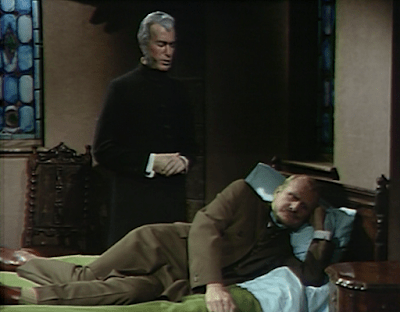
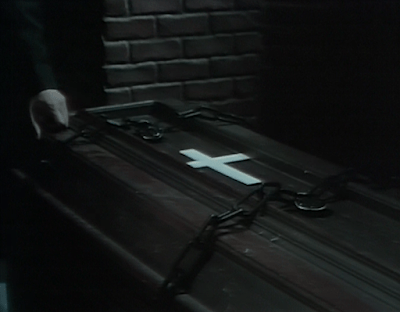
Barnabas finds that the coffin is topped with a cross. He can’t get close enough to take hold of the coffin and move it, so presumably even after he gets the soil he needs he will have to plunder a mortuary showroom to get a fresh resting place before dawn.

The unusable coffin. Screenshot by Dark Shadows Before I Die.

Charity does go to the basement. She puts some soil in her purse, then knocks over a crate, attracting Edward’s attention. She does not run away, but merely hides in an alcove until Edward comes down, sees her in shadow, and orders her to show herself.