Episode 33: The one with Harvey Keitel

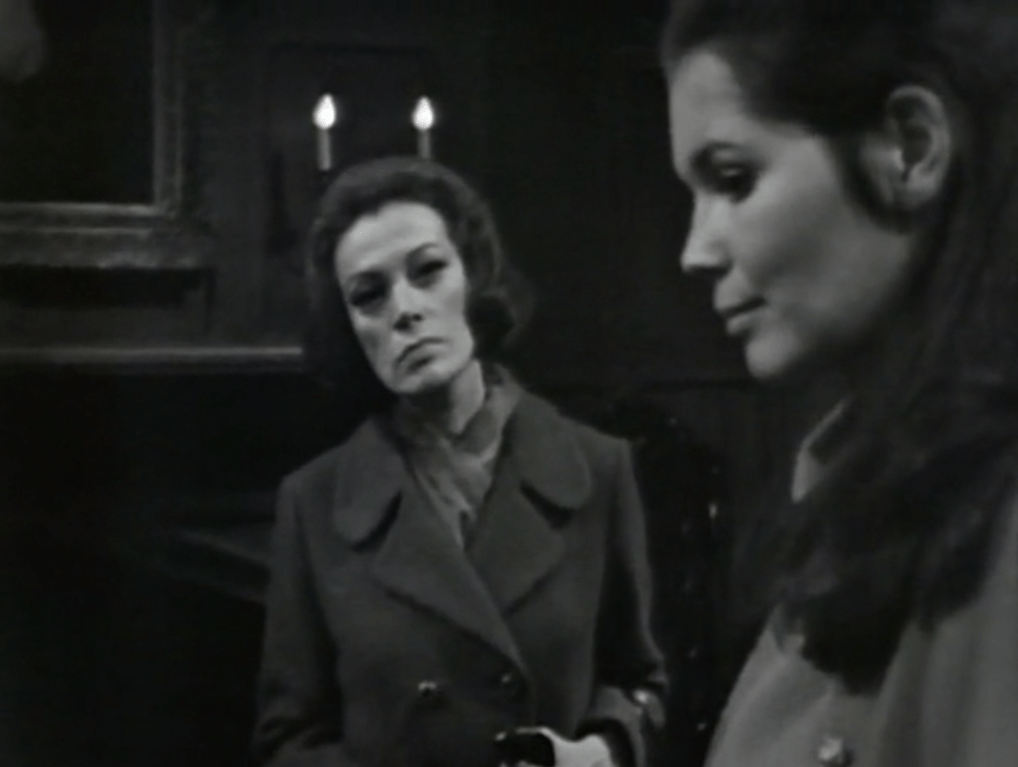
At Collinwood, Liz tells Carolyn that David won’t be going away just because he tried to murder his father. “Things will go on just as before.” On the other hand, Carolyn should marry Joe and leave the house, because “You’re the only one of us who can have a sane, happy life.” I suppose we’ve all seen that in real life, someone swinging wildly between deep denial and exaggerated despair. Two forms of learned helplessness, I guess.

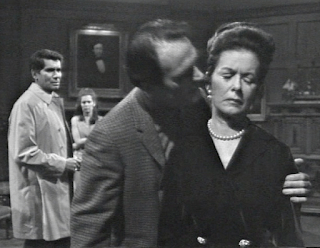
At the Blue Whale, Joe is getting well and truly sloshed. Burke joins him at his table, interrupting a conversation between Joe and his whiskey glass. Joe tells Burke that he doesn’t like him, expresses his frustration with Carolyn’s refusal to get married, then goes to Collinwood, roaring drunk, and tells Carolyn, Liz, and Vicki what he thinks of them.

One thing Joe thinks is that Carolyn is doomed to be a spinster. Considering that she’s supposed to be about seventeen, that does call to mind Barnabas’ line to Carolyn in the 2012 Dark Shadows movie, “Fifteen? And no husband?

Marc Masse brings this point out well on his Dark Shadows from the Beginning, and argues that the depiction of Carolyn may be one of the things that sunk the show with young viewers between the end of the first month and the introduction of the vampire:

You have to wonder what kind of impression the character of Carolyn Stoddard would have made to young viewers in 1966. Here she is having grown up in a mansion with forty rooms and her only option in life is to be married off before her eighteenth birthday to a local fisherman, or else face a life of lonely spinsterhood. In that respect, Dark Shadows seems to belong to the sensibilities of previous decades.

This paragraph is part of an in-depth discussion of Dark Shadows’ place on ABC’s schedule, its ratings, the show that preceded it in its time-slot, and Art Wallace’s rather antiquated view of the world. It’s all very informative, highly recommended.

When Joe passes out on the couch, Vicki goes to town. She goes to the Blue Whale, where Burke asks if she’s looking for someone. “I just found him,” she replies. Obviously, she’s talking about Harvey Keitel, who is dancing a few feet away from her.

That Harvey Keitel was once an extra on Dark Shadows is pretty interesting. If he took that job, clearly he would have taken a speaking part. I gave some thought to parts I wish he had taken in comments on Danny Horn’s Dark Shadows Every Day four times: here (on episode 470,) here (on episode 769,) here (on episode 1057,) and here (on episode 1137.)

Episode 32: Where all criminals belong

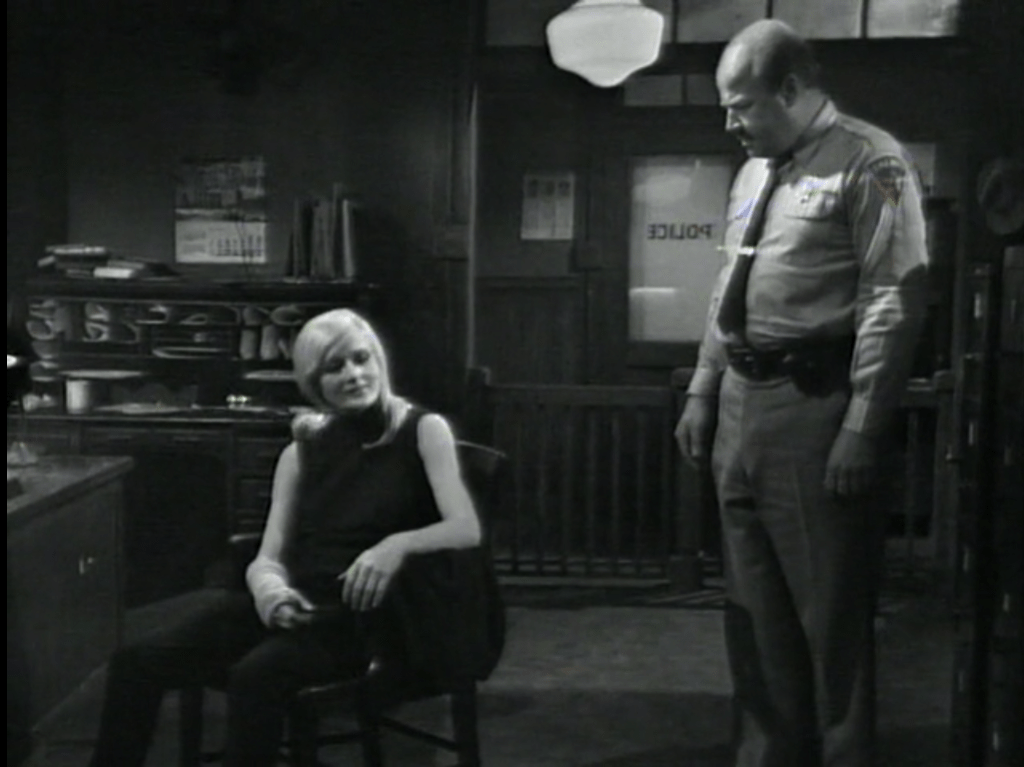
In today’s compare-and-contrast, we see the sheriff and Bill Malloy demonstrating how mentally healthy people might react to the idea that a nine year old boy has devised and executed a plan to murder his father. Then we go to Collinwood, where we see how Liz and Roger react to the idea.

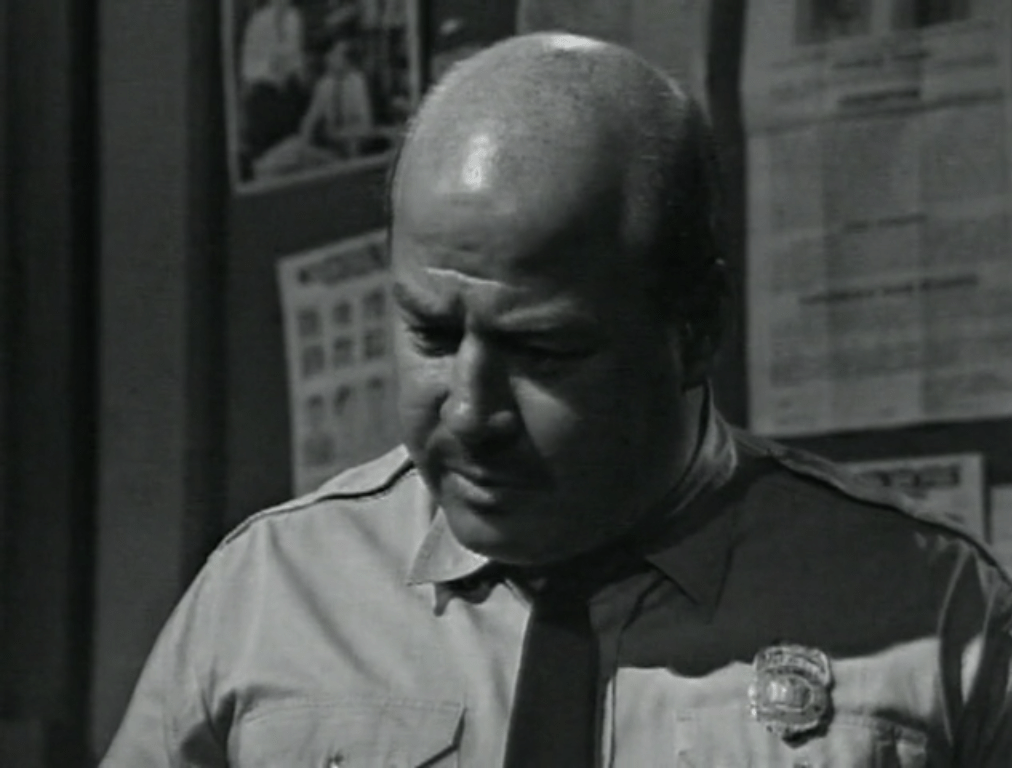
The sheriff can’t bring himself to say out loud what the evidence is leading him to suspect David has done. Bill can say it only in part, and then only to express shock and bewilderment.

The scenes between Liz and Roger in this episode are among the strongest in the entire series. Roger is quite drunk, almost giddy, almost laughing at the fact that his son tried to kill him. Liz cycles through a half dozen intense emotions before finally accepting the fact that David is the culprit. She orders Roger to lie to the sheriff and say that what happened to his car was a simple accident, that no one was at fault.

In response to her explanation that this is the sort of thing the Collinses have always done, Roger brings up his suspicion that David may not be a Collins at all. David was born less than nine months after Roger and Laura* were married; she’d been Burke’s girl… Liz won’t hear such things, and insists that David is a Collins, that he belongs to all of the ancestors. She blames Roger for raising David in a home where he knew nothing but hate from the moment he was born, hate he couldn’t understand or cope with.

Roger insists that David be sent away to a mental hospital; Liz says no, that he will stay in the house, that “Miss Winters and I” will give him the home life he needs. Her mention of “Miss Winters” in this connection makes it clear that Vicki is central to Liz’ plans for the future, whatever those might be.

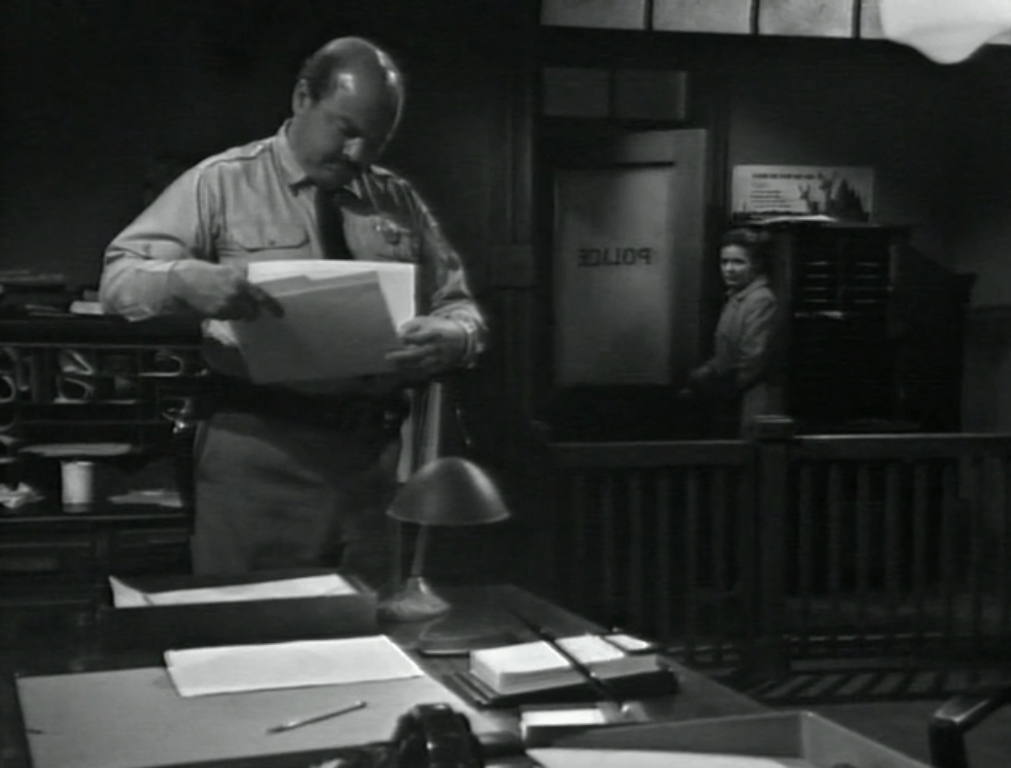
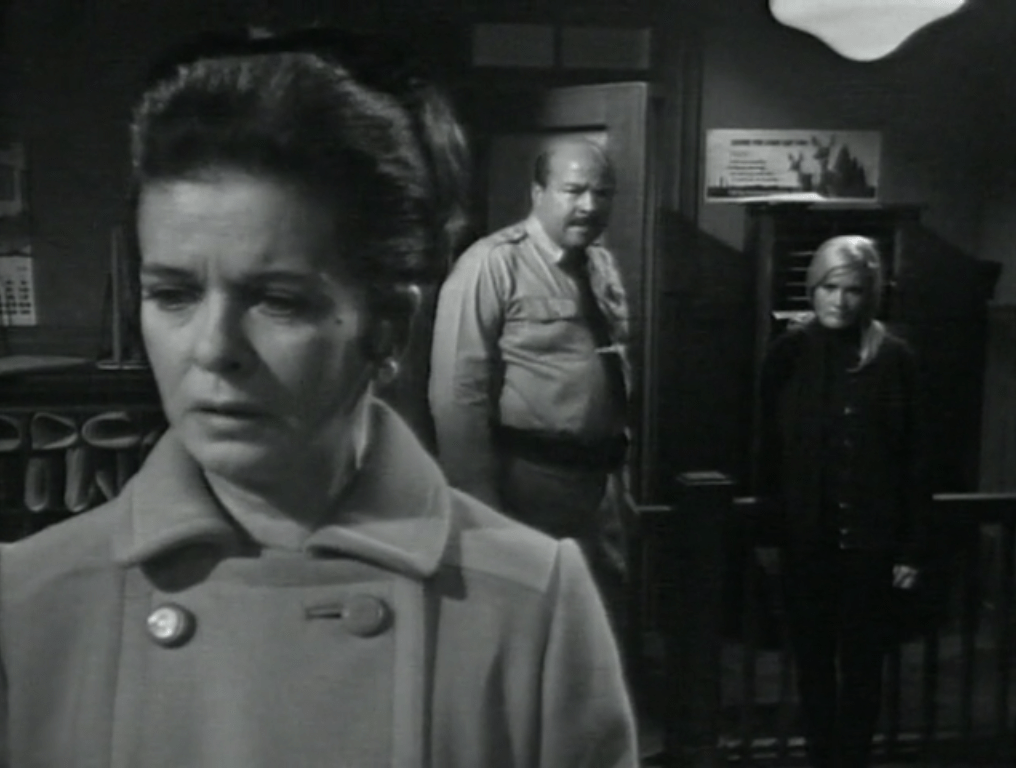
The sheriff shows up. He’s taking his time to get to the point. Roger cuts him off: “Is it about David?” At that, even the background music falls silent. The sheriff starts talking. Liz jumps in and says that the sheriff should drop the investigation, that it was all just an accident. The sheriff looks uneasily from Liz to Roger and back again, and finally agrees to do so.

In the coda, Roger tells Liz that she will regret covering up for David. He gives her a look of contempt that is among the most powerful things I’ve ever seen on a screen. Liz is totally alone now; Roger will obey her, but he’ll never respect her again. Joan Bennett was pushed to the margins of the show in later years, but she really did fill her “Starring” credit in these first months. It isn’t every show that would present us the leading lady devastated like this.

*Aside from the prologue delivered by Alexandra Moltke Isles, there are no surviving cast members in this episode. As of 9 August 2022, it is the earliest episode of which that can be said.

**Laura’s name is first mentioned here.

Episode 25: A neat way of managing people

The episode revolves around a letter to Victoria from the Hammond Foundling Home. The letter reports that no one connected with the Home had ever heard of the Elizabeth Collins Stoddard or any of the other Collinses before the letter came offering Vicki the job as David’s governess. This letter has set Elizabeth into a panic, since it exposes as a lie her story that Roger was friends with someone connected to the Home and that that person had recommended her. It sets David into an even more extreme panic, since he is terrified that his father will send him away to some kind of institution where children are kept and the Hammond Foundling Home is such an institution.

In her panic, Elizabeth demands that Roger sit down with Vicki and corroborate her lie. Roger is worried that Burke, who has hired private investigators to look into Vicki’s background, will discover some piece of information that will damage the family, and wants Elizabeth to confide in him. He is insistent enough about this to raise the audience’s hopes that in some future episode, we will get answers about Vicki through dialogue between the two of them. For now, she shuts him down by threatening to throw him out of the house unless he obeys her.

When Roger does talk with Vicki, she reminds him that she had asked him if she knew anything about her or about the reason she was hired when they first met. He had said no, and in every way showed bafflement about how Elizabeth heard of her. He tries to explain that away by saying that he was distracted by worry about Burke, and tries to deflect further questions by saying that his contact is a donor who wishes to remain anonymous.

Vicki is obviously unconvinced. Alexandra Moltke Isles has strabismus, and in her closeups during the scene with Roger she turns this to her advantage. Her eyes seem to be moving independently of each other, a more polite expression than eye-rolling, but just as effective at communicating disbelief. Marc Masse captured the effect quite well in this still image, on his Dark Shadows from the Beginning:

Roger’s remark to Elizabeth in this line, that she has “a neat way of managing people,” applies equally well to Vicki in her scene with him. At the end of the conversation, she knows that he was lying, and he knows that she knows. She also knows that he is under his sister’s thumb, not a threat to her position no matter how uncomfortable he may find her presence on the staff, and he knows that she knows that.

David’s panic leads him to take a less devious path than does his aunt, but ultimately an even more disastrous one. He steals the letter from Vicki. His father catches him with it and returns it to her.

Vicki herself is less concerned with the letter than with a thought we saw take shape in the back of her mind at the end of episode 23. She asks David about the magazines on auto mechanics he likes to read, about how he learns to put things together and take them apart. David responds with a denial that he sabotaged his father’s car; Vicki calmly replies that she hadn’t accused him of that.

Vicki comes into the drawing room and tells Elizabeth that David has been acting strangely ever since his father’s car went off the road, that when the sheriff came he was overwhelmed with the thought that he would be arrested, etc. Elizabeth dismisses the topic brusquely, seeing no significance in it. Vicki persists in the topic, reminding her that the sheriff said they should try to think of someone other than Burke who might want to kill Roger. Elizabeth declares “There is no one else”; at that, Roger sashays into the room and declares “Except my loving son, of course.”

Elizabeth has even less patience with this remark from Roger than with whatever it is Vicki is saying, and moves along so that Roger can tell Vicki the lie she has ordained. In the course of that conversation, she again says that they don’t actually know that Burke was the saboteur, a point that is no more meaningful to Roger than it had been to his sister.

Afterward, she goes back to her room and finds that David has stolen the letter again. She goes to his room to look for it. She doesn’t find it. Instead, she finds the bleeder valve, evidence that her suspicions are correct.

Episode 17: Such a strange question

Another of the diptych episodes in which Art Wallace excels. This time we have two pair of contrasting scenes.

David, thinking he has succeeded in his attempt to murder his father by tampering with the brakes on his car, awakes from a nightmare and walk out through a feature no nine-year-old boy’s bedroom should be without, a full window that opens on a ledge above a two hundred foot drop to the sea. Elizabeth stops him before he can jump. David is hysterical, Elizabeth frantic to console him.

Juxtaposed with the wrenching scene between David and Elizabeth is a very light scene between Roger and his doctor. Roger is in the doctor’s office, pitying himself for his minor injuries. The doctor is overly friendly and relentlessly makes little jokes at which he himself seems to be quite amused. Roger is annoyed with the doctor’s manner and impatient with his work. The self-contained, self-satisfied, ultimately trivial Roger seems to live in a different world than the one where his son is suffering so grievously.

Then we have two scenes of teacher and student. Bill Malloy explains hydraulic braking systems to Roger and a scene in the drawing room where Elizabeth tells stories from family history to David. Since Malloy’s explanation advances the mystery story that is the main thread of the show at the moment, it is fascinating, and since the early history of the family is not (yet!) relevant, Elizabeth’s stories are intentionally presented as tedious. Here’s how I put it in the comments on John and Christine Scoleri’s Dark Shadows Before I Die:

Bill Malloy was a talented guy. His explanation of a hydraulic braking system, supplemented by that admirably drawn schematic, was not only crystal clear, but genuinely interesting.

There’s a structural justification for it- Liz’s lecture to David about Isaac Collins in front of Isaac’s portrait is deliberately presented as boring. So including another lecture supported by a single illustration and making it urgently interesting shows that what’s boring isn’t the format, but the relevance of the content to the story.

That venture into educational programming is a fine example of the freewheeling experimentation the series was doing in these early weeks. Some of those experiments come up again. The final 2 seconds of the episode is the first time a character looks directly into the camera, a trick they will use to advantage many times down the line.

Also, the date 1690 is interesting, not only because the portrait is ludicrously anachronistic- the man is wearing clothes from and is painted in a style that date from 200 years after that date- but also because we will hear about that period again, near the end of the series. Most likely that’s a coincidence, but I suppose it’s possible someone connected to the show in its final months remembered that the 1690s were supposed to be important in the history of the family.

Episode 15: I think he’s beginning to trust me

I left two comments about this episode on John and Christine Scoleri’s Dark Shadows Before I Die. A long one about its place in the overall development of the show’s stories:

This is a vitally important episode. The scene in David’s room is the first of many in which David Henesy and Alexandra Moltke Isles act their way out of weak writing to establish a relationship between two characters who can always make a connection with each other. Their body language, tones of voice, etc, triumph over some remarkably tedious dialogue to show us what people look like when they’re starting to trust each other. The growth of that relationship is really the only story that works in the first 42 weeks of the show. The big events involving characters we’ve only heard about or who will soon be recast matter insofar as they represent developments in that story, and other events don’t matter at all.

The scene that Liz and Roger play out in the drawing room while Vicki and David are talking upstairs is important in its own way. That these conversations are going on simultaneously is an example of the mirroring of Vicki and Liz that is such a strong motif in the first 42. Vicki is open and uncomplicated as she tries to talk David down from his superheated hostility to his father; Liz is guarded and double-minded as she tries to talk Roger back up to fear of Devlin. In the contrast between the two women, we see the difference between the innocent one with no past, and the frightened one with nothing but a past.

The contrast between father and son plays out in those scenes, and also in the two brief scenes between them. Roger’s narcissism renders him utterly childish, making no effort to take his son’s feelings into account or to understand Devlin’s motives. David’s fear and pain drive him to mimic adult behavior with absurd and indeed horrifying results. Liz tries to make Roger grow up, as Vicki tries to free David to be a child, but Roger’s inability to take anyone’s feelings but his own seriously dooms both efforts.

The moments between Liz and Vicki call for comment. Later on in the series, these characters will be stuck in many frustrating scenes where they inexplicably fail to pass on information that would resolve story points. At first glance, Vicki’s failure to tell Roger about Burke’s presence in the garage and Liz’s failure to pass the word of it on to him after Vicki tells her may seem to be the first of those failures. But Vicki has no reason to trust Roger, and very little to suspect Burke of wrongdoing. On what she’s seen of Roger so far, she can only assume that if she tells him what she saw he will jump to the most sinister possible conclusion and enlist her in his mad campaign against Burke. Liz seems relatively reasonable, at least on the topic of Burke Devlin, so by telling her Vicki is both satisfying an obligation and reducing the likelihood that she will be a party to slander. Indeed, Liz and Vicki tell each other quite a bit about themselves, much more than they will later on.

And a short one about a point that bothers many viewers:

Oh, and Liz’s failure to repeat Vicki’s news to Roger isn’t a problem. Liz is deeply preoccupied, and Vicki’s report wouldn’t be particularly interesting to anyone who hadn’t been watching the show.

Episode 10: To the death of the monster

Carolyn is in Burke’s hotel room, where he charms her and tricks her into believing that he’s planning to leave town soon. I suppose the definition of “dashing” would be a charming fellow who makes things happen, things you wouldn’t have predicted and of which you aren’t sure you can approve. Burke is at his most dashing in scenes where he’s trying to enlist the women and children of Collinwood to his side. With Carolyn here, with Vicki back in episode 7, most of all with David in episode 30, we wonder what exactly he’s trying to do. He’s not so good with the men- when he tries to recruit Joe Haskell to his intelligence-gathering operation in episode 3, he ends up baldly offering him a bribe.

Liz and Roger are in the drawing room, where she demands he be less openly hostile to his son David. Unknown to them, David and his toy robot (a Horikawa “Attacking Martian,” which sold for $4.22 in 1966, not including two D batteries) are hiding behind a chair listening to Roger’s brutal denunciations of the boy. Unknown, that is, until Roger goes to the brandy bottle for his second drink, when the Attacking Martian starts attacking Roger.

Roger all but assaults David in response. David flees his father’s rage. He runs out of the house, telling Roger he hopes Burke Devlin gets even with him. Roger is as bleak and maladroit in these interactions as Burke is glittering and skillful in his handling of Carolyn. Again we see Art Wallace’s use of intercut scenes to bring out a comparison between characters.

After the second part of the scene in Burke’s room, David slips back into the house to find his Aunt Elizabeth asleep in a chair, muttering about ghosts. After all the talk about ghosts in the first two weeks, Elizabeth’s muttering about them seems significant- perhaps we are to think that her dream is a message from the ghosts who linger about the house, a sign that something is happening that will stir them up. Elizabeth awakes, and sees that David is in front of her, smeared with grease and holding a small object. He won’t answer any questions or let her see what he has in his hand. Before she can pursue the matter, Carolyn appears in the foyer, bringing an unexpected guest- Burke Devlin. Confronted with this shocking sight, she forgets all about David.

Episode 6: “Winters! Victoria Winters!”

Looking for David in the basement of Collinwood, Vicki encounters caretaker Matthew Morgan. No one has bothered to tell Matthew that a new person will be coming to the house, so he assumes she is a burglar and confronts her accordingly. Liz shows up, telling Matthew that Vicki belongs in the house and telling Vicki that she doesn’t belong in the basement.

In week one, Liz refused all requests for information about who Vicki was and why she hired her to be David’s governess. But at least she had told the other members of the household that Vicki would be coming. She hasn’t told even that to Matthew, notwithstanding the fact that, as she will explain to Vicki in this episode 13, Matthew is a “strange and violent man.” By taking the job and living in the house, Vicki, our point of view character, has made herself dependent on Liz; we the audience are also dependent on Liz, in that the stories in these first months all revolve around actions Liz will or won’t take. So it’s doubly unnerving that she is so very stingy with information.

George Mitchell, who plays Matthew here and in his next few appearances, is the sort of actor we often see in the first 42 weeks of the show. He is essentially a miniaturist, who builds a character one finely etched mannerism at a time. His successor in the role, Thayer David, worked at the opposite extreme, becoming the first exponent of the Dark Shadows house style of acting (often called “Go Back to Your Grave!” because of Lara Parker’s explanation of it.) Without that style, the show wouldn’t have become what it did in the period which people remember, so I can’t regret the recasting. But I do wish we could somehow see what it would have been like had George Mitchell carried the character through his whole arc of development. He could have played something I think Art Wallace could have written, a closely observed, sensitively explored psychological study.

There’s another what-might-have-been moment when Vicki tries to make friends with Matthew. He introduces himself to her with a gruff “Morgan! Matthew Morgan!” To which she replies, mimicking his down-east accent, “Wintahs! Victoria Wintahs!” It isn’t much of a joke, and Matthew isn’t amused. But it’s hard not to wonder what Vicki might have become if she’d been allowed to make the occasional joke as the series went on.

Episode 4: Frightening a new friend

Here’s the comment I left on the Scoleris’ Dark Shadows Before I Die blog entry about this episode:

Interesting how the early episodes tiptoe towards the supernatural. Burke, Roger, and Carolyn all use the word “ghost” metaphorically, to refer to unresolved conflicts from the past that are still causing problems in the present. Liz and Vicki, each in her turn, responds by saying there are no such things as literal ghosts, only to hear the first person assert that there absolutely are. Giving this same little conversation to both Liz and Vicki is one of the ways the show tries to establish Liz and Vicki as mirrors of each other, of presenting Liz’s current life as a possible future for Vicki and of Vicki as a revenant of Liz’s past.

The sobbing sounds Vicki hears in this one are the first occurrences that would have to be explained as the act either of a ghost or of someone trying to make Vicki believe there are ghosts. The next such moment will come in episode 14, and there will be several more in the weeks and months ahead. This tiptoeing is what the Dark Shadows wiki on fandom tracks as “Ghostwatch.”

In view of the near-sexlessness of the later years of the show, it’s striking how frank this one is. Roger’s aggressiveness towards Victoria is plainly sexual. Liz catches him trying to sneak into Victoria’s bedroom, he derides her attempt to regulate his “morals.” He offers Victoria a drink, they talk about pleasure and pain in words that so clearly about sex that they barely qualify as sens double. Indeed, that is the only moment in the whole series when Victoria seems like what she’s supposed to be, a street kid from NYC. And the flirtation between Uncle Roger and his niece Carolyn is so blatant that it’s a wonder how Louis Edmonds and Nancy Barrett keep the scene from making the audience either laugh or feel ill.

A story idea: Adam in New York

In 281 of the posts that follow, I link to comments I made on Danny Horn’s “Dark Shadows Every Day.”

In a number of these comments, I explained particular ways I had of correcting Dark Shadows in my head while I watched it. I rarely bothered telling people about times when I didn’t notice bloopers because I had put the words in the right order while hearing them, or other small corrections. I did mention times when I thought out major changes. Many of those changes could only be called fanfic.

Perhaps the most ambitious piece of fanfic I shared there, and certainly the longest, was my response to the show’s failure to resolve the story of Adam, the Frankenstein’s monster-like creature. My idea, if presented at the right time, would also have tied up the show’s most embarrassing loose end:

Here’s an idea I had today for a story that would save Vicki.

It would be a TV movie airing late in 1969. Start with a prologue set in Collinwood at that time. Adam returns, looking for Barnabas and Julia. He’s very well-spoken and accomplished now, but still socially awkward, still prone to fits of anger, and in need of help to get papers that he needs to establish a legal identity.

He finds that Barnabas and Julia are gone. He also happens upon some mumbo-jumbo that dislocates him in time and space.

It plops him down in NYC in 1945. With his facial scars, everyone assumes he’s a returning GI injured in the war. He meets a young woman, supporting herself by work at a magazine about handheld machines, trying to establish independence from her wealthy family back in Maine. This woman, played by Alexandra Moltke Isles, is Elizabeth [Collins.]*

Adam and Elizabeth slide into a love affair. She has another boyfriend, a dashing young naval officer named Paul Stoddard. Elizabeth is frustrated with both Adam and Paul; Adam refuses to talk about his background, and while Paul says many words when asked about himself, he doesn’t really give significantly more information than Adam does. Paul is slick, charming, and familiar with all the most fashionable night spots, but he does show signs of a nasty side. Besides, he rooms with a disreputable young sailor named Jason McGuire who keeps turning up at the most disconcerting moments.

For his part, Adam is sincere, passionate, and attentive, but given to quick flashes of anger. He’s just as quick to apologize and sometimes blubbers like a giant baby with remorse for his harsh words, but he’s so big and so strong that when he is carried away in his fits of anger Elizabeth can’t help but be afraid of him. Besides, he’s not a lot of fun on a Saturday night. He doesn’t have a nickel to his name, and his idea of an exciting weekend is an impromptu seminar on Freud’s TOTEM AND TABOO, followed by a couple of games of chess.

Elizabeth’s mother, played by Joan Bennett, comes to town. Mrs Collins is appalled by Adam’s scars, impatient with his refusal to discuss his background, and contemptuous of his obvious poverty. Paul’s effortless charm and sparkling wit, packaged in the naval dress uniform he makes sure he’s wearing when she first sees him, fit far more tidily into her vision of a son-in-law. Mrs Collins presses her daughter to spurn Adam and pursue Paul, and for a time Elizabeth tries to comply with her wishes.

Yet she cannot forget Adam. Paul realizes this, and sees his chance at an easy life slipping away. We see him in a dive in Greenwich Village telling Jason McGuire that Elizabeth and her inheritance are going to end up with the scar-faced scholar. He and McGuire review Adam’s weaknesses, and decide they can exploit Elizabeth’s concern about his temper. They trick her into believing that Adam is on the run from the law, having beaten his wife to death. They lead her to believe that it’s just a matter of time before his occasional verbal outbursts give way to physical abuse, and that when that happens it will be too late- he will kill her. Believing this, Elizabeth gives Paul another chance, but still cannot break things off with Adam.

Adam does not know what Paul and Jason have led Elizabeth to believe. He knows only that she has become distant from him, and that she is still seeing Paul. He becomes angry and shouts at Elizabeth. He reaches for an object; she believes it is a blunt instrument with which he will kill her. In a moment of panic, she grabs a gun she has been studying for an article the magazine has assigned her to write and shoots him. As he lies motionless on her floor, she discovers that he wasn’t reaching for a weapon at all- he was reaching for a love letter that he had written to her. She realizes that he was no threat to her, that she has shot him for no reason.

She flees to Paul and Jason’s apartment, telling them that she has killed Adam. Paul calms her and promises to take care of matters so that she will not be suspected of any crime. Paul and Jason go to her apartment and find it empty. There are bloodstains on the carpet where Adam fell, and a trail of bloodstains leading down the hallway out the front door. They follow the stains and find Adam nursing a serious, but clearly not fatal, wound. They lead Adam back to Elizabeth’s apartment. They draw on their naval training to remove the bullet, clean and dress the wound. After a conversation. Adam admits that there is no point in his pursuing Elizabeth, and he agrees to leave town. Paul gives Adam some money and promises to tell Elizabeth that he is all right and that he doesn’t hold a grudge. Adam shakes Paul’s hand and leaves.

Paul and Jason clean the bloodstains. They then return to their own apartment. On the way they exchange a look that begins as nervous, and ends with two broad grins. Elizabeth asks why they were away so long. They tell her that it takes quite a while to dispose of a corpse. She sobs. Paul holds her.

Paul and Elizabeth announce their engagement. A few weeks later, the doctor informs Elizabeth that she is pregnant. The child must be Adam’s. Paul is not interested in raising any child, and certainly not interested in splitting the estate with a child not even his own. He orders Elizabeth to give the baby up. She refuses. He points out that she wouldn’t be able to do much mothering if she were in prison for murder. She sobs. In the final scene, we see Elizabeth outside on a snowy day, holding a basket and writing a note. In voiceover, we hear the contents of the note: “Her name is Victoria. I cannot take care of her.”

*Originally I wrote “Stoddard” here.

My usual themes: Bossy Big Sister/ Bratty Little Brother

In 281 of the posts that follow, I link to comments I made on Danny Horn’s blog, “Dark Shadows Every Day.”

Not all of these comments were absolutely unique. Several times it occurred to me that a Dark Shadows features a number of older sisters who clean up messes that their misbehaving younger brothers make, and that a variety of male-female relationships on the show take on the dynamic of a bossy big sister and her bratty little brother. Danny doesn’t cover the first 209 episodes of the show, when we learn that Roger Collins has managed to squander his entire inheritance, half of the family fortune, and that his older sister Elizabeth Collins Stoddard has gone deeply into debt to contain the damage that his irresponsibility has done to the family business. Elizabeth takes Roger into her house, and alternates between demanding that he reform his ways and enabling his ongoing bad conduct. She takes charge of the raising of Roger’s son David and puts Roger to work in the family business, setting bounds to Roger’s crapulence but also insulating him from its consequences.

My first remarks about this theme were in a comment on episode 565:

Watching this episode, I just realized the main relationship in DARK SHADOWS- Bossy Big Sister/ Bratty Little Brother. Liz and Roger are literally that, and each one’s struggle to safeguard their relationship by keeping the other in the dark about their shameful secrets is the background of every storyline in the first 209 episodes. Carolyn and David become the functional equivalent of a Bossy Big Sister and a Bratty Little Brother, and that’s the development that makes Carolyn a relatable character.

In Julia and Barnabas, we have the supreme example of such a relationship. They fall into it naturally; Julia is used to giving orders, and Barnabas is used to disobeying them. From the moment Julia lit her cigarette on the candles in the old house, she’s been Barnabas’ Bossy Big Sister, pursuing one plan after another meant for his own good. He’s been alternately pouting at her, raging against her, and clinging to her, at once resenting her demands on him and craving her validation for his narcissism. The climax of the episode, when they both know that a he-vampire is roaming about in search of a victim but it occurs to neither Julia nor Barnabas that Julia might be in danger, shows how deeply they have embedded themselves in these roles. Barnabas won’t even let Vicki walk to her car alone, and Julia, hearing the dognoise, understands why. But when Julia tells Barnabas that she will close up the lab and leave shortly after he goes out to join Willie, implying that she’s going to walk all the way back to the Great House by herself, he just leaves. Of course nothing will happen to Big Sis, she’ll always be OK.

That’s also why I don’t see how slashfic positing a sexual relationship between Barnabas and Julia can work. They are so much Bossy Big Sister and Bratty Little Brother that no matter how much time they spent telling themselves that they aren’t actually related, it would still be impossibly weird to try to be something else to each other.

I returned to the theme in a remark about episode 572, where Jonathan Frid gives a line-reading so pouty that I wonder if he was consciously trying to depict Barnabas as a bratty little brother to Julia:

I love the way Jonathan Frid pouts the line “I was afraid your visit would be pointless.” He’s every inch the bratty little brother upset that his big sister went out when he didn’t want her to go.

By episode 648, the idea has moved me to fanfic:

Cavada Humphrey looks quite a bit like Jonathan Frid. I wonder what 1795 would have been like if Barnabas had had an older sister who bossed him around, stood around during his ridiculously childish fits of petulance, occasionally acted as his conscience, and time and again serve as his enabler and protector. It would have been funny to see Grayson Hall’s Countess express disapproval of such a relationship.

Heck, that older sister could have been Sarah. Just because she’s a child in her ghost form doesn’t mean she has to have died at that age. Maybe she comes back in the form in which her relationship to her brother took its permanent shape, when she was about nine and he was about seven. Of course, that possibility is foreclosed at Sarah’s first appearance, when she tells Maggie not to let her “big brother” know she saw her, but I suppose they could have retconned that away with a phony flashback where she says “little brother.”

I revisited these points a few times- Danny’s blog consists of over a thousand posts, one each for episodes 210-1245, plus a few dozen about properties related to Dark Shadows, and each post has its own discussion thread. So it isn’t bad netiquette to repeat yourself a bit from one thread to another- there is always a chance someone who didn’t see a comment previously posted elsewhere will take an interest when you post a similar one. But I did try to keep from making a bore of myself to those who read everything.

I could have mentioned some other bossy big sister/ bratty little brother combos. In a comment on the 1897 storyline, I alluded to the relationship between Judith Collins Trask and her feckless younger brothers. Judith’s arc doesn’t really allow her to be a bossy big sister to any of her three bratty little brothers. But each of them does find himself attached to at least one woman who is stronger than he is, and who might well treat him as Elizabeth does Roger and as Julia does Barnabas.

It’s a shame Terry Crawford wasn’t a more accomplished actress in the 1960s- in the scripts Beth fluctuates between indulging Quentin in his every vice and insisting that he clean up his act. That’s the bossy big sister/ bratty little brother dynamic we’ve seen so many times, but unlike any previous pair who have enacted it Beth and Quentin are lovers and are not social equals. It would be interesting to explore the dynamic in that context, but Ms Crawford’s performance is so wooden that you sometimes have to think about her scenes after it is over and call to memory the dialogue and the visual composition before it strikes you what the point was.

Pansy Faye isn’t on the show very long, unfortunately but she’s clearly in the driver’s seat in her relationship with her thoroughly clownish husband Carl Collins. And Edward Collins is much the weaker personality in his connections with both his estranged wife Laura and with Kitty Soames. So each of those men was looking for a woman who was forceful enough to take charge of him, but indulgent enough to allow him to continue in all his established habits.

I also made only one brief reference to the bossy big sister/ bratty little brother dynamic in the discussions of the 1840 storyline. That’s rather odd- after all, in that one Julia actually presents herself to the family as Barnabas’ sister, and he is forced to go along with the pretense.

I did not refer to the theme in my comments on posts about “The Haunting of Collinwood” by the ghost of Quentin, and I made only a single reference to it in my comments on posts about the “Re-Haunting of Collinwood” by the ghost of mini-Quentin Gerard. Indeed, that single reference is to Julia’s failure to focus her bossiness on Barnabas. I dropped the ball there, I think- the relationship between David and Amy in the original “Haunting of Collinwood” is at its most interesting when it mixes elements of the bossy big sister/ bratty little brother dynamic with other types of interaction, while the bland, lifeless relationships between David and Hallie on the one hand and between Tad and Carrie on the other in the “Re-Haunting of Collinwood” could benefit from some kind of structure.

I also left the theme unmentioned in my comments regarding the show’s dying days, the 1841 Parallel Time storyline of episodes 1199-1245. That’s understandable- the show did not develop any bossy big sister/ bratty little brother relationships in that period. But there was an implicit one- Miss Julia Collins was the sister of Justin Collins, and she had functioned as head of the household during his years of madness. Justin dies a few episodes into the story, without sharing a scene with Julia, and she is left as a bossy big sister with no bratty brother to whom she can attach herself. Meanwhile, Bramwell is a thoroughly bratty man with no big sister. It’s rather sad for the loyal audience, having enjoyed so many scenes in which Grayson Hall and Jonathan Frid had enormous fun with the bossy big sister/ bratty little brother pattern, seeing them drift separately through these dreary episodes.

The closest we get to a bossy big sister/ bratty little brother scene in the dying days of the show is also the one genuinely irresistible moment of that segment. In episode 1215, Flora Collins (Joan Bennett) and her son Morgan (Keith Prentice) are walking through the woods on their way to Biddleford’s Creek. He whines about the pointlessness of the trip, she scolds him, and we get a brilliant little glimpse of what their relationship must have been like since he first learned to talk. That authoritative mother/ whiny son moment left me, not only wanting more such scenes between them, but also wishing it had been presented in contrast with a bossy big sister/ bratty little brother relationship elsewhere in the show.