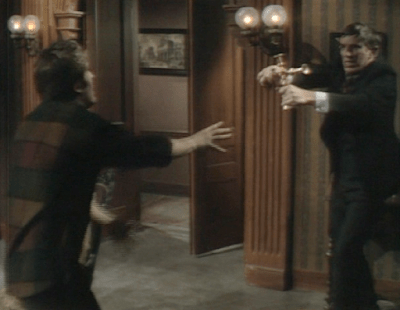
Episode 641: Your time is now

In #2, high-born ne’er-do-well Roger Collins saw governess Victoria Winters standing at the edge of a high cliff overlooking the ocean. She didn’t know he was there until he startled her by asking her if she was planning to jump. As the weeks go on, Vicki will learn of other women who have leapt to their deaths from that spot, including a story that over the years two governesses were among them and that legend says a third will someday follow suit. The cliff is the face of Widows’ Hill, named after women whose husbands never returned home from the sea; several times during storms an eerie note sounds in the wind, a note known as “The Widows’ Wail,” which the locals believe to be the ghosts of the Widows announcing that a tragic death will soon take place.

Vicki stands at the edge of the cliff again at the end of this installment while the Widows’ Wail sounds. She is distraught that she has herself become a widow and is dwelling on the idea that she can be reunited with her husband in death.

Though occult expert Timothy Eliot Stokes told her earlier in the episode that “Your time is now!,” Vicki’s time as a lively part of the show in fact ran out in March 1967, with the resolution of the story about her effort to befriend her charge, Roger’s strange and troubled young son David. Actress Alexandra Moltke Isles finally gave up on the character and left Dark Shadows after #627. Her successor in the role, Betsy Durkin, has essentially nothing to work with. We do not share her grief for the husband she is mourning; he was one of Dark Shadows‘ most repellent characters, and it is such a relief that he is away that we sympathize only too much with everyone who tells her to stop bringing him up. Nor do we have any other reason to care about her, since she is relevant to no ongoing plotlines. Even longtime viewers who remember the foreshadowing of Vicki’s possible death by a jump off the cliff will not react strongly to the sight of her there, since Miss Durkin is not Mrs Isles and does not bring her screen iconography to the reprise of the theme.

This phase of the show actually belongs to a character introduced in #632, eleven year old Amy Jennings. When Amy meets Stokes today she announces that she likes him because he is funny; he replies that he is pleased to find that “My appeal extends to all ages now.” Indeed it does; in its first year, Dark Shadows was very much aimed at adults, some of whom remembered Joan Bennett as one of the great movie stars of the 1930s and 1940s and were impressed by her presence in the cast as matriarch Liz, some of whom appreciated it as a specimen of slow-paced, highly atmospheric Gothic romance, and some of whom were fascinated by the story of Vicki and David and its theme of a grownup trying to make a difference in the life of a troubled child. But by the time Stokes arrived in #464, Dark Shadows had become a kids’ show. As Thayer David plays him, Stokes is amusing enough that anyone can like him, but the absolute seriousness with which he regularly expounds the most preposterous mumbo-jumbo is designed to make him a favorite of the very young.

Amy likes Stokes. Screenshot by Dark Shadows Before I Die.

Amy’s friendship with David develops in scenes that kids will find engaging, as they go exploring the big haunted house of Collinwood and find their way into spooky adventures. She also takes the lead in her relationships with adults more consistently than David ever did. While in the first year and a half of the show David often knew things the adults didn’t know, that was usually because he accepted the facts they refused to see. No matter what he said or did, he couldn’t move them from their habits of denial and evasion. But Amy has sources of information that the grownups around her don’t have. So today she has a vision of her brother Chris in some kind of terrible trouble. When she tells Vicki and Liz about her vision, Liz tries to telephone Chris and is deeply disturbed when he doesn’t answer. As my wife, Mrs Acilius, pointed out, it is after one o’clock in the morning, so you wouldn’t expect her to attach great importance to his failure to pick up the phone. That she does suggests that she is taking Amy seriously.

Returning viewers know that Amy’s vision is correct. Chris is a werewolf, and he just killed a barmaid. That Amy not only has a paranormal means of knowing how Chris is doing, but that she is also able to get through to the adults and influence their actions, suggests that she will have a major impact on the werewolf story as long as it continues. Indeed, she already has- the werewolf was about to eat Liz the other day, but backed off when he saw Amy nearby.

Amy is central to the other storyline that is beginning at this point. That is “The Haunting of Collinwood,” in which the ghost of Liz and Roger’s’ great-uncle Quentin Collins is going to be creating difficulties for everyone. Amy and David went into the long-deserted west wing of the house and retrieved an antique telephone from a room there. Though its cord is cut, Amy can sometimes hear Quentin’s voice through its receiver. When she is alone and worried about Chris, she picks the telephone up and asks for Quentin. She is disappointed he does not answer. None of the adults knows about Quentin’s ghost or the telephone. Not even David has heard more than Quentin’s breathing through the receiver. Again, Amy is uniquely positioned to understand and affect the action.

According to the closing credits, this week’s five episodes were directed by “Penberry Jones.” The name “Penberry Jones” is unknown to Google aside from these credits, and it sounds like a joke of some sort. Though the fansites all mention the improbability of Jones’ name and the likelihood that it is a pseudonym, none that I could find offers any clue as to who might have been behind that pseudonym. From the early 1970s until the quarantines of Covid-19 in 2020, Dark Shadows fans would organize festivals a couple of times every year at which panels of people who had been involved in making the show took questions from the audience. If any of those audiences asked who Penberry Jones was, either they did not get an answer or that answer was not recorded.

The name “Penberry” may remind longtime viewers of Dark Shadows of episode #83, which is about Roger burying a pen. Roger was a major villain then, and his part gave actor Louis Edmonds an opportunity to show what he could do. Roger has long since been demoted to occasional comic relief; one might imagine that Edmonds wanted to take a turn in the director’s chair, and that he chose his whimsical pseudonym as a nod to his character’s origins. Appealing as that idea may be, it does not seem at all likely. So many of the panel discussions among cast members abounded in fond stories about Edmonds that surely someone would have mentioned it if he had directed five episodes.

Indeed, most of the longer-lived members of the cast participated in so many of those panels that they all had moments when they had to grope more or less desperately for something fresh to say. If anyone whose name fans would recognize and who worked closely with the cast were “Penberry Jones,” it’s hard to imagine that one or another of them wouldn’t have brought it up in one of those moments.

Whoever it was must have been known to executive producer Dan Curtis and line producer Bob Costello, and probably quite well known to them. The Directors Guild of America does allow its members to change the names under which they are credited, as for example John Walter Sullivan was allowed to direct several episodes of Dark Shadows as “Jack Sullivan” and several more as “Sean Dhu Sullivan.” But it does not allow them simply to use pseudonyms at will. It wasn’t until 1969 that directors working in features could be billed as “Alan Smithee,” and then they had to prove that they did not really have control of the final product before they were allowed to substitute that name for their own. The first television production credited to “Alan Smithee” didn’t appear until 1970. So it is unlikely that “Penberry Jones” directed any screen productions under any other name. Curtis and Costello probably wouldn’t have chosen a first-time director with no imminent prospects of other screen work unless it were someone they already knew and trusted.

If “Penberry Jones” didn’t cover anyone the cast knew well or a director who worked under another name, but was someone who was close to Dan Curtis or Bob Costello, it should be possible to compile a short list of suspects. I’m not so deeply immersed in the behind-the-scenes lore that I can compile that list myself, but maybe you are. If so, I’d like to hear from you in the comments!

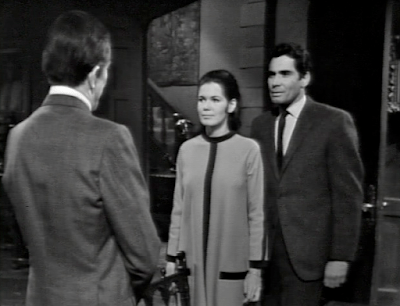
The director’s name isn’t the only puzzle in the closing credits. Every previous episode of Dark Shadows ended with the credits playing in front of a stationary shot of one or another set. It was always one shot per closing credits sequence. This time they start with a stationary shot of Vicki’s room, then cut to a stationary shot of the foyer. It’s hard to see what the point of that transition is. Perhaps we could ask “Penberry Jones,” if we had any idea who that was.

Episode 640: Stay for another séance

Eleven year old Amy Jennings and her big brother Chris joined the show recently, and they are the stars today. Amy has discovered the ghost of Quentin Collins, who haunts a room in the long deserted west wing of the great house of Collinwood. Strange and troubled boy David Collins is rather miffed that Quentin prefers Amy’s company to his- after all, “Quentin Collins is my ancestor,” not Amy’s. They hold a séance in an attempt to bring Quentin to them. David has only participated in one séance, back in #186, when he went into a trance and gave voice to the late David Radcliffe, a boy who died (by fire!) in 1867. So he hasn’t had a chance to catch on that séances on Dark Shadows require a minimum of three people- the first to begin the ceremony and bark orders at everyone else, the second to go into the trance and act as medium, and the third to grow alarmed, try to wake the medium from the trance, and be sternly rebuked by the first. Since David and Amy have no third person, they have no chance of contacting Quentin.

Instead, a shadowy figure appears in the doorway. She is well-meaning governess Vicki, or a rough approximation thereof. David Collins’ scenes with Vicki had been the highlight of the first year of Dark Shadows, not because of the writing or the direction but entirely due to the rapport between actors David Henesy and Alexandra Moltke Isles. A few weeks ago Mrs Isles left the show, and Vicki was recast. Her brief appearance is Mr Henesy’s first scene with the new actress, Betsy Durkin. They can’t recreate his chemistry with Mrs Isles, and Vicki ran out of story long ago. As a result, the scene sounds a discordant note for longtime viewers, reminding us that Miss Durkin, whatever her talents, is here nothing more than a fake Shemp taking up screen time.

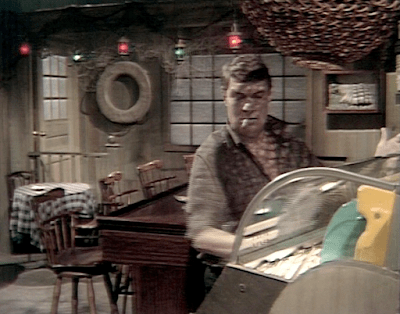
Unknown to the other characters, Chris is a werewolf. Chris accepts an offer from the Collins family to host Amy at Collinwood while he deals with his mysterious problems; in gratitude, he takes heiress Carolyn for a drink at the Blue Whale tavern. While there, he sees a pentagram on the barmaid’s face and hurriedly excuses himself. Later, he transforms into his lupine shape and returns to the barroom, not through the door this time but through the window. He kills the barmaid.

The werewolf drops in to the bar. Dark Shadows Before I Die.

The barmaid appears only in this episode; she doesn’t even get a name. But we see her face in closeup often enough that she feels like a person. Even more importantly, she is wearing the same wig that Maggie Evans, The Nicest Girl in Town, wore in her first four episodes (#1, #3, #7, and #12.) Since Maggie was also a server, working the counter at the diner in the Collinsport Inn, this wig tells longtime viewers that the werewolf’s victim could just as easily have been Maggie, one of everyone’s favorite characters.

Don Briscoe played Chris in his human phase, Alex Stevens as the werewolf. Stevens was credited not as an actor, but as “Stunt Coordinator.” Yet today, his credit card appears in between Briscoe’s and that of Carol Ann Lewis, who was cast as the luckless barmaid. Some of the original audience may have caught on that Stevens was the man in the character makeup, but others who noticed the odd billing order would have chalked it up as another of the show’s frequent imperfections.

Episode 637: Too late for anything to happen

Well-meaning governess Vicki ran out of story in #191, and has been at the fringes of the show ever since. Since March, Vicki has been stuck in a relationship with an unpleasant man named Peter who preferred to be called Jeff.

As long as Alexandra Moltke Isles played Vicki, longtime viewers could hold onto some sliver of hope that she would eventually reconnect with an interesting plotline. Mrs Isles’ last episode was #627, and the part was taken over by Betsy Durkin, who stresses random words in her lines (such as, “Jeff, you’ve got to stop thinking about the past!,”) keeps looking at her scene partners with her face still for a few seconds too long after delivering her lines, and moves about awkwardly, as if she were afraid of tripping over her costume. For his part, Peter/ Jeff is played by Roger Davis, a highly trained actor who doesn’t do any of those things, but who routinely assaults actresses on camera and who clenches his rectal sphincters whenever he raises his voice, causing him to sound like he is struggling with constipation. Miss Durkin and Mr Davis are a difficult pair to watch, and since there is no reason in the story for either fake Vicki or Peter/ Jeff to be on the show their scenes are an unwelcome intrusion.

Today, fake Vicki and Peter/ Jeff get married. The morning after their wedding, he fades into nothingness while she watches, which considering his personality is the best case scenario for her.

We spend the middle of the episode with recovering vampire Barnabas and mad scientist Julia, who unlike fake Vicki and Peter/ Jeff are actually characters on Dark Shadows. Barnabas and Julia enter the great house of Collinwood. They have been at pains to keep the residents of the great house from finding out about any of the supernatural doings, yet when they walk in the front door they blab about everything in nice loud voices.

Matriarch Liz comes in and tells Barnabas and Julia that Vicki has married Peter/ Jeff. Once Liz leaves, Barnabas, stunned and dejected, moans “Julia, why did she do it? Why did Vicki marry him?” Barnabas has often claimed to be in love with Vicki, but in fact takes remarkably little interest in her, so it is no surprise that less than a minute goes by before he shrugs the whole thing off with “I’ll accept it and pray that she’ll be happy with it.”

Julia reacts to Barnabas’ reaction to the news of Vicki’s wedding. Screenshot by Dark Shadows Before I Die.

Barnabas and Julia go off to drive a stake through the heart of witch-turned-vampire Angelique. It’s a rule on Dark Shadows that a wedding scene leads to the exposure of an empty coffin, so it will be no surprise to longtime viewers that when Barnabas and Julia open Angelique’s coffin they find she isn’t in today. Barnabas fears that she has changed in some way that will make her even more dangerous when she eventually returns.

Angelique and Peter/ Jeff were the last loose ends left over from the big collection of storylines introduced in the spring of 1968; her absence and his vanishing wrap up the Monster Mash period that constituted Dark Shadows 4.0. The only indication we have had so far as to what version 5.0 will turn out to be was a scene in #632 between werewolf Tom Jennings and his sister Amy. It remains to be seen how the Jenningses will connect with the Collinses and what other characters will join them.

Episode 631: The curse of the undead

Old world gentleman Barnabas Collins, himself a recovering vampire, bursts into well-meaning governess Victoria Winters’ bedroom just in time to prevent another vampire from claiming her as his victim.

Once the coast is clear, Barnabas explains to Victoria what happened, using the word “vampire” and telling her what it means. For the first 40 weeks Barnabas was on the show no one used that word, and even when Victoria was briefly Barnabas’ victim in March 1968 it seemed she didn’t understand what it was all about. The scene of Barnabas bringing Victoria up to date is interesting, but it could have been so much more. Victoria is played today by Betsy Durkin, making her second appearance in the role. Had Alexandra Moltke Isles still been in the part, it would have been electrifying to see Victoria reconnected with the plot after her long exile. Miss Durkin does what she can, but as a new face she simply does not bring the iconography of all those hundreds of episodes in which we saw Mrs Isles held at arm’s length from the story.

Barnabas and Victoria identify the vampire as the late Tom Jennings. Victoria tells Barnabas that she had, earlier that evening, gone to see suave warlock Nicholas Blair and confront him about his plans to marry Maggie Evans, The Nicest Girl in Town. Barnabas is shocked to learn of this plan, and agrees with Victoria’s surmise that Nicholas must have made Tom a vampire and sent him to kill her. He promises to take care of the problem, but won’t tell her how.

For his part, Nicholas is dealing with a visit from Tom’s brother, the mysterious Chris Jennings. Chris was introduced in #627, Mrs Isles’ last episode as Vicki. He is a drifter who refuses to answer any questions about himself, but he has plenty of questions for other people about what happened to his brother. While Nicholas is dodging Chris’ inquiries, he glances out the window and sees Tom. This implies videotape editing, since Tom and Chris are both played by Don Briscoe and Tom’s makeup is slightly different than Chris’. Chris himself notices a figure at the window, but does not get a good enough look to know who it is.

Later, Barnabas comes to see Nicholas. Nicholas has extorted Barnabas and his friend Julia Hoffman, MD, to perform an experiment. Only they can do the experiment, and if it is not completed, Nicholas’ boss, Satan, will punish him. Barnabas says that he and Julia will not continue working unless Nicholas can assure him that neither Victoria nor Maggie will be harmed and that Tom Jennings will be destroyed. Nicholas gives him those assurances, and he leaves. As dawn approaches, Barnabas slips back into Nicholas’ house. He meets Tom there. He uses two candlesticks to make a cross, and at the sight of it Tom is immobilized. The sun rises, and Tom vanishes, destroyed forever.

Drac on Drac violence. Screenshot by Dark Shadows Before I Die.

Episode 630: Held back by something that is over

Well-meaning governess Victoria Winters ran out of story at the end of #191, but they kept putting her on the show. Frustrated by her character’s uselessness, Alexandra Moltke Isles finally gave up and left Dark Shadows last week, but not even that sufficed to get the point across to its producers. Today they bring in one Betsy Durkin as a fake Shemp to postpone the character’s departure.

Vicki’s big scene today is a confrontation with suave warlock Nicholas about his plans to marry Maggie, The Nicest Girl in Town. In the course of it, Vicki says “I know you’re going to say it’s none of my business, and it isn’t. Except I’m making it my business!” In other words, Vicki has to meddle in other people’s affairs, since she is not involved in any ongoing story that the audience could possibly care about.

Vicki tells Nicholas everything she knows about him and everything she suspects, leaving the audience with no questions about what is in her mind. Nicholas points out that Maggie would laugh uproariously if Vicki repeated her speech to her. Vicki does not deny this, but nonetheless says she will to go to Maggie unless Nicholas breaks his engagement to her.

This blatantly empty threat draws a contrast between Vicki, who is powerless to change the direction of any story she might join, and mad scientist Julia, who in #619 faced Nicholas down in this same room. Julia also began by ignoring Nicholas’ display of geniality, stating the facts about his nature, and declaring her hostility. But Julia had information Nicholas didn’t have, and when she revealed it to him she knocked him off his guard and took charge of the situation. Vicki has no such cards to play, and comes out of the scene looking more foolish and helpless than ever. Considering these scenes side by side, it is no surprise that Julia has taken over as the audience’s main point-of-view character, a function Vicki served in the show’s first year.

Nicholas does not use his magical powers against Vicki, and after she leaves his house he wonders why he did not. Again the contrast with Julia shows why this is so bad for Vicki’s character. When Julia brought Nicholas news about trouble he did not know he was in, he couldn’t be sure he would not need her help to get out of it. That not only explained how she managed to get out of his house without being turned into a toadstool, it also helped cement her status as Dark Shadows’ most dynamic protagonist. But when the only explanation Nicholas can find for his failure to brush Vicki aside is that he is ceasing to be much of a villain, he is telling the audience in so many words that Vicki is not worth their time.

Nicholas decides that he really ought to do something with Vicki after all. He goes to his basement and rips the tiles out of the floor. Longtime viewers will remember #273, when the flooring in the basement of the great house of Collinwood was torn to reveal that no corpse was buried there. That brought one of the principal storylines of the show’s first year, matriarch Liz’ long seclusion in the great house, to a ridiculous anticlimax.

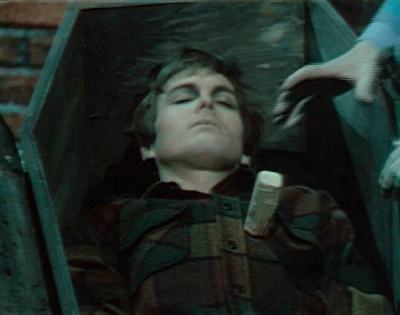
Now the result is rather different. Nicholas drags a coffin up out of the hole he makes in his basement floor, opens it, and exposes a body with a stake in its chest. It is the body of Tom Jennings, who became a vampire in #564 and was staked in #571. Tom’s body disappeared shortly after the staking, and Nicholas was in the area at the time, so we were warned that he may not have been truly destroyed. Today we find that Nicholas did in fact preserve Tom, when he pulls the stake out of Tom’s heart and declares himself to be his master. At the end of the episode, Vicki is in bed when Tom crawls in through her window and bares his fangs at her.

The unstaking feels like a cheat, despite the earlier warning Tom might return. It looks silly when Nicholas pulls the stake out. Vampires are important enough in the world of Dark Shadows that they really oughtn’t to be things you can turn on and off like an electric light.

Nicholas reaches for Tom’s power switch. Screenshot by Dark Shadows Before I Die.

But the shot of Tom crawling into Vicki’s room is pretty effective, suggesting that he is a feral beast. It makes a nice counterpoint to the scene of ex-vampire Barnabas crawling out of a cell in #616, when Barnabas was reduced to a very basic psychological condition. Barnabas disappeared after his crawl, but Don Briscoe follows Tom’s by wiggling his tongue at the camera in his final closeup, making it look like he is super-excited to drink Vicki’s blood.

Nicholas and Maggie have a funny scene. Yesterday his boss, Satan, ordered Nicholas to sacrifice Maggie in a Black Mass so that she could join him in Hell. Today, Nicholas shows her an ancient cup. He tells her it was made “before your Christ* was born.” Maybe Maggie knows Nicholas isn’t Christian, but certainly she doesn’t know that he isn’t human, much less that he is a minion of the Devil. So you might think that she would react to the bizarre formulation “your Christ,” but she doesn’t seem to pick up on it at all. When Nicholas uses the cup for a little fortune-telling trick and tells her she will have a long and happy life, she does notice that he sounds disappointed.

*The first mention of that title on the show. Dark Shadows is in a weird little quasi-Christian phase at this point.

Episode 304: Strange vibrations

Yesterday, fake Shemp Burke Devlin tested his hypothesis that old world gentleman Barnabas Collins abducted Maggie Evens, The Nicest Girl in Town, and held her prisoner during the period covered by her current amnesia. On the one hand, he found that Maggie was perfectly relaxed when Barnabas visited her recently, and that she regards him only as a mildly pleasant acquaintance. There would seem to be no way she could have this reaction to someone who had subjected her to such an ordeal. On the other hand, he found that a melody she seems to remember hearing during her captivity might have come from a music box that was in Barnabas’ possession at the time. Since he has also found that the only person Barnabas will admit to having known before his arrival in the town of Collinsport lived over 130 years ago, he seems to be willing to consider that the resolution to this paradox might require a supernatural element.

Since we know that Barnabas is a vampire and have been frustrated with Burke’s recent angry denials of the existence of supernatural phenomena he previously knew all about, that episode felt like a breakthrough. Lately Barnabas has been harmless and all the non-villain characters have been clueless, leaving the show adrift. Maybe Burke will restart the vampire story. Maybe he will again become the dashing action hero he was when the charismatic Mitch Ryan played him in the first year of Dark Shadows, and maybe his investigation will precipitate a crisis that will bring the Barnabas arc to an exciting climax.

That hope shrivels to nothing in the first minutes of today’s outing. We begin with Burke knocking on the door of Barnabas’ house. When sorely bedraggled blood thrall Willie Loomis tells Burke that Barnabas isn’t in, Burke says that he knows he is. Willie asks why he thinks he knows this, and Burke says that he’s been hiding behind a tree for hours staring at the front door. Burke is supposed to be a rich guy- it would be one thing if he’d hired private detectives to hide behind trees, but that he chose to spend his time doing that himself makes him look ridiculous. He pushes past Willie and declares that he won’t let Willie keep him out of the house. So before the opening titles roll, we’ve seen Burke as an unstable man who alternately cowers in the dark and perpetrates home invasions.

After Burke shouts Barnabas’ name a couple of times, he tells Willie he knows Barnabas is there because he never saw him come out of the front door. Willie says he might have gone out the back door. Burke’s response to that is “Maybe.” With that, Burke blows his last shred of credibility as an action hero. He presses Willie with some questions about Barnabas’ business interests; usually when characters ask about that, I think a suitable send-off for Burke would be a story where Barnabas bites him, enslaves him, and uses his money and connections to put some substance behind his pretense to be an independently wealthy cousin from the Collins family’s long-lost English branch. But when we see Burke being such a total schmuck as he is in this sequence, it’s hard to imagine he could be of any use to anyone, or to care very much how they go about writing him off the show.

That “Maybe” is such a preposterous anticlimax that I wonder if it is a sign of some politics behind the scenes. Long after the show was made, writer Malcolm Marmorstein remembered executive producer Dan Curtis wanting to end the vampire storyline around this time and to give the show over to an arc about Burke and well-meaning governess Vicki getting married and moving into a long-vacant “house by the sea.” There have been a few vague stabs at getting such a story off the ground- Burke and Vicki are engaged now, and he is in the process of buying such a house. But the vampire story was so much the biggest ratings draw the show has had that it is hard to imagine Curtis really wanted to scrap it- more likely he wanted to have more than one story going at a time, as soap operas usually do. In any case, the “house by the sea” bits have been so dull that it feels like the writers are simply refusing to develop the theme, and Ron Sproat’s script today could hardly fail to do lasting damage to Burke. So perhaps there is a sneaky kind of revolt in progress.

Meanwhile, visiting mad scientist Julia Hoffman and strange and troubled boy David Collins have left the great house of Collinwood to take a walk in the woods. They are looking for David’s friend, the ghost of nine year old Sarah Collins. Sarah leaves belongings of hers as tokens of her presence; these objects linger in physical existence until she reclaims them, after which they vanish when she vanishes. Some Dark Shadows fans put a lot of energy into saying that this aspect of Sarah “doesn’t make any sense!” To which I reply, she’s a ghost. All you can expect is that the story will tell you what the rules are and will follow them consistently. Not only does Sarah follow this rule consistently, but the ghosts of Bill Malloy and of Josette Collins had both previously left things lying around the house for people to find. Most recently, Sarah left her bonnet in the house, and now David and Julia are on a quest to return it to her.

David takes Julia to a clearing in the woods where he has encountered Sarah before. We hear “London Bridge” on the soundtrack, the musical cue telling us that Sarah is present, but she does not appear. David and Julia look around and don’t see her. David thinks he hears someone nearby to their left. They look that way, but don’t see anyone. They turn back, and find that the bonnet is gone.

This little scene captures some of the feeling of live theater that gave the early episodes of Dark Shadows such a special quality. I particularly like the low camera angle on David and Julia, as if we are looking up at a stage.

Later, Julia goes to Barnabas’ house. She and Willie talk about Burke’s visit. Julia muses about the need to provide Barnabas a more complete cover story to keep Burke at bay. This is the first staff meeting we see between Julia and Willie. Until this scene, the only conversations we’ve seen between two people who knew that Barnabas was a vampire were between Willie and Maggie during her captivity, and only a sharply limited number of things could happen during those conversations. Willie would tell Maggie to submit to Barnabas, either sorrowfully or angrily. Maggie would either express defiance openly, pretend to be cooperative, or give nonresponsive answers that suggested she was losing her mind. Combine those attitudes, and you have six possible interactions. Sometimes the characters would change attitudes in mid-scene, multiplying the number of possible interactions, but no matter how you mix and match you still end with Maggie in the same fix she was in at the beginning. But when both characters have some measure of personal autonomy and both are invested in helping Barnabas keep his secret, the number of possible interactions is very large and the number of possible outcomes is infinite. So this is an exciting scene.

We end in The Blue Whale tavern, where Burke asks Vicki to stay away from Barnabas for reasons he refuses to explain. The only interesting thing about this scene is that Bob O’Connell does not appear in the background as Bob the Bartender. Some other uncredited extra is pouring today. 

Mystery man. Screenshot by Dark Shadows Before I Die.

Episode 303: Separate worlds

Fake Shemp Burke Devlin is starting to suspect that there is something odd about old world gentleman Barnabas Collins. He suspects that Barnabas is not from England as he claims to be. More darkly, he is considering the possibility that Barnabas might be the one who abducted Maggie Evans, The Nicest Girl in Town, and held her prisoner. As it happens, the audience knows that he is correct in both of these suspicions. We also know more- that Barnabas is a vampire.

Burke has hired investigators to probe into Barnabas’ past. Barnabas told him he lived near London with a cousin named Niall Bradford. Burke’s investigators have found that the last time a man of that name lived in London was 130 years previously. Dark Shadows has been going back and forth for months on whether Barnabas lived in the 1830s or in the eighteenth century. Yesterday they seemed to commit themselves to the earlier date, but now we’re back with the 1830s.

Burke asks Maggie’s doctor, addled quack Dave Woodard, to show him all of her medical records. Woodard protests that medical records are confidential. He then tells Burke everything he knows about Maggie’s case.

Burke calls on Maggie. She is back home, apparently well, but suffering from amnesia covering the entire period of her captivity. Unknown to any of the characters we see today, Maggie’s psychiatrist Julia Hoffman is a mad scientist in league with Barnabas, and she has wiped Maggie’s memory clean of any information that might threaten to expose him. Burke talks with Maggie and her boyfriend, hardworking young fisherman Joe, repeating everything Woodard told him a few minutes before.

Maggie and Joe tell Burke that she has had a few visitors since she came home. Maggie blithely mentions that Barnabas was one of those visitors. Burke is startled to hear this, and Maggie repeats that Barnabas dropped in to pay his respects.

During the fourteen weeks when Dark Shadows was driven by undead fire witch Laura Murdoch Collins, Burke saw extensive evidence of supernatural doings. But he lately he has decided that he lives in the kind of world where the show took place in its first few months, where there might be hints of ghosts in the background, but all the action came from flesh and blood humans subject to the usual laws of nature. Since it doesn’t occur to him that a person might have powers like Julia’s, Maggie’s calmness when talking about a visit from Barnabas seems to prove that Barnabas is innocent.

Burke learns that Barnabas has been to see Maggie.

Maggie does say that there is just one memory she has that seems to be connected with her time in captivity. It is a bit of music- “a light, playful tune. A soft, tinkling sound.” She freely admits that it seems unlikely that this would have any connection with such an experience, and speculates that it may have been something she remembered from childhood.

In the great house of Collinwood, well-meaning governess Vicki is listening to the enchanted music box Barnabas gave her. Burke and Vicki are now engaged to be married. He comes to see her, and remarks on the music box. She accuses him of being jealous of Barnabas, and he keeps coming back to the music box. When she opens it for him, he remarks that it makes “a light, playful tune… a soft, tinkling sound.”

The episode ends with Burke listening to the music box and staring off into space. Barnabas gave the music box first to Maggie, then to Vicki, in each case hoping that she would listen to it until its magical quality caused her to believe that she was his lost love Josette. Seeing the look on Burke’s face as he listened, my wife, Mrs Acilius, said “Maybe Burke will start to think that he’s Josette.” Who knows, maybe he and Barnabas could be very happy together.

Episode 293: A better story next time

Well-meaning governess Vicki was the main character of Dark Shadows in its first 39 weeks, and themost interesting storyline was her relationship to her charge, strange and troubled boy David Collins. That story came to its climax when David chose life with Vicki over death with his mother, blonde fire witch Laura Murdoch Collins, in #191, and Vicki hasn’t had much to do since.

Yesterday, Vicki told her depressing boyfriend, fake Shemp Burke Devlin, about an old vacant house that excites her. Since Vicki’s work with David is compensated mainly with room and board, the only way her interest in an empty house could lead to anything happening on the show would be if she quit her job, married Burke, and moved there with him. Since Burke has even less connection to the ongoing narrative arc than Vicki does, and has been spending his time lately demanding that she stop trying to attach herself to the story and settle in with him in his dead end far away from the plot, that is a dismal prospect.

All the action on the show is centered on vampire Barnabas Collins. In the opening scene, Barnabas talked with his sorely bedraggled blood thrall Willie Loomis about two women. One was Vicki. Willie was agitated that Barnabas is planning to bite Vicki. This is an odd thing to worry about- Vicki has gone out of her way to make herself available to Barnabas for biting, even contriving to spend the night in his house. But she still has all her blood, and no foothold in the vampire story. When Barnabas tells Willie that he does not intend to harm Vicki in any way, those of us who hope she will stay relevant to Dark Shadows have a sinking feeling that he might be telling the truth.

The other woman Barnabas and Willie discuss is mad scientist Julia Hoffman. In contrast to his assurances that he means no harm to Vicki, Barnabas muses openly that he might have to kill Julia at any moment. Observing Willie’s reactions, Barnabas comments that it is interesting that Willie is so concerned about Vicki, but utterly indifferent to Julia. If we remember Willie as he was before Barnabas enslaved him, this may not be so odd.

Before he became sorely bedraggled blood thrall Willie Loomis, he was dangerously unstable ruffian Willie Loomis, menace to womankind. Willie tried to rape Vicki, among others, and his guilt over the use he made of his freedom when he had it is reflected in his solicitousness towards those whom he once used so ill. By the time he met Julia, he had been under Barnabas’ power for months, so he has made no choices concerning her that he can regret.

Barnabas shows up as Vicki and Burke are getting ready to visit “the house by the sea.” Barnabas slips a couple of times as he talks with them about it, revealing to the audience that he is familiar with the house. This raises our hopes- perhaps Vicki’s fascination with the house will lead her to Barnabas and relevance, not to Burke and oblivion. Vicki invites Barnabas to come along with her and Burke as they tour the house, and he agrees.

While Vicki is upstairs changing her clothes, Barnabas and Burke talk in the drawing room. Barnabas points out that little is known of how Burke became so rich so quickly in the years before he came back to Collinsport. Burke responds that far less is known of Barnabas than of him, that his entire life before this year is perfectly obscure to everyone. As Barnabas, Jonathan Frid plays this scene with more variety and subtlety of expression than any previous one, and as Burke, Anthony George gives a tight, forceful performance. It is the first time Dark Shadows viewers have glimpsed the reason George had such a long and busy career as an actor.

George was a cold actor who excelled at characters whose intelligence and determination were obvious, but whose feelings and intentions the audience could only guess at. That would have made him a fine choice for the part of Burke in the early months of the show, but these days he spends most of his time giving big reactions to bewildering news and the rest in passionate love scenes with Vicki. George was just awful at both of those. But in today’s duel with Barnabas, Burke is choosing his every word and gesture with care, putting him right in the center of George’s wheelhouse. Opposite the much warmer Jonathan Frid, the effect is electric.

It leaves me wondering what might have been. Mitch Ryan was compelling as Burke #1, but his hot style of acting pushed Burke’s emotions to the surface and took away some of the mystery that would have been needed to make the “Revenge of Burke Devlin” storyline a success. With George in the part, that story would probably still have fizzled, but it might have taken a bit longer to do so. And of course the part George has been struggling with, until this scene in vain, was written for Ryan. If the two had just traded places and the scripts had stayed the same, Burke #1 and Burke #2 might both have been strong characters.

Of course, they wouldn’t have stayed entirely the same. The writers watch the show and are influenced by what they see the actors doing. But they may not have changed as much as you might expect. Neither Ron Sproat nor Malcolm Marmorstein seemed to have much sense of what actors could do. It’s no wonder that George’s first good scene comes in the second episode credited to Gordon Russell. Perhaps if Russell had been with the show earlier, Burke #2 might have been more of a success.

The scene also brings up one of my favorite fanfic ideas. People are going to wonder about Barnabas’ background, and Burke needs to be written off the show. Why not solve both of those problems by having Barnabas enslave Burke, make Burke set up businesses in Barnabas’ name and use his shadier contacts to get Barnabas false identification papers, then kill Burke off once he has exhausted his resources? You could do that in such a way that the other characters would think Barnabas was a nice guy who was using his wealth to prop Burke up, consolidating his position in their eyes. You could also use it to connect Barnabas to the wider world beyond the estate, suggesting that he poses a menace not only to one family but to a whole community.

At length, Vicki comes back downstairs. Burke greets her first, but she barely acknowledges him. She has eyes only for Barnabas. Barnabas may not be in any hurry to bite Vicki, but she is bursting with readiness to get into the vampire story and back into the main action of the show.

Eyes on the prize. Screenshot by Dark Shadows Before I Die.

Episode 292: I know who’s dead and who isn’t

Mad scientist Julia Hoffman is hanging around her new base of operations, the Old House on the great estate of Collinwood. She is getting ready to perform an experiment which, if successful, will convert vampire Barnabas Collins into a real boy. She learned of Barnabas’ existence when treating his former victim Maggie Evans, The Nicest Girl in Town. Julia answers a knock on the front door, and sees her old acquaintance, addled quack Dave Woodard.

Woodard has no idea what Julia is up to. So far as he knows, she is still on board with his own idiotic scheme, in which he, along with Maggie’s father Sam and her fiancé Joe, has told everyone in town that Maggie is dead in hopes that her captor would forget about imprisoning girls and draining their blood. In fact, Julia has told Barnabas that Maggie is alive and has lured him into cooperating with her project by promising to keep Maggie in a state of amnesia so that she will not represent a threat to him.

In yesterday’s episode, Sam and Joe called on Woodard and complained that Julia is staying at Collinwood while Maggie is a hundred miles away. They demanded that Woodard take her out of Julia’s care. Woodard tells Julia today that her conduct is growing “more and more unethical.”

Last week, Julia was able to forestall Woodard’s threat to take her off the case by playing dumb. This time, she has to take him partly into her confidence, telling him that Maggie encountered the supernatural and that her case represents an opportunity to find a crossing point on the boundary between life and death. She dangles the possibility of great fame before him, saying that the doctors who make the breakthrough she sees coming will go down in history. When he presses for details, she says that there is great danger in what she already knows, and that she must not tell him more.

Woodard has been on the show for months, and has been stuck in just two modes the whole time. When he’s with a patient, he makes a show of brisk dissatisfaction, as if trying to convince them that they oughtn’t to take their disease so seriously that they give up. This mode was as far as Richard Woods, the first actor to play Woodard, got in his two appearances (in #219 and #229.) When he is talking with someone else, Woodard struggles to find the words to express his bafflement at the terrible case he is treating. These two modes didn’t make Woodard a source of suspense. They were just filler between his announcements of what the script called for him to do next.

When Julia asks Woodard if, when he was in school, he dreamed of making a major contribution to the science of medicine, he gets a thoughtful look and says “Well, of course.” This is the first moment we have seen Woodard outside his two modes. When Julia tempts him with the idea that he will go down in history as the co-discoverer of the most fundamental truth imaginable, he displays an emotion that might lead to him to any of a number of exciting, story-productive actions. The first scene in the first episode credited to writer Gordon Russell manages the astounding feat of turning Dr Woodard into an interesting character.

We cut to the woods on the estate. We see the ghost of Barnabas’ nine year old sister Sarah sitting on a rock crying. All of Sarah’s previous scenes started with some other character on camera, then proceeded to Sarah making a mysterious entrance. That’s what we would expect of a ghost, after all. This time, Sarah is all by herself at rise. The first time we saw a ghost was in #70, when the ghost of Josette Collins emerged from her portrait and danced around the columns of the Old House. That was a solo appearance as well, but people had been in the Old House talking about Josette immediately before, so she was manifesting herself in response to attention from the living. Here, we see a ghost on her own, processing her emotions, hoping someone will come and hang out with her.

Strange and troubled boy David Collins shows up and asks Sarah why she is crying. She says she can’t find Maggie. David breaks the news to her that Maggie is dead. Sarah laughs, and assures David that she is still alive. When David insists that Maggie is dead, Sarah tells him that he may know “about leaves and everything,” but she knows “who’s dead, and who isn’t.”

Sarah laughs at the idea that Maggie is dead. Screenshot by Dark Shadows Before I Die.

Less than a week ago, in #288, David saw a portrait of Sarah and wondered aloud if the girl he has met is her ghost. In the first 39 weeks of the show, he was on intimate terms with Josette and some of the other ghosts. When he first met Barnabas in #212, he asked him if he were a ghost, and was disappointed to hear that he was not. So returning viewers expect David to ask Sarah the same question. Indeed, David has always interacted with ghosts as if they were people with whom he could pass the time of day, share thoughts and feelings, and get to know better from one encounter to the next. Seeing Sarah crying by herself should validate this attitude. But instead, David has developed Soap Opera Goldfish Syndrome, forgetting information which everything we have seen has led us to expect he will remember.

David insists Sarah come home with him to the great house of Collinwood and have dinner with the family. She tries to decline politely, but he will not take “I’ve been dead for centuries” for an answer. He gets Sarah into the foyer, then goes to the drawing room to announce her presence. He finds Julia there, with well-meaning governess Vicki and Vicki’s depressing boyfriend, fake Shemp Burke Devlin. By the time David gets the adults into the foyer, Sarah has disappeared.

Vicki is suffering from an even more frustrating version of Soap Opera Goldfish Syndrome. She had had extensive dealings with the ghosts of Collinwood on many occasions between #85 and #191, and that had been the basis of her bond with David. Vicki’s interactions with the supernatural reached a climax when she led the opposition to David’s mother, undead fire witch Laura Murdoch Collins, from #126 to #191. Since then, Josette has spoken through Vicki at a séance and she has seen Sarah.

But lately, Vicki has started to deny that there are ghosts. This is in response to Burke’s demands. Burke lost his connection to the story months ago, and he’s been trying to gaslight Vicki into dismissing all of her spectral encounters as signs of mental illness so that she will join him on the show’s discard pile of useless characters. In Friday’s episode, Vicki had apparently decided to give in to Burke and make herself believe that there were no supernatural beings at work around Collinwood. As a result, her scenes in that episode were unbearably dreary.

Before David brought Sarah home, Vicki had been dreary again. She’s excited about some old house she saw, and wants Burke to go look at it with her. As David’s governess, Vicki’s compensation consists largely of room and board, so as long as she has her job her interest in any particular piece of real estate isn’t going to lead to story development. If she quits the job and marries Burke, she will be giving up on ever being part of the action again. So her rambling about “the house by the sea” is suspenseful only to fans of Vicki who are afraid she will vanish into the background of the show.

When David starts telling the adults about Sarah, Vicki launches into the same garbage Burke has been giving her, talking down to him about imaginary friends and insinuating that anyone who believes in ghosts is soft in the head. Burke, who had previously been David’s great friend, joins in this abusive behavior. After David indignantly stalks away, Julia gets very uptight and lectures Vicki and Burke about the need to stifle David’s imagination and discourage him from telling them things they don’t already know. This scene is effective, but the effect is claustrophobic- by the end of Julia’s little speech, we feel like the mad scientist is holding us prisoner.

Vicki and Burke decide to leave to look at the house, and Vicki finds Sarah’s cap on the floor. That’s such a great moment that not only do we leave the episode no longer disappointed in David’s goldfish memory, we can even forgive Vicki’s.

The closing credits run over an image of the foyer with Sarah’s cap on the table. My wife, Mrs Acilius, thought it would have been hilarious if Sarah had marched in and taken the cap while the credits were rolling. I’d have liked to see that too, especially if, after putting it back on, Sarah had turned to the camera and put her finger to her lips, telling the audience to keep quiet about what we had seen.

Sarah’s cap on the foyer table. Screenshot by Dark Shadows Credits.

Episode 288: Feminine vanity

At the great house of Collinwood, well-meaning governess Vicki is in a stupor, staring out a window and dreaming of a time when she will again be central to the plot.

Ever since #191 when she rescued her charge, strange and troubled boy David Collins, from his mother, undead fire witch Laura, Vicki has been hanging on to narrative relevance by her fingernails. Now Dark Shadows is built around vampire Barnabas Collins, and Vicki longs to play a major role in his storyline. He plans to make her his next victim, but is moving so slowly towards that objective that we’ve started to wonder if he ever will strike.

David comes into the room and calls Vicki’s name several times. When she finally comes to, she admits that she has been zoning out a lot lately, and says that it is a habit she needs to break. David says that it frightens him when she gets that way. She doesn’t look like herself when those spells come over her. He gets the feeling that she’s turning into someone else. Vicki can’t deny that David is onto something, and only when he insists on sticking with the subject after she has clearly become uncomfortable does Vicki become defensive and retreat behind claims that David is letting his imagination run away with him.

Mad scientist Julia Hoffman has insinuated herself into the house, concealing her true identity and pretending to be an historian writing a book about the old families of New England. David shows her an album of family portraits. He identifies one portrait as his namesake, David Collins. In #153, it was established that he was the first member of the family to bear the name “David,” and that his mother Laura insisted on giving her son this name would ultimately become evidence that her evil plans for him were in place long before he was born. So David’s remark about a previous “David Collins” will strike longtime viewers as a significant retcon.*

Though David has looked through the book many times, he finds a portrait in it that he has never seen before. It depicts Sarah Collins, who lived from 1786 to 1796. Sarah’s ghost has been busy in the area in recent weeks, and the clear implication is that she inserted the page. That in turn would suggest that Sarah might have more powers than we have seen her use so far.

Julia and David find a photograph of Sarah Collins, d. 1796.
Screenshot by Dark Shadows Before I Die

David has seen Sarah and played with her on more than one occasion, and he recognizes the portrait. He wonders aloud if the girl he has met is Sarah’s ghost. Julia laughs off the suggestion. Vicki returns. She also recognizes the picture of Sarah. The police circulated a drawing of her when Maggie Evans, The Nicest Girl in Town, was missing. Since Julia is actually a doctor who found out that supernatural doings were afoot at Collinwood when she was treating Maggie, she has heard several facts about Sarah, and by the end of her talks with David and Vicki she knows enough to be sure David is right about her.

We cut to the Blue Whale tavern, where Vicki is on a date with her depressing boyfriend, fake Shemp Burke Devlin. Burke sullenly complains about Vicki’s wish to help Julia with her project, complaining about Vicki’s “interest in the past.” “Interest in the past” is at this point synonymous with “a function in the story,” and Burke lost the last trace of that months ago. It’s as if Burke and Vicki know that they are fictional characters, and he resents her for holding on to a place in the action while he has settled in once and for all on the discard pile.

Vicki mentions that the night before, she had been awakened by the sound of a small girl singing. She says that after she got up and lit a candle, she could still hear the singing, but could not see the girl. Burke is too busy grumbling and making nasty remarks about Vicki’s mental health to ask her why she lit a candle rather than flipping the light switch. Vicki has to press on with more details and then volunteer that she wasn’t sleeping in her own room. She was sleeping in the Old House at Collinwood, home to Barnabas Collins.

Burke is upset by this news. Unfortunately Vicki doesn’t let him believe she went to bed with Barnabas. She tells him she was in a guest room, and that Barnabas was “a perfect gentleman.” Burke demands Vicki never go to the Old House again, and she refuses to make any such promise.

Julia takes the book of portraits to the Old House and insists that Barnabas look through it. While he grudgingly complies, Julia opens her compact. She finds that Barnabas does not cast a reflection in its mirror. This confirms her suspicion that Barnabas is a vampire. In #241 and #278, we had seen his reflection, but perhaps those were slip-ups and they were planning all along to use the idea that vampires do not cast a reflection.

Barnabas catches Julia studying her mirror and angrily asks what she is doing. She smiles and chirps that even historians have their share of feminine vanity. He glowers at her. The camera holds on his menacing look for quite some time, leading us to think that Julia has signed her own death warrant. But she doesn’t seem to think she is in any great danger. She is still smiling when she leaves.

Back in the great house, Vicki wanders up to the portrait of Barnabas that hangs by the front door. Apparently she is planning to stare at it as she resumes her dream of having something to do on the show. It worked for dangerously unstable ruffian Willie Loomis- after a couple of long sessions staring at the portrait, Barnabas summoned him and next thing he knew he was securely established as his sorely bedraggled blood thrall, a core member of the cast. So Vicki is trying to take a proven path to success.

Before Vicki can get any high-quality staring done, Julia enters. Vicki asks her how it went with Barnabas, and Julia exults that she may have learned everything she needed to know.

*My wife, Mrs Acilius, noticed this and had a lot to say about it. I will refer to her insights in later entries, as they would contain spoilers at this point in the run of the show.