Professor Timothy Eliot Stokes has parked his car and is walking up to the great house of Collinwood, home to matriarch Elizabeth Collins Stoddard and her daughter Carolyn Collins Stoddard, among others. He sees a man lying on the ground and asks him what is wrong. The man pleads with Stokes to help him get away. Stokes asks him what he wants to get away from; the man responds “I can’t tell you.” Stokes asks who he is; he says his name is Stoddard. Stokes replies “You’re Paul Stoddard, Carolyn’s father.” Paul brightens momentarily at Carolyn’s name, but then draws up tight and asks “They sent you after me, didn’t they?” Stokes assures him that no one sent him, and tells him he will catch his death of cold if he continues lying on the ground.
Paul asks Stokes to take him to the police. Stokes nods to the house and says they can call the police from there. Paul cries out, “No! No, not to Collinwood. Please, Professor Stokes, you’ve got to take me to the police, it’s the only thing you can do for me. If you don’t, I’ll be dead. No, no, no, I am not being hysterical or melodramatic…” At this, Stokes turns to face his car. He gives Paul his arm, and says he will drive him to the police station.
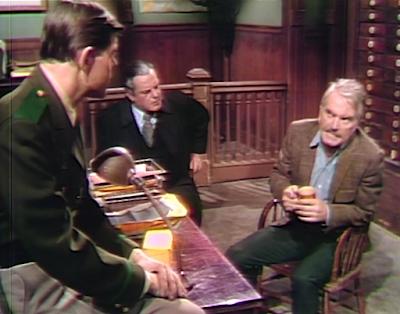
The police station was a frequent set for about a year after its first appearance in August 1966. It hasn’t changed a bit when we see it today. The officer on duty is someone we haven’t seen before, but that doesn’t mean he is a new character. Four actors took turns playing Sheriff George Patterson between September 1966 and January 1969; this man is not named in the dialogue and there are no acting credits on screen today, so for all we can tell he might be a fifth. He is younger and slimmer than were any of the other incarnations of Sheriff Patterson, but maybe he’s been working out.
Stokes introduces Paul to the policeman, and explains that Paul will speak only to the authorities. The policeman sits Paul down, gives him some coffee, and assures him that everything will be all right.
Paul tells the policeman that “It will never be alright until they stop chasing me” and “They have been after me ever since I got here.” The policeman asks “What are these people doing to you?” and Paul replies that “At first, there were just little hints, phone calls, things like that- veiled threats. It was their way of making me know that I was under their control. And I was, too, because when I tried to get away they took me back to Collinwood.”
The policeman responds “I see,” and Paul bursts out with “No, you don’t see! You think I’m mad!” The policeman tries to reassure him that he will listen, and asks him if he can name any of his persecutors. “Yes, I’ll name one, all right! My [ex-]wife, Elizabeth Stoddard.” The policeman says “That’s a little hard to believe,” and Paul responds “It’s impossible to believe, and yet! You tell me why she took me back into Collinwood, after years of open hatred, unless they wanted me there! And you know this town, you know how they gossip. And you know my wife. Why, why would she risk all that gossip, unless they wanted her to do so?” He answers that even so, “It’s still a little hard to believe.”
Paul angrily says “Yes, and because it’s Elizabeth Stoddard who’s involved, you will do nothing!” The policeman responds “I didn’t say that. I intend to talk to Mrs Stoddard and the doctor and whoever else is involved. If you still feel you’re being held captive, well, we’ll have to do something about it.” Paul visibly relaxes.
Earlier in the episode, we saw Liz forcing medicine on Paul. Returning viewers know that Liz has been absorbed into an evil cult that is trying to do something terrible to Paul, and indeed to the whole human race. We saw today that Liz has assigned her housekeeper, Mrs Johnson, to trick Paul into taking the medicine. It quickly becomes clear that Mrs Johnson has no idea that Liz is involved in anything sinister- she simply trusts her employer to do the right thing, and she follows her orders. Liz owns most of the village of Collinsport, and most of its people would react as Mrs Johnson does.
When we saw the last Sheriff Patterson for the last time in #675, he told a prisoner that he was releasing him because Liz’ cousin Barnabas said he was with him when the crime was committed, and Barnabas is “just about the best alibi you can have in this town.” He shook hands with the prisoner and sent him on his way. Since we know that Barnabas is, off and on, a vampire, and that even when he is free from the effects of that curse he spends most of his time covering up murders, that left us with an impression of Collinsport law enforcement as hopelessly in the thrall of the Collinses. That reinforces the image left by Sheriff Patterson’s predecessor, Constable/ Sheriff Jonas Carter, who was last seen in #32, toddling off after taking Liz’ orders to accept an obvious lie as a way of closing a case against a family member. Paul has every reason to suppose that this new policeman will be as submissive to Liz and her family as were his predecessors.
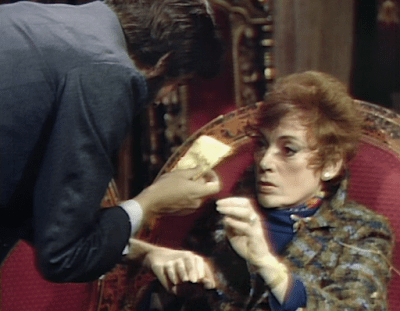
Now that Paul can hope that the policeman will be different from the others, he asks him to lock him away, to put him under guard someplace where no one can get to him until his daughter Carolyn Collins Stoddard can come for him. Stokes agrees to telephone Collinwood and talk to Carolyn, and the policeman escorts Paul to a back room. Paul awakes from a nap, and smiles at the policeman. He tells him he can’t tell him how much better he feels. The policeman tells him someone has come to see him. Paul’s delight at the thought that Carolyn has arrived gives way to cries of terror when he sees Liz at Stokes’ side. She comes at him with a spoonful of the hated medicine while Paul tells Stokes and the policeman that they are traitors and killers.
This one is primarily a showcase for Dennis Patrick as Paul, but all of the acting is excellent. My wife, Mrs Acilius, found it very difficult to watch the episode to the end, saying that they did too good a job- she felt as trapped as Paul. It really is one of those episodes you could show to a person who had never before seen Dark Shadows with a reasonable confidence that they would understand why we like the series so much.
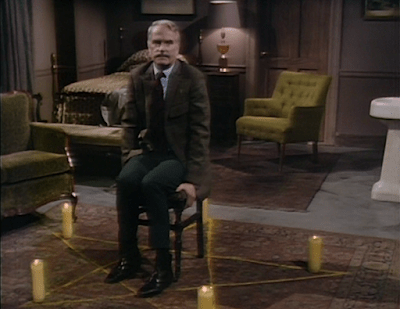
We open with the sight of a man (Dennis Patrick) sitting nervously on a chair placed in the middle of a pentagram marked on a rug. At each point of the pentagram there is a candle. The man is Paul Stoddard.
Regular viewers will remember #752, in which Quentin Collins was told to sit on a chair in the middle of a similar pentagram. Quentin’s friend, amateur warlock Evan Hanley, told him that by doing this he could keep from turning into a werewolf. Paul isn’t afraid of turning into a werewolf, and he doesn’t have a friend like Evan. His worry is vague, but urgent- he knows that someone is after him, that if that someone catches up to him they will do something horrible, and that whoever it is keeps sending him messages that it is time for him to pay his debt. But he has no idea who that is, what they will do, or what the debt they are talking about. Sitting in the pentagram was a suggestion that came from a sailor who cruised him in a gay bar met him in a local tavern.
Paul’s pursuers are a cult associated with mysterious beings known as “the Leviathan people.” It has been made clear to us that both Paul and his daughter, heiress Carolyn Collins Stoddard, are, unknown to themselves, part of its orbit. In #888, Paul and Carolyn ran into each other at a cairn that is the cult’s ceremonial center and looked at it. Carolyn had been on its site many times, and could not understand why she had not seen it before. In #894/895, the cult’s acting leader, Carolyn’s distant cousin Barnabas Collins, took antique shop owner Philip Todd to the cairn. Philip told Barnabas he had walked past the site a few days before and that the cairn was not there then; Barnabas explained that only those connected with the Leviathan cult can see it. Barnabas has also been highly solicitous of Carolyn’s well-being since he became part of the cult, and he keeps telling her that he knows she has an extraordinary future ahead of her. So we know that the cult has plans for her, and Paul’s distress suggests that they have less attractive plans for him.
Paul sees the doorknob turning. He is terrified. Instead of the enemy Paul expects, Carolyn enters. He yells at her to leave. She stays. When he is unable to explain what he is afraid of, but that the pentagram on the floor will protect him, she notices that it is the same as the symbol she has been wearing on a chain around her neck. Barnabas gave it to her some days ago and urged her to wear it always. The audience knows, but she does not, that he intends it to protect her from the local werewolf. When she sees the similarity, the show invites us to wonder what the Leviathans have to do with werewolves. Carolyn tells Paul that if the symbol will protect him from his enemies in the form of chalk or gaffer tape on the floor, it will also protect him when it is composed of a silver pendant. He puts the pendant on and declares that he feels much better. He can no longer hear the voices that have been telling him his payment is due immediately. He embraces Carolyn and tells her he trusts only her.
When Carolyn mentioned Barnabas to Paul, he responded “Who is Barnabas?” Carolyn seems surprised he does not know, since she saw him near Barnabas’ house. Indeed, we saw him enter Barnabas’ house and wander through it the night he first returned to Collinwood, after an absence of twenty years. But he doesn’t remember anything about that.
Not that Carolyn’s own long acquaintance with Barnabas is all that enlightening to her just now. Ever since the Leviathans adopted him as one of their own, he has not been himself at all. We see him in his front parlor with mad scientist Julia Hoffman, who has for a year and a half been his inseparable best friend. She is trying to interest him in some information she has gathered about another storyline, and he makes it clear he could not be less interested in it or in her. She demands to know what he is interested in, and he refuses to answer. Carolyn enters, and suddenly Barnabas is all ears. Julia, frustrated, snaps that now she can see what he does care about.
In the autumn of 1967, Barnabas was a vampire and Julia had failed in an attempt to make him human again. He bit Carolyn and made her his blood thrall. He also decided that he would kill Julia to prevent her exposing him. Julia soon learned that Carolyn was both a wily operator and a most devoted servant. Julia had already realized that she was in so deep with Barnabas that she would be unlikely ever to make a life with anyone else, and so she conceived an unrequited love for him. In her dealings with Carolyn in those days, terror mingled with jealousy. Her bitter remark when she sees that Barnabas, who has been so dismissive of her, is now so concerned with Carolyn, reminds longtime viewers of that jealousy. Combined with the story of a daughter reunited with her long-absent and none too respectable father, this faint suggestion of a love triangle is enough to remind us that we are watching a daytime soap.
For her part, Carolyn was freed of her subservience to Barnabas as soon as he was freed of the effects of the vampire curse in March 1968. For some time, Nancy Barrett went out of her way to play Carolyn in a way that left us wondering if Carolyn remembered her time in his power. The scripts didn’t give her a lot of support in that endeavor, but the closeness she feels towards him combines with Julia’s jealousy to bring it back to our minds.
Carolyn has come to ask Julia to help Paul. Julia is back in the great house of Collinwood getting her medical bag to take to Paul’s hotel room when Paul himself bursts in. He demands to see Carolyn. Julia tells him that she left a little while ago to go to his hotel, and is probably there now. The telephone rings. Julia answers it, and tells Paul it is for him. This doesn’t strike her as odd, even though he hasn’t set foot there in twenty years, not since the night he left his wife Liz thinking she had killed him. Julia hands the phone to Paul. He expects to hear Carolyn, but instead hears the same voice that has been taunting him, saying that his bill is due now. He hangs up, and it starts ringing again. He forbids Julia to answer it, and runs out. We cut to his hotel room, and see that this time it is Carolyn trying to reach her father. Later, Carolyn will come home and Julia will tell her that Paul doesn’t seem to want help, however much he may need it.
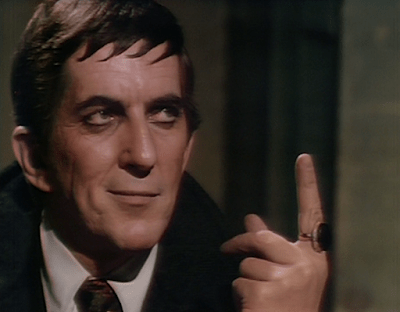
Paul goes back to his room, and hears the phone there ringing. Terrified, he runs out, returning to the bar where he’d picked up trade met a new friend the night before. He sees another stranger sitting at a table, looking him over and beckoning him by rolling back one finger. The stranger is Barnabas.
Paul reluctantly goes to the table, and Barnabas introduces himself. Paul says he doesn’t know Barnabas, but Barnabas makes it clear he knows all about Paul. He asks him to think back to the night he left Collinwood in 1949. We dissolve to a flashback.
Paul is at the bar, and another strange man strikes up a conversation with him. The man encourages him to assume that he has the power to grant any wish Paul might make in return for a price they would agree on. Paul says that in that case, he will ask for twenty years of boundless prosperity. At the end of those twenty years, Paul will give up anything he has, even his “most precious possession.” They shake hands on this deal. Paul laughs, and says he has won the game. He said that he would surrender anything he has, present tense- not anything he might gain in the course of his successful future, but anything he has as of 4 December 1949. On that date, Paul assures the man, he has nothing anyone could possibly want. The man laughs, and wants to drink to congratulate Paul on his cleverness.
Back in the present, Barnabas is laughing as heartily as the other man did twenty years before. He finds it preposterous that Paul could have forgotten such an important encounter. Paul can’t see anything important in it- it was just a silly little game, and its only consequence was that a strange man bought him a drink. Barnabas says that on the contrary, the bargain he struck was quite real. The Leviathans kept their side of it by giving him the success he has had over the last twenty years. Now that the twenty years are up, the time has come for them to claim the most precious possession he had the night he fled Collinwood.
Paul says that he supposes Barnabas is talking about his soul. He laughs heartily at that, and tells Barnabas that he is welcome to it. He is telling Paul that that is not what he meant as Carolyn enters. Paul is still laughing, and is delighted to see his daughter. She says she is relieved that the two of them found each other, and he tells her everything will be all right now. Barnabas says that Carolyn is her father’s most precious possession.
The scenes of Paul rushing around in a steadily mounting panic he is unable to explain are highly reminiscent of The Twilight Zone. The last line is a twist worthy of that classic series, especially as delivered by Jonathan Frid. His icy performance as Barnabas in these early episodes of the Leviathan arc not only recalls the malign representatives of alien powers on that show, but is superb in itself. He stumbles a little over his words in Barnabas’ scene with Julia, but is perfectly composed otherwise, and the effect is quite frightening.
I remarked on the gay subtext of the barroom scenes in the comment thread on Danny Horn’s post about the episode at his great Dark Shadows Every Day:
So far, this has been the gayest storyline the show has taken on yet.
In 899, the sailor offers to buy Paul a drink, and Paul shouts “I buy my own drinks!” This isn’t subtext- any man getting that reaction in a bar will know that the other fellow has interpreted his offer as including more than the drink. Paul apologizes and becomes friendly, indicating that he is willing to abandon that interpretation and set aside the hostility that accompanied it.
In this episode, we’re back in the same bar. Barnabas beckons Paul to his table with his index finger. I invite any man who doesn’t think we are intended to read this as a reference to a sexual come-on to try that move on a homophobic tough guy in a bar.
Paul’s face shows his inner struggle as he tries to resist Barnabas’ advances, but he can’t. Barnabas coaxes him into reminiscing about yet another night in the same bar, when a casual encounter with yet another guy led to something that seemed at the time like a little harmless tomfoolery, but that has now grown into a threat to his relationship with his family, his standing in the community, his physical well-being, and everything else.
Comment by “Acilius,” left 12 December 2020 on Danny Horn, “Episode 900: The Long Con,” posted on Dark Shadows Every Day, 18 July 2016.
In response to someone who said some kind words about that comment, I made a remark that I no longer think is very good:
Thanks! It’s a bit of a puzzle- so far as I know, none of the writers on the show at this time was gay, so I’m not sure why they decided to go so deep into these themes just then.
Comment by “Acilius,” left 11 April 2021 on Danny Horn, “Episode 900: The Long Con,” posted on Dark Shadows Every Day, 18 July 2016.
What I think now, and probably would have thought then if I had stopped and considered it for a minute before I hit “Post Comment,” is that the writing staff’s sexuality has nothing to do with it. They were worldly, sophisticated people with long experience in the theatrical profession in New York City. They all probably had many gay friends, and when they are called upon to write a story about people being drawn into a secret underworld and learning uncomfortable truths about themselves in the process their minds will naturally turn to themes having to do with closeted homosexuality. Granted, that doesn’t fully account for Christopher Bernau’s decision to play Philip as a much queenier version of Paul Lynde, but it is hardly a “puzzle” that the writers would draw on motifs suggestive of the closet when that’s the story they have to work with.
The man who met Paul in the bar in 1949 is unnamed in today’s dialogue, but will later be referred to as Mr Strak. Strak is played by John Harkins, who appeared in #174 as Lieutenant Costa of the Arizona State Police and in #878, 879, 880, 881, and 883 as Garth Blackwood, formerly the keeper of England’s Dartmoor Prison, and by that time a creature raised from Hell to wreak vengeance on an escaped prisoner and anyone else who caught his attention.
Strak’s name may remind longtime viewers of another minor character whom we saw in episodes #1 and #2, Wilbur Strake, private eye. We saw Strake in this same bar, where he gave reports about Carolyn and other members of the Collins family to his employer, Burke Devlin. Like Strak, Strake was a rather smug, sardonic sort. Add to this the rarity of the names “Strak” and “Strake” and the fact that they sound so much alike, and it seems obvious that there is an intentional reference of some kind. Paul’s presence in this storyline is the result of the writers reaching back to the show’s early days to find a loose end they could attach to this storyline to incorporate it into the Collins family saga, so they probably were looking through the scripts from the first week. Still, I can’t imagine they thought many people would remember Wilbur Strake by this point. Likely the reference is an inside joke, but who was on the inside and what the point of the joke was, I can’t begin to guess.
I wasn’t writing detailed posts with background information when I covered the first weeks of the show, so I will mention here Strake was played by Joseph Julian, who later became a regular on Somerset, a soap that aired on NBC opposite Dark Shadows for the last year of its run. The cast of Somerset included several Dark Shadows alums, including Dennis Patrick, Joel Crothers, and Christopher Pennock in major roles, and, as day players, Dolph Sweet and Humbert Allen Astredo.
Most of the episode revolves around the fact that Julia Hoffman cannot speak. Grayson Hall uses a whole new set of acting techniques playing a mute character than we had seen in her appearances as the most talkative human beings imaginable, and the result is absolutely fascinating. I’d have been glad to watch the episode again as soon as it ended.
We open in the basement of the Old House on the estate of Collinwood. Julia is sitting at a table in front of a set of I Ching wands. These wands are still in the pattern recovering vampire Barnabas Collins cast several months ago, when he was trying to contact the malign ghost of Quentin Collins. Barnabas meditated on them, and his “astral body” went back in time to 1897. Since his physical body was also in 1897, confined to the coffin in which he was at that time trapped, he became a resident of that year, and met the living Quentin.
Julia has decided that she, too, must travel to 1897. So she meditates on the wands. She tells herself that she must visualize them on a door, and she tells herself to “Empty your mind of everything else.”
She follows this injunction only too well. After passing through a series of doors, she collapses outside the great house at Collinwood in 1897. When stuffy Edward Collins takes her into the drawing room and questions her, she can respond only with a blank stare. Quentin comes in and finds a letter from Barnabas in Julia’s pocket. He asks her if she is the Julia addressed in the letter and why she has a letter from Barnabas. She does not recognize her own name or Barnabas’.
Quentin has become Barnabas’ friend, and his brother Edward has become his enemy. When he reads the letter Julia brought, Quentin realizes that Edward has locked Barnabas in the prison cell in the basement of the Old House. When dawn comes, Barnabas will not be able to get back to his coffin. Since he is a full-fledged vampire in 1897, that means he will disintegrate into dust.
Quentin leaves Edward with Julia and goes to Barnabas’ rescue. Quentin knows that Barnabas is a vampire and that he is trying to help him, and he knows that if things keep on as they are going he might become a family-annihilating ghost at Collinwood in 1969. But it is only while talking to Barnabas about the letter that he learns that he has come to 1897 from that year. The pieces start falling into place in Quentin’s mind as he absorbs this information.
Barnabas goes to hide in “the old rectory on Pine Road.” Quentin takes Julia there. Barnabas can’t get any information out of her, but he is sure that she knows how to save Quentin’s life. He is also sure that if they don’t find out what she knows, Quentin will be killed on this night, 10 September 1897.
The basis of Barnabas’ certainty regarding this latter point is a vision that a woman had. This woman used to be the repressed Charity Trask, but has now by supernatural means been transformed into the late Cockney showgirl/ psychic Pansy Faye. Pansy’s psychic act was fake until she came to Collinwood in #771. In the spirit-laden atmosphere of the estate, even her phony mumbo-jumbo called up real voices from the great beyond. Pansy’s stunned reaction when she actually contacted a ghost reminded longtime viewers of #400, when Charity’s ancestor, the fanatical witchfinder the Rev’d Mr Trask, conducted an exorcism to drive a witch out of the Old House and showed delight and not a little astonishment when the person he believed to be the witch came running out at the climax of the ceremony. Perhaps Pansy reminded the writers of Trask as well, and that was where they got the idea of having her spirit take possession of Charity.
Charity/ Pansy is in today’s episode. She’s the one who finds Julia, and she tells Edward that Julia “has death written all over her face!” She also says that she has a job. She is working at the tavern in the village of Collinsport, the Blue Whale. Presumably she is doing Pansy Faye’s old act there, singing, dancing, and doing psychic readings. We can imagine what Charity’s father, the hypocritical Rev’d Gregory Trask, must think of that.
We open in the woods on the estate of Collinwood, where a young woman in heavy makeup and bright clothing is crying. Another woman in even heavier makeup and even brighter clothing approaches and asks her what is wrong. The first woman says that she had a vision which told her that the rakish Quentin Collins will die of stab wounds twelve days from now, on 10 September 1897.
The first woman used to be Charity Trask, the miserably repressed daughter of the evil Gregory Trask. She is now possessed by the spirit of Cockney showgirl Pansy Faye. Charity knew that Quentin was a werewolf, and wanted nothing to do with him. Evidently Pansy did not acquire that knowledge when she took up residence in Charity’s body, and has decided that she will marry Quentin. Quentin has no interest in either Charity or Pansy, and already has two other fiancées, one of whom he loves, at least after his fashion, and the other of whom is sealed to him by a pact with the Devil. Yesterday Charity/ Pansy learned of the second engagement, and tried to kill Quentin to prevent it coming about; week before last, she tried to end the first engagement by killing the fiancée. Pansy had her faults, but she wasn’t inclined to physical violence. That part seems to be Charity’s contribution to the symbiont.
The other woman is broad ethnic stereotype Magda Rákóczi. Magda was the one who made Quentin a werewolf in the first place. She cursed him for murdering his wife Jenny, who was her sister. It was only after she had placed the curse that Magda learned that Jenny had given birth to Quentin’s twin children, a boy and a girl. Since the curse is hereditary, Magda is now desperate to lift it, and she and Quentin have become allies.
Some time ago, we learned that if Quentin dies, there will be no hope of lifting the curse. So Magda is terrified when Charity/ Pansy tells her of her vision of Quentin’s death. She takes her back home to the great house on the estate, where her father and Quentin are bickering while they recap yesterday’s story. Trask tries to deny that Charity/ Pansy is insane or that she is capable of killing, but when she enters and announces that she will murder the first person who comes between her and Quentin he has to admit that it might be time to find a place for her in residential care.
We turn our attention to the upstairs of the great house. We see Charity/ Pansy in bed, with Magda sitting in a chair beside. The gramophone is playing a record of Pansy Faye’s theme song. Regular viewers will wonder where Charity/ Pansy could possibly have found such a thing. Charity never met the living Pansy, who was killed the very evening she arrived at Collinwood. Perhaps Pansy’s fiancé, the childlike Carl Collins, bought the record when he met Pansy in Atlantic City and brought it back with him. Carl himself was killed well before the possession began, but perhaps Charity or Charity/ Pansy found it among Carl’s effects.
Charity asks Magda if she likes the tune. “I only like Gypsy music,” she replies. Charity/ Pansy and Quentin both reiterate their theme songs endlessly, but few other characters in the 1897 segment have so much as a dedicated entrance cue. This line of Magda’s makes us wonder what the show might have been like if they had given every major character a theme song.
Trask has a crisis in the drawing room. He hears a ghostly voice warning him that there will be another killing soon. He starts shouting the name “Minerva!” and pleading for mercy. First time viewers might not know what to make of this. Those who have been with the show for a while know that Minerva was Trask’s wife and Charity’s mother, and that he instigated a plot to murder her so that he could marry wealthy spinster Judith Collins and become master of Collinwood. When the voice starts to talk about “the beast that walks like a man,” Trask says “You’re… not Minerva?” Jerry Lacy is an expert comic actor, and his delivery of that line is laugh-out-loud funny.
The same ghost appears visibly to Quentin in his room. He recognizes it as that of Tessie Kincaid, a woman he killed in a recent fit of lycanthropy. He knows that she is appearing to him because tonight there will be a full Moon.
Magda enters and finds Quentin writing a suicide note. She tells him he must not kill himself. She chains him to a post in his room and stands by with a pistol. Trask enters and finds them in this compromising position. Mrs Acilius and I laughed as we imagined how Magda and Quentin might have claimed they were planning to spend the evening.
But there is no point in lying to Trask. Between what Tessie’s ghost told him and what he overheard while eavesdropping on a conversation Quentin and Magda had earlier in the drawing room, he has figured out Quentin’s problem. He takes the gun from Magda and recognizes the bullets with which it is loaded as silver. He announces that he will wait until the Moon rises and see what happens.
Tessie’s turn today marks Deborah Loomis’ third and final appearance on Dark Shadows. Miss Loomis didn’t get to do very much, but she made the most of all of it, and I wish we had seen more of her.
The dramatic date is 28 August 1897. On 23 July, in #803, sorcerer Count Petofi cast a spell on stuffy Edward Collins. Ever since, Edward has believed he was a valet recently separated from the service of the Earl of Hampshire. This led Edward’s brother, the rakish Quentin, to follow the Collinses’ long-established procedure for responding to mental illness and lock him up in the room on top of the tower in the great house of Collinwood.
In #816, broadcast on 11 August 1969 and therefore set on 11 August 1897, Petofi brought something even stranger on Edward’s twelve year old son Jamison. He called the spirit of Jamison’s grandson David to project itself from 1969 and to take possession of Jamison. In 1969, David is deathly ill because Quentin’s ghost had besieged him and everyone else at Collinwood. Now, Jamison too is dying, and in the moments he has been able to speak he has let the living Quentin in on the fact that he will eventually become a family-annihilating ghost.
Wicked witch Angelique has made a bargain with Quentin. She will try to restore Jamison and Edward to their usual selves, and if she succeeds Quentin will marry her. We see her beside Jamison, talking earnestly with him, praying loudly to “the Master of Darkness” to cure him and Edward so that she and Quentin can devote themselves to the service of that supernatural personage. In 1968, when the show was in contemporary dress, Angelique and others used a lot of euphemisms like “Master of Darkness,” but lately the ratings are high enough that the ABC network’s office of Standards and Practices has been letting them say the name “Satan.” I suppose Angelique’s persistence in the former phrasing shows that she’s still devoted to the old time religion.
Satan comes through, and Jamison and Edward are freed. This leads to a bit of awkwardness in each case. Quentin and Edward’s step-niece Charity Trask has lost her personality as the result of another of Petofi’s spells, and is now hosting that of the late Pansy Faye, Cockney showgirl and onetime fiancée of Quentin and Edward’s late brother Carl. Charity/ Pansy is exploring the great house when she comes to the locked door of the tower room. She hears Edward inside calling for help. He is still in his valet persona, and he is delighted with her when she promises to get a key and let him out. Edward returns to himself, with no memory of anything that has happened since 23 July, while Charity/ Pansy is away. When she comes back up and opens the door, she finds that he is in a foul mood and that he disapproves of her intensely. She is understandably miffed at his apparent fickleness and ingratitude.
For his part, Jamison’s quite different experience has left him with some memories. He tells Angelique of images that are floating around in his mind. She recognizes them as things associated with Petofi, and is distressed. She tells him he is better off not knowing what they are. Quentin is more distressed when Jamison looks at him and asks why he is trying to kill David Collins. Jamison can’t explain who David Collins is or how he learned that Quentin was trying to kill him, but this does confirm everything Quentin has gathered about his post-mortem destiny.
While Edward comforts Jamison in the study, Quentin and Angelique meet in the drawing room. She asks if he will honor his end of their deal; he says that he will, though he makes abundant protests about his reluctance to do so. Charity/ Pansy eavesdrops at the door. She has decided that she will marry Quentin, and is horrified to hear this conversation.
Edward enters and asks Angelique to excuse him and his brother. She exits, and Edward declares that the first order of business must be to hunt and destroy vampire Barnabas Collins. Quentin is appalled at this. He tries to tell Edward that Petofi is their most immediate threat; after he explains who Petofi is, Edward agrees that they will get around to fighting him at the appropriate time, but he insists that Barnabas is their main concern.
Edward exits, and Charity/ Pansy enters. She tells Quentin that she overheard his conversation with Angelique. She says that he will not marry Angelique. Quentin bitterly responds that he will, and that there is nothing she can do to stop it. At this, Charity/ Pansy picks up a knife and tries to stab Quentin. Quentin holds her at bay, and Edward enters in time to see what is happening and to get Charity/ Pansy off of Quentin. Quentin says that Charity/ Pansy’s condition is further evidence of the need to focus on fighting Petofi, but Edward will not swerve from his determination to concentrate on Barnabas. Moreover, he decides that he will now quiet Charity/ Pansy himself. He sends Quentin out of the room and prepares to give Charity/ Pansy a stern talking-to.
Charity/ Pansy’s attempt to prevent Quentin’s marriage to Angelique by stabbing him is of a piece with her attempt to break up Quentin’s relationship with maidservant Beth in #823/824 by poisoning Beth’s brandy. The original Pansy, whom we saw as a live person in #771, was not exactly nice. She was cold, hard, and cynical, trying to exploit the childlike Carl. But she didn’t seem to be bent towards physical violence. That appears to be Charity’s contribution to the composite being that the two of them now make up.
Before Edward can deliver whatever lecture he had planned to give Charity/ Pansy, she goes into a trance. The live Pansy had done a stage act as a “mentalist” and fortune teller, and was astonished in #771 when she tried to do her act at Collinwood and found herself actually channeling spirits from the great beyond. Now Charity/ Pansy routinely acts as a medium.
Charity/ Pansy announces that something terrible will happen on 10 September. Countdowns don’t usually work as a source of suspense on soaps. They might be all right in a play or a feature film, where we know that there will be a final curtain or a last frame after which the imaginary universe will cease to exist, but so long as the series is scheduled to come on every weekday at 4 PM, we know that there is always going to be room to move any deadline a little further out. Besides, since Dark Shadows was done virtually live to tape, they could rarely predict with any accuracy just how many ticks of the clock it would take to get all the movements made and dialogue spoken before the crisis is supposed to be reached. But “10 September” is in a slightly different category. Quentin explicitly says on screen that today is 28 August, which was indeed the original broadcast date in 1969. And when Edward says that his last memories are of 23 July, he is indeed referencing the original broadcast date of #803. So when Charity/ Pansy says “10 September,” she is committing the show to something in the real world. We may well sit up and take notice.
Charity/ Pansy has a vision of what will happen on that date. She sees Angelique looking at a portrait of Quentin in the drawing room. Red paint is dripping from the figure’s chest into a pool on the floor. That pool is next to a trail of other drops of red. In her mind’s eye, Charity/ Pansy follows the drops into the foyer, up the stairs, and into the tower. There, she sees Angelique opening the door to the tower room and finding Quentin sprawled, a sheet of red plastic, or perhaps construction paper, on his chest. Charity/ Pansy screams and runs out. From the dramatic music and Charity/ Pansy’s agitated reaction, I take it the object lying on Quentin’s chest is meant to suggest blood.
The acting is all very strong today. I was fascinated with Nancy Barrett’s use of her face to highlight Charity/ Pansy’s makeup. She relaxes her jaw muscles slightly more than usual, causing the dark treatment around her eyes to stand out. That in turn creates a visual metaphor labeling Charity/ Pansy a “painted lady.”
My wife, Mrs Acilius, was particularly impressed with Louis Edmonds’ realization of Edward. When the spell breaks and he becomes himself again, Edward is alone in an empty room. He has no dialogue, no props, and no scene partner to work with. Yet he instantly conveys what has happened. Even first time viewers will understand that the obliging servant has now become a stuffy authority figure.
Edward’s towering indignation when Quentin first tells him he was the one who locked him in the tower room gives way instantly when Quentin explains that he was under a delusion at the time. Edmonds executes that transition so smoothly that first time viewers will not notice the oddness of it, but longtime fans who remember the many previous occasions when the Collinses locked each other there as a response to mental illness will chuckle.
One of the prominent features of Edward’s personality is his warm relationship with his children. This sets him apart from the first two characters Louis Edmonds played on the show, high-born ne’er-do-well Roger Collins and haughty overlord Joshua Collins. Edward’s dialogue in his scene alone with Jamison involves several discrete points of information, and it would have been understandable if the affection he displays for Jamison while he getting all of those words across had been either perfunctory or mawkish. But he and David Henesy get the emotions exactly right while also delivering the lines very clearly.
Edward’s preoccupation with Barnabas is a delicious little bit of commentary on the show itself. Dark Shadows‘ ratings, chronically low during its first 42 weeks on the air, perked up when it added Barnabas to the cast in April 1967. That summer, schoolkids curious to see a vampire on daytime TV made it into a hit, and not long after Barnabas became one of the pop culture sensations of the 1960s, instantly recognizable to many millions of people who never watched the show. To this day, people who have heard of Dark Shadows are likely to refer to it as “the vampire soap opera from the 60s.” It was Barnabas who took us with him to 1897, when he traveled back in time in the course of his attempt to rescue David from Quentin’s ghost, and for the first months of the 1897 storyline he was the only character who knew what was at stake for the 1969 version of the Collinses in the events going on around him.
But now Barnabas is on the fringes of the story, and Quentin, Angelique, and Petofi all know about 1969. Edward’s idea that the action has to focus on Barnabas is evidence that he hasn’t been watching the show. Petofi is the principal antagonist now, Quentin the chief protagonist, and Barnabas can be absent for weeks at a time while they and others find all sorts of things to do. This represents, not Barnabas’ failure, but his ultimate success. Before he was introduced, every story revolved around well-meaning governess Vicki, the main character. A soap opera can’t really have a main character. It needs to keep multiple storylines running at once, occasionally intersecting with each other, often running for long periods with little or no interaction. When one person had to be at the center of every development, the result was slow and claustrophobic.
Barnabas blew that confining structure open, because as a vampire his function in the story was not to solve problems, but to create problems for other people to solve. So no matter how much time they spent focusing on him, he always directed our attention towards everyone else. We wondered who would catch on to his secret, who would fall victim to his malign intentions, who would find a way to fight him, etc. When a mad scientist managed to free Barnabas of the effects of the vampire curse, he retained his function as a problem-maker, even when he set out to be a problem solver. Every time he announced that he had a plan, we looked forward to seeing how the rest of the cast would react to that plan’s rapid and catastrophic collapse.
Barnabas is as hapless in 1897 as he has been in every other time period, as witness the fact that he has been exposed as a vampire and driven into hiding. But he isn’t even the show’s Screw-Up-in-Chief now. That title belongs to broad ethnic stereotype Magda Rákóczi. In #807, Petofi compelled Magda to review the preceding 22 weeks of the show and admit that she had precipitated every plotline. The first of those was the release of Barnabas into the world of 1897, so that his crimes and misadventures are just a subcategory of hers. Since Magda is played by Grayson Hall, who in her original role of Julia Hoffman is waiting for us in 1969, we can be confident she won’t be coming back to contemporary dress with us, but for the moment she has relegated Barnabas to the status of a secondary character.
One night in 1797, nine Rroma men trapped sorcerer Count Petofi in the forest of Ojden. They amputated his right hand, and with it took most of his magical powers. Some time after, Petofi learned that he had exactly one hundred years to reattach the hand. If he managed it within that time, he would become immortal. Otherwise, he would die on the anniversary of the amputation.
Now that anniversary has come, and Petofi has succeeded in regaining his hand with only minutes to spare. Time-traveling vampire Barnabas Collins and his distant cousin, desperately handsome werewolf Quentin, have decided that because Petofi’s spirit is in possession of Quentin’s twelve year old nephew Jamison and Jamison is as close to death as is Petofi himself, only by surrendering the hand to Petofi can they save the boy. Barnabas did get Petofi’s servant Aristide to promise to free Quentin of lycanthropy once he has the hand back, but he put little faith in that promise.
Now Petofi is jubilant and Jamison is still sick. Barnabas tells Petofi about the deal Aristide made, and also says that he wants Jamison and the rest of the Collinses to be freed from the ill effects Petofi has had on them. Petofi could not be less interested. Instead, he wants Barnabas to tell him how he traveled in time from 1969 and how he will travel back there.
Petofi lets slip that he is anxious to go to another period of history because he is afraid of the Rroma people who are still after him. We know, not only that it was Rroma who cut off his hand, but that when Petofi saw a young Rroma woman in a tavern in #794 he couldn’t get out fast enough. While it may have taken nine Rroma men to take his hand, evidently a single Rroma woman, and a tiny one at that, is capable of doing him considerable harm. Barnabas has a Rroma friend, broad ethnic stereotype Magda Rákóczi, who has considerable magic powers of her own, and he knows of a Romany band currently camped near Boston. So Petofi’s apparently well-founded ziganophobia is a sign that Barnabas may be able to defeat him, even though Petofi’s powers were formidable even before he was reunited with his hand.
Petofi says that he will cure Jamison only if Barnabas explains how he traveled to 1897 from 1969. Barnabas tells Petofi he has no idea how he made that journey. This is so. He meditated on some I Ching wands, a process which he was told might have any of an infinite number of effects, and found himself in 1897. Nor does he have any idea how to get back. He might have enlarged on the theme of his complete lack of useful knowledge in this area. In 1968, Barnabas traveled back to his original era, the 1790s, by going to the grave of a man named Peter Bradford on the anniversary of Bradford’s death. Bradford’s ghost had been haunting him, and Barnabas called for Bradford to take him back to the year 1796. After he did so, Barnabas found that he could return to the 1960s only by having himself sealed in his coffin and waiting inside it for 172 years until friends let him out. He doesn’t tell Petofi about that incident, but it does not seem likely to be of any more help to him than the story about the I Ching would be.
Petofi does not believe that Barnabas is so hapless. First he squeezes Barnabas’ hand, depriving him of the power to dematerialize. Then he opens a cupboard and tells Barnabas to look in it. It takes a while to warm up, but eventually it gets an ABC affiliate showing Dark Shadows. Barnabas sees the parlor of the Old House on the estate of Collinwood in 1969. His best friend, mad scientist Julia Hoffman, MD, is sitting there reading a book. We haven’t seen Julia since #700, but she might be on our minds today. At one point Aristide lights his cigar on a candle burning in a large candelabra. In #296, Julia very memorably did the same thing with her cigarette.
Barnabas sees strange and troubled boy David Collins come staggering downstairs, raving deliriously about Quentin. Julia tells him to reject Quentin, who in 1969 is a ghost haunting Collinwood and draining the life from David. David passes out, and Julia injects him with a powerful sedative, as you do with unconscious children.
The cupboard loses the channel, and Barnabas asks Petofi what else is happening in 1969. Petofi cannot answer any questions; it quickly becomes clear that he couldn’t see or hear the scene. Barnabas is intrigued to learn of another of Petofi’s weaknesses, and walks out.
Aristide then speculates that Barnabas might be telling the truth. Petofi rejects this at once, reveals more of his cupboard’s limitations:
No, he’s not a fool, Aristide. He thinks he can win, accomplish whatever he wants to do here, and disappear without me…
Had Petofi ever seen even one episode of Dark Shadows, it would not occur to him to say that Barnabas is “not a fool.” Nor would he surmise that Barnabas is pursuing a plan that includes a plausible method of escape. If Barnabas had a plan of any kind, Petofi would know all about it, since it would have failed spectacularly the moment he took the first step towards putting it into effect.
Petofi and Aristide then go to the Old House. They find Magda there. At the moment, she is under Petofi’s power. Like Julia, Magda is played by Grayson Hall. We may have thought the glimpse into 1969 was a videotaped insert, but evidently it was done live, because Magda is not wearing her usual heavy brownface makeup. She may have a bit of an artificial tan, but Julia’s blue eyeshadow is clearly visible through it.
Magda, looking more like an actual Rroma woman than she ever has before.
Petofi forces Magda to lead her to Barnabas’ hiding place. He has a cross and Aristide has a chain and a padlock. Petofi puts the cross inside the coffin, and orders Aristide to chain the coffin closed. Petofi declares that Barnabas is in for a long journey.
Charity Trask is in the drawing room of the great house on the estate of Collinwood trying to call the police when her abusive step-uncle, Quentin Collins, comes out of a secret panel and takes the telephone from her. He tells her that there is no longer any point in telling the police about Tessie, the injured woman upstairs. Tessie won’t be telling them anything. She has died. Apparently the sheriff of Collinsport is the same in 1897 as are his counterparts in other periods when Dark Shadows has been set- if you’re already dead, it’s too late for them to take an interest in you.
Charity says that Quentin killed Tessie. Charity knows that Quentin is a werewolf. He locks the door to the room and asks “Are you afraid to be locked in alone with a beast, a murderer, a creature of the supernatural?” This would seem to be rather an odd question, especially since he spent yesterday’s whole episode threatening to kill her.
Charity says that her father, Gregory Trask, will see to it that Quentin is brought to justice. Quentin takes a paper from his pocket and shows it to Charity. It is a confession to the murder of Charity’s mother, signed by her father. Charity claims that it was fabricated by Satan, which is what her father told her when she first saw it, and that Trask repeatedly tried to destroy it. This only convinces Quentin that the confession is true. He says that if either Charity or her father tells the police about him, he will hand over the paper. He adds “Now, Charity, I may hang for murder, but your father will be dancing at the end of a rope, too.”
Dark Shadows is set in the state of Maine, which in our universe abolished capital punishment in 1887. That used to be true in the show’s universe, as well. In #101, broadcast and set in November 1966, high-born ne’er-do-well Roger Collins told his son, strange and troubled boy David, that “They don’t hang people anymore. Not in this state, anyway.” But by the time the show left the 1960s for its first costume drama segment a year later, characters were already afraid of being sentenced to death. The morbid fascination of the gallows is so much of a piece with the show’s exaggerated melodrama that there must be a death penalty, no matter when or where the action is supposed to be taking place.
Quentin tells Charity that there is a chance- a small chance, he concedes- that he will be cured of lycanthropy before the next full Moon, so that she need not feel that she is an accessory to murder if she doesn’t turn him in right away. Miserable, frightened, and confused, she takes this seriously enough that she remains quiet at least through this episode.
We cut to a hiding place where a man known as Aristide is looking at himself in a mirror and primping his hair, moving his fingers through it with an exaggerated daintiness. We pan to broad ethnic stereotype Magda Rákóczi , who impatiently asks “Did you send for me so there would be two of us to admire you?” Aristide has some business to discuss relating to plot points not directly involved in this episode, and he and Magda trade menacing insinuations about the danger each faces from the various supernatural forces at work in the area. Magda says that what the ziganophobic Aristide calls her “Gypsy cunning” will protect her, and Aristide says that an amulet he wears around his neck will protect him.
Magda replies “All right, we’ve both got something to protect us. I go now,” and starts to leave. Aristide stops her, and says that she must recover the severed hand of Count Petofi. She says that a man named Tim Shaw stole the hand and ran off with it, and she has no way of knowing where Tim is. Aristide says she must find out and bring it soon, “before time runs out.” She asks “Before time runs out for who? You mean when Petofi comes back!” In fact, Aristide means more than that- his master, 150 year old sorcerer Count Petofi, will die in a matter of days unless he is reunited with the hand that was cut from his right arm a century before, in 1797. If he does recover the hand in time, he will become immortal. Magda fears Petofi and hates him, and would doubtless make any sacrifice to keep the hand away from him if she knew these were the stakes. So Aristide is mortified that he let slip the phrase “before time runs out,” and is anxious to avoid saying anything else.
Back at Collinwood, Quentin confers with a Mrs Fillmore. Mrs Fillmore has been looking after the twin children Quentin’s wife Jenny bore him after he left her and before he murdered her. This is the first time we have seen Mrs Fillmore. It is also the first confirmation we have had that Quentin has seen Mrs Fillmore. He didn’t know about the twins until #798, when the boy twin was already dead as the result of a curse that a woman named Julianka placed on Magda, who is Jenny’s sister. Now Mrs Fillmore tells Quentin that the girl is suffering the same symptoms the boy showed before he died, and that the doctor is at a loss what to do for her. Quentin says he will look for someone who might be able to help, and they both exit.
Charity is alone in the drawing room, making an earnest effort to get drunk. Magda enters and expresses surprise that the unbendingly prudish Charity has been drinking. Charity replies that she merely ate some chocolates that were filled with brandy. At the sight of an empty snifter, she says that after eating the chocolates she poured herself a small brandy. She then picks up and drinks another, regular-sized brandy. Charity starts talking about how terrible life at Collinwood is. Magda mentions Tim Shaw, who was once Charity’s fiancé and who was framed for her mother’s murder. Charity wonders if Magda can use the Tarot cards to find Tim and bring him back. She asks if Tim will have to tell the truth if he comes back, and Magda assures her that he will. Magda may assume that the truth Charity wants is about the end of her relationship with Tim; she does not know that Charity is desperate to revert to believing that Tim, not her father, murdered her mother.
Magda asks Charity to tell her as much as she can about Tim. Charity says that when Tim was a boy, his closest friend was named Stephen Simmons, and that “He and Stephen Simmons used to always say they would go to San Francisco when they grew up.” Magda asks where Stephen Simmons is now, and Charity says she thinks he lives in Worcester, Massachusetts. She goes to her bedroom to look for a Christmas card Stephen sent her last year, hoping it may have his current address.
Quentin returns and finds Magda. He asks Magda how she knew about his daughter. She asks what he means. When Quentin tells her that the girl is suffering the same symptoms that her brother showed immediately before his death, they rack their brains to come up with a potential defense against Julianka’s curse. Magda remembers Aristide’s amulet. It is capable of warding off vampires and witches- perhaps it will defend against Julianka as well. Magda tells Quentin where Aristide is hiding, and he decides to go to Aristide and rob him of the amulet.
Aristide is asleep when Quentin arrives. He awakens before Quentin can take the amulet, and declares “This pendant protects me from witches, warlocks, and unnatural spirits.” Quentin asks “How does it do against flesh and blood, Aristide?” Aristide draws a curvy piece of wood with no sharp edges and replies “For flesh and blood, I have The Dancing Lady.” The piece of wood is supposed to be a knife. When Aristide first displayed it in #792, he called it “The Dancing Girl.” Perhaps this is a case of Soap Opera Rapid Aging Syndrome, and in a couple of weeks it will be The Dancing Dowager, then The Dancing Crone. At any rate, Quentin replies “Then let her dance, Aristide, let her dance.” Quentin wins the subsequent fistfight. He knocks Aristide senseless, then takes the amulet from him.
Quentin and Magda go to Mrs Fillmore’s house, the first time we have seen this set. Appropriately for a member of the Collins family, the baby sleeps in a cradle shaped like a coffin.
Quentin talks with Mrs Fillmore about little “Lenore,” a name we have not heard before today. The only other girl of Lenore’s generation in the Collins family is the daughter of Quentin’s brother Edward, and she is named Nora. Since the name “Lenore” became popular outside Greece because speakers of English and French thought it was an alternative form of “Nora,” that would suggest rather a limited imagination regarding girl’s names on the part of whoever chose them.
But it is appropriate that Quentin and Edward have children with similar names. They are two variations on Dark Shadows’ first archvillain, Roger, whose evil largely expressed itself in his amazingly bad parenting of David. Edward’s attentive and caring interactions with Nora and her brother Jamison show that he is a less villainous Roger, while Quentin’s frequent assaults on his adult family members are among the evidence that he is an even worse version of the same character. Jamison is the only child we have seen Quentin interact with, and he is fond of him. But while we were still in the 1960s, Quentin’s ghost was possessing and killing the children at Collinwood, and in #710, only two weeks into the 1897 flashback, he and his fellow Satanist Evan Hanley used Jamison as a “sacrificial lamb” in a ritual meant to exploit his innocence for their own sinister purposes. Clearly, Quentin is no more to be trusted with the care of a child than was the early Roger.
Quentin asks Mrs Fillmore to leave him and Magda alone with Lenore. They apply the amulet, and it does not seem to work. Magda tries to raise the spirit of Julianka. After some pleadings and whatnot, there is thunder, wind, and other signs of ghostly presence. Magda cries out in hope that Julianka has come with pity. A figure materializes and says “Not with pity, Magda.” But the figure is not Julianka. It is Jenny.
In #804, we saw a photograph of Jenny in Quentin’s room. It was a full length picture in a period-appropriate costume, not just Marie Wallace’s professional headshot, raising a hope that we would see Miss Wallace again before too long. But after a week and a half, those hopes had begun to fade. Perhaps they took the picture months ago and never got around to using it when Jenny was on the show. If they had done that, they wouldn’t be above sticking in a scene of Quentin looking at the picture and discussing it with his distant cousin Barnabas the vampire so that they could get their money’s worth out of it. When Miss Wallace does in fact return, the show sends us out on a high note.
The spirit of evil sorcerer Count Petofi has taken possession of twelve year old Jamison Collins, much to everyone’s consternation. David Henesy spends most of the episode mimicking Thayer David’s Petofi, with hilarious results.
Jamison/ Petofi sipping a glass of “mineral water… for the digestion.” Screenshot by Dark Shadows Before I Die.
We see Jamison’s favorite uncle, Quentin the Satanist, trying to cast a spell to break Petofi’s possession of Jamison. As he always does when he is calling on the dark powers of the unseen realms, Quentin gets very fervent. We pan to Jamison/ Petofi, standing next to Quentin in a state of utter boredom, asking if Quentin will bring him a glass of mineral water once he’s “finished with all the mumbo-jumbo.”
Twice, Jamison/ Petofi pretends he is not possessed, but is his usual preteen self. He does this in order to trick people into letting him kiss them, which is how Petofi’s power spreads to them. This gives Mr Henesy the challenge of showing how Thayer David would play Petofi playing Jamison. That’s the sort of thing an actor needs a director’s help to pull off. Unfortunately, the woeful Henry Kaplan was at the helm today, so we discover that Petofi’s imitation of Jamison sounds exactly like the original, who is in turn uncannily like Jamison’s grandson David Collins and his great-great-grandfather Daniel Collins, who are also played by Mr Henesy.
Those whom Jamison/ Petofi kisses reveal their “true selves.” So maidservant Beth reveals that she was under the power of Jamison’s distant cousin, vampire Barnabas Collins. When Jamison’s father Edward passes this word along to Quentin, Quentin tells him is going to confront Barnabas. Edward has been hunting Barnabas, and by saying this Quentin implies that he knows where Barnabas is and that he has been helping to hide him. For some reason, Edward only smiles in response to this revelation.
Petofi wears a prosthesis in place of his right hand; Edward finds that Jamison’s right hand has also been replaced with a prosthesis. After this horrifying discovery, Jamison/ Petofi kisses Edward. Quentin returns shortly after, and finds that Edward does not recognize him or know the name of the house. Edward identifies himself as a newcomer to the area, and says that he would be glad of any work the family might hire him to do. Evidently his “true self” is a guy who needs a job. Since he has not inherited any assets or accumulated enough to live on, I don’t suppose we can disagree with whatever force it was that declared this to be Edward’s reality.
In the Old House on the estate of Collinwood, broad ethnic stereotype Magda Rákóczi accuses a man who calls himself Victor Fenn Gibbon of being Count Petofi, a sorcerer who, a hundred years before, was cured of lycanthropy at the price of his right hand and most of his magical powers. Fenn Gibbon denies the charge, and fills the awkward silence with a story that Petofi’s saddest morning came when he awoke to find that his pet unicorn was dead, killed by the wolf. Also in the room is the desperately handsome Quentin Collins, who is himself a werewolf. Quentin says that after they return to human form, werewolves do not remember what they did the night before. Since Fenn Gibbon’s story reveals his knowledge of that fact, Quentin takes it as confirmation that he is indeed Petofi.
Petofi’s severed hand is still in existence, and still carries with it great power. Magda stole the hand from Romani tribal leader/ New England crime boss King Johnny Romana several weeks ago in hopes that she could use it to lift the werewolf curse from Quentin. Since then it has been stolen by one person after another, none of whom has much benefited from it. Now schoolteacher-turned-adventurer Tim Shaw has taken the hand and skipped town. Petofi threatens to use his remaining powers to harm Quentin and Magda unless they find the hand and return it to him by morning; they have to admit they have no idea where it is.
At the end of the episode, we are in the great house on the estate. Petofi makes a series of ominous remarks to Magda and Quentin as he takes his suitcase and goes out the front door. Quentin’s twelve year old nephew Jamison appears at the top of the staircase. He is speaking in a raspy voice, continually suppressing a chuckle at his own witty remarks, and squinting by tightening his eyelids in the middle. He addresses Quentin as “Mr Collins,” says he is not in the habit of being interrupted, and walks downstairs with a slow gait, raising himself slightly from the hips as he comes to each step. We recognize an imitation of Petofi, and Magda declares that the boy is possessed.
Regular viewers will be intrigued to see Jamison as a medium for Petofi. Jamison is played by David Henesy, who in the parts of Dark Shadows set in the 1960s plays strange and troubled boy David Collins. In #186, David Collins participated in a séance during which he channeled the spirit of David Radcliffe, a boy who was burned alive by his mother in March 1867, exactly one hundred years before. In December 1968, David Collins was intermittently possessed by the ghosts of Quentin and Jamison, and when Quentin was temporarily dead and his body was a zombie in April 1969 Quentin possessed Jamison. So by this time Mr Henesy has substantial experience playing a boy who is being used as the vehicle for another spirit.
Mr Henesy is also deeply familiar with the style and manner of Thayer David, who plays Petofi. Thayer David’s first role on the show was crazed handyman Matthew Morgan, who had many scenes with David Collins, and his second was much-put-upon indentured servant Ben Stokes, who when the show was set in the 1790s shared screen time with Mr Henesy’s character Daniel Collins. Thayer David’s third role, Ben’s descendant and occult expert Timothy Eliot Stokes, crosses paths with David Collins only occasionally, but he was on so much that all Mr Henesy would have to do to keep up his status as an expert on Thayer David would be to watch the show on his days off. So it is exciting to see what Mr Henesy’s interpretation of Thayer David’s Petofi will be.
David Collins is always on the minds of longtime fans when Mr Henesy appears, and is especially so today. Magda has a crystal ball into which she occasionally peers; she gets melodramatically frustrated with it shortly before we cut to Jamison and Petofi today. This ball originally belonged to David Collins. He received it as a gift from dashing action hero Burke Devlin in #48, and thereafter used it several times to get information to advance the plot and to establish himself as a link between the visible action of the show and the supernatural forces which at that point lurked in an unseen back-world. Magda’s failed attempt at scrying today may seem like a throwaway to relatively recent fans, but when those who have been with the show from the beginning see the ball and then see Jamison so shortly afterward, they will know that something spooky is coming.
Thayer David might never have been cast on Dark Shadows if he had acted under the name he was given at birth. He was originally called David Thayer Hersey. It’s hard to imagine a producer adding David Thayer Hersey to the cast of a show that had already for eight weeks featured David Thomas Henesy.
Broad ethnic stereotype Magda Rákóczi is in her home, the Old House on the estate of Collinwood. She takes a hatchet and chops a plastic model of a severed hand into two plastic models, each representing half of a severed hand. She then throws a handkerchief into the fireplace, all the while declaring that no further trouble will come from the hand. Later, she goes to the great house on the estate and tells handsome libertine Quentin Collins about this; to her surprise, he responds by flying into a rage and choking her.
Quentin’s rage abates when a huge image of the hand materializes in the room and floats towards Magda’s rear end. After she goes home, it materializes again and again drifts towards the same destination. With that, she runs outside.
Meanwhile, some activity is going on at The Blue Whale tavern. One man asks another for information about Quentin. The inquirer is named Aristide; the other, Tim Shaw. Tim identifies himself as an employee of the Collins family. Tim tells Aristide that all he knows about Quentin is that he is an arrogant jerk and that the only reason his family lets him live in their mansion is that their grandmother’s will requires them to. Aristide says that he already knew those things, and he asks Tim to carry a message to Quentin.
Tim is in the foyer of the great house while Magda and Quentin are in the drawing room. He eavesdrops on their conversation about the hand. He overhears them saying that the hand is magical, that properly used its powers are limitless, and that it is in a box at Magda’s. After the hand’s second attempt to grope Magda’s buttocks drives her from her house, Tim sneaks in, finds the hand, and tells it that it is just what he needs.
The message Tim brought from Aristide invited Quentin to meet at The Blue Whale. Quentin goes and brings up something that happened a few days ago, when Aristide tied him to a table and tried to kill him. Aristide agrees that this was not a good plan. Aristide says that Quentin can be “cured”; returning viewers know that Quentin is a werewolf, and that it is for this condition that he wants a cure. Aristide admits that he does not know what the cure is; Quentin says that if he had claimed he did know, he would have killed him. But he says that someone else does know. Quentin learned yesterday that Aristide is in the service of a man whom he knows as Victor Fenn Gibbon; evidently Aristide was not aware Quentin had picked up on that, because he is alarmed when Quentin drops Fenn Gibbon’s name. Nonetheless, Quentin does agree to meet Aristide again, and to give him proof that he has the magical hand. Once he has been cured, Quentin will surrender the hand to him.
Before Magda entered the drawing room at the great house, Quentin had been talking with Miss Charity Trask, his sister’s new stepdaughter. Returning viewers know that Charity’s father, the evil Gregory Trask, has decided she ought to marry Quentin. This scene is the first time we see Charity trying to follow this plan. She mentions that Quentin is a widower. It has not been clear to us whether this is generally known. His wife Jenny was hidden away the year before, after he left her, and she was buried very quickly after he murdered her in #748. For all we know, Charity may not know that Jenny is dead, or even that she ever existed. Quentin’s siblings have been holding information about Jenny very tightly; it was just yesterday that Quentin learned Jenny bore twins while he was away. At the same time, he learned that one of those twins has died. He tells Charity that he is a father, and she is confused.
I don’t suppose any of this sounds very exciting, but it is a remarkably fast half-hour. The script is crisp and rapid; even viewers who haven’t missed an episode and know all the background will appreciate the air of mystery that arises from leaving so much unsaid and unexplained. And the actors are uniformly excellent. I can imagine a first-time viewer seeing this one and making a note to watch again tomorrow.






 Dark Shadows Commentary