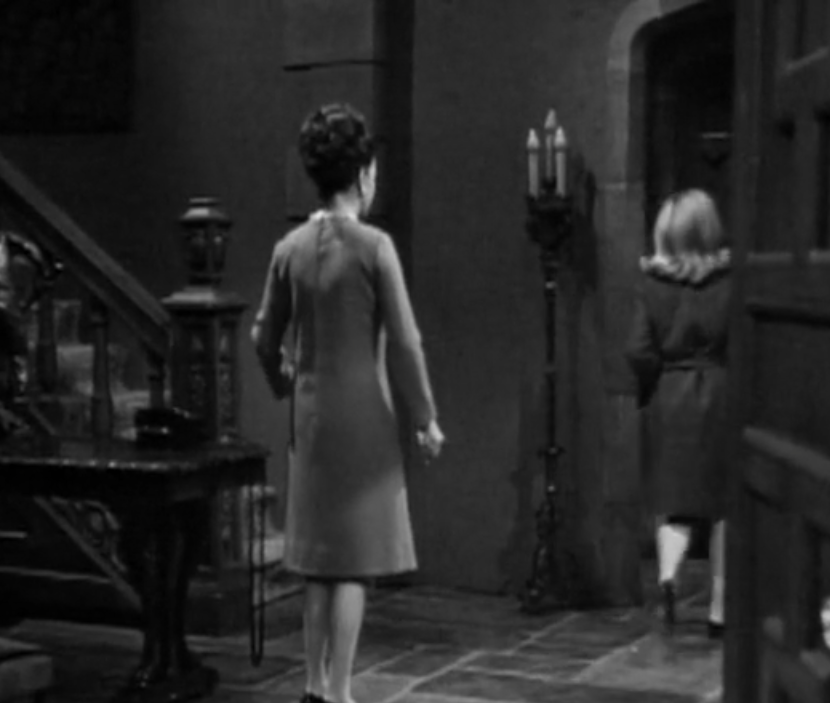
Episode 622: A position to help each other

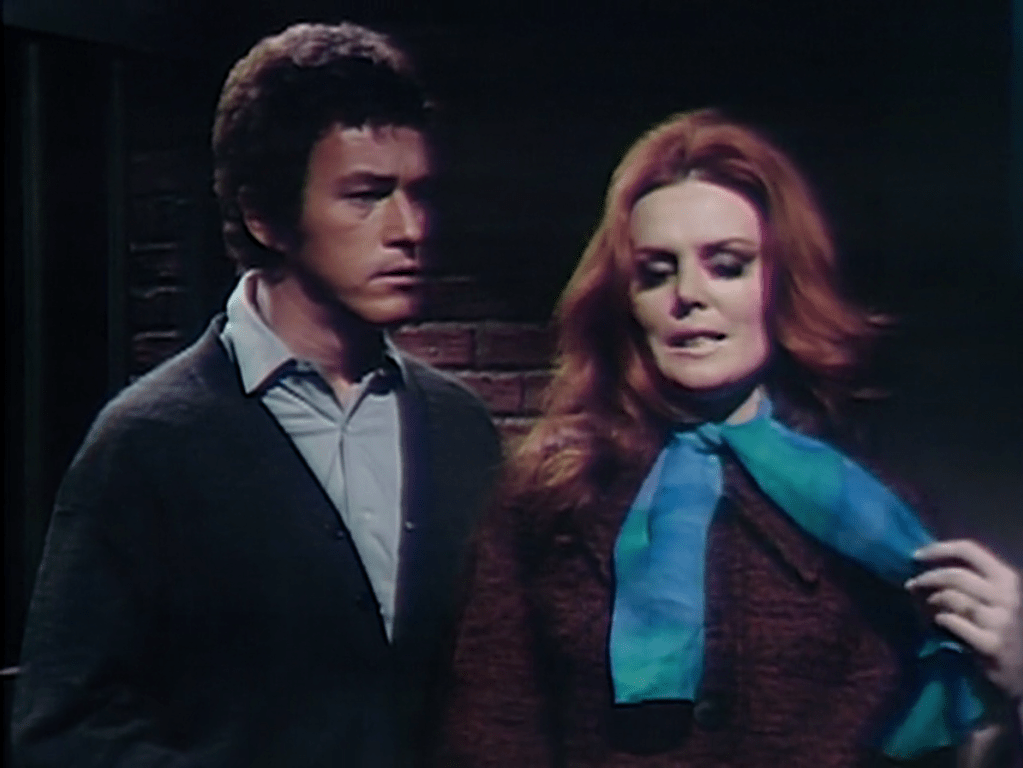
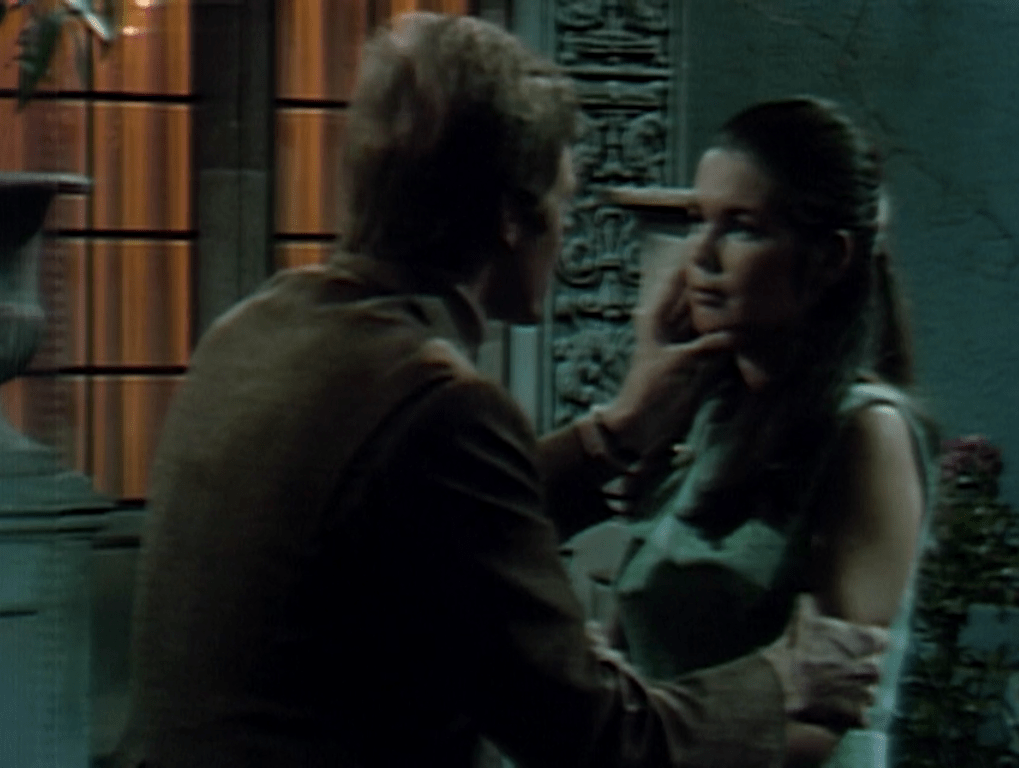
Well-meaning governess Vicki is on the terrace of the great estate of Collinwood. A man known variously as Peter and Jeff keeps clutching at Vicki’s arms so sharply that her biceps pulse, then holds her with one hand and paws her with the other as she stands rigidly still. First time viewers, knowing only that Dark Shadows features stories of monsters and crime, would think that the man had some power over the woman and that they were seeing him abuse that power. They would be right. Unfortunately, the man and woman are not Peter/ Jeff and Vicki, but actors Roger Davis and Alexandra Moltke Isles. Vicki is supposed to be in love with Peter/ Jeff and reluctant to part from him, but the instant she has spoken her last line she turns her face from him and runs away, without the slightest attempt to suggest that she wants to linger.

Roger Davis has his fun.

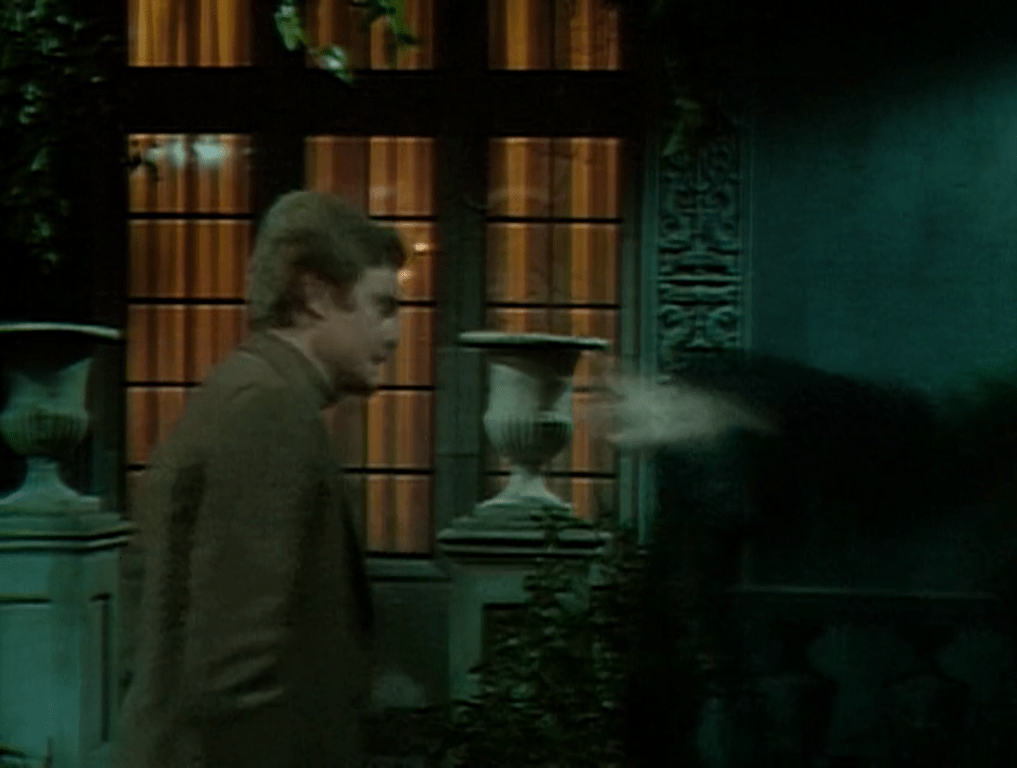
After Vicki escapes from Peter/ Jeff’s repellent attentions, a woman named Eve emerges from the bushes. Peter/ Jeff is angry with her. He grabs her roughly and throws her out of the frame. Peter/ Jeff then stalks off. Eve comes back into the frame. It’s a relief to see her upright and well-put-together- Mr Davis shoved Marie Wallace so hard she had to struggle to right herself as she spun out of view. It looked like she might have slammed her head against the floor.

Marie Wallace using her arm to regain her balance and keep from sustaining a serious injury.

In a comment on Danny Horn’s post about this episode on his blog Dark Shadows Every Day, Marc Masse reports what happened when this scene came up at a panel discussion at a Dark Shadows convention many years later:

This was the episode where Grabby Davis got so overly excited in his scene with Marie Wallace on the terrace that he grabbed her by the arms and threw her completely out of frame. You see her struggling to remain on her feet as she stumbles off to the right. Some 20 years later at a fan convention (it’s in Dark Shadows 25th Anniversary Special from the disc set that has the last episode of the series), Marie Wallace brought this up as Roger Davis was telling the audience of how they (or rather he) would cut up and laugh and have fun while they were making the episode, and of how they would just laugh off their flubs. Wallace then broke in to remind Davis of episode 622 as she recalled, “Hey, Roger? I didn’t laugh when you threw me out of frame in that scene, on camera. Remember that? Several times?” She explained to the audience how all during dress rehearsal he’d never touch her and then when he’d done it on camera he’d come up to her and apologize profusely, but Wallace told him then and there at the convention that she never believed him.

Marc Masse, as “Prisoner of the Night,” in a comment left 8 April 2015 on “Episode 622: Heated Conversations on Somebody Else’s Lawn,” Danny Horn, Dark Shadows Every Day, 8 April 2015.

In a response to another post of Danny’s, Marc added that in the same video you can see actress Donna Wandrey’s appalled reaction to Mr Davis’ statement, and her increasingly visible disdain for him as Miss Wallace makes her case against him.

After Peter/ Jeff is gone, another visitor comes and addresses Eve by name. She is Angelique. Angelique is not a Roger Davis character, she is merely a vampire, so everyone can relax.

Regular viewers have been wondering what would happen when Angelique shared a scene with Eve. Marie Wallace’s style as Eve relies on many of the same techniques Lara Parker uses as Angelique. Both use an elevated style with many catches of breath, changes of volume in mid-sentence, and striking of oratorical poses. Each was capable of making this exaggerated method work, but no one could conceal its profound silliness, and a scene consisting of two characters both using it would be too ridiculous even to make a good joke in a cartoon. What actually happens is that Parker demonstrates the quietest possible version of the style, while Miss Wallace shows a more typically brassy version. Recognizing their approaches as two poles of the same axis, we are not only interested in their encounter, but also in what they show us about the craft of acting.

Angelique persuades Eve to join her in an alliance against warlock Nicholas. This might be an exciting development. Nicholas is the show’s chief villain at the moment, and between them Angelique and Eve just might be able to bring him down. It is also the first alliance we have seen take shape in a long time. Many characters have tried to control other characters, to deceive them, to imprison them, to enslave them, to brain-wash them. But the only group working towards a common end is made up of old world gentleman Barnabas, mad scientist Julia, occult expert Stokes, and servant Willie. That team formed long ago, has not managed to get anywhere lately, and is, at the moment, immobilized by Barnabas’ absence. Yesterday Julia tried to form an alliance with Nicholas against Angelique, but at the last minute his inability to talk with her forthrightly aborted that effort. So it is refreshing to see that the show is still capable of imagining a new alliance.

Danny’s post about this one is one of his very best, a composition in free verse weaving together quotes from the dialogue with retellings of the overarching narrative with meditations on a number of topics that the episode touches on. If you are a Dark Shadows fan and haven’t read Dark Shadows Every Day, this is a fine post to start with. It’s like a song- you may not understand all the lyrics the first time you hear it, but the sound of it will carry you along.

The comments below it include some great stuff too. I’ve already mentioned Marc Masse’s remark about Marie Wallace’s confrontation with Roger Davis. There are also two fanfic ideas about how the show might have resolved the question of who Vicki’s parents were. Someone posting under the name “William” had this plausible one:

My own theory: Victoria the daughter of Jamison Collins and Betty Hanscomb. So she’s Roger and Liz’s half-sister. Liz knows and Roger doesn’t.

Jamison aggressively seduces Betty, on whom Roger had teenage crush. He makes her pregnant and then coldly casts her out. A pregnant Betty shows up at Collinwood and tells Liz and Roger about what happened.

Roger confronts his father in a fit of rage in the Tower Room during one of Collinwood’s famous storms.

Jamison Collins has a heart attack during the confrontation, and Roger leaves him in the room to die. Roger staggers out, and Liz finds her father dead.

Roger has a complete breakdown and is sent to Windcliff, where Dr. Julius Hoffman, uncle of Julia Hoffman, wipes out his memory of that night in the summer of 1946.

Liz, with the help of new guy in town Paul Stoddard, pays off Betty Hanscomb to leave town and arranges for her half-sister to be raised at the foundling home in New York. Grateful to Paul for his help, Liz starts to fall for his charms …

(And this is why Liz is so fond of Victoria, but not like she is with Carolyn. And this is why she refuses to tell Roger anything about why she brought Victoria back).

–“William,” in a comment left 22 August 2016 on “Episode 622: Heated Conversations on Somebody Else’s Lawn,” Danny Horn, Dark Shadows Every Day, 8 April 2015.

That has a lot of potential. Liz doesn’t seem ever to have loved Paul, she did marry him shortly after her father’s death, and Roger’s attitude towards Vicki in the first months of the show was a strange mixture of extreme hostility and obvious attraction. “William’s” story would account for all of those things. But it doesn’t hold a pale blue candle to this theory posted by Pedro Cabezuelo:

Everybody, we’re missing the obvious! Vicki IS Betty Hanscombe!!!!! Somehow she managed to time travel AGAIN and ended up in Collinsport circa the 1940s and adopted the Betty Hanscombe identity, working her way as a servant at Collinwood. She had an affair with Paul Stoddard, gave birth to herself (at which point the adult Vicki ceased to exist) and THAT’S what caused all the irreperable harm to the time stream/parallel time/anything else you want to blame on Vicki.

Pedro Cabezuelo, in a comment left 10 April 2015 on “Episode 622: Heated Conversations on Somebody Else’s Lawn, Danny Horn, Dark Shadows Every Day, 8 April 2015.

I have my own fanfic idea about Vicki’s origin. I’ve shared it here before, and will again. But Pedro’s is so good I want it to be the last word today.

Episode 396: The doll and the pins

Well-meaning governess Vicki is wrongly suspected of witchcraft and needs a place to hide. Young gentleman Barnabas takes her into his house. In her gratitude, Vicki tells Barnabas the truth about herself. She is a time-traveler, yanked back to this year 1795 from her native 1967 by forces she does not understand. Indentured servant Ben enters the room and Vicki leaves. Mystified by her story, Barnabas asks Ben if he thinks Vicki might be a witch after all.

It is exciting when Vicki starts confiding in Barnabas. She has utterly failed to adapt to her new environment, and has none of the abilities she would need to scam her way into a secure place there. She has ended up as an obstacle to story development and an irritating screen presence. If Vicki isn’t going to lie competently, she may as well tell the truth. But that turns out to be a dead end as well- there is no use for Barnabas to make of the information she has given him.

Barnabas doesn’t repeat Vicki’s story to Ben- he just reports that she said something utterly bizarre. What Barnabas does not know, but Ben does, is that there really is a witch in the house- it is Barnabas’ bride-to-be Angelique. Angelique has enslaved Ben, so if he found out Vicki’s secret she would as well, and would be able to use it against her as she frames Vicki for all of her own crimes. Ben proclaims to Barnabas his absolute certainty that Vicki is not a witch, but since he can’t tell anyone about Angelique, this only puzzles Barnabas. Barnabas is further baffled when Ben says he hopes that Barnabas’ marriage to Angelique brings an end to his troubles.

The other day, Angelique tried to solve a problem of her own by raising a corpse from its grave. This was the late Jeremiah Collins, uncle of Barnabas and his best friend until, under the influence of Angelique’s spell, he and Barnabas’ fiancée Josette eloped together. Barnabas responded to that by challenging Jeremiah to a duel. Conscience-stricken, Jeremiah decided to let Barnabas kill him and told Josette that she would be free to marry Barnabas once he was dead.

Angelique had ordered Jeremiah to plague Josette and Barnabas with angry demands that they stay apart. We could interpret that simply as puppetry on Angelique’s part. But today, Jeremiah is harassing Angelique and refusing her repeated commands to go back to his grave. He says he was at peace in the earth until Angelique disturbed him. He was content with his decision to forfeit his life, but now he has become something he didn’t bargain for. Maybe it’s the indignity of that change that accounts for his change of personality, or maybe he’s just cranky because he can’t get back to sleep.

Regular viewers will think of a third possibility. In the segments of Dark Shadows set in 1966 and 1967, we saw other supernatural beings, such as undead fire witch Laura Murdoch Collins and the ghosts of Josette and of Barnabas’ little sister Sarah. These beings looked at first glance like humans, but the more we learned about them the clearer it became that each was in fact a complex of multiple entities, some of which operated independently of and occasionally at cross-purposes with others. As a witch, Angelique might also be a composite being. Perhaps each time she casts a spell, she breaks off a little piece of herself and deposits it within the person she is trying to control. If so, the creature she is trying to send away is not simply Jeremiah, but the body of Jeremiah animated by a chunk of the spirit of Angelique. That would explain why the actions of the risen Jeremiah are characterized by three traits that were alien to the living man, but that Angelique has in abundance- single-mindedness, vengefulness, and ineffectiveness.

Barnabas, Ben, and a clergyman are in the front parlor, ready for the wedding. Angelique takes a long time to come downstairs. Barnabas goes up to her room to see what is keeping her. He finds her terribly upset, insisting that they have the ceremony somewhere else. Barnabas looks in her suitcase, which had a moment before held the clothes she removed to put on her bridal gown. Those clothes have vanished, and in their place Barnabas finds a doll belonging to his little sister Sarah and some pins. Had Barnabas ever seen a horror movie, he would know to interpret this as a clue from Jeremiah that Angelique had caused a recent illness of Sarah’s by sticking pins in her doll, but people didn’t get to the cinema in 1795, so it’s another dead end.

Angelique composes herself and says she will be right down for the wedding. Barnabas leaves the room. The door closes itself, and Angelique cannot open it. Jeremiah enters and tells Angelique she must be punished for disturbing the dead. He takes her to his grave, which is open. Angelique raised Jeremiah some days ago- if the grave has been open this whole time, you’d think someone would have noticed and people would be talking about it. Anyway, he puts her in the grave, and from her point of view we see him throwing dirt into it.

Jeremiah dropping dirt onto Angelique, from her point of view. Screenshot by

This is the first live burial we’ve seen on Dark Shadows. It’s true that the POV shot from inside the grave echoes a moment in #248 when Barnabas, who is in 1967 a vampire, shuts his prisoner Maggie Evans in a coffin and we see him through her eyes, but that coffin wasn’t in the ground.

Barnabas shuts Maggie in a coffin in #248. Screenshot by Dark Shadows Before I Die.

Harking back as it does to that shocking moment from Barnabas’ early days on the show, the image of the reanimated Jeremiah dropping dirt in the grave invites us to make a comparison between Jeremiah and Barnabas. In life Jeremiah was a mild-mannered, good-hearted fellow, as is the living Barnabas. The destructive behavior he has exhibited since Angelique raised him from the dead is not only typical of her, but also of what we saw from the vampire Barnabas in 1967. Again, we wonder if the fate that awaits Barnabas is not only something Angelique will do to him, but if everything we saw of him in the months between April and November was what Angelique was doing disguised as him.

Closing Miscellany

Angelique’s repeated commands to Jeremiah today to “Go back to your grave!” find an echo in one of the great moments in the history of Dark Shadows conventions, when Lara Parker used that line to explain the Dark Shadows house style of acting:

“Go back to your grave!!!!!”

When Vicki tells Barnabas the truth about herself, the camerawork makes Alexandra Moltke Isles’ strabismus impossible to miss. Previously they had taken great care to photograph her from angles that would obscure this condition, but we’re going to get another clear look at it on Thursday. Combined with the lousy lines the scripts have given Vicki since the beginning of the 1795 segment, it is hard not to suspect that there was some kind of deliberate effort behind the scenes to push Mrs Isles aside.

Vicki and Barnabas. Screenshot by Dark Shadows Before I Die.

This was the first episode of Dark Shadows broadcast in 1968. The copyright date printed on the screen at the end still says 1967. They were several months late before they stopped putting “1966” there, so I guess we shouldn’t be surprised they didn’t update it for an episode shown on New Year’s Day.

Episode 385: How long have you been in league with the devil?

Repressed spinster Abigail Collins has invited a visitor to the great estate of Collinwood. He is the Reverend Mr Trask. It’s 1795, so the Rev’d Mr T missed the big excitement in his hometown of Salem, Massachusetts by 103 years, but he’s trying to make up for it by hunting witches elsewhere.

Enter Trask. Screenshot by Dark Shadows Before I Die.

Both caddish naval officer Nathan Forbes and young gentleman Barnabas Collins are appalled by Trask, and each of them wants to defend the target of Abigail’s suspicions, governess Victoria Winters. They are powerless to do much for her. Barnabas cannot overrule his father, haughty overlord Joshua Collins, who is the master of the house and has given Abigail “full rein” in re Vicki. And Nathan cannot persuade Vicki to run away with him, because she distrusts his intentions and cannot believe that she is really in danger.

Unknown to any of the other characters, Vicki is a time-traveler displaced from 1967 by the ghost of Sarah Collins, who is now alive and studying under her direction. Vicki has been making one inexplicably foolish mistake after another since she began her uncertain and frightening journey to the past four weeks ago, and now they are all catching up with her.

It is hard to imagine what the writers were thinking when they made Vicki do such dumb things. Today, Trask, accompanied by his supporters Abigail and house-guest the Countess DuPrés, confronts Vicki in her room. At first, her behavior in that scene makes sense. He keeps putting his hands on her, prompting her to object; he asks her leading questions based on the assumption that she is guilty of witchcraft, to which she reacts with disbelief. But she has been in 1795 for nearly a month, and that whole time she has been a servant in the house of the tyrannical Joshua. She must know that she is subject to arbitrary exercises of power.

Further, we have seen Vicki in 1966 teaching history to her charge, strange and troubled boy David. You would think that she would have some appreciation of social context and would make some effort to play along with people who are native to the setting in which she finds herself. When Trask tells her to kneel and pray, he’s giving her the option to get out of trouble by doing something she wouldn’t have any reason to find objectionable. But she just gets angrier. She and Trask take turns slapping each other, and Abigail helps him bind and gag her.

Vicki slaps Trask. Screenshot by Dark Shadows Before I Die.

Later, Abigail and the countess are in the front parlor of the manor house. The countess has been pushing hard for action against Vicki, but she recoils from Trask’s methods. She tells Abigail that she wishes she knew where Trask had taken Vicki. Abigail reproves her, shocked that she would second-guess “a man of God!” The countess is played by Grayson Hall, who in the parts of Dark Shadows set in the twentieth century plays mad scientist Julia Hoffman. Like the countess, Julia is fascinated with the occult. Julia has expert knowledge that leads her to draw correct conclusions about this subject. Perhaps the countess’ misgivings about Trask show that she, too, is smart enough to see through the charlatans. Maybe Vicki will find herself with a more formidable ally than the irresponsible Nathan or the bumbling Barnabas.

Trask has tied Vicki to a tree deep in the woods. He tells her that if she is guilty of witchcraft, the tree will be dead by morning. He asks her to renounce Satan. In another Dumb Vicki moment, she refuses simply to say “I renounce Satan and all his works.” He leaves her tied up.

Trask leaves Vicki tied to a tree. Screenshot by Dark Shadows Before I Die.

Jerry Lacy joined the cast in #357 as lawyer Tony Peterson. In his performance as Tony, Mr Lacy did his famous Humphrey Bogart imitation. Bogart slips out once or twice today; when Trask looks away from Vicki and goes into monologues, he does sound like he is about to start explaining how he will find out who stole the strawberries from the officers’ mess. But what’s more important about his performance is how very far he goes over the top. Lara Parker famously described the Dark Shadows house style of acting by talking about the hyper-intense manner in which she was expected to deliver the line “Go back to your grave!”; Mr Lacy’s performance today is as intense as any we will ever see.

As Vicki, Alexandra Moltke Isles is usually one of the quietest and most interior-directed members of the cast. In Vicki’s scenes with Trask today, she shows that she can shout with the best of them. If Vicki had taken her brain with her to 1795, it might have been fun to see what Mrs Isles could do with the part under the new regime.

Mr Lacy wasn’t the first shouty actor to share a scene with Mrs Isles. For the first several weeks of the show, the cast included a man named Mark Allen. In alternate episodes, Allen either shouted all his lines or whined all of them. Mrs Isles responded to that memorably in #20 by growing ever more still and quiet as he bellowed at her. But while Allen’s shouting was simply a sign of incompetence, Mr Lacy’s is textured, nuanced, and funny. When other actors shouted back at Allen, the result was a lot of noise. When Vicki shouts back at Trask, she comes to life.

I do wonder about Trask’s name. Just a few days ago, I was looking through a book about Marvel Comics in the 1960s, and learned that a villain named Bolivar Trask was introduced in The X-Men in 1965 and was a big deal in several Marvel titles for the next few years. The writers, producers, and directors of Dark Shadows were all middle-aged, and it is unlikely that they were reading comic books for pleasure. But they had shown engagement with comics before- a graveyard scene in #209 includes a rather clear echo of the visual style of the horror comics EC was putting out fifteen years or so earlier. Since that is part of the lead-up to the vampire story, the directors would have been making an obvious move had they sent a production assistant to a flea market to look for some old horror comics to which they could slip in an homage.

Besides, Dark Shadows itself had been licensed to Dell for comic books by this time. It would only have been natural for people involved with the show to have been curious what might come of that. Maybe they were browsing through Marvel’s output to get a sense of what was going on in that medium.

Or an influence could have come through an even less unusual vector. Several members of the production staff had children who were teenaged and younger, as did writer Sam Hall. Those children might well have been fans of Marvel’s in those days. So it is possible that someone behind the scenes might have heard the name “Trask” mentioned around the house as a good one for a villain.

Episode 374: A woman decides, and it happens

No two performers did more to pioneer what would become the Dark Shadows house style of acting than Thayer David and Lara Parker. When David first appeared as gruff groundskeeper Matthew Morgan in #38, he stood out in a cast of theater actors who tended to play their parts somewhat larger than life by his exceptional intensity. In the 1795 period piece, he brings the same quality to his portrayal of kindly indentured servant Ben Stokes. As wicked witch Angelique, Parker is the first member of the cast to find a kind of ferocity that outdoes even David. Today, the two of them are the main characters in the episode, yet each shows great restraint and understatement. Their performances are admirably precise.

Angelique is maidservant to Countess Natalie DuPrés, a French lady who took her to the island of Martinique when she fled the Revolution. The countess hasn’t been much in evidence, so that Angelique spends most of her time working for her niece Josette, fiancée of young gentleman Barnabas Collins. Before Barnabas and Josette became a couple, he had a brief affair with Angelique, to which Angelique attached great importance. When she finds that Barnabas does not love her and cares only for Josette, she sets about casting spells to ruin their happiness.

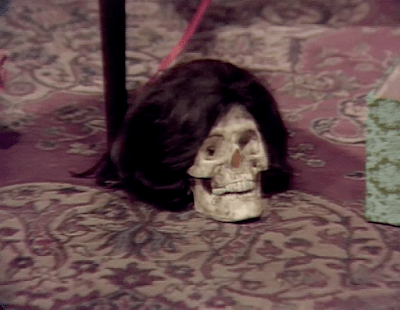
Today, Josette opens a gift box to find a skull wearing a wig. She is altogether undone by this. Barnabas confronts Angelique about it. While he does not seem to have any idea that Angelique is a witch, he is sure she is responsible for the nasty surprise. She denies everything, and he has no evidence against her.

The first bewigged skull to appear on Dark Shadows. Screenshot by Dark Shadows Before I Die.

Ben had tried to tell Barnabas and Josette about Angelique, but being under her power, he cannot. But Barnabas could tell Josette the truth about his past with Angelique. Because he does not, she goes on trusting Angelique, giving her full access to her things and to her person, enabling her to cast whatever spell she wishes. Had Barnabas trusted Josette with the truth, they might have been able to fight Angelique. Because he insists on hiding it from her, they are utterly helpless and will lose absolutely everything.

When Dark Shadows started, the 1960s version of the Collins family was isolated from the community, unable to make anything happen, and vulnerable to a wide variety of enemies, all because matriarch Liz and her brother Roger clung desperately to shameful secrets. When those secrets came to light, they lost nothing and found themselves with a new freedom. Now, in 1795, the Collinses are the lords of the town, running a dynamic business, and apparently unassailable in their wealth and prestige. But in Barnabas’ failure to come clean with Josette, we see the beginning of the process that will lead them to the precarious state in which they are trapped in 1966.

Today, Angelique completes a spell that causes Josette to conceive a mad passion for Barnabas’ uncle and best friend Jeremiah. After Josette sneaks into Jeremiah’s room and makes a fool of herself by propositioning him, she runs back to her own room and sobs on the bed. Angelique is there, feigning puzzlement and sympathy, quietly accepting the young mistress’ refusal to tell her what is wrong.

This is the first episode of the 1795 segment not to include time-traveling governess Vicki. While actors Kathryn Leigh Scott, Thayer David, and Anthony George all appeared in the main time frame (debuting in episodes #1, #38, and #262, respectively,) only Jonathan Frid, as Barnabas, is playing a character we had met there. There’s a heavy-handed moment of self-reference today when Josette tells Barnabas that sometimes he is “too modern,” and he thinks about it during a close-up. That close-up goes on so very long that there is no doubt they are giving us reading instructions, telling us that Barnabas, rather than Vicki, is now our point of view character.

Episode 72: Whose eye is she after

Well-meaning governess Vicki sits placidly in her bedroom at the great house of Collinwood, sewing and looking out the window. Flighty heiress Carolyn comes in and loudly berates Vicki for spending the day away from her charge, problem child David. Carolyn saw Vicki coming home as a passenger in a car driven by the family’s arch-nemesis, dashing action hero Burke Devlin, and jumped to the conclusion that Vicki was both on a date with Burke and on Burke’s side in his conflict with her family. Vicki is at first bewildered by Carolyn’s rage, and then confronts her with her own record of infatuation with Burke.

This scene shows how well cast Nancy Barrett and Alexandra Moltke Isles were as Carolyn and Vicki respectively. Miss Barrett throws herself completely into whatever her character is supposed to be doing at any given moment, a perfect style for the role of someone who is stormy and unpredictable. Mrs Isles takes a very deliberate approach to her part, working her way from the center of Vicki’s thoughts out to whatever lines she has to deliver. That suits the role of someone who is often baffled by the strange goings-on around her and who gradually gathers the strength to stand up for herself.

Carolyn is on her way to the front door when her mother, reclusive matriarch Liz, asks her where she’s going. Still upset after her confrontation with Vicki, Carolyn snaps at Liz and gives sarcastic answers. Eventually she tells her that Vicki didn’t give David his lessons for the day, that she spent the day with Burke, and that she brought Burke home with her. Alarmed by this report, Liz heads upstairs towards Vicki’s room. Carolyn remembers her latest project, persuading her mother to take Mrs Sarah Johnson onto the domestic staff as a housekeeper. Liz cuts her off, saying that she has no time to think of hiring a housekeeper- all she can think about is firing a governess.

After Liz leaves the foyer to fire Vicki because Carolyn has led her to suspect she might be a spy for Burke, Carolyn picks up the telephone. She tries to call Burke. Evidently the infatuation Vicki had brought up to her is still driving Carolyn to inexplicable actions.

Mrs Johnson is in the restaurant at the Collinsport Inn. In fact, we first see her on the pay-phone there, talking to Burke about her plan to join the staff at Collinwood so she can work as a spy for him. Patrick McCray makes a nice remark about this on his Dark Shadows Daybook:

[P]lanting a spy for Burke Devlin is just the touch of espionage intrigue that Collinwood needs. Finally, someone can actually be the spy that Vicki is suddenly accused of working as. (In the same episode no less, with the irony and subtlety of an anvil landing in your lap.) That kind of duality — especially among the backstairs staff — is a concession to the dramatic thinking that DARK SHADOWS kinda lost over the years. The show gained plot, but it lost those opportunities for characters to reflect one another. As it reached a supernatural frenzy, this earlier, authorial delicacy was a necessary casualty. However, it’s vital to know that a sculpted duality like Mrs. Johnson and Vicki is an instinct buried in the program’s DNA.

I think he paints with a bit of a broad brush when he says that “this earlier authorial delicacy was a necessary casualty.” The frenzied pace of the later years didn’t stop Joe Caldwell or Violet Welles from crafting dramatic miniatures Art Wallace and Francis Swann would have been proud of. While Sam Hall and Gordon Russell were no miniaturists and did often value slam-bang story development over every other consideration, they did take time to show characters in each other’s reflections. Indeed, the whole “1970 Parallel Time” arc is months and months of nothing but “opportunities for characters to reflect one another,” and the actors could often make those reflections interesting (at least the first two or three times you saw them.) Of course, there are also large numbers of episodes written by Ron Sproat and Malcolm Marmorstein, but you can’t blame their shortcomings on excessively rapid pacing.

Mrs Johnson is a difficult customer for Maggie Evans, who runs the restaurant. She sends a sandwich back because she disapproves of the mayonnaise, and the look on Maggie’s face shows us that the cost of that sandwich is coming out of her paycheck. Mrs Johnson insists her meal be served in courses, demands that Maggie sit at her table, and gives her a tip of 10 cents (I checked- 10 cents in October 1966 would have the same purchasing power as 90 cents in October 2022. You could take that to your local hardware store, buy several nails, and still have enough left to operate a gumball machine.) She declares that the death of her late employer, beloved local man Bill Malloy, was no accident, and that according to the Bible someone will have to pay for it. When Carolyn comes into the restaurant, Maggie leaps at the opportunity to leave Mrs Johnson and wait on her.

Clarice Blackburn must have had tremendous fun playing Mrs Johnson in these sequences. The character is exaggerated almost to the level of what would become Dark Shadows’ Go back to your grave!” house style of acting, so that there is no need to worry about overacting. Besides, so many performers wait tables that one of the standard responses young people in Los Angeles get when they tell people they are actors is “Great! What restaurant?” So it must always be gratifying to play a character who will show the world what a bad restaurant customer looks like.

As Maggie, Kathryn Leigh Scott also has a juicy role today. We usually see her in one of two settings. Either she is in the restaurant, where she is required to be nice to everyone, or she is at home with her father, drunken artist Sam. As the adult child of an alcoholic, she has a thousand habits designed to keep the mood light. When she is dealing with Mrs Johnson, Miss Scott shows us what Maggie looks like when her Nicest Girl In Town persona is stretched to the max.

When she greets Carolyn, Maggie goes right into the chirpiest version of that persona. It’s a version that brings home the continuity between Maggie’s relationship to her father and her relationship to her customers. She speaks the first few syllables of each of her lines through a laugh. Many Dark Shadows fans complain about that as a habit of Kathryn Leigh Scott’s, but it’s a habit of Maggie’s. And if you start watching the series from episode 1, seeing all the scenes in the Evans cottage between Maggie and Sam, you’ll recognize it as something many adult children of alcoholics do. At the risk of giving away a spoiler, I’ll say that Sam will eventually cut back on his drinking, and some time after that will be written out of the show altogether. But Maggie’s character is formed in these weeks, when Sam is drunk all the time. Some of Miss Scott’s other characters on the show have similar habits, but those are the characters who are presented as Maggie Evans by other means, so they would have to be recognizable as her.

Carolyn tries to explain to Maggie, sotto voce, why Mrs Johnson is so upset, and Maggie drops her Nicest Girl In Town voice completely for a second- “I know who she is,” she rasps. Carolyn has been friendly to Maggie, and is equally friendly when she goes to sit with Mrs Johnson and tries to talk her into taking the job as housekeeper at Collinwood, assuming that her mother will offer it to her. After Mrs Johnson leaves, Maggie tells Carolyn that she has never been able to stand her- “She’s always given me the willies. I don’t know why,” she says, looking thoughtfully off into the middle distance.

Carolyn’s friendliness to the working class Maggie and Mrs Johnson is a welcome relief from her terribly snobbish sneer at Vicki as “Little Orphan Annie” who should “go back to your precious foundling home.” And it’s an opportunity for Nancy Barrett to take her performance from one emotional extreme to another within a single episode.

Back in the mansion, Liz confronts Vicki about not giving David his lessons. Vicki replies that Liz’ brother, high-born ne’er-do-well Roger, had said that he would tell Liz that he had taken Vicki on a tour of the cannery and had given David the day off. When Vicki hears Liz on the telephone confirming this with Roger, she blows up at Liz. She objects to being checked up on, she objects to being accused of lying, and, turning to look at the last spot where she had seen Carolyn, she objects to being accused of stealing people’s boyfriends. After she is done with her objections, she walks over to Liz. With their backs to the camera, the women quietly apologize to each other. Vicki explains that her protests mark the only way she can go on living in the house. Liz for the first time calls Vicki by her first name. Hearing this conversation when they are looking away from us is remarkably effective at creating a sense that they are sharing an intimate moment- more is happening between the two of them than even the audience can know.

Mrs Isles and Joan Bennett, as Liz, both play a wide array of emotions in their two scenes together, and do so brilliantly. It’s particularly interesting to compare Liz’ startled reaction to Carolyn’s snapping at her in the foyer when she asks her where she’s going to with her startled reaction to Vicki raising her voice at her in the drawing room when she’s been on the phone with Roger. They are two quite distinct startles. We see Liz from behind when Carolyn startles her. From that angle, we see the muscles in the back of her neck tense, signifying anger. That startle gives way to a parental sternness. The startle Vicki provokes is shown in profile. Liz pulls back a little, suggesting guilt. It leads to a rapid retreat.

Startled by Carolyn
Startled by Vicki

Episode 35: I got a million recipes how to cure it. None of ’em work.

David Ford joins the cast as Sam Evans, replacing the woeful Mark Allen. Ford was always one of my favorites. He was one of the reasons I started watching the show when it was on the Sci-Fi channel in the 90s- I remembered him from one of my favorite movies, the musical 1776, where he plays John Hancock.

Marc Masse made a point in his Dark Shadows from the Beginning that I hadn’t thought of before. I’d always thought of Thayer David as the founder of the Dark Shadows house style of acting (“Go back to your grave!”) That isn’t wrong, as we will see when Thayer David joins the cast next week. But David Ford made a much bigger contribution than I realized. Several members of the cast, especially Louis Edmonds and Nancy Barrett,* tend to play their roles in a big, stagy manner, but Ford represents a step beyond them.

Masse writes:

To this point Dark Shadows has been written, directed, and acted solely as a vehicle for television.

Here in episode 35, the style of acting on Dark Shadows takes a theatrical turn with the debut of David Ford, who, with one grand and sweeping wave of the arm and eloquent turn of phrase, will single-handedly transform the acting approach from that of a standard television show to that of a teleplay:

“A façade, my dear boy!”

David Ford_gesturing GIF_ep35

You have to wonder if that line was an ad lib; it fit in perfectly with the gesture, and thus far Art Wallace has never written with such a fanciful flourish.

Masse also gives some very interesting information about what Ford was doing when he landed the role of Sam Evans, information that points towards an approach to casting that will become a marked feature of the show in the years ahead:

In the year preceding Dark Shadows, Ford was performing on the Hartford Stage in a successful production of the Tennessee Williams play Cat on a Hot Tin Roof in the role of Big Daddy. That’s why when he first appears on Dark Shadows he has that half a beard type style, having fashioned his performance of Big Daddy after the one made famous in the 1958 motion picture adaptation, especially the way he scrunches up his eyes for the effect of dramatic intensity, giving it his best Burl Ives.

There is indeed a good deal of Burl Ives in today’s iteration of Sam, enough that we can assume that Ford was hired in part as a Burl Ives imitator. In future years, we’ll see Jonathan Frid, who looks like Bela Lugosi and walks and talks like Boris Karloff, playing a character who is a mashup of Lugosi’s Dracula and Karloff’s Imhotep.** And Jerry Lacy, who was most famous for his Humphrey Bogart imitation, and whose first role on the show was as a Bogart-inflected lawyer. And David Selby, who, if you listen to him with your eyes closed, you’d swear was Joseph Cotten. And Roger Davis, who Joan Bennett famously described as show business’ answer to the question “What would Henry Fonda be like if he had had no talent?” Ford is the first of that company of mimics, and among the best.

This is also the first episode where Carolyn and David have a scene together, rather odd considering we’ve had 34 episodes mostly set in the house where they are two of the five residents. Carolyn can’t stand the boy to start with, and in this one she’s just found out he tried to murder his father, her beloved uncle Roger. Besides, she’s in a bad mood because Joe called her up and told her he found Vicki in Burke’s hotel room. So they have a shoving match, she tells him he’s a monster, etc. Nancy Barrett and David Henesy ham these scenes up so grandly that it’s hard to imagine why they haven’t been on camera together before, it’s tremendous fun.

This is a bad episode for Alexandra Moltke Isles. Carolyn is nasty to Vicki about Burke, then apologizes and gets mad at herself, all while Vicki stands perfectly still with a smile plastered on her face. Vicki’s own lines are patronizing and inappropriate, starting with “Carolyn, you idiot” and going downhill from there. When Carolyn makes the painful admission that she has a tendency to grab for everything, Vicki delivers a smugly sanctimonious “That’s a good way to end up with nothing.” At the end of the episode, Vicki has a brief confrontation with David, which Mrs Isles plays well enough, but there isn’t much to it.

I think Mrs Isles’ technique was to start with the emotions the character was supposed to be feeling and to project those through whatever dialogue she is given. That’s served her well so far. Dark Shadows was her first professional acting job, and she fits right in with old pros like Joan Bennett and Broadway up-and-comers like Mitch Ryan. But she’s just awful in these scenes. My guess is that she couldn’t figure out what Vicki was feeling or thinking, since no one would do or say the things she does or says in today’s show, and so she just tried to stay out of Nancy Barrett’s way. Or maybe she read the script, thought Vicki was being an ass, and decided to play the character in the most asinine way possible. Either way, I winced to see it.

*Both natives of Louisiana. I doubt that means anything, but as the series goes on and gradually loses all interest in creating an illusion of being Down East someplace near Bar Harbor, I get more and more interested in the geographical origins of the actors. I’ll try to confine that topic to footnotes for the next three years, but when we hear David Selby’s voice we’re going to talk about the idea of a New England Brahmin with a West Virginia accent.

**Imhotep is the title character from The Mummy. Originally I was going to say that Frid moves and sounds “like Boris Karloff’s Mummy,” but that rather overstates the feminine side of his role.

Episode 6: “Winters! Victoria Winters!”

Looking for David in the basement of Collinwood, Vicki encounters caretaker Matthew Morgan. No one has bothered to tell Matthew that a new person will be coming to the house, so he assumes she is a burglar and confronts her accordingly. Liz shows up, telling Matthew that Vicki belongs in the house and telling Vicki that she doesn’t belong in the basement.

In week one, Liz refused all requests for information about who Vicki was and why she hired her to be David’s governess. But at least she had told the other members of the household that Vicki would be coming. She hasn’t told even that to Matthew, notwithstanding the fact that, as she will explain to Vicki in this episode 13, Matthew is a “strange and violent man.” By taking the job and living in the house, Vicki, our point of view character, has made herself dependent on Liz; we the audience are also dependent on Liz, in that the stories in these first months all revolve around actions Liz will or won’t take. So it’s doubly unnerving that she is so very stingy with information.

George Mitchell, who plays Matthew here and in his next few appearances, is the sort of actor we often see in the first 42 weeks of the show. He is essentially a miniaturist, who builds a character one finely etched mannerism at a time. His successor in the role, Thayer David, worked at the opposite extreme, becoming the first exponent of the Dark Shadows house style of acting (often called “Go Back to Your Grave!” because of Lara Parker’s explanation of it.) Without that style, the show wouldn’t have become what it did in the period which people remember, so I can’t regret the recasting. But I do wish we could somehow see what it would have been like had George Mitchell carried the character through his whole arc of development. He could have played something I think Art Wallace could have written, a closely observed, sensitively explored psychological study.

There’s another what-might-have-been moment when Vicki tries to make friends with Matthew. He introduces himself to her with a gruff “Morgan! Matthew Morgan!” To which she replies, mimicking his down-east accent, “Wintahs! Victoria Wintahs!” It isn’t much of a joke, and Matthew isn’t amused. But it’s hard not to wonder what Vicki might have become if she’d been allowed to make the occasional joke as the series went on.

My usual themes: Alexandra Moltke Isles, David Henesy, and other underrated actors

In 281 of the posts that follow, I link to comments I made on Danny Horn’s blog, “Dark Shadows Every Day.”

Not all of these comments were absolutely unique. A number of times I argued that Danny and other contributors to the discussion threads were unduly harsh in their assessments of various actors on Dark Shadows, especially Alexandra Moltke Isles (who played Victoria Winters) and David Henesy (who played David Collins and various other members of the Collins families.)

I argue that Mrs Isles and Mr Henesy were the best thing about the first 42 weeks of the show:

I always liked Alexandra Moltke Isles; her scenes with David are not only the only things that work in the first two hundred episodes, they are also the purest example in the whole series of performers overcoming weak writing. Even when the scene begins with David accurately describing something that we, and Vicki, saw happen a few moments before and Vicki replying “That’s! Not! True!,” the two of them still manage to display deep enough emotions to carry us through. Her relatively quiet style doesn’t give her much scope as the show goes on and the “Go back to your grave!” school of acting becomes mandatory, but she always makes the most of whatever chances she has.

Nor are her performances in the first 42 weeks of the show all I find to praise in Mrs Isles’ work. I say that she made the most of the few opportunities the scripts gave her in the period of the show I call “Monster Mash” (episodes 466-626):

I’m not at all sure you’re being fair to Alexandra Moltke. She turns in some nice little performances in her scenes in this part of the series. She’s arrestingly fierce in her confrontations with Cassandra-lique, and in the confusion of her references to what she kind of remembers from 1795 she finds a kind of music. Each time she brings up her half-memory that the original Barnabas never went to England, but died in 1795, it’s a theme that resonates a little differently with everything else around it. Yes, Vicki was a dead-end character after the end of the Phoenix storyline, but I do wish the Countess had done a bit more screen acting.

Furthermore, I wish Vicki and Adam had a number of scenes together. The only thing that worked in the first 209 episodes was the relationship between Vicki and David, a theme crowned by the Phoenix storyline. Alexandra Moltke Isles and David Henesy made it work because they are both actors who excel at precisely crafted, quietly realized little scenes, and it was in scenes of that sort that the story of David learning to trust Vicki moved forward. When the vampire comes in and the overwrought style of acting (“Go back to your grave!”) takes over, the show doesn’t have room for many scenes like that. So often Isles and Henesy seem like chamber violinists trying to accompany a heavy metal band. Robert Rodan is of the same type.

As I say above, I believe Isles found a way to have an impact on a heavy metal concert with her chamber violin, and the others did as well. But it would have been satisfying in a different way if the chamber musicians had been paired with each other on a regular basis. Scenes with Vicki helping Adam could have been as compelling as the first season scenes of Vicki giving David his lessons were, as could scenes of David interacting with Adam.

I amplified my point about the Phoenix storyline (a.k.a. “Meet Laura,” episodes 126-192) here:

I liked the original Phoenix storyline… it was the payoff of the only thing that worked in the first 210 episodes, which was the development of a friendship between Vicki and David. The scene on the cliff, when David is clutching Vicki while Vicki urges him to go to Laura, is among the most emotionally powerful in the whole series because it shows us how far this development has come.

I wasn’t Mrs Isles’ only defender in the comment threads. Another commenter suggested a doozy of a rewrite of the “Meet Another Angelique” storyline (episodes 969-1060, also known as “1970 Parallel Time) in which Mrs Isles would play the villain and Lara Parker the damsel in distress, reversing their roles from the original “Meet Angelique” storyline (episodes 365-466, set in the year 1795.) Several people, including me, replied to that suggestion, all of us with an enthusiasm that showed our certainty that Mrs Isles could play the part brilliantly.

Like Mrs Isles, Mr Henesy was ill-served by the scripts and the house acting style that prevailed after the vampire was introduced (the “Go back to your grave!” style.) That ill service created a major problems later in the series. The “Haunting of Collinwood” storyline (episodes 639-700, which I usually group as part of the “Meet Amy” segment) turns on complex feelings of anxiety and dread that grip David Collins and Amy Jennings (played by Denise Nickerson.) The scenes between David and Amy work well enough; these two young actors not only convey the intricate malaise of people driven by obsession and fear, but even manage to find unexpected humor in their roles, turning into a grumpy old married couple after a few scenes together. But when Mr Henesy plays opposite an adult actor he often finds himself in an impossible situation. I give an example in this comment on episode 680:

This episode shows what Joel Crothers was talking about when he said he was glad to leave Dark Shadows because they had started spending so much time setting up special effects that the actors could no longer rehearse properly. You see it in the confrontation between David and Maggie, after he finds her waiting for him in his room. Kathryn Leigh Scott doesn’t have many lines, and only one emotion to express, sternness. She does a great job. But David Henesy has lots of complicated lines, and is trying to show us a character who is lying and who feels conflicted about lying. It would take a lot of practice for any actor to figure out a way to get all that across, and he doesn’t seem to have had the chance for it. Compare that scene with the many times he and Alexandra Moltke Isles overcame the drab dialogue they had to work with in their scenes together in the same setting, and it’s hard not to lament the missed opportunity.

Things got even worse for Mr Henesy when he was cast as Tad Collins in the 1840 segment of the show, for reasons I try to explain:

The writing isn’t the whole problem with Tad.

David and Vicki becoming friends is the only story that works in the first 42 weeks of the show, and it works in spite of the fact that the writers give the actors nothing at all to work with. We cut from a drawing room scene where Roger loudly declares to Vicki that “Yes, I’ve always HATED David!” to a scene where David looks up from his desk and tells Vicki “My father hates me,” and she responds “David, THAT’S! NOT! TRUE!” But whatever idiotic lines the script may require them to speak to each other, the body language and tone of voice between David Henesy and Alexandra Moltke Isles gets steadily warmer as the weeks go on, and you really believe that they are learning to care about each other. By the time Laura shows up, it makes perfect sense that Vicki is the referee between David and his mother, and it is inevitable that Vicki will be the one to pull him out of the burning shack.

As Tad, Henesy didn’t have the screen time it took to triumph over the writing like that, and frankly neither Kathleen Cody nor Kate Jackson was the sort of partner he needed to pull it off. Alexandra Isles worked very much from the inside out, feeling her way into the character’s emotions and letting them out through whatever parts of her were on camera, while the two K’s worked outside in, starting with the dialogue and putting the words on display. That may have made them a more natural fit for the Dark Shadows house style of acting (“Go back to your grave!”,) but it left everyone high and dry when the scripts stank.

For all that was against him, Mr Henesy did manage to create some bright spots in the later episodes. For example, his performance as evil sorceror Count Petofi speaking through the body of young Jamison Collins features some terrific moments, as I note in this comment on episode 803:

Much is asked of David Henesy in this episode. There are moments when he has to do a Thayer David impression. Those he carries off splendidly- “mineral water, for the digestion.”

At other moments, Petofi is tricking people into thinking that Jamison is free of his influence. That requires him not only to show the other characters a convincing likeness of Jamison, but also to show the audience the wheels turning in his devious mind. Sometimes that works- when he tricks Edward into letting him kiss him, he does create suspense as we wait to see his evil plan work itself out. Other times it doesn’t. When he tells Beth that “I just want people to like me,” he sounds so much like David Collins circa December 1966 that it just seems like he’s forgotten that he’s supposed to be possessed.

From time to time I spoke up in favor of other much-maligned cast members. In addition to the favorable reference to him above, I several times listed Robert Rodan among those I wished we had seen more on the show, and those references sometimes brought enthusiastic agreement from other commenters, suggesting that the negative remarks others made about him had more to do with the dead-end his character, the Frankenstein’s monster-like Adam, found himself written into than with the late Mr Rodan’s interpretation of the role.

Other actors may have left something to be desired from time to time, but did turn in good performances. I tried to call attention to those positive moments when others were venting about the less successful ones. For example, Lisa Blake Richards’ turn as Sabrina Stuart before and after the 1897 storyline is not widely admired, but I thought she was a substantial asset to the show in the “Meet Another Angelique” period.

Terry Crawford’s turn as Beth Chavez during the 1897 storyline is the object of a great deal of very harsh criticism, most of it justified. How many women could there have been who could not convince an audience that they were attracted to the young David Selby? But she did have one or two good moments then, and when she returned as Edith Collins in the 1840 segment she was very nearly competent.

Kathleen Cody also gets a lot of grief. I grant that Ms Cody was bad in the first episode in which she had lines to deliver (#1071,) but say that she was OK after that, and attribute the hostility to her to a mix of that bad first impression with a general distaste for the last 150 episodes of the show.

An actress who tends to be, not indeed denounced, but simply overlooked, is Elizabeth Eis. That puzzles me; I think she was phenomenal in all three of the parts she played. She had a one-episode spot as a devotee of the sinister Leviathan cult in #951; the character isn’t much, a cliched hillbilly teenager cribbed from Tobacco Road, and her main function is to serve as breakfast for the vampire. But in Elizabeth Eis’ hands, she bursts off the screen.

In “Meet Another Angelique,” she plays Buffie Harrington, a woman so lonely that she owns a television set (the only one we see in the entire series) and submits to life as a slave of the evil half of the Dr Jekyll/ Mr Hyde character. In that role, the late Ms Eis is so magnetic she makes a love scene with Jonathan Frid seem sexy.

In her final role, as jailer Mildred Ward in the 1840 segment, Ms Eis earned a spot in the Dark Shadows Hall of Fame by excelling in one of the show’s characteristic parts:

And another fine moment from Elizabeth Eis. Quentin, who is in jail on suspicion of strangling someone, grabs the constable’s wife through the bars of his cell and starts strangling her. The part of “person being strangled” isn’t an easy one to play, as Dark Shadows shows us two or three times a week, and she does it as well as any of them. You can see her cycle through about a half dozen emotions while she’s struggling for breath.

A few episodes later, Ms Eis reprised the role of Person-Being-Strangled, and she outdid even her previous performance:

Compare her scene getting strangled by Gerard in this episode with her scene getting strangled by Quentin last week… In the scene with Quentin, she cycles through a half dozen emotions while being choked; in this one, she digs down deep and shows a very specific form of terrified disbelief.

Episode 1147: The Strain

I say that David Henesy and Alexandra Moltke Isles, as David and Vicki in the first 42 weeks of Dark Shadows, used nonverbal communication to triumph over poor writing to present an interesting story of a troubled boy and a young woman learning to trust each other. I then try to explain why Henesy was unable to repeat that success as Tad in the “Meet Gerard” segment of the series. 

Episode 1147: The Strain