Episode 484: Not so much for you as for me

Recovering vampire Barnabas Collins has brought his former blood thrall Willie Loomis home to the Old House on the great estate of Collinwood. Willie had been confined to a mental hospital during the several months that have passed since Barnabas framed him for crimes he himself committed against Maggie Evans, The Nicest Girl in Town. The chief of the mental hospital, mad scientist Julia Hoffman, is now Barnabas’ best friend, and he talked her into releasing Willie to him.

Today, Barnabas tells Willie he is going to send him back to the hospital for the rest of his life. Barnabas is furious that the first thing Willie did after promising not to leave the Old House without him was to sneak off and go to Maggie’s house. Barnabas found out about this when Maggie’s boyfriend Joe came to the Old House and told him about it. Joe also told Barnabas that he would kill Willie if he ever again saw him anywhere near Maggie.

Yesterday, it was impossible to tell what was going on in Willie’s mind. At one point he seemed to be in a childlike state, remembering nothing of his time with Barnabas and believing that they had been friends. When he went to Maggie he seemed to have reverted to the way he was when Barnabas was holding Maggie prisoner in the Old House and Willie was desperately trying to spare her the worst. At the end of the episode he pointed an unloaded rifle at Joe and squeezed the trigger, grinning maniacally when he heard the click. Perhaps two of those attitudes were fakes meant to cover the third, or perhaps his personality really is unstable and was fluctuating as the episode went on.

Barnabas has concluded that Willie’s childlike friendliness is a fake and that he is exactly the same as he was when he lived with him. So he gets impatient with Willie when he doesn’t seem to remember that he was a vampire. He talks to Willie as if he remembers everything. He tells him that he can go around in the daytime now, but that he is not really free of the curse yet. He persuaded Julia to release him so that he could help with an experiment that will complete the cure.

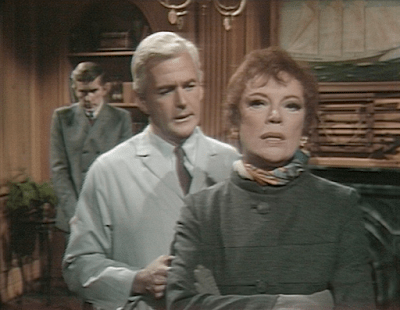
Julia enters in time to hear that, and reacts angrily. The experiment is the work of another mad scientist, Eric Lang. Julia is opposed to the experiment and had no idea Barnabas was planning to use Willie to further it. She and Barnabas stand on either side of Willie and argue. At the end of their argument, Willie says he will do whatever Barnabas and Lang say.

Barnabas and Julia fight over Willie.

Lang comes to the Old House. Julia tells him that Willie was Barnabas’ victim, and says he has hidden resentments against Barnabas that will likely surface and prompt him to sabotage the experiment. This is interesting as an explanation of Willie’s visit to Maggie, which was after all one of the most self-destructive things he could possibly have done. However much damage Willie did to himself by going to Maggie’s house, he also subjected Barnabas to considerable embarrassment and inconvenience. So maybe Willie’s puzzling behavior yesterday was the result of a neurotic complex, unconscious hostilities towards Barnabas combined with feelings of guilt that drove him to actions he himself couldn’t have explained. On this interpretation, Barnabas is accidentally functioning as Willie’s therapist. By modeling the conversations they used to have when Barnabas was a vampire and Willie was his blood thrall, Barnabas is helping Willie recover his memory.

The rest of the episode is taken up with a dead end story called the Dream Curse. This consists of frequent repetitions of an acting exercise that gives each cast member an opportunity to show what they can do when they don’t have many lines and just have to emote. Unfortunately, this time it is Lang’s turn to run through the exercise, and Addison Powell’s abilities as an actor were severely limited. He’s pretty nearly unbearable.

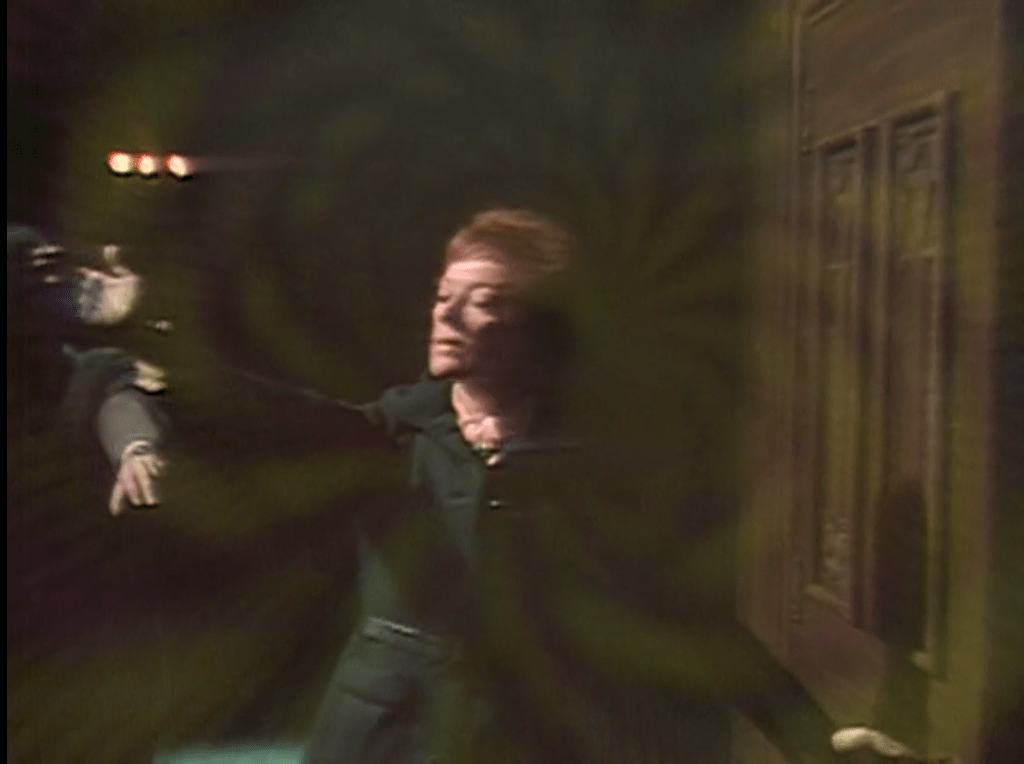
There are two things going on while Powell is shouting and stumbling around that I want to mention. Julia appears to him at the beginning of the sequence, and she makes a series of delightful little balletic movements with her arms. There is no apparent reason in the story for her to turn into a ballerina, but those movements are more worth watching than anything we’ve seen from
Powell.

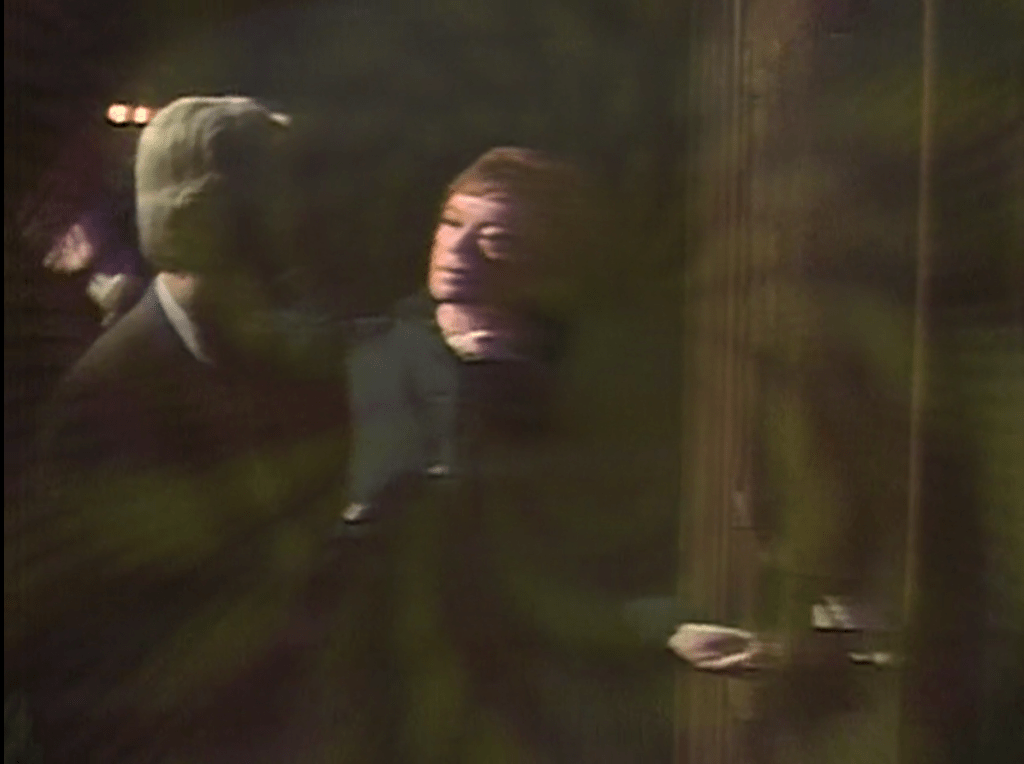
At the end of the sequence, Lang opens a door and is greeted by a headless body with a turtleneck sweater. The men in the segments of Dark Shadows set in the 1960s all wear either neckties or turtlenecks, and lately the turtlenecks have been getting ever more prominent. I suppose it was just a matter of time before a character appeared whose turtleneck replaced his head altogether.

Not sure what this guy’s deal will turn out to be, but he’s already more appealing than Lang.

Episode 483: The three faces of Willie

In April 1967, dangerously unstable ruffian Willie Loomis inadvertently freed vampire Barnabas Collins to prey upon the living. Barnabas made Willie his blood thrall, and reduced him to a sorely bedraggled state. As spring turned to summer, Barnabas added Maggie Evans, The Nicest Girl in Town, to his diet. When Barnabas first held her captive in his house, Maggie was dazed and submissive, but as he tried to brainwash her so that her personality would disappear and that of his lost love Josette would take its place, she began to rebel. Maggie and Willie formed a strange friendship as he did what he could to protect her from Barnabas. Eventually she escaped, and mad scientist Julia Hoffman erased her memory of what Barnabas did to her. When Willie tried to warn Maggie that Barnabas might attack her again, the police jumped to the conclusion that it was he who had abducted her. They shot him. He was declared insane and sent to Windcliff, a mental hospital of which Julia is the director.

A few weeks ago, another mad scientist, Eric Lang, gave Barnabas a treatment that put the symptoms of his vampirism into remission. At the time he was feeding on two women, heiress Carolyn and well-meaning governess Vicki. When Barnabas gained the ability to go around in the sunlight, cast a reflection, and eat solid food, Carolyn and Vicki’s bite marks disappeared. It is unclear whether either of them remembers that Barnabas was a vampire, but their personalities certainly went back to what they were before he bit them. That leaves us wondering about Willie. When Barnabas responded to Lang’s treatment, did Willie revert to the violent personality he had in his first full week on the show, when on Tuesday he menaced Maggie in a barroom, on Wednesday he cornered Vicki in the study at Collinwood, and on Thursday would have raped Carolyn if she hadn’t drawn a gun on him? Did he become some version of the deeply troubled young man who was desperate to help Maggie but powerless to resist Barnabas? Or did he become something else entirely?

Today, in furtherance of Lang’s evil plans, Barnabas wants to free Willie from Windcliff and bring him back to his house on the great estate of Collinwood. Julia has become Barnabas’ best friend, but she is firmly opposed to his association with Lang. So Barnabas lies and tells her that he wants to free Willie because his conscience is plaguing him. Julia knows that isn’t true, and points out that he never visited Willie at Windcliff. Barnabas replies that when he was in the full grip of the curse, he could move about only after dark, and says that he could hardly show up at the hospital to visit Willie in the middle of the night. Julia says that she would have arranged it had he asked. He doesn’t have an answer to this, and she doesn’t fall for any of Barnabas’ other fabrications. But she can’t figure out what he really is doing. She plays along with him, and the two of them go to see Willie at Windcliff.

This is the first time we have seen Barnabas outside of a little orbit composed of Collinwood, the village of Collinsport, and the cemetery north of town. Not only was Barnabas’ ability to travel limited while the symptoms of the curse were manifest, he often lost interest in people when they left the area. So in the fall of 1967 he was obsessively hostile to strange and troubled boy David and obsessively indecisive about Vicki until the two of them went to Boston, at which point he seemed to forget they existed. It’s too bad the set representing the waiting area at Windcliff isn’t more visually striking- Barnabas’ first trip out of the Collinsport area marks a significant change in the character’s possibilities, and it would be good if it came with an image that would stick with us.

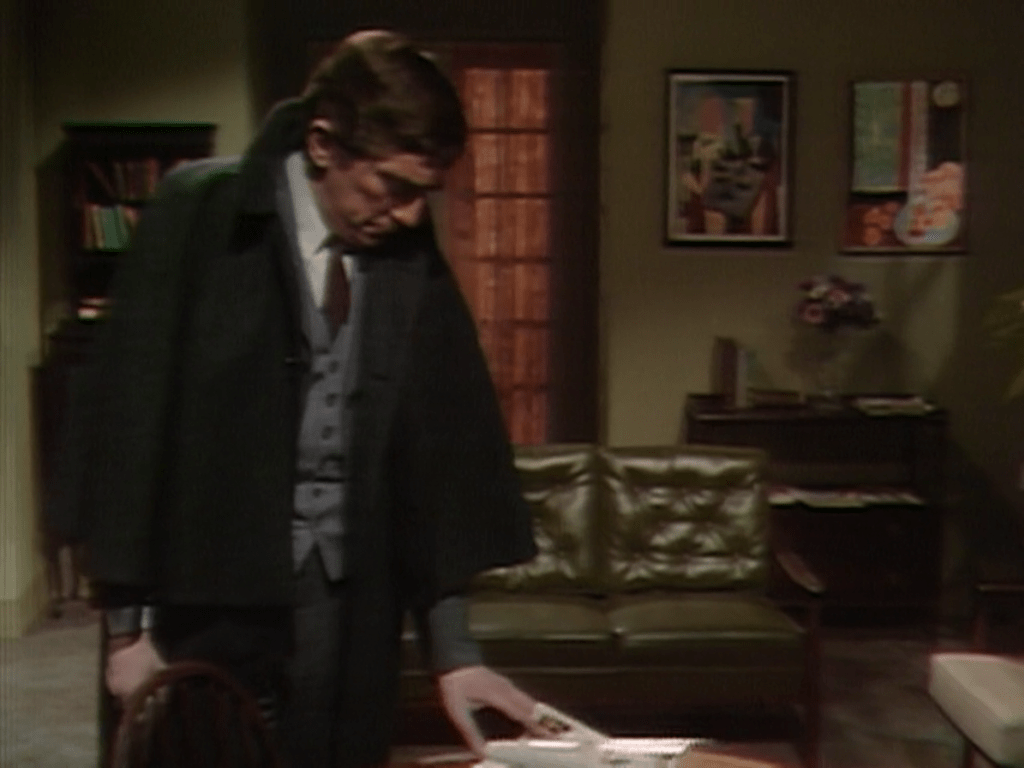
While Barnabas waits, a glossy magazine catches his attention. He picks it up and leafs through it. Since we are about to see Willie for the first time in several months, there is a good chance that this little bit of stage business will remind regular viewers of a peculiar remark Barnabas made shortly before the last time we saw Willie. Shifting the blame for his own crimes onto Willie, Barnabas planted Maggie’s ring in Willie’s room. When he came up with this plan, Barnabas remarked that the cheaper sort of tabloids say that criminals sometimes hold onto morbid mementos of their crimes, prompting us to picture Barnabas reading a cheap tabloid. That incongruous image comes to life here:

Julia joins Barnabas in the waiting room. They talk for a moment, then a nurse ushers Willie in.

At first, Willie is silent, a confused look on his face. He walks slowly towards Barnabas. Barnabas asks Willie if he recognizes him. In this moment we pick up exactly where we left off in #329, when Willie was a patient in another hospital and did not remember who Barnabas was.

This time Willie does recognize Barnabas. But as he did at the end of #329, he seems happy and untroubled. He is positively childlike in his eagerness to go back to Barnabas’ house and work for him again. He says that he and Barnabas were friends and that he always enjoyed their time together, a statement that dumbfounds Julia, as it dumbfounds anyone who remembers the show from April to September 1967. Even when Barnabas wasn’t bashing Willie across the face with his cane, Willie was miserable beyond words and hated everything Barnabas forced him to do.

Julia sends Willie back to his room, and Barnabas proclaims that Willie is entirely cured. Julia sarcastically thanks him for his diagnosis, calling him “DOCTOR Collins!” This too harks back to #329, which ended with Willie asking Barnabas if he were a doctor, to which Barnabas replied, “That’s right. I am a doctor!”

Barnabas takes Willie back to his house and tells him that for the time being, he must not so much as go outside by himself. Willie accepts Barnabas’ explanation that many people in the area will have to be prepared for his return before they see him. Willie gladly agrees to stay in the house. Barnabas leaves him alone, and he immediately slips out. He is heading for Maggie’s place.

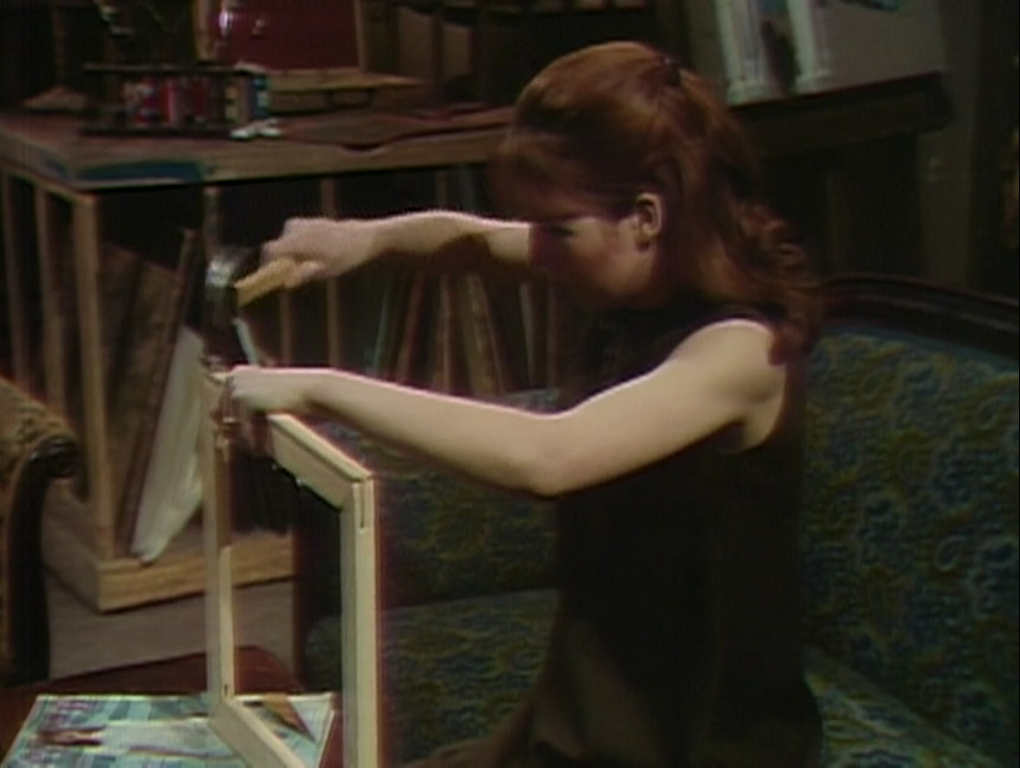
Maggie’s father Sam is a painter, a fact advertised by the canvases around the cottage they share. When we cut to the cottage, she is making a frame. This is rather an obvious visual metaphor. The last time Willie came to the cottage, he inadvertently framed himself for Barnabas’ crimes against Maggie.

Of course Maggie is horrified to see Willie at the door; of course she demands he leave; of course she threatens him with her hammer when he insists on staying and telling her he is innocent; of course she cries for help when her boyfriend Joe comes to the door; of course Willie runs off when Joe enters. Willie puts himself in the frame again, this time as an ongoing threat to Maggie and all the women of Collinsport.

Joe goes to Barnabas’ house and demands to see Willie. At first Barnabas plays dumb, but Joe doesn’t give an inch. Barnabas then admits that he persuaded Julia to let Willie out of the hospital, but assures Joe that Willie is no longer dangerous and tells him that he will see to it that Willie behaves himself. Joe says that Barnabas has already failed in his responsibility, since Willie just went to Maggie’s house and scared her. Joe says that he will kill Willie if he goes near Maggie again. He repeats that assurance, and his voice is pure steel.

Joe exits the house. We see him outside, walking away. Willie emerges from the shadows with a rifle. He takes aim at Joe and squeezes the trigger. The gun isn’t loaded, so Willie makes nothing more than a click. Apparently that was enough for him. He grins maniacally.

On their Dark Shadows Every Day, John and Christine Scoleri point out that the the gleeful face Willie flashes after he clicks his rifle at Joe is the same expression he showed in the frenzied crimes he committed before he came under Barnabas’ power. They back this observation up with a pair of screenshots, one of Willie immediately after he pretended to kill Joe, one from his last moment before he released Barnabas and lost his freedom:

Indeed, the whole episode replays Willie’s character arc from April to September in reverse. He starts as the crushed little thing we had seen at the end of #329, becomes Maggie’s tormented and misunderstood would-be protector, then ends as the dangerously unstable ruffian who followed seagoing con man Jason McGuire to town. If the episode were a few minutes longer, John Karlen might have had to take a break and let James Hall play the last scene. This recapitulation heightens the initial suspense generated by the question of how Willie would be after Barnabas had lost his vampire powers. Whatever effect the change in Barnabas has had on Willie has certainly not made him less complex or more predictable. We can’t tell when he is being sincere and when he is faking. Based on what we see today, it’s possible he is being sincere the whole time, but that he is just extremely impulsive, and equally possible that everything he does and says is a fake meant to cover up something we don’t yet know enough to guess at.

The actors are uniformly excellent today. John Karlen has to recreate the three faces of Willie in quick succession, and executes each of them clearly and memorably. Almost all of Grayson Hall’s dialogue is expository, but while delivering it she shows us all of Julia’s complicated feelings about Barnabas and lets us into her attempt to solve the riddle of his plans for Willie. Kathryn Leigh Scott is only on screen for a few minutes, beginning with her absorbed in carpentry and proceeding directly to screaming and running around and clutching at her male scene partners, but still makes it clear that Maggie is a strong and level-headed person who has been forced into frantic behavior by circumstances no one should have to face.

In the confrontation with Barnabas, Joel Crothers shows us a new side of Joe. Always loyal, always honest, always hardworking, Joe has up to this point been soft-spoken and self-effacing, deferential towards members of the ancient and esteemed Collins family. The only time he broke that deference was when he spoke some harsh words to matriarch Liz in #33, and he had to get thoroughly drunk to manage that. There is no trace of drink in him now, and he does not regard himself as anything less than Barnabas’ equal. For the first time since Burke Devlin lost his connection with the plot and shriveled so drastically that he ceased to be Mitch Ryan and became Anthony George, Dark Shadows has a plausible action hero in its cast.

The part of Barnabas is especially challenging today; he tries and fails to fool Julia in the beginning and Joe at the end, and in between may or may not have fooled Willie. So Jonathan Frid must show us what it looks like when Barnabas does an unsuccessful job of acting. He chooses to do that by having Barnabas overact. My wife, Mrs Acilius, pointed out that Frid’s own performance in the role of a man who is severely overacting is in fact exceptionally restrained and precise. Frid bobbles his lines as he usually does, but never makes a wrong physical move, and not for one second does he miss the perfect tone for Barnabas’ lines. The result is simply outstanding.

Episode 480: Bring your medallion

Mad scientist Eric Lang has been building a Frankenstein’s monster out of body parts his assistant, a man named Peter who prefers to be called Jeff, has dug up out of the cemetery. Once the body is completed, Lang will “drain the life-force” from recovering vampire Barnabas Collins into it, bringing it to life and freeing Barnabas of vampirism once and for all. The time has come to fasten a head on the creature. Barnabas and Lang decided the other day to cut Peter/ Jeff’s head off and use it. When Peter/ Jeff found out about this, he irritated Lang with a lot of small-minded objections. When Barnabas realized that his friend Vicki was in love with Peter/ Jeff, he had second thoughts and stopped Lang from proceeding with the decapitation.

Lang pulls a gun on Barnabas, leading to several minutes of rather tedious business. Lang finally capitulates to Barnabas’ insistence that they call in a second mad scientist. Barnabas assures Lang that Dr Julia Hoffman can be trusted to keep their secrets. Julia, Barnabas says, “cares for me,” and will be discreet for his sake. He telephones her.

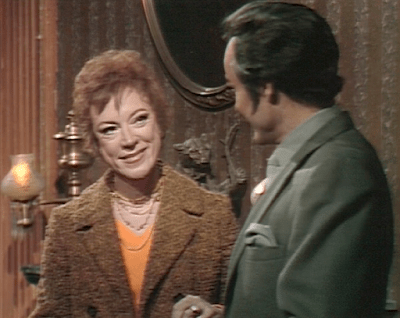
Julia is a permanent houseguest in the great house on the estate of Collinwood. We see her there carrying on a friendly conversation with the newest member of the household. Like Peter/ Jeff, this person has two names. She is Angelique, the wicked witch who made Barnabas a vampire in the first place. She has been telling everyone that her name is Cassandra, and has made her way into the house by marrying sarcastic dandy Roger Collins.

Julia smiles at Cassandra/ Angelique, agrees with everything she says, and talks in a soft, warm voice. She praises her for her honesty, and tells her that honesty is a quality she admires in people. With this, returning viewers have no doubt that Julia knows exactly who she is dealing with. Honesty is a quality Julia finds difficult to tolerate; several times we have seen her having conversations with the scrupulously ingenuous Vicki, and she could barely wait for Vicki to look away from her before she rolled her eyes, squirmed, and showed evidence of physical pain. When Barnabas was still an active vampire Julia once went to him after a conversation with Vicki and offered herself to him as his next victim, apparently a desirable fate if the alternative was having another conversation with Vicki. Angelique/ Cassandra hasn’t known Julia long, but her puzzled facial expressions do hint that she might suspect that her pliant manner and conventional words are an act put on to deceive an enemy.

The telephone rings; as a houseguest, Julia steps aside and lets Angelique/ Cassandra, a member of the family, answer it. We see the grimace on Barnabas’ face when he hears the voice of his bête-noire answer. He asks for Julia. Angelique/ Cassandra hands her the phone, and Barnabas orders her simply to do as he says. She replies, still speaking in the sweet, quiet tone she had been using with Angelique/ Cassandra, “all right.” This is so much unlike her usual self that it can only be an act she puts on when she is in the presence of an extremely deadly foe. Barnabas commands that she come to Lang’s and bring the medallion she uses to perform stupendous feats of hypnosis.

At Lang’s, Julia asks what’s going on. When Barnabas and Lang give her a cover story about Peter/ Jeff having paranoid delusions, she has her back to them and her face to the camera when she assures them that she is accepting their version of events. Again, we can see that she is far too savvy for these two guys to hoodwink.

Julia, unconvinced by the story Barnabas and Lang have given her. Screenshot by Dark Shadows Before I Die.

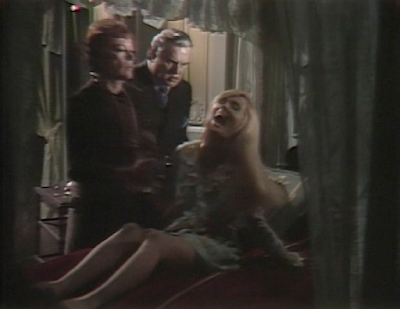
Lang escorts Julia to the room where the sedated Peter/ Jeff is tied up on a bed. Julia orders Lang out of the room. Peter/ Jeff regains consciousness; Julia identifies herself as a friend of Vicki’s come to help him, and he tells her all about the experiment and Lang’s attempt to murder him. After she hypnotizes him into forgetting the preceding five hours, she goes to the laboratory, finds the creature, and confirms Peter/ Jeff’s story. At the sight of the creature, she can’t help but scream.

Grayson Hall’s performance up to this point in the episode has been so masterful that the scream is a terrible letdown. Hall had asthma, and as a result she could not control the quality of her voice when she screamed. This was a major disability for an actress on Dark Shadows.

Julia’s scream brings Lang and Barnabas. Barnabas makes it clear that he is still determined to go through with the experiment. He just wants to make sure the person they decapitate isn’t close to Vicki. Julia staggers out of the lab. She is in the foyer when we hear her interior monologue. She tells herself she cannot be a party to another murder, not even for Barnabas’ sake. She goes into Lang’s front parlor and picks up the telephone to call the police. Lang and Barnabas come to the door of the parlor, find it locked, and pound on it. Lang draws his gun again.

This is the first episode without any cast members who were on Dark Shadows before Barnabas was introduced in #211. This one is so much focused on Julia that faces which would remind regular viewers of what the show was like in those first 42 weeks would just be a distraction, so it’s logical to leave them all out.

Episode 474: A Collins does the unexpected

Wicked witch Angelique (Lara Parker,) pretending to be named Cassandra, met sarcastic dandy Roger Collins (Louis Edmonds) one day and married him the next. Roger’s sister, matriarch Liz (Joan Bennett,) confronts Angelique/ Cassandra. Liz tells her that Roger has not been well and urges her to annul their marriage.

In the course of her confrontation with Liz, Angelique/ Cassandra reveals that she is not all-knowing. She thinks that Roger owns the great estate of Collinwood and the family’s business. Liz quickly explains that Roger owns nothing. He lives as a guest in her house and works as an employee of her company. Angelique/ Cassandra takes this in stride, and stands up to Liz’ insistence that the marriage must end. The only sign that Liz’ words are having an effect on anyone at all comes in the very last syllable of the scene. Unfortunately for Liz, it is not Angelique/ Cassandra who is intimidated by her, but Lara Parker who is intimidated by Joan Bennett. Angelique/ Cassandra’s mid-Atlantic accent vanishes and the purest musical note of Parker’s native Tennessee sounds as the word “you” emerges as “yeww.” If there had been another page or two of dialogue, she might have ended with a honeyed smile and a lethal “Bless your heart!”

From #395 to #461, Dark Shadows was a costume drama set in the late 1790s. In that segment, Angelique came to Collinwood as a servant girl and used her magical powers to manipulate scion Barnabas Collins (Jonathan Frid) into marrying her. Barnabas’ parents, Joshua (Louis Edmonds) and Naomi (Joan Bennett) were unhappy about the marriage. Joshua demanded that it be annulled, as Liz today demands Roger and Angelique/ Cassandra’s marriage be annulled. Naomi took a more conciliatory approach. Advocating Joshua’s position and but showing Naomi’s temperament, Liz combines two challenges Angelique has already shown herself able to overcome easily. Returning viewers will therefore have little hope that Liz will be able to stave off the disasters Angelique has in mind for the Collinses.

Angelique/ Cassandra is eager to get to work on the evil plans she has for the people at Collinwood, and so she is trying to stop Roger taking her on a honeymoon. She contrives to injure her ankle. We see permanent houseguest/ medical doctor/ mad scientist Julia Hoffman (Grayson Hall) in the bedroom Angelique/ Cassandra will be sharing with Roger, bandaging her ankle. Angelique/ Cassandra asks a series of questions about old world gentleman Barnabas Collins (Jonathan Frid,) making Julia visibly uncomfortable.

Barnabas is the same man Angelique married in the 1790s. He is here in 1968 because she turned him into a vampire then. He was relieved of the symptoms of vampirism only a couple of weeks ago. He and Julia are becoming fast friends, and on Tuesday he told her all about Angelique. He identified her as the woman in a portrait that has obsessed Roger, and expressed his belief that Roger’s obsession was a sign that Angelique herself was returning to Collinwood. Julia can see how strongly Cassandra resembles the portrait, and knows that Roger’s obsession led directly to his marrying her, so she really ought to have figured out by now that she is Angelique.

Like the scene between Angelique/ Cassandra and Liz, the scene between her and Julia makes an instructive comparison with the parts the same actresses played in the 1790s segment. Angelique was originally lady’s maid to the Countess DuPrés. We saw her helping the Countess put herself together in a bedroom that was a different dressing of the set on which Julia is now attending to her foot. This apparent reversal of roles illuminates the extent to which Angelique’s command of black magic always made her a mightier figure than her nominal mistress. As a mad scientist, Julia is far more formidable than was the countess, but this scene leaves us wondering if she will be able to stand up to Angelique for any longer than could her counterpart.

Well-meaning governess Vicki (Alexandra Moltke Isles) had traveled back in time and was at Collinwood through the 1790s segment. She recognizes Angelique, knows well how dangerous she is, and is desperate to stop her. She tries to tell Liz about the situation, but Liz has a very limited tolerance for information about the supernatural. Vicki later meets Julia at the gazebo on the grounds of the estate and shares her information with her. Julia knows as much as anyone about the strange goings-on, and what Vicki tells her confirms what she already has reason to suspect. However, Julia pretends to have trouble believing Vicki.

This pretense enables Julia to probe the limits of Vicki’s own knowledge. Barnabas and Julia do not want Vicki to know any of Barnabas’ secrets. Julia incredulously asks Vicki if she thinks the Barnabas Collins of 1968 is the same person she knew in the eighteenth century. Vicki turns away from Julia, looks troubled, and says that she does not believe this. Vicki has encountered plenty of evidence to that effect, not least when Barnabas bit her and sucked her blood, and the audience wonders what she knows. We see Julia studying her, trying to find the answer to the same question. In the first year of Dark Shadows, Vicki represented the audience’s point of view, the resolutely normal outsider getting to know the Collinwood crazies. In this moment, we see Vicki through Julia’s eyes. We identify, not with any sane person from the world of sunlight and natural laws, but with a mad scientist who has cast her lot with a vampire.

Vicki thinking about Barnabas, with a facial expression straight out of MAD magazine. Screenshot by Dark Shadows Before I Die.

Angelique/ Cassandra and Roger chat in their bedroom. He seems utterly delighted to be married to her, until she slips something into his drink. Suddenly he starts having doubts. Nothing we have seen leads us to expect she would want him to feel this way. The scene leaves us scratching our heads.

We end with Angelique/ Cassandra alone in the foyer of the great house, looking at the portrait of Barnabas that hangs there and vowing to restore the curse that had made him a vampire. We know that she is Angelique and that such is her goal, so her speech doesn’t set up any new story points.

It does give us some world-building information. Angelique says that the only way she knew that Barnabas was walking among the living in the 1960s was that Vicki had traveled back in time to the 1790s and told her. That explodes a theory some fans like that Angelique herself called Vicki back in time. When Vicki left the 1960s in #365, it was quite clear that the ghost of Barnabas’ little sister Sarah was sending her on the journey. Sarah has been fading steadily from our awareness, not least because child actress Sharon Smyth aged out of the part, and so it is not surprising that people expect a retcon to attribute the time travel story to a different force. But not only does Angelique rule herself out with this line, Sarah’s name comes up in the conversation between Julia and Vicki, reminding regular viewers of the original explanation.

More importantly, it confirms that once one person has made a wrong-way journey through time, a gate opens through which other unexpected things may come. To some extent we saw this when Barnabas himself was released from his coffin and Sarah’s ghost began showing up around the estate. The cosmological point will become extremely important for the rest of Dark Shadows, as one time-travel story keeps leading to another. Dark Shadows is often described as the story of the house, and so I can’t resist an inelegant metaphor from the building trades. It’s as if Vicki wrecked the plumbing of the universe when she went through the pipes backwards and then abruptly forward. Time will never flow the right way again.

Episode 469: Temporarily arrested

Well-meaning governess Vicki and mad scientist Julia have gone to the Collins family mausoleum in the old cemetery north of town. Vicki wants to see whether her memory is correct and there is a chamber hidden behind a secret panel in the mausoleum, and Julia is trying to limit what Vicki can find. As they enter the mausoleum, Vicki shines a flashlight directly into the camera, then sees a man lurking in a dark corner of the mausoleum.

Vicki assures us that, no matter how much the show might have changed since last summer, it’s still Dark Shadows.

The man is Peter, an unpleasant fellow with whom Vicki unaccountably fell in love when she met him on an unscheduled journey through time to the 1790s. For no reason that will ever be of interest to the audience, Peter keeps insisting that his name is Jeff and that he is not a time traveler. Yet he is the one who finds the mechanism to open the secret panel and expose the hidden chamber where Vicki and Peter once found refuge. Even after that he keeps wasting our time with his pointless denials of the obvious facts.

While they inspect the chamber, Vicki realizes that Julia knew it was there. She confronts her about it, and Julia feigns ignorance. Vicki points out that Julia tried everything she could to keep her from going to the mausoleum and that when those efforts failed she insisted on accompanying her there. Vicki is taking a breath, apparently about to list further evidence supporting the same conclusion, when she glances at Peter and changes the subject.

Vicki remarks that the only way the room has changed since she was there in the late eighteenth century is that there is now a coffin in the middle of it. Julia knows that it is the coffin in which vampire Barnabas Collins was confined from the 1790s until 1967. Barnabas bit Vicki several days ago, but it didn’t really take, and he has since been cured of vampirism. So Vicki probably doesn’t know that Barnabas ever was a vampire, and certainly doesn’t know that it is his coffin. Peter opens the coffin. The empty interior of the coffin dissolves to Barnabas in his hospital bed.

Mid-dissolve.

Barnabas sits up by bending from the waist, showing that old habits die hard. He cries out for the doctor who rehumanized him, Eric Lang. A look of panic spreads across his face.

Terrified Barnabas

He is alarmed to hear hounds baying outside his window. He goes out on the terrace of his hospital room and touches its stone balustrade.

What, your hospital room doesn’t have a terrace with a stone balustrade?

Barnabas goes back inside and continues crying for Lang. When Lang shows up, he explains that the cure isn’t quite complete. There will be occasional relapses of varying intensity, and further treatments are necessary. Barnabas throws a tantrum in response to this news, pouting that if he has to keep taking medicine he may as well go back to being an undead abomination who preys upon the living. Lang talks him down, telling him that he is confident he will be able to effect permanent remission.

We see Julia standing in the rain beside a sign for the Collinsport Hospital, looking up at Barnabas’ silhouette in the window behind his balustrade. She walks away. We then see Lang at a desk in a large wood-paneled room. There is a knock. Lang gives a self-satisfied smirk as he looks at his watch, then opens the door to let Julia in. We see that the wood paneling continues in the corridor behind her. In later episodes we will learn this is in Lang’s house. In that case, the paneling in the corridor behind Julia makes it clear someone has already let her in. At this point, a viewer would naturally assume that it is Lang’s office in the hospital. Wood paneling may not be standard for doctors’ offices in hospitals, but neither are terraces with stone balustrades standard for patient rooms.

Julia looking innocent.

Julia had been treating Barnabas’ vampirism in 1967, and wants to reclaim the case. She and Lang sit across from each other and engage in a verbal fencing match. Lang uses many of the ploys we have seen Julia use to keep control of the situation. On his great blog Dark Shadows Every Day, Danny Horn speculates that the audience’s revulsion at the prospect of Lang replacing Julia was the intended reaction. It cements our sympathy for Julia as a trickster figure and as the de facto protagonist of the chief storylines.

I agree with Danny’s assessment of the scene’s effect, but I doubt it was fully intentional. When I imagine the scene played with Howard da Silva instead of Addison Powell as Lang, I see the audience conflicted and in suspense. We are invested in Julia and her relationship with Barnabas, and so we don’t want Lang to push her aside. But an actor like da Silva would be so intriguing that we couldn’t help but be curious how it would play out if he did. It is only the severity of Powell’s professional deficiencies that causes us to see Lang as nothing but a threat. Compared with the more complex reaction a da Silva could have generated, this scene falls flat.

As Julia is leaving Lang’s office, Peter barges in. Julia’s eyes widen when she sees that the two are connected. Lang realizes that she is likely to make good use of this information, and is furious with Peter for exposing it to her.

It becomes clear that Peter has been implicated in a homicide, that he is suffering from amnesia, and that Lang is blackmailing him into stealing body parts from a nearby cemetery. When Peter says he will no longer help Lang, Lang threatens to send him back to the institution for the criminally insane where he found him. He also forbids Peter to see Vicki again, telling him that Barnabas Collins wants to marry Vicki and that Barnabas’ happiness is important to his plans.

In yesterday’s episode, Peter talked to Lang about his hope that he might be able to learn something about himself from Vicki. This reminds longtime viewers of the first year of Dark Shadows, when Vicki’s motivation for staying in the great house of Collinwood was her hope that she would learn who her biological parents were and why she was left as a newborn at the Hammond Foundling Home. Peter even uses the same phrases Vicki had used in expressing the desire to learn more about himself. Moreover, Vicki, like Peter, has an important gap in her memory, having forgotten key details of her time in the eighteenth century.

That Lang has plans for Vicki was strongly suggested last time, when he told her that he expected her to have an extremely significant future. When we see what future he has decreed for a character who is in a position so similar to Vicki’s, and that the future he has in mind for her includes marriage to Barnabas, we can have little doubt that his plans for her are most evil.

The scene between Lang and Peter is a very efficient piece of exposition, but it is poorly executed as drama. Addison Powell keeps pulling funny faces for no apparent reason, does not appear to have any control over the volume of his voice, and alternately drifts off his mark and stands unnaturally still. Roger Davis is a highly trained professional actor, but he must have skipped the day when his acting teachers covered means of shouting without sounding constipated. The two of them together are not very easy to watch. I get through their scenes with a further bit of imaginary recasting, picturing a onetime Dark Shadows extra like Harvey Keitel as Peter opposite da Silva’s Lang.

Episode 462: Whole image

In November 1967, Dark Shadows was very rapidly running out of stories to tell. Rather than introduce new characters and new complications to solve this problem, they kept killing off existing characters and foreclosing possible developments, making it impossible not to notice that they were speeding directly towards a blank wall. In #365, they did something no one could have seen coming. Rather than crashing into the wall, they passed right through it and relaunched the show as a costume drama set in the 1790s. The result was a triumph, nineteen weeks of high drama, low farce, lurid horror, pointed satire, and authentic tragedy. Now they are back in contemporary dress, and we are waiting to see what comes next.

Before the costume drama insert, mad scientist Julia was trying to keep well-meaning governess Vicki from falling into the clutches of vampire Barnabas. Julia’s efforts pitted her against many opponents. Vicki regarded Barnabas as a friend, actress Alexandra Moltke Isles was eager to get into the main storyline, the fans wanted to connect the show’s original point of view character with its breakout star, and the writers needed a fresh story to tell. But by repeatedly hypnotizing Vicki and making her subconsciously aware of Barnabas’ horrible secret, Julia was able to hold the line until Vicki disappeared into the 1790s and took the audience, the writers, and Mrs Isles with her.

At the top of today’s episode, Julia is hypnotizing Vicki again. Vicki is in bed, and Julia is extracting memories of her visit to the late eighteenth century, using a post-hypnotic suggestion to sequester those memories from her conscious mind.

Julia hypnotizes Vicki. Screenshot by Dark Shadows Before I Die.

Vicki has a dream in which the ghost of Jeremiah Collins, who befriended her in 1795, warns her about Barnabas. The ghost’s voice is provided by Addison Powell, whom Danny Horn named on his great blog Dark Shadows Every Day as “THE WORST ACTOR EVER TO APPEAR ON DARK SHADOWS.” I can think of two or three who might finish ahead of Powell in the contest for this title, but his voice performance today is indeed amazingly bad. He delivers his lines on a single shrill note throughout, and has a lot of trouble managing his breath. I suppose his attempts to get through long speeches without inhaling make sense for someone who just emerged from his grave, but the consequent lack of emphasis on any particular words or phrases and the intermittent gasps each time he runs out of oxygen do keep him from establishing the sense of mystery and terror that the scene calls for.

We then cut to the terrace outside the house, where we see Barnabas approaching the door. Julia meets him, with a new haircut.

Julia’s hair. Screenshot by Dark Shadows Before I Die.

This is Grayson Hall’s actual hair; the wig she was wearing in the first scenes had been part of Julia’s costume from her first appearance, in #265. The last time an actress was freed from a wig to perform under her own hair was when Maggie Evans’ tight little blonde hairpiece gave way to Kathryn Leigh Scott’s reddish brown tresses in #20. With that, the wised-up waitress who was everybody’s pal and nobody’s friend became The Nicest Girl in Town. Longtime viewers who remember Maggie’s transformation will recognize what is happening today, when the same device marks a reset of a character. Julia, who yesterday was precisely as hostile to Barnabas and as helpless before him as she was when we left off in November, is today both willing to cooperate with him and very much in control of the situation. He even goes down on one knee to beg her to help him find out what Vicki learned during her sojourn in the eighteenth century. She promises nothing.

Kneeling Barnabas. Screenshot by Dark Shadows Before I Die.

After another visit to Vicki in her room, Julia assures Barnabas that she can use her mastery of hypnosis to cordon off any memories Vicki may have that might pose a threat to him. Unconvinced, Barnabas decides to take matters into his own hands.

Julia tells Barnabas she can control Vicki. Screenshot by Dark Shadows Before I Die.

Barnabas appears in Vicki’s room. She awakens and is surprised to find him at her bedside. She recoils from him as she had been doing in November, when Julia had made her unconsciously aware of his true nature, but, again as she had done in those days, she overcomes her aversion and turns to him. He tells her to come to him. She hesitates, but does. He tells her he can give her peace and make it seem that everything that is distressing her is far away. She embraces him and asks him to do so. It looks very much like a seduction. Considering that Vicki kept embracing Barnabas and pushing her neck towards his teeth before Julia started hypnotizing her, it is an overdue one. Barnabas opens his mouth. He displays the same inner struggle he has shown on previous occasions when he had the chance to bite Vicki, but is still bending his head towards her neck when we fade out for the closing credits.

Barnabas about to bite Vicki. Screenshot by Dark Shadows Before I Die.

Episode 386: Innocent until proved innocent

For the first nine months it was on the air, Dark Shadows was the story of well-meaning governess Vicki Winters and her efforts to befriend her charge, strange and troubled boy David Collins. That phase of the show reached a climax with the story of David’s mother, blonde fire witch Laura Murdoch Collins, who was on from December 1966 until March 1967. Vicki rallied the regular characters in opposition to Laura’s evil plans for David, and when Laura went up in smoke David found refuge in Vicki’s arms. He had exchanged his destructive, death-oriented mother for the loving, life-affirming Vicki. At that moment, Dark Shadows version 1.0 ended.

Now, Vicki has been thrust back in time to the year 1795. Vicki has managed to get another job as governess on the great estate of Collinwood, supervising the education of ten year old Sarah Collins and her second cousin once removed, the visiting (but so far unseen) Daniel Collins. There is a blonde fire witch here as well, the mysterious Angelique. Viewers who have been with the show from the beginning will remember Vicki’s leadership of the campaign against Laura, and are waiting to see how she will take charge of the effort to defeat Angelique.

It’s already been a long wait. Vicki has not adapted her thinking at all to her new surroundings. Angelique’s spells have wrought considerable havoc, and members of the Collins household have begun to wonder whether a witch might be at work among them. Angelique hasn’t lifted a finger to deflect suspicion to Vicki, but Vicki’s own behavior has been so bizarre that she is the obvious suspect. As we open today, she has been tied to a tree by the Rev’d Mr Trask, a visiting witch-hunter from Salem, Massachusetts.

Vicki’s ineptitude is particularly frustrating to watch because the major theme of Dark Shadows 2.0, which ran from Laura’s immolation in March to Vicki’s temporal displacement in November, had been a brilliantly successful deception by a different sort of time-traveler. Vampire Barnabas Collins presented himself to the Collinses and their neighbors, not as a blood-sucking ghoul native to another century, but as a distant cousin from contemporary England. Barnabas made plenty of slips and raised miscellaneous suspicions in the minds of various people, but he played his part well enough that the Collinses let him take possession of a house on their estate, the people of Collinsport accepted him as a member of the local aristocracy, and in one way or another he made himself indispensable to everyone around him. We began this version 3.0 expecting to see Vicki do in 1795 something like what Barnabas had done in 1967, and instead we see her as a tedious dingbat.

Barnabas is alive and benevolent in 1795. He and his friend, caddish naval officer Nathan Forbes, are men of the Enlightenment who are appalled that there are still people who believe in witchcraft. They hold Trask in contempt and are committed to saving Vicki from him. Barnabas and Nathan ask the Collins family’s house-guest, the Countess DuPrés, what Trask has done with Vicki. The countess had originally believed Vicki to be a witch, but after seeing Trask’s lunatic behavior while interrogating her came to regret her involvement in bringing him to Collinwood. She tells them that Trask tied Vicki up and took her out of the house, whither he would not say.

Outraged, the men head out of the house. They meet Trask coming in. He refuses to tell them where he has left Vicki. Barnabas thunders that “[I]t perhaps has escaped your memory that we have just fought a war recently-a war to establish certain rights. And I am defending the right of this girl to be judged innocent until she is proved innocent. I am sure that this idea is a little complicated for your mind to absorb.” He’s probably right about that, I certainly find it difficult to absorb.

“Innocent until she is proved innocent!” Screenshot by Dark Shadows Before I Die.

Once Barnabas and Nathan are on their way to look for Vicki, Trask tells the countess he has tied her to a tree somewhere in the woods and that if she is a witch, the tree will be dead by morning. Angelique’s regular job is as the countess’ maid. She is in the room with a tea tray when Trask says this, and she smiles delightedly when she hears it. Later, she will sneak out of the house to go searching for Vicki herself.

Barnabas and Nathan find Vicki and untie her. They decide to hide her in the great house of Collinwood. The great house is Vicki’s home in the 1960s, and is under construction in 1795. They set off, and Angelique comes to the tree.

Once she is alone, Angelique takes a cutting from the tree and sets fire to it. This causes the tree itself to burn. It is not entirely clear why she doesn’t just set fire to the tree, since the cutting she has taken is the greenest and least flammable part of it, but witches gonna witch, I guess.

Building a fire the witchy way. Screenshot by Dark Shadows Before I Die.

The next morning, Trask goes to the tree. The countess insists on accompanying him. They find that Vicki is gone and the tree is a hunk of scorched timber. Trask triumphantly silences the countess’ doubts.

In our time-band, the last witchcraft trial in the English-speaking world was held in Scotland in 1727. The Westminster Parliament finally abolished all laws against witchcraft in 1736, including those still on the books in Massachusetts* and some other British colonies in North America. Had they lived in our 1795, Barnabas and Nathan could have gone to the constable and reported that Trask had abducted Vicki, bound her, and left her outside. The constable would help them find her, arrest Trask, and that would be it. But of course Dark Shadows takes place in a world that differs from ours in many respects, not least in regard to the legal history of Massachusetts.

As the countess, Grayson Hall has been doing an excellent job establishing a character who is distinct from mad scientist Julia Hoffman, the role she plays in the segments of Dark Shadows set in the twentieth century. But as my wife, Mrs Acilius, points out, Hall does lapse into Julia a few times today. When she gasps in horror, she makes a little clicking noise in the back of her throat that is one of Julia’s most recognizable mannerisms. Julia is deeply entangled with Barnabas’ activities, and has developed an emotional attachment to go along with her inability to get away from him; shortly before Vicki took us with her to 1795, we heard Julia address him with a deeply felt “Barnabas, Barnabas.” The countess barely knows Barnabas, but in an anguished moment today, she says “Barnabas, Barnabas” to him. Hall does return to being the countess before the episode is over, but there is a weird little visit from Julia in the middle of it all.

Vicki went back to the past after Sarah’s ghost took possession of her at a séance and said she was going to “tell the story from the beginning.” Vicki has traded places with Sarah’s original governess, a woman named Phyllis Wick. Presumably Angelique chose Phyllis as a patsy, and she wound up as Trask’s target. Maybe Angelique did this simply because Phyllis was new to the house and had no old friends to object that she couldn’t possibly be a witch, but maybe it was because she had caught on to Angelique.

It would make it all the more exciting to see Vicki catch on to Angelique and do battle with her. We’ve already seen Smart Vicki defeat one blonde fire witch, so if we see her try to fight another, we will hope that she might win again. Only when we saw the attempt end in disaster would we realize that everything we’ve seen Vicki doing is what Phyllis Wick did the first time around, and that her intervention won’t have changed a thing. That would be a powerful twist ending to the whole 1795 flashback. Instead, we are subjected to Dumb Vicki doing things neither Phyllis nor anyone else who belonged in 1795 could possibly have done, and we end up wondering what she is doing in this story.

*Collinsport is in Maine, which until 1821 was part of Massachusetts.

Episode 385: How long have you been in league with the devil?

Repressed spinster Abigail Collins has invited a visitor to the great estate of Collinwood. He is the Reverend Mr Trask. It’s 1795, so the Rev’d Mr T missed the big excitement in his hometown of Salem, Massachusetts by 103 years, but he’s trying to make up for it by hunting witches elsewhere.

Enter Trask. Screenshot by Dark Shadows Before I Die.

Both caddish naval officer Nathan Forbes and young gentleman Barnabas Collins are appalled by Trask, and each of them wants to defend the target of Abigail’s suspicions, governess Victoria Winters. They are powerless to do much for her. Barnabas cannot overrule his father, haughty overlord Joshua Collins, who is the master of the house and has given Abigail “full rein” in re Vicki. And Nathan cannot persuade Vicki to run away with him, because she distrusts his intentions and cannot believe that she is really in danger.

Unknown to any of the other characters, Vicki is a time-traveler displaced from 1967 by the ghost of Sarah Collins, who is now alive and studying under her direction. Vicki has been making one inexplicably foolish mistake after another since she began her uncertain and frightening journey to the past four weeks ago, and now they are all catching up with her.

It is hard to imagine what the writers were thinking when they made Vicki do such dumb things. Today, Trask, accompanied by his supporters Abigail and house-guest the Countess DuPrés, confronts Vicki in her room. At first, her behavior in that scene makes sense. He keeps putting his hands on her, prompting her to object; he asks her leading questions based on the assumption that she is guilty of witchcraft, to which she reacts with disbelief. But she has been in 1795 for nearly a month, and that whole time she has been a servant in the house of the tyrannical Joshua. She must know that she is subject to arbitrary exercises of power.

Further, we have seen Vicki in 1966 teaching history to her charge, strange and troubled boy David. You would think that she would have some appreciation of social context and would make some effort to play along with people who are native to the setting in which she finds herself. When Trask tells her to kneel and pray, he’s giving her the option to get out of trouble by doing something she wouldn’t have any reason to find objectionable. But she just gets angrier. She and Trask take turns slapping each other, and Abigail helps him bind and gag her.

Vicki slaps Trask. Screenshot by Dark Shadows Before I Die.

Later, Abigail and the countess are in the front parlor of the manor house. The countess has been pushing hard for action against Vicki, but she recoils from Trask’s methods. She tells Abigail that she wishes she knew where Trask had taken Vicki. Abigail reproves her, shocked that she would second-guess “a man of God!” The countess is played by Grayson Hall, who in the parts of Dark Shadows set in the twentieth century plays mad scientist Julia Hoffman. Like the countess, Julia is fascinated with the occult. Julia has expert knowledge that leads her to draw correct conclusions about this subject. Perhaps the countess’ misgivings about Trask show that she, too, is smart enough to see through the charlatans. Maybe Vicki will find herself with a more formidable ally than the irresponsible Nathan or the bumbling Barnabas.

Trask has tied Vicki to a tree deep in the woods. He tells her that if she is guilty of witchcraft, the tree will be dead by morning. He asks her to renounce Satan. In another Dumb Vicki moment, she refuses simply to say “I renounce Satan and all his works.” He leaves her tied up.

Trask leaves Vicki tied to a tree. Screenshot by Dark Shadows Before I Die.

Jerry Lacy joined the cast in #357 as lawyer Tony Peterson. In his performance as Tony, Mr Lacy did his famous Humphrey Bogart imitation. Bogart slips out once or twice today; when Trask looks away from Vicki and goes into monologues, he does sound like he is about to start explaining how he will find out who stole the strawberries from the officers’ mess. But what’s more important about his performance is how very far he goes over the top. Lara Parker famously described the Dark Shadows house style of acting by talking about the hyper-intense manner in which she was expected to deliver the line “Go back to your grave!”; Mr Lacy’s performance today is as intense as any we will ever see.

As Vicki, Alexandra Moltke Isles is usually one of the quietest and most interior-directed members of the cast. In Vicki’s scenes with Trask today, she shows that she can shout with the best of them. If Vicki had taken her brain with her to 1795, it might have been fun to see what Mrs Isles could do with the part under the new regime.

Mr Lacy wasn’t the first shouty actor to share a scene with Mrs Isles. For the first several weeks of the show, the cast included a man named Mark Allen. In alternate episodes, Allen either shouted all his lines or whined all of them. Mrs Isles responded to that memorably in #20 by growing ever more still and quiet as he bellowed at her. But while Allen’s shouting was simply a sign of incompetence, Mr Lacy’s is textured, nuanced, and funny. When other actors shouted back at Allen, the result was a lot of noise. When Vicki shouts back at Trask, she comes to life.

I do wonder about Trask’s name. Just a few days ago, I was looking through a book about Marvel Comics in the 1960s, and learned that a villain named Bolivar Trask was introduced in The X-Men in 1965 and was a big deal in several Marvel titles for the next few years. The writers, producers, and directors of Dark Shadows were all middle-aged, and it is unlikely that they were reading comic books for pleasure. But they had shown engagement with comics before- a graveyard scene in #209 includes a rather clear echo of the visual style of the horror comics EC was putting out fifteen years or so earlier. Since that is part of the lead-up to the vampire story, the directors would have been making an obvious move had they sent a production assistant to a flea market to look for some old horror comics to which they could slip in an homage.

Besides, Dark Shadows itself had been licensed to Dell for comic books by this time. It would only have been natural for people involved with the show to have been curious what might come of that. Maybe they were browsing through Marvel’s output to get a sense of what was going on in that medium.

Or an influence could have come through an even less unusual vector. Several members of the production staff had children who were teenaged and younger, as did writer Sam Hall. Those children might well have been fans of Marvel’s in those days. So it is possible that someone behind the scenes might have heard the name “Trask” mentioned around the house as a good one for a villain.

Episode 368/369: Whole future

In 1966 and 1967, supernatural menaces Laura Murdoch Collins and Barnabas Collins would often be seen staring out the windows of their houses on the great estate of Collinwood, sending psychic energy towards the targets of their sinister plans. In 1795, Barnabas is neither supernatural nor menacing, but we already see him peering out one of those windows. He is not projecting bad vibes into the world, but is worried about his beloved fiancée, Josette DuPrés. She is supposed to arrive soon, in fact was supposed to arrive some time ago. Now there is a storm, and he hopes she is not at sea.

Earliest window-stare, by dramatic date. Screenshot by Dark Shadows Before I Die.

The audience’s main point-of-view character in 1966 and for most of 1967 was well-meaning governess Vicki. Now Vicki has come unstuck in time, and found herself in this extended flashback to the eighteenth century. Since she will know Barnabas and regard him as a close friend in the 1960s, she is at her ease talking to him now. Although she is a member of the staff in his family’s house in a period when it was customary for masters to summon their servants with bells and communicate with them only in direct commands, Barnabas is a remarkably genial and democratic sort who welcomes her casual manner.

Vicki has already annoyed the audience several times by blurting out information that makes it obvious to the other characters that she does not belong in their world. She does that again in this scene. Barnabas is worried something may have happened to Josette, and Vicki tells him that she will arrive safely. He is surprised by the assurance with which she delivers this prediction, and asks if she is clairvoyant. She realizes that she has been indiscreet, and denies that she is. He is unconvinced.

Barnabas’ father, haughty overlord Joshua Collins, enters. He is appalled to find his son socializing with a servant. He dispatches Vicki to the nursery to look after her charge, his young daughter Sarah. He demands to know why Barnabas is not tending to his own duties at the family’s shipyard. They begin to quarrel, when a knock comes at the door.

Barnabas opens the door to find a woman named Angelique, whom he identifies as maid to Josette’s aunt, the Countess DuPrés. Angelique says that the countess was on her way to Collinwood, but that her carriage is stuck in the mud. Joshua orders Barnabas to send a footman to rescue her. Angelique is the first character we have met in 1795 who is not played by a performer we have seen in the first 73 weeks of the show.

Enter Angelique. Screenshot by Dark Shadows Before I Die.

Joshua goes to his wife, Naomi. Naomi is an alcoholic, a fact of which we are made aware because almost her every scene begins with a shot of her drinking alone. That’s what she is doing before Joshua finds her. He scolds her for her drinking; she complains that he doesn’t allow her to do anything else. She can’t even pass the time with a book- we saw Monday that Naomi is completely illiterate.

Glug glug glug. Screenshot by Dark Shadows Before I Die.

Naomi’s alcoholism is both a nod to the concern of first-wave feminism with the atrophy of the elite housewife, and a suggestive side-light on Barnabas as we knew him in the 1967 segment. Then, Barnabas abducted Maggie Evans, The Nicest Girl in Town, and tried by more or less magical means to replace her personality with that of Josette. For the first 40 weeks of Dark Shadows, Maggie’s father’s alcoholism had been a substantial story element, and she would always retain a number of classic Adult Child of an Alcoholic (ACoA, in the lingo of the recovery movement) characteristics, such as beginning utterances with a little laugh to prove that she is happy. Now that we know that Barnabas is also an ACoA, we can wonder if that shared experience was part of the reason he was drawn to Maggie.

The countess arrives. Since she is played by Grayson Hall, who also plays mad scientist Julia Hoffman in the parts of the show set in the 1960s, Vicki blurts out “Julia!” when she sees her. Hall had also been nominated for an Academy Award for her performance as Judith Fellowes in the 1964 film Night of the Iguana; if Vicki is going to keep the audience up to date on the cast’s resumes, it would have been more interesting if she’d exclaimed “Judith!” Vicki explains that the countess looks like someone she once knew who was named Julia, a remark which irritates the countess, who would like to think her appearance is distinctive. Vicki has certainly not made a favorable impression on this grand lady.

Joshua tells the countess he is surprised that “You still affect a title” when “France has followed our example and become a republic.” His pride in this development, after the Terror and in the bloodiest year of the wars in the Vendée, marks Joshua as a member of the Jeffersonian party in US politics. The Federalists and others had long since turned against the French Revolution by that year.

The countess tells Joshua that it is precisely because France has become a republic that she chooses to live on the island of Martinique. That answers a question that some fans ask about Angelique- why is she white? If the DuPrés family lives on Martinique and are major sugar planters there, they must hold a great many African people in slavery. When we hear that they are bringing a servant with them, we expect that servant to be Black. When we learn that the the countess is an emigré, we realize that she brought Angelique with her from France.

The countess may solve one puzzle for us in her exchange with Joshua, but she presents us with another. Josette’s father André is the countess’ brother, yet he is never referred to as a count. Indeed, when he appears, we will see him answer to “Mr DuPrés.” Perhaps he renounced his title, as many French aristocrats did during the Revolution.

Whatever the explanation, “DuPrés” would seem to represent a missed opportunity. When Josette was first mentioned, in the early months of Dark Shadows, her maiden name was given as “LaFrenière.” It would have been a nice touch to have kept that name for Josette and her father, and to have reserved “DuPrés” as the name of the countess’ late husband.

“LaFrenière” had been a perfect choice because of its class ambiguity for a show about an aristocratic family in the state of Maine- it was originally the family name of the barons of Fresnes, and could therefore be a sign of a senior order of nobility, but is also a very widespread name in Quebec. So “Josette LaFrenière” might either have been a French noblewoman who deigned to marry into the mercantile Collins family at the apex of their prestige, or a working class girl from the north who eloped with the boss’ son.

The choice of Martinique as Josette’s place of origin might add a new twist to this class ambiguity. The Empress Josephine grew up there as a member of the untitled but ancient Tascher family, who, like the fictional DuPrés family, owned an enormous sugar plantation on the island. The Taschers of Martinique went back and forth between Martinique and metropolitan France, and Josephine herself was living there in 1779 when she married her first husband, the Vicomte de Beauharnais. Josephine herself was in prison when the vicomte was guillotined in 1794, one of the last to die in the Reign of Terror, and she was freed just a few days later. The next year, she recovered her husband’s property, and a year after that married the young general Napoleon Bonaparte. It seems likely that the similarity between the names “Josephine” and “Josette” was writer Sam Hall’s inspiration for placing Josette’s origins on Martinique. Association with a figure who was at once a grand lady and an example of very steep upward social mobility could synthesize the two possible Josettes LaFrenière into a single figure.

Had they developed the story of the family’s relationship with the town of Collinsport more richly in Dark Shadows 1.0 and 2.0, they could have used this ambiguity to build up suspense that would be resolved today, in the third episode of Dark Shadows 3.0. Since they did so little with that theme in those days, when the story was moving very slowly and it would have been relatively easy to fit just about anything in, I suppose we shouldn’t be surprised that they drop it so completely at this period of the show, when the story is flowing at a breakneck speed.

The countess’ lofty aristocratic manner stings Joshua. Alone with Naomi, he loudly proclaims his belief that all men are equal. We already know enough about Joshua’s tyranny over his household that this absurd little speech must be an intentional spoof of the rich landowners who supported the Jeffersonian party in the early decades of the Republic. Again, this would be funnier and more poignant if the show had done more with social class in its first 73 weeks.

Barnabas sees the countess dealing out tarot cards. He tells her she is too sophisticated for them, and is reluctant to sit with her while she uses them to read his fortune. The moment she says that the cards suggest a connection between him and the concept of infinity, his skepticism evaporates instantly and he excitedly asks if that means he will live forever. The countess cautions that his jubilation at this idea may be misplaced. She notices the “Wicked Woman” card, and takes a significant look at Vicki. Evidently the audience is not alone in objecting to Vicki’s brainless nattering about what the show used to be like.*

Angelique comes to Barnabas’ room. It turns out the two of them had a brief affair when he was first on Martinique, and she expects to resume it. He is not at all pleased at her attentions.

Not how every man would react to a passionate embrace from Lara Parker… Screenshot by Dark Shadows Before I Die.

Barnabas explains that he was already falling in love with Josette when he and Angelique had their fling, but that he didn’t really know her. He couldn’t believe that she would reciprocate his feelings, and consoled himself by dallying with Angelique. This explanation goes over with her about as well as you’d expect, and she storms out of the room, vowing that she will get her way in the end.

We know that the tarot cards are giving accurate information, because the show leans heavily on the uncanny and they wouldn’t have spent so much time on a gimmick that wasn’t meant to advance the plot. We also know that Vicki is not the Wicked Woman the countess is looking for. That leaves Angelique, and we can assume that her wickedness will express itself in some supernatural action taken to avenge herself on Barnabas. Since we know that Barnabas will become a vampire, we wonder if it is Angelique who makes him one.

Closing Miscellany

I usually refer to surviving cast members with courtesy titles and to deceased ones by surname alone. So Alexandra Moltke Isles is “Mrs Isles,” which has been her professional name for 56 years, David Henesy is “Mr Henesy,” Nancy Barrett is “Miss Barrett,” etc, while Jonathan Frid, Joan Bennett, Louis Edmonds, and Grayson Hall are just “Frid,” “Bennett,” “Edmonds,” and “Hall.” Until last month, I’d been looking forward to saying lots of things about “Miss Parker” and her portrayal of Angelique, but Lara Parker died on 12 October 2023. So she’s just going to be “Parker,” and I’m going to be sad about it.

Artist Teri S. Wood has created a number of short animations about Angelique and Barnabas. This one is based on their two-scene at the end of today’s episode:

https://www.youtube.com/watch?v=pyxI0q2aOIk

Patrick McCray has a post about this episode that mystifies me. He writes that “After seven months of hearing about Angelique, today, she enters. So, no pressure Lara. You only have to live up to a half year of build-up.” Uh, what? There has been absolutely no reference to Angelique on the show before today. I can think of an interpretation of the story that might retroject Angelique into episodes #211-365, and I will talk about it next week. But I don’t think it is an interpretation Patrick would favor.

He also talks about David Ball’s method of reading plays from the ending back to the beginning and then from the beginning forward, so that the ending comes to seem implicit in everything else. He allows that Dark Shadows has more than one ending, but I would say he doesn’t go far enough. I’d say the series has ten endings. The first came in #191, when Laura went up in smoke while her son David found refuge in Vicki’s arms. That ending defined Dark Shadows 1.0 as the story of David’s escape from his evil, undead mother Laura, and his adoption of Vicki as his new, life-affirming mother. The second came in #364, when Barnabas met the ghost of his little sister Sarah, she commanded him to be nice to the living, and he went right on with his murderous plans. That ending defined Dark Shadows 2.0 as the story of Barnabas’ irredeemable evil.

Two of the other endings will feature Angelique dying in Barnabas’ arms, and Patrick suggests that those make the whole show the story of their relationship. I don’t buy it at all. Each of the ten parts is about what it is about, and even those two episodes with Angelique dying derive more dramatic charge from other moments.

*Making connections with the first 73 weeks is my job!

Episode 364: Barnabas, Barnabas

Vampire Barnabas Collins has been part of Dark Shadows at least since we first saw his portrait on the wall of the great house of Collinwood in #204, more properly since they went to great lengths to make it look like there was a portrait on that spot in #195. He is now the main force driving the action of the show, and pretty much the only reason people are tuning in to watch it. The ghost of Barnabas’ ten year old sister, Sarah, first appeared in #255; ever since, we’ve been waiting for the two of them to meet. At the end of yesterday’s installment, they finally did.

Barnabas was in his living room, trying to choke the life out of his only friend and would-be lover, mad scientist Julia Hoffman. Sarah materialized, and he let Julia go.

This echoes a scene in #341. Barnabas and Julia were in the act of murdering her medical school classmate and onetime friend, Dave Woodard, when Woodard claimed to see Sarah. At that, Barnabas almost let Woodard escape. Only when Julia called out “Stop him!” did Barnabas take hold of Woodard and kill him. Not only is he murdering a good-guy character, he has coerced Julia into taking part in the crime and will gloat over her new status as a murderer. But in the middle of all that loathsome cruelty, we see a flash of his longing for his baby sister. It is a tribute to actor Jonathan Frid that we can feel Barnabas’ loneliness and want to like him even in the middle of one of the character’s very darkest moments.

This time, Sarah really is there, and she really does stop a murder. There is a puzzle as to why. In #360 and #361, Julia knew that Barnabas wanted to destroy her, and appealed to Sarah for help. Sarah refused, saying that she liked Dr Woodard and knew what Julia did to him. We heard Sarah’s “London Bridge” theme on the soundtrack during the murder of Woodard, so it is clear that she witnessed that crime. But if she can stop Barnabas killing Julia, why couldn’t she stop him killing Woodard?

Today is only the second time Sarah has appeared to more than one person at a time. When Barnabas’ ex-victim Maggie Evans, The Nicest Girl in Town, wanted to escape from the hospital where Julia was keeping her locked up in #294, both she and her nurse could see and hear Sarah. Maybe it is difficult for Sarah to manifest herself to two people, and impossible for her to show herself to three. In that case, Julia’s presence would have stopped Sarah from saving Woodard.

It’s also possible that Sarah can’t do anything that will lead to Barnabas’ capture. She has appeared to many people and given all of them clues about the strange goings-on, but she has referred directly to Barnabas only when speaking to his partners in crime Willie and Julia. Time and again she has stopped short of giving information that would expose her big brother. When Barnabas and Julia moved against Woodard, he was calling the sheriff. Woodard might have placed himself beyond Sarah’s protection when he picked up the telephone.

Indeed, if Barnabas does kill Julia now, he will probably be caught. Julia has given a notebook full of incriminating evidence about Barnabas to a local attorney to be handed over to the authorities in case anything happens to her. Besides, everyone knows she spends a great deal of time at Barnabas’ house, so if she suddenly goes missing he will be investigated. By preventing Barnabas from killing Julia, Sarah is protecting him from exposure.

Sarah tells Barnabas that he taught her the first lessons she ever received in morality, and that he has now forgotten them himself. He begs her to stay, showing at length the vulnerability and need that have been so effective at recruiting our sympathy when we have glimpsed them before. She says she will never appear to him again, not until he learns to be good. We’ve known him long enough to know that this will be an extremely long wait.

Barnabas begs Sarah to stay while Julia looks on. Screenshot by Dark Shadows Before I Die.

Sarah vanishes. Julia sees her friend shattered. She approaches him. She addresses him, for the first time, as “Barnabas, Barnabas.” He recoils from her. He does not renew his attempt to strangle her, but he does tell her in the coldest imaginable voice that he could kill her as easily as he could crush a moth. It hasn’t been two minutes since his little sister reduced him to tears, and he has snapped back into his place as death itself.

“Barnabas, Barnabas.” Screenshot by Dark Shadows Before I Die.

Some say that Barnabas’ frequent references to his longing for Sarah during these weeks are meant to make him easier for the audience to sympathize with. I think this scene shows that the opposite is more nearly the case. They’ve undercut every other ground for liking Barnabas, leaving us only his love for Sarah. When we see that not even a visit from Sarah can thaw him out for any length of time, not only do we have to give up any hope that there is a nice guy hidden inside him, but we also hear the door slamming shut on any possibility that his character will develop in a way that will surprise us. Since he is the show, the closing of that door means that Dark Shadows 2.0 is all but over.

In the great house, matriarch Liz breaks the news to well-meaning governess Vicki learns that the authorities in Brazil have identified one of the corpses found in the wreckage of an airplane that crashed outside Belem as that of Vicki’s depressing fiancé, Burke Devlin. It has been clear for some time that Burke probably died in that crash, so Liz is worried that Vicki’s refusal to accept their verdict is a sign that she is in an unhealthy denial about the facts of the situation.

In the first 25 weeks of Dark Shadows, Burke was a major figure, the arch-nemesis of the Collins family. His storyline never really took off, though, and when undead fire witch Laura Murdoch Collins was on the show from #126-191 his issues were all absorbed into her arc. He formally renounced his grudge against the Collinses in #201, and has been surplus to requirements ever since.

There is just one thing I wish they had done differently about Burke’s death. During the early period of the show, there was a story about high-born ne’er-do-well Roger Collins trying desperately to hide a custom-made filigreed fountain pen of Burke’s. That dragged on for months, and dominated 21 whole episodes. It would have been a nice Easter egg for those of us who sat through those not-very-interesting installments if Liz had said the authorities were able to identify Burke’s body in part because that pen was on it.

There is a bit of intentional comedy this time that works very well. Telling Barnabas of Vicki’s refusal to accept Burke’s death, Liz exclaims “She can’t go on loving a dead man all her life!” Barnabas is clearly offended by this remark, quite understandably since he is deceased himself. He responds that “It has been known to happen.” But he manages to keep cool enough that Liz doesn’t notice.

“It has been known to happen.” Screenshot by Dark Shadows Before I Die.

Closing Miscellany

This episode marks the last appearance of Sharon Smyth as the ghost of Sarah Collins.

Episode 1-274 of Dark Shadows each began with the words “My name is Victoria Winters,” delivered in voiceover by Alexandra Moltke Isles and leading into a few sentences vaguely related to the plot of the show. Beginning with #275, these voiceovers might be delivered by any actress with a speaking parts in that episode, and do not involve their character’s names. Many are written in the first person, however, as is today’s:

There has been a homecoming in the great house of Collinwood, and those who have returned have found that very little has changed. We still live within a ring of fear, a fear that is generated by the one who lives in the Old House, where on this night a kind of madness prevails, a madness that will lead to the threat of murder.

Every time this happens, the Dark Shadows wiki complains that “by this time in the series, the narrations are no longer spoken in character.” That complaint might have made sense if only a few of the episodes since #275 included first person pronouns, but dozens of them do. So we would have to say that they often are spoken in character, but that it isn’t always clear who the character is. The wiki editors will be glad from now on, because this is the last time a narrator says “we.”