In #891, old world gentleman Barnabas Collins gave a present to antique shop owners Megan and Philip Todd. It was a wooden box. When the Todds opened the box, it made a whistling sound. By #893, the whistling sound had taken the form of a newborn baby whom Megan introduced to heiress Carolyn Collins Stoddard under the name “Joseph.” In #905, Joseph had taken the shape of an eight year old boy, and was going by “Alexander.” In #909, Alexander briefly shape-shifted. He kept his apparent age and mass, but his body became that of a girl. In particular, s/he was for an hour or two a perfect double of Carolyn as she was at eight. In that shape, s/he tormented Carolyn’s father Paul, who had been absent throughout Carolyn’s childhood. In #913/914, Alexander gave way to a thirteen year old who insisted on being called “Michael.”
Clearly, none of these children is really human. They are manifestations of a supernatural force known as “the Leviathans.” The Leviathans operate through a secret cult that is gradually taking over people in and around the estate of Collinwood and the nearby village of Collinsport. Barnabas, the Todds, Carolyn’s mother Liz, and her cousin, strange and troubled boy David Collins, are among the members of the cult. Paul is one of its enemies, and others are coming into their sights.
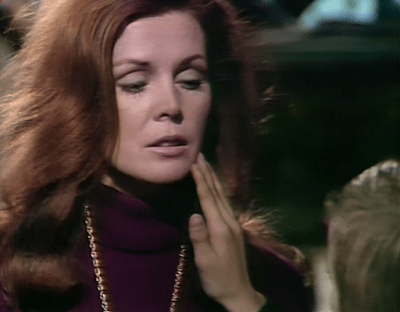
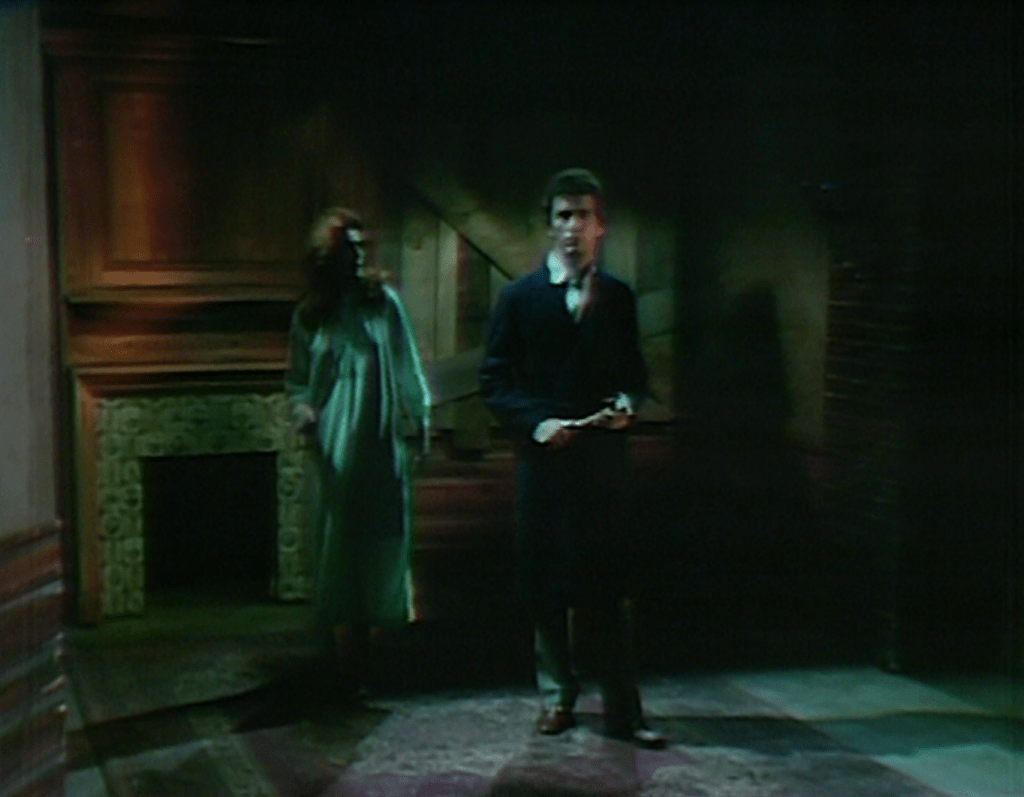
As he was when he was Alexander, Michael is a bully, monotonous in his hostility and demands for obedience. Philip has had about enough of this. He spanks Michael today, and tells Megan that it is time they think about quitting the Leviathan cult. Megan is appalled by Philip’s apostasy. She and Michael talk alone. He caresses her face, exciting a physical response from her. She then agrees that Philip should be got rid of, and picks up a gun.
We have seen Barnabas caress the faces of people whom he wanted to bring under the control of the Leviathans, so the makers of the show could tell the ABC network’s Standards and Practices Office that Michael was doing a magic trick when he did that to Megan. But in a period when Sigmund Freud was the among most cited nonfiction authors in the English-speaking world, few adults in the audience could have failed to notice the erotic charge in the contact between Michael and his (foster) mother as they plot the murder of his (foster) father.
Freud has turned up on the show before. In September 1968, Carolyn hid Frankenstein’s monster Adam in a room in the dusty and long-disused west wing of the great house of Collinwood. Adam spent most of his time alone, with little to do but read. When Carolyn brought him a meal there in #577, Adam was disappointed she was not prepared to discuss Freud’s works with him. She mentioned that she was dealing with some family troubles, at which Adam invited her to sit down and to “Tell me about your mother.”
Adam is long gone, but we see today that the west wing is still dusty. Maggie, David’s governess, fell afoul of Michael yesterday and is wandering around there, hopelessly lost. For some time, Adam held Maggie’s predecessor Vicki prisoner in his room; evidently writers Sam Hall and Gordon Russell see some kind of connection between Freudian psychoanalysis and governesses stuck in the west wing.
Like Adam, Michael came into being otherwise than by sexual reproduction, and the arrangement of his anatomy is the result of a series of conscious acts of will. Also like Adam, he has an intense crush on Carolyn, one which does not exclude violence. In #549, Adam attempted to rape Carolyn. In #919/920/921, Michael introduced himself to Carolyn by creeping up behind her and putting his hands over her eyes; moments later, he was yelling at her and demanding “How dare you” when she would not go along with an idea of his. Since Carolyn is virtually the same height as Michael, his disregard of her personal space and his unrestrained bullying come off not only as bratty, but as rape-adjacent.
Furthermore, Marie Wallace, who plays Megan, first joined the show as patchwork woman Eve, Adam’s intended spouse. Megan’s desperate indulgence towards Michael puts her at the opposite extreme from Eve’s total rejection of Adam, but it is equally inflexible, and when she takes up her gun today it seems likely to lead to an equally disastrous ending. Whatever point Hall and Russell were making by associating Adam with Freud is apparently in their minds again when Michael and Megan play out their little Oedipal dance.
Closing Miscellany
When Maggie is first trapped in the west wing, she reaches up to bang on the closed panel. When her shoulders rise, the high hem of the outfit Junior Sophisticates provided Kathryn Leigh Scott exposes parts of her that performers on daytime television in the USA in 1970 did not customarily display.
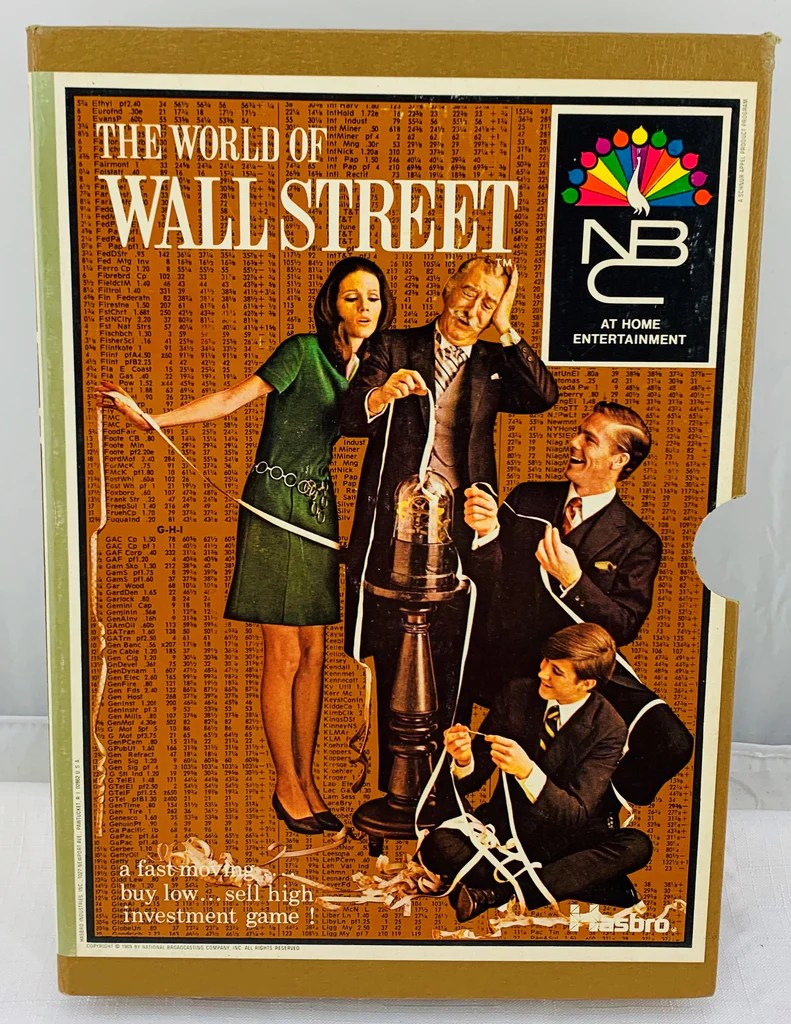
Yesterday and today, David and Michael play a game they call “Wall Street.” They use Monopoly money and a playing surface which, when Michael overturns it today, proves to be a checkerboard with a backgammon board on the reverse. A board game called The World of Wall Street really was around in those days; it was produced in 1969 by Hasbro and NBC. The dialogue David and Michael exchange during the game sounds like things you might say while playing it. Perhaps the script called for the boys to play that game, but ABC vetoed it since the rival NBC network’s logo appeared prominently on the box.
Professor Timothy Eliot Stokes has parked his car and is walking up to the great house of Collinwood, home to matriarch Elizabeth Collins Stoddard and her daughter Carolyn Collins Stoddard, among others. He sees a man lying on the ground and asks him what is wrong. The man pleads with Stokes to help him get away. Stokes asks him what he wants to get away from; the man responds “I can’t tell you.” Stokes asks who he is; he says his name is Stoddard. Stokes replies “You’re Paul Stoddard, Carolyn’s father.” Paul brightens momentarily at Carolyn’s name, but then draws up tight and asks “They sent you after me, didn’t they?” Stokes assures him that no one sent him, and tells him he will catch his death of cold if he continues lying on the ground.
Paul asks Stokes to take him to the police. Stokes nods to the house and says they can call the police from there. Paul cries out, “No! No, not to Collinwood. Please, Professor Stokes, you’ve got to take me to the police, it’s the only thing you can do for me. If you don’t, I’ll be dead. No, no, no, I am not being hysterical or melodramatic…” At this, Stokes turns to face his car. He gives Paul his arm, and says he will drive him to the police station.
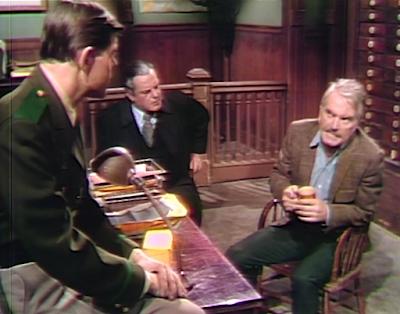
The police station was a frequent set for about a year after its first appearance in August 1966. It hasn’t changed a bit when we see it today. The officer on duty is someone we haven’t seen before, but that doesn’t mean he is a new character. Four actors took turns playing Sheriff George Patterson between September 1966 and January 1969; this man is not named in the dialogue and there are no acting credits on screen today, so for all we can tell he might be a fifth. He is younger and slimmer than were any of the other incarnations of Sheriff Patterson, but maybe he’s been working out.
Stokes introduces Paul to the policeman, and explains that Paul will speak only to the authorities. The policeman sits Paul down, gives him some coffee, and assures him that everything will be all right.
Paul tells the policeman that “It will never be alright until they stop chasing me” and “They have been after me ever since I got here.” The policeman asks “What are these people doing to you?” and Paul replies that “At first, there were just little hints, phone calls, things like that- veiled threats. It was their way of making me know that I was under their control. And I was, too, because when I tried to get away they took me back to Collinwood.”
The policeman responds “I see,” and Paul bursts out with “No, you don’t see! You think I’m mad!” The policeman tries to reassure him that he will listen, and asks him if he can name any of his persecutors. “Yes, I’ll name one, all right! My [ex-]wife, Elizabeth Stoddard.” The policeman says “That’s a little hard to believe,” and Paul responds “It’s impossible to believe, and yet! You tell me why she took me back into Collinwood, after years of open hatred, unless they wanted me there! And you know this town, you know how they gossip. And you know my wife. Why, why would she risk all that gossip, unless they wanted her to do so?” He answers that even so, “It’s still a little hard to believe.”
Paul angrily says “Yes, and because it’s Elizabeth Stoddard who’s involved, you will do nothing!” The policeman responds “I didn’t say that. I intend to talk to Mrs Stoddard and the doctor and whoever else is involved. If you still feel you’re being held captive, well, we’ll have to do something about it.” Paul visibly relaxes.
Earlier in the episode, we saw Liz forcing medicine on Paul. Returning viewers know that Liz has been absorbed into an evil cult that is trying to do something terrible to Paul, and indeed to the whole human race. We saw today that Liz has assigned her housekeeper, Mrs Johnson, to trick Paul into taking the medicine. It quickly becomes clear that Mrs Johnson has no idea that Liz is involved in anything sinister- she simply trusts her employer to do the right thing, and she follows her orders. Liz owns most of the village of Collinsport, and most of its people would react as Mrs Johnson does.
When we saw the last Sheriff Patterson for the last time in #675, he told a prisoner that he was releasing him because Liz’ cousin Barnabas said he was with him when the crime was committed, and Barnabas is “just about the best alibi you can have in this town.” He shook hands with the prisoner and sent him on his way. Since we know that Barnabas is, off and on, a vampire, and that even when he is free from the effects of that curse he spends most of his time covering up murders, that left us with an impression of Collinsport law enforcement as hopelessly in the thrall of the Collinses. That reinforces the image left by Sheriff Patterson’s predecessor, Constable/ Sheriff Jonas Carter, who was last seen in #32, toddling off after taking Liz’ orders to accept an obvious lie as a way of closing a case against a family member. Paul has every reason to suppose that this new policeman will be as submissive to Liz and her family as were his predecessors.
Now that Paul can hope that the policeman will be different from the others, he asks him to lock him away, to put him under guard someplace where no one can get to him until his daughter Carolyn Collins Stoddard can come for him. Stokes agrees to telephone Collinwood and talk to Carolyn, and the policeman escorts Paul to a back room. Paul awakes from a nap, and smiles at the policeman. He tells him he can’t tell him how much better he feels. The policeman tells him someone has come to see him. Paul’s delight at the thought that Carolyn has arrived gives way to cries of terror when he sees Liz at Stokes’ side. She comes at him with a spoonful of the hated medicine while Paul tells Stokes and the policeman that they are traitors and killers.
This one is primarily a showcase for Dennis Patrick as Paul, but all of the acting is excellent. My wife, Mrs Acilius, found it very difficult to watch the episode to the end, saying that they did too good a job- she felt as trapped as Paul. It really is one of those episodes you could show to a person who had never before seen Dark Shadows with a reasonable confidence that they would understand why we like the series so much.
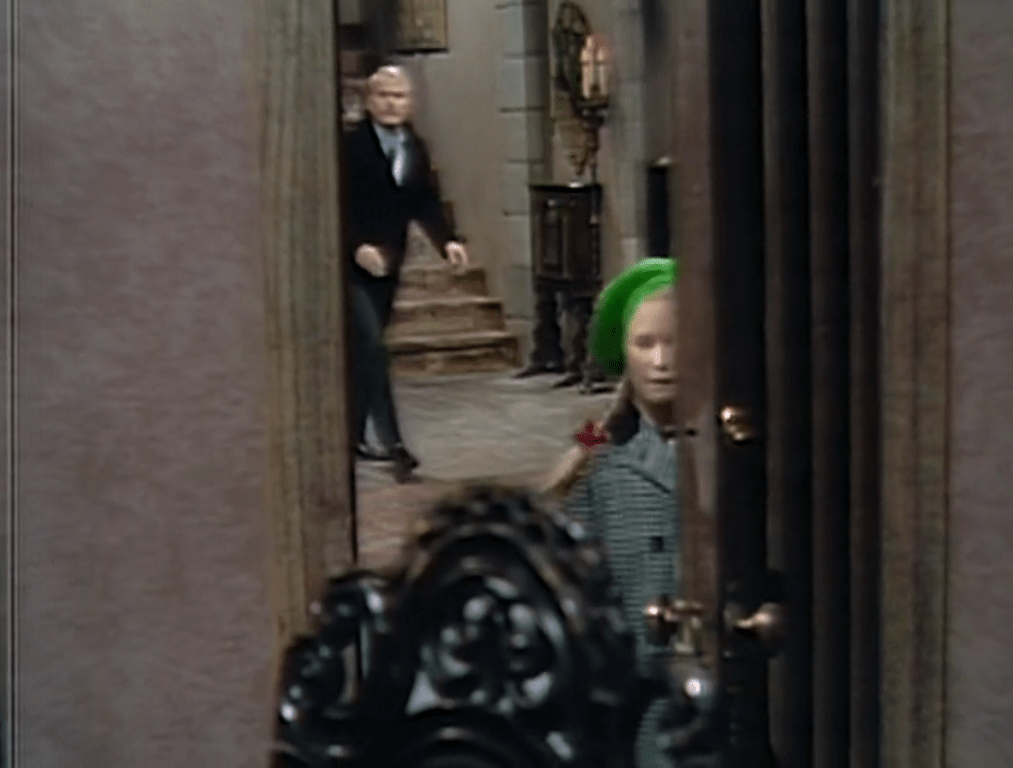
Paul Stoddard (Dennis Patrick) has been staying in his ex-wife’s home, the great house on the estate of Collinwood. At the end of yesterday’s episode, he found a boy known as Alexander hiding in his room. He chased Alexander out of the room. We saw Alexander go behind some curtains. In today’s opening reprise of that scene, Paul looks behind the curtain and sees, not Alexander, but a girl. The girl calls him “Daddy” and runs off. He looks at a photo album and recognizes her as his daughter Carolyn as she was at the age of eight. Since Carolyn is alive and well, the girl cannot be her ghost. He concludes that she must be something that the mysterious enemies whom he knows to be persecuting him have conjured her up.
Paul sees this pseudo-Carolyn a few more times, but no one else does. The last time he sees her, he chases her into a closed room.
Paul chases the pseudo-Carolyn into a closed room.
When Paul opens the door to the room and invites permanent houseguest Julia Hoffman to look inside, no one who could be mistaken for Carolyn is there. Alexander is, and he has the same book with him that the pseudo-Carolyn took into the room with her.
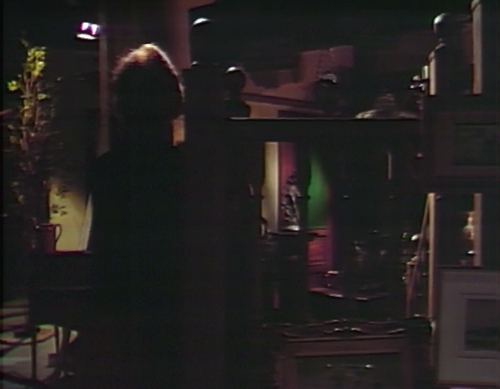
The foyer from a new angle.
Alexander is not the eight year old boy he appears to be. He is both a borrowing from H. P. Lovecraft’s The Dunwich Horror and a meta-fictional comment on Soap Opera Rapid Aging Syndrome. He began life a couple of weeks ago as a whistling sound coming out of a wooden box, spent a week as a newborn baby, then emerged in his current form. When he masquerades as the very young Carolyn, he doesn’t get any bigger or smaller, but he does shift his shape between male and female. Which, good for him (them?,) I suppose.
Many longtime viewers will be even more intrigued by another metamorphosis that we see today. The foyer set has always stopped a little bit downstage from the front door. The room into which Paul chases Carolyn/ Alexander lies beyond this line. Previously, when characters had entered that space they simply exited and were picked up elsewhere later. The only time the camera followed actors beyond the line was in #664, when time-traveling vampire Barnabas Collins and indentured servant Ben Stokes walked from the foyer to the study by way of an undecorated area of the studio. That area is decorated now.
New set.
In the picture of Julia, Paul, and Alexander above, we see a portrait in the foyer behind Paul’s left shoulder. That depicts Barnabas as he was in the 1790s, before he became a vampire. It first appeared in #204, when Dennis Patrick was on the show as Paul’s sometime friend, seagoing con man Jason McGuire. It was still being painted when Patrick joined the cast a few weeks before. When he first entered the great house in #195, there was a mirror on that spot. The mirror had been trading places with a metal doodad that was shaped like a coat of arms. At the moment Jason entered, the mirror caught a portrait on the opposite wall, making it look like there was a portrait there. On repeat viewings, that effect makes it clear that Jason’s purpose is to clear the decks of leftover story elements that will not be needed in the show’s future as a supernatural thriller.
When Jason first came to the house and insisted on staying, he and Liz stood in the foyer. She looked into a space beyond the camera, to the viewer’s left (=stage right,) and said that she supposed she could find a room for him there. Jason identified the imaginary part of the house Liz was facing as the servants’ quarters, and when in later episodes we saw servants going to their rooms that was indeed the direction they exited. So when they have Patrick on screen when they enlarge the performing space available in the foyer to include an area to the viewer’s right (=stage left,) they are picking up on that aspect of his iconography.
The Carolyn side of Carolyn/ Alexander is played by Lisa Ross, whose given name was Alyssa Mary Ross. In later years, she took her husband’s name and was known as Mrs Eppich. She was born in 1959 and died in 2020; her family put a very nice tribute page to her online, you should look at it.
Lisa Ross had brown eyes; Nancy Barrett, who plays the adult Carolyn, has brilliantly blue eyes. Since half the episodes of Dark Shadows in this period were directed by Henry Kaplan, a specialist in extreme closeup shots, no regular viewers can be unaware of this. For a single episode, #578, Miss Barrett was replaced as Carolyn by Diana Walker. That one was directed by Sean Dhu Sullivan, who was adept at a wider variety of setups than Kaplan and therefore did not shove the camera into the actors’ faces over and over. Miss Walker’s eyes might be brown, I can’t tell. If so, maybe it was her Carolyn whose juvenile form Alexander assumed.
The current phase of Dark Shadows is focused on the threat to the human race posed by the Leviathans, unseen supernatural beings who have taken control of several characters on the show. Among their devoted servants are matriarch Elizabeth Collins Stoddard and her nephew, strange and troubled boy David Collins. Today, Liz and David welcome a boy known as Alexander to the great house of Collinwood. Alexander appears to be an eight year old boy, but is in fact an extreme case of Soap Opera Rapid Aging Syndrome. Last week he was an infant, and a few days before a whistling sound coming from a wooden box. Whatever Alexander may really be, he holds a key position in the Leviathans’ plan.
At times, Dark Shadows becomes so much a kids’ show that it loses much of its adult audience. The Leviathan story so far has gone to the opposite extreme. A scene in which Alexander orders the thirteen year old David to give up the transistor radio he had long wanted and that his father just gave him will probably get similar reactions from viewers of all ages, but when Alexander scolds Liz for asking questions and she apologizes, only those who remember Joan Bennett as the great star she was in the late 1930s and early 1940s will get the full force of the moment. In general, adults will probably feel the distress Alexander’s tyranny is supposed to induce, while the fans who are running home from elementary school to watch the show will likely be either annoyed with the kid or amused to see the grownups getting theirs.
Liz’ ex-husband Paul is being persecuted by the Leviathans and their human agents. Paul is staying at Collinwood, and he is outraged to find Alexander in the house. Paul carries on like a crazy man, prompting Liz to tell him that if he doesn’t compose himself he will end up in a mental hospital. He tells Maggie Evans, David’s governess, about his suspicions; she listens sympathetically until he catches Alexander eavesdropping and roughs the boy up. Maggie then freezes in horror, and Paul goes on shaking Alexander and yelling at him until Liz enters and puts a stop to it. While Liz and Maggie stand in the corridor and talk about Paul’s lunatic behavior, he paces in the drawing room, telling himself that he mustn’t “fly off the handle” again.
David enters and hands Paul a small photo album. He says that it has pictures of Paul and Liz’ daughter Carolyn when she was a child. Since Paul wasn’t around when Carolyn was growing up, David says it occurred to him that Paul might want to look through it. Paul thanks David for his thoughtfulness.
As Paul leafs through the album, we get a look at a picture depicting Carolyn as she was when she was about ten. We haven’t seen the model before. Dark Shadows had such a tight budget that regular viewers will be fairly sure they wouldn’t have brought a girl in only to pose for a single photograph, so we might start wondering when we will meet the ten year old Carolyn.
We may also be wondering when we will see another girl of about the same age. Denise Nickerson, twelve years old in December 1969, has been in the cast for a year at this point, and has made major contributions every time we’ve seen her. We saw in #893 and #896 that her character Amy Jennings is still living at Collinwood and is still David’s chief playmate. But as is usual in episodes where she does not appear, Amy is unmentioned today. Liz tells Paul that David spends entirely too much time surrounded by adults, as if Amy does not exist. They followed the same pattern during the eight months of 1969 when Dark Shadows was set in 1897 and Nickerson played nine year old Nora Collins. When Nora was in the episode, she was often its brightest spot, but when she wasn’t her name never came up. It’s unnerving that the show does so little to reassure us that it will continue to make use of such a talented and appealing young actress.
Alexander sits on the bench that has been in the foyer at Collinwood throughout the whole series. The Dark Shadows wiki says this is only the second time the bench has been used. I want to say it is the third- I remember David sitting there in #176, when Maggie’s predecessor Vicki told him he could have two desserts, cake and ice cream, but I seem to recall either him or someone else sitting there at some point around that time. I’m not going to go back through those episodes to check, but if you’ve been watching them I’d appreciate it if you’d leave a note in the comments.
For eight months, from March through November of 1969, Dark Shadows was a costume drama set in the year 1897. Among the characters we got to know during that period were Amanda Harris (Donna McKechnie,) who came to life when an artist named Charles Delaware Tate used magical powers he didn’t know he had and painted a portrait of an imaginary woman. As long as the portrait exists, Amanda will live, remaining young and beautiful. Tate also painted a portrait of the rakish Quentin Collins. As Amanda’s story is a retelling of the ancient Greek tale of Pygmalion and Galatea, so Quentin’s portrait is a version of Oscar Wilde’s Picture of Dorian Gray. Quentin had been a werewolf when Tate painted him, but as long as the portrait is intact it will change on moonlit nights, while Quentin remains human. Like Amanda, Quentin is immune from aging while his portrait lasts.
These two conditionally immortal beings found each other towards the end of the 1897 storyline and fell in love. They were going to run off together, but Tate had stolen Quentin’s portrait and Quentin couldn’t leave without it. Shortly before the show came back to contemporary dress, it seemed that the portrait had been destroyed when Tate’s cottage burned down, though we did not see this happen.
In September, mad scientist Julia Hoffman managed to travel back in time and spend a few weeks in 1897. She befriended Quentin and saw Amanda’s portrait. After returning to 1969, Julia found a mediocre landscape Tate painted in 1949 at an antique shop in the village of Collinsport and shelled out a ridiculous sum for it, hoping that it would help her find out whether Quentin is alive, where his portrait is, and whether Tate himself might be alive and able to help Quentin’s great-grandson Chris Jennings, who has inherited the werewolf curse.
Another woman is interested in the portrait. She is Olivia Corey (Donna McKechnie,) a famous Broadway actress. Olivia has come to Collinsport to try to persuade Julia to sell her the painting. Julia sees Olivia’s resemblance to Tate’s paintings of Amanda and suspects that the women are one and the same, but since she did not meet Amanda when she was in 1897 she cannot disprove Olivia’s story that she is Amanda’s granddaughter.
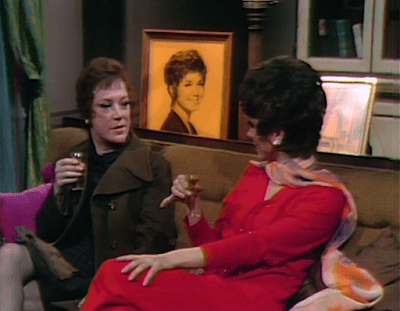
We fade in on Julia today, sitting with Olivia on a couch in Olivia’s suite in the Collinsport Inn. We can tell Olivia is staying there, because she has decorated it with a copy of her professional headshot, among other things.
What, don’t you set your headshot on a table when you stay in a hotel room? Screenshot by Dark Shadows Before I Die.
The two are having a conversation in which they declare themselves to be devoted admirers of Tate’s works. We saw many of Tate’s works in the 1897 segment, and few of them were any better than the crummy landscape that has brought them together. When Julia found the painting, heiress Carolyn Collins Stoddard expressed amazement she would pay a hefty sum for such an undistinguished piece, and later today Olivia will say in so many words that it is of little interest to anyone but a Tate completist, so the show is not pretending that Tate’s pictures had great aesthetic value. We can therefore be sure that Olivia, like Julia, has an ulterior motive.
Olivia claims to be working with a figure in the fine art business in New York City who wants to stage an exhibition of Tate’s works. She refers to this figure as “he,” disappointing our hopes that she might be in league with the show’s most interesting character, NYC art dealer Portia Fitzsimmons, whom we met in #193. Then again, Olivia represented herself as “Mr Corey” in the telegrams she sent to the antique shop inquiring after the painting in an attempt to conceal her identity, so maybe she is doing the same thing on behalf of Mrs Fitzsimmons.
Olivia asks to be allowed to photograph the painting, and under the circumstances Julia can hardly refuse that request. Olivia asks when she can call at the great house on the estate of Collinwood, where Julia has been in residence since 1967. Julia says that she will have the chauffeur bring the painting to the hotel later that evening.
This is only the second time we have heard anything about a chauffeur at Collinwood. The first time was in #543, when Carolyn hired unsightly ex-convict Harry Johnson to help her manage Frankenstein’s monster Adam and covered up his true responsibilities by putting him on the payroll as chauffeur. We haven’t seen or heard of Harry since #669, which was also the only episode in which he was played by Edward Marshall. In previous episodes Harry had been played by Craig Slocum, usually pretty badly, but Mr Marshall did such a good job with the character we would be glad to see him again.
We have little hope this will happen, however. Not only is Harry generally forgotten after his long absence, he and Julia never had much to do with each other when he was on the show. Since her activities concerning the painting are a big secret, she would choose only an assistant whom she could trust. That means Chris.
Carolyn hired Chris as groundskeeper at Collinwood in #677, by which time he was already living in the cottage on the estate that goes with the job. By the time the show went to 1897, his lycanthropy had surpassed all bounds and he was a wolf at all times, even during the day. In #889, set in 1969, we saw that he had regained his human form and spent the eight months of the 1897 flashback confined to a mental hospital Julia controls. We also saw that Carolyn had no idea where he had been or what his problem was. That made it rather a surprise in #897, when we saw that he still lived in the cottage. Presumably he still has the job, as well. You’d think an unexplained absence of eight months, followed by a confrontation in which he told Carolyn that he was a monster who would kill her if she didn’t watch out, would lead to a firing, but evidently the Collinses have a relaxed attitude towards their staff.
When we cut to Julia after her scene with Olivia, we see her in the drawing room of the great house with Chris. She shows him a handwritten note from Amanda to Quentin, written in 1897, that she dug up someplace. He tells Chris that he is to take the painting to Olivia’s room and get a sample of her handwriting to compare to that standard. He is to present himself as the chauffeur at Collinwood. Since he is in fact the groundskeeper at Collinwood and he will give Olivia his right name, it’s hard to see what the point is of claiming to have a different position in the household. Chris is skeptical that Olivia and Amanda can be the same person, but Julia tells him that he of all people should be willing to accept the apparently impossible.
Chris is nervous in Olivia’s room, especially when she introduces him to a Mr Nakamura. She gives the painting to Mr Nakamura, who takes it to another room. She explains that Mr Nakamura is a professional photographer and will be taking the picture. She says she will call Chris when Mr Nakamura is finished. Chris says that Julia explicitly told him to wait for the painting. This is odd- if the goal is to get a sample of Olivia’s handwriting, why not insist on leaving it with her? Then she would have to write out a receipt.
Mr Nakamura takes a long time. Olivia takes out her silver tea service and keeps offering Chris more tea. It’s for just such situations that I take my silver tea service with me every time I check into a hotel, it really is a pity more people don’t think ahead like that. Eventually Chris gets restless and barges into the room where Mr Nakamura took the painting. He finds a fancy camera there, but no person and no painting. We don’t see much of the room, but from what we can see of the layout of the suite, there doesn’t appear to be any way Mr Nakamura could have exited except the way he went in. Chris is upset, but eventually Mr Nakamura comes back with the painting. He says that he had to go to a local shop to have it done, and shows Olivia a large photograph of the painting. She says that it is acceptable, and tells him that Chris is ready to call the police if they don’t return the painting to him at once.
Chris takes on a sheepish manner and apologizes for his nervousness. He tells Olivia he is an admirer of hers and asks for an autograph. She writes a little note for him. He takes it and the painting and goes.
Back at the great house, Chris delivers the painting and the autograph to Julia. She can see that Olivia’s handwriting is similar enough to Amanda’s to warrant an expert analysis. She thinks of her friend, Professor Timothy Eliot Stokes. Stokes is an expert on the occult, an expertise which typically arises in fields like history or classics that involve the study of manuscripts, so it makes sense that he would be trained in recognizing hands. Chris marvels at Olivia’s attractiveness.
Alone with Olivia, Mr Nakamura says that he found the best radiographer in Collinsport. He paid him to x-ray the painting and to keep quiet about it. Since Collinsport is supposed to be a very small town, one wonders how many radiographers Mr Nakamura had to choose from. At any rate, the x-ray confirms that there is another painting underneath the landscape. Olivia looks at the x-ray exposure, and says that it looks like a portrait.
Chris’ attraction to Olivia recalls the 1897 segment. Amanda came to Collinsport in the company of miserable schoolteacher-turned-unscrupulous adventurer Tim Shaw, who like Chris was played by Don Briscoe. Amanda and Tim stayed in the Collinsport Inn together, perhaps in this suite. We don’t know if Tim and Chris are supposed to resemble each other, and Olivia doesn’t show any signs of recognition. But regular viewers will enjoy seeing Briscoe and Donna McKechnie together in a situation so different from those they explored before.
Olivia’s conversation with Julia, like her headshot on the table, emphasizes that she is A Big Broadway Star. A few years after this episode, Miss McKechnie originated the role of Cassie in A Chorus Line, and actually became A Big Broadway Star. Watching this episode, I wonder if she found herself imitating Olivia when that happened to her.
Mr Nakamura is played by Sho Onodera. Onodera was born in Seattle in 1915 and died in New York in 1974. According to his obituary in The New York Times, Onodera served in US military intelligence during the Second World War, and was the court’s chief interpreter at the Tokyo war crimes trials after the war ended. In later years he.worked as a reporter for both American and Japanese news services. The Times does not mention that Onodera, like 120,000 other Americans of Japanese extraction, spent part of the period of US involvement in the war as an internee, in his case at the Manzanar camp. That fact is recorded in his IMDb biography. As an actor, he appeared in several television shows and a couple of movies, most notably the 1974 film The Taking of Pelham One Two Three, in which he took the role of Mr Matsumoto.
This episode marks Onodera’s only appearance on Dark Shadows. He was one of only three visibly non-white actors to appear in the series. The others were Beverly Hope Atkinson, who had a speaking role as an unnamed nurse in #563, and Henry Judd Baker (also known as Judd Henry Baker,) who was visually prominent but silent as Rroma tough guy Istvan in #821, #825, #826, and #827. From now on, the cast will be all-white. Granted, fishing villages in central Maine in the late 1960s and early 1970s didn’t tend to have a lot of racial diversity, but enough visitors come to town that you might think they could have found more opportunities than that to use the talents of the nonwhite actors who were working in New York in 1966-1971.
When Dark Shadows debuted in June 1966, matriarch Elizabeth Collins Stoddard (Joan Bennett) had not left the estate of Collinwood in eighteen years. We soon gathered that Liz was afraid that if she strayed far from the house someone might open the locked room in the basement and discover that her husband Paul was buried there, dead of a blow she dealt him when he was trying to run off with a chunk of her patrimony.
Liz’ reclusiveness was a major theme of Dark Shadows‘ first 55 weeks. After the show committed itself to becoming a supernatural thriller with the story of Laura the humanoid Phoenix, which ran from December 1966 to March 1967, they brought in Paul’s old friend and partner in crime Jason McGuire (Dennis Patrick) as an in-betweener to sweep away the few miscellaneous this-worldly narrative threads not already subsumed in the Laura story and to help introduce the next uncanny Big Bad, vampire Barnabas Collins.
It turned out Jason was the one who agreed to bury Paul for Liz, in return for the money Paul had been trying to steal from her. Upon his return to Collinwood, Jason blackmailed Liz with this information. Time and again she caved in to his demands. Liz let him stay in the great house, gave him money, hired him for a lucrative non-job in the family business, let his rapey sidekick Willie Loomis stay in a room just down the hall from those occupied by her daughter Carolyn Stoddard and her all-but-acknowledged daughter, well-meaning governess Victoria Winters, and was in the middle of a wedding ceremony meant to unite her with Jason when she finally burst out with the truth. When she did that, Carolyn dropped the loaded pistol with which she had planned to prevent Jason becoming her stepfather. For his part, Jason said that Paul wasn’t dead, and that he hadn’t buried him. Perhaps the whole thing started when Jason said “cranberry sauce,” and Liz misheard it as “I buried Paul.” With that, the wedding was off, and a few days later Barnabas killed Jason. Since Jason was on his way out of town and had no friends left, no one missed him. He has barely been mentioned since.
Now, Paul himself has come back. Like Jason, he is played by Dennis Patrick. He has charmed Carolyn into thinking he had nothing to do with faking his own death, and she is falling over herself in her eagerness to establish a relationship with the father who left the family when she was an infant. Carolyn and Liz are on their way out the front door of the great house, heading to a committee in charge of raising funds for the hospital, when the phone rings. It is Paul, asking Carolyn to come to his hotel room at once. She agrees. She gives her mother a vague excuse, irking her, and the women leave the house separately.
In the hotel room, Paul tells Carolyn that he is in some kind of trouble that he can’t explain. Someone is trying to do something terrible to him, but he does not know who or what. Carolyn takes a firm tone when she urges him to tell her what he does know, and when she tells him that whatever is happening she will help him.
Father and daughter embrace, and Liz enters. She is furious to see Paul. She demands Carolyn leave the room. Only when Paul says that he and Liz need a moment together does Carolyn comply. The ex-spouses have a confrontation in which Liz gets to voice her righteous indignation with Paul. She tells him that she expects him to be on the next train out of town. She lists some of the people she will call if he isn’t. Among these is the proprietor of the hotel, who will presumably throw him out in the street at her behest.
In its first months, Dark Shadows tended to attract an aging audience, largely composed of people who still thought of Joan Bennett as the star she was in the late 1930s and early 1940s. Now, with its cast of vampires and werewolves and witches and ghosts and zombies and mad scientists and heaven knows what, it is more of a kid’s show. By the end of the costume drama segment set in the year 1897 that ran from March to November of 1969, viewers over the age of twelve would find themselves reacting to more and more episodes with little more than an indulgent chuckle.
Now that they have returned to contemporary dress, they have swung sharply back towards an adult audience. Carolyn was supposed to be a teenager when the show started; Nancy Barrett was significantly older than the character, and they let Carolyn catch up to her age after a while. But having her spend her evenings serving alongside her mother on the hospital’s fundraising board suggests that they’ve aged her up quite a bit further than that, foreclosing any youth-oriented stories. The conventionally soapy situation the Stoddards find themselves in today is of course something that will be of little interest to the elementary school students who are running home to see the show at this period. And while the main overall story is supernatural, about a cult controlled by unseen beings called the Leviathans that assimilates to itself one character after another, it is understated in tone, allegorical in development, and densely allusive in its relation to its literary antecedents. However many older viewers the show may have lost in the second half of the 1897 segment, they are in danger of shaking off an even larger number of their very young fans if they continue down this road.
In Art Wallace’s original story bible for Dark Shadows, titled “Shadows on the Wall,” the blackmail story was to be followed immediately by Paul’s return. Wallace called for Paul to be a man pursued by dark forces from his past. They made major changes to “Shadows on the Wall” long before they taped the first episode, and it has been almost entirely forgotten for years now. Indeed writer Ron Sproat, who was with the show from October 1966 to January 1969, said that executive producer Dan Curtis told him when he joined the staff that they were going to be leaving “Shadows on the Wall” behind and never let him see it. But they did dip into it in the case of Paul’s return- he is indeed being pursued by dark forces from his past. The Leviathan cult is after him.
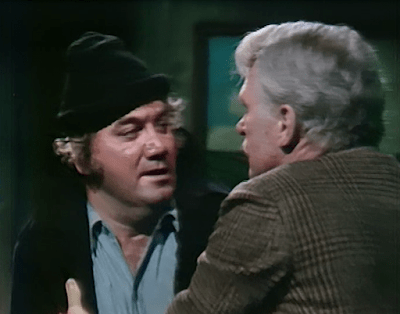
After his confrontation with Liz, we see Paul sitting at the bar in the Blue Whale tavern. The jukebox plays a tune familiar from the early days of the show, when the Blue Whale was a frequent set and there were usually extras dancing in the background. Today the only people we see there are Paul and a middle aged sailor sitting next to him.
The sailor keeps looking at Paul. We hear Paul’s thoughts as he wonders if the sailor is “one of them.” Paul irritably asks him why he is looking at him. The sailor says that he wants to buy Paul a drink. Paul angrily snaps back that “I buy my own drinks!” After some sharp words, the two men warm to each other. They wind up getting handsy with each other and disappear for some private time together.
This scene turns out to be motivated by the two men’s mutual awareness of the Leviathan cult. Over the years, I’ve seen lots of guys in bars interact with each other in exactly this way. I don’t know what that’s all about, maybe the Leviathans are real.
Since I mentioned “Shadows on the Wall” above, I should say that the tavern figures in there as well. Only it isn’t called “The Blue Whale,” but “The Rainbow Bar.” I don’t know, somehow I think Paul and the sailor might not have got off to such a rocky start if the show had gone with that name. Sounds friendlier, somehow, at least to lonesome sailors and the mature men for whom they want to buy drinks.
Paul’s new buddy, unnamed in the dialogue, is identified in the closing credits as “Jack Long.” He is played by Kenneth McMillan, in his first screen credit. In the 1970s and 1980s, McMillan was one of the busiest television actors in the USA. I always mixed him up with Dolph Sweet, who was a similar physical type. Sweet appeared on Dark Shadows once, in #99. He played Ezra Hearne, the most loyal employee at Liz’ cannery. Sweet was a tremendous actor, McMillan a very good one, and they occasionally worked together. So long as they are doing normal soap opera stuff, it would have been nice if they could have had a little story about Ezra’s reunion with his long-lost cousin Jack. Maybe Jack could have introduced Paul to Ezra, we could have seen how he’d fit in with the family.
A cult devoted to the service of supernatural beings known as “the Leviathan people” is secretly establishing itself in and around Collinsport, Maine. Antique shop owners Megan and Philip Todd are members of the cult. Its acting leader, old world gentleman Barnabas Collins, has entrusted them with several items sacred to the cult. The Todds are responsible for a scroll, a box, a book, and a baby. Now the book has gone missing, and the baby is sick. Yesterday, Barnabas responded to this situation by brainwashing Philip into killing Megan. Today, we open with Philip entering the antique shop and choking Megan.
Megan is Marie Wallace’s third character on Dark Shadows. Her first, fiancée of Frankenstein Eve, was strangled by her intended spouse Adam in #626. Her second, madwoman Jenny Collins, was strangled by her estranged husband Quentin in #748. The murder of Eve came at the end of the Monster Mash period of the show that stretched throughout most of 1968, while the murder of Jenny marked a turning point in the eight-month costume drama segment set in the year 1897. The Leviathan arc is just beginning, and Miss Wallace’s character is already being strangled by her husband. If we were hoping for fresh new story ideas, we couldn’t be more disappointed.
Until, that is, the strangulation is called off. Philip is holding Megan by the neck, reiterating that “There is no margin for error! Punishment is necessary!,” when strange and troubled boy David Collins appears on the staircase and announces “punishment is no longer necessary.” Philip releases Megan, and David informs them that he is now “the keeper of the book, and the protector of the baby.” He gives Megan and Philip medicine that will cure the baby of his illness. He tells them that if they need him, he will know and will appear.
Barnabas was a vampire when he joined the cast of characters in April 1967. As a villain he was unrivaled at giving everyone else things to do, whether as his victims, his accomplices, or his would-be destroyers. In March 1968, his curse was put into abeyance and he became human. He set out to be the good guy, but still had the personality of a metaphor for extreme selfishness. As a result, Barnabas the would-be hero created at least as many disasters as Barnabas the monster ever did. He thus remained the driving force of the show, as well as its star attraction.
While Barnabas can keep things going from day to day, Philip’s attack on Megan suggests that he cannot take the story in new directions. From episode #1, that has been David’s forte. The series began when well-meaning governess Vicki was called to Collinwood to take charge of David’s education, took its first turn towards grisly tales when David tried to murder his father, became a supernatural thriller when David’s mother the undead blonde fire witch came back for him, began its first time travel story when Barnabas was planning to kill David in November 1967, and was launched into both the “Haunting of Collinwood” that dominated the show from December 1968 through February 1969 and the 1897 segment that followed it by David’s involvement with the ghost of Quentin Collins. David was not always a highly active participant in the stories that began with him; indeed, he sometimes disappeared altogether for months at a time. But even from the outside, he is the instrument by which the basic architecture of the show is reshaped. Now that he is, apparently, the leader of the Leviathans, we can renew our hopes that something we haven’t seen before is still in store for us.
David is still in the shop when a gray-haired man enters. David greets him as “Mr Prescott,” the name by which he heard his cousin Carolyn address the man when he met her in the shop the other day. David has a smug look on his face that suggests he knows this is an alias. Indeed, we already know that the man is connected with the Leviathan cult, so the leader of the cult may well recognize him as Paul Stoddard, Carolyn’s long-missing father.
Paul asks the Todds to give a note to Carolyn. David says that he will be going home to the great house of Collinwood in a few minutes, and volunteers to take the note to her there. Paul gladly hands it to him.
At Collinwood, permanent houseguest Julia Hoffman is conferring with mysterious drifter Chris Jennings. Yesterday, Jenny’s ghost appeared to Chris and told him that Quentin could help him with his big problem, which is that he is a werewolf. Jenny did not identify herself, and Chris had no clue who she was.
Julia shows him a Collins family photo album. She shows him a picture of maidservant Beth Chavez and asks if that is who he saw. He says it wasn’t, and they keep turning pages. It is interesting for regular viewers that they take a moment to put Beth’s picture on the screen and to make some remarks about her. Beth appeared several times during the “Haunting of Collinwood” segment, and was a major character during the 1897 flashback. The sight of her picture is the first reason we have had to suspect that either she or actress Terrayne Crawford will be back.
Chris and Julia look through a Collins family photo album. Screenshot by Dark Shadows Before I Die.
When Chris recognizes Jenny’s picture, Julia breaks the news to him that Jenny and Quentin were his great-grandparents, and that Quentin was the first to be afflicted with the werewolf curse. We know that Quentin and Jenny’s daughter was named Lenore, and that she was raised by a Mrs Fillmore. Chris confirms that his grandmother’s maiden name was Lenore Fillmore. Wondering how Quentin could help Chris, Julia decides they will hold a séance and contact Quentin’s spirit.
David enters, looking for Carolyn. Julia asks him to participate in the séance. He agrees, with the blandness appropriate in a house where séances have become almost routine. When Julia tells him that the spirit they are trying to reach is that of Quentin Collins, David becomes alarmed. As well he might- we left 1969 at the beginning of March, but in #839, broadcast and set in September, we saw that the haunting continued in the absence of the audience, and that Quentin’s ghost had killed David. That episode took place on the anniversary of an event in 1897 that was changed by time travelers from the 1960s, and so David came back to life and the haunting ended. But everyone at Collinwood still remembers the ten months that Quentin exercised his reign of terror, and David does not want to return to it.
Julia assures David he has nothing to be afraid of. She says that the past was changed as of September 1897/ September 1969, and that Quentin’s ghost was laid to rest forever. This doesn’t fit very well with her plan to disturb that rest, but David is still ready to go along with the plan.
When they have the séance, David goes into the trance. He speaks, not with Quentin’s voice, but with that of Jamison Collins, his own grandfather and Quentin’s favorite nephew. Jamison says that Quentin’s spirit is no longer available for personal appearances. He doesn’t know more than that, and excuses himself. When David comes to and asks what happened, Julia says she will tell him later and sends him to bed. Once he is gone, she tells Chris that she thinks Quentin may still be alive.
Quentin was a big hit when he was on the show as an unspeaking ghost during the “Haunting of Collinwood,” and became a breakout star to rival Barnabas when he was a living being during the 1897 segment. So the audience is not at all surprised that he will be coming back. But David’s behavior before, during, and after the séance is quite intriguing. He is not simply possessed by some spirit that is part of whatever it is the Leviathan cult serves. He is still David, is still afraid of Quentin’s ghost, and is still fascinated by séances. During the 1897 segment, Jamison was a living being; like David Collins, he was played by David Henesy. That Jamison can speak through his grandson and not express discomfort at the unfamiliarity of the atmosphere suggests that there are sizable expanses inside David which are still recognizably him.
There is a similar moment between Philip and Megan. She smiles at him and in a relaxed voice says she understands why he had to do what he did. Philip has no idea what she is talking about. She reminds him that he tried to strangle her earlier in the evening, and he suddenly becomes highly apologetic. She tells him he has nothing to apologize for, that it was his duty as a servant of their cause. He is still anguished about it. They share a tender embrace. Again, while the force that animates the Leviathan cult may have the final say over what Megan and Philip do, their personalities are still there, and the loving couple we met a not so long ago still exists. There is still something for us to care about concerning them.*
Paul also has a lot of activity today. He goes to the cairn in the woods that is the ceremonial center of the Leviathan cult and that only people associated with it can see. He wonders why he keeps being drawn to it. When he first returned to Collinwood in #887, he was watching when the cairn materialized in its place out of thin air. He didn’t react at all, but merely turned and continued on his stroll. That led us to believe he knew a great deal about the cult, enough that he not only expected to see this extraordinary sight, but knew he need take no action regarding it. But evidently his connection is more subtle, and he does not understand it himself.
In his hotel room, Paul goes into a trance and circles the date 4 December 1969 on his calendar. That was when the episode was first broadcast, so the original audience would have assumed he was merely circling the current date. But when it was taped, the makers of Dark Shadows had expected the episode to be shown on 3 December. In between, there had been a pre-emption when the ABC television network gave its news department the 4:00 PM timeslot to cover the end of the Apollo 12 lunar landing mission. So the intention had been that we would share Paul’s puzzlement as to what was so special about the next day.
Paul is already worked up because some unknown person left him a note at the antique shop reading “Payment Due, 4 December 1969.” By the end of the episode, he notices that a tattoo has appeared on his wrist. It is a symbol that the show refers to simply as “the Naga,” a group of intertwined snakes that represent the Leviathan cult. All of this combines to get him into quite a state.
* I should mention that Danny Horn made the same point in his post about the episode on his great Dark Shadows Every Day: “And then they kiss, and the creepy thing is that I think they’re actually in there… So far, I’ve been critical of Chris Bernau, but he’s the one who pulls this moment together. As far as he’s concerned, the unpleasant incident is entirely forgotten — but when Megan brings up the fact that he was seconds away from killing her, his apology is entirely sincere.” Danny Horn, “Episode 989: Executive Child,” on Dark Shadows Every Day, 12 July 2016.
Yesterday we saw strange and troubled boy David Collins (David Henesy) go to a mysterious cairn in the woods, the ceremonial center of the cult of the Leviathan people, and announce that he was now one of the cult. The cairn then opened, revealing a little gap. David crawled into the gap. The gap was not quite big enough for him, so that the episode ended with an extended sequence of David Henesy wiggling his rear end at the camera while he tried to wedge himself into place.
Today we learn that the carpenters were not the only ones who haven’t caught on that Mr Henesy isn’t nine years old anymore. David has followed the gap to an underground chamber with a steaming cauldron. He takes some vegetation out of the cauldron and recites a cryptic poem, all the while staring portentiously off into space. His manner, words, and actions would be effective as part of a creepy little kid sequence, but the thirteen year old Mr Henesy looks mature enough that we just chalk him up as one more member of the Leviathan cult.
The Trouble with Chris
Heiress Carolyn Collins Stoddard calls on drifter Chris Jennings in his cottage. They talk about someone named Sabrina who has told Carolyn that while Chris is a nice enough guy, he will, in spite of himself, kill her if she keeps hanging around him. Chris tells Carolyn that this is true and that he is “a monster.” He does not explain. She leaves, and he takes out a pistol. First-time viewers will wonder if Chris has a compulsion to fire his pistol at people. Regular viewers know that he is a werewolf, and that his particular case of lycanthropy is so advanced that he sometimes transforms even when the moon is not full. We can assume that he plans to use the pistol to put himself out of his misery.
Regular viewers also know that Chris was safely confined to a mental hospital until he checked himself out recently. When he returned to the great house of Collinwood, he told his psychiatrist, permanent houseguest Julia Hoffman, that he just couldn’t stand the conditions at the hospital. Since leaving the hospital means that Chris will resume killing at least one random person a month, this decision just about completely erased any sympathy we might have for him as a character. It also undercuts his motivation in this scene. If Chris really wants to stop killing, he is free to go back to the hospital at any time.
The ghost of Chris’ great-grandmother, Jenny Collins (Marie Wallace,) appears. She tells him not to commit suicide. Dark Shadows was a costume drama set in 1897 from March to November 1969; in those days, we got to know Jenny as “Crazy Jenny,” who played nothing but one mad scene after another. She was sane and well-put-together just once, when she appeared as a ghost in #810 and #811. In this second postmortem appearance, Jenny is extra mad, wearing a disheveled wig that reaches heights few hairpieces have dared. She does not tell Chris to return to the hospital, but to find his great-grandfather, Quentin Collins. She says that she cannot help him, but Quentin can.
This confirms what the show has been hinting, that Quentin is alive. Chris doesn’t know that, nor does he know of his relationship to Quentin. He is left bewildered and helpless by Jenny’s pronouncement. His response would no doubt be more complex if he were up to date, but he has been so ineffective at managing his curse and so irresponsible generally that we can’t imagine he would do anything constructive even if he knew everything we do. The character seems to have reached a dead end.
The Trouble with Barnabas
Upset by her conversation with Chris, Carolyn goes to her distant cousin, old world gentleman Barnabas Collins. She enters his home, the Old House on the estate of Collinwood, and finds the front parlor empty. She hears Barnabas’ voice coming from behind a bookcase, repeating over and over that “There is no margin for error. Punishment is necessary.”
Longtime viewers know, not only that a room is hidden behind this bookcase, but that Carolyn knows about that room. Her friend, David’s well-meaning governess Vicki, was held prisoner there by a crazy man in December 1966, several months before Barnabas joined the show. Carolyn is moving her hands, as if she is looking for the release that makes the bookcase swing open, when Barnabas comes downstairs.
When Carolyn says that she heard his voice, Barnabas explains that he was simply keeping busy by “conducting an experiment in electronics.” The candles around the room will suffice to show that the house doesn’t have electricity, and even if Barnabas weren’t so resolutely technophobic it would still require explanation that the text he set his speakers to reproduce over and over was “There is no margin for error. Punishment is necessary.” Moreover, Carolyn knows Barnabas well, and she can’t have overlooked that he is not his usual self these days. He is distant, calm, and utterly self-possessed, a far cry from the fussy, excitable chap who so often stumbles over his words. He remains formidably well-composed as he reiterates his position that Chris is a dangerously unstable person whom Carolyn should avoid, and that she has a bright future ahead of her. He gently but firmly guides her to the front door, and she is out of the house in record time.
Carolyn does not know that Chris is the werewolf, but at least she knows that there is a werewolf. She does not know that the Leviathan cult exists, and so it is understandable that she does not suspect that Barnabas is acting as its leader. But as the story unfolds, others will no doubt catch on that something is up, and so many people have spent so much time with Barnabas that it is difficult to see how they can all fail to notice the drastic change in his personality and to connect it with the strange goings-on. Putting him in this position makes it likely that the writers will have a harder time managing the story’s pace than they would if his involvement were more subtle.
Once Carolyn has exited, Barnabas opens the bookcase and reveals Philip Todd, antique shop owner. He rewinds a reel-to-reel tape and replays “There is no margin for error. Punishment is necessary.” Philip and his wife Megan are members of the cult, entrusted with the care of many of its most sacred items. Yesterday Barnabas found out that one of these, a book, had gone missing. He summoned Philip to the cairn, and it seemed he might be about to kill Philip. But now, he sends Philip off to administer the punishment to someone else, presumably Megan.
The Trouble with Megan
Megan (Marie Wallace) has been in an extremely overwrought state ever since she found that the book was gone. Today’s episode ends with a long scene in which she is alone in the shop, feeling that someone is coming to kill her, reacting sharply to every noise.
Danny Horn devotes most of his post about the episode on his great Dark Shadows Every Dayto reasons why this scene does not work, among them the fact that a depiction of a person descending into madness requires that the person start off as something other than over-the-top loony. Megan has been so frenzied for the last few days that Miss Wallace has nowhere to go when she hears the ominous noises. Moreover, her first two characters on Dark Shadows, fiancée of Frankenstein Eve and Crazy Jenny, were both intense, overbearing characters who were so inflexible that they had little opportunity to respond to anything their scene partners might do. Longtime viewers therefore expect to see Miss Wallace screaming and carrying on by herself, so nothing she does here will unsettle us. They lampshade this iconography problem by showing us Crazy Jenny’s ghost today, but that doesn’t help at all.
Many fans compare this scene to episode #361. Most of #361 is devoted to a one-woman drama in which Julia is tormented by sights and sounds in her bedroom, suggesting that her mind is collapsing. I don’t think that episode is a success, but because Julia had always been in control of herself up to that point we can see what is supposed to be at stake in it. That’s more than we can say for Megan’s fearful turn.
In John and Christine Scoleri’s post about the episode on Dark Shadows Before I Die, Christine points out the prominence of the taxidermied animals in the background, and speculates that the scene is an homage to The Night of the Living Dead. I wouldn’t have guessed that director Lela Swift or writer Violet Welles would have studied that film, but Christine provides screenshots from it and from the episode, and the parallels are so striking that I can’t see how she could be wrong.
Closing Miscellany
I think the tape recorder is the same one we saw in the summer of 1968, when it was part of the Frankenstein story. It also appears to be the one that parapsychologist Peter Guthrie brought to Collinwood early in 1967.
Her haunting of Chris marks Jenny’s final appearance. Miss Wallace reprised the role decades later in a couple of the Big Finish audio dramas.
During Megan’s big scene, the camera swings a bit to the left and we can see beyond the edge of the antique shop set. We get a good look at a tree that stands near the cairn in the woods. Making matters worse, when they turn the camera away from the tree they go too far right, showing a stage light on the other side.
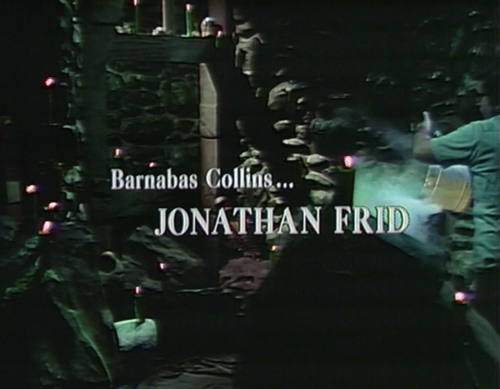
As the opening credits begin to roll, the camera is pointed a bit too far to the right and a stagehand is visible, adding dry ice to the steaming cauldron in the underground chamber.
Heiress Carolyn Collins Stoddard is sitting at a table in the Blue Whale, a tavern. A man who refused to give his name when she caught him trespassing on her property invites himself to sit down with her. She objects to this. He identifies himself as her father, the long-missing Paul Stoddard. She objects far more strenuously to that. Not only did Paul leave the family when Carolyn was an infant, he and his friend Jason McGuire faked his death. Jason convinced Carolyn’s mother, Liz, that she had killed Paul and he had buried the corpse in the basement. In response, Liz immured herself in the house for nineteen years. Only after Jason came back and was blackmailing Liz into marrying him did the truth come out and Liz break free of her reclusive ways.
Paul tells Carolyn that he didn’t know Jason told Liz that she had killed him. Longtime viewers may suspect this is a lie, not least because Paul and Jason are both played by Dennis Patrick. Nonetheless, Carolyn falls for it. Soon she is agreeing to sound Liz out to see how she might react were she to hear that Paul had returned. He walks her home to the great house on the estate of Collinwood. He can’t go in, but gives her a goodnight kiss on the forehead.
Carolyn’s young cousin, strange and troubled boy David Collins, sees Paul kissing her. When she goes inside, he asks who her new boyfriend is. Carolyn is vexed. She refuses to tell David anything, and sends him to bed.
Carolyn’s friend Philip Todd comes to the door. He tells her that he and his wife Megan want Carolyn to work at their antique shop in the village. It may seem rather odd for the keeper of a little shop to go to a vast mansion and ask the daughter of its proprietor to take a job as his assistant, but Carolyn loves the shop and was volunteering there yesterday. She agrees happily, and mentions that a man might be leaving messages for her there.
In the shop the next morning, Carolyn sees that Megan has a baby. Megan says it is her sister’s son. Carolyn asks his name. Megan thinks for quite a while before coming up with “Joseph!”
Carolyn is alone in the shop when David comes in with his friend and fellow resident of Collinwood, Amy Jennings. We haven’t seen Amy since #835; that in turn was her first appearance since #700. For eight months, from #701 to #884, Dark Shadows was set in the year 1897, with only a few brief glimpses of the 1960s. In the 1897 segment, Denise Nickerson played Nora Collins, whose own final appearance was in #859. Both Nora and Amy had long absences from the cast, and were usually unmentioned while they were away. So we’ve been afraid that we wouldn’t see Amy or any other Nickerson character again. It’s good to have her back. She even pulls her signature move and gives a meaningful look directly into the camera at one point.
A Nickerson special.
Amy and David see a doll that longtime viewers will recognize as Samantha, favorite plaything of the late Sarah Collins both when we saw her as a living being in the 1790s from November 1967 to March 1968 and before that, when she was a ghost haunting Collinwood and its environs in 1967. There are also a couple of toy soldiers from “The Regiment,” which Sarah’s brother Barnabas played with when he was a young boy and which Sarah gave to people in 1967 as protection against Barnabas, who was at that time a vampire. Barnabas did sell a bunch of things to Megan and Philip the other day, but neither Samantha nor the members of The Regiment were in Barnabas’ possession when last we saw them. Presumably the camera lingers on the toys, not because we are supposed to know how Philip and Megan got them, but because we are supposed to be pleased with ourselves for recognizing them.
Paul comes into the shop. David recognizes him as the man he saw kissing Carolyn. Carolyn addresses Paul as “Mr Prescott,” sends him into a back room, and hustles the children out of the shop. She tells Paul who David is, and explains that he saw them together, complicating their plans.
When Carolyn was minding the shop yesterday, her friend Maggie noticed an old book on a table. Neither of them knew what it was, but viewers knew it was an object of great importance to a cult into which Philip and Megan have been inducted. It seemed inexplicable that they would leave it on a table in their shop, as if it were for sale. We get a hint today as to what they may have been thinking. In his room at Collinwood, David shows Amy that he has stolen the book. She asks why he would want it. He explains that Carolyn said that if they damaged anything in the shop, his father, Roger, would have to pay for it, and he creased a page in the book. David’s fear that his father would punish him drove several stories in the early months of the show. Roger has mellowed enormously since then, but evidently David is still so afraid of him that he will make a bad situation worse rather than face his wrath.
Indeed, many major storylines have begun with David. The 1897 flashback started because Barnabas was trying to keep a ghost from killing David, as the 1790s segment started when David’s governess Vicki participated in a séance meant to solve a mystery concerning him. For that matter, the whole show started when Vicki was summoned to Collinwood to take charge of David’s education. David doesn’t always have a lot to do in the stories, and when they are over it is often as not forgotten that he was in peril when they began. But he is so often the catalyst that we can suppose that David was supposed to find the book so that the current story could move into its major phase.
If that was the intention, Megan and Philip didn’t know about it. When they discover that the book is gone from the shop, they fly into a panic and declare that whoever took it must be killed. It may turn out that the mysterious forces behind the cult want David to become involved and that they created a situation in which he would find the book and take it with him, but if so, those forces are operating outside the cognizance of anyone in today’s episode.
Old world gentleman Barnabas Collins has given a present to antique shop owners Megan and Philip Todd. It is a wooden box. This box has a strange effect on the Todds, filling them with a mixture of irresistible fascination and nameless dread.
When the Todds go to open the box, it makes a whistling noise. They find a book inside it. The book is noticeably larger than the box. It is written in a script they do not recognize. There is also a scroll. That is in English, but may as well not be- neither Philip nor Megan can understand it, though Megan does say that she feels as if she almost can.
Later, Megan has a dream. It is the sort of dream people had in the first year of the show, before there were special effects. Like the dreams in ancient Greek literature, it takes the form of someone standing by the bed and making a speech. The speaker is Barnabas, and he tells Megan to empty the bedroom of furniture, board up its windows, and let no outsiders enter it. She calls him “master,” and he tells her she will not recognize him as such when she is awake. When she does wake up, she finds that Philip is already following the instructions, and realizes they had the same dream.
Downstairs, heiress Carolyn Collins Stoddard is minding the antique shop. She receives a telephone call from someone wanting to buy a cradle that is on the shop floor. At the end of the call, we hear Carolyn’s thoughts as she congratulates herself on making a sale. She is shocked when Megan comes down and tells her the cradle is not for sale. Philip comes afterward, and with a blank expression on his face carries the cradle upstairs. Carolyn is left to call the buyer back and apologize.
Philip and Megan set the cradle in the special room. They are apparently in awe. They look like any new parents stunned by the fact that they have brought a new life into the world, but the cradle is empty. After they leave the room, it starts rocking by itself.
The cradle is an interesting choice of prop. It was important early in 1969 in the “Haunting of Collinwood” story, when it was associated with the ghosts and rocked by itself. We then saw it a couple of months later in the 1897 flashback, when we learned why it was haunted. Those stories have been resolved in such a way that it won’t occur to us that the consequences of the same tragic events are animating it this time. The cradle seems to have become a generic symbol of spookiness. Considering that its back is coffin-shaped, that’s an understandable association.
Meanwhile, Maggie Evans, The Nicest Girl in Town, has come into the shop. Maggie is the governess in Carolyn’s home, the great house on the estate of Collinwood, and they are friends. Maggie notices the sacred book on a table and asks Carolyn what it is. Carolyn doesn’t know anything about it. Why the Todds would leave such a thing on a table in their shop, a placement that implies it is for sale, is not explained.
Maggie tries on a feather boa. Like the cradle, this prop was significant in the 1897 segment. In that part of the show, Nancy Barrett, who plays Carolyn, was introduced as a woman named Charity Trask. Charity’s body was eventually taken over by late Cockney showgirl/ mentalist Pansy Faye. She wore the boa to indicate that she was Pansy. We last saw Charity/ Pansy, boa and all, in #883, and heard her voice in #887, so when we see it in the shop regular viewers will have fresh memories of her. We may well hope Carolyn will put it on and start singing Pansy’s song. But Maggie is the only one who is interested in the boa, and she doesn’t seem possessed at all. She wants to buy it, but Megan comes in and prevents her doing even that. She declares she is going to be closing the shop early.
Maggie leans very heavily on Carolyn to join her for a drink at the local tavern, The Blue Whale. Even after she drags Carolyn there, Maggie keeps pressuring her to stay for another drink. This is not at all typical of Maggie. When we find out her reason, it turns out to be even less characteristic. A mysterious gray-haired man who has been lurking around Collinwood lately wants to sit with Carolyn. When he comes to the table, Maggie gets up and leaves Carolyn alone with him. She has a self-satisfied smirk on her face as she does so, not a look we have ever seen her give before.
The man introduces himself to Carolyn as Paul Stoddard, her father. Paul abandoned the family when Carolyn was an infant, in the process faking his own death and prompting Carolyn’s mother Liz to believe that she had killed him. That belief led Liz to confine herself in her home for nineteen years, terrified that she would be caught. So it is simply inexplicable that Maggie would think Carolyn would be happy about having this bomb dropped on her.
Paul’s introduction of himself to Carolyn is the first time he is identified in a scene, but it is not the first time viewers have been told who he is. His name appeared in the closing credits for #887 and #891, ruining the surprise that is supposed to give a punch to the ending of today’s episode.





 Dark Shadows Commentary